
In short
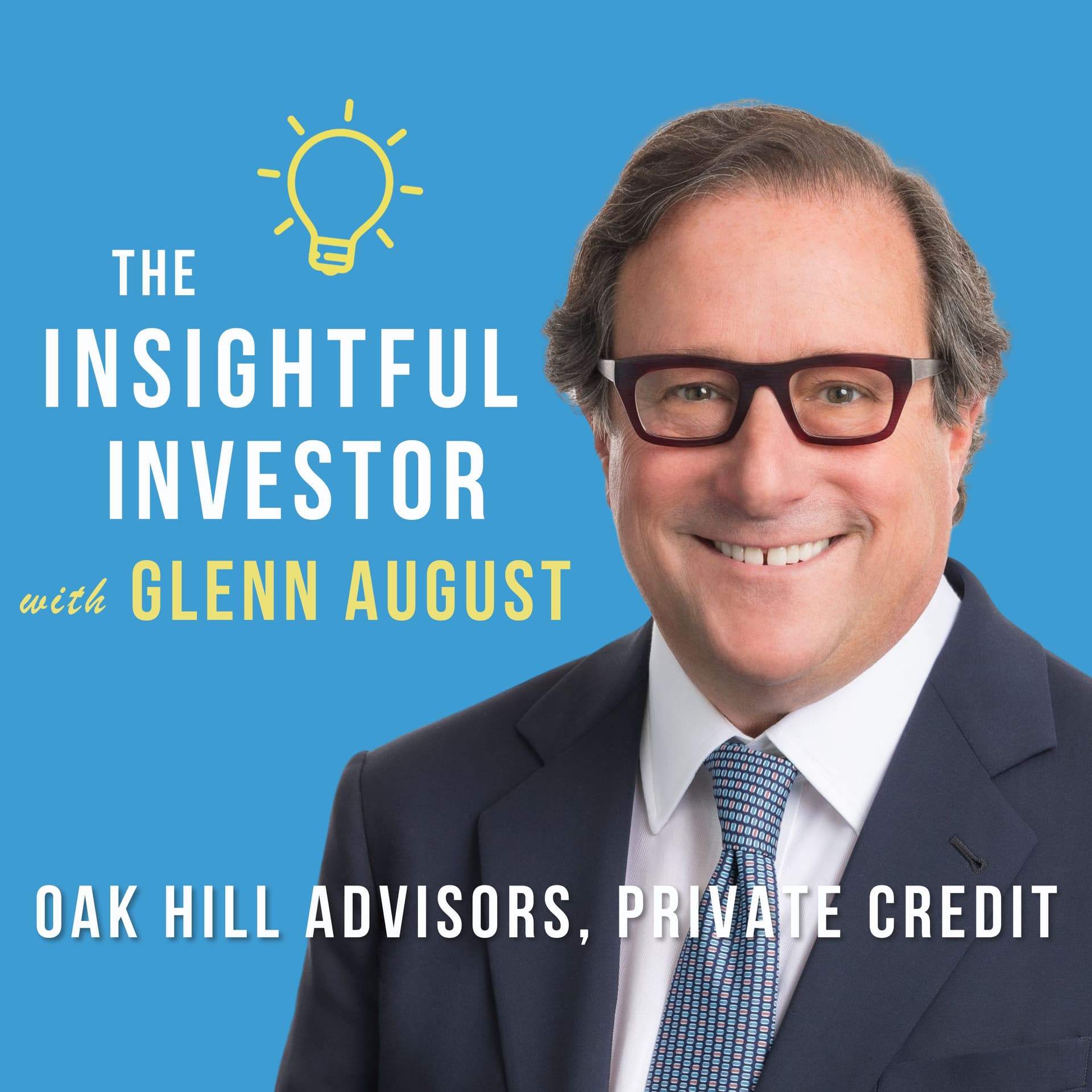
Insightful Investor - Episode #14 Summary: Glenn August: Oak Hill Advisors, Private Credit
Podcast Overview Podcast Title: Insightful Investor Host: Alex Shahidi, Co-CIO of Evoke Advisors Episode Title: #14 – Glenn August: Oak Hill Advisors, Private Credit Episode Description: Glenn August discusses his early career in investing, the challenges of scaling an organization, and insights into private credit. Oak Hill Advisors, founded by Glenn, manages over $63 billion in alternative investments.
Introduction
- Alex Shahidi introduces the podcast as a source for unique market insights.
- Guest Glenn August shares his journey in the investment industry, beginning his career at Morgan Stanley in 1982.
Key Themes
Early Career and Founding of Oak Hill Advisors
- Glenn's fascination with corporate strategy and markets led him to start his career in M&A at Morgan Stanley.
- He co-founded Acadia Partners in 1987, focusing on private equity and credit.
- The October 1987 stock market crash presented opportunities for undervalued equities, leading Glenn to success in risk arbitrage.
Transition to Credit Investing
- Glenn eventually pivoted to credit investing, finding it compelling to apply a private equity mindset.
- Key principles established:
- Buy companies, not just securities.
- Manage risks with a focus on downside protection.
- Emphasizes the importance of choosing the right companies with strong management and competitive positions.
Growth and Scaling of Oak Hill Advisors
- Glenn reflects on growing the firm from a small startup to a leading alternative investment firm with over $63 billion in assets.
- He discusses the importance of hiring like-minded individuals and establishing a strong organizational culture.
- Core values of the firm:
- Smart, conscientious, hard-working, and nice individuals who prioritize teamwork.
Insights on Private Credit
- Glenn provides a historical overview of private credit:
- Growth of private equity and leveraged finance since the mid-80s.
- Impact of financial crises on the evolution of private credit markets.
- Highlights current trends in private credit:
- Increasing demand from institutional investors.
- Benefits of private credit for issuers: speed, confidentiality, and tailored structuring.
Risk Management in Private Credit
- Discussion on the significance of investing in larger companies compared to middle-market firms:
- Larger companies tend to have higher margins, less volatility, and lower default rates.
- Importance of credit selection and understanding the business model to protect downside risks.
Key Takeaways
- Investment Philosophy: Focus on understanding the interplay between corporate strategy and market dynamics, emphasizing risk management and downside protection.
- Culture and Teamwork: Successful organizations are built on shared values, mutual respect, and a collaborative environment.
- Private Credit Growth: The market for private credit is robust, driven by the need for flexible financing options and the rise of alternative investment strategies.
Conclusion
- Glenn August shares a wealth of experience and insights, stressing that investment success comes from thorough analysis, strong relationships, and adapting to market changes.
- The episode wraps up with a reminder that relationships and trust are central to effective investment management.
Additional Resources
- Website: [Insightful Investor](https://insightfulinvestor.org/)
- Contact: info@insightfulinvestor.org for questions or feedback.
- Reminder: The podcast is for informational purposes only; listeners should conduct their own research before making investment decisions.
Written by AI. May contain mistakes. Listen to the episode to check what was said.
Transcript
Automatic transcript. May contain errors.0:06Welcome to the Insightful Investor Podcast, a weekly series that seeks to share industry, investment, investment, and market insights. We define insights as concepts that are counterintuitive, widely misunderstood, or underappreciated. In other words, unique ideas that you probably won't hear elsewhere. I'm Alex Shahidi, the host of the podcast and co-CIO of Evoke Advisors, one of the nation's leading investment advisory firms. Learn more about our show at insightfulinvestor.org.
0:43I'm very excited to have Glenn August with me today. Glenn, thank you for being here. Pleasure. Glenn is the founder, senior partner, and CEO of Oak Hill Advisors, a leading alternative investment firm that manages over$63 billion. Glenn, you started your firm all the way back in 1987. Why don't we just kick it off with what piqued your interest in investing to begin with? Did you just say I was old? So I would say that the beginning was really being fascinated by corporate strategy and the intersection of corporate strategy and markets. I was lucky enough to start my career at Morgan Stanley in 1982 when I graduated college.
1:36And I worked in the M &A department, which was something that was super exciting to me because I loved what M &A represented. And I ended up working in the business development group or transaction development group at Morgan Stanley, essentially pitching M &A ideas to large corporates. And that gave me the opportunity opportunity to look at thousands of companies over what was a three-year period. I spent two years in New York and one year in London and really look at companies in terms of their business strategy and then how they were valued in the markets. The more I did it, the more I loved it.
2:17Literally, I'll probably talk about some history of Morgan Stanley as we go through this discussion. But even today, what is now more than 40 years later than from when I started at Morgan Stanley, I tell more stories disproportionately about those first few years in terms of being formative in my career as any other period of my life. But in terms of the question, so I spent three years there. I went off to business school. And when I came out of business School in 1987, I was, again, really lucky to have the opportunity to join a startup firm called Acadia Partners as one of 10 founding partners.
3:00I was only 26. So now you can figure out how old I am. I feel younger, but that's a separate story. And as soon as I started in August of 87, the fund was a unique fund. It was really groundbreaking. It was$1.750.000 of capital. And it had two mandates. One was private equity and one was credit. And while that may sound like every day today with all of the large firms that do both private equity and credit along with other strategies, it was groundbreaking back then. And$1.750.000 of capital, which is still a lot of money today, was a lot more money on a relative basis, inflation adjusted then.
3:39And to be 26, to be one of the founding partners was an extraordinary opportunity. And then I joined to do private equity. And no sooner had I gotten there in August of 87 that we had the October 87 stock market crash. And I was like a kid in a candy store because all these companies that I had followed for years were trading at deep discounts. About six months into it, post the crash in 87, one of the partners on the credit side and the investing side, the liquid security side said, we'd like to give you$5 million and go buy some undervalued equities. Go do what you want to do. Let's see how it goes.
4:26And five over a billion, 750 wasn't that much money. So I guess they didn't feel like they were taking too big of a risk. But nonetheless, it turned out that two weeks later, I asked for permission to take a$20 million position in one risk arbitrage opportunity associated with Kraft and General Foods. And I just thought it was an incredibly undervalued equity and that the bid that started at 75 was going to go a lot higher. And based on all the years I'd spent looking at food companies consumer at Morgan Stanley, and sure enough, within 12 days, we made$2.2 million. And all of a sudden, I was playing with house money.
5:07And what followed from there was I ended up within the next 12 or so months managing about$150 million risk arbitrage undervalued equities portfolio that did really well. And then, not to go too long to this question, but just kind of filling out the story, in 1990 when Drexel collapsed. I had been following a lot of what we were doing on the high yield side because the trading side of Oak Hill or Katie at that time was really focused on high yield debt. And I was doing a little bit of undervalued equities. I was a board observer at Vaughn Supermarkets where we had taken a large stock position.
5:48I was involved in some of the work we were doing with Drexel. And when Drexel collapsed, the head of the firm asked me if I wanted to run a credit portfolio. And I have to admit, I paused when that opportunity came because I wasn't sure if I wanted to pivot all the way. And I still like the private equity world. But I certainly thought it was a great opportunity. And so I said yes. And at that point, we probably had about a$400 million portfolio in credit. And I took it down to$200 million because I didn't like half of what that portfolio management team had bought. And over the next five, six years, I took that to a billion dollars of capital, the billion 750.
6:33We did about$12 billion of trades over that period of time, generated about a 25 % unlevered return and was really one of the major players in the distressed market in the early 90s, which was an incredible period. And we did really well with it. And so that whole experience of ripping apart companies and really bringing a private equity mentality to credit was kind of it just kept on growing. And it just kept on compounding my interest and enthusiasm for the asset class, for understanding the intersection of, again, corporate strategy and markets, add in restructurings, which are complicated and fascinating.
7:18And to this day, I still lead our global distressed business. And it was just an incredible opportunity. And then just to fill out the history, and then we can go anywhere you'd like. At the end of 1991, the head of the Bass family, who was the lead equity partner in the fund, decided to change management and asked the managing partner to leave and promoted four of us, including myself, to co-head the firm. and so it was 1990, December 91 and really at the bottom of the recession and I was running this distressed portfolio and all of a sudden I'm 30 years old and I'm co-head of a billion 750 fund as an equal partner, excuse me, with my other partners really focusing more on the private equity side.
8:08One of my partners spent some time on the credit side too but and then built out the business. We renamed ourselves Oak Hill. It was actually Oak Hill Partners originally. And then when the Acadia Fund came to an end in 1997, in 1996, right ahead of that, we decided to separate the businesses more fully and really created the predecessor of Oak Hill Advisors. And we raised$1.750.000 in 1996. We did another$1.6.000.000 in 1999. So we had three plus billion of capital in 1999, at which point I decided to buy out my private equity partners and promoted two of my younger partners to partner. And we had 3 billion of capital and 23 people.
8:52And today we have, as you said, over 63 billion, 416 people and one of the leading alternative credit players in the markets. So there was this transition early in your career from equity to credit, and you've stayed there since. What is it about credit that originally drew you in and has kept you there? So I guess, first of all, I'd say that, as I said a moment ago, the big piece of it from the beginning and really to this day is I view credit investing, we do credit investing with a private equity lens and a private equity approach. And in 1990, very audacious of me, I put together kind of the principles of how I wanted to run our credit business.
9:42And one was obviously take this private equity approach to credit. And then secondly, and this might be the defining theme, is we buy companies, not securities. And that really is the interplay of taking a private equity mentality to credit. And I don't think of myself being a credit investor per se. I think of myself being an investor, investor in companies. And when I look at a capital structure, when any one of my firm looks at a capital structure, we're really pricing risk at every layer of that capital structure, including the equity. Now, the focus of what I do is clearly credit. And credit is different than equity.
10:25Credit, except for distressed credit, your upside is capped, whereas your downside is unlimited to your cost. And so the return profile is very, very different. And that necessitates a different mentality whereby you really need to manage the number of mistakes you make and the cost of those mistakes. Because unlike equity investing, where if you make a mistake and you lose all your money, hopefully you've got some parts of your portfolio that you double, triple, quadruple, or more. Certainly, we know over the last 30 plus years, there's been opportunity in many names to make more than 10 times your money, but in credit, you don't.
11:08And so I think it was very much and really fascinating in some respects, the mentality of a risk arbitrageur, which I dare say that I was one at 27, 28 years old, is very much the same as credit in that your upside is limited to where you buy it in the takeout price in the deal. But your downside, if the deal were to fall apart, is pretty substantial. And so I think that mentality of trying to make very, very few mistakes and not too costly a mistake and have that be part of a risk-adjusted return mentality just became very central to who I became, who I am, and really what our firm tries to do every day.
11:57And so for me, what's fun about credit is, again, this challenge of not making too many mistakes or too costly mistakes. And yet, in many cases, making some very attractive returns. And this whole mentality of maximizing risk-adjusted returns, which in some respects are just a buzz, a cliche phrase, to me, it became central to who we became as a firm and who I became as an investor. And then clearly having the distressed opportunity to have the opportunity to make multiples on our money as part of some of our strategies is also very exciting. And there's no doubt. And part of the reason why I've stayed is attached and involved in the distressed opportunities because I do like the opportunity, like everyone else does, to make multiples on your money, but still very much focused with a risk-adjusted mentality.
12:55And this whole notion of downside protection, right tail, if you will, upside potential, Those just became central themes of how we've managed money over the last few decades. Was there something about your early career? You mentioned when you talk about stories of when you started, it goes all the way back to Morgan Stanley. Are there important lessons that you learned that helped shape that investment principle in your core tenets? Again, I think there's a lot of them. A few come to mind, not just as an investor, but as a manager. and I'll share a few stories. The first is just on the investing side is that companies don't all have an upward straight line to the right.
13:41And clearly equity investing is all about trying to figure out what the slope of that curve is on the upside and hopefully having the downside not be too meaningful. In credit, you're really playing for a shorter term spread compression if you've got call protection and, again, avoidance of loss. And so I do think analyzing the hundreds of companies, thousands of companies that I did, watching companies that at points in time were very successful become less successful. As we know, I mean, I was a large investor in the supermarket industry. I mentioned bonds earlier. We owned a lot of equity. We owned a lot of credit in the supermarket sector in the 80s and early 90s.
14:29But as you know, and as anyone who's listening to this knows, is that that industry changed dramatically as Walmart and Costco and other big box concepts came to market. And that's well before the online side of the market. And so what continues to fascinate me as an investor is how industries change and even the best companies. I mean, you look at AT &T back 40, 50 years ago when they were the only game in town. They were an incredibly successful company. And decades later, the stock trades at or below where it was. And so, you know, being the best in what you do in a company, being the best what you do in asset management or trying to be, you can never get too comfortable and you need to keep on.
15:19The best have to keep on getting better. In terms of a couple of stories to me that really were so formative in my career very early on. I tell the story a lot to younger colleagues who join our firm. and when I've spoken at different universities over the years. I remember one of the first assignments I got at Morgan Stanley. I was working on pitching. There was a bottling, Coke bottler that was getting acquired that was announced. And the job I had was to go figure out if there was anyone else that Morgan Stanley covered who might want to compete and bid against the, once the company was for sale, was there anyone else who was going to want to purchase the company and the associate that i was working with who had worked in morgan stanley and an absolute prince of a guy named bob lindsey who runs lindsey goldberg he asked me to go to the mna library that morgan stanley had and get an exhibit called a premiums paid exhibit looking at past transactions and this is well before computers i mean there's a mainframe we have it there's no there was nothing you could do online because there was no online and there wasn't even PCs back in 1982.
16:38And so I dutifully ran over to the M &A library, which is a pretty big library. And there was lots of these giant three ring binders. And I talked to the M &A librarian and said, you know, so I need to find this exhibit. And, and I pulled through the exhibit and I found the deck and I'm pulling through every page and I get it. And then I run back to Bob Lindsay's desk and said, here, so proud of myself. And he said to me, so what's it say? And I said, I didn't know. I didn't know because I hadn't looked at it. You were so excited to find it. I was so proud that I found it. And so from that day forward, I never wanted to feel that small in my life that I came up with a very simple phrase that if you touch it, you own it.
17:39And what a great lesson to learn. I mean, I was 21. I graduated college a year early. And it was such an amazing lesson. And to this day, when I go into meetings, whether the people in the meetings are young or old, I mean, I ask them questions. I'll ask them what's in the footnotes. I read everything that I'm handed because I want to understand more. And I want to challenge the younger people especially to have ownership. And it's okay to ask dumb questions. It's okay to have wrong conclusions when you have less experience. But if you touch it, you'll notice. That was one great Bob Lindsay story and Morgan Stanley story and really formative in my career.
18:29I'd say a second one, which, funnily enough, was also with Bob and a guy named Scott Newquist, who was at Morgan Stanley at the time. We went on my first business trip at Morgan Stanley. And there's lots to tell another day about that trip. But the most important point that I think to this day is so central to who I am as a investor, as a manager, as a partner to some of the largest sovereign wealth funds, pension funds, families in the world. is we go down and we're meeting with a company called East Systems, which was a defense electronics company. I had spent about a month, I got assigned to cover the defense electronics players.
19:18And I got myself a subscription to Aviation Week in Space Technology. And I read every, I read like 10 issues and thought I was an expert in defense electronics. And we were visiting this company, Systems, because it crossed the tape that they were interested in making acquisitions. And the three of us fly down to Dallas. And I'm super excited. It's my first business trip. And I had stayed up all night for probably two or three nights putting together this fancy book of 10 different ideas that eSystems could consider as acquisition targets and again, ripping all these companies apart and ready to talk about any one of them and carry those big black boxes that lawyers carry or bankers carry sometimes with presentations.
20:04Nowadays, everyone says they just want a soft copy, so they don't even make them. And we walk into this meeting with the CFO. And the CFO, and I'm not going to butcher a Texas accent in 1982, but the CFO basically says, now I'll do some accent, which will definitely be the wrong one. And his opening line to the three of us is, well, I hope you guys are in some of these smart New York investment bankers who know absolutely nothing about my business. And they're going to tell me about a bunch of companies that you know nothing about and tell me I should buy them. That's his opening line. Meanwhile, I'm carrying this big black box with that exact proposition.
20:46and to Bob's credit and to Scott Newquist's credit, we never opened up the box because that was the right answer. It was the right answer because in the client service business, it's not what you're selling, it's what does someone want to buy. And if you can be great at what they want to buy, then that's great. But don't sell them something that you want to sell as opposed to something that they want to buy. And that lesson, again, that was 1982. So 32 years later, 1982 is more than that. So we're now 40, 42 years later. Oh, my gosh. Sorry. 42 years later, that's really how I think as an asset manager.
21:43I mean, we are really fortunate. We manage capital for eight of the 10 largest sovereign wealth funds. We've managed money for 10 of the top 20 U.S. pension plans. And when I was younger, even with that lesson, I would often be focused on what I wanted to sell. And certainly, over the last couple of decades, for sure, I really go into every meeting, not asking, do you guys want to buy what I'm selling? I really go in to a meeting saying, okay, what do you need? What do you want? What's important to you? What do I think you might want? If I were you, how would I focus on your portfolio, construction, asset allocation, manager selection, strategy, tactical, strategic, short-term, long-term?
22:41And so that lesson literally 42 years ago is with me every day. And so, again, that's why when I tell you in the beginning that I think of those stories, I mean, those are life lessons. Those are not. And by the way, they're not they're not unique to the investment management business. They're really unique. They're really central, not unique. They're central to every product that gets sold because every product that gets sold as a consumer and a manufacturer per se. And understanding what a consumer needs and wants and why and then delivering that product is just fundamental to any transaction.
23:21And again, I also comment on the same tone that in terms of lessons, again, there are a lot of people in the world that are transactional. And I don't think of myself or my firm as one of those because what I have seen over the years in the e-systems defense electronic story of 1982 makes it incredibly clear is that relationships really matter. Now, quality matters. Quality matters. Consistency matters. But if you have two products that are very close, and I have a lot of great competitors, what you really want is to have a relationship with someone who cares about you as a client. and you know this from your own business and the e-system circle back or this story circle back is one year later we got hired by e-systems to represent them in an acquisition so relationships matter and people want to do business with one of my other phrases i've come up with over the years all very simple ones by the way is like trust and respect and people need to respect you.
24:39They need to believe you have the capability for what they're looking for. People need to trust you because they can't risk ever being embarrassed or taken advantage of. But let's stipulate that most of the best managers in the world, you're going to respect their capabilities and you're going to feel that you can trust them and you build in your interest for sure. But then it comes down to the, do you like them? Do you want to do business for them? Do you want them as your partner? And, and so I just think the relationships matter, everything else matters too. And we all fight day and night to be the best we can in, in the, in the, in building and earning that respect, but, but relationships matter.
25:26So those are just a handful of stories from a long time ago. That's fantastic. One thing that you did that I think is atypical is you graduated business school and rather than going and working at a firm like most people do, you decided to start your own firm with your partners. What motivated you to do that so early in your career? So, you know, again, there are a lot of people and I meet with a lot of people who say, so what was your plan? Did you plan to go build this, you know, tens of billions of dollars as a manager. And wow, what was on your mind? And, you know, I, for better or worse, and I'm not sure which one it is, I did not have a grand master plan.
26:09And I have been again, for better or worse. And as I get older, I try and think a little bit more than one or two feet ahead of me. But in my early stages of my career, and truly to this day, I've just felt grateful for the opportunities that have been in front of me. And I wanted to learn. I wanted to contribute. And I believe that the harder I work, the better I would do. And so I really do believe, and people talk about what is luck and is it, the age old phrase, is it when opportunity meets It's preparation, which is another cliche phrase, but one I believe in a lot. I do believe people do get, people find themselves in opportunities.
27:03Now, you have to seize the opportunity. You have to make it work. And of the original 10 partners back in 1987, within 10 years, more than half of them weren't there. but for me coming out of business school and having had the three years of morgan stanley and by the way the work hard piece was absolutely a lesson i learned at morgan stanley the harder i worked the better i did and i literally worked 100 hour weeks and to this day still work six seven days a week because i can't help myself but um we can talk about work-life balance later It'll be a very short conversation. And so I definitely found that work ethic.
27:46But when I was coming out of business school, I had an offer to go back to Morgan Stanley. I had an offer to go to First Boston. I spent the summer at First Boston, which was another big M &A shop with Bruce Wasserstein, Joe Perella, and they had built a great business. And this opportunity of joining a new firm that had$1.750.000 of capital. I mean, Blackstone didn't have a billion seven fifty a capital in 1987 was just an incredible opportunity. And and I just I have to admit, I didn't take it on the spot. But I did take it. One of my close friends one day basically shook me a little bit. So, Glenn, what's wrong with you?
28:31This is like the best opportunity in the world to join this giant fund is one of the founding partners. And he was absolutely right. And so so that's what I did. But it was never there was never this grand plan of let's go build an even bigger business. We had a billion seven fifty of capital as a 10 year partnership. and I just wanted to do the very, very best I could with the capital and generate the highest absolute and risk-adjusted returns. And the better I did, the more responsibility I got. I mean, again, this decision of allocating ultimately a billion to the billion 750 in credit and liquid securities was not because there was this big tactical asset allocation.
29:16How do we go about private equity versus credit? It was, I was generating great returns and there was a desire to get more exposure if we could do it well. So I'd say there was not a grand plan and it really was keeping my head down and just doing the best I could. Glenn, one question that I think might be on listeners' minds is you started a business some time ago, relatively small, big at the time, but relatively small compared to today. How do you grow a firm and scale it without sacrificing quality? So there's no simple answer in no order. I think it is we're in a people business. So this is not a manufacturing with machinery business.
30:10It's a people business. And so if you want to grow your business, you need like-minded people and you need to have a culture that culture, strategy, organizational design, incentive, set of incentives that all come together to grow the organization and with the same values, institutional values. And so I am a big believer that it really does start with people that keep the choice of who you hire. And then the culture that you have as an organization, again, that has to fit the business strategy. And there's not one good, in my view, there's not one good or bad culture or approach. But whatever you do, whatever your values are, you have to have everything support that.
31:15And in our case, it starts with the people. So the logical question is, well, what kind of people did you hire and did you develop to grow the business? and I make a couple of comments here. It took me about 20 years to be able to articulate for someone who was interviewing with us, what does it take to be successful at our firm? But I did come up with it, and I practiced it before I came up with a very simple set of principles. But the principles, the things that make someone successful at our firm, and this is our firm, not another firm, is there has to obviously be some minimum level, required level of smarts and competency.
32:08But smarts, as I kind of hinted earlier, competency is not enough. So the second principle was, I really wanted someone who cares and is really conscientious about every aspect of what they do. And so I'm a big believer in how much do you care really translates into how well you do. But leaving that aside, the third piece is if you're smart and you care immensely, then the third piece is someone who's willing to work hard. And again, this may be not fashionable today. And I understand, especially in the post-COVID world where people got a taste of a different type of work-life balance. And I'm not saying I'm right by any means, but I believe deeply that the harder you work, the better you do.
Read the full transcript
33:06And so if you're smart and you work and you care a lot, you're likely to work hard. And again, there may be different ways to work hard. Maybe some people can actually work as well or more efficiently and better and have the same output in a different work environment. That's another discussion, perhaps another day. But the fourth piece is I want nice people, good people. And that's particularly important because we work in our firm and our whole approach for decades is we work in teams. And so that's the fifth piece. You have to want to be on a team. Now, I commented a moment ago and said that there's more than one type of successful organizational structure and values.
33:56There are a lot of super, super, super successful firms, I imagine many you've invested with, where they're dominated by just one person. And they reward, it's a superstar culture that rewards superstars and everyone else get the heck out. In many cases, those superstars compete with each other in the same firm, but it works. That's not our firm. To be successful at our firm, you have to want to be on a team. You enjoy being on a team more than purely individual success. Again, that's not to say that we don't differentiate. That's not to say that there aren't a lot of people here who are more individually successful, but they do it in a team construct.
34:50And then again, our culture is having good people, nice people, respectful people of everybody, not I'm too senior, I don't care about the junior people or the receptionist or the person who does the IT or puts coffee in the machine. We have a culture that we want people who respect everybody. And so to me, the way we've been able to build the organization is by really prioritizing and being incredibly discriminating on the people that we hire. That's number one. number two and again no order here but number two is you need to have a a structure that works in terms of decision making process where you're really going to invite people and to be part of the team you can't say hey we're a team culture and then one person makes all the decisions right you need you need to have that that desire to get more input again i happen to that's an incredibly valuable training tool.
36:02When you take a 25-year-old and you sit them in the same room as a 55-year-old who has 30 more years of experience, think about the learning. Again, it's not a hierarchical organization. It's a pretty flat organization in terms of access and learning. You need to have a comp structure where, at least in our firm, we don't create silos. We have more of an integrated model where, because we believe, and we'll get into our business, I imagine, in the not-too-distant future after I wax out on my philosophy of life. But you have to have a comp structure. We believe that our liquid loan and high-yield business helps our private credit business.
36:47We believe our distressed business helps our performing business. We believe having a performance business gives us a running start on anything that's distressed. We believe looking at relative value in Europe and the US is incredibly important. And so if you have that philosophy, then you want to have comp structures that incentivize collaboration rather than discourage it. And so there's 24 partners in the firm and nobody has a disproportionate share of the P &L from their business. The partners have a share across the business. Now, again, I'm not saying that's the only way, but it works for us.
37:33And then you need culture carriers. You need to do as you say. There's often a phrase, do as I say, not as I do. But really, do as I do. Lead by example. If you want people to work hard and you hope they're going to work hard, you can't call it in if you want people to be respectful of others you can't be disrespectful yourself and so i think we've been able to grow the firm and then and then i add another point which is we never let a goal of growth dictate our strategy we let our strategy and our culture culture and our clients determine our growth. And so there are a lot of firms that just say, I need to grow.
38:30I've got to raise more assets. I've got to do this. And when they do that, they can risk their culture and they can sacrifice on who fits and who wants to be part of that team. And again, they're great firms. I'm not critiquing anyone. But for us, it's been about how do we do what we do really, really well? How do we do it consistently? How do we genuinely do it better tomorrow than today or yesterday? And that's just not made up stuff. That's really how we think about our business. And I will tell you, I mean, I'm 62 today, whatever, I'm 63 in June. I want to get better tomorrow. And I want to challenge everyone in my firm to be better tomorrow.
39:19And so it doesn't just happen. I'm sure there are people at our firm would say, oh, it doesn't feel like it used to. But I will tell you, in my opinion, I'm probably meaningfully biased, but I will tell you, I think there is the fundamental values of teamwork, of partnership, of respect, of caring about our clients, our colleagues, our communities. you know i think those are fundamental principles and i don't think they've changed and i'll say one left one other thing and that is again you have you do have to grow to give people responsibility because everyone wants to grow and if you don't have the opportunity to grow then you leave right and so i remember in 1996 uh we had a presentation of one of my colleagues and i were we had a big presentation in Boston and our flight was delayed.
40:16So we went for a drink at a hotel before we went out to the airport. And this guy was exceptionally and is exceptionally smart. He retired probably a decade ago. And he was at the time probably, let's just see, I might as well get it right. If I was 35, he was probably 29. And he said to me, so Glenn, when am I going to become portfolio manager? And we had probably 18 people at the time. And I said to him, I said, Scott, his name was Scott. I said, Scott, you'll become a portfolio manager. And we look at the same, if we were to look at the same company independently, that 90 % of the time we came to the same conclusion.
41:04And 5 % of the time you convinced me why you were right and 5 % of the time I convinced you why I was right. And then I joked and I said, and right now you're only at 60. Now, truth of the matter is he probably was at 80 at the time, but anyway, and he became one of the guys I promoted as partner in 1999 and had a great, great career here. Fast forward to today, if I was asked that exact question, and again, this is part of learning, maturing, growing myself, I would say I want to look at the same situation independently. And 75 % of the time, we agree. 10 % of the time, I convince you 10 % of the time, you convince me.
41:48And 5 % of the time, we agree to disagree. And I think it's somewhere in that range that you then have shared investment culture. Because again, when I think about culture, there is investment culture. Again, thinking about downside protection, owning the business, not just the security, conducting yourself in a way that you're proud of and respectful of others, whether it be restructuring or new issues. I think that's probably a better mix of how to build out a team where you can grow and scale the business and still maintain the culture. I mean, it's very complex. You're building a machine that's based on the people interacting and capable people who care and have all the qualifications.
42:35And that is far more complex than building a machine based on parts. Well, I often joke about, this may be a stray comment, but I often joke about how so many of us in the investment business say, well, it's not brain surgery. I often say there would be a great commercial for an investment firm if they had two brain surgeons sitting doing very intense brain surgery. say, wow, well, it's not investing. So yes, it's a people business. And there's certainly tools and the technology and a lot of things that can make us all better. And obviously, the difference of me running down to the M &A library in 1982, when I can hit one button on a Bloomberg and get years of financial history and stock prices and bond prices and yields, it's a different world.
43:23Why don't we focus on private credit a little bit? It's just so popular. And we can talk about other forms of lending as well. But you've been investing in private credit longer than most, early on in your career. Would you talk about the history of private credit and what has caused it to grow so rapidly recently? Sure. So I'm going to do the first 35 years of private credit very quickly. And I'm going to spend a lot more time on the last five and even in the last couple. But I do think that having that historical framework is really valuable. So we are part of an ecosystem of the private equity leverage finance universe.
44:09And the private equity leverage finance universe essentially consists of private equity firms who buy companies using leverage, and public companies that are below investment grade and access the capital markets, private or public. And the very quick 35-year history is, and I've been there from the beginning. I mean, really, the first buyouts, I mean, you know, Kate Carroll talked about buyouts in the 70s, but as a practical matter, it wasn't until the mid-80s. And then I joined, as I said, Again, I was there in 82 in M &A, but the leverage finance business really began in the mid to late 80s.
44:50And so I've had a front row seat as well as playing on the field for decades. And really quickly, in the early days, it was Mike Milken's origination and idea and execution of building a high yield bond market. And that was the dominant source of finance, that and big banks that held loans on their balance sheet. and when Drexel blew up, and Merrill Lynch and First Boston others tried to copy that, but when Drexel blew up in the 1990-91 recession, the banks had the S &L crisis, who also had a lot of high-yield exposure, there was a shortage of capital and the dumping of below-investment-grade debt, which has created the great distressed opportunity that I talked about earlier.
45:39And so the bank loans became HLTs and they had to sell them off the bank's balance sheet. And the high yield market kind of went into a pause mode. As we came out of the recession, the early 90s and into the late 90s, you started to have banks, JP Morgan bought chemical, uh b of a started to get more involved the the credit sweet spot dlj you started to have a bank dominated market where banks would not put stuff on their balance sheet but they sell a lot of it to clos the clo market emerged in the late 90s into the early 2000s and so as you go forward, fast forward, I'll make this 20 years from the mid 90s to 2008.
46:27You had the evolution of the CLO market. So banks were syndicating to CLOs. You had the high yield market, which the banks, big banks consolidated, and they were now running the high yield business too, in leverage finance groups. And you had all this great backdrop and all this leverage on leverage and leverage. And then you had the global financial crisis. And part of the global financial crisis was a lot of the banks, while they weren't necessarily putting on their balance sheet, they were bridging a lot of debt before they sold it to the high yield market or to the bank loan market. And so when the global financial crisis came in 08, the regulators stepped in, we all know what happened then.
47:14And essentially, over the next decade, you had a real change in the evolution of the leveraged finance market. The CLOs actually proved that they worked, even though in 08 and 09, they looked terrible. Some of the best performing vintages of CLOs actually were done right before the GFC. And the banks, the regulators would not let the banks put stuff on their balance sheet. The high yield market was operating fine. The global backdrop for the economy was fine. And what really started to happen is you had the emergence of large alternative credit players. So Blackstone bought GSO. Apollo built out their business.
47:58ARIES became a bigger factor. And so you start to have these larger alternative asset managers who could do a lot of different things. The CLO business began to blossom. And if you fast forward to today, the CLOs represent 70 % of the bank loan market. So banks aren't taking down the assets in the US. In Europe, they take down more. CLOs are. Banks are just syndicating for a fee. The high yield market became a higher quality credit market because BB experience was a lot better than single B and triple C. And so investors flocked to BB high yield. And firms like Blackstone, Aries, Apollo, and O 'Kill started to raise a ton of money from large sovereign wealth funds and from large pension plans.
48:51And in the private credit space, you really had a middle market private credit And when GE capital kind of blew up and CIT blew up, you started to have the emergence of BDC. So the ecosystem pre-2018 was large cap deals were getting done in the high yield or loan market. Middle market deals were getting done in the BDC market. The backdrop was good in the economy for the decade post the global financial crisis up until COVID. and everything was working just fine. So then you ask, what happened? And during that period, private credit, depending on how you look at it, middle market private credit went from being nonexistent to$150, a couple hundred billion dollars.
49:43Again, it's a backdrop of a high-yield market that's over a billion, over a trillion, excuse me, a leveraged low market over a trillion. What happened in 1819, and to fast forward, which got accelerated over the last couple of years, is that the private equity business became more of a growth equity business because that's where the equity market went. And the ability to buy industrial companies that were undermanaged and split them up really was going away because all those deals had happened. and because private equity was now playing in growth equity the multiples of deals became higher the amount of equity needed to finance the deal became higher and if you pay 15 times ebitda for a growth equity company that's growing really nicely and it's not capital intensive software business, healthcare services business.
50:49And you have to put up 50 % equity instead of back in the early days, you'd put up 10 % equity or 20 % equity. But the banks didn't want to put it on their balance sheet, seven and a half times leverage, because that would get them in trouble. The CLOs want a very simple, high quality single B portfolio. And if it's seven and a half times leverage, even if it's 50 % loan to value, doesn't really work for them. It's not double B by the rating agencies because they just don't like the leverage and they're not willing to stick their neck out on making credit calls. And then you have these tens of billions, hundreds of billions of capital raised from the sovereign wealth funds and large pension plans who could basically write a check and say, wait a second, I can buy a high quality business that someone who I know and like and trust and respect is putting up 50 % of the money and I can negotiate a bilateral deal with them and be the first zero to 50 or many cases, zero to 40 % loan to value and get paid five, six, 700 basis points to spread over LIBOR and then SOFR.
52:03Wow, that's really great risk adjusted returns. Great. And if SOFR is five and the spreads was six, six 50, that's 1150 plus a little bit of fees on origination, that's 12 % unlevered. And if I lever that one-to-one, I make 15, 16, 17 plus that starts to look better than public equity and private equity. And so in the last five years, that risk-adjusted return profile, especially in, again, the big debate, and we'll come back to it in a minute, large cap mid-market, the opportunity to invest in world-class multibillion-dollar businesses at zero to 40, zero to 50 loan of value with 50 % to 60 % new money cash going in below on businesses that we have followed for decades.
52:58It's 50 % to the plus of things we do in private credit we've been an investor in before in the last decade. And so we know these companies. And so from an investor standpoint, and I'll get to the issuer in a second, from an investor standpoint, the opportunity to make double-digit returns in relatively modest risk is very compelling. And that's why the demand from pensions, from individuals, we get to that a little bit later, from sovereign wealth funds to invest in private credit has exploded. Now, why is it attractive for the issuer? Well, lots of things, but in no order. To me, when you borrow money from somebody, you're kind of inviting them into your house.
53:56so you really care who owns your debt and having some debt holders that you don't know or like or trust or respect if there's ever a problem is not so easy to restructure not that it's definitionally easy if you know the person but at least you have some common common values the ability to move very very quickly i know we've been in an incredible bull run market for the last number of months for sure and longer. But markets open and close. And private credit is a reliable source of capital. There's confidentiality. You don't want to necessarily print all your margins to your competitors. There's speed.
54:44There's certainty. And if you need more capital because you want to do an add-on acquisition, it works. If you have a business you want to sell in a year, you can build that into the structure. You can build flex. Again, to me, so much of what I think about is capital structures should get structured to meet a business. They shouldn't contort themselves and not fit the business. Private credit makes a ton of sense. for the issuer. And by the way, furthermore, if there's volatility because the bond market, the stock market went down and people see bond prices down 10 points, that's not good for their customers or their employees.
55:34I mean, and so doing this in a private setting, bilateral, a few people maybe in a club deal, I just think, and as all of us have gotten larger and have the ability to write multi-hundred million or multi-billion dollar checks with ourselves or with some co-investment partners, that's really very, very powerful. And so you've seen, you can look at lots of different tables, but one table I look at had private credit going from$150 billion to$600 plus billion. Again, it all depends how you define private credit in the last five years. 70 plus percent of all deals in the last five years have used private credit.
56:16and I just think it's here to stay. The banks in the US do not want to be in the business. There's scores of articles on Bloomberg saying the banks are getting back in. The banks aren't getting back in. The banks are just syndicating to the CLO market and the high yield market, which is hotter now than it was a year ago because the Japanese providers of AAA capital for CLOs have now repriced themselves from 200 to 150 over. And that has brought the bank market to new highs and so now lower spreads. And so you can reprice things and there's more demand. So again, that's what I love about our business is we have a giant CLO business too.
57:07I love the ecosystem of how what the Japanese banks are doing in AAA financing affects bank loan pricing and private credit pricing. I love the ability to look through CLOs and figure out what's the impact on distressed restructurings. Because CLOs have different rules than a private investor has. And so to me, this trend is real. Now, the last piece of the equation, two last pieces, one is the supply and demand of private credit or leveraged finance credit. And what is clear is that in the last two years, private equity activity has come down 40%, 50%. And that means there's fewer large deals that need to get financed.
58:01And that's part of the reason why spreads have come in as well. Now, my view is that with two plus trillion dollars of capital out there, dry powder for private equity and the LP community getting frustrated that their money that they commit isn't getting spent, that there's going to be a lot more deal activity in the next couple of years. And understandably, when stocks went from 4 ,800 on S &P into the high 3 ,000s, 4 ,000, there was a real disconnect between sellers' expectations and buyers' willingness to pay. Obviously, the financing costs are higher, which challenges returns. But I think we're getting into more equilibrium.
58:43There's obviously been geopolitical uncertainty, which I don't think is necessarily going away. but I do think that there's likely to be a lot more private equity activity. So I think that's here to stay. Private credit is here to stay. There will be windows when the syndicated markets take a bit more share, periods when the private credit markets take more share. But the ability to go to someone that you've worked with for decades and have them write you a billion-dollar check customized for what you need, that's really, really valuable. Yeah, and the system works efficiently in that way. There's need for capital.
59:22There are those who are willing to provide capital. And an asset class is born. Yeah. I mean, that's how it works. Our largest investor is a very large state pension plan. We have now over$6 billion of capital from them. And the demand from sovereign wealth funds, from large pensions, and from individual investors is growing pretty dramatically with non-traded BDCs. We have one, others have them. And again, I do think that the two next waves of capital are clearly the insurance community with all the insurance capital has been taken over by private equity and recognition that there's opportunities to increase yields in the insurance space.
1:00:06And we do a lot with insurance companies as well. And then the individual investor who has been dramatically underweighted alternatives is now saying, wait a second, how about me? And I like to make the comments very simple. Why should the dentist in California not have a private credit, not have private credit in their portfolio, but the teacher does? It doesn't make sense. And it is because the teachers have a giant pension plan and the dentist doesn't. And so that's where obviously RIA's product from people like us that is customized to have individuals have access is exploding. And again, I think that trend and whether individuals have 2%, 3%, 4%, 5 % of their capital today in alternatives, and certainly some of them have gotten ahead of the curve and maybe up to 10 or more, there's enormous capital that's out there that ultimately should have alternatives, should have private credit in their portfolio.
1:01:08And that's how we're working to design products that meet that need. You described the backdrop for private credit and why it's here to stay. As an investor, would you describe what an ideal tailwind looks like and also what a perfect storm looks like in terms of returns for investors? Yes. So again, remember we're talking about credit and we're talking about typically in private credit, the loan is callable at par or maybe 101 or 102 in the early years. And so there's not material opportunity for capital appreciation unless you buy it at discount. Typically, when it's newly issued, you might get a point or two of origination discount.
1:02:04And so ultimately, the pieces of private credit return are what is the base rate, what is the spread, and what are the fees and call protection? And then do you use leverage to enhance those returns or not? Yeah. And we've been in a world, obviously, where short rates have gone up dramatically. And there's been a lot of debate in the last couple of months of whether or not the Fed's going to do six cuts. And now it's down to three. We never thought they were going to do six cuts. And whether or not they do two or three, we'll see. But what we do think is that we're going to be higher for longer.
1:02:45And so whether it's 5 % or 4.5 % or 5.5%, You know, that's where the base rate is. The spreads have come in recently from 600 plus to 5 to 550. There'll be a couple of deals done below 500. But if we assume just to make the math simple that you're 5 on base rates and 5 on spreads or 450 on base rates and 550 on spreads, you're basically at 10 % plus a little bit of fees and a little bit of call protection if you're taking that early. that to me to be first dollar debt in multi-billion dollar companies is really really attractive and so from a tailwind standpoint there's not tailwind to enhance that return but you would like to have a reasonably constructive economic backdrop to earn that return now one of the things i like to say because i'll go to the other side now um so by what could go wrong in a good world is, again, if rates, I'm going to do a couple scenarios here.
1:03:50So let's just have a scenario where you have softening in the economy and short rates come down, your floating rate. So five becomes three. You still earn your spread of five on what you owned. So you made eight instead of the 10. The question then becomes, did you have credit impairment. And my view is that when you're investing in large world-class companies with hopefully world-class management and competitive positions with equity investors below you, you put up 50 or 60 % of the capital, that I'd like to think that you or we can pick credits that even if we go into a recession, that they're money good.
1:04:41There's a lot of cushion there, right? There's a lot of cushion. We did analysis of the S &P mid-cap index from 2000 to 2023. And the average EBITDA of the S &P mid-cap was$150 million, which is where$125 to$150 is our median of EBITDA. and only 5 % of the times did you lose more than 50 % of your value. And that was in 2001, 2003, post 9-11 tech bubble burst, 2008 when everything went down, and 2022 when the bubble popped in all the growth equities. If you pick your spots and don't buy zero one outcome credits, and we don't do that, we don't do Netflix. so we didn't make a little money on Netflix, but we don't do WeWork so we didn't lose a bunch.
1:05:35And so you can pick your spots on the risk curve where you really believe that even if the world got a lot uglier, you still are covered. I tell this story a lot often that in 2008, if you looked at our portfolio on July 1st, 2008, and you went away for two and a half years, and you had no communications and you came back on December 31st, 2010, you looked at the July 08 portfolio and the December 31, 2010 portfolio. You'd basically say, hey, I guess it was pretty quiet while I was away. Yes, things got marked down, but we picked good companies. It's all about credit selection. Then some people say today, well, you know, all you guys look the same.
1:06:21How do I pick? There's no differentiation. It's just a commodity. And I don't believe that. And I say that, sure, with bias. But we don't know what the world is going to bring. There could be geopolitical. There could be macro. Where you find out, as Warren Buffett said, who's wearing a bathing suit when the tide goes out. And to me, what I say to people is, don't just look at the private credit records of us and our competitors for the last five years. Look at our last 20, 30 years of how did we navigate 2008? How did we navigate 2001? How did we navigate 1994 when rates went up? How did we navigate the early 90s?
1:07:03How did we navigate 2011 when Europe went bad? How did we navigate 2014 when energy, which represented 20, 25 % of the high yield market, crashed when the Saudis changed pricing? So there's history. And I believe that today's private credit market is really the successor or the evolution of the bank loan and high yield market, syndicated markets of the last 20, 30 years. So I think there's a heck of a lot of data for investors to evaluate managers. And again, there's lots of great managers out there, but we have hundreds of billions of dollars of experience through these cycles. And it really is about picking credit.
1:07:43So I think that the opportunity is really attractive. And one last thing on the leverage side, when there is the ability to leverage one to one, pretty comfortably one and a half to one, some leverage two to one, banks are levered 10 plus to one. And that leverage moves up and down as well when spreads come in. So you still, when private credit spreads were 650, it might have cost 300 or more to get financing. Now that pricing, that private credit spreads are lower, the financing spreads are lower, which makes sense. And so, again, the opportunity to generate low double-digit net returns in private credit as an asset class, I think, really fits a lot of people and a lot of institutions.
1:08:32And that's why we continue to be so bullish and positive on the space. One thing you just said reminds me of an analogy I often use is if you had the ability to pick the pilot that's going to fly your plane, you don't want to just look at their historical track record when the skies are clear. right you want to know how have they done and in some ways that's all you care about is how have they done during the severe storms of the past and those are the people you want to get on the plane with i use that analogy too when i talk about 2008 you could not be on autopilot in the fall of 2008 or the spring of 2009 you won an experienced pilot you know to to to quote a few good men.
1:09:13You need me on that wall. But anyway, you need experience. You want experience. And there's no substitute for it. And one of the things I've also commented recently, which is, again, another sign of my age. But I was thinking about how important the 2008-9 experience was. And what's crazy is that that's 16 years ago. Okay. Almost 16 years. It's a year at 16. in September, it'll be fully 16. So if it was 16 years ago, and you graduate, most people graduate college at 22. If you're less than 38 years old, you never experienced it all. And as a practical matter, while I got the great experience, when I was 21, 22, 23, a lot of people in their early 20s, don't have that kind of hands on experience, certainly today, as the business is institutionalized.
1:10:08And so arguably, you'd want somebody to have at least 10 years of experience by the time they got to 2008. That means they have to be 48 years old to have really experienced the GFC. Forget about 9-11. Forget about the early 90s. I mean, 48 years old. And we all know, and I'm not critiquing people who are younger. There are a lot of smart people. And I know when I was 30 years old, I thought I was really smart too. But there's no substitute for experience of navigating up and down markets. And again, we all get caught up in the trend of a positive market. Everyone feels great if they're long equities today.
1:10:50And everyone feels great for any exposure they've had. But experience really matters. And it's very different living through it than reading about it. And there's also another side to it is I know a lot of investors who've been around 40, 50 years and they feel like they've seen everything. But there's going to be things that happen in the future and possibly in the near future that are very different. None of us, we all know, none of us ever saw COVID. Right. I mean, the world economy shut down. And so, again, you want someone that has a ton of experience because you don't know. I don't sit here today and say I've seen everything because I haven't.
1:11:31But I know that the different experiences I've had make me in my firm more able to at least think about what could be. And certainly, I do have memories of 1994 when rates went up a lot and high yield was down. And we outperformed like 700 basis points that year because we had all short duration and yield took all paper. And just how you think about duration is important. And again, you learn a lot as you do this over a long time. And is the focus on larger companies related to risk management and just how you think about protecting the downside? Yeah, it's a great and important question that gets asked a lot because there obviously is a very large middle market private debt business.
1:12:16And we as a firm generally focus on upper middle, larger cap companies. And we have focused on larger cap companies for years because we like multi-billion dollar franchises. We like the quality of management, information systems, access capital markets, the visibility of businesses a lot more than some smaller family-owned business that has generational issues or might not have the reason to exist five, ten years from now. That's not to say that middle market is bad because there are a lot of people who do middle market really well. But here's what I know. I know that larger cap companies have higher margins.
1:12:54That's just fact. I know that larger cap companies in general have less volatility in their margins. I know they have higher interest coverage. And I know they default less. Those are all really, really powerful things. Now, the comeback on that, some middle market competitors, is we have covenants. you guys have no covenants and i'm like a few things one good covenants don't help a bad company they just get you in control earlier but which is good and and i just feel and and so the second thing is i've spent my career my team has in the loan and high yield markets leveraged finance markets where there were not covenants in those deals either.
1:13:49Now, when I talk about covenants, not all covenants are the same. Obviously, you need certain protections on restricted payments. You need protection that they can't sell you a can of Coke and be able to have a straw that takes all the soda out of the Coke can and you just own a can. and we are vigilant on protecting ourselves in documentation but i don't need it'd be nice to have i don't need to have a minimum ebitda covenant to necessarily protect me i i am comfortable i say this not in any kind of cavalier way because we make mistakes too but i am comfortable in our credit judgment that we're going to be able to pick the companies that have good business models and that while they may underperform our expectations from time to time, that our debt is money good.
1:14:47And again, when you have 40, 50, 60 % equity in businesses that we followed for decades, that's really valuable. I mean, in our leverage loan business, which again, I think is a great indicator of our credit skills, we have like 30 basis points of default record versus 220, 230 for the market, one-seventh. And that's because we are disciplined in the credits we pick. And if we pick a company and the performance is deteriorating, we will get out. We don't always get out. We make mistakes too. But I think that credit picking, just like stock picking, really matters. And again, if you go back to the thesis that there's limited upside, there's a lot of downside.
1:15:35The whole key is making few mistakes. And institutionalizing that as an approach to how you analyze companies is what we've tried to do for decades. And instilling that culture and that DNA through the company. And again, if you touch something, you own it. And so there is that taking it personally is just very important. That's the caring piece that I talked about earlier in terms of the values in our firm. That's wonderful. Glenn, you've been very generous with your time. You've shared very interesting stories about your formative years and how that's shaped your investment principles and just your core tenets.
1:16:19And I appreciate listening to it. And I hope our listeners did as well. Thank you. Well, I appreciate it. And thanks for all that listened. And I hope it was helpful and I look forward to the opportunity to engage in the future. Thanks. All right. Thank you. Thanks for listening. We hope you enjoyed this episode. Please visit our website at insightfulinvestor.org to access past shows and learn more about our podcast. If you have questions, feel free to email us at info at insightfulinvestor.org. And if you enjoyed the discussion, please subscribe to this podcast to ensure you don't miss future episodes.
1:16:57And don't forget to forward today's conversation to others you think would enjoy listening. This podcast is provided for informational purposes only and should not be relied upon as legal, business, investment, or tax advice. All opinions expressed by podcast participants are solely their own opinions and do not necessarily reflect the opinions of Evoque Advisors, their affiliates, or companies featured. Due to industry regulations, participants on this podcast are instructed not to make specific trade recommendations, nor reference past or potential profits. and listeners are reminded that securities trading, commodity trading, and alternative investments are complex and carry a risk of substantial losses.
1:17:37As such, they are not suitable for all investors.
1:17:44Listeners should be aware that guests featured on The Insightful Investor may have current or past associations with Evoke advisors or the host, including as an investment manager of a private fund opportunity by Evoke or access through an affiliated Evoke fund or as a client. Participation as a guest on the podcast should not be perceived as an endorsement or testimonial with respect to Evoke Advisors, the podcast host, or their services. Similarly, the inclusion of a guest on the podcast does not imply that Evoke Advisors or the host endorses the guest or any company with which they may be affiliated or employed.
From the publisher
Glenn is Founder, Senior Partner and CEO of Oak Hill Advisors, a $63B alternative investment firm. In a broad ranging conversation, Glenn talks about his formative years in the investment industry, explains how to scale an organization and shares insights about private credit.


