
In short
```markdown
Podcast Notes
Insightful Investor - Episode #22
Guests
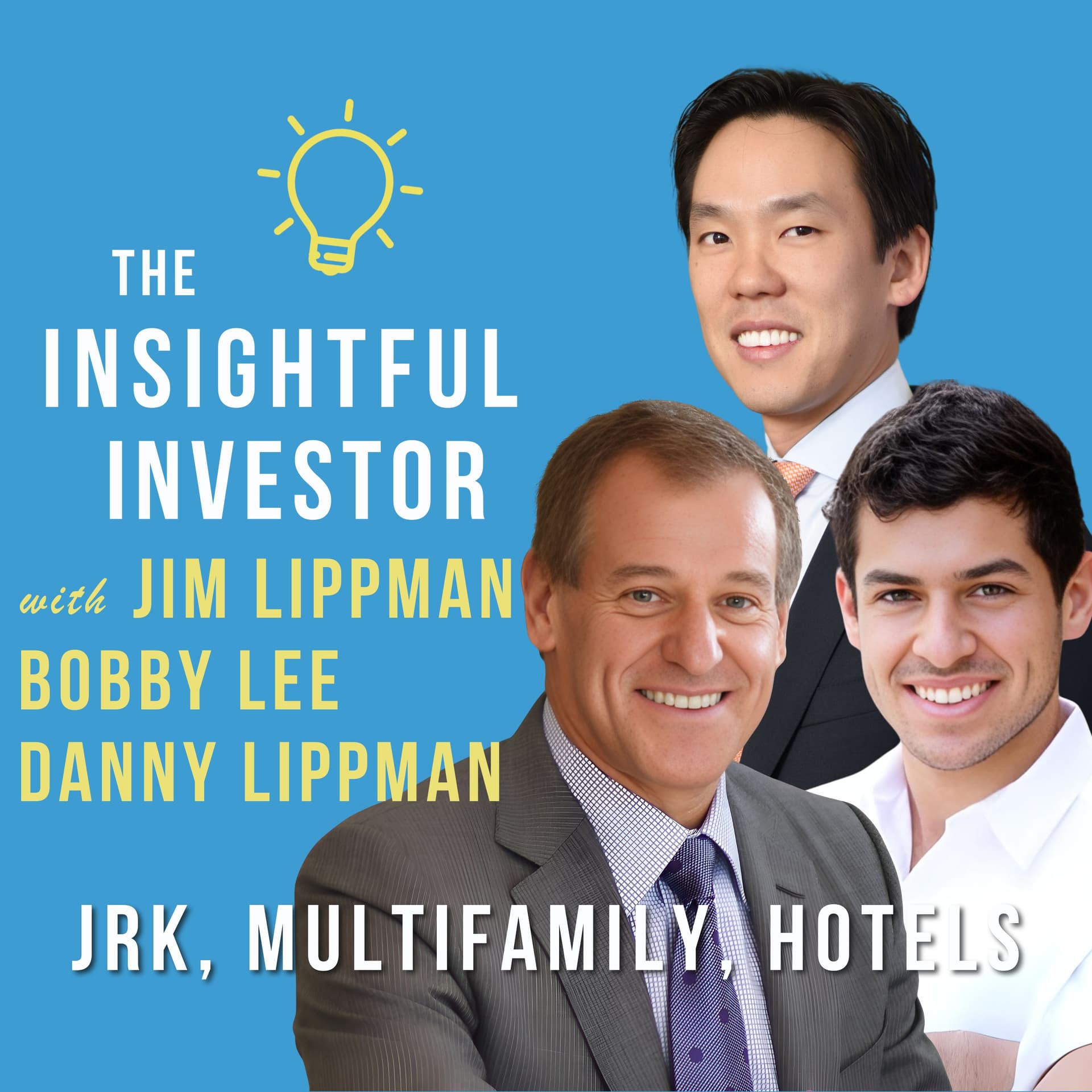
Jim Lippman, Bobby Lee, Danny Lippman of JRK Property Holdings
Episode Overview In this episode of the Insightful Investor podcast, host Alex Shahidi engages in a comprehensive discussion with key figures from JRK Property Holdings, a company that has managed over $9 billion in multifamily and hotel assets since its inception in 1991. The conversation explores their unique investment strategies, insights into the real estate market, and their outlook on multifamily and hospitality investing.
Key Participants
- Jim Lippman - Founder and Chairman of JRK
- Bobby Lee - CEO of JRK
- Danny Lippman - President of JRK
Episode Highlights
Introduction to JRK Property Holdings
- Founded in 1991, focusing on multifamily and hotel assets.
- Operates across 26 states with a portfolio exceeding $9 billion.
Transition to Real Estate
- Jim's Background: Started in finance with a focus on equities and commodities but transitioned to real estate to find passion and fulfillment.
- Emphasizes the importance of working in a field one loves.
Investment Philosophy
- Focus on Passion: JRK fosters a culture where passion drives performance.
- Bobby's Insights: Started in investment banking, learned the importance of cash flow and organic value creation versus temporary value engineering.
- Danny's Journey: Grew up in a real estate environment, transitioned from development to focusing on multifamily investments.
Operational Excellence
- Emphasis on a maniacal focus on operations to distinguish JRK from competitors.
- Operational efficiency is viewed as crucial to generating outsized returns.
Multifamily vs. Hospitality Investment
- Differences in the investment dynamics between multifamily properties, which are seen as stable, versus hotels, which are more volatile and dependent on market cycles.
- JRK's strategy includes buying at below replacement costs and focusing on value-add opportunities.
Current Market Outlook
- Multifamily Sector: Anticipates continued demand due to limited new supply and rising rents, particularly in the wake of significant wage growth among lower-income earners.
- Hospitality Sector: Mixed outlook with strong leisure demand but challenges in business travel; opportunity exists in distressed hotel assets for repositioning.
- Concerns about potential market corrections but a belief in strong fundamentals for multifamily investments.
Long-Term Trends and Predictions
- Observations on shifts in investor interest from urban to suburban areas post-COVID, with a more favorable environment for suburban properties.
- Anticipation of changes in regulatory environments affecting multifamily properties, including rent control discussions.
Key Takeaways
- Focus on Cash Flow: All investments are evaluated based on cash flow rather than speculative growth, leading to more stable returns.
- Operational Control: Being a vertically integrated company allows JRK to maintain complete control over management, reducing conflicts of interest and improving performance.
- Market Cycles: JRK's investment strategy allows it to navigate market cycles effectively, focusing on operational improvements rather than solely market timing.
Conclusion The episode concludes with insights on maintaining operational excellence and the importance of aligning investment objectives with the performance of the properties. The JRK team expresses confidence in their strategy and the multifamily sector's resilience in the face of economic challenges.
Additional Resources
- Visit [Insightful Investor](https://insightfulinvestor.org/) for past episodes and more insights.
- Feedback can be directed to info@insightfulinvestor.org.
---
Disclaimer: This podcast is for informational purposes only and should not be relied upon as investment advice. All opinions expressed are those of the participants and do not necessarily reflect the views of Evoke Advisors or its affiliates. ```
Written by AI. May contain mistakes. Listen to the episode to check what was said.
Transcript
Automatic transcript. May contain errors.0:06Welcome to the Insightful Investor Podcast, a weekly series that seeks to share industry, investment, investment, and market insights. We define insights as concepts that are counterintuitive, widely misunderstood, or underappreciated. In other words, unique ideas that you probably won't hear elsewhere. I'm Alex Shahidi, the host of the podcast and co-CIO of Evoke Advisors, one of the nation's leading investment advisory firms. Learn more about our show at insightfulinvestor.org.
0:43Today, I have three guests from JRK Property Holdings. JRK has owned and operated over$9 billion in multifamily and hotel assets in 26 states since its founding in 1991. They were kind enough to invite me to their offices in Los Angeles, and we're all sitting here together in Jim's office. So with me today is Jim Lipman, who is the founder and chairman of JRK. Bobby Lee is also here, the CEO, and also Danny Lipman, the president. Guys, thank you for joining me today. Thank you. Thank you, Alex. Jim, let's start with you. I understand you started your investing career by trading equities, options, and commodities, which is very different from real estate.
1:28Would you tell us about that experience and how you transitioned to real estate and why you love real estate? Thanks, Alex. That was a long time ago, but we'll go back. So back in late 1979, I started my career, which I had for 10 years in finance. I started at Oppenheimer, and I then moved from Oppenheimer, where I did over-the-counter trading, to Drexel Burnham, where I did options arbitrage. During that time, the Hunts were cornering the silver market, and I had the opportunity with the senior partner who was retiring from Oppenheimer of buying a seat and going down to the exchange. And for the next decade, I traded commodities and basically arbitraged that as well, which is what my career was about.
2:10So I would butterfly the different months as I traded between the commodities. But by my young, early 30s, I'm a huge, as you can tell from my accent, New Yorker, New York football giant fan. And I would wake up in the morning and I would have butterflies on Sunday in my stomach and I couldn't even enjoy the games. And I knew it was time to make a change. My cousin who ran everything at Drexel that Michael Milken didn't do here in LA was forming a real estate venture with Fred Carr from Executive Life. And I had the capital, was asked to join as a principal. And I came out here in late 89 to do that.
2:49Within two years, unfortunately, Executive Life went into conservatorship, which is like a bankruptcy. And the insurance commissioner, Garamendi, asked me to stay on and liquidate the$1.5 billion portfolio, which I agreed to do if I was allowed to form my own real estate firm, because it was at that time that the Resolution Trust Company was starting to sell assets, hence the formation of JRK. And that's how we went about that. So you've been at this for many years, but oftentimes what happens is we learn very important lessons early in our career, and that tends to form our investment thinking and our core beliefs.
3:30Were there any early learnings that you experienced that are still with you today? So what I learned early on in Vime Investment Philosophy, as a commodities trader, I was fortunate enough to have made a lot of money, but I didn't love what I was doing. When I came out and started doing real estate, I found outside of my family, the passion of my life, legitimately. It was something that allowed me to use both my analytical skills and my creative skills to both reposition these assets. And so when I tell people, when I interview people, and what you see is the culture of JRK is I say to people, this is a place you're going to have to work really hard, which is the reputation.
4:10So you're not going to want to be here if it's not your passion. We will reward you handsomely, but you have to like it. And so what I learned early on is find something that you're passionate about. And a fun antidotal story with that is my friends became great golfers early on when we started. And I didn't get to play golf like them. And they would ask me why. And I would tell them, you know what? You know how you love being out there playing golf? I actually love sitting in my office or traveling to the properties and working. So real estate is more than my job. It is actually my passion. I actually love it.
4:43Bobby, you took a little bit of a different path. You started in investment banking after graduating college. What was that like? And what lessons did you learn early in your career that helped shape your investment philosophy? Look, in hindsight, looking back on my time at Lehman Brothers in investment banking, it was a perfect place for me to start my career. I learned all the things that you don't learn in college. I came out of there with the analytical toolkit, modeling skills, the basics of finance to help me as an investor later on. And probably equally as importantly, I made a lifelong group of friends that had similar career aspirations in finance investing, many of which are investors or friends to this day.
5:22When I look back on the lessons that I learned that stuck with me, many years later. One of the ones that I recall is I worked on both the deck and the equity sides of transactions, leveraged finance, investment grade debt, covering the major financial sponsors based on the West Coast. And I remember thinking that equity valuations were pretty fickle and volatile. There were a series of so many different future projection assumptions we would put together in these models. And within a span of a couple of days, that valuation could change wildly. Whereas credit was pretty simple. It was just cashflow, actual cashflow based, backwards looking.
5:56And I remember thinking over time, in the end, the equity valuations are going to converge based on what the cash flows of an asset are. And it stuck with me. So I became an early believer in cash flow based value investing. The other thing that stuck me on Wall Street was there was a lot of bright people. And we spent a lot of time thinking about ways to engineer value that seemed to be temporary, whether it's through debt financing or acquiring other companies with some type of multiple arbitrage in mind, but nobody was focused on organic value creation. And so I always was left there wondering while working on financial spreadsheets, how do you get to the other side where you can learn how to build a company's value or an asset's value on an organic level where the thing continues to grow every year?
6:41Hence, I was pretty intrigued when I met Jim and learned about real estate and found that there are sectors out there where you can operate them like multifamily and hospitality, and every year you can create value. And you joined Jim in 2005. What was it that drew you into working with Jim? How has your role at the firm evolved over the almost 20 years now? I mean, coming from Lehman Brothers and seeing when I first met Jim and learned how he ran the business, it was completely intriguing. I mean, this was a sole proprietor, owner-operator that seemingly to me made every single decision that mattered about the assets.
7:16So one day he's underwriting the new investment, he's raising the capital for it. He's setting the rents on every single property every week. He's making all the critical personnel decisions. He's reviewing the financials on a monthly basis, coming away with pages and pages of notes from those and to improve the assets every month. And at the same time, I'm putting together the track records for our first fund. And they were uncanny results, unparalleled to anything I'd seen. And I just said, this can't be a coincidence. How much control he's able to have on and all the levers he's able to pull on the assets.
7:49And I think over time, what I've really been able to appreciate about multifamily and hospitality at a vertically integrated company is we get to hone our craft every single day on a detailed level, at the minutiae asset level, on a series of very low risk decisions. And then the next day we get to learn from whatever decision we got right or wrong. And it's pretty rare when I look at other investment asset classes, whether it's private equity or a hedge fund or venture capital, they don't get that same repeat knowledge working on the same type of asset every single day. So I thought what we do is pretty unique.
8:23And I think just personally, you know, getting pretty integral responsibilities early on in my career at a smaller company was really great. So I had responsibilities in fundraising and acquisitions and dispositions and an asset management within my first three or four years. Eventually I oversaw the investment team for about five years and then was promoted to president in 2013, which is really when Jim and I began partnering on the oversight of all the day-to-day responsibilities of the firm. And so we've been doing that for about 11 years now. You know, Jim's children joined the firm about a decade ago.
8:58And with me recently transitioning to CEO last year and Danny becoming the president, it's been pretty cool, like a full circle moment for me, Alex, now training Danny on the things Jim trained me 11 years ago on all aspects of the business. And what's really been really neat for me with Danny, Matt, or Alex is I oftentimes learn from them. They bring in fresh perspectives on things that we've been doing for so long, but that really improve what we do every day. You've risen up the ranks pretty fast. What do you think allows you to do that? And I'm curious if Jim would answer the question the same way.
9:33I'm more curious to hear how he answers this one. But from my perspective, the reason I've risen the ranks is because I care sincerely about our results. And like Jim, I'm not going to settle for good enough. Doesn't mean that I get everything right. I'm actually very far from it, but I focus my intent every day on trying to get it right. And because that pursuit of perfection is never achieved, you know, we're constantly pursuing that. We're pushing our teams to pursue that every day. So I think he and I are very aligned in that regard. And I think the firm overall has done it pretty well over the last two decades as shown from our success.
10:07I guess overall, we've gotten more things right than wrong. So Bob does follow in that. I'm a perfectionist and I demand a lot from those around me. And the cream seems to rise to the top. And Bob, when he started in the firm, was in an area as an acquisitions person, not the lead person. And it became apparent very quickly that this was a very talented individual. And obviously, since then, that's how he grew so fast into running the acquisition area and then ultimately running the company. I always say that when I started and Bobby grew up like that over the time, he was my right arm. Now I'm kind of his right arm and Danny's his left arm right now as he's running the day-to-day operations along with Danny with the company.
10:50But what I'm most proud of what they did accomplish is when you look at where that is, JRK's returns when Bobby started, with a very small company of five people. And when we started acquiring assets, our first assets were in 1991 from the RTC, one of which we still own today in Oklahoma. But when we started acquiring, our goal was to generate the best risk-adjusted returns. So what was going to distinguish JRK from pretty much every one of the other firms out there is our maniacal focus on operations. Most firms acquire assets. I was involved with a lot of the REITs and they acquire assets. If you go to a lot of the people, the leaders of the company, they don't even visit the assets after that.
11:37Danny, Bobby, and I visit every asset every year. We have a very extensive team that's visiting. It's why we ultimately got involved as a vertically integrated company that specifically manages our own assets because we're going to look to get outsized risk-adjusted returns, which again, we have generated almost 30 % IRRs since inception and almost four-time multiples. But what we're most proud of, which is what Bobby and Danny and what's imbued in JRK is that risk-adjusted return. We have never not made money on a single one of our$10 billion assets that we purchased. So that's kind of how we go about it.
12:16And it's that demand for perfection and that focus on operations. And what I've always talked about is properties talk to you. When you go to a property, it's not one size fits all. Each property has different reasons to be transitioned. So it can be operational changes or it can be physical changes or it can be a combination of both, but different things with each property. And it's that focus that has distinguished JRK from other companies. Those are phenomenal results. So congratulations. One of the lessons that I've learned with these podcasts, I had one guest on, his name is Glenn August, a few episodes ago.
12:56And I asked him, he's a founder of a large firm. The start is smaller and it grew. I said, how do you maintain the quality as you scale? And he said, it's all about the people. It's the people that make the company. It's not a machine, it's a machine made of people. And he said, and you need three qualities. One, they have to be smart. Two, they have to work really hard. And number three, which you don't hear as much about, is that they have to care. And I think what you just described is a good summary of that, is smart people who work really hard, but they actually care. And it's not just caring about making money.
13:30It's caring about the asset. It's caring about the people. It's caring about the vision and being aligned in that way. Does that sum it up reasonably well? Alex, you said it better than I did, but that's actually correct. Danny, you started here about six years ago. Would you share your experience with us? When I graduated college, I knew I was passionate about real estate. I'd grown up in the same household as my dad, so I'd been exposed to it for a very long time and done internships in college at various private equity firms. I knew that I didn't want to initially start at JRK because I wanted the experience to work outside of with family members and also in a different asset class.
14:11So I started off my career at Hudson Pacific Properties, where I focused on development, mostly with office and mixed use. And I enjoyed my time there, but I knew that long term, I liked multifamily and hotels a lot more as an investment class than office. And so after a couple of years of working there and their investment group, I transitioned over to JRK, where I started off exclusively on the investment side. And over the past couple of years, I've slowly transitioned into overlooking both operations as well as the investment side and working in tandem with Bobby and my dad. Jim, your firm has changed significantly since you started it over 30 years ago.
14:57I think most impressively, you've been able to scale your organization while maintaining the high quality standards, which is not easy to do. Would you talk about how you've been able to do that? One of the things was when we started our firm, it's kind of a funny story. We had five people, four of whom are still involved at JRK to this day. Today, those five people, we now have 140 in the LA office, 1 ,400 around the country in 26 states. And something certainly changed. Bobby described early on how every decision was made by myself. That has certainly changed. We now have divisions running our multifamily area, our hotel area, our redevelopment area, accounting, HR.
15:42We have a technology area. So all of these areas have grown. And what we have found is we homegrown many of these people and they've been with us for a long time. And we're able to, which is I think one of the secret sources for JRK, to be able to retain and entice the best individuals to come here. Because unlike other firms, one, our performance is exceptional, and we let them participate in that performance. So unlike other firms that will sometimes give people rewards for AUM, we don't do that. We're not looking to necessarily grow just to buy deals. We're looking to have outperformance, which we've continuously done.
16:21And that outperformance comes from the individuals that work here. And so we reward them for doing that by giving them some of the equity. So the big changes that I look at that have happened is from this small five-person firm, we now have all these people and they will have autonomy and responsibility, but they got that by earning that and by seeing and getting involved in the culture of what JRK is about. Let's shift into investing in real estate, which you know a little bit about. I think it would be helpful to just lay the foundation for our listeners. And maybe if you could just talk about what the real estate landscape looks like in terms of how the industry is set up.
17:02And perhaps you could just talk about the distinction between investors who are allocators versus those who are operators. So I'm going to, which is the best part of where this is, I indicated early on that this firm started as something that I founded and was focused very much on myself. and today that firm has grown to be a large firm with diverse leaders that are independent to it, of which Bobby is at the top of that. So I'm going to let Bobby answer that question for us. Sure. I'll take that one. I mean, I think fundamentally, Alex, multifamily is a real estate asset class where there's a real estate and there's a business attached to them, and they are separate things.
17:44And so when I look at the business, which is how we approach operating multifamily real estate, I think there's really three central players we have to discuss. So one is the investor or the allocator, if you will. The second is the operator or the general partner. And the third is the management company. Let's start with the first. The first is the investor or the allocator is generally going to be an investment fund or a family investment office. And they're responsible for raising the pool of capital from a limited partner and investing the capital, which provides their limited partners with some allocation to the real estate sector, they're typically going to be compensated on an AUM-based fee and some split of the profits.
18:26They're going to be looking for operators or general partners. Those operators or general partners principally are going to be tasked with finding the new investment. They're looking for deals. They're going to have the relationships with the brokers or the owners. They're generally going to have some local or regional knowledge. And for them, they are also paid on some type of transaction-based or asset-based fee and some split of the profits. So as you can see, in this model, there's two levels of fees, two levels of profit sharing. And then there's a third company, which is the management company.
18:57They're the one that actually manage all the day-to-day operations of the actual businesses. What's interesting about our sector is you can be fully vertically integrated like JRK, where you're all three, you're the investor, you're the operator, and you're the management company. You could be two of those three things, or you could just be one of each of those things and have this partnership. And generally management companies, they're generally paid on a percentage of revenue basis. Most of the industry is third-party property managed. And so I think the vertically integrated companies like JRK, they inherently have some advantages to them.
19:29So the first being there's no conflict of interest. The person that's making the day-to-day decision on your rent setting, what personnel should be at the property, how to find the expense efficiencies. They have a complete economic vested interest with the LPs. The dirty secret you see is a lot of management companies, they could manage three competitors with three different owners on the same block. And more importantly, when they're managing those companies, which is a really big distinction, JRK, because of its outperformance, was asked by a major national company to take over a significant part of their portfolio.
20:01we don't do it for management fees because JRK doesn't make money managing assets because the amount of people and effort we put into that. So we took a percentage of the NOI growth that would happen and it worked out well for them and for us. But one of the things we did is take over management from like 20 or 30 management companies, the top companies in the country. And what we quickly found is that most of those companies, again, they're a third-party management company. They're in the business of making money from managing properties, which is the distinction right off the bat. So we would go to properties.
20:32And after a while, when Bob and I would travel to these properties, they would actually throw up their arms as we approached and said, I know we're overstaffed. And staffing is a huge percentage of the course. And we do time and motion studies on work orders, on make readies, on leasing and how many people should be in the leasing office per how many phone calls they get and how many visits they get. And it is those changes, whereas a third-party management company has to staff a utility company for peak capacity because the last thing they want to do because they'll lose money is to have to send their own people to have to work on it, where JRK doesn't do it that way.
21:09So the operational efficiencies of managing our own assets are very significant. And I'm sorry for cutting in. Yeah, of course. That's great. I think the other pieces we see, Alex, with not being vertically integrated, there's adverse selection with the allocator operator model. So typically when an allocator is trying to put out capital, the deals that are out there are going to be for operators that are having trouble raising capital. So either they have short track records or they have some blemishes on their track records, but those are the deals out there and allocators by their nature, they've raised these funds.
21:39They have to put it out on a deployment pace and they are tasked with allocating real estate for their LPs. So they are putting out capital when they have the most plentiful capital is probably the worst time to put out the capital and vice versa. So we see some flaws with that model. And I think the biggest one that we see for the industry is honestly the AUM and fee focus, fee bias that we are now seeing. So when you take those three separate components, the way that these guys can drive their business is based on growing AUM or growing unit count. That's their biggest way they're going to be driving the business versus the vertically integrated operators that are relying on their carried interest and their profit sharing to grow their business, one blemish on their track record, and their business model is over.
22:21So for us, we take that really seriously. We talk about it all the time. No deal is too important to pass up because our track record and not preserving capital on every single investment, making every investment successful is so critical to our success. You highlighted a couple of things there that I think are really insightful. One is we all know you got to follow the money. You got to follow the incentives. And the way that the real estate industry is set up isn't necessarily in the best interest of the end investor. So it's important for people to be aware of that. It doesn't necessarily mean it's a bad thing, but you should just be aware of how the incentives are aligned or misaligned.
22:57And then the second part, which I want to dig into a little bit more, is what you described is the landscape. And you have to think about what is your objective? One thing that's loud and clear in this short conversation so far is our objective isn't to grow assets under management. Our objective is to generate returns for our clients, including ourselves, that you're investors in your own funds, your employees are investors in your own funds. That, believe it or not, is a little unique in the industry because most of the industry focuses on growing assets under management to get bigger, to charge more fees.
23:31You're clearly focused on returns. So would you talk about potentially the inefficiencies in this industry that you look to take advantage of to generate those outsized returns, particularly relative to the risk that you're taking? I think, is that Bobby or Danny going to be answering that one? But I'm going to talk to you about alignment for a second first, which is, again, JRK doesn't make money, which is exactly what it is. We're very aligned with our investors. We make our money based on the performance of the properties rather than based on AUM. We don't charge fees unless we acquire an asset.
24:05So even within our funds, we don't do that. So that alignment really, really helps. The other part is from the onset, when we founded JRK to this date, the reason we elected to be in multifamily residential and hotels is their management intensive. So the advantage that we have is that management intensive. And if you look at what most other companies end up doing, which is, I think, really why we create 150, 200 basis points to alpha on all of our deals is that most institutions, when they're buying deals, they're buying those deals. A third-party management company is running their deals and then they're selling them.
24:45So they're macroeconomic buyers. We can buy through all cycles and we have proven that. We bought a bunch of deals in 2007 and 2008 and made a lot of money on those deals as well. Because when we're buying deals, we're basically going to be looking at deals that we have the opportunity to operationally reposition. And that takes the intense focus that we end up having on an asset that other teams don't have. And we call it our famous green book of going through a lot of different analytics, which include time and motion studies, but also include looking at more efficient ways to do it. So if you look at most property management companies, they're going to come on and they're going to say, there's 300 units you need, three leasing people, you need four maintenance people.
Read the full transcript
25:30We're going to look at the number of work orders a property has, what those specific work orders are. We're going to look at how long it takes them to paint a unit versus contracting to paint that unit. We're going to look at how many traffic phone calls they're getting, how long it takes to answer that phone, how long it takes to tour it. And it's all those differences which then get tied into even looking at how most management companies use an LRO system to set their rents. JRK again turned around and we looked at both an LRO system as well as our setting our rents ourselves. And we took properties in the same geographic location.
26:09We gave some to a company, to multiple different LRO systems, and some for ourselves. And we clearly in every instance outperformed them. So we set all of our own rents. Every Tuesday and Friday, rents get fully adjusted. One person is fully responsible for that, and each asset manager is intimately involved in that. Every quarter, we do a deep dive into every single asset. These are things that no company that I know of does the same thing. So it's those kind of different attributes in a very highly management-intensive business, which is what multifamily is and hotels are, that allow J.R.K. to generate these significant outsized returns.
26:52And before we dig into more details, is that a discovery you had early in your career where when you look at the landscape that Bobby just described, did you zoom in on the operations is where the value add comes from? Is that something you discovered early and just refined through time? Yes, actually, it was actually how I fell in up with this business. So when I moved out to California, the first assets that I took over were two assets. I won't say the names, but in Atlanta, Georgia, and they were struggling assets. And I looked at this and this was, we had taken them over and our own company had done nothing different than the prior company.
27:29And I looked at these assets and was able to see the significant mismanagement and opportunities to reposition these assets during, as you probably recall, in the early 90s, a very weak market. And so by implementing those and seeing the amazing difference in generation that they did to the NOI of those properties and the revenues and expenses, I said, wow, this is the right business. I'd like to touch on one thing going back to, you know, an earlier part where you said investing in multifamily, Alex, I view it as part, it's the real estate and part is the business. And I think where most folks gravitate to is they spend 95 % of the time is analyzing the real estate, doing forecasting trends on population growth in markets and sub markets and where they think demographics are going to shift.
28:15Look, it's not that we don't place bearing on that. We very much believe that you got to invest in the right markets. But we've also realized over three and a half decades, 30 % of the time you're going to get those demographic predictions wrong. So where we spend is we may spend 20 % of the time on the real estate and obviously doing the best we can to forecast the future. We're spending 80 % of our time analyzing the businesses of each of the deals. So it's a numbers game. We're looking at 3 ,200 to 3 ,500 investments a year. We're going to focus on the 15 to 20 very best investments where we like the real estate, we like the locations, we like the physical assets, but that we're going to stack the deck in our hand where the businesses are so under managed or that they're so physically under capitalized that we know that we can deliver alpha over the first three to four years instantly to take a lot of the risk out of the deal and to generate outsized returns.
29:04That's where we spend our energy. I'm curious if you were to assign a grade to operators, because I think we want to zoom into that area. What grade would you give the average operator? Are they decent? Are they not very good? We're talking about two different kind of, we'll distinguish as operators. You're talking about one being the accumulators, the people that are the general partner in it. And most of them are not going to be really the operators of the property. So there's a break between the two of them. They're buyers of assets. And again, I say that has worked very well for those people.
29:39And some of them have done, if there was a complaint about JRK, it's our lack of putting the money out as quick as it can, because we're conservative. Because I always say, you can make a performer say anything you want it to say. So we're going to, again, look at significantly a trend analysis. We obviously are very focused on locations and those opportunities. But I would say that most accumulator of assets, I would give a D as to operations because that's not what they end up doing. And if you would look at most of those accumulators after they buy the asset, many of them have never visited their asset again a decade later.
30:17They have lower level people that are visiting them. The other ones are the operators themselves, which are generally the third party operators. And there's a problem with that as well, because again, as I already have pointed out, they're in the business of making money to manage them. So by their very nature, they're overstaffing on those properties versus the other. And again, as a management company versus a JRK, where we make our money with our investors based on the multiples and the returns to our investors, that's not how a management company or anyone who works there is incentivized. So I truly believe that I, again, there are very few, it's why groups that I would end up giving very high grades to.
31:00Now, I did tell you I'm a perfectionist. We are perfectionists, but it does speak. So when we go out to raise money, which is something that Bobby and Danny, we don't do it that often, but do it more frequently than I will now. When we're going to go out to raise money, the first question we get asked is how do we generate these outsized returns? And that's exactly why we generate these outsized returns. As an allocator, that seat that I sit in, I think about there are returns that come from just market cycles. So real estate goes through good and bad periods. And as Bobby referenced, it's not always easy to predict when those cycles turn.
31:35And then there are returns that come from operational efficiencies and closing those gaps, particularly if you're able to find assets that are not well operated, there's more gap to close there. That is a more predictable return generator through time. And it's in many ways, it's cycle independent. So you can think of it as what JRK offers is you get some exposure to the ups and downs of the market cycle, but a lot of the alpha and returns come from operational advantages that you have. Those two returns are effectively uncorrelated to one another. And therefore, in total, you can generate something that's a lot more consistent through time.
32:15And that's potentially one of the reasons you've been able to avoid losses on any property in over 30 years, which is pretty rare. Does that sum it up reasonably? That sums it up really reasonably well. Okay. So why don't we dig in a little bit into how you operate more efficiently? Obviously, you don't want to divulge proprietary information and insight, but are there major operational inefficiencies that you've seen other operators miss that you find have added a lot of value over time? Yeah, I think you hit the nail on the head, Alex. We're probably not going to divulge our secret sauce, if you will.
32:49But I think it comes down to something Jim said in an earlier question, which is this business is difficult. Operating multifamily, period, is difficult. Operating it as efficiently as you can and optimizing the cash flows year in and year out and compounding success and success becomes even more difficult. So, you know, it takes looking at every single part of our supply and vendor chain, whether we can bring things in-house versus outsource them. You know, what is the efficiency of the maintenance team and the efficacy of the maintenance team and the leasing team, et cetera. Also, on the revenue side, just as much active management, which is looking at where can you optimize the rents and the occupancy on a weekly basis, looking at different demand streams, et cetera, and other sources of revenue.
33:33And then looking at things that are maybe taken for granted, things like fixed expenses, utilities, for example, property taxes, insurance that we spend a lot of time. They're actually called fixed expenses in our industry because folks don't look at them. It's just a given. we spend a lot of time to make sure that those are made as efficient as possible, as well as things below the line, whether it's interior capital or other operational capital that folks tend to just underwrite at$250 a unit on a blanket and never analyze what it's actually costing them and what kind of return on investment.
34:04So for us, we've set up all of our analytics so that we can look at things on a daily, weekly, and monthly basis. Like I said, our business, I look at the series of low risk decisions that we are making, but you have to constantly make sure that you correct each week and each month if you miss. And if you do that disciplined over time, you find a lot of efficiency in this business. In addition, the arbitrage that we talked about early on, we're in 26 states. We're looking at properties in all 50 states. And the advantage of that is we're able to see the disequilibriums between one location and another.
34:39So as an example, a number of years ago, you would see properties in Florida trading 150 to 200 basis points tighter than you would see properties in Ohio. All of a sudden, as the market compressed and more money went into the market, you watched cap rates across the nation flatten. So what would JRK do as an arbitrageer in that? We sold all of our assets, which was six or seven assets in Ohio, to buy more assets in states that would generally have tighter cap rates than the others. So we became a seller. Today, you're seeing that change back a little bit. And so we are looking in different ways to do that.
35:19So it's also those arbitrage differentials between both age of project, location within different states, and the geographic reach of what JRK has has allowed us to arbitrage those situations as well. And how do you think about risk and limiting downside? I know that's a big focus of yours and not having lost money on a single property in over 30 years. Obviously, there's a heavy component of risk management. How do you think about that? We've always taken the approach that we'll give up upside in exchange for downside risk. And as my dad's mentioned, being a cash flow focused value investor, it definitely limits the number of investments that we have open to us.
36:00But it's also helped us avoid bad investments throughout the firm's existence. One thing that we do is we exclusively use long-term fixed rate debt on our assets as opposed to shorter duration or floating term debt. It limits our flexibility, but what it also does is it gives us certainty of cash flow and longer optionality on refinance and sale decisions. You can appreciate that over the past couple of years, that's allowed JRK to not have the same balance sheet issues that a lot of other operators are contending with. And then similarly, in reviewing new acquisitions, a lot of the times we see opportunities to buy deals where there's a large value add component and you have the opportunity to buy the deal at a very tight cap rate with the expectation that after a renovation, you'll stabilize to north of a market cap rate.
36:49There's other deals where there might not be the same value-add component, but you're buying the deal stabilized at relatively close to where you'd ultimately be stabilizing that value-add deal. So for us, from a risk standpoint, we'd much rather buy that deal without taking the risk on execution of the renovation. And the same applies for markets with growth expectations. And so a lot during COVID, there was a lot of operators that bought properties in these markets where there was high expectations of growth. And we saw the opportunity where there was markets that are pricing historically wide from a spread to the market and those high growth markets where we didn't need the growth in order to achieve very similar returns.
37:34And there's also less risk of cap rate expansion on those deals. And so we've always taken the approach of taking the risk averse deal and having this certainty of cash flow with fixed rate financing to drive our returns. And ultimately, we're trying to buy cash flowing real estate that can appreciate over time. And we're not trying to generate our returns through financial engineering. There's a very clear theme here, which is you want to emphasize the things you can control and de-emphasize the things that are largely beyond your control. You use 10-year fixed rates because you don't know what interest rates are going to do, and you have no control over what interest rates are going to do.
38:14You're focused on operational efficiencies because those are things you can't control. And the better you're able to do that, the more return you can generate for investors. And the more you can do there, the less exposure you want to all the other risks that you can't manage. I'll actually give you an example that I think sums it up. We can't control the market, what investments are available in the market. our first fund that Jim and I raised at the end of 06 had a traditional fund management fee. And I remember we would get calls from investors upset after six months or nine months. Why am I paying this fee every quarter?
38:45You guys aren't finding investments. And Jim and I would say, look, we don't think it's the right time. We don't like some of the pricing nuances we're seeing in the market. We're trying to be good stewards of your capital, be fiduciaries. But that we realized that there was a misalignment with having this fund management fee and a J curve. So what we do in our second fund and on, we got rid of the fund management fee. It allows us to be able to buy when the market, because we realize we don't control the market, buy when we think it's the right time to buy. When it's not the right time to buy, and we've gone through nine-month dry spells, 10-month dry spells, Alex, we'll be frustrated.
39:12We will sit on our hands if we don't see the right value out there. And I think we think about things all the time, which is even the things that are outside of control, what can we do to mitigate around that risk? And in the past, we always basically, as an example, we had always built-in cap rate expansion into all of our models, expecting these compressed cap rates to see some expansions. And that ranged from 10 % to 30 % cap rate expansion that we were looking at. Today is actually one of the first times that we are no longer building in cap rate expansion. That doesn't mean we're building in cap rate compression.
39:45We're saying there's an equal likelihood of cap rates going down, the 10-year going down, as there is the 10-year going up over the next few years. So for the first time when we're buying, we don't have to basically build in cap rate expansion into our models. And how do you think about multifamily versus hospitality or hotels in what we just talked about? I had some people on Squawk on the Street, which I watch religiously every morning. And they asked somebody about what he would invest in if he was an investor, a famous real estate investor. And he said, multifamily, multifamily, multifamily.
40:23I would argue that multifamily is and has been an exceptional, unbelievable asset class and will continue to be that. Hotels are very different animal. Hotels aren't even taxed the same way as the rest of real estate. It's taxed as an operating business because it is an operating business. So as I told you, we've generated almost four-time multiples on all of our multifamily deals. We've generated north of seven-time multiples on all of our hotels that we've ever acquired. And we've acquired hotels all over the country. We're very, as we are with everything, opportunistic acquirers of real estate, and particularly when it comes to hotels.
41:00So we're looking for hotels that are both mismanaged or in need of capital, where the operators don't have that capital to put in. We're just now buying a very significant couple of hundred million dollar opportunity in an incredible location here in California on the water, where again, the asset is in dire need of significant capital repositioning. And JRK was able to buy that at a significant discount. So my answer is, I think because they're both management intensive, they're probably the two areas that I would be looking to invest in. I would also add that with multifamily and especially the types of assets that we buy, where they're cash flowing and we're using a fixed rate liability structure, we're able to make money on multifamily investments regardless of when we buy it in the cycle, especially because we take this long-term approach.
41:50So even if there's a recession or some sort of disruption at the property, we ultimately will make money on that investment. I think hotels, the income is a lot more volatile and it's a lot more tied to macroeconomic factors. And so it's critically important what point in the cycle you're buying the hotel, as opposed to multifamily, you can generate those returns over a long period of time regardless. And so I think we're much more careful on timing of when we're buying these hotels. And something that we do that's unique in that industry is most groups are using floating rate debt to kind of tie their income stream to where interest rates are since it's very correlated on the hotel side.
42:31We take the same approach as multifamily where we fix our liability structure over the long term. And it just gives us a lot more predictable income streams on the hotel side. Yeah, I think big picture, Alex, how this results in our business, we generally see consistency in the volume of multifamily investments that we're able to source because we're able to source through all cycles. And big picture, I sort of look at multifamily is a steady, slow, steady, positive IRR for the industry, likely in the high single digits of an industry. And we're able to alpha generate much better returns, but able to do it through all cycles.
43:05In the hospitality sector overall, if you probably average the returns, it's probably close to zero or low single digits. with wide losers and wide winners. And so what we see with our own returns, we actually have outsized returns in our hospitality business. So we see higher IRRs, higher multiples, but with just a much less frequency of the volume of deals that we're doing because we are always on the hospitality side. We have to make sure we're coming out as a winner, you know, when we're making those investments. Which ties to what you said, Danny. So thank you for amplifying on that because it is the timing of cycles, which is the only one a little bit more important, a lot more important in the hotel sector.
43:41Okay. Why don't we shift to your outlook? I think our listeners are always curious what you foresee. We talked about it being difficult, but just your perspectives would be helpful. Why don't we just start with your high level outlook? Bobby, you talked about how multifamily has this, I guess, long-term secular tailwind. Maybe talk about that a little bit. And then also if you want to talk about hospitality outlook currently. Why don't I start with the hospitality, Alex, and I'll let Danny chime in on the multifamily. In both of our businesses, we're seeing that with where new construction prices have gone and with what's happened with interest rates, we're seeing that the construction pipelines are drying up post-25.
44:20So from 26 on, we don't think that there will be much new supply that's going to hit either one of the two markets. And you're able to buy assets below replacement costs, which is good. And it's healthy for us as an investor. I think when I look at the hospitality, the outlook becomes very much more market specific. So I think we are saying a tale of, depending on who your end consumer is. So we see a strong leisure market in the hotel industry right now. We're not seeing signs of weakness there. We are seeing that the group market continues to return back. So these large scale conventions and meetings, and people have a desire to do that.
44:53I think where we're seeing softness and probably we'll continue to see softness and we're not going to be as bullish leaning in as business travel. The everyday routine meeting, somebody has to go on the road. We're seeing that the workplace is adapting to doing these things virtually. And T &E departments, unfortunately, are probably getting used to having these lower spending levels that I don't think that they're going to want to see them go up. So I think as we look at that, we're very cognizant of that. I mean, clearly we're not going to lean into markets that have gotten overheated from a leisure perspective and may pull back, but it's a mixed view.
45:24But I think generally overall, we are seeing a healthy hospitality business. And like I said, we expect the construction pipeline to really dwindle in a couple of years. And we're also looking in the hotel side at some distressed operators based on what's happened. And what that allows us is with some of these distressed operators, and these are large operators and they become undercapitalized, allowing us, which is one of the things that really can help on the hotel side is the repositioning of that asset. I'll tell you one quick story before I let Danny do. I know we jump into this. So as an example, though, of an operations on the hotel side, because we've spoken much more about the multifamily side.
46:02On the hotel side, we took an asset over that didn't need in Nashville a number of years ago, a large holiday and the largest holiday express in the country at the time. And when we bought this asset, what we identified from ownership of other assets that we had up in Santa Barbara and elsewhere was the difference between weekday and weekend occupancies and the ability to drive rent during compression periods on weekends. And looking at their revenue management that was going on with this operator, we determined that they were running it where their compression was next to nothing. And we felt we could generate a 40 % compression differential in rates between weekdays and weekend.
46:44We were able to do that. the revenue growth, as you can imagine, was astounding on that. And it again, turned out to be a great opportunity. And there's an example without a physical repositioning, that was an operational mismanagement from the revenue side that JRK was identifying. So we, again, feel that right now, the real opportunity though is on the hotel side is to buy these assets at slightly wider caps than we have seen for a number of years from operators that are capitally constrained. On the multifamily side, we really started to see rent growth temper in the middle part of last year.
47:22So that's continued into this year. And our expectation is that will continue through 2025 until we see this influx of new supply taper off, which we know is going to happen because when you look at construction starts today, they're basically at zero. So we know that 26, really the early mid part of 26 through 2028, 2029, there's going to be very little supply in the market. Our new rent growth has definitely slowed to standard seasonality of leasing slightly above in the spring, summer months and flat generally during the winter. We are still getting good renewal growth, although we expect that's going to slow down a bit in the latter part of this year and into 2025.
48:06But fundamentals in multifamily are still really strong. So our primary renter cohort, which is the bottom 50 % of earners, are still seeing north of 5 % wage growth. It's a tight labor market. And when you look at the alternative of buying a home, homeownership, which used to kind of price right around one-to-one with renting, has now ballooned to basically being 50 % more expensive. And so there really isn't any alternative option for housing. We think that long term, as you see the supply dry up, multifamily rents will accelerate in that latter part of 2026. And we're able to buy these products at below replacement cost and at cap rates that have limited risk of expansion.
48:51And if we end up with a recession at some point, and I think many economists predicted a recession last year, and some are saying this year, and some are saying next year, but there will be a recession at some point. I would suspect that the demand for multifamily wouldn't go down as much, or if at all, versus other housing. Does that sound right? If you're looking at it and generally say that probably you could look at a potential recession next year, and I always say if you could predict recessions, you'd be the richest man in the world, but there's a lot of them. But regardless, there will be a recession over time.
49:24if that timing is in the next year or so when you're looking at it, which is the fortunate thing in the multifamily, coalesce with the lack of product that's going to be delivered. So there's going to be that demand. Occupancies continue to remain strong in most areas. And I don't see wage growth, which is really enhanced, being a problem right now. So when we buy properties, one of the things we look at is the ratio of what someone's earning to what they have to pay in rent. And we're seeing it at pretty high levels right now. I suspect that through a recession, that multifamily would hold up very well.
50:02That effectively gives you a cushion. Yes. Are there any long-term trends that you've seen that you think may reverse or have already reversed in either of these areas? I can think of three, you know, right off the top of my head, Alex. One is, you know, over the last 15 years, we saw this push by institutional investors to invest in the urban core versus the suburbs. You know, with the thesis being you have a walkable lifestyle that you can walk to bars and restaurants, you can walk to work. And COVID completely disrupted that. With remote work, you've seen office vacancies fall. People don't want to be in the metropolitan cores.
50:35You've seen rising homelessness. And now, you know, people can work from their homes. So now how do people pick their apartments? They pick where do they want to live? Where is it going to have the best quality of life? Where are the best school districts? So we actually saw suburban properties outperformed pretty significantly post-COVID. But the strange thing is we were always overweighted towards suburban because we could clip a premium yield at the time. And suburban properties didn't underperform pre-COVID. They kind of performed in line and you got premium yield. The other trend that we have seen, you know, is this coastal versus non-coastal.
51:06That was a very big theme. And so folks went overweight and whether it's San Francisco or Los Angeles or New York City and these other places. And you're quickly seeing some of those have started to reverse. I mean, the theme du jour right now that you hear in our industry is blue states versus red states. What JRK, like I said before, has tried to avoid is we don't spend too much time or put too much weight, even though we have some convictions on where we'd like to be overweighted. We try to stay opportunistic because at some price, you'll go to whatever's the out of favor asset class or sector.
51:37And that's where we've made a lot of our money over time. So I suspect, look, if urban core becomes really attractively priced, we may go long in the urban core. I think we are seeing that there have been some blue states and blue metropolitan areas in the country that are some of the hottest markets that are actually fundamentally very strong. For us, philosophically, we believe in kind of a reversion to the mean to some degree and taking advantage of those arbitrage opportunities. Bigger picture, what you could see in our industry, the long-term trend over the last eight to 10 years has been going from that sharpshooter investor to now more of a AUM allocation-based investing in real estate, that I think that model could come under question over the next five years as folks realize it's not so easy to allocate money to real estate in one of these vehicles and then try to redeem ahead of everybody else that you are locked in in an illiquid asset class.
52:33So I think what will happen is I then think track record, meaning IRR, multiple become more important and not deployment plays. So I do think that is something that could shrink the amount of capital chasing deals, leave it to folks that are more the sharpshooters in the industry, which again, I think, Alex, is a healthy correction for the multifamily industry and for investors. One trend that looks like it may have reversed is the trend of falling interest rates or low interest rates. So since you started the company, Jim, in 1991, one, interest rates have either been falling or near zero for 30 plus years.
53:07And potentially, that inflection point has been reached and rates are maybe higher for longer. Who knows where they go? It feels like things have changed. How does that reversal impact the industry? So it's twofold there. You're looking at what you've seen, which is what we're talking about, which is cap rate expansion. It'll be mitigated to some extent because there has to be, as you look at the demographics and the demand for housing, they have to build. And right now, JRK is able to buy all of our assets at below replacement cost. So at some point, that has to change anyway. But the other part is the amount of money that's gone into this industry and the acceptance of real estate as a class of assets that you want to own is going to compress long-term the spread between real estate and other assets.
53:59As I saw with, when I started in this business a long time ago, and I was doing options arbitrage, we would make a point and two points on conversions and reverses. And today it's as tight and as perfect as it can be. That tightening is occurring and will continue to occur in the multifamily, which will be an offset to potentially rising interest rates. Although So we're not betting on rising interest rates or falling interest rates, and we understand all the arguments pro and con. So now we're looking and saying, this is where it is. Where do you generate returns based on those interest rates that you're buying at today?
54:35That's why we still lock in today fixed rate financing to do that. Yeah, I think the thing you could see, Alex, in this new normal, as Jim mentioned, we're not going to bet any of our firms' investment returns on that. So we're still locking in 10-year fixed rate debt. But I think what you could see is some of the other folks that are relying on floating rates dropping or seeing a lower 10-year and lower cap rate, these folks that have floating rate debt or short-term debt right now, I mean, you are seeing whether it's a wall of maturities or just a wall of floating rate debt out there that folks are going to have limited options.
55:04We made sure over the last couple of years to have dry powder available to take advantage of what we expect will be a pretty opportunistic time to buy assets over the next couple of years. Yeah. It seems that a lot of investors were surprised by the sudden movement. I think most people were surprised by the sudden move in interest rates. We got so used to rates being near zero for a long period of time, and all of a sudden they jumped pretty significantly. The fastest rate of increase in 40 plus years. You could see a lot would be caught off guard. And it seems that sometimes the immediate impact isn't felt and it's just there's a lag response.
55:41So is your sense that there's something down the line that may create distress and you're getting ready to potentially take advantage of those opportunities? So we've been waiting for that distress since this occurred, actually. And some of the private REITs have significant capital, so they were able to withstand it and use the Harry Helmsley philosophy that if you hold it long enough, it's going to come back because interest rates have risen, cap rates have therefore risen. So the values of the underlying assets have gone down, but rents are still increasing. And so with rents increasing, they're still growing the NOI.
56:15So many of them that have the financial wherewithal will grow into it. Some of the developers and some of the weaker hands, that's not the case. And we are absolutely looking at those opportunities. It seems like the industry from a high level has taken a few punches. You got COVID hits that kind of took out retail and office. Then you had the rising interest rates that kind of took out the highly levered players. and maybe the next punch is some bad recession or maybe rates stay higher for longer. It's like you're taking out the various players one by one. But if rates stay higher for longer, as Danny had pointed out earlier, you're looking at probably outsized wage growth.
56:57And our cohort group is not the high-end people. So our cohort group, those people are getting increases that far exceed what they were getting a few years ago. And so they're able to, and their choice is, everyone needs shelter. So their choice is basically renting or buying, and those opportunities are better in renting, and you're going to have a scarcity of product. I would tell you I'm more bullish on the multifamily over the next five years than I've been in a long time. I would think that the biggest headwinds that we see is the dynamic that occurred, as you alluded to, based on COVID, which is the change in some of the sentiment in some states and localities in terms of rent control and different controls on evictions, et cetera.
57:42Those have impacts on different properties. And again, tighter and more focused property management really enhances addressing those issues. But that is, I would think, the single biggest issue we would potentially have. I think in some ways, Alex, the silver lining of what's happened over the last couple of years, I mean, interest rates rising are painful for everybody. But I think the silver lining, it actually de-risked in a lot of ways making new investments. Look at what's happening with supply now. There's no development capital. There's no debt financing. You've seen because of inflation, construction costs have rise, which is tempered debt.
58:15And you're seeing more discipline. And you've seen rents come back down the earth. So you're not worried as much about cap rate expansion. Whereas two years ago, you wonder what happens if you go to a normal tenure. There's always in the back of your mind. So I think we have lighter headwinds. But as Jim mentioned, I think the headwinds in front of us are much more acute and specific to markets because I think the regulatory environment for those that own multifamily properties is very different than it was five years ago. Do you have any closing thoughts that you'd like to share with our audience?
58:43Any words of wisdom or any unique insights that you think would be particularly helpful? Well, as for JRK, I would say that one of the best compliments I ever had from an institutional investor one time was when they said to me, we're actually reallocating where we assign you and putting you into our fixed income bucket. The reason for that was obviously with outsized returns, but it's because of the regularity. And I still believe that in the multifamily sector in particular, the opportunity to have outsized risk-adjusted returns today are more exceptional than at most times, because I don't believe you're going to see significant cap rate expansion.
59:22And when you're looking at a potential slowing of the economy. If there's a slowing in economy, you are going to see interest rates drop. If interest rates don't drop or they rise, the economy is staying strong. And right now we're buying it well below replacement costs. So at some point, the rental growth will have to exceed that so that they will be able to continue to build apartments or you're going to have everybody full. And we're running pretty full now. Well, gentlemen, thank you for taking the time sharing your wisdom and insights with us and our audience. Well, thank you, Alex. Thank you, Alex.
59:55Thanks, Alex. Thanks for listening. We hope you enjoyed this episode. Please visit our website at insightfulinvestor.org to access past shows and learn more about our podcast. If you have questions, feel free to email us at info at insightfulinvestor.org. And if you enjoyed the discussion, please subscribe to this podcast to ensure you don't miss future episodes. And don't forget to forward today's conversation to others you think would enjoy listening. This podcast is provided for informational purposes only and should not be relied upon as legal, business, investment, or tax advice. All opinions expressed by podcast participants are solely their own opinions and do not necessarily reflect the opinions of Evoque advisors, their affiliates, or companies featured.
1:00:43Due to industry regulations, participants on this podcast are instructed not to make specific trade recommendations, nor reference past or potential profits. And listeners are reminded that securities trading, commodity trading, and alternative investments are complex and carry a risk of substantial losses. As such, they are not suitable for all investors.
1:01:06Listeners should be aware that guests featured on The Insightful Investor may have current or past associations with Evoke advisors or the host, including as an investment manager of a private fund opportunity by Evoke or access through an affiliated Evoke fund or as a client. Participation as a guest on the podcast should not be perceived as an endorsement or testimonial with respect to Evoke advisors, the podcast host, or their services. Similarly, the inclusion of a guest on the podcast does not imply that Evoke Advisors or the host endorses the guest or any company with which they may be affiliated or employed.
1:01:45Evoke has neither paid nor received compensation from guests for their participation.
From the publisher
Jim (Founder and Chairman), Bobby (CEO), and Danny (President) of JRK discuss multifamily and hotel investing. JRK has owned and operated over $9 billion in assets since its launch in 1991. They share insights into the investing landscape, their unique approach, and their outlook.


