
In short
Insightful Investor Podcast - Episode #24 Summary
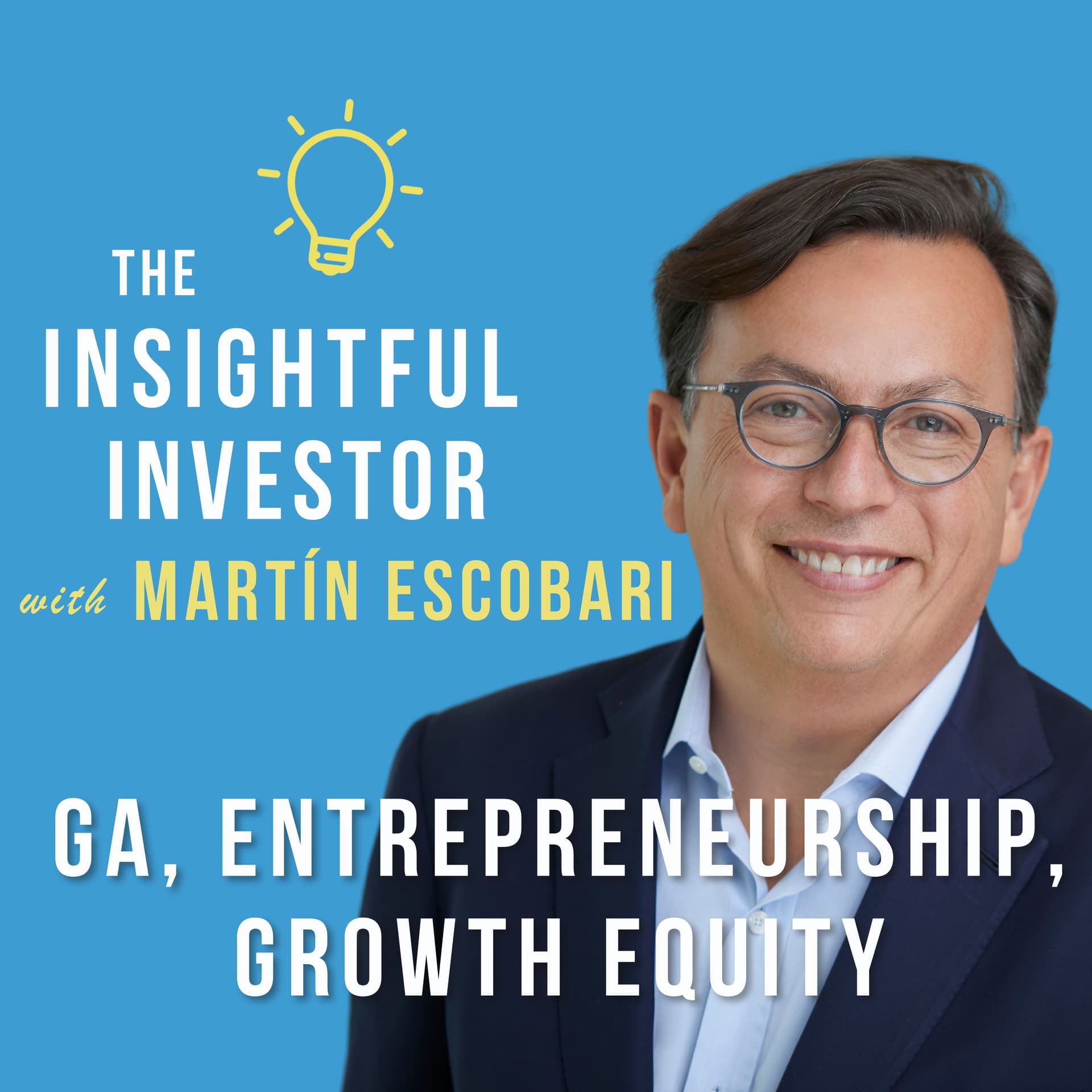
Episode Overview Title: #24 - Martín Escobari: GA, Entrepreneurship, Growth Equity Description: Martín Escobari, Co-President and Head of Global Growth Equity at General Atlantic, discusses his unique journey, entrepreneurial insights, and the outlook for growth equity in this engaging episode of the Insightful Investor podcast hosted by Alex Shahidi.
Key Takeaways
- Background of Martín Escobari:
- Born in a small town in Bolivia; first Bolivian to attend Harvard.
- Co-founded a successful company in Brazil, leading to a role at General Atlantic (GA).
- Emphasizes the role of "lucky accidents" in shaping his career.
- General Atlantic (GA):
- Founded in 1980, GA manages approximately $84 billion and is a pioneer in growth equity.
- Core principles include supporting entrepreneurs globally and focusing on long-term value creation.
- Emphasizes the importance of philanthropy, stemming from founder Chuck Feeney's vision.
- Investment Philosophy:
- GA focuses on sectors where they have developed deep expertise, known as "power allies".
- Emphasizes the significance of maintaining a strong brand reputation and building long-term relationships with entrepreneurs.
- GA's approach to portfolio management includes intensive support and intervention in their companies to enhance performance.
- Balance in Investing:
- Escobari discusses the importance of balance in various aspects of life and investing, including:
- Balancing optimism and realism.
- Recognizing the value of emotional intelligence (EQ) along with intelligence (IQ).
- The need for adaptability and flexibility in decision-making.
- Decision-Making Framework:
- Escobari uses a combination of data analysis and gut instinct to inform investment decisions.
- Emphasizes learning from both successful and unsuccessful investments to refine decision-making processes.
- Introduces the concept of using AI (Ada) to assist with data-driven investment decisions.
- Future Perspectives:
- Discusses the ongoing revolution in technology, healthcare, and the energy sector.
- Predicts significant advancements in biotechnology, potential societal changes from AI, and a shift towards a greener economy.
- Highlights the challenges of potential geopolitical tensions and societal polarization.
Discussion Points
- Entrepreneurial Mindset:
- Identifying a "chip on the shoulder" as a common trait among successful entrepreneurs.
- The narrative of overcoming adversity as a predictor of future success.
- Growth Equity Insights:
- The importance of choosing the right partners and building trusted relationships with entrepreneurs.
- The difference between simply buying a company and forming a partnership with growth potential.
- Market Cycles and Investing:
- The cyclical nature of growth equity and strategic deployment of capital.
- Acknowledges the challenges of current market dynamics while maintaining a steady investment approach.
Final Thoughts
- Martín Escobari emphasizes the need for thoughtful and intentional decision-making, harnessing both analytical skills and emotional insight.
- The conversation underscores the intersection of technology, entrepreneurship, and investment, highlighting the transformative potential of AI and other innovations in shaping the future of business.
Additional Resources For more insights and past episodes, visit [Insightful Investor](https://insightfulinvestor.org/).
Disclaimer This podcast is for informational purposes only and should not be considered as financial, legal, or investment advice. The opinions expressed are those of the participants and do not necessarily reflect those of Evoke Advisors or its affiliates.
Written by AI. May contain mistakes. Listen to the episode to check what was said.
Transcript
Automatic transcript. May contain errors.0:06Welcome to the Insightful Investor Podcast, a weekly series that seeks to share industry, investment, investment, and market insights. We define insights as concepts that are counterintuitive, widely misunderstood, or underappreciated. In other words, unique ideas that you probably won't hear elsewhere. I'm Alex Shahidi, the host of the podcast and co-CIO of Evoke Advisors, one of the nation's leading investment advisory firms. Learn more about our show at insightfulinvestor.org.
0:43Today's guest is Martin Escobar. Martin is co-president, head of global growth equity, and chairman of the investment committee at General Atlantic, or GA. GA is a leading growth equity firm that manages about$84 billion and has been one of the pioneers of growth equity since its founding all the way back in 1980. Martin, thank you for joining us. Thank you, Alex. It's a pleasure to be here. Martin, you have a fascinating and unique background, and we must start there. Would you talk about your journey from a small town in Bolivia to a full ride at Harvard to managing one of the largest private equity firms in the world and not being overwhelmed all along the way?
1:29Well, I was plenty overwhelmed along the way, but no, thank you for the kind question. It's an incredible privilege to be a senior leader at General Atlantic, which for 43 years has been a pioneer in growth equity and backing entrepreneurship and doing this globally. GA has been doing international private equity for 30 years. It's been investing in the emerging markets for 22 years and has backed some incredible entrepreneurs over that period. Everyone's life, I believe, Alex, is determined by a few lucky accidents. that makes sense on the rearview mirror, but they are unusual and surprising real time.
2:11So not only was I born in a small town, but my parents were communists and did not have the best impression of the United States in the 70s, which there were reasons why you did, if you were in Latin America, you did not have the most pleasant association with the US. And first accident was the neighbor was an English teacher and convinced my mom that it was in my best interest to learn English and convinced my mom that we should go to the American school because it was an oil town and it had a lot of subsidies to the American school. It was a really good school. So I went to a really good school in a small town.
2:45The second accident was getting a scholarship to go to Harvard, which was life-changing. I was the first Bolivian ever in 430 years to go to Harvard for undergrad. And that was an incredible, incredible experience. It's changed changed my life profoundly. And happy to report that since then, there's been 32 Bolivians that I've gone to Harvard College, and I'm very proud that my sister was one of them. So that's a special source of pride for me. Actually, both my sisters went to grad school. So Harvard is a big spot in my heart. And then I stumbled into GA. I, after business school, went to Brazil to be an investor, but it was 1998 and it was a complete bubble and it made no sense to deploy capital when you could raise capital with incredible pre-monies and people giving you a license to create.
3:41So I was a co-founder of a company called Submarino, it was the Amazon.com lookalike or Alibaba lookalike of Brazil and pitched my company to Bill Ford at GA in 1999 in Greenwich, Connecticut at the time. and GA made an incredible impression on me. Unfortunately, they did not have such a favorable impression on me, so they did not invest. It was a little too early for them. But it started, that was 25 years ago and it started my relationship with GA. We ended up building a great company, took it public, eventually sold it at a very good outcome for all our investors. Was briefly a partner at Advent and Bill called me back.
4:22And that was 15 years ago. And I said, can you come run Brazil for us? And I said, sure, yes, Bill. This time, yes. Okay, we both say yes. And built the Brazil practice, built the Mexico practice. And Bill invited me to join the Global Investment Committee. And I was the only person from the emerging markets in the Investment Committee. And it was a great experience for me. And then six years ago, I became chair of the committee, moved to New York. And then last September, I became head of Global Growth Equity. So an incredibly lucky path and very exciting and very grateful to be at GA today. And now today talking to you.
5:01I really appreciate that. The feeling is mutual. GA has a tremendous reputation. Would you share some of its core principles in case we have listeners who haven't heard of GA? Yeah. So GA was born out of one single individual called Chuck Feeney. who built a great retail business, World Duty Freeze, and ended up selling it in the early 80s. And he grappled with the question of what is the purpose of all this wealth I've created? He became rich beyond his expectations. And his answer was the purpose of wealth is to improve the human condition today. And he said, I'm going to start this small investment house called General Atlantic.
5:48And I want them to back incredible entrepreneurs globally, to be pro-entrepreneur, to be pro-company, to be long-term thinkers. And me, myself, Chuck speaking, I'd like all the returns of this activity to go into philanthropy. And I'd like to invest in philanthropy in my life so that I die a poor man or not a wealthy man. And he passed away last year Over the course of his lifetime, he donated$9 billion to great causes globally and is an inspiration to all of us. And it was his vision of building a platform that supports entrepreneurship. GA started just in the U.S., just investing in technology.
6:30We soon discovered that technology was changing many industries. So we went into fintech and healthcare tech very quickly within the first decade of starting. 30 years ago, we went into Europe, recognizing the phenomenon we call entrepreneurship. It's a global phenomenon, and technology disruption and entrepreneurship would create opportunities also in Europe. And then 22 years ago, we entered the emerging markets with simultaneously opening offices in China, India, and in Brazil. Over the course of that journey, growth equity, which was less than 1 % of all private equity, has now become 38%.
7:08So it's been a great journey. And the ethos of supporting entrepreneurs globally has been a constant through the 43 years of our history. One of the challenges with firms that start small, they grow through time, is transitioning from the original founding group to the next generation without degradation of returns. She has been able to achieve that. What do you attribute that to? We try to be very, very deep in each one of our strategies. So within GA, there's about 15 what we call power allies. These are business models where we've got between 10 and 20 years of experience. We've been doing investment management for 25 years.
7:52We've been doing value-based care for 20 years. We've been investing in online marketplaces, online classifieds for 20 plus years. So we develop, even though we have a broad mandate, in our strategies, we're absolute specialists. The second way in which we've kept our strategy fresh and our returns, I think, the way we measure our returns, by the way, is alpha. What's the premium we obtain for our investors over long periods of time? And are we earning our keep? And that number has been north of 10 % throughout 40 years. And we refresh that analysis. And whenever we find something is below that, we refresh the strategy.
8:30We have also developed in ways that we use our scale and our experience to our advantage. I'll give you two examples. Because we're so large, we can afford to have a portfolio support team that's north of 100 people strong. This team does 1 ,000 interventions per year in the portfolio with high-impact, short-duration, high-impact projects, and it really differentiates ourselves from less-scale players. That's how we use our scale. How we use our experience, over the years, we've codified what leads to breakout returns and what leads to capital loss. Typically, over long periods of time, about 10 % of our transactions generate 40 % to 50 % of our wins.
9:15So we find these transformative companies with more frequency than many of our competitors. And at the same time, our loss ratio has only been 3 % realized loss ratio, which is low for technology and growth investing. So there's something about the way we underwrite that allows us to have a disproportionate share of these transformative companies. And these companies have some common characteristics, which we've codified. And similarly, we've codified things that have led to capital loss, and we try to stay away from that. Version 2.0 of that framework is how we're using artificial intelligence today to make better decision making.
9:57Hopefully, we're going to talk a little bit more about AI later in the podcast, but it is a transformative new technology, which will lead to 30 to 50 percent improvement in productivity across the board. It can also lead to better decision-making by humans. Augmented decision-making aided by AI should be better than pure human decision-making. And for the last three years, leveraging 43 years of data, leveraging 20 years of voting data of our most productive investors who've become members of our investment committee, we've trained the machine, we call her Ada, to vote on all our transactions.
10:33So that's sort of the checklist version 3.0 in where she's helping us make better decisions burdened by lots of data. So we're constantly thinking how we use experience and scale to produce better returns. And then the third component of the durability of our returns, I think, is our brand. Our brand is 43 years old. It stands for being a good, thoughtful, long-term partner. our referenceability with former CEOs who we've backed, it's very, very high. We defend that brand deeply because in today's market, all entrepreneurs have choice in terms of sources of capital. And you have to be able to differentiate yourself in ways that are meaningful to them.
11:21And I think we work really, really hard to preserve and continue to build and push forward what our brand stands for. I wanted to chat with you a little bit about just general philosophy, because I've heard a lot of your perspectives, and I think it's particularly insightful. People who know me know that I'm a big proponent of balance. I think of it as being a key part of life. There's work-life balance, there's a balanced diet, there's balanced portfolios. You can extend this further to having a balanced perspective, not being overly optimistic or pessimistic. Like, I've heard you talk about balancing talking versus listening, balancing being dogmatic about the things you know are true and last and being flexible around all the other things.
12:08Are there any particular examples that come to mind that you'd like to share with this whole notion of balance? That's a great question, Alex. I'll tell you a story from one of our most experienced partners at GA, Dave Hodson, who's employee number three at GA. He's still working. He's still leading us into new areas. He looks amazing for his age. His brain is gorgeous. And over lunch among the partners, it was a big social lunch. I asked him, what's the secret to eternal youth? because he truly looks half his age and he's happy and bright. And the entire table quiets down because it turns out all 27 of us wanted to hear the secret to eternal youth.
12:56And he gave three tips. The most important one was I refuse to think like an old person. and and what he meant by that is all people are full of certainty and lose the ability of joy and wonder and young people are plastic and that's why they're so adaptable and so attuned to what's new and what's transformative and then what can lead to different outcomes and i every time i catch me being full of certainty and and and very certain on the path i need to take i remind myself that there's a child inside me and I wonder a little bit. And some of my best decisions have been when I have opened myself to the magic of the universe and to the uncertainty and to exploration.
13:41So keeping the brain plastic is very important. Recently, separate story, but one that touched me. In my HBS reunion, there's a new professor, Arthur Brooks, who's written about happiness. And it turns out the class on happiness is the most popular class in all of HBS. And it's around the science of happiness and the attributes of happiness. And one framework which he pushes forward is this idea that we all experience reality rationally and emotionally. And if you double click on how we experience reality emotionally, there are really four types of people or four quadrants, two by two, where it's just how strongly do you feel your highs?
14:27And how strongly do you feel your lows? And if you, for example, struggle really feeling the highs, but really feel intimately the lows, the archetype is the poet, incredibly sensitive person that dwells in the deepness of the mind and writes beautifully based on that asymmetry and how he experiences the world. If you experience the highs and the lows very intensely, the archetype is the mad scientist, if you experience the highs very high, but you don't really experience the lows, you're a cheerleader. And he jokes, it's his joke, so blame him if you don't like him. When two cheerleaders marry each other, they end up with lots of credit card debt and venereal diseases.
15:17You have to think carefully how you pair yourself. And then there's the low lows. They are the people that keep their balance emotionally. Don't get overexcited. and don't get over depressed. And when I look at the temperament of some of the great investors I've had the pleasure to learn from, they're low lows. They keep an even keel. When it's bubbly, they remember that, you know, things should always trade at a multiple of earnings and long-term, you can't avoid being valued on earnings. You can, I joke, you can, you know, taxes, death, and being valued at multiples of earnings, you can delay, but can never avoid perpetually.
15:57So I think there's something about the temperament of great investors, which allows us to be a little more balanced when we're exposed to something that draws super high emotions or super low emotions. But recently, three weeks ago, my teenage daughter, because I had told her about this framework and where I thought she landed, gave me a twist to this theory, which I began to implement. I don't know if I will be successful because we were in the middle of the Knicks Pacers playoff game and we had great seats and it was a nail biting game. And my daughter was screaming out of her lungs and I was even killed.
16:37And she went to me like, Dad, I know this is good for work, but you've got to turn it off for games and for fun. And I did. So I think you can have it both. But I think in the context of investing, keeping a balanced view and keeping your emotions in temper leads to better decision making over time. And in the next game, you should turn it off and enjoy the game. It's fascinating. I guess another way to think about it is a balanced perspective about the past and the future. And the way I think about that is not overly weighting the past. And another way to say that is extrapolating the past into the future, recognizing that the future may look different from the past and being somewhat balanced in that perspective.
17:26Pattern recognition is important. history doesn't repeat itself, but it rhymes. Of course, it's true. But the rate of change is accelerating and the number of variables is growing exponentially. So extrapolating a line from the past gets harder and harder. Something I have seen great investors do is as they think of projecting the future of an investment we're making, we're making a$200 million investing in a company that's growing 100 % per year. Typically, in an investment case, There's the downside case, everything went wrong. There's the base case, the thing we underwrite with 85 confidence.
18:03And then there's the upside case, which is we got lucky in many ways. And then you divide it into three scenarios. The reality is a million scenarios. You can get unlucky the first six months. And then, you know, year seven, something incredible happens that allows you to redefine the industry or whatever it is. The best investors I've seen think of a thousand scenarios, not three. And then they recognize situations that have a lot of embedded lottery tickets. And they try to think how we can make those lottery tickets become reality by changes to team, to strategy, to structures. and similarly ways in which you can get hurt and can try to think of mitigants and alignments and structures that make the outcomes lean more towards the, I got lucky and this is a 10X transaction and less against, we got extremely unlikely and two things that we thought were risk really materialized and hurt a lot of value.
19:03So I think thinking dynamically, recognizing with humility that the world is unpredictable, but having seen all the possibilities, identify opportunities that have a disproportionate upside relative to the downside is one of the great skills of an investor. I've heard you give presentations a few times and I feel that you're excellent at it. And I think part of what makes you great is your passion, but there's also the art of giving a presentation and conveying a point. And I sit in a unique seat in that I see investment managers make presentations to our clients And I know both of them pretty well.
19:39And the vast majority of presenters aren't very good. And I think it's because they're too deep in the weeds and they have trouble seeing the world through the eyes of the audience. And as a result, their message doesn't translate. And I think a lot of it is not talking at the right level. I'm curious how you think about giving a presentation. It's hard not to be passionate when you love your job. I mean, I have the best job in the world. I get to meet the most exciting global entrepreneurs of our generation. And I get to learn a new industry every week. And it's just my life is full of energy and variety.
20:17And I'm privileged. I joke with my partners, I would do this for free. And they remind me at every comm committee that I said I would do this for free. But I didn't really mean that I would do it for free. It just felt like I could do it for free. I'm also from Latin America. I think in Latin America, we are more comfortable showing a little bit more emotion. We all have emotion, but some cultures are not comfortable showing it. So that is also something to be aware. One of the strategies, clearly there's a component of knowing your audience and empathizing with the audience in a way that you can speak to them in a way that they will understand and they can relate.
20:53And there's some of that. There's something else, which is the best way to deal with complexity and we manage a lot of complexity in our daily lives, all of us do. If you're doing global investing in technology, it's even more. It's to try to synthesize it to the few core issues at hand and do it in a way that is soothing because it gives you a sense of control. So there's this famous, I don't know if it's true, but it's pop history, which is someone asked Churchill to give a presentation to a large audience. and they asked him, how long do you need to get ready? And he said, listen, it really depends on the length of the presentation.
21:41If you need me to speak for an hour, I'll need a week. If you need me to speak for five minutes, I need a month. But if I can go on for four hours, I'm ready right now. So this idea that forcing you to synthesize, it's really hard and requires a lot of preparation. But once you do, it's just pure energy in a way that you've distilled it to the point that it's accessible and absolutely true. You don't dumb it down. The mistake is to distill it by dumbing it down and oversimplify it and not being truly authentic to the complexity of the situation. But you can synthesize it without dumbing it down.
22:20That's incredibly powerful. It leads to better communication, but more importantly, it leads to better thinking. Yeah, I think that's right. Because there's a lot of times where I see somebody give a presentation and there's great insight within that presentation, but it's buried with a lot of noise. And the way that that works is you're assuming that the audience can extract the key points amidst all the fluff. And if you're able to just get rid of the fluff and just provide the key points, then you don't have to get lucky in that the audience extracts the right input. So I'll give you an example.
22:55So when I was co-founder of my company, my final role, it had many roles, was to be CFO that took the company public. In the two and a half, two years and change we were public before we sold ourselves, I must have done a thousand meetings with investors, which were fun for the first 30. But it gets a little repetitive, right? So I was like, how do I keep it fresh? and what started with one hour presentations and 64 slides, I would cut out pages, words, thoughts, and try to make it shorter and shorter and shorter, more to the point. And the definition of success was at the end of the presentation, there were very few questions left unanswered because 90 % of the questions in Vestor, that's where I was the same.
23:48I got it done from 64 pages to seven, from one hour to 17 minutes. And the beauty was, if you're done within 17 minutes, the conversation that ensues after that is so interesting because you created the empty space and you delivered the message in the shortest period of time without dumbing it down. So it's a good muscle to develop. It's fun to develop and it leads to better relationships, I think, and better thinking. Let's talk about decisions. Obviously, we all know that good outcomes come from a series of good decisions. It's like that decision tree. Would you talk through your process for making decisions?
24:26So when Bill invited me to be chairman of the investment committee from Brazil, moved to New York, I was a little... Many times in my life I've felt the imposter syndrome. So this is one of the 17 other times I felt the imposter syndrome. So I was like, how do I do this? These are some very senior managers that are going to... What do I have to teach them from Latin America to a deal in Germany or a deal in China? So I went to Steve Denning, our first CEO, an incredible man, McKinsey train, Navy lieutenant in one of those scary ships. Very disciplined man, a wonderful man. And I said, Steve, not too differently from what you said, what is your framework for making decisions?
25:15How do I make sense of all these complexity and sort of the broadness of our coverage and our reach? And he said to me, Martin, you need to develop a checklist. And it's a little bit of what I was saying in the beginning of the podcast, which is let's look at our best performing 10 % deals. Look at their commonalities and then look at your bottom 10 % deals where you lost money. look at the commonalities and create a positive and negative checklist and run this very complex organization called GA anchored around a checklist that filters out the noise. And I was like, this is a beautiful, beautiful framework.
25:51And I had read Checklist Manifesto, which was in vogue at the time. And it's all about checklists for pilots and checklists. I was like, of course, we need a checklist. The second meeting, same day, I go to Dave Hudson, the man with the beautiful mind that never ages, the same guy of the previous story. And I say, Hodge, same question. And his first phrase is, resist the temptation to use a checklist. If it was simple enough to be simplified into a checklist, people wouldn't pay us one and a half and 20 to manage the money. The world is a lot more unpredictable, and you have to be able to have the flexibility to see the complexities of the world.
26:32So I was like, these two guys were the two key managers of GA for the first 25 years, where we had fantastic returns, they built a great business, and they don't agree on the basic framework of how to make investment decisions. So this became like a, sometimes I get hung up on these research, these anomalies, that I have to reconcile these, like there's a way in which these two interact. And then I read Thinking Fast, Thinking Slow by Danny Callum, which is really around how our brains are really two brains. One is primitive and emotional, and the other one is rational and language-based, and how our primitive side often blurs our thinking.
27:14And he concludes the best way to have a balanced decision-making is to use checklists. So it's very much on the Steve cap. Not satisfied with his answer, I just started to look on YouTube. on interviews that he had done on this topic. And there was one interview that answered the question for me. It actually wasn't an article. It was an interview in print in an Israeli newspaper where he talked about how this idea of the checklist was born in his work for the Israeli Defense Forces in the process by which they selected people to the elite forces. And it was a highly inefficient system in that 80, 90 % of the people that were selected didn't graduate from the trainings, didn't make it to the elite forces.
27:56So he did a checklist to filter out the noise, and the 80 % failure rate became 10 % failure. So massive improvement in decision-making from the imposition of a checklist. But then he double-quicked on the data, and he found there was some dispersion of decision-making quality based on the interviewer. the person doing the checklist in assessing the candidate there were some super forecasters that had a 98 success rate so almost never made a mistake and there's one time he interviews this woman who's the best one of the whatever hundreds of interviewers and she says listen of course i do the checklist but after i'm done with the interview and the checklist i close my notebook I shut my eyes and see how I feel and I always go with my gut The uneducated gut is very primitive.
Read the full transcript
28:58It's good for running away from tigers and elephants and and praise The gut that has been educated with all the data so you thought your eyes cross your T's and you've gone through all the motions, yet you still accept the other data that is not there is the combination of both, which I think is the right way. That's how I approach decision-making, which is I go through all the data and all the diligence, but at the end of the day, if my gut says no, I listen to my gut. And if my gut says yes, I double-click on the data to see how can I be wrong on that. And some of the best decisions have been ones where they God overrode the brain and it worked out okay.
29:41But it has to be the combination of the bone. One without the other is a highly imperfect tool. That makes sense. That kind of goes back to our balance discussion in the beginning. Yeah. I'm curious how you think about this notion of alternate histories. You talked about collecting data. So what most people do is they look backwards and whatever actually happened is part of the data set. But what about all the things that could have easily happened but just didn't, shouldn't that also be part of the data set to give you a broader range to assess probabilities looking forward? Not only is what happened or didn't happen a part of accidents that now you're in the benefit of the future, you see what happened, but what actually happened is also a product of perspective.
30:30there is no such thing as a unique reality so it's a lot more complicated than almost misses and i and the guy that drove this point to me was this best professor i had in college professor dominguez and he taught a course on the cuban revolution government course and the structure of the course was kept secret so you didn't really know about the course I designed it. There was a process of discovery in the course. It was two classes per week. And on Tuesdays, we would talk about the beginning of the revolution from the standpoint of idealist young men who believe their country deserved better.
31:15And they were taking down a despot, a corrupt leader that has destroyed their country. And it tells the story of the first week of them landing and going into the mountains and immersing themselves with farmers. And you get a view that first week. On Thursday, there's no new assigned readings. He shows up and talks about the first week from the standpoint of the democratically elected government fighting an insurrection. From these lawless savages that killed innocent soldiers unprotected. The facts were exactly the same. The number of people die, the hour of the... The facts were exactly the same.
31:57The versions of reality were completely different and both equally convincing. So there is a humility in understanding that not only what happens is a product of some number of decision points that could have gone yes or no, but how you interpret and look back into what actually happened is also potentially not accurate because there were multiple perspectives and you weren't there. So it's a lot more complicated. It's a lot more humbling. I've always felt that one of our greatest constraints is time. Would you talk about how you think about the constraint of time and how that filters to your business philosophy, your investment philosophy, and perhaps even your life philosophy?
32:39I'm very generous on first-time dates. I mentor, I'm a board member and I've been a volunteer at Endeavor, which supports entrepreneurship globally. over 22 years that I've been a mentor, I have mentored thousands of kids, some of them more than once. Because I see a lot and I love to share. And in one hour with a young entrepreneur, I can be very, very helpful. And I'm very generous with first dates because I think it educates me and I can be helpful. And I occasionally stumble into amazing things that wouldn't have come had I not been very generous with first dates, first meetings. I am the opposite in what we decide to invest.
33:24When we invest in a company, we're signing up to be together through thick and thin for five to 10 years. And when we invest, you have the full support of the firm. So in any given year, we will meet 10 ,000 companies. We will do due diligence in about 2 ,000 of them and invest in 40. So extreme selectivity, because when we partner, it's very intense. And we want to make sure, since we only have 40 slots, 30 to 40 slots per year, that we're selecting the best 30 or 40. So very strict at not letting B candidates, complicated candidates, into that group of people where you're going to be in a journey for five years.
34:06So sort of flexible and very strict. Life has taught all of us to be hyperproductive, and there's a million books on productivity. activity, how you go through email, how you filter, how you da da da. So for a period of time, we and most senior executives have to develop sophisticated time management tools. What's urgent, what's important, what can be delegated. You get an email and if you can solve it in less than two minutes, solve it then, don't put it for later. There's all these hacks. And of course, I went through a phase in my life that that was a pursuit, which I think I got better at.
34:42But then something happens as you get more senior and older. The organization requires deep thought and ideas outside of the ordinary. And that's how you make the organization better and leave the company in a better spot than when you received it when you joined the company. And the ability to deep thought requires time for those thoughts to emerge. And if you're busy doing your hyperproductive stuff, you never have time to think the big things. So something I did recently, it's less than two years, I try to clear at least five hours of my week, which are just mine. They're not a buffer for meetings we couldn't schedule anywhere else.
35:33They're not a place where I leave some things to read. They're completely unstructured. And sometimes I go for a walk. Sometimes I go for an ice cream. Sometimes I go for a workout. Sometimes I just sit and read some book unrelated to anything. The frequency of big insights that I've had, and I don't know if they're right. We'll know in five years. It got up dramatically because I created a five-hour buffer within my 60 to 70-hour weeks, which is not a lot. It's less than 10%. But that which might seem anti-productive has actually been super productive in my ability to think thoughts that are not in the normal course of business.
36:10So I think you have to balance it. I'd like to think that we all have some superpower. What do you think is your superpower? And how do you find the superpower with the entrepreneurs and individuals you partner with? So I asked them. My favorite question is, what moves you? Why are you doing what you're doing? And my second favorite question is, what's your superpower? And those two questions, people talk a lot. And you get to understand the person. I think we've already covered my superpowers, is my ability to pierce through the fog of uncertainty and synthesize what's really important and create a vision of what could happen and have the sensitivity to know what the levers are to make the chances of getting lucky get a little bit higher.
37:05Martin, you're in the business of finding great entrepreneurs and through partnering with them, you help them realize their full potential. What would you say are the key attributes of a great entrepreneur? There is no one formula fits all, but things I see with higher frequency. they have a chip on their shoulder. They have something to prove to the world, to themselves, to their families, to their partners, that gives them an extra tank of oxygen in a journey that is very tiresome. And it doesn't necessarily mean they come from a little town in Bolivia and sometimes the trauma is the 13-year-old girl didn't accept them on a date and the other guy was richer, better, taller.
37:49It doesn't matter. The source of the trauma or the reason of the chip Sometimes it's idealism, the sense that the world is inquirably unfair and I want to bring financial inclusion or educational health care outcomes. Is there something that gives you that extra tank of gas? That is a very important one. The second one is a narrative of a track record of success. and I emphasize the narrative because many times you're meeting people and they're presenting their idea, their past. It's all about the almost wins. It was going to be great, but then the great financial crisis. I almost sold this business, but then the competitor went bankrupt.
38:35I was about to go to this great opportunity, but then my family situation. There's an alternative narrative of how you overcame adversity and delivered a consistent set of successful outcomes to you in your narrative of whatever the definition of success may be. That narrative is empowering. That track record is a good predictor of future success. And a lot of it is the mind frame. We all fail. We all face hardship. Do we dwell on that or do we just focus on the fact that we've been able to overcome many things and many things have come this way? So this narrative of a successful track record And then the balance of IQ and EQ.
39:17You need to be proficient at both. And often if you spike in one, it comes at the cost of the other. And you need to find ways to augment yourself with a partner or therapy or whatever way you can. But I look either in the individual or the group that this individual has assembled around people around him. there is balance of not just EQ and IQ, strategy and operations, being good with numbers, being good with TV. So it's this notion of balance, which we were talking to before, I think, individually, they have it, or the group needs to have it. Yeah, a big part of it is appreciating and having the insight to see your weaknesses, and then surrounding yourself with people who complement you.
40:03Yeah. Would you talk about the difference between being a successful entrepreneur versus being a successful investor since you've done both successfully? So I was an entrepreneur for seven years, helped build a company which did well, almost died, recovered and then did well. It's really hard. The journey of the entrepreneur is a masochist journey. All the odds are stacked against you. everything that could go wrong at some point goes wrong and you have to fix it and you got to keep morale and discipline on a large group of people of divergent skills experiences and ages it's really hard the reward is fantastic because you look back and you said this didn't exist and now it exists thanks to my labor and my team's labor and i've created it with our joint dna and it scaled to be transformative to the lives of clients and investors and so forth.
41:06It's an exciting journey, one that I love. What I learned having done it is how hard it is. And I'm constantly reminded when I'm sitting in a board meeting across from someone who comes bloodied from what the things he needed to do or she needed to do over the last quarter to produce the numbers that they produced. And just be grateful. They are the heroes. They're in the front lines. You're the supply line. We occasionally provide some intelligence from seeing tomorrow's newspaper because you have more data than they do. But they're the absolute heroes and their struggle is hard and we have to be supportive, appreciative and grateful.
41:43And that's how it changed me. Why I decided to be an investor as opposed to stay on and try to be a manager, which I seriously considered a serial entrepreneur. As I thought of my own strengths and weaknesses, the great managers are fantastic at leading large groups of people. They derive so much energy from this notion of I've got these 10 ,000 people, different levels, different backgrounds, different stages of life, and they're all connecting with me at an emotional and a rational level, and everyone is rowing in the same direction. and that energy, that exchange of energy is fantastic and they got this down.
42:30They thrive on that environment. I spike on more the thinking side. I thrive on variety. I thrive on understanding a new industry. Given a choice, I prefer a small team to a big team. It doesn't come as naturally to me, this idea of managing 10 ,000 people and so forth. So I gravitated to trying investing and I'm 20 years into it and I can't complain. But the biggest insight is the respect that we must have for the brave entrepreneurs that are conquering the new. It's hard. I've heard you make the distinction between buying a company versus partnering with a company. Would you talk about that a little bit?
43:19growth equity is buying a teenage company. It's already proven, it's already sized almost like an adult, but it's still growing at very high rates. And it still needs to decide where it's going to go to college and where it's going to go to their career. Our companies on average are growing 40 to 50 % per year. It is extremely hard to buy control or to buy 100 % of one such company. Because the people that are owning it and managing it recognize that if they wait 18 more months, the company is twice the size. If they wait five years, the company is five times the size. You would have to pay an absurd premium to buy control of such a well-operated company.
44:07And if the company is growing 50 % to 60 % without you, it's hard to argue that premium is justified because you're going to run it so much better than they're running it. So typically what we buy is between 10 % and 40 % of a company over some period of time and to give them primary capital, typically, to grow faster. So we never control. 80 % of the time, we don't control. The way we influence and partner with the company is we bring them great ideas based on the fact that we've seen thousands and thousands of companies for 43 years, tend to see what the dead end alleys are, the common mistakes, some things that seem to work in other situations.
44:48And then we give them resources that are available that are never imposed. So we've got this great pricing team. If you want, they can come in and tell you a little more. We've got this great Salesforce effectiveness team. We've got this great AI team that you want to spend some time thinking about how AI is going to change your world. That we provide and we never impose. And we always think the company's interest comes first. It's ahead of the management's interest and it's ahead of the investors is. It's the company. And the company's interests focus on the long term. And with that philosophy and with that approach, I think we're really good partners.
45:24Let's take a hypothetical. You and I are sitting in a room and we come up with a great business idea that we think has massive potential. What are the key steps we need to take to be successful? Starting with an idea is the hardest moment. It's the rocket at launch. The first two minutes are where 90 % of the accidents happen because it's so hard to launch. Advice I would give with people with a blank sheet of papers, go after a large market because that's the ceiling of how big you're going to be. Choose a business model that has a gross margin. So the market pays the premium to what it costs for you to produce that service or a product.
46:07And that gross margin is defensible. So once you've scaled, you don't risk someone coming in, offering something 10 % cheaper, and they take away the business. And thirdly, find the collection of co-founders and early employees that augment you in ways that make success in that business model more probable. And it requires diversity. If you're just hiring your buddies from Princeton who all went to the rolling team, it's unlikely you have enough diversity to fulfill the mission as complex as the one you've approached. So those are the three general comments. The reason there's very few venture capital firms that have had consistently higher returns is that it's really hard to judge the potential in the business when it's still in the seed or Series A.
46:59The idea might be great. The team might be great. But it's so early and you have so little data that the breadth of potential outcomes is very, very diverse. And that's why the distribution curve of venture is, you know, 5 % of the deals are 80 % of the gains and 40 % of the time you lose money. It's a lot more diverse. What they do is they do deep due diligence on the founder. There's a great venture capitalist, I'll go on name, he says, we have so little information on this 21-year-old, we went to his sixth-grade math teacher to ask her how he was approaching problems in the sixth grade, and she gave a great answer, and we gave him the 100K.
47:39It's just hard. By the time you're coming in for your Series C, which is when we meet a company, there's three years of data. There's customer survey data. There's competitive assessment. There's a technology assessment. There's a deep management assessment we can do. So there's a lot more data. So even though we're being asked to pay a higher price because the business is more advanced, our position, that's why we've never gone into venture, is the risk-adjusted returns when we come in is actually the optimal point, which is still early and the company can still grow 10x, maybe sometimes more, but you have enough data points that you can keep your error rate below 5%.
48:18And we've kept it at 3%, which we find very good. One of the key data points is knowing how people respond to adversity. We can learn a lot about people when they go through a difficult period. How do you think about selecting partners who you want to have by your side when the next storm comes, particularly the ones that have not been battle-tested? One of the things that we pride ourselves is we try to be good partners in good times and that times. And when we embark on a journey, we're going to see this through. And even if the end is we shut down the lights. It happens seldom, but sometimes happens.
48:57Especially in the bull market in 19 to 21, there were a number of more recent players into the growth space who were paying more, doing diligence in days, not months. And we're very transparent. They said, if you need help, we're not the right partner for you. We're just cappers. But we are, you know, we pay top dollar and we get out of your way. And I told a lot of, and we lost a lot of business to those people in 19 to 21. But what I would always tell entrepreneurs is like, you're choosing a partner, a wife or a husband. Do you choose the one that's the fastest to marry and has the biggest dowry?
49:37Or you choose the one that's going to be there in good times and bad times? I think you choose the one that's going to be there in good times and bad times. most entrepreneurs have had difficulties in their life. So it's very hard to get to 25 or 30 and not have had adversity. I haven't yet to meet a person that's 35, 30 years old that describes their life without any adversity. A lot of people, however, have not had serious business adversity. And that's where the combination of their youth and some of our experience. and I find in dealing with adversity pattern recognition is important and I always start with the first question which is, is this going to kill you?
50:23This big problem that we're very focused on, but you were hacked, you're being the ransomware attack is this going to kill you? Physically? The answer is always no then we're good, let's just deal with the problem and you take the emotion out and you begin to sort of parcel out the steps you can take to prepare yourself for survival. And it is my experience, and again, I'm getting older, so I have more experience, the best opportunities happen in the aftermath of a great tragedy or a great dislocation. It shakes things up in ways that are not predictable. And as long as you don't die, physically and corporately, you are going to be in a great position to capture an opportunity.
51:06It can be M &A, it can be reinventing a business model. I'll give you one example. So we were investors in a gym membership, corporate gym membership program, very successful in Brazil. And I said, let's come to New York and we'll do it in the United States. And it was doing well for a while. And then COVID hit. Gyms were closed. Revenue zero. Costs high. And this business had never launched a digital alternative to going to the gym because the gyms hated it. They're like, no, no, I can't be on the same platform where you can do an online from your room than from the gym. Because of COVID, the gyms themselves started employing their trainers to do virtual sessions.
51:53And the platform became both virtual and physical without any resistance. Welcome. them. That opening of the floodgates, the coexisting of physical and online, was only possible because we had this great disaster, this horrible disaster that created this great opportunity. A few years later, GymPaz is now WellHub because they discovered that this digital hybrid can be used not just for fitness, but also for mental health, for weight loss, for all sorts of other services that are hybrid. So this is a company that reinvented itself in ways that are only possible in the aftermath of a tragedy, a very sad tragedy, but it created an opportunity.
52:39That kind of perspective is one that's useful to have as you cross the valley of death. We live in an age of unbelievable technological innovation, and I know that's something you're very passionate about. What do you think the world looks like 10, 20, 30 years from now? So there is no one version of the future, right? As we've agreed before. The virtual version of the future is 90 % of the world is online. We're already at 60. 60 % of the world is transacting and communicating online. We're going to be north of 90. And that's amazing because the digital inclusion is one of the great hacks of lifting humanity out of poverty.
53:23healthcare innovation, particularly around biotechnology, is going to make us live well into our 90s with tremendous amount of vitality and health. And people are going to be having third, fourth, and fifth careers in their 80s and their 90s. So the promise of longer, meaningful lives, the statistic is competitive. Half of the untreated disease burden of the world has some sort of biological solution in clinical trials. So if you fast forward 30 years with the acceleration of innovation now powered by AI, health spans are going to be much expand. And the third one, I think the future is green.
54:05Not only has 80 % of the world GDP signed up to net zero, we're seeing early signs that unless addressed, the climate situation is going to get very, very tricky. So I think there will be political will. there already is technology solutions to get the net zero. We will, and the world will be greener. So all those three things mean that my daughters will have a much better future than, much more difficult, much less difficult future than I did. Healthier, more productive, with less poverty. The two big risks that I worry about, one is Cold War II. decoupling of the US and China can be handled productively by choosing areas of common objectives and choosing to have commercial disputes and segregation in certain areas, but the two countries of the two blocs coexisting peacefully or not.
55:02That's a big if. I still think you're more likely to find peaceful outcomes, but that's a big risk. The other big risk, not completely unrelated is the level of polarization in society as spiked, not just in emerging markets. And you see it in France, you see it in the US, the division between the left and the right, the haves and the have-nots, it's becoming more divided and potentially more violent. And at its root, I think, is rising inequality in a portion of the population for whom the current system has not produced increase in wealth and well-being. I mean, the baby boomers saw more rise in disposable income and waste growth than the last 30 years, where globalization eroded the labor force manufacturing to go to the emerging markets.
55:58So it's a very tricky situation. Democracy becomes more challenging. Good governance becomes more challenging. There's a way out through dialogue and bipartisanship and other ways. But these two things are the scary pieces of the future. But the other three are so exciting. So I lean with optimism, not with fear. And if you look at that, the growth of technology and innovation and the productivity that's come from that, the slope has been relatively steep. Do you feel that AI has changed the trajectory even more? So we're in the early stages of AI. And investing in AI companies today is a little tricky because the valuations are disconnected from reality.
56:44Now, as a user of AI in the portfolio, in my personal life, in my professional life, it's the greatest innovation tool since the Internet, which was 25 years ago. it is likely and we're seeing data proofs across the portfolio that you get 30 to 50 % gains in productivity when you use AI to augment programmers effectiveness on the coding when you use AI to do customer service it is likely we will never talk to a human again when you call a call center because Bob is going to be so much better at resolving your issue and we'll remember all previous interactions that you had and will be absolutely assertive and definitive in solving the problem real time.
57:31We're seeing tremendous amount of productivity gain in online marketing. We're seeing online marketing costs come down 20 % to 30 % because unlike a human that can only do A-B testing slowly, a machine can do A-Z testing faster, cheaper, and get to the most effective end very, very quickly and can actually customize ads for different clusters with agility. So the promise of AI is fantastic. I think it's going to be amazing. I think there's a little bit of hype right now. There always is. There was hype around the telecom bubble. There's hype about the internet. There's hype around the mobile internet.
58:08There's hype around biotech. Hype is how we mobilize resources to make the future happen faster. And you just have to protect yourself not to get burnt on being too early. but super exciting and we're embracing it in the portfolio on that chair. It seems the hype can also be self-reinforcing in that if you're a business, you don't want to be left behind. And so maybe it speeds up the investment in AI to keep pace with your competitors. If there hadn't been a hype around telecom in the late 90s, the magnificent coverage that we have, broadband and wireless, would have been 10 years late. Instead, there was overinvestment and then the consolidation.
58:49And the end result, we had infrastructure sooner. Same is going to happen with AI. Overinvestment, consolidation, AI soon. You gave us a little glimpse into Ada at GA. Would you talk about her a little bit more and how she's involved with decision making? Sure. Our investment committee meets every Tuesday and takes five to seven hours. And we look at deals from around the world. And these are open forums. so all the investment professionals are invited to participate. It's listening only, but incredibly insightful to see your most experienced investors debating out the issues of the risk and the upsides of an investment.
59:30After we've discussed, we go into an executive session, which is only open to partners, and we vote in the app. So there's five investment committee members. We all vote independently, and then we show our votes to each other. and we sometimes try to convince each other to switch to a yes and so forth. At the time that we show our votes, we're showing a sixth vote, which is Ada, which is saying yes or no and why she's saying yes or no. And she's very fact-based. She's not emotional at all. She doesn't like one partner more than the other. She's just driven by fact. And the commentary that she provides is very insightful.
1:00:12She'll say things like, I have not seen such rapid margin improvement in this geography ever. And you're like, hmm, that's not a feeling. That's a fact. Maybe the planet is a little rosy. So it's interesting. It's early. We back tested it. So if we had had ADA in the past, would we have been a better investor? And unambiguously, Ada is, because she was trained in the past, she's much better than us at predicting the past. So she beats us in the past. The real test is going to be, as we have more experience with Ada real time, was she better than us? And in which ways is she better than us? And can we learn from that?
1:00:59And how can we make Ada smarter? Like Ada 1.0, in our vision, is trained on our data. And that's, you know, 43 years of data. We have a lot of data. But the universe has a lot more data. So ADA 2.0 is going to be trained on the data of some of our friends who are willing to pool data. So we draw collective insights on that information. ADA 3.0 is going to be able to answer questions. And that's the one that I think is most exciting because that means all our investment professionals, as they go up their journey of learning how to be invested, They have a sparring partner that they can ask questions and someone who's burdened with lots of data can give you a precise, non-delusional answer.
1:01:43But we're far away from ADA 3.0. By the time we have ADA 3.0, I'll be retired in some island in the Caribbean, living a very happy life. It's fascinating to see the evolution of that voter or investment committee member. And I suppose just like anybody else, they have certain credibility in areas, probably in this case, historical data. Yeah, numbers. So that is an interesting perspective. And it seems that it would be helpful because they're diverse to the other voting members. Absolutely. What are the major sectors you focus on and why? Listen, we've been investing in technology for 40 years.
1:02:23Technology is the core. But technology is also changing financial services, payments, healthcare, even the way we've received consumer products. So we've expanded. As we sit at today, three very exciting trends. One is we're in the golden age of biology. The future of healthcare is through biologics. And the speed of innovation is accelerating. and the funding model to take a new idea through clinical studies is broken, so much so that too many biotech companies go public free revenue, which is an anomaly that shouldn't exist. So that's very exciting. Digital transition is one that we've been investing for 40-plus years.
1:03:0980 % of our portfolio is digital. Now there's the twist of which businesses will be transformed faster with AI. and we're iterating and there's some really interesting examples of companies that are using AI to generate content quickly, make better decisions, affect human behavior in ways that get you more healthy based on signals that you send that in the context of large data sets, the AI machine can take. And the third one is the energy transition. It will take$9 trillion a year of investing to get to net zero. That's probably 10 % of that is going to be very high margin and very high return.
1:03:51So we've been investing in asset-like digital transition technologies now for four or five years. And with the acquisition of Actis, we're getting into the actual infrastructure side of energy transition with a team that has 20-plus track record of doing it in a very tough neighborhood, which is the Global South. So those three trends are top of mind and will lead to, I think, a lot of activity. In terms of investing in companies, I've heard you talk about always being willing to pay a fair price. Sometimes the clearing price is not a fair price. How do you respond to those environments? And do you ever compromise on your belief that we should just be paying a fair price?
1:04:35One of the dangers of growth equity is the cyclicality of it. and it means that there will be certain years where everything is overexcited and overvalued and there are some periods of time where everything goes on sale. And our job is to not get overexcited but also not shut down when we're overly depressed. Being a global investor, we interact with entrepreneurs with various levels of financial sophistication. And particularly in Latin America in the beginning of my journey with GA, there would have been many situations where I probably could have invested at a significantly lower valuation because of the lack of sophistication, lack of competition in the market.
1:05:16And I said, no, because if I want to, my partnership with this entrepreneur starts with a situation where I have done this thing hundreds of times, and this is the first time he's doing it or she's doing it. And so we overpaid by 10, 20 % of a number of situations because it was the right thing to do. And that came back to us times 10, because we were seen as constructive players that were trying to do the right thing. Similarly, in 19 to 21, we were bombarded by crossover investors who were paying 30 to 50 percent above with a value proposition of speed and low touch. And we refused to partake.
1:05:57And we said, we don't think this is the kind of partnership. We don't think the growth at any cost mentality that they're incenting is one that's conducive to long-term value creation. We lost a lot of transactions. In retrospect, many of those companies came back to us after the correction and said, now I need help. And then I said, remember the fair price? That's the price we're going to do it. Okay, let's do it at the fair price. Vintage is very important, obviously. And a lot of that is driven by the economic cycle, which is largely unpredictable and has a potentially large impact. How do you think about that economic cycle?
1:06:34Listen, the cycle is only obvious with a rearview mirror. So we try not to be market timers and try to have a steady deployment pace on the deployment side. So we try to run our funds three-year cycles, which means when the market's really hot, we're going very slow. but it also means years like this year where the market is not hot and everything's on sale, we're going to deploy$9 billion. But we're steady. We're not steady when it comes to the liquidity. If someone is willing to give us tomorrow's price today, we think about it. But if they give us next month's price today, we don't even think about it.
1:07:09You can have it. So I think we've been able to be flexible on the realization, which is a great way to converting equity risk into cash and discipline on the deployment. Because a lot of our companies are digital disruptors, 90 % of their growth is irrespective of GDP growth. So yes, it moves the needle a little bit, but the secular growth is the primary driver of the growth. So we're not as vulnerable as buyouts or consumer companies to the GDP growth. One area we are vulnerable to is FX. because we report our returns in dollars, and half of what we do is not dollar-genominated. So we do monitor the strengths and weaknesses of a given currency and the risks to that strength or weakness as we make decisions about what's the acceptable level of return given that risk profile.
1:08:04And the most dangerous variable to track is how levered is a company or a country. leverage is a great enhancer of returns when things are up and to the right and I get great destroyer of good night's sleep when things are not up to the right. So we we try we try to monitor that. And in our companies, we keep them with very low left. You know, two thirds of our companies have zero debt. When we lever something, we tend to lever it, you know, less than five times, four times, but only highly recurring revenue businesses. So that's the number one watch out that we always monitor at the country and the company level, which is the level of leverage.
1:08:45And how do you think about the current market environment? So we kind of had a boom a few years ago. You've had a downturn. Where are we in that cycle? For growth equity, best market in 15 years for deploying capital. It took longer to correct. the correction which started in 21 and finished in the beginning of 22 because companies were so overcapitalized. It took them a while till they needed to come up for air. They're up for air. Similarly, there's 10 ,000 GPs that raise capital for venture and growth just in the United States. Many of them are coming up with fundraising, and their investors are like, can I please have some of my money back before I give you more money?
1:09:30So there's a tremendous amount of pressure, not just from companies who need capital to finance their growth ambitions, but also from GPs who need to show some DPI so they can fundraise. So the current pipeline, as I said today, and we just had the investment committee earlier today, the pricing and the quality of the companies, it's the best entry point into growth equity in the last 15 years. It's also the hardest time to raise funds for growth equity in the last few years. So the two things tend to go together. And but to all the people who are listening, not just with GA, I think all growth equity, seasoned growth equity players will benefit from very good two years, given all that's gone on.
1:10:12Martin, you've been very generous with your time. Do you have any closing thoughts or any unique insights you'd like to share with our listeners? No, I just thank you, Alex, for having me. It's always fun to get questions that go deeper than just what's your strategy and what's your DPI. And so it's fun to do it. And for those of you that shared this hour with us, thank you very much for your time. I appreciate it, Martin. Thank you. Thanks for listening. We hope you enjoyed this episode. Please visit our website at insightfulinvestor.org to access past shows and learn more about our podcast. If you have questions, feel free to email us at info at insightfulinvestor.org.
1:10:54And if you enjoyed the discussion, please subscribe to this podcast to ensure you don't miss future episodes. And don't forget to forward today's conversation to others you think would enjoy listening. This podcast is provided for informational purposes only and should not be relied upon as legal, business, investment, or tax advice. All opinions expressed by podcast participants are solely their own opinions and do not necessarily reflect the opinions of Evoque advisors, their affiliates, or companies featured. Due to industry regulations, participants on this podcast are instructed not to make specific trade recommendations, nor reference past or potential profits.
1:11:32And listeners are reminded that securities trading, commodity trading, and alternative investments are complex and carry a risk of substantial losses. As such, they are not suitable for all investors.
1:12:09with respect to Evoke Advisors, the podcast host, or their services. Similarly, the inclusion of a guest on the podcast does not imply that Evoke Advisors or the host endorses the guest or any company with which they may be affiliated or employed. Evoke has neither paid nor received compensation from guests for their participation.
From the publisher
Martín Escobari is Co-President, Head of Global Growth Equity and Chairman of the Investment Committee at General Atlantic. GA is a leading growth equity firm that manages $84B and has been one of the pioneers of growth equity since its founding in 1980. Martín covers a wide range of topics including his philosophy, entrepreneurship and the outlook for growth equity.


