
In short
Insightful Investor Podcast Episode Notes
Episode Details
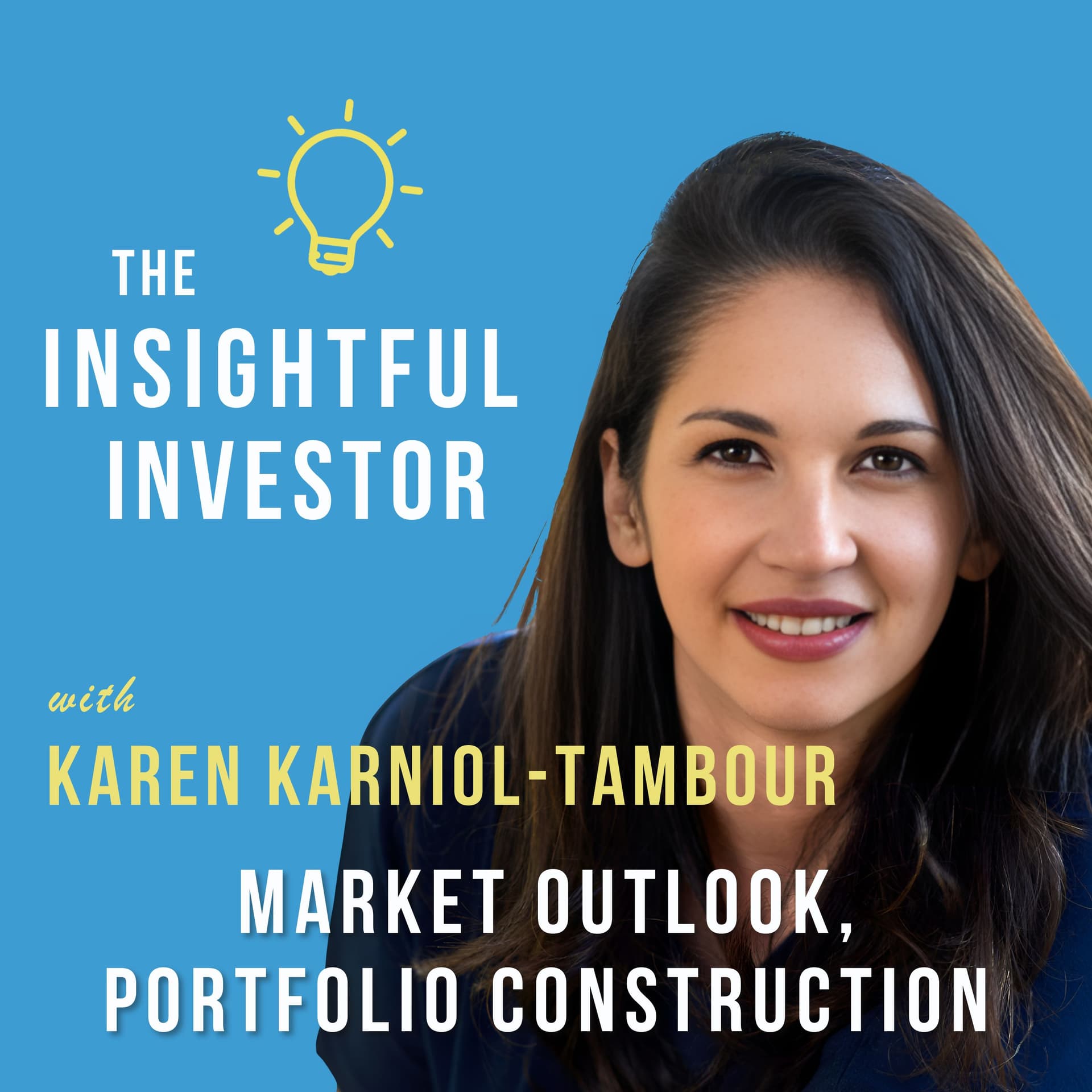
- Title: #29 - Karen Karniol-Tambour: Market Outlook, Portfolio Construction
- Description: Karen Karniol-Tambour, Co-CIO at Bridgewater Associates, shares insights from her 18-year career at the firm, discusses Bridgewater's current market outlook, and provides strategies for effective portfolio construction.
- Host: Alex Shahidi, Co-CIO of Evoke Advisors
---
Key Takeaways
Guest Background
- Karen Karniol-Tambour:
- Co-CIO at Bridgewater Associates, one of the world's largest hedge funds.
- Joined Bridgewater in 2006, initially without a clear interest in finance.
- Influenced by her academic background, particularly her thesis with psychologist Daniel Kahneman, focusing on human decision-making flaws.
Bridgewater's Culture
- Meritocratic Environment:
- Encourages open discussions irrespective of seniority.
- Fosters a culture of challenging ideas and mentorship.
Personal Insights and Strengths
- Curiosity & Energy: Identifies herself as someone who flows to impactful opportunities and quickly synthesizes complex information.
- Communication Skills: Recognized for her ability to distill complex ideas into understandable concepts.
Bridgewater's Future Vision
- Focused on maintaining investment excellence while adapting to changes in market conditions.
- Aims to deliver significant value to institutional investors through deep understanding and innovative strategies.
Market Outlook
- Transition from a 40-year investment paradigm characterized by:
- Lower interest rates and disinflation, to a new era with higher structural costs of capital.
- Current economic landscape shows increased volatility with inflation becoming a significant factor.
Impact of AI
- AI could dramatically reshape the labor market and economy, potentially displacing more than 10% of the workforce.
- Short-term implications may be inflationary, while long-term effects could reshape economic structures.
Portfolio Construction Strategies
- Three Return Sources:
- Cash Rates
- Risk Premiums (Beta)
- Alpha (Skill and Timing)
- Current Portfolio Trends: Many portfolios are overly concentrated in U.S. corporates, neglecting diversification.
- Resilience Building:
- Suggests moving towards balanced asset allocations.
- Incorporating inflation-protected assets, such as infrastructure.
Practical Steps for Investors
- Reassess Goals and Constraints: Understand acceptable loss thresholds and volatility tolerance.
- Evaluate Asset Allocation: Update allocations to reflect current market conditions.
- Ensure Each Allocation Meets Goals: Focus on real alpha in equities and the purpose of bond allocations.
Avoiding Catastrophic Losses
- Stress the importance of avoiding tail risks and maintaining a consistent returning pattern.
---
Discussion Highlights
- Human Psychology in Investing:
- Discusses the psychological barriers in realizing the importance of diversification and risk management.
- Long-term Investment Perspective:
- The need to zoom out and recognize that past performance is not indicative of future results.
- Risk Management:
- Emphasizes the importance of hedges and diversifying to manage exposure to potential downturns.
---
Closing Remarks
- Karen and Alex conclude with a reflection on the intertwining of market psychology and economic principles in effective portfolio management. They emphasize the need for investors to adapt their strategies to the evolving market landscape while remaining vigilant about historical lessons in investment behavior.
Additional Resources
- Website: [Insightful Investor](https://insightfulinvestor.org/)
- Contact: info@insightfulinvestor.org
---
This episode of the Insightful Investor Podcast not only highlights the experiences of Karen Karniol-Tambour but also provides listeners with valuable insights into market dynamics and effective portfolio management strategies.
Written by AI. May contain mistakes. Listen to the episode to check what was said.
Transcript
Automatic transcript. May contain errors.0:06Welcome to the Insightful Investor Podcast, a weekly series that seeks to share industry investment and market insights. We define insights as concepts that are counterintuitive, widely misunderstood, or underappreciated. In other words, unique ideas that you probably won't hear elsewhere. I'm Alex Shahidi, the host of the podcast and co-CIO of Evoke Advisors, one of the nation's leading investment advisory firms. Learn more about our show at insightfulinvestor.org.
0:43Joining me today is Karen Carneal Tambor. Karen is the co-CIO at Bridgewater Associates, which is one of the largest hedge funds in the world. And Karen joined Bridgewater back in 2006 after graduating from college. Karen, welcome. Great to be here. Thanks for having me. Karen, before we discuss your market outlook and thoughts about portfolio construction, I'd love to share some of your background with our audience. Why don't we go back to the beginning? What would you say originally sparked your interest in investing? Well, I definitely was not one of those people that sort of grew up knowing this is what I was going to do.
1:24Even through most of college, it's not what I expected to do. I don't think I could have really explained what a stock or a bond was until very close to graduating from college. But my parents were both professors growing up. I somewhat assumed that that would be the path I would take. and as soon as I got exposed to investing though, it spoke to me right away that it's kind of an industry where you just get to sort of think about what's happening in the world and predict what's going to happen and you kind of live off of your ability to understand and make your own decisions, which is very appealing for someone who wants to think about and understand the world.
1:59So I was drawn to it right away as something potentially interesting, but I don't think without kind of meeting Bridgewater on campus and running into the firm I would have ever likely ended up in this industry. So I guess that there's certain aspects of the industry that just seem to be a very good fit for the way you think and the type of career you'd like to pursue. Yeah, I mean, when I was an undergrad, I wrote my thesis with Danny Kahneman, the author of Thinking Fast and Slow. And I was fascinated by human decision-making and its flaws. And when I ran into Bridgewater, it sort of occurred to me like they built a whole firm around the understanding of the flaws in human decision-making, built a whole firm around the idea that humans are going to be really good in sort of, you know, system two, slowly thinking through cause-effect relationships, trying to reason what's happening in the world.
2:53But that doesn't mean they're going to be good at day-to-day making decisions, remembering everything they thought about in the past, monitoring their emotions, avoiding kind of all the biases and what it's like when all the data comes at you. And the firm was really built to bring together that fundamental thinking with being able to take a more systematic approach to then putting together all of your thoughts. So that spoke to me right away as a really interesting way to think about decision making. So you've been at Bridgewater for 18 years now. Would you talk about how your experience relates to what you had expected when you first joined the firm?
3:28Honestly, I don't think I had very many expectations. And I think it was a little bit to my advantage because a lot of people came in with this feeling of, you know, I finally made it. I'm at the biggest hedge fund in the world. Now I got a lot to prove. And I didn't feel like I had a lot to prove because I didn't know if I even wanted to be there. I was sort of exploring and figuring it out. And so I think it made me less hesitant to ask questions and say things that maybe even sounded sacrilegious to the firm. And it's a really helpful thing in your career to be able to kind of question things and not feel like you're too nervous to ask because you sort of have something to prove.
4:05I think that was very helpful. The thing that definitely met my expectations as soon as I started meeting people from Bridgewater, it really spoke to me about those people relative to everyone else I had met kind of on the job market It was how much people were really, truly motivated by deeply understanding how things worked and why, rather than, you know, kind of sounding smart, proving things out, but really wanting to understand. And everything goes from there. And that the firm has definitely lived up to that. That's definitely our culture. Well, you've steadily advanced at Bridgewater and are now one of the co-CIOs at a relatively young age.
4:40What is it about the culture there that has enabled you to thrive so far? I think it is a very meritocratic culture. We encourage people to speak their minds and express their opinions, regardless of how long they've been at the firm. When you look at our key investment meeting of the week, we kick off every Monday morning with an investment meeting. There is research that people read over the weekend before that meeting, and anyone can comment on it. And a lot of people at a lot of different levels of seniority write comments. And some of those people that you've never heard of and are way more junior actually write some of the most insightful comments.
5:18So there's really a culture that encourages people to kind of speak up at any level and to draw out ideas and not to kind of build meetings hierarchically, but really seek what the disagreements are and where you can get views from different people. And at the same time, there's a very strong culture of challenging people. So there isn't a sense of, you know, you sort of have to get really good at your job and be a little bit bored in it before somebody is willing to give you the next challenge, but much more challenging people quickly and pushing them to do the next thing. And a really strong culture of mentorship.
5:51And so the three chief investment officers when I started, Ray, Dalio, Bob Prince, Greg Jensen, all were incredible mentors to me as were others at the firm. And often Bob Prince, I think was my closest mentor, honestly saw things in me before I saw them myself and pushed me to do things before I sort of thought I was capable of them. So I think those three parts of the culture really help us bring a lot of people up the curve and into big leadership positions, relatively young, relatively early when we see talent. We have a bunch of people that, you know, you'd be surprised maybe are in the role they're in because we kind of saw that talent early, spotted it, and were able to kind of challenge them and encourage that really quickly.
6:27And I think it's a lot of what made us successful. Let me dig into that a little bit. You're in a unique situation because you're surrounded by some of the smartest, hardest working people on earth. And when you look around, you know, thinking objectively, and you see what you're really good at relative to the others that you're constantly interacting with, what would you conclude are some of your superpowers? Superpowers. I like that phrasing. I mean, I think I have a lot of curiosity and energy. I sometimes say that I'm like water. I flow to where I kind of get a sense of the biggest impact.
7:10So I really kind of like will be drawn to where I see the biggest potential for impact. And I think I get to a cut through synthesis heart of the issue quickly. So I think my ability to kind of look at, you know, a deep set of analysis and a lot of information about what's happening in the world and kind of get to the heart of the issue quickly has let me kind of do a wide range of things. But at the end of the day, I think that almost anybody in this business, you kind of have to have curiosity and like deep interest in understanding what's happening in the world and what's going to happen next.
7:53That has to be part of your superpower suite, if you will, because that's what we do at the end of the day. That's what investing really is. There's one other that I'd like to share just knowing you for a long time. It's one thing to learn quickly and be able to synthesize things in your mind. It's another to be able to effectively communicate that to the audience and to the rest of the world. And that, to me, is a very distinct skill. And I've just noticed the way you explain things is just you hear it and you say, oh, that's obvious. But synthesizing it to that degree and making it sounds simple is not an easy thing to do.
8:28Well, thank you. From you, you talk to a lot of people and see a lot of things. I really appreciate it. Let's talk about Bridgewater a little bit. You mentioned Ray Dalio, the founder. He recently handed the reins over to the next generation. What would you describe as the vision of the firm over the next decade or so? I think that we're trying to both have a significant amount of continuity, but also open ourselves to changes and understanding how the world is shifting. Most importantly, our goal is to really over-deliver on our investment promise, be able to set out how we want our performance to look, hold the highest possible standards of excellence, keep growing our understanding and capabilities to manage money in markets, and really be able to deliver.
9:23The thing I would add to that is we really want to be the best partner to the institutional investors we work with. We've always been a firm that has a small number of partners rather than a huge number of partners because we saw ourselves as being able to kind of be in there with them, understanding their full set of circumstances. and we want to keep those origins and keep thinking about what are the ways that we can deliver the most value into investor portfolios with the set of capabilities that we have. And so we've kind of set up to say the vision of the firm over the next 10 years is number one, investment excellence, deep understanding, over-delivering and everything that we're doing and really having excellence in markets.
10:07But number two, and equally important, using that to really be able to have the biggest impact that we can in investor portfolios, which doesn't always mean a setup that's a traditional hedge fund setup. Being broad and open-minded and creative to what is the way that we can bring the most value to our partners and make the biggest difference in how they're managing money. What would you say are some of Bridgewater's strengths? And you probably just shared some of those now, but also some of its weaknesses and areas of improvement for the firm over the next five to 10 years. So I think our big strengths are, you know, kind of above a literal strength, just the culture of constantly raising the standards, focus on excellence, calling out problems, continuous improvement, kind of underlies everything.
10:52And then in terms of what we literally do, I think we have incredible fundamental understanding, deeply understanding how markets work, paired with the ability to kind of process that data, write down that thinking, and then be able to build on it. So all the thoughts we've had about markets work over the last 40 years have really been written down, codified, can be used and built upon rather than starting from scratch. Back to this idea about decision-making, this is what enables good decision-making, not just having any new person's thinking, but also being able to really build on that. And then lastly, I take portfolio engineering, like knowing what to do with that insight to actually have the biggest impact on a portfolio.
11:27I think our weaknesses... Look, I'll be the first to admit that our culture is certainly not for everyone. It requires you to be able to separate yourself from your ego in a way that can be difficult because we prioritize being able to give unadulterated feedback. And it's hard, especially when you're an experienced person, you think you know what you're doing and you got to be able to just sort of open yourself up. But I think it makes us great. It's part of that relentless pursuit of improvement and so on. I think it takes us time to build new expertise because we have that high bar and we want to kind of codified and stress tested and so on.
12:00And I think it's been difficult for us to integrate new talent. And that's something that we're really working hard at improving and changing because it kind of limits the growth of the firm if you can integrate new talent, but we've been weaker relatively speaking at that. Let's transition into the market outlook. I think everyone's always interested in what Bridgewater thinks the future holds. And let's start at a very, very high level. If we zoom out and we look at, let's say, 100-year charts, how do things generally look at this point? I think we were in a specific investment paradigm for something like 40 years that hit its limits when COVID hit with consistently lower and lower interest rates, disinflation, integration across the world, and almost like a gravitational pull towards maybe like if you did all else equal, inflation would have been something like zero, consistently lower and lower interest rates.
12:56And something really broke with COVID and we kind of propelled us out of that paradigm into a different investment paradigm. We're now entering, I'd say kind of the height of that old investment paradigm over 50 years. to 40 years before it was probably really like kind of the height of it was probably in the 2010s, where you really had, you know, zero rates, quantitative easing, extremely easy money, and a traditional portfolio kind of invested in just like a market cap 60, 40, 70, 30 just did incredibly well, because there was just such a desire to keep rates at zero and have risk preuums continuously fall.
13:34We've now kind of been catapulted into a very different environment that has a lot of echoes of what occurred, I don't know, 70s-ish, before this kind of big disinflationary period, but it's also different in its own right. It's an era where interest rates are back to being the main tool of policy rather than quantitative easing. But interest rates are not just one-sided because the kind of gravitational pull of inflation is no longer to zero. So there's actually tension between how you use the interest rate and how you're balancing between growth and inflation at the same time, where inflation is a factor.
14:10One of the interesting things in that 40-year period before is you could understand a lot of markets and break them down if you showed up from another planet and never have heard of inflation and understand what happened. That's not normal. That was not true in 50 years before. Inflation is a big factor. Again, governments are back to playing a much bigger structural role. Part of the role of interest rates is someone to compensate for this very easy fiscal policy and debt-taking that's happening on the government side. And at the same time, there are things that look very unprecedented. We don't know where they're going to play out.
14:44I'm sure we'll talk more about AI, but while we've had a lot of technological transformations, then this one might be somewhat different. What's happening in climate is going to change somewhat what the nature of risks are, what a tail risk really means. So it's an interesting environment, but I've had to boil it down to one thing. we're definitely out of this kind of consistently falling interest rate environment or very, very low interest rates to just needing a higher cost capital structurally. And the transition there, it's been gradual. There are reasons that it's more gradual than in a day, but I think that's just the new paradigm that we're in.
15:16And you mentioned AI. If we zoom out a little bit, do you feel that AI is going to meaningfully change the trajectory any more than all the previous technological innovations like the internet, railroad, electricity, et cetera? Look, the comparison I would make is to what happened in manufacturing in the previous few decades. Basically, what happened in manufacturing, if you had to kind of sum it up, even though it wasn't all tech innovation, something like 10 % of the workforce in the rich countries was taken out, partly because there were machines that were put into manufacturing sites, but partly because we just outsourced to cheaper places.
15:56But the bottom line is we took about 10 % of the workforce and we took them out. And if you look at who works in manufacturing today, they're very productive relative to what they used to be, but there are way fewer of them and lower value add work is happening abroad or happening via machines. That was about 10 % of the workforce. And there was no one day where that was the event. But over a long period of time, you could say this was really a very significant, if not the most significant event that took place over that preceding couple of decades. And it didn't only have market implications.
16:26The biggest market implication was really the fact that inflation kind of tended towards zero or so because goods got so cheap and were constantly deflating. It also had big social and political implications. And a lot of what we're seeing in the rise of populism and whatnot would have looked very different if none of that occurred. Now you look at AI and you basically say, could we get an event as big as that? It could easily be bigger. AI could easily take out more than 10 % of the workforce. You could look at a lot of estimates that would say you could end up with more than 10 % of the workforce being out.
16:55Could it happen faster than manufacturing could? You could imagine that. It takes time to literally rebuild your physical manufacturing. It also takes time to redo your services and use AI, but it may be faster than that. We don't know. So if you say that what happened with manufacturing is a little bit of a downside case almost for AI, and there's a lot of upside beyond that, there's a decent chance it's going to be the economic event of the next at least 10 years, maybe 20, depends on exactly the pace that it goes. Now, the big issue is that that's kind of the medium to longer term picture. I don't think that's the short term picture on AI.
17:31I think the short term picture on AI is it's extremely inflationary. It's almost the opposite of everything I said. It's not deflationary at all. It's a reason for people to spend large amounts of money actually not being tied to productivity gains, to lowering costs, because they see this future coming and kind of want to be prepared for and don't want to miss out. So you have this world where people have a desire to do a lot of spending they feel is existential. And it's not tied to taking cost base out. It's not tied to getting more productive. They feel it's existential spending. And that means in the near term, that's incredibly inflationary spending.
18:04It's inflation you're going to do regardless of what demand you face, regardless of kind of how the cycle goes. And so in the near term, I think it's a very inflationary pressure. But when I look out even a little bit beyond that, I think there's a decent chance we're looking at a very, very big event. And I guess it's one of those things where you can easily overestimate or underestimate its impact and its timing. Yeah, I think that one of the things happening with investor portfolios is that investors almost have to ask themselves, what is neutral exposure to AI? Because the big companies that are in the AI movie are just such dominant parts of people's portfolios, whether they expect it to or not.
18:40They're just a big part of market cap. And you get this divergence where what they're doing doesn't look like what the rest of the stock market is doing, because they're not reflecting what's currently happening in the economy, right? They're pricing off of this thing into the future that, as you say, you could underestimate, you could overestimate, you could also get the players wrong, you could think it's these players, and it's different players that will reap the benefits. So you can kind of say that's one thing causing market moves. And then there's what's actually going on in the economy today that's also causing market moves.
19:06So you also have to ask yourself, like, what is my neutral position with regards to that? And how do I want to be positioned related to this? Knowing that I don't know, and I think anybody who tells you they confidently know, you shouldn't trust. And I guess the default answer is market cap weight, but I guess you could also view it differently from that. Exactly. I think market cap weight is too easy of a default for too many things. Another big trend that we've observed over the last three, four decades is as a country living far beyond our means. You have these massive deficits that just seem to grow and growing debt.
19:41What would you say is the long-term impact of the debt accumulation that we've experienced? It's interesting because with longer-term perspective, the big thing that happened is that we shifted from the people taking on the debt being the private sector to it being the government. And so we were taking on massive debt before the great financial crisis, right? It just it wasn't the government, it was businesses, it was households, that's who is getting massively indebted. And we understand how you run into limitations, like what happens that a household suddenly can't pay its mortgage, we sort of understand how you run into like, when are you at your limits and can't take on more debt?
20:18It's a harder question, how does the government run into limits? So I think where we're at now is one, they're really good structural reasons why the government will be the structural borrower in the next 10 years. Biggest thing being geopublica competition, right? We moved from this environment in the years prior where there was constant integration and that was a deflationary pressure to one where everybody, but the United States probably most prominently, is kind of reassessing what does it mean to feel that China is now a competitor? Are we energy independent? Are we manufacturing independent?
20:49Where is our reliance? And so while the private sector feels this energy too, and they also feel a great need to be spending on this issue, the government's clearly taking a lead role in creating the incentives and saying this is the kind of spending I want to see. And the shift between thinking that what's typically called industrial policy, where government kind of directs where capital is going to go, is kind of ideologically not in our wheelhouse, has changed to say, well, if China is going to spend so much money, basically going in and, you know, having different sets of incentives and whatnot and saying, I want to be a solar powerhouse and then winning, why are we not doing the same thing?
21:23And so you have a lot of government spending that's going towards whether it's remilitarization. Let's build our own semiconductors. There's a lot of money that's going towards building our own industrial base up. So I think government's going to stay a bigger spender than they had been structurally for some time. And then the question you get to is like, well, what's the limit of that? When are we going to be told that that's not going to work anymore? There's a lot of things that are delaying that kind of reckoning. We don't know exactly how reckoning is going to look like. The only developed country I think has really had it is if you look at the UK kind of had this like Liz trust moment where we're sort of told by the markets, like, wait a minute, this is too much.
22:02This is not going to work. And you can look at that market action and say, what would it look like if it happened to the US? I think a lot of the reason it's not happening to the US is there's not a lot of competitive places for the capital to go, right? And so you need a structurally higher cost of capital to deal with the fact that there's such a desire to spend on things like AI, like geopolitical remixes, you need a structurally higher cost of capital to deal with the fact that fiscal policy is so easy. But then at these higher level of rates, there isn't any borrowing happening from the private sector.
22:32People are just using their incomes, using their balances. They have lots of cash. And so it's not like there's a lot of competition for capital. So we're not actually asking people to fund that much borrowing overall. So I think we're far from knowing what that reckoning is really going to look like. But you play forward, such a reckoning, some version of it will occur. When we look at some of the risks out there, there's obviously a lot of uncertainty. What are some of the major ones that you're thinking about? Is it a surprise recession that most expected a couple of years ago and have kind of forgotten the risk of?
23:06Or is inflation staying higher for longer? Or are there other big risks you're thinking about? Well, I think I often start with what is the positioning that people are in that a risk will actually really hurt them. So, for example, you could have great or terrible performance in China. It's not going to affect almost anybody because most people don't have any Chinese assets anymore. That's a weakness in the sense that they're less diversified, but it's a reality. Versus if you look at what people have, there's a couple of major exposures that people have that are kind of the primary question to be asking.
23:38The most obvious one of them is everybody is massively allocated to U.S. corporates. What used to be standard as more of a 60-40 is now more of a standard 70-30. People got rid of their bond allocations in this period where there were negative real rates. And so it just didn't feel like it made sense to hold any bonds. They couldn't really meet any of your return goals and got really concentrated in equities. And then with what we've had happen in US tech firms, US equities became such a big part of any global market cap. There were a lot of people kind of being anchored on market cap. You end up with an insane concentration.
24:17I mean, typical portfolio I look at is somewhere between 80 and 90, sometimes 95 % of the risk, I'd say, is in some version of US corporates. You also had a lot more correlation get higher between US and kind of the main markets people do hold, like Europe, like Canada. So the main risk people face is a bad environment for US corporates. And then you have to ask what would cause that. And so you have a surprise recession. And for that, you actually have a really good hedge that existed and didn't exist for a while, which is if you had a really surprise US recession, the Fed could ease rates are such the feds could actually ease.
Read the full transcript
24:54That's a traditional role bonds used to play in portfolios. They can actually play them again. You also have higher for longer, stickier inflation. You actually need to tighten a lot more than discounted, where bonds obviously don't help you with that. And then your best bet is to be somewhere else. Go to places where you're not invested. Go to places that are maybe on a different cycle of growth and inflation, like, for example, in Japan, which is less likely to have a sticky inflation problem you need to tighten much more aggressively into. So let's talk about portfolio construction. Obviously, asset allocation is the major driver of returns.
25:29And you just talked about your observation about how most portfolios that you've seen are currently positioned. But one of the first rules we learn as advisors and allocators in managing a portfolio is don't put all your eggs in one basket. Yet when you say 80 or 90 % is in US corporates, that sort of sounds like it's all in one basket. How do we get to that point? Well, I think the biggest thing that's going on is that there's still a lot of hesitancy to use leverage. So one of the clearest arbitrage that exists is that if you're not comfortable with leverage, then people just look at return levels, even if something is less risky.
26:09The perfect example is in the equity markets. I think there's a lot of academic papers and whatnot to say this is still true and a lot of evidence of this, that if you look at companies that are just less volatile, they just have less going on. They sell something that people just buy every year, no matter what, even when there's a recession. They tend to kind of have the same returns, even though they're a lot less volatile. So it feels like something is off. And the reason is, if you wanted to make the same return and have a less volatile thing, you'd have to leverage it. So people actually demand the same kind of nominal level of return regardless.
26:39You see it in what happens with attraction to, there's a lot of alpha in private assets, but there's also a lot of attraction to private assets because the leverage is sort of embedded. And so it's just the nominal level of return can just be higher than what you can accomplish by yourself. So a lot of what ends up is if you kind of start and say, I need 7 % return, I need 9 % return, I want some number return, but I don't really feel comfortable kind of dealing with leverage myself, you have to end up where you think that's the nominal return level, even if there are good risk premiums in other places.
27:08And that's sort of how you end up where you are. The second thing is that I think that market cap is a natural thing to look at, right? There's a vision mark hypothesis of this for a reason, et cetera. But it has gotten more concentrated. So that becomes your starting point. And tracking here is hard for people to live with. If you constantly have to justify yourself relative to what any index is, you're drawn to be more like the index or to kind of add something uncorrelated on top of the index. So if you have an index that kind of goes up or down, what you want is a straight line, you have to be able to live with the fact sometimes when you have a straight line, you feel like an idiot because what everyone else is doing is going a lot better.
27:48And other times, you feel like a genius. It can be a lot easier to live with. I'll take that not straight line. I'll take that up and down. And I'll just add something uncorrelated on top. So I'll always be needed by a couple percent, much easier to live with. And so that's how you end up that if market cap is concentrated and other people are concentrated and you can't take leverage, you're in US corporates. What you just described is a framework that many investors take is they back into the allocation based on the expected return and the tools in their toolkit to build that portfolio. Would you walk us through the way you think about constructing portfolios if you're starting from a blank slate?
28:22And if your goal is to build a resilient portfolio as close to a straight line as possible, walk us through your thought process for how you construct that portfolio. So first, I'd remember there's basically three sources of return you can have. There's the cash rates. There is beta or risk streams that you're earning, holding riskier assets than cash. And then there's alpha or your skill and timing. Cash was an irrelevant thing for a pretty long time. And so I think a lot of investors almost forgot to think about it, which made sense when cash was at zero, but cash is no longer at zero. And if you look at what cash is sort of priced to be over time, you can make a bunch of the returns you need just sitting in cash.
28:59And that's a big deal. And that means that, for example, if you're buying a bond, a lot of what you're doing is not really trying to make a risk premium. You're just trying to lock in that cash rate and say, I'm pretty sure I'm at least going to make this nominal return, which is primarily just what the Fed is going to do with the cash rate is going to be. So it kind of deserves new consideration. Then there's what risk premiums are you earning or your beta. And there, I think that you don't have to be confident that the world is going to turn to at least be skeptical that it'll be as good of an environment for earning risk premiums as it was.
29:29Because the 2010s were like a runaway success, right? Like the returns relative to cash were the highest we've ever seen in the decade. And that's the decade with the highest returns relative to cash, primarily driven by US equities doing so well. And so you don't have to really have a strong view to at least say I'm skeptical that repeat. I know that in the start of the 2010s, valuations were terrible. I just came out of the great financial crisis before that I had, you know, 1999 and that stock market blow up. I started with good valuations. And now I'm, you know, 10 plus years into an amazing bull run, a lot of success is already priced in, I at least would be skeptical that's going to repeat itself.
30:08And so I think you can look at what risk premiums you're kind of sitting and earning, at least with some more neutral view of saying, I know I'm positioned for what just happened. What's the best way position going forward? Where do I think there are in our risk premiums? And I think when you look around the world in a lot of places, it doesn't look like risk premiums look great. There's already a lot of optimism priced in. There's a lot of easing that's already baked in. So it doesn't take a lot to imagine tightening more than is already priced, being difficult for all risk premiums, et cetera.
30:36It's just probably not going to be a great place to make returns where it was incredible kind of the last period. And then you get to alpha. And the biggest thing I'd say about alpha is that in the environment we just had, alpha was almost... People almost didn't notice it because everything went up, right? And so you didn't really suffer if you had slightly worse or slightly better private equity or public equity managers because everything went up. The differences felt small. We're probably moving to an environment where it will matter and where differentiation gets a lot bigger and you actually have big opportunities.
31:07Just look at in the public equity markets how lowly correlated single stocks are to each other. That's telling you it's a time of big opportunities. The last thing I'll say in kind of building the portfolio is don't take anything for granted. For example, for a long time, people didn't even ask themselves, what am I holding in terms of currencies? It just kind of happened. So you've gone into these habits where, for example, most people hold their bonds hedged and their equities unhedged. Does that really make sense? No, just kind of what expertise has grown up like. It felt for a long time in equities that it didn't really matter what currency or equity was in.
31:40And in bonds, it was easier to see the impact. So you got more skill set on the bond side to deal with currency than in equities. That doesn't actually make a lot of sense. You're in a different environment now. And back to the alpha opportunities, when you start getting divergences, divergences also exist across countries. So you can actually get exchange rates moving. So in the last few months, the Japanese equity market is like the best in the world, if you hedge the currency, and not that good if you're exposed to the yen. And probably whoever was making that decision for you, didn't even ask that question about the yen or has no expertise in that space, that decision becomes more important, starting to split out decision and asking, where do I have alpha?
32:16Where do I have expertise? And where are the opportunities going to be? And it's interesting when you use that framework of where the returns come from, cash plus risk premiums or beta plus excess returns or alpha. And you look backwards, cash was zero, and beta was high, particularly in equities. And alpha was more challenged. And let's say over the next 10 years, it could be almost the opposite, where beta could be more challenged. Cash is a lot better than it's been for a long time. And there may be more alpha opportunities as you get divergences across the globe and across asset classes. Yet most portfolios are backward looking and have a lot of beta exposure and probably much less in the other categories.
33:01I totally agree. This is the fundamental flaw that probably the biggest flaw in investing and based on how markets price and why opportunities get created, which is whatever just occurred, there's just a bias to be expecting the same thing is going to happen. And it's natural. It's a natural human flaw in decision making. Whatever just occurred, it just feels to you like that's likely to happen again. What ends up happening is that that then gets into the price because everyone expects it's going to happen again. So by definition, what just happened can't occur again because now it's in the price and markets basically price relative to how things transpire relative to the starting price.
33:38And so people naturally get positioned for a repeat of what happened in the past, even though the future really can't look like the past precisely because market prices have incorporated that information and now already have that outcome in its pricing. And investors have been too late to build a portfolio that's appropriate for what's coming ahead versus what worked for them in the past. To me, that's one of the most fascinating things about investing. in that we can only see historical prices. We can't see future prices. So it's natural to extrapolate the recent past into the distant future because I think our minds have that blind spot.
34:16And what ends up happening, at least in my experience, is oftentimes the near future looks like the recent past. And so it can reinforce that belief and keep it going for an extended period because you have human psychology actually plays into markets. And I think that's part of why you get these cycles that go longer in both directions than they may otherwise. Well said. Very well said. And I guess this all kind of circles back to what you said in the beginning, which is what attracted you to Bridgewater is being able to separate out how the economic machine works, how fundamentally markets price, the cause effect linkages, and then overlaying on top of that human psychology and its impact on prices and trying to put it all together to come up with forecasts for the future.
35:03Yes. And at Bridgewater, for me, the two sides of the equation have been really fun. We're both one hand, just truly trying to get my best view of what's going to happen next. And that's really what kind of making alpha is all about, right? Taking in everything you see happening and trying to call like what's coming next and trying to stress test that thinking and live through it. But then the flip side of that, which is really fun from Bridgewater's kind of perch where we see whole portfolios and look at every asset in the market, is also being able to come into big portfolios and partner with them and say, okay, here are probably the flaws in your thinking that you're making and here are the dials that you could potentially turn that would make you better prepared for what you kind of see coming ahead.
35:45Speaking about portfolio construction and its goals as you're building a portfolio, I'm curious to see your thoughts about what I always feel that one of the primary goals and actually probably the primary goal for every portfolio should be to avoid a catastrophic loss. And I think of it as similar to one's health. It tends to creep down the priority list the longer you go without suffering some pain and until you have the next crisis and all of a sudden it's priority number one again. I'm curious how you think about this dynamic and how do you generally think about this risk? I agree. I mean, I would say that the right way to think about your goals in a portfolio is that people really should have four goals.
36:28One is the most obvious one everyone always wants, they want higher returns. Everyone wants higher returns. The second is the one you list, which is easy to be aware of when it seems like a big deal and not otherwise, which is avoid tail risk outcomes. And then the kind of less thought of ones are narrow the range of outcomes. Actually, it's a bigger deal than people sort of think about, especially when you do use your cash along the way, right? And so if you lose a bunch of money, it's not good enough that it's theoretically going to recover, you need to be able to potentially spend at that point and not be able to just reinvest it all.
37:03And so it's really is helpful to have more of a range of outcomes be narrower. And the second is avoiding sustained periods of underperformance, which again, over a very long period of time, you can say I can live with it, but sustained period, you have to use that money. It matters. It matters for the pattern. So in other words, people think a lot about the level. They don't think a lot about the pattern. If they think about the pattern, they usually think only about tail risk, risk of ruin, which is extremely important because you got to stay in the game. but you also want to think about what am I doing for the pattern and what can I do to basically get from a lot of ups and downs to something that feels more like a consistent straight line, which over time is going to compound your wealth a lot better, especially if you're planning on, you know, kind of using the money at different times.
37:44Everyone thinks of themselves as a long term investor, but the reality is we all have some timeframe on it. It's never a forever and it does matter how our wealth compounds along the way. And in markets, long term is a lot longer than it is in the regular world. Yeah. I mean, you look at what happens when you are in a place like Japan and you go through just a long period of equity underperformance, and it's not something you can tolerate, even if after many, many years, it's going to recover. You're much better off saying, what assets should I be in that avoid that outcome? We're seeing the same thing in China now where stocks have been a disaster, but actually it's been a great time to hold bonds because there is consistent carry there and a consistent need to stay easy.
38:25And so you keep having these cases where you basically say, I know that just being concentrated in the stock market has these outcomes sometimes. Sometimes I can get very long periods of underperformance. I've seen it. It happens over and over at different places. I know it hasn't happened recently in the United States, but I certainly know it can happen. I know it can have a very wide range of outcomes and very long periods of slow underperformance. And so you have to kind of at the same time get yourself a little bit of psychology of it's been such a good investment, and I have so much peer risk if I move away from just being in the stock market, am I really willing to sacrifice that for something that I think should be more resilient to a wider range of outcomes, even though I'm not necessarily betting on what the outcome is going to be?
39:07And there's always a narrative that supports the strategy. So for example, the S &P 500 has been on fire. It seems to never go down. Anytime it has a little blip, it bounces straight back. But people forget that the prior decade before this 15-year, 16-year bull market, S &P was negative, one of the worst places in the world to be, as it was grossly overvalued after the late 90s boom. But that narrative of these are the greatest companies in the world, they're growing fast, how can you lose by investing in them? That can be pretty self-reinforcing. Totally. And it can make being more diversified look like a bad decision for an extended period of time.
39:51Yeah, you know, I was talking to someone recently that was telling me how they had some things in their portfolio that were really intended to do well when the rest of the portfolio did badly. That was the goal of those things. And we were talking about how hard it is to live with things in your portfolio that that's their literal goal. and they were saying to me, I find myself sometimes rooting for the hedges. And I know it's illogical because it's just a hedge. So it means that my overall portfolio is doing badly. So I can't really want to root for this. I have to root for like the main horse, but I just wish I could prove better that the hedge matters and it's going to work.
40:25And it's a real, you know, it's a governance problem. It's a psychology problem. It's difficult to kind of live in those periods where at any point in time, one thing is going to be the best and you could feel bad that you're not in the single best thing. It's the hardest when other people are by definition, just harder at those times. And it comes back to, I think when you kind of look at what levers people can pull in some ways, the hardest lever to pull is to do the most diversifying thing because it's something that just doesn't stand on its own. You're adding something for the purpose of complimenting everything else you do.
41:01So that's kind of the most difficult decision. Easier decisions are to more gradually shift your portfolio asset allocation or look within assets and say, how do I do them better in a way that you can still kind of be able to evaluate that outcome with less of a sense of as extremity of just complimenting my issues. And one of the challenges that I've seen with investors and clients is this tendency to zoom in to more recent periods rather than zooming out. So you mentioned that straight, if you had a choice between investing in, let's say the S &P 500 over 100 years, and you can get a straight line S &P that gets you that 9 % or 10 % every year without fail, or the volatile S &P that swings up and down and ends up in the same place.
41:45If you're zoomed in, you may choose the more volatile one because over that period, it looks like it's doing better. But if you were to zoom out, it'd be very obvious what the choice should be. So oftentimes, people just get too zoomed in. And it's really hard to get them to zoom out, to see the bigger picture. And to remember that that's what it's supposed to look like, that's actually what success looks like. Like I had a couple of conversations recently with folks that had made attempts to take their equity allocation and say, my goal is a total highest ratio equity allocation. I want my equities to be more consistent, just like you're saying.
42:19I want to create an S &P that's more consistent. And you know that the goal of that is literally like the meaning it would be making a straight line. And you don't think that straight line is going to make you 20 % a year or even 10 % a year. That's not sensible. But that's the goal. And you know that that means that if you really succeeded, sometimes you'll be under the S &P, sometimes you'll be over, but over time, you'll have more of a straight line. And literally, they do it thinking, on average, I'll have the same return as the S &P. 50 % of the time, I'll be above, 50 % of the time, under.
42:46And they set that up. But now they're living through probably the biggest period of divergence ever. Because today, literally, the biggest thing that determines your quote unquote, tracking or difference to the S &P is how much you hold of just a few companies. And so living with that and saying, I know that goal, as you're kind of saying, Alex, if I zoom out, I know that's what I want. I chose it proactively, but it doesn't feel good right now because right now I'm under what would have been this really cheap S &P 500 exactly the way it is. And I think part of the issue is the reference point.
43:19If the S &P was down 20 and you're down five, you're doing okay. But if the S &P is up 20, then all of a sudden you look like you're not doing well. And it's that reference point. And the US stock market, at least for investors in the US, maybe for investors globally, is the kind of de facto the reference point, because that's what's talked about on TV. When you ask somebody how the market's doing, they're talking about the US stock market. And so I guess part of the issue is that's the reference point we all compare ourselves to. And so the question is, is that the right reference point? Is that just what it is?
43:54Or should investors think about it differently? It's hard to commit to really assessing what you're doing relative to absolute returns. But I think that's actually the right answer. The right answer is to commit to assessing yourself relative to absolute returns, or even better would be relative to cash. Saying cash is really the thing I don't control. I'm going to just assess my level of return over cash. So I'm just going to say, my goal is to make cash plus X, let's pick cash plus four, cash plus five, I'm just going to assess myself relative to meeting. That'd be kind of the right intellectual answer.
44:23Very hard to do. Very, very hard to do. And so I do think there's steps you can take that move you away from just purely looking at market cap and let you kind of, you know, go along towards that direction. Even things like, I'm going to create an equity index that's more geographically diversified, doesn't have limits how much is in any one company, does something that kind of helps me get in the direction of remembering that the right perspective doesn't have to be the random one that just happened to be set by the market cap. So the other thing I've seen people a little bit do is try to build portfolios to do the two extremes.
44:58And then you can see the two extremes. So you can literally say, okay, here is where I do the market cap and alpha overlay. So I'm just trying to beat the market cap. I'm gonna assess any manager there by whether they beat the market cap. That's just what I'm gonna do. And over here, I'm just gonna try to make cash plus four, cash plus five, or you pick your number. And I'm going to be able to see the extremes and I'm able to see what bias I'm getting by being attached to market cap. But like, again, sticking with the equity example, one of the things you see is if you tell a manager, I want to make sure that you beat the market cap, I'm going to assess you by whether or not you kind of outperform the market cap.
45:31And let's say that manager, for some reason, thinks that meta sucks. They think meta is a bad company. They have to put all their efforts now and all their focus on do I have alpha in companies somewhat similar to meta? Because that's the biggest driver of my deviation. I know that's how you're going to assess me. And so there's a lot of downside to that because whatever is that thing, that might not be their best source of alpha in returns. And they might think, oh yeah, I'm buying something for you. It's very similar. So I'm minimizing my tracking error or something, but actually it's not because that is just really fundamentally different and idiosyncratic.
46:05So you're kind of messing up your like, what's the best way to use your insight, but you're getting the benefit of making you comfortable to be able to say, I know I just want to make a market cap. I want to be able to compare myself and I'm going to just check ability to do it relative to that. So it's almost sometimes nice to say, I'm just going to do the two extremes, see what that's like, see what biases I'm getting in both and be able to use that to kind of assess where could I be and what can my portfolio do for me? And I know that my portfolio that's stuck with market cap is stuck with that.
46:31Its base is 90 % risk in US corporates. That's its weakness. And I guess perhaps most practically, somewhere in between those two extremes is probably a place to be in terms of being able to hold on when your peers are performing relative to that straight line and protect yourself during those periods of extended underperformance. Yeah. Karen, what would you say are some practical steps that investors can take to build a more resilient portfolio? I'd say first step is always step back and try to be honest with yourself about your goals and constraints. What are you really trying to achieve? What would be a big deal for you in your financial situation?
47:14What is an unacceptable loss for you? How much volatility are you really willing to take? Second, I'd say is reassess your asset allocation. You're probably stuck in an asset allocation that is not right for today. And the most obvious example I see in most portfolios there is people hold no bonds because bonds just had zero returns for so long that they really couldn't achieve any goals I talked about in that first step with zero returns. But now they can, they can actually achieve returns. But there could be other elements of your asset allocation as well. Then the third, I would say, is make sure each part of your asset allocation is working for you to meet the goals that you set in the first kind of step.
47:49And so as an example, a lot of the reason people are in equities to a large extent is they feel they have real alpha. They can get out of that space, make sure you really believe in that alpha. And it's not just kind of showing up as if you had alpha because you're in an environment where everything went up. In the bond space, a lot of people end up in allocations where when they look at the alpha, the way that they get, you know, kind of active decision making added to bonds is primarily through leaning into credit spreads. Well, that kind of negates the reason you have bonds in the first place.
48:20If what you're trying to do is, you know, get away from concentration in US corporates. And so think within each asset class, what you're really doing to kind of get the allocation you want. And then the last thing I would do is basically step back and say, here's where I am. Is there anything I can do that would directly mitigate the vulnerabilities I have left? And how much am I willing to take something kind of mismatched and different to remember that that's my hedge? Whether that's an asset allocation that is much more balanced to begin with, and you want to watch that and see how that does, something more like a risk parity, whether that's something like something you feel is more negatively correlated alpha, so you have good reason to think it tends to do better when things are bad, whether it's a geographic diversifier?
49:03You sort of say, this left me being places like Japan and Korea that just have a different cycle. What are things I can do that kind of directly mitigate whatever vulnerabilities I have left? And I guess part of that is also looking at assets that may do better during inflationary periods, because that's why I found that's missing in a lot of portfolios, because we haven't had inflation issues for several decades. I agree. Almost no one has almost any inflation protection. I think that, as you kind of said, It felt unnecessary because there was no inflation. And then even the last few years have given people, I think, some sense of false comfort because inflation rose to high levels, and yet people's expectations were that inflation would come back down.
49:45So you didn't get a repricing of all assets to account for inflation staying high. If you had said to me, kind of going into this period before it happened, you're going to see the kind of inflation numbers we saw. But don't worry, no one's going to believe that's going to remain. I never would have believed it. And it's actually back to the topic we talked about before with all the government debt. It's kind of magic for the government, right? Like you run high inflation, inflates away your debt, but no one believes it's going to stay. So you don't have to pay higher interest rates. It's kind of magical.
50:12But it has lent people with a lot of lack of inflation protection. And it means that there isn't a lot of value being put on those places where there is inflation to be had. And one example we've talked about recently is infrastructure assets. Some of them have a lot of inflation protection. Some of them don't. You don't necessarily see a lot of differentiation because a lot of investors aren't in there, again, remembering the goal of why they're in the asset class and trying to kind of prioritize that and what they pick. To me, it's amazing when you get a massive disconnect between if you ask somebody what their goals for their portfolio were, and you look at how they're positioned.
50:47And I guess every once in a while, you just got to reset, take a step back, ask yourself those very obvious questions, and reassess it, not relative to what you've experienced in the recent past, but what the future may help. Absolutely. And that's really what portfolio construction is all about. It's about those tensions of you can't see the future, don't know what's going to happen. You're trying to build resilience through whatever methods you have. And you've got to kind of trade off confidence. What are you really confident in? What do you have a strong view of how it's going to transpire?
51:20What alpha do you really believe is going to deliver with diversification and realizing you don't really know how the world's going to play out. You don't have to make a big, bold bet about the world in everything that you do. and you have to trade these things off. If you always buy just the things you're most kind of confident in, you will end up sometimes blowing up because you're going to be wrong. Even the best decision makers are wrong, you know, 40 % of the time, 45 at best. But if you over lean on just diversification, you're missing the chance to really take advantage of where you do have opportunities you can lean into, whether that's managers where you believe in your alpha, whether it's an understanding of where the world is going to go and trading those things off well is really what portfolio construction I think is about.
51:59Well, Karen, thank you for sharing your insights with us. I greatly appreciate it. And I know our audience does as well. Thanks a lot for having me, Alex. Thanks for listening. We hope you enjoyed this episode. Please visit our website at insightfulinvestor.org to access past shows and learn more about our podcast. If you have questions, feel free to email us at info at insightfulinvestor.org. And if you enjoyed the discussion, please subscribe to this podcast to ensure you don't miss future episodes. And don't forget to forward today's conversation to others you think would enjoy listening. This podcast is provided for informational purposes only and should not be relied upon as legal, business, investment, or tax advice.
52:43All opinions expressed by podcast participants are solely their own opinions and do not necessarily reflect the opinions of Evoke Advisors, their affiliates, or companies featured. Due to industry regulations, participants on this podcast are instructed not to make specific trade recommendations, nor reference past or potential profits. And listeners are reminded that securities trading, commodity trading, and alternative investments are complex and carry a risk of substantial losses. As such, they are not suitable for all investors.
53:39Thank you. or their services. Similarly, the inclusion of a guest on the podcast does not imply that Evoke Advisors or the host endorses the guest or any company with which they may be affiliated or employed. Evoke has neither paid nor received compensation from guests for their participation.
From the publisher
Karen Karniol-Tambour is Co-CIO at Bridgewater Associates, which is one of the world’s largest hedge funds. Drawing from her 18-year career at the firm, she offers valuable insights into her professional journey, Bridgewater's current market outlook, and strategies for effective portfolio construction.


