
In short
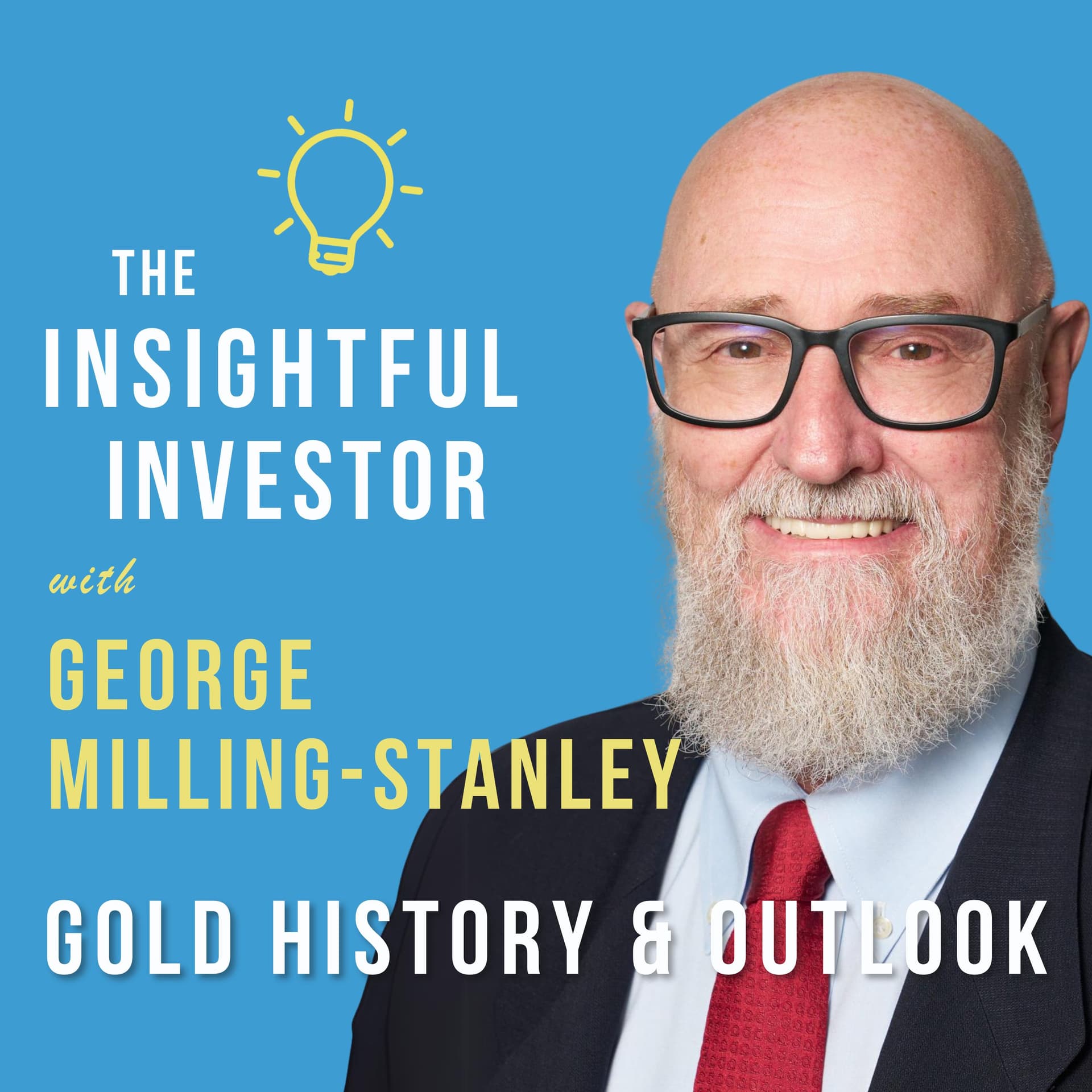
Podcast Notes: Insightful Investor - Episode #32 - George Milling-Stanley: Gold History & Outlook
Episode Overview In this episode, Alex Shahidi interviews George Milling-Stanley, the Chief Gold Strategist at State Street Global Advisors, focusing on the history of gold, its role as a portfolio diversifier, and insights on the gold market's future.
Key Themes
- History of Gold: George shares his personal journey into gold investment and its historical significance, particularly since the abandonment of the gold standard in 1971.
- Gold as an Asset: Discussions around gold's unique characteristics and its behavior compared to other commodities and assets.
- Market Outlook: Insights into the current macroeconomic and geopolitical landscape impacting gold prices.
Main Discussion Points
Introduction to George Milling-Stanley
- Background: Over 50 years of experience with gold, including roles at the World Gold Council and State Street.
- Initial Interest: Sparked by an assignment to write about gold in 1972, which has since evolved into a lifelong exploration of the subject.
Gold's Unique Characteristics
- Diverse Demand: Gold is used for jewelry, investment, industrial applications, and as a reserve asset for central banks.
- Distinct from Other Commodities:
- Gold’s price drivers are unique compared to silver and platinum, whose values are heavily influenced by industrial demand.
- Gold serves as a currency and investment, unlike other commodities.
Investment Attributes of Gold
- Portfolio Diversification:
- Gold has shown minimal correlation with equities and bonds, making it a valuable portfolio diversifier.
- Historical average appreciation of gold has been about 7.75% per annum since 1971.
- Volatility:
- Gold's volatility is comparable to that of the S&P 500, which is unusual for a single asset.
Economic Environment Impacting Gold
- Current Economic Context:
- Discusses the implications of prolonged zero interest rates and the risk of high inflation.
- The relationship between gold and the U.S. dollar is essential; gold tends to perform well when the dollar weakens.
- Geopolitical Risks: Ongoing global conflicts increase demand for gold as a safe-haven asset.
Gold vs. Other Assets
- Comparison with Bonds:
- Gold may have taken on some of the protective attributes historically associated with bonds.
- Cryptocurrency Discussion:
- Cryptocurrencies are seen as competing for speculative dollars but exhibit higher volatility compared to gold.
- Gold can serve as a stabilizing asset in a portfolio that includes cryptocurrencies.
Central Bank Activity
- Gold Purchases by Central Banks:
- Emerging market central banks have been increasingly accumulating gold since geopolitical events like the conflict in Ukraine and U.S. sanctions against Russia.
- Record levels of gold buying have been observed, indicating a shift in reserve asset preferences.
Future Outlook for Gold
- Market Predictions:
- As of the conversation, George maintains a 20% allocation in gold, indicating optimism for the gold price in light of current economic conditions.
- The expectation of higher prices as geopolitical tensions and economic uncertainties persist.
Conclusion George emphasizes the vital role of gold as a protective asset with both risk-reduction qualities and potential for capital appreciation. His insights highlight the importance of considering gold in a diversified investment strategy.
Key Takeaways
- Gold's Unique Nature: It serves multiple roles (currency, jewelry, industrial use) that other commodities do not.
- Portfolio Allocation: Maintaining a strategic allocation in gold can help protect against economic instability.
- Market Dynamics: Geopolitical risks and macroeconomic conditions are strong influencers of gold prices.
Additional Resources
- For further insights, visit the [Insightful Investor website](https://insightfulinvestor.org/).
- Subscribe to the podcast for more discussions on investment strategies and market insights.
---
These notes encapsulate the rich conversation between Alex and George on gold, providing a concise summary of key insights and themes discussed.
Written by AI. May contain mistakes. Listen to the episode to check what was said.
Transcript
Automatic transcript. May contain errors.0:05Welcome to the Insightful Investor Podcast, a weekly series that seeks to share industry, investment, investment, and market insights. We define insights as concepts that are counterintuitive, widely misunderstood, or underappreciated. In other words, unique ideas that you probably won't hear elsewhere. I'm Alex Shahidi, the host of the podcast and co-CIO of Evoke Advisors, a leading investment advisory firm. Learn more about our show at insightfulinvestor.org.
0:38Joining me today is George Milling Stanley. George is the chief gold strategist at State Street Global Advisors. Prior to his decade at State Street, George was with the World Gold Council. I couldn't think of a more fitting guest to cover the history and outlook for gold on today's podcast. Welcome, George. Thank you, Alex. That's a nice introduction. I really appreciate that. Well, George, you've been studying, writing, and speaking about gold for about 50 years. When did you first catch the gold bug? And what catalyzed your interest in gold investing? Yeah, okay. It's a pretty simple story.
1:19What I usually say to people when they ask me this is, look, if you can cast your mind back to the summer of 1972, and if it helps you to picture this, I had an afro because every 25-year-old in London in 1972 wore his hair in an afro. And I was a reporter on a financial magazine in London. when the editor of that magazine came to the door of my office and said, George, it's been 12 months since President Nixon closed the gold window. What do you think of that? And I looked up at him and said, I have the faintest idea of what you're talking about. What does that mean? And he said, good, I'm glad you don't understand it.
1:54I don't understand it either. I just read a headline somewhere, probably in The Economist. But it occurred to me that if I don't understand it and you don't understand it, then probably our readers don't understand it either. He said, we're a monthly magazine. You've got three weeks to deadline. Go find out about gold and write me a story. And 52 years later, I'm horrified to realize it's that long, but 52 years later, I'm still chasing that same story about gold. Back when I was 25 years old, I knew all the answers like most 25-year-olds do. If I've learned anything in that 52-year period, You'll have learned a little humility.
2:32These days, I just hope I'm asking the right questions and talking to the right people. So that's broadly how I got started. I would take offense if you were to call me a gold bug, Alex, because I've never been one of those. I've never had more than 20 % of my personal portfolio involved in gold, which means I don't qualify for membership in the exclusive Gold Bugs Club. But I've never had less than 5%, which is my long-term strategic allocation, never had less than 5%. So it means I am a believer in the benefits that gold can bring to a portfolio. Very fair. You spent 15 years with the World Gold Council, and then you transitioned to State Street, which is an asset manager.
3:18Would you talk about that change? Yeah, there was an interregnum, and that probably helped me to make that transition, Alex. I left the World Gold Council in 2011 and set up a consultancy of my own, a one-man show, if you like. And basically, I was offering my services to a number of people. J.P. Morgan was a big client for the first couple of years. And then I approached State Street in 2013. There had been some outflows from GLB at that point. And I was proud of my involvement with GLD when I was working at the World Gold Council. So I asked and I offered to see if there was something I could do to help.
4:02And they took me on as a consultant, too. So I was a consultant for three years. And I transitioned from the World Gold Council, which is essentially a promotional organization, to working primarily for a very large commercial bank in the form of J.P. Morgan, and then transitioning to having one foot in, if you like, at the asset manager at State Street. So I had already had a good deal of experience. The other thing is that when I was at the World Gold Council and we were coming up with the idea of trying to revitalize the gold investment business, after a while, we did an awful lot of research using practically any company in North America that had the word consulting in its title, whether it was McKinsey or Bain or Boston Consulting and a whole raft of other people.
4:51We did an enormous amount of interviews. And the issue really was trying to figure out what it was that prevented people from investing in gold. I mean, that was the idea. And so I got an enormous amount of information from financial advisors, from investors. So I already had a good deal of experience with that. At some point during that process in the early 2000s, as we launched GLD in 2004 in November, 20 years old this year, at some point in that process, it became clear that what we were looking to try to do was to marry the commodity market and the equity market, which nobody had done before.
5:31A number of people have done it in different ways since then, but nobody had done it before we did in 2000. And it became clear to us at some point that what we really wanted was to try to set up an exchange-traded fund. Now, ETFs were only about nine years old in 2002, 2003, the period we're talking about. And State Street had launched the first one in the form of SPY based on the S &P 500. So we figured these guys probably knew something about ETFs if they'd invented them and launched the first one and a whole slew of other ones since then as well. So we talked to the people that we knew at StageStreet.
6:06They were extremely helpful in helping us to come up. We provided the gold expertise, gold market expertise. They provided the ETF expertise. And so it seemed natural after a couple of years of working very closely together, it seemed natural that we would appoint them. We at the World Gold Council, a sponsor of GLD, would appoint State Street as the marketing agent. And I was on the team of people that made that decision. So I had been working with them because we continued to work with them in the marketing efforts. We would go in with a State Street representative to go and talk to financial advisors all over the world.
6:45We would make the case for investing in gold. and the State Street rep would make the case for doing that through the means of the ETF that we jointly offered to them. And that, I think, was a marriage made in heaven. And so here we are. It was a seven-year deal initially. Here we are 20 years down the road. And I think it is still a wonderful relationship and beneficial to both sides, both to State Street and to the World Gold Council. So I had a lot of experience of working with them. And so I was not totally ignorant of the asset management side at the time when I finally was invited to join them as a full-time member of staff in 2014.
7:24Long answer, but it was a good question. And it was a transition I found relatively easy, but I think that was simply because of the experience that I developed with State Street. It seems just like a natural transition, natural evolution of your involvement with gold. It's a very strange kind of thing that the older you get, When you're actually going through a career and you change jobs here and there, I think increasingly people are changing them even more rapidly than in my generation. But you change your jobs and it seems like you almost feel like one of those steel balls on a pinball machine.
8:01And you go bong and you go bong and you move this direction, you move that direction. And by the time you get to my age, you look back on it, and it seems like a relatively coherent career path, moving from writing about gold for my small financial magazine and then spending 10 years writing about gold at the Financial Times, covering essentially gold mining company stock, and then working for a mining company doing supply-demand research. And then when that company was taken over, moving to the United States from London to New York to trade gold for Shearson for six years or so, and making that transition from researching and writing about gold to actually buying and selling it is something not a lot of people have done.
8:44If I had a difficult transition in my life, that was probably the hardest one, moving from being a writer and researcher to actually having to buy and sell the stuff. And then after that, it seemed a logical idea to go and work with the World Gold Council. And my job there was essentially working with governments and central banks for 15 years, working with governments and central banks on how they structure the whole reserve portfolio, the whole official reserve portfolio, but with particular reference to the role that gold can or should or does play in official reserves. And my secondment to the investment division to work on inventing GLD was a relatively brief period of my 15-year career.
9:29So before we dive into a brief history of gold, would you tell us why it makes sense to separate out gold from all the other commodities? How is it so different? I'm always very careful with language, Alex, because I don't want to be misunderstood. understood and I really dislike words that only have one, you know, I really am very careful with words that only have one meaning, like unique. But I think if push came to shove, I would have to say that I think that gold has unique attributes that make it important to consider gold on its own and not as part of a complex. I think the main reason why this is so is that gold's demand Sources are myriad.
10:16There are many different ways in which people use gold, whether they're buying gold jewelry, which amounts typically to about half of annual demand, or whether they're using it as an investment. Again, that's anywhere from 25%, 30%, 35%, or whether they're using it in industrial applications, increasingly electronics, but also including dentistry and fountain pen nibs and spectacle frames and all sorts of other uses that fall under that catch-all category of industrial use. And of course, it's the only commodity that central banks hold in their reserves. There's no central bank in the world that holds silver or the platinum group metals or any other commodity, copper or oil, in its official reserves.
11:01So gold is basically being used as a currency as well as jewelry, industrial products, and investment products. And all those diverse sources of demand, I think, mean that the price drivers are unique because this is completely unlike silver, for example. Silver does an enormous number of very, very useful things. It's a terrific metal. It does wonderful, useful things in high-tech imaging for the scientific and medical professions. It's used in pollution control. It's used in water filtration. It's a wonderful bactericide. But there's not a lot of silver jewelry and not a lot of silver investment, and there's certainly no use in official reserves.
11:49So it really only meets that industrial category as far as comparing it with gold is concerned. So silver's price dynamic is driven much more by GDP growth, for example, in the nations that tend to use it most. And it's very, very similar with the platinum group metals as well. Most of the platinum group metals that are mined every year disappear up the tailpipes of automobiles and do a wonderful job, just like silver, do a wonderful job in controlling carbon emissions. although i do occasionally speculate as to where the platinum price might be when we're all driving electric cars in five years or 10 years time and we don't need to be controlling carbon emissions we'll just have to see about but i think that's really the reason why i always look at gold i look at gold always in terms of its investment attributes always in terms of a properly balanced portfolio, but I don't really regard it as part of the commodity complex at all.
12:49It doesn't really behave like most of the other commodities, which have essentially one demand function, or maybe just a couple like silver does. So if we look at gold as a currency or a storehold of wealth, it has three attributes. I won't use the word unique, but you can say that are interesting. There's no counterparty. It's virtually indestructible. And there's a finite supply. Are those the three characteristics that you think put it in a different category? And is there anything else that you would add to that list? That's one good way of looking at it. I think you've hit the nail on the head with attributes.
13:28The way that I look at gold in terms of as an investment, and I think that's really where our focus is probably going to be in our conversation today, Alex. The way that I look at gold is historically investors have turned to gold for two reasons. I like that, that gold's appeal has a dual nature. Essentially, they do so because they believe that over time, not every year, but over time, gold can help to enhance the returns of a properly balanced portfolio. And whether the gold price is going up, down, or sideways, it is always going to be reducing the volatility of a properly balanced portfolio.
14:07Gold doesn't correlate hardly at all with anything that you would normally find in a typical portfolio. If you look just at the 50 years of my career, the 50 years essentially since President Nixon created a free market in gold for the first time, cutting the final legal formal link between gold and currencies. If you look at that 50-year period, gold's correlation with the S &P 500 has been 0.01%, i.e., no correlation at all. The correlation with the bond market is a little bigger than that. Over that same period, that 50-year period, correlation with the ag has been 0.09%. Again, not really a correlation at all.
14:51And that's how and why gold reduces the risk of a properly balanced portfolio. As far as the returns part is concerned, I recognize that gold doesn't have a coupon like a bond. It doesn't pay dividends like a stock. So it doesn't produce cash flow. But again, looking at that same 50-year period, I think it's a statistically significant sample. Looking at that 50-year period, the annual average appreciation of the gold price has been around 7.75%. Now, those returns have been very lumpy. They were very good in the 70s, not so good in the 80s and 90s. They've been very, very good, again, since the turn of the millennium.
15:31But that 7.75%, that's not too shabby a return for an asset that many people claim simply doesn't have a yield. Those are the things that I would add to the three things that you've talked about, focusing specifically on gold's role as an interest. That's great. So let me go back to something that you started with, which is coming off the gold standard in 1971. And you were seeking an answer to what that meant 52 years ago. And do you have a best guess as to what the answer of that is? Meaning, what does it mean to come off the gold standard and what are the long-term implications? I kind of touched on this in my last response.
16:13I think that what President Nixon did, he didn't mean to do this, but the effect of what he did, freeing up gold from the constraints of the gold standard or the gold exchange standard as it was by the time Nixon took his action, I think that what he did was to create a free market. If you think about it, history before 1971, first of all, gold was currency in the form of doubloons and sovereigns and ducats and all sorts of pieces of eight and all sorts of other wonderful coin names. So gold was money in those forms, in gold coins. And then somewhere around about 1870, when the gold standard became popular when people backed their currencies with gold, then gold and money were still inextricably linked with that.
17:06And then at the end of World War II, when the gold standard worldwide would have been difficult to maintain given the economic depredations of World War II for a lot of countries in Europe and Asia, for example, the Bretton Woods conference set up the gold exchange standard. And what that meant was that foreign currencies were linked in a fixed ratio to the dollar, and the dollar was linked in a fixed ratio to gold, so that there wasn't an indirect link between all of the currencies in the world and gold, but it was via the powerful dollar at that time. So that That was the gold exchange standard.
17:47And that meant that foreign central banks from 1944, the Bretton Woods Agreement, through to 1971, when Nixon took his historic action, what that meant in practical terms was that foreign governments, no longer individuals, but foreign governments could bring their dollar bills to the gold window. And it was literally a window in the Federal Reserve. They could bring their foreign currencies, their dollars to the gold window, and they could take in exchange for their dollars at that fixed parity of the dollar to gold, for most of the time,$35 an ounce toward the end,$42. They could take gold bars out of Fort Knox or one of the other depositories that the US keeps its gold reserves in.
18:35And Nixon ended that automatic right of foreign central banks to do that. And I think the main reason he did was quite simply because the U.S. gold reserve had been cut in half by certain foreign countries. And here I'm looking especially at France, but Great Britain was also guilty of this, were very, very enthusiastic in bringing their dollars to the gold window in the Fed and taking gold bars in exchange. So America's gold reserves have fallen from 16 ,000, 17 ,000 metric tons to about 8 ,000 metric tons by 1971. Nixon ended the right of central banks to do that. And that's why we still have our gold reserves at around about the 8 ,000 metric ton mark.
19:22There's been really no significant change. We've issued various gold coins. But there is a requirement for the U.S. government to buy from domestically mined gold at the end of every year to replace in the reserves whatever they've taken out of the reserves and minted into coins. So the American gold reserve has remained pretty much unchanged ever since Nixon took his action. Whether the gold standard was a good idea or a bad idea is something that economists will continue to debate long after I've given up being involved in coal myself. I think that there are arguments that you can make in favor of having some kind of objective standard rather than simply fiat currencies, which are worth what governments say they are.
20:10They're worth what people are prepared to pay for them. But I also think that I think it's unlikely that anybody would ever want to go back onto a gold standard. Because essentially, if you do that, you can't have Keynesianism when you pump money into the economy when it's in trouble, and you withdraw money from the economy when it's doing well, which is essentially how Keynesianism operated. And then a number of people felt that this might be somehow a socialistic thing, a terrible thing to be doing. So they did the same thing, but they called it quantitative easing. And that's what we've had since people abandoned the whole notion of Keynesianism.
20:48But it's essentially the same thing. When the economy is in trouble, whether it's 2008, whether it's 2001, whether it's 1987, or whether it's COVID in 2020, when the economy is in trouble, you pump money into it, try to stimulate economic activity, and to minimize the problems that this causes for consumers. And the other side of that coin is that when the economy is doing well, Well, you should, and I stress that should, you should try to pull money out of the economy. But most American governments in the past 20 years or so have forgotten about that second piece. So they pump money into the economy when it needs it, and then they start pumping money in.
21:30But nevertheless, that is really why we have huge deficits these days, why our national debt is so big, why each of us as an individual American citizens owes thousands and thousands and thousands of dollars to the Chinese and other buyers of American debt and so on. So I don't think anybody's ever going to go back to the economic rigor, the discipline that a gold standard implies. And as I say, I'm agnostic as to whether that's a good thing or a bad thing, but I don't think it's going to happen. So there's really not much point in discussing. Let's talk about the economic environment. We know it's difficult to predict what the future looks like, but it seems that gold tends to do well in certain economic environments and poorly in others.
22:15Would you describe your experience with the types of environments that are favorable for gold and unfavorable? Yeah, I think we need to look at the macroeconomic environment. No question about that. That's very important. I'd like to bring in the geopolitical environment as well, because I think that also can be, not always, but it can be very, very important too. So when the economy is weak, typically the stock market is weak as well. And very often, it happens frequently, that the dollar will also be weak. In those kind of circumstances, that tends to be when gold does very well. This is what we saw during the 1970s, when the gold price went from$42 an ounce, when Nixon took his action in 1971, rose from$42 an ounce to$850 by January of 1980.
23:0320 years, So essentially from when Paul Volcker took the Fed funds rate to 19.5 % in order to try to drive down inflation and succeeded in driving down inflation. For the next 20 years, we had what was essentially a benign economic environment. The stock market was doing pretty well most of the time. It was the odd time when it wasn't, but for most of the time it was doing pretty well. The dollar was pretty strong and was securing its dominant position in international reserves and in the settlement of international trade transactions and so on. The bond market was doing pretty well. We certainly didn't have problems as big as the Second World War or even the Vietnam War or the Korean War.
23:50The wars tended to be smaller and somewhat more localized. A benign period for the economy and for geopolitics, and gold didn't do very well. Gold basically fell from the high of$850 an ounce in January 1980 until by April of 2001, the gold price was down to$255 an ounce. Looking at today's price of somewhere north of$2 ,300, and the fact that just last week we were on the verge of hitting$2 ,500, we hit$2 ,480. So seeing the price over the last 20-some years going up by about 10-fold, I think that those gains are essentially sustainable. I think that the 20-fold increase in the price from$40 to$850 in the 70s was not sustainable.
24:40But I think because it all happened really in about the five-year period from when Americans were allowed to invest in gold again. It had been illegal until January 1 of 1975. So really just a five, six-year period that the gold price went up 24. So those are the kind of situations that I think that definitely have an impact on gold. I think the primary thing is not so much the performance of alternative assets, except for the dollar. I think that the crucial relationship is between gold and the dollar, rather than between gold and interest rates, which a lot of people think is the important relationship.
25:19I think it's really between gold and the dollar. If we look at the macroeconomic environment we have today, with the possibility that the Fed just might do something that it's done in the past, which is it does the right thing when there's a crisis, but then it carries on doing the right thing for too long, and it becomes the wrong thing. This is what I'm worried about. Zero Zero interest rates were absolutely the right thing to do in 2008, but to keep interest rates at zero for effectively 13 years was probably too long. Most people have blamed the inflation that we've had with consumer prices going up over 9 % a year.
26:01Most people blame that inflation on COVID-related supply chain disruptions, I think is the usual phrase. I think that free money had a lot to do with it as well. There's really no question about that, but free money for 13 years also contributed to the inflation. My worry, now that the Fed has raised interest rates to the highest level in 20 years, my worry is that the Fed, and Jerome's mantra seems to be higher for longer. He's still promising that and saying he wants to see some weakness in the economy. He wants to see some weakness in the labor market because he thinks that's the only thing that can bring inflation down.
26:40He's probably right. He's a smart man. But my worry is that the Fed just might keep interest rates too high for too long. Higher for longer is all very well, but too high for too long. That could push us into very definitely into what Jerome Powell has said he's looking for, which is an extended period of below trend growth. And that sounds an awful lot like that might be a recession to me. So I worry about that. And I think an awful lot of investors worry about that. And those are the main reasons, I think, why the gold price from the macroeconomic viewpoint is so high. Geopolitically, well, I guess we're in a bit of a mess geopolitically.
27:22We have an armed conflict in Europe with the potential to turn nuclear at the push of a button. The conflict that was originally confined to Israel's borders is a now open conflict between Israel and Iran and the Middle East. I've always regarded the Middle East as potentially a very combustible area. It worries me a lot when we see major conflicts growing there and with little progress in terms of anybody trying to organize peace talks. The same with the Ukraine situation. Again, nobody's really making progress on peace talks. So that's two realities. We have China making rather belligerent noises toward Taiwan.
27:59I'm doing my best to parse what the Chinese government is thinking these days. and I still have a number of friends in China from my days of traveling there regularly. I think the Chinese government is keeping a very, very close watch on how solid our support for Ukraine is, because I think they see some kind of a template for the sort of support we might offer Taiwan in the event that China were to try to invade. So I think it's important to keep our support solid in order to keep Russia at bay in Europe and China at bay in Asia. And then in this country, I've been saying for months that we are going to have a very ugly presidential election.
Read the full transcript
28:40And then if you think of the events of the last couple of weeks, an assassination attempt, selection of a vice president candidate who is not universally popular, let's just put it that way, No politicians universally popular, but this one, I think, has some issues here and there with a lot of people. And then, of course, with the sitting president withdrawing from the race and putting his vice president up as the candidate, and she has to choose a vice president too. I just think that the presidential election in this country is going to be even uglier than I thought it was a few months ago. We'll see how that unfolds over the next four months.
29:18But there's plenty of time for things to get nasty, and I'm afraid they will. So I think those are the kind of environments in which historically gold has tended to do pretty well. And I think that there's no reason to suppose that this time is going to be any different. As I say, with the price having recently reached an all-time high at$2 ,480, most of Wall Street still believes that there is definitely a good deal more potential. Even though the price has risen about 15 % year to date, there are still plenty of people who are saying we could still see several hundred dollars more on the gold price.
29:55Well, let me throw one more consideration into the mix. What about this long-term trend of debasement of fiat money, where you have a problem and you print more currency, print more, print more? How does that impact the price and interest and demand in gold long-term? I think that when you have currency depreciation, then obviously gold takes in more of the currency. The currency is depreciating. I think it's not so much of the gold price going up and down. It's the value of currencies going up and down. You look at it from that point of view. And I think there's a number of economists that look to go from that point of view.
30:35And I think that gold is the stable. The best book I ever read on gold was called The Golden Constant by Professor Roy Jastrom from the University of California at Berkeley. And I think that maybe gold is the constant and currencies are the things that fluctuate. The other thing I think it's always salutar to remember. I don't think the dollar is going to disappear. I don't think the dollar is going to lose its dominant position overnight. I think it'll probably see me out and probably see my grandchildren out as well. But I think inevitably, reserve currencies, whether it's a buy currency system or a single currency system, such as essentially we have today, the history of reserve currencies is that eventually they depreciate, they lose value.
31:21and again I see no reason to believe that the dollar will not follow that same course of action. It's not going to happen quickly at all but there are a couple of trends going on as far as the international monetary system is concerned that I think support the view that eventually the dollar will come down in value. I think one of these is that the euro when it was first launched very quickly became an important element in foreign exchange reserves. It has since diminished a little, partly because they managed to have two sovereign debt crises in Europe within the space of three years, which sounds like bad management to me.
32:06Or maybe they were just out of luck. I don't know. But I think that as Europe gets over whatever shock Brexit might have been, whatever shock COVID might have been, And I think that the Europeans are getting their act together. And I think that the euro is strengthening because of that. And I believe it will continue to strengthen. And I believe the euro will play a larger role in the settlement of international trade and will play a larger role in official reserves of countries around the world. We've already seen a number of emerging market central banks who are purchasing gold steadily and have been for almost 15 years now.
32:45And certainly, I don't see any signs of them getting out of that trend. I see that trend continuing for the foreseeable future. So I think that the euro will become more important in official reserves. I think gold will become. I think it already is becoming more important in official reserves. The IMF invited the Chinese government to submit the renminbi to be included within the special drawing right. Now, that special drawing right doesn't really amount to a hill of beans. The only people who use that in their accounting are the International Monetary Fund and the Bank for International Settlements in Basel.
33:21But it does have a significant symbolic value to the Chinese and to the rest of the world. It's kind of like an endorsement from the IMF. If we think that this currency is important enough to be included in the special drawing right, then we're not going to get upset if central banks decide that they want to include the Chinese currency in their official reserves. And I think that is a trend that has already begun and is only going to continue to grow. All of these things, I think, come at the expense of the American dollar. As I say, it's a very, very gradual decline. But I'm expecting the dollar's dominance gradually to continue to decline gradually as other currencies, especially the euro, gold and the renminbi, as they take a more significant role within the international monetary system.
34:12It seems in some ways almost a natural progression. And what I mean by that is you work your way to becoming the world's reserve currency. And then over time, maybe you spend beyond your means and accumulate these growing debts. And it becomes very tempting. And the market basically lets you get away with it where you can debase your currency and try to get out of your dead hole. And so it seems like you'll keep doing that until the market says, no, you can't do that anymore. And that's how reserve currencies lose that status. And maybe there is no competitor today that is worthy enough to replace it and maybe transition gradually into a basket of currencies.
34:54Is that sort of how you see it? I think that is definitely more likely, as long as we include gold in that basket, because gold does, as I say, very often behave like a component of the currency market. So no, I think you're absolutely right. I think the American debt position is unsustainable. Let's just put it that way. If we are going to be repaying in a depreciating currency, that's going to make certain people unhappy. You know, so I don't see any other way out of it. You know, I simply don't see a solution. So yes, I think that if something is unsustainable, it's not going to happen forever.
35:31But as I say, the process of change in the international monetary system is glacial at best. So I'm just watching points very carefully. And we have to look at the tiny little incremental changes on the margin and try to read the tea leaves and figure out what we're going to project as far as change is concerned. If we were to examine the returns for gold over the long period of time, obviously, it's been around thousands of years. But does it make sense to draw a line at 1971 when we came off the gold standard and look at returns from that point forward differently than we looked at returns prior to that period?
36:13Yeah, I mean, I think the returns themselves have been substantially different once the gold market was freed from being linked inextricably to currencies. And as I say, that was the course of effectively the whole of history up until August of 1971. I think that that was a very, very significant change. And I always try whenever it's possible and whenever the data is available, I always try to take any chart that I look at, any chart that I use and show to investors. I always try to take data back to 1971 if I can, because I think that was a major juncture. I don't think there's any date before that that was comparable, because gold wasn't really being looked at as an investment until 1971.
37:01Gold mining companies were, that's no question. But there was relatively little interest in gold as an investment prior to 1971. That creation of the free market, I think, made a huge difference. The only thing that is even remotely comparable, I'm not suggesting these two are equal by any manner of means, but I think that the advent of gold exchange traded funds in 2004, I think that was also a very important juncture. A number of people said that the launch of GLD effectively took the friction out of gold investing. before 2004, a number of people didn't invest in gold because they felt that the barriers were just too big.
37:46And I think that that was also an important, no one near as important as 1971. So that is, to me, that is the major cutoff. And I only wish that we had data on all the other assets that I want to compare gold with all the way back to 1971. But we didn't have treasury inflation-protected securities in 1971. For example, there were a whole raft of things that we can't compare gold with because of that. But at least we can compare gold with stocks and bonds, and I think those are still the two most important components of our portfolio. So we do have those comparisons. We can look at in terms of volatility.
38:25Again, over that 52, 53-year period that we're talking about here, gold's annualized volatility has been around about 14%. The S &P 500 has been around about 15%. I know it's only a one percentage change difference, but it's a one percent in the right direction. I think that's a useful thing to have. The other thing, mathematically, one would always expect an index to be less volatile than a single asset. But here we are in the position of the reverse being true, the single asset gold being marginally less volatile than the 500 stocks in the S &P index. I think that speaks to gold's credit, I think, no question.
39:07So let's talk about returns for a second. So if we go back to since 1971, you mentioned seven and three quarters annualized returns since then. That's only about a percent, plus or minus a little bit less than the global stock market for 50 plus years. I think that's That data point surprises a lot of people. And in many ways, it challenges a common comment that I've heard from market experts that say gold has no risk premium. You shouldn't expect much of a return. Yet when you go back to that 50 plus year period, it has generated actually a relatively attractive return. How would you explain those returns in the face of this view that there should be no risk premium for owning gold?
39:52I think that that 7.75 % annual average, and again, I stress these returns were very, very lumpy, but nevertheless, that 7.75 % average effectively represents global GDP growth multiplied by global population growth, who are very, very important. There are solid demographic reasons why we would expect the gold price to go up over time rather than expecting it to be fixed. I think a lot of people, because of the gold's use as a currency and because then of the gold standard and later the gold exchange standard, a lot of people believe that the gold price would never move. And it didn't move for a very long period of time.
40:35If you look at the chart of gold, I've got a table of gold prices going back to the 14th century, which I think I stole from Roy Jaston's book, The Golden Constant. And it was a constant. It flatlined for thousands of years. And then all of a sudden, in 1971, we've had this rather volatile market. Not quite as volatile as stocks, as I say, but rather volatile markets. So I think that there is some relationship between population growth and GDP and economic growth, I think, is responsible for this. So again, as I say, you could and some people have basically contended that gold doesn't move. The value of gold remains identical.
41:20The price moves only because currencies change in value. You know, that's an interesting contention. I don't know whether it's right or not, but it's an interesting thing to think about. And it's occupied a number of economists to try to come up with proofs of this. Is there a reasonable methodology that you can think of to come up with an expected return for gold over the long run looking forward? Yeah, the Warren Buffett argument that there's no predictable stream of future revenues that I can discount back to net present value. Therefore, gold has no value. I think that's using the word value in the same sentence in two very, very different meanings, if I can put it that way.
42:04I don't think there is. I think that, you know, history is a lousy guide to markets. But unfortunately, historical performance is the only one we've got. And I know as well as anybody else does that historical performance is no guarantee of future returns and so forth. But looking at 50 years of experience, 50 years of a free market in gold, and looking at the fact that on average, the annual average appreciation and the price has been 7.75%, I think that it would be a defensible move. if somebody wanted to try to predict a future price appreciation, if they were to look at a long-term average of 7.75%, that would probably not be a bad idea, 7.75 % a year.
42:51Now, that being said, just because gold's gone up 15 % already year to date, that should not persuade anybody to say, oh, well, gold's already doubled its long-term average return. Therefore, it is going to come down very, very soon, because that's not the way that gold works. Gold went up way more than seven and three-quarter percent a year during the 1970s. It went down somewhat more than that on average in the 1980s and 90s, and it has very definitely gone up a lot more than that in the 21st century. So I wouldn't get too set on trying to come up with a prediction. But to say that over time, gold is potentially likely to show an annual average appreciation of 7.75 % because that's what it's done for 50 years wouldn't be an unreasonable thing to do.
43:46I don't tend to use that in any prognostications and forecasts that we make at State Street. Basically, what I do is, first of all, we have a gold strategy team. That's an unusual thing for a big bank to have, but we have a gold strategy team. And we all have a view on where we think gold is going and why. That's important. I think the other thing is that I look at everything that happens in the world, whether it's macroeconomic or geopolitical or anything else. I look at that, but I tend to look at it through the prism of gold and what impact is this likely to have on gold. So it's very much a pragmatic, you know, boots on the ground kind of an approach.
44:30I was at a conference a little while ago when the four of us on the panel were invited to suggest where we thought the gold price would be at the end of the year. And I suggested possibly somewhere in the region of 2 ,400 to maybe 2 ,600, 2 ,700 might be a reasonable expectation, given all that's wrong with the world macroeconomically and geopolitically, and given what's going on in the internal market dynamics, the balance between demand and supply. The guy next to me said that it should be at$3 ,000 because there was some ratio that he had in mind as to how when people backed their currencies with gold, there was a particular ratio.
45:18And now, given the amount of currency in issue around the world,$30 ,000 is where the gold price should be. And he could make the argument that, in fact, it should be$70 ,000 because for a while, that ratio had been double what it was. And I just basically said that I prefer to deal in this universe rather than whatever universe this gen was dealing. Let's talk about gold as a portfolio tool. So as you're building a portfolio, it's really helpful to have different assets that you can pick from to build a well-diversified portfolio. So when we look at gold and we just look at that 50 plus year history and its return is a percent, percent and a half a year less than global equities for 50 plus years.
46:01And what's interesting is the 70s, it did great, and equities underperformed cash. The 80s and 90s, it lost money, and equities had a historic bull market. The 2000s, equities were down, and gold did well. It seems from a high level, that's a pretty good diversifier. Is that how you see it? Oh, absolutely. I think that the lack of correlation with the equity market, a lack of correlation with the bond market are absolutely crucial attributes. And I think that's why gold makes a significant contribution to a portfolio. To me, there's no question about that. I see gold primarily as a protective asset.
46:39And I think that is probably the mindset of a lot of people in the US as well and around the world. It protects the value, it protects wealth, and I think it protects purchasing power. And I think those are very, very important things to focus on. sometimes gold will offer you performance as well in terms of the price moving up as it has been doing this year as it has been doing basically since 2001 so anything that offers me protection plus performance even if the performance is not sustained and not every year and nevertheless anything offers me protection plus performance deserves a place in my portfolio no question about that.
47:24And so some of the characteristics you just described, people would describe bonds that way, good downside protection, good diversifier to equities. Is it reasonable to think about gold either as a gold substitute or a gold complement in constructing a well-diversified portfolio, particularly if it has outperformed bonds over the long term? I think that what you say about bonds was certainly true for most of my career. But something funny happened in 2008. And I think that was another, we talked about 1971 being a juncture that gold before 1971 was one thing. And since 1971, it has been another thing.
48:08I think that the bond market before 2008 offered you the best protection that you could get against the potential weakness in the equity market. I think that in 2008, stocks and bonds basically fell together. The correlations often happens in crises. Correlations move to one. Stocks and bonds went down dramatically in 2008. I think they did the same in 2020. The gold stocks didn't correlate in that same way. But the correlation between stocks and bonds in 2008 moved very, very close to one. And again, Bennett did something similar in 2020. Gold didn't do that. Gold didn't behave like stocks and bonds in 2008 and didn't behave like stocks and bonds in 2020.
48:56I would venture to say, I think this is going out on a limb a little bit, but I would venture to say that the jury's still out. Since 2008, it was not a long enough statistical sample for me to feel comfortable coming to a firm conclusion. But let me throw this one out at you, Alex. I think that in the last 16 years or so, I think that gold may well have taken on some of the attributes that used to formerly belong to the bond market. I think that gold is now offering you protection against potential weakness in the equity market. And I think it's doing so in a more reliable way than the bond market has over the last 16 years.
49:37That may be going out on a limb, but nevertheless, I'm prepared to try it. And protection against potential weakness in equities is one of the reasons that doles in my portfolio, one of the reasons that I believe it should be in everybody's. Protection against inflation, and I want to come back to that one in a second, but protection against inflation, yes, I think that that's a very good reason to have it. Protection against potential weakness in the US dollar or any other currency. Protection against weakness in the Indian rupee, I think is one of the reasons why India is one of the largest consumers of gold in the world.
50:10Protection against potential weakness in the renminbi, I think is one of the reasons Chinese consumers and investors are among the largest in the world and so on. So protection against potential currency weakness is another reason why I like it. The fact that sometimes you get performance as well as that protection only makes the deal an awful lot sweeter. Let me talk a little bit about inflation if I can. A lot of people, I think, basically misread gold's relationship with inflation. There are people who say that gold is a really good, movements in the gold price are really good predictors of inflation.
50:45Gold's going up, that means that inflation is going to go up as well. I think that's nonsense. And I mentioned this book, The Golden Constant, Professor Roy Jastrom, and that basically was looking at gold's relationship with inflation back to the 14th century up until the 1970s, which is when Professor Jastron wrote his book. He agrees with me. He says that gold is not a good predictor of inflation at all. If anything, I think the gold market probably follows inflation rather than predicting it. So that's one myth that we've laid to rest, I think. The second one, a lot of people say, oh, well, if we have inflation, then that's the time to be buying gold because gold offers protection against inflation.
51:28And again, I think that's a misread of the situation. Jastrow concluded, and I go along with him out of my own personal experience, I don't believe that gold offers you significant protection against sudden sharp moves in the rate of inflation. The important relationship between gold and inflation occurs when we get sustained high inflation. Gold then tends to offer you decent protection. What do I mean? Sustained a minimum of 24 months and preferably longer, and high inflation, 5 % or above. Whenever we've had those circumstances, then on average, the annual appreciation of the gold price has doubled from its 7.75 % to better than 15%.
52:13That, I think, is good protection against inflation. But that, I think, is the only time when we get a really good solid relationship, a predictable relationship, when we have sustained high inflation. And that, I think, is an important lesson for an awful lot of people. People think, oh, it's an easy relationship. Gold protects against inflation. Well, no, it doesn't. Gold protects against sustained high inflation, that's an important thing to bear in mind for people. Isn't it also a hedge against, if I may make the distinction of monetary inflation, where you're printing money and debasing fiat currencies, isn't it a good hedge against that risk?
52:55Oh, absolutely. I think it's one of the best. I think that's one of the main reasons why, for example, an awful lot of gold demand, whether it's for jewelry or for investment, is concentrated in the emerging world. because there's an awful lot of problems with currencies in the emerging world. Whether you look at Venezuela or Turkey or El Salvador or Argentina, there's a whole raft of countries. The Indian rupee has never been a particularly stellar performer, even though the Indian economy is doing very, very well right now. And the Indian economy is one of the very few that the IMF has a favorable view of and is expecting significant growth.
53:34But the currency has never really reflected that. So I think you're absolutely right. Gold is a very, very good protector against currency depreciation. No question about it. Early in your career, you focused on gold mining companies. As an investor in gold, you can either invest in a gold ETF or a gold fund and get the gold price, or you can buy gold mining stocks. How do you compare the two? Gold mining stocks are a terrific investment when the stock market's going up and when the gold price is going up. And there are plenty of times when that happens. There's not a one-to-one inverse correlation, some people seem to suggest.
54:15One problem I have is that one of the reasons I've said this, one of the reasons I own gold in my own portfolio is because I believe it offers me some protection against potential weakness in the equity market. And it's done that for the 40, 50 years that I've actually owned gold. So I'm starting to rely on that now. I'm starting to trust it at last. I'm a pretty careful kind of an investor. A lot of people buy gold mining companies believing that they effectively mirror the gold price, the stock price performance. And I don't believe that's true. And if you look at charts, you would also not believe it's true.
54:54I think that movements in the price of gold are the only thing that determines the gold price. That's obvious truism there. Movements in the price of gold are one input into movements in the stock price of mining companies. But mining companies are essentially companies. And mining companies' stock price performance is subject to exactly the same things as tech or pharma or financials. They're subject to management skill or ineptitude in the minds of investors. They're subject to success in things like mergers and acquisitions and new product development and a whole raft of things like that. So that the first thing to say is that gold mining companies, a lot of people bought gold mining companies as a proxy for the gold price.
55:41They were a rotten proxy, but they were the only one that was actually available to people until we launched GLD. Since then, I think that a number of people have realized that, yeah, if you do your due diligence on gold mining companies, you find one with very good management, and you find one that's both lucky and good, then fine, go ahead and invest in it. But you need to do the due diligence. I did that for 10 years at the Financial Times, and I know how you do due diligence. And I know how hard it can be to do that. My big worry is that whenever we get a significant downturn in the stock market, then gold mining company stocks tend to remember that they're stocks.
56:21And they may not go down as much as the stock market, but they go down when the stock market is going down. And the gold price tends to go up when the stock market is going down. That's why I think that gold is offering me a level of protection against potential equity weakness that gold mining company stocks don't. So that being said, I like them when the gold price is going up. I like them when the stock market's going up. But I worry about them when, as I am now, I'm a little concerned about the general state of the stock market. Earlier, you mentioned that a 5 % strategic allocation to gold was very reasonable within a total portfolio context.
56:59When you scan across institutional and high net worth portfolios in your work at State Street, is your sense that the strategic allocation is generally rising or is it about the same or is it falling? I think it's rising, but let's drill down into this a little bit, Alex, I think it's worth doing. If you take the quantum of investable assets around the world, I don't know what that figure is, but it's many, many, many trillions of dollars. When you take the quantum of investable assets, and you look at among those assets, any that have any relation to gold, whether it's gold bullion, whether it's gold ETFs, whether it's gold futures, or even gold mining company stock, gold accounts for about 1 % of the quantum of investable assets around the world.
57:47And that really hasn't changed much. I think it's gone up a little. And I think a number of people have become long-term strategic investors. And I think a lot of people have done that. But my belief is that it is still very, very, very low. I think it's growing. And I think that gold ETFs have helped to do that. You know, as I said, we launched GLD 20 years ago. It has$65 billion in it. When I'm looking at investor attitudes, I look at what they're doing with investor money. Investors vote with their wallets. And I think that they have voted very strongly in favor of gold ETFs. If you take the whole universe of reliable, physical ETF backed by physical gold bars, what in a vault somewhere?
58:36I think that the total quantum is somewhere around about$200 billion. So we're comfortably more than a quarter with GLD, easily the biggest. But I think, you know,$200 billion or something of that order, that's a pretty sizable investment. So I think that ETFs have certainly taken a good deal of share. And a lot of those are institutions and individuals who are making long-term strategic allocations. There's always going to be tactical players in gold.
59:09I've never really been successful at being a market timer, so I don't try. I do have a tactical overlay. As I say, I've got a 5 % strategic allocation. I have a tactical overlay of 0 % to 15 % that I play with depending on how I feel about the market. And I know your next question is going to be, where am I at present? I am at my full 20 % allocation, 5 % strategic, which I rebalance every quarter, and the 15 % tactical because I'm optimistic about the gold price over the next 6 to 18 months. So that's where I sit. But I think that, yes, strategic allocations are very definitely growing because it's easy to do with ETFs.
59:51I think that's another thing. They show up on your statement from your broker. You don't have to get a statement from your commodity broker showing you your futures positions or anything of that kind. You don't have to go to your own safe and pull it out and then try to get an up-to-date gold price on the coins and bars that you may have stashed in there. ETFs, I think, make it easy for people to invest in gold. And I think because of that, we have seen very, very significant long-term strategic applications being made. So that's a perfect segue into the conversation about the gold outlook and just looking ahead.
1:00:30If we just take a step back and just look at the last couple of years, it's been an interesting time because typically gold moves counter to the US dollar, as you referenced earlier. The US dollar has been very strong, yet gold has done well. Is your sense that this underlying elevated geopolitical risks has played a significant role in this growing demand for gold and has allowed it to perform well despite a strong dollar? I think investor perceptions of masks and investor perceptions of geopolitical risks, the two combined, are really why gold has done very, very well. The other thing, again, I'm going to try to break down a bit of a myth here.
1:01:12people think that there is essentially a one-to-one inverse correlation between gold and the dollar. In other words, when the dollar's going up, gold's going down and vice versa. I don't believe that that's true. I don't believe it has ever really been true. But certainly in the last, I don't know, let's call 2008 as a major juncture again, certainly since 2008, I think that essentially what we have seen is that when the dollar's going up, Gold can go up, down, or sideways. It has at various points in the cycle done all three. The dollar has basically been going up the whole time since then, but gold has either gone up, down, or sideways.
1:01:50So I don't think there's really a strong relationship at all. Where the relationship comes in is that every time the dollar has taken a downward turn, which it has from time to time, gold has tended to go up. So instead of an inverse correlation, you have an asymmetrical relationship. And basically, when the dollar is going up, you don't care what your hedge against potential dollar weakness is doing. It doesn't matter. But whenever the dollar is going down, you want to know that your hedge is functioning and that your hedge is going up in value. And that is essentially what gold has delivered, certainly since 2008.
1:02:25So I think that's an important thing to bear in mind as well. Understanding that relationship, I think, is as important as understanding the real relationship between gold and inflation. Understanding the relationship between gold and the dollar is very, very important as well. And I think that has been a prime reason why gold has done so well. And we did have this period in 2022, in the fall of 2022, when I don't know whether this is true, but I have a certain hunch that I think Jerome Powell felt that the markets were not taking him seriously. He was starting to come up with the mantra of higher for longer.
1:03:04He was telling people he was going to continue raising rates until he had a significant period of below trend growth, all of this stuff. And I think he felt the markets were not really taking him seriously enough because they were going from strength to the stock market, particularly from strength to strength. So instead of raising rates by 25 basis points on three consecutive Fed meetings, he raised rates by 75 basis points at each one of those. I think it was perhaps a way of smacking the market upside the head and saying, pay attention, you guys, I mean what I say. What was the result of that?
1:03:38The dollar promptly went to a 20-year high against just about any other currency you could name. And that proved to be something of a headwind for gold. Gold didn't go down as most of the currencies went down. Gold didn't go down, but gold had been moving up gently during 2022 and ran into a brick wall with the strength of the dollar at a 20-year high against all other currencies. So whenever you get something like that happening in any market, people like me say, okay, so when are we going to see the reversion to the mean? It's not going to be immediate, and it certainly hasn't been. The dollar has continued very strong, and other currencies have continued weak.
1:04:18We have seen something of a reversion to the mean as far as gold is concerned. I think that's important, that the dollar has continued to go up, not as fast as it did then, but continued to go up, and gold has gone up alongside it. So that's kind of an important thing to bear in mind. When are we going to see the reversion to the mean? I wish I knew. I don't have a crystal ball, Alex, but I'm going to suggest that when we see the reality of the first rate cut, when we see the start of what we expect to be a sustained rate cutting cycle for the Fed, whether that September or whether it's not September, I don't know.
1:04:55I'm not as convinced as most of the market is that we're definitely going to get a rate cut in September. We'll see. That's perfectly possible. But I think there's still a few data points to come out before Jerome Powell and his colleagues make up their minds. But I think that we will start to see the reversion to the mean in the currency markets. That means other currencies will go up against the dollar. The dollar will weakened against other currencies. And I'm expecting gold to behave like one of those other currencies as well. And I'm expecting a higher dollar gold price. When we start to see the decline, when we start to see the start of rate cuts, I think is when we're going to start to see the decline in the international value of the dollar.
1:05:36Let me ask you a question that I'm sure you've been receiving more regularly over the last five, 10 years, and you never received it 30, 40 years ago, that's for sure. Bitcoin, it's gained a lot of popularity over the past decade. Is this a worthy young competitor to gold? I think that the cryptocurrencies as a whole are certainly providing some competition for the speculative dollar, for the tactical investor, for somebody who's basically a day trader. And generally speaking, day traders like to follow momentum. And I think that the cryptoverse has shown a good deal of momentum in the, what are we talking about, 15 years that it's been in existence.
1:06:18I love to represent an asset that has 6 ,000 years of a track record, but I'm not saying anything bad about the cryptos. I think that their volatility is a good deal higher than gold's volatility in that 15-year period. But you heard me say it earlier, and I'm going to say it again, I'm not convinced that this is a statistically significant sample. So we can only talk about that 15 years. And volatility of the cryptoverse has been much, much greater. I have no problem with people who want to invest in cryptos. I'm not so sure that I would recommend it as a long-term strategic asset. But an awful lot of people have made an awful lot of money out of following the momentum in the crypto universe.
1:07:06The one thing I would say is if somebody does want to invest in cryptos, then face up to the fact that what you're doing is increasing the volatility of your portfolio, because cryptos are more volatile than stocks, bonds, and so forth. So maybe it's a good idea if you want to invest in cryptos, why not invest in some gold at the same time, because gold is very, very good at reducing the volatility. So I have faced the question in particular, can they coexist? Not so much as do they compete, but can they coexist? And I think that there's a very easy case to make that they coexist. I think that gold can be very helpful in reducing the added volatility that cryptocurrencies will bring to our portfolio.
1:07:52Is there a way to know whether gold is overvalued or undervalued? And is there anything to compare it to? Well, we did use the word unique a little while ago, didn't we? Even though we were both trying to avoid it.
1:08:08I can't think of anything that I would compare gold to. I have to say that the sheer diversity of the whole demand picture, I don't know anything that is quite like that. I really don't. I don't know any other asset that has that kind of diversity. And I think that this is why gold is a good diversifier, because of the diversity of its demand picture. As to whether it's overvalued or undervalued, wow, beauty's in the eye of the beholder, Alex. I think we've said that Shakespeare said it. We've all said it a lot of times. I think that that is a personal decision and a personal judgment, and every investor has to take that essentially for himself.
1:08:50I'm not here to say that it is undervalued. And what I am here to say, and I'm happy to repeat this, is that given the current environment in history, gold has tended to perform well whenever the environment has been remotely like what we have right now. So my sense would be that, you know, that we could be in for a good period for gold. A few years ago, when the U.S. weaponized the dollar against Russia, what would you say are the long-term implications of that event? It was definitely something that took a lot of people by surprise. I think the main thing that that did was it persuaded a number of foreign countries that it reduced the attractiveness of owning US dollar denominated debt instruments in their official reserves and storing them in Western government hands, whether it was in central banks or commercial banks, whether it was at the Fed in New York or the Bank of England or the Bank for International Settlements.
1:09:51or in commercial banks, because sanctions are very easily applied to those kind of balances. So I think it reduced the attractiveness of the dollar as a long-term official reserve asset. And I think it raised the attractiveness of the only asset that I think you said earlier is entirely anonymous and is universally accepted, which is gold. So I think that But that was part of the reason why we'd had, as I said, we'd had several years, more than a decade of strong net purchases by central banks for official reserves, primarily in the emerging markets, when this happened a couple of years ago. And when this happened, that simply accelerated those net purchases of gold.
1:10:38I think it probably accelerated net sales of US dollar denominated debt out of reserves. But I don't have statistics. I don't have direct evidence for that. I'm just making a guess there. But it certainly accelerated net purchases of gold for reserves by emerging market central banks. They were more in 2022, net purchases by emerging market central banks of gold for official reserves were more than double what they had been in any year before that. An all-time record, more than double the previous high. And I think that was partly because of a number of countries that have either upset us in the past or are contemplating upsetting us in the future, thinking, well, it makes an awful other sense to have gold in my reserves.
1:11:23It doesn't make as much sense to have dollar-denominated debt in my reserves. And so I think that that was what accelerated and took those net purchases to an all-time record high in 2022. I'm a prudent sort of person, so I spent most of 2023 telling people, look, net central bank buying is going to be very strong in 2023, but don't expect to match that extraordinary record that we made in 2022. A good deal of that was to do with the SWIFT issue. So what was the outcome? Net central bank buying was about 1 % lower than the all-time record that we'd seen in 2022. And that's a rounding error. So I think we had a second record year of comfortably more than 1 ,000 metric tons net purchases by emerging market central banks in 2023.
1:12:13So again, I've been saying, let's not expect to match that record in 2024. At this juncture, we only have official numbers on the first quarter, but net central bank buying in the first quarter was the strongest it has ever been in the first quarter. I don't know whether we're on track for another record in terms of central bank buying, but the possibility has to be there. I don't think that this is a trend that's not going to go away anytime soon. And I think it's probably going to be pretty strong this year. and into the foreseeable future as well. After 14 years and change of strong net buying of gold, we see that emerging market central banks on average still have around two-thirds of their reserves in dollar-denominated debt, and they still on average have less than 5 % of their reserves in gold.
1:13:02They haven't really moved the needle very, very much. So, you know, we'll see what happens. George, you've been very generous with your time. I appreciate you sharing your insights It's about the history of gold, your outlook, ways to use in a portfolio. I learned a lot and I hope our listeners did as well. Thank you so much. Alex, thanks for the opportunity. It's a real pleasure to talk to you. Your questions are insightful. You really, you stumped me on a couple of them. So, you know, that doesn't happen very often. And thank you for the conversation. I'll look forward to doing it again at some point in the future.
1:13:34Thanks, Alex. Thanks for listening. We hope you enjoyed this episode. Please visit our website at insightfulinvestor.org to access past shows and learn more about our podcast. If you have questions, feel free to email us at info at insightfulinvestor.org. And if you enjoyed the discussion, please subscribe to this podcast to ensure you don't miss future episodes. And don't forget to forward today's conversation to others you think would enjoy listening. This podcast is provided for informational purposes only and should not be relied upon as legal, business, investment, or tax advice. All opinions expressed by podcast participants are solely their own opinions and do not necessarily reflect the opinions of Evoque Advisors, their affiliates, or companies featured.
1:14:22Due to industry regulations, participants on this podcast are instructed not to make specific trade recommendations, nor reference past or potential profits. and listeners are reminded that securities trading, commodity trading, and alternative investments are complex and carry a risk of substantial losses. As such, they are not suitable for all investors.
1:14:45Listeners should be aware that guests featured on The Insightful Investor may have current or past associations with Evoke advisors or the host, including as an investment manager of a private fund opportunity by Evoke or access through an affiliated Evoke fund or as a client. Participation as a guest on the podcast should not be perceived as an endorsement or testimonial with respect to Evoke Advisors, the podcast host, or their services. Similarly, the inclusion of a guest on the podcast does not imply that Evoke Advisors or the host endorses the guest or any company with which they may be affiliated or employed.
1:15:24Evoke has neither paid nor received compensation from guests for their participation.
From the publisher
George is the Chief Gold Strategist at State Street Global Advisors. Prior to his decade at State Street, he spent 15 years at the World Gold Council and has been working with gold for about 50 years. George shares insights about the history of gold, how it can serve as a portfolio diversifier and his gold market outlook.


