
In short
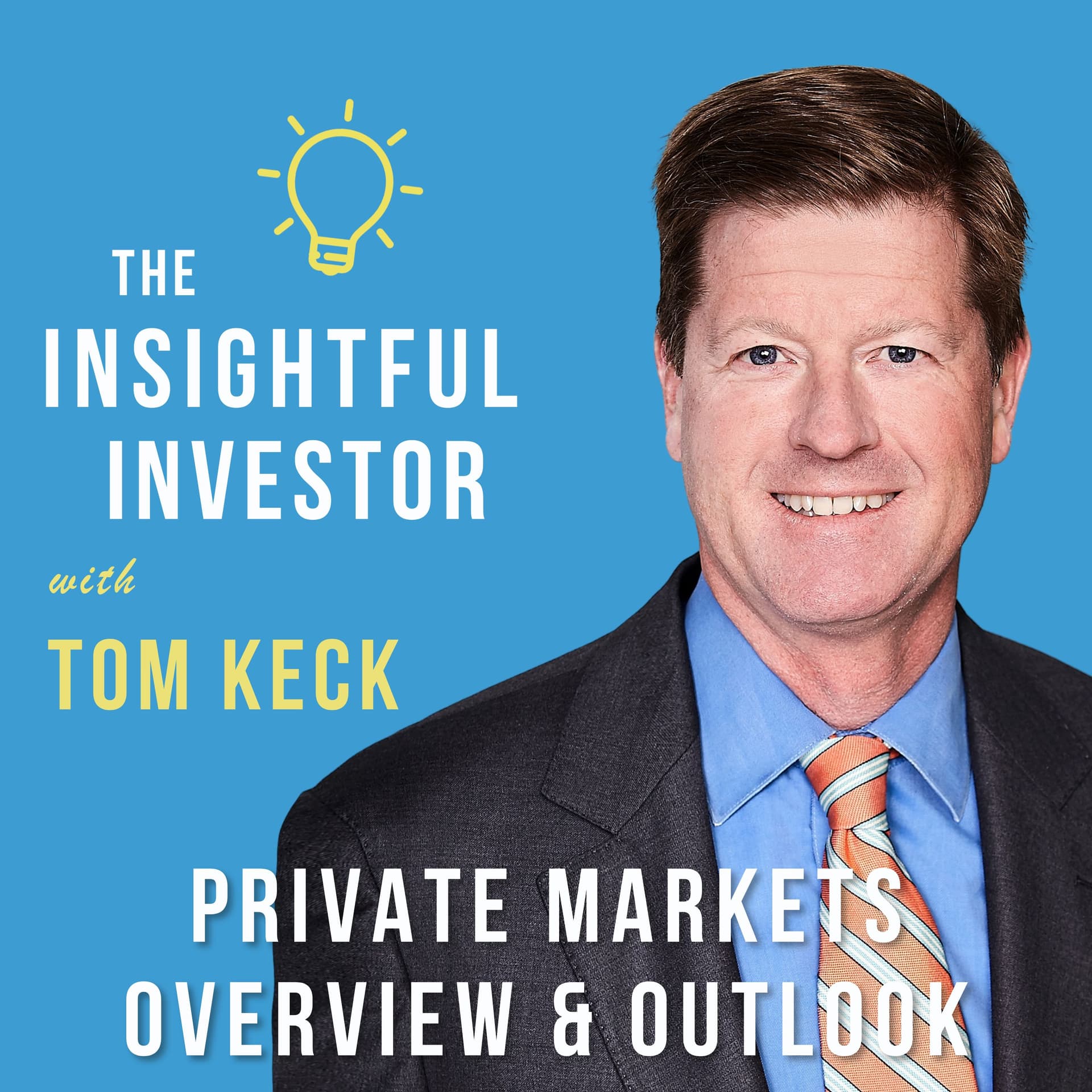
Insightful Investor Podcast: Episode #36 - Tom Keck: Private Markets Overview & Outlook
Overview In this episode of the Insightful Investor, host Alex Shahidi speaks with Tom Keck, co-founder and head of research and portfolio management at StepStone, a firm managing over $150 billion in private markets. Tom provides a comprehensive overview of private markets, discussing its segments, growth, and trends.
---
Key Insights and Discussions
Guest Background
- Tom Keck's Background:
- Former Navy pilot, which instilled lessons of humility and risk management.
- Emphasizes the importance of learning from mistakes and valuing experienced partners in investing.
Founding StepStone
- Motivation:
- Founded StepStone in 2007 after leaving a previous firm during its turnaround phase.
- Aimed to create a viable competitor focused on private equity.
Growth and Culture at StepStone
- Growth Strategy:
- Adopted a growth mindset: prioritizing a larger, cooperative team over individual gains.
- Resulted in the firm rapidly expanding from a few employees to over a thousand.
- Maintaining Culture:
- Focus on hiring individuals who align with the firm’s values and vision.
- Encouragement of intellectual curiosity and teamwork.
Private Markets Overview
- Market Segments:
- Private Equity, Private Credit, Real Estate, Infrastructure, and Secondaries.
- Overall market has grown significantly to an estimated $10-$13 trillion in AUM.
- Evolution:
- Private equity transitioned from high-leverage buyouts to investing in stable, high-growth businesses with less leverage.
- Infrastructure investments have matured, moving from risky financing structures to more stable, predictable returns.
Investment Insights
- Illiquidity Premium:
- Private markets offer a risk premium for liquidity constraints, with data suggesting a potential return advantage of 200-300 basis points compared to public markets.
- Risk Management:
- Importance of understanding and managing risks associated with illiquidity, especially when investing in private companies or assets.
Market Dynamics
- Current Trends:
- Private Credit: High growth and potential for attractive returns, particularly amidst rising interest rates.
- Real Estate: Offers opportunities for investors willing to navigate inefficiencies; however, sectors like office and retail face challenges.
- Infrastructure: Considered stable and low correlation to traditional markets, making it an attractive diversifier.
Secondary Markets
- Growth of Secondaries:
- Allows investors to buy existing fund interests at a discount, with potential for significant returns.
- Motivations for sellers include liquidity needs and portfolio rebalancing, indicating a more strategic approach beyond distress.
Future Outlook
- Investment Strategies:
- Tom discusses the importance of dollar-cost averaging into investments rather than timing the market.
- While private debt may offer immediate opportunities, real estate is suggested to have potential for future gains as markets stabilize.
---
Concluding Thoughts
- Tom emphasizes the necessity for investors to have a clear understanding of the private markets they engage with and to align investments strategically with their broader goals. The conversation reinforces the notion that while private markets present unique opportunities, they require careful navigation and an understanding of underlying risks.
---
Key Takeaways
- Humility and Risk Management: Essential traits for successful investing.
- Growth Mindset: Fosters collaborative culture and drives firm expansion.
- Market Segmentation: Understanding different areas within private markets is crucial for effective investment.
- Illiquidity Premium: Offers potential higher returns but comes with associated risks.
- Strategic Rebalancing: Sellers in secondary markets may not only be distressed but also strategically realigning their portfolios.
---
For more insights and details on the evolving landscape of private markets, you can listen to the full podcast episode at [Insightful Investor](https://insightfulinvestor.org/).
Written by AI. May contain mistakes. Listen to the episode to check what was said.
Transcript
Automatic transcript. May contain errors.0:05Welcome to the Insightful Investor Podcast, a weekly series that seeks to share industry investment and market insights. We define insights as concepts that are counterintuitive, widely misunderstood, or underappreciated. In other words, unique ideas that you probably won't hear elsewhere. I'm Alex Shahidi, the host of the podcast and co-CIO of Evoke Advisors, a leading investment advisory firm. Learn more about our show at insightfulinvestor.org.
0:38Joining me today is Tom Keck. Tom is co-founder and head of research and portfolio management at Stepstone, which manages over$150 billion and focuses on private markets. Tom, thank you for joining me today. Alex, thanks for having me. Looking forward to this conversation. I always like to start with your background because I think it gives us a little glimpse into the way you think and where your perspective comes from. And you have a pretty interesting background. Prior to business school, you spent your time as a Navy pilot landing jets on aircraft carriers, which I don't know if any other guest has that experience.
1:17What lessons from that experience do you still carry with you as an investor? Well, I think one of the counterintuitive lessons that I learned in the Navy, uh, it was really humility. Um, when you first join a squadron, you're managing about 60 people. Uh, the guys that I managed fixed the electronics on the airplane. And there's a chief petty officer there who helps you manage the division. he's been in the Navy for 18 to 20 years and he actually knows everything about how it all works. So even though you're theoretically his boss, you have a tremendous amount to learn from him, not only about the day-to-day activities of the squadron, but really about leadership and management.
2:13So one of the great things about the Navy is, you know, they put you into these positions of leadership, but they remind you immediately that you really have a lot to learn. And so I think as we approach investing, it's always good to approach it with a sense of humility and kind of recognizing that there's an awful lot that you don't know about what's going on. The second thing as an aviator that is super important is risk management. And as an investor, we spend a lot of time on risk management. So the idea is not necessarily to peg the risk meter, it's to take judicious risks that have reasonable upside.
3:00And so when you're thinking about risks as an aviator, or thinking about risks as an investor, you're constantly evaluating evaluating what could go wrong versus what could go right. And I suppose a big part of that is thinking about catastrophic risks, the risks where you never make it to the destination. We definitely try to avoid taking on any catastrophic risks for sure. Right. And I suppose in investing, a lot of times you may not think about that because it's not on the horizon or you haven't had a bad experience in the recent past. or you're just not aware of those risks. And I assume when you're flying a plane, you're constantly thinking about what can cause me to crash.
3:48Thinking about what can cause you to crash, but also thinking about recovering from something that doesn't go your way. So you always try to make good decisions. Even when you make good decisions, sometimes things don't work out your way. We had an expression that you never want a wingman who doesn't know what it's like to get punched in the face. So you want to make sure that your wingman, if things start to get a little difficult, isn't going to cut and run and leave you there on your own. You want them to have enough experience to know that you can stick together and make it through. And I think investing is very much the same way, investors who have made mistakes that weren't catastrophic learn from those mistakes and then can do a better job going forward.
4:42So whether it's looking for people to hire at StepStone or looking for the general partners that we invest with, we do value to some extent people who have been punched in the face and have learned those lessons and have demonstrated that they can avoid making those same mistakes going forward. And I assume those people also have greater humility because you get punched in the face a few times. It teaches you things. Yeah, that's a great point. That's really true. Well, you founded StepStone in 2007, about 17 years ago. What prompted you to go out on your own and why focus on private markets? My partners and I had been running another firm that was in turnaround mode.
5:31And we had come up with a plan for how to turn that firm around and make it a more interesting place to work, as well as a more viable competitor in its industry. And it happened to be focused on private equity. the reasons why that company had gotten into trouble were things that we ultimately were not able to fix and so we ended up leaving that firm it was based in san diego um san diego's pretty nice uh enjoy living in san diego there's not a tremendous amount of financial services opportunities here so our wives basically came together and said if these guys want to stay here in San Diego, they're going to have to start their own shop.
6:18So we sat down and we talked about it and realized that we actually had a pretty good business plan. We had a lot of experience working together. We'd been punched in the face many times together and kind of knew that we weren't going to cut and run. So it seemed like a good idea at the time. 2007, you could just start to see some of the cracks in the dam that led to the global financial crisis. But we felt very good about each other and about the plan that we had. And so we raised a little bit of money. We're able to get some really great people to join us and went through some twists and turns along the way, but it turned out to be a good decision.
7:03Well, you started with just a few employees and a small office and eventually you went public in 2020. Now you have over a thousand employees and manage over$150 billion and then become a global organization. What enabled you to grow so fast? I think when we started the firm, we had some core tenants to our vision. One of the key ones really was a growth mindset. So we decided early on that if we bring more people into the firm in terms of the economics of the firm, as well as the governance and how you run the firm, that we're going to have a smaller piece of the pie, but the pie is going to grow faster.
7:49And so in the end, we're going to have more pie, but we're also going to make a place that's going to be a lot more fun, interesting place to work. So I think that growth mindset attracted the right kinds of people, helped us to develop the vision and the culture that we wanted, and really led to not only us realizing our vision, but having other people buy into that vision and then add to it and help realize these sort of new features that we hadn't even really thought of when we started the firm. And you talked about culture, but how do you scale while maintaining your culture and without sacrificing quality?
8:34It's been quite an adventure. So I think you need to, as a manager, recognize early on who is buying into the culture and who is kind of a carrier of that culture going forward. and who is a good person and competent investor or analyst or whatever, but maybe isn't quite as invested in developing that culture. Pruning the tree as you go and making sure that you're reinforcing the same messages gets more and more people who are bought into that culture. And you really can't do it individually. You've got to make sure that the systems and processes are designed to really promote the people who support the culture that you're trying to build.
9:29And a great example of that, one of the first resumes that came in when we announced that we were starting the firm was from our now CEO, Scott Hart, who joined us as seemed like a young lad at the time. but he's been with us through the whole journey and has really been a key element of figuring out helping us develop the vision of how the business was going to work, how the culture was going to function. He moved to Europe to help really launch the European business, has been essential to our co-investment business. And a few years ago when Monty was looking to change his role, Seemed like the obvious choice to take over as CEO and has really led us into being a public company and has really been a great steward of the firm as we've grown from, I think, around 500 employees when he became the CEO to, as you pointed out, over a thousand today.
10:40And how would you describe the culture at your firm, the DNA? I think we like people who are intellectually curious. So people who are going to ask questions and sort of approach things with an air of skepticism, but an informed skepticism. collegiality is incredibly important so we don't have superstars here at the firm we're a team and if so a teammate needs help in a particular area we want people who are going to pitch in and help them out kind of recognizing that growth mindset that if somebody else gets ahead it helps me get ahead as well i think those two pieces are super important the other thing that was incredibly important when we started the firm, and I think has really been a core of us growing, is approaching everything we do like investors.
11:38So instead of talking to clients and just trying to figure out what they want us to tell them and then telling them that, actually developing our own view about what we think they should do with their portfolio, what we think is happening with the various financial markets, where we think things are headed. And so I think our clients value the fact that we have our own informed opinion and we'll advocate for that in a professional way. But we're not just there to do whatever the client wants. We're there to be a thought partner with them in building the best portfolio. Well, you focus on private markets.
12:22Would you provide an overview of private markets and how the asset class has expanded over the last couple of decades? It's grown tremendously over the last couple of decades. So I think the overall market today is somewhere between$10 and$13 trillion of AUM across private equity, private credit, real estate, and infrastructure. So those are sort of the four main areas that we think about. Private investment has been around forever. Bank lending started thousands of years ago. Long before public markets. Long before public markets. But it certainly has evolved since the 70s when these funds started getting set up, these fairly large funds, taking in dollars from public pension funds and using those to buy kind of sleepy businesses that were undervalued that could take on a lot of leverage.
13:27So that was really the birth of private equity. Real estate has been around, private real estate has been around even longer. And the fund side of private real estate hasn't developed as much, but the overall market something like 80 % of privately held real estate assets are owned directly on balance sheets of institutions and individuals. So those are kind of the two oldest segments of the market. In the early 2000s, mainly in Australia and Canada, we saw the development of the infrastructure, private infrastructure market as countries privatized previously national assets and sold them to institutional investors in the private sector.
14:21That industry has evolved tremendously from being sort of a copycat of private equity to kind of realizing not only how things should be financed, but what the expected return profiles should look like for those assets. And then around the middle of the 2000s, we started to see a real expansion in private credit. Here in the United States, you had seen a number of non-bank lenders in the 90s that eventually consolidated mainly into GE Capital. And then as GE Capital decided that they were going to get out of the business, You saw a lot of private funds get raised, and that business is now raising something like$200 billion a year in private funds to invest directly into lending to primarily middle market companies.
15:19So the overall market has grown tremendously. Private equity is the largest single part of the market in terms of organized funds, but infrastructure and private credit are growing very rapidly. And I would say the fund side of the real estate business is also growing rapidly. Well, thinking about it from an investor standpoint, many are attracted to private markets because of this understanding or expectation that there's a risk premium for giving up liquidity. You studied the data. You have tens of thousands of transactions that you've looked at the data on. What does the data say in terms of that illiquidity premium and what is the rough amount of that?
16:05So, economists argue about whether there should be a liquidity premium or shouldn't be a liquidity premium. That's a little above my pay grade. But if we just look at where assets trade in the private markets versus where they trade in the public markets, you can compare the median buyout multiple enterprise value to EBITDA in private transactions to, say, the S &P 500 enterprise value to EBITDA multiple. And generally, there's about one to two turns of difference in those multiples. So the S &P 500 is today at somewhere around 15 times EV to EBITDA. And the median multiple for private buyouts is probably 11 to 13.
16:58so you've got somewhere around a 10 discount that you can buy companies in private markets relative to the public markets and if you take that and extend it over a four to half to five year hold period it implies about 200 to 300 basis points of excess return that you get if you can buy it at the private multiple and sell it at the public multiple so that's a very shorthanded way of saying you probably should expect to get 200 to 300 basis points more return from your private investments relative to public investments. Now, is that all just because of illiquidity or are there other factors that weigh into that?
17:42There's absolutely other factors that weigh into that and actually can drive your returns much higher than 300 basis points. But But sort of rough justice, that's kind of a shorthanded way to think about what the liquidity premium might be. Right. It's not an exact science, obviously. So if we look at private markets, if let's say we go through an environment where there's just a flood of money coming in, there's just a lot of demand for looking for that 2 % to 3 % higher expected return by giving up liquidity, can that risk premium disappear if that happens? So the private markets are a little bit different than the public markets in that capital isn't invested immediately when it flows into the asset class.
18:29So the majority of the capital that comes into private markets comes in through blind pool funds. And those blind pool drawdown funds essentially are reserves of capital waiting to be invested. And so that weight of capital can influence prices. But generally speaking, when money's flowing into private markets, it's also flowing into public equity markets. And therefore, you have the sort of rising tide lifts all boats, so to speak. so you would need to see a tremendous flood of capital into private markets relative to public markets in order for the kind of return profile of private versus public to change dramatically and the private markets are really just very small compared to the public equity markets.
19:27So it's still, I think, somewhere around 10 % the size of the public equity markets in terms of capitalization. So I think we're pretty safe from the flood of capital changing the relative value between public equities and private equities. We have seen segments of the private markets become more efficient over time. And therefore, capital tends to flow into areas of the private markets that haven't previously gotten a lot of capital. And so I think there's still plenty of room for that to continue to happen. So overall, I think as more capital flows into the private markets, we'll see those private markets extend deeper and deeper into not only the US economy, but economies overseas to find inefficient parts of the market where they can capture that excess return?
20:32So in terms of inefficiency, that's one of the potential benefits of private markets, to public markets. Public markets are relatively efficient. There's information publicly available. Whereas in private markets, it can be a lot more difficult to get great insights in terms of getting the information. Do you sense that just high level speaking, the inefficiency in private markets allows for the opportunity to have outsized returns relative to the risk that an investor takes? Absolutely. I actually think that the inefficiency is the main reason why you want to invest into private markets. So if assets are inefficiently managed, then there's an opportunity to manage them better and have them produce better financial results.
21:23And whether it's a company or a real estate asset, an infrastructure asset, all those things are true. On the private credit side, the opportunity is slightly different, but is maybe even more compelling and we can get into that. Essentially, what we've seen over the past 10 to 15 years, so since the global financial crisis, the drivers of returns, and that's just talking about corporate private equity, but gives you an example of the inefficiency. see, we've seen the revenue growth of buyout companies exceed the revenue growth in the S &P 500 by about 400 basis points. Margin stay about the same, but that means that profits are also growing much faster.
22:21So we've seen tremendous multiple expansion in the public markets, some multiple expansion in the private markets, but really the outperformance has been driven by excess financial performance in the companies that private GPs have been by. So how have they been able to do that? I think one of the main reasons is active shareholding. Whether it's a venture capital fund, a buyout fund, or a real estate asset, or even an infrastructure asset, you have investors who are actively pushing management to make good choices about how to steward the capital that goes into the asset. So that means that you find management that has the ability to make changes necessary to get assets to operate better.
23:13If the current management isn't doing that, then you replace them and put in different management. If the company gets into trouble, you can take aggressive action to restructure the assets the cost structure. You can negotiate with lenders to basically get options on future cash flows. All of these things create value for equity investors and are tried and true methods that general partners use when they're managing the assets in their portfolio. So the inefficiencies are really centered around bad management of assets more than stock picking necessarily. Stock picking is certainly a piece of it, but when you put those two things together, you get a much better result than just stock picking alone, which is really all you can do in the public markets.
24:12And we talked about two to 3 % extra return for the same risk, roughly speaking. Do you think of what you just described as distinct from that premium, that kind of the liquidity premium, or is it one in the same? I think they're intimately bound up together. That's why I don't necessarily call it a liquidity premium. Part of the reason why private assets trade at a discount could be because they're smaller because they're less well understood because they're, they're perceived to be riskier. So a lot of what private investors do is they buy the companies that are less well understood and transition them to become better understood.
25:05And then maybe they are able to take those companies public and then arbitrage that multiple differential. Maybe you wind up actually just selling at the same multiple, but if you've been able to grow your returns, grow your profits and cashflow faster than public market companies, then you still win, even if you aren't capturing that multiple arbitrage. So that's what I think is really key is making sure that you are capturing those inefficiencies along the way. So you're not relying on multiple arbitrage for your excess return. How do you think about the risk in private markets relative to public markets?
25:49It's a great question. So I think equity risk, if we talk about three of the four private markets are really about equity risk. And equity risk in the public markets and private markets shares very similar characteristics. And if you look at the volatility over a long enough timeframe, the volatility is kind of the same. And I'm talking about valuation volatility. So over a five-year period, there's no difference between the S &P 500 and private markets. But if you shrink that time period to a single year, there's tremendous volatility difference. So S &P 500 could be in the high teens. Private equity is kind of around 10%.
26:36So almost half the volatility that you get in the public markets over a one-year period. Now, a lot of that is because you're not selling those assets all the time. And therefore, the ebbs and flows of the daily irrational exuberance or depression of the public markets doesn't necessarily impact your your private market valuations. So there is a little bit of a smoothing effect there in terms of valuation volatility that is beneficial to an investor's portfolio. The active shareholding, I think, is also a part of why that volatility is lower. So you are able to negotiate with lenders. you capture less of the downside in public markets because you don't have to sell when the public markets are depressed.
27:35But you can capture all of the upside because you can sell when the public markets are irrationally exuberant. And so we find that you capture in private markets about 60 % of the downside in public markets and about 100 to 120 % of the upside in public markets. So that's good. What you don't necessarily have in a lot of the traditional markets that you do have in private markets is this illiquidity. And so I think that's the primary risk that investors have to be wary of. In traditional assets, they're not always wary of the illiquidity that they might be taking on. So if you're investing in micro cap stocks, They can become very illiquid at awkward times.
28:24Certainly in the fixed income market, different types of bonds and bank loans have varying liquidity profiles. So liquidity is a dimension of risk that I think a lot of investors don't necessarily have in their kind of mental framework because we're conditioned to think about efficient markets and perfect liquidity being available. Why don't we dig in into each of those market segments that you described? Let's start with private equity first. How has this market evolved over the past few decades? So it's been very interesting to see. So in the 90s, general partners were more like investment clubs.
29:08You'd have a few investment bankers and maybe some ex-consultants come together and they would go around and look for companies to buy, lever up on the venture side, would kind of leverage their networks to invest in companies. But the GPs themselves were not really run as businesses. In the 2000s, we saw a transition as those businesses recognized that we're not just a collection of individuals, but there's actually enterprise value that we're building because of the ability to raise capital, the ability to invest in companies, in the right kinds of companies. And so we saw a professionalization of the general partner side of the industry.
29:58And that has really continued through today and has, I think, really contributed to the sustained performance of some firms and has allowed other firms to grow very quickly because they had this mindset of, we're running a business and we need to manage ourselves professionally, not just our portfolio companies. The other significant trend that has happened over time in the 80s and 90s, you could see buyouts that would have 80 or 90 % of the capital structure might be leverage, and you'd only have 10 % or 20 % in equity. In the last 10 years or so, since the global financial crisis, we've seen the proportion of debt and equity be closer to even.
30:48So something like 50 % of the capital structure in buyouts is debt versus 80 % or 90 % before. So that has really shifted the kinds of companies that these GPs can buy. They've gone from really massively under-managed companies that had tremendous cash flow, but were very slow growing, to today, something like 30 to 40 % of the industry is invested into very stable IT-oriented businesses like enterprise software, where you have 80 or 90 % recurring revenue, very little in terms of assets, but fast-growing businesses with lots of white space. And those businesses can support a tremendous amount of debt.
31:36However, they also have a tremendous number of growth opportunities. And so the cash is not just being used to service debt. It's being used to invest in these new growth opportunities. So buyouts have gone from being about restructuring in kind of slow growth companies that needed to be managed better to today using less leverage, reinvesting more capital into these businesses, getting them to grow faster, and more kind of IT, financial services, healthcare, consumer durables. So very different kinds of companies that are being invested in today. The third thing that has happened since the global financial crisis, and it's sort of linked to the first two, there were a number of firms that got into trouble during the global financial crisis.
32:25They spent a lot of time kind of looking at their processes and what they were investing in and refocused themselves going forward. And so we've seen a tremendous amount of specialization since the global financial crisis as GPs have specialized on certain types of deals, certain industries. And that, I think, has, again, served to enhance the returns available because now the investors are really focused on where they can drive financial returns rather than just be stock pickers. If we take a high level view of private equity, those investors who can access it, so wealthy individuals or large institutions, they are attracted to private equity because of its high historical returns.
33:19That's one of the main reasons they invested it. But when we look backwards, those returns were by and large earned during a period of either falling interest rates or near zero interest rates. What's your sense about this asset class? Should that tailwind of falling or low interest rates reverse? Well, the tailwind is gone. And I think it benefited all equities. And it certainly benefited all fixed income as well. So if you're investing in fixed rate, fixed income, declining interest rates definitely helped you drive returns. And so investors across every asset class now have to cope with that tailwind no longer being around.
Read the full transcript
34:04I think the importance of low interest rates for the debt portion of private equity is probably a little bit overstated. So we looked at typical buyouts and said, well, if you increase interest rates by 100 basis points, how much does that impact returns versus increasing profit growth or something like that. And so the spread over five years, the impact on multiples of higher interest rates is very low, like 0.1 or 0.2 multiple points, whereas driving excess profits can really drive a lot more value. So I'm not overly concerned about the compression in interest rates because I don't think that is going to be the main driver.
35:03Certainly, we talked about the debt equity ratio going from eight or nine to one to one to one. That has been a major factor in why interest rates are less important today than they might have been 15 or 20 years ago. So that's helpful insight because I know a lot of investors think of private equity as just levered equity. And so what you're describing is a little bit different from that. Yeah. I mean, certainly leverage plays a part. And if you've got 50 % debt in your portfolio, then half your return is going to come from leverage, assuming that you're able to drive some return on the other half of the capital structure.
35:45So I don't want to understate the importance of leverage, but I think we've definitely seen whether it's in private equity, but even when we talk about real estate and infrastructure, the use of credit and the durability of the capital structures has changed dramatically from the 90s. So let's transition to private credit. This has been a rapidly growing market, trying to catch up to its public or its private equity counterpart. Would you talk about the history of private credit and how it has evolved? So private credit, as we talked about earlier, has been around for a very long time. I'll talk mainly about the last 25 years or so, because the private debt business that we're in today has really evolved since then.
36:40And we're talking mainly about non-bank lending in the senior part of the capital structure. So mezzanine lenders have been around for a very long time. It used to be that the senior part of the capital structure was dominated by banks, both here and overseas. In the 90s, we saw a number of non-bank financial companies arise to service the buyout industry and provide leverage into companies that didn't necessarily have a lot of assets, but had a lot of cash flow. Banks only wanted to lend against assets, and these non-bank lenders were willing to lend against cash flow. And so the technology around those types of lending developed very quickly here in the U.S.
37:36And over time, those structures migrated into what we see today, where we have a lot of BDCs, which are both traded and non-traded structures that allow investors to get access to these types of loans. The BDCs have a little bit of the same structure as a bank. So a bank has short-term liabilities and long-term assets. The BDC, the liabilities aren't quite as short-term, but they're not necessarily as long-term. And then you also have these closed-ended funds, which service a tremendous amount of the industry today. The closed-ended funds are actually, they have the same duration on their liabilities and their assets.
38:26So it's actually a much more stable vehicle to make these types of loans. And so I think the evolution of that technology of how we structure the lender has evolved over time and is in a much more sustainable place in these closed-ended funds. So I think that is a very good development. The other interesting thing to me about the private debt business, if we look at the sharp ratio of the returns that you get in that business, it's the most attractive sharp ratio across all the four asset classes. Now, you also have the highest correlation between assets on the debt side versus a traditional 60-40 portfolio.
39:17So you don't get quite as much diversification as you might get from real estate infrastructure or private equity. But you get this very nice sharp ratio. The assets themselves don't vary a lot. And you get, you know, today you can get SOFR plus, you know, four or 500 basis points for lending to these small middle market, primarily sponsor-backed companies. That's a pretty good return with SOFR at, you know, 550 or so. So you can just about hit your equity target just by investing in private debt. You won't have the tremendous upside that you might have in some of the other asset classes, but you will definitely have lower volatility as well.
40:08So let's dig into that a little bit. You mentioned the Sharpe ratio. So that's the return for the amount of risk that you're taking. And private credit, as you just referenced, has a yield, call it about 10 % plus, which is very competitive with the long-term return of the stock market. and obviously the stock market has a lot more volatility than private credit. And if you just look at the private credit index, it was down about 6 % or so in 2008. It was up in 2022 when stocks and bonds were down. So on the surface, that sounds very attractive from an investment standpoint. So what is the risk that investors should consider?
40:45So you talked about the downdraft in 2008. A lot of that was from credit reserves being taken. So they weren't necessarily actual losses that happened. It was just the expectation of losses going forward, which ended up not actually materializing. So while you did have that down draft in that one year, the losses were actually relatively mild compared to what we expected in the global financial crisis. So as an investor into private debt, you need to really think a lot about the general partners that you're investing with and their ability to manage that default risk. So I think that you really need to be able to hold the assets through the cycle.
41:38And that's kind of the benefit, but also the challenge of a closed-ended fund is, again, the assets and liabilities are matched well, but as an investor into those funds, you may have periods where you're just getting the coupon. You're not necessarily getting your capital back. So I think the liquidity is really the piece that investors need to think about. So invest with quality GPs and then make sure that you've got the ability to withstand the liquidity profile over an extended period of time. The underlying assets in these credit funds tend to be floating rate debt. So that's good news and bad news.
42:29If interest rates go down, your return's going to go down because those rates are going to reset on a quarterly basis. On the other hand, if interest rates go up, you're not going to take a hit to your capital value because the interest rates adjust up as well. So what you don't have in private debt that you might have in other forms of fixed income is that interest rate risk to your capital. And in that way, you can think of it as a good diversifier to traditional high-quality public bonds. Yeah. The private credit market is largely investing in sponsored-backed companies. So companies are backed by private equity firms.
43:17What are your thoughts about non-sponsored private loans and also real estate lending now that many banks have stepped away? So I think I'll take those as separate questions. The non-sponsored is an interesting area of the market that is growing, although not quite as quickly. A lot of the non-bank lenders aren't set up to originate loans in that part of the market as widely as they are in the sponsor-backed market. It's just easier to cover sponsors than to cover the tens of thousands of small businesses out there. So regional banks have an advantage in that they already have those relationships and they're set up to originate those loans.
44:06But I think over time, we will see those regional banks partnering with non-banks to essentially fund that business. and you'll see the origination stay with the regional banks and you'll see more of the financing taken on by the non-bank lenders. Because the banks have the relationships? Exactly. And that's really their advantage in that market is the presence in the market and being able to originate those loans. the real estate side you essentially have a similar dynamic where the banks are in those markets they have the position to originate those loans uh they definitely don't have the balance sheet uh appetite to originate those and so i think that's a very interesting uh place for the next three or four years, as a lot of the commercial real estate paper comes up for refinancing, I think you're going to see more and more non-bank lenders getting involved in that space.
45:23And it's a pretty interesting opportunity because there's a tremendous amount of inefficiency available to take advantage of. Plus yields are much higher than they used to be. Yields are higher than they used to be. The challenge, of course, is the loan to value and figuring out what the value is. So the yield is great as long as you can get comfortable that your loan to value is in the right spot. and that is much more difficult for an office property than it might be for an industrial or you know like a data center type of a property so that's what that's what is going to make this such an interesting time over the next few years it's going to take a long time for all of that to shake out.
46:20And therefore, it's a big opportunity for private capital, both on the debt side and on the equity side, because patient capital is going to better be able to take advantage of those inefficiencies. Yeah, that's a perfect segue to talk about private real estate. And if we just focus on the property side, so buying the buildings and investing in that real estate, it's a very interesting time. As you mentioned, there are certain market segments facing severe headwinds like office and retail, et cetera. And there are others still enjoying secular tailwinds. And all of this, while the cost of financing has materially increased and many of the traditional lenders have stepped away.
47:02Would you share your high level observations of private real estate market? It's like a Charles Dickens novel. It's like the best of times and the worst of times. So if you're in core real estate, which historically got kind of a six to 8 % kind of return, well, as you pointed out earlier, now I can go and get senior secured corporate credit at 10%. So the six to eight doesn't necessarily seem that interesting. So there's a lot of capital that has flowed out of the real estate business into these other areas where these higher yields are available. And so that creates opportunity for patient capital to come in and reprice assets and take advantage of that.
47:58So that's more of an equity strategy than a debt strategy. The debt's going to be interesting. It's going to get repriced. The real estate debt tends to be more fixed rate than floating rate. And so there's a nice opportunity there. On the equity side, there's going to be a lot of uncertainty about what the value is. The senior is going to therefore be at a very low basis. The equity isn't going to want to fill the gap between where the senior used to be and where they are today. And so there's going to be a big gap in these capital structures that is the opportunity for private credit to come in and structure a return profile that essentially bridges the gap between what the senior lender is willing to lend against and what the equity hopes the thing is eventually going to be worth.
48:56and so that arbitrage is a really interesting part of the market that again is going to take a few years to evolve we still need you know prices we need transactions to start happening again and we need price discovery to happen that's just now starting to pick up and it will be fueled by the wall of maturities that are coming as these assets need to to refinance Um, so I think real estate is a very interesting time in the market. Uh, you'll be able to find very interesting assets at compelling prices, but you've got to be very careful about not catching the following knife. Um, and you know, what's interesting, you talked about office.
49:44Office was a sector that was out of favor well before COVID hit. Um, COVID just accelerated a change that was already happening in the market. And so we saw the same thing with retail, where e-commerce accelerated a change in how retail was used. And so there's been a reshuffling of the tech on the retail side. The retail sector is just now finding its feet, and there's some compelling opportunities in retail, whereas five years ago, you wouldn't touch retail with a barge pole. So eventually, office will probably shake out. Does it take longer than retail took? I mean, retail was sort of in the penalty box for a decade and still not completely out of it.
50:38So I think office is going to take a long time. In the meantime, you do have, because of the change in retail because of the changes in information technology. As you pointed out, data centers and industrial have been very hot. I think residential is also a very interesting segment because of the changes in the way that people think about where they want to live, as well as kind of the underbuilding of new residences that has happened since the GFC. So I think the dynamics there are very interesting as well. Well, one of the interesting aspects of private markets is the markets tend to move slower than their public market counterparts.
51:31And so typically when I see an area that's under distress or really suffering, and most people try to stay away, I view that as maybe there's an opportunity there. But as you referenced, areas like office and retail, it's slow moving, but at some point, the price makes it attractive, even with the falling knife dynamics. Is that how you think about it? So prices in the private markets are much stickier, and that can be a problem. One of the reasons why there hasn't been any transaction volume in real estate in the past few years is because sellers didn't adjust their price. And there wasn't anything that was forcing them to adjust.
52:14So if you owned an office building, as long as you had it pretty well occupied, your mortgage financing was at a very low rate because you still had your mortgage from pre-COVID, and therefore your cash flow wasn't forcing you to make any decisions about what to do with the building. You could reduce your capex a little bit and still service the debt and essentially have a hope certificate that the market would somehow come around and save you. That tends to be less of a feature in corporate equity. Prices still don't adjust as quickly as they do in the public markets, but they adjust faster than in real estate.
53:02And then infrastructure has its own dynamic because they're such long-lived assets in the way that the cash flows work. Even with an office building, you have tenants that are constantly moving out and so that asset gets repriced on a regular basis. The cash flows tend to stay stable over a much longer period of time. So the prices there don't adjust as quickly, but we've still seen assets trading on the infrastructure side because the prices are reasonable. Whereas on the real estate side, I think there's still a big gap between what sellers are willing to pay and what buyers are willing to accept.
53:43You touched on infrastructure. So we talked about private equity, private credit, and private real estate. The fourth area that is commonly owned in private markets is infrastructure, but it doesn't typically receive as much coverage as the other segments that I just referenced. Would you tell us about this market segment and what you find attractive about it? So infrastructure is fantastic because these are basically monopoly assets. And so everybody wants to own a monopoly. how much you pay for the monopoly is a problem and often with monopolies you wind up in partnership with the government so those are things that you have to be aware of and manage but if you know how to manage these assets and you know how to manage the relationships with the governing authorities they can be really terrific assets because you can lock in a great rate of return when you buy the asset.
54:45You can manage it more efficiently and you can drive up your cash flow and your profits, your net income on the asset. Interest rates will impact the value of the asset, but the interest rates that matter are the ones at the long end of the curve rather than the short end of the curve. And so those tend to adjust very slowly. And so you don't get a lot of wild price swings from interest rate adjustments. So you have these nice cash flows, you have these assets that they'll capture a little bit of economic growth, but they're just great assets because they're positioned in a particular market. and therefore the return on the asset has very low correlation to traditional asset markets.
55:41So we talked before, private debt market has a relatively high correlation to public markets. Private equity is lower. So private debt, we'll call it say 90 % correlation. Private equity is maybe 70 % correlation. Real estate is like 30 to 40 % correlation. So it's a great diversifier, but you do have a little bit of interest rate risk built in there. Infrastructure is like almost zero correlation to traditional asset markets. So it's a fantastic diversifying asset and you are able to capture a little bit of the growth in the economy to the extent that you're able to invest in things like airports, toll roads, digital infrastructure type assets, cell towers, data centers, and that sort of thing.
56:32One argument I've heard against infrastructure is the historical returns aren't high enough to give up liquidity. What does your data say and how do you think about that? The early 2000s, as infrastructure assets started to be privatized, the technology for how to buy and manage those assets didn't really exist um so people took private equity buyout techniques and applied them to those assets and they said well we need to get a 15 return off of this airport so we're going to put 90 leverage on it because it's not growing very fast, but it's got great cash flows. Well, 90 % leverage on any asset is highly risky.
57:26And so we went into the global financial crisis and a bunch of those assets got into very deep trouble. Since the global financial crisis, infrastructure GPs have recognized that, okay, there are some assets that can deliver a private equity style return. There's other types of assets that should be delivering a core real estate type of a return. And so we have this much broader spectrum of expected returns that I think does a better job of thinking about the underlying risks in a particular investment. And so they're not injecting so much financial risk into these assets in order to try to artificially generate a super high return.
58:13And so I think the reason the historical returns don't look so good is because they include all of this historical stuff that really wasn't structured the right way. And so today, if you approach the asset class and say, okay, I really like the lower return, super stable, I can lock in my 8%. return at very low volatility for a very long period of time. And I don't have to worry about reinvesting that capital. That's one part of the market. Or I really think that digital infrastructure is, AI is going to change the world. So I want to invest in that part of infrastructure. That's a different risk profile and a different return profile.
59:00So I think it's incumbent upon investors to be more clear about why they're investing in infrastructure. What's the role it's going to play in their portfolio, and then positioning their capital in the right GP based on that thesis. I guess going back to the beginning of our conversation, the asset class was hit in the face and it learned a lot through that experience. That's absolutely true. And unfortunately, a lot of investors got punched in the face as well. But one of my partners loves to say, you want to partner up with somebody who's learned to shave on somebody else's face. And so a lot of these GPs have essentially, they made mistakes with other investors' capital.
59:49But now, if you give them capital today, they'll be able to do a better job of managing it because they made those mistakes in the past and learned from them. That's right. Within private markets, there's also an area that has been growing relatively rapidly called secondaries. Would you talk to us about that and how you think that market will continue to evolve? Secondaries means different things in different parts of the market, but generally speaking, it is buying out a private market closed-ended fund before the end of its life. And so the secondary has an asset portion and has a liability portion.
1:00:36You're not just buying the assets, you're also taking over whatever the liabilities are, the undrawn capital that still has to get funded over the remainder of the life of that fund. so that dynamic of having both an asset and a liability means that the general partner who manages the fund gets a vote on who can buy the asset because they want to make sure that that person also is able to service the liability now the gp is in the fundraising business and if they're losing an LP, they want to replace them with somebody who's going to potentially invest in their next fund. So there is a little bit of a dynamic of the GP not only wants to make sure that the buyer of that interest can make the capital calls for this fund, but they're more interested in somebody who's potentially going to invest in the next fund as well.
1:01:38And therefore, the information asymmetry of buyers in the market favors those buyers who also invest a lot of capital into new closed-ended funds. And so there are more inefficiencies to arbitrage for those types of players in the market, whether you're talking about private equity or real estate or infrastructure or even private debt? So if I make a commitment to a private fund, let's say private equity in this case, and let's say it's a 10-year commitment, they call for capital. And after, let's say, year three or four, I say, you know what? I want to sell this fund. I can't go back to the company that I invested with and get my money back.
1:02:26I go into the secondary market and I sell that to a willing buyer. And I typically sell it at a pretty steep discount to what it's worth. So why would sellers sell at a big discount? I can see the advantage to the buyer of that buying this asset at a steep discount, but why would a seller be motivated to sell? There are different reasons. In recent years, so initially it was mainly about liquidity and sellers being in trouble and just needing cash. And this is the only way they could raise it. Since the global financial crisis, it has become more about rebalancing than just about seller distress.
1:03:08And so you have large institutions, even medium or small institutions that have many more relationships in these closed-ended funds than they want to hold going forward. And so they will occasionally reset the relationships that they have. They will rebalance their portfolio to align with what their strategy is going forward. And the secondary market is a very useful way for them to offload exposure that they're no longer interested in. And so the price of being able to do that is the discount that you talked about. It can be very, very different. An old venture fund that only has two assets in it is going to sell at a much bigger discount than the year three or four fund that you talked about that maybe still has 20 or 30 assets in it that are growing and very diversified.
1:04:06That might sell for a 5 % or 10 % discount. And so you have this kind of wide range of discounts because the assets themselves are so different in terms of what's in them, how close they are to liquidity, and what the growth prospects are. So as an investor, if I'm looking at investing in secondaries and buying these existing funds at some discount, should I focus more on getting the biggest discount I can get, or should I focus more on the asset that I'm buying, or is it a little bit of both? It depends on what your strategy is. But generally speaking, if you're investing into secondaries, you're going to get something like 1.7 times your money over the overall hold period on average in secondaries.
1:05:00So if you buy at 80 cents, then immediately you get to write it up to par after you buy it. So now you're sitting on a 1.25x. So you've got 0.25 of your profit that you've already captured that's about a third 0.45 you still have to earn through appreciation in what's left so that ratio is roughly two-thirds asset appreciation to one-third discount again it depends on what you're buying and you know But if you're only getting a 1.4 and you're buying stuff really cheap, then maybe it's more discount. But then you're not getting as much asset appreciation. And so you have to figure out, like, how long do I have to hold these things before I get my 1.4 back?
1:05:59So the strategy matters. We tend to focus more on assets that are appreciating on a regular basis. because if you're going to end, the secondary is going to maybe have a three-year duration versus a new fund might have a four and a half or five-year duration. So you are shortening your duration, but you still want to make an attractive return over that timeframe. And so you're going to need to get some asset appreciation in order for that to happen. One interesting aspect of secondaries is let's say you're focused on the asset. You can go buy attractive, what you view as attractive assets at a discount to what you would if you were investing on a primary fund, a discount even net of the added layer of fees with high diversification, assuming you invest in a secondaries fund and potentially a shorter fund life.
1:06:56And you can minimize or almost completely eliminate the J-curve. So given all that, which all those sound relatively attractive from an investor standpoint, is it feasible for investors just to focus on secondaries to get private market access? So it really depends on the scale of what you're trying to deploy. So if you're trying to invest$100 ,000, you can absolutely do that just in secondaries. If you need to deploy a billion dollars, that becomes more challenging because finding the scale to invest there, it's not an infinitely scalable strategy. And so different types of investors will have differing capabilities to focus on secondaries.
1:07:49And so that's really, I think, the challenge there is being able to deploy capital in the volume you need to in order to put together a good portfolio. So on paper, it may sound great, but in practice, it's not as easy to implement. I mean, it's sort of job security for us, for all private markets, because all of these things that we talk about sound terrific, but actually making sure you just invest in the good stuff and avoid the bad stuff is much harder than I make it sound. So yes, I think that's an important lesson across all private markets. They're expensive because it's really hard to do this stuff.
1:08:37And giving up liquidity becomes much more painful when you're in something that you don't like. Yes, that's absolutely true. Marry and haste, repent at leisure. You keep getting punched in the face and you can't duck. That's right. So taking a step back and look at all these private markets that we talked about, real estate, equity, credits, infrastructure, what generally speaking looks the most attractive at this point in the market cycle to you? so i mean i love all my children um equally but they each play a different role in the portfolio so when investors ask me a question like this it it really is driven by what are they trying to accomplish and what are they trying to add to their portfolio so private equity is great for getting access to kind of the growth part of the economy, capturing inefficiency and driving profits.
1:09:40We talked about real estate. Real estate has got a tremendous amount of inefficiency right now. So there's a lot of opportunity. That opportunity is going to evolve over time. So it's not necessarily something that's happening today, but you have to position capital to be available to go into that market as those opportunities arise. And so what we find is that each of these different markets becomes attractive at different parts of, and they each have their own cycles, but you can't just sell out of private equity and buy real estate today. You kind of have to position yourself to take advantage of those when they happen.
1:10:28So private debt is a great place to put capital today. If interest rates start coming down in the fourth quarter, it's going to be less attractive in six or nine months than it is today. Real estate, on the other hand, is probably going to be more attractive, but it's not as actionable today. um so you know some of this depends on your horizon some depends on what your portfolio really needs and some depends on like we talked about before what's the scale that you need to deploy what's the resources that you have available um but i think each of the different asset classes has really interesting inefficiencies that they are capitalizing on over the medium term I have one more question for you, and I appreciate all your time today.
1:11:23So much of investing in private markets has to do with your vintage. Is your sense that 2024, 2025, generally speaking, is a relatively attractive vintage? So I think, again, it depends on which of these strategies you're talking about. So I would say private debt, the absolute returns are going to vary a fair amount depending on what happens with interest rates just because it's floating rate product. the credit spread doesn't actually change as much it will change a bit over cycles but the base rates tend to move around a lot and that kind of drives changes and returns so the difference between you know was 2005 was sort of a bad vintage even though it looked like credit spreads were pretty high and interest rates were pretty high, but defaults ended up being challenging.
1:12:31So in 2005, you didn't really know that because you needed to know what was going to happen in 2008 in order to see that coming. So I will use that as kind of my out on making any pronouncements. I do think that it's an attractive time to deploy capital we counsel our clients not to time markets, but to try to dollar cost average through these vintages because it is difficult to know today what's going to happen in three years. And a lot of the capital gets deployed over the next couple of years. So even knowing what you're deploying into can be a challenge. Very fair response. I appreciate that.
1:13:22And I appreciate your time sharing your insights with us, Tom. It's been a real pleasure chatting with you. I appreciate you inviting me on.
1:13:46info at insightfulinvestor.org. And if you enjoyed the discussion, please subscribe to this podcast to ensure you don't miss future episodes. And don't forget to forward today's conversation to others you think would enjoy listening. This podcast is provided for informational purposes only and should not be relied upon as legal, business, investment, or tax advice. All opinions expressed by podcast participants are solely their own opinions and do not necessarily reflect the opinions of Evoke advisors, their affiliates, or companies featured. Due to industry regulations, participants on this podcast are instructed not to make specific trade recommendations, nor reference past or potential profits.
1:14:27And listeners are reminded that securities trading, commodity trading, and alternative investments are complex and carry a risk of substantial losses. As such, they are not suitable for all investors.
1:14:41Listeners should be aware that guests featured on The Insightful Investor may have current or past associations with Evoke Advisors or the host, including as an investment manager of a private fund opportunity by Evoke or access through an affiliated Evoke fund or as a client. Participation as a guest on the podcast should not be perceived as an endorsement or testimonial with respect to Evoke Advisors, the podcast host, or their services. Similarly, the inclusion of a guest on the podcast does not imply that Evoke Advisors or the host endorses the guest or any company with which they may be affiliated or employed.
1:15:20Evoke has neither paid nor received compensation from guests for their participation.
From the publisher
Tom is co-founder and head of research and portfolio management at StepStone, which manages over $150B and focuses on private markets. Tom shares an overview and insights about the various segments within private markets: equity, credit, real estate, infrastructure and secondaries.


