
In short
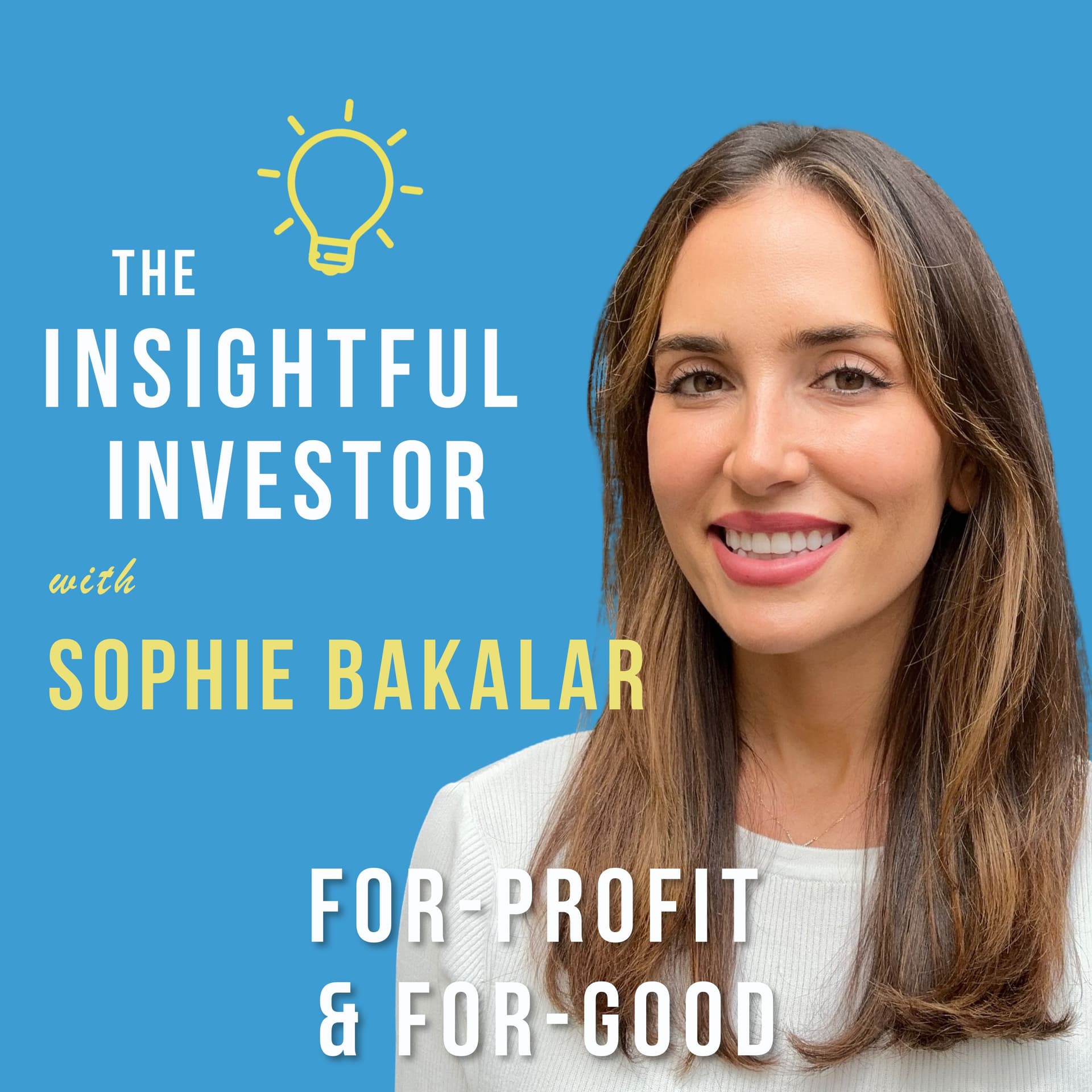
Insightful Investor Podcast - Episode #38 Summary
Episode Title
Sophie Bakalar: For-Profit & For-Good
Host
Alex Shahidi
Guest
Sophie Bakalar, Partner at Collaborative Fund
---
Overview
In this episode, Alex Shahidi speaks with Sophie Bakalar, a partner at Collaborative Fund, a venture capital firm that focuses on investing in companies that balance profit with positive societal impact. They discuss Sophie's life philosophy, her insights on sustainability, the evolving landscape of climate investment, and the framework used by Collaborative Fund to evaluate potential investments.
---
Key Themes and Concepts
- Life Philosophy and Minimalism
- Simplicity Over Optimization: Sophie shares her journey of moving away from over-complicating life for productivity’s sake to embracing minimalism and simplicity.
- Natural Waking: Advocates for waking up without an alarm clock, promoting a lifestyle change that leads to better health and well-being.
- Investing Fundamentals
- Back to Basics: Importance of focusing on three core factors in early-stage investing: team, product, and market.
- Long-Term Perspective: Emphasizes the value of zooming out to recognize macro dynamics that significantly influence business evolution.
- Climate Change and Sustainability
- Personal Motivation: Sophie's interest in climate and sustainability was sparked during a 2015 backpacking trip, where she observed global perspectives on environmental issues.
- Paris Agreement Insights: While aware of the agreement, Sophie expresses skepticism about its effectiveness and emphasizes the need for actions that align various stakeholders towards climate goals.
- Villain Test Framework
- Investment Criteria: Collaborative Fund employs a "villain test" to evaluate potential investments, asking whether a villain would use the product or service, ensuring that investments are both profitable and socially beneficial.
- Climate and Health Intersection
- Emerging Opportunities: Sophie identifies areas where climate tech intersects with health, such as the impact of microplastics and air quality, indicating a growing field for investment.
- Challenges in Climate Tech
- Accessing Capital: Notes the difficulties climate tech companies face in obtaining funding, especially in later stages.
- Commercial Scalability: Stresses the challenge of transitioning from technology-focused companies to commercially viable businesses.
---
Investor Insights
A. Historical Context
- Rising Focus on Values-Driven Companies: Sophie's observations on how companies aligning with consumer values are becoming more successful, particularly among younger demographics.
B. Market Dynamics
- Importance of Market Readiness: Sophie's controversial view on the equal significance of market dynamics alongside team and product in early-stage investments.
C. Future Outlook
- Optimism for Consumer and Climate Sectors: Despite current headwinds, Sophie is hopeful about the future of climate and consumer goods sectors, particularly as AI enhances customer acquisition.
---
Conclusion
In this enlightening discussion, Sophie Bakalar shares her unique insights into the intersection of profitable investing and making a positive impact. The episode emphasizes the importance of simplicity in life and investing, the relevance of sustainability, and innovative frameworks like the villain test that guide investment decisions.
For more information, visit [Insightful Investor](https://insightfulinvestor.org/).
---
Additional Resources
- Podcast Website: [Insightful Investor](https://insightfulinvestor.org/)
- Contact: info@insightfulinvestor.org
---
Disclaimer: This podcast is for informational purposes only and should not be relied upon as legal, business, investment, or tax advice.
Written by AI. May contain mistakes. Listen to the episode to check what was said.
Transcript
Automatic transcript. May contain errors.0:05Welcome to the Insightful Investor Podcast, a weekly series that seeks to share industry, investment, investment, and market insights. We define insights as concepts that are counterintuitive, widely misunderstood, or underappreciated. In other words, unique ideas that you probably won't hear elsewhere. I'm Alex Shahidi, the host of the podcast and co-CIO of Evoke Advisors, a leading investment advisory firm. Learn more about our show at insightfulinvestor.org.
0:38Today's guest is Sophie Bacalar. Sophie is a partner at Collaborative Fund, which is a New York-based venture capital firm with a mission to identify and support companies that live at the intersection of for-profit and for-good, which we're going to spend a lot of time getting into. Sophie, thank you so much for joining me today. Thanks so much for having me, Alex. I'm excited. So I've listened to a few of your podcasts, and there was something that jumped out at me really quickly. And that's your general life philosophy, which I find pretty insightful. And so I'd like to start there before we get into the business side.
1:18Would you share your ideas about things like minimizing clutter, not waking up to an alarm clock, being balanced, and any other core values that you think listeners would find interesting? Yeah, of course. I'm always happy to share more about how I think about structuring my life. But first of all, no one should listen to me or take anything I say as advice because what the heck do I know about any of this? But yeah, I spent a good number of years really obsessing over perfecting every facet of my life from my health to my work productivity to my sleep. All of those things, I put a lot of energy into figuring out how to sort of hack each component of my life.
2:07And it took me a while to realize that I was actually incurring a lot of debt in that process, a lot of tech debt, a lot of health debt, that actually the process of sort of over-optimizing my life was having the inverse effect. And it caused me to really take a step back and recognize that maybe simplify my life quite a bit and reversing course to not try to create the perfect productivity hack for my workday was actually going to have tremendous benefits. And so I really do try to simplify as much as possible. I don't use a lot of productivity tools, for instance, anymore. And when it comes to my health, I try not to obsess over, you know, am I getting exactly the right number of hours of sleep or am I getting the right number of steps in?
3:02I think a certain amount of simplicity is actually really beneficial. I think of that, do you know that bell curve meme that's all over Twitter and it's applied to all sorts of things, but I spent a lot of time at the sort of median of that bell curve and certainly not a Jedi by any means, but now I think I've really tried to move over to the right side of that equation. And specifically on the alarm clock question, because I do get asked this quite a bit, it's really not that hard to wake up without an alarm clock. It just requires a lot of consistency around when you wake up. And there are tons of resources online if people are interested, but I think it made a big difference in my life.
3:41I really don't like waking up to super loud jarring noises. It's nice waking up to the sun or just to my own body waking up naturally. And I get out of bed feeling good every morning, which is not something I could have said years ago. So I'm grateful for that. And I do recommend it if people, if there were anything I were going to recommend, that would probably be the one thing I would say to give it a try, or at least, you know, work towards it. Then there's so much relevance with trying to keep things simple in life to investing because there's so much noise and there's so many distractions.
4:18And at the end of the day, it's only a few things that really, really matter the most. And if you get overly focused on all the noise, you can miss the most obvious things, which I've noticed a lot of people do. I completely agree. I think there's an urge to really overcomplicate a lot of what we do, particularly at the early stages when there's not a lot of data to assess. There's not a lot to evaluate. It's really easy to talk yourself out of investing. You can always find a reason not to invest. And so it helps to kind of dial it back to basics. What are we really looking for in a company at the super early stages?
5:01It's some combination of team, product, and market. And there are different vectors to each of those kind of pillars. But if you really pull back and you think about, okay, are we looking at a really compelling product or technology? Is this a market that we're excited about? Is it large enough, growing enough? Are the dynamics within the market and the sort of customer base, are those compelling? And is it a really strong team? It removes some of that friction that I think can, again, really, really risk sort of talking yourself out of doing anything. And one of the lessons that I've learned by spending a lot of time with investors who've been in the market for a very long time, decades, is that they tend to be a lot more zoomed out than those who have less experience.
5:59And I think part of that comes from living through the ups and downs, gaining an appreciation of the things that really matter over the long run. And so I try to do the same thing that you just described is try to simplify things, try to zoom out and look at the most obvious factors and not try to over-optimize because you could just miss the most obvious things very easily. Yeah, absolutely. I think you're right. The longer you do this, the more you recognize that there are massive macro dynamics that are much bigger than the granular tech deep dives that you might do at an early stage company before even the go-to-market strategy is figured out.
6:44those things, the sort of macro factors can shape how a business evolves so dramatically. And I think when you've been doing it for a while, you just see that there's such a nonlinear path for every business that if you're trying to predetermine the path for a company at the very beginning, you're almost certainly going to be wrong. So you can't kind of over engineer that at the beginning stage. Let's talk briefly about climate change and sustainability. Two areas of focus for you. What would originally spark the interest in these areas? Yeah, I mean, there was a specific moment. I went on a backpacking trip for many months back in 2015.
7:35When I left New York at the time, I had tons of friends who were self-proclaimed environmentalists who were certainly thinking about the impacts of climate change. But it really, truly was not a leading topic of conversation. You know, I always say it wasn't something people were talking about at dinner parties at that point. It was something I was aware of, but it wasn't a major concern, at least for the cohort of people that I was engaging with in New York. And then I went on this backpacking trip, and I got to meet so many people from so many different places and cultures. And it was very clear that the rest of the world was a little ahead of us in terms of thinking about this shift away from fossil fuels and what that was going to mean for, you know, both the necessary changes that we have to make as societies, but also the opportunity that that was creating.
8:30And so when I came back to New York, I just felt like this was one of the biggest opportunities of my generation. This was going to be a tremendous chance to do some good in the world, but also to really get in early on a seismic opportunity that was coming. And so those two things really made me perk up and recognize that I wanted to do something in this space. It also felt like we were at the tipping point of a pretty big inflection point in consumer behavior. I was thinking a lot of the time about sort of cultural shifts and demographic shifts and the way that younger consumers who were making up increasingly larger percentage of the global economy, how those consumers had different purchasing criteria than their parents or grandparents and how that was going to create a lot of opportunities for new companies to come and displace incumbents, not just within sustainability, you know, across multiple sectors, including health and wellness and others.
9:33But it just became very apparent to me that there was this kind of really, really big change coming and I wanted to be part of it. Would you tell us about the Paris agreements and what it is and how it impacted you and your focus? Yeah, you know, the Paris agreement, I believe you have to fact check me on this, I believe it It was signed right around the time that I took that trip. And so I was certainly aware of it. There was a lot of news. It's a massive international treaty that's holding a lot of different countries to account on achieving climate-related goals. But even though I was aware about it, it didn't really filter all the way through.
10:14It wasn't something I was paying attention to super closely when I came back from that trip and decided I wanted to do something in climate and sustainability. was very aware of it, but it felt to me that it just wasn't going to be nearly enough. You know, these are unenforceable declarations of intent that various countries are making. It didn't feel credible to me, I guess, particularly seeing what the sentiment was in the U.S. at the time that these were achievable goals. There were enough repercussions to not achieving them that it was going to be, you know, that it was going to be enough.
10:52And I've often felt that you really do need to align lots of stakeholders to achieve any massive goal like addressing climate change. And that's everything from corporate interest to consumer interest. Finding ways to align those interests with broader environmental goals, I think, is really critical for achieving what we need to achieve. And so I guess your point, Paris Agreement didn't have a huge impact on me or my interest in climate. I sort of felt, okay, there's a signal here that the rest of the world is aware that there's a problem, but it's not going to go far enough to really affect meaningful outcomes.
11:33It's just another sign that the momentum is building, but still a long way to go. Yeah, exactly. Well said. You spent the first eight years of your career trading credit derivatives at a hedge fund. What are some key learnings from that experience that you still hold with you today? Yeah, I mean, I got a really early start. I was still in high school when I joined that hedge fund. So, you know, as effectively a teenager, the whole experience of working on a trading desk was so shocking and exciting and interesting and certainly imparts on you a very strong work ethic. You have to be at a trading desk before 7 a.m.
12:16and you work as late as is necessary. So the work ethic was drilled into me from a very early age. But I also, working in the credit market, got to see the highs and lows of a credit cycle or a financial market cycle pretty early. And that's definitely something that I still hold near and dear to me is just the extreme volatility that can happen and how quickly things can change for better or for worse. It also taught me a lot about, you know, I was early on on the trading desk. I was doing a lot of financial underwriting and analyzing corporate balance sheets. And so really understanding the criticality of strong fundamentals, strong unit economics, those are things that I take even into very early stage investing, you know, on the very other end of the spectrum, understanding, you know, what it takes to build a really fundamentally sound business is something that I take super seriously.
13:20You also co-founded your own company called Digit that digitizes charts, and you subsequently sold that to a strategic buyer. How would you say the journey of launching, building, and selling a company help you with your current role at Collaborative? Yeah, I mean, everything about Digit was luck, truly. I mean, I started working on that software when I was on the trading desk and really only thought of it as a tool to make my own life easier. It wasn't designed to be a company by any means. It was sort of just good fortune that I realized there was a customer, primarily management consultants who needed to use this service or had a real pain point around reverse engineering chart images.
14:10And that gave me the opportunity with my co-founder, Jeremy, to launch the company. And then we lucked out in getting a very large customer and then getting acquired in a pretty short period. But I can't extrapolate too much from that experience to anything else because I do think a lot of it was just luck. It was a little too easy, right, to learn lessons. Yeah. I mean, certainly wasn't easy. There were a lot of very, very, very late nights and a lot of stress and strain, which is partly because we bootstrapped the business. We didn't raise any outside capital. I didn't know much about venture at the time.
14:50I didn't know much about starting a company at the time, again, because we kind of tripped and fell into it in a way. And so the thought of raising outside capital hadn't even really occurred to us when we started the company. And then things moved so quickly, it just never really became necessary. But I think that experience of bootstrapping a business is really valuable as an investor. It really helps you understand what it takes to roll up your sleeves and get a business built and growing and to not have to rely on outside funding. I think, again, going back to just the real focus on fundamentally strong businesses is something that I take seriously and my partners here take seriously, too.
15:35It's somewhat unusual in that the partners on the investment committee here, we almost all have operating experience and experience bootstrapping startups. So knowing what it takes to build a business without venture funding makes you understand how complimentary venture funding can be to a business without relying on it, if that makes sense. Yeah. It also probably gives you a lot more appreciation for the founders and entrepreneurs that you work with. Definitely. I'd like to think that I have a little extra layer of empathy and understanding for the founders that I work with because I can absolutely put myself back into their shoes.
16:16And yeah, have a front-hand, first-hand experience of how challenging it can be. What was it about Collaborative that drew you in that caused you to join the firm? Yeah, I mean, it's a combination of the mission, which you touched on, that investing at the intersection of for-profit and for-good, which resonated so strongly with me. I, it's very much, I couldn't have articulated it that way. My partner, Craig, who founded the firm, I think he, he's done a really great job sort of creating that thesis and then also finding ways to articulate it. I couldn't have put it so succinctly, but it is how I was thinking about the world, which is, you know, again, going back to this shift we're seeing consumer purchasing behavior and sort of where culture is moving.
17:08It seemed apparent to me and still seems very apparent to me that values driven companies or, you know, companies that are aligning their values with their customers and then consumer and culture at large. Those are the companies that are going to outperform the market. Those are the companies that are actually going to generate alpha. They're the ones that are going to be successful. And conversely, companies that are successful and can grow and scale and generate profit, those are the ones that are going to have the ability to have more impact, to do more good in the world. And so there's this symbiotic relationship between for-profit and for-good.
17:43If you can truly think about them in parallel, and we have some guard rails and frameworks for ensuring that we're really thinking about them as complementary, If you can do that, it's this really powerful equation that just is, it was very exciting to me. It still gets me extremely enthusiastic, as I'm sure you can tell. So it was that, it was the mission. And then it was also Craig himself. So Craig, again, founded the firm back in 2010. And we met, I think, in 2015. And we just sort of immediately clicked, both in terms of the sensibilities around what we wanted to invest in and this idea of investing in companies that are pushing the world forward, but also on a personal level.
18:27He's not a typical VC. You know, we both share a love of art and design. And there is definitely a very particular sensibility of the collab that is not mainstream with InVenture and that just really resonated with me. And I think if anybody ever comes to our office, you can kind of get a sense of that. It's kind of a different place. And I give Craig a lot of the credit for that sort of culture that he's developed here. You brought up a very important point, which is this notion that you can seek for profit and for good simultaneously, because a lot of people believe that's not easy to do. It's like you have to give up something to get something.
19:11I think it would be helpful to maybe dig into that a little bit more. And then one test that you've applied is called the villain test. Would you tell us about that and how that can be a good framework? You hit the nail on the head in that a lot of people do find it hard to wrap their heads around doing good in the world without it being concessionary. I know when I first joined Collaborative Fund and told some of my old trading buddies about the mission, they were extremely skeptical that you could generate good returns while still doing good in the world. Those things seem sort of mutually exclusive.
19:47Right. Are you a VC or are you a charity? Exactly. You sort of had to pick a lane historically. And so I do think it was a pretty, pretty enlightened perspective that Craig took when founding the firm that you don't have to pick a lane. And not only are those not mutually exclusive, those two concepts can actually support each other to make better business. and again from a macro perspective if you if you believe that consumers are more willing to spend their dollars with companies that align with their values then those companies are going to be more successful and that's sort of the very very high level way of thinking about how a values-driven company can actually outperform the market but the way that we think about it sort of on a tactical on a tactical level is using this framework that we call the villain test.
20:40There's this Venn diagram that if you go to our website, you can see it shows for profit, for good. And then at the intersection is where we like to invest. And in order to ensure that we're balancing those two concepts for profit and for good, we only meet with companies that are doing good in the world. We're only chatting with companies that are pushing the world forward. And so that helps satisfy the for good side of the equation. But the for profit side of the equation, we assess using the villain test, which is a very simple framework. It's a question we ask before we make an investment, which is, would a villain use this product or service?
21:19Or would a villain invest in this company? And that's our way of ensuring that we're not just investing in companies that are sort of feel good, do good missions, they really have to satisfy the very self-interested side of customers or consumers. So they have the standalone based purely on a self-interest from a self-interested perspective without considering the broader interests as well. And a classic sort of example that I like to give is, you know, historically, if you were shopping for a car, you might be the kind of consumer who's going to buy a really cool, sexy, sleek sports car like a Porsche or a Ferrari, purely looking at the purchase from a self-interested lens.
22:05Or you might have historically been a consumer on the complete other end of the spectrum, someone who really cares about the environment and might have purchased a Toyota Prius or something like that a decade or so ago. But again, those things, those two concepts were pretty bifurcated. Those were two totally separate lanes. And then along came Tesla and Tesla created a product that was better for the planet. It served a broader interest, but it also spoke to the self-interested nature of consumers. It's satisfied that villain test in that you don't have to care about the world to want to drive a Tesla.
22:47It's cool and sleek and has a lot of benefits to the driver. So that's the way that we think about it. How do you find companies, products, services that are better for the world but are not asking the customer or the consumer to sacrifice? There needs to be some benefit that balances out the whatever concessionary aspect of the business model is in order to justify even a villain wanting to use that product or service. So let's delve into that a little bit more and go back to where we started our conversation and try to simplify things. If we have two identical companies with the exact same product sold at the same price and one does good, does it earn a little bit less than the other?
23:34If there are two products that are both identical, one is doing good, but there's no price difference, then I think the consumer is more likely to go for the company, the product that is doing good in the world. I mean, we see that in spades, particularly with younger consumers that are a little more values driven. Now, the complicated question is, what if it's more expensive? Will consumers pay a little bit more for products that are doing good in the world? My theory and the sort of theory that drives the villain test is, no, not really. You need to be either, if you are asking for more money for that product, that you need to be justifying that with something that serves the self-interest of the customer.
24:17So it can't purely be consumers paying more for products or services that are doing good in the world. There needs to be a self-interested component as well. And that may change over time because it seems like there's this trend of just a greater focus on doing good and trying to get positive impacts on your environment. And as that cohort ages and has more purchasing power, their focus and their priorities may have an interesting impact on markets. Definitely. And I hope that's the case. But we don't want to rely on that. We want to be able to have enough confidence that the companies we're investing in can weather whatever volatility is going to happen in consumer balance sheets, consumer purchasing behavior, particularly in an environment like this where inflation is high, consumer goods are really expensive.
25:16People want to be able to spend a little bit more on companies that are better for the planet, but they might not necessarily have the means to do that. And so however we can kind of level the playing field to make it easier for them to make the choices that they want to make, I think, you know, that only benefits all of us. That focus on good is relatively new in our capitalist culture, but it seems that there's a growing percentage of advocates. What factors do you think ignited this trend? I think we're seeing more companies that have that values alignment become successful. We are seeing enough case studies of companies unseating incumbents because of their values, because they're doing good in the world and managing to do it in a way that is cost competitive or creating better products.
26:14In the case of Tesla, for instance, it's not that Tesla was competing on price with incumbent cars. They just made a much better car. So it makes it easy to do good and it makes it easy for the customer in that sense. And how much of the change do you think is driven by consumer preferences versus potential regulations forcing companies to incorporate sustainable business practices? Yeah, we've definitely seen regulation play a pretty big role, particularly in other markets in the US as well. But you're seeing Europe in particular regulation over there is having pretty seismic impact on what companies are successful and giving an edge to companies that are more sustainable.
26:58It plays a big role. I think it will increasingly play a big role. But we're very cautious about ever letting our investment thesis rely on regulation just because it is volatile and you don't know when things are going to reverse. So cultural tailwinds, consumer behavior, those are things that I think have much more resilience, much more staying power over the long run. So for good, is that something that is highly scalable or does it only work with small dollars? Obviously, Tesla has been able to scale, but is that an exception or do you feel there's a lot of potential room there? Yeah. I mean, that's very central to our thesis.
27:42In order to do the maximum amount of good, you have to be able to scale. And the companies that pass that villain test, the companies that are able to generate profit and stand on their own merit beyond just the good that they're doing in the world. Those are the companies that are going to be able to reach maximum impact, maximum scale. So I definitely think it is possible. And I think it's almost becoming necessary. The companies that aren't doing good in the world, especially emergent companies, those are the ones that consumers are not going to be gravitating towards. And so in order to be a successful large company, I think you need to be thinking about values alignment.
28:28That makes sense. Why don't we transition to potential attractive market segments for investment? Then we'll talk about climate, sustainability, and other areas. Would you share some examples of the types of climate tech companies that you're finding most interesting right now? You know, it changes so frequently that it's hard to pin down very specific examples of subsectors within climate tech. But one area that I do spend a lot of time thinking about is sort of the intersection of climate and health. I think that the threshold that we have to meet in order to achieve the villain test and sort of merge the for profit and for good components of our thesis.
29:11it's easier to satisfy that self-interested criteria when you combine climate with something that is inherently self-interested, like, you know, personal health. And there are a lot of aspects of, you know, the effects of climate change that those intersect with consumer health in pretty dramatic ways. And so I'm thinking most specifically around like microplastics and the impact that those have on our bodies, in addition to plastic, be very bad for the environment. So microplastics is definitely an area where I have a lot of keen interest. We haven't made a ton of investments in this space yet, but it's something that I'm deeply interested in.
29:53Same with air quality. That's another sort of knock-on effect of climate change that has really, really meaningful impact on consumer health. I think I read Professor Joseph Allen at Harvard University had put out a study that 90 % of our time is spent indoors. And so by the time you're 40, you've spent 36 years breathing indoor air. And so, you know, when you think about how much time we spend thinking about the food that we eat or the quality of the water that we drink, which is not enough time, in my opinion, but even so, those are, you know, peanuts compared to breathing in and out indoor air all day, every day.
Read the full transcript
30:35And so the quality of that air is really important. And as we're seeing air quality worsen outdoors because of climate change, that has an effect on indoor air quality as well. So those are a couple areas, climate and health. I'm spending a lot of time thinking about data center infrastructure, obviously for data centers to keep up with the growing demand from AI. We need to build thousands and thousands and thousands of new data centers over the next few years. That's a huge, huge impact on electricity, energy demands. And I think being able to optimize the energy usage of those data centers is going to be a really critical problem over the next few years.
31:17So looking at a lot of technologies in that space. And then I'm always on the hunt for companies at the intersection of climate and consumer. We have a lot of interest in consumer personally and at that collaborative fund where we've been investing in consumer goods and consumer tech for a long while now. Unfortunately, there just isn't that much. And that might partly be because we haven't seen a lot of big success stories. The two big stories have been Tesla and Nest. But also, again, it's hard to satisfy that villain test in climate. You know, consumers want to pay more for companies that are more sustainable or they want to purchase from companies that are more sustainable.
32:02But especially when it comes to consumer goods, it's just there's a lot of price pressure on consumers. There's a lot of perception around sustainable products or materials being lower quality, lower performance, higher cost. And those are features that obviously don't satisfy our villain test. So anyway, I would like to find something good to do there, though. So hopefully we'll see more opportunities. You've met a lot of climate focused founders. Would you say just in general, are they primarily motivated by financial gain, saving the world, or is it a healthy balance of both? I think there's a good amount of balance.
32:44It's funny, I used to ask in a lot of pitch meetings, what was an example of a big company that the founder took as inspiration? What's a brand or company that you are inspired by? And I would guess that two thirds of those responses ended up being Patagonia. People love Patagonia is sort of my big takeaway. I stopped asking the question because it was so, so common. But Patagonia is a good example of a company that's been very successful. It's scaled. It's not a tiny little mom and pop shop, but is doing good in the world. And I think, you know, just seeing how frequently climate founders seem to point to companies that are successful and big and have scale and recognizing that you really do need those things to have a meaningful impact within climate.
33:35It's hard to address climate change on a tiny scale. I think the typical climate founder wants to do good in the world, of course, but is ambitious, you know, is sees that there's a big opportunity here. And so hopefully there's a healthy balance between the two. What would you say are the typical initial screens you apply to the companies you like to invest in? I assume ESG ratings is not one of those. You know, we haven't found really great metrics, particularly at the super early stages, like seed stage or even series A for quantifying impact. I know there are other funds and different perspectives and hopefully we'll find one one of these days.
34:18But I generally find that most of the really stringent ratings or qualifications are pretty limiting because a lot of these companies are so early, their impact is a few years out. And so if you're holding them to a really strict rubric, then it's going to eliminate a lot of companies that can have really, really meaningful outcomes. So we do do a lot of screening around sort of theoretical outcomes and what the potential downside risks are in terms of impact and what the upside potential is in terms of impact. And we have to believe that that's meaningful enough to satisfy the criteria that we have for our thesis at that intersection for profit and for good.
35:04But I couldn't sort of show you a spreadsheet with like a checklist at the moment because we just don't think there is one. And I'm eager for there to be one. I just, I haven't, I haven't found it yet. I'm sure you've heard a lot of very compelling stories when you meet with founders who are very passionate about their, their, you know, approach, their business and their cause. But what would you say are some of the biggest obstacles that climate tech companies have generally faced in your experience? I'd say the biggest problems are generally going to be split between accessing capital. That certainly wasn't that big of a problem in the 2020 era, but now it's becoming a much bigger hurdle, particularly as companies move into the Series B, Series C stages.
36:01it's that and then it's also just making that transition from a technology company to a commercial company we haven't seen enough examples of companies successfully navigating that move from sort of tech research science stage to real commercial scale and so that's where i think that we really play an important role is working with companies through that transition really being able to think through what is the optimal go-to-market strategy, making customer introductions, really working closely with customers to understand what their needs are. Because you could come up with the absolutely best, most revolutionary climate technology, but if you can't scale it, if you can't find customers for it, if you can't get customers who are willing to pay for it, it ultimately isn't going to have any impact, right?
36:56You talked about the three common pillars for success, team, product, market earlier. Which of those do you think is the most important for climate tech? You know, I don't know that it's different for climate tech versus venture broadly. And I almost hesitate to answer this because I think I have a bit of a controversial take here. I know even my own partners internally might not agree with this. And I think a lot of investors won't agree with this, but you typically see most people put team founder as a very first top metric and then product and market are way down below. I'm not going to say that that's a wrong framework for thinking about investing at the early stage, but I think market is a really, really critical component of assessing opportunities in venture.
37:48I think too often, you know, you see a really great idea, a really great product and a great team working on it. But the dynamics around the market, like is the market ready for this? Is the timing right? Is, you know, what is the makeup of incumbents in this space? You know, how how fragmented is it versus how densely controlled is it? What types of customers are they? Are you selling to farmers or utilities? Like those are really tough, tough customers with very long sales cycles. You know, what is the willingness to pay in this market? I think you can get the best, most exceptional team with a really, really stellar idea, but they're charging at a brick wall because the market isn't there for it.
38:39And so, I don't know, all those things work in tandem. I think you have to kind of equally assess team product and market. But I just advocate for not forgetting about market because too often it's sort of the ugly stepchild of the other two. And it is really critical, particularly maybe within climate tech, because some of the dynamics around customers and market can be really big challenges. And you've seen countless examples of mediocre teams, mediocre product, but a very favorable market environment. And a lot of those products have really taken off. Definitely. Which kind of supports your perspective on market being really important.
39:27Yeah. Not that we advocate for investing in media for teams or products, but sometimes you got to just time things right. and working in a big enough market that success has a super, super meaningful outcome. You talked about consumer products and that area tends to ebb and flow and it's been slow for a while. What would you say is your outlook in that area? I'm pretty naturally optimistic. I think I always think things are going to get better and I'm hopeful that the opportunities around consumer get better from here. I think there are a few positive signals. We did see a pretty big rush towards consumer around 2016 to 2018, and valuations got pretty inflated in this space.
40:23So it became really hard to achieve venture-like outcomes in consumer for a long time. But now valuations have come down to a much more attainable level and one that I think will be supportive of venture-like outcomes in this space. So hopefully we'll see more capital flowing into consumer. There's also the impact of AI on customer acquisition. I think we're already starting to see customer acquisition costs come down quite a bit because advertising is a lot more efficient if you're using some sort of AI enablement for it. And so I think that'll hopefully help accelerate some of the opportunity in consumer.
41:11But there are a lot of macro headwinds against consumer. I mean, high interest rate environment is tough for consumer products. the extreme sort of lowering of the barriers to entry within consumer means that there are absolute proliferation of new consumer goods that have flooded the market, a lot more price sensitivity from consumers. There are a lot of challenges in the space. So I think it'll be a bit of a rocky road, but I think we'll start to see a lot more interesting companies kind of crop up. Sophie, this has been great. Did you have any additional insights about climate or sustainable investing that you'd like to share with our audience?
41:55I was just talking to someone about what the sentiment is within climate investing right now and this general feeling that it's not great. We had these incredible highs in 2020 where so much capital was flooding into the space and there was a lot of momentum around some of the regulations in the US. And now a lot of the generalist investors who were dabbling in climate have pulled out. There are a lot of subsectors within climate, including food and ag, that have just like super dried up. It's getting harder to raise the Series B round, much, much harder to raise the Series B round because there are so few later stage investors.
42:37And so it's really easy to get sort of dejected about what it looks like to build within climate. But I remain optimistic. I think that these are very long cycles we're talking about. I think what it means to build a climate company is changing in some ways. Every company is going to have to be a climate company at some point. And we're seeing a lot of interest in the intersection of climate and other categories. Like I mentioned, climate and health, but also climate and industrial tech and climate and defense and climate and you name it. Every company that's being built has some sort of climate impact.
43:13And so I think we'll just see it sort of the sentiment shift around what it means to build a climate business, but still a lot of enthusiasm for the category. Well, certainly the shift in sentiment has nothing to do with the underlying problems because those are not getting better. Those are generational. Exactly. Well, Sophia, I appreciate you taking the time and sharing your insights with us. Thank you so much. Thank you, Oz. It's great. Thanks for listening. We hope you enjoyed this episode. Please visit our website at insightfulinvestor.org to access past shows and learn more about our podcast.
43:50If you have questions, feel free to email us at info at insightfulinvestor.org. And if you enjoyed the discussion, please subscribe to this podcast to ensure you don't miss future episodes. And don't forget to forward today's conversation to others you think would enjoy listening. This podcast is provided for informational purposes only and should not be relied upon as legal, business, investment, or tax advice. All opinions expressed by podcast participants are solely their own opinions and do not necessarily reflect the opinions of Evoque Advisors, their affiliates, or companies featured. Due to industry regulations, participants on this podcast are instructed not to make specific trade recommendations, nor reference past or potential profits.
44:34and listeners are reminded that securities trading, commodity trading, and alternative investments are complex and carry a risk of substantial losses. As such, they are not suitable for all investors.
44:49Listeners should be aware that guests featured on The Insightful Investor may have current or past associations with Evoke advisors or the host, including as an investment manager of a private fund opportunity by Evoke or access through an affiliated Evoke fund or as a client. Participation as a guest on the podcast should not be perceived as an endorsement or testimonial with respect to Evoke Advisors, the podcast host, or their services. Similarly, the inclusion of a guest on the podcast does not imply that Evoke Advisors or the host endorses the guest or any company with which they may be affiliated or employed.
45:28Evoke has neither paid nor received compensation from guests for their participation.
From the publisher
Sophie is a partner at Collaborative Fund, a New York-based venture capital firm that invests in companies operating at the intersection of for-profit and for-good. She shares insights on the dual objectives of generating financial returns while making a positive impact, discusses their unique “villain test,” and explores the emerging opportunities in climate and sustainability investing.


