
In short
Insightful Investor Podcast Notes
Episode #41
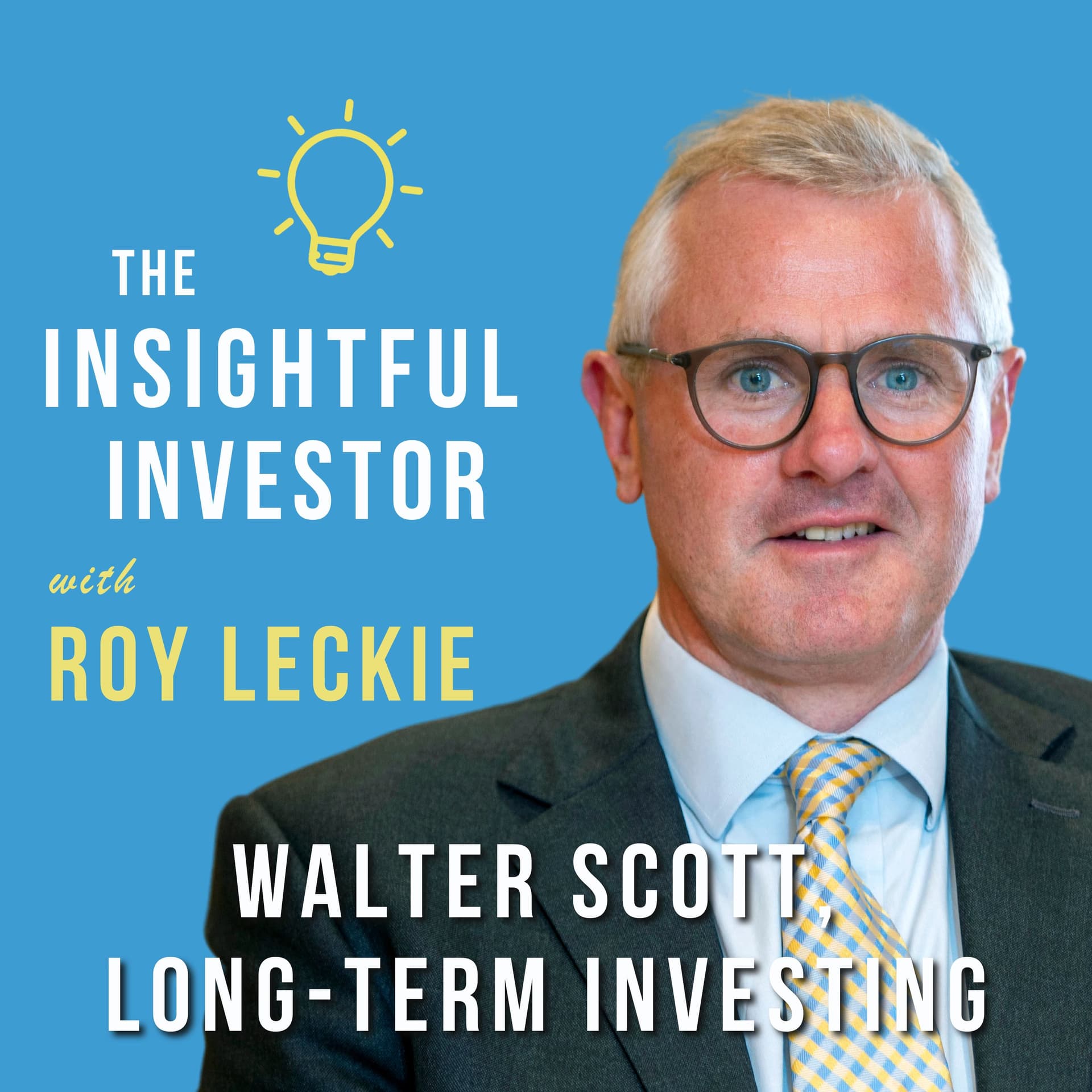
Roy Leckie: Walter Scott, Long-Term Investing
Host
- Alex Shahidi: Co-CIO of Evoke Advisors and host of the podcast.
Guest
- Roy Leckie: Executive Director and Co-Chair of the Investment Management Committee at Walter Scott, a Scotland-based investment firm managing around $100 billion in assets.
---
Overview In this episode, Alex Shahidi engages in a deep conversation with Roy Leckie about principles of long-term investing, insights from market history, and the strategic management of investment portfolios focusing on resilience and risk management.
Key Themes
- Background and Early Influences:
- Roy's childhood in Hong Kong instilled an early fascination with finance and risk.
- His education in statistics laid a solid foundation for his investment career.
- Lessons from Market Mistakes:
- The Asian financial crisis taught Roy about the dangers of leverage and currency mismatch.
- The TMT (Technology, Media, and Telecom) boom/bust highlighted the importance of valuation discipline.
- Risk Management:
- Understanding risk as a means to preserve capital is fundamental.
- Investing in high-quality, resilient companies is essential for long-term wealth creation.
- Investment Philosophy:
- Walter Scott’s enduring investment philosophy focuses on long-term wealth creation through disciplined and risk-aware investing.
- The firm prioritizes investments that balance high quality with downside protection, particularly during downturns.
- Cultural Insights:
- The culture at Walter Scott emphasizes collaboration and shared decision-making, ensuring comprehensive analysis before buying stocks.
---
Detailed Insights
Background
- Roy's journey in investing began with a strong academic background in statistics and a desire to integrate classic Scottish investment principles into his career.
Lessons Learned from Mistakes
- Asian Financial Crisis: Showed the impact of leverage and financial mismanagement.
- TMT Boom/Bust: Highlighted the risks of investing without a solid valuation foundation.
Managing Risk
- Downside Protection: Investing in resilient companies with predictable cash flows.
- Market Cycles: Roy emphasizes the importance of recognizing that investment markets go through cycles, advocating for a long-term perspective.
Investment Approach
- Buy and Hold Strategy: Focused on investing in high-quality businesses and holding them for the long term.
- Valuation Awareness: Strives to avoid overpaying for stocks while recognizing the importance of time for compound growth.
Company Evaluation Framework
- Seven Sisters Analysis: A structured framework that evaluates management quality, market positioning, and competitive advantages before making investment decisions.
- Team Dynamics: Emphasizes the role of a stock champion in advocating for new investment ideas while ensuring rigorous discussion and consensus before acquisitions.
Thoughts on Market Efficiency
- Roy believes that while the market appears more efficient, there are still opportunities due to the short-termism prevalent among many investors. He suggests that patience and a long-term approach can yield significant returns.
Perspectives on Global Investing
- The conversation highlights the importance of international investments, particularly in Asia and Europe, as a counterbalance to the US market's current dominance.
Client Relationships
- Walter Scott focuses on building long-term relationships with clients, with an emphasis on service and communication during different market cycles.
---
Key Takeaways
- Invest for the Long Term: Successful investing is about time in the market rather than timing the market.
- Avoid Chasing Performance: Investors should resist the urge to react to short-term market movements.
- Focus on Quality: Prioritize investments in companies with strong fundamentals and resilience.
- Risk as Capital Preservation: Consider risk primarily as the potential for permanent loss of capital.
Final Insights
- The discussion concludes with Roy advocating for a disciplined long-term investment approach, emphasizing the compounding effect of time and quality in achieving financial success.
---
Closing Remarks
- Roy Leckie shares his commitment to maintaining the core investment principles of Walter Scott as the firm evolves, underscoring the importance of adaptability within a framework of consistent philosophy.
Written by AI. May contain mistakes. Listen to the episode to check what was said.
Transcript
Automatic transcript. May contain errors.0:05Welcome to the Insightful Investor Podcast, a weekly series that seeks to share industry, investment, investment, investment, and market insights. We define insights as concepts that are counterintuitive, widely misunderstood, or underappreciated. In other words, unique ideas that you probably won't hear elsewhere. I'm Alex Shahidi, the host of the podcast and co-CIO of Evoke Advisors, a leading investment advisory firm. Learn more about our show at insightfulinvestor.org.
0:38Today's guest is Roy Leckie. Roy is Executive Director and Co-Chair of the Investment Management Committee at Walter Scott, which is based in Scotland and manages about$100 billion. Walter Scott was established in 1983 to manage equity portfolios for institutional clients around the world. Roy joined the firm in 1995. Roy, thank you so much for joining me today. Thanks, Alex. It's a real pleasure. Let's start with your background. I think it's always interesting to dive into how you got to where you are. What would you say originally sparked your interest in stock investing, if we go back a few years?
1:18Look, there's two or three things, I think. I had the great privilege of growing up in Hong Kong, where my dad was posted through his work. He's an actuary in the late 70s. You'll know enough about Hong Kong, I'm sure, Alex, to know that it's a city that has finance and trade, investing, running through its veins. So I was exposed at quite an early age to that central dynamic in Hong Kong. Dad, obviously, being an actuary, had that family exposure as well. And I developed at quite an early age a fascination for the concept of risk, did okay at maths in school. We call it maths. I know Americans like to call it math, Maths plural.
2:04There's more than one, apparently. Of course. Did a degree in statistics. And then I knew during my undergrad years that I really wanted to get into investing. And actually, I was determined to try and get a background, a training in classic Scottish investment management principles with a view to then heading back out to Asia. And 29 years on, haven't quite got around to that part of the planet yet. That's the background. Obviously, being an investor for a long time, you have the opportunity to learn a lot, but you also, unfortunately, make a lot of mistakes. But oftentimes, the mistakes are what teach you the greatest lessons.
2:43What do you feel are the biggest lessons you've learned from mistakes that you've made in the past? Alex, how long have you got? Let me answer it like this. Two really significant things happened earlier in my career. The first one was the Asian financial crisis. and I learned then about leverage, particularly currency mismatch. Companies that were both leveraged and had a mismatch in their liabilities and their assets or their liabilities and their revenues, they hit the skids pretty hard in that period. So I was a great front seat to the fact that with every dollar of debt you have as a business, you kind of lose a degree of freedom.
3:26You lose the ability to cope in challenging times. That was really interesting. And then not long after that, of course, was the TMT boom and bust. And I think, of course, the lesson then was really around valuation discipline, not to get carried away with exuberance, with hype, with the zeitgeist of the era. if there was ever a time where it paid to stick to our classical Scottish risk-averse investment principles, that was then. And I was very lucky that at Walter Scott, we had some real giants of the investment industry to learn from. I would point to those two periods as really, really helpful learning periods quite early in my career.
4:14And you mentioned a few, but you've lived through many significant market downturns, including global financial crisis and COVID and et cetera. What have these experiences taught you about managing risk? I mean, it is interesting. When I look back at my career, there's been so many defining moments. You've mentioned a few. I think there's been at least seven 20 % drawdowns. Some, of course, a lot more severe than that. Over the last 29 years, the Asian financial crisis, TMT, GFC, COVID, there was SARS, one or two other bits and pieces. I think there's always new learnings, but I think probably the most important general learning, if you will, is that downside protection is really very, very highly valued.
5:03So investing in companies that are more resilient, better quality, more predictable. They've got risk attributes that see them protect wealth, protect the restore of value in really challenging times. That's really, really highly valued by clients. And so I think those characteristics of our portfolios have really been the foundation, actually, of our long-term record of wealth creation. So the learnings around understanding risk, being aligned to companies and creating portfolios that have got that downside protection characteristic? Risk is such an interesting concept because unlike returns, which you see every day, oftentimes you don't see risk and it's kind of hidden just beneath the surface until something bad happens and all of a sudden it's front and center.
5:55It's such an interesting concept. And so I feel like you have to keep those painful experiences close to you so that you don't get get complacent and feel like it's not a risky time anymore. Yeah, absolutely. You joined Walter Scott almost 30 years ago. What was it that motivated you to join the firm? And what is it about the culture that has kept you there all this time? Yeah. So as I said earlier, the plan wasn't to stay at the same firm or plan wasn't to stay in Edinburgh for the 29 years that I've been here. As I said, I was very keen to get these Scottish or classical investment training background.
6:34And there weren't that many independent investment firms in Edinburgh at that time that wrote a bunch of letters, had a few interviews and had a couple of opportunities. And actually, it was someone whose opinion I respect very highly said to me, well, look, Walter Scott, it's a great little business. And it was little then. I think we managed under a billion dollars. But it's got a very well-defined investment approach. And they all sit in one room. and that comment stuck with me. I thought, well, if they all sit in one room, what better way is there to learn? And so I jumped straight in. Walter kindly made me an offer.
7:10Actually, my offer was dependent on getting certain grades in my examinations at university. And if I was to pass and get the grades, then I was to turn up on the 5th of September. And that I did. And to this day, no one's ever asked me if I actually got those grades, But there we are. And it was just a brilliant learning environment. You will well understand, Alex, that so much of this industry, this art of investing can't be taught from a textbook. It's listening and experiencing. and having the opportunity to discuss, debate with Walter, with his founding partners, Ian Clark, Ken Lyle, one of two others, was just a magnificent grounding.
7:53And the firm has gone from strength to strength. And hopefully I've played a little part in its growth and its success over the years. It's interesting, the comment that you just made, because we learn a lot with just personal experience, but you can complement that with experiences of others and their path. their learnings. And so you don't necessarily just have to learn it on your own. You can actually learn from a lot of other people. And people look at the world through a different lens. And it's really helpful to try to view things through the perspective that they have. Absolutely. As allocators of other people's capital, one of the great things, one of the great privileges of the job is that we spend time with the management of many of the world's best companies.
8:37And yes, they're not necessarily investors themselves, but they are capital allocators. So there's huge amounts to learn, not just from other investors, but from how other people run successful businesses. So we're really, really privileged in the investment world, particularly in the equity, the stock picking world that I have a seat in. We've kind of got a front row seat to this very dynamic and exciting world that we live in. Walter Scott launched over 40 years ago. How would you say the firm has evolved since its inception? Probably the best way for me to answer is to tell you what's not changed, actually.
9:15And I think there's two key pillars to that, or two key things that have underwritten our success. And one is the investment philosophy. We've been really true to our core investment beliefs since day one of the firm's founding. And then the second thing would be the culture. And I know culture, people will define it in lots of different ways. The culture of Walter Scott, the sense of purpose, the way it's led, the way we all interact with each other, communicate with each other, the kind of alignment we have with our clients. I think those are the two principles that have been constant throughout.
9:49Now, we've grown, as I said, both in terms of assets and client numbers, client types. We're doing a range of different strategies and products for different clients in 23 different countries now. Our back and middle office functions are incredibly sophisticated, using all sorts of fairly high-tech applications and processes. The resources available to our investment research team are just so much greater now. So things have developed and evolved and moved forward. But the crucial thing is what's not changed, I would argue, and that is the philosophy and the corporate culture, which we value very, very highly indeed.
10:27You just mentioned the philosophy, and it's essentially been the same for four decades. One of my prior guests emphasized the importance of being adaptable rather than dogmatically relying on an approach that may no longer work as the market catches up. So how do you think about achieving the balance between being adaptable and sticking to your core approach? Yeah, so Alex, I mean, there's lots of ways to skin the cat in this game. Obviously, plenty of different approaches, many of which work really, really well until they stop working. Of course, we think our approach is really, really well time tested.
11:06It doesn't work every year. In fact, there could be quite long periods where it doesn't add or obviously add value. But over pretty much the vast majority of rolling three and five-year periods, it's worked in that we've generated good alpha. I think in every rolling 10-year period, if you look at it monthly, it has done the job. So it does take time, requires patience. But sticking to our core philosophical beliefs, our philosophical principles has worked well for us. Now, as I say, lots of ways to skin the cat, lots of different investment approaches, some of which are the complete antithesis of our research-driven, bottom-up, fundamental, stock-picky approach.
11:48And that's great. We have our way. We have no intentions of changing. And so let me ask you about those stretches of underperformance. So how do you conceptually know what attributes of your philosophy are timeless, particularly when you're going through those periods? Are there questions of, okay, maybe things have changed now, and obviously you have some history to give you a longer timeline, but how do you think about that? The core belief, if you like, within our philosophy is that the external return, the return you get as a shareholder in a company, in any company, is ultimately driven by the internal return, i.e.
12:26the return that the company makes, the wealth created by that company. So as companies, through time, compound their earnings and cash flows and dividends and book value and so on and so forth, given enough time, the return to shareholder accurately reflects that very, very similar. So that's our core philosophy. So that sees you investing in companies with certain attributes. Obviously, the key attribute is that they deliver superior rates of internal wealth creation through time. Now, in order to find those companies, we look for certain characteristics around balance sheet, cash generation, certain qualitative and quantitative characteristics.
13:02And the market recognizes those different characteristics in different ways at different times. So thinking back over the last few years, there was a period going into COVID where it was all about growth and then companies that had a kind of exciting ESG story to tell were performing really well. And then we went into a period where it was value was the key focus of investors. And then profitability has been rewarded over certain periods. My kind of best guess is that as we look forward from here, probably the characteristic that's going to be rewarded most is balance sheet resilience. So our core philosophical identity stays the same.
13:45How that's played out in the stock market can vary through time, can be pretty difficult to predict in all honesty. So we don't really try it. That's why we adopt the buy and hold approach that we're devoid of having to try and second guess what themes investors are going to focus on. We just stick with these high quality businesses through time, knowing that ultimately external return will equal. So we can tolerate, as long as our clients understand what they bought and will be patient with us, we can tolerate those periods of underperformance. So you've been a professional investor for three decades.
14:23Do you feel that the stock market has become more efficient over time and therefore more difficult to outperform a passive index or not? I think it appears to be the case in the US, Alex, particularly where returns have become so concentrated of late. Many investors, many active investors haven't really felt covered, don't really feel comfortable running such concentrated portfolios as concentrated as the US market has become. So it looks like active isn't doing all that well, particularly in the US. I think that will turn at some point, in all honesty. I think the next bear market will expose quite a lot of weakness in some of those stocks, some of those companies that have been driving that concentration, driving the overall performance.
15:11So yes, in bull markets, as we're experiencing right now, particularly in the US, active management is struggling. But active management isn't just for bull markets. Long-term savers, long-term asset owners have to understand that markets go in cycles. And it's likely, in my opinion, that active managers, not all, but many more than have been active managers will earn their crust as market conditions become more challenging. I'd say the US, though, is the market that has and will probably likely continue to be the hardest one to outperform. We're very happy to be global investors in that regard.
15:52One of your core tenets is that superior long-term returns are generated through ownership of great businesses, which you talked about, with high levels of profitability, strong balance sheet, enduring growth. All this obviously sounds intuitive, but how do you assess how much of these attractive attributes for a company are already reflected in the prices you have to pay to invest? Look, when it comes to valuations, we seek to be very conservative around valuation risk. We just don't want to overpay for stuff. So we do a huge amount of work, look at a range of different valuation metrics. This is where the experience and actually our team-based dynamic really comes to the fore.
16:34But I would also say that real wealth creation isn't necessarily in the buying. For us, it's more in the owning over the long term. So we are very patient. We understand that a great company can be a bad investment if we overpay. But paying a fair price for a brilliant business that compounds over a long period of time, it tends not to matter whether the initial starting valuation was 20 times or 18 times earnings. So we're pretty good at valuing the opportunity set. looking at companies, trying to figure out what they're worth today and what the future prospects are. And we're very patient, so we'll wait till opportunities arise.
17:18But we're also very cognizant of the fact that compound growth and time tend to be the main determinants of investment success rather than starting valuation. Is another way of saying what you just described, that you're much less focused on the timing, and in some cases, even the valuation, as long as you're not grossly overpaying and much more focused on just identifying the great companies that you want to partner with, that you want to hold for a long time. Really, it can be simplified down to those core components. Yeah, our favorite holding period is forever. It's trying to create wealth for clients through the ownership of great businesses as they compound year after year after year.
18:01Share prices might not reflect that compound of wealth creation year after year, But ultimately, they will. Ownership rather than the buying and selling of share prices, it's the ownership of great businesses, wealth-creating businesses. That's the approach, always has been. You can tell that by our turnover rates. So average turnover in portfolios of 10 % to 15 % per annum. That tells you we're buying and holding for an average of seven, eight, nine years. And indeed, there's probably half a dozen companies, Alex, in the portfolio today that we've held for well over 20 years. There's three or four in the portfolio we've held for 30 years that were in the portfolio the day I started at the firm.
18:41And the cool thing is one of them recently, the dividend they paid us was greater than the share price we initially paid. That is compound growth investing. Is your sense that the market doesn't fully price the quality? If you're buying a really high quality business and the market recognizes that it's high quality, it may not be easy to get in at a price that actually allows you to generate a good investment return. I'd rather not concur with that and answer the question like this. We just look longer ahead than most people. If you look at the average holding period that most investors own stocks for, it was short when I started my career and it's got a huge amount shorter.
19:26So are we better at valuing a business for the next month, the next six months, the next year? Don't know. Do we have a skill set in identifying companies that have the ability to compound for many years into the future and figure out what a reasonable price is? I think we do. So it's not so much a comparative advantage on valuation, rather the skill set of thinking about investing as a long-term undertaking, which is increasingly rare, much to my surprise. I mean, one of the many things I've got wrong in my career, when I got to grips with what it is that we're trying to do, I said, well, surely, surely the rest of the market is going to start thinking more long-term.
20:15And the exact opposite has happened. And you see that. You see it not just in investor behavior, you see it in corporate behavior as well. I mean, I find it quite bizarre. Many companies seem to manage their business on a quarter by quarter basis. They talk about earnings over the next quarter as if this is the defining criteria on success, which of course is not. So it's our ability to frame the investment challenge as a multi-year undertaking rather than a quarter by quarter or even shorter in some instances. That's how I would answer that, Alex. It's actually very insightful what you just said in that in some ways, the market has become less efficient.
20:53If you're approaching the market from a long-term investment standpoint, 30 years ago, you had more people like that than you do today. Yeah. I shouldn't complain. I don't think that others are not adopting because at the end of the day, we have the ability or the opportunity to capitalize on the impatience of others. Many ways that kind of summarizes what Walter Scott does, how we add value. The short-termist bias in the market provides opportunity for long-term investors such as ourselves. One of your core focuses is on companies that are not only built to survive the downturn, but can potentially prosper when others are challenged.
21:35Would you talk about that? Well, look, it comes back to what I said earlier about understanding risk, downside, protection. We like to invest in companies that have got quite a high degree of resilience, quite a high degree of reliability, predictability. That means they need to have certain characteristics. around cash generation, around balance sheet, around management quality, management teams who are honest and properly incentivized, aligned to the long-term wealth creation objective, and so on and so forth. So these companies, both in a business and a stock market sense, tend to provide that downside protection that helps build or helps to underwrite a long-term successful track record of alpha generation.
22:24Clients tend to be pretty happy if in a roaring bull market, we are there or thereabouts. We wouldn't expect to add huge amounts of alpha in a roaring bull market. But what clients really highly value when market is down 20 % or 25%, and they happen, I've had seven, as I think I said, or seven or eight over the course of my career. If you're down a whole lot less. You've preserved value. It means you don't need to rise nearly as much to get back to the high watermark. And clients sleep better at night. So we think we can deliver that pretty well, that downside protection. It's not because we're doing anything fancy financial engineering, protecting the portfolios, because we're investing in companies that firstly we know are going to be around when they come through the other side.
23:13Actually, there's a reasonable chance they're being predatorial. Companies we invest in quite enjoy tougher times. It's when things are too easy, rates are too low, liquidity is too abundant. Economic growth is so robust that everyone's doing well. We don't fear the challenging economic or stock market times when they come. It tends to shine a light on the qualities of the stocks we've picked for clients. Right. Another way to think about it is if you're a highly skilled pilot and you're flying with your peers and the skies are clear, everybody looks like they're equally skilled. So in some ways, you tend to thrive when a storm approaches because your skills are better showcased in that environment.
23:57Yeah, it's a great analogy, which I'm going to use at some point, Alex. Thank you. Sure. I completely understand being a long-term investor in equities and thinking with the long-term in mind, which is largely related to just survive. Don't go down with others, survive in order to compound over time. How do you deal with investors or clients who may not have the same time horizon as you? And is it just a challenge to try to help them zoom out and appreciate the time horizon? Generally, how do you deal with those considerations? Part of that job should be done or most of that job should be done at the initial client take on.
24:36Well, we seek to be very, very diligent around who we work for, in all honesty. Clients must want a manager who does what we do. So we actually think we should be bought rather than us going out and selling to people. We don't have a business development for a year. You don't see us doing much advertising or selling, if you like. The culture of the firm is very much being an asset manager rather than an asset gatherer. And if an asset owner likes our approach the way we think, the way we slice the dice, we'd be delighted to throw a hat into the ring. But we're probably not for everyone. So the first thing is to ensure clients understand what they're buying.
25:16We work very hard at that. But then it's around client service. So we've always sought to accompany an excellent performance profile with first class or best in class client service. So we have a group of colleagues who go out and engage with our clients, tell them what we're doing, tell them what we're thinking, how we're positioning the portfolio, the sorts of companies we're investing in, explaining why performance is in line or behind their expectations over whatever period, and ensure that they feel comfortable and confident with what it is we're doing. Our main management KPI, Alex, most important metric for Walter Scott's management, it's not our AUM or our profits.
25:59Our most important KPI is client longevity, how long our client relationships last. And we're very proud to have a growing group of clients that we've been working with for 30 years. They've been through a number of performance cycles with us. In order to ensure our underwrite client longevity, we've obviously got to deliver the performance. that has to be accompanied by great client service. And also we've got to get the operational stuff right. So the administration. Longevity is a very persistent or prevalent theme throughout everything to do with Walsh Scott. Long-term how we invest, long-term with a team, 30 years, 29 years, and long-term with clients.
26:38The investment management service should really be considered as a long-term undertaking in our opinion. Yeah, just like the stocks that you're picking, you're looking to invest for the long run. You want your clients to invest with you for the long run. Yeah, clients get the best out of us when they are with us for a long time. And of course, that can require patience. We don't deliver every year. We all know investor psychology is difficult. Many asset owners, the temptation is to buy on the back of a great performance spurt and then sell when things don't look so good. Thankfully, many of our longer standing clients understand actually certainly don't fire us when the performance doesn't look good.
27:21If anything, add to Walter Scott and the knowledge that the philosophy and the process of the team haven't changed, so the performance will come through. You have something called the seven sisters analysis. Would you walk us through that at a high level? To use your analogy, Alex, this is like a pre-flight safety check. It was the US Air Force, wasn't it? The pilots, accident rates, fatality rates plummeted when they introduced just a 20-question pre-flight safety check. In many ways, our seven sisters is a bit like that. We ask a series of questions around management quality, market positioning, barriers to entry, pricing integrity, whether the company's got comparative advantages that are difficult to replicate, and so on and so forth in order such that we kind of expose ourselves, hopefully, to a clear understanding of all the risks that a company's business model might face in different phases of the economic cycle.
Read the full transcript
28:22So it's really a standardized list of questions. And I like the flight analogy. It's a pre-flight say check. Before we would invest in a company, we ask and answer all these questions, and they have to be answered satisfactorily before we would put a single cent of clients' money into it. It's really about understanding the business, where it sits within its industry, and what are the industry dynamics? Is this a vector of the global economy that is growing? Because long-term growth companies tend to operate in parts of the economy that are also growing. And the Seven Sisters, what we call the Seven Sisters analysis, is really designed to bring all that out.
29:05Would you walk us through your team decision-making process and just this notion of a stock champion? Yeah. So the proposer, the analyst of any particular investment that we look at or own has a stock champion. They tend to be the one that initiated the idea, did all the financial analysis, carried out the seven sisters analysis and presented it and got it through into ownership. And the reason it's quite important is because Walt Scott is a global equity investor. We organize ourselves into regional teams, though, just for ease of travel and such like. So we have Americas, we have EMEA, and we have AsiaPAC.
29:44But crucially, we rotate people amongst those teams. The team rotates. So after you've been at the firm for, let's say, 10 years, you'll have spent time on each of the three geographic teams, such that you have gone to Yokohama to visit the Japanese auto companies, you'll have been to Detroit to visit the US auto companies, you'll have been to Stuttgart and Wolfsburg to see the German car companies. Then you are a global equity investor or stock picker. So you've traveled to, you've met the management of, you've analyzed and you've made decisions on companies right across the industry and geographic spectrum.
30:21Now, as you move across the teams, you will take your stock champion responsibilities with you. Again, anyone who's been here for a long period of time will champion, Alex, a range of stocks across a range. That means you're a global equity investor. Now, how we ultimately make decisions, we've got a standardized framework for how we analyze companies in terms of how we get companies actually into the portfolio, how we make decisions. And this, to be honest, is probably the most crucial part of any investment firm. You can have all the best analysts in the world, but if you don't have a robust process for making decisions, then it's wasted.
30:59Our approach to make decisions is to involve the entirety. So we are a very cognitively diverse group of individuals who are very highly motivated and aligned to getting every investment decision right. There's a higher probability of getting it right. So stock champions propose ideas, they're discussed, they're debated. Have you thought of that? Have you met the management of this? Have you spoken to that supplier, this competitor, or whatever? It's a very iterative process. And not until, Alex, the entire team of about 20 gives their backing to an idea, will we step up and buy it? So it's really tough.
31:37It's really tough to get stocks into a portfolio. But that's aligned to our low turnover approach. And it ensures that we understand what we buy. Because remember, we hope to own this, whatever it is, for a very, very, very long time. if we've got it right. And then how does the sell process work? I assume it's not the reverse of the buy process. No, there's an asymmetry. So we've tried to build in a conservatism to the sell process such that it's actually only one well-researched, well-articulated dissenting voice is required to sell a stock. So it prevents us all falling in love with names, becoming too comfortable, and ensure there's always sort of challenge on everything we own.
32:23So we have this one dissenting voice principle that again, errs on the side of conservatism, but has actually served us really well throughout the history of the firm. We touched on this a little bit earlier, but at least in the US, there's been this trend towards this notion of all you have to do is just buy the S &P 500, forget about diversification, it only goes up and it contains the world's best companies. How do you respond to this common viewpoint? That observation has been dead right for a number of years now. Our view is, my view is that that just will not last forever. Lots has been written.
33:01Lots has been talked about this very dramatic, significant concentration within the US market currently. But it's never really happened before that the top 10 companies stay at the top 10 year after year after year. If I look at it every five years over my investment career, there's a surprising amount of change. And I think that dynamic will continue. So the dominance of just a small group of companies within the US that's really been leading that performance is going to come to an end at some point. So we think investing internationally, increasingly starting now, is going to be a sensible thing as we look back in time.
33:44There's a valuation story. There is also, and more importantly to us, just this incredible opportunity set of brilliant businesses in Japan and Asia Pacific and right across Europe today that are largely being ignored by those US asset owners who are just maintaining this very strong home bias. Whether it's today, tomorrow, next month, sometime in the next 12 months, that international investing starts to reassert itself, it will at some point. It will. I think passive investing has its place. I'm very optimistic about the US and its entrepreneurial dynamism and very cognizant of the fact that it has dominated investor returns for a long time, but there's a cycle to it.
34:33And at some point, there will be an extended period of US underperformance. And I think our global and international portfolio is a really well position for that when it happens, which it will at some point. A very simple way to see that is you could just take the comments that I just stated and run it back in time. And the same comments would have been made multiple times in the past. And usually those comments are made near the end of the cycle rather than in the middle or the beginning of the cycle. 100%. We've got clients pushing us quite hard. Well, why do I need to bother about international investing?
35:12Everything we need is in the US. That's not the case. One of the world's most exciting growth vectors, to use that phrase again, would be savings and insurance and protection in Asia, where tens of thousands of people every week are exploding up through that income level where they start to think about savings and protection, insurance. Now, there's very few, if any, US companies exposed that. You really have to go to Asia. Some of the really exciting dynamics within the factory automation theme, the improved productivity theme, can only be found in Japan, a little bit in China, but mainly in Japan.
35:53Japan's still got this comparative advantage in robotics and certain areas of automation. There is no one that does luxury goods better than the French and the Italians. That is just a fact. So whether it's Hermes or Louis Vuitton or Ferrari, they are great growth vectors and you have to go to Europe. If you want to say, well, look, it's all about AI and tech at the moment. Yes, the big headline players are American, but dig into the supply chain of whether it's the chips, the chip manufacturing process, or whatever, you'll find an incredibly globalized network of companies. Many, a surprising number actually, are not American.
36:37Many are Asian, many are Japanese, European as well. We feel very privileged today to be global, looking globally, because at some point, Pendulum's going to swing back away from the US. And as I say, I think our portfolio is a really well positioned for that. One of the more fascinating aspects of investing that I've seen over my 25 years is that there's this persistent oversight among investors where they hear a compelling narrative that makes sense, sounds right. They see it in real life and they have a very difficult time appreciating that much of that may already be in the price. And in many cases, the price may be overly optimistic.
37:21And then that part is, I think, what keeps these cycles repeating through time. Yeah, I agree with that. We spend a lot of time on the road. Again, one of the great privileges of the job. We've got guys just back from two weeks in China. I actually got two guys in India at the moment. We don't own really many or any Indian stocks, but there's cool stuff happening there that It's going to inform the thinking around our research on other stuff. And who knows, at some point, we do want to have an inventory of Indian ideas. At some point, they will force their way in because of their qualities into the portfolio.
37:59But going around the world, speaking to the world's C-suite, it's not just a US story. If anything, there are risks building in the US investment thesis. and we are pleased, as I say, to be exposed to some brilliant Japanese, some brilliant French, German, Swiss, Australian, Hong Kong businesses. And much of the excitement, I think, centers around what you're perhaps looking to is just the relative valuation, how investors are thinking about the opportunities that many US investors, the very fact that you're asking these questions, Ali, shows that many investors are just going to say, no need to bother about the rest of the world.
38:42They will be proven wrong. We touched on this a little bit earlier about risk. How do you think about risk? Is it volatility? Is it drawdown? Is it permanent impairment of capital? Is it underperforming the index? How do you think about it? It's really the point about loss of capital. We don't really think about risk as a relative concept as a measure of how different we are from the index or the volatility of returns. It's really the probability that we lose our clients' money. And the way we mitigate that risk is by understanding what we buy. And you understand what you buy by very thorough, rigorous, robust research, investment analysis, and a rigorous decision-making process.
39:26Again, I think we've got that. Our portfolio looks really quite different from the benchmark. I think the active share, I'm not sure if you'll be familiar with that metric, but it's just a measure of how different your portfolio is to the index. Our active shares are 85 % and 90%. So the performance pattern is always going to differ. If you want to beat something, you have to be different from it, as I think Sir John Templeton said. So the great strength of our portfolio, we would argue, is the fact that it's different. I mean, another way of thinking about this, Alex, you kind of alluded to this earlier, the question about passive investing and just buy the index.
39:58So look, most of our industry, most active investors have underperformed over the long term. I think around a third have delivered alpha over any reasonable time period. And I put us in that portion, that part. They're not all the same. But when you look at the characteristics of that segment of the market that has delivered sustained out performance, you tend to find three common characteristics. One is this active share, portfolios that look different to the benchmark. The second one is that they tend to take a long-term approach and they're buy and hold. They're not trading the portfolio, turning it over too often.
40:32And the third thing is that the aggregate characteristics, the financial characteristics of the portfolio are superior to the index. So the growth, the profitability, the balance sheets. So the way I like to say it is that for each unit of PE or each unit of valuation that Walter Scott's paying, you get much more growth, much higher return on capital, and a clean balance sheet. And oh, by the way, a much higher standard of ESG if you're interested in that. So risk can be mitigated against by understanding what you buy and ensuring to the best of your abilities that you do not expose a client's capital to permanent impairment.
41:10That is how we consider risk. I guess one way to summarize our conversation today is it's the Walter Scott compounding machine. You're looking for companies that will survive over the long run, will grow and be resilient. And through that mechanism, you achieve compounding, which is the magic of investing. Compound growth is the best force or tool or ally, whatever you want to call it, that any investor has going for him or her. But what's the key ingredient to getting that to work? time, right? Compound multiplied by time equals happiness, wealth. That's right. Walt Scott is a long-term buy and hold, high conviction, compound growth stock picker, benchmark unaware.
41:59We're on the third generation of management of this business currently. At some point, the next generation will be called into action. And I think that with each generation so far has got better. And I'm really confident that the next generation, when they take over from Jane Henderson and myself and Charlie McQuaker, they will do a better job. So really excited, both about the business and about the portfolio. Roy, this has been very insightful. I appreciate your time. Do you have any additional investing insights that you'd like to share with our audience, particularly anything that you feel may be counterintuitive or highly misunderstood?
42:33then? I hate to be cliched here. It shouldn't be counterintuitive. I think you have to think about investing as a long-term undertaking. It's all about time in the market rather than timing the market. You'll have heard that, I'm sure, many times from your guests. The second thing is don't get whipsawed by performance chasing. Investor psychology sees far too many asset owners, savers selling low and buying high. So when you look at the track record of many mutual funds or different vehicles, the time-weighted returns look good, but the money-weighted returns look awful, i.e. what tells you the average client doesn't do nearly as well as the performance record on the fact sheet.
43:18You can do as well as the performance record on the fact if you buy and hold. Don't chase short-term returns. Now, I talked about seven drawdowns. Over that period, I think global equities have compounded at eight and a bit percent, and our global portfolios compounded a bit over 10. So they are volatile over short-time periods, but actually equities are a brilliant, in fact, the best asset class for capturing that general propensity of economies to grow, living standards to rise, new ideas, new technologies to come to the fore. And good stock pickers should have the ability to find those companies that are either driving that growth or at least benefiting from it.
44:04That's what we come to work every day to try and do. That's wonderful. Rai, I appreciate your time and for sharing your insights with us. I really enjoyed the conversation, Alex, and I hope we can do the next one face-to-face. Sounds great. I'll come to you. Perfect. All the best.
44:46others you think would enjoy listening. This podcast is provided for informational purposes only and should not be relied upon as legal, business, investment, or tax advice. All opinions expressed by podcast participants are solely their own opinions and do not necessarily reflect the opinions of Evoke Advisors, their affiliates, or companies featured. Due to industry regulations, participants on this podcast are instructed not to make specific trade recommendations, no reference past or potential profits. And listeners are reminded that securities trading, commodity trading, and alternative investments are complex and carry a risk of substantial losses.
45:23As such, they are not suitable for all investors.
45:30Listeners should be aware that guests featured on The Insightful Investor may have current or past associations with Evoke Advisors or the host, including as an investment manager of a private fund opportunity by Evoke or access through an affiliated Evoke fund or as a client. Participation as a guest on the podcast should not be perceived as an endorsement or testimonial with respect to Evoke advisors, the podcast host, or their services. Similarly, the inclusion of a guest on the podcast does not imply that Evoke advisors or the host endorses the guest or any company with which they may be affiliated or employed.
46:09Evoke has neither paid nor received compensation from guests for their participation.
From the publisher
Roy is Executive Director and Co-Chair of the Investment Management Committee at Walter Scott, a Scotland-based firm managing $100B in assets (as of 8/31/24). With a focus on long-term investing, he emphasizes the significance of compounding returns and the importance of a disciplined approach to risk management.


