
In short
Insightful Investor Podcast Episode Notes
Episode Title
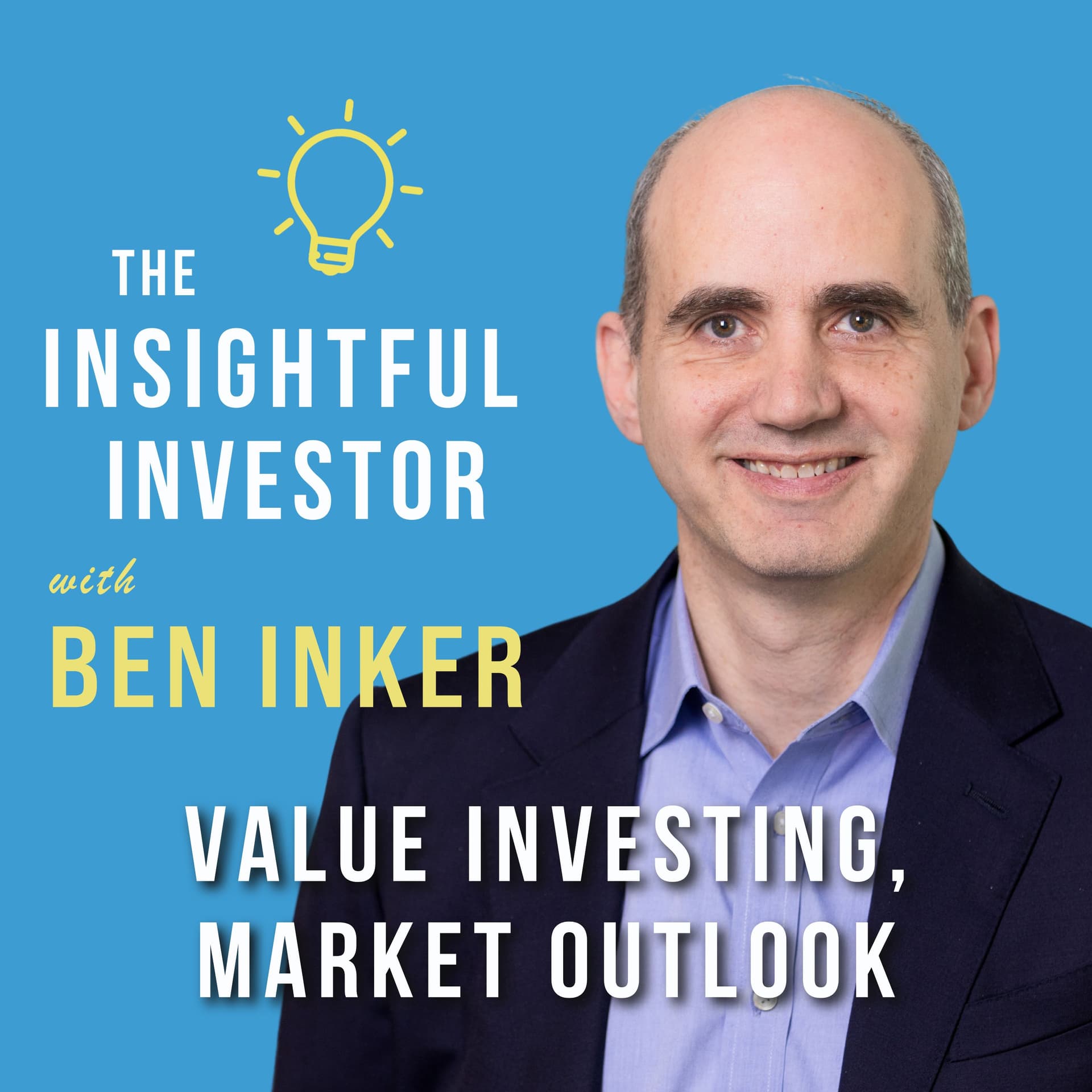
#48 - Ben Inker: Value Investing, Market Outlook
Host
- Alex Shahidi: Co-CIO of Evoke Advisors, leading investment advisory firm.
Guest
- Ben Inker: Co-Head of GMO's Asset Allocation team, partner, and portfolio manager. GMO manages over $65 billion in assets and is known for expertise in multi-asset class portfolios.
---
Episode Overview In this episode, Ben Inker shares his investment framework, principles of value investing, and insights into current market conditions. The conversation emphasizes the complexities of investing, the importance of understanding economic principles, and the evolving landscape of value versus growth investing.
---
Key Concepts and Discussions
- Investment Philosophy
- Investing should be regarded as a puzzle that can be enjoyable and intellectually stimulating.
- Key Lesson from David Swenson: Investing involves understanding economic services provided and justifying returns from counterparties.
- Complexity in investing can often be simplified to fundamental economic principles.
- Behavioral Aspects of Investing
- Investors often misinterpret past performance as a predictor of future results.
- A need to differentiate between returns earned and those borrowed from future performance is crucial.
- Value vs. Growth Investing
- Historical Performance:
- Growth has outperformed value since 1978, raising questions about the sustainability of value investing.
- Value Investing Insights:
- Value stocks often trade at discounts for reasons that need examination, such as growth rates and market perception.
- Deep Value: Current market conditions reveal deep value stocks are trading at historically low levels, indicating potential for future outperformance.
- Market Outlook
- Interest rates have increased, providing alternatives to equities, which were previously yielding zero.
- Current equity markets, particularly large-cap U.S. stocks, appear expensive relative to historical values.
- Investment strategies now have to account for inflation risks and economic fluctuations.
- Inflation Considerations
- Inflation risks remain a concern due to fiscal policies and previous supply chain disruptions that could resurface.
- Strategies to hedge against inflation include TIPS (Treasury Inflation-Protected Securities), although they may come with their own risks.
- Investment Strategies
- Emphasize the importance of understanding the economic activities underpinning investments.
- Analyze potential future scenarios rather than relying solely on past performance.
---
Key Takeaways
- Investing is an evolving puzzle that requires constant analysis and adjustment.
- Understanding the distinction between value and growth investing, especially in current market conditions, is crucial for making informed decisions.
- Inflation and interest rate dynamics significantly impact investment strategies and asset allocations.
- Maintaining client confidence and adapting investment approaches in response to changing market conditions is essential for long-term success.
---
Conclusion Ben Inker's insights reflect a deep understanding of the complexities of investing, the importance of fundamental analysis, and the need for adaptability in a fluctuating market environment. His emphasis on value investing, particularly in the context of deep value opportunities, provides a compelling perspective for investors navigating the current landscape.
For more details on past episodes or insights, visit [Insightful Investor](https://insightfulinvestor.org/).
Written by AI. May contain mistakes. Listen to the episode to check what was said.
Transcript
Automatic transcript. May contain errors.0:05Welcome to the Insightful Investor Podcast, a weekly series that seeks to share industry, investment, investment, and market insights. We define insights as concepts that are counterintuitive, widely misunderstood, or underappreciated. In other words, unique ideas that you probably won't hear elsewhere. I'm Alex Shahidi, the host of the podcast and co-CIO of Evoke Advisors, a leading investment advisory firm. Learn more about our show at insightfulinvestor.org.
0:38Joining me today is Ben Inker. Ben is co-head of GMO's asset allocation team and serves as a partner and portfolio manager at the firm. GMO was founded all the way back in 1977 and currently manages over$65 billion in assets. The firm is well known for its expertise in asset allocation and its management of multi-asset class portfolios. Ben, I'm so thrilled you could join me today. Yeah, very happy to do it, Alex. Well, let's go back a few years. You studied at Yale under the famous David Swenson. If you look back today, what would you say were the key lessons you learned from him that are still with you today?
1:20The first lesson I would say I learned from Dave is that investing can be and should be fun. I had taken enough economics and finance to kind of know the efficient markets hypothesis, rational expectations, all of that stuff, which made it all seem kind of dry and uninteresting. And I think in one of Dave's first lectures, he pointed out, hey, if the market actually was to be efficient, it would become so because of hard work done by smart people trying to exploit inefficiencies. So do not assume the market into efficiency and just say, oh, well, there's no point in doing any of this because it will not be efficient unless people are working on it.
2:11And he made investing seem like this fascinating puzzle. And I loved puzzle solving. So he made it seem like a lot of fun. He also had this rare ability, not unique, but rare ability to take pretty complicated investing and economics topics and boil them down to a significantly simpler essence, which is certainly something that I have tried to keep with me in the 30-odd years since I graduated. That part to me is really fascinating because it seems that there's obviously a lot of complexity. But if you kind of zoom out and you look at the most important things, they're actually pretty simple. And it's so easy to mix the two up.
3:10Absolutely right. You know, for me, one of the things I always come back to in investing is the question of what is the economic activity I am actually involved in here? What am I doing such that somebody else should be interested in paying me for that service that I'm supplying. And if I can't come up with a good answer for here's why my counterparty should be happy for me to earn a decent return in the long run, then I'm not going to invest until I can figure out what's really going on here. Because investing is about performing economic services. and boiling it down to what is the service I'm providing and how do I think about how I get paid and by who?
4:00It's a pretty simple question, but if you can't answer it for a given activity, I would say you've got a real problem. Yeah, and what's a fair amount to get paid? It's easy to get caught up in, oh, the price of something is going up a lot, therefore I should invest in it. Yeah. Now, the question of what is the fair amounts to get paid is, I wish I knew how to come up with the right answer, right? Even when you're asking about the question, well, what should the equity risk premium be? It's like, well, there is no right answer. It needs to be material, right? It doesn't make any sense for equities not to give a return materially above low risk assets over time.
4:42But does it need to be three or four or five or six? You know, you read things that sort of have all of the above, and there's a very big difference between three and six. Going back to David Swenson, are there any lessons you learned from him before you launched your career that you now disagree with? Dave had some heuristics that he liked. And some of this is a little bit unfair because I'm talking about things I learned from him in 1990. I knew him up until he died. And I continued learning from him for 30 years after I graduated. But one of the things I can remember him saying back when I was an undergraduate was he was never really interested in investing in corporate bonds.
5:42And his view was investors underestimate the value of the option that they are giving to the corporation. And so these are a lousy risk reward tradeoff. and it's not a bad heuristic to have, but what strikes me is missing from an idea like that, kind of a simplification of, all right, here's an asset class I'm just not going to look at, is, well, you are claiming this is an option which is being systematically underpriced. So how do you test that? well, come up with a value for the option, what you think the option should really be valued at, and then check against how it seems to be valued in the market.
6:34So I would say he had a few heuristics where my response is, well, I'm not sure whether that's still right. And let's check whether it's right, rather than just say, let's ignore this asset class because it's never going to be that interesting. But even there, I would say he was probably much less dogmatic about that 15 or 20 years later than he was when I was in his lecture class. So you graduated from Yale and you were looking for a job. Would you tell us the story about how you landed at GMO. I know it wasn't the traditional path that you took. Well, it wasn't that untraditional in a sense.
7:21It was the spring of my senior year. The thing that was untraditional was I had already accepted a job at a management consulting firm when David called me up and said, hey, there is a manager of ours who I think you really need to interview with. And I said to him, you know, Dave, I've kind of already accepted this job. It's not the limit. You know, they were hiring a bunch of people and they said, well, you need to make your decision by X day. But do you really think I should interview? And he said, absolutely. This is kind of the right place for you. And so I went up to GMO to interview. What I hadn't realized at the time was GMO, when they called Dave up, they said, hey, we are looking for someone who's about to graduate from an MBA program.
8:24Is there anybody at the Yale School of Management who you think would be a good fit? And David said, well, no, I don't know anybody like that, but I have this undergraduate you should talk to. and they said, no, we're not interested in hiring an entrepreneur. We want to hire someone who's had some work experience. And what I didn't know when I came up there was he kind of strong-armed them into interviewing me in the first place. So I went up there, had a day of interviews, the most uncomfortable interviews I've ever had. One of them was with a partner at the firm who actually, to come to think of it, you knew, Forrest Berkley.
9:03and Forrest, when I sat down to interview with him, said, well, before we get started, you just need to know, I don't think we should hire you. I don't think we should hire anyone like you. So I had a day of uncomfortable interviews. I went back down. I told Dave, yeah, I'm not really sure this would be such a great fit. And then Jeremy Grantham called Dave and said, yeah, you know, thanks. He seemed like a really nice kid, but no, we're just not interested. We really want somebody with more experience. And so Dave said, well, I tell you what, interview him one more time, because if you don't want him now, you know, I want you to keep him in mind for when he does graduate business school.
9:52So I went back up again. I think I favorably impressed approximately no one. came back down and then Jeremy spoke to Dave again and said, yeah, you know, I mean, he seems like a smart kid, but the reality is, you know, we've never hired someone right out of college in this way. If it doesn't work out, you know, he won't have a job. And then, you know, then we're just doing him a disservice. And that proved to be Jeremy's undoing because Dave's response was, oh, well, if that's your worry, don't worry about it. Give him a job. If after a year you don't like him, I promise you I will get him another job.
10:35If I can't get him another job somewhere else, I will give him a job at the investments office and I'll make sure he gets into business school. So don't worry about doing him a disservice. And so Jeremy kind of got backed into offering me a job, partially because Yale was one of GMO's largest clients at the time, and you don't really want to piss off your very good clients, but partially because he just kind of knocked his legs out from under him with regard to kind of the risk to me of making me an offer in the event that it didn't turn out. So Jeremy gave me an offer. And you had to take it at that point.
11:18Well, what I didn't know, I actually spoke to David after Jeremy gave me the offer and I said, I'm still not entirely sure whether he really wants to give me this. I mean, he's given me this offer, but it doesn't really sound like he wants to hire me. And Dave said, no, you have to take this job. I will not speak to you again if you don't take this job. So David was entirely to blame for me getting hired by GMO. And here we are 30 plus years later, and it looked like he was right and everybody else was wrong. Well, it's been an interesting 30 odd years. Let's go back, maybe even before that. What would you say originally sparked your interest than investing?
12:01I've always really liked solving puzzles. And I quite liked science and kind of the concept of doing a research and kind of solving a puzzle. And then I got to college and I remember talking to one of the teaching assistants who was teaching a biology course that I was taking. And I was asking him about the research he was doing. And he said, yeah, I'm on my second thesis project because the first one didn't work out. I'm like, oh, well, what happened? Well, we worked on this. We were doing this breeding experiment. And after a few years, we never got these animals to breed. So I had to give up and do something else.
12:53and just the concept that, oh my God, if I actually get on the wrong problem, right? You know, I want to solve problems. I want to solve puzzles. But in science, I might pick the wrong problem and years will go by and I will have nothing to show for it. Um, so I, I got a little bit disenchanted with kind of research science. And at the same time I had taken economics and that was also about solving problems. Um, and then I, I had the really good fortune of having astonishingly good finance professors. David certainly first and foremost, but the other two professors that I took finance from as an undergraduate were Bob Schiller and Jim Toth.
13:56Robert Schiller hadn't yet won the Nobel Prize, but a future Nobel Prize winner, a current Nobel Prize winner, and the greatest investor of his generation. So part of why I got interested in investing was because of the puzzles. And part of it was because simply I had the most amazing teachers anyone could have ever asked. That's a great way to kick off a career. And regarding the puzzle, to me, what's most fascinating about this industry and trying to solve the investment puzzle is that there really is no great answer. And it's like a lifelong process. And the learning curve is always steep and you're always learning.
14:42There's much more limited data than people realize. And so it's just, it makes for a great career because there is no finish line. Yeah, that's absolutely true because the world is always changing. And it's not just about there not being a right way to solve the problem. It's also about the fact that there are a number of different solutions that kind of work for different people. There are great investors out there who simply do things in a way that I know if I attempted, I would fail dismally. So I can't try to be George Soros because I will fail at being George Soros. The question is, how can I invest in a way that kind of interacts well with who I am, kind of my emotional makeup, how I deal with investment successes and failures.
15:48And so it is, yeah, it's just fascinating. And 32 years later, it's still a really interesting set of problems. So let's dig into how you think about investing. One of the things that I've heard you talk about is talking about stocks first, is that stocks underlying fair value has very low volatility. But when we look at the prices, which is what we see every second, it can be highly volatile. What conclusions do you draw from this observation? Yeah. So this was a wonderful insight that Robert Shiller had back, I think, in the early 80s. He said, well, we can't know the future, but we can be clairvoyant about the past.
16:35So I don't know what stocks are worth today. But if I go back in time 100 years, I know what they really were worth 100 years ago because I have the next 100 years of cash flows from them. And so I can work out the net present value of those cash flows back then. And so he came up with this clairvoyant fair value for the market. And as you say, the clairvoyant fair value of the market has a volatility of about 1 % a year, whereas the volatility of stocks is something like 17 % per year. So what that means is most of the risk from stocks does not directly come from the risk of their cash flows, which is kind of unintuitive.
17:23We think of stocks as being risky because they have these risky cash flows, and they do. But an incredibly important part of the risk of stocks is the changing expectations of investors. And when you recognize the fact that human beings are really lousy forecasters of the future, it does a couple of things. One is, well, if the underlying cash flows are stable and the prices are unstable, the market is really unlikely to be efficient. And the other is, if you see a very sharp move in the market, chances are there was not an equivalently sharp move in the underlying fair value. that goes along with it.
18:13So it does tend to give you a bit of a contrarian box in the way you look at sharp market modes. So when the prices have gone up a lot, you look at that and say, okay, likely overbought and vice versa. Yeah. You always want to test it. The stock market has just gone up by 20%. Well, why is that? In some cases, it's, yeah, earnings just went up by 20%. But in a lot of cases, it isn't. If the market is going up a lot, in general, things are getting better. But the general expectation I would have is that the market is overreacting to a pretty significant degree. Yeah, that there's a huge tendency to develop a narrative.
19:05And most of the participants in the market are people who have emotions and wild imaginations. So that can certainly, and dominated by fear and greed. So obviously all of that can introduce a lot more volatility than the underlying value. I mean, markets have a mind of their own, right? And it is one of those tearing apart the problem of the wisdom of crowds, the ways in which markets get things right, because you have a lot of people independently trying to estimate things, which tends to pull errors in versus the craziness of crowds. where people kind of take the wrong lessons from the information and actions of others and actually in a group act much stupider than anyone would have acted on their own.
20:06And trying to pull apart where the market is being wise and where the market is being foolish is a fascinating part of the puzzle of investing. I know you have a value bias in your investment philosophy, which we'll get into in a second. But one interesting development is that there's data on value versus growth that you can easily get data since 1978. It's probably more difficult prior to that. But I just noticed that growth has actually outperformed value since 1978 based on the recent significant outperformance of growth versus value. What do you make of that change? One of them is I do not fundamentally believe that value investing, which as embodied by buying stocks that look cheap on kind of traditional accounting metrics, necessarily should outperform in the long run, right?
21:04If value investing outperforms, it is because these stocks are trading at too big a discount relative to true economic value, they are trading cheap for a reason, right? Value stocks undergrow and they undergrow by a lot more than the extra income. So what do people know about value? Well, value gives you more dividends and in general, more stock buybacks than growth, and they give you less growth. And that is true. And it has been true since 78 and it was true before then, and it will be true in the future. And the problem with the math for value is value gives you maybe three points of extra income, and it undergrows by about eight.
21:47And plus three minus eight is not a good sum. The other piece, which is where that issue of how big a discount are they trading at, really comes to the fore is what we refer to slightly oversimplified as rebalance. So the thing about value and growth is they're not static strategies. If you look at a value index or a value portfolio, you buy a bunch of cheap companies at the beginning of the year, you come back at the end of the year, some of them no longer look cheap. And so they get kicked out of the value universe. They get kicked out of the portfolio of value managers if they're active managers.
22:38By virtue of no longer looking cheap, in general, that means something good has happened. It's possible that their fundamentals have so deteriorated that despite the fact that they looked cheap a year ago and they have done badly, their fundamentals have deteriorated by more, but that is honestly a very rare occurrence. What's more often is something between 10 % and 20 % of the stocks in the value universe graduate into the growth years. So these were companies that people didn't think much of, and then something good happens, and they change their mind. They say, oh, well, actually, this is a pretty good company.
23:14Same thing happens in reverse for growth. So if you could just put together a portfolio of growth companies that not were the best growing growth companies in a given year, but simply didn't disappoint, you would do fantastically well. Because the problem for growth is that 10 or 20 % of the growth universe that in any given year falls into value, they do quite bad. So if you look over any given period of time, well, there are four main drivers of the performance of value versus growth. You've got the relative income, which is going to be in favor of value. You've got the relative growth, which is going to be in favor of growth.
24:02You've got this rebalancing term, which is more or less definitionally in favor of value. And then you have a fourth term, which is the change in valuation. one thing that has happened between 78 and 2024 is that the discount that value stocks have traded at is a lot bigger now than it was then so part of that negative return for value relative growth in fact depending on the on the way you're defining this very well more than a hundred percent of that underperformance is due to the fact that the value stocks have gotten cheaper over that period. Now, but there's also another problem, which is the way you would have defined value in 1978, probably you would have used something like price to book.
24:56Maybe you would have used price to earnings. And if you come to today, one of the things that is uncomfortable is book values don't really mean anything anymore. Even earnings are farther from their economic rationale than they should be. So one thing about value investing, value investing is not cheap price to book investing. It is not cheap PE investing. It is really about buying the companies that are cheap relative to the economic fundamentals. And that isn't quite the same. The other thing is those stocks have some good features and some bad features. When they are trading at a big discount to the market, that is probably a sign that they are going to do pretty well in the medium to longer term.
25:51If they're trading at too small a discount, that is probably a sign that they're going to do badly. Back in 2005, I wrote a paper called The Problem with Value, The problem with value was value had just been on an amazing rock. It had just destroyed the market for five years and was trading at just about the smallest discount to the market we'd ever seen. And when value is trading at a really small discount, it deserves to lose. Today, we think value really does deserve to win because it's trading at a discount in the US, I think it is the sixth or seventh percentile versus history. So better than it has been 93 or 94 % of the time.
26:36In the non-US developed markets, it's actually even a little bit wider than that. So we're seeing some of the biggest discounts we've ever seen. and that generally presages good things for value with this caveat that I talked about. One of the things that has changed about value versus growth is the way you measure value really needs to change and change by more than the accounting standards have. The other thing that is very different is what is growth? And here, what I really mean is that growth universe, that growth index has gotten astonishingly concentrated. And that means there is more possibility for the results of a single company to really drive the returns to that broad universe than anything we used to see historically.
27:49I do think the reality is there is no company that will be a growth company forever. But today, the trouble with value is not so much value. It's that you're comparing it to this group growth, which has a ton more stock-specific risk for well or ill than anything we're used to in the history. Which can definitely impact the dispersion. and you could have outsized returns in either direction. Yeah, absolutely. And looking at it, one of the fascinating things has been since 2020, the fall of 2020, we saw an incredibly wide spread between value and growth. We said, hey, this is a wonderful opportunity for value.
28:34We launched a value versus growth long short portfolio and we bought a bunch of value stocks kind of on a long only basis. And that value versus growth long short has done hugely better than the long only has versus the market. And the reason why is in that long short portfolio, we don't have a ton of stock specific risk on the short side, right? Growth has done well. Growth has done well because the Mag 7 have done really well and lately because NVIDIA has done astonishingly well. And that's a huge issue in a long-only portfolio against the cap-weighted benchmark. If the platonic essence of value versus growth is about these types of stocks, they're probably better represented by a more equal-weighted version of things rather than just the companies that happen to be the hugest at any given time.
29:40and over the last four years, you could make good money in a long short value versus growth portfolio, even though value has really struggled to keep up on a cap weighted basis. Let's talk about deep value for a second. You've said that deep value, especially outside of the US, is about as cheap as it's ever been. And I know you've recently launched two ETFs that are aimed at this? What is so compelling in that area? Yeah, so deep value is a very simple idea. Rather than just split up the market into two halves and call the cheap half value, let's focus on just the cheapest 20 % of the market instead of the cheapest half.
30:25That's particularly important to do in the US right now because what we find if we split up that value group into two pieces in that way, the deep value guys are trading extraordinarily cheap relative to their history. And the rest, what we refer to as shallow value, are actually trading expensive relative to their history. And so we would say, hey, over half of the value universe is not cheap enough to deserve to outperform. but the rest, that cheapest tier, is trading at some of the cheapest levels we've ever seen. So we do think if one is going to buy value, you should really be buying deep value.
31:10That's true in the US. It's true outside the US, even though the dichotomy between deep value and shallow value isn't quite as extreme. Outside of the US, all value stocks are cheap, but the shallow value guys are trading at maybe the 21st, 22nd percentile versus history. And the deep value guys are trading at the second percentile versus history. So the very cheapest they have ever been. And if you're going to buy value, you want to buy value when it's cheap and you want to buy the value that is cheap. And so we think now is a very good time to own deep value and probably not as good a time to own broad value.
31:52It's so interesting listening to you describe this, because looking at it through your eyes and the way you think about investing and solving that puzzle, you're scanning the world for cheap assets. And the logic is there's a reversion to the mean, the markets that are really cheap, there's asymmetry in its future return profile, and focus on those and avoid the areas that are expensive. And in some ways, the worse it does, the more interest it gains for you. Yet when you look at the average investor, even very sophisticated investors who are, I guess, better at rationalizing their perspectives, they tend to be pessimistic about the areas that are done poorly, looking at it backwards.
32:36How do you view this dichotomy and why does this exist? It's just such a fascinating difference. Well, I'd say kind of a classic thing that investors tend to do is they simply look at the returns and say, OK, this group outperformed or underperformed, therefore they deserved what happens. And I will assume kind of the indefinite future is going to look like the recent past. Right. That is the the natural human way to look at things. What we try to do is decompose those returns and separate out those returns that are from kind of sustainable sources where something strong should be expected to continue to be strong versus those that are likely to reverse.
Read the full transcript
33:32So in 2005, we thought value deserved to lose. we thought value deserved to lose because it was expensive relative to history. And actually, for kind of the next decade, it mildly underperformed and it stayed expensive. So it never really got attractive for that next decade. From about 2016 till 2020, it underperformed actually by even more than it had in the prior years. But unlike that period from 2005 to 2015, where value underperformed and kind of stayed at similar relative valuations, that relative valuation absolutely collapsed. And so when we see collapsing relative valuations, that starts to get us excited because that isn't a trend that can persist.
34:24And it is a trend that very well might reverse. And even if it doesn't reverse, creates interesting opportunities. But if you don't look under the surface at what's going on, all you see is, well, value underperformed. And I don't like things that underperform. And so for us, the way we can get confident in assets that have been doing badly is to decompose those returns and see where those losses came from. Some kinds of losses are really problematic because you have to believe something is going to change in order to get a better result. Other things are really quite different, right? If you look at the return to value stocks from 2015 to 2020, and you could say, oh, my God, they underperformed by a ton.
35:24But if 150 % of that underperformance was driven by falling relative valuations, then even if valuations simply stop falling, value should start winning. Whereas, let's say you are looking at a different asset. What has happened in China in recent years is absolutely fascinating. China had been a market where people were in awe of it because you saw stronger fundamental growth out of China than you had anywhere else on earth. From 2005 to 2014, China's underlying organic growth in the stock market was like 18 % per year. Astonishingly good. Huge. That is five to 10 times what you normally get.
36:24And so people were absolutely in love with China. The next 10 years, not only did that 18 turn into five, which is actually fine, but that five was eaten away by a combination of one stock issuance by companies that were already public. And this very pernicious thing that the companies that entered into the Chinese index, in this case, I'm looking at MSCI China, came in at systematically higher valuations than the rest of the index and then proceeded not to grow. So you went from a situation where you had 18 % fundamental growth, which turned into about 14 % fundamental returns to something where you had 5 % fundamental growth that turned into minus three because of all that dilution.
37:14And the thing is, if you're investing in China now, you need that minus three to change, right? It's not enough that China is cheaper. Yeah, China is cheaper, but it is not cheap enough to deal with this underlying fundamental minus 3 % per year. You need change. In the case of value stocks in either the US or Europe or Japan today, you don't need fundamental change. You do not need these companies to have their underlying performance be any different than it was over the last five or 10 years. You need the price action in the market to not just be a one-way ticket of following relative valuations.
38:01The framework you just described, I think, is really insightful. And I want to try to restate it and tell me if this is accurate. So most people look at the returns looking backwards. And what you're saying is, you can look at the return, but you got to go one step deeper. And the way I think about it is, was the return earned or was it borrowing from the future? Meaning, was it in some ways deserved, or is it over extrapolating the future and borrowing returns from the future? And so when you go back to fundamentals, you're going to give back some of those returns. Is that a fair way of describing it?
38:38Yeah, absolutely. There is kind of a further nuance that can come in, which is part of where all of this stays more of an art than a science. So in the case of value, I think we've had a situation where those relative return, those relative valuations have been falling. That means if they were to be stable going forward, even at this really discounted level, so they don't have to move back up towards historic norms. If they just stay where they are, value deserves to win. Now, what happens if you've got a situation where you've got a stock or a group of stocks for which the underlying fundamentals were amazingly good?
39:30So in this case, think about the magnificent set, right? They are magnificent not simply because the stock prices have done well, but the stock prices have done well because these companies have done amazingly well. and if they continue to do this amazingly well yes the stocks are more expensive than they were but one of the key things about growth stocks is until and unless they disappoint the valuation almost doesn't matter so if those fundamentals continue to be amazing those stocks will continue to be pretty magnificent. How do you figure out whether that run of fundamental growth is sustainable or is not?
40:30Because the problem with these companies today is they are not priced for a future that is as amazing as their past was, but they're priced for a pretty goddamn good future. And how do you figure out whether the future is going to be as good as they are pricing in or not? Well, you won't know until the future. Yeah, you won't know until the future. One of the fascinating things about kind of this period of gross outperformance is you might have thought this was a period where the economy fundamentally did really well, and there were these kind of huge transformations. But in fact, right, since 2005, we've kind of gotten the worst productivity growth in the developed world than we have in a very long time.
41:24GDP growth, even apart from the two nasty recessions, was really pretty subpar, driven by not very good productivity growth and then the fact that population growth has been slowing everywhere. So the growth outperformance was not driven by an extraordinary economic event. If anything, it may have been helped by the fact that because the economy was not as dynamic as it had been in the past, the future actually looked more like the recent past than it normally does. There can be this counterintuitive factor that a less rapidly growing economy actually makes it easier for today's dominant companies to stay dominant.
42:12they are less likely to get disrupted because there's less discontinuous change. In some ways, you could argue it mirrors the wealth divide outside of the corporate world, but in the household world. Yeah. I mean, some of that has been driven by changes in the economy, right? There is this underlying truth. There are advantages to scale. There are advantages to being better than the other guy in this global economy in a way that there weren't in the past. The virtue of being the most extraordinary singer in a world where everybody was singing in a bar concert hall of a couple hundred people and you couldn't travel that much, it didn't matter.
43:05If you were the best versus the 10th best, who really cares? Today, Taylor Swift, assuming she is indeed the best, by some metrics she must be because she is so extraordinarily popular, but she can capture a huge amount of the total kind of economic rents for singers. And so some of this is sort of a natural response to the way the economy has changed. Some of it is about policy decisions that we have made that have favored wealth. And some of it is, you know, the roll of the dice, the way things happened to turn out but didn't have to. And again, the incumbent winners stand to gain more by having less discontinuous change because they are less likely to be disrupted themselves.
44:06But it is still truly the case that these companies have advantages that prior generations of companies simply did not. The fact that so many of these businesses are so much less capital intense than they used to be. Scaled used to be a profound problem because the investment decisions you needed to make when you were that big meant things could go catastrophically raw if you misestimated the future. And today's giant businesses have a real advantage that they're not responsible for all of that capital expenditure. So the risks to them of being raw are still meaningful and important, but less catastrophic than they would have been.
44:59What would you say are some of the biggest mistakes you've observed investors make? Well, kind of the classic biggest mistake that investors make, and I've seen myself make it on a number of occasions, is reacting badly when things go wrong. And so, you know, you put together your portfolio, you were hoping you were going to make money. Instead, you lost money, right? You were fully invested going into the global financial crisis and you lost more money than you expected you could. and you say, oh my God, I was taking too much risk. I have to take down my equity weight. And so you take it down in the winter of 2009.
45:43That kind of error, I see people doing again and again. There's a few different reasons why they make that error. One is they may not have analyzed where the returns came from and where those losses came from. Another is they may not have properly specified the problem they were trying to solve. And when you don't properly specify that problem, you wind up with results that you did not think were possible. And then you change the problem on you. And in general, when you change that problem, you are going to change it into solving the wrong problem. So it's kind of the most important thing I see people getting wrong.
46:29and again, I've done it myself, is taking the wrong lessons, making the wrong responses when things are going badly. So when I'm kind of advising
46:43investors, a key thing I ask of them is, all right, why are you confident the portfolio you have is the right portfolio for you? What are you going to do when it does badly? Why are you invested in the things you are invested in? And if they start doing badly, how do you maintain confidence that you still believe the things you believed? Because if you don't know what to do, if you have not sort of had a kind of a pre-mortem, a here is the analysis I am going to do when things go wrong, you are going to make the wrong decisions when things go wrong. So make those decisions before they go wrong.
47:29Make the decisions before they go wrong and make sure you are solving the right problem. Today, one of the real issues that is facing investors of all kinds is traditional equity indices are hugely more concentrated than they used to be. if the problem you are trying to solve is about tracking error relative to that index and generating alpha relative to that index, that is very different today from saying, well, what I want to do is put together a fundamentally diversified portfolio of assets whose characteristics I really like. Those are two different problems. And if you start trying to solve one and you really should be solving the other, you are going to wind up very likely with a bad outcome and you are going to react badly to it.
48:27And now, which is the right answer? Some of it depends on who you are investing on behalf of and what risk really means. but until you've answered that question, you can't put together even a large cap U.S. equity portfolio. You cannot put together a large cap U.S. equity portfolio until you have defined which of those two questions you are trying to answer. So how do you balance being adaptable, which I feel is important in the investment world, with maintaining your core approach, particularly after an extended period of underperformance. So that is difficult. And in the business that you and I are in, part of it is how do you keep your own confidence?
49:26And then is how do you keep your clients' confidence? Because I could be absolutely confident that I'm doing things the right way, but if all my clients have fired me, I am no longer in the money management business, except on my own behalf. So I think there is a key element of trying to communicate with your clients about what you are trying to do, what problem you are trying to solve, how things could go wrong, and what you are likely to do about it when they do. But then internally, and this is where kind of who you are as an investor is incredibly important. How do you go about trying to get confident that your portfolio is the right portfolio?
50:15because if your confidence is going to directly be hit by poor performance, one thing that that means is you are not well served by taking much tracking error relative to whatever your benchmark is. if the way you know how to do that is by, to keep the confidence is, okay, here is the kind of analysis I know how to do when things go wrong. Then that tells you, okay, here is a certain kind of strategy I know how to deal with. And here is another kind where I don't. So just as an example, in kind of the hedge fundy type space, like given the way I know how to handle the world, merger arbitrage investing is a kind of investing I can get my brain around.
51:20I understand what kind of economic activity this is. I understand the kind of economic service that I'm running. I understand that this is a certain amount of picking pennies up in front of a steamroller. So periodically, I'm going to have some pretty bad returns. But then I understand how to analyze, okay, this one worked out badly. am I doing good underwriting of these deals? What probability did I put on these deals actually closing versus what actually wound up? How long did I think they were going to take? What did I think the upside and downside were going to be? And I can look and see whether I am well calibrated on that or not, separate from what is the recent result I have had.
52:07whereas let's say I don't know discretionary macro investing where you've got someone who is attempting to divine what the near future is going to be like and you know you're hoping they're right more than they're wrong but now you have a situation where they got it spectacularly wrong how do you determine whether they still have an edge and the next time they will do a good job versus, no, this is a sign that they fundamentally don't really understand or don't have an edge. And honestly, having an edge should be a fairly rare thing. So I can say, on behalf of my clients, I think I can be an appropriate investor on their behalf in merger arbitrage.
52:58I don't think I can be a very good investor on their behalf in discretionary macro. Would you provide a high-level overview of GMO's seven-year forecast? I guess in some ways that goes back to having an objective fundamental measure to understand what is priced correctly and what's inefficient and potentially provides opportunities going forward. To build our forecasts, which are still kind of called seven-year forecasts, even though they are not all seven years. The reason why we have had a struggle to move on from the term seven years is because there is this importance to the idea, not of seven, but of the idea that this is a long-term forecast.
53:45And that is, hey, just because we thought this thing was going to go up this year and it went down or go down this year and it went up, It doesn't mean it was fundamentally wrong. It means that the time horizon over which it may prove correct is a longer one. but at heart, what we're doing is we're trying to step back and say, what's the economic activity going on here? Am I giving equity capital to companies? Am I supplying credit to them? Is it just a maturity transformation thing of I'm giving up a consumption for some period of time and buying an effectively riskless asset, but one where I'm forgoing my consumption and should get paid something for it.
54:34We want to understand what is the activity, what are the basic risks we're taking, and how much should we get paid for taking those risks? And that to us is going to define fair value. So fair value is not necessarily the last hundred year average of the, you know, the Shiller PE of the stock market. It is, well, what's a valuation at which, as a stock investor, you would deserve to get a fair return for taking that risk. And so that tells us the underlying kind of fair value that things should be reverting to. And then we're going to build our expected returns out of two pieces. Basically, carry, which is the underlying income and growth for things that grow that will be happening along along the way.
55:30And as we talked about early on, a lot of that has very little volatility to it. And then the other piece, kind of the mean reversion piece of where this thing is trading different from fair value, let's assume, and this is a slight oversimplification, but let's just assume it's going to go one-seventh of the way back to fair value over the course of a year. And so our forecasts embed both that underlying carry and that reversion towards fair value. Where life has gotten more complicated is we used to think, you know, we've been doing these forecasts since the mid-90s. We used to think we really understood where the risk-free rate was.
56:21You know, we looked at history since 1955 and we said, OK, you're going to get paid one, one and a half percent real for owning cash. By real, I mean over and above expected inflation. And then the global financial crisis happened and interest rates went significantly negative relative to inflation. And they just stayed there for a while. And we had always assumed, hey, if interest rates are too low for too long, you're going to get an inflationary outturn. So that's not going to happen. But then it happened. So one of the complexities that we've had to build into our forecast is saying, actually, there is not a single right answer to where that risk-free rate is going to be from now till kind of the indefinite future.
57:15but there's a few different plausible scenarios as to where that would be. And so we actually have, depending on how one wants to think about it, either two or three forecasts based on different scenarios for the risk-free rate for the future. For some things that matters, for other things it doesn't. The thing is equities in general have pretty similar sensitivities to that changing risk-free rate. So whether we're in a low rate environment or a higher rate environment, it doesn't change the rank ordering of equities. But it does change whether you want to be in stocks versus cash, whether you want to be in bonds versus cash.
57:59And so if you could have certainty around those future interest rates, that would be really convenient. If you don't have that certainty, it's important not to have your portfolios built as if you did. The other thing that I think is interesting about having some long-term forecast is that the path really matters in the real world. Meaning, let's say you have a seven-year forecast and you expect the S &P to earn zero net of inflation for seven years. You could be dead wrong, let's say, for the first six years. And then in year seven, it drops 50%. And you look back and say, we were exactly right for seven years, but it felt wrong for six years.
58:40And the duration matters a lot in terms of the behavioral aspects of those forecasts, which adds another layer of complexity. Yeah, absolutely. And, you know, it is also quite possible that instead of the S &P doing anomalously well for six years, it does anomalously well for seven or nine. And even if it eventually comes back down, it was a painful ride if you were assuming it was going to do badly the whole time. One issue with investing is it is impossible to pull yourself out of that path dependence. There are certain things that are easier and harder, right? So the charm of kind of a traditional long-only portfolio is, in principle, you don't have path dependence, right?
59:32If you bought this thing because you said, hey, 10 years from now, this is going to be worth three times what it is today, and you hold on for 10 years and you're right about that endpoint, it doesn't matter what that path was. And the more volatility there is to that path in principle, that gives you options to change your portfolio along the way, but does not require you to change your portfolio. If you are trying to run a hedge fund, if you are running a long short portfolio, it It doesn't matter whether you were right in the end if that path was something that caused too many losses along the way.
1:00:11And then there's the issue that behaviorally, that volatility along the way can cause you or your clients to make bad decisions at bad times. And I wish I knew an answer to that. Life would be a lot easier if I did. It seems if you have a framework like you do where you're constantly looking at what the fair price is, and so you have a metric to compare where are we today relative to that fair price? Are we above? Are we below? It gives you potentially more confidence to avoid buying at the highs and more conviction to buy at the lows. Is that right? Yes, as long as we have defined our problem correctly.
1:01:01So one of the things about, you know, if I am managing against a benchmark and that benchmark has a higher and higher weight in U.S. large cap stocks and I don't do something about that, I am generating a larger and larger bet, which at some level becomes an inappropriate bet. So first, I need to make sure I understand and my client understands what problem am I trying to solve. Do I have a traditional benchmark or am I trying to invest for kind of a goal or an absolute return, absolute risk? But you are, in my experience, absolutely right that having a framework and for us actually having those expected returns is a nice check on the very human behavioral response to both pain and pleasure, which is, hey, I own this thing.
1:02:05it went up, aha, it must be better than I thought. And even though I had said this thing deserved to go up 10 and it went up 20, I'm not going to sell because look, it's so wonderful. And I've just had this wonderful feeling of being right. Or by the same token, man, I really thought the S &P 500 was not going to do that well, and it has, I must be wrong. So having that kind of underlying check on your emotional responses is helpful. But one of the tricky things about asset allocation is it is an area where you hit the limits of what quant can do for you, right? Quant does really well when you have lots and lots and lots of data.
1:03:01The more data you have, the more powerful quantitative tools are. And if you have enough data, then you can get amazing results from like artificial intelligence, which doesn't have to know anything about the problem other than the data it gets. In asset allocation, there simply isn't enough data. So we like having a quantitative framework to kind of help make sure we don't fall into emotional traps and behavioral traps, but we can't afford to just outsource this entirely to a computer model because we do not have enough runs of history. we do not have enough data to be confident that a given quantitative model is really approaching the underlying economic truth.
1:03:56And when you say data, I assume you're talking about useful data, because there's certainly a lot of data you could categorize it as noise. Part of this depends on what kind of framework you have, what kind of time horizon you're looking at, right? If you are trying to forecast the next tick for stocks, well, there are a lot of ticks every day. There are a lot of days in the year. There are a lot of days, you know, there's a lot of years that we have. So if you are Citadel, if you are Renaissance Technologies, maybe you can really get wisdom from the pure data. If we are trying to say, hey, what happens when the stock market looks cheap or expensive over the next 10 years?
1:04:43Well, the problem is we don't have very many 10-year periods. We've got these overlapping ones, but they're not actually independent sources of data. And we've only got one run of history. So we simply don't have enough data to truly have statistical confidence in the results, whereas the shorter your timeframe and the broader the set of things you're looking at, if we've got thousands of stocks in our universe, that's much more helpful than if we have four regions and maybe a couple of dozen markets. You can have more confidence in the data and what the data is telling you when you've got more data.
1:05:28Why don't we transition to your market outlook? You mentioned AI. Did you see similarities between the current AI enthusiasm that has gripped the markets and the dot-com bubble? There's definitely some similarities. One, this is a new technology for which we're not entirely sure what its eventual economic use case is. So it is hard to estimate how economically important it is going to be. We have this sense of, oh, this feels like it is going to be important. But we can really misestimate how quickly those kind of economic use cases are going to come in and who is going to be the beneficiary of.
1:06:19Uh, so yes, this is a paradigm shift. It is a paradigm shift, which is causing kind of extraordinary moves in the stock market ahead of the actual kind of true economic value being created. Now there are some important differences while a bunch of the AI plays are pretty expensive. As a group, they are not as insanely expensive as the internet bubble was at the peak.
1:07:05And there is a broader array of companies that actually is making money along the way. I mean, the obvious beneficiary today is NVIDIA, although it's helping TSMC and by virtue of helping TSMC, it's also helping ASML and the other people who are part of that ecosystem. It is a situation where the market is getting fascinated ahead of the actual economic value being created. That tends to be a situation where big mistakes are going to be made, but it is also a situation where the companies that are in the right place at the right time with the right capabilities will be able to make a lot of money.
1:07:56So it is an area that's kind of ripe for bubble formation. I think we have seen some of the pathologies of bubble formation going on. But like the creation of the internet where people were saying, I'm not exactly sure how, but this thing is really going to change the world. AI is going to change the world. Yeah. And the internet changed the world, but it took possibly longer than the market was discounting at the time in the late 90s. Yeah. And if we misestimate how quickly this thing is going to grow, there's going to be a bunch of malinvestment. And that malinvestment may be problematic for the people who invested in it, but could still be useful, right?
1:08:45So one of the things is we laid way too much fiber optic cable in the late 90s and early 2000s because we were overestimating how fast internet traffic was growing. So most of the companies involved went bankrupt. That underlying fiber optic cable has enabled us to generate more available bandwidth for very little money because it was sitting there already somebody else had paid for. You can imagine a similar situation where today there is an extraordinary amount of money that is going into building these data centers that are assuming we are going to be doing a ton of AI inference in the near term.
1:09:32And if we do, those data centers will earn a good return. If we don't, a bunch of those data centers will turn out to be a disastrous investment, and the companies who spent that money will regret spending that money. But we will have these nice data centers, and at some point they will get used. So one thing about bubbles is they can be really painful. And if you invest in the wrong place, you can lose all of your money. But economically, they're less disastrous than they can seem at the time. What's your perspective on the persistence of these big tech monopolies that we've seen? Yeah. I mean, they have performed fundamentally different than the giant companies of the past.
1:10:23What we have seen historically is very big companies have a real problem growing. It is just increasingly hard for them to grow as their scale gets so big. And one of the reasons for that is their required investment gets so big that if they get things wrong, it can be an utter disaster. One charm of the Magnificent Seven is not true of all of them, but in general, they're not that capital-intensive businesses. So if NVIDIA had to be vertically integrated and it had to guess how many AI chips are going to be needed, not this year, not next year, but five years from now, because building a state-of-the-art fab takes years and tens of billions of dollars for each fab, they would have to be making decisions with hundreds of billions of dollars on the line, if they get it wrong.
1:11:29And the charm is they can outsource that to TSMC. And for TSMC, it's less risky because they don't have to care whether NVIDIA wins or AMD wins or somebody else wins. They don't even really have to care whether AI wins or something else wins. So TSMC is a fairly capital intensive company, but because of the number of different clients they have, they can de-risk more of their investment. And so there is something really important about that. The other thing that's obviously really important is the network benefits of so many of these companies. The fact that everybody else uses Google makes it more valuable for you to use Google.
1:12:28The fact that everybody else is on Instagram or what have you. And that is a benefit that we haven't seen before. These companies, not so much Tesla, but the other companies are really high quality companies with really broad modes and wonderful advantages. They are also absolutely gigantic. And their decisions and actions have real impacts on society. And so we're now in this situation where the question is, can these companies continue to be allowed to do what they want without having such horrible impacts on society that we have to do something about? So these are amazing companies. They are priced as if the future will at least be fractionally as amazing as their past was.
1:13:28So they're not cheap. And we are getting to the point where a bunch of their actions not only have kind of traditional antitrust type risks across the economy, but across society as well. What would you say is your overall market outlook now that we've transitioned from the zero rate world that you described earlier to a more normal interest rate environment? Well, I mean, one nice thing is it does mean that there is an alternative to owning equities, right? When cash rates yielded zero. And, you know, even as recently as late 2021, the 10 year treasury yielded less than 1%. So the good news is today there's a wider array of assets that are interesting to own.
1:14:19And that's traditional stocks, bonds, and cash. They all seem ownable. But also other activities which start off with a cash return, things like merger arbitrage. You've got a cash return plus some alpha. When that cash return was zero, man, you needed a lot of alpha to make that thing interesting. And today with cash returns of, you know, four and a half percent, you don't need to imagine you're getting paid that much for the activity for it to be interesting. So I think it's in a lot of ways a better environment to try to make money than it has been in a long time. We do have the most important equity market in the world, the US large cap equities, which look really pretty expensive relative to history, and we worry about them.
1:15:10But if we can afford to be looking at the problem where I am not trying to control my risk against the S &P, but I'm trying to put together a portfolio to deliver decent risk and decent return, there's a whole bunch of things we can buy that have pretty good expected returns. Some of them have really good expected returns, and we can diversify nicely. So in that sense, it's a really good environment. on a cap-weighted basis, we have this problem that the very largest asset class for investors in the world looks pretty expensive and may have some pretty disappointing returns going forward. And then let me just ask you one final question about inflation.
1:15:58I know it's one of those things that until it's a problem, people don't really think about it. And COVID hit, massive stimulus, inflation jumped, and then it subsided. And it seems like in some ways, we put the genie back in the bottle. Is your sense that that problem has faded into the past and it was just a blip? Or given where we are from a monetary and fiscal policy standpoint, is that something that is a risk that you're contemplating? I wish I had the absolute answer. Now, on one level, we are always investing, worrying about it, inflation. There are three basic risks we think of from a fundamental perspective that we want to understand how much we're getting paid for taking that risk and how much the downside would be if it came in.
1:16:51Those are what we refer to as depression risks, so the risk of a really bad economic outcome, unanticipated inflation risk, and liquidity shock risk. So inflation is always at least somewhat on our minds. The question of what caused the inflation problem that has kind of fallen away is an important one, because if it was caused by reckless fiscal stimulus, well, we are still running a deficit of 6 % of GEP at pretty close to full employment. And, you know, the incoming administration is talking about ramping up fiscal stimulus from here. So if it is driven by too loose fiscal policy, we have a real problem.
1:17:45If it was driven by this unique disruption of supply chains, well, we are unlikely to get that kind of disruption again, although kind of deglobalization, putting on tariffs is a kind of supply chain disruption. So you wouldn't expect as extreme an inflationary outcome, but you would expect some. We think inflation is a very meaningful risk from here, not least because we still haven't gotten down on a core basis to 2 % or anything particularly close to 2%, which is worrying. It would be worrying under any circumstances, and it's a little bit more worrying when the set of policies for the Income Administration looks more likely to cause inflation to go up than go down.
1:18:46Maybe the good news in that is a lot of that is fairly specific to the U.S. Localized inflation is a pain. global inflation is a much bigger problem. But we think inflation risk should absolutely be on investors' minds. The problem with inflation risk is if you want to protect yourself from depression risks, there's actually an easy way to fix it. Buy long-term government bonds. If you want to protect yourself from unanticipated inflation risk, At some level, you can do it because you could just buy an inflation swap. The problem with buying an inflation swap is the circumstance in which inflation is going to wind up far short of people's expectations is that depression about.
1:19:42So there is no brilliant way of protecting your portfolio against inflation that doesn't open it up for some other risk. the good news is the thing that makes a depression absolutely horrific is, yes, it hits your portfolio, but it hits everything else too. So if you're saving for retirement, you're much more likely to lose your job. If you don't lose your job, you're much more likely to see your income cut. If you are a corporation, your ability to fund the pension or even a public entity, a government, your ability to fund the pension goes down. If you are an endowment or a foundation, your gifts going in are going to fall.
1:20:28So the problem with the depression is it's bad for your portfolio and it's bad for the income statement. The issue with unanticipated inflation is it turns out to be kind of holy hell for your portfolio. The vast majority of assets do really badly under inflation. The good news is it's nowhere near as bad for the income statement. And so if you think about things not just in terms of the portfolio, but the long-term goals, what am I trying to do with this? Inflation's a problem, depression's a disaster. So does that lead you in terms of thinking about those two tails? You have more protection against a depression type and then maybe some protection against the risk of outsized inflation, but not as much.
1:21:18Yeah. The tricky thing on the other side is, right, a depression, I was just talking about how horrible it is. On the other hand, being willing to take a bad return in a depression is so far and away the thing you most reliably get paid for. So it is the economic service you can provide that you can be most certain you are going to get paid for, which means you got to suck it up and take depression risks. The question is, how much can you afford to take? Take as much as you can afford, but not more. With inflation, it's a little bit more nuanced. It's going to be bad for your portfolio. It may not be so bad for your ability to otherwise fund what you need.
1:22:03the question is, where can you get the protection? If you think about, okay, government bonds are this great protection against the depression, well, maybe TIPS are a good protection against inflation. Relative to traditional bonds, they absolutely are because you're guaranteed to get the inflation, but they've also got this really long duration to them. And one of the things that happens when inflation turns out to be significantly higher than anybody expected is real interest rates go up. So right in 2022, we had a ton of inflation. It was horrible for bonds. It turned out to be only marginally less horrible for tips, even though they got to keep that inflation because that long duration hit them.
1:22:49Still useful diversification, but it's not that windfall. What you would love to get is that windfall in the event of inflation, and that's hard. So going back to solving the puzzle, bringing it full circle, it's a complicated puzzle, right? You're thinking about depression, maybe lower odds. You're thinking about inflation, maybe higher odds. And you're trying to develop a portfolio to meet the objectives of whoever the end investor is. And this is something we don't even talk about. Sometimes objectives change, right? It could be relative during good times. It could be absolutely during bad times.
1:23:27So you put all this together and there's no simple answer, but it's good to always be thinking about it in terms of your framework and how you approach it. Yeah, the changing nature of the problem is, I don't know how one deals with that. Because even though we have clients who are endowments and have 100-year timeframes or 500-year timeframes, but the CIO can change. and when the CIO changes, the problem he's trying to solve, it still may be a 500-year problem, but he goes about it in a different way. So, yeah, there is no way. I mean, the problem with being a professional money manager is you are managing money for someone other than yourself.
1:24:18And so you not only need to worry about the risk of the money, you need to worry about the risk for the client. And part of that is trying to guess not just what the client is telling me they care about today, but what they might tell me they care about tomorrow. It's a complicated world, but if it wasn't complicated, it wouldn't be that interesting. The first thing you said is, yeah, it would be too boring and we probably wouldn't be sitting here talking about it. Yeah. Ben, I appreciate you taking the time, sharing your insights. I thought it was fascinating and I hope our listeners did as well.
1:24:57Yeah, that was a lot of fun. Thanks very much, Alex. Thanks for listening. We hope you enjoyed this episode. Please visit our website at insightfulinvestor.org to access past shows and learn more about our podcast. If you have questions, feel free to email us at info at insightfulinvestor.org. And if you enjoyed the discussion, please subscribe to this podcast to ensure you don't miss future episodes. And don't forget to forward today's conversation to others you think would enjoy listening. This podcast is provided for informational purposes only and should not be relied upon as legal, business, investment, or tax advice.
1:25:35All opinions expressed by podcast participants are solely their own opinions and do not necessarily reflect the opinions of Evoke Advisors, their affiliates, or companies featured. Due to industry regulations, participants on this podcast are instructed not to make specific trade recommendations, no reference past or potential profits. And listeners are reminded that securities trading, commodity trading, and alternative investments are complex and carry a risk of substantial losses. As such, they are not suitable for all investors.
1:26:09Listeners should be aware that guests featured on The Insightful Investor may have current or past associations with Evoque Advisors or the host, including as an investment manager of a private fund opportunity by Evoke or access through an affiliated Evoke fund or as a client. Participation as a guest on the podcast should not be perceived as an endorsement or testimonial with respect to Evoke advisors, the podcast host, or their services. Similarly, the inclusion of a guest on the podcast does not imply that Evoke advisors or the host endorses the guest or any company with which they may be affiliated or employed.
1:26:48Evoke has neither paid nor received compensation from guests for their participation.
From the publisher
Ben is Co-Head of GMO's Asset Allocation team and serves as a partner and portfolio manager at the firm. Founded in 1977, GMO manages over $65B (as of 9/30/24), and is renowned for its expertise in multi-asset class portfolios. In this episode, Ben shares his insights on his investment framework, the principles of value investing, and his perspectives on current market conditions.


