
In short
Insightful Investor Podcast Episode #49 - Summary Notes
Episode Details
- Podcast Title: Insightful Investor
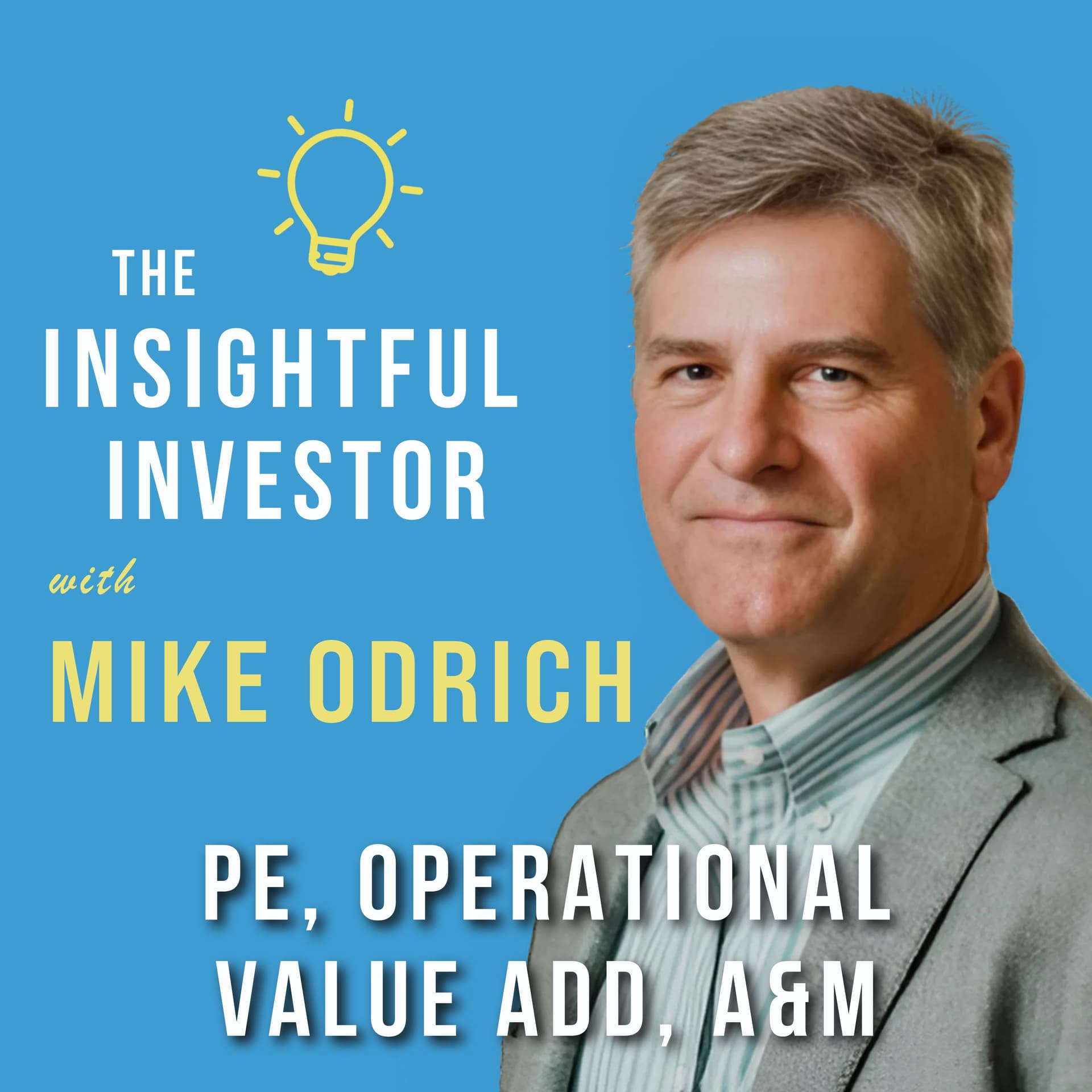
- Episode Title: #49 - Mike Odrich: PE, Operational Value Add, A&M
- Guest: Mike Odrich, Managing Partner and Founder of A&M Capital Partners
- Date of Episode: (Not specified in transcript)
- Host: Alex Shahidi, Co-CIO of Evoke Advisors
Key Points Discussed
Introduction to Mike Odrich
- Mike Odrich has a background in private equity and investment banking, having started his career at Lehman Brothers.
- He founded A&M Capital Partners, managing approximately $5.9 billion in total commitments.
Early Investing Passion
- Mike's interest in investing started at a young age, influenced by his middle-class upbringing and fascination with the stock market.
- He shifted from a pre-med track to finance, opting for a career in corporate finance and investment.
Transition to Private Equity
- Mike began his career in M&A at Lehman Brothers, where he gained expertise in corporate finance and valuations.
- After Lehman's spin-out from American Express, he saw opportunities in private equity and started developing the firm's private equity platform.
A&M Capital Partners and Operational Value
- A&M specializes in private equity with an operational focus, leveraging their consulting arm (A&M Consulting) to add value through operational improvements.
- Mike emphasizes the importance of operational changes for value creation in private equity.
Lessons Learned from Career
- Skepticism in Investing: Always question information provided by sellers; due diligence is critical.
- Price Sensitivity: The only unchangeable factor in a deal is the purchase price; underscores the need for discipline in investments.
- Team Dynamics: Successful investments are team-driven, and collaboration is crucial for navigating challenges.
- Avoiding Bad Deals: The firm places significant emphasis on identifying and avoiding potential pitfalls in investment opportunities.
Importance of People and Business Models
- Successful investments hinge on backing the right leadership and understanding the business model's dynamics.
- Companies with essential products and services that exhibit recession resistance are preferred investment targets.
Current Private Equity Landscape
- The shift to higher interest rates poses challenges for private equity, particularly affecting capital structures and returns.
- A focus on operational improvements and deep sector expertise is necessary for success in the evolving market conditions.
A&M Consulting and Its Role
- A&M Consulting provides operational expertise and strategic advice, significantly differentiating A&M Capital from other private equity firms.
- The firm focuses on implementing solutions rather than just providing strategic recommendations, allowing for a more hands-on approach in portfolio management.
Investment Strategy and Focus
- A&M Capital primarily targets lower to middle market companies, investing in businesses with $10-$25 million in EBITDA.
- The firm aims to build platforms rather than just purchase them, enabling significant value creation through operational excellence.
Challenges and Future Outlook
- The current environment is more challenging for private equity due to rising interest rates and inflation.
- Mike believes that firms with operational capabilities and deep sector knowledge will outperform in the long run.
Conclusion Mike Odrich's insights into the private equity landscape highlight the necessity of operational improvements and strategic partnerships to navigate the complexities of investments successfully. The conversation underscores a unique approach to private equity that leverages A&M's consulting expertise, emphasizing the importance of assessing risk and focusing on essential products and services to drive growth.
Key Takeaways
- The integration of operational capabilities into private equity investment strategies can create competitive advantages.
- Maintaining skepticism and diligence in the investment process is crucial to mitigate risks.
- The focus on essential services and recession-resistant businesses remains a core strategy for A&M Capital.
- The current market conditions require private equity firms to adapt and emphasize their unique strengths to sustain performance.
Written by AI. May contain mistakes. Listen to the episode to check what was said.
Transcript
Automatic transcript. May contain errors.0:05Welcome to the Insightful Investor Podcast, a weekly series that seeks to share industry, investment, investment, investment, and market insights. We define insights as concepts that are counterintuitive, widely misunderstood, or underappreciated. In other words, unique ideas that you probably won't hear elsewhere. I'm Alex Shahidi, the host of the podcast and co-CIO of Evoke Advisors, a leading investment advisory firm. Learn more about our show at insightfulinvestor.org.
0:38Today's guest is Mike Odrich. Mike is managing partner and founder of A &M Capital Partners, which is a private equity firm that manages about$5.9 billion of total commitments across six funds. Mike, thank you for joining us today. Great. Thanks so much, Alex. Really appreciate the opportunity to be here with you. I always like to start with your background. It gives us a window into who you are, how you think. Why don't we go back to the beginning? and I wanted to ask you, when did you first become passionate about investing? It's a great question. As I reflect on it, it was a long time ago. I'm getting old, I'm 61 years old, but it was a long time ago and I grew up in a very middle-class neighborhood on Long Island.
1:27My dad was a school teacher, but for some reason, I was always intrigued by the stock market. I remember reading the business section of the local newspaper every day. I wasn't buying the journal back then. And the first investment that I made was in a public company called Ramada. Ramada was in the hotel business, hospitality business, and they were moving into gaming and setting up casinos in their hotels. And I thought that was going to be a great growth opportunity. So I think I bought 10 shares with my saved up allowance. And meanwhile, I was watching IBM go up and up and up and I never bought it.
2:08I thought at some point it would go down, but I guess I was wrong. So going back, just always following and having an interest in the stock market was something that's always been a part of me. But anyway, I was pre-med when I went to Stanford. I was accepted to a bunch of medical schools. And then my senior year, I decided that I really wanted to go to Wall Street. I went to Lehman Brothers, talked my way in. I remember the partners there saying, why are you here? You should be in medical school. And I remember saying that I was just really interested in corporate finance and investing. And so that's where it all started.
2:46You talked about the stock market, but you've gone into private equity as opposed to public equity. What caused you to take that route? I started at Lehman in the M &A department and spent four years there working on some incredible deals, learning the corporate finance business, how to value businesses, providing advice to companies that were being sold and being bought. I had the honor of working for Tom Hill, who was running the M &A department at Lehman for a number of years, and then getting introduced to Dick Fold. A couple of years later, Tom and Dick had become co-heads of the firm in 1990, and they asked me to work closely with them as we were trying to get separated from American Express.
3:30If you remember back then, American Express owned 100 percent of Lehman Brothers. and so I worked on that transaction in 1994. We did get separated and spun out into a separate publicly traded company, 100 % spin out and Lehman became a public company for the first time, 100 % owned public company by the public markets for the first time it's in existence. There was a stub that traded in the late 80s that American Express bought back in in 89. So this was truly getting separated from Amex at that point in time. But all along, I saw a real opportunity for private equity. And Lehman had one fund in 89 that was invested from 89 to 93, very successfully.
4:16It was a controlled buyout fund, but Amex wouldn't let us raise the next fund. So we effectively were out of the business of private equity in 1994 when the spinout happened. And so I went and wrote a business plan to start a multi-strategy, diversified private equity business, presented it to Dick Fold, who I had a very close relationship with. Dick loved it. He said, all right, we're going to present this to the Lehman board, which really surprised me. I was probably 31 years old at the time. Presented it to the Lehman board. They liked it too, got the green light and all systems were go. And I started building the Lehman private equity platform in early 1995.
5:01I started with a combination of the merchant banking side, which were control buyouts, where we had already had one fund and had been successful, but needed to restart that investing activity, but also started a new focus on venture capital. At that time, the internet was really at an inflection point in revolutionizing the world. And I felt we needed somehow to figure out how to get capital invested behind that transformation. And I saw a major opportunity really to position Lehman for internet investing by getting us set up to lead mid to later stage rounds of financing behind some of the premier earlier stage VCs.
5:49I built a whole set of relationships with Kleiner Perkins, Sequoia, a lot of the blue chip VCs. My pitch to them was we can really help organize the pricing of subsequent rounds of financing for your companies, leveraging the Lehman Brothers investment banking, research, wealth management capabilities, and really focus on companies that were closer to IPO. That way, product services were typically touching customer hands and within 24 months of an IPO where really the resources around the Lehman Bank could be helpful to getting those companies moved forward. And it was an amazing time, particularly in the VC market.
6:32We just made so much money. There were a couple of deals that I think were over 100 times our money. And then we used that success and the success of building our merchant bank into building a PE business that was diversified with$35 billion of assets under management. We had 38 different strategies across six different asset classes. We had real competitive advantage. Most of our funds were first quartile performers. We had done a really good job of figuring out how to bring the relevant resources from around the investment bank to help us in terms of sourcing proprietary deals, bringing in the mindshare of the bankers and the research analysts and the wealth managers to differentiating ourselves and helping us be successful.
7:19And I'll tell you, the bankruptcy of Lehman happened in 2008. We had visibility on doubling or tripling the size of that private equity platform in the next three to five years. So from my perspective, the bankruptcy was just a crushing blow because this business was just exploding positively and everything went away because the bankruptcy of Lehman, it was a bankrupt estate and the general partner of all the funds. And we had hundreds of funds. We probably had about 15 ,000 investors across the various funds. The bankrupt estate was the GP, and that obviously wasn't tenable. So I met the Alvarez and Marcel consulting guys on the second day of the bankruptcy, and we wound up repositioning all of those strategies into new ownership.
8:10So the merchant bank became Trilantic Partners. The venture firm became Tenaya Capital. The real estate funds became Silver Peak. The whole fund of funds, secondaries, co-invest. We were launching the dial platform in the summer of 2008 when the bankruptcy happened. That all went with Neuberger Berman and became Neuberger Alternatives. Just a fun fact there is, I think the AUM at the bankruptcy of just that Neuberger Alternatives business was about$12 billion. Today, it's over$120 billion. So that team has done a phenomenal job in building that business. And these are all still close friends of mine today.
8:52So I'm incredibly proud of what they've been able to do. We had several private credit funds that went in different directions, and our infrastructure business became part of Tiger Management. So a very successful repositioning, but an incredibly sad one for me. It was an amazing business, but I've been fortunate to be able to create another amazing business here at A &M. So it sounds like you jumped right into private equity for the beginning with M &A and the work surrounding that, as opposed to ever looking at investing as a public equity investor. Is that accurate? Yeah, that is accurate. In the M &A department, I had worked with a couple of the earlier really successful PE firms, and I loved what they were doing.
9:40I was interested in the public equity side too, but just given the lens that I was operating out of in the M &A department, I was really dealing much more with the private side of the investing market. So that's where I gravitated. It also seems like there's more opportunity to add alpha and excess returns and value in that space. And we'll get into being able to do that operationally. But did you have that sense early on in your career that this is an area that where I could add a lot of value? Yes, I did. And we can talk about it a little bit, but there were some major changes that were happening really from the time that I started at Lehman in the mid 80s.
10:27You had Michael Milken and Drexel Burnham that effectively transformed how valuations of companies were done. It's the change from earnings-based valuations to cash flow-based valuations. You think about the impact of that. It was literally like going from landlines to cellular. It was truly transformational. and the ability to make those types of operational changes outside of the public shareholders was a really powerful thing to be able to create value. So I saw that opportunity and there was a big arm that happened from the public to private markets as a result of that, created huge opportunities for the earlier investors.
11:11We're going to get into A &M and your work there, but before we do, would you share any early investing lessons that you learned early in your career that have shaped your approach today? Yeah, this is such an important thing. And I would encourage people who are just getting going, or even just through your professional careers, to talk to people about their investing lessons and things that have helped shape their approach to investing. Because everybody's had a unique journey and people take different things away from that. And I've always found asking that question, I almost always learn something new when people answer it.
11:53So at Lehman, in fact, at the end of every year, I used to keep a log called lessons learned. And it would be like 20, 30 things every year that would come in there. Unfortunately, I wish I could find that right now. I haven't been able to do it again. That was a long time ago, but there are so many of them. But let me get into a couple first, and it's probably incredibly important, more important or as important today as it's ever been is never trust the information that you're given. You always need to be skeptical. If you're a buyer and you're being furnished with information from a seller, whether it's a bank or it's a family or a founder that's selling a company, you need to be skeptical.
12:39You have to have a glass that's half full because if you're too skeptical, you'll never do a deal. But at the same time, that upfront judgment is so incredible. And it's incredibly important to save you from mistakes, to make sure that you really understand the asset that you're buying. And you'll always be surprised or almost always be surprised that there's something that you didn't know or didn't think about is that's just the nature of the beast. But having that upfront skepticism and distrust, if you will, I think is really important and will serve you well. Another thing that's somewhat related is that the only thing you can't change, particularly about a controlled buyout deal, is the price you pay.
13:28You can literally change everything else. And we often do in the deals that we do at A &M Capital. Sometimes we even create businesses out of nothing and build them. But the price you wind up paying up front is something that you can't change. And that really underscores the importance of discipline in that investment process. I think the success of private equity partnerships really depends on their process and how they go about their diligence and how they go about their approvals and all the economics for the various partners in the firm. You want to make sure that that's all lined up and that people are all working together.
14:17I like to say investing is a team sport. It really is. Nobody has the market cornered on intelligence. And the more diversity of opinion and skepticism you can bring into that process, the better you're going to be. The other thing that's also related to that is I think the success of any given fund is not only defined by quality of the good deals that you do, but it's also defined by the avoidance of what could have been bad deals. And we oftentimes go back and look at deals that we came very close to and decided not to pursue for a variety of reasons. And we've missed a few for sure, but we've also avoided some real bombs that could have negatively affected a bunch of our funds.
15:07So anyway, I think those are all important when taken together. Another thing is the importance of people. I still have yet to find a business that runs itself. It always gets down to people. and it's also a question of having the right people in the seat at the right stage of maturity of the business. The leader of a business who takes a company from founding to 10 to 15 million of EBITDA, for example, might be, but almost is most unlikely to be the right person to take that to 50 to 100 million of EBITDA. It's just there's so much organizational complexity surrounding that type of growth, particularly in a shorter period of time, which is where we focus a ton of operational complexity and growing organizations that quickly over a three to six or seven year period, which is our standard horizon.
16:05But making sure that you back the right people at the right time is really, really important. Another one I would say is really focus on the business model, how the company makes money, how it differentiates itself, what are the key risk areas in that business model, make sure you really understand it. Because if you don't understand it, my advice is run, don't walk away from it. It's something you just don't want to touch. And sometimes I like to say this to my kids too, things that seem too good to be true almost always are, right? So that gets back to that skepticism point. On a related point, businesses can get too broken.
16:47They can get too broken to be fixed. Sometimes you hear people say, oh, well, it's really the right side of the balance sheet that's broken and we can go in and recap it and fix that. But what I've found over time is that that right side of the balance sheet problem almost always crosses over to infect the left side of the balance sheet. And so be very, very careful if you're thinking you can just do some financial engineering and the rest of everything is going to be great. Similarly, it's really hard to fix a broken end market. So we pay very close attention to the end market, the competitive dynamic, how that company sits inside that competitive dynamic, how it differentiates itself, and how it's likely to perform across economic cycles.
17:39Broken markets, we don't even touch them because they're so hard to deal with. One of our key areas that we like to focus on in our investing activities is focusing on companies that are providing essential products and services, where customers need to have these products or services, they can't just switch them off. They might be able to hold their breath for a while, but fundamentally switching them off is impossible. And so that has become a centerpiece of our investment focus, recession-resistant businesses, essential products and services, high cashflow conversion, competitive barriers. It's a little bit motherhood and apple pie, but when you put them all together, it's really powerful.
18:27Don't be greedy. This is another one. Sell when the time is right. The old expression, pigs get fat, hogs get slaughtered. It's really true. I just heard a story of another PE firm, won't say their name, former manager from one of our businesses that we sold to someone else. The company was struggling through COVID. We sold it before COVID. This one particularly struggled through COVID. And this firm did a really nice job coming out of COVID, turning it around and apparently was offered$900,$950 million for the business, which was significantly more than we had sold it for five, six years earlier.
19:06And this manager had rolled a bunch of his equity and the firm turned it down. They wanted an extra$50 million. And I said, wow, sounds like it's pretty short-sighted, but not knowing all the facts around that particular situation, it certainly sounded like this executive was a little bummed out about it. So don't be greedy. Sell when the time is right. And I like to say, if you get hit in the head with a paycheck, you take it. You'll always learn more from a tougher deal than you will from a great deal. And it just is the case. When everything goes right, there are deals that go that way. Oftentimes, you're luckier than you're good.
19:44And you never see the potential warts that can expose themselves and significantly hurt a business. So when you do go through and we're most proud of a couple of the deals that have been the hardest to generate returns on even some that have generated lower absolute returns of one and a half to two times deal, we've worked our tails off to make that happen. And I know there are several examples I could go through, but you almost feel most proud of those because you learn so many lessons and you figure out how to make lemonade out of lemons sometimes. But the key is, is don't forget those lessons and don't repeat those mistakes.
20:25And so we're always refining our investment strategy based on those lessons learned. You'll almost never know the full answer to all of the information that there is about a company before you buy it. You just really need to be able to gauge risk on that 10 % to 20 % that you're never going to be able to get at, particularly through the course of a well-run auction process. And it's really focusing on what can go wrong in that last 10 % to 20%. And again, some luck is involved there too, but you're just never going to have the perfect answer, I don't think. I've mentioned investing is a real team sport, so it gets at making those really good decisions.
21:10And that's why we've set up our investing activities as a very collaborative process. We need unanimous approval at our investment committee to get a deal approved. And that's not easy. There's a real healthy, like trust and respect among our partners, but we have no problem disagreeing in a very healthy but respectful way. Everybody has a vote. Everybody has a view. And that goes down to the principals, VPs, and analysts. Anyone who has a thought, we want to understand it. We want to hear it. And we want to make sure that when we approve a deal, we're all together so that invariably there are going to be problems in the portfolio.
21:52And we want everybody running toward those problems to help. We don't want finger pointing and, oh, that was his deal or her deal. That wasn't my deal. That's like a cancer. It's toxic inside a private equity partnership. And so that's the way I had built the culture at Lehman. And that really is the way we've set things up. Jack McCarthy, my partner, and I are both very insistent on that. And not only that, we allocate carry at the very beginning of the fund. There isn't jump ball economics that creates really weird incentives for what we'll call bad behavior. You don't want someone trying to hide the salami on diligence because they're going to get paid more if they get their deal through versus somebody else.
22:41It just creates really perverse incentives. So we've been doing it this way for 15 years, 350 investments that we've made since that time. And we think we've got it set up in the right way. That was great. The tone that I heard, and as you were describing many of the investment lessons you've learned over time, the tone is one of try to minimize the risk of negative surprises. And so that involves a healthy dose of skepticism. It involves thinking about the risk, all the things that can go wrong. And I'm curious if you feel that your experience going through that Lehman bankruptcy that was completely out of your control, if that colored a lot of that insight that you just shared with us.
23:24Yeah, look, I think you've paraphrased it, summarized it perfectly. The Lehman bankruptcy was another learning point, probably for the conversation another day, but I saw real problems coming well before they happened. I remember having conversations with a couple of the very senior people at the firm back as far as January of 2007, talking about some of the macro decisions that the firm was making that I fundamentally disagreed with. And it was really around adding risk exposure to our balance sheet at a point in the market that was incredibly toppy. And I do feel today that I said my piece, I brought it up.
24:09I turned out to be right about that. And I wish I weren't right. I wish I was wrong. I wish Lehman were still here today. It was an incredible firm. We had incredible people. It was just a very special place. On the other side of that, building a new business from scratch in 2009, 10, 11, 12, 13, that wasn't a lot of fun coming out of the great financial crisis, particularly starting a new fund at that point in time, a new strategy with new partners. there was a lot of new stuff involved and the market really was extremely challenging, particularly on the capital raising side. If we had capital, we probably would have done really well at that point in time, but we didn't have it.
24:51But yeah, Alex, I mean, it was such a big lesson in decision-making, lack thereof, greed. Greed was a lot of it. It was a lot of it. So yes, I think it just continued to add to my experience base. And I think that's helped in future investment activities here into A &M Capital. So let's talk about A &M Consulting first, which started all the way back in 1983. Would you tell us about that organization and how it's evolved and how it differs from other consulting firms? Yeah. A &M started in 1983. Tony Alvarez and Brian Marcel came together. Tony was at Coopers and Lybrand. Brian was in the restructuring group.
25:37at Citi. They worked on a couple of deals together. And there's some very funny stories around that that I won't go into right now. But I just love listening to Tony and Brian tell those early days stories about how they left their firms. One little quick anecdote, it's fantastic. They left their firms, they had really good jobs, and they set up A &M in 1983. And they worked on a deal that they were going to take ownership of, and they got topped in a bid. And so they made some money, but they effectively didn't have their own jobs and they weren't sure where the next paycheck was going to come from.
26:14And so they looked at each other and they said, how are we going to tell our spouses that we don't have a job anymore? And so they decided to go to a Mercedes dealership and they each bought Mercedes for their wives and came home. They said, the good news is, is we did well on this deal. Here's your new Mercedes. The bad news is we don't have a job anymore and we're going to start our own firm. So that was 1983, so 41 years ago. And they started it as a really boutique restructuring focused advisory firm representing the debtor side. So coming in to take over the operations of companies that were struggling from the financial standpoint and really representing all of the interests of the stakeholders and trying to work those troubled situations out.
27:04And they grew the firm slowly, but steadily up into the early 90s, where it was a couple hundred people, very boutique, still focused restructuring firm. And they started the growth of bringing in C-level executives from industries. Again, these are operationally focused people, consultants that are full-time employees, but they're really operationally focused, typically coming out of Fortune 1000 to Fortune 100 type companies across a whole range of industries, the C-level. So CEOs, CFOs, CIOs, CTOs, the whole C-suite of executives. And underneath that, once they started getting into the 2000 timeframe, they started adding deep functional experts, people across just about every area of an enterprise.
27:54So you think about supply chain, inventory management, finance, tax, HR, if it's a manufacturing firm, Sigma-type activities, brand managers out of some of the big consumer products companies like P &G and Unilever, people who can do skew rationalizations, go through research, R &D budgets, etc. And so very different from a Bain, Booze, McKinsey, which are strategy consultants coming in to provide strategic advice to companies on the direction that they should focus on. A &M can do that too, but they actually have the people that can go in and help execute change inside that organization. So for example, an IT service that A &M has provided time and again is an SAP system gets put in place in a corporate and it's not really implemented right.
28:55And the company will hire A &M to go in and their IT professionals to go in and do a re-implementation of that SAP system, but making sure that they have finance professionals in there with them to make sure that the end product is up and running and with the functionality that was intended to have. And so if you think about that, multiplied across all areas of an enterprise, that's really what A &M is. And so they've had this incredible growth, particularly since the late 90s. When Jack and I started A &M Capital in 2009 with Tony and Brian, A &M had about 1 ,200 people. And once I realized, I always thought it was, well, it's restructuring advisor and private equity firm associated having some kind of association with A &M would be more focused on distress, stress type companies.
29:51And once I got to understand what A &M was, I had no idea that they had built out this breadth of operational talent across not only the C-level, but the functional expertise. I realized that if we built a private equity platform that could have real-time access to those ops executives, bring them into our investment process to help front to back on the investing side from sourcing proprietary opportunities to diligence and screening of those opportunities. And then really important, which we never had at Lehman, was the ability to transform these companies operationally, to focus on post-acquisition performance improvement, leveraging interim management capabilities from A &M executives to bring them into the companies to help professionalize, scale, grow, making sure that all the systems are right.
Read the full transcript
30:51That's something we have a checklist every time we do a deal. We're doing a full analytic on that business and what needs to be improved, what needs to change, and mapping out the roadmap to get to making those changes to get to the end game. It's like building a house, building a foundation in a house. And so A &M has those capabilities. And so today, A &M is over 10 ,000 people. A lot of that expansion has been in North America, but tremendous expansion in Europe. When we started our first European fund And in 2019, there were about 250 consultants at A &M across the continent. Today, there are well over 2 ,500.
31:36That's in five, six years, a tenfold growth there. A &M now operating 25 offices across over 20 different countries in the European markets. So tremendous growth there. And as A &M has grown, it has provided incredible competitive advantage and differentiation to us on the A &M Capital side. A big area of A &M's growth today is in the Middle Eastern markets. A &M is a major player there now with, I think, 300, 400 plus people on the ground with plans to add significantly across that region. So that's something that we are also engaging with on the investing side at A &M Capital. But it's an incredibly powerful firm that has been just phenomenally successful.
32:24And as they have achieved more and more success, that has helped us in turn be successful as well. Let me restate the value add of A &M Consulting and tell me if this is accurate. So I think of individual businesses as like a machine. The machine is made up of processes, systems, technology, and people. And you can manage that efficiently or you can manage it inefficiently. And so there's a design aspect, which I guess a lot of consulting firms focus on. But actually implementing the design is very difficult because it's a complex system. So A &M Consulting can come in and not only help with the design, but can step in and say, this gear needs to be re-evaluated.
33:10it. We've done a hundred of these and best practices is to change it this way. And we can actually help you do that. We can maybe bring in people that help you become more efficient and can actually implement the design much more efficiently and add value in that way. Is that a accurate description? You nailed it. That's exactly what it is. And A &M can come in and act as advisors or commensurate coaches to existing management teams that just need some oversight and help with those improvement processes, or they can come in and roll up their sleeves and do it themselves on an interim basis. And again, there's no other firm like it of this scale in the world.
33:50And so we're incredibly lucky to have them as our partner. And I will say, Tony and Brian, I didn't know them when we set out on this journey back in 2009. they have been amazing partners. I mean, they are really great people. They are people of their word. We had some tough times early days. It took us a while to raise Fund One, and they never flinched, not once. And if I'm in a battle, I want to be in a battle with this team. They're truly, truly remarkable. And what they can do for businesses, Alex, you're 100%, you nailed it. And that's exactly the benefit that we get from this great partnership and association.
34:30Okay, so let's talk about that. We just described A &M Consulting, which started in 1983. And after Lehman, you started A &M Capital in 2009, as you just referenced. And so you're partnering with A &M Consulting to add value to the private equity investments that you make. Would you walk us through that partnership? Yeah, we went to a whiteboard. Tony, Brian, Jack, and I literally spent four or five months walking through how we were going to design this business model. And we came up with what we thought based on our relevant experiences, mine at Lehman Brothers, where we were part of an affiliated model.
35:14Jack McCarthy was at Bank America Capital Partners in Europe. That was also an affiliated strategy that was investing across the European markets. A &M had never been part of any kind of private equity investing activities. They had done a couple off of their own balance sheet that with moderate degrees of success, they had one deal. I remember Tony saying that it was a 10-bagger and they got greedy and they thought it could go to 20 and they wound up losing everything on it. They wanted to make sure that they did it in a professional way and build a best-in-class business. And that's really been their focus in building A &M.
35:51So we went to the whiteboard and designed this business model, which I'm proud to say is the same business model that we have today. If you look in our flip book, there's a page in there that literally hasn't changed in 15 years. The numbers have gotten considerably bigger just in terms of the investment from A &M partners across our funds, which is wonderful. But the business model itself really hasn't changed. And there are a couple of key tenets that I'll take you through because I don't know of a similar type of a business that exists in the market today. It's a cross between an affiliated model like we had at Lehman and B of A and a true independent model, which most private equity firms are operating out of.
36:34It's a hybrid. And we call it effectively an associated model because it starts, the foundation is that separation of church and state. So the capital business is 100 % separate from the consulting business. The capital business has dedicated, experienced private equity investment professionals that are managing the full life cycle of the funds from raising the capital to investing the capital, improving the businesses, realizing on those investments, returning that capital back to our investors and then raising the next fund. That is a really key thing. Again, very different from what we had at Lehman where everyone, the investors worked for the broker dealer.
37:19And there were just a lot of conflicts when you have things set up that way. Are you doing deals for truly returns or are you doing them for client facilitation to make fees on the banking side? And it took us a while at Lehman to really convince LPs that we were doing deals for returns purposes, but there was a lot of skepticism up front. So we never had that problem here. So separately capitalized business, but very, very close links. And we've created a series of economic alignments with the A &M business for them to help us be successful. three key areas there. The first is the partners investing in every one of the funds that we raise.
38:09So we're managing six funds right now. In total, we probably have close to$500 million invested from six, 700 of the partners at A &M across these six funds. So that's when I said the numbers have gotten bigger. That's what I'm talking about. As A &M has gone from 1 ,200 people to 10 ,000 plus, they have reinvested a lot of the wealth that they've created in their A &M stock coming into the A &M capital funds. So every time we raise a fund, A &M has the opportunity, the partners have the opportunity to put capital into our funds. It's coming out of their pocket. So it's not coming off of an A &M balance sheet.
38:50These people have paid tax on this capital. It's in their bank account, and then they're committing it to our funds. And they're paying full fees and carry on whatever that strategy is. So if it's our flagship, it's a two and 20 strategy, they're paying two and 20 on that capital. What the investment team shares with them though, is about 30 % of the team's carry goes to those partners who are putting up their own capital on roughly a pro rata basis. Now at Lehman, in a true affiliated model, we used to share 35 to 50 % of our carry with the house. But who was the house? The house were the public shareholders of Lehman.
39:33The public shareholders weren't in any position to help us on the investing side at Lehman. So that carry escaped the system. Here, it's a closed loop system. A &M is a private partnership. It almost always will be a private partnership, we think, just because of the provisions in their governance agreements. It's owner-operated. Tony and Brian always wanted to be owner-operated. So we have an incredibly stable partner on the one side that's committing more and more capital to our funds. And if you think about it, those partners are in the same economic position as any of our investors in our funds.
40:11They have the same downside if the funds aren't that successful. As the funds become more successful, though, there's upside sharing with those partners because they actually turn into carry recipients. So we now have sent significant carry checks from realized deals across to the A &M partners who have seeded our funds. And we've become very popular in that wealth creation. We've proven the ability to create value consistently and return that value to our investors. And so it's become a very popular thing. that investment in the funds is a really powerful economic driver. The second piece is our working relationship.
40:56We, A &M Capital, are under no obligation to use A &M for services whatsoever. We don't share in any of the economics of A &M. When we pay A &M a fee, effectively, it's coming out of our pockets. Now, we'd have to hire people anyway for those tasks. If it's financial diligence, operational diligence, We need an interim CFO. We need help fixing a broken supply chain, whatever it happens to be. And A &M is providing those services to about 600 different GPs anyway. So there's well-established pricing on that. But when we do use A &M, we get a discounted price that no other GP gets, which is a real benefit to our investors and us.
41:38And when we're using them and decide to use them, And that all gets factored in. So that's the second piece. And the third piece is something that I did at Lehman very successfully. Jack actually used it also at B of A, which is a finder's program to reward people who source and help us execute proprietary deals. We have the ability to pay a person, or sometimes it's more than one person, a finder's fee of up to 1 % of the equity check that we write into that company. So if we make$100 million upfront investment and somebody handed it to us on a silver platter and it wasn't a marketed deal and it was proprietary, that person or people could get up to a million dollars in cash from us, which is actually a pretty inexpensive buy side fee if you think about it.
42:30Typical buy side fee is one and a half to two and a half percent of enterprise value. So this is up to one percent of equity value. It's a fraction of what a standard buy side fee would look like. And in our flagship strategy, AMCP one, two and three, we've completed 23 platforms to date and half of those have been sourced with A &M involvement, meaning we would not have seen those platforms had A &M not been involved with us. And we've paid about 18 of those finders fees just for that strategy. So it's a major competitive advantage. So when you couple those three links together, A &M is really encouraged to help us be successful.
43:17And by the way, those people who find those deals, that payment doesn't run through the partnership waterfall where maybe 10 cents or 15 cents of every dollar goes to the actual person or people who help make that possible. It goes directly to them, which is a very, very meaningful compensation for those people. So that has increased the velocity of deal flow coming out of A &M significantly. Now, on the other side, the alignments and fiduciary alignments that we've set up with our investors is very significant. I mentioned it's a separately capitalized business, dedicated experience team. Our compensation, our investors' compensation from the A &M capital team 100 % comes from the performance and success of the funds that we manage.
44:06So there's no sharing with A &M on the economic side. We are responsible for the investment decisions and the investment process and raising the funds and managing the funds. I talked about how we do that from the unanimous approval process. That's all working incredibly well. The thing that we also do, I think, which needs to happen with our business model is we have transparency to our LPs. So twice a year to our LPACs, which they're comprised of the largest investors in each one of our funds. We report when we use A &M, what we use them for and what we pay them. So there is complete transparency on that economic relationship back and forth.
44:51If we pay a finder's fee, we report that. If there are conflicts in our business that we experience that involve A &M, we'll also report that. And if we need help in how to determine an outcome, we'll actually get on the phone with the members of that LPAC and talk to them about that. So it's a really nice, balanced alignment mechanism with the A &M organization to help us be successful, but also maintaining that fiduciary alignment with our investors. That's so critical for that trust to make sure that they know we're making these investments for returns and returns only. Now, I'm happy to report that in terms of the partners' commitments to our funds and our own commitment from the A &M Capital Investment Team, the last two funds we've raised, we are the largest investor.
45:43We, the GP, are the largest investor in those two funds. So our flagship, which came in at$2.25 billion Fund 3, we have a total commitment of$207 million to that fund. We're the largest. There are a couple at 200, one at 150, 125, 110, 100, but no one above 200. And I was really happy to report that to our investors when we had the final tally on it. And that came from about 165 million from 450 partners at A &M and another 42 million from the A &M capital investment team. So we are putting our money where our mouth is. All of these alignment mechanisms, the thought that we put into this business model up front is paying incredible dividends for us.
46:31The one piece, and I know this is getting a little bit of a long answer and I apologize, but it's so important to understand the power of our model is what we've done is we actually share the technology platform with A &M. And we're actually operating under a separate instance. So all of our data and information is walled off and separate. But the way A &M staffs its own advisory assignments, say there's a widget manufacturer in Wisconsin that needs help on its supply chain. How does A &M figure out in their 10 ,000 plus person organization who's got relevant skills, experience, or contacts to that situation?
47:13Well, they send out what's called a request for experience. And it goes to all people in the firm around the world. And it'll describe that situation. Which a manufacturer based in Wisconsin looking for help with their supply chain, please respond with any direct relevant skills, experience, or contacts you may have to that situation. And what comes in within typically a 24-hour period, again, this is because this is how A &M consultants get staffed on these projects. So it's in their DNA to respond to them is sometimes you'll get 50, 70, 100 responses from people that can range from, I was a CFO in that industry.
47:54I just finished a supply chain assignment for a competitor. I know the CEO of that company. I know a board member. I know another experienced executive who's not at A &M, who knows that space cold. So literally that all comes in and A &M decides who has time and capabilities and that's how they staff their assignments. Well, we use the same tool. Say we're looking at that same company, we'll send me from A &M Capital. It won't come from A &M, it'll come from A &M Capital and it'll go out and we'll see all those responses directly. It won't get filtered through a screen and then A &M will show us maybe two or three people who might have capabilities.
48:34We'll see all 50, 70, 100 responses, get on the phone with the people who have the most relevant experience, and we'll start talking to them about it. And then if we go forward, we can actually, and we do this all the time, is take those people with us to the first meeting. If it's a management team, if it's a founder, family-owned business. We've been incredibly successful with founder and family-owned businesses where we're the first institutional investor to come in. About 60 % of our 350 deals fit that characterization. And we differentiate ourselves immediately because not only are we showing up with an experienced private equity investment team, we're bringing oftentimes one, two or three Fortune 1000 or 100 level executives who know that industry or subsector or niche sector oftentimes better than the people on the other side.
49:34And they're not there to try to take their jobs. They're there to help to get to the next level of success like we had talked about. The size companies we're targeting, which are smaller, particularly for that size fund, 10 to 25 million of EBITDA up front, we're showing up with those kinds of resources. Nobody else looks like us. So it's a real major competitive differentiator. So that is really the key in how we execute our strategy. And we've taken it to the next level by finding A &M partners and professionals who have deep expertise in sectors that are of particular interest to us that fit our strategy where we actually proactively, we call these proactive initiatives, we proactively go after finding opportunities and reviewing those opportunities together in certain areas.
50:30And sometimes we'll look at 10, 20, 30 companies and before we find one that really works for us. But when we find it, we have high conviction that it's checking all the boxes, we can move very quickly and really differentiate ourselves. It's an unbelievably powerful playbook that we have. As A &M's success has grown and we've grown, it's just become very self-reinforcing. Sorry, that was a long answer. No, it's all good. There's a lot of thought that went into that. If I can share my perspective from my vantage point, looking at it through the investor's standpoint. Obviously, the clients, the investors, the people putting their money in, they're focused on returns and the value add that comes from the partner helping these businesses improve.
51:19What you just described to me is really interesting because going back to when you were designing this business 15 years ago, you're in a unique position where you had a blank slate, You had a consulting company that you could partner with that was adding a lot of value to the companies they were involved with. And at the same time, you're competing with other private equity firms looking to partner with companies where a lot of private equity companies are very good at financial engineering. They come in, they know how to engineer finances. And oftentimes when you have the tail at your back and the markets are going up, you can generate great returns.
51:57but that can mask a lot of areas where you're not really adding value. In your case, you're coming in, adding operational value, which you spent a lot of time describing, and also properly aligning all the incentives. So you're incentivizing the right players who can actually add that value. And it's really fascinating how that business plan you set 15 years ago has worked as you had expected, and as a result, you haven't had to make any major changes in that time. Yeah, frankly, it's worked better than I expected. I was hopeful and optimistic and really excited because I felt it was truly differentiated.
52:35But again, it was on paper. It had never been done before with A &M. And it was a lot of hard work in building that out. But wow, it's quite an amazing thing that all the people at A &M Capital, and we're around 80 people now, really understand the power of it. And we're fortunate to be a part of it. So given your focus on making operational improvements in the companies in which you invest, how do you think about mitigating risks from external factors that things you can't control as much? We are really focused on situations where we can control the risk and the risks we know we can control and can make sure that we challenge ourselves, that we have a high degree of confidence in our ability to control them are operational risks.
53:26So exogenous things, ops risks upfront, we can assess, we can control them. And we focus on situations where we have a high degree of confidence in our ability to execute those operational changes that will drive significant value creation. Risks that are out of our control are things that we really, really try to avoid. You think about what those are. I like to say stroke of the pen risk. A government proclamation can change a law that can completely upend a business model. I'm sure most private equity investors have been on the wrong side of that. We certainly have also. One of the lessons we learned, want to deal in fund one, had that happen to it, we had to re-architect the entire business model.
54:12And we did. We had to change the leadership team a couple of times, re-architected the business model. This happened twice, actually, in fund one. And at the end of the day, we made solid returns out of it, but worked our tail off to get that done. So we're not going to make that mistake again. So that's become one of the core areas of things that are in our control, not out of our control. Anything like required approvals, business models that are subject to consumer preferences or fads that could be here today, gone tomorrow. We just really try to avoid those. If you look at how we perform through COVID, and I talked about this a little bit earlier in terms of focusing on businesses that are providing essential products and services that are recession resistant, et cetera.
55:00Almost all of our companies came out of COVID, except the ones I just had mentioned. They came out of COVID in a much better spot that they went in. Now, we worked our tails off on that, too. We went in and turned every economic lever we could to make sure that upfront, to make sure that these companies were set up to survive a prolonged pandemic and the effects of it. But effectively, they were providing essential products and services and you couldn't switch them off. And so we were able to grow most of these businesses through COVID. So that just underscored our emphasis and focus on that component of, again, things in your control, operational risks that we have confidence in, but also the business model itself, companies that are providing real essential services.
55:49Also, we don't like to rely on external supply chains, foreign manufacturers, etc. We do a lot of business services deals for that reason, that our assets are mostly our people and they're more local in terms of access there. And that makes a huge difference, particularly when you have major dislocations and we might be coming upon some major trade wars here in the next period of time. We'll probably have a little bit of impact on that, but we're not really worried about it. Again, because of that core focus. And strategically, that makes sense. If you have high confidence that you can generate operational alpha, if we were to phrase it that way.
56:29Absolutely. Then you want to minimize the risk of the things beyond your control as much as possible so that the return to the investors is as much made up of the things within your control, that operational side. That's exactly right. I believe our risk-adjusted returns are as good or better than anyone's. And we're never taking the last dollar of leverage that's available to us. We don't need it. We don't need that last dollar of leverage to generate our returns of two and a half to three X plus gross and 25 to 30 % plus IRRs. We're able to do that through the core strategy of our operational focus and really this focus on building platforms as opposed to buying platforms.
57:13We capture so much value up front in doing that correctly and then in executing a buildup, leveraging merger integration capabilities and all the great things that we do to these businesses to create market leaders from very small businesses. It's all execution-based. And if you do that successfully, you're going to create value quickly and consistently and then get to return that value back to our investors. Why focus on middle markets and how do you define this segment? Yeah, boy, there's such a wide definition of what middle market is. There's lower market, lower middle market, middle market, upper middle market, large cap, a lot of the terms that get thrown around.
57:56We like to define it. We think we're lower to middle market players and that's where our investing activities are focused. We are the 800-pound gorilla there. We can differentiate ourselves based on this wonderful business model that we have, this partnership with A &M, how we organize ourselves through the proactive initiatives, through access to all these wonderfully talented operational executives. We can build platforms as opposed to buying them. We start smaller, typically 10 to 25 million of EBITDAs are starting point. We might be a couple million lower or a couple million higher, but that tends to be where our deals are centered around.
58:40If you look at Fund 3 right now, there are five platforms in there. Our HVAC, our business, we started at around$24 million. Our IT staffing business, we combined two businesses, one with$13 million of EBITDA, one with$10 million of EBITDA, and combined that and put them together for that initial platform, creating these things at a major discount. Our government services business, we started at around$22 million. One of the businesses in Fund3, we actually built the company from nothing. We took five different elements, three physician practice management businesses in the orthopedic space, combined that with two ambulatory surgery centers where they were doing most of their procedures and separately negotiated all five of those elements, brought them together, created a company, installed an interim CEO from A &M.
59:33and an interim CFO from A &M built the finance backbone, built the technology backbone, and created a company with 17 million of EBITDA for 10 times. Now, that business would almost immediately trade in the market for 13 to 15 times. So that's a deal that almost no other private equity firm would have the guts to do or the capabilities to do. Our fifth platform in commercial kitchen service and repair. We started that with seven to eight million of EBITDA for a$2.25 billion fund, but we're going to grow the heck out of that thing. We've got a long line of highly accretive add-on opportunities for that.
1:00:13We just put in place a really experienced leadership team who we've actually worked with several of them before. We had dinner last night with the team, very excited to get everybody back together, the ones who have worked with us before. And we're going to build that to a 50 plus million dollar EBITDA business and have a phenomenal outcome there. It's early innings. If we like to say, where are we in terms of the consolidation of a subsector, a niche area in terms of a baseball analogy? And this one feels like it's first inning, first, second inning. We love things that are before the fourth inning where we can go in and create a market leader in a highly fragmented industry very quickly.
1:00:51And value you create by doing that effectively is tremendous. So that's really core to our strategy. We have two platforms that we're about to close in the next two months. One is in the adolescent behavioral health space, an area we know incredibly well. We're super excited about this deal. It's$16 million of EBITDA today, but it's operating in a single state. We're going to take that multi-state. We haven't even closed this deal and we have an executed LOI on our first add-on in Arizona that we're operating in Connecticut right now. And then the last deal is another proactive initiative in the utility service and repair space.
1:01:28The electric grid is something that needs all kinds of service, repair, upgrade. And we found an incredibly capable executive that we're backing. We're starting at$7 million to$8 million of EBITDA in that strategy too, in that particular platform. So even though our fund sizes have gone up, we're actually starting at or below building these platforms from where we were in fund two and even fund one. So it's ripe with opportunity. Fragmented marketplaces offer exceptional opportunities to create value quickly if you've got the operational capabilities to be able to handle those risks. And so that plays right into the center of our sweet spot.
1:02:09And so that's where we're focused. And that's why we love the lower middle market where we're playing. Are there any common shortfalls you've noticed in your target companies that you feel are relatively easy to fix? Yeah. As I mentioned earlier, we're always doing these full diagnostics. And what falls out of that almost inevitably is gaps, weaknesses in the finance function, the finance systems on the technology side. we do so many founder and family-owned businesses. What we found is that oftentimes the management information that they're dealing with is substandard. They don't have the right systems.
1:02:51They're not getting the right reports out. But interestingly, they actually have great visceral sense, these founders and families, and they do a pretty good job of managing the businesses, but they just can't scale them. They can't scale them because there's not enough automation and technology to really help manage a hyper growth, more complicated operational environment. And that's where we come in. That's our expertise. So really doing that diagnostic upfront and starting with these smaller businesses. But the last piece, and I've talked about this, is the people. Making sure you have the right people at the right stage of maturity to execute a plan to go forward and grow.
1:03:35And we're creating our returns really through growth. It's not financial engineering. It's through growth. It's through business improvement, et cetera. And it's all about people at the end of the day. So when you throw all those things together, we think that's our A &M capital playbook. That's why we've been successful and that's where we're going to continue to focus. I'd like to ask you just a few questions about the outlook. Let's start high level. When you look at private equity and you just look at its history, most of it actually occurred during either a falling rate or a zero rate environment.
1:04:07And it's very possible that that tailwind has reversed. How do you anticipate the shift to potentially higher interest rates for longer and possibly even higher inflation affecting the private equity landscape? Yeah, it's a really important question. I'll say that we're definitely living through that right now. It has been a very difficult transition from effectively free money environment, which is like steroids to the private equity business, into where we're at a place where we have higher rates. Don't forget cap structures that were put in place in prior years are under significant pressure, just the interest burden alone, it wasn't contemplated.
1:04:52And a lot of the larger deals, the interest structures have been swapped to fix, but in some of these smaller deals, they have not. So there's been particular challenges in the lower to middle market side around dealing with some of those interest-related cost pressures. Cap structures have seen that pressure. Lenders have pulled back. We've seen higher equity components in terms of the total capitalization of these businesses, which puts pressure on returns. So when you factor in, I think we quantified it, the move in rates is probably around a quarter to 0.3 turns of MOIC on most deals, assuming you run them out to maturity.
1:05:37And fortunately for us, We're underwriting at pretty healthy levels. Certainly in the period leading up to the rate spike, we were in inflation. We were underwriting to 3x plus gross. So we have room in our deals to handle that. We're likely to hold those businesses probably for another year or so to make sure that we have the time to generate the appropriate MOICs. And that really is where our focus is. Investors give us a dollar. We want to give them two to$3 back net of all fees and carry, et cetera. But it's causing a lot of defaults and restructurings. It's keeping the A &M restructuring people busy.
1:06:17But don't forget, let's go back to the 80s, 90s, 2000s. The interesting term, when you think about a preferred return in a standard buyout fund, it's 8%. What is that 8 %? 8%. That term came into being in the 80s because that effectively was the quote unquote risk-free rate. That was the 10-year government rate. It was 8%. And investors wanted to make sure that in a buyout transaction that they were investing in with illiquidity, that the manager was at least crossing that threshold before they could start taking a profits interest through the carried interest. This has been the case for a long period of time where we've had higher rates and we've had to invest through those.
1:07:06Now, I will say that back then, because we were going through that transition from earnings to cash flow, there was a lot of low-hanging fruit in the operational improvement opportunities inside these companies. There was a lot of opportunities to make money just through that. It's gotten harder than the amount of capital that's been allocated to the private markets here, and it's driven by LP demand, have been almost insatiable. It's spawned so many private equity funds that it's compressed returns. And really, we're at a point now where we're starting to see some of those PE firms are not going to be able to raise, and they haven't been able to raise the types of funds that they had before, or they're just going to wind down altogether.
1:07:51And I got to tell you, that's a healthy thing for the business. There's too much capital. There's too many PE firms that are out there that are less differentiated, undifferentiated. And so I think that could be a positive thing coming out of this. But it really does put the focus on the firms that are going to perform better in these tougher times. And they're going to be the firms, two of them, I think, in particular, ones that have deep sector expertise, ones that really understand in depth what's happening inside a sector and can actually add value to companies in those sectors. And two are people with deep ops capabilities.
1:08:33I would like to think we're in that second bucket because while we do have certain sectors that we focus on, we do have a little bit more of a generalist approach and we narrow that through our proactive initiatives, but we have the deep operational capabilities and the ability to build platforms that gives us a real competitive advantage in these more difficult markets. But let's say it what it is. It's challenging in tougher, higher interest rate, higher inflationary environments than without it. But I think a lot of that pain now we've gone through, it feels like if anything, there's likely to be more attenuation on some of those lowering of rates here.
1:09:12We'll see what happens with this next administration, who the hell knows. But I think there's more equilibrium at this point, but it's going to put pressure on returns. So it will come down a little bit, but I think still attractive in the overall scheme of other asset classes that are out there. Mike, this has been great. You've been very generous with your time. You've shared a lot of insights. I've really enjoyed it, Alex. I appreciate it. It's a pleasure to see you and to spend a little time and talk about this. And obviously I'm passionate about it and I appreciate you giving me and A &M Capital the chance to talk about what we think is a pretty special business on our side.
1:09:50So thank you for that. And we love working with you and your firm too. That's great. Thank you, Mike. Thank you. Thanks for listening. We hope you enjoyed this episode. Please visit our website at insightfulinvestor.org to access past shows and learn more about our podcast. If you have questions, feel free to email us at info at insightfulinvestor.org. And if you enjoyed the discussion, please subscribe to this podcast to ensure you don't miss future episodes. And don't forget to forward today's conversation to others you think would enjoy listening. This podcast is provided for informational purposes only and should not be relied upon as legal, business, investment, or tax advice.
1:10:32All opinions expressed by podcast participants are solely their own opinions and do not necessarily reflect the opinions of evoke advisors their affiliates or companies featured due to industry regulations participants on this podcast are instructed not to make specific trade recommendations nor reference past or potential profits and listeners are reminded that securities trading commodity trading and alternative investments are complex and carry a risk of substantial losses as such they are not suitable for all investors.
1:11:06Listeners should be aware that guests featured on the Insightful Investor may have current or past associations with Evoke advisors or the host, including as an investment manager of a private fund opportunity by Evoke or access through an affiliated Evoke fund or as a client. Participation as a guest on the podcast should not be perceived as an endorsement or testimonial with respect to Evoke Advisors, the podcast host, or their services. Similarly, the inclusion of a guest on the podcast does not imply that Evoke Advisors or the host endorses the guest or any company with which they may be affiliated or employed.
1:11:45Evoke has neither paid nor received compensation from guests for their participation.
From the publisher
Mike is a Managing Partner and Founder of A&M Capital Partners, which is a private equity firm that manages $5.9B of total commitments (as of 9/30/24). In this episode, Mike shares valuable insights on how to add value to companies through operational improvements, leveraging the unique partnership with A&M Consulting.


