
In short
```markdown
Insightful Investor Podcast - Episode #50
Top 10 Insights from 2024 (Part 1)
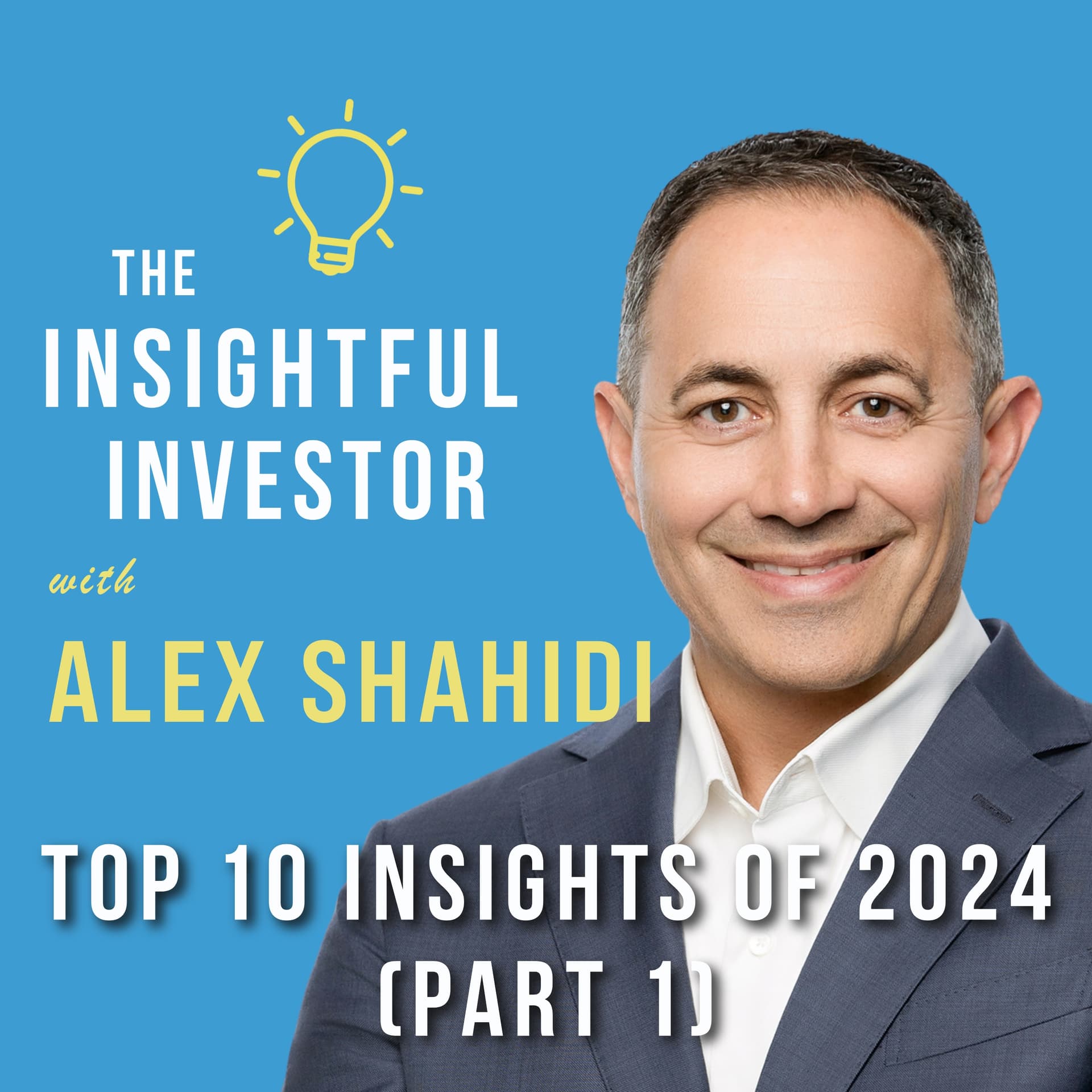
Episode Overview In this episode, Alex Shahidi, the host of the Insightful Investor podcast, presents a countdown of the top 10 insights from 2024, highlighting insights ranked from 10 to 6. This episode marks part one of a two-part series, with the top 5 insights to be revealed in the next episode.
Key Themes and Concepts The podcast emphasizes the importance of uncovering insights that are often counterintuitive, misunderstood, or underappreciated in the investment landscape. Alex expresses gratitude to listeners and guests for contributing to the podcast’s success over the year.
Insights Breakdown
- The Power of Compounding
- Key Concept: Emphasizes the significance of compound returns in long-term investing.
- Speaker: Roy Leckie (Walter Scott) discusses the necessity of time in achieving the benefits of compounding.
- Discussion Points:
- The average investment holding period has decreased, leading to a focus on short-term results.
- The skill of identifying long-term compound growth opportunities is increasingly rare.
- Inefficiencies in Private Markets
- Key Concept: Identifies opportunities in less efficient private markets compared to public markets.
- Discussion Points:
- Operational Alpha: Value can be added through better management.
- Secondary Transactions: Acquiring assets at discounted prices can yield superior returns.
- Featured Guests: Jim Lipman (JRK) discusses mismanaged properties, while Mike Odrich (A&M Capital Partners) emphasizes operational improvements.
- Historical Analog to Today
- Key Concept: Draws parallels between today's economic conditions and the late 1960s.
- Speaker: Matt Smith (Ruffer) discusses inflationary pressures and government responses.
- Discussion Points:
- Past fiscal policies have created a cycle of high inflation and weak responses.
- The current political and economic landscape may be leading to a structurally inflationary future.
- Zooming Out
- Key Concept: The importance of taking a broader perspective in investment decisions.
- Speaker: Paul Podolsky (Still Press Media) emphasizes thinking in frameworks rather than silos.
- Discussion Points:
- It’s essential to define goals and understand the nature of investments beyond conventional advice.
- Martin Escobar (General Atlantic) shares his practice of creating unstructured time for deeper thinking, leading to greater insights.
- Climate Change
- Key Concept: Recognizes the financial implications of climate change on investments.
- Speaker: Jeremy Grantham (GMO) articulates the urgent need for action against climate change.
- Discussion Points:
- The evidence of climate change impacts is becoming undeniable, affecting various sectors.
- Urges the need for corporate responsibility and government action to mitigate risks associated with climate change.
Listener Engagement Alex Shahidi encourages listeners to provide feedback and share suggestions for future guests, acknowledging the growing popularity of the podcast with an average of 10,000 downloads per month across 120 countries.
Conclusion The episode concludes with an invitation to join the next installment for the remaining top insights and encourages ongoing engagement with the podcast community.
---
Podcast Details
- Host: Alex Shahidi
- Website: [insightfulinvestor.org](https://insightfulinvestor.org/)
- Next Episode: Top 5 Insights from 2024
```
Written by AI. May contain mistakes. Listen to the episode to check what was said.
Transcript
Automatic transcript. May contain errors.0:05Welcome to the Insightful Investor Podcast, a weekly series that seeks to share industry investment and market insights. We define insights as concepts that are counterintuitive, widely misunderstood, or underappreciated. In other words, unique ideas that you probably won't hear elsewhere. I'm Alex Shahidi, the host of the podcast and co-CIO of Evoke Advisors, a leading investment advisory firm. Learn more about our show at insightfulinvestor.org.
0:38As we conclude 2024, I'm so excited to highlight the top 10 insights from this year's episodes, ranked from 10 to 1. I'll present these insights in two parts. This episode will count down insights 10 through 6, while the final episode that'll come out next week, the final episode of 2024, will reveal the top five insights. These will be our final episodes for the year as we take a break for the holidays during the last two weeks of December. This pause not only gives us time to recharge and hopefully gives you time to recharge, but also provides you, our listeners, with an opportunity to catch up on some of the highlighted episodes that you might have missed.
1:18Each insight has been chosen based on its value, as noted both by myself and many listeners who have been kind enough to share feedback throughout the year. So whether you're revisiting these episodes or discovering them for the first time. I hope you'll find them as insightful as we have. Before we begin, I really want to express my gratitude to all the listeners and the guests. We launched this podcast on January 2nd of this year, and it has far exceeded all of our expectations. Initially, I was uncertain about starting a weekly podcast, questioning whether I could secure enough high-quality guests with valuable insights.
1:57And before going live, I actually compiled a list of potential guests I thought would be suitable and willing to join a brand new podcast. I set a target of at least 50 to cover the first year. What's interesting is after releasing about 50 episodes, only a quarter of the guests were from my initial list. About a quarter are individuals I know but hadn't originally considered. And the remaining 50%, Half of all the guests are people I had never met who were introduced to me through this podcast. That has certainly been the most rewarding aspect of this experience, the opportunity to meet so many insightful individuals.
2:38Our approach to each episode is comprehensive. I thoroughly research each guest, reviewing their previous interviews or writings. I spend a lot of time crafting a set of questions, which I send to each guest in advance. That gives them enough time to think through their responses. And through this process, combined with conducting the interviews, that process has been incredibly educational for me, and I hope for you, our listeners, as well. The numbers so far suggest this has indeed been the case. We currently average about 10 ,000 downloads or views per month across approximately 120 countries, and the momentum seems to be growing.
3:18Our most downloaded episodes to date have been Jeremy Grantham, Rajiv Jain, George Milling Stanley, he talked about gold. David Dredge, that was a popular one. Karen Carnial Tambor, Matt Smith, Rob Arnott, Mike Green, and Martin Escobari so far have had the most downloads. Most of our podcasts include video content, in case you're not aware, and it's available on Spotify and YouTube, and also on the insightfulinvestor.org website. As always, we welcome your continued feedback and any suggestions you have for future guests who you think may offer valuable insights as we look forward to continuing to share insights in the years to come.
4:02Okay, now let's dive into the top 10 insights of 2024. And I'm going to start with the 10th best insight for the year. Number 10, the power of compounding. The focus of long-term investing is to take advantage of one of the most powerful forces in finance, compound returns. The first clip, which I'm going to share with you, is from Roy Leckie, who is co-chair of the Investment Management Committee at Walter Scott, which is a Scotland-based firm that is a long-term investor in stocks. Compound growth is the best force or tool or ally, whatever you want to call it, that any investor has going for him or her.
4:43But what's the key ingredient to getting that to work. Time, right? Compound multiplied by time equals happiness. Wealth. That's right. World Scott is a long-term buy and hold, high conviction, compound growth stock picker. Benchmark unaware. We just look longer ahead than most people. If you look at the average holding period that most investors own stocks for, it was short when I started my career, and it's got a huge amount shorter. So are we better at valuing a business for the next month, the next six months, the next year? Don't know. Do we have a skill set in identifying companies that have the ability to compound for many years into the future and figure out what a reasonable prices.
5:35I think we do. So it's not so much a comparative advantage on valuation, rather the skill set of thinking about investing as a long-term undertaking, which is increasingly rare, much to my surprise. I mean, one of the many things I've got wrong in my career, when I got to grips with what it is that we're trying to do, I said, well, surely, surely the rest of the market is going to start thinking more long-term. And the exact opposite has happened. And you see that. You see it not just in investor behavior. You see it in corporate behavior as well. I mean, I find it quite bizarre. Many companies seem to manage their business on a quarter-by-quarter basis.
6:16They talk about earnings over the next quarter as if this is the defining criteria on success, which, of course, is not. So it's our ability to frame the investment challenge as a multi-year undertaking rather than a quarter by quarter or even shorter in some instances. In this next snippet, David Dredge, who is the founder and CIO of Convex Strategies, which is based in Singapore, explains compounding in slightly more technical terms and then later talks about just staying in the game by hedging against really bad things happening that could wipe you out. In other words, stay in as long as you can so you can compound.
6:56Again, this goes back to this sort of single slice of time versus a path through time. So if we lived in a single slice of time, we could look at arithmetic returns. And you could say, well, this year I made 50 % and then next year I lost 40%. And you add those together, take the average and you say, well, I'm up 5%. But in a compounding path, that's not true. If I made 50 % this year, if I invested$100, I made 50%, I have 150, and next year I lose 40%, I go to 90. And every step through that process on a plus 50 minus 40, which has an expected return of five, I'm down from 100 to 90 in two turns, assuming it's a 50-50 game that's fair, 90 to 81 in four turns, 81 to 72 in six turns.
7:51And basically the median of that investment path is to zero. And so the simple example Nassim uses all the time when he talks, he's like, if there was a hundred of us in a room and we gave everybody a hundred bucks and say, go to the casino and play one hand of the same game that we know the odds of, and then come back and we'll add up the average and we'll get out of the hundred people with one slice of time, the average. But I gave one person all the money and told him to go play the game a hundred times. He'll go bankrupt every time because the compounding path, the non-ergotic path, I think I said it last time, but everybody should go and Google the word ergodicity and understand the difference between what's ergodic and what's non-ergotic, simply put or mathematically put.
8:42Ergotic means that the ensemble average and the time average is the same. Non-ergotic means that the ensemble average and the time average are different. So my plus 50 minus 40 coin toss through time is non-ergotic because the ensemble average, 5%, and the time average minus one over n every time is different. and so investment paths are non-ergotic and they should be managed accordingly and this is where the geometric compounding comes in and this is how you grow wealth because geometric means that you're going to multiply the returns arithmetic means you're going to treat the returns as additive and once things start to multiply you have the opportunity the potential of exponential growth and this is where true wealth gets built and true wealth comes from and yet as we mentioned earlier The incentive structure, because it's looking at this single slice of time, tends to operate under an objective, a metric of arithmetic returns and ignores the important factor, the single important factor, which is the geometric compounding through time.
9:53Number nine, the inefficiency in private markets. One of the key lessons from these podcasts with all these brilliant investors is that gaining an edge in investing can be very challenging. And this is particularly true in public markets like traditional stocks and bonds. These markets are relatively efficient due to readily available information and a lot of well-informed buyers and sellers. Private markets, however, may offer more opportunities to outperform because they tend to be less efficient, more fragmented, more complex, and more difficult to access. Two segments within private markets where I've noticed material inefficiency include, number one, areas where an expert can add significant value by operating the asset much better than the competition.
10:42And the second is investing in private markets by acquiring assets at a material discount through secondary transactions. These areas of inefficiency can potentially provide investors with unique opportunities to generate superior returns. When discussing the notion of adding operational alpha or adding value through better operations, two firms stood out. The first is an LA-based real estate firm called JRK. The founder, Jim Lipman, talks about why he has focused his career on investing in multifamily real estate because of how inefficiently many properties are managed. And then the CEO, Bobby Lee, details insights into specific ways to add operational value.
11:27Listen to them speak right here. It was actually how I fell in love with this business. So when I moved out to California, the first assets that I took over were two assets. I won't say the names, but in Atlanta, Georgia, and they were struggling assets. And I looked at this and this was, we had taken them over and our own company had done nothing different than the prior company. And I looked at these assets and was able to see the significant mismanagement and opportunities to reposition these assets during, as you probably recall, in the early 90s, a very weak market. And so by implementing those and seeing the amazing difference in generation that they did to the NOI of those properties and the revenues and expenses, I said, wow, this is the right business.
12:15I'd like to touch on one thing going back to an earlier part where you said investing in multifamily, Alex, I view it as part, it's the real estate and part is the business. And I think where most folks gravitate to is they spend 95 % of the time is analyzing the real estate, doing forecasting trends on population growth in markets and sub-markets and where they think demographics are going to shift. Look, it's not that we don't place bearing on that. We very much believe that you got to invest in the right markets. But we've also realized over three and a half decades, 30 % of the time you're going to get those demographic predictions wrong.
12:47So where we spend is we may spend 20 % of the time on the real estate and obviously doing the best we can to forecast the future. We're spending 80 % of our time analyzing the businesses of each of the deals. So it's a numbers game. We're looking at 3 ,200 to 3 ,500 investments a year. We're going to focus on the 15 to 20 very best investments where we like the real estate, we like the locations, we like the physical assets, but that we're going to stack the deck in our hand where the businesses are so under managed or that they're so physically under capitalized that we know that we can deliver alpha over the first three to four years instantly to take a lot of the risk out of the deal and to generate outsized returns.
13:24That's where we spend our energy. I think it comes down to something Jim said in an earlier question, which is this business is difficult. Operating multifamily period is difficult. Operating it as efficiently as you can and optimizing the cash flows year in and year out and compounding success and success becomes even more difficult. So, you know, it takes looking at every single part of our supply and vendor chain, whether we can bring things in-house versus outsource them, what is the efficiency of the maintenance team and the efficacy of the maintenance team and the leasing team, et cetera.
13:57Also on the revenue side, just as much active management, which is looking at where can you optimize the rents and the occupancy on a weekly basis, looking at different demand streams, et cetera, and other sources of revenue. And then looking at things that are maybe taken for granted, to things like fixed expenses, utilities, for example, property taxes, insurance, that we spend a lot of time. They're actually called fixed expenses in our industry because folks don't look at them. It's just a given. We spend a lot of time to make sure that those are made as efficient as possible, as well as things below the line, whether it's interior capital or other operational capital that folks tend to just underwrite at$250 a unit on a blanket and never analyze what it's actually costing them and what kind of return on investment.
14:40So for us, we've set up all of our analytics so that we can look at things on a daily, weekly, and monthly basis. Like I said, our business, I look at the series of low risk decisions that we are making, but you have to constantly make sure that you correct each week and each month if you miss. And if you do that disciplined over time, you find a lot of efficiency in this business. The second one is Mike Odrich. He is the founder of A &M Capital Partners. In this clip, Mike emphasizes adding value to private companies through operational improvements rather than relying solely on financial engineering like many private equity firms do.
15:16His approach focuses on enhancing efficiency and productivity in portfolio companies, which is particularly crucial when economic tailwinds like strong growth and low interest rates are absent. Once I got to understand what A &M was, I had no idea that they had built out this breadth of operational talent across not only the C-level, but the functional expertise. I realized that if we built a private equity platform that could have real-time access to those ops executives, bring them into our investment process to help front to back on the investing side from sourcing proprietary opportunities to diligence and screening of those opportunities.
16:02And then really important, which we never had at Lehman, was the ability to transform these companies operationally, to focus on post-acquisition performance improvement, leveraging interim management capabilities from A &M executives to bring them into the companies, to help professionalize, scale, grow, making sure that all the systems are right. That's something we have a checklist every time we do a deal. We're doing a full analytic on that business and what needs to be improved, what needs to change, and mapping out the roadmap to get to making those changes to get to the end game. It's like building a house, building a foundation in a house.
16:46The second private market segment that may offer interesting opportunities is secondaries, where investors can potentially acquire stakes in private funds at significant discounts, relative to their actual value. Two guests provided valuable insights into this area. Mike Bigot is the founder of Klein Hill Partners. In this clip, he addressed skepticism about the secondaries market seeming too good to be true. And he also explained the dynamics of the secondaries market and its potential benefits. So look, I think there's three points I'd have to make on this. One is to look at the returns that secondary funds actually get.
17:26Second is to look at the performance on the assets that are being sold, you may have already made a lot of money. And the third is on the opportunity cost that you have for the capital. So if you look at returns in the secondary industry, they've been very strong over a long period of time. So if you look at Cambridge Associates data going back to 1993, almost every vintage of secondary funds has delivered double digit net returns, except for a handful, most of which are high single digits. So it does perform very well. But most of those returns are 10 to 15 % IRR to secondary fund investors. And a lot of those returns, especially at the big funds, have a large component of leverage to get that return.
18:10So as a seller, you can think of maybe you're giving up 8 to 12 % in terms of the return that you're walking away from by executing a trade. That's really not that huge of a discount that you're giving up and the liquid asset where the buyer may have to wait three to 10 years for all the cash to come out. The second thing is if you look at the portfolio that you're selling, you very likely have already made a large amount of capital from your investments. So you may have 50%, 100%. So when you're actually going to sell and you apply the discount to how well you've done so far, it may not be so much to walk away from.
18:48And the third is if you look at opportunity cost, when you're allocating into private equity and you're rotating from one portfolio to another, if you're selling and you're losing 8 % to 12%, I can bet you that most allocators are targeting returns much higher than that. For some of the amazing managers that they're going into, they're probably targeting 15%, 20 % or more. And so you can actually see that as being a pretty good trade as a seller. In terms of barriers to entry, I see there's two different angles to look at that question. One is for firms to enter the industry and for firms to compete.
19:23And the second is for the overall secondary industry to innovate and to change to be more efficient in the future. And so in terms of firms entering the industry, first of all, raising capital is not always a straight line. It can take a great deal of time. You have to build up a platform, a team. It's not easy to get the capital. The second is it's very hard to build up the platform. And so if you think of what it takes to invest while in secondaries, you need a massive investment team that's highly experienced. There's a great amount of valuation work, understanding different industries, different managers, different companies, and knowing how to get information that's not public and very hard to find.
20:10So building the teams is very difficult. I'd also say that from like a deal sourcing perspective, you see newcomers sort of show up on the stage and expect to just start doing lots of deals. They're not seeing the deal flow. So just even finding these liquid secondary deals is very hard. then picking the right ones to work on is difficult. And groups that don't have a track record of getting lots of deals done often find themselves stuck and have a lack of conviction on which deals to even do or pay up for. And so what you've seen, Alex, is that there's some massive, very well-regarded firms in the industry that have wanted to launch into secondaries, and they've tried to do it themselves with confidence on their own investing capabilities and their platform.
20:58And typically they have very often tended to either completely fail or take many years longer than they thought. And along the way of firms trying to enter the industry, they maybe have not been the best fiduciary of the capital that they're managing trying to get there. So it's not so easy just to like launch and dive into secondaries and launch a new strategy or a new firm. It's actually quite difficult. And the second thing is if you think about the whole industry and how the industry, which may change over years or what it will take for that to happen. I think it's actually very difficult.
21:33And you've seen firms like NASDAQ that has come in and tried to make an exchange to have very efficient trading of interest on the secondary industry. It's been more challenging than I think they thought it would be in the beginning. And so why is that? I think there's four main reasons. One, first of all, when you're going through to execute these secondary transactions, you really need to know what the right price is. Unlike the public stock market, there aren't these clearing prices. The valuations that need to be made to determine the price are based on highly confidential information that people don't want all over the internet.
22:11It's not easy to access. And actually, we spend a very large amount of resources to dig very deep beyond what's easily available from the managers. So the information is very difficult. Second is the overall volume is just very low. So if you look at a lot of managers or companies, there might only be a transaction for them a couple of times a year. There isn't the volume to support the industry to instantly be hyper efficient. And so it has to be something that will take quite a while to build up. And then third is when you think of trades that happen in the secondary industry, it's not like with public stocks where you realize you want to buy IBM stock and you can research IBM, decide what price you'll pay to buy it or sell it.
22:56In the secondary industry, first of all, as we mentioned before, you're not typically buying for LP trades one company at a time, nor are you buying one fund at a time that may have five companies. but a seller is coming with a package of funds that they want to sell. They're going to have picked out, say, 20 different funds. And so in one go for one transaction, you're going to have to understand 20 managers and all of those companies in that whole portfolio. And so that's a huge barrier, not just for a firm to enter, like we were just talking about, but also just for the industry to provide simple liquidity when you have very complicated buckets of assets.
23:37And then the fourth thing, which today is complicated, is maybe more easily fixable, is that the transfer process is complicated because each of these funds that you're looking to transfer is operating under different contracts and different agreements. And so you actually have to hire lawyers and spend thousands of dollars for each fund that you want to transfer. And typically, those transfers are limited to the end of each quarter. Next, Tony Cusano, who is the co-founder of Banner Ridge, discussed reasons why sellers might be willing to sell at substantial discounts. And he also highlighted information asymmetries that secondary buyers can potentially leverage.
24:18Listen to him here. There's different reasons. Sometimes it's because you're selling a billion and a half dollars of assets. and all you care about is that the pooled assets you're selling gets you some price. Let's say that price is 95 cents in the dollar. Well, you're not going through every line item and trying to figure out, is the venture fund that I'm selling getting me the same price as the buyout fund that I'm selling or the Sequoia Venture Fund that's one of the hottest funds on the secondary market today? I think you're just saying you either got 95 for the whole thing or you didn't.
24:52And so within that, there can be multiple buyers pulled together And almost certainly, some of those buyers are buying for a massive discount to that 95 price. But the question is, are they really buying real value for that discount? And we can talk about discounts in general at some point. But basically, buying a discount in and of itself does not mean you're getting a good deal. Because there are lots of situations where GPs overmark their portfolios. So they're telling you it's worth a dollar. But if you went out and tried to sell that today, it might be worth 70 cents. That's really the secondary buyer's job to determine what the real value is and then make sure they can buy it at a discount.
25:33Now, there are other reasons that people sell at bigger discounts. There's liquidity needs, which happen from time to time. There's a denominator effect issue, which has been plaguing US public pensions for a while, where they're significantly ahead of their private allocation. They might have an allocation to privates of 20%, all privates, buyout, venture, infrastructure, everything. And they're at 35%. Well, that puts them in a position where they, over time, need to either sell or stop making new commitments or hope that the other 70 % of their portfolio that's liquid rips higher and then reduces the impact of the privates and moves it closer to 20 % again.
26:18So in those situations, I wouldn't say they're for sellers because they're really not, but they're motivated. And so as long as you can justify the price that you're buying as being in the ballpark with fair, they'll take it. So there's a lot of reasons, but those are some of them. The best opportunities that I've seen and I've taken advantage of in my career were situations where my team and I had better information about the assets we were buying than the seller did. And this is a unique situation where there are a lot of investors and privates that are very unsophisticated. Because if you think about where so much of the institutional money is coming from, these aren't typically the same types of investors that you would find at hedge funds or at direct private equity funds.
27:02So there's an information asymmetry which exists and creates opportunity. The more skewed the information asymmetry, the better the deal on average. So Banner Ridge cast a pretty wide net, look at everything at a high level, and then try to determine where the information differential is the largest focus there. But I think a lot of people talk about forced sellers because it sounds sexy and it's exciting. It's a story point. But in my career, I could probably count the number of forced seller situations we've been a part of where we bought something on one hand. And actually only one of those deals would make it into the top 10 of the best deals that I think we've done.
27:41So there are lots of exciting kind of inefficiencies that all boil down to the information of symmetry in private markets, specifically in secondaries. And we're trying to really take advantage of as many of those as we can in each one of our funds. Insight number eight, the historical analog to today. Matt Smith, who is a senior fund manager at Ruffer, a UK-based absolute return manager, is a student of financial markets history. In this segment that was recorded back in May, he shared his perspective about the closest historical analog to today's environment. That's a very easy one for me. And that's the late 1960s, which probably tells you a lot about where I think we're headed.
Read the full transcript
28:29You had a period coming out of the Second World War. When the Second World War was a time of locked down travel restrictions and destruction of supply chains. In the post-war period, you had transitory high inflation and it was corrected to say, don't mess around too much with policy settings. Inflation has gone up, but it'll come back down again as supply chains heal. And it did that, went from kind of 10 to zero and back again a few times. And through the 50s and 60s, you had very high real economic growth, high levels of fiscal stimulus, and a view that you could control the business cycle with correct application of fiscal and monetary policy.
29:13But slowly, the system was becoming more inflationary. You know, The spare capacity was reducing or slack was reducing. Economic growth was picking up and unemployment was falling. And I'm going to quote here, liberally, from a speech by Arthur Burns in 1978, i.e. post the experience of the 70s. And he was a chairman of the Federal Reserve at the time. Yes, exactly right. So, you know, he's got an incentive to blame other factors than himself. But I think the clearest thing you can learn by studying central bankers through time is that none of them, and I mean none of them, are independent. They're all products of their time.
29:59So to attribute any kind of power, really, to any of them individually is, I think, a waste of time. They do what the popular and political atmosphere around them permits them to do. And that was exactly Burns' point. He said people over time came to see the government as the solution to all of their problems. And he specifically says, what an inversion that is of the American mentality through all of the 19th and early 20th centuries, where it was very much, you know, you're on your own and pull yourself up. You had excessive fiscal and monetary stimulus, thanks to the Vietnam War and the Great Society program.
30:42You had crop failures in 1973 and the OPEC price shock in 1974. So we were familiar with all of that, zero rates, a lot of QE, some fiscal through the IRA, the CHIPS Act, the CARES Act. And then with Russia, Ukraine, you had rising food and energy prices. And he says two things were critical. The goal of the Federal Reserve and the federal government was to promote maximum employment, not price targeting. and I think implicitly that's where we are today and secondly budget deficits as a result were incurred I quote when business conditions were poor and also when business was booming I think the fact that in a presidential election year when the budget deficit is at five six seven percent No one is talking about that.
31:41That is almost the single most important piece of evidence pointing towards an inflationary future. Neither candidate is saying, I'm the fiscal rectitude candidate. That's exactly what was going on in the 70s. the solution to rising inflation was more spending. And we have that again today. When energy prices went up in 2022, the response of the UK government and the European government was to spend money to prevent prices rising. And if you understand anything about how the price mechanism works, that's a bad idea. And the same was true in California. I think you guys had gasoline subsidies to prevent the price rising too much.
32:29I'm actually not saying that that was a bad idea. And I think they would say, look, we've been vindicated. It helped smooth a temporary price spike. My point is that that tells you so much about where we are today psychologically. That's really what matters, is what is the attitude of government and the voting public towards inflation? It's a very simple question you have to answer. Do people hate the pain of dealing with inflation? Or do they hate the pain of inflation itself? Which do they hate more? And I think there was a period in 2022 when people said, well, this inflation thing really is a problem.
33:12Let's deal with it. But as it came down, and you had a banking crisis as a result of the tightening quite quickly everyone went oh i think we don't want the pain of dealing with inflation thanks and it seems to be resolving itself in the background so let's you know take our foot off the break and i think where we are today people hate the pain of dealing with inflation a lot more than they hate the pain of inflation and you will get inflation structurally until that is no longer true. The Gerald Ford campaign included in October 1974 something called WIN, WHIP Inflation Now. And these were badges that were handed out as a sort of signature policy.
34:01And it involved things like carpooling, turning down the heating in your house. I mean, really sort of pathetic macro proof I guess, ways to deal with inflation, anything to avoid actually hiking rates. And that was at a point where inflation had averaged 6 % over the previous five years. Today, it's averaged 4 % over the previous five years. So we're not far off. But that was in 1974. They just didn't do anything about it. And over the next five years, inflation averaged 8%. That was the point at which people decided we've had enough. We're electing a president focused on deregulation and supply side reform in the form of Ronald Reagan and a central banker who is willing and mandated to hike rates until the monetary aggregates start contracting, you know, until inflation is under control.
34:58And they imposed tight money policies through two hard recessions. I always liked the quote that Volcker had coffins left outside the Federal Reserve building made out of two by four planks that were put there by bankrupt home builders. And he had car keys posted through his mailbox from car dealers who'd gone bankrupt. That's what tight monetary policy really looks like. Even if you think we're in 1974 today, It took another five years, very high inflation before people were willing to elect someone who would deal with it. And I think we're miles from that today. If I had to summarize where I think we are today with regards to inflation, which is possibly the most important macroeconomic variable, I would say that we have moved from a ceiling of 2 % on CPI to a floor of 2 % on CPI.
35:57That is a true regime shift. It doesn't sound like very much, but the asset allocation implications are very significant. And I think we've seen one cycle of inflation. We're going to find out quite how far down inflation comes again. How sticky does it prove to be? How much do the Federal Reserve really care about getting it right back down to two? Are they willing to impose the true tight monetary policies that are needed to do that? And I think we will learn a lot once that tightening cycle comes into contact with the enemy. There are three enemies. The first one is interest costs. Your own congressional budget office says that interest costs are nearly 20 % of government revenues today.
36:45And actually in the fiscal year to date, the US government has spent almost exactly the same amount on interest as it has on the armed forces. Basically, the whole defense budget, basically through thousands of years of economic history, when that happens, when interest costs rise a long way up the national budget line items. The government does something about it. It cuts rates, or it starts to enact policies to force down the rate of interest on bonds. We're very familiar with what those are. And then we will, I think, the true inflation-fighting credibility of the Fed will be revealed at that point.
37:25And that actually, incidentally, tells you what our structural allocation in the portfolio today is, which is inflation-linked bonds and precious metals. Inflation-linked bonds currently price a 30-year inflation rate of 2%. That is completely unchanged from the pre-COVID era. And that is essentially a vote of confidence in central banks, saying that they are independent, they'll do what it takes to get inflation back down to two, and they'll hold it there. For all the reasons I described above, I think this is the late 1960s, and I really want to take the other side of that 2 % view. Number seven, zooming out.
38:09Throughout the year, I've discussed the importance of zooming out to gain a broader perspective. This approach tends to reveal insights that may be missed when focusing too narrowly, looking at things too closely. Paul Podolsky, who is a former senior investor at Bridgewater Associates and founder of Still Press Media and Kate Capital, articulated this concept effectively. He emphasized that one of his key learnings from Bridgewater was to ask the broader question, what is the right framework? This is Paul. I really value my time there, and I'm also glad I moved on. Both things are true. And what I learned there was the power, I would describe it, of thinking in frameworks, and that continues the work I do now.
38:57A lot of what we're taught in school, I would describe it as thinking very much in terms of silos. How does chemistry work? How does math work? What are the key facts of the French Revolution? It's not really stepping back and thinking in frameworks. And by thinking of frameworks, what I mean is a lot of people, if they first get involved with investing, they're like, what stocks should I buy? Stepping back and thinking of a framework is first of all saying, well, wait a minute, what's the goal and what's money? It's a much more step back and ask how it works. If you begin to ask that, you can apply it to so many different areas in your life.
39:34Say you're considering buying a home. You're like, what's the nature of real estate? What are the attributes of real estate? What's the history of it? How does it move? If you have a health problem, it's the same thing. You can apply it in a framework as opposed to narrowly how to step back and ask how it works. So Bridgewater did that, and that was like a real eye-opener for me because once you applied that framework, you arrived at all sorts of different conclusions than what you'd been told about how to invest. And a classic example of this that I know that is close to your heart too is the typical advice to retire, somebody saving will say, invest in a 60-40 portfolio.
40:11And people just accept it like, okay, that's what the experts told me to do. But if you actually think about what that is, it's terrible advice. It would be like, it's the equivalent of like, get up and have a couple of beers for breakfast. Well, people do that, but that's really not an effective way to achieve the goal. So we can get into the reasons why that is. So that thinking in frameworks is really powerful. We should also listen to Martin Escobar, who is the co-president, head of global growth equity and chairman of the investment committee at General Atlantic or GA, which is a leading growth equity firm and one of the pioneers of growth equity.
40:45In this segment, Martin shares an idea that has worked for him to practically create headspace to Zoom out. And of course, I went through a phase in my life that was a pursuit, which I think I got better at. But then something happens as you get more senior and older. The organization requires deep thought and ideas outside of the ordinary. And that's how you make the organization better and leave the company in a better spot than when you received it when you joined the company. The ability to deep thought requires time for those thoughts to emerge. And if you're busy doing your hyperproductive stuff, you never have time to think the big things.
41:32So something I did recently, that's less than two years, I try to clear at least five hours of my week, which are just mine. They're not a buffer for meetings we couldn't schedule anywhere else. They're not a place where I leave some things to read. They're completely unstructured. And sometimes I go for a walk. Sometimes I go for an ice cream. Sometimes I go for a workout. Sometimes I just sit and read some book unrelated to anything. The frequency of big insights that I've had, and I don't know if they're right. We'll know in five years. Got up dramatically because I created a five-hour buffer within my 60 to 70-hour weeks, which is not a lot.
42:08It's less than 10%. But that which might seem anti-productive has actually been super productive in my ability to think thoughts that are not in the normal course of business. And finally, number six, climate change. Speaking of zooming out, very few have the ability to zoom out like Jeremy Grantham, who is the co-founder of GMO, as demonstrated by his comprehensive analysis of climate change in this clip from our most downloaded episode of 2024. I started trying to filter warnings on climate change into the investment community 15 years ago, and I must say I got world-class eye-rolling in return.
42:49And those days have changed enormously. Like everybody except a few ideologues can't bring themselves to see the facts in front of their noses. But everyone can see the weather, the climate changing rapidly and dangerously. It's increasing the risk enormously for farmers. It's increasing the risk enormously for people who live in low-lying coastal areas. increasing the risk for people who live in forests, where even forests that almost never used to burn are now burning great quantities. And the damage is racking up our recent posting for this week. It has a pretty well-known exhibit that shows all the billion-dollar first derivative problem, damage from forest fires, damage from floods, damage from droughts.
43:41And the number has risen very rapidly. And there's a lot more damage that is not in that list, damage to agricultural crops, particularly in the third world where droughts are pulverizing their GDPs because of crop deficiencies and health. Climate change is not that healthy in many ways, but you rack up all of those costs and it seems that at least a half a percent, and the experts seem to think closer to 1 % of global GDP. And 15 years ago, it was completely a rounding error. Seven years ago, it was hardly ever talked about. But last year was the first year where people say, ouch, global growth is two and a half points.
44:28It might have been just over three, say, or a few bibs higher than that, had it not been per climate then. We started with 280 parts per million carbon dioxide, and we've kicked it up to 423. And before we finish, if we behave quite well, it will rise to 550. Let me point out the difference between an ice age with two miles of ice on Manhattan is 120 parts per million, from 160 to 280. And we have just put on slightly more than that. So we have incremented this heat trap in gas by more than the difference between an ice stage and a wonderful interglacial of the kind that we've had for the last 2 ,000 years.
45:19This is a very rash experiment. And we're going to put on another 120 bits before we finish. Now, if you back up to 1964, the year I arrived, we were adding just less than one part per million, 0.8. And now we're adding more than two. So we have escalated the amount of damage we're doing every year. And if you escalate the damage, you should count on, if you escalate the cause of the damage, parts per million CO2, you should count on the damage escalating. And it is. The air temperature has gone up a lot faster since 1970 than it did before. It has arguably gone up a lot faster since 2000 than it did before that.
46:07And this last year was the hottest ever, and it was the hottest ever by the widest margin for the month of February. February is the hottest February by the biggest margin in the history of February. And the year ending February through February was substantially more than 1.5. So we had centigrade with 2.7 Fahrenheit. So we've gone through that infamous, theoretically dangerous barrier for the first time on a one-year basis. So it's a very bleak outlook. We have to do better. We are doing better. The question is, can we continue to improve? In the end, we have to have a penalty, a clear penalty on people who push out the CO2.
46:58And if that's an extra cost, we have to pay for it. and if we don't, the damage will escalate and the GDP growth will pay a higher and higher penalty until we look back and we will realize what the experts have been saying for 20 years, and that is the return on preventing the CO2 from getting in the air is very high indeed. Trying to recapture it or trying to correct for the damage is many times more expensive. Just think of the ocean level rising and starting to flood the low-lying cities like Cambridge, Boston, Miami, and so on. The cost of doing that rapidly becomes astronomical. So that's really the story.
47:45Happily, the world begins to get it. Most of the governments begin to get it. The style of politics these days is to attack China for everything, but China has tried much harder than pretty much any other country to green its economy. It installed as much solar as 1.3 times all the solar the US has ever installed in second place. So more last year than any country in the world, including the US ever, and about two-thirds of the wind. So they did in a single year last year, two thirds of the US wind. We've been doing wind for 30 years. And these are incredible numbers. The same goes for, they create, of course, over 80 % of all the solar panels, over 85 % of the silicon that goes into it.
48:39They're building more than half of all the nuclear plants that are being built today. They've done really well in hydro. and they're way years ahead of their schedule for solar and wind. And yet we managed to attack them. 35 % last month of all their vehicles were electric vehicles, fully fledged electric vehicles. And we're at eight and slowing down because, because. And we can't sell any electric vehicles in half the states in America, it seems. So we're way at the bottom of the list in our response. to dealing with climate. That's the really tough side of the equation. So corporations have to pull their weight.
49:25The government switches every four years. It's simply not reliable. If we mean to pull our weight, we have to lean on corporations being sensible and setting a good example. Whether that is going to happen, I don't know. Some companies look to be trying pretty seriously and others do not. I'm going to close this week's episode with one bonus quote from Jeremy who was full of great quotes when he explained the five most dangerous words in finance in this excerpt. Hanging over it all is that slight chance that the game has changed, which is what the Bulls always say. And up until now, they've always been wrong, but they can be right.
50:09And I had a debate with Jim Grant where I took the argument, this time is different. about five or six years ago. And you know the old cliche about what's-its-face, the old fund manager who said, John Templeton, the poor most dangerous words in the English language are this time is different. And indeed, they were pretty damn dangerous for 100 years. But I wrote in a quarterly letter that I thought the five most dangerous words are actually, this time is never different because occasionally it is. Japan going to 65 times earning, pretty different from anything that preceded it. The oil in the OPEC going up four or five times in a hurry, pretty different.
50:53And it changed the world in many ways. And it stayed changed in many ways forever. We never went back to a pre-1972 world in energy. So it does happen. So that is every value manager should have that pinned on their doorway, along with a few other things. You have to be aware it's possible that things are different, even though history says they very seldom really change. The reason they very seldom really change, they're all based, as you were saying, on human nature. And human nature is the one more or less inflexible point in life. We're capable of being crazy dudes just like we were a thousand years ago or the South Sea bubble in 1721.
51:35And we're still the same crazy dudes when we want to be. Well, we just counted down insights 10 through 6. I hope you'll join me next week for our final episode of 2024, where we will reveal the top five insights. Thanks for listening. We hope you enjoyed this episode. Please visit our website at insightfulinvestor.org to access past shows and learn more about our podcast. If you have questions, feel free to email us at info at insightfulinvestor.org. And if you enjoyed the discussion, please subscribe to this podcast to ensure you don't miss future episodes. And don't forget to forward today's conversation to others you think would enjoy listening.
52:18This podcast is provided for informational purposes only and should not be relied upon as legal, business, investment, or tax advice. All opinions expressed by podcast participants are solely their own opinions and do not necessarily reflect the opinions of Evoke Advisors, their affiliates, or companies featured. Due to industry regulations, participants on this podcast are instructed not to make specific trade recommendations, nor reference past or potential profits. And listeners are reminded that securities trading, commodity trading, and alternative investments are complex and carry a risk of substantial losses.
52:53As such, they are not suitable for all investors.
53:00Listeners should be aware that guests featured on The Insightful Investor may have current or past associations with Evoke Advisors or the host, including as an investment manager of a private fund opportunity by Evoke or access through an affiliated Evoke fund or as a client. Participation as a guest on the podcast should not be perceived as an endorsement or testimonial with respect to Evoke Advisors, the podcast host, or their services. Similarly, the inclusion of a guest on the podcast does not imply that Evoke Advisors or the host endorses the guest or any company with which they may be affiliated or employed.
53:39Evoke has neither paid nor received compensation from guests for their participation.
From the publisher
As we conclude 2024, I’m excited to highlight the top 10 insights from this year's episodes, ranked from 10 to 1. We’ll present these insights in two parts: this episode will count down insights 10 through 6, while the final episode of 2024 will reveal the top 5 insights.


