
In short
Insightful Investor Podcast Episode Notes
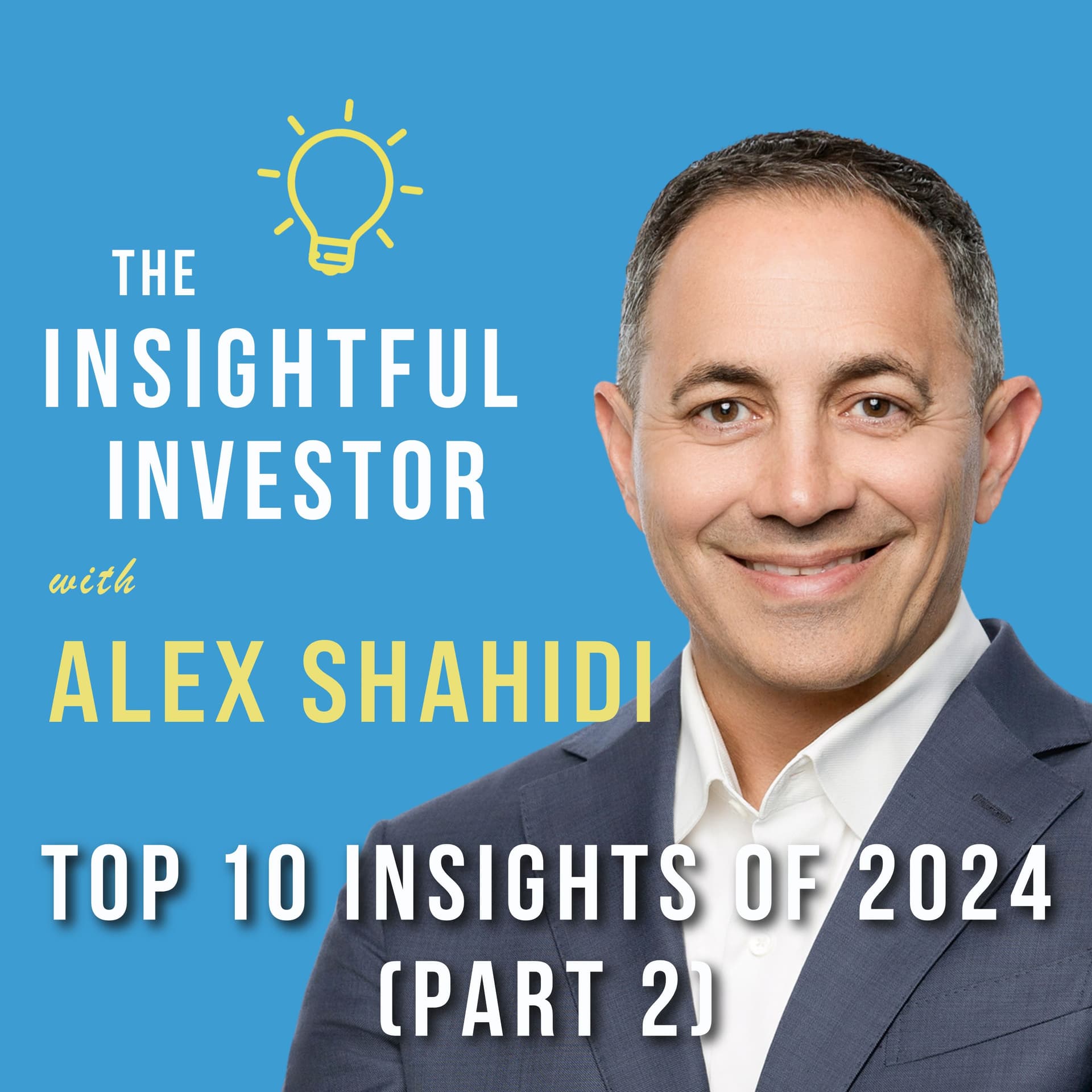
Podcast Overview Title: Insightful Investor Host: Alex Shahidi Description: A weekly podcast featuring conversations with premier investors and business icons, focusing on unique market insights that are often counterintuitive, misunderstood, or underappreciated.
---
Episode Details Episode Number: 51 Episode Title: Top 10 Insights of 2024 (Part 2) Release Date: Wrap up of 2024 Episode Format: Summary of the top 10 insights from the year, ranked from 10 to 1. This episode continues from part one, which covered insights ranked 10 through 6.
---
Key Insights Discussed
5. Building a Great Business
- Martin Escobari's Insights:
- Successful entrepreneurs often have a "chip on their shoulder" driven by personal motivations.
- A compelling narrative of overcoming adversity can be a predictor of future success.
- Balance of Intellectual Quotient (IQ) and Emotional Quotient (EQ) is crucial for effective leadership.
- Glenn August's Insights:
- Emphasis on hiring like-minded individuals and fostering a strong organizational culture.
- Successful firms prioritize respect, teamwork, and hard work over individual superstar performance.
- Growth should align with organizational values and culture rather than being a primary objective.
4. Behavioral Economics
- Hal Hirschfeld's Discussion:
- Connects the psychological barriers to achieving long-term goals with the concept of our future selves.
- Emphasizes empathy and emotional connection to improve decision-making for future benefits.
- Fran Canary's Perspective:
- Argues that "irrational behavior" in investments may be rational when considering market dynamics.
- Highlights the need for due diligence in capital markets.
- Ted Sides' Strategies:
- Suggests frameworks to improve decision-making processes that mitigate behavioral biases, such as forming diverse decision groups and conducting post-mortems.
3. Investment Framework
- Karen Carniel-Tambour's Insights:
- Identifies a common flaw in investing: the tendency to expect the past to repeat itself.
- Advocates for a balance between diversification and strategic investments based on confidence.
2. Adaptability
- Rajiv Jain's Views:
- Stresses the need for investors to adapt as markets evolve and to avoid rigid thinking.
- Reflects on learning from mistakes and the importance of being open to change.
- Martin Escobar's Takeaway:
- Importance of maintaining a youthful mindset to remain adaptable and embrace uncertainty.
1. Understanding Risk
- Vanir Bonsali's Definition:
- Highlights that risk perception varies significantly among investors, making a unified definition challenging.
- David Dredge's Insights:
- Emphasizes that true risk lies in the unknowns and highlights the importance of not just forecasting but also preparing for unexpected outcomes.
- Draws analogies about risk in investment to illustrate vulnerabilities and the consequences of ignoring potential threats.
---
Conclusion
- The episode wraps up the top 10 insights from 2024, reinforcing the importance of understanding risk, adaptability, and the psychological aspects of investing.
- Next Episode: Scheduled for January 7, 2025, with a suggestion to revisit previous episodes from 2024.
---
Additional Notes
- Listeners are encouraged to stay informed by subscribing, and previous episodes can be accessed on the [Insightful Investor website](https://insightfulinvestor.org/).
- The podcast provides insights that should not be considered as legal or investment advice, and listeners are urged to conduct due diligence.
---
This markdown summary encapsulates the key insights and takeaways from the podcast episode while maintaining clarity and structure for easy reference.
Written by AI. May contain mistakes. Listen to the episode to check what was said.
Transcript
Automatic transcript. May contain errors.0:05Welcome to the Insightful Investor Podcast, a weekly series that seeks to share industry, investment, investment, investment, and market insights. We define insights as concepts that are counterintuitive, widely misunderstood, or underappreciated. In other words, unique ideas that you probably won't hear elsewhere. I'm Alex Shahidi, the host of the podcast and co-CIO of Evoke Advisors, a leading investment advisory firm. Learn more about our show at insightfulinvestor.org.
0:38Welcome to part two of the top 10 insights from 2024. In case you missed it, part one was released last week and covered insights ranked 10 through 6. That episode is also linked in the show notes. Today, I share the top five insights from 2024. Let's jump right in. Number five, building a great business. Many of our guests are founders of highly successful businesses, and two in particular provided excellent insights into effective business management. First, Martin Escobari, who is the co-president and head of global growth equity at General Atlantic, which is one of the pioneers of growth equity investing.
1:21Martin shares his insights on the key attributes of a great entrepreneur, drawing from his own experiences as an entrepreneur. This is Martin. There is no one formula fits all, but things I see with higher frequency, they have a chip on their shoulder. they have something to prove to the world, to themselves, to their families, to their partners that gives them an extra tank of oxygen in a journey that is very tiresome. It doesn't necessarily mean they come from a little town in Bolivia. Sometimes the trauma is the 13-year-old girl didn't accept him on a date and the other guy was richer, better, taller.
1:58It doesn't matter. The source of the trauma or the reason of the chip sometimes is idealism, the sense that the world is incredibly unfair and I want to bring financial inclusion or educational healthcare outcomes. Is there something that gives you that extra tank of gas? That is a very important one. The second one is a narrative of a track record of success. And I emphasize the narrative because many times you're meeting people and they're presenting their idea, their past. It's all about the almost wins. it was going to be great, but then the great financial crisis. I almost sold this business, but then the competitor went bankrupt.
2:41I was about to go to this great opportunity, but then my family situation. There's an alternative narrative of how you overcame adversity and delivered a consistent set of successful outcomes to you in your narrative of whatever the definition of success may be. That narrative is empowering. That track record is a good predictor of future success. And a lot of it is the mind frame. We all fail. We all face hardship. Do we dwell on that, or are we just focused on the fact that we've been able to overcome many things and many things have come this way? So this narrative of a successful track record.
3:18And then the balance of IQ and EQ. You need to be proficient at both. And often, if you spike in one, it comes at the cost of the other. And you need to find ways to augment yourself with a partner or therapy or whatever way you can. But I look either in the individual or the group that this individual has assembled around him. There is balance of not just EQ and IQ, strategy and operations, being good with numbers, being good with TV. So this notion of balance, which we were talking to before, I think individually they have it or the group needs to have it. I was an entrepreneur for seven years, helped build a company which did well, almost died, recovered, and then did well.
4:00It's really hard. The journey of the entrepreneur is a masochist journey. All the odds are stacked against you. Everything that could go wrong at some point goes wrong, and you have to fix it. And you've got to keep morale and discipline on a large group of people of divergent skills, experiences, and ages. It's really hard. The reward is fantastic because you look back and you said, this didn't exist. And now it exists thanks to my labor and my team's labor. I've created it with our joint DNA and it's scaled to be transformative to the lives of clients and investors and so forth. It's an exciting journey, one that I love.
4:42What I learned having done it is how hard it is. And I'm constantly reminded when I'm sitting in a board meeting across from someone who comes bloodied from what the things he needed to do or she needed to do over the last quarter to produce the numbers that they produced. And just be grateful. They are the heroes. They're in the front lines. You're the supply line. Occasionally provide some intelligence from seeing tomorrow's newspaper because you have more data than they do. But they're the absolute heroes. And their struggle is hard. And we have to be supportive, appreciative, and grateful.
5:16Next, Glenn August, who is the founder and CEO of Oak Hill Advisors, which is a prominent alternative investment firm, discusses how to scale a business without sacrificing quality while maintaining company culture. Here's Glenn. There's no simple answer in no order. I think it is, we're in a people business. So this is not a manufacturing with machinery business. It's a people business. And so if you want to grow your business, you need like-minded people. And you need to have a culture that culture, strategy, organizational design, incentive, set of incentives that all come together to grow the organization with the same values, institutional values.
6:15And so I am a big believer that it really does start with people that the choice of who you hire and then the culture that you have as an organization. Again, that has to fit the business strategy. And there's not one good or bad culture or approach, but whatever you do, whatever your values are, you have to have everything support that. In our case, it starts with the people. So the logical question is, well, what kind of people did you hire and did you develop to grow the business? I make a couple of comments here. It took me about 20 years to be able to articulate for someone who was interviewing with us, what does it take to be successful at our firm?
7:12But I did come up with it and I practiced it before I came up with a very simple set of principles. But the principles, the things that make someone successful at our firm, and this is our firm, not another firm, is there has to obviously be some minimum level, required level of smarts and competency. But smarts, as I kind of hinted earlier, competency is not enough. So the second principle was I really wanted someone who cares. and is really conscientious about every aspect of what they do. And so I'm a big believer in how much do you care really translates into how well you do. But leaving that aside, the third piece is if you're smart and you care immensely, then the third piece is someone who's willing to work hard.
8:12And again, this may be not fashionable today. and I understand, especially in the post-COVID world where people got a taste of a different type of work-life balance and I'm not saying I'm right by any means but I believe deeply that the harder you work, the better you do and so if you're smart and you work and you care a lot you're likely to work hard and again, there may be different ways to work hard maybe some people can actually work as well or more efficiently and better and have the same output in a different work environment. That's another discussion, perhaps another day. But the fourth piece is I want nice people, good people.
8:55And that's particularly important because we work in our firm and our whole approach for decades is we work in teams. And so that's the fifth piece. You have to want to be on a team. Now, I commented a moment ago and said that there's more than one type of successful organizational structure and values. There are a lot of super, super, super successful firms, I imagine many you've invested with, where they're dominated by just one person. and they reward. It's a superstar culture that rewards superstars and everyone else get the heck out. In many cases, those superstars compete with each other in the same firm, but it works.
9:47That's not our firm. To be successful at our firm, you have to want to be on a team, you enjoy being on a team more than purely individual success. And again, that's not to say that we don't differentiate. That's not to say that there aren't a lot of people here who are more individually successful, but they do it in a team construct. And then again, our culture is having good people, nice people, respectful people of everybody, not I'm too senior, I don't care about the junior people or the receptionist or the person who does the IT or puts coffee in the machine, we have a culture that we want people who respect everybody.
10:36And so to me, the way we've been able to build the organization is by really prioritizing and being incredibly discriminating on the people that we hire. And then you need culture carriers. You need to do as you say. You know, there's often a phrase, you know, do as I say, not as I do. But really do as I do. Lead by example. If you want people to work hard and you hope they're going to work hard, you can't call it in. If you want people to be respectful of others, you can't be disrespectful fully yourself. And so I think we've been able to grow the firm. And then I'd add another point, which is we never let a goal of growth dictate our strategy.
11:36We let our strategy and our culture and our clients determine our growth. And so there are a lot of firms that just say, I need to grow. I've got to raise more assets. I've got to do this. And when they do that, they can risk their culture and they can sacrifice on who fits and who wants to be part of that team. You do have to grow to give people responsibility because everyone wants to grow. And if you don't have the opportunity to grow, then you leave. And so I remember in 1996, we had a presentation of one of my colleagues in Boston and our flight was delayed. So we went for a drink at a hotel before we went out to the airport.
12:23And this guy was exceptionally and is exceptionally smart. He retired probably a decade ago. And he was at the time, probably, let's just see, I might as well get it right. If I was 35, he was probably 29. And he said to me, so Glenn, when am I going to become portfolio manager? And we had probably 18 people at the time. His name was Scott. I said, Scott, you'll become a portfolio manager. If we were to look at the same company independently, that 90 % of the time we came to the same conclusion. And 5 % of the time you convinced me why you were right. And 5 % of the time I convinced you why I was right.
13:07And then I joked and I said, and right now you're only at 60. Now, truth of the matter is he probably was at 80 at the time. But anyway, he became one of the guys I promoted as partner in 1999 and had a great career here. Fast forward to today, if I was asked that exact question, and again, this is part of learning, maturing, growing myself, I would say I want to look at the same situation independently. And 75 % of the time, we agree. 10 % of the time, I convince you. 10 % of the time, you convince me. And 5 % of the time, we agree to disagree. And I think it's somewhere in that range that you then have shared investment culture.
13:52Because again, when I think about culture, there is investment culture. Again, thinking about downside protection, owning the business, not just the security, conducting yourself in a way that you're proud of and respectful of others, whether it be restructuring or new issues. I think that's probably a better mix of how to build out a team where you can grow and scale the business and still maintain the culture. Number four, behavioral economics. While most investing insights emphasize analytical strategies and empirical data, the psychological and emotional aspects of investing are equally crucial.
14:34Several guests this year illuminated this critical dimension of investment decision making. The first, Hal Hirschfeld, who is a professor of marketing, behavioral decision making, and psychology at UCLA's Anderson School of Management, explores this terrain in his book, Your Future Self, How to Make Tomorrow Better Today. In my conversation with Hal, he delved into why people often struggle to take actions aligned with their long-term goals, introducing the compelling concept of our future self. This is a clip from my podcast with Hal, where he shares the psychological barriers that prevent us from making optimal decisions.
15:13I do so many people have a hard time doing the things that they say that they want to do. I say I want to save more, but I often overspend. Or it's not just money. I say I want to eat healthy, but then I snack at night. Or I say I want to exercise more. Or, you know, time. Like I say, I want to spend more time on the things that are important to me. But then I find myself answering my, you know, hundredth urgent but not important email. And suddenly the day's gone. The book really looks at the reasons why we have these gaps and starts from this perspective of trying to understand the relationships that we have with our future selves.
15:51recognizing that sometimes those relationships are fraught, that we don't really connect to the people that we will eventually become. There's a lot of other people in our lives who we make decisions on behalf of. And those people range from folks we're barely connected to to people that we're very connected to, emotionally speaking. And there are times, many times where we say no. And it may not be a conscious no, but we walk by people and help. We don't respond to requests from our money or our time because we have only so much money and time that we can give to others. But there's a lot of other people and organizations and groups where we do say yes.
16:29And those are the ones that we feel a sense of connection to. And so you translate that to our future selves. And the point is that there may be cases in which we don't really feel a sense of connection to our future selves. It's easy to ignore them. We don't see them, but it's not just that we don't see them. We don't feel their feelings or we don't really take the time to feel their feelings. And then it's easy to say, oh, you know, yeah, I'm going to sleep in today rather than work out or I'm going to eat the thing my doctor said I probably should stay away from, but it tastes so good right now.
17:01But when we can try to create those relationships that are high on empathy, that are representative of a strong emotional connection, that's when we'll start doing more things for our future selves, the things that will benefit us later, but not just later also benefit us now. I think this is one of the misconceptions that everything always has to be a trade-off over time. There are plenty of times where I can do something that will benefit me in the long run, and it benefits me now too. It's a hot right now to talk about biases. And of course, we can't talk about this without mentioning that Daniel Kahneman just passed away.
17:34Daniel Kahneman, I'm sure many of your listeners know, but if they don't, he's considered one of the co-founders, if you will, of behavioral economics. He's a psychologist, and a lot of what he and Tversky and others have studied are these quote unquote biases. But biases, I think it leads us to think about these things in not quite the right light. There are a lot of tendencies that we have that serve a purpose, but then when they're over applied, they can become a quote unquote bias. So the one that I've spent so much of my time on is known as temporal discounting. That's a fancy term for basically saying that we often choose the thing now over the thing later.
18:13Now, here's where it's not a bias. If I were to say to you, hey, Alex, you want$100 now? Or do you want to wait six weeks and get$100? I can't imagine why you would tell me you would wait. It's the same amount of money. From a financial perspective, you could invest that money right now and make more. But now if I said, okay, wait, you want$100 now or$150 in six weeks. And if you still choose $100 now, now we're starting to see that your tendency to choose now over later may have been over-applied. A 50 % return in six weeks is pretty good. That's a bias that I've studied quite a bit is the tendency to excessively discount future rewards in favor of the present day ones, the things that I can get right now.
18:58In this segment, Fran Canary, who is a principal and head of Vanguard Investment Advisory Research Center, also explains that actions that may seem irrational aren't always irrational. A lot of people call it irrational behavior. I actually think it's rational behavior. And what I mean by that is we did a whole study looking at consumer reports, trip advisors, top doctors, top universities. And what we see in almost every other field is persistence and durability. And what that means of persistence and durability is if you are the top quartile, doctor, hospital, or bottom quartile, you see very little regime switching.
19:44You don't see bottom quartile, hospitals, doctors, crash tests, moving to the first and vice versa. But in the capital markets, you see all kinds of random cyclicality and no patterns, right? Because I do know a lot of people think that it's better to just be contrarian or buy the worst performing asset class because it's undervalued. That doesn't work either. There's really no pattern that we see. People have been betting against this stock market for the last five years. They've been saying growth is overvalued, US is overvalued, and they've gotten their heads handed to them because they think it's going to mean revert.
20:24And so eventually trees don't grow to the sky. So you may have mean reversion, but there is no trading pattern. And We see a lot of people really getting harmed by believing patterns exist that do not exist. Putting that all together is that what that means is doing your due diligence and information, unlike finding a doctor or a university, it doesn't have all that much value in the capital markets because of the cyclicality and the randomness and the amount of skill that we can't even say is skill. It might mostly be luck. Ted Sides is a podcaster and investment industry expert who started his career working with the famous David Swenson at the Yale Endowment.
21:07In this segment, Ted shares valuable insight into how to practically manage around the known behavioral biases that we all may have. I think a lot of it comes to decision-making processes. And there's no better book or resource that I've seen in the application of how to think a little bit better about these behavioral obstacles we all face than Annie Duke's thinking in bets. So one of the challenges with all of the things that Danny Kahneman and Amos Tversky shared in their research about behavioral bias is that we're all hardwired to make bad decisions. It just comes from how the brain thinks from surviving in the wild.
21:54And so the easy example of that in that system one, system two thinking, we'd like to think you hear something, you think about it, you decide if it's true, and then you act. But that's not how our brains work. We hear something, we almost always immediately think it's true. And we're a little bit lazy. And occasionally, we'll decide if we want to do our own work. So that causes all kinds of challenges. It comes from if hundreds of years ago, you were in the wild, and you heard a little rustling in a bush, you don't want to wait around and assess, is that a lion or not, because if it is, you're going to be dead.
22:24And so evolution has caused our brains to think in a way that's not really set up for the modern world. So what good decision-making does is it creates frameworks to try to mitigate some of those biases, knowing all along you can't do it. Annie, who's written the book on this, can't do it. And so those are things like having the right-sized group together, trying to get all of the information that's available on the table before you make a decision, particularly within a group. Sometimes that comes from the most junior person who the most senior person might be normally saying, oh, you don't know anything.
23:00I don't care what you think. And then there's all kinds of different mechanisms and creating premortems and going through decision processes and having decision criteria and postmortems afterwards that you try to get better and better at decision-making. And I think that that is one of the key things that people have learned and tried to apply in trying to mitigate the behavioral biases that we all have. Number three, investment framework. One of the most critical aspects of investing is developing the right investment framework. Karen Carniel-Tambour, who is the co-CIO of Bridgewater Associates, one of the world's largest hedge funds, offers compelling insights into portfolio construction.
23:43In this clip, she explores how portfolios are traditionally built and then highlights what she considers a crucial missing element in many investment allocations today. This is the fundamental flaw that probably the biggest flaw in investing and the biggest flaw in how markets price and why opportunities get created, which is whatever just occurred, there's just a bias to be expecting the same thing is going to happen. And it's natural. It's a natural human flaw in decision-making. Whatever just occurred, it just feels to you like that's likely to happen again. What ends up happening is that that then gets into the price because everyone expects it's going to happen again.
24:18So by definition, what just happened can't occur again because now it's in the price and markets basically price relative to how things transpire relative to the starting price. And so people naturally get positioned for a repeat of what happened in the past, even though the future really can't look like the past precisely because market prices have incorporated that information and now already have that outcome in its pricing. And investors are then too late to build a portfolio that's appropriate for what's coming ahead versus what worked for them in the past? Almost no one has almost any inflation protection.
24:51I think that, as you kind of said, it felt unnecessary because there was no inflation. And then even the last few years have given people, I think, some sense of false comfort because inflation rose to high levels, and yet people's expectations were that inflation would come back down. So you didn't get a repricing of all assets to account for inflation staying high. If you had said to me going into this period, before it happened, you're gonna see the kind of inflation numbers we saw, but don't worry, no one's gonna believe that's gonna remain. I never would have believed it. And it's actually back to the topic we talked about before with all the government debt.
25:26It's kind of magic for the government. You run high inflation, inflates away your debt, but no one believes it's gonna stay, so you don't have to pay higher interest rates. It's kind of magical. But it has left people with a lot of lack of inflation protection. And it means that there isn't a lot of value being put on those places where there is inflation to be had. Karen concludes by discussing the practical application of balancing a well-diversified portfolio with strategic tilts towards high conviction investments in this excerpt. And that's really what portfolio construction is all about.
25:56It's about those tensions of you can't see the future, don't know what's going to happen. You're trying to build resilience through whatever methods you have. And you've got to trade off confidence. What are you really confident in? What do you have a strong view of how it's going to transpire? What alpha do you really believe is going to deliver with diversification and realizing you don't really know how the world's going to play out? You don't have to make a big, bold bet about the world in everything that you do. And you have to trade these things off. If you always buy just the things you're most confident in, you will end up sometimes blowing up because you're going to be wrong.
26:29Even the best decision makers are wrong 40 % of the time, 45 at best. But if you over lean on just diversification, you're missing the chance to really take advantage of where you do have opportunities you can lean into, whether that's managers where you believe in your alpha, whether it's an understanding of where the world is going to go. And trading those things off well is really what portfolio construction I think is about. Number two, adaptability. I've observed that great investors tend to be highly adaptable. They understand that the market evolves over time. And if you can adjust your approach, your strategies may become outdated.
27:05Rajiv Jain, who is the founder of GQG, a large global equity manager, emphasized this concept in his episode. Listen to how he explained it. As you know, world will change. There's nothing permanent in this world. There's no absolutes. Everything is relative. And the direction of travel matters. So you have to adapt. We will make mistakes. I mean, we lost a lot of money in Russia. You're wrong. But we also got other things right. We simply can't say that, oh, we will never do this because it's always been bad. We'll never do this because it looks bad is the right response rather than saying, for example, if you look at the steel industry, the steel industry sometimes can be very high barrier to entry businesses.
Read the full transcript
27:48Other times it can be very cyclical and low quality industry. So you can't simply say it's always bad. Tech has been bad for a long time and can be good for a long time. So adaptability is all mark of everything we do. Sometimes we've been accused of being a value manager. Sometimes we're accused of being a growth manager. We always like growth businesses at sensible prices. The fascinating part of this business is the market is nothing but me, you, folks we talk to, right? That is the market. So if you all agree that Microsoft is a great business, question is how much of that is discounted in valuations?
28:22People forget Microsoft went from 60 times earnings to 10 times earnings, and you almost lost a shirt over a 10-year period. It's not always a great business. There's a management needs to change. And I think that aspect has to be incorporated in thinking. And sometimes that leads to other areas. I do believe, particularly in this day and age, following conventional wisdom is a real problem because there's a strong narrative for and against certain things. I think it's very convenient and comfortable to follow what others have done. People talk about Buffett all the time, quote Buffett. Well, guess what?
28:58Buffett is happy to buy energy in a big way, is happy to buy China in a big way, and Japanese cyclical commodity names in a big way. Vast majority of folks who follow Buffett wouldn't want to do that. So there's a big folks come with a mindset. And if you have a strong mindset, fixed mindset, in my opinion, this is a tough business because the world will change. If I have to summarize, what are the most common themes amongst thousands of mistakes that I've made over my career? Because say, what are the biggest mistakes? I said, tell me the year and the country. I'll tell you the biggest mistake.
29:31It's not one or two huge mistakes. I just gave you a few, but those are some. I think a common mistake always is being too comfortable about what we know or what I knew about that and then slow to react to reduce the risk. That is the common theme in the biggest mistakes. It's less about entering into riskier areas. Because a lot of times, if you don't do that, you would not outperform. I mean, why would you outperform? It's just the most comfortable thing. The index is pretty darn good. But it's on the other side, exiting when data points begin to change. That is almost always the root cause.
30:08And did we recognize what are the signals? What was the data that we ignored? I mean, Snapchat went from 75 to 7 over a year and a half period. What were the signals? I'm not saying we went all through and through, by the way. But what were the signals? Facebook went down 75 % plus. It has recovered. What if it hadn't recovered? So the fact that it recovered doesn't tell me anything, frankly, because a lot of businesses simply don't recover. So there's no point taking victory laps. Amazon in 1999, 2000, versus what Amazon became 16, 17 years later, is a completely different animal. The only common theme is Jeff Bezos.
30:48But the business model changed. I personally, and I lived through that cycle. I doubt anybody would have predicted that Amazon will be the winner. If you bet on Jeff Bezos, turn out a winner, that's wonderful. But I know that we didn't have the ability. I did not have the ability to predict that. I know for sure. I said, I shorted Amazon. I mean, let's talk about long-term ability to predict. How about zero? Won't happen. And by the way, Amazon did decline 95 % in 2000, 2002. Not many people can stomach that loss. I know I can't. So the common theme always is, are you willing to reduce the bets or the risks from time to time.
31:22And I know there's a narrative that some great investors can hold forever, including Buffett. But look, the fact that I was shorting Amazon should tell you what is my ability to long predict long-term. Zero. Martin Escobar, whom we just heard from about running a great business, also addressed the importance of being adaptable in this brief segment from his podcast episode. I'll tell you a story from one of our most experienced partners at GA, Dave Hudson, who's employee number three at GA. He's still working. He's still leading us into new areas. He looks amazing for his age. His brain is gorgeous.
32:01And over lunch among the partners, it was a big social lunch. I asked him, what's the secret to eternal youth? Because he truly looks half his age and he's happy and bright. And the entire table quiets down because it turns out all 27 of us wanted to hear the secret to eternal youth. And he gave three tips. The most important one was I refuse to think like an old person. And what he meant by that is all people are full of certainty and lose the ability of joy and wonder. And young people are plastic. And that's why they're so adaptable and so attuned to what's new and what's transformative and then what can lead to different outcomes.
32:46Every time I catch me being full of certainty and very certain on the path I need to take, I remind myself that there's a child inside me and I wonder a little bit. And some of my best decisions have been when I have opened myself to the magic of the universe and to the uncertainty and to exploration. So keeping the brain plastic is very important. And finally, the number one insight from 2024, risk. Many investors fixate on returns, but few deeply examine risk. Risk is challenging to assess because returns are visible daily, while risks can remain hidden until a negative event occurs. Understanding risk is critical, and protecting oneself against catastrophic losses should always be a top priority.
33:34However, However, like one's health, risk management often slips down our priority list during periods of stability, and only when we face negative outcomes does this suddenly resurge to the forefront. Two guests this year shared valuable insights on this often underappreciated topic of risk management. First, Vanir Bonsali, who is the founder and CIO of Longtail Alpha, addresses the definition of risk in this clip. Well, about five or six years ago, I started collaborating with a couple of other people. We never finished writing the paper. But the question was, and this is one of our firm risk forums that we had here, question came up, what does risk mean to you?
34:13And there were about 10 very, very senior decision makers who are CIO levels at very large public pensions and endowments and so on. And when we went around, the biggest conclusion from that discussion was that risk means a very different thing to different people. There's no one unique definition. For one investor, it might mean volatility. One investor might be underperforming their benchmark. One investor might be permanent drawdown risk. Another investor might be not being able to meet their obligations to their retirees or whatever. So the definition of risk is very different. And I think one of the problems with academic finance is that these little soundbites like variance or volatility or value at risk have become embedded as the only definition of risk.
34:55So from my perspective, and this is what I have specialized in now for the last 20 something odd years, is really working with investors and solving their definition of risk. Next, we have David Dredge, who is the founder and CIO of Convex Strategies, an alternative investment manager based in Singapore. Dave shared valuable insights on the topic of risk, and in fact, his thought-provoking episode inspired us to create a second episode that we titled Part 2 to further explore the conversation. In this segment, Dave delves into the nuanced definition of risk and identifies the most significant threats to long-term compounding, which is itself one of our top 10 insights covered in the last episode.
35:41Listen to Dave here. So what I've learned is it's uncertainty that is the problem. It's not what you think the risk is. It's all the things the risk could be. And that's what you're protecting against. Every major event, every major occurrence, good or bad, occurred because it was unanticipated. Risk isn't about predictability. Risk is about vulnerability. It's a quote from a friend, Harry Krishna, in his book. And so when you're thinking about protecting risk, you're not trying to protect a specific outcome that you're anticipating. You're trying to protect the things you're not anticipating.
36:23You're not trying to forecast the weather and then only do business when the weather is going to be good, because there's so many other things that can sink your ship other than just the weather. That's why you buy insurance on your ship. In which case, you don't need to bother with forecasting the weather because you can sell your ship every day, even when the fees are the highest, because everyone else is sitting in the port because their forecasters said the weather is going to be bad next week. And that's really, I've gotten to the big story right at the beginning. And when we speak to pension funds and endowments and sovereign wealth funds over the decades, the two biggest destroyers of compounding over time are bearishness and bad risk mitigation.
37:12And everyone's a sucker for the first one because they don't have the second one. Then Dave continues with this line of thought. So if you're in the shipping industry and you own a ship and your job is to ship stuff across the sea, statistics say that 5 % of ships sink every year. But if your ship sinks, you don't lose the expected value of 5%. You lose 100%. Now, if there was one great big insurance company and he insured every single ship, he's happy to do that based on the probability because 5 % of the ships he insures might sink. but it behooves you to pay his cost for the insurance and deliver goods every day.
37:58Whereas your competitors who don't buy insurance, they've gone out and hired weather forecasters, also known as economists, who tell them which weeks it's going to be safe to deliver ships based upon their forecast of the weather. Well, guess what? Whenever they're forecasting bad weather is when the fees for shipping are the highest. The guy with the insurance is earning all of those fees because they're all sitting in the port. Meanwhile, guess what they find out eventually? The guys would, even if they have good forecasters, which these forecasters known as economists, I've not seen one of them that's good.
38:32But let's say hypothetically, they did have good forecasters. And these guys never once went out to sea without insurance when the weather turned out bad and was forecast as good. And they never once were sitting in the docks when the weather was forecast as bad and it turned out to be good and they could have been shipping at higher fees because the forecast is where they're at. What it turns out is there's a whole bunch of other ways to lose your ship too. There's pirates, there's exploding boiler rooms, there's rocks, there's all kinds of things, which again is the perfect analogy for the financial markets.
39:03I go to meetings and dinners and stuff, conferences on risk every day, every week, every month, where some senior risk officer gets up and tells us about the risks they're worried about. And I, of course, always ask the same question. What about the risks you're not worried about? And they say, well, we're not worried about those. I say, well, did you forecast COVID? Did you forecast the market rally after COVID in terms of having your ship out in the ocean? Did you forecast the breakdown and correlation between bonds and equities in 2022? Did you forecast the 55 % up year of NASDAQ in 2023? Did you forecast equities having their best first three quarters ever in 2024?
39:51I didn't forecast any of those things. So you consistently, your boat was sinking in things you didn't see coming, and your boat was sitting in the dock because you were afraid to take it out because your backward looking thing said, well, the weather was bad last week, it'll probably be bad this week too. And this is what destroys wealth for end capital owners and arguably far too much transfers wealth to financial fiduciaries. Dave has a talent for making abstract concepts tangible by creating relatable, vivid imagery. In this segment, he shares an insightful analogy about how risk can accumulate over time until unexpected shocks occur.
40:29I linked a paper from one of these other leaders of chaos economics, a guy named Doin Farmer, who's just written a new book. But I think one of his papers last month, just building a computational model that shows that the power law distribution, the negatively skewed power law distribution of returns comes from leverage. And he builds a simple model that says there's two types of market participants, there's market makers, and there's fundamental investors. And the fundamental investors can use leverage. And the better they perform, the more money they attract and the worst performing ones, the less money.
41:04And the guy who performs the best during the good times is the guy using leverage. So he gets more money. So he uses more leverage. And so eventually the system, as you go through a good period, attracts more and more leverage. And all of a sudden, the value investor who would be the buyer in falling prices, because he sees better value, becomes a forced seller because the leverage is made vulnerable and thus creating the left-held return distributions that we're also familiar with. And that's exactly the point, is that that track record of the past rewards the risky behavior. And you get more leverage in the whole system, obviously, that, again, probably the best analogy of how markets and economies function, Again, going back to chaos theory is sort of the specific field of self-organized criticality, which gives the forest fire, but the computer model of a sand pile.
41:57What causes the avalanche is the last grain of sand. It just becomes sufficiently fragile and the fingers of fragility woven in connectivity within the sand pile. It doesn't require some exogenous event. It just needs one last grain of sand and that triggers the avalanche that triggers the connectivity of the next avalanche. And that's really the market. Eventually enough of that leverage builds up, particularly if you've got some market manipulator trying to prop up the sand pile, aka central banks, governments and moral hazard. And it gets more dangerous, preventing every fire until there's so much fire risk in the forest.
42:35You've got no choice to prevent fires, which creates more fires in the forest. And then eventually all of Yellowstone National Park burns down because you've created the GFC and you destroyed the system. And then you start over again and that risk builds again. Here's another useful analogy from Dave on how risk is not easily observable. History is a terrible measure because history only tells you what did happen. I always use the simple example, two guys climbing up a cliff face. One guy has a rope, the other guy doesn't. They both had a perfect sunny day, dry rocks, no wind. They both climb up at the same time and get to the top at the same time.
43:14And if you measured it, did they have the same risk? When the financial markets, they'd say they did have the same risk. But the guy with the rope had far less risk the whole time. And the next time they're climbing and it starts raining or the wind blows, the guy with the rope's got enormous benefit. The summary on risk is that it is often not well understood and can remain hidden until it takes you by surprise. One effective way to mitigate risk is through a well-diversified portfolio, a critical topic we've explored in several podcasts throughout the year. This includes one episode last month where I discussed the four biggest mistakes investors make and highlighted that many put all their eggs in one basket.
43:58In other words, are not well-diversified. Okay, that concludes our top 10 insights from 2024 and wraps up the year for the podcast. Our next weekly episode will be released on January 7th, so I hope you join me then. As we take the final two weeks of the year off, I encourage you to catch up on any of the previous 50 episodes we published in 2024 that you may have missed. I look forward to what 2025 has in store. Thanks for listening. We hope you enjoyed this episode. Please visit our website at insightfulinvestor.org to access past shows and learn more about our podcast. If you have questions, feel free to email us at info at insightfulinvestor.org.
44:40And if you enjoyed the discussion, please subscribe to this podcast to ensure you don't miss future episodes. And don't forget to forward today's conversation to others you think would enjoy listening. This podcast is provided for informational purposes only and should not be relied upon as legal, business, investment, or tax advice. All opinions expressed by podcast participants are solely their own opinions and do not necessarily reflect the opinions of Evoque Advisors, their affiliates, or companies featured. Due to industry regulations, participants on this podcast are instructed not to make specific trade recommendations, nor reference past or potential profits.
45:18and listeners are reminded that securities trading, commodity trading, and alternative investments are complex and carry a risk of substantial losses. As such, they are not suitable for all investors.
45:32Listeners should be aware that guests featured on The Insightful Investor may have current or past associations with Evoke advisors or the host, including as an investment manager of a private fund opportunity by Evoke or access through an affiliated Evoke fund or as a client. Participation as a guest on the podcast should not be perceived as an endorsement or testimonial with respect to Evoke Advisors, the podcast host, or their services. Similarly, the inclusion of a guest on the podcast does not imply that Evoke Advisors or the host endorses the guest or any company with which they may be affiliated or employed.
46:12Evoke has neither paid nor received compensation from guests for their participation.
From the publisher
As we wrap up 2024, I'm excited to highlight the top 10 insights from this year's episodes, ranked from 10 to 1. These insights are presented in two parts: insights 10 through 6 were released last week, and today, we reveal the top 5 insights.


