
In short
Insightful Investor Podcast Episode Notes
Episode Information
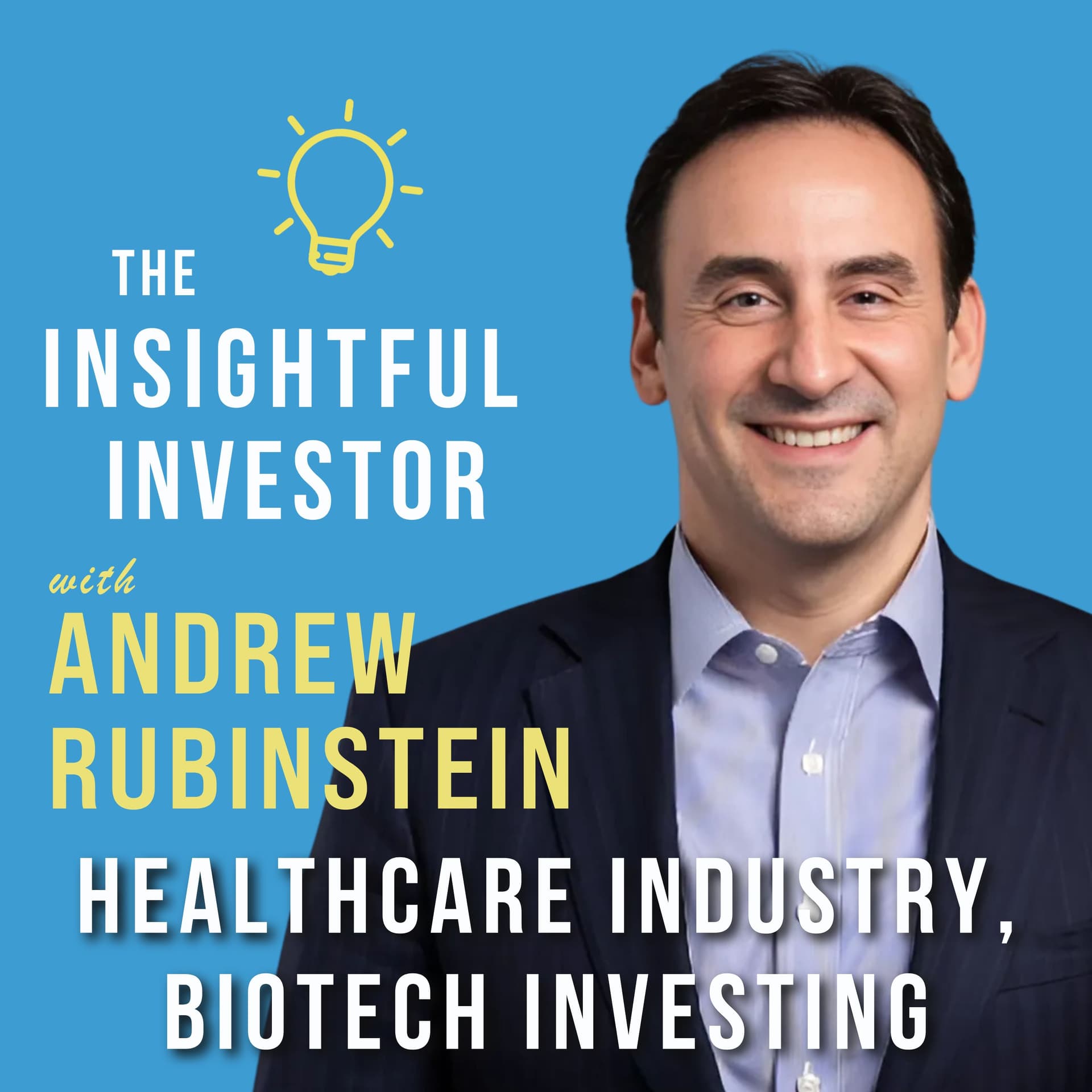
- Title: #53 - Andrew Rubinstein: Healthcare Industry, Biotech Investing
- Host: Alex Shahidi, Co-CIO at Evoke Advisors
- Guest: Andrew Rubinstein, Co-founder of Oberland Capital
- Focus: Challenges and opportunities in the U.S. healthcare industry with an emphasis on biotech investing.
---
Key Themes and Insights
Introduction
- The podcast aims to provide unique market insights that are often counterintuitive or underappreciated.
- Andrew Rubinstein brings a wealth of experience in healthcare investment, focusing on biotech.
Background of Andrew Rubinstein
- Education: Economics major followed by a JD/MBA program.
- Career Path:
- Started in investment banking at Merrill Lynch.
- Transitioned to a healthcare licensing company, eventually becoming CEO.
- Co-founded Oberland Capital, focusing on healthcare royalties.
Overview of Healthcare Royalties
- Types of Royalties:
- Traditional Royalties: Payments from biotech companies to patent holders (e.g., universities) for licensed technologies.
- Structured Royalties: Created when funding is provided to biotech companies, earning returns based on revenue percentages.
Current Challenges in the Healthcare Industry
- Rising Costs:
- U.S. healthcare spending has increased from 5% of GDP in the 1960s to 17-18% today.
- Chronic diseases are a key driver behind escalating costs, influenced by rising obesity rates.
- Chronic Disease Statistics:
- Approximately 60% of U.S. adults have at least one chronic condition; over 40% have two or more.
- Potential Solutions:
- Focus on innovative treatments (e.g., GLP-1 inhibitors for obesity).
- Addressing food supply issues and promoting healthier lifestyles are also critical.
Insights on U.S. Healthcare Administration
- New Administration Focus:
- Appointment of key figures in the FDA (Marty Makary) and HHS (RFK Jr.) signals potential reform areas.
- Emphasis on transparency in drug pricing and the role of pharmacy benefit managers (PBMs).
Recommendations for Healthcare Reform
- Addressing fraud, waste, and abuse in healthcare, with estimates suggesting up to 10% of costs may be attributed to fraud.
Biotech Sector as a Bright Spot
- The biotech sector is viewed as a "golden goose," driving innovation not only in the U.S. but globally.
- Successes in cancer treatment are notable, with survival rates for prostate and breast cancer nearing 100% over five years.
Investment Strategy in Biotech
- Focus Areas:
- Products that treat serious diseases with significant unmet needs.
- Preference for approved products or late-stage development assets to avoid binary risks associated with early-stage investments.
- Investment Philosophy:
- Oberland Capital looks for structured deals that provide downside protection while offering substantial upside potential.
Future of Innovation in Biotech
- Drivers of Innovation:
- Decreasing costs of genetic testing.
- Advances in therapeutic modalities (e.g., mRNA, gene editing).
- Utilization of AI in drug development, leading to an acceleration in the number of potential first-in-class drugs.
Conclusion
- The episode emphasizes the need for continued investment in the biotech sector to foster innovation while also navigating the complexities of healthcare reform.
---
Key Takeaways
- The U.S. healthcare industry faces significant challenges, including rising costs driven by chronic diseases.
- Biotech remains a critical area for investment and innovation, presenting unique opportunities for investors.
- Effective healthcare reform will require a focus on transparency, cost control, and encouraging further advancements in medical science.
---
Please visit the [Insightful Investor website](https://insightfulinvestor.org/) for more episodes and information.
Written by AI. May contain mistakes. Listen to the episode to check what was said.
Transcript
Automatic transcript. May contain errors.0:05Welcome to the Insightful Investor podcast, a weekly series that seeks to share industry, investment, investment and market insights. We define insights as concepts that are counterintuitive, widely misunderstood, or underappreciated. In other words, unique ideas that you probably won't hear elsewhere. I'm Alex Shahidi, the host of the podcast and co-CIO of Evoke Advisors, a leading investment advisory firm. Learn more about our show at insightfulinvestor.org.
0:38Today, we're joined by Andrew Rubenstein, who is the co-founder of Oberlin Capital, an alternative investments manager focused on healthcare royalties with approximately $3.5 billion in assets under management. Welcome, Andrew. Thanks, Alex. Great to be here. We're excited to have you. Our focus today is going to be on the U.S. biotech sector, an interesting component of the vast U.S. healthcare industry. While the healthcare industry as a whole faces a number of challenges, including rising costs, workforce shortages, quality and access concerns, and potential regulatory headwinds, among others, the biotech sector continues to be an exciting engine of innovation, not just for the US, but for the world.
1:22Andrew, you have a very unique perspective as both an investor and industry expert. I expect great things from you today, including valuable insights into this critical growth sector. So we have a lot to cover, including potential investment opportunities in this evolving landscape. Are you ready to dive in? Absolutely. Let's kick it off with your background. How did you come to be a healthcare investor? I wish I could tell you it was as simple as as a young boy, I always dreamed of becoming a healthcare royalty investor, but the truth is a lot more complicated than that. I came at this in a very roundabout way.
2:00I was an econ major in college. And when I graduated, not having a clue what I wanted to do, I did a four-year JD MBA program. And while in that program, it gave me an opportunity to explore a lot of different jobs and potential industries. I worked in sales and trading. I worked at a law firm and M &A and corporate work. I had a chance to work at the SEC and the U.S. Attorney's Office. And then when I graduated, I decided I would start out in investment banking. I was at Merrill Lynch in leveraged buyouts, and I did that for a while. And then I had an opportunity to join a startup licensing company broadly in the healthcare industry, focused on licensing out its technologies in the antimicrobial space.
2:55And I had a variety of roles there, eventually was CEO of the company. And I was really, while there, I was having lunch with one of our VC backers, talking about my mid to longer range plans and wanting to get back into finance. And I was wondering out loud, how would I combine my law background, investment banking background and licensing background. And this guy who was a partner at a venture fund had said to me, you're never going to believe this. There is a fund that invests by buying royalties. Head exploding moment. I think it was within a month or two from that conversation that I started working at that very fund that he had mentioned.
3:41That's how I came about it in a more roundabout way. I'd like to think that my varied experiences play a role in what I do today. All of those were not necessarily total dead ends. So you mentioned royalties. Would you walk us through what healthcare royalties are and what attracted you to this segment for investing? At a very high level, there's two kinds of healthcare royalties, what we call traditional royalties and structured royalties. The traditional kind are really, this is where you've got a biotech company or a university or an inventor that's invented some new technology, patented it, and then licensed it out typically to large pharma.
4:27And in exchange, they're going to get quarterly royalties for the remaining life of the patents. So we, as a royalty fund, would approach those inventors or inventor institutions and provide them with capital and take over those royalty streams as a way of earning a return on investment and get paid directly by the large pharma. So that's traditional royalties. The structured kind are what's a royalty, but it's really just a piece of the revenues on a product, a percent of the revenues. is you can approach biotech companies, provide them with capital, and you can create a royalty as a way to earn a return.
5:08It didn't exist before you got there, but as part of a transaction of providing capital, you create one and that's how you earn your return for investors. There's a whole host of structures under that big umbrella of structured royalties, but that's it in a nutshell. Well, you co-founded Oberlin Capital in 2013. What motivated you to take that big step? I had been working at a fund for a while and there was a small group of us that worked really closely together and had a slightly different view from the rest of the shop in terms of how best to invest and how best to manage relationships on a transparent basis internally and externally with investors.
5:53And we just felt that we could do a better job of that, starting our own thing rather than trying to kind of move the ship in the direction that we wanted slowly over time. So I think that was one reason. I think the other was really just, we felt like, hey, we'd rather be owners and compensated by equity value that we could build over time rather than joining a place. And the best way to do that was starting our own thing. I'm proud to say that small group of us, we're still working together. We're coming up on 20 years of doing this kind of investing together and still having a lot of fun doing what we do.
6:32That's great. Let's start talking about the healthcare industry before we do a deeper dive into the biotech sector, which is where we start our conversation. So would you give us an overview of the broader healthcare industry and what you see as the key challenges that industry faces? I think you've listed a number of the challenges at the outset. I would answer that question really by taking the 20 ,000-foot view. It's a very complicated industry if you peel the layers of the onion, but if you take the 20 ,000-foot view, I think the biggest challenge is there's broad agreement that we're just spending too much on healthcare as a country.
7:14In the 60s, we spent about 5 % of GDP on healthcare. We're spending 17 % to 18 % of GDP on healthcare today, and that's a massive number. That's about$4.5 trillion spent annually. And unfortunately, the trend is that number's been growing over time. And I think the industry faces this challenge of how high can you go where it's really just unsustainable? This is kind of a guns and butter thing. If you remember your econ 101, there's trade-offs. If we continue in this trend, do you really want to be spending 20 to 25 % of GDP on healthcare? That means you're sacrificing other areas in terms of productivity.
8:00This is a broader point than just the healthcare industry, but it affects the U.S. economy and the future productivity of the country. So I think that's kind of the big picture problem. The good news is there's both innovation and initiatives underway that I think are already going to reduce those big numbers. And I think when you think about the new administration, there's a number of initiatives that I think will be undertaken that can further improve those efforts to get these numbers back down to manageable levels. So before we get to the new administration, is the increase in costs, is that just because the population is aging and there's more need for healthcare or are there just growing inefficiencies?
8:46There's a number of factors. I think one that is a big area of focus, and I think it's being talked about by the new administration, a big area of focus is just looking at chronic disease. When you think about that 3.5x roughly increase in healthcare spending as a percent of GDP, you could roll back the clock and look at the growth in obesity rates in the U.S. And you could draw a similar line. Those rates back from the 60s are up about 3.4 times. We were looking at about 13 % obesity rates back in the 60s. That number is closer to 50 % now in the U.S., and that's a staggering number. And it's not obesity unto itself that is necessarily the cause of the increase.
9:36It's the fact that there's so many chronic conditions that relate that are comorbidities along with obesity. You get increases in cardiovascular disease and fatty liver disease and kidney disease. You have increasing rates of dementia and cancer among obese patients. And then, of course, you have diabetes. And every one of those conditions, think about all of the hospital visits and doctor's appointments and testing that's as a result of all those various conditions. That's a huge driver. Chronic conditions is a great area for focus. It's estimated that about 60 % of U.S. adults, people 18 and over, have at least one chronic condition, and over 40 % have two or more.
10:23And that's unprecedented in the Western world. And that's why I think it's rightly a big area of focus for controlling costs. And when you think about obesity, you can treat that with a drug. And I'm sure you've heard of the new class of treatments, the GLP-1 space from some of the large pharma providers already doing a great job at reducing obesity. And I think you're going to start to see the effects on all those other conditions that I mentioned. That's why I think you saw Elon Musk tweet out just a couple of weeks ago on X that I'm quoting here. There's nothing that you can do more to improve lifespan and quality of life for Americans than making GLP-1 inhibitors super low cost to the public.
11:14Nothing else even comes close. obviously one approach is through medical technology. The other is you kind of look upstream and you can look at the food supply. And I think that's being talked about as a big area of focus. And you can look at increases in sugar and corn syrup and salt in foods and ultra processed foods. And those are areas you could potentially look to for improvements. I'm a little skeptical that you can take on large pharma, large agriculture, and large food at the same time if you want to make changes. I heard somebody say, there's three pharma lobbyists for every congressman and senator in the United States.
12:02What does that number grow to when you take on agriculture and food? But I think it's a worthy cause. Food and exercise has got to have an impact on these staggering obesity rates in the country. So basically, we're not only getting older, but we're less healthy than we used to be. And you put all that together and you've got rising costs and the numbers that you described earlier. Absolutely. Okay. So let's talk about the new administration's recent healthcare appointments. Where do you see those individuals likely to focus their efforts in terms of potential healthcare industry reform? There's a lot of appointments focused on the areas that are most important to my business, and that is the FDA and HHS, Health and Human Services.
12:50Let me just start by saying, we're not even in the early innings of the new administration. I mean, this is like we're in the warm-ups. None of these people we're going to talk about are even approved by Congress yet for their positions. But what do we know? We know HHS, the nominee is RFK Jr. and FDA is Marty Macri. I like to look at the biotech index as a way of gauging the kind of market reaction to these appointments. You saw when Trump was elected, the index had a nice boost, was up about 5%, followed by about a 12 % drop in the week that RFK Jr., that his appointment was announced. So that was obviously concerning for the industry.
13:35And then you saw a big bounce when Marty McAree was named for FDA. The market went back to its pre-election levels just on the announcement of him for FDA. And why is that? I think because he's a serious candidate for the job. I think he's an excellent pick. He's a surgical oncologist. He's a member of the faculty at Johns Hopkins. He's a published author. He's got two New York Times bestsellers. I think if you look at the views that he expresses, many of them line up very nicely with the views of myself and my firm. Maybe I'd just talk about a couple of those. One is, I think he's planning on focusing on carrying on the good work that was done by his predecessor in the first Trump administration of really streamlining, making more efficient and improving the drug review process at the FDA.
14:32I think the FDA is still in need of modernizing, and it's going to be all the more important to keep up with what is an accelerating pace of innovation in the industry. So I think that's a great area for him to focus on. And then I think another area that he's written about extensively is, number one, the lack of pricing transparency, and number two, the role of middlemen in the system, which has a role to play in increasing costs. Specifically, one of his focuses is on PBMs, pharmacy benefit managers. Pricing transparency, I think this is an obvious point for people that if you've ever been to a hospital, you shouldn't need to be a brain surgeon to understand your hospital bill.
15:15Pricing transparency is a huge area for improvement. When you talk about middlemen, And I think most people just are not aware of the role in increasing prices that middlemen play. They'd be shocked to hear pharmacy benefit managers been around a long time, but it's only recently where they come to play such a massive role. The top five PBMs control about 90 % of all U.S. prescriptions passed through their hands. And that's an unbelievable increase in the last decade. And now you have PBMs have been vertically integrated into insurance companies. So when you look at the revenue of these top five PBMs, this is from a recent FTC study, they're doing about$1.2 trillion in revenues.
16:04I think this is a great area for increased transparency and focus in terms of whether there's savings that can be had in focusing on that end of the industry. When it comes to HHS, I think RFK Jr. is focused on trying to shift the focus of government from what has been over the last five years a necessary focus on infection and viruses and that sort of end of the healthcare market to thinking more about how can we focus on reducing this chronic disease burden that I mentioned earlier. So that I think will be a big focus for him and Matt in trying to go upstream to the food industry and focus on that as a way to make America healthy again.
16:53Is there any advice you would provide to these groups in terms of where you think they should focus? There's a great area to focus on, and that is focusing on fraud, waste, and abuse in the system. The Justice Department did a survey. They were primarily focused on Medicare and Medicaid. And they estimated that fraud was up to 10 % of the total costs in that sector. If you extrapolate that to both private and public payers, you come to an insanely high number. I mean, that's like a$450 billion problem in the United States. And if that's 10 % of the total spend, that's like the entire annual expenditures in healthcare of the countries of France and Spain combined, just to put that in perspective.
17:46And then by way of reference, the entire retail prescription drug market is 9 % of the pie. So if you want to focus on an area where you can get a huge bang for the buck, you could potentially squeeze big pharma for some amount. How much do you think you're going to get in terms of reductions out of the 9 % in retail prescription drugs without harming potential innovation versus going after this even bigger pie, which is in the area of fraud, waste, and abuse. This is like a memo to Doge, Musk, and Ramaswamy. If your total target is for government waste and savings is$2 trillion, you might be able to find a quarter of that just in this one area.
18:31So I think that'd be a great area for them to focus on. Are there any other key topics for consideration that you think are important as we talk about the broad healthcare industry? I have a pretty long list. I'm just conscious of what we can accomplish in one podcast. Maybe I'll just hit on some of the very high-level points that I think are going to be in the news and important for consideration. One is, what's going to happen with the Inflation Reduction Act as it relates to healthcare? You'll recall, for the first time, this was approved with fairly bipartisan support. you've got the possibility of the government coming in to negotiate on price.
19:13And that's a big deal. The government's obviously a huge purchaser of drugs. And in other countries, you get the benefit of that purchasing power. I think the compromise reached between Democrats and Republicans was, if you're going to do that, you need to leave a period of time for innovators to earn a fair return for the investment that they've made in innovation. So that resulted in nine years if you develop a small molecule before the government will start to come in and negotiate on price in 12 years for a biologic. And that's great. That tends to coincide with the remaining patent life on these drugs by the time they get approved.
19:55The issue is there was an out for the future head of Health and Human Services to walk away from this act. So it's very possible that the Republicans, who I think it's fair to say were sort of grudgingly in favor of the changes, might walk away from it. So we'll see how that plays out. And then I think another topic that's being focused on now is changes in the funding of early stage research and just talking specifically about the NIH. I think there's some talk that we need to move away from the funding of older scientists or more experienced scientists who tend to necessarily be more up to speed with the status quo and perhaps less likely to think of revolutionary ideas.
20:43So maybe there's a shift there into funding big new ideas. I think even though that's very topical in the news, it's kind of a small piece of the pie. It's like we're talking about$50 billion in the context of$4.5 trillion. Another topic for sure that is going to be focused on if RFK Jr. is appointed is vaccines. I'm reluctant to even go there. I would imagine this may be a hill that is Candacy potentially dies on in confirmation hearings. I look forward to the confirmation hearings when they get to the subject, and there might be some friction between him and Marty Macri on this point. Suffice it to say, as an investor, I think this is an area for investment that you do well to be cautious for waiting into for some period of time until this shakes out.
21:33And then I think there's also potential changes in the insurance industry are a big topic of conversation. Where do we go with Obamacare, the Affordable Care Act? We're now many years into this. In Trump's first administration, he decided to try and work within the framework. Is that still going to be the case? Are we making tweaks to it? Is there a different framework that's potentially going to be put in its place? We'll see how that plays out. And then maybe the last thing I would just mention is I would expect with the Republican administration and control of Congress, we're going to likely see enhanced M &A activity in the sector.
22:17That's always been a great bellwether for the biotech space as a whole, as a great sign of growth in the sector. So I wouldn't be surprised if we start to see a big pickup in that area again. Let's talk about the biotech sector that you just referenced. I know it's an area that you're passionate about. Why do you see this as a potential bright spot within the broader healthcare industry that we just covered that faces a lot of challenges? And what are some of the sector's accomplishments? I think there's very broad agreement that this is the golden goose in the healthcare sector. The biotech sector, it's a true American success story.
22:58I mean, we are not just the engine of innovation in the United States in healthcare, but the engine of innovation for the world. It's our sector where that comes from. If you've ever been a patient yourself or had a loved one suffering from any kind of a serious condition, you thank your lucky stars that you've got the U.S. biotech industry that's coming up with innovation that's likely had a role in the treatment that you or your loved one is getting or may even be a cocktail. of treatments that came from the sector. So looking ahead, it's just an area that we should still hope to expect great things from and that needs to be encouraged.
23:38As I look at the space, it's hard to encapsulate the entire industry and tell you examples of the biotech industry success, but maybe we can just name a few that I think people would be familiar with. I look at the cancer space and the improvements that we've made over the last decade or so that come from the biotech space, maybe like a benchmark that is used to measure progress in the industry is how many patients survive five years following diagnosis of their cancer. And when you look at prostate cancer and breast cancer, two of the most common forms of cancer, we're going to have to start coming up with a new metric for success because we're approaching 100 % of patients living five years or more from diagnosis, which is just an incredible improvement.
24:34And the same can be said across other forms of cancer that come from innovation in the space, kidney cancer, various blood cancers, colorectal cancer, where more than two-thirds of patients now are living to that five-year mark or more, there's still a lot of work to do. There's still a huge amount of unmet medical need, which drives the biotech space for additional innovation, whether that's other forms of cancer or Alzheimer's or Parkinson's. There's still a tremendous amount of unmet need, but we've made amazing progress in this industry, and it's a real bright spot within the healthcare space as a whole.
25:13So how can we further advance America's position as a global leader in medical innovation? You could look at the NIH, who provides grants for early stage research and say, maybe we could do more there. I'm a free market guy. And my view is the biggest thing we can do is not have government intervention to kind of screw things up and keep the incentives for companies to continue to innovate and do the job that they're already doing when coming up with new therapies with the right incentives. I have a suggestion for NIH, and I'm obviously biased. I love royalties. I feel like I sound like Mr. Wonderful and Shark Tank.
25:57I think what the NIH should do is, as it's giving these grants out, and there's some great statistics out there showing that NIH grants were a part of almost 100 % of the drugs that have been approved in the last decade at some stage, try getting a royalty, just a really small royalty when you give out the grant. No one's going to avoid working with a product because there's a half a percent or a one percent royalty. If the stats are true in terms of the ratio of success where they're getting involved, then the royalty will not only fund the costs at the NIH, but potentially allow for even more investment back into the biotech space.
26:38So basically, you have this secular wave of technological innovation, and you want to let it do its thing and create incentives, and definitely don't create disincentives. That's right. And I think there's a great case to make that the pace of innovation in the sector, if left alone, is actually going to accelerate, not just continue at the pace that it had been at previously. So that's all the more reason we should be optimistic that great things are going to come from the space. And why do you think we're on the verge of a period of accelerated innovation? I think that it's for a number of reasons.
27:18The first thing I would point to is improvements in genetic testing and a dramatic decrease in the cost of that testing. It used to be, you were talking tens of millions of dollars to perform genetic testing. We've now gotten that costs down to about 500 bucks and it's continuing to decline. That's an important piece in both understanding diseases and in thinking about ways to customize therapies for different genetic mutations, which is an important part in designing new treatments. So I think that's a component. I think the fact that we have so many new therapeutic modalities that are promising, There's about 17 of them that you could rattle off that I think are going to be platforms for new development.
28:12You're probably familiar. We all saw during the pandemic, when we were focused on infectious disease, the power of mRNA, that's one of those platforms to help to accelerate the development of a new therapy in the fastest time in human history. And there's others that I'm sure people would be familiar with, gene editing and stem cells and others that I think hold significant promise. And then you throw AI into the mix, where it's always taken a lot of time to develop new molecules and new targets. It's required a ton of computing power. And I think now, when you think about the promise that AI holds, at least for this industry, to help accelerate that molecule selection and target selection, I think that will pay big dividends in terms of accelerating innovation in the near future.
29:08And then that's translating already into an acceleration. If you kind of look at the earlier stage pipeline, you're seeing a dramatic increase in the number of molecules in development. And these are, and I'm talking about potential first-in-class drugs. And that's where you really tend to see the big innovation. Overall, the current pipeline, you're seeing about 70 % of the drugs in the current pipeline. That's phase one, phase two, and phase three that are potential first-in-class drugs. But if you focus on what's in the earlier stages and phase one or even preclinical, that number even goes up significantly.
29:48So when you think out five to 10 years in the future, it's those preclinical and phase one drugs that are benefiting from all these new modalities and better testing and computing power that I think have this massive potential to accelerate breakthroughs. Yeah, it seems to me, looking from the outside in, is that obviously there's clearly technological innovation in the world. And you could imagine that most people would be completely on the same side of this issue of, do we want more innovation in medicine and treatment? Because obviously that benefits everybody, assuming you can do it safely.
Read the full transcript
30:27And so it seems that that should be a relatively easy hurdle to overcome, to create incentives rather than disincentives. I'm curious why someone would disagree with that. I really don't think people disagree with that. I think the talk for legislative reform tends to be, how do we balance getting costs under control with not stifling innovation? I think everyone understands that we're still losing loved ones from cancer and Alzheimer's and Parkinson's and other serious diseases where there's no cure, let alone rare diseases, that we all benefit from that. It's really a question of where should we focused to get the overall costs in the system under control?
31:12Think back to the bigger picture view. And I think the answer is we've just laid out a whole bunch of areas that would be fantastic to focus on, at least one of which, when you're talking about chronic diseases, relies in part on new therapies, new treatments for obesity that I think have this massive potential to make a difference. So it's the very industry helping to solve the problem through innovation. That makes sense. Let's transition to healthcare investing. How do you think about investing in the biotech sector in terms of an area of focus? We tend to focus on what we know, which is we focus on products that treat serious disease where there's a big unmet medical need.
31:57Those are products where you can get your arms around the market. How many people suffer from the disease, both today and how many patients are likely to get it over time versus having to think about whether there's economic factors. Maybe you've got a potential elective procedure where if the economy is doing great, people get the procedure. If the economy is not doing great, they don't get it. I think you can get your arms around if it's a cancer treatment. People need to take that treatment, whether markets are up or down. So that's one of the reasons we tend to focus on that. The other is the promise of innovation.
32:35when you focus on the drugs of that type, they're going to roll out around the world and become a new standard of care in the industry, not just play some small role in the overall treatment paradigm. So that's really where we kind of like to focus and build our portfolios around. And that's something we've been doing for about 20 years. And I'm sure the greater population appreciates that. So most investors focus on equity or debt when they're investing, but you focus on royalties. You described what royalties are when we started our conversation, but would you tell us why you focus on royalties from an investing standpoint?
33:13This is sort of a perfect fit with my background. I love the pure play nature of royalties. You're just getting a piece of the top line. You don't have to focus on company building. This is no knock on venture capital or other forms of investing, but if you're doing early stage venture, you're on the board, you're worried about how every dollar is being spent and incremental capital raises. When you're just getting a piece of the top line on a drug, it's just kind of a pure play on the characteristics of that particular disease and the performance of that drug. And you can have companies that have a very successful drug and then have a bunch of failures, and that's going to impact the equity performance versus just having the one successful product that we might have an interest in.
34:01And I think debt, there are some positive characteristics in terms of what you can do in our industry with debt. And we do a mix of debt, equity, and royalties. We're primarily focused on royalties. One of the things I love about royalties versus debt is with debt, you're focused on some large back-ended exit or return of principal. You're getting yield along the way, but you're exposed to the longer term performance of the business with some sort of future exit versus with royalties, you're kind of exiting all the way along the way. You're getting big, chunky cash flows that are the equivalent of yield and return of principal along the way.
34:42You don't get that with debt. I also think from a company's perspective, there's a little more of an alignment of interest with royalties. We participate as companies grow their revenues over time, payments to us will increase because we're getting a percentage of that versus with debt. It's independent of the performance of the company. Pay me my yield regardless of your performance. And that tends to be tied more to for the lenders. They're worried about where our interest rate's going. I've got some spread to treasuries or some other benchmark. And so now I've got to worry more about those macro factors that we don't tend to worry about when you're focused just on the royalty side.
35:20So those are all kinds of reasons I tend to prefer investing via royalties. And looking at it from the asset allocator's perspective, which is the seat that I'm in, debt and equity have certain characteristics. Most portfolios own a lot of debt and equity, but royalties is a different return stream. It's a different risk. And you could view that royalty return as largely uncorrelated to the stock market or the bond market, which have various factors that influence their price. Is that accurate? I think that's an excellent point. And I think at the end of the day, we're just trying to build a portfolio where you're getting a piece of the revenues on a diversified pool of drugs.
36:03They're diversified by therapeutic category. And as you say, the performance of our investments are dependent on the performance of those drugs, not on other factors that might influence the overall equity markets or credit markets, this tends to be an area that has shown low correlation to both debt and equity indices over time. Yeah. And it's because what fundamentally drives the success or failure of that return stream is by and large different from stocks and bonds. Stocks and bonds are largely influenced by how the economy does and by how inflation transpires, Whereas royalties, it's more about the success of the drug, and that's something you can diversify within that sector.
36:49Absolutely. So how would you describe Oberlin Capital's style of investing? And how do you avoid one of the big risks in biotech, which is binary risk? It's either a success or a failure of that drug. We like to think of ourselves as doing structured credit within the healthcare space. Our style is we always look for ways to provide investors with downside protection first. First, think about ensuring that in all instances, investors are going to get return of capital on their investment. And then we like to find ways where investors have significant upside exposure in our investments. Royalties are great in terms of building in a way to participate in future growth.
37:37You just have to have revenues increasing. But there's other means of building in upside exposure. Maybe that's through getting equity kickers or warrants. And on the downside, you might ask, how do you build in downside protection? There's a myriad of ways that we do that in our deal structures, whether that's guaranteed minimum royalties or being senior in the capital structure of a company, having put options in the event there's underperformance, that tends to go along with the call option. If things are going great, the counterparty wants the ability to buy you out at some premium. But the quid pro quo is you can often build in a put option if things aren't going well to get a still attractive return.
38:22And in terms of binary risk, I know that's a big perception. When you say healthcare investing, Investors tend to immediately assume you're taking early stage bets with all the attendant risk along the way, and then ultimately some kind of binary FDA decision where the FDA gives a thumbs up or a thumbs down and you have a chance to hit big or just get wiped out. That's really not what we do. The first thing is our primary investment platform. We focus on products that are already approved by the FDA. So these products have already bubbled up, shown clinical success, both in terms of efficacy and safety.
39:03They've been blessed by the FDA and now they're on sale. So it's really more of an exercise of how big are they going to get and what is the potential competition that they might face over time. The good thing about competition in our industry is it's not like tech where who knows what's being developed in secret in somebody's garage, like all good tech products that's going to come on the market in the next two to three years. If you want to develop a product and treat humans, you got to register with the FDA and that becomes publicly available, researchable information. There's no surprise product that just suddenly makes it onto the market that you're not aware of.
39:45Our primary platform is investing in products that are already approved. So you're avoiding that binary risk. We also have an investment platform that invests in late stage development assets. So you're still pre-approval. And we look for opportunities there to avoid binary risk where the company's got multiple shots on goal. So if you have a failure, you've got other products that are still nearing approval that could get you your return. And also companies that already have meaningful dollars on their balance sheet and could get to the approval without your money, but are looking to make the transition from being an R &D focused company to then ultimately becoming a commercial stage company, which is a very expensive exercise.
40:37size. You got to hire a sales force and run a marketing campaign. No biotech company wants to show up at an approval running on fumes. You want to be able to have a big blowout launch and maximize the opportunity that you have to kind of make hay while the sun shines, while you have patent protection to be able to earn an attractive return before generics potentially enter the market at some point in the future and reduce the profit potential. So Andrew, the healthcare industry and potential reform is a big topic today. I appreciate you taking the time to share your insights with us and our audience.
41:15No, it was a pleasure, Alex. And I very much appreciate the opportunity. Thanks for listening. We hope you enjoyed this episode. Please visit our website at insightfulinvestor.org to access past shows and learn more about our podcast. If you have questions, feel free to email us at info at insightfulinvestor.org. And if you enjoyed the discussion, please subscribe to this podcast to ensure you don't miss future episodes. And don't forget to forward today's conversation to others you think would enjoy listening. This podcast is provided for informational purposes only and should not be relied upon as legal, business, investment, or tax advice.
41:55All opinions expressed by podcast participants are solely their own opinions and do not necessarily reflect the opinions of Evoque advisors, their affiliates, or companies featured. Due to industry regulations, participants on this podcast are instructed not to make specific trade recommendations, nor reference past or potential profits. And listeners are reminded that securities trading, commodity trading, and alternative investments are complex and carry a risk of substantial losses. As such, they are not suitable for all investors.
42:29Listeners should be aware that guests featured on The Insightful Investor may have current or past associations with Evoke advisors or the host, including as an investment manager of a private fund opportunity by Evoke or access through an affiliated Evoke fund or as a client. Participation as a guest on the podcast should not be perceived as an endorsement or testimonial with respect to Evoke Advisors, the podcast host, or their services. Similarly, the inclusion of a guest on the podcast does not imply that Evoke Advisors or the host endorses the guest or any company with which they may be affiliated or employed.
43:08Evoke has neither paid nor received compensation from guests for their participation.
From the publisher
Andrew is co-founder of Oberland Capital, a healthcare investment manager with $3.5 billion in assets (as of 11/30/24). In this episode, he shares valuable insights into the challenges and opportunities across the U.S. healthcare industry, with a focus on biotech as a driver of innovation. Tune in to explore the evolving landscape and discover key investment opportunities from this industry expert.


