
In short
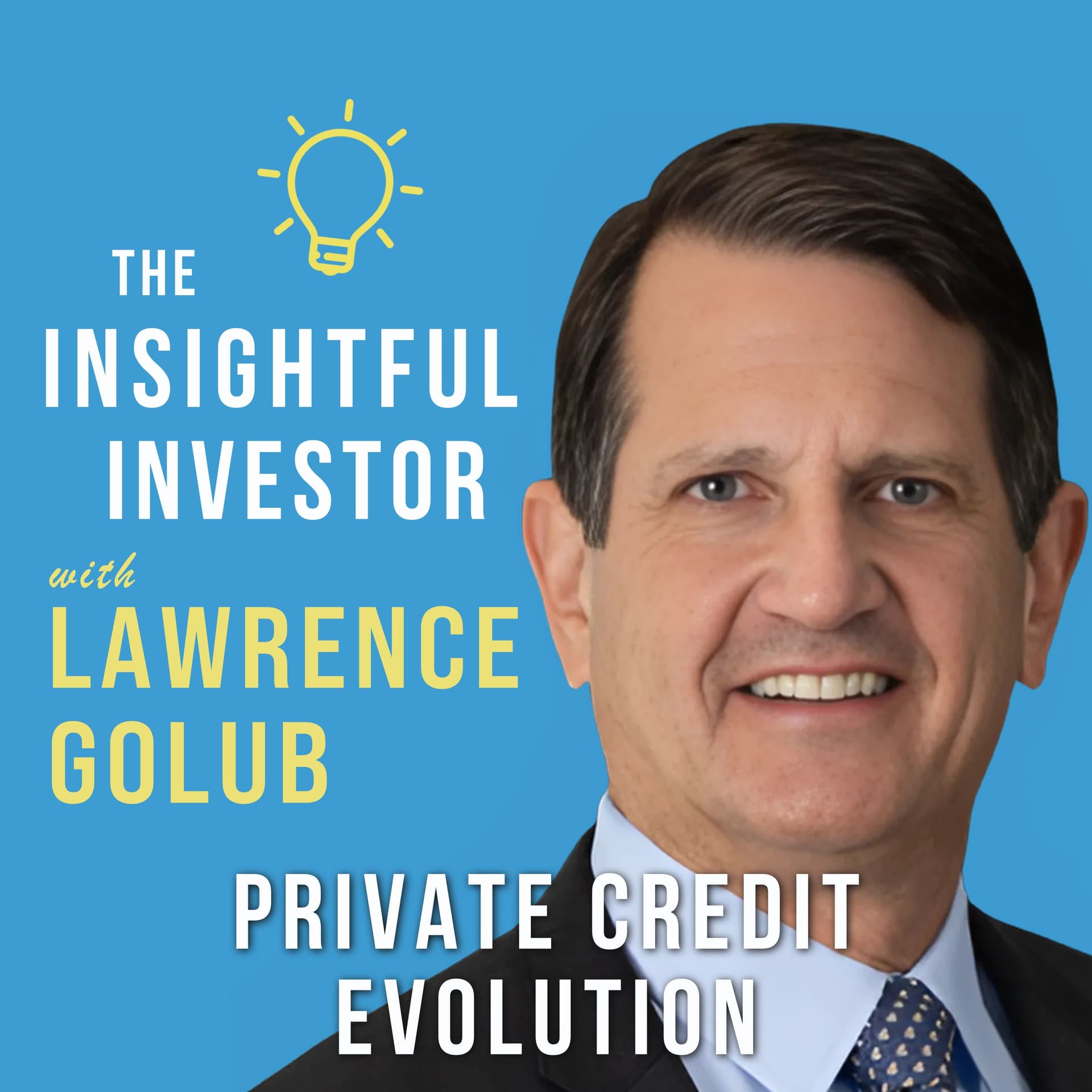
Insightful Investor Podcast - Episode #55: Lawrence Golub: Private Credit Evolution
Episode Overview
In this episode of the Insightful Investor podcast, host Alex Shahidi interviews Lawrence Golub, Founder and CEO of Golub Capital, a prominent alternative investment manager specializing in private credit and direct lending. Lawrence discusses his journey through the finance industry, the evolution of private credit, and the intricacies of middle-market lending.
Key Takeaways
- Background of Lawrence Golub
- Early Life and Education:
- Lawrence grew up in a middle-class household with academic parents.
- He attended Harvard Law School and completed an MBA.
- Career Path:
- Started at Goldman Sachs in investment banking but found it uninteresting.
- Transitioned to Allen & Company, where he learned about investment and ownership.
- Later became involved in structured finance and capital markets.
- Founding Golub Capital:
- Established Golub Capital in 1994 with a small fund.
- Initially focused on tiny private equity investments and mezzanine debt.
- Shifted to sponsor finance after recognizing opportunities post the internet telecom bust.
- Evolution of Private Credit
- Historical Context:
- Private equity and lending developed significantly since the 1980s.
- Early inefficiencies in how private equity funds sourced lending led to issues during deal closures.
- Emergence of Golub Capital:
- In the early 2000s, Golub Capital identified opportunities in the lending market as banks exited due to regulatory pressures.
- Developed a one-stop loan structure that simplified lending for private equity firms, gaining their trust over time.
- Challenges in Building Trust
- Communicating Strategy:
- Initial reluctance from private equity firms to trust Golub Capital due to previous negative experiences with lenders.
- Required time to establish credibility and demonstrate partnership-oriented behavior.
- Building Long-Term Relationships:
- Golub emphasized the importance of reliability and open communication with private equity partners.
- A focus on mutual success builds trust and increases likelihood of repeat business.
- Current Landscape and Future of Private Credit
- Competitive Environment:
- The private credit market is evolving, with significant liquidity and competition from both private lenders and banks.
- Golub Capital operates primarily in the middle market, which has distinct advantages over larger deals.
- Impact of Economic Cycles:
- Interest rates and economic conditions impact private credit and private equity returns.
- Golub Capital's strategy includes underwriting loans with a focus on resilient companies and strong relationship management.
- Risk Mitigation Strategies
- Senior Secured Floating Rate Loans:
- Golub Capital focuses on lending structures that offer better risk profiles and flexibility.
- Specific underwriting strategies include assessing potential for strategic buyers in case of borrower distress.
- Monitoring and Adaptability:
- Maintaining relationships and communication with borrowers is crucial for risk management.
- Building a portfolio with diverse, healthy companies mitigates risks associated with economic downturns.
Conclusion Lawrence Golub provides invaluable insights into the private credit market, highlighting the importance of trust, relationship-building, and strategic risk management. His experiences and the evolution of Golub Capital illustrate the complexities and potential of middle-market lending in today's financial landscape.
---
For more episodes and information, visit [Insightful Investor](https://insightfulinvestor.org/).
Written by AI. May contain mistakes. Listen to the episode to check what was said.
Transcript
Automatic transcript. May contain errors.0:05Welcome to the Insightful Investor Podcast, a weekly series that seeks to share industry, investment, investment, and market insights. We define insights as concepts that are counterintuitive, widely misunderstood, or underappreciated. In other words, unique ideas that you probably won't hear elsewhere. I'm Alex Shahidi, the host of the podcast and co-CIO of Evoke Advisors, a leading investment advisory firm. Learn more about our show at insightfulinvestor.org.
0:38I'm so pleased to have Lawrence Golub join us today. Lawrence is the founder and CEO of Golub Capital, a$70 billion investment manager specializing in private credit and direct lending. Lawrence established a firm about 30 years ago. Lawrence, thank you for joining me today. Happy to be here with you, Alex. Thanks for having me. Let's start with your background. Would you walk us through your career progression from investment banking to private equity and ultimately to private credit? Sure thing. So I grew up in a middle-class household. Parents were academics. Nobody really knew much about business, but I was always intrigued by it.
1:16And I did very well in school and went straight from college to the Harvard JD MBA program. And during that program, you get a few summer jobs. And I thought, OK, now I'm finally going to live my dream. And I was able to get myself a summer job at Goldman Sachs in investment banking. and I was smart and I was immature. And Goldman Sachs was a great place at that time. Bob Rubin was running the trading floor. Steve Klinsky was my office mate. And I got a couple of really good projects that I did a good job on early. And then I got boring work. I thought, wow, investment banking is boring. And I just, I said immature, I really was.
1:58And so I got in my head that the problem was at Goldman instead of the problem being me, which was wrong. and backwards. I had unreasonable expectations. But over the next couple of years, I was lucky enough to be introduced to a man named Stan Schumann, who was one of the senior partners at Allen & Company, who, when I finished graduate school, hired me as his key lieutenant. And I did everything that was necessary. I was the junior partner. I was the after-hours secretary. I carried bags. I got to do some negotiating. And that was a transition point in part because it was a mixture of investment banking and principal investing.
2:37I really started to learn how Allen and Company, which was investing its own money and the partner's own money and not really money for other people, thought about things as an owner. I did, as time went on, get recruited away by Bruce Wasserstein to start a structured finance and capital markets group at Wasserstein Perala. So going back to pure investment banking, that was a magnificent professional experience for me, but I'd spent enough time at Allen & Company to have forgotten some of the lessons about me and investment banking. So it was great to be made a managing director, have P &L responsibility, but I really missed being a decision maker instead of an advisor and started thinking about and ultimately started Gallup Capital in 1994 with a relatively small fund.
3:25Most of the money I had saved in my career, money from my former bosses. One of our investors was Stan Schueman, my old Boston Allen company. One of my investors is one of my bosses from Wall Street and Perella. And it took off from there. And at some point, your brother, David, came to join you at Gallup Capital. How would you say that partnership has shaped the firm? Well, the partnership has helped the firm really take advantage of all of its opportunities. So started the firm in 1994. And as David joined in about 2004, 2003, 2004. Now, he and I are very close. He had been a close advisor of mine throughout building the firm.
4:06And in the period from about 1994 to 2001, we were really not the most successful business. We had good IRRs, good returns for investors. But a lot of what we were doing were really tiny private equity investments. We were doing structured finance and mezzanine debt, but we didn't start to hit our groove as a business till about 2001 after the internet telecom bust. And we went full bore at that time into sponsor finance. As we were growing, Greg Cashman and Andy Stoyerman were two key senior partners of the firm. They're both senior partners of the firm today. And so it was me, Andy Storman, and Greg Cashman as the senior leadership team.
4:52David at this time was working at Center Partners, a private equity firm, and he was getting very involved in leverage finance from a different side, from the CLO, broadly syndicated loan side of the business. And he decided to make a change. He had been helping us invent taking CLO technology, securitization finance, as a way to borrow on a very long-term, safe basis, very inexpensive debt as we were starting to move into senior debt. And during 2004, David joined the firm full-time. And it's really a tribute to David and Andy Storyman and Greg Cashman that he came in to a position of an existing partnership as my brother.
5:36And all four of us were able to make that work and get along. I think Andy Storyman has a particular interpersonal genius. And I remember one year we're going over a year-end review, and I asked him a question along the lines of, all right, well, what do you want to accomplish next year? And Andy said, I'd like to be the third brother. And over time, I consider Andy and Greg both business brothers. It's been the four of us. And as it relates to David and my relationship, I think one of the keys to our business success has been unlimited trust, unlimited respect and intelligence and a willingness to most of the time do a good job of dividing and conquering.
6:24And having grown up getting into a fight every day and learning how to make up every day. We fight. We fight plenty. We know how to make up. That's great. The conversations that you and I have had in the past, one of the topics that I found highly insightful is your stories and insights about the private credit landscape. So if we could start at a very high level, would you describe how private equity funds historically sourced lending for their portfolio companies and the inefficiencies that existed in the early stages? Sure. And, you know, let's keep in mind that while it seems like private equity and LDO firms have been around forever, it really was an industry that started developing only in the 1980s.
7:10And even at that time was a fraction of the size it is today. So in the 1980s, think of the private equity business having two sizes of deals, really big ones and medium sized ones. The really big ones would get funded by a syndicate of banks, and the banks would actually hold the loan. They'd hold the revolvers. They'd hold the term loans. And then Drexel Burnham, Mike Milken, who is a genius for discovering, inventing, building the high-yield business, generally Drexel, not just a junk bond issuer, would finance the junior debt. You could think of it as subordinated debt, but it was in the form of notes.
7:53no covenants, very high yields, high yield bonds. For more medium-sized transactions, banks would typically make a loan that they would hold themselves, not a syndicated loan. You'd have one bank or two banks. And then there'd be a mezzanine fund that would come in and do the junior debt. Now, very, very document-heavy, highly lender-friendly, complex legal documents, frequently with warrants. And one of the patterns in almost every deal was that after the buyer and the seller reached an understanding, and after the buyer, the private equity firm, found a bank who wanted to make the loan and found a mez firm who wanted to make the mez, everything would be sorted out except there'd be a giant fight two days before the closing was supposed to happen over what's called a subordination agreement, the document that defines the relative rights between the bank lender and the mezzanine lender.
8:55And this was always a headache, deals blew up, frequently headaches after a deal closed. If the portfolio company went sideways, never went terribly, it didn't matter. Senior lender gets paid, the junior lender doesn't. But it goes sideways or there's an opportunity for add-on acquisitions, very, very hard for the private equity firm to take advantage of those situations. As the S &L crisis hit around the end of that decade, around 1990, the Fed and the various regulators basically told banks, get out of the highly leveraged transaction business. And a new regulatory framework came in where the banks were told, hey, the total leverage on the transaction matters, not just the leverage through the senior debt.
9:44And we hadn't even started our business yet. But in the 90s, Heller Financial and some other finance companies figured out they could help private equity firms on the medium-sized deals. The big syndicated loan deals with junk bonds stayed pretty much financed the same. But Heller and some of its competitors and progeny started creating the finance company model, which was enterprise value lending, ignoring bank capital requirements. And that business gradually expanded through the 90s. We saw an opportunity in 2000 and 2001 to take advantage of all of the mezzanine firms that had really lost a ton of money in the internet bust and the telecom bust because a lot of messaging firms had expanded into lending they really didn't know how to predict.
10:41And we saw two giant business opportunities. One was to provide more non-bank risk capital because after that telecom internet bust, the last of the middle market banks exited the lending business. I think Bank Boston was probably the last one, which got merged out of existence in about 2001. And the second thing we saw was the benefits of a one-stop loan, of figuring out how to simplify capital structures, provide just as much credit, but have one lender who was providing both the senior debt and the subordinated debt. And really, when we finally, it took a few years to figure out how to get private equity firms to trust us on that, to get the product introduced.
11:29And it's a product that is magnificent if both sides treat each other in a fair and partnerly way. But it took a while for that to really take. And that structure is common today, but it obviously took the market a while to adopt and appreciate that approach. Are there any challenges that you faced in communicating the strategy? And why do you feel like it took such a long time until it became more widely adopted? We're really in a business where we have four groups of partners. We have investor partners and investor partners want low risk and a high return. We have private equity firm partners who want low returns and want loose documents.
12:15We have our employees, we have the lenders to us because we use a modest amount of leverage in our business. Part of getting the one-stop loan product off the ground, where it's finding sources of equity capital, investors, limited partners, who were interested in the asset class. People were used to and had allocations for mezzanine debt, which had return targets in the teens. One-stop loans don't have return targets in the teens. They have return targets unlevered in the high single digits for the most part. So we innovated by introducing a modest amount of leverage into our funds so that for every dollar of equity limited partnership commitments we got, we raised about$2 of very inexpensive AAA rated debt that allowed our funds to earn a return higher than mezzanine funds with lower risk than mezzanine funds because we started at$1.
13:16on. And as we started developing more of a track record, it really blossomed in terms of investor demand. Investor demand, though, not from traditional pension funds, not from the traditional folks advised by consultants, because those big institutions, they didn't have a bucket for senior secured debt. They had a bucket for mezzanine. They had a bucket for private equity. It didn't matter that we were delivering equal or superior returns. So we built our business through originally the family office, high net worth channel, foundations, endowments, and some strategic partners. Now, on the private equity firm side, it's all well and good for me to tell you, hey, don't worry about borrowing from Bank Boston and then doing a mezzanine loan.
14:05You can avoid all those intercreditor problems. You can take more advantage of new opportunities that are good or deal with bumps in the road. But you then turn around and say, well, wait a minute. Yes, absolutely. It's a nightmare. Every deal, two days before the deal is supposed to close, my lenders yell at each other and fight and everybody acts like the deal is blowing up. And I hate that and it's not in my control. But if I do a one-stop loan with you, you have all these remedies as a senior secured lender. Well, let's say the deal's not going so great, but if I had a senior lender, the senior lender would be fine.
14:44Well, you're also my sub-debt lender. How do I know you're not going to use these rights and remedies to hold a knife to my throat and really take advantage of it? And that is a question of repetition and trust. And after we'd done 50 of these loans and doing repeat business, that was easy. But one of the biggest challenges was that Heller Financial and Capital Source, who were doing sort of, kind of, sort of one-stop loans, actually both engaged in unpartnerly behavior with the private equity firms. They would view, it's a little bit like doing a renovation on your house. The contractors all bid it really cheap and then gouge you on the change orders.
15:31Some of the firms would bid things very cheap, but then charge giant amendment fees. It took a long time, but we came out of an equity environment ourselves. We had funds that were structured like private equity firms where most of our compensation came from doing well over the life of the fund. And we were gradually able to persuade private equity firms to give us a try, but it was critical that we lived up to this idea that we want to do repeat business, that we're not ever going to treat one situation as the last deal we're doing. We're going to come to every situation like we're going to do five more deals, whether the situation was troubled or not.
16:12And over time, we were able to develop a good track record, but it was not until the great financial crisis that we really had a breakthrough. the great financial crisis. So 2007, we had proven the relationship-oriented one-stop loan worked. In 2007, there were some league tables who were like number 28 in middle market lending. Great business. I was proud of myself, proud of our team. Four of us had done a great job. I remember we had some off-site, a strategic planning session on a Saturday, and somebody advised us, sorry, what would be some great big goals to have that you might never achieve?
16:53And I remember one of the partners said, wow, it'd be great if someday we could do a$100 million one-stop loan because our loans were smaller than that. So in 2007, we're a very respected, high-performing niche player. 2008, as the financial crisis starts to roll in, we do the same amount of lending that we did in 2007, but at the end of the year, we're number three on the league tables. 2009 we did half as much business and we were number one on the league tables we were just about the only people who stayed in business and we had done a careful enough job in our own internal capital structure we had long locked in capital from our limited partners and we had a track record of showing we could actually be successful and partnerly keeping our credit losses low doing one-stop loans.
17:45And so the world said to private equity firms in late 2009 and 2010, you want to do a deal, borrow money from Gallup Capital, and we've never looked back. I suppose in some ways, not just you, but the private credit landscape competes against banks, but banks may face constraints such as regulation and other factors, none of which are new. How would you say that has impacted the private credit sector? Well, if we talk about middle market direct lending, so private credit is a very broad array of different kinds of instruments. And I wish folks had used the term private credit back in the 90s and aughts when I was building the business because I got coming back to this allocation question.
18:33I couldn't get anybody in big institutions to even know who to talk to. Our business is primarily middle market direct lending. And in middle market direct lending, banks have not been a factor for at least 20 years. And they're not really a factor today. Banks, from a regulatory point of view, can't do a loan with the leverage levels that a one-stop loan has. Banks can't do a low amortization loan. Banks have trouble doing add-on loans for add-on acquisitions. Banks aren't staffed with the kind of professionals that we have. Our professionals are absolutely as skilled as the partners at private equity firm.
19:15They're highly compensated. They know how to think about deals. They know how to build bridges. They're engineers in that sense, not financial engineers, but business engineers. So there are banks around the edges. is banks are great at asset-based lending. If there's a borrower, whether it's private equity or a private company, and they want a line of credit against their inventory and receivables, banks do that, they're great at it. Certain kinds of leasing, real estate lending. But for enterprise value lending to help people buy or expand operating businesses that can fit inside the relatively recurring stable box that good direct lenders look for, banks aren't really a factor.
20:01Now, on the jumbo loan side, the very upper market, the large inflows into private lenders have created a new source that's really an alternative to the broadly syndicated loan market. It used to be that any sort of private credit facility over, say,$800 million or a billion dollars, just there wasn't enough capacity in the industry for that. Today, there is. And so in large deals, there is a ongoing and probably permanent competition between the giant private credit lenders and the broadly syndicated loan market. In today's environment, like literally today, the broadly syndicated loan market's very healthy, spreads are tight, money's available.
20:48It's hard for those giant private credit lenders. Two years ago, when rates were just on the uptick and the broad-sicketed loan market and new CLOs were pretty much shut down, it was a better time. That's a cyclical business. The middle market, absolutely, credit loss is impacted by the economic cycle or can be impacted by the economic cycle. But it's a solution to a business need, which is having debt that's flexible and long-term for private equity firms to implement plans they want to implement on the middle market businesses. Let me ask you a question about private equity. For decades, it's benefited from tailwinds like falling or low interest rates.
21:33You mentioned the industry basically started in their early 80s. So basically you had falling rates for four decades. and you've also had massive fiscal deficits to stimulate economic growth. How might a reversal of these trends affect private equity and potentially private credit? Declining interest rates and multiple expansions are fantastic tailwinds. If the value of a business you buy goes up without improving how it runs, that's pretty sweet. So that isn't there and it's not going to be there for a while in all likelihood. I mean, rates, at least for this raising cycle, have peaked out. I don't think we're going to see a lot of cuts.
22:13On the other hand, through COVID and the different sort of shocks post-COVID, private equity and private equity firms have demonstrated an ability to adapt faster to change conditions than any other sector of the economy in the United States or anywhere else. And the United States economy has demonstrated a resilience superior to that of just about about any other place in the world. Now, let's take those two factors together. COVID, shutdown, big problems. But private equity-backed businesses figured out how to adapt. It was private equity - backed restaurant chains that went from white tablecloth to drive throughout the parking lot the fastest.
22:57It was private equity-backed companies that, in addition to the PPP money, got new equity checks from private equity funds to take advantage of what was going on. It was probably private equity-backed companies that cut costs faster than other businesses did. And then you had the supply chain snafus as the economy started opening up again. We do something called the Gallup Capital Middle Market Report. So we have a portfolio of a few hundred loans. Most of those companies give us monthly financial results. And right around this time, the first month of the new quarter, because right now it's early January, We put together a report based on the actual results for October and November that companies our portfolio achieve.
23:42And we do this every quarter. We've been doing it for 15 years. Private equity-backed companies consistently outperform the revenue growth and profit growth of public companies and of every private company index we can find. Now, performance is different than valuation. So I feel very strongly, and the data shows, that private equity firms in general get better growth, better capital efficiency, better profit margins out of their companies than other businesses. Your question about interest rates, in part, is, well, what's happening to multiples? We've seen in the past two years the pace of new private equity transactions slow, and we've seen an even bigger slowing in the pace of exits.
24:31and many private equity firms with the benefit of hindsight paid too much for the businesses that they bought in 2020 or 2021. And you could say it was the multiples were too high, but really the problem was too much optimism about adjustments to EBITDA. So it was very high multiples of very optimistic adjustments to EBITDA. And so we're seeing a pickup in deal volume now because as private equity firms have had to hold companies longer to achieve their growth targets, growth in profits and growth in value. Probably a couple of years added on to that cycle and the 2021 vintages are not going to be great vintages.
25:13In fact, I think most established private equity firms are going to be perfectly happy with single digit positive net returns from their 21 vintage. So I think, yes, absolutely, the multiple contraction or interest rate increases have had an impact on recent vintages. Yes, absolutely. I don't know that rates of return in the private equity industry in the next 10 years will match whatever 10-year perfect period you want to pick where multiples were expanding as well. But there is a 40-year track record of premium returns and high quality private equity firms that really have an edge, that know some industries that can create the alignment of interest, do deliver superior returns over time.
25:59Now, you also asked, okay, what about multiple contraction interest rates for private credit or direct lending? So we always want to have a margin of safety in the loans we make. Our particular strategy is to focus on borrowers that have not just a below average risk of getting into trouble, but borrowers that even if they got into trouble would have strategic buyers, non-financial buyers interested in buying. So part of the margin of safety for us is thinking about if a business gets in trouble, would there be multiple strategic buyers who'd be interested the customer base, the distribution channels, the manufacturing technologies, whatever the edge is, and what value would they pay relative to our low.
26:49So we lend to healthy companies with a big margin of safety, but we're kind of also underwriting to not lending a lot more than we think of as the stressed sale value of the business. So if those circumstances work out, Having interest rates go up is actually good for us because while the companies, the borrowers, have a somewhat lower margin of safety because their interest costs go up, those interest costs are coming to us. So their reduction in cash flow is our increase in cash flow. And the margin of safety for us, instead of measuring it on the borrower side, we can measure it on the lender side.
27:29So that's all good news. when enterprise values don't hold up. If multiples contract, that then becomes a factor that we have to take into account in thinking about this enterprise value margin of safety. And it really makes a critical difference as it separates good underwriting from bad underwriting. It's about execution. That doesn't come from thinking about the asset class. It comes from how you have built-in competitive advantages to really be careful about what loans you make and how you make them and how you monitor them. And basically, you want to lend to people that have a high likelihood of paying you back.
28:10Really as simple as that. That's exactly right. That's exactly right. And have other ways of paying us back that the private equity firm puts more money in or someone else will buy the business. I mean, it really, if you think about Credit Suisse and how many times they got into financial distress, in part from making loans that couldn't get paid back, it's partly just from the compensation system. Credit Suisse, lenders and investment bankers got paid enormous annual bonuses based on annual profitability that didn't have anything to do with actually when the loans got paid back or if the loans got paid back.
28:47At Golub Capital, it's really the opposite. Our senior professionals are very focused on the total returns over time that our investors earn. And it changes the way we talk when we sit around an investment committee. It's not unique to the lending business. It's really an alignment of interest issue. You, in general, get the behavior you incent. And if you have proper incentives, you get good results. So let's dig into your approach a little bit more, if we could. Your strategy involves roughly charging market yields, but focusing on superior credit underwriting. So how does this win by not losing approach translate into practice?
29:28That's about making better choices about making loans, which has two critical parts. The easy part, not easy. The only hard part is being honest about what you know and what you don't know. And if a loan is too complicated, it's a bad loan. And just say no. The even harder part is if we're going to be more selective than our competitors, then what's the value proposition for the private equity firm's point of view? We try to think about each of those four categories of partners. Well, from their point of view, the fact that we only say yes to a quarter of their deals instead of half or two-thirds of their deals by itself is a negative.
Read the full transcript
30:16We can mitigate that negative by investing a lot of resources early. And with our best clients, we're generally talking to them about how we would structure loans before the client has even decided whether to bid on buying a business. We can mitigate that by saying no early so that we don't ever leave a client disappointed, we can mitigate that by being the most reliable. When we say yes, it means yes. And that means we don't push things to the limit. And it also means we're client friendly and living up to what we say we're going to do. Those are all mitigants. Our goal is, you could say it two ways.
30:56Our goal is to absolutely make it more likely that the private equity firm is going to have a successful transaction in the loans where we do make the loan. And thereby, we want the private equity firms kind of hope we'll want to do the loan. And I talk with our underwriters regularly about how to think about how we're working with clients, because underwriters do, first and foremost, have to make sure we rarely lose money. But it's also a mindset. And we have to think about who's the junior partner or the senior vice president at the private equity firm. And we may do 100 loans a year, but that private equity firm does five investments a year.
31:40And this senior VP or junior partner who hopes to get promoted to senior partner might do one deal a year. We have to approach the transaction like it's our job to get her or him promoted. It's our job to serve our investors. And it's our job when that deal closes for that person to get a call from the senior partner saying, wow, that was easy. And we build all kinds of systems around that. And so by making ourselves more desirable as a partner, by not trying to charge a premium and by reducing our credit losses, we're in a business and that's what creates the alpha for our investors. It's also very pleasant to have fewer workouts.
32:29It's much easier to be friends with your private equity firm partners if the workouts are rare. For sure. A lot of what you just described sounds like one of the main goals is to build long-term relationships, which is typically what banks do. And you've translated that into the private credit landscape. That's spot on. It's long-term relationships, but with a caveat, we have to be clear at the beginning of the relationship about where we shine and where someone has to understand, I don't know if I'd call it limitations, but just what we do and what we don't do. And one of the things we do with clients, with private equity clients, is we make clear, we'll never disappoint you by saying no at the last minute.
33:18We'll never disappoint you by changing our mind. We'll never disappoint you by treating a deal like it's the last deal we're working on. And I'll talk to partners all the time. And I still, a few times a year, I'll get a call from a client who says, hey, wait a minute, what's happening here? We'll look into it. But we also say, don't expect us to say yes to two thirds or three quarters of your deal. Our yeses are very valuable. They're very thoughtful. And we want to make you happy whenever we say yes. The only thing we ask in return is that you be patient with us when we don't say yes. And what are the characteristics of a deal where you typically do say yes?
33:56So we have several industry verticals where we have very deep expertise of understanding businesses. And we also are good at thinking as a generalist about some new and innovative areas. But the deals that we like and the deals we say yes to have a theme which comes back to, like any lender, you expect to have a relatively low risk of a default. And we do that, and you have to do that, and that affects the structure, not just whether you're going to say yes. And then we have this whole second approach of if we're wrong, if you, the private equity firm, do a bad job, if there's some technological advance or bad luck or a recession, would this be a business that industry players would want to buy?
34:50And so it's, yes, recurring revenue. It's, yes, sticky customers who have a high cost of switching. It's, yes, having growth. And coming back to your question about rising interest rates being a headwind because of multiple contraction, growth is a mitigant to that. Growth is really helpful. We consider ourselves to be a specialist in growth-leverage buyouts because that growth increases the margin of safety over time. So, for example, we lend money to our biggest single industry is enterprise software, business-to-business, mission-critical enterprise software, where customers renew their contracts with over 90 % consistency and where the typical customer is increasing the size of their contract year over year.
35:40We talk about it as gross retention, which is what percentage of the customers re-up for the next year. And then net retention, which is from the existing customers, how much revenue do you get. Typically in our loans, net retention is over 100%. And that's even before any new customers to the business. And gross margins are really strong. But market share matters. And you have to look at the changing competitive dynamics. So lending to an enterprise software business that has 75 % market share is fantastic. lending to an enterprise software business that has the same margins, the same growth rate, but there are four competitors who each have 20 % share, not nearly the same thing, because in a shakeout, they're going to go after each other's customers and margins are going to collapse and bull market margins don't equate into recessionary margins.
36:35Another example of an industry we really like is lending to franchisors, where the bulk of the profits are coming from royalties that are based on revenues of the franchisees. So we'll look carefully at the financial health of the franchisees, because if a bunch of the franchisees are going out of business, that does over time affect your royalty streams. But you're much less impacted by a recession as a franchisor than you are as the operator, say, at the store level. Is there a reason you focus on middle markets? Are there certain advantages or inefficiencies that you see in that segment? We're able to do a much better job of having successful borrowers in the middle market.
37:20You know, come back to those default statistics. In theory, the very big companies are more stable. So in practice, that gets negotiated away or competed away between the broadly syndicated loan market and different kinds of giant loans. In the middle market, you have this nice intersection of businesses that are big enough to be professionally managed, that are big enough if there are issues to bring in really top-notch service providers and deal with new situations. with the ability to impact the size and value of the business through growth and having really a partnership relationship among the borrower, the private equity firm, and us.
38:08So typically in our middle market loans, we're the only or the majority lender. And that's a big advantage. It's a big advantage if anything goes wrong. It's a big advantage in terms of helping the private equity firm take advantage of other opportunities. So less competition than with the big companies and therefore better yield for the risk that you're taking. The yields sometimes are higher, sometimes are lower, but there's much lower risk. You get to negotiate your own documents. You have a covenant. You have a seat at the table. The way we do it, probably 90 % of our business is repeat business, meaning that we've either lent money to that particular borrower before or we have other deals with that private equity firm.
38:53And yes, it's relationship lending. Yes, we also have to keep our eye on the ball. And part of the relationship is information flow and open-mindedness and talking about problems early. You don't get that in the broadly syndicated loan market. It's not a relationship. It's a more anonymous venture. Would you elaborate on the risk mitigation strategy, particularly the focus on senior secured floating rate loans, lending to resilient companies, and also partnering with high quality sponsors? So we have to plan for the next recession. Nobody knows when it is. We're not in a liquid market. I get asked by investors and potential investors, is now a good time to put more money into middle market lending?
39:47And I try to be polite about it. But really, the answer is that the answer doesn't matter because you don't really get to just pick the time you make a loan or pick the time you get out. Now, if you're a retail investor in semi-liquid or liquid BDCs, okay, you in your individual capacity has some ability to go in and get out. The ability to be at the top of the capital structure, take a lot of the interest rate risk out by being floating rate. I mentioned earlier, we borrow money. We almost always borrow money on a floating rate basis or swap it into floating rate. So we're not taking interest rate or duration risk.
40:24the ability by working with resilient companies to sometimes have that difficult conversation with a private equity firm where you say, you know, you came to us a year ago and said things weren't doing so great and we adjusted our covenants and we all agreed we'd pay a lot of attention and now things have gotten worse. Let's remember, we're the lender, you're the equity. and we say in polite words, we get all our money back before you get your money. And we lent to a resilient company. Maybe it wasn't as resilient as we all hoped, but there's still a lot of value here. So we're in the money. And maybe when we made the loan, we thought we were lending 50 % of the value of the business and maybe the value of the business has declined.
41:14And now we're lending 80 % of the value of the business, but we're covered. So either put up some more money or sell the company, or if you think we got it wrong, refinance us out with somebody else. Now, it doesn't go quite as smooth and easily as that. And like I said, we're not going to all of a sudden surprise a private equity firm because that's just not the way we do business. But the typical result or the typical way out for us from a difficult situation is the sponsor puts up more money. And even when there is a default, we typically recover all our money. Now, the ones that we don't recover all our money on are where we have our credit losses.
42:03And as you think about a portfolio of loans, this is another way to come at your question. As a private equity firm, you make a lot of your excess returns on your best quarter of your deals. You hope not to have many losers, but you really make your returns on the ones that are bonanzas. As a lender, we don't lose any money on our average loan. We only lose money on the very tip of the tail. And so these risk mitigation strategies, being senior secured floating rate debt, taking risks out is to make that deal smaller and skinnier. In real life, every deal is a deal, and you've got to work it out.
42:44But from a business strategy point of view, it's about really designing protections so that your worst deals aren't so bad. There's been a lot of money flowing into private credits, and that's caused a discussion about a potential private credit bubble because you see all this money going in there. Is your sense that that is just merely closing a gap? Or do you feel like there's excess money entering the market? So again, let's split it between big deals and middle market. In middle market, there's a tremendous amount of private equity dry powder. There's been a slowdown in new deals. And while there's been some amount of new capital coming into the market, it hasn't been gigantic relative to the dry powder and relative to the existing middle market credit ecosystem.
43:37We ourselves have done a majority of the lending that we've done over the past couple of years in add-on loans, which has played into some of our competitive advantages, having incumbencies and having these relationships. So I think there has not been a very large impact on the middle market. Spreads have come down over the past 12 months. Spreads have come down on every credit asset class everywhere in the world. I don't think there's anything standing out in middle market credit. A little bit of a different story in the large end of the market. Tens of billions, hundreds of billions, potentially, of money have flowed into giant credit funds that compete with the Broadly Syndicate loan market.
44:24And when the broad-scale loan market was basically shut to the creation of new CLOs, even with all those funds, there was a relative imbalance, and it was a lender-friendly environment. AAA rates have come in with the spread compression across all credit asset classes. CLOs are getting formed again. And even in large deals, there aren't as many new transactions as there were three years ago. it's picking up gradually. I think there's much more cyclicality in the large end of the market than there is in the middle market. I think that we'll see if the pace of deployment issues get to be a bigger concern.
45:10Because when one talks about a bubble, bubbles aren't a problem because loan margins come down. Bubbles are a problem if people make risky loans without knowing it. And then there are credit losses that really damage the total returns. The best lenders and a smart investor looking at any kind of private credit ought to be thinking about what's the net return after credit losses they expect to earn, not our spreads especially wide or especially narrow. It's net returns after credit losses that over any five or 10 year period really are the key criteria. The last question I'd like to ask you is looking at the broad private credit asset class as an asset class.
45:57If we just look at the numbers, you look historically, it's relatively low volatility and minimal historical drawdowns. Looking at it from the other side, what would you say are the potential risks or perhaps even a perfect storm scenario that could lead to significant losses in this asset class? So there's a long history of new lenders entering different segments of private credit, including middle market, but all different asset classes, but asset-based, I mean, look at the real estate industry, and entering because they can raise money, making loans because they have and there is money, hiring staff who are available, and then a recession or a crunch comes, and many of them not only underperform, many of them go bust.
46:47I think that there will be another recession. We see tremendous robust economic growth in the U.S. right now. There's absolutely nothing on the horizon that makes us think that there could be a significant recession in the nearer foreseeable future, but there will be. And I think certainly in the private equity sponsor finance world, at whatever size company you're looking at, recession is going to be a catalyst for losses, without a doubt. It's interesting that having SOFR and Fed funds rates go up 500 basis points really haven't moved the needle very much. I think that's an indication of some of the resilience.
47:34But if Fed funds had gone up 20 points, it'd be a real difference. Well, and yeah, that's hopefully a ridiculous scenario. But having EBITDA drop by half can be the same thing as having your interest rates go up a lot. So I focus on recession. I think that there's tremendous optimism in the deal community right now about deregulation and changes in how the federal government is approaching business and growth. And dealmakers, we'll see how it plays out, but dealmakers are much more optimistic and excited about deregulation than they are worried about tariffs. We'll see how that plays out. Lawrence, I always enjoy our conversations.
48:21I feel like I learn something new every time, and I hope our listeners enjoyed this one and learned something as well. So thank you. Thanks, Alex. It's great to be with you. Thanks for having me. Thanks for listening. We hope you enjoyed this episode. Please visit our website at insightfulinvestor.org to access past shows and learn more about our podcast. If you have questions, feel free to email us at info at insightfulinvestor.org. And if you enjoyed the discussion, please subscribe to this podcast to ensure you don't miss future episodes. And don't forget to forward today's conversation to others you think would enjoy listening.
48:58This podcast is provided for informational purposes only and should not be relied upon as legal, business, investment, or tax advice. All opinions expressed by podcast participants are solely their own opinions and do not necessarily reflect the opinions of Evoque Advisors, their affiliates, or companies featured. Due to industry regulations, participants on this podcast are instructed not to make specific trade recommendations, nor reference past or potential profits. and listeners are reminded that securities trading, commodity trading, and alternative investments are complex and carry a risk of substantial losses.
49:33As such, they are not suitable for all investors.
49:40Listeners should be aware that guests featured on The Insightful Investor may have current or past associations with Evoke advisors or the host, including as an investment manager of a private fund opportunity by Evoke or access through an affiliated Evoke fund or as a client. Participation as a guest on the podcast should not be perceived as an endorsement or testimonial with respect to Evoke Advisors, the podcast host, or their services. Similarly, the inclusion of a guest on the podcast does not imply that Evoke Advisors or the host endorses the guest or any company with which they may be affiliated or employed.
50:19Evoke has neither paid nor received compensation from guests for their participation.
From the publisher
Lawrence is the Founder and CEO of Golub Capital, a leading alternative investment manager specializing in private credit and direct lending, that he launched in 1994. In this podcast, Lawrence shares deep insights into private credit markets and his pioneering approach to middle-market lending, offering a nuanced perspective on the industry's challenges and opportunities.


