
In short
Insightful Investor Podcast Episode Notes
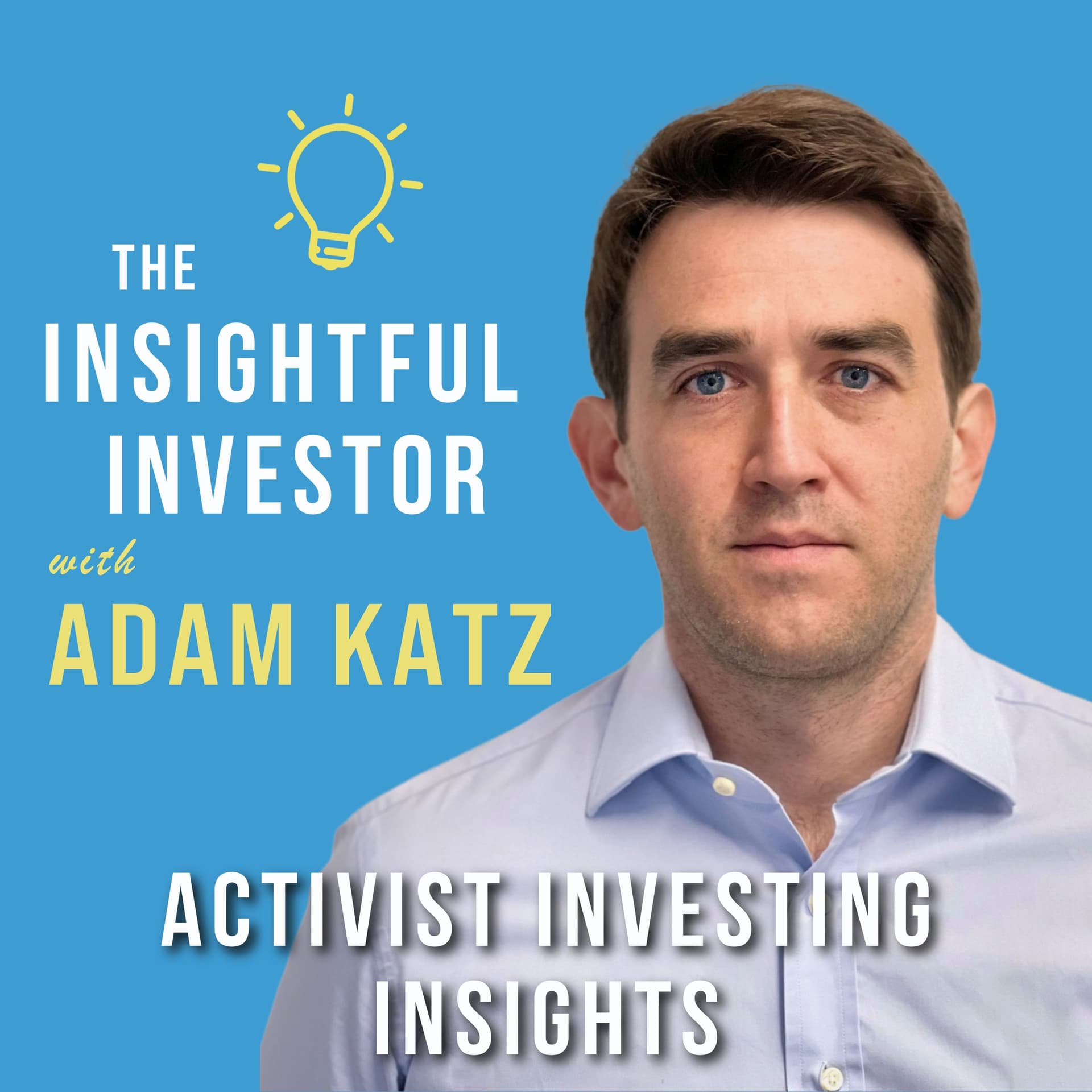
Episode Overview Title: #56 - Adam Katz: Activist Investing Insights Host: Alex Shahidi Guest: Adam Katz, CIO of Irenic Capital Management Air Date: [Insert Date] Link: [Insightful Investor](https://insightfulinvestor.org/)
In this episode, Adam Katz shares his insights on activist investing, particularly in smaller companies, drawing on his experiences at Elliott Management and Irenic Capital Management. The discussion touches on various aspects of risk management, market inefficiencies, and the evolving landscape of activist investing.
---
Key Discussion Points
Introduction to Adam Katz
- Co-founder and CIO of Irenic Capital Management.
- Background includes nearly a decade at Elliott Management.
- Early interest in investing sparked during the dot-com bubble.
Foundational Concepts in Investing
- Katz emphasizes the importance of variant perception: having a viewpoint that differs from the market consensus.
- Discusses the idea of investing as a way of assessing and predicting future states of the world.
- Highlights the need for insights that incorporate multiple disciplines—psychology, economics, etc.
The Role of JD MBA in Katz's Career
- Katz's JD MBA provided him with a unique understanding of corporate governance, mergers, and capital allocation.
- His legal background informs how he navigates the rights of minority shareholders and corporate structures.
Lessons from Elliott Management
- Intellectual Humility: The importance of asking questions and understanding deeply.
- Partnership Dynamics: Observing effective partnership strategies between leaders like Paul Singer and John Pollack.
- Risk Awareness: Acknowledges the need for managing risk proactively, especially in uncertain market environments.
Activist Investing Strategy
- Focuses on smaller companies, with a desire to uncover and unlock value.
- Employs process-driven investment strategies similar to those at Elliott but tailored to smaller capitalizations.
- Emphasizes the importance of engaging with companies rather than merely investing passively.
Value Addition to Companies Katz enumerates several means through which Irenic adds value:
- Operational Improvements: Enhancing performance metrics compared to peers.
- Capital Allocation: Advising on the intelligent use of free cash flow.
- Corporate Governance: Seeking better board structures and practices.
- Investor Communication: Articulating strategies and value propositions effectively.
- Structural Changes: Sometimes advocating for divestitures or going private when beneficial.
Challenges and Opportunities in Activist Investing
- Observes a shift in market dynamics, particularly the increasing influence of passive investment strategies.
- Identifies opportunities in overlooked small and mid-cap companies that may be inefficiently managed or positioned.
Reflections on the Market
- Discusses the evolving landscape of corporate governance, especially as ownership consolidates among a few passive entities.
- Questions the efficiency of current markets, suggesting that many companies remain under-researched and inefficient.
Conclusion
- Katz shares his views on the principle-agent problem in corporate governance, emphasizing the need for alignment between management and shareholder interests.
- Highlights the common misalignment in incentives, especially in public companies, and the psychological pressures faced by CEOs.
---
Key Takeaways
- Variant Perception: Critical for successful investing; having a different view from the market is essential.
- Importance of Legal Knowledge: Understanding shareholder rights and corporate governance can provide an edge in activist investing.
- Engagement Over Passivity: Actively working to improve companies can yield better returns than simply relying on market movements.
- Navigating Market Inefficiencies: There are significant opportunities in smaller companies that may be overlooked by larger funds.
---
Contrarian Views
- Katz believes that while markets are becoming less efficient, the ability to predict the future value of companies remains a significant challenge. He contends that many investors may overestimate their capacity to forecast future performance accurately.
---
Closing Thoughts This episode with Adam Katz provides deep insights into the complexities of activist investing, the importance of engagement, and the challenges faced by both investors and corporate leaders in a rapidly evolving market landscape.
For further inquiry and feedback, listeners are encouraged to visit the [Insightful Investor website](https://insightfulinvestor.org/) and subscribe for future episodes.
Written by AI. May contain mistakes. Listen to the episode to check what was said.
Transcript
Automatic transcript. May contain errors.0:05Welcome to the Insightful Investor Podcast, a weekly series that seeks to share industry, investment, investment, and market insights. We define insights as concepts that are counterintuitive, widely misunderstood, or underappreciated. In other words, unique ideas that you probably won't hear elsewhere. I'm Alex Shahidi, the host of the podcast and co-CIO of Evoke Advisors, a leading investment advisory firm. Learn more about our show at insightfulinvestor.org.
0:38I'm pleased to have Adam Katz with me today. Adam is the co-founder and CIO at Irenic Capital Management, which is a New York-based hedge fund. Adam spent about a decade at Elliott Management prior to Irenic. Adam, I'm so glad you can join us today. Thanks for having me. Let's go back to the beginning. What would you say initially drew you to the world of investing? I was, I guess I grew up during the dot-com bubble, right? So, during the 90s. And I'm not sure if you can call that investing necessarily, right so but whatever was going on in the 90s uh but the idea of deploying capital uh you know and having that capital work for you and produce a return that was kind of in the ether or sort of in the in the ecosystem uh you know in in 90s so that was in and of itself kind of interesting to me and sort of just being around that and sort of seeing that uh so that was the first parts of going way back to sort of the beginning and then uh there's a there's a really wonderful book uh It's an old book now, actually.
1:37A guy named Robert Hagstrom wrote a book called Investing. I think it's about Investing as the Last of the World. I may not have gotten that exactly correct, but Investing as the Last of the World. And what Hagstrom wrote about is this idea that to develop an investment thesis requires bringing insights across many disciplines and sort of stitching them together. So maybe it's psychology, it's economics, it's biology or engineering or all of the above and stitching them together to develop a view of actually of reality. And if you think about what investing is, it's sort of like assessing, like, what does the world think about?
2:12How is the world assessing the likely, you know, future states of the world, right? How do market participants assess the future states of the world? And do I have a different view of those of the likelihood of those various future states of the world? And then I'm putting that view into practice and then sort of investing around that view. And then ultimately, the market will determine and events will determine if you're correct or not. And I've always loved reading, always a wide range, history, biography, current events, anything nonfiction across a wide range of disciplines. And so the idea of developing a view of the world, thinking about how my view related to the views of other market participants, of other people, being able to say, hey, I think I'm right about this, and then sort of test that proposition.
2:56and do and that test is also the important part one of the things that was always appealing to me about investing is there's investing outcomes are objective there's no there's no you know teacher at the end of it where you submit a paper and it's like okay you know this is an a work or this is b work there's no office politics there's no uh you know there's no tenure track committee like in academia and so you have to like navigate you know university uh politics and all that it's simply the outcome is the outcome and it's objective and it's real. And so that was always very appealing to me. You know, it's interesting what you just described.
3:31It sounds to me, it sounds very intuitive to you. It sounds like it sounds very intuitive, but there's, there's an aspect of it that just in my experience is quite different from the way a lot of people think about investing. So what people think about is what do I think the future holds? And I want to invest in those things that I think will benefit from that future, the future state. And what a lot of people miss is what does the market think and how are my views different from the market? And that is a huge difference. And in some ways, it's very counterintuitive. It's that idea, that concept that you have to have a different or I think that a lot of investing goes around the idea of a variant perception.
4:11Having a view that's different from other market participants, that's always made intuitive sense to me. I'm not entirely sure exactly why. But famously, Charlie Munger talks about investing as kind of like a paramutual, right, where the odds are in part sort of dictating and moving around based upon how people are betting. That has always made sense to me, has always made intuitive sense to me. It's also, I think, informed – I mean, by the way, I'm sure or imagine we'll probably get to this later in the conversation. But if you think about the nature of what we do and how we invest. I mean, the idea that having a real understanding of where we're different or where we're adding value or where we're doing something different than other market participants is critical to how we approach investing in every aspect of what we do.
5:02Yeah, because, and we'll get into this obviously, but if you have some control over future state, and that is insight that others in the market doesn't currently reflect, that is clearly an edge. The genius of market systems is that in the absence of having an edge or having something different, there should be no excess returns. And so I think that is our basic sort of intellectual construct on how markets, whether that's securities markets or markets broadly, markets in which corporations compete with each other. How does capitalism work? Capitalism is designed to arbor away excess returns in the absence of some differentiated insider edge.
5:41Well said. So still in the beginning, before you got into investing, you decided to pursue a JD MBA. How has that influenced your career path? I don't think I would have gotten my start at Elliott absent doing a JD MBA. I had a very unusual background before going to Elliott. I'd actually run an e-commerce business before doing the JDMBA and actually did it a little bit for my first two years when I was in law school and a business school. So I didn't have a traditional finance background of a couple of years in banking, a couple of years in private equity and then Elliot. So I don't think I would have had the opportunity at Elliot absent going to do the JDMBA program.
6:22And obviously that was a formative experience for me and a wonderful experience. So that's, I think, the first part of doing the JDMBA and how it shaped me. That's one. I think, too, I spent a lot of time, especially in the back half of it's a four year program that I did, especially back after the back two years of that program, really focused on corporate governance, on mergers and acquisitions law, on bankruptcy law, and really having a deep understanding of how all that works. And that's gone on to inform what we do today at Irenic, where we're spending a lot of time in equity activism. We do some opportunistic corporate credit.
6:54We're doing things that tend to have an element that touches on the sort of legal rights afforded to either minority shareholders. And every shareholder in a public company, or not everybody, the vast majority of shareholders in public companies are minority shareholders, right? If you own 100 shares of Google, you're a minority shareholder. What are the rights afforded to you as a minority shareholder? What can you do? What you can't do? how are you able to hold the management team and board to account? All those kind of things are things that I was thinking about from law school. And also then obviously the case of credit, like those are obviously credits are basically, credit securities are essentially dictated by contract, right?
7:31Your rights and obligations as a creditor are defined by contract. So those are, I would say, those are very practical. I'd say the third aspect of it, and I think actually, and Elliot thinks this way too, And my former ultimate boss, Paul Singer, was a practicing lawyer before he started Elliott. And I think what permeates that organization is thinking very, very deeply about just reading the documents. If you own a bond, read that indenture. If you own a part of term loan, read that credit agreement. Going through it, just reading the documents, reading it closely, reading it in detail, thinking about all the different ways in which a motivated counterparty could sort of navigate around those documents to secure economic advantages at your expense, being very, very thoughtful about all those things.
8:15I think a lot of that started at law school and that was obviously enhanced by my time at Elliott. As I think back on it, over time, the law school aspect or the law school part of the JDMBA, the JD part of the JDMBA has tended to predominate in my thinking. You know, I'm going to share my personal experience because I also went to law school and I'm curious if you agree or disagree with this perspective. So I studied economics and then I went to law school. And I think, you know, my mind works in black and white. And I saw the world in black and white before law school. And when you go to law school, they train you in the shades of gray.
8:52So, you know, you ask an attorney a question, the answer almost always starts with it depends because they're operating within that shades of gray. And what I found in, and I didn't know this in advance, but I've learned since, is that investing has a lot of black and white and a ton of shades of gray. So having that balanced thinking has actually been very beneficial. I couldn't agree more. I mean, I think the other thing that law school does, it forces you to recognize that markets are a product of legal structures and legal norms that have been established that enable people to sort of compete in trade and participate in free exchange.
9:27And the legal rules and norms will shape how exactly everybody operates in those. That's one. Two, you know, if you say to me, you own I'm not making this up, by the way, but you own 100 shares of Apple and 100 shares of Google. You know, I think most people, certainly I would think prior to law school, that's basically the same thing where the residual you own the sort of you're the residual claimant on cash flows. Right. That's what equity is. You're the residual claimant on cash flows of the company after creditors and tax and all that has been paid. But in fact, actually, 100 shares of Apple and 100 shares of Google may be very different things.
10:03Again, making this up. Apple might be domiciled in Delaware, and Google might be domiciled in California. Again, making this up. Delaware, directors generally offer fiduciary duties to shareholders. Google may be in a state that's an expanded constituency state where the directors have duties to a broad set of quote-unquote stakeholders. So it could be shareholders, it could be employees, it could be communities in which it operates. So, you know, just think, and then if you're an Apple, just to expand this point, you know, if you're an Apple shareholder, you might have the ability to call a special meeting if you own 15 % of the company, or you might be able to act by written consent in terms of removing directors or, you know, nominate director or things along those lines.
10:38You know, you may not have those same rights at Google. So, you know, understanding and thinking deeply about what it means to actually say, I own 100 shares of something or I'm a bondholder. You know, really, I think law school helped to help think about that. Yeah, that makes sense. So you spent about eight years at Elliott. What would you say are the most valuable lessons you took away from that experience? I'll maybe break this up. And maybe the first part of this might sound a little bit... I don't want this to sound cliche or trite or any of those. And these are... I think they're actually extremely important investing lessons, but they're not obvious investing lessons, I would say.
11:13And the first thing is, and I have tremendous admiration for Paul Singer and for John Pollack for the entire team at Elliott and my boss from the George Thomas there, Dave Miller. It's an extraordinary group of people. It's a wonderful institution. And I think one of the things that Paul and John and everybody at Elliott really does well is says, I don't know, sits in a meeting, just says, I don't know, or wait, slow down, explain that to me again, or I don't get it. Explain that to me like I'm a five-year-old. And there's a real willingness. There's no fear about, hey, I'm going to look stupid if I ask this question.
11:50Just always ask the stupid question. And I think the firm – and that starts at the top with Paul and with John. And that idea of being willing to look silly just to make sure you really understood something, really understood something deeply, that ethos permeates the firm. And I think that's a wonderful thing. And I think that helps avoid a lot of mistakes. So that's the first thing. The second thing is I co-founded Irenic alongside my partner, Andy Dodge. And Andy and I have known each other for 20 plus years. We lived together in college for three years. But watching Paul and John as partners and watching the ways in which they respect each other, the way they treat each other, the way they hashed out disagreements, that was a real lesson in how to do a partnership right.
12:35I think one of the ways, if you look at how do firms like ours ultimately struggle or not work or blow up, I mean, I thought a lot about this when we started our firm, is partnerships is having two people start these things and have a falling out and not get along. And so we spend a lot of time thinking about how we work together, what our division of labor is, how we treat each other. And just seeing that example from Paul and John was really wonderful. was wonderful. So I say those two things don't, don't seem like they're not like, this is how you hedge or this is how you do activism or this is how you read a credit agreement, but they're, those are extremely useful lessons.
13:09I think that those are the first two things. I think if I, in the department, I mean, there's, there's so much in terms of just the tactical aspects of say, doing equity activism, you know, engaging in process driven credit, and go through all those different tactics. But I think the most important thing, and this goes back to even the original discussion we had a few minutes ago about how to think about markets, is there's a real intellectual humility to Elliott and to that firm. And the firm doesn't think it can necessarily, at least it's my view of the firm. I shouldn't speak for the firm. This is my view of my assessment.
13:49The firm doesn't necessarily think it could see the future better than the next person. What it does is it actually says, hey, we're not smart enough necessarily, or our hit rate on seeing the future better than the next person may not be sufficient to drive compelling risk-adjusted returns. But we can work harder. We can drive change. We can make things happen through our own, I think Paul would use the phrase, quote-unquote, manual effort. And I think that idea of making things happen, of getting paid for your work, I took away from that firm what we're trying to do at Irenic. In other words, being honest about the factors within your control and those beyond your control and those that are not predictable.
14:39That was a shorter, better way of putting it than I did. It says, yeah, I'll take that. But Elliot also has a very strong reputation, I guess it's related to this, of being highly risk conscious. How did that perspective shape your approach to risk management? And how do you generally think about risk? If you're humble about your ability to predict the future, right, you're not, let's just make this concrete. If you're saying, hey, I want to invest in a company that is exposed to the aerospace cycle. So what you might say is, okay, hey, I'm not sure I can predict the aerospace cycle better than the next guy, but I can do things at this company, improve its operating margins, work with the company to improve capital allocation, enhance corporate governance in various ways.
15:22Those are the things I can change. What I can't do is either predict or affect the aerospace cycle. So what I'm going to do is sort of hedge out the risks associated with the part that I can't necessarily predict better than the next person or affect. And so I think that's at the core of, I would say, what's called the position level hedging. And it's really that we do. And I think that we do at Irenic and certainly that, you know, my assessment that Elliot does. I think there's a second layer, which is just, you know, spending, you know, a fair amount of time thinking about the kind of sort of Rumsfeldian known unknowns and the kind of, you know, wondering and trying to bring content to the unknown unknowns.
16:04and just finding ways of trying to mitigate those various scenarios in the way you can start the portfolio and the way you put on certain sort of tail risk type hedging positions. My expectation and my experience is the unknown unknowns are probably the most dangerous. I agree with that. Yeah, absolutely agree with that. So Elliot, you mentioned this just now, hedges out as much of the market risk as possible, largely because it's kind of beyond your control. And if you have a lot of control in other areas that can add value, then it makes sense that conceptually you'd want to hedge out as much as you can't control.
16:41But that also can be costly because markets tend to rise over time. So how do you think about that in terms of the net cost over time? Markets do tend to rise over time. I think we've generally, though, I mean, we've been in a reasonably benign, let's call it, 50 to 60 year period of world history in some way. So you can sort of say, OK, well, it's been a lot of events, but they generally sort of, you know, it's been a tropism for the positive, at least for sort of called Western securities markets. Open question if that's true over the next 50 to 60 or 70 years. So, I mean, there's a real unknown unknown in that sense.
17:16And I think it's worth considering that. That's the first thing. I think the second thing is if you look at great investment track records and I think about, you know, Andy and I, we started this firm. Our ambition is to build this firm over the next 30, 40, 50 years. And if you look at great investment track records, and I think in almost any way, to even call an investment track record a great investment track record, it has to be a track record that has gone on for a long period of time through multiple market cycles. I think then you could say you have a great investment track record. One, two, three, four, five, that may not be enough to even say, I think that you have a great investment track record.
17:49It's got to be longer than that. And I think if you look at great investment track records, those track records tend to be characterized or there's evidence that the investor has had liquidity when other people don't and has been able to take advantage of large dislocations in markets. And so I'm thinking about – and there are various ways of having liquidity when other people don't. So if you look at, say, Baupost, for example, there's a wonderful piece. I think it's probably a decade-plus old by a partner. I think it's like Brian Spector, I think was the partner of Baupost, who wrote this piece online.
18:25And Baupost runs generally with a very large cash balance at Baupost. And the basic idea – and people said, well, Baupost did these great returns despite running with a large cash balance. And this guy's point was, no, no, no, no. What you have to realize is the cash is sort of an option. and the performance wasn't despite the cash balance. It was because we had this cash when disaster struck, when liquidity was scarce, and then we were able to deploy that cash at extremely attractive rates of return in those moments. So that's the ValPost model, run with a lot of cash and have that liquidity when you, and I'm obviously oversimplifying some of the stuff, but have that liquidity when others don't.
19:06That's one model. You obviously have something like a Berkshire Hathaway, which has operating businesses that generate a substantial amount of free cash flow per year that send that cash flow back to Omaha to then be allocated. It's got a substantial amount of insurance float. It's just generated on an ongoing basis that then Berkshire has the ability to invest. That's another model. And I think if you look at the model from Elliott, it's that you have hedges that tend to increase in value in large market dislocations that can then be monetized and allow you to be aggressive in large market drawdowns.
19:38I think there's so those are I would say three different models I think we generally tend to be obviously we don't own large insurance uh subsidiaries or or have operating companies that are sending us cash cash we're sorry probably more in the sort of Elliot Baupost camp of how to think about the world and those are maybe aspirational we aspire to be you know mentioned in that conversation but that's how we that's how we think about the world uh I'd say in addition I think this is important and I think I've heard Paul talk about this there's a psychological insight that I think is real, which is if you're experiencing a very large drawdown, if you're losing a bunch of money in periods of market stress, it's very difficult psychologically to be aggressive in those moments.
20:16Yeah, because your natural inclination is to be defensive as opposed to playing offense. Exactly. And if you are hedged, and if you do have, if you thought, if you put those hedges on prior to this large market drawdown, you're then able psychologically to play offense. You know, you've mitigated some losses. Probably you're still losing money, but not as much as everybody else, not as much as border markets. And then you could monetize some of those hedges and play offense. So I think that psychological insight is important into why we're hedged. And related to that, I suppose you could also play offense more aggressively during good times when you know you have a backstop.
20:52Yeah, I think that's absolutely right. And that's a great point. And there's an important – so that's true broadly. And then there's a specific – when you think about it at the position level, it's a really good point, I should have mentioned this, is being able to be hedged and being willing to be hedged widens the aperture, let's call it, of positions that you can put on. So let's imagine – I'm, again, making this up – but let's imagine that you find that there's a really good opportunity in a business that sells into the automotive end market. right and you may say i don't i don't know about the automotive cycle i don't know if you know we're going to do 15 million SAR or 16 million SAR 18 million SAR next year and how am i going to figure that out right well if you hedge and you say i can you know belong you know what i can do is we belong this one company automotive industry that i think has a lot of different value that i can unlock through my engagement okay and i could hedge out the automotive cyclist then you could actually put the position on then that's an actionable opportunity if you're not hedging You may say, yeah, the cycle is just, I can't figure this out.
21:51It's too hard. So the willingness to be hedged at the position level to hedge out the industry and end market risk with which you're uncomfortable actually enhances your ability to put positions on the page, even in good times or bad times. Right. It basically broadens your universe because now what you're investing in isn't the market exposure plus whatever value you feel like you can extract. You're basically hedging out the market risk and you're limited to the value that you can focus on. That's exactly right. So you made a big decision about three years ago to leave Elliott and co-found Irenic.
22:23Would you talk us through that? I would say four different things to think of. First is, I think, and this is by no means, I don't think I'm saying at this school, it's by no means a knock on my old shop. I think as that firm grew larger, I mean, there were a set of opportunities, I think, in smaller companies that I thought I'd be able to access with a smaller firm, with a smaller balance sheet that were just not practical to necessarily access at a much larger organization. I thought those opportunities in smaller companies were compelling, were interesting, were highly asymmetric in terms of the up-down risk reward in those situations.
22:57That's one. Two, my partner, Andy Dodge, who, again, I've known for a long time, he was at a firm that was mostly focused on those small and mid-cap companies. And we would talk all the time, I mean, he'd call me or I'd call him, and I'd say to him, what are you looking at? What stocks are you buying? What credit is interesting to you? And I found him increasingly talking to me about small and mid-cap companies that were really interesting and really compelling. And what he was great at, and Andy's strength is really, and this is not false modesty on my part, Andy's a better bottoms-up fundamental investor than I am.
23:35And he's, in my personal opinion, the best bottoms-up fundamental investor I know. and he's great at uncovering value and finding that value. And I think my strength is maybe unlocking the value that he finds. And so the idea was, right, can we put those two things together, his ability to uncover value, my ability to unlock value and do something really compelling in the small mid-cap space. And then I think the third point is when I think about Elliot, like I say, four points, but third point is when I think about Elliot, I think they're the best in the world at process-driven investment. And I thought if we could just take kind of that playbook or set of tactics that Elliot had honed over the years, and I learned that from that playbook and bring that down market, we could do something exceptional.
24:21I thought there was just a white space in that part of the market. And then the fourth thing is, going back to the very start of this conversation, I think you have to – investing is this curious mix of being willing to say, I can do something, I can make something happen in a situation, and also being extremely humble about your willingness or ability to sort of see the future or be smarter than other market participants. and certainly I think Andy and I both inform Irenic. We want to see kind of how good we were and how good we are and I think that's a real part of this. I mean, when you're in a larger organization, to what extent is your success or what extent are your successes or your failures a product of your own efforts, your own, what you've done versus the larger organization.
25:07So we want to see for ourselves. So you've touched on this a little bit, but could you share your vision for Irenic and what sets it apart in the hedge fund landscape compared to competitors? Yeah, so break that part up. The first part, I think, is relatively straightforward. The first part is we want to be the world's best process-driven investor in investing in generally public securities, so across the capital structure, equity, and credit, in companies that are generally less than$15 billion in enterprise value. That's what we want to do. Full stop. The second part about what sets us apart is, I think there's a whole – David Einhorn, who's obviously a brilliant investor, has written in some of his letters lately that he thinks the market is broken.
25:52That the changing – for a variety of reasons, he points to, for example, that the shift from actively managed mutual funds to passive ETFs have left a number of securities, traditional value investor type securities, orphaned small mid-cap companies, He's generally orphaned in public markets. And I'm oversimplifying here. But in the past, he would go and find this undervalued company and buy stock in the undervalued company. And he'd kind of sit around and just wait for that under-followed, under-covered company to be discovered. He'd wait for mutual funds to come and say, oh, this is a really interesting business with increasing earnings power, with compelling moat, whatever it may be.
Read the full transcript
26:31And he'd wait for those mutual funds to go and start buying it. And now, because of passive flows, because of ETFs, whatever it may be, that process of discovery does not happen in the same way. And I think Cliff Asnes, from a more quantitative perspective, maybe top-down looking at different trends, has also sort of written some stuff lately about the challenges in markets and the ways in which markets might not be as efficient as when he started his career. And I think what we've – what I think maybe sets us apart is we just decided we're going to make stuff happen. And the universe of firms that actually make stuff happen as opposed to, say, just picking stocks, I think is reasonably small.
27:06And I think that's what sets us apart. One, the willingness to make stuff happen. Two, both the knowledge and ability to operate across the capital structure, I think, are probably our defining characteristics. So you just brought this up that most investors are passive. They buy and they wait. So at a high level, would you talk about how you add value to the companies in which you invest? How can a company be improved? One question, right? And if you think about, there are probably four or five, let's use four or five different categories. One category is you can improve the operational performance of the business, right?
27:41The operating margins of the business might be lower than it should be based upon benchmarking to peers that operate in the same industry, right? So you might be earning 15 % EBIT margins as opposed to 20 % or 25 % that your peers are earning. And maybe that's because you price your product incorrectly. And maybe that's because you have too many facilities and you've got to consolidate facilities. Maybe that's because you have a bloated workforce and you need to cut costs, whatever it may be. So there's improving the operating performance of the business. And what we do in our investments is we bring in, almost like private equity does, we bring in an operating partner, somebody from industry who helps us diligence the investment, diligence the business, and actually helps us put together a performance improvement plan for the company in which we're invested in.
28:21And so that person will help us figure out, okay, can we actually improve those operating margins? If we're going to improve those operating margins, how are we going to do it? Right. So those are that's you know, that's one operational improvement. It's one area. Second area might be capital allocation. You might have a business that's operated really well day to day, but they don't allocate capital all that intelligently. So they take the free cash flow of business and then they they spend it on the pre-cap ex, let's call it pre-R &D cash, free cash flow of business. and then they spend it on unnecessary capital expenditures.
28:49They spend it on wasteful R &D. They go out and do poorly considered, poorly thought through M &A, value destructive M &A. It's very common. There are a variety of different ways in which capital allocation can potentially be improved in a company. That's a second area. A third area can be just corporate governance. This is a company where the board doesn't have the right skill set to actually steer the company for the long run. There can be ways in which the company might have a dual class share structure and then trade at a discount as a consequence. The company might be incorporated in a jurisdiction, unlike Delaware, that is an expanded constituency state and trades at a discount as a consequence of that.
29:24There may be a variety of ways in which you can improve the corporate governance. It might be a staggered board and you move to a de-staggered board. That's one where shareholders can sort of elect the board each year as opposed to a subset of directors each year. There are a variety of ways you should improve the corporate governance of a company. The fourth area in which it sounds kind of soft, but we see a lot, is investor communication. actually communicating to investors, communicating to market participants. This is what we do. This is how we do it. This is why we're compelling an investment opportunity.
29:50This is why you as an investor should entrust your capital to us. Those are kind of four different buckets in which to think about how we improve a company. And it's obviously highly situation specific, right? So it's not like we have, okay, we always do X, we always do Y, we always do C. What I would say is it's rare for us, and I think we generally try to avoid situations that require a change in management to achieve the improvements that we seek. And the reason for that is pretty straightforward, which is, I think there's a mistake that is made off an outside looking at what people like me, activist investors do.
30:35We're not in the fighting business. Our job is not to go out and get into fights with companies. That's not what we want to do. That's not what we like to do. And I'd prefer if we were never in the newspaper. I would prefer if we never had to run a proxy. I'd prefer if none of that ever existed. Our job is to go out and make money. Our job is to go out and produce performance improvements that actually produce compelling returns for our investors. And the easiest way to get into a fight with a company is to sit down and sit across the table from the CEO. And you say to the CEO, he or she, you say, Mr.
31:04CEO, the way we're going to improve this company is by changing the CEO. Usually the CEO doesn't like when you say that. So we try to avoid those situations. I should add a fifth, and I think this is an important one. It's a big part of what we do, and I shouldn't have caused it. It would change maybe the organizational structure of the company. Maybe the company should be split apart. Maybe it should sell a division and sell some assets. Sometimes a company may be one thing. I'm talking about this about smaller companies. Sometimes a lot of these smaller companies shouldn't be public companies in the first place.
31:34These companies, it's unlikely that they're ever going to be appropriately valued in public markets. That's fine. And so if that's the case, the company should consider going private. So those are, I would say, the five different ways we can affect, we tend to try to affect change in a company. I like to double click on one of those items that you just mentioned, which I think was number four, this idea of clearly articulating the strategy and the approach. And I think that kind of goes back to this notion of, if you can be clear in your thinking and your understanding, clear in your writing, clear in your speaking about what the goal is.
32:08And usually that's at a higher level. I feel like so much of that is often missed because people are focused on the details. They're too zoomed in. And sometimes you have this experience of a fresh set of eyes comes in and see something. I view that as they're properly zoomed out and they see what the vision is and they can clearly articulate. It's such an important aspect of all this. I couldn't agree more. I think it's funny we're doing this in an interview type or conversation type format. I mean, I personally prefer writing. I mean, I think our view is clear writing is evidence, maybe necessary, but not sufficient evidence of clear thinking.
32:44We have a very written culture at our firm. We try to do a lot of things in the form of written communication, written memos, written letters to the companies in which we're invested in. So we're a very writing oriented firm. I think just to go through on your question, I think you'd be surprised, or I think most people, maybe you wouldn't be surprised, but most people would probably be surprised if you went to the CEO of a publicly traded company. And then you went to the board of directors and said to each person, hand them a piece of paper. And you said, can you write one page on how your company creates value for the owners of the company, the shareholders?
33:17I bet you a good number of them couldn't do it. What are the competitive advantages of your business? you know and and or they couldn't do it without writing a bunch of kind of corporate jargon and all that but couldn't like in very clear simple basic prose tell you how do you make money how do you create value for your owners why do you think that is i think it's what you said which is you get you get focused on you know if you're a ceo you think okay i'm hired by the board to do a job and that's not i mean anybody who owns a business doesn't think themselves as if you're a business owner you're on a small business you're a uh you're an entrepreneur who's built a business you don't think so i am my job is to run the company no your job you own the business your job is to create value at the enterprise that's your job right and i i think but most of you say okay i'm hired by the board i'm hired by the board to do a job my job is to increase the you know revenue of the business my job is to uh you know increase the your ebda of the business the earnings of the business or my my you know my job mostly is not to get fired.
34:16So that means hitting my quarterly earnings estimates every quarter. Those are the kind of things that most CEOs think about day to day. It's understandable. This is not because these CEOs aren't smart. It's not because they're not capable. It's not because they're not thoughtful people. It's just the pressures of the job are immense. And the day-to-day demands of the job are immense. So I think one is maybe if I break it down, I'll probably try to make this as clear as possible. One would be there's a psychological thing about how CEOs approach the job. They're doing a job as opposed to owning a company, one.
34:54Two, and this, by the way, is true of the board, members of the board, too. I think a lot of board members view themselves as being their job is to be a good director as opposed to be a good owner. Okay, so that's one. Two, I'd add the incentive structures for CEOs and for executive teams are often not necessarily aligned with the ways in which value can be created for shareholders. That's another way in which we can often improve companies by increasing the alignment around value creation for shareholders with the ways in which the executive team gets paid.
35:27So one, psychology. Two, incentives. Three, I'd just say the day-to-day demands of the job.
35:36If you're running a business, there's usually a crisis every day. And then you've got, on top of which, you've got public markets, you've got a quarterly cadence. So you're quartering every quarter. You're worried about how people can react to that, how are analysts going to react to that. So I think those are probably three things, sort of psychology, incentives, and just natural sort of day-to-day demands are the reasons why. What you're saying makes sense to me in that if you can identify and clearly articulate and execute creating value for the owners, then that should benefit everybody. and you can mess that up in a lot of ways.
36:14So it sounds like a lot of what you're thinking and your perspective is you see the gaps in creating value for the owners and you come in and try to execute that. And I guess a lot of it has to do with convincing everybody involved that this is the way it should be approached. Yeah, I think that's exactly right. And look, some of these things, right? I mean, I don't, there's a larger conversation, But I think that we haven't quite figured out how to appropriately pay executive teams and public companies. I mean, I think the way in which I think that if you look at there's a reasonably linear relationship, let's call it, a high correlation between the size of a public company and the compensation of the CEO.
37:00It's not obvious that that should be the case. And certainly that in and of itself generally creates a misalignment of incentives. Okay, maybe a company should get smaller. Maybe it's really good. Maybe it's got five divisions, and it's great. It's really well positioned in two of those divisions. It's competitively advanced in two of those divisions. It earns compelling returns of capital, can deploy incremental capital at high rates return in those businesses. But the three other ones, it should maybe just sell those three businesses. It should exit those three businesses. But then the CEO is running a much smaller company, and then maybe the compensation of that CEO goes down.
37:30I mean, maybe the ways in which we compensate the CEO generally in terms of, you've got to go read the proxy. And it's like reading a proxy is like it's this Byzantine kind of thing to try and figure out, OK, how is the CEO actually paid? There's an annual incentive plan, an AIP. There's an LTIP, a long-term incentive plan. And then the long-term incentive plan is around these four different metrics modified by this TSR metric modified by these board qualitative assessments. It's just it's a mess. And I don't think we've quite figured out how to create good alignment and proper alignment necessarily between public company executives and their shareholders in terms of creating long-term value.
38:06And that's an ongoing challenge. And look, that makes sense. I mean, basically, it's the broader principal agent problem that we consistently are trying to solve when you have a distributed shareholder base run by a concentrated management team. Also, you have a stock price that people look at every second. and that that drives more short-termism than it does long-term you know perspectives of creating value absolutely but i think the funny you know that's a one of the things that there's a uh i love this you know all the on the defense side and uh defense being that the advisors the law firms the bankers that advise companies when dissonant shareholders like us or an idea shareholders like us get involved uh they always say they always talk about guys like me as we're the short-term ones.
38:51We're short-termists and all that. And I think the most short-term person on the planet is sort of the CEO or is the management team, okay, when there's a heck of a shareholder involved. They're focused on the stock price. They're hyper-focused on the stock price day-to-day. We're not, actually. And I've been surprised, negatively surprised by how focused boards and management teams are on the day-to-day share price. I mean, we often just take us to back, or we constantly are telling companies, just do the right thing. If you think something's going to create value, just do the right thing. It's also a weird thing, too, because I think management teams tend to have this markets will figure things out.
39:29They think that, oh, if you can do something in the short run that makes things look better in the short run, markets won't see through that. Markets tend to see through that kind of stuff, and vice versa. If you have to take some pain in the short run for long-term benefit, markets, too, can sort of look through that and price appropriately. So we're always telling companies just do the right thing. It's so interesting. you know, if I'm an observer of this conversation that doesn't know much about the markets, there's a lot of parts of it that seem quite counterintuitive. So you're an outside investor coming in and you recognize that predicting the future is hard.
40:03So you want to hedge out the market risk. Whereas the people managing the company, they theoretically have more control over the outcome, but they're more focused on the things that they can't control. And they're driven by the things that they can't control. You know, the market price that changes every second. Yeah. It's also a funny thing too, or they're driven by the market price that change every second, which they can't control. And yet in many cases, boards and management teams own very little stock. So it's, but it's the stock price is viewed as this like day-to-day scorecard in terms of how they're doing.
40:34So it's coming slower. I've heard you talk about having an owner's mindset and you touched on that a little bit. Would you delve into that a little more? I mean, it's just this. It's thinking about what are the actions in any given situation that are going to maximize the value of the enterprise for its owners. And that's how a company should be run. Our job is to make MPB positive decisions at companies and not worry about all the other kind of noise that's out there in markets and press and all that kind of stuff. That's easier if you're running a private company, but it shouldn't be really different from a public company.
41:14Yeah. I mean, I think that's, I think the basic insight, I think that the private equity firms have done is they've tried to collapse some of the principal agent problems that exist, right? By getting essentially closer, by collapsing ownership and control, the distinction between ownership and control, right? So, you know, it's obviously not the PE partners that are running the companies that PE firms own, but generally it's the PE partners that sit on boards of the companies they own. Whereas by contrast, in a public company, you've got a public shareholder base, the shareholders elect the board, then the board then picks the management team.
41:44And the misalignment sort of occurs, the sort of board picking the management team and the board members not necessarily being fully aligned with the shareholders. And so the P guys try to collapse that distinction between ownership and control. But in theory, there should be no difference between the way a CEO approaches running a business that's a public company versus running a business that's a private company. what's value maximizing in a private context is no different than what's value maximizing in a public context. I mean, the number of times I've had executives say to us, well, if I do this, the market's going to hate, you know, it's the right thing for the company to do, but the market's going to hate it.
42:15And we're like, no, the market's fine. The market will be okay. Just explain it. Explain why it's great value, why it's a good decision, why it's thoughtful, why it makes sense, why it's an NPV positive decision, and the markets will understand it. And, you know, So that advice is often hard. That doesn't necessarily come, it's not all that successful. In your experience, how common is it to find public companies that are operating relatively inefficiently? I think the universe of public companies that are operating inefficiently is vast. I think the question or the massive, there's tons of them.
42:49I think the tricky part for us is not necessarily finding companies that are operating inefficiently. It's finding situations where we can make a difference, right? And so, and then that, there's a variety of considerations. It's one, you know, what is the type of change that needs to happen at this company? And are we in well-positioned to help that company affect that change? Two is, you know, given the nature of the shareholder base, given the nature of who owns this company. You know, remember, ultimately, any sort of, we're talking about equity activism, put aside credit for a minute. Any change that we make is ultimately about the power to persuade, right?
43:23Because basically the nature of securities laws in this country, right? Generally, you file a 13-D when you get to 5 % of the ownership of common stock of a company. You're subject to short-term profit rules at 10%. You're generally owning, if you're a shareholder like us or even a big firm like an Elliott or Bill Ackman or Carl Icahn, they're just operating in bigger companies than we are. But we own 3 % to 7%, 8 % of a company. We don't own – we can't force anybody to do anything. So we have to persuade the management team. We have to persuade the board of directors. We have to persuade other shareholders that we are correct in sort of what we think this company should do to create value.
43:56So question one is sort of what change does a company need? Or question two is are we well positioned to sort of affect that change? Three, do we know something about the change that has to happen? Are we intelligent and thoughtful about that change? Question three would be are given the nature of the shareholder base, given the nature of the matchmaking board, Or are we well positioned to make that change happen or to persuade the necessary folks of the merits of that change? And then fourth and probably the most important question, and by the way, it's a question that we start everything with, is putting aside all the things we want to do to this business, is this a compelling investment?
44:34Are we buying a business that we actually want to own? Because I think one of the challenges when you're in my job, I don't want to say it's like every year, when you've got to hammer everything, it looks like a nail kind of thing. But one of the challenges that I think – one of the ways in which activists or engaged shareholders tend to screw up, tend to mess up. Andy and I spent a lot of time thinking how do we screw – I mean I think it started this about our partnership. How do we mess this up? How do we blow up? What are the ways in which we get it wrong? And one way that we have seen activist investors like us get it wrong is just because something can be fixed doesn't mean you should spend your time trying to fix something.
45:10It doesn't mean maybe it's a business that's in a broken industry. Maybe it's an, you know, the number of, give you an example, you know, the number of investors that over the years, and not to say that there's not money to be made here in some way, but certainly not for us, that over the years have tried to go in and take positions in department stores, for example, okay, and go and try and, you know, fix department store chains, okay, or monetize the real estate department store chains, or all these other different ways in which people have tried to make money in department stores. and it's just and and i don't know if any of those have actually worked i mean you might know better than i do but it seems like that's just a really really hard way to make money uh and so what we've got to do before we even do all this stuff about you know what you know the the changes that are necessary our ability to affect that chain or ability to persuade all that which is this is a business that we actually want to own at a price that we want to own it and only if we can answer that question in the affirmative do we even get to the other questions about our ability to produce change.
46:01With as much detail as you're comfortable, could you provide any examples of how you've successfully improved companies in the past? Yeah. I mean, we've been involved at everything from a biotechnology company where we've encouraged that company to monetize a number of assets at that company that were under monetized. And we put an independent director in that boardroom and worked with that company to actually get two shareholder representatives at that company. And that company's in the process of cutting unnecessary costs, monetizing some assets and returning capital to shareholders. I've recently sat on the board of aerospace, kind of a subscale aerospace and industrial conglomerate that was overlooked in the public markets that's ultimately decided to sell itself to a private equity sponsor.
46:43We've been involved in a media business that owns a hodgepodge of assets, let's call it really good, high-quality assets, but kind of an unwieldy collection of assets. And we've been encouraging that company to sell some of those assets to split itself up in various ways, and it's in the process of undertaking a strategic review. We're involved in a healthcare services business where we're trying to reset the compensation structure for the executives in a way that better aligns the executives with the sort of value creation for shareholders. That's great. Now, do you feel that being a smaller investor, obviously there are some advantages, but are there some challenges as well?
47:21I think if you'd asked me that question a decade ago, I would say to you that the challenge is it'd be extremely difficult to do what we do, this engaged investing, non-investing, without bringing a lot of resources internally into the firm and bringing in terms of lawyers and PR folks and bankers and advisors and all sorts of people around these engagements. Over the past decade, decade plus, there's been the engaged investing, active investing world. There's been like a real cottage industry that has developed. And there is now a robust network of law firms, advisors, bankers, academics who are operating in this universe.
48:05And we can tap into those folks on an as needed basis. And so I think a lot of the disadvantages that existed as recently as even seven, 10 years ago have gone away. What would you say are the biggest challenges and opportunities in activist investing over the next five to 10 years? It's going to be really interesting. I mean, one ongoing question is going to be, how does the shift in assets from actively managed mutual funds to passive ETFs, how does that affect corporate governance in America? I think one of the most under-discussed things is there has been a quiet revolution where, if you look at a US-listed index-included company today, five out of the top five shareholders, certainly the top 10 shareholders, it's probably Vanguard, BlackRock, State Street, probably in that order.
48:58And that wasn't necessarily the case a decade ago. We've all seen these charts where it's passive flows are up and to the right, and active flows are sort of down to the right. And that doesn't seem like there's any sign of that changing necessarily. Right. So you're going to find yourself in a world where, you know, you know, corporate America is essentially owned by these big passive, you know, these passive giants. And how are they going to wield that power? John Coats, who's a professor in Harvard Law School, has written an interesting book. I think it's called The Power of Twelve. I think it's The Power of Twelve about how these organizations wield their power in the marketplace.
49:31So I think that's an ongoing question. I don't know if it's a pro. I don't know if it's a con. I think it's just an ongoing question as to how we navigate a world that is increasingly dominated by those three institutions in particular, but certainly that's just broader flow into passive investment strategies. So that's sort of one. I think, too, it's going back to this conversation about David Einert said, the universe of companies that are two, three,$4 billion companies. I mean, it's amazing to me. You have two, three,$4 billion companies. They're covered by one, two, sell-side analysts. Right?
50:00So it's also that being the investment research. I know you know this, but the investment research shops that put out research. So they're covered by one or two South Sudanels. Often these companies, their shares, they don't trade all that much. They'll trade 50 basis points in the market cap every day. And so the coverage on the buy side is a consequence of the limit of liquidity. That's also increasingly thin in terms of that coverage. I mean, there's a massive opportunity in these companies that probably shouldn't be public companies. probably have various ways that they could be improved even as public companies.
50:34They're just overlooked. So I think the universe of everybody's focus, right? Look, the S &P 500 was, I mean, you know, the S &P, I think last year was up 25 or so with dividends reinvested, I think it was S &P 500. The S &P 500, I think equal weight, correct me if I'm wrong about this, was up maybe 14 % equal weighted, right? So not capitalization weighted, but equal weighted. And then the S &P 600 small cap index, I think, was up 8.5%, 9%, if I'm not mistaken. So, I mean, beneath the surface of the extraordinary performance of a handful or two handfuls or so of securities, there are, I think, a number of companies that are increasingly undervalued, increasingly under-followed, increasingly ones that are attractive for us to make an investment catalyzed in positive change.
51:19So Adam, if you were to look back on your career so far, what would you say are the most valuable learning experiences or even the biggest mistakes that you've had? The biggest mistake and most valuable learning experience often go hand in hand, right? But when I was at LA, we were involved in the separation of what was then Alcoa Inc., the sort of broad integrated business into three companies, Alcoa, Arconic, and Howmut Aerospace. and I think we initially got, we had a thesis about the operating performance of the business being improved, but probably needed a management change at the business.
51:56And it took us a number of, took us multiple shots on goal, let's say, until we got the right CEO in place to do the management change. And that CEO, who now is running HowMed Aerospace today, who's an extraordinary CEO, a remarkably talented guy named John Plant. If you look at the returns to HowMed, it's been exceptional, but it took us a number of times to get the right person in John into that seat. And so the lesson that I take away from that is that, one, initially we had to have a proxy contest with Alcoa, with Arconic, initially to sort of get the first initial management change. So one was that lesson of, hey, if you want management change, you're often going to end up in a fight.
52:36That's one. Two, picking CEOs is really hard, really, really, really hard. And so I try to avoid, even if we're successful in advocating for change in management, I try to avoid situations where we have to change management. That makes sense. So Adam, the last question I'm going to ask you is, what is a contrarian view that you hold about markets or investing that you feel that most of your peers may disagree with? I think markets are pretty darn efficient, which doesn't sound all that contrarian. Well, today it's more contrarian. Right. But meaning, obviously, we've had this discussion about Einhorn and Cliff Adams and all these people saying markets are less efficient than they used to be.
53:14And I think that's very possible. And I think that's increasingly true. But I think broadly, I mean, look, one, one, the state, the obvious, right? You. I don't believe and the reason I say that that was a bit of a flip answer in some sense of saying, hey, I think markets are efficient. But I think certainly, you know, there are a lot of folks who spend a lot of time trying to figure out who think that they can. that the analyst, he or she, can have a better view on, say, NVIDIA's earnings power in five years or Microsoft's earnings power in five years or Apple's earnings power in 10 years or what the terminal value of Google is.
53:47I have no idea how anybody can be convinced that he or she has a better ability to predict the terminal value of those companies or the earnings power of those businesses in five, 10 years than the next person. I certainly don't think I can. I'm certainly not smart enough to do that. And so that's what I believe. And there's a lot of capital, a lot of investment, a lot of dollars managed by very, very, very smart people devoted to trying to figure that out. And I just don't think I have that. I have a hard time understanding how people believe that they can figure that out. Well, you can be fooled into believing that by guessing right and then the market confirming that you're right and then attributing skill to that rather than luck.
54:27Yeah, I think that's right. Well, Adam, I really enjoyed that conversation and I hope our audience did as well. Thank you for joining me. Great. Thanks, Alex. Really appreciate the time. Thanks for listening. We hope you enjoyed this episode. Please visit our website at insightfulinvestor.org to access past shows and learn more about our podcast. If you have questions, feel free to email us at info at insightfulinvestor.org. And if you enjoyed the discussion, please subscribe to this podcast to ensure you don't miss future episodes. And don't forget to forward today's conversation to others you think would enjoy listening.
55:04This podcast is provided for informational purposes only and should not be relied upon as legal, business, investment, or tax advice. All opinions expressed by podcast participants are solely their own opinions and do not necessarily reflect the opinions of Evoke Advisors, their affiliates, or companies featured. Due to industry regulations, participants on this podcast are instructed not to make specific trade recommendations, nor reference past or potential profits. And listeners are reminded that securities trading, commodity trading, and alternative investments are complex and carry a risk of substantial losses.
55:39As such, they are not suitable for all investors.
55:46Listeners should be aware that guests featured on The Insightful Investor may have current or past associations with Evoke Advisors or the host, including as an investment manager of a private fund opportunity by Evoke or access through an affiliated Evoke fund or as a client. Participation as a guest on the podcast should not be perceived as an endorsement or testimonial with respect to Evoke Advisors, the podcast host, or their services. Similarly, the inclusion of a guest on the podcast does not imply that Evoke Advisors or the host endorses the guest or any company with which they may be affiliated or employed.
56:25Evoke has neither paid nor received compensation from guests for their participation.
From the publisher
Adam is the CIO of Irenic Capital Management, a hedge fund he co-founded after eight years at Elliott Management. In this podcast, he shares his perspective on activist investing, particularly in smaller companies. Drawing from his experiences at Elliott and Irenic, Adam offers insights into risk management, market inefficiencies, and the evolving landscape of activist investing.


