
In short
Insightful Investor Podcast Episode Notes
Episode Title
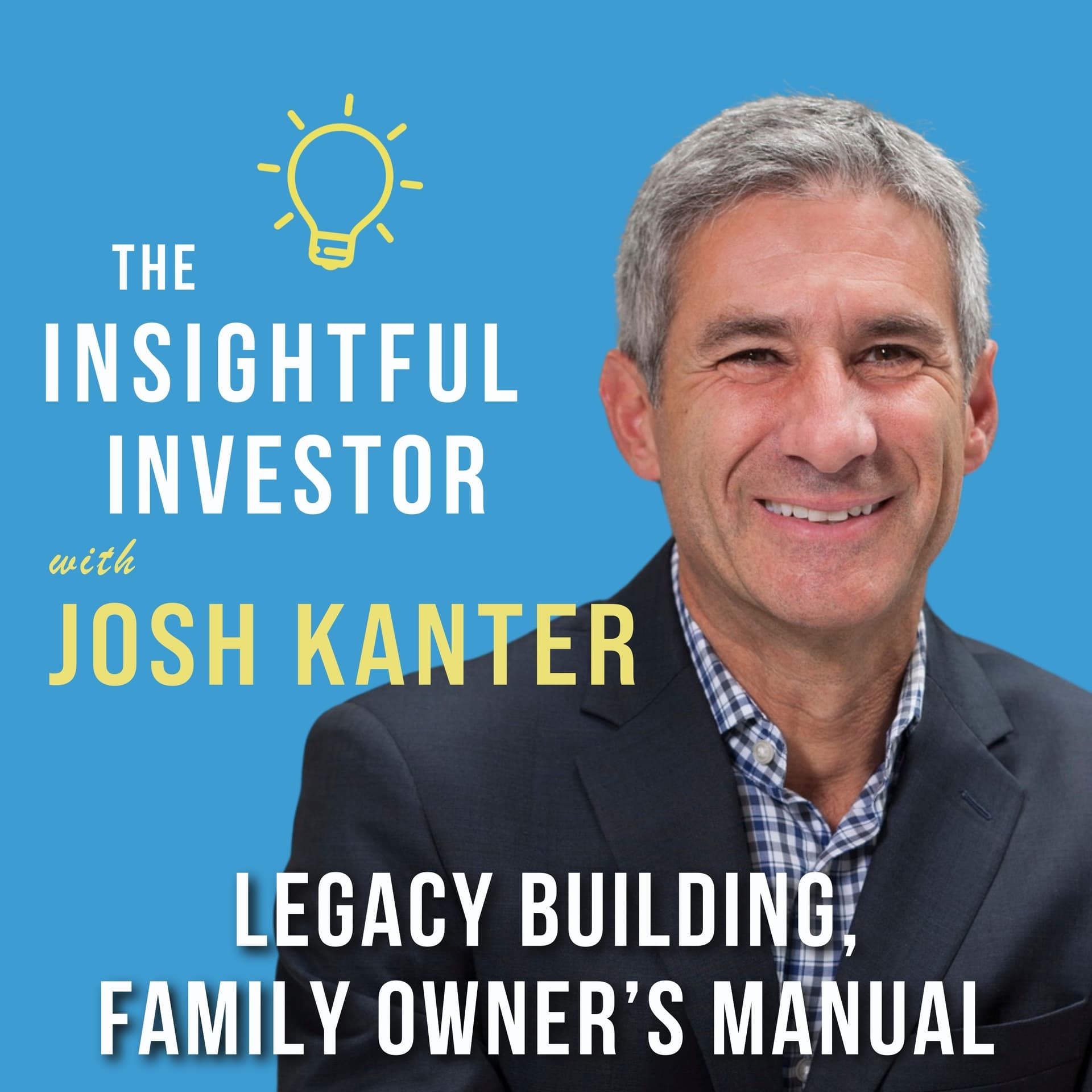
#60 - Josh Kanter: Legacy Building, Family Owner’s Manual
Host
- Alex Shahidi - Co-CIO of Evoke Advisors
Guest
- Josh Kanter - Founder and CEO of Leaf Planner and Principal at Josh Kanter Wealth Advisory Services
Episode Overview
In this episode, Josh Kanter shares his journey of managing his family's wealth and building a legacy through effective governance and communication. Drawing from nearly 25 years of experience, he discusses the complexities faced by wealthy families, the importance of a family owner's manual, and insights into legacy building beyond financial wealth.
---
Key Concepts and Takeaways
- Personal Story and Background:
- Josh transitioned from a successful law career to manage his family’s single-family office after his father’s diagnosis of cancer.
- His father's career as a tax lawyer and involvement in venture capital shaped Josh's understanding of complex financial structures and the family’s legacy.
- Navigating Family Wealth Complexity:
- Every family faces its unique complexities, whether due to wealth or personal relationships.
- Josh emphasizes the importance of communication and transparency in navigating these complexities:
- "Communicate, communicate, communicate."
- Transparency is a continuum; families need to discuss their financial situations without overwhelming younger generations.
- Legacy Beyond Financial Wealth:
- Moving beyond financial assets, legacy entails values, ethics, and family culture.
- The concept of the "100-Year Family" highlights the importance of establishing long-term goals and values to sustain the family's legacy.
- Families should focus on how to support various forms of capital: intellectual, social, human, and financial.
- Challenges in Legacy Building:
- Wealth creators (G1) often struggle with the balance between providing for their children (G2) and allowing them to face challenges.
- Ensuring that children are instilled with values while navigating their own life's difficulties is crucial.
- The danger of complacency and assuming that wealth will automatically lead to a positive legacy without deliberate effort.
- Family Owner’s Manual:
- The absence of a family owner's manual is highlighted as a significant pitfall.
- An owner’s manual should include:
- Family values
- Documents related to the family enterprise
- Key relationships and contacts
- Contextual information about decisions made throughout the family’s history
- The purpose is to ensure continuity of knowledge and values, especially in times of crisis.
- Education and Financial Literacy:
- Tailored approaches to educating family members about financial literacy are vital.
- Understanding different learning styles (auditory, visual, etc.) helps in designing effective educational experiences.
- Encouraging engagement with family members, regardless of their backgrounds.
- Deliberateness in Family Governance:
- Importance of recognizing the need for structured governance and planning within families.
- Families should actively work to maintain relationships and navigate discussions about wealth and legacy.
- Engaging outside experts can help families avoid common pitfalls and misunderstandings.
- Technology and Security:
- Josh discusses the transition from a traditional owner’s manual to a digital platform (Leaf Planner) that ensures security and accessibility of family information.
- Emphasizes the need for strong cybersecurity measures in managing sensitive family data.
- Troubleshooting and Crisis Management:
- Importance of having a troubleshooting section in the family owner's manual for quick guidance during emergencies.
- Proactive planning is essential to navigating crises effectively and making informed decisions.
---
Conclusion Josh Kanter provides critical insights into the intricacies of wealth management, the importance of communication, and the need for deliberate actions in legacy building. Families are encouraged to recognize their unique challenges and invest in the tools necessary for effective governance, including the creation of a family owner's manual to guide future generations.
Additional Information
- Website: [Insightful Investor](https://insightfulinvestor.org/)
- Contact: info@insightfulinvestor.org
---
Disclaimer
This podcast is for informational purposes only and should not be relied upon as legal, business, investment, or tax advice.
Written by AI. May contain mistakes. Listen to the episode to check what was said.
Transcript
Automatic transcript. May contain errors.0:05Welcome to the Insightful Investor Podcast, a weekly series that seeks to share industry investment and market insights. We define insights as concepts that are counterintuitive, widely misunderstood, or underappreciated. In other words, unique ideas that you probably won't hear elsewhere. I'm Alex Shahidi, the host of the podcast and co-CIO of Evoke Advisors, a leading investment advisory firm. Learn more about our show at insightfulinvestor.org.
0:38Today's guest is Josh Cantor. He is the founder and CEO of Leaf Planner and also principal at Josh Cantor Wealth Advisory Services. With nearly 25 years of experience managing his family's single family office, after transitioning from a successful law career, Josh is very passionate about helping families navigate the complexities of wealth management, legacy building, and governance. A lot of things we'll cover today. Josh, I appreciate you joining me today. Thanks, Alex. I'm really excited to be here. Thanks for having me. I've been looking forward to this conversation. Why don't we kick it off with you sharing your family story and how it has shaped your passion for helping others navigate wealth challenges?
1:23I'd love to. Thanks. So first of all, I could take our entire time just talking about my family story. So I'll try Try not to do that and give you a bit of a shorthand version, but my journey, which is, I suppose, true of so many people, has gone on twists and turns that I never expected. This was not the path I set out to pursue and are certainly not the end point that I expected to get to. So as you mentioned in that nice introduction, thank you. I'm originally a lawyer. I was a corporate and securities lawyer. My family had been, my dad was actually a world-renowned tax lawyer, represented kind of a who's who of corporate industrial America in his era, and really a tremendous number of sort of the most famous families of multi-generational wealth, again, of that era.
2:10And as I said, I had become a corporate and securities lawyer. My dad ultimately went into the venture capital business. We ended up running a couple of venture capital funds. My brother joined him on the venture side, and I became a corporate and securities lawyer, not by design, I will say, but by sort of by accident. And because of that, I ended up doing a lot of the work for our venture funds and our portfolio companies and our family and things like that. So back in those days, you know, the words family office would not have even been in my vocabulary. I would have said we were three guys with the same last name who happened to be working together.
2:43And that kind of went forward for a long time. I was very happy as a lawyer. I was good at it and I really enjoyed it. So I'm not one of these guys who walks in a room and says, I'm the recovering lawyer, you know, as, as most of us have encountered over the years. And in 2000, we found out that my dad had cancer and was going to die. And he was 70. So still now for me really seeming young back then, even it seemed, you know, young and he was still globe trotting deal junkie really all over the place. And so I left my private practice to come help my family figure out how do we navigate through both the traditional loss of the patriarch.
3:22And we were three generations up and down and three branches of the family kind of left and right, my brother and sister and I. And one of the things that really happened, I guess, is, well, I knew we were facing a tremendous amount of complexity. And so because of my dad's tax career, which is the reason I bore your listeners with that, we were filing 750 tax returns a year, we had a wildly complicated balance sheet. And we were embroiled in what I didn't know at the time, but would turn into a 33-year battle with the Internal Revenue Service that started in 1979 and didn't end until 2012. So my dad ends up dying in 2001.
3:59And we're in the middle of this tax litigation where we've, again, got this wildly complicated enterprise. And so my big first career shift, I guess, was leaving my private practice to come help my family and start to really dig into this family office world and understand what it was and deal with the complexity that we were trying to address for our family. And in some respect, I guess what I really came to learn and believe is that every family has their complexity. Ours was a little crazy, right? 750 tax returns and a 33-year fight with the IRS, which I don't really wish on anybody, but everybody's got their version of complexity.
4:36And so that led me into the family office world, which ultimately leads me to realizing that families struggle with different things, right? I mean, for me, again, it was that complexity. It was a relatively sudden loss of my dad. But those I actually feel like I was lucky. I had 18 months with my dad before he ended up passing away. Like most families don't get that. Most families don't have a me. And so my passion for helping other families as I sort of broke into this whole family office world was realizing if I take kind of my corporate law experience and my family office experience and my hopefully relatively empathetic personality and put that all together, that I can really help other families, not necessarily avoid what we avoid, what we went through, although there is an element of that.
5:24Again, if you at least look at it may not be identical, but it'll certainly rhyme a little bit with other families' complexities. So again, just kind of became passionate about helping other families and figuring out how to do that, both in my personal advice or career helping other families, and then as well through the software platform that we've developed to help other families. What would you say are the main lessons you've learned from the process of organizing your own family's family office over the last 20 plus years? I would say, it's interesting the way you said that, because I think that in any number of industries, right, there's the, well, I guess in real estate, right?
6:04It's location, location, location. So in families, I would say it's communicate, communicate, communicate. And there's no amount of communication that's too much. Now, I come from a very communicative, very transparent. My dad didn't die till we were all adults. I'm the baby of our generation. So we were all adults working with careers. And so there was a tremendous amount of transparency. But I think transparency is often confused. First of all, I think people think of transparency as kind of a binary issue, right? I'm either going to show the kids the balance sheet or I'm not. And I think people need to reframe that to there's a continuum of transparency.
6:44And being transparent about what you do, why you do it, who you do it with is not the same as saying, and by the way, here's what it's worth. And so I get that there's families that are still hung up on, I'm not going to tell my eight-year-old what this is worth or something like that. So I think that transparency continuum is really important. And then I think among the things that I really realized is how important, excuse me, context is. And that, again, you can, even if you're willing to share in a state plan or a balance sheet or all these things, it's all the context around them that really matters and that I find families don't do a great job of describing.
7:25I mean, that was really my biggest hangup. When I say we were filing 750 tax returns a year, I realized over the course of the first decade of my career now doing this for my family, that I didn't know why we had 750 entities. And if I don't understand the context of why, I can't take it apart. And what I really learned in that process was, for example, that a lot of those entities, I believe, existed because of things that were true in the tax code in the 1960s and 1970s that by the time I come in in the 2000s or 30, 40 years in the past, nobody even remembers that that's why these things were done.
8:03So again, kind of that, I would say context is really shockingly important. So to set the context for our conversation, in your experience, who do you feel requires the most support when navigating these challenges? Is it determined more by their wealth, a certain amount of wealth? Is it determined by the complexity of their situation? Is it a combination of both? I think it's a combination of both, but I would say I would err toward the complexity side of that because I jokingly say you could be with$10 million and have a couple of kids and a couple of cars and a couple of homes and a couple of private investments and a couple of insurance policies and a couple of trusts.
8:46And if you start looking at all those moving pieces, you're really complex and there's a lot of moving pieces and conceptually you could be worth right a billion dollars of bitcoin on a usb drive and don't lose that password and you're not that complex at all so i think that the level of complexity is really not is there a correlation between wealth and complexity of course i don't think it's a correlation of one but there is a correlation. So I would start with complexity. And again, you know, complexity can be how many in a partnership of spouses or partners, right? Does somebody pass away or incapacitated or ill, whatever it is, and the other person doesn't even know how the utility account gets paid.
9:31So complexity doesn't even necessarily need to be about, you know, why did I do these deals? And who am I in them with and do I trust them? And those are all, again, part of that context and complexity. But we're all, I do think it's kind of a first world problem, but we're all really way more complex than we tend to give ourselves credit for. Yeah, it definitely feels like life used to be much simpler. And over time, it's become more complicated. And a lot of what we're going to talk about is how do you simplify the complex and have this succession of information through time? Yeah. I've heard you reference the hundred year family and the idea of building a legacy.
10:14How would you say families can define their legacy beyond financial wealth? The hundred year family is, is just to be clear is not my phrase. I think it's Dennis Jaffe. I'm not positive about that, but I think it's somebody else happy to, happy to abscond with the phrase and use it. Cause I think it's really brilliant. You know, if you think about companies typically aren't created to last for a single generation and families clearly aren't either. And so when you think about families of wealth, this idea, the frame that I think Dennis is the one who put this, you know, kind of in that frame or that paradigm of thinking about the 100-year family or the 100-year enterprise is really thinking about how do you set these things up for success?
10:55And that does then mean combining lots of the work that I get to stand on top of, you know, people who came before me looking at these issues and thinking about these issues. But if you combine that 100-year family or family enterprise concept with all the great work that Jay Hughes and sort of the whole progeny around Jay Hughes' work of the multiple capitals, and I think you just had Richard Orlando on your podcast, and I imagine you guys haven't heard it yet. So I imagine you guys talked about the different capitals. In fact, his company is called Legacy Capitals, I believe, right? So it's all about how do you think about financial capital as one family capital.
11:33But if you go back to Jay's originally paradigm, it's intellectual capital, social capital, human capital, financial capital, intellectual capital. And so how do you think about using that family's financial capital to support those other capitals, which Jay really beautifully, I think, articulates is part of the family balance sheet, right? The fact that we all have lived experience, we all have educations, we all have social networks, we all have all these capitals that are coming to the family to help with future success. And so thinking about how do you build all those things and how do you use them?
12:10And then really directly to your question, when you think about legacy, some of the most interesting families are families that feel a deep, deep connection and legacy. but maybe there was a family business, but it was sold two generations ago. And yet they're still connected, not just as a family, but to something. So I'm working with one family currently, and I guess it was only a generation ago that the business was sold, but the family legacy sort of shifted around entrepreneurship and starting businesses. And so anyway, I think this notion of helping families think about what is the legacy that may be just values-based, it may be entrepreneurial-based, it may be around a family company.
12:56And then again, how do you use the family's financial capital to sort of build those other capitals and that legacy going into future generations? In my experience, it just feels like maintaining a positive legacy is just generally challenging for wealthy families. I don't know if you agree with that. And if so, why do you think that's the case? Well, I think it is. I And I'm a lawyer by background, not a psychologist of any kind. When I work with families, I jokingly usually say, like, I'm not a therapist. I play one on TV. And I get to be one. I get to have an opinion as opposed to, like, I guess, a real therapist.
13:36You know, relationships are hard, right? I mean, I'll go back to the communicate, communicate, communicate. Relationships are hard. Every generation probably has some level of suffering from the, well, I don't want to ruin my kids or I don't want to make it too easy. or they should go through the same hardships that I went through or whatever, you know, pick your, pick your kind of phrase du jour. Right. And, and I think that maintaining that in a level of, uh, productive, as you said, positive legacy is hard and it's deliberate work. And I think that's one of the things that people I think fail to understand is it is work, right?
14:13It's not, you spent, if you're the typical matriarch or patriarch who spent their adult life and career building a business and putting their head down and working really hard and creating value, and then assume that the family and the legacy isn't going to take the same level of work. Well, that's just, honestly, from my perspective, that's just a mistake, right? It's a whole other thing that requires the same kind of nurturing and outside advisors. And, you know, again, not to pick on Richard, because you just interviewed him, but families have to understand, you wouldn't build a business without your board of directors, or, you know, your, your CPA, and your lawyer, and your this, and your that, and you're not going to really successfully build a family legacy and a family enterprise without guys like Richard, right?
15:03Because you've got to have those experts and, and to not bring in, not recognize the amount of work that goes into this is a mistake. And, and it's hard to then get over the, my brother did this to me when I was six years old, or my dad did this, or my mom did that, right? I mean, it's just, you gotta, you gotta know how to navigate through all that if you're going to have that positive legacy and throw money on the, on the table. And it just gets that much more convoluted and difficult. I mean, money is, money is complicated, right? People's relationship to money is complicated. You said something that I think stands out, which is you have to be deliberate and intentional, and it takes work to make this prosper through time.
15:44So it may be helpful for our audience to get a sense of, let's say you're not deliberate and you just let nature take its course. Well, what are the risks for families who don't take a deliberate approach to defining and sharing their legacy? How do things typically turn out if you don't work at it? Well, look, of course, everything, you could get lucky and everything could be fine. So I guess I can't say, oh, you're destined to the, you know, the waste heap or whatever. I think, again, family relationships are really difficult. And so, and especially when you're involving money, right? I mean, you know, we all have our own relationships with our siblings and our parents and our kids and all these different relationships that have to be managed and understood.
16:30And when you throw money into it again, I'll say it just gets more and more complicated. So I think if families are not deliberate about it, there's all kinds of complications that can come up, right? I mean, there's, well, I've got two siblings, so I'll use me as an example, right? There's three of us. Well, most families, if you think about it and you think about a basic estate plan, you got a will, you got a trust, you got whatever it is. And then you've got these two little things sitting out there. You've got a healthcare power of attorney, a general power of attorney. You know, you've got maybe a trustee, maybe an executor.
16:59Well, a lot of those roles were really natural for me to step into because I was the lawyer in the family. I spent that 18 months with my dad. But, you know, families tend to argue about, well, why did mom and dad do that? Right? Why did you get named as the healthcare power? Why did they trust you to pull the plug and not me? Right? Or whatever it is. So if you don't communicate about those things, if you're not deliberate about it, and you think about the things that families will argue about or blow up over, if there's a family business and some kids are in the family business and some kids are not, now you've got, do they know how to be siblings?
17:36Do they know how to be shareholders? Do they know how to be managers of that business? Whatever those different roles are. And do they know how to change those hats? Right? That's a really complicated transition if you're not deliberate about teaching people what those roles are. How do you, when you've got the sibling who's in the business and the sibling who's not in the business, and now you're talking about an allocation of capital, right? Do I want to reinvest in the business or would I rather have a larger distribution so I can go buy a yacht, whatever, right? How do you think about that allocation of capital?
18:11So if you're not deliberate about all these issues, you know, whatever the situation is, the complexity and the relationships are going to be that much more tenuous and difficult. And if you think you're perpetuating an actual legacy, whatever that means to you, then that's almost certainly, I would say, going to fail if you're not deliberate about it. I don't know that this is really true. I've never really looked at it. But I always say to people, if you think about what lands you on the front page of the New York Times and the Wall Street Journal, it's typically not, did I outperform the markets by 100 basis points?
18:47Right? It's, I'm mad at my sister, I'm going to sue her, right? Or some other thing. Those are the things that land you on the front page when you don't want to be on the front page. Yeah, I think that's fair. I've heard you mention the notion of learning to think like a family office. Would you talk us through that? So when my dad passed away again in 2001, again, like the word family office didn't mean anything to me. And the good news was, I think, I had had, as I said, obviously, a reasonably successful career as a lawyer. And most of my work was as a corporate lawyer and a securities lawyer.
19:28And what I really liked about being the corporate lawyer was the idea of working with my clients. And a lot of my clients were entrepreneurs. And so they were at the beginning of this journey and really thinking about how do all these pieces fit together? What are the options? How do I come to you and say, Alex, here are your three options or your 10 options. I will help you assess those, but there's no right and wrong answer. It's how do you assess your risk tolerance or your objectives? And how do you match up the solution to those objectives? And I think when I jumped into the family office world, I really started to see a similar attitude of how do you look very holistically at the entire picture and understand how do all these pieces fit together?
20:15And therefore, how do you navigate the right answer for a family? And every family is going to make their own decisions about risk tolerance and about perpetuation of wealth, or again, back to what's my legacy, what are my values, and how do I want to perpetuate those? And so thinking like a family office to me, you know, people today, family offices obviously have exploded in the last 10 or 20 years, and there's now, you know, thousands and thousands of new family offices that are coming up. And whether those are truly family offices or whether those are, I've heard somebody refer to them as founder offices or investment offices and things like that is to me, it's how holistic a picture view are you taking?
20:54If you're looking at investment management and estate planning and risk management and family education and financial literacy, and I don't know, I've got normally, I've got a diagram that has all these different bubbles. The more you're thinking about how do all of those things intersect, the more I think you're thinking like a family office. And so people talk about family offices being very expensive. And by and large, of course, they are because you're in-housing a lot of different things. But at the same time, I often will talk about this and say, you know, look, the core function of a really well-functioning single family office, in my view, is in my case, it's me, right?
21:37It's our office is me. It's how do I look at, again, how do all these things fit together? How do I wake up every day and think about what does the Cantor family need today and how does that fit into this big puzzle? It's not, can I go hire the best CIO or the best estate person? I can outsource that. I can come hire you guys. I don't need to hire. I don't need to compete with Harvard or you for the best CIO. I can't. but I can have this really holistic view of what the family needs and what the family's, where it's going and what it needs to get there. And that I would say is thinking like a family office.
22:14I hope that made sense. And it's kind of along the lines of this notion of recognizing there's a need to be deliberate about all these different topics that maybe you didn't think about before. And if, and if the goal is to perpetuate the legacy, allow it to continue through time, particularly generation three, four, five, and beyond, you have to think that way. Otherwise, nature will run its course and it usually doesn't end with perpetuation of that wealth. One of the priorities you touched on earlier was, when I think of it in terms of families, is how do I not ruin my kids? Because that is challenging, especially for G1 going to G2, because G1 created the wealth, they worked hard, and now they want their kids to benefit from some of that hard work.
23:03But there's a balance between giving them everything that they want and letting them struggle a little bit to gain the advantages that could come with going through that process. So are there any suggestions that you have or just general insights on that topic? Yeah. So I guess, first of all, again, I'll go back to your discussion with Richard. He's more of an expert at this than I am. I think, first of all, age matters. So let me frame this and say maybe what I'm going to say I'm going to caveat on different levels of age. But I find a lot of families I'll come work with, you know, maybe they've got college age kids or older.
23:50And I don't want to ruin my kids. And my attitude is if you've got college age kids or older and you're saying, I don't want to ruin my kids, you are asking entirely the wrong question because you're so far past that. I mean, your kids are baked, right? I mean, who they are was baked a long time ago. And I just saw this morning something that I don't know if it's really if it's if the attribution is correct, but was about, you know, Warren Buffett saying something about raising kids and that, you know, it's really more obviously about what the kids see you do than what you tell them. And of course, that's, you know, we all know that, right?
24:22That's just basic parenting is knowing that your kids are watching everything you do. And so, you know, look, if you've got little kids, and you're flying private everywhere, and you're worried about ruining your kids, well, maybe you need to look in the mirror and think a little bit about like, what's what am I showing my kids, if your kids are really, you know, pretty well baked in their value system. my argument in some respect would be that your kids are going to face their own challenges. Like my challenge, my parents came from nothing. I don't feel like my parents ever said, oh my God, my kids have to have the exact same hardships that I had.
25:01And I find a lot of G1 entrepreneurial wealth creators think that the only way their kids are going to develop into good humans or good members of society is if they have that same challenge that G1 had. Well, G2 is going to have plenty of challenges. The world's a different place, right? I mean, I don't feel like my life was lacking challenge. And here I am at 62 years old, still working seven days a week. I clearly don't have to be because my values and the values my parents gave me and the work ethic they gave me, which I'll never forgive them for, has me doing this, right? So I think ruining your kids is, I'm not in favor of saying, oh, you're 25 years old, here's$100 million.
25:48But most people I assume are not having that conversation anyway. And at the margin, helping your kids understand what's important to you, what are your values? Are you living those values? Did they take on those values? Some of this is like parenting, right? And I think it's interesting because in this industry, when I work with families, I'll often say to families like, look, I'm not a parenting expert. I've got two kids. I think they're fabulous. I love my kids, but I've got two kids. I've got two data points as a parent. I have a lot of data points as a consultant and advisor to families. That's different.
26:22And so you got to, you got to parent, right? Which goes back, I guess, to the private travel, right? Or those kinds of things. So I think ruining your kids is, again, I'll say it's overgeneralizing, but I think it's the wrong question. It is challenging because the G1 has one rep of not ruining their kids. And so it is helpful to have somebody who's witnessed multiple reps and seen things that have worked well and things that have not worked well and having that consultative approach, which kind of goes back to what we talked about earlier, which is recognizing that there's probably some need to be deliberate about all this rather than just letting it run its course by itself.
Read the full transcript
27:07Yeah, I think that's definitely true. I think, you know, as you're saying, right, being able to come in and say, hey, I've seen families do this in five different ways. That's different than being, than saying, well, I don't know, or just picking one or just doing, you know, whatever it is. And again, I'll go back to those hats, right? It's really hard for families to switch hats. There's a great story in one of Jay Hughes's books about a family that actually printed hats with the title of what they were doing when they communicated. And it may be made up for the book, I'm not sure. But the dad sits down with the son and puts on his boss hat.
27:46And he says, son, I'm sorry to tell you that we have to let you go. You're fired. And then he switches hats and put on his father hat. And he says, son. Mom and I heard you've been let go. What can we do to help? And I love that story because it really like just so simply embodies this idea of you, we all communicate differently, wearing the different hats that we wear, and we all wear different hats and multiple hats. And so if I'm communicating to my sister as my co-shareholder, that's different than if I'm communicating to my sister as my sister. And so, and if you don't have those experts, and if you don't know how to do those things, and you haven't had those reps, as you said, you're not getting, you won't even recognize the question because it's not, it's not part of our normal experience to say, how do I communicate with my sister as my sister versus how do I communicate with her as my fellow shareholder?
28:46Like those are, those are really different, which all to your point goes back to the deliberateness. You've got to be deliberate. Do you have any approaches you'd like to share for educating future generations about financial literacy? So when I work with families, I try to first of all, understand, engage where everybody really is. I mean, I think it's really important that the kind of consultants and advisors who do this kind of work are out there really matching. This should be a very hand in glove kind of fit, right? I don't think there's a one size fits all. I don't think there's a, oh, good, go do this financial literacy program on the internet and, and you're going to be good to go, right?
29:25People learn in different ways. So you've got to understand, do you have audible learners? Do you have visual learners? Do you have, you know, whatever the different kinds of learning? And there's different level of interest too. Yes, exactly. And there's different need to know, right? Not to say this is on a need to know basis, but again, I, I, I sort of pick on my sister a lot. My sister is an artist and I love her to death and she's a brilliant woman and whatever, but she's got a very different background than me as a lawyer and my brother as a venture capitalist. But my sister also went out because she's an artist.
29:57She ended up sitting on all kinds of art boards and ultimately was the board chair of a particular organization in Chicago. And she ended up on the investment committee and all over the place. Anyway, Anyway, one day she comes back and I'm like, you know, Janice, your branch of the family is not represented on the family's investment committee. You really should be. Why don't you sit on the family's investment committee? And I'll tell you, Alex, she uses an entirely different vocabulary than the rest of us, but she knows what she's talking about. And she makes perfectly valid points. And she, by getting that financial literacy in another context, she didn't have to be an MBA.
30:38She didn't have to be an economics major. She didn't have to be a venture capitalist. She is an artist who can communicate, again, using her own words, some of which are made up, but, you know, able to come to the investment committee and provide a really valuable perspective. So I think anyway, first is just that understand where people are, what do they need? What do they need in order to be contributing to that process? And then what are the tools that we can use to get there? And that, I think, becomes a really interesting part of the work that I've tried to do is to help families understand what are the tools that are out there.
31:15Again, maybe it's going to be XYZ firm has a financial literacy course online. Maybe it's a tool that you're using internally, all these different things, but helping families navigate that education. So in your work with wealthy families, are there any common pitfalls you've observed when you look at it across generations from one to two to three and beyond? And how can families break some of these negative cycles? I think that common problems, I'll say, or common tension, some of which we've obviously already talked about is the G1 wealth creator who wants their kids to suffer the same challenges that they did.
32:03I think that's just a fallacy. Again, I'll say it's in part a fallacy because the world just doesn't look like what it looked like when G1... When I have families that we'll talk to about mom and dad did this to buy their first home. Well, guess what? As we all know, buying a home these days, not the same thing as it was when we were kids and when we all bought our first homes, right? So you got to adjust for what that world looks like. Money messages is like a really big issue, I think. And again, this goes back to the deliberateness. It goes back to families having the right outside advisors, or at least do the reading to understand this stuff and to know how to think about it.
32:43I worked with a family that one of the kids said, dad doesn't approve of us having sports cars. And the kid was like a huge lover of sports cars. And the dad finally is like, where'd you get that? He's like, well, you've never driven a sports car. And the dad said, well, I've never driven a sports car because the company that we built that created this wealth for us has a manufacturing facility, which is where I worked every day, that's full of blue collar workers and I'm not going to drive a fancy sports car to work where these guys are going to, you know, see it and, and it's going to look like I'm above them or whatever.
33:19Right. And, but they'd never understood that the message that the kids were receiving was dad doesn't believe in sports cars. The message dad was sending was, this is the value that I'm bringing to my workers into my factory or whatever. Right. And so I think that the whole notion of money messages and what do we want? Are we clear? Are we communicating about what we really are intending to say? Do we have messages that we want to ditch? I'm sure you, just as I do, know families that will still say they're, I guess it's now more grandparents, but the grandparents went through the depression. And so they have certain views about food and leftovers and taking things home from a restaurant and whatever.
34:06And those are circumstances that we all live through and we build these traits and attributes. And if we don't communicate about them, what they mean, we also can't ditch them. And sometimes they just need to be ditched. Back to communicate, communicate, communicate. I wanted to talk about this notion of a family owner's manual. So when you go buy a product at the store, it comes with a manual. Why do you think a family owner's manual generally doesn't exist? So we started building an owner's manual for our family right after my dad died. And the impetus for that was recognizing, again, as I said earlier, most families don't have a me and most families don't get 18 months of notice that you're going to lose this patriarch or this repository of information.
34:53And frankly, I mean, I hate to say this, but think about all the families in L.A. who lost a house. Right. And all of a sudden they're out of a house overnight, right? It's not like you had 18 months of notice that you were going to lose. It doesn't have to be a person. It can be all your stuff and all the stories and all the pictures and all this other stuff. So when my dad died and I realized even with my training and even with that 18 months, there was so much stuff I still didn't know. I mentioned earlier, like I didn't understand why we had 750 entities. And so we started to build this owner's manual that was designed to say, I want everybody in the family to know what do we do?
35:28How do we do it? Who do we do it with? Why do we do it that way? And some of your listeners are going to immediately say, well, that's the old in case of emergency file or the red file or the red glass file or whatever you want to call it. And I'm going to say, no, no, no. This is exponentially further. To your point, everything comes with an owner's manual. And there's the old joke that you get an owner's manual with a toaster and not with a kid. And so I always said, well, you don't get one with a family wealth either. And so if you start to pick up these pieces and need to understand how they work.
35:58And for me, by the way, also when my parents died, my brother and sister and I are equal owners of the Cantor family enterprise, whatever that thing is. And so I don't want to be a gatekeeper of information. I'm not above them. They're equal. And so I don't want to be a gatekeeper of information, even if I'm the one who knows the most. And so the owner's manual was this idea of how do you pick up a family enterprise and make it work? And sometimes to your point about, you know, you get an owner's manual with everything. I analogize to like you can pick up, you know, we all could pick up a digital point shoot camera and take a picture and it's going to be fine.
36:35Right. It's probably going to be a pretty good picture. But the more you dig in the owner's manual, the more you understand depth of field and aperture and this and that and the other. right, the better your outcome is going to be. And why is that any different with a family of wealth, especially when you're talking about as we started this conversation around legacy and perpetuation? Well, how are you going to best serve the legacy of this family if you don't understand these details? And again, even to the discussion we were having about financial literacy, not everybody needs to know everything, or at least at that same level of detail.
37:10but I want it to be accessible to them if they do want it. So the owner's manual for us, which fast forwarding to a few years ago became a platform called Leaf Planner, but how do you share again, all these details about what do we do? How do we do it? Where do we do it? Why do we do it that way? Whatever somebody could possibly need to know was kind of encapsulated in this owner's manual. So that was the idea of the owner's manual. And I think every family needs one, Because to your point, everything else you buy on the planet, it may come with a really crappy diagram done in another country that you can't figure out what they were trying to say.
37:46But everything comes with an owner's manual except families and kids, I guess. But that's family. Yeah. And I assume the content goes beyond just vital information. And I think of it as you want a succession of this data, this information through time. and a lot of that is just stored in someone's head. It's not written anywhere. And so you need something that can put it all on paper and something that you can pass on that people can reference. Yeah, and I think exactly as you're describing, I think of it as kind of a giant mind map over time, as you said, of how do all these things fit together and what, again, I'll go back to my comment earlier about context.
38:29And so if you look at an owner's manual, either our original owner's manual or now what Leaf Planner does, you might start and I might say, well, who's this guy, Alex? And it's going to say, well, Alex touches these 17 things. And this is the role he plays when he touches them. And by the way, the reason I know Alex is X, Y, and Z. And we've been really good friends for 25 years. and I would trust him with my life and whatever that context is that somebody would need to know. And of the 17 things that Alex touches, I'm going to look at this one. Maybe it's going to be a trust and maybe I've asked you to be trustee of a particular trust and that trust banks at Northern Trust and that bank owns, I'm sorry, that trust owns my house and my house has a mortgage from Bank of America and it has utility accounts and my dog lives in the house and my dog goes to this vet.
39:23And you're just kind of going into, again, sort of this ever expanding level of how do things change. And by the way, Alex and I, hey, we had a falling out five years ago. So when Alex comes and says, I want to take you out of this deal, or I want to do the next deal with you, take that with a grain of salt, do a little due diligence. So again, it's context, it's relationships, it's how do these pieces fit together? It's why did they fit together at that time? Go back to my example of the 750 entities and saying in the 60s and 70s, when marginal rates were still, I think, at like 94%, part of the idea was you could income split across hundreds of trusts.
40:02And so if you had$100 ,000 of income and you put$1 ,000 in each trust, you were pushing them into those lower tax brackets. Well, that didn't matter later when tax rates on trusts all of a sudden got reversed, right? And now trusts go immediately to like the highest rates at super low levels of income. So if you look at that through today's lens, it doesn't make any sense. If you look at it through a lens of 50 years ago, makes all the sense in the world. And so documenting that context, documenting just the emotional intelligence, I'm not sitting, I don't know if there's any video to this, but I'm not sitting in front of a painting that had any particular importance to our family.
40:39But if I was doing this from my office upstairs, you'd see a painting behind me. And the story in the owner's manual would tell you that that painting was in my dad's office. And now I look at it every day in reverse through Zoom, but I look at it every day, right? And think about my dad and talk about my dad. That's really meaningful to me. But I need my kids to know that. I need them to know why that painting is so important to me. It's also worth a fortune. So how do I tell them where to go if they're going to sell it? But again, I'll say that context, that emotional intelligence is not something, if you look at the normal emergency file that people used to keep or still do, and it's great, by the way, I mean, at a bare minimum, everybody should have an emergency file, but it's going to have, here's my trust, here's my will, here's my balance sheet, here's my key advisors, something, right?
41:26It's a great start, but it doesn't pull at these threads of why, why, why, why, why, why. The example that you just shared about your father's painting is, I think, a very good example because without that story and the history, after you pass, that history also passes. But if you just – it's as simple as sharing that with the next generation, then it continues because then it's like this is my grandfather's and the great-grandfather's and it continues down the line. And that's part of the legacy. It's a bunch of things like that that effectively build the legacy through time. Right. And it's interesting because, you know, if we go back to even the comments about as much as you and I have now talked about being deliberate about this, it's hard for me to imagine that you get any more deliberate about this than I am.
42:15Right. I mean, I'm really deliberate. I work on this every day and I'm paid by my family to work on this every day. And we did a family meeting last summer, which in fairness was like the first one we've done since COVID that included the next generation. and the number of things that the the grandkids were asking about my dad our dad that they didn't know shocked me i was like i've been working at this and throwing stuff at you guys for years and it was just amazing so again it's just like this isn't a one and done even for families that do i i'll say a really good job of it and even if you've gone out and hired richard to work with you're right.
42:55It's, it's this, it's a constant, deliberate, ongoing, never ending piece of work to keep this going and to share those stories. And I suppose a big part of the process is knowing the questions to ask, right? Meaning, meaning that you talked about history of the painting and so on. You need some mechanism to ask the right questions. So you can start filling in the questions, filling in the answers to those questions and building your family owner's manual. Yeah. I think, look, there's a classic, you don't know what you don't know problem. I mean, it goes back to your comment about only having one rep with kids, right?
43:36G1 to G2 is one rep with those kids. And I think this is the same problem in the world that you and I live in of advisors and lawyers and accountants and investment managers and all this stuff, we're all pretty good about seeing a problem and saying, okay, let me go figure out how to attack that problem. I'd say we're typically less good at saying, what am I not even thinking of? Right? And so that you don't know what you don't know piece comes in. And so one of the things we've tried to do with LeafPlanner, for example, as clients come on, it takes you through an entire process as you're describing.
44:13It may be our team, it may be the application itself, but regardless of how you do it, it's exactly what you were just saying. It's how do I even know to tell the story of why that's important? How do I know how to make sure that my kids or my family are aware of all the different relationships that I have and where those are key relationships? I've got a friend from law school who's a really important number two guy at the bank that we primarily bank with in Chicago. And he's in my owner's manual. Nobody in my family knows him. We don't bank with him. Nobody's met him. My wife knows him. That's it.
44:51So nobody in the family is going to know, like, he's a really important guy at this bank. If you have a crisis, and in my owner's manual is a note that says, do not call this person if you balance a check. Like, we have bankers to do that, right? But they used to be our art lender. Well, what if they called the loan one day and I wasn't here and nobody would know that they could pick up the phone and call this guy and say, hey, we need some help. so again it's kind of how do you how do you even know to ask those questions how do you know to document all this so what we've tried to do is bring all kinds of experts together to say how would you think about this question and what would you tell people that they don't typically know so that you know yes you and i could each go out and hire a dozen advisors in different industries and capacities and and subject matter expertise but how do you bring that all together and you said something interesting too because you said alex you made a comment about everything being lost in what's in somebody's head.
45:44I don't think you didn't mean it in a limiting fashion, but I'll take it in a limiting fashion. Because that's also a problem is that people think about what happens when the matriarch or the patriarch is gone, or whatever it is. So but if you start to think about, hey, I've got documents in box, I've got documents in Dropbox, I've got stuff in Carta, I've got stuff on this portal, or that portal, I've got a property manager who understands what's going on with this particular property. I've got a CFO who understands this. It's not just about what happens when I get hit by a bus. That's bad. There's a lot of things that people won't know that's in my head, but it's how do you bring together what's in the CFO's head, what's in the advisor's head, what's in the lawyer's head.
46:26How many families do we both know who have a lawyer who's been their lawyer since they were whatever? The lawyer is probably 80 and retiring, and that's the person who knows all this stuff. So how do you bring all of that together into this owner's manual idea so it's not just about that one person getting hit and losing the knowledge that's in their head? And for me personally, the part of an owner's manual that I find most useful is the troubleshooting section. Because typically what happens is you buy something, you might glimpse through the owner's manual and figure out how to use it. And then you put it away until something goes wrong.
47:00And then you go straight to troubleshooting. Okay, how do I fix this? And so that is, I think, a lot of what you're describing. Yeah, for sure. I mean, again, it's funny. We should think about how to construct a troubleshooting section. But it is, it's, you know, again, it goes with complexity, but families may have different, you know, we've got our primary insurance person is different than our fine arts insurance person. So if I'm just, if I all of a sudden said, I got a notice that our fine arts coverage was discontinued or needs to be reshopped or whatever it is, how do I, to your point, go to the troubleshooting section and say, who's the, instead of having it, like, I don't want to call three people until I find the right one.
47:46I want to know who's that person to call. So yes, I think there's a, there's definitely that troubleshooting aspect. There's the educational aspect for the person who's willing to read the owner's manual, or again, going back to your question about financial literacy, we see the owner's manual as a real educational tool. It's a succession tool. It's an educational tool. It's an engagement tool. It's an empowerment tool. You know, how do you look these things up on your own? How do you use it for that education? But then to your troubleshooting, it's okay, now I'm in crisis. And I just heard this great line last week at a meeting, maybe it's a really famous line I've never heard before, don't make decisions at dusk, because that's when you think you can see everything, but you can't.
48:29And I've always heard the one that's like more psychological, like don't make major decisions within 90 days or something like that of a trauma, because you're not in a good mode to make. But if there's a death in the family or incapacitation or anything else, well, guess what? Nobody's sitting around saying, oh, get back to me in 90 days. Right? It's I got to make decisions, I gotta make them now. And so if you can turn to that troubleshooting guide and say, oh, now I'm in trouble, right? I need answers and quickly. And I want to make smart decisions because a lot of these are irreversible decisions or have major consequences.
49:05What if I sell the wrong investment to pay an estate tax? What if I, whatever. I know one of the issues that often comes up when we talk about consolidating information and putting it all in one place is the confidentiality and the security factor in putting everything in one place and keeping it simple. So how do you manage that and how do you balance that with the risk side of it? So when I used to do our old owner's manual, which in fairness, you know, for 20 years was a Word document that had like, it was a cool Word document, I will say. It did not look like a normal Word document. But it was, you know, we would turn into a password protected PDF and I would share that with the family.
49:47So I'm making my own security decision. Now, also 20 years ago or over the last 20 years, that's gotten to be a much more significant decision than it was 20 years ago, right? When password protecting a PDF seemed like that was pretty secure. with leaf planner what we've done is a few different things i mean one from just a pure cyber security standpoint we're super excited about the things we've done and i won't bore your listeners with it but i'm really excited i think we're at the like cutting edge of breaking up data and moving it around in different places and encryption and obviously things like multi-factor authentication and iso compliance and sock compliance all that kind of stuff what i think is interesting in the way we designed this though and was kind of even true in my Word document was we want people to basically be able to design their own security journey, if you will, or privacy journey.
50:36So the way LeafPlanner works, for example, is if I'm putting a trust document into LeafPlanner, you could put that directly in LeafPlanner. I could say, hey, that document is in Box. And I could integrate or not integrate with Box if I want to. I could say that document, we had a client who was not going to move from paper files. But by being able to put into LeafPlanner, the will is in the file cabinet behind my desk at home in Lake Forest, in the file cabinet under W, then everybody knew where to go. And that's okay. And so you can split up data. We're not designed to be a password manager. So in my LeafPlan, I happen to use LastPass, is my master password to LastPass.
51:26So I'm not making this from a security journey standpoint, but LastPass is built to be a password manager, like 1Password, LastPass, Dashlane, right? All these systems that are out there. So when I tell people to construct an owner's manual, it's not to say, and don't use the best thing for whatever purpose you're doing, but how does my family know that I use LastPass? Right? They're only going to know that if I tell them that. And so again, it's you're designing a bit of your own journey from the privacy standpoint or the security standpoint. And still we're encouraging people to use the best thing that's out there for your circumstance or what you're already doing.
52:07I use Box, for example, as I've now said, I think probably a couple of times. I've got 225 ,000 documents in Box. If you told me to move those, I'm going to tell you, get out of my office. Our conversation's over. So the whole idea of the owner's manual is helping people know where to go. whether that's a person, a storage system, a password manager, it doesn't matter. It's just how do you, again, how's the owner's manual tell you where to go? Call 1-800. Yeah, and you can make all that very secure. Well, Josh, this has been great. I appreciate you sharing all your insights with us. I enjoyed the conversation.
52:46I learned a lot and I hope our listeners did as well. I hope so. Well, thank you so much for having me. It was a true pleasure and I appreciate it again. Thanks for listening. We hope you enjoyed this episode. Please visit our website at insightfulinvestor.org to access past shows and learn more about our podcast. If you have questions, feel free to email us at info at insightfulinvestor.org. And if you enjoyed the discussion, please subscribe to this podcast to ensure you don't miss future episodes. And don't forget to forward today's conversation to others you think would enjoy listening. This podcast is provided for informational purposes only and should not be relied upon as legal, business, investment, or tax advice.
53:30All opinions expressed by podcast participants are solely their own opinions and do not necessarily reflect the opinions of Evoque Advisors, their affiliates, or companies featured. Due to industry regulations, participants on this podcast are instructed not to make specific trade recommendations, nor reference past or potential profits. and listeners are reminded that securities trading, commodity trading, and alternative investments are complex and carry a risk of substantial losses. As such, they are not suitable for all investors.
54:04Listeners should be aware that guests featured on The Insightful Investor may have current or past associations with Evoke advisors or the host, including as an investment manager of a private fund opportunity by Evoke or access through an affiliated Evoke fund or as a client. Participation as a guest on the podcast should not be perceived as an endorsement or testimonial with respect to Evoke Advisors, the podcast host, or their services. Similarly, the inclusion of a guest on the podcast does not imply that Evoke Advisors or the host endorses the guest or any company with which they may be affiliated or employed.
54:43Evoke has neither paid nor received compensation from guests for their participation.
From the publisher
Josh is the Founder and CEO of leafplanner and Principal at Josh Kanter Wealth Advisory Services. Drawing on his nearly 25 years of experience managing his family's single-family office, Josh shares insights on legacy building, creating a family "owner's manual," and illuminating common pitfalls wealthy families face when raising children.


