
In short
Insightful Investor Podcast Episode #61 - Summary Notes
Episode Overview Host: Alex Shahidi Guest: Jonathan Ruffer, Co-Founder and Chairman of Ruffer Release Date: [Date Unspecified in Transcript] Podcast Link: [Insightful Investor](https://insightfulinvestor.org/)
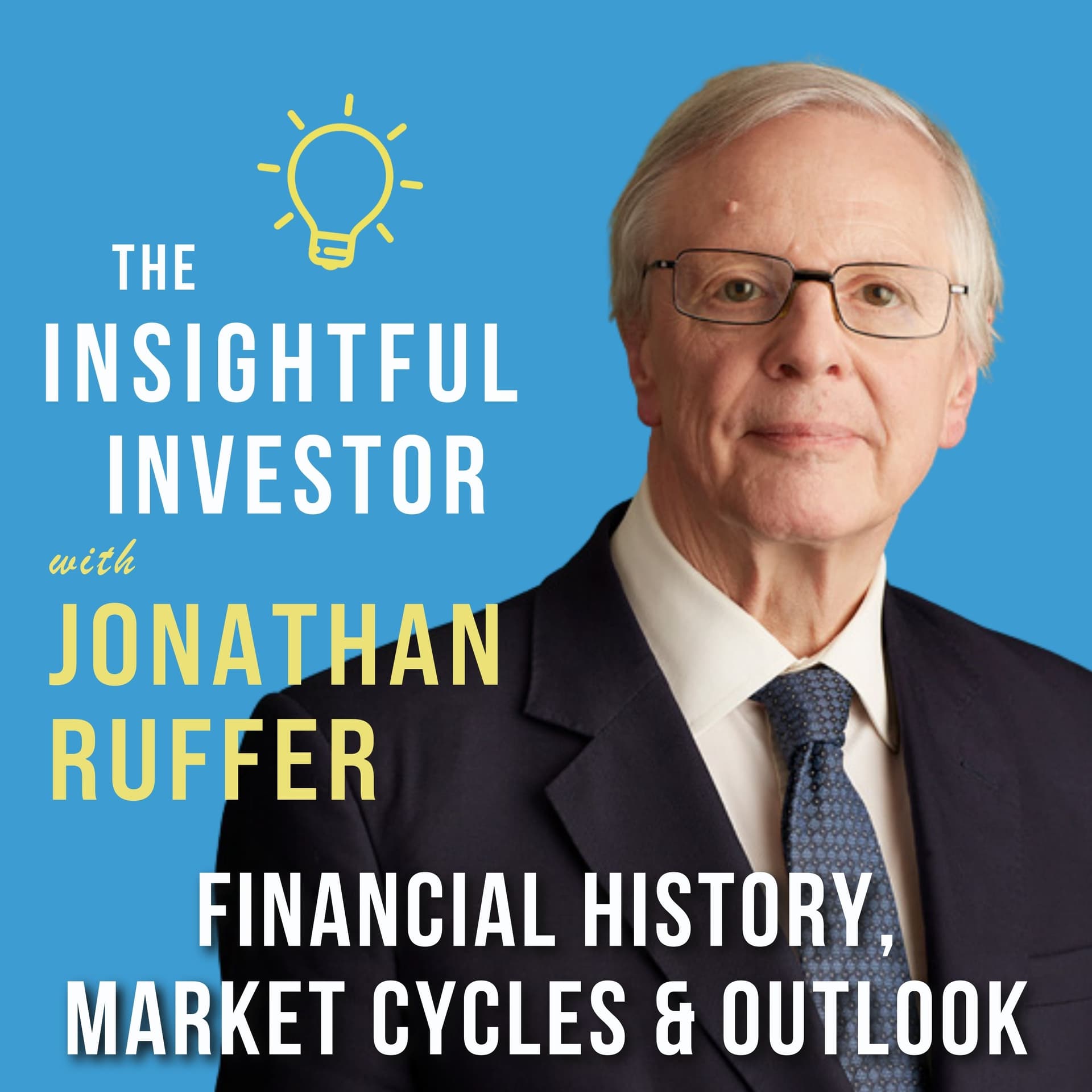
Episode Description In this episode, Jonathan Ruffer shares his unique insights on financial market history, long-term cycles, and personal market outlook, drawing from nearly five decades of investment experience. The conversation delves into the qualities of great investors, the dynamics of market cycles, and what the future may hold for investments.
Key Themes and Insights
- Journey into Investing
- Jonathan's early exposure to investing was influenced by his father's gift of a book on investment via charts.
- He emphasizes a fascination with financial history and storytelling as a means to understand current markets.
- Qualities of a Great Investor
- Cleverness vs. Humility: Ruffer stresses the importance of humility in investing, noting that overconfidence can lead to poor decisions.
- Poverty of Spirit: Acknowledging one's limitations in knowledge is crucial; most information is uncertain (90% uncertainty vs. 10% certainty).
- Investment Philosophy
- Risk Management: Ruffer identifies as both risk-averse and compulsively risk-taking, advocating for minimizing downside while optimizing upside.
- Market Timing: Ruffer has operated under a philosophy of cautious investment, particularly during the unprecedented bull market of the last 40 years.
- Market Cycles and Predictions
- Historical Context: Ruffer discusses the cyclical nature of markets, emphasizing that past performance does not guarantee future results.
- Equities and Market Dynamics: He predicts a significant decline in the relevance of equities, suggesting a shift toward private equity and other asset classes.
- Value of History in Investing
- Understanding financial history provides insights into current market behavior and cyclical patterns.
- Ruffer warns against assuming that past trends will continue indefinitely, emphasizing the importance of adapting to changing conditions.
- Inflation and Economic Forces
- Ruffer predicts that inflation will return and suggests that the balance of power between capital and labor will shift, impacting economic dynamics.
- He discusses how inflation affects investment strategies and the perception of risk.
- Investment Areas to Watch
- Undervalued Assets: Ruffer points out inflation-linked bonds as an overlooked area that could provide significant returns, emphasizing their potential amidst misunderstood market dynamics.
Conclusion The episode concludes with the importance of continuously adapting investment strategies based on historical insights and changing market conditions. Ruffer's perspective encourages humility and a thoughtful approach to risk, aligning with the broader themes of the podcast around underappreciated concepts in investing.
---
Key Takeaways
- Great investors possess a blend of cleverness and humility.
- Historical context is vital for understanding current market dynamics.
- Inflation-linked bonds may become increasingly valuable as economic conditions change.
- Continuous adaptation and awareness of market cycles are crucial for long-term investment success.
Written by AI. May contain mistakes. Listen to the episode to check what was said.
Transcript
Automatic transcript. May contain errors.0:05Welcome to the Insightful Investor Podcast, a weekly series that seeks to share industry, investment, investment, and market insights. We define insights as concepts that are counterintuitive, widely misunderstood, or underappreciated. In other words, unique ideas that you probably won't hear elsewhere. I'm Alex Shahidi, the host of the podcast and co-CIO of Evoke Advisors, a leading investment advisory firm. Learn more about our show at insightfulinvestor.org.
0:38I'm delighted to welcome Jonathan Ruffer to the podcast today. Jonathan is the co-founder and chairman of Ruffer, a London-based investment manager focused on generating absolute returns for its clients. Jonathan, thank you for spending some time with us today. It's a great pleasure, Alex, to be with you. Well, Jonathan, you started your career a little over 50 years ago, but do you feel that investing has always been a core part of who you are? In a sense, do you feel that you were born an investor? It's always rather hard to know the answer to that sort of question, But I do remember my dad gave me a book, which in retrospect must have been about how to invest via charts, because the idea of following Diners Club, which is the stock that was used in the book, absolutely stuck with me.
1:32And throughout my life, although I'm not actually very interested in investing via charts, that idea appealed to me. And I must have been about 11 years old when that happened. Well, you are a dedicated student of financial markets history. What do you feel sparked your deep interest in studying the past? Well, I think there one can talk more about the way one's made. To me, the fascination of history is its stories. And I find that the best way of grasping the essence of something is that if you can tell it or hear it through a story, it lands more vividly than something theoretical. and when you're investing, you don't really want to be dealing with fairy tales.
2:30So from an early age, I've wanted to understand the present through things that have happened in the past. That is fascinating. And I think something that's interesting about what you just said is the stories are always unfolding. And even when you're living through the history that we're creating today, it's hard to envision how that story is going to be told in the future. So part of studying the past is looking at the past through the stories that are told after and then trying to relive it real time as you're going through it. One of the things I was thinking when I was walking over today is that Britain lost Singapore in 1942 in the sweep of Japan's conquest of Asia.
3:20And a decision was made in 1924 when Britain was rather strapped for cash, not to reinforce it, not to bring it up to date. and I'm thinking to myself well that was 18 years before what mistakes were we making 18 years ago that we're paying the price of today so to speak there's nothing magic about 18 years but this idea of a period of time seems to me to be the way to get the feel of how people's memories mature on things that were perhaps a complete non-event when they happened, or perhaps an amazingly big event, but turned out not to be such a big event. These are the things that fascinate me.
4:14If we shift to what qualities make up a great investor, you've obviously hired a lot of smart people to surround yourself with to allow you to be a great investor. Are Are there any specific qualities that you look for? I think that the way I want to answer that is to talk negatively. You need to be clever, but you must, if you have a self-image of yourself as clever, you'll go wrong.
4:52some buffoons said that when you make an investment when you've done all your homework you're probably looking at six percent of all the relevant facts which will determine whether it's a good investment or not now if you're a clever clogs and you know you're a clever clogs and you're a lot of pleased with yourself you can probably get that six percent to ten percent but you know who wants to be leading with the chin with something where the uncertainties are 90 % and the certainties are 10%. So poverty of spirit is quite an important element. And I think above all, a sense of maybe. I always am on edge when people tell me that the new administration will be a success.
5:42Yes, that will is the word which doesn't land well with me. Everything in life is a maybe, and investment is made up of maybes. Yeah, so I guess another way to summarize what you just said is, if you're really smart, maybe you're at that 10 % level. And the key is that you recognize that it's 10%, not that you're too smart for your own good where you think it's 90 % when it's actually 10%. That's exactly it. My dad, I'm talking a bit about my dad, but not for any particular reason, but I remember him telling me, we were driving in the car one night, and on the road, there was a roadkill of a hare, which had been hit by a car.
6:32the hare knows that it's the fastest animal in the region and so it will always try to run away from danger so the car hits it whereas every other animal will chink to the side because it knows that it's not that fast to run and it seems to me that we don't want to be hares because we'll be hit by that 90%. Yeah, and I suppose part of that is also informed by your actual experience. So if you start off as an investor, and the reality is you have 10 % of the information, but if the first five or 10 investments hit, you could easily become overconfident because you attribute skill to what was actually luck.
7:21Yes, I guess that's right. But, you know, you get pummeled so much in the investment world that I think it's the failures that one remembers more than anything else. It took me some time to work, to articulate it to myself. But I've got two characteristics that really shouldn't coexist. I'm risk averse and it always amazes me when fund managers make a boast of being risk averse to me that's like being a fighter pilot and saying that you're a coward if you're a coward become a librarian if you're risk averse why are you taking on risk so I tell you that as a confession I am risk averse but I've also got within me an absolute compulsion of taking risk, manic risk, you know, the sort of risk that one wouldn't even admit to one's dentist.
8:33And these two qualities play like orangutans within me, you know, the compulsive side saying, oh, go for it, At the other side, you're not sure about that. And that's really why I landed on the way of investing to take real risk. That's the orangutan of compulsive risk-taking. but to do it in such a way that you were using your skills and you were using the elemental risks in the market to try and never, never, never to lose money. If you think of a good investment, it's a commonplace thing to say, But really, investment is about optimizing upside risk and minimizing downside risk. Now, effectively, what we're trying to do is to optimize the upside and minimize the downside, but with the emphasis on minimizing the downside.
9:57such that we wouldn't lose money in risk markets. And the fascinating thing was that when we started the business in 1993, people said it is not possible. I mean, they didn't know about Ponzi in those days, But I think they would have said if they had done, at least Ponzi sounded like he'd got a good idea. You've just got a bloody awful idea because it can't be done. And the thing that makes it possible is the fact that if you're playing the roulette and the engineering's wonky, so some numbers come up more than they should, and the croupier's drunk, so he's declaring the odds wrongly, it's those two facts that become the decisive element in making investments.
10:57And I mean, to be honest, I think it was a flu, but for two and a half decades or more, we actually didn't lose money, at least in a calendar year. And then everybody thought, gosh, not only is this doable, but it's culpable not to do it. And, of course, that brings problems with it then because everybody thinks that if you have a year or, as we've just had, two years of not making any money, they think that somehow or other it's not the model that's wrong. It's there's something wrong with us. And, you know, the fact is that we're in a constant firefight and that's just the way it is sometimes.
11:49Yeah. And I guess if you go back to what you said earlier, which is being risk averse and being a risk taker at the same time is very similar to knowing that you're in the six to 10 % and being skeptical that you don't know a lot. And those two kind of states put together force you into a discipline of, I'm going to take risk where there's a lot of asymmetry. There's a lot of upside potential, low downside risk. And I'm going to look for those unique opportunities. I'm going to do a bunch of those things. And then you can effectively take risk, but it's like a calculated risk as opposed to just a risk that has kind of equal upside and downside.
12:27That's exactly right. And of course, they always say that being a market timer is the key to investment. Well, I've been operating this formula to the 40 years of the biggest bull market that has existed since Marcus Aurelius. So in other words, I've been driving with a handbrake on when actually what you wanted to be doing was listening to John Bogle, who was saying, take all the risk that you can, and just if you can shave a hapenny off the fees, you know, that's what will make you better than average. So the result is that ETFs now rule the world. and the rougher patent medicine is still in its infancy, I think, Alex, is how I'd put it.
13:27Yeah, and when you look back 20, 30 years from now and the story of the current environment is written, it's going to be something to the effect of best companies in the world, the market just keeps going up. Anytime it falls, you just buy and it rebounds. And that story can easily change. You could easily go through a 20-, 30-, 40-year period where you don't have that. And that story would be very different. Absolutely. And the great thing about making forward-looking observations is that you can't say to me, Jonathan, I'm sorry you're wrong about that. But I fancy that the extraordinary thing about the last 40 years is we haven't had a bear market.
14:16What we've had is a constantly rising market punctuated by collapses, by crevasses. And that's really what stopped the market going up from nothing to the moon. but if you look at the amount of time that the market's gone up since 1992 it's really been a high percentage of it and what I think could easily happen for the next 3, 5, 10 years whenever it starts is that it will be a constantly falling market punctuated by, is it stalemites, you know, the ones that go shooting up. So you can't just operate on the bear tag because you will suddenly be confronted with the market doubling as it did in January 1975.
15:16So I don't think for us that next phase will be any, it'll certainly be easier in the sense that we will be directionally in sympathy with the idea that markets can go down. But I think we will be able to be caught out just like the next man from these sharply rising expressions of ebullience. So another, I think, key component to investing is just your intuition. Are there some things you've discovered through trial and error to be incorrect about your intuition that you have now adjusted? One of the striking things, which I would definitely call a weakness in the way I invest, is that I have never, never, I don't think, had properly invested in a company which went from being a little one to a big one.
16:28I've honed my skills, and I'm nicely arrogant about how to buy stocks. But sooner or later, particularly if they were well bought, I tend to see the sale of those stocks as the vindication or otherwise of the purchases that I've made. And what it does mean is that, you know, in new industries come, the magnificent seven happens, and I've been innocent of all those stocks. I've traded in and out of them. But when I'm a trustee of a lot of old family portfolios, and what strikes me when I look at them is you usually find that they bought GlaxoSmithKline at a hundredth of what it's worth now, Shell Oil at a hundredth of what it's worth now.
17:31Yeah, sure, they've owned them for 40 or 50 years, but actually, I strongly suspect that those decisions never to sell fine companies has taken their performance beyond what I've done. Yeah, and that's obviously a byproduct of this bull market age that we've lived through for several decades. Yeah, yeah. The other thing that I think is interesting about investing is that there are components of it that are deceptively simple, and many people tend to overcomplicate them. And at the other end of the extreme, there are aspects that are incredibly complex that are prone to oversimplification. Do you agree with that?
18:18I think that is right. One of the things that I've pondered is the way that investment has professionalized and not to its advantage. I have, I think, the perfect cerebral makeup for investment. I've got a quick mind so I can pick things up almost instantly I've got a great imagination so I can make connections straight away that other people can't make and I'm stupid now it sounds like I'm paying myself two compliments and dissing myself on the third But there's a great advantage in being unable to understand what other people, what other class acts can understand, because it keeps it simple.
19:21I never read, I don't think I've ever read the whole of any Fed governor's statement, mostly because I can't understand them, and partly because they're boring. But it was in the middle of the 19th century that the discipline of political science changed from being people -watching to mathematical. And the thing about it being people-watching is that that becomes open to everybody. but the moment you introduce the element of mathematics it is really only open to a cadre of people who can understand the mathematics and one of the things, I talked earlier about Singapore but there was the Battle of Chutland when the Germans and the Brits knocked seven bells out of one another in the North Sea it was a sort of defining naval battle in the First World War And the Germans turned out to be rather good at gunnery.
20:39They were quite accurate. And the Brits turned out to be perfectly hopeless. And the reason I reckon for that was that the Navy was only open to gentlemen. So you had to be a Tufton Buffton to be able to join the Navy. And when gunnery came along, gunnery was rather messy, and that messed up your nice white gloves that you wore as a gentleman. And so you didn't do too much practice. And the people who were good at gunnery were considered not really the sort of people you wanted in the Navy. So what you had was an irrelevance getting in the way of effectiveness. Now, I think that's what the maths, you know, all those zooms or whatever they're called, those sort of e's that look like they've been lying in the sun for too long.
21:40I think what they do is they keep real investors from having the confidence to see that investment is really little to do with these questions. Bonomi Price, who was the last proper political scientist in the way that I think of it as a social discipline, he described economics as elevated common sense. Now, that feels to me spot on. It's not enough simply to observe how people behave. You have to take that raw material and spend a lifetime working out what that means in the investment world. And doing it through the prison of history is the way that I've done it. And everybody who works at Ruffin at least pretends to pay lip service to that one.
22:42And along the same lines, do you see investing as both a science, you know, an engineering or math-like exercise and an art that's rooted in investor psychology? And I guess these two elements interrelate and contribute to the complexity and predictability of markets. I would say yes. And I would say that the science is to do with short-term performance and the soft EQ applied, the elevated common sense gives you the long-term edge. And I covet both. So no man has all the elements that you want, or if they exist, I've never met such a person. but I think as a group you can find that and it also helps the humility because what you can see is people with qualities that you not only are not your strengths but you might not even have at all that's how you can you can build you can see a team built I wouldn't say I built a team but And that's how a team gets built.
24:07We talked about generating returns while minimizing risk. And returns are easy to see. You can see them every day. But risk is often invisible, yet it's ever-present and it quietly builds over time. And I guess paradoxically, the longer it remains hidden, the greater its potential impact becomes. Do you agree with this? And what's your general perspective on risk? Well, that was the only thing that you wrote, which I actively disagree with. It seems to me that the only reason that the risk seems to grow is because it only grows like that in a unidirectional market. So, I mean, one of the people we discovered earlier, he's now better known, was Hyman Minsky.
25:05And the Minsky moment when the sand that goes through the egg timer has formed a little hill that it then collapses. And the more prominent that hill of sand is, the greater the fall of it when it does. So I think it is absolutely fair to say that when this market goes, it will be an extremely colourful one, not because of the fact that Germany has got an election or things are happening in Colombia that shouldn't happen in Colombia, But simply because the world has grown into the shape it has is because we haven't had a setback that has allowed to be a setback. I mean, my own feeling is that 2008 was a proper game changer, and the authorities simply used their balance sheet to create a more powerful dynamic on the other side.
26:36And in the short term, if 15 years can be regarded as a short term, they've got away with it. But it's left all the imbalances greater in Minsky language than they were in 2008. And that was bad enough. So let me ask you some questions about financial market history, because you have this very zoomed out perspective of looking backwards over a long period of time across countries. But if I ask you to look forward 50 years into the future, are there any timeless principles you feel will endure? And what aspects of the world do you feel might fundamentally change? I think one of the mistakes that people make is that what happened yesterday will probably happen tomorrow.
27:27What happened last year will probably happen next year. And that isn't so. I think the shape of the vehicles that we invest in will change enormously. I think equities are finished. Now, why do I say that? The cult of the equity is pretty young. It's a post-war phenomenon. And it isn't that before that equities were not important. But the reason you were in stocks and shares was primarily either to own a business or to control the business. So that was where you went if you were in the business of controlling it. And if you were trying to make an investment, what you wanted to do was to find in a long list of quoted fixed interest.
28:41In Britain, you had debentures, unsecured loan stocks. You might have five unsecured loan stocks, which traded preferentially. then you'd have preference shares beyond that. And if you could find a company that you thought was more powerful than the market thought, you'd buy a junior tranche of the debt on a high yield and you would watch it trade up to a treasury yield. So that was how you got it. You were doing it for capital gain, but you weren't basically trading the equities. Now, when I think of a profit-making business, I think that there are four claims on that business. You've got the government who wants to tax it.
29:44You've got the workforce that, for some odd reason, wants to get paid. You've got the management who run the business. And you've got the shareholders who own the business. Now, if you put it like that, what you can see is that the shareholders have naturally two weaknesses. One is that they are spread among a great many people. So everybody has only a small fractional interest in the business. And they're sleeping. They don't have anything to say. I mean, if you said that to Elliot, I think he'd rather disagree and say he's got quite a lot to say about the running of business. But basically, the position of an institution investor is to be a sleeper of a small interest.
30:43Now, that became transformed when managers decided to unite with the stockholders through stock options. So, you know, you get paid hundreds of thousands of dollars for your salary, but you get millions or tens of millions of return through your stock options. So those two together became more powerful than anything else. But I think that that phenomenon is basically over. You know, the growth in the private equity and private credit market is an indication that if you want to own the equity of a business, you need to have control of it. So the provider of private equity does that. They will own enough of a business really to be able to control it on behalf of their investors.
32:00So it's no surprise to me at all to see the health of stock markets declining sharply so that European bourses are too small to remain viable. you know, Canada and Australia aren't big enough really to have a say. And if you look at the American market, the dominance of the Magnificent Seven really tells you quite a lot about the undemocracy of the pool of corporations whose shares are traded on the market. So in my view, that what George Ross Gooby worked out in the early 50s, that equated a coming asset class, that was true for the period then. But now, 75 years on, I don't think the conditions, I don't think he discovered an eternal truth.
33:16I think he discovered a market truth, and market truths come and go. And I think equities are going to be not the place to be as we pull out of a bear market that I think will last quite a long time. Do you feel like that's a realization that the market participants will gradually observe and catch on? Or is it something that you hit a tipping point and all of a sudden becomes obvious to everyone? I think what will happen is that management will become increasingly, managers of interest will become increasingly different from the shareholders. I mean, the conglomerates in the 1970s, Charles Bluthorn, you remember him, Gulf and Western, Lim Tinko Voigt, LTV, these were enormous businesses.
34:18And what the guys running it realized was that if they did a value-destroying takeover bid and the business was twice the size as it was, the chief executive got paid more. So that's what happened in the 1970s. The quality of the businesses decreased, and it was only in the generations that followed that that that mischief, which had been done basically quite cynically, when I first started investing, maybe did invest in Germany, because the businesses were run for the management and the workforce. What was the point of the shareholder? There wasn't any point in the shareholder. So I didn't see this as a new phenomenon, and it's just a return to an old one.
35:17You alluded to the U.S. as being a global dominant economic power since World War II. How sustainable is that position and what historical lessons might inform our view of America's future economic role and perhaps the success of its stock market? I've thought a lot about this, Alex. What destroys empires? The Spanish empire in the 16th and 17th century never realized that it needed to build into its model commercial success. So it sort of became a sort of heap of scrap metal really and filled it under its own weight. What Britain discovered was that the empire that it created, which was not dissimilar to the Spanish one, provided a different sort of excellence to commercial excellence.
36:29and that allowed really other nations to build past what the UK was doing. The UK felt very distressed. There were two great exhibitions, one in 1851, when absolutely every best invention seemed to be British, And 1867, which was only 16 years later, when they all seemed to be German or French or even American. And, you know, the confetti that had made Britain great had disappeared. Now, when one looks at America, it looks to me that it is past its sell-by date, but it's not yet clear to me what will bring it down. It's rather like looking at the sort of, you know, the chief lion in a pack of lions.
37:47You can say, you know, he's getting on a bit. That isn't quite the same thing as saying, and that's the lion that will replace him, or, you know, there'll be this or that. It's just an observation that the dynamism, that creative dynamism, which drives nationism to great things, seems to me to be becoming shadowy. Now, that's a fairly discursive answer. So I'd be more confident that being a bear of America, taking a 20-year view will be a right one than being able to put any cogent course, which would confirm that. Yeah. And I think that is, it's a very important insight because in my experience, amongst investors, there is this underlying assumption, even if it's not stated, there's an underlying assumption that US companies are the dominant global superpowers economically, and they're going to last forever.
39:06And so you just buy the S &P 500 and you hold on forever and you're good. And you don't have to worry about an extended period of underperformance or anything like that. That's just a general sense. And you've described a couple of things. One is US dominance may be on the other side of its arc and heading down and that may be gradual until it speeds up. You've also pointed out this whole notion of just don't assume that stocks for the long run is a truism. That could not – that can change. So there's multiple factors. And that kind of goes back to what we started with is that 6 % to 10 % of what your intelligence might know, there's a lot that is out there that can become a negative surprise.
39:54Yes. I must say, Alex, when you put it as bold as that, I do it if I'm wrong. I mean, I tell you one of the things that struck me from how this conversation is going is that I believe that valuations are the key to good or bad investment more than the comparative success or failure of the underlying investments. So that I read an investment review about three months ago when I said, you know, what's happening in the markets now feels like a combination of two things, the dot-com boom at the turn of the century and the nifty-fifty boom of a generation before that. and the thing that caught the dot-com boom out was that people bought the wrong companies.
Read the full transcript
41:01They bought young companies, which however cleverly placed they are, are always vulnerable because new businesses, particularly in frontier industries, need a lot of cash and the cash isn't always available. Whereas in FD50, the market... But they absolutely got the idea that online was going to replace retail. So they got the phenomenon right, but they played the wrong stocks. And in the Nifty Fifty, they absolutely got the right stocks. You know, 48 out of those 50 really were, a generation later, the great stocks of America. So they picked the right stocks, but by paying the wrong price, they were absolutely done for.
41:56So if you turn that on its head, I think that probably explains why I didn't spend enough time trying to find the next NVIDIA or the next Walmart or the next this or that. because I can have more success or lack of success by playing valuations. That makes sense. I guess along the same lines, if we zoom out a little bit, you can have extended periods of prosperity that can inherently lead to future instability. That is largely because of increased risk-taking or focus on short-term gains over long-term resilience. And valuations, I guess, is one component of that. Absolutely. And I do think prosperity is a more dangerous phenomenon for all of us.
42:59It isn't just investment accounts, than adversity, because adversity is something that the human spirit rails against and wants to see corrected, whereas prosperity invites you to be a laser-seater. And if it ain't broke, why mend it? Well, by the time you've driven your car without having it serviced for eight years, don't be surprised that when it breaks down, the guy at the garage says, buy another one. Yeah. And I guess when you go through a period of adversity, it strengthens you. It builds character. Whereas when you go through a period of prosperity, you can get lazy. They call it you get fat and lazy.
43:54And so when you have an extended period, and the longer those periods go, the easier it is to extrapolate that into the distant future. And that can drive your behavior. And all of that feeds into these cycles that we see happen. That's exactly right. And it's why fund managers are the most dangerous when they've had long experiences of success. I say that with two bad years behind us. But I didn't find myself holding my head low and wondering what went wrong. Because the concept, I think a lot, Alex, about the concepts of now. How long does now last for? If I say to you, if you say to me, look, I just boiled this egg, is it ready for eating?
44:52And I say, yeah, yeah, you can eat it now. If I'm wrong, and you've still got it on the flame, I'm not going to be wrong for more than about 25 seconds. I'm told that if you say, you know, there's a volcano, you have a volcano appeared in Iceland. when is it going to blow? If you're a volcanologist they give you 80 years if I say now and it goes in 75 years time they say wow that man he really called that one right now the difference between 25 minutes and 75 years where does the needle fall if I say I think the market is going to go into a really dark phase now. Now, that's, you know, have I got more than 25 minutes?
45:53Have I got to wait 75 years? And the truth is that the now of these very big issues is longer than is comfortable wearing an investment hat. I mean, in fact, we were wrong for nearly two and a half years before the 2008 crash. And in that crash, I think we made 22 and a half percent. Then, of course, everybody said, gosh, aren't they brilliant? Aren't they marvelous? And everybody forgot about the two and a half years. But if you'd been a client of mine in June 2008, I would be making eye contact with you. right, they say, oh, wow, I still think we're right, you know, blah, blah, blah, blah. And, you know, the inherent danger of being a client is that you can't tell the difference between the people who actually know what they're doing and the people who either think they know what they're doing and don't, or pretend that they know what they're doing when they know they don't.
47:03And from a business point of view, it makes sense to tap a bit. Don't hazard the ship by trying to be absolutely right. And my attitude to that is my job is not having a business with a seamless track record, which is suboptimal because I've been guarding its future reputation. I'm out there absolutely to do the best I possible can.
47:49one of the things I say to people is isn't it funny how we're all happy to say that we're in a service industry but actually if somebody says well does that make you a servant we get a bit shirty but we are that's what we are we're servants and my job is providing a good service for my clients. I had a client, Alex, in 1999, who was so cross with me for not making any money in the dot-com boom that he took all his money. It was£100 ,000. I mean, the key was not that it was actually not that much money. It was all his money. He took it away and put it in two dot-coms, both of which went bust. Now, I didn't think what a fool he was, I thought I did that to him.
48:47You know, if I hadn't been so doctrinaire as to have nothing to do with the dot-com boom, you know, he'd have growled a bit, but he'd have put up with it. So I think the responsibility we fund managers have, you know, this isn't a game. You know, we can destroy people, and it's a terrible responsibility to have that. That's for sure. And one thing that you just referenced goes back to one of the four big mistakes that I've observed is the time horizon mismatch. Because in the investment world, the time horizon, it's like an alternate universe. The time horizon is longer. You know, it's longer than it is in the rest of the world.
49:31Yeah. Like you think about four years, you can graduate college in four years. But in the investment world, four years isn't that long. It's like a blink of an eye. It could just be one environment. Exactly. One of the things I love doing is looking at mistakes that people have made. It makes me feel good about myself. But one of my favorite ones was the Duke of Bedford, who was an ultimate Tufton-Buffton, who owned most of Bloomsbury in London. And in 1913, he thought that the yields were getting a bit low. which being translated meant he thought that capital values were a bit high. So he sold in a great chunk of central London in 1913 and was gratified to discover that he could invest in imperial Russian bonds on a 5 % yield, which he'd usually received for four years until they defaulted.
50:32So he sold something that was going to be massively valuable and bought something that was worthless. And he did it on a highly theoretical, he was just sort of, this was a thought that he'd had. And basically, he crippled the duper trip on that one. So earlier, you talked about the four players that command a share of the revenue pie from a company, shareholders, management, the labor force, and the government. Would you discuss the historical shifts in power between capital and labor and how that pendulum has swung over time and what key turning points caused that reversal? It's so interesting that I've noticed that when I talk about Karl Marx, my chance tends to shift from one buttock to another.
51:33So by and large, fund managers need to be not left of liberal democracy, I think. But what Marx absolutely got right was to think of an entity that creates value as having two possible owners. Either it's the guy who puts the factory up or it's the guys who work in the factory. One or other both have, in the theory of things, a claim to ownership. And the communists say they all ought to belong to the workforce. and the capitalism says, no, they have to be seen right, but actually the business belongs to the person who put the capital into the business. Now, I park that, but I note that. and if you go back through back to the Black Death is usually the place that people start.
53:01There's a very good book written by somebody called Hackett Fisher in the 1990s which whenever I'm feeling rather pleased with myself I go and have a read of so I read it again and again. But what's very striking about that is that the The interplay between capital and labour seems to operate on about a 50-year cycle. And sometimes capital absolutely has the stranglehold. And then 50 years later, it's labour that has the stranglehold. And because once the pendulum swung, it goes on swinging absolutely everywhere geographically until the thing has become so extreme that the pendulum is almost forced to swing back.
54:02Now, if you look at it through an English prism, the mid-1970s was the absolute high watermark of the unions. We used to go and have beer and sandwiches with the Prime Minister. And if you and I were setting up a business and we discovered the source of life and we thought, well, should we invest in that? We think, well, why bother? Because all that will happen is if it fails, we'll do badly. And if it succeeds, our workforce will capture all the benefits of it. And what in November 2021 seemed to me to be the high watermark of capitalism in the sense that winner takes all. that the amount of wealth that was earned by incredibly few people absolutely matched America in the early 1890s, before the trusts were busted.
55:14That was a point when the extraordinarily rich were as rich as they were ever going to get. So the reason I'm interested in this is because I'm an inflationary I think inflation is coming back. And inflation is always quiescent when the commercial world is in charge and is always dominant when the workforce is in charge. I mean, if you look and if you really want to have a boring read, look at bimetallism and the battle in America between silver and gold and silver, because Nevada had discovered great chunks of silver. All the people who were growing stuff wanted a depreciating currency, whereas the northeastern coast of America, as manufacturers, wanted steady state money.
56:19And actually, the northeastern of the New Yorkers won in that battle. But I think from now, currencies are going to be sacrificed and the workforce will be the beneficiaries of that. And if one is an inflationist, I think globalization is a deflationary force. And the balkanization, which must have increased in pressure since Donald Trump took power, this is another force for prices going up. Now, if you take inflation-linked bonds, they have been poor performers because they have traded off the price of conventional bonds. And conventional bonds don't much like what's going on at the moment. But I think you have to look at index-linked bonds as being two things.
57:24There are conventional bonds. They've got all the elements of a conventional bond with one extra, which is the fact they protect you against inflation. And they are priced. the way you see whether an inflation bond tips are expensive against conventionals is to see what the real yield what the difference is between the nominal yield and the yield on an inflation bond and the answer is it's about 2.75 % at the very long end now if we go into financial repression which is an absolute ding-dong certainty when times get hard because the amount of debt simply has to be washed away. The Brits are brilliant at this.
58:23We realised we couldn't pay our debts from the Second World War. So what we did, we simply kept interest rates below the rate of inflation. So you've already got a built-in margin for that difference. But if inflation is running somewhat ahead of where it always has, say perhaps it's 5%, perhaps it's 6%, sometimes it's 8 % and then back to 5%, the difference between the yield that you should receive on conventionals and inflationary bonds is very, very different to the one that it tends at the moment. And the crucial thing is, I remember as a teenager in the 1970s, holding a half crown, which was a 12 and a half piece, holding a half crown and looking at it and thinking that in two years' time, it would be a florin, which was worth 10 pence.
59:27So I was looking at 12 and a half pence, and I could see no way, and nor could anybody else, that that wouldn't become worth 10 pence, and then 8 pence, and 6 pence. Now, these inflationary bonds, nobody understands them. You know, they were issued in 1980 in Britain, absolutely, as the problem of inflation had been solved. So they've been basically a wrong play for 45 years. But when they're right and people are just in despair about preserving their money and discovering that back today you could buy them on a 2.3 % real yield, I think they could get to a minus 8 % yield. You multiply your money, I can't remember if it's 20 times or 50 times, but it's definitely quite a lot.
1:00:26So here is something. Oh, by the way, we just sold our entire position of them. So that doesn't mean that I sit there waiting, waiting, waiting for them. But direction, that's where they're headed. Yeah. And I suppose if you look forward for the next 10, 15, 20 years, and you think about what could happen that would cause a negative shock to most investors and most portfolios, one is obviously significant US equity underperformance because there's a heavy overweight there. But one of the areas that there's a heavy underweight to, or perhaps no weight, are inflation hedge assets. Because other than post-COVID, a short blip of inflation, we really haven't had inflation volatility for decades.
1:01:14So you could easily see that causing significant harm in a widespread fashion. Absolutely. And the thing is that people think that inflation is caused by overheating economies. And the answer is, to some slight extent, that is true. But the much better way of regarding inflation is a partial destruction of your currency. So in other words, it happens much more usually when figures aren't adding up. The other big issue that I see is that we have these excessive deficits and debt that just keeps accumulating. And it seems like you could just keep feeding the machine and things go up. But at some point, you hit a tipping point.
1:02:10Did you feel like we're near that point? Absolutely. And I've been feeling that since about 1984. I had a marvelous friend who was the nearest I've ever come to a country in Decatur and he was late into gold but by 1979 he was fully invested in gold and he wrote a book in 1982 saying gold was the only place to have your money And I remember being very sympathetic to that view, but I thought to myself, this is David. He's bound to be wrong. So I was saved by the name of the author rather than the force of the argument. And that example you just shared is one of those four big mistakes, buy high, sell low.
1:03:09So I remember gold was up 30 % a year in the 70s, and it was negative in the 80s and 90s. So he literally bought at the top. That's exactly right. Gosh, I'm beginning to feel like I'm a sort of retired major general, remembering, you know, how well I defended Rourke's Drift. I keep dragging the conversation back to these faraway days. But gosh, they're relevant today, Alex. They really are. and the key is not to put all your weight on what you secretly think is the next move. Go back to this idea of the roulette wheel. You've got to have money on the other side of the table and in this question we say, well, if we don't like equities and the danger is that we have two more years of great economic growth, would we do better to win commodities?
1:04:16So, you know, we have commodities. Now, in 2023, that rather caught aside. So those were investments in greed, which were designed to do well in a good market, but they did badly as the market narrated. But the reason for owning them isn't so foolish. It's hard to see how corporate earnings can power ahead across an entire index without people using more raw materials for what they're doing. Your roulette wheel example, I think, is a very good one because in that one, if the dealer is announcing, you know, 100 to 1 odds, if you bet on black, you know, as opposed to red, you still know. Well, you know that's a great bet, but you're going to be you're still going to lose all your money half the time.
1:05:10Half the time, that's the point. That's exactly right. And one of the things that human beings are bad at is splitting out the idea that something can be a brilliant investment, but you could lose half your money. I mean, funnily enough, one of the areas where I actually think that it isn't just me, I think the brain can't tell the difference between something that is bound to happen and something that will happen very soon. I think that you can articulate, you can see in theory that something is bound to happen, that it might be quite long delayed. But when it comes to the visceral sense, you have that idea that it must happen soon.
1:06:01If you and I are canoeing down the Limpope and somebody says, do you realize that the Victoria Falls is on this river? You and I will look at one another and assume that the Victoria Falls is just around the next bend. But it might be three days commuting before you get to feel the full force of gravity on that one. Yeah, and obviously the markets are more like that example than they are the roulette wheel example, where there are clear odds that everybody can see. Yeah, yeah. So the last question I'll ask you, Jonathan, and I appreciate all your time and all your insight. Are there any investment areas that you feel are currently underappreciated or overlooked?
1:06:47You talked about inflation-linked bonds, but is there anything else that you feel really stands out today? That feels to me like the standard area. I can see nothing that in any way matches it for the size of the market. You know, for me to say, oh, gosh, there's a little AI company in Denver capitalized at 200 million. And I think that's really going to fly. I think that there are some of them as well. But for an asset class that people don't even hate, they're mystified by it. They're bored by it. And they take quite a lot of understanding. I think that that's where I'd be. And I very much hope that you will put this conversation into the deep freeze until such time as it's right.
1:07:53And then you triumphantly bring it out, Alex. That is the plan. And we'll pull it out at the exact moment and all of your forecasts will come true at that point. And thank you for being such an encouragement and keeping the conversation on its toes. Very much. Yeah. Thank you, Jonathan. Thanks for listening. We hope you enjoyed this episode. Please visit our website at insightfulinvestor.org to access past shows and learn more about our podcast. If you have questions, feel free to email us at info at insightfulinvestor.org. And if you enjoyed the discussion, please subscribe to this podcast to ensure you don't miss future episodes.
1:08:38And don't forget to forward today's conversation to others you think would enjoy listening. This podcast is provided for informational purposes only and should not be relied upon as legal, business, investment, or tax advice. All opinions expressed by podcast participants are solely their own opinions and do not necessarily reflect the opinions of Evoque Advisors, their affiliates, or companies featured. Due to industry regulations, participants on this podcast are instructed not to make specific trade recommendations, nor reference past or potential profits. And listeners are reminded that securities trading, commodity trading, and alternative investments are complex and carry a risk of substantial losses.
1:09:18As such, they are not suitable for all investors.
1:09:25Listeners should be aware that guests featured on The Insightful Investor may have current or past associations with Evoke advisors or the host, including as an investment manager of a private fund opportunity by Evoke, or access through an affiliated Evoke fund, or as a client. Participation as a guest on the podcast should not be perceived as an endorsement or testimonial with respect to Evoke Advisors, the podcast host, or their services. Similarly, the inclusion of a guest on the podcast does not imply that Evoke Advisors or the host endorses the guest or any company with which they may be affiliated or employed.
1:10:04Evoke has neither paid nor received compensation from guests for their participation.
From the publisher
Jonathan is the Co-Founder and Chairman of Ruffer, a London-based investment firm focused on absolute returns. Jonathan shares his unique insights on financial market history, long-term cycles, and his market outlook, drawing on nearly five decades of experience.


