
In short
Insightful Investor Podcast - Episode #67 Summary
Guest
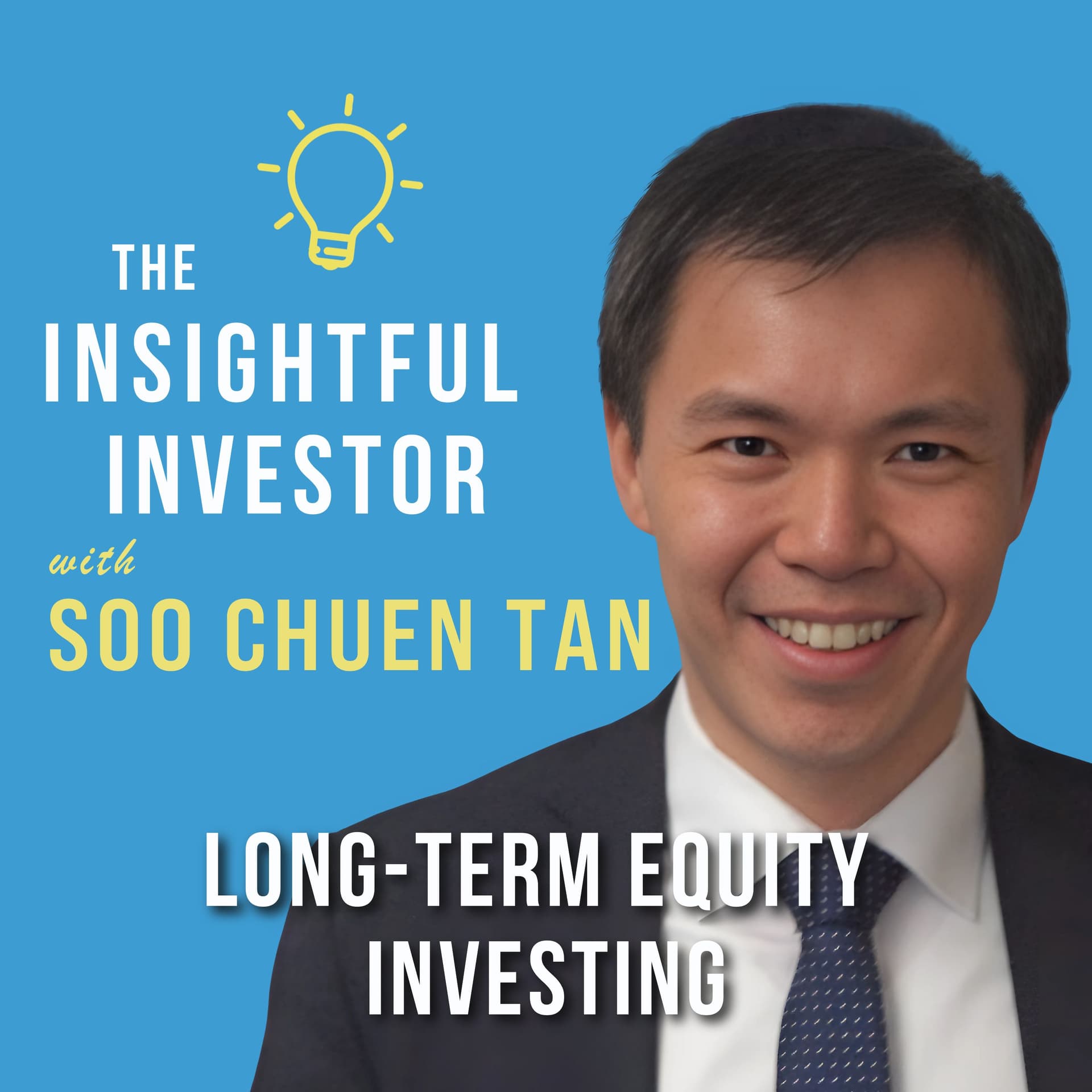
Soo Chuen Tan Episode Title: Long-Term Equity Investing Date: [Insert Date if available]
Overview In this episode of the Insightful Investor podcast, host Alex Shahidi engages with Soo Chuen Tan, founder of Discerene Group, an investment management firm specializing in fundamental, contrarian, long-term value investing in global equities. The conversation delves into Tan's unique investment philosophy, emphasizing patience, structural moats, and significant margins of safety.
Key Concepts Discussed
- Independent Thinking
- Influences on Tan’s Mindset:
- Combination of genetic predisposition and educational nurturing.
- Encouragement from parents (physics teachers) to question norms and seek understanding.
- Exposure to philosophy and psychology during his studies at Oxford, leading to a critical view of social and business constructs.
- Path to Investing
- Late discovery of investing through Warren Buffett’s teachings.
- Transition from a business analyst role at McKinsey to founding Discerene Group, fueled by a passion for value investing.
- Buffett and Munger's Influence
- Learned the importance of helping others and long-term thinking.
- Recognized the need for patience and a contrarian approach in investing.
- Vision for Discerene Group
- Founded with the intent to establish a long-term investment horizon of 50 years.
- Focus on fundamental, long-term, contrarian, global value investing, with a commitment to owning businesses rather than stocks.
Investment Philosophy
- Long-Term Focus:
- Aim to hold businesses through economic cycles rather than reacting to short-term fluctuations.
- Contrarian Approach:
- Buy when companies are out of favor to benefit from significant margins of safety.
- Global Perspective:
- Invest in opportunities beyond the U.S. market, recognizing the inefficiencies in global capital markets.
Structural Innovations
- Unique Fund Structure:
- Implemented investor-level gates to allow for a longer investment horizon.
- Introduced a capital drawdown structure allowing for the return of capital to investors when no compelling investments are found.
Competitive Advantages
- Longer Investment Horizons: Structured to invest over longer periods, benefiting from multi-year time arbitrage.
- Flexibility and Independence: Ability to pursue opportunities globally without rigid constraints.
- Analytical Tools: Focus on long-term business fundamentals rather than short-term earnings.
- High-Quality Investor Base: Built strong relationships with investors who share a long-term vision.
Challenges in the Industry
- Many investment firms struggle to maintain a long-term focus due to institutional pressures and the nature of asset management.
- The competitive landscape requires a unique approach to investing to survive and thrive over decades.
Insights on Risk
- Definition of Risk:
- Risk is defined as the probability of permanent capital impairment, rather than volatility.
- Avoiding Value Traps:
- Differentiated value traps into scenarios of stagnant growth versus poor capital allocation by management teams.
Practical Advice for Investors
- For Aspiring Portfolio Managers: Treat investing as a craft, focusing on the art of investment rather than mere financial transactions.
- For Individual Investors: Emphasize a business-like approach to investing; focus on the intrinsic value and long-term potential of investments rather than short-term market moves.
Concluding Thoughts Soo Chuen Tan's approach to investment is characterized by a deep understanding of business fundamentals, a contrarian mindset, and a commitment to long-term value creation. His insights challenge conventional market behaviors and emphasize the importance of independent thinking and strategic patience in achieving investment success.
Contact & Additional Information Website: [Insightful Investor](https://insightfulinvestor.org) Feedback: Email info@insightfulinvestor.org Subscribe: Do not forget to subscribe for future episodes and share with others who may find this discussion valuable.
--- This summary encapsulates the highlights and key discussions from the episode, providing a comprehensive overview of Soo Chuen Tan's investment philosophy and insights on long-term equity investing.
Written by AI. May contain mistakes. Listen to the episode to check what was said.
Transcript
Automatic transcript. May contain errors.0:05Welcome to the Insightful Investor Podcast, a weekly series that seeks to share industry, investment, investment, and market insights. We define insights as concepts that are counterintuitive, widely misunderstood, or underappreciated. In other words, unique ideas that you probably won't hear elsewhere. I'm Alex Shahidi, the host of the podcast and co-CIO of Evoke Advisors, a leading investment advisory firm. Learn more about our show at insightfulinvestor.org.
0:38Today's guest is Su Chuan Tan. Again, Su Chuan is the founder of Disarane Group, which is a$2.5 billion investment manager focused on fundamental contrarian long-term global value investing. And we're going to get into all of that today. Su Chuan launched the firm in 2010 and has developed a unique investment framework and mindset that I look forward to digging into today. Thank you so much for joining us. Thank you for having me, Alex. It's a pleasure to be here with you. We've had a few conversations in the past. And one thing that's clear to me is that you're a true independent thinker. What influences would you say have shaped this aspect of your approach?
1:20That's a great question. I'm not a psychologist. What I am about to say is simply my own intuition. So take it for what it's worth. But I suspect that independent mindedness is partly genetic and partly learned. In my case, I think that my brain is wired to need to understand things around me from first principles. When I was young, I was that annoying kid that kept asking why, why, why about everything around me. But as far back as I can remember, it was not satisfying to get the answer. Well, it's because it's always been this way or because I said so or because everybody else agrees that it is so.
1:53It was intuitive for me to ask, but why could it not be otherwise? Looking back, I was lucky that this natural independence streak was not shut down by the adults in my life. My parents were both physics teachers, and they encouraged me to go find out the many whys that occupied my interests. Like, why is the sky blue? Let's go figure that out. Many of my teachers allowed me to read and pursue special projects beyond the required curricula at school and made time outside the classroom just to engage in discussions where I I was treated as an equal despite, of course, massive age and experience gaps.
2:30So much of how we think is a matter of habit. Environmentally, I was lucky that figuring things out for myself without an over-reliance on received wisdom was allowed to become a natural neural pathways reinforcing habit over time. Then, while at Oxford, I discovered David Hume. for the 19-year-old me, what is it to know something? Or what is truth? Seemed to be crucially important as a foundational question to try to figure out. Wrestling with epistemology, the nature of reality, the nature of truth statements, led me to Charles Barkley and Immanuel Kant and Ludwig Wittgenstein, among many others.
3:12And then I entered the workplace and in a practical business world, my interest shifted from philosophy to psychology. and both personal psychology and social psychology, it was interesting for me to learn why people believe what they believe within social constructs. For example, I was a business analyst at McKinsey and Company in 1999, and you remember the height of the dot-com bubble. So many CEOs of large, well-established corporations were deadly worried that tiny little dot-coms with limited resources would nevertheless put them out of business. For example, some energy companies were busy shedding assets to try to become more Enron-esque, become more asset-like in their business model because that was what was perceived to be the flavor of the day.
4:00I figured out that truth in an objective, empirical, verifiable sense was often a separate metaphysical thing from the dominant beliefs of people at the time. Yes, sometimes the observers can affect the value of the observed. That reflexivity is also true in physics as well as in economics, but it's still an independent thing with a separate existence from the observer. This epistemic stance has given me a lot of courage in making my own decisions. In both my personal and professional life, I think I've been more comfortable than most taking the road less traveled. As long as I'm focus on genuinely trying to figure out what is true with a capital T instead of what's convenient or what's expedient or conventional wisdom.
4:46Sometimes, of course, this leads to mistakes because I'm a human being, I have my own calibration instruments, and my instruments are imperfect and inevitably colored by my own biases. But at least when I make mistakes, it's my own mistakes, not somebody else's. More often than not, though, it's led me to making choices that I'm glad with hindsight that I made, even if the choices felt lonely or contrarian at the time. I guess you could start with what others believe, but then don't just assume it to be the truth. You can question it and test it and maybe build what you find to be truth around that.
5:22If we go back a few years, what would you say originally sparked your interest in investing? And when did it begin? I wish I can say that I've always wanted to be an investor and that I write securities analysis when I was 10 and got my first stock when I was 12 or something like that. like some of the people at the district team can. I wasn't that kid and I didn't. My interests growing up were omnivorous and far-ranging, but it didn't include stock picking. I discovered Warren Buffett rather late when I was at business school. He came to speak on campus and a few of my classmates recommended I read his letters.
5:53I did and I was immediately captivated. Buffett just made so much sense. For the first time, investing felt like a craft. You can wrap your head around it with rules of reason instead of voodoo. I know this is getting it backwards, but reading Buffett's letters led me to security analysis and that led me to intelligent investor. And I was sold on a career in investing. I decided not to return to McKinsey after business school. And that was an expensive decision at the time because it meant I had to repay McKinsey for sponsoring my MBA. But I thought that it was the worthwhile decision and I have not looked back since.
6:26You mentioned Warren Buffett. How would you say Warren Buffett and Charlie Munger inspired you? And what were the biggest lessons you learned from them? And are there any areas where you disagree? Warren and Charlie have said many memorable things, but my favorite quote is this rather modest one from Charlie, which is, the best thing a human being can do is to help another human being no more. Warren and Charlie have walked the walk of this dictum by generously sharing their worldly wisdom with so many people, including me. They didn't need to do so. Many wealthy people choose to spend their time very differently.
7:02And of course, Berkshire Hathaway is the ultimate pedagogical platform. I'll tell you a funny story. When I met Charlie in 2018, this was a few years before he passed away, I told Charlie that we were struggling to find good investments that met our investing bar. And I asked him if he had any advice on what we should be doing differently. He looked at me unblinkingly through his moon-shaped glasses and said, who said this would be easy? Which is, of course, exactly right and served as a timely kick out my behind. Charlie deservedly is famous for such laconic singers, but I also found him in person to be more measured, more equivocal, almost wistful than this projected image of his pithy, punchy public statements.
7:51Over time, I've become more convinced that Warren and Charlie's belief to help people know more is in fact the best thing that each of us can do to people around us. There are fewer, purer expressions of caring and fewer gifts that are more valuable. I can't think of major areas where I disagree with Warren or Charlie. Empirically, Diswin's investment program has been more intrepid than Berkshire Hathaway's or the Buffett Partnerships. But I also started my investing career at a different time. I have a different biography and therefore different in circles of Compton's than Warren or Charlie.
8:25They lived through Pex Americana. A lot of wealth was created in the US over their lifetimes. So owning C's Candy or Geico or Coca-Cola or American Express or Walmart over a generational time horizon during their particular lifetimes have been wonderful. This was in launch in 2010, not 1950. The world is a much more global place today. Barriers to information, trade, technology, capital, talent, labor have all come down. I'm not American, and here I am in Stanford, Connecticut, and incredible businesses are being built around the world. Yet, there's still significant language and culture and time zone and home bias-based barriers that make capital markets globally far less efficient than in the US.
9:10For example, the capital markets in Malaysia even today in 2025 looks like that of the US 60, maybe 70 years ago. I believe that over my own investing lifetime, being willing to look for businesses to own generationally across the globe, not just the US, is the right thing to do from first principles. Would you walk us through your vision when launching Disarane about 15 years ago? Sure. I started Disarane when I was 33 years old. Sometimes it's good to be young and idealistic. I didn't know how hard it was going to be, which is great because I may not have started it. But because I was such a big Buffett fan, I wanted to do the Buffett thing, that is to run an investment program over a 50-year time horizon.
9:52I was 33. I thought maybe if I stayed healthy and I worked out and I was lucky, I could have a 50-year investing career. So that was a time horizon. I wrote a white paper on what a 50-year investment program would look like from first principles. In it, I said that we would invest pursuing a fundamental, long-term, contrarian, global value investing philosophy. Of course, we weren't reinventing the wheel. These elements are all classic value investing philosophy elements. The terms are almost a roll of the tongue. Few stock pickers say they're not fundamental or they're not long-term. But I was very specific about what each term meant.
10:28First, fundamental. That term sometimes means as opposed to technical, but that was not what we meant. Fundamental for us meant that we would own businesses and not stocks. And if you talk to any business owner, even if it's a small business like car, dealership, or gas station, or laundromat, you know that that business is going to go through good and bad times. It's a given. No business owner will say, oh, my dealership is going so badly. Let me dump it. And when earnings recover, I'll buy it back. That's crazy talk. A business owner will own that business through good and bad times. Of course, you can choose not to be in the business at all.
11:03If it's a business that you're going to put too much capital in, and you're not going to get enough return out of it, then don't be in that business at all. But if the returns through cycle are good, if a business is worth putting money in, then expect to own it through economic cycles, good and bad times. That leads directly to the second element, which is being long-term. Sometimes when public market investor says, I'm long-term, they mean holding a stock for more than one year, or maybe two years, maybe three years. But we're talking about owning businesses through economic cycles. While each cycle is seven to 10 years, So if you want to own a business through more than one economic cycle, you're literally talking about a generational time horizon.
11:45So we put a stake in the ground in 2010 to say, we're going to try to own public companies generationally. As you can imagine, that was countercultural at the time. This is in the aftermath of the global financial crisis. People were worried about whether stocks are even an asset class that people can safely own anymore. It was a different time. but it's also still countercultural today in 2025 to say that you want to own businesses generationally. The third element was being contrarian. This is a crucial element of value investing but it's also an element that has fallen out of favor lately because it has paid off to buy businesses that are riding high and they keep riding higher.
12:24The big companies keep getting bigger. So the idea of buying something when it is out of favor is itself out of favor. But our belief was and still is, if you want to generate supernormal returns by owning companies generationally, then you need to buy businesses at prices offering large margins of safety because markets generally are efficient. They're not efficient all the time, but generally they're efficient. So if you just pay a fair price for a business, then you're going to get a fair return. So you need to pay an unfair price for a business. But unfair prices don't come around that often.
12:58Usually when you're getting a business at an unfair price, it's because something went wrong with it. Sometimes it's very company specific, like they messed up, they lost a big customer, or they had an operational mishap. But sometimes it's a whole industry that goes through a convulsion. In 2010, when we launched, it was the US healthcare industry that went through a convulsion because the Affordable Care Act had just been passed. And you may recall that created a lot of uncertainty among payers and providers, and they created a sell-off in US healthcare stocks. Sometimes it's a whole country going through a recession or inflation or unemployment, whatever the case might be.
13:30And sometimes the whole world, like a global pandemic, the dislocation could be very micro, it could be very macro or somewhere in between. When there's that dislocation, things tend to sell off because a human being is just not wired to like uncertainty. And uncertainty breeds fear, fear breeds force selling. And during that time, to use a buffer phrase, you can be greedy when others are fearful. and to use a different Buffett phrase, at that time, you can almost step in to be the underwriter of the business. At this price, I'm willing to own that business. Sell it to me. You're fearful. You want to dump it.
14:04I'm going to take the other side. I'm going to buy it. Not because I believe I can then flip it to somebody else, but because at that price, I'm willing to be the final owner of that business. So that's being contrary. The last part is being global, which we've already discussed. Our belief was and still is that these are principles are so easy to describe. I just described it in five minutes, but they are hard to execute against. Everyone wants to invest like Buffett, but very few people can because of the structural asset-like mismatch in the modern money management industry. Asset-like mismatches were back in the headlines a few years ago because of Silicon Valley Bank and First Republic, etc.
14:40We don't think about it that much in the case of non-banks, but there's an even bigger asset-like mismatch in the asset management industry. Most public markets funds have daily liquidity if it's a mutual fund or quarterly, sometimes annual, sometimes two years liquidity if you're a hedge fund. But you cannot invest in companies generationally in public markets if you have liquidity terms of a day or a quarter or a year or two years. You cannot tell investors that with a straight face. This is especially true for emerging managers like we were back in 2010. Emerging managers have to put up numbers in the first three years.
15:17If you don't do that, 80 plus percent of emerging managers shut down. So you don't have the luxury of thinking long-term, no matter how well-intentioned you are. Our thesis was, if you want to invest generationally, then we have to structure the firm very differently from the typical public markets fund. So we did. When we launched in 2010, we created three-year, five-year, 10-year investor-level gates, which were highly atypical in 2010. This was after Lehman and a lot of big funds threw out gates and LPs hated that. And here we were, a new fund, and it's like, okay, we're going to have investor-level gates from the get-go.
15:53But today, 2025, they're still unusual. But we also wanted to align incentives. So we created three-year clawbacks on our incentive allocations so as to avoid the heads I win, tills you lose, structure of many investment punishers where general partners collect a lot of incentive allocations a little way up and then they have a big drawdown and then they shut down the partnership because they're under the high watermarks. No GP ever returns incentive allocations to their LPs. So we wanted to make the incentives more aligned and have more skin in the game. These were some of the structures that we created from the get-go in 2010.
16:30However, in 2018, which is about eight years after we launched, we did something even more. We decided to return capital to our investors because cash balances in our fund were creeping up and we couldn't find anything we wanted to buy. So we thought that the intellectually honest thing to do was to just give the capital back. But we wanted to be able to call the money back to us in the future when we next found something compelling to buy. In order to do that, we needed a capital drawdown structure, a capital commitment structure, which is of course very typical in private equity punishers, but not at all typical in public markets funds.
17:09The idea was we would sweep the cash back to LOPs, but contractually, they were committed to funding these capital calls in the future. And when we have exits, we can sweep the cash back to LOPs. And this was of course an unusual structure. We still have the structures today. The structure allows us to maintain strict investment discipline and demand an absolute, not a relative hurdle rate every time we make an investment. Because of our structure and because of our mandate, we're willing to do anything and the ability to do nothing. Those two things are rare privileges. I've only been discussing legal structures so far.
17:45But back in 2010, I believe that setting the right culture for the partnership is even more important than setting the right legal structures. We sometimes forget, but investment partnerships are actually partnerships. If you roll back the clock on the early partnerships, whether it's the Alfred Winslow Jones partnership or the Barford partnership or Graham Newman, people were actually going into business together. Someone contributed the capital, someone contributed the sweat, but it was really a JV. It's just like any other JV. It happens to be an investment JV. Roll the clock forward. Investment partnerships legally are still partnerships today, but they look more like products rather than JVs.
18:28LPs can buy this hedge fund product or that private equity product and gain that stream of returns and that exposure. They get their statements, they get their PowerPoint presentations, they get investor days, and they get a chicken dinner once a year. But really, the LP is a customer of the fund, not a partner in that partnership. We wanted to dial the clock all the way back and build Disarine as a genuine partnership with the DNA of a de facto JV, not just a de-uray partnership. We wanted our limited partners to be partners as to the customers, basically saying, let's go into business together.
19:06Well, there was more than a little bit of self-interest in this because I was 33 years old at the time. I fancied myself to be smart and hardworking and well-intentioned, but we had limited resources. And we had this global mandate. We wanted to go anywhere, we wanted to do anything. It was a very broad investment program. We were lucky that we were backed by a handful of rather thoughtful, long-term institutions, endowments, families, etc. that had far more resources and experience and networks than we did. There was self-interest in saying, let's all be partners together. And that gave us access to all those resources and networks, etc.
19:42that allowed us to punch above our weight when we launched. Of course, we couldn't just simply demand that our partners, whether it's an endowment or a family, work with us as part of our team. My theory was, and still is, that you actually had to earn the right to do that. And you do that by behaving like a partner with a certain amount of transparency that is not typically an investment firm. Sometimes people say transparency, that just means is the general partner willing to share what they own in the portfolio, etc. To me, it's more than that. Transparency means sharing what it is that we're working on.
20:12What is it that we're struggling with? What it is that we're keeping us up at night? And there's a certain vulnerability in that process. But the idea is to share what the investment program is working on, such that our LPs can actually help us do our research and try to figure out those questions. Like, there's a Eurozone crisis. Who can we reach out to? What are the networks that we can use? What are the resources that we can bring to bear in order to try to understand things better and have our LPs be part of that? And they were incredibly responsive at the time. So for example, the CIO of a university endowment traveled with us to Greece on a research trip, and we met with a bunch of regulators and families and businesses, and it helped us understand the situation better.
20:51I'm proud to say that we've maintained that partnership till today. We don't have many of the trappings of a modern day investment firm. We don't have a one-pager. We don't have fancy offices. We don't have a PowerPoint presentation. Our investors interact directly with me. In many ways, we behave truly like an investor's investor, not an investment product. And we have been rewarded for that. Of course, I'm biased, but some of the most thoughtful, supportive, patient, long-term partnership-minded investors that one could have were truly blessed. Well, we started our conversation about being independent thinking, and you just walked us through doing that in practice.
21:30It's not easy to do. It's unusual. And I believe you did it because you felt like that was the right way to invest, the right way to set up your business. But it's still very difficult to convince others of that. So you obviously have had a lot of success in describing your vision and getting people to jump on board, even at an early age and early life cycle of your business. Yes, I think we were lucky. It was just a handful of people who were willing to make that bet on me and looking back as a 33-year-old, that was privilege. What would you say are Disarine's competitive advantages? I'll name six and they're interrelated.
22:11The first one is we are in fact structured to invest over a longer time horizon than many investors, which allows us to take advantage of multi-year time arbitrage. That's a legal structure advantage. Number two, we wander off the beaten path to look for investment opportunities and we have the broad mandate to do so. We're not constrained. We're camping out in Greece. at the height of the great crisis. Number three, our analytical and pattern recognition toolkits are oriented towards the long-term underwriting of businesses. Things like focusing on the structural modes of the business or failing hard assets rather than predicting near-term earnings a share.
22:47The focus on our analysis is different. Number four, we have the luxury of maintaining strict price discipline when making an investment. We can say no, no again, no again, and then no strikeouts. Number five, the empirical evidence suggests that we're temperamentally wired to be long-term daily investors. Each of the team members is patient and skeptical and contrarian and independent-minded, so cats as opposed to dogs. And we think instinctively in terms of probabilistic distributions of our company. That's a psychological trait. And number six, we're supported by a high quality investor base with whom we've built muscular actual working relationships.
23:31These are not truly independent, they're cumulative and mutually self-reinforcing. For example, because we have long-term capital, we do not need to focus on short-term fluctuations in companies' business and that allows us to focus on the longer-term structural dynamics of the business and it allows us to spend our time differently and develop different analytical toolkits, which in turn then attracts analysts. Well, why in a particular way? And we'll find it interesting to come to Tissrin to hone their craft to be long-term investors. And that gives us access to a different talent pool from other firms.
24:03And then we have an investor base that philosophically align to give us the broad mandate to go to places, to go to Argentina, to go to Greece, to go to Turkey in a way that many firms can't. And then we have the ability to wait for the right prices before we act. We don't have a gun to our head to put capital to our head in a given time. These things feed on each other in a lot of ways. Earlier, you mentioned the goal of building a 50-year firm. But why do you think that there aren't many firms that have been around for 50 years? And why do you feel that you may defy the odds? I think it's really difficult to think and act long-term in the modern money management industry.
24:46I've already discussed building generational partnerships with our limited partners. The institutional investment management industry as currently constituted is just not set up to operate with those time horizons. Even though an institution, whether it's a sovereign wealth entity or an endowment or family office or foundation may have a generational investment horizon. But the people who work for those institutions don't. And many of the investment managers that they hire also don't. so structurally it's just hard to do but then that's just one set of a three-legged tool the second leg of the tool is the team many investment analysts would join the industry do not have generational time horizons for their careers it's just not how people manage their careers we have succeeded in creating a home for bright talented people who are ambitious They want to do great things to get into the investing hall of fame, but they're willing to come here, put down roads, and actually be patient about their careers.
Read the full transcript
25:56This is very cultural because this is an industry where every end of year you have musical chairs after bonus season. Our team here thinks in terms of what does the firm look like in 10 years and what do we want to build together, and that's hard to do. The third leg of a three-legged stool is our portfolio companies because of the modern-day money management industry, being a CEO of a public company can feel like Groundhog's Day. You meet investors and you talk about the same thing over and over and over again. And every time you meet an analyst from a particular investment firm, it's a different analyst.
26:29That firm could have owned your stock for a few years, but the person you're talking to is different each time. And so you cannot actually build a relationship. We've succeeded in building long-term relationships with CEOs and CFOs and management teams. And that means they drop the guard when they talk to us. You'll open up the kimono and you actually have a working relationship where shareholders together. Then companies that we've owned for 15 years in the portfolio, they're still in the portfolio today, where we're only 15 years old. And qualitatively, that's a different kind of relationship that you have with portfolio companies.
27:00These things are hard to do. It's hard to have long-term partnerships with LPs. It's hard to retain people long-term. It's hard to have long-term relationships with portfolio companies. And that's why it's hard for an investment firm to have a 50-year horizon in which they build the firm. We are very proud of the culture we've built with this three-legged stool. There are few enduring sources of competitive advantage in investing. It's a very competitive industry and long-termism is one of them. We are students of businesses ourselves. And when we study businesses, we give names to them. Sometimes we call a business a fruit fly business.
27:34They grow and they die really quickly. There are other businesses that are sea turtle businesses. They grow slowly, but they die slowly. They last a long time. Within that spectrum, from fruit fly to sea turtle, boutique investment managers such as ourselves are generally salmon swimming upstream through bear dabs. It's a dangerous industry. Very few firms survive. All these actions we've taken to create the three-legged stool do not turn a high clock speed industry, an industry that changes very quickly, into a low clock speed one. it's still a high-coxed industry, especially with technological and geopolitical and socio-economic developments around us.
28:14We're keenly aware that we have our work cut out for us if we want to compound over generational time horizons and beyond. It's hard to do. The odds remain stacked against us, even with all the advantages that we've built out, given the base rate of survival in our industry, which are incredibly low. And we're well aware of that. Now, those odds motivate us and we want to beat them, but it's absolutely no guarantee. You said something that stood out to me, which is one of your enduring sources of competitive advantage in investing is long-termism, meaning being a long-term investor. And it's interesting because you hear everybody talk about, I'm a long-term investor, but you alluded to this earlier.
28:59Most people have a different definition of long-term than maybe you and I have. It's much shorter term, and it's probably getting shorter with the age of technology and information and so on. So it is interesting how competitive advantage is actually being a long-term investor and structuring your business and your investment philosophy that way. Do you view investing as both an art and a science? Yes, I think it's both an art and a social science. Naturally, value investing is embedded in economics and game theory and financial theory. Those are very much social science fields. In addition, it also requires an understanding of human psychology and sociology and history and law and politics.
29:39It also requires fluency in the language of accounting, but also the language of organizational behavior and incentives. At its core, as we've already discussed, value investing is also embedded in an epistemic stance of a natural scientist, not just a social scientist, we're natural scientists. Value investors believe that truth lies out there in the world to be discovered. It's not in our heads. It's not constructed in other people's heads. The tool for describing truths are necessarily the tools of a scientist. What attributes define great and poor investors? We think about this question a lot.
30:15And the reason for that is we try to hire analysts that we think will develop into great investors over time. Fundamentally, we believe that it It takes a servant personality, call it chutzpah if you like, for an analyst to believe that he or she can consistently make money by being right, analyzing businesses when others are wrong. Analysts with the most potential are not likely to be the most consensus-driven people or the most easygoing people that you'll meet. When we recruit, we actively seek out that free-to-national spark, that almost off-center quality that many people with high capacity for independent mind that blue sky thinking have.
30:55However, that intellectual creativity does not always go hand in hand with analytical discipline. We look for folks with the ability to follow through on that independent germ of a thought with rigorous, methodical, empirical work, especially seeking out and evaluating disconfirming evidence, evidence that this proves what their intuitions say, guided by clear knife-through-butter logic. We find that sometimes folks with high IQs have never had to push past thinking mostly at an intuitive level. because, unfortunately, for analytical muscle training purposes, their initial intuitions often have been right, or at least persuasive, such that those intuitions do not often get questioned or subject to empirical investigation.
31:55In particular, a phenomenon we've observed among some folks with high IQs is they've also learned, whether consciously or subconsciously, along the way, to help them better blend in and thrive socially. What that means is truth for them becomes a social construct to be figured out within a particular context. Instead of something objective to be discovered from first principles, we believe that we've created an environment where original thinking is allowed to flourish, but we also know that the patterns of behavior for people are generally already well established by the time we come here. It's very hard to rewire people if that way of thinking has already been fully formed.
32:31Investment research embraces calibrated, nuanced, counterintuitive, probabilistic thinking. We look for folks whose raw analytical horsepower is also embedded in important mental dispositions, including the tendency to collect information before making up one's mind, the tendency to seek out various points of view before coming to a conclusion, the disposition to think extensively about a problem, to gnaw at the problem before responding, the tendency to calibrate the degree and strength of one's opinions of degrees of evidence available. You want convictions to be thought through but likely held, meaning it's subject to investigation.
33:10The tendency to think about future consequences before making action. The tendency to explicitly weigh pluses and minuses of a situation before making a decision. The tendency to seek nuance and to avoid absolutism. And then we also need intellectual humility. And here, I don't mean modesty in the way that well-socialized analysts with pedigree backgrounds learn to project, like I went to this school in Boston. We're looking for radical intellectual humility, rounded in a true thoroughgoing appreciation for just how little we can actually know, and just how contingent, probabilistic, and slippery knowledge really is.
33:53If this humility is combined with a deeply rooted commitment to intellectual honesty, that is the commitment to finding truth, a combination can be powerful. The commitment to truth also requires intellectual flexibility and malleability, including a willingness to use contingently held beliefs about the world as placeholders, while simultaneously placing those beliefs under scrutiny. There's a fine line between what Leibniz is describing. With outright nihilism or cynicism, when pursuit of truth ceases to motivate, then one loses sight of it, and the preoccupation for managing the regard for others as opposed to figuring out what's true becomes the dominant motivator for action, and that can be really dangerous.
34:39Given our epistemology, our house view is that analytical rigor is often inversely correlated with rhetorical pugilism. Without intellectual humility, we are aware that the personality traits that encourage unconventional thinking can ossify into stubbornness over time. Our culture works best with, and we think attracts, natural givers who find joy, real joy, in discovering and accumulating and sharing and imparting knowledge. In people we encounter, we find intelligence most compelling when it's coupled with an instinctive generosity, honesty, almost earnestness, and fair-mindedness. Now, sound thinking does not translate to successful practical investing without a goal orientation.
35:27You can be very intellectual, you can be very curious, but without a goal orientation, you're still not a successful investor. A trait with comitivalient people that we work with is a sense of ownership. of people who care deeply and passionately about what they do. And that sense of ownership carries forth and propels them to action as a motivating force. The quality and integrity of the work matters to them. And that is often innate. They care just as much when no one's looking. It inspires courageous and sometimes heroic action. For example, it compels one to speak up even when it's against their own interests.
36:04And it compels one to rise up and do things that are difficult. So whenever we discover this trade, we found it absolutely winning, but it's also uncommon. Then closely intertwined with this sense of ownership, but not identical to it, is internal drive. That drive is often a source of grit. It allows people to find an extra gear when the going gets tough. However, and this is unfortunate for us when hiring, we found that drive is often coupled with impatience and an overeagerness to action. And both of those things are sometimes counterproductive. It's a rare combination for someone who's willing to have that drive and work really hard on a research project, knowing that after all that work, we might only harvest the fruit of his work or her work five years from now, 10 years from now.
36:54Rarer still is the person who's willing to go to the extra mile or project only to make the case, hey, I've studied this and we should not make the investment. And after all that work, after all that effort, we look for this uncommon combination of commercialism, meaning the appetite for chasing down and finding a good bargain, with an uncompromising intellectual honesty and rigor. The traits I just described are unlikely to be present in a person without a healthy self-esteem or ego drive. People that we hire are often very ambitious in the best sense of the word. They want to make a difference in their vocations.
37:27They want to do great things. But we also look for their intangible vision thing, which is, do they want to do great things as part of something bigger than themselves, which is share in our vision, our philosophy, our goals, and values. At the foundation, we look for integrity and character. Political analysts can quickly destroy our culture, fragile egos resulting in overly reflexive agreeableness, or territoriality, or defensiveness. And many things from an overt attachment to seeming to be right, can seriously detract from the effectiveness of the team. We want folks who have a strong drive to succeed, but not driven by success.
38:05And the difference is reflected in what it's willing to do or not do to achieve that success and how one behaves if and when one achieves that success. We find people with a stronger sense of self are also those who are least mindful of their self and hence possess the highest potential to be effective. That creates a paradox. We want team players, but not overly eager consensus builders. We seek out intellectual iconocloss, but not those who set out to be perceived to be iconoclastic. We want detail-oriented analysts, but not those who will miss the forest for the trees. We have a culture where each person knows that we all want him or her to succeed and will be out there backing him or her, especially when the chips are down.
38:47But that frees us up to be honest, tough, even demanding when we're holding each other to high standards of professional output and personal conduct. Our commitment to each person that we hire is to create the conditions, the team environment, and a runway for each person to learn, grow, and flourish. This is giving a space to be vulnerable, to admit mistakes, to learn and ask why more often than is generally expected in the workplace, and then have the autonomy and work to work out solutions and problems for themselves, and have the ability to turn to others for coaching and mentoring, and then have the ability to try to truly develop and master the craft of investing, all of the while being held to ever-higher status of productivity and performance and productivity.
39:26Are there any aspects of investing that you find to be most counterintuitive that many may not fully appreciate? I've been doing this for over 20 years now, and I still find it incredible that investors tend to like their investments more when they get more expensive and less when they get cheaper. from first principles that's just never made sense to me. So that's pretty counterintuitive. How do you go about determining the intrinsic value of companies? Because as a value investor, you're trying to find something that's cheaper than what it's actually worth. Intrinsic value of any company is just the net present value of its future cash flows.
40:06And by the way, it's true of any asset. Very simple concept. We learned that in Finance 101. This value does not fluctuate moment to moment based on how others perceive it at any given time. Our job as value investors is to try to figure out what this is the best we can. And of course, with imperfect information, imperfect tools, imperfect skills. Anyone who's built a DCF knows that it's an imperfect tool. We're all in Plato's cave, as it were, because we're grasping at truth imperfectly. But the fact that we measure intrinsic value imperfectly, and we can change our minds on it, does not mean that intrinsic value doesn't exist.
40:44with the passage of time, we'll find out exactly how much cash flow a business generates. Objective truth actually happens. You know, well, even if no one has a monopoly of it because no one is able to do the time travel. Therefore, figuring out intrinsic value becomes a weighing exercise, not a voting exercise. The extent to which we're right or wrong does not depend on how many other people agree with us. We'll make money if the business we bought actually generates a cash flow that we thought they would generate and we're able to buy it. at a sufficiently compelling price. Let me ask you about risk.
41:18How do you define and think about risk? And what do you consider not risky that maybe many others do consider risky? We view risk as the probability and potential magnitude of a permanent capital impairment. Risk is not volatility. The interstitial market-to-market price of any asset we own becomes irrelevant if we intend to hold it for the long term, except when we get offers we can't refuse to sell an asset or alternatively to buy more of it. Illiquidity risk only matters in so far as it exacerbates the loss resulting from the crystallization of the risk that we'll discuss. Over long-term investment rises, the risks that we care about and that we believe dominate are, Number one, business calibration risk.
42:09The risk of being wrong in our evaluation of a business and therefore overpaying for it. Two, fundamental business risk. Even if we're right in evaluating the business and we calibrate it correctly, a priori, a posteriori, things happen. And there can be adverse outcomes, bad draws. And there are also unknown or unknowable adverse outcomes. Things that we don't contemplate. things that could come up left field, that could happen as well. So that's also risk. And then there's people and situational judgment risk. The risk of being wrong in our evaluation on the honesty and competence and incentive alignment of the people we partner with, or our rights to recourse if our interests as investors are not protected.
42:52And then there's forced seller risk. So we could be right on an investment, we could be right on the people, we could be right on a calibration of potential draws. But that doesn't matter if there's an asset-lifely mismatch and we can't hold on to the investment because of short-term liquidity needs or panic. So that's how we think about it. Well, because of that, we size our investments from a risk management perspective, bottom up, one by one. We don't use bar models or maximum drawdowns or mean variance models, etc. We think about how much money we can lose in any one investment on a fundamental basis if one of these risks that we talk about actually happens.
43:37And if there's a common risk across multiple investments for which the fundamental risks are the same, then we group them together and think about that as one position. To answer the second part of your question, because we don't view volatility as risk, we're happy to own certain businesses that some other investors tend to avoid. For example, we think that investors tend to conflate the idea of predictability with the idea of stability. Predictable and stable. People tend to use it synonymously. We distinguish the concepts. For example, Procter & Gamble is both predictable and stable. Their earnings don't move around dramatically from year to year.
44:16But there are other companies that are predictable but not stable. because of business cyclicality. But such cyclicality can be quite predictable. For example, you can literally write a math equation for a sine wave. In such a case, we're happy to estimate the average earnings power of that cyclical business through a full economic cycle. It's not an earnings in any given year, but it's the earnings power of that business through cycle. And step in and buy that business as it's going through the downpass of the cycle. And that often is hard for investors to do because you don't want to stand in front of a falling knife.
44:56Your description of how you think about risk, I think, provides some insights into how you think about investing, which is the risk to you is a change in the intrinsic value. It's like what the fundamentals of the business, as opposed to the way most people think about risk, which is the volatility of the price. It's really interesting how you've made that distinction. You also talked about catching a falling knife. Would you describe your approach to avoiding value traps? Sure. Well, we distinguish two different archetypical value trap scenarios. The first one is the 50 cents on a dollar that does not grow.
45:34We think that that's an ethical fallacy. Here's why. A 50 cent that does not grow is not worth 50 cents at all. For example, a zero coupon bond that matures 50 years from now, but it's not worth part. A 50 cents has to grow at its cost of capital to be worth 50 cents in net present value terms. An all too common value trap for naive bargain hunters is buying worthless assets at big discounts to its book value. For example, steel plants in excess supply at half of its historical costs or real estate on the balance sheet at discounts to what someone paid for it. But if those assets are likely to produce significant cash flows for the foreseeable future, then those things are not worth much at all.
46:18They're not worth the dollar. So you're not buying at 50 cents on the dollar. Once we've adjusted for time value of money we can value many different kinds of assets on apples to apples basis. The shape of the cash flows of each asset is different. Some assets are cyclical, some are not. Some earnings are back-end loaded. Some earnings are front-end loaded. But at the end of the day you can do the NPV of all those assets and you can compare them apples to apples. But the second one it is buying at 50 cents on the dollar but you never get the dollar because it's never paid out to shareholders. There's a different kind of value trap.
46:47This is where a company actually generates cash, but as minority shareholders, you don't get a return because the management team does things to the cash. It doesn't create value. As minority shareholders, underwriting the capital allocation decisions of management teams with which we invest is a vital part of what we do. The problem investors face is often mediocre businesses with low returns on capital that require the most capital. It's ironic. Low RIC businesses need a lot of cash. High RIC businesses are often capital light. Therefore, there are very few businesses that can absorb a lot of capital at high RICs.
47:28So you have very capital-intensive businesses, industrial businesses, infrastructure businesses, all-in-gas businesses, real estate utilities. And then you have very high RIC businesses, brands and database companies and network-based companies and service companies and software companies. The intersection of the two, which is businesses that generate high ROIC, but also need a lot of capital, that's a very small set of companies. What that means is, regardless of whether the company is asset heavy or asset light, with very few exceptions, we as investors are likely to be able to reinvest capital and better prospective returns than our underlying portfolio companies can.
48:07Even the high ROIC businesses that we own, because they don't need a capital. We tend to look for portfolio companies that are run by management teams that are good at returning capital to us. If the market price of our portfolio companies fell in that case, then we're happy to buy more because we know that we're going to see that cash. And if capital markets close permanently, your return is going to come from the return of cash to us over time, as opposed to some mark-to-market valuation in the future. What are your thoughts on the time horizon arbitrage? It's something that we talked about a little bit earlier, and its practical implementation.
48:43Yeah, as we discussed from the outset, we wanted Disserene to be a mutant sea turtle, now teenaged in a sea of salmon. This required us to make unconventional strategic decisions. For example, we've already discussed our liquidity terms, which is way longer than the industry norms and slowed our asset growth, frankly, from the get-go because it's hard for folks to commit for that long, but it gave us a capital base that continues to be a source of enduring competitive advantage. We sought out partners that truly shed our relational DNA, and we genuinely viewed them as a long-term relationship rather than a temporary arrangement of mutual convenience.
49:18Over the years, we've turned away more capital than we care to admit when we believed that there was not a meeting of the minds in terms of shared expectations and goals and partnership values. We're really serious about that. We've hired slowly because as we discussed, we wanted to build a thick culture with the people that we do hire. And we knew that that needed time to take shape with students of local exterior culture. Culture cannot be forced. It has to be organic and that takes time. And we've invested cautiously with large margins of safety. That too has been a little bit cultural, but this has allowed us to find our sea legs as we continue to tinker and improve the district investment machine.
49:55We've tried not to grow too fast. We have these capital call structures. We slowly call capital down over time. It's been a patient process. In general, we've continued to be willing to trade off short-term profits for potential long-term gains. We look for the same thing in the companies that we study. We watch for how much public companies pander to the Greek chorus of short-term investors by means of managing earnings guidance and the extent to which they reward exiters on such KPIs. We believe that companies get the investors they deserve and will act accordingly. We judge the extent to which companies treat their stakeholders, including their customers, their shareholders, their employees, their suppliers, as true long-term partners rather than temporary arrangements of mutual convenience.
50:40Here, we focus on what the companies do, not on what they say. We look for companies with thick rather than thin cultures, and I use air quotes here because it's a term of art. At companies with thick cultures, the corporate mission and value statements are lived out and experienced by their stakeholders. When you talk to the employees, they can recount how the company's commitment to these statements drove important decisions. At companies with thin cultures, employees are hard-pressed to even recall what the mission and the values are. We also admire companies that have this continuous improvement jeep.
51:17So they're willing to try to tinker with new things. They're willing to fail, but they feel smart and they feel quickly. They seldom bet all on red in the hope that red turns up, even though companies who make these big bets sometimes get the front page of Wall Street Journal, most followers on X, et cetera. So they get all the glory. But the people who try to work on continuous improvement, they're often quieter. We seek out companies who willingly and consistently trade short-term gains or long-term ones. There's a delayed gratification gene. They reinvest in customer price rebates and improved offerings.
51:51They reinvest in their employees via training and retention tools. They reinvest in the future via R &D and capital expenditure, even though shareholders often don't like that. So in many ways, they behaved in the exact opposite way that most private equity roll-ups do. It's interesting, just the term time horizon arbitrage is in many ways counterintuitive. You would think that there's no arbitrage by being a long-term investor because that's how people should think about investing, but that's just not the reality of how things work, which offers this arbitrage to be a truly long-term investor.
52:29Yeah, we joke about this. Why is it an arbitrage at all? It's just common sense. And yet here we are. So it's one thing to state that objective. It's another to actually do it in practice because you're managing other people's money, not your own money. And so what would you say is the longest period of relative underperformance you've experienced? And how did your clients react through those stretches? You know what? That's an interesting question. Frankly, I don't think we know what our longest period of relative underperformance was, which is telling in itself because we're not actually that benchmark aware.
53:03But off the top of my head, I can talk about two periods. The first period was right out of the gate at launch in 2010. And this is kind of crazy. We ended up investing a significant chunk of our portfolio right at launch in a handful of Greek companies in the middle of the Greek crisis. These investments got cheaper and cheaper after we bought them from 2010 to 2012. Naturally, they were drags on our mark-to-market returns in those early years. And as you know, the first three years are crucial for any emerging manager to do a track record. And here we were with our outsized Greek holdings that didn't work, quote unquote, in the first three years.
53:48So you were tested right off the bat? Right off the bat. Obviously, it worked out well, but at the time, we didn't know that. The second period was 2018-2019. And this is years after. We had exited a number of our investments, including some of our great investments. and they were profitable. And that meant that it was a bunch of cash in a portfolio. And we didn't find anything we wanted to buy. So we were struggling to put capital to work. What we did is we reached out to our partners and offered to return 30 % of our capital to them. And that's when we created this capital drawdown structure that I described earlier in our conversation.
54:22It was highly unusual for funds to want to return capital back to LPs. It's highly unusual for LPs to be so punishment-minded. NLPs work with us to design the structures. We created new funds with the right to call the capital back. One phenomenon that I've noticed through the many years that I've been investing is many investment managers report time-weighted returns, the returns that they see. But the investors get what's called the dollar-weighted return, meaning it's the earnings on the dollars that they invest. And if they buy high and hold on to that manager and then sell low, So over time, they actually earn less than what the time-weighted return is.
55:02One thing that I noticed when I looked at your historical returns is your dollar-weighted returns have been higher than your time-weighted returns. Would you walk us through why that's been the case? Yeah, absolutely. And we're rather proud of that fact. We believe that this is because of our capital drawdown structure that we created in 2018. We tend to call more capital from our partners and double down on our portfolio positions when they trade down. We return capital often when we exit investments, which typically correlate with periods of strong market-to-market returns. So we actually increase the size of our fund when we have drawdowns through new capital inflows.
55:41And then we shrink the size of our funds when we have exits, and we voluntarily return capital in investors. And that affects the dollar-witted returns. This is the opposite of the more typical industry experience. Public market funds tend to not control when money comes in and when money comes out. In fact, more money comes in and they get more interest from investors after periods of strong returns, and they tend to get redemptions after periods of weak returns. Performance chasing is the rule, not the exception on investor behavior. As a result, typical experience is that the dollar-weighted returns of public market funds tends to significantly lack time-weighted returns.
56:18LPs don't get the experience of the time-weighted returns of the fund. Related to this topic that we just covered is this question. What would you say is the value of maintaining dry powder in an investment portfolio to potentially buy low? And how do you avoid cash drag if you're sitting on cash? Cash is most valuable when it's scarce. For example, we had a war chest when markets sold off during the COVID-19 pandemic in early 2020, which allowed us to put a lot of fresh capital to work at what we believe were wonderful companies at wonderful prices in the middle of the pandemic. We were able to be greedy when others are fearful.
57:01And the reason we were able to do that is we had these unfunded capital commitments that we could call down from investors. Because of our structure, we didn't need to maintain dry powder in the funds. We had significant unfunded capital commitments from our partners that we called quite aggressively in March and April of 2020. In fact, we struck a mid-month net labor so we could call capital in the middle of that month. Of course, because these were unfunded capital commitments, we ran the risk that our partners would not send us cash even though they were contractually committed to do so for whatever reason.
57:34But all our partners funded our capital calls in full on five business days notice, including in the middle of the month, from their bedrooms. It was a testament to their partnership mindedness and their trustiness, and we could not be any more grateful. So the 15 years that you've been investing has been a tremendous time for US stocks, particularly the big tech names, and it has not been so great for most of the rest of the stock market. but you've done reasonably well over that period, even though you have not focused on the tech names. Would you tell us about that? Sure. You're exactly right.
58:12Our nearly 15-year track record was generated despite having almost half of a long portfolio invested in emerging markets companies and just 20 % approximately invested in the US. By way of comparison, EM currently accounts for about 10 % of the MACI equity and the US is a whopping 66 % of the equity. So the weights are almost flipped around in our portfolio versus the equity index. And from June 2010, when we launched, till December 2024, the US S &P index has compounded at 14.4%, while the MSCI EM index has compounded at just 3.6%. Huge difference. In addition, the past decade and a half has been a difficult environment for value investors because of the astonishing effects of monetary policy and tech boom, among other factors.
58:58The MSCI equity value index has compounded at 7.6%. over the same period of time, June 2010 to December 2024, while the MSA Acquic Growth Index annualized at 10.5%. So a significant difference between the two. The Disarine Investment Program has held its own despite this difficult top-down positioning because of old-fashioned bottom-up stockpicking. At the foundation, we've been right a lot more often than we've been wrong. And even when we've been wrong, our mistakes haven't been very costly to the overall portfolio. And that's why we've been able to generate returns that we have. So you don't own many of the popular tech stocks.
59:36Can you explain your reasoning? Precisely because they're popular and therefore expensive. We do own several not so popular tech companies, though. What are your views on reflexivity and its role in investing? Apart from principal agent issues, I think that reflexivity is a major reason the real world doesn't operate in accordance with idealized economic models. Let's use ride-hailing as an example. We've wondered why ride-hailing companies don't use AI tools more in pricing and driver payout models. Could a ride-hailing company not use external data, for example, weather forecasts, airline schedules, sports schedules, concert schedules, other event calendars, as inputs to drive demand prediction models in a local market?
1:00:26For example, you know that Billy Joel is performing at Madison Square Garden, get drivers to get to Madison Square Garden before the concert ends because such price is a lag indicator. If so, could the market not clear at a better equilibrium where you have the supply and demand meet before such prices come in? And then you realize that a few people end up paying very high prices for the right and many people don't get rights at all. with the help of big data, you can unlock certain latent demand and the total addressable market for ride-hailing would expand. The issue we learned from our research is that if a ride-hailing company started offering drivers too much money upfront to get to a specific location in anticipation of demand increases, then drivers would not be willing to go to these locations if they're not give an incentive to do so.
1:01:22Some drivers may also start cutting back on their driving during normal times when there aren't paid driver incentives. Their income satisfies, not maximizes. So paying out for drivers to unlock otherwise latent and unfulfilled demand in certain areas may actually cause market failure in other areas because of the impact these payments have on driver behavior, hence the reflexivity. Reflexivity exists in financial markets just as it does in right handling markets and is often similarly underappreciated. For example, we believe that among the bigger investment stories of the last decade is how ultra-loose monetary policy, which were intended by central banks around the world as a tool to counter-cyclically reduce economic and financial system risks.
1:02:15Instead, dramatically exacerbated those risks. This is the result of free money changing the behavior of economic actors. Startups with Hail Mary business models were given, and this is a little geeky, but I'm going to say it, new scum under suitcases of cash to pursue these startup ideas at obscene valuations. Investment managers were given new scum under suitcases of cash to roll up perfectly mediocre businesses with mountains of debt and wisps of equity and equipped with the license to self-determine the value of those businesses using prices that they and others like them pay, so they mark their own book.
1:02:56Public company promoters were given new scum under suitcases of cash to perpetuate onzi-like roll-ups of other quote-unquote compounder companies and were rewarded by shareholders when they kept rolling out other companies, so it becomes a self-fulfilling prophecy. Credit market participants willingly lent new scum and the surcases of cash to anyone and everyone who were often able to offload the risk to others, for example, through securitization. The central bank port changes the behavior of the actors in the system and exacerbates the risk in the system. We think that this story is not yet fully told.
1:03:30As Charlie Munger quipped, easy money corrupts and really easy money corrupts absolutely. What widely followed investment methodology seems flawed to you?
1:04:07For example, Charlie's influence on Warren to buy wonderful businesses at fair prices over the years has been co-opted by so many investors to justify paying insane prices for good businesses, thereby guaranteeing poor returns on those investments. Even though they're good businesses, when you pay insane prices, you're going to get poor returns. over time as too much capital began chasing too few such good businesses because everyone wants to buy high quality compounded businesses and so much money goes into that the definition of quality quote-unquote change such the investors began throwing insane money behind shockingly poor businesses, who have structurally challenged economics, and called them high-quality components.
1:05:02You're just slapping a label. Of course, Warren and Charlie themselves did not participate in the escalating insanity. Instead, they continued to be rare voices of common sense in our age of epic financial unreason. And I suppose some of that becomes much more obvious with time, meaning as you're living through it, it's easy for many investors to get sucked into that mindset because it seems to be working for an extended period. And then when you zoom out and you fast forward many years and you look back, it was very obviously a very risky thing to do. In my experience, there seems to be a spectrum of money managers, those truly in the business of generating returns for clients.
1:05:44And on the other end of the spectrum, those primarily aiming to gather assets. While everyone claims to prioritize returns, their actions may not always support this narrative. Like you said earlier, you can't just go by what they say. You have to look at what they do. You don't engage in any marketing and all your clients come from referrals. How do you think about the spectrum of gathering assets versus generating returns for clients? I think that this comes down to a quite fundamental question about what drives someone and why someone does what they do and what one wants one's life painting to look like.
1:06:20It's a very fundamental and somewhat personal question. Don't get me wrong. We love our partners and we would be delighted to have more, but only if they are philosophically aligned, only if they're truly long-term focused and only if they're genuinely partnership minded. We do not consider capital to be fungible. The who behind the capital, the relationships we build with them are core to our DNA. We hope to celebrate our 50th anniversary, and we talk about this often, with a room full of septuagenarians and octogenarians and nonagenarians who have traveled with us on our investing journey. And we would love for them to say, look at what we achieved together.
1:07:00Look at what we learned. Look at how much fun it was. Look at how profitable and look at how worthwhile it's been. At the end of the journey, what we want our partners to say is they did all things well. And this is a very personal thing. These things, not asset under management, not how big we are, it's what animates us. And it's what makes us jump out of bed every day. You can't fake that. In a recent podcast that I did, I discussed four major mistakes investors often make. Number one, poor diversification. Number two, they tend to buy high and sell low. We touched on that earlier. Number three, they tend to have a short time horizon.
1:07:40We cover that as well. And then number four, there's a general overconfidence in predicting the future. Do you generally agree with these observations? And are there any other significant mistakes you've noticed investors commonly make? Yes, very much so. I was nodding along as you were describing the tendency of investors to buy high and sell low and think over far too short time horizons and being overconfident about the future. I'm like, yeah, exactly. I will add two observations, one relating to stock pickers and one relating to allocators. The first one, in recent years, it's been fashionable for stock pickers to pour scorn on Ben Graham value investing, a school of investing that emphasizes scrubbing balance sheets and reconciling income statements to cash flow statements and reading the footnotes.
1:08:25And we believe that this is a mistake. In fact, we believe that good value investors must pass through Ben Graham on their journey to profit. In one's 20s and early 30s, one is often reaching the height of one's analytical horsepower. At that stage, we believe that young analysts must develop a fluency in accounting, which is the language of investing. By working to understand the financial mechanics of a business, including quote-unquote boring things like working capital terms and cash conversion and operating financial leverage and price and volume and cost drivers, etc. In the process of working through these mechanics, young analysts begin to develop pattern recognition for what's a good business.
1:09:06And the opposite of that, looking at bad businesses, so vulnerable balance sheets and fragile business models. But that language of accounting by which you understand a good business or a bad business is numbers-based. Now, as analysts continue to progress in the development, then begin to appreciate that not all valuable assets in business are on the accounting balance sheets. For example, rent recognition, habitual consumption, global distribution. These are all assets of a company like Coca-Cola, and they're not all on the balance sheet of Coca-Cola. him, analysts begin to understand that accounting earnings do not always reflect the true economics of business.
1:09:44For example, the Berkshire Hathaway re-insurances group produces a lot more free cash flow than the actual accounting earnings suggests because of the float that the business generates. Over time, young analysts begin to appreciate the power of intangible assets. In addition, analysts begin to recognize the true outliers, the exceptional businesses that buck the trend of particular industries. For example, the rare retailer that makes sustainably high supernormal profits, the atypical industrial supplier that sustainably commands high margins, or the uncommon software company that benefits from low industry clock speeds.
1:10:25These are all uncommon. These are outliers. As analysts continue to mature and as fluid intelligence becomes crystallized intelligence, they begin to appreciate the incorporeal elements that make a difference, including incentives and leadership and cultures and values and the softer things that as you gain wisdom, you begin to appreciate more of. But there is no shortcut for this process. A gramite foundation is a feature, not a bug in the education and makeup of a value investor. One cannot reasonably expect to be able to spot exceptional companies if one has not yet sufficiently studied the economics and accounting of an average business so that you can establish a base rate by which to recognize exceptionalism.
1:11:13Without being fluent in the language of accounting and microeconomics, analysts are unable to process narratives as descriptors of real-old phenomena that can be independently tested. It may be the case that many outstanding companies are led by driven, out-of-the-box thinking, larger-than-life operators that seek to upend existing industries and disrupt industry structures. But how many failed companies are also led by such outsized personalities? We don't hear about those. You don't hear about that. And the question becomes, well, which outcome is more likely? And there are confounding variables.
1:11:50For example, monetary policy. They're not endogenous to the business. that increases the likelihood of success for a while. But these confounding variables get lost in the narrative. If you peel the onion, you find that genuine outliers to the economics of business are rare. WeWork is a real estate business. As the economics of a real estate company, you begin to realize that the narrative needs to be tested a lot more. Many investors we respect, from Warren Buffett to Nick Sleep, have had to travel in the evolutionary journeys with skills that are built on classical grammy foundations. Now, on to our observation about allocators.
1:12:28We observe that many allocators view alpha as something attached to beta, like an appendage. For example, if an allocator expects a public markets investor to generate 3 % of alpha a year, they expect that investor to beat the market by 3 % every year. In our experience, alpha tends to be rather lumpy. The alpha as an appendage view is highly dangerous because returns compound geometrically and not arithmetically. At the limit, if an investor is up 100 % in year one and down 100 % in year two in a flat market, the alpha of the investor is not zero, you've lost everything. When companies with little or no intrinsic value are the ones that run up the most.
1:13:20It is especially exigent for long-term investors to maintain this discipline and to resist the pressure of keeping up with Joneses. For example, in 2021, when there was a rather unsubtle inverse correlation between the intrinsic value of a business and the market price of a business, just about the only way for an investor to beat the market, quote-unquote, or generate alpha, quote-unquote, in that year, was to be even more irrationally exuberant than other investors. The financial markets rally in that year was very narrow and very concentrated on high-growth businesses, and here I use air quotes, both public and private, with growth expectations that investors took to burlesque extremes.
1:14:12To be willing to pile into these investments in 2021 required a suspension of disbelief and a shushing of common-sense judgment. But not piling into these investments meant being willing to be left behind as investors propelled one another to shell out ever more gaudy prices for emperor's new close assets based on ever more frenzied and ever more fevered narratives. Being willing to opt out of the language of alpha as appendage and to be willing to be commonsensical about business was just hard to do. So Shuan, you've been very generous with your time. I have one final question to ask you. What advice do you have for aspiring portfolio managers or individual investors who are looking to pick securities?
1:15:02My advice is colored by my own worldview and utility functions, so take it for what it's worth. For aspiring portfolio managers, my advice is to treat investing as a craft and not a business. You may be surprised by how fun and fulfilling that craft can be. For individual investors, it's to remember Buffett's dictum that investing is most successful when it's most business-like. So think like a business owner. Don't think like a stock jockey. Tune out the noise and the chatter of the markets and really think about the businesses and assets that you want to own. And once you decide on them, own them for the long term.
1:15:36I know this is a final question. So I want to end this conversation by saying that our compliance policies restrict me from discussing performance in a forum like this. And our compliance team has asked me to point out that nothing I said is an offer to sell or solicitation offered to buy any security and investment decisions should be made on customary and thorough due diligence procedures and should include, but not be limited to a review of all relevant documents as well as consultation with legal, tax, and regulatory experts. Suchuan, I appreciate your time. Thank you. Thank you. This was a lot of fun.
1:16:06Thanks for listening. We hope you enjoyed this episode. Please visit our website at insightfulinvestor.org to access past shows and learn more about our podcast. If you have questions, feel free to email us at info at insightfulinvestor.org. And if you enjoyed the discussion, please subscribe to this podcast to ensure you don't miss future episodes. And don't forget to forward today's conversation to others you think would enjoy listening. This podcast is provided for informational purposes only and should not be relied upon as legal, business, investment, or tax advice. All opinions expressed by podcast participants are solely their own opinions and do not necessarily reflect the opinions of Evoque Advisors, their affiliates, or companies featured.
1:16:52Due to industry regulations, participants on this podcast are instructed not to make specific trade recommendations, nor reference past or potential profits. And listeners are reminded that securities trading, commodity trading, and alternative investments are complex and carry a risk of substantial losses. As such, they are not suitable for all investors.
1:17:15Listeners should be aware that guests featured on The Insightful Investor may have current or past associations with Evoke Advisors or the host, including as an investment manager of a private fund opportunity by Evoke or access through an affiliated Evoke fund or as a client. Participation as a guest on the podcast should not be perceived as an endorsement or testimonial with respect to Evoke Advisors, the podcast host, or their services. Similarly, the inclusion of a guest on the podcast does not imply that Evoke Advisors or the host endorses the guest or any company with which they may be affiliated or employed.
1:17:55Evoke has neither paid nor received compensation from guests for their participation.
From the publisher
Soo Chuen is the founder of Discerene Group, a $2.5 billion investment manager (as of 12/31/24) specializing in fundamental, contrarian, long-term value investing in global equities. He shares insights into his unique investment approach, which emphasizes patience, structural moats, and significant margins of safety.


