
In short
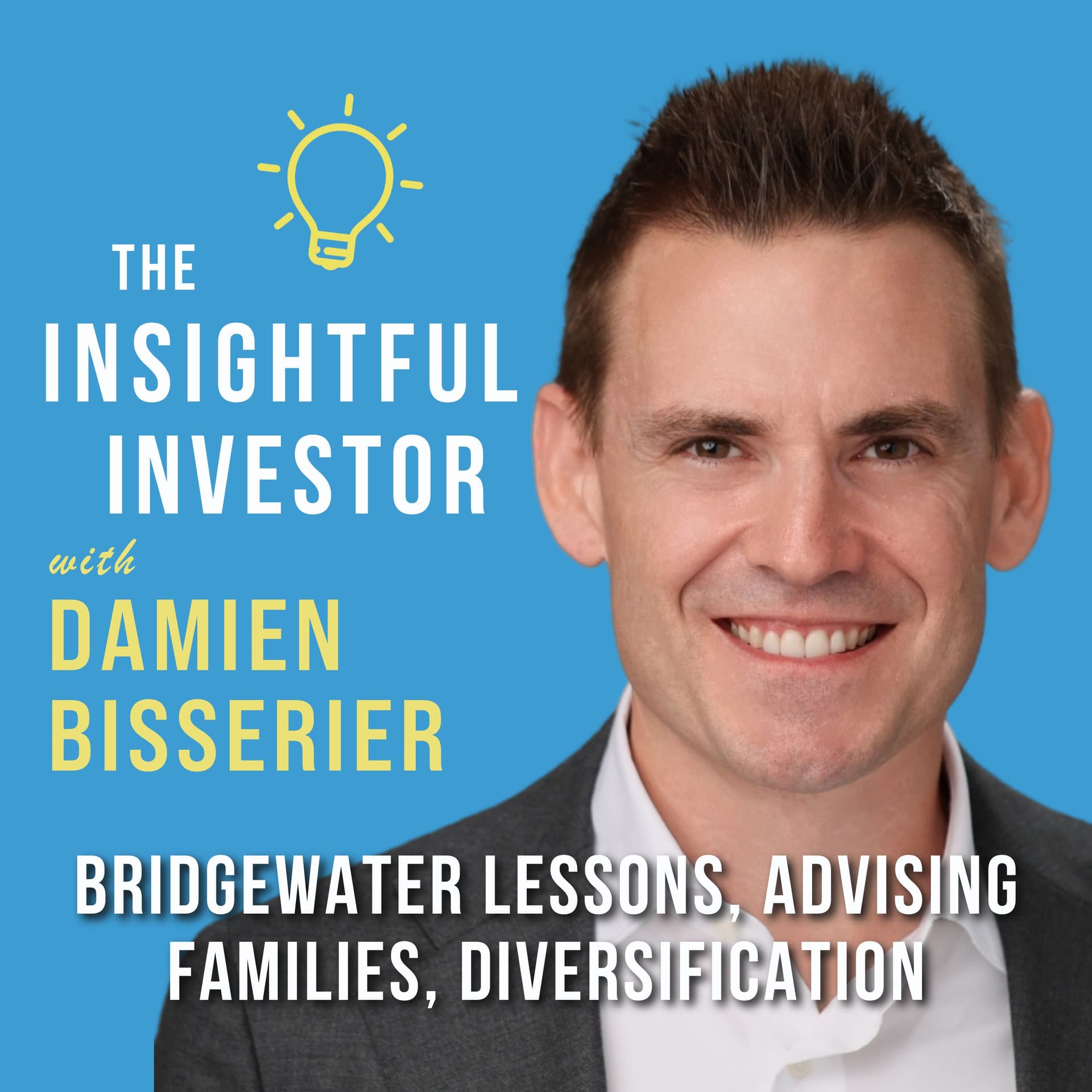
Podcast Summary: #72 - Damien Bisserier: Bridgewater Lessons, Advising Families, Diversification
Overview In episode #72 of the Insightful Investor Podcast, host Alex Shahidi engages in a deep conversation with Damien Bisserier, Co-CIO of Evoke Advisors and Alex's long-time business partner. The episode focuses on Damien's journey from advising large institutional investors at Bridgewater to working with wealthy families and smaller institutions. They discuss valuable investment lessons, diversification strategies, and the importance of understanding client needs.
Key Points and Themes
- Introduction to Damien Bisserier
- Background: Damien studied operations research and financial engineering at Princeton, which combined his interests in math, science, finance, and economics.
- Transition to Investing: His passion for investing was sparked at Bridgewater, where he learned valuable lessons from industry leaders.
- Lessons from Bridgewater
- Diversification: Emphasized as a critical strategy in investment management. Damien learned the importance of being humble regarding the ability to predict market outcomes.
- Culture and Relationships: The exceptional talent and culture at Bridgewater shaped his professional development and created lasting friendships.
- Moving from Bridgewater to Personal Finance
- Motivation: Damien's transition to becoming a financial advisor was driven by his desire to help clients and solve strategic problems for them.
- Client Relationships: The consultative approach at Bridgewater allowed him to build deep relationships with clients, focusing on asset allocation and risk management.
- Investment Philosophy
- Overall Strategy: Aims to find lowly correlated return streams to build resilient client portfolios. This involves a focus on both public and private markets for diversification.
- Customization: Portfolios are tailored to meet specific client needs and preferences, considering factors such as liquidity and risk tolerance.
- The Role of Education in Client Relationships
- Understanding Preferences: Emphasizes the importance of understanding client biases, preferences, and needs to create satisfying investment experiences.
- Continuous Learning: Both advising families and learning from clients adds to Damien's investment acumen.
- Active Management and Alternate Investments
- Identification of Quality Managers: Look for strong organizational culture, integrity, and unique insights among active managers.
- Access to Alternatives: Building long-term partnerships with high-quality managers allows for better access to alternative investments.
- Current Investment Strategies
- Market Environment: Discussed the importance of diversifying given the current economic uncertainty.
- Compelling Strategies: Areas such as secondary markets, secured lending, and energy investments were highlighted as attractive opportunities for the future.
- Tax Strategies
- Tax Minimization Tools: Discussed the importance of tax-loss harvesting and private placement life insurance as ways to improve after-tax returns for clients.
- Diligence on Tax Implications: Analyzing the tax treatment of investments is integral to the advising process.
- Looking Ahead
- Future Themes: Expectation of increased regional diversification in portfolios and the shift away from US equities as the dominant investment driver.
- Access to Alternatives: The trend towards better access to alternative investment vehicles is anticipated, requiring thorough diligence.
- Final Thoughts
- Main Advice: Surround yourself with smarter individuals and maintain a humble mindset regarding market predictions. Focus on building resilient investment strategies.
Conclusion The episode concludes with Alex thanking Damien for sharing his insights and experiences. The conversation reinforces the importance of diversified investments, client relationships, and the adaptability needed in today’s complex financial landscape.
---
For more insights and to listen to past episodes, visit [insightfulinvestor.org](https://insightfulinvestor.org/).
Written by AI. May contain mistakes. Listen to the episode to check what was said.
Transcript
Automatic transcript. May contain errors.0:05Welcome to the Insightful Investor Podcast, a weekly series that seeks to share industry, investment, investment, investment, investment, and market insights. We define insights as concepts that are counterintuitive, widely misunderstood, or underappreciated. In other words, unique ideas that you probably won't hear elsewhere. I'm Alex Shahidi, the host of the podcast and co-CIO of Evoke Advisors, a leading investment advisory firm. Learn more about our show at insightfulinvestor.org.
0:38One important mission of this podcast is to share practical wisdom, to help listeners become better investors. Today, I'm excited to be joined by Damien Besserier, who's been my business partner for over a decade, and he's also the other co-CIO of Evoke Advisors along with me. Damien brings a unique perspective shaped by his journey at one of the world's largest hedge funds. He worked with very sophisticated institutions and some of the largest pools of capital in the world there. He's transitioned to advising wealthy families and smaller institutions. Through this transition, Damian has gained firsthand experience with a wide range of investment approaches and priorities.
1:18Today, I hope to explore the most valuable lessons he's learned along the way. Damian, thank you for joining us. Thanks, Alex. Let's go back to the beginning. You studied operations research and financial engineering at Princeton. Would you tell us what that field encompasses and what drew you to it? Yeah, in retrospect, I wish I could have studied investments, but that wasn't really an option. So that was actually a major that had just started the year I graduated. So we were the first graduating class with that major. It was essentially applied math interdisciplinary between the engineering school, which I was a part of, and finance and economics.
2:00So I have always enjoyed math and science. And that seemed to combine a lot of the things that I really enjoyed. You know, there were aspects of engineering I enjoyed, but it was never something that I wanted to pursue as a career. And so that ultimately led to me going into finance for a career and ultimately finding my way into investment management. You talked about wishing you had gone into investing early on. What first sparked your passion for investing? And was there a particular moments or influence that led you in that direction? I had a good friend that was working with me at Oliver Wyman.
2:37My first job out of school was at a consulting firm called Oliver Wyman. We did management consulting for large financial institutions, insurance companies, banks around the world. And I really enjoyed my colleagues and being in all these wonderful places. I worked in Asia. I worked in Europe. I was working in various parts of North America, but I was never super thrilled with the actual content, which was a lot of risk management and building models and spending my days in spreadsheets. And so a friend of mine left that firm to join Bridgewater. And I think the recruiter saw a potential source for additional recruits to go to Bridgewater.
3:15So I talked to that same recruiter and ended up also going to Bridgewater. And that's where my eyes really opened to this fascinating world of investing. And I frankly got lucky. It was a place where I learned a tremendous amount and I can't think of a better place to have started my career in investment management than Bridgewater. Knowing you for a long time, I know Bridgewater was a major inflection point in your career. What would you say are the most important lessons or experiences you took from your time there? Yeah, Ray is full of tidbits of wisdom. As many of you know, anyone that follows his LinkedIn or has heard him speak, he is very good at imparting wisdom and seeing, I think, certain frameworks in the complexity of the world.
3:58And so he was definitely instrumental in helping me think about investing and building a business. So some of the things that I took away from Bridgewater, one key thing is just emphasize diversification, be humble about your ability to predict the future. Bridgewater focused on public market return streams and And everything we did, whether it was active management or whether it was holding assets for the long term, we really emphasized diversification and thinking deeply about where do return streams come from and what drives the risk in those different types of investments. And so that was, I think, a big learning for me is just be diversified, be humble.
4:37The thing that I found most exceptional about Bridgewater were the people. For whatever reason, I think Ray had a lot of principles that he espoused, but ultimately that acted as a filter to bring in just an exceptional group of people that were super talented, all with different skill sets, but all, like I said, humble and caring for one another. I think sometimes the outside perspective on Bridgewater is that people are really cruel to one another because it's an environment that really prioritizes honesty and direct feedback. And that is true because I think those things are critical to improving.
5:16But above all else, when you're in the trenches with people, you actually develop these incredible bonds. And I have many, many stories, which are maybe saved for another day, but many stories of just tremendous care that came within that community. And a lot of my closest friends are still there or are still from there, they moved on to other jobs. So the relationships, I think, were probably the thing I valued the most coming from Bridgewater. But certainly from an investment perspective, there were many learnings that served me today. I know another turning point for you was leaving Bridgewater to join me and become a financial advisor.
5:53What motivated you to make that leap from being a senior partner at one of the world's largest hedge funds to working more directly with individual clients? So my job at Bridgewater was pretty unique. So at most investment managers, most hedge funds, you have an investor relations function, and that's pretty much restricted to giving information to your clients about what that firm is doing. And maybe you have a business development role. But at Bridgewater, we had a very consultative approach to building relationships. So I actually started in the investment group at Bridgewater. I went through the investment associate training alongside everybody that ended up leading research ultimately.
6:34And I chose to work with clients. So I took that skill set, that investment skill set, and I used that to build deep relationships with our investors, which were basically the 300 largest pools of capital in the world. And we wanted to be more than just a return stream to those clients. So I still had the role that I needed to inform them on what we were doing and the investments that they had with us. But a lot of my role was figuring out ways I could be a strategic resource for them and marshalling the insights and resources at Bridgewater to help them solve their biggest challenges. This was the part of my job I enjoyed the most.
7:07So helping them think about asset allocation or helping them think about hedging inflation or what should be the correct currency mix in their portfolio. There was an endless series of these strategic questions that I frankly loved to be in the role of helping our clients solve. And when I reflected on where I got the most satisfaction in my job, it was precisely in that way, building those relationships and helping clients and solving these problems. And so when you came along, you were one of my clients, I saw what you did day to day and how you approached the business. And it seemed like the ideal role for me.
7:43So, you know, the story that I think maybe some people have heard before, but I'll tell it again. You actually came into the office and met with Ray and shared some of your learnings along the way in the meeting with Ray. And I think he was impressed by that. And so in the hallway after the meeting, Ray Dalio grabbed me and said, that guy I was talking to, he's got good common sense, we should hire him. And that was, of course, not the typical response from Ray after meeting somebody for the first time. So I called you up and I offered you a job at Bridgewater. And your first question was, can I stay in California or do I have to move to Connecticut?
8:16I said, I'm sorry, but being from California, I've been trying to convince Ray to open a California office for years. It's not going to happen. And your response was, well, as flattered as I am, I'm not going to move my family cross country. But while we're on the topic, would you consider working with me? And that was really when we started talking about that, which was maybe, I think, probably six years before we actually went into business together. Over the years, we explored this idea of building a business together, building it on the basis of surrounding ourselves with the smartest investors, which is an incredible opportunity.
8:48It was how lucky we are that we get to do that every day. We talk to the smartest investors in the world, take the insights from those smartest investors, build deep, long-term strategic relationships with them, do our own independent research, and then only then provide that advice to clients and use that advice to build resilient and well-constructed portfolios for clients. That sounded like an amazing role for me. And so it didn't take too much convincing. It took some time before I was ready to make the move. But ultimately in 2014, I chose to leave Bridgewater. My wife and I, we moved back to California and we started our business together.
9:23The next question, I'm going to give my answer. And I'm curious if your answer is similar, because it's very similar to what you just described. And the question is, is what aspects of being an advisor do you most enjoy? And for me personally, it's what you just said, which is surround yourself with the smartest investors in the world, learn from them, and then share that insight with your clients, many of which are some of the smartest people in the world, and you learn from them in response. And that flywheel of learning and getting smarter and becoming better informed just continues. And that's, to me, the most gratifying part.
9:59I'm curious what your answer is. Yeah, I mean, it's the relationships, clearly. But it's also the intellectual stimulation. So I get to come to work every day, and the world is a complex place. I think there's essentially a limitless number of ways to make money in investing. So I get to learn about all these various ways from the people that are the very best in the world at doing it. And then I get to take the best of what I've learned and offer it to my clients, who also, in many cases are exceptionally successful and insightful in their areas of expertise, sometimes investing, sometimes other areas.
10:33And I get to work with this exceptional group of people here at Evoke, not just you, but people that are best in class on areas outside of investing as well, or are amazing at building relationships or amazing at building businesses. And so it's just getting to surround myself with exceptional people and learning from them. And most of all, being with people that I respect as individuals, high quality people who want to do the right thing for clients. That's what gets me up every morning. And Bridgewater, as much as I learned there and benefited from my time there, I'd go home after a long day at Bridgewater and I'd complain about work.
11:08And I know many people that do that. And since I started this business with you, I've never complained about work. I love coming to work every day. And of course, I don't love every single thing I do during the course of the day, but I'm so energized by getting to surround myself with these people and just the constant learning. It's a really exceptional opportunity that we have here, and I feel very grateful for it. I do as well. And that's really the main reason I started the podcast, is to share all the wonderful insights that I've been able to learn from talking to some of the smartest people, both investors, many of our clients, and then others that are neither of those that I've been fortunate enough to connect with and learn from.
11:48Let's transition to investing. Damian, would you describe your overall investment philosophy? So my investment philosophy, I think it probably started with what I learned at Bridgewater, which is essentially find lots of good unrelated return streams, combine them to create something that's very consistent. At Bridgewater, we focus just on public markets. Now I get to focus on all markets. So if I think about my role as a co-CIO at Evoke, it's to cultivate a platform, build a platform, a menu of high quality public and private return streams that we can then incorporate into client portfolios to help our clients meet their objectives.
12:32Within the public markets, there are opportunities to diversify across equities, fixed income, inflation hedges, but you run out of line items pretty quickly. A lot of the things that people invest in in public markets are actually quite similar to each other. So you have different exposures within equities, large cap, small cap, international, et cetera, but they're quite correlated in particular in the tougher environments, they're very correlated. And so if you really want to build resilient portfolios, you have to augment your lens to include other return streams in the private markets or skill-based return streams, maybe in the hedge fund area.
13:07And so that's been a lot of fun for me and for you and for our team to go out and find these return streams, find these individuals, these exceptional individuals that produce these return streams. I think of it as lots of different categories of returns that we can incorporate into our client portfolios. And we're just looking for the best in class practitioners in each of those categories. And that's a never ending challenge. So we continue to fill out that grid, that menu. And then that allows us to build really well diversified, resilient portfolios. And that's very simplistically what we're trying to achieve is finding lots of good, lowly correlated or diversifying return streams and incorporate those into client portfolios based on their specific needs.
13:50So we customize that for each client. The conceptual framework is simple. I find a bunch of things that are attractive in terms of the returns and they go up and down at different times. And you put all that together and you get attractive returns with relatively low risk and low risk of significant declines. So that conceptually sounds obvious and simple, but implementing it in practice is much more challenging, of course. It is. And I think you need a platform like ours to be able to evaluate these return streams. It's not super simple in many cases, particularly in the alternative space. There's not a lot of transparency.
14:25There's not a lot of information. You have to really spend a lot of time assessing the integrity of the people that you're entrusting with client assets. And that requires, again, that network that we've been able to build here of investors and clients that help us diligence and evaluate these individuals. And then you need to be able to access these things. And that's something that I think we can do very efficiently because of our size. So once we've decided, we've completed our diligence, we decide something's high quality, and we want to allocate, we can use our size to get capacity and to usually, in many cases, maybe get some concessions in terms of fees or other advantages so that our clients can access these things and access them efficiently.
15:08So that's definitely something that we focus a lot on. You've been an investor for a couple decades. The first decade you spent at Bridgewater, which we talked about. The last decade you've spent as an advisor to wealthy families and institutions. How would you say your mindset and approach to advising clients has evolved since you first started? So investing, it's interesting because I really think about my job as trying to achieve the best outcome for the client. That doesn't always mean build the best investment portfolio. I think at Bridgewater, we were much more rigid about what the best portfolio is.
15:50And I think that there's a beauty in that. But in practice, that's not necessarily the best portfolio for every individual or every institution. And so there's a lot of back and forth and learning and conversations that go into learning what's appropriate for each client. Because if you think about getting the best outcome, it's not just building the best portfolio, it's figuring out what it is that that client is comfortable with, and what it is that's appropriate for their needs. So things like liquidity, some clients are better suited to more liquid portfolios, simple, low cost portfolios. Some clients want more alternatives.
16:29Some clients are very equity oriented. And so if you do something that's very different than the equity markets in a strong bull market, they're not going to keep up and they may be disappointed with that portfolio, even if it's well constructed. And oftentimes when people make changes, it's after a bad experience. So you can imagine you build a portfolio, it might be a good portfolio, but if it underperforms relative to their reference point, they may end up selling that portfolio at the absolute worst time after it's underperformed, and then going and putting their money in something that's just done very well, and then catching that period of underperformance that inevitably happens.
17:04So all of these investment portfolios, all these investments are cyclical in nature. They all have good periods and bad periods. And we want to make sure that we build something as stable as possible and as in line with the client needs and preferences as possible. And that's likely to lead to happier clients. There's a big educational component as well, making sure they understand what's in there. And that will create happier clients and more patient clients and ultimately achieve better investment outcomes. But all of the understanding of investor preferences and biases and needs, that was something I had to learn.
17:41That was all brand new for me when I started on this journey of being an advisor. It's an important piece in that, frankly, I spend most of my time on today. I spend a lot of time diligencing investments, and I spend a lot of time getting to know our clients and making sure that we're building things that are appropriate for them. Yeah, managing somebody's money can be a very emotional experience for them as well. So you have to understand the art of consulting beyond just the science of what should be done on paper and recognize that there are biases, there are emotions involved, prior experience reference points that you talked about.
18:18It's a much more multidimensional than just what's the best on paper. Absolutely. So you talked about learning from some of the brightest minds in the industry. What role would you say clients play in making you a better investor? So a lot of our best investment ideas come from clients. That's a very obvious one. So by managing money for clients that are in the business, we often see more and they can help us also diligence those things in a much higher quality way. One of the things that we frequently do in our diligence process is we reach out to either existing clients or sometimes our existing managers to talk to them about their experience with a particular investor.
19:07And you learn a lot. If you go off of the reference sheet that you usually get from managers where everybody says something nice because they're on the reference sheet, the official reference sheet, and you go talk to other people that have done business with these individuals, that's where you learn the most. And so our clients are an exceptional source of information there. I think we get to work with some of the most talented people in the world in their respective professions. So I love learning about those businesses. I love learning about the various ways that people have created wealth for their families.
19:37And I really love, you know, kind of stretching myself and learning about all the other aspects of what we do for our clients. So, you know, a lot of the problem solving isn't even investment related that we engage with. sometimes it's estate or tax-related. And those have been things I've learned a lot from clients about over time. Well, you've worked with both highly sophisticated institutional investors and ultra high net worth individuals. How would you say their approaches to investing differ? And what can each group learn from the other? Well, so if you think about an institution, oftentimes it's a committee that changes over time.
20:17They will typically be a little bit more rigid about having a document that details out the game plan for investing in the portfolio. They'll have an investment policy statement. If I think about the starting point of having an investment policy statement, I think that kind of discipline is really valuable. And so I think a lot of individuals and families can benefit from having that investment policy statement upfront. So that's definitely something I think individuals can learn from institutions. I think sometimes individuals can often see the bigger picture though, sometimes a little bit better than institutions.
20:51Again, because you have a consistency of messaging, you have a consistency of relationship. You don't have board turnover constantly where you have to re-educate people. Some of those people might have differing opinions. When you have a single individual client or family that you're working with, you can over many years have a vision of what you're trying to accomplish. And you may not get as bogged down in details and you don't have to confront changes of opinion around how things should be done because you're sort of executing this long-term plan. Whereas institutional investors, it can be complicated at times.
21:24There are politics that enter into it. There are personalities that enter into it. And then sometimes you can get very focused on details that aren't quite as important. So I think from that perspective, that consistency of relationships and long-term vision can be sometimes easier to implement in a family context. In your role overseeing the investment platform at Evoke, you've had a unique advantage point on what makes successful investors. You talk to a lot of them. Are there particular qualities you look for when identifying active managers? Yes. So I learned this at Bridgewater, but you want to see a strong culture of excellence and it should permeate the organization.
22:07So there are a lot of really bright people in our industry, but very few of them have built great organizations where the consistency in your interactions leads you to sort of see this organization that is humming and working well in all aspects of what they do. So how are the investor relations folks trained and how do they communicate what they do? And do they reflect the values of the founding partners? When you engage with the organization, are they responsive? Do they give you quality answers? You could see it in terms of how they handle things like compliance. So the culture is a really important thing that is, I think, an indicator of a place that's well-run, that's likely to be successful for very long periods of time.
22:51You clearly have to have an edge. So you have to be exceptionally bright. This is a business where everybody's smart, more or less, but you're looking for the exceptional. Is it an organization that has demonstrated an understanding that is unique? When you have conversations with these folks, do they share insights that you don't hear elsewhere? That's an important piece of it, certainly. Performance is useful. So you obviously want top performers, but performance doesn't tell the whole story. So a lot of our work comes from understanding how has the performance been generated. And really looking for those quality answers and those unique insights is something that is very important to us if we think about whether that's repeatable going forward.
23:37And we do a lot of reference checks. That's another thing is not just relying on the marketing of the firm that we receive, but talking to others who have done business with these individuals, who have sat alongside them, who have seen them at their worst. How do they behave in those environments, we cannot compromise on integrity ever. And so that's a critical piece. I would say that we also want to see organizations that are really thoughtful about capacity. There are many organizations that were great when they were smaller. And then for obvious reasons, they want to grow. We all want to be able to offer new opportunities to new partners, but you want to make sure you're growing with an emphasis on return generation and not growing just to make the organization larger and more profitable, because that may not be the best thing for clients.
24:22I'll add to two things you just said. One is performance. And this sounds very obvious, but we don't get past performance. We get future performance. It's something that is, in my experience, so widely underappreciated because people look at past performance and they assume the future performance will look like the past performance. And you just have to look at the past performance, understand where it came from, and then you're trying to guess what the future performance is going to be. And past performance is just one aspect of that. And for, in my experience, most people, that becomes the majority of the input as opposed to a minority and all the other things you just described should definitely go into the equation.
25:04And the other thing that you mentioned that I'll share a quick story on is you talked about how just about everybody on the investment management side is very smart. So the first, I'd say, 10 or 15 years of my career, I was meeting with 200 to 300 investor managers every year. And the first one I met, I said, you know, these people are really smart. They should get everything. And then you meet the second one and you're like, oh, wow, they're really smart too. And then after you meet about 100, you realize they're all smart. And now what it does is it raises the bar because in effect, they're all competing with each other.
Read the full transcript
25:38And the bar just keeps going up the more of them you meet. And then what you're really trying to find are the ones that are exceptional beyond the average. And just the average is at a higher level because it's an industry that if you do well, you can get paid a lot. It attracts a lot of really smart people and it's brutally competitive. And I think that's one of the key learnings that I've had is after you meet with hundreds and hundreds and even thousands of managers, you realize how smart they are and it just raises the bar. And then you have to look at that as the bar that the next manager has to overcome.
26:12And then if they're that good, you got to figure out how to get capacity. That's right. Right. And then there's all the qualitative aspects of underwriting. So it's far more complicated than it may seem on the surface. This has to be an organization that prioritize not losing money. That's another thing we spent a lot of time on is how do they handle risk management and how do they think about that in all these different return streams that we're accessing, that risk management may take different forms. In some cases, it might be just having a lot of different unrelated positions. In other cases, it might be structural downside protections that can be built into contractual lending terms, for example.
26:49So we spent a lot of time trying to understand those things and really digging into what could go wrong, even if it hasn't gone wrong. Oftentimes, people will reference, oh, in the global financial crisis, X, Y, and Z happened as if that's the worst case. But then if you look at the current environment, for example, if you're investing in office, it's way worse than the global financial crisis. So there are always going to be surprises, always going to be things you haven't seen before. We're trying to invest with people that are thinking in those terms, and they're thinking about things that maybe haven't happened.
27:17And how do we protect investor capital? That has to be the very first priority in their mindset. So Damien, one of the oldest rules in investing, just to go back to basics, is don't put all your eggs in one basket. When you talked about your overall investment philosophy, it's about diversification. One of the things Ray taught you is be humble and be diversified. And that goes to don't put all your eggs in one basket, meaning be diversified. In your experience, do most investors actually follow this simple principle? It's quite difficult when the dominant exposure in most people's portfolios is doing so exceptionally well, which has been US stocks for the last couple of decades.
27:56In practice, it is much more challenging than it sounds. And frankly, if you're just looking at public markets, there aren't that many places to go. The other thing that has been challenged, I think recently, is that typically the main diversifier people use for stocks has been bonds. And we're in a bear market for bonds where the return of the Barclays aggregate has been negative for a number of years. It's starting to recover now, but it was a very painful adjustment to go from near zero interest rates to where we are today. So I think that has left people in many cases with very concentrated portfolios because they've stuck with what's worked.
28:35And that's a logical thing. You also have tax considerations for folks that have had success. I know a lot of clients own very large exposures to the MAG7 stocks because those stocks are great companies and they've done well. And so there's a comfort in having those exposures. But that's something that we've been actively helping clients figure out ways to diversify without taking a big tax hit. And it's pretty important because these things, again, they all move in cycles. So this wasn't that long ago, but many people might remember that the US stock market was negative for over a decade in the 2000s.
29:08And I'm sure, I don't know when it's going to happen, but I'm sure at some point in the future, there will be an extended period of underperformance from US stocks as there is in anything. And it will be critical, I think, for investors to find other return streams that are equally attractive over the long term, but that are different. And so that's what we spend our time trying to educate our clients about, and also helping them solve some of the challenges with diversifying, like dealing with you know, embedded taxes and such to help get them to a better place that, again, is more appropriate for their long-term risk and return objectives.
29:41A lot of those return streams that you just alluded to fall outside of public markets and fall into the world of alternative investments. But accessing high-quality alternative investments is limited for most investors. How do you address the access problem for clients? So we have, for a long period of time, sought to find these best in class managers across all these various verticals, across all these categories within private equity, private credit, private real estate, hedge funds. And as you alluded to, many of these managers that are exceptional, they have exceptional results, and they run out of capacity or they have very limited capacity.
30:23Our challenge is identifying them and then building long-term strategic partnerships with them, using our scale to be a meaningful partner to them, and also get discounted terms, so attractive terms and access for our clients. And this can take many years in many cases. And a lot of times with these managers, we start small, we grow that relationship over time. I think because we tend to focus on fewer higher quality relationships because we, again, we don't think there are that many exceptional investment managers out there. So we want to find the few exceptional ones that exist and then be good partners to them.
31:01And they like working with us in many cases. And so they then give us capacity and give us preferential terms because we've been a good partner to them. It's not something that happens overnight, but it's been built up over decades of experience working with these individuals and building relationships with these individuals. And over that time, if we're making large allocations is because our conviction has grown as we've gotten to know the organizations better. So I think our confidence also is it's grown in line with those larger allocations, which again, gives us the ability to access those things.
31:30So access, I think, is a big drawing. It's a big selling point for us with clients who want to access high quality alternatives because we're at a size where we can access things, usually with preferential terms, and be meaningful partners to these managers. And our rigor on the research side, which is something that you and I have in our DNA, I saw it with you. And in fact, you've written a couple of books on asset allocation. And I was sort of trained at a place, Bridgewater, where the diligence was incredibly deep. They produced some of the best research in the world on macroeconomic topics.
32:08And then I basically applied that same sort of rigor to building out our investment research function here. And I hired other people that have that same sensibility and that same drive to really understand things at a very deep level. So it's like the diligence and then building those long-term strategic partnerships that allows us to access those things for clients. And it's something I'm very proud that we can offer to clients. When it comes to diversification, which we obviously spent a lot of time talking about today, how do you balance what is theoretically optimal with what clients can realistically handle, both emotionally and practically?
32:43It ultimately comes down to understanding what a client needs and what they're comfortable with from an investment perspective. And so that's the initial conversation we have with clients to understand the types of investments they're interested in, what they're trying to accomplish, what their risk tolerance is, what their liquidity preferences are, what their spending is, or other liabilities that they have coming up. And all of that then gets reflected in a portfolio that we think is appropriate for their needs and their preferences. And then it's constant education. So we are providing information on a at least quarterly, but oftentimes more frequent basis.
33:23And we also produce a lot of additional content to help clients understand what's happening in the world and what's influencing our decision making. We also provide transparency into any of the alternatives that we're investing with, usually with some content that gives investors direct exposure to the managers themselves and the types of questions that we're asking and the types of things that have led to us having conviction. It's all of those things that I think translate to arriving at a point where clients are happy with what we're doing. And it's an ongoing process to make sure they continue to be well-educated and understanding of how we're approaching things.
33:59And to the degree that things are not proceeding as they'd like, we make adjustments. That's ultimately the challenge. It's not just building a portfolio, one size fits all. It's a really highly customized, highly interactive approach. One of the big differences between institutional and high net worth or family office portfolios is tax. So part of the optimization for those that pay taxes is tax minimization or after tax returns. Are there certain tools families use to improve after-tax outcomes? Yes. And I spend a lot of time advising families on this. For whatever reason, tax is a topic that gets people more excited sometimes than the actual investments themselves.
34:42Maybe because it's a little bit easier to quantify. Pick a great active manager, they may continue to outperform, they may not. It's a little bit of a probabilistic guess. Whereas if you can build a more tax-conscious portfolio, there is a certainty with the kind benefit you can get on the tax side that I think is valuable and people appreciate. So a couple of the things that we've been doing on the tax management side that I think has been interesting and something that I think we will do in greater size across the platform. One is implementing long, short tax loss harvesting mandates. So historically, you can hold an equity index in a tax loss harvesting mandate.
35:27This is the traditional way of doing it, where you essentially go out. There are many firms that do this, where you buy individual stocks to replicate an index like the S &P 500. And as individual stocks go down, you sell that and buy it back 31 days later. So you're still replicating the index, but you're capturing losses along the way. And in that traditional long only context, you will have losses that you're capturing for maybe the first five years. And if you're not adding money, you basically run out of losses after that. And you're capped with how much loss you actually can capture just because everything ultimately becomes appreciated in the portfolio unless you're adding new funds.
36:03There's been a step change in the technology of being able to harvest losses where today you can now add longs and shorts on top of the index replication, and it allows you to generate a lot more losses consistently, so a greater magnitude of losses, and then you never run out of losses. Because if you think about putting on short positions in a portfolio, as you close out those shorts, they tend to be closed out at a loss. And so you essentially never run out of losses. There are all sorts of ways this new technology can be applied to client portfolios. I alluded to this need earlier on. We have clients with a lot of concentrated stock positions.
36:36So you can actually use this approach to, in a tax neutral way, move out of a concentrated portfolio into diversified index replication. And there are other applications too. If you have a big capital event coming up and you're going to sell your company and realize a big gain, and you're already holding index exposure in the S &P 500, you can do that with greater loss capture in advance and that those losses then can be used to offset the gain that you have that's coming from the sale of your company and it will reduce your tax bill. And what that results in long-term is you still have that equity index exposure as part of your portfolio with very, very low cost basis stock.
37:12And you have planning ways to deal with that later on, whether it's giving it to charity or dealing with various considerations and how it passes to your heirs. But being able to defer those gains is powerful and something a lot of our clients are now implementing in various forms. So that's one exciting thing because it's this new technology you can use in lots of different applications. And there are a lot of providers to do this and not just one provider. So that's another thing that we take comfort in. It's an established technology now, and there are lots of different practitioners that we can utilize to do that.
37:42Another thing that has been something that we just have been growing on the platform is something called private placement life insurance. So it's the ability to take out a life insurance policy and basically use that as a wrapper around a portfolio of different investments, usually alternatives, less tax efficient investments. And it allows you to invest in those things and your portfolio value, your cash balance value in that life insurance policy will grow in line with those underlying investments. And there are no tax ramifications. So ultimately, the cash value will be your death benefit, which is paid out and doesn't carry any tax consequence.
38:22There are some estate tax consequences that you would have to deal with. So you can fund that out of a grant or trust, for example, and then you get around the estate considerations. But it's really powerful if you're thinking about building a portfolio that includes alternatives, you can wrap some of those alternatives in a tax efficient wrapper utilizing life insurance. So that's another area that we've been focused on. And we've seen a lot of clients express some interest in this. And it's a growing space generally. So we see a lot of firms doing this. And in fact, some of the opportunities we're seeing today are helping clients maybe improve what's happening within an existing policy that maybe somebody else put on for them, but they're unhappy with for whatever reason, we can now offer them a better solution.
39:02When we think about tax generally, it's a critical part of our diligence process. So whenever we're recommending things to clients, we're always thinking about what's the best outcome net of fees and taxes, we incorporate an understanding, a deep understanding of tax as part of our diligence process. So anything we actually look at, we're looking at what's the actual tax treatment for that and what are clients going to ultimately get after considering those taxes. And so that's something I think we spend a lot more time, frankly, on than a lot of others because usually you're not evaluated on the after-tax returns, but we know that's a really critical piece for our clients.
39:36So we spend a lot of time on it. We live in very interesting times, as you know. What are some investment strategies you find compelling in today's environment? Yeah, it's a tricky macro environment, to say the least. We've had a quite good economy for an extended period of time, and now we have these very dramatic policy shifts that I think are introducing a lot of volatility and a lot of uncertainty moving forward. But there are certain areas of the markets where we see a shortage of liquidity and a very attractive return relative to risk. And also, these are areas that can be complementary for a broader portfolio in terms of diversification benefits.
40:15So one area that we continue to spend a lot of time on is secondaries. It's essentially a strategy whereby you're buying existing fund interests from other investors. You're providing liquidity to investors who are invested in existing funds because they want liquidity before the end of the fund term. They are willing to sell that LP interest at a discount. And if that discount is large enough, we view that as a really attractive thing to harvest. Essentially, you're getting to provide liquidity and in exchange, you get a nice premium because you get to buy assets at a big discount. Now, in practice, much of the secondary market transacts at a very small discount, which is not interesting to us.
40:54But there are pockets of opportunity, whether that's in credit-oriented LP interests, where there isn't as much competition because they're complicated and they're harder to understand and there just really aren't many skilled players in that space. So the discounts are much larger there, sometimes 30%, 40 % relative to net asset value. And because it's credit, you get paid back pretty quickly. So it's a pure play on monetizing that discount. So that's an area that we continue to have an interest in. There are certain secondary buyers that focus on much smaller bite sizes. So if you buy from individuals who don't have a lot of options to sell these interests, they also are willing to accept a larger discount because they don't have a lot of buyers that are willing to buy a million dollar interest, for example.
41:38And so that's been an area as well that we focused on. Those are a couple of the niche, niche or sectors within secondaries that we think there's a real need for liquidity. and people are willing to pay a premium to get liquidity and we're happy to provide that. And that discount that we can capture is essentially an uncorrelated return stream that we can harvest in our client portfolio. So we like that. Another area in today's market environment that we feel better about, because again, it's a risky environment, the economy we think is likely to slow from here, is secured lending. So lending money at high interest rates, double-digit interest rates, but with collateral as your protection.
42:15So if the borrower doesn't pay you back, you can capture the collateral that is securing the loan and sell that. And many times you make more money on those defaulted loans than you do on the loans that pay off normally, because in the cases where there's a default, you have incremental fees. And sometimes you can foreclose on the asset, own the asset, and the asset's worth a lot more than what you're owed. And so with the right underwriters, with the right risk controls and people that have had a long-term experience and track record of being able to do this well, we can get comfortable with lending against various hard assets, real estate, inventory, equipment.
42:51That's an area that we've been spending a lot of time on. And I think it kind of takes advantage of a higher interest rate environment, gives you that added protection, and we think offers a nice return relative to risk. Everybody likes income in the current environment. So that's a way to harvest the income with good downside protection. Another area that I think is interesting and relevant geopolitically is energy. So there's been a lot of capital flight from energy for ESG considerations. And so there is generally a shortage of capital there. So today you can buy cash flowing oil and gas wells at yields of 15 % plus in many cases, and you get the land that's adjacent that you can drill for free.
43:31And so that kind of setup where you can buy a discounted cash flow stream that's attractive on its own, and then you have upside optionality to develop land that's adjacent, and you can hedge a lot of your principal, essentially protect your principal through hedging of the existing cash flows. That's an interesting configuration to us and very different than what the energy markets look like 10 years ago. And if you think about the geopolitical environment, one risk that's out there is an escalation of tension globally. And that's probably an environment in which energy prices might go higher.
44:02And so having that hedge in your portfolio, we think is pretty interesting. It's an environment where we really are focused on the downside protection. And we want to make sure we have things that can make money across the very broad range of environments we're likely to face here. Yeah, it does feel like diversification is, you know, it's always important, but in this world where you have a wide range of potential outcomes and greater risks of extreme outcomes, diversification is paramount. Would you agree with that? Absolutely. And, you know, I alluded to this earlier, but some people, you know, they think about diversification as in, well, I can own bonds and that's my downside protection, but there are a lot of other things out there that can be resilient in a tougher economic environment.
44:43In fact, the challenge, I think the last few years has been that fixed income hasn't been that downside protection. Fixed income was down double digits in 2022, and it really hasn't helped, added much of a buffer for portfolios for the last few years. And so we actually augment our lens. We look at things like low correlation hedge funds as offering some of the same kind of fixed income characteristics where you can get returns that are higher than fixed income in our of view, even on a post-tax basis. But with a well-constructed portfolio, because these are managers that aren't taking a lot of directional market risk and they're uncorrelated to each other, you get a portfolio that can actually have risk that's lower than the bond market.
45:26So just thinking about all these different return streams that we can access across the platform, you can actually build in a much more resilient portfolio than a more traditional equity fixed income orientation. The other aspect of diversification are inflation hedge assets. And if you just take a step back, we haven't really had inflation problems until very recently post-COVID for three or four decades. And all of a sudden, it could be an issue again. And when you look at most portfolios, at least in my experience, they don't have a lot of inflation hedge assets because they weren't really needed for a long time.
46:01What's your perspective? Absolutely. It's something I think we've been putting into client portfolios for a number of years. And there are certain environments like 2022, when it was essentially the only thing outside of some of the alternatives that were positive. We believe strongly that inflation hedges are an important part of a diversified portfolio. And given the risks around the dollar today, and a weakening of the dollar, which the current administration has explicitly said they want to achieve, you have a lot of these policies that I think are challenging the supremacy of the dollar and long-term, there's a clear path here where the dollar is unlikely to retain the sort of dominant status it's had.
46:41You want to have real assets, tangible assets, inflation hedges of various forms. We believe that's a critical part of portfolios going forward. Looking ahead, are there other perspectives or themes you think will shape investing over the next decade or so? Absolutely. I don't think that US equities will forever remain the dominant return driver in portfolios. So really thinking about how do you build portfolios that are resilient and diversified regionally, because we have a much more fractured world. This is a world that is moving away from the globalization of the past couple decades to something that is much more disjointed.
47:21And so I think you're going to see bigger dispersion in outcomes across countries, across regions, more diversification benefit from having different regional exposure in portfolios. As you said, having exposure to things like inflation hedges that can hedge against a weakening dollar, for example, that's critically important. One thing that we've seen in recent years is better access to alternatives generally. So more vehicles to access alternatives in an efficient way. I think that's going to continue. A lot of larger asset managers are looking for different ways to deliver their return streams to clients.
47:56So that's a positive thing that means you can access, I think, a broader range of return streams for all investors. We, in certain cases, will utilize those vehicles as well. But we also think it's critical to do all the things that we do in terms of the diligence of the underlying return streams. And so the alternatives, I would say, are not all created equal. As you move into the alternative landscape, there is a greater component of active management, and there's also much higher fees. And so you want to be very mindful of those things, fees, taxes, and being really convicted that what you're getting is active management and not just leveraged or really expensive versions of things you can get in the public market.
48:37So I think it's exciting that you'll be able to access more things, but I think it requires a greater scrutiny than maybe you might have with traditional index funds within equities and fixed income. Damien, the final question I'll ask you is, if you could give just one piece of advice to help listeners become more insightful investors, what would that be? Surround yourself with people that are smarter than you, because we don't know everything. Be humble about what you can predict. Recognize that you'll be surprised constantly. And try to build something that can be as resilient as possible across as broad a range of outcomes as possible.
49:20This has been great, Damian. I appreciate you taking the time to share your experiences and your insight with our audience. Thank you. Thanks for having me on, Alex. Thanks for listening. We hope you enjoyed this episode. Please visit our website at insightfulinvestor.org to access past shows and learn more about our podcast. If you have questions, feel free to email us at info at insightfulinvestor.org. And if you enjoyed the discussion, please subscribe to this podcast to ensure you don't miss future episodes. And don't forget to forward today's conversation to others you think would enjoy listening.
49:57This podcast is provided for informational purposes only and should not be relied upon as legal, business, investment, or tax advice. All opinions expressed by podcast participants are solely their own opinions and do not necessarily reflect the opinions of Evoque advisors, their affiliates, or companies featured. Due to industry regulations, participants on this podcast are instructed not to make specific trade recommendations, nor reference past or potential profits. And listeners are reminded that securities trading, commodity trading, and alternative investments are complex and carry a risk of substantial losses.
50:32As such, they are not suitable for all investors.
50:39Listeners should be aware that guests featured on The Insightful Investor may have current or past associations with Evoke advisors or the host, including as an investment manager of a private fund opportunity by Evoke or access through an affiliated Evoke fund or as a client. Participation as a guest on the podcast should not be perceived as an endorsement or testimonial with respect to Evoke Advisors, the podcast host, or their services. Similarly, the inclusion of a guest on the podcast does not imply that Evoke Advisors or the host endorses the guest or any company with which they may be affiliated or employed.
51:18Evoke has neither paid nor received compensation from guests for their participation.
From the publisher
Damien is my long-time business partner and the other Co-CIO of Evoke Advisors. He brings a unique perspective shaped by his journey from advising some of the world’s largest institutional investors at Bridgewater to working with wealthy families and smaller institutions. Through this transition, Damien has gained firsthand experience with a wide range of investment approaches and priorities.


