
In short
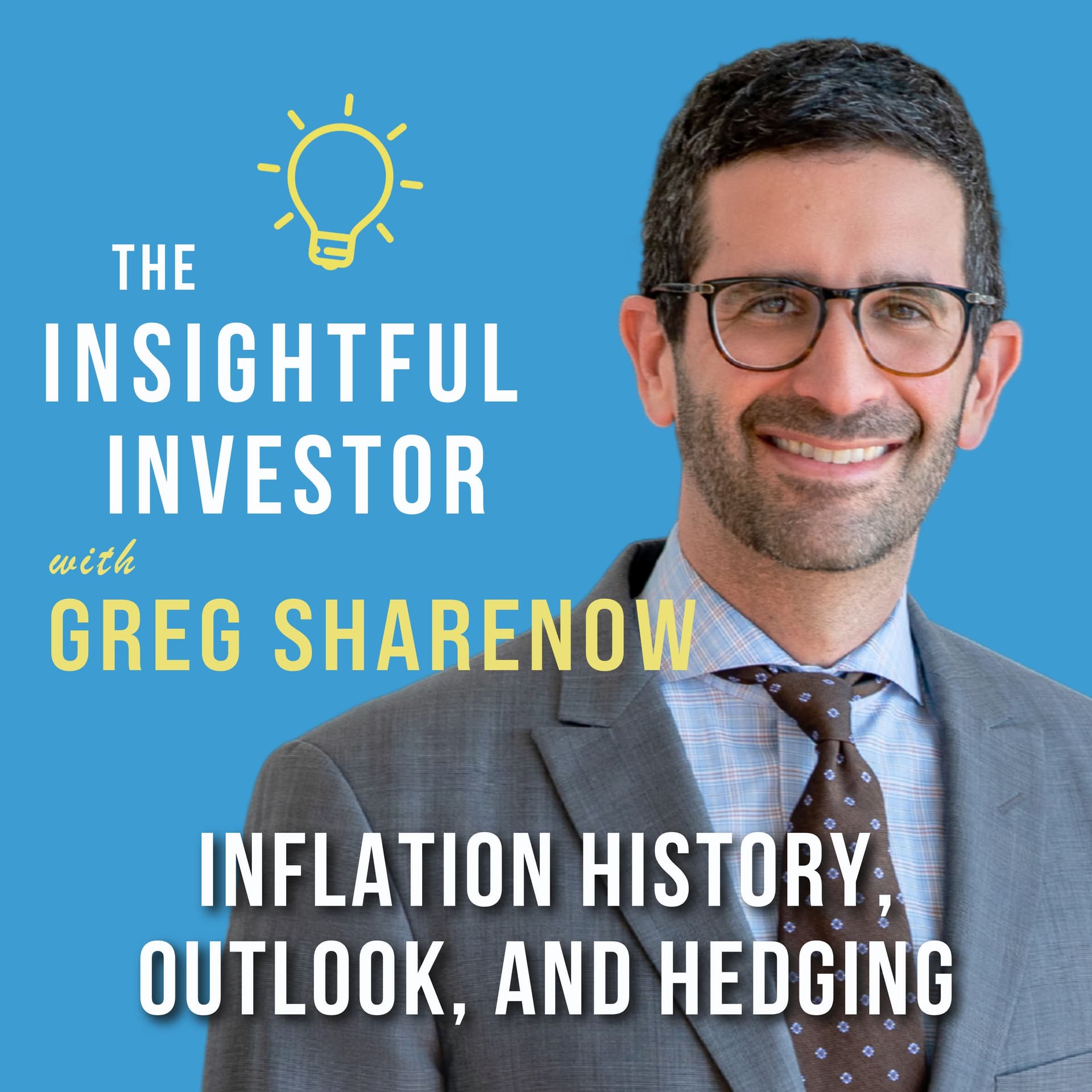
Insightful Investor Podcast - Episode #73: Greg Sharenow on Inflation History, Outlook, and Hedging
Host and Guest Introduction
- Host: Alex Shahidi, Co-CIO of Evoke Advisors, leading investment advisory firm.
- Guest: Greg Sharenow, Managing Director and Portfolio Manager at PIMCO, focusing on commodities and real assets.
Episode Overview In this episode, Greg Sharenow shares insights on the forces driving inflation, how investors can navigate the current macro environment, and the importance of diversification when hedging inflation risk.
Key Topics Discussed
- Personal Journey into Inflation and Real Assets
- Greg's career began with a job in quantitative portfolio analysis at Goldman Sachs, where he transitioned into commodity research.
- His interest in inflation and commodities stems from a blend of microeconomics, macroeconomics, history, and politics.
- Important Lessons in Money Management
- Emphasizes the importance of:
- Humility and diversification.
- Understanding the misalignment of incentives in finance.
- The value of stable capital in managing volatility.
- Inflation: A Historical Perspective
- Inflation arises from an imbalance of supply and demand.
- Historical inflation episodes include:
- Early 2000s driven by China's growth.
- The 1970s oil crisis and recent post-COVID inflation.
- The understanding of inflation is influenced by generational experiences, with those born post-1970s lacking firsthand knowledge of high inflation.
- Investment Philosophy on Inflation
- On short-term inflation surges, stocks and bonds historically show negative returns.
- Commodities are highlighted as the best hedge against inflation surprises.
- Future Inflation Outlook
- Current trends indicate a shift towards higher and more volatile inflation due to:
- Deglobalization and geopolitical tensions.
- Increased tariffs leading to higher costs.
- Energy transition impacting commodity and material demands.
- The Role of AI in Inflation
- AI requires significant investment in infrastructure, which is energy and materials-intensive, suggesting an inflationary impact in the short term.
- Investment Strategies and Asset Classes
- Importance of investing in a diversified basket of inflation-hedging assets rather than trying to pick individual outperformers.
- Long-term ranking of asset classes:
- Equities
- TIPS (Treasury Inflation-Protected Securities)
- Commodities
- Gold
- Core bonds
- Common Mistakes in Inflation Hedging
- Market Timing: Investors often crowd into assets after inflation has already impacted them.
- Private vs. Public Real Assets: Overvaluing private assets for short-term inflation hedges can lead to liquidity risks.
Key Takeaways
- Recognize the historical context of inflation and how it influences current market expectations.
- Diversification is crucial in navigating inflationary pressures, and investors should maintain flexibility in their portfolios.
- An understanding of the macroeconomic landscape is essential for making informed investment decisions.
Conclusion This episode of the Insightful Investor provides a comprehensive view on inflation, driven by Greg Sharenow’s extensive experience in commodities and real assets. Investors are encouraged to adopt a diversified strategy to hedge against inflation while being mindful of market conditions and evolving economic factors.
For Further Information: Visit [Insightful Investor](https://insightfulinvestor.org/) for past episodes and insights.
Written by AI. May contain mistakes. Listen to the episode to check what was said.
Transcript
Automatic transcript. May contain errors.0:05Welcome to the Insightful Investor Podcast, a weekly series that seeks to share industry, investment, investment, and market insights. We define insights as concepts that are counterintuitive, widely misunderstood, or underappreciated. In other words, unique ideas that you probably won't hear elsewhere. I'm Alex Shahidi, the host of the podcast and co-CIO of Evoke Advisors, a leading investment advisory firm. Learn more about our show at insightfulinvestor.org.
0:38Today, I'm in beautiful Newport Beach, California in PIMCO's spectacular studio. If you're listening to this podcast on audio only, you should check out the video version on YouTube or Spotify. Today's guest is Greg Chernow. Greg is the managing director and portfolio manager at PIMCO, and he focuses on commodities, real assets, and inflation solutions. He leads PIMCO's Commodity Portfolio Management Group, and he's been at PIMCO since 2011. I couldn't think of a better guest to cover today's topic, which is inflation. Greg, thank you for joining us. Thank you for having me. So let's go back to the beginning.
1:20What originally inspired you to focus on inflation and real assets? A paycheck. Okay. I was in university, obviously, in Northwestern and looking for a job and banking, investment banking, consulting, a variety of recruiters would come to campus. And I was thinking, what can I do for consulting? I don't know anything yet. And research at a bank seemed like a good place to start learning something about the world, the markets. So I actually got hired at that time to be a quantitative portfolio analyst, writing CIO targeted level research at Goldman Sachs. Steve Strungan happened to know some of my professors from Chicago Fed days and offered me a job.
2:02So I called up a friend of my dad's and said, should I take this job? He's like, you have an offer to work at Goldman Sachs. Why are you calling me? I'm questioning your sanity at this moment. At that time, Steve Strungan also ran the Commodity Research Group. And while I was doing research on the Quonset, I was supporting some of the GSCI, Goldman Sachs Commodity Index research at the time. And then when PetRocks.com and every internet stock took over, I ended up migrating out of what became no longer interesting, which is CIO targeted level research and moved into the commodity research group, which was for me very fortuitous because at a fairly young age, I found something that was perfect for me.
2:39You know, if you think about inflation, you think about commodities, it's a mixture of microeconomics, macroeconomics, history, politics. And when you, I think back, one of my favorite books I read in college was Daniel Juergen's The Prize. And also I did love reading like From Beirut to Jerusalem. And I had a real interest in the history of the Middle East, the history of the commodity markets kind of like became a launching ground. So it just ended up being a great opportunity for me in the end. And 26 years later, I'm still in that business. Well, you spent time at Goldman Sachs, D.E. Shaw, Hartree, and now over a decade at PIMCO.
3:16What would you say are the most important lessons you've learned about managing money before we get into inflation? Yeah, so I think there's the normal answers of be humble, diversification. You know, one of the things that I did learn early on in sort of the research I did in the quant research focus was that if you're right 53, 54 % of the time, like you're distinguished, you know, you need to have smart portfolio construction. But in the grand scheme of things, what I feel like I realized is that there is a misalignment a lot of times in incentives in our business. and being in a place where you have stable capital, being in a place where your incentives are aligned with your clients and long-term performance enables one to sort of manage through a lot of that volatility that comes.
4:02You never know when volatility is gonna jump, but you wanna be in a place where you have that ability to look through that day, that moment. You're not worrying about being tapped on your shoulders. And I've been very lucky in my career because everywhere you mentioned there, has a very long-term view. And not a lot of people are as lucky as that. So when I think about when I walk in at the beginning of every day, I'm not worried that my clients are going to be upset that I lost them 50 basis points today. What we're looking for is to create retirement income and retirement results where people are thinking 5, 10, 15 years down the road.
4:37Now, that may be too long for incentivizing portfolio managers, but the point being is that stability of capital is a very key attribute to being able to, I think, succeed in my industry, particularly because commodities are one of the most volatile asset classes around. When the rates markets start moving 10 basis points, 15 basis points a day, and everyone gets very excited about it, I'm like, eh, that's just a normal day in our land. How would you say your investment philosophy has evolved as you've lived through several macroeconomic shifts in your career? So I think probably the first and foremost is just to make sure that you understand that your ability to call any one factor is going to be very limited.
5:18So what you want to do is always think about portfolio construction, understanding also what you will do ahead of time should something really change that challenges your reasons for that portfolio. What do I mean by that specifically? I didn't see COVID coming. I didn't see the Russian invasion. Those are things that really changed the fundamental backdrop. Like just prices changing in a day does not mean you have to react. But when the world changes, you have to be thoughtful. And where that implication comes really to the forefront to me, and this, again, happened in global financial crisis.
5:55You could even, in the commodity market specifically, when OPEC moved to a more market share-driven view of 2014. If you don't change at all, my guess is the vols in your portfolio has gone up, your concentrations have gone up, your correlations have changed. And you have to be very thoughtful and articulate about what you want to do when those things happen. So, for example, when oil or European gas went up seven times, if you didn't change your position, chances are you're having way larger risk than you would have done before. So I think a simplest way of saying is sometimes you need to be able to re-underwrite and regularly re-underwrite.
6:32And if the vols are changing significantly and you're not changing your position, you've just assumed a much higher level of confidence than you would have had otherwise. And I think that's very important. So when the conditions change, you have to be with a game plan ready to change. And I guess at the same time, you have to be sensitive to overreacting. So I guess it's more about taking in the new information, reassessing. And maybe the answer is don't do anything, but at least you need to reanalyze. Correct. You know, it's going back to what I said, you know, initially it was that having stability of capital is important.
7:05Like you don't always have to over, you know, react, but you have to have some game plans and understanding like, well, if I have 150 basis points in a 10 % vol targeted fund in this trade, and now all of a sudden prices go up four times and vol doubles, do I really have 700 basis points of confidence in that trade? Is that inconsistent with my clients and their interest? So you have to really be ready and proactive in dealing with that happening, but recognize that you just don't want to react as prices move. So today's topic is inflation, a hot topic in the world, as you know. Would you give us a brief history of inflation and the key factors that have driven major inflationary episodes in the past?
7:47And we recently had one post-COVID. Yeah. So inflation is going to generate when there's an imbalance between supply and demand. When demand is exceeding supply, higher prices you would expect to either disincentivize demand or incentivize new supplies. So when you have inflationary episodes, the genesis of the backdrop to those are really just that imbalance. Now, some of them are slower boil. If you look at the early 2000s, for example, when commodity prices in particular, and I'll focus on commodity because it's the most volatile component of inflation, but most of what I can say could be applied more broadly to any economic driver's inflation, whether it be real estate or whatnot.
8:32When you look in 2000s, it was China growth that steadily exceeded expectations that ended up whittling away at any of the surplus supply capacity that existed in the market. And then you needed to get much higher prices to disincentivize demand and increase supply. Or you could have examples like in the 70s or post-COVID, let's say, or certainly the Russian invasion where you have a supply shock where there is a contraction of supply. That tends to be a very challenging environment, but then you end up with higher prices as well. But from an investor standpoint, there's something we discovered or rather we were discussing at a secular forum a few years ago.
9:13So Secular is our annual three-day conference where we get out of the mindset of thinking about what's the next six or 12 months. And we try to think of what's like next three to five years and beyond. And we had a speaker who talked about how important your year of birth was at determining your sensitivity to different inputs or your views on certain markets. So if you were born post, you know, mid-70s, you don't know inflation. You don't remember inflation. It doesn't inform your understanding of the world. And the vast majority of people on Wall Street sitting on any trade floor right now will fall into that bucket.
9:48But if you ask someone before, they have a much different expectation and understanding of what inflation can mean. It's very different living through it than it is reading about it. Oh, for sure. I didn't have to go through gasoline lines. I was born in the late 70s. So I got to avoid that experience. So why that's important is because if you're going to be thinking about where your biases are in your investment process and where your bias is in your expectations of what cost of living could be, you have to really kind of like vet it against your starting points. And it's amazing how predictive that year of birth is in something like inflation.
10:24And it also then informs a lot of what portfolio construction is today, because a lot of it was generated after the mid-80s where stocks and bonds were uncorrelated or diversifying. And a lot of that was due to the fact that we just didn't have inflation. One common belief is that stocks are a good inflation hedge. Did you agree with that sentiment? On a short-term basis, in our mind, no. And we have a fairly strong empirical result that I'll share with you. So if you assume the markets are efficient, the current valuation should reflect the forward earnings, P ratios, growth potentials, and inflation outlook.
11:09So if you look at what the impact of inflation could be on your portfolio, you could look at surprises of inflation. So since the late 90s, you have forward expectations of what inflation was in the tips market. But before then, you could take a survey of professional forecasters and say, how did they do relative to the subsequent realized inflation? And what you see is that for a 1 % positive surprise to inflation, stocks and bonds both average in the United States about a minus 2 % return. This is from the early 70s and on. So basically, if you had a positive surprise of inflation like we had in COVID, post-COVID, you would expect stocks and bonds both to react negatively to it.
11:53And it's very much consistent with the empirical estimates ahead of time were very consistent with what you ended up realizing afterwards. Now, on a global basis, it's a little bit different because it has a much higher natural resource equity component, and which actually kind of goes to probably one of the issues facing investors in the United States today is natural resource equities are a very small percentage of the overall market cap in the S &P now relative to where they were, let's call it 25 or 30 years ago. But in general, on a short-term basis, very few sectors could have offered any sort of major portfolio diversification.
12:32Now, over a longer term, the sectors that benefit from higher inflation, whether it be real estate, which tends to end up having a very good real asset component and will benefit from higher prices, higher wages, higher income over a longer run. Over a longer term, they will be able to recruit some of that benefit. But on the short-term horizon, the duration in equities, the duration in private real assets even, will end up impacting the ability to insulate from inflation, and particularly inflation surprises, which is really from an investor standpoint, you want to be able to hedge those inflation surprises because in the case of what happened in 2022, what was the assets that you could sell to rebalance and buy the equities that it sold off?
13:17really was something like commodities, which really was an inflation-sensitive asset. Stock did not do that for your portfolio. Right. So let's talk about inflation surprises. And then I want to get into your outlook a little bit. So we've had decades, you just described since basically the early 80s, where inflation has been low and stable. Is your sense that we're approaching a major structural inflection point where inflation volatility may pick up looking forward? Yeah, our general view is that we have moved out of a period where the forces of globalization, the peace dividend, central banks having increasing credibility is still there.
13:58But the inflation targeting that it came out provided a period of relatively low and relatively stable inflation. But a lot of those forces are going in reverse now. Certainly, deglobalization is making it so that we're not looking to invest in the lowest cost location, but we're willing to accept the fact whether we for security reason. I'm not saying any of it is purely a bad idea by itself, but there are implications of that. Yeah, there's a tradeoff. Exactly. And that tradeoff is real. Some of the net zero goals or the energy transition in the short term, as in the next three to five years and maybe even longer, tends to be relatively inflationary because of the energy and commodity intensity of creating even something like a windmill, like the amount of cement that goes into it, plus the amount of commodities that go into it.
14:54In the U.S., we have some shorter-term unique implications, which is tariffs, which has a potential to actually have higher inflation. Also, the volatility of those tariffs are increasing the volatility of an estimated inflation market. I think last week, we had a 25 or 30 basis point move in the one-year break. I mean, these are pretty meaningful challenges to sort of what would normally be a rather stable outlook for inflation in the grand scheme of things. Because they're significant factors that are highly unpredictable. Correct. But I do think the longer term also of the fiscal stimulus that is likely to come down, the pike is also another area.
15:39So we think inflation is going to be higher and more volatile in the secular horizon than it has been. But what ultimately will be the keys, and this is mentioned before, like the difference between the demand side driven inflation and the supply side is pretty meaningful in terms of how the market corrects. Because when you get the supply side, hiking central bank rates, which is helpful to slow the demand side to allow supply to come up, is not nearly as effective than if it's a demand side. There's real challenges when you have a supply side inflation shock. You need to be able to make capex.
16:18And sometimes the capex, certainly in the commodity side, is a three - and five-year process. There are real challenges embedded in how you actually address it when you get the inflation. And certainly, if we are making the markets less efficient, if we're bifurcating markets, and we haven't even talked in the geopolitics of it. Because if you look over the last five or 10 years, the amount of, I don't want to describe a regional, but block-related trading, where Russia trades with China and India and Venezuela kind of ends up trading with us, but not with us anymore or not with Europe, creates real rigidities also in the system that have an implicit cost to it.
16:58So you put all that together and you're trying to look forward and project where inflation may play out relative to what's discounted. And what's discounted isn't very high to begin with. You could see the volatility of where it's going to transpire versus what's discounted and the range of outcomes. And you talked earlier about surprises. That's what really moves markets, that the odds are just greater that you'll have surprises one way or the other. Correct. Well, historically, inflation on average, if there was a surprise, is to the upside. But certainly when you look at, let's say, the five-year starting, five-year break-even or sort of implied inflation for CPI in the United States, which if you start out a few years for your listeners, you get away from some of the near-term tariff noise and some of the near-term price movements and commodities.
17:44So focusing on a way of saying market expectations, it implies in the tips mark is implying a 2.2 % CPI, 2.3. It moves a lot on a daily basis now as you mentioned. But that on a core PCE or a PCE basis, which is what's the central bank's benchmark, is exactly that they're going to be effective at keeping inflation anchored. And in our mind, if you do believe that there is a right tail to inflation that is currently not being appropriately priced, the tips market is a perfect example of where that is true today. Now, it's amazing if you look at the University of Michigan, which I know it's a small survey and there's a lot of volatility in that.
18:27But still, there are sensitivities to inflation right now. That sensitivity is a little more dependent on what party you belong to. When you look under the surface, the University of Michigan, the Democrats are very worried about inflation and the Republicans are still more worried than they were, but less so. It still points to the fact that like there's an understanding that inflation is higher. Not all asset classes are pricing it. How do you view the impact of artificial intelligence on inflation, both short term and long term? That is a question we spent a lot of time talking about last week and then emails subsequent where a lot of our colleagues or my colleagues are arguing their case one another.
19:05I think artificial intelligence, I'll start off with who I can say the most concrete. Investing in the data centers, running the data centers are incredibly energy and materials intensive. So from an inflation standpoint, I feel very confident to say that when you add the AI tailwinds from an investment in a CapEx on top of the energy transition on a global basis, you have real positive materials and energy demand. And I'll put a number or two on this. If you look at power demand in the United States and in Europe and most developed markets, we averaged between 20 and 25 basis points per annum growth in power demand.
19:53You could be looking in the next 15 years at like 2%. Our systems are old. They're rigid. I'm sure all your listeners found out about the Iberian Peninsula blackout. We've had problems in Texas. There's real constraints on being able to deliver this. So if we really build out all this extra demand for the materials that go into construction or for the energy that needs to run, there's an inflationary component to that. Now, with regards to broader determinants of inflation, like is AI ultimately going to be productivity enhancing? Will the AI be able to create technology improvements, which is certainly one of the bigger hopes that I would have, so that we could end up bringing on new energy supplies or new industries or just do things a lot better?
20:42There's a lot of hope for it. But the uncertainty bands on the impact of that is just fairly wide and estimates are very uncertain depending on how you estimate a variety of inputs that it's hard to say definitively. But what I do feel like I can say, which matters to me and my investors on a three-year or five-year horizon, is that the build-out to that destination is incredibly commodity intensive. which is interesting because my sense is most people think of AI as being deflationary in terms of its impact. And what you just described is more of an inflationary impact over the near term, which is oftentimes what markets price.
21:24Yeah. And much like estimating productivity is a lot of art. I mean, I don't think economists have a very robust history of doing that well. understanding how something of this nature and at what time it's going to happen. Like you can clearly imagine a world in which it's very productivity enhancing in five-year to 10-year windows and not zero to five-year window, where it would actually mean something on a macro aggregate scale. While on the near term, I can say on a micro and macro aggregate scale in the next three years, I have an investment CapEx horizon that is pretty meaningful. And to give a parallel, China's copper demand did not fall despite the fact that their real estate market was in contraction for much of the last five years.
22:15Taking statistics as a rough guess of what's happening there, clearly their real estate's been in a very traumatic situation. But the energy transition alone was able to fuel and offset that. Now you add AI, which is piling on top of the energy transition. These are meaningful tailwinds and real constraints without a supply side capex self-evident to make it. What would you say is your outlook for inflation hedge asset performance over the next three or five years, given the backdrop you just described? So I can lean on a few things. We have our market forecasts under RCMAs that have between a 4.5 % and a 6 % return for whether it be the S &P or whether it be TIPS or commodities.
23:02The fact that they've merged so close is actually kind of interesting to me. It really suggests that the time for portfolio diversification, if you go back a couple years ago, fixed income was more challenged because of the initial starting conditions. And now the initial starting conditions have really changed. And if we get back to a world where inflation is not the only thing driving markets, which today there's a lot of things driving, but you can get a little more natural diversification between owning fixed income as well as on top of your equities. But even then, if you look at TIPS with, let's call it the 10-year real yield, so basically how much you would earn above inflation implied by the TIPS market of like 220 basis points, let's say, that's the highest we've been in 15 years.
23:48So the initial starting conditions for real assets are more attractive than they've been. Now, the one commodity, and this is deeply ironic from I'm sure what we're going to talk about next or soon, is gold is probably the lowest ranked in our capital markets assumptions, in part because of the massive outperformance it's already had for other real assets. So if you think of gold as a store of value real asset, I mean, it's gone up twofold in the last couple of years, while real rates and nominal assets have sold off a lot. So that's the one area where we have a lower capital market assumption, but there's good reasons why gold has outperformed and could very well continue to.
24:27But the rigor around that modeling, to be honest and candid, is challenging given the massive outperformance we've had. It is an interesting time because earlier you described potential inflection point where you're reaching an environment where inflation volatility may be greater. there's a lot of uncertainty in terms of global economies. So it seems like a good environment to be more diversified rather than less diversified. Yeah. When you look at most portfolios, they're less diversified than they probably were 10 years ago, more concentrated in stocks, more concentrated in US stocks, even though US stocks are more concentrated than a handful of companies.
25:06And then you just walk through your capital market assumptions looking forward, and you have not much difference between all these diversifying asset classes. I assume the conclusion of all that analysis is investors should allocate more to inflation hedge assets given everything that we just described. Would you agree with that? Yes, for sure. The problem you get in a lot of these analysis is that there are definitely periods where real assets have underperformed. Talking about our priors, for example, and like when I was born, I'm not a gold bug. Like I entered the market in the late 90s. Gold had been a poor asset to invest in for the previous 15 years.
25:52It lasted for another five years and then it became interesting. I approached some of these markets with like a real hesitancy in part because of that experience. But then I sit there and I say to myself, the portfolios that we have to construct today are definitely experiencing a different environment than what they had for that informative period of my career. And gold, I probably changed my view on meaningfully after 2022. And the main catalyst of that was when the US and Western European government started seizing Russian assets. And that was a real stark moment for the global financial system in my mind.
26:41And it's dramatically changed the way in which central banks and it dramatically changed the way in which ultra high net worth individuals viewed the sanctity of their investments, the safety of their investments. If honing a house in the southern, a chateau in the southern France was a way in which you stored your wealth before, do you have the same level of trust in that today? Because you saw what could happen. Exactly. So when I start thinking about like the overall portfolio construction and going back to what we were talking about in terms of inflation having a higher tail, I think the way things are priced today, I think the uncertainty around policy, the uncertainty around macroeconomic outcomes, you know, and if you think about tariffs.
27:24itself, like it's in the US, it's viewed as like almost stagflationary. Not that I'm recalling for stagflation, but we've reduced our GDP outlook while increasing our inflation. So those directionally are going in those two directions. Real assets just become that much more important to portfolio construction and portfolio diversification. What I've experienced, and I think part of it is the last couple of decades, is there's a viewpoint that you get high returns from stocks. And if you go into those other assets, they're diversifying, but they lower your return. And your capital market assumptions looking forward would argue that not only do you not give up returns, you may actually improve returns depending on which way things go.
Read the full transcript
28:09They're close enough, but the diversification is so important in this environment given the uncertainty. Yeah. So two things. So one, liquid real assets for those who own them in the last five years had a real pivot point that they were able to be aggressive on buying the devs, as I mentioned before, like reallocating or for many of our clients, even just meeting capital calls for previous commitments that they had made that they didn't expect to have a challenge meeting. And I think the outlook going forward, it just means that there is a real benefit where you can get a more efficient portfolio.
28:45And if you go back and look at the last 40 or 50 years, when you've wanted to own real assets, it tends to be you want to own a lot. If you look over the last five years, commodities have been one of the better performing asset classes. Gold has by far the last couple of years stolen the mantle. Dan Iveson was on your podcast and talking about some of the challenge and disappointment investors had because even though you got the inflation accruals, unowning tips, you still had a real duration risk. But if you think about it today where the starting conditions are, it really does provide that protection that you would want.
29:26So why it didn't work necessarily because you were at negative 110 basis points real yield before the inflation shock really took hold. Like today, we're at 220 positive. I mean, your prospects for positive returns and meaningful diversification is just as meaningfully better. You've mentioned gold a few times. Do you think Think of it differently from all the other commodities. It is different for a couple of key reasons. One is actually just purely logistics. All the gold ever mined is still on the surface of the earth. Most other commodities degrade or are used, and as a result, they're not here.
30:07Gold is a continual stockpile. And when you think about the supply and demand, investors, central banks are a very key component of it while it is very hard for anyone to own oil and own the physical oil because the cost of storage, the fact that you will have to cycle it. It's just very different in terms of an asset. And it's the one asset that central banks do want to have in terms of their portfolio. Now, when you think about the last couple of years, in addition to the sanctions driving interest in a lot of countries who aren't either directly opposed or in between and needing to hedge between the growing multipolar world we're in, they found themselves short inflation in ways in which they hadn't expected because of the nature of the inflation shock.
31:03So they found themselves short real assets. Like if you look at a lot of developed market economies that are export dependent or emerging markets, their inflation playbook from the previous 20 years was that if you had higher inflation, you had good economic outlook. We had stronger local currencies. We would be somewhat insulated from that inflation. And it turns out that they didn't get a good economic outcome. They had a weakening local currency because the U.S. dollars were strong. And they've become reevaluating their real asset deficit in their portfolio construction and looking to diversify their reserves into real assets such as, well, really mostly exclusively gold.
31:42So it does play a different role in the financial system than a typical commodity would. And it recently went through a very interesting experience where central banks materially raise interest rates. And normally gold, you think of it as competing with cash in some sense. And the yield on cash went up a lot, yet gold still rallied. So is the backdrop that you just described largely the reason for that? Exactly. The amount of gold buying that has happened across many central banks, China notably, but other central banks as well, even some that are more aligned with the West than aligned with, say, Russia, but are in Eastern Europe, have seen a meaningful increase.
32:28And I think that's hard to know when that inflection point comes. But I think if you sit there and say today, like given the quartet of countries that are working on degrading the centrality of the U.S. in the global systems and the politics around this of that, I think is going to continue to make gold an asset that continues to be in favor. It's hard to model something of that nature and that behavior. But what you can say is if every central bank wanted to increase their gold holdings meaningfully, we don't have enough gold at these prices to do that. When you look historically and you look at asset class returns, which ones have done the best when you've had these upside inflation surprises?
33:13So supply shocks for usually worse, I can't say better or worse because it's usually worse, often is a commodity driven supply shock. So in the environment of 2022, in the environment in the 70s, obviously like two like key examples where there was really nasty inflation that dramatically changed economic outlooks. A lot of times it was a resource constraint. In those cases, they were oil. So in those environments, you want to own something that has a real leverage to those shocks. You're not going to have a real estate shock tomorrow. Those in my lifetime have tended to be negative shocks. We have horrible financial, which is not today, but you have real estate market way overextended and you have, as a result, a negative feed through to the global economy.
34:05Right. So, you know, that shock tends to be very commodity sensitive. So in those situations, you want to own the commodity itself. You know, oil and metals, while you don't consume metals, so it's not nearly as life threatening today as like an agriculture or an energy shock is, you know, on the short term, what we saw in 2022 is that, you know, REITs, for example, traded with a nominal duration, a real, you know, a real nominal duration that ended up making owning those in the equities. very challenging, even though over the long run, we would think that those would normalize to the higher cash flows that you would expect in an inflationary environment.
34:43But today, or while that was happening, that was the case. And so commodities really end up being your number one diversifier in that time. Does it make sense to own a diversified basket of inflation hedge assets as opposed to trying to pick the one that you think is going to outperform? Yes, because I think it creates some greater resiliency to be able to hold that investment through many different economic and inflation scenarios. And two, I think it's very hard to ever be bright on any one singular macro. Back to the 53%. Yeah, exactly. So if you can get a diversified portfolio of inflation, my guess is on any sort of three and five year rolling periods, you'll be much better balanced and you'll be able to have that inflation hedging throughout whatever economic and market environments that come in.
35:39But if you just say, I'm going to just have oil or I'm just going to have gold or I'm just going to have REITs, the precision for which you would need to get that scenario to play out for that to either be a good return or be the diversifier you want probably exceeds what I think almost anyone. I'll leave that open that maybe someone has that crystal ball ability to estimate. And I think you can look at 2022 as a good example of that. Commodity prices went up a lot. Gold was about flat. Real estate didn't do well. Tips were down a lot. That's a pretty big divergence for these real assets in a relatively short period of time.
36:14And if you looked at three and five-year rolling window of a basket of them, you had a much smoother experience and you still got the positive returns. So I do think that argues for a sense of balance in a portfolio. So you've talked about commodities a few times. Let me ask you about natural resource equities. So if you look at their historical returns, they've been a lot higher than commodity futures. There's a concern that the correlation of natural resource equities to equities is relatively high. But if you zoom out a little bit and you look at it over longer timeframes, you can look at the decade in the 1970s.
36:51Natural resource stocks did great. Global equities, underperformed cash. The 2000s, same thing. Equities, underperformed cash. Natural resource stocks did well. Even in 2022, they did well. And global stocks, as we know, were negative. So how do you think about the correlation over longer timeframes? And then what role do natural resource stocks fit in a diversified portfolio? So this is actually a really interesting question to me. Because what if I was to tell you that from 2020 to 2025, you are better off investing in a basket of commodities and equities that proxied the beta to each of those than owning the natural resource equities.
37:37So said another way, natural resource equity, C-suites, boardrooms were destroying value for investors. you were better off being devoid of them than if you were owning their underlying betas in the other markets. Just the indexes. Yeah, or like replicating an oil company with owning oil and the S &P. The reason for that is, frankly, a very long period of very poor stewardship of investor and investor capital. So I think of natural resource equities as this period of time clearly demonstrating that they were a much worse outcome for investor than owning more S &P and adding a commodity sleeve.
38:27That said, and I think this is important, is that I do think the C-suites have had to change. I think the concerns around ESG-style investing, which coincided with many of these companies having very poor returns following COVID with prices having collapsed, being the third, fourth, fifth time that there's been a shock to their valuations, has really sort of driven a much better balance in a lot of the companies. I'll give you a few stats. Before E &P companies in the United States used to spend like$1.10 to$1.20 for every free cash flow they made in CapEx. They're now spending$0.60 to$0.70. Their balance sheets are in much better condition.
39:16So I think the resiliency of these companies today and the initial starting point of their balance sheets are better than they've been. And in many respects, it kind of goes back to when I first joined the industry. I'll never forget one of the head of commodity, a natural resource equity analyst. We were standing in the elevator bank at Goldman complaining about how relevant we were at that time because no one wanted to talk to us. No one really cared. It's because the companies were state. They were cash flow generating, returning the money to investors to try to incentivize. So I think today they are better than they have been for the lion's share of my career.
39:55And there's pockets of it that offer really attractive growth opportunities, particularly if you're able to leverage off of the growth and the AI generation demand for power as well as gas. But historically, natural resource equities have not necessarily been the defensive play that portfolios are really looking for. Now, over a longer term, there's opportunities, but certainly in the investment horizon, one, two years, they were not particularly good. You'd rather have owned their betas and their equity and commodity market. If we look forward for the next decade, how would you rank these asset classes in terms of returns?
40:35So I'm not going to ask you over short term, but longer term. Global stocks, core bonds, tips, gold, and a broad commodity basket. Okay. So of all the answers I've given you, we have to take the highest haircut to anything I'm going to say now. The information ratio I have on these are pretty, pretty thin at best. And I think that's kind of maybe goes wide. I like to think in RV terms and I feel like I can say some more intelligent things. I think history has proven that equities have been a positive generating return, particularly with dividends over a long period, five, 10-year periods. And there have been periods where they haven't been great, but certainly one would have to probably stick with our capital market assumptions there.
41:22If you get 5%, 6 % return there, probably not a reasonable starting point. But what's attractive to that is that tips maybe are 4.5 % to 5 % now. That is also very, very attractive. For a lot less risk. For a lot less risk, yes. And we think of a tail risk property that's attractive. So I think you have a higher expectation for equities than you do for nominal bonds per se, but you get, I think, real benefits from having tips and nominal bonds. Now, in terms of commodities, I mentioned that I wasn't a gold bug by trade. I had to get there by a catalyst. I think commodities over very long horizons, they tend to be declining assets in real terms because technologies come on effect that they help change the supply curve or the demand curve.
42:13Look at electric vehicles, how much they've displaced in Chinese oil demand. I mean, like we may have peaked in Chinese transportation, on-road transportation demand through the growth. And five, 10 years ago, you wouldn't have had that, but you give$100 prices and, you know, and very expensive gasoline to a research-sufficient country. And, you know, they changed their consumption. So, you know, 10-year horizons is a very long one for commodities. So I feel a little more comfortable saying, I think, the three and five-year controlling for the macro cycle. I think commodities offer very attractive because of the growth in capex that is needed.
42:48And frankly, the better balance sheets that the companies are deploying means less dollar going into creating new supply. But if you say a 10-year endpoint, I would say we're going to return cash, which is probably under the other ones. And I think a diversified basket is always going to be better on that longer-term horizon than any single commodity. Gold, part of the reason we have the lower capital market assumption is because of the massive outperformance we've had of other real assets. So a little bit, I think, will determine what will drive that. It doesn't make me feel good as an American to say this, but a little bit to determine whether or not there are continual debts in the centrality of the U.S.
43:29to the global financial system. I think like we've seen it this last month when there is going to be doubts whether U.S. fiscal house is in order and whether we are trusted capital partners and, you know, a safe haven. You know, another reference to Dan Iverson's podcast, like he mentioned, like, what happens, you know, this could happen if we have. And this was done way before we knew the evictor. There was still uncertainty of Biden was the nominee. And, you know, there was a real question about the fiscal trajectory under either party. and if that creates any questions. So if we end up getting into that universe again, then I think gold can continue to be a major flight to quality and it could end up still being the number one performing assets like it has been the last few years.
44:13Or if we pivot and become back to a little bit more of the mean, yes, we're going to outspend our means and the deficit will probably be building, but it won't be nearly as traumatic as the shock that could come. So I think that's an unsatisfying answer. It's certainly unsettling, but that's kind of how I'm thinking about gold. What would you say are the biggest mistakes investors make in terms of inflation hedging their portfolio or just thinking about real assets? There's two. One is market timing, and the second is how they value private versus public real assets. And I'll address them both.
44:53So one, we often see a crowding in after the inflation's already happened. Reacting to the inflation. Exactly. I actually think about it in a slightly opposite way. I am happy if my clients are selling our asset when they served as their portfolio diversification. So we had a bunch of clients that were in commodities for a long time. They equities came down 20%, commodities went up 50%. They had a much larger position now. They rebalanced. Great. Do I like seeing sell tickets come through? I mean, just as a business, as an as a member, no, that's not awesome, but I am happy for them. I think a lot of clients kind of get crowded in too late and that becomes a bit of a problem because then it creates also that stain on that feeling and that asset, broader asset classes.
45:47And I think that is unfortunate because a lot of times when you feel that discomfort is when the re-evaluations happen and now it actually can be a good investment for your portfolio. The other part is, is that, and I think we've seen this in lots of respects, is they're moved towards like private real assets and private investments. But if you care about hedging a portfolio and its inflation risk on any shorter window than five to 10 years, the liquidity penalty there goes up a lot. Because the opportunity cost of not being able to sell your private real assets, because of the duration risk, because of the liquidity, it took a long time and it's still not even great for a lot of private real assets to be sold after the inflation shock.
46:38So you can't rebalance basically. Exactly. So it's not the error in the sense that you were asking, like, what's the mistake? The mistake is thinking that is sufficient to be able to protect you if you have a shorter horizon than five to 10 years. It doesn't mean it's a bad investment over that long. No, totally. I think there's a lot of opportunities. But if you want to create the resiliency in your portfolio, you do need to have some liquidity. And I think that's where some of the errors come into play. Well, Greg, this has been fascinating. I appreciate you sharing your insights with us on the hot topic of today, inflation.
47:21And I look forward to continuing the conversations with you and the firm. Thank you. Thank you for having me. And I very much enjoyed this. Thanks for listening. We hope you enjoyed this episode. Please visit our website at insightfulinvestor.org to access past shows and learn more about our podcast. If you have questions, feel free to email us at info at insightfulinvestor.org. And if you enjoyed the discussion, please subscribe to this podcast to ensure you don't miss future episodes. And don't forget to forward today's conversation to others you think would enjoy listening. This podcast is provided for informational purposes only and should not be relied upon as legal, business, investment, or tax advice.
48:05All opinions expressed by podcast participants are solely their own opinions and do not necessarily reflect the opinions of Evoque Advisors, their affiliates, or companies featured. Due to industry regulations, participants on this podcast are instructed not to make specific trade recommendations, nor reference past or potential profits. and listeners are reminded that securities trading, commodity trading, and alternative investments are complex and carry a risk of substantial losses. As such, they are not suitable for all investors.
48:38Listeners should be aware that guests featured on The Insightful Investor may have current or past associations with Evoke advisors or the host, including as an investment manager of a private fund opportunity by Evoke or access through an affiliated Evoke fund or as a client. Participation as a guest on the podcast should not be perceived as an endorsement or testimonial with respect to Evoke Advisors, the podcast host, or their services. Similarly, the inclusion of a guest on the podcast does not imply that Evoke Advisors or the host endorses the guest or any company with which they may be affiliated or employed.
49:18Evoke has neither paid nor received compensation from guests for their participation.
From the publisher
Greg is Managing Director and Portfolio Manager at PIMCO, one of the world’s largest asset managers. He leads the firm’s commodity and real asset strategies. Greg discusses the forces driving inflation, how investors can navigate today’s evolving macro environment, and why diversification is essential when hedging inflation risk.


