
In short
Insightful Investor Podcast Episode Summary
Episode Information
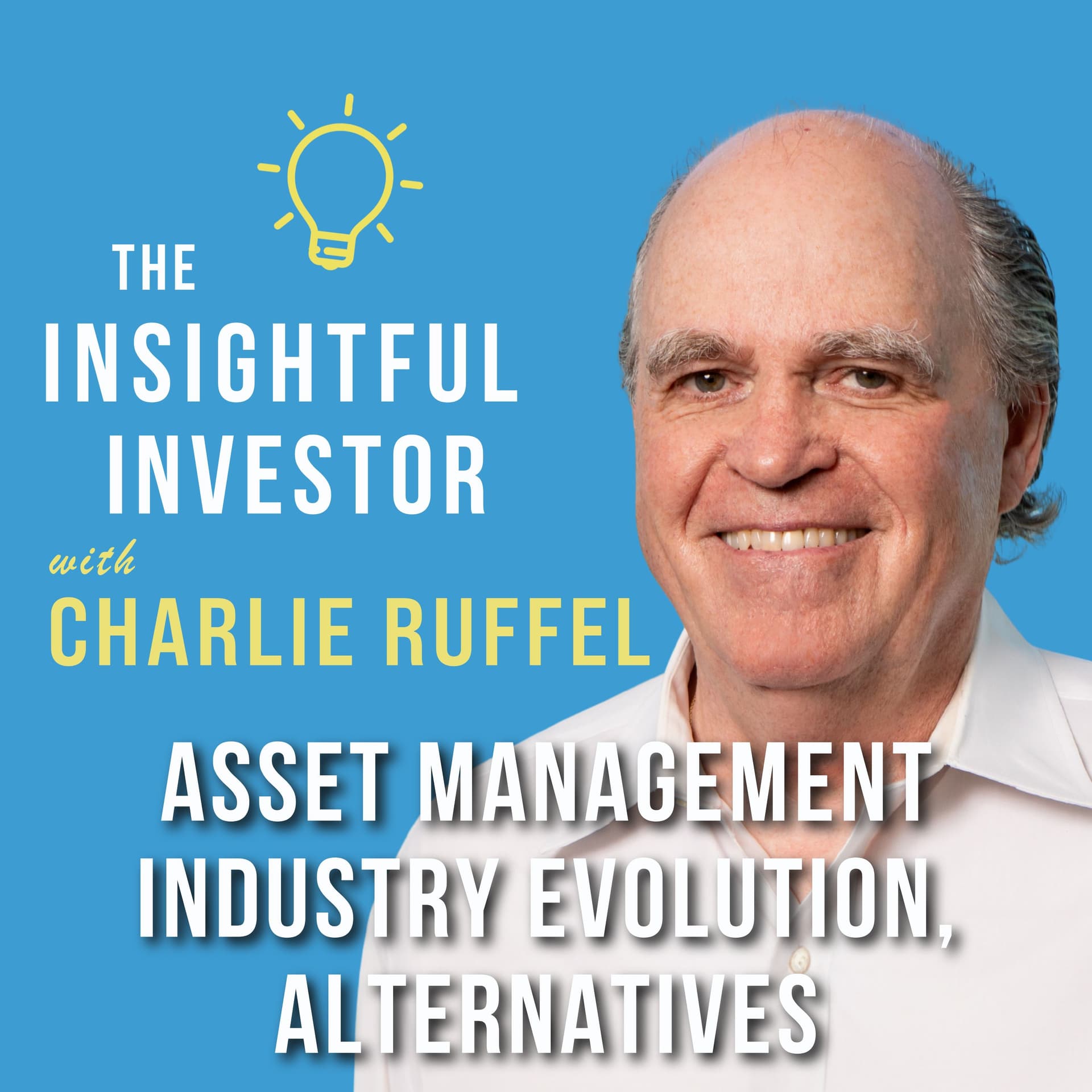
- Title: #77 - Charlie Ruffel: Asset Management Industry Evolution, Alternatives
- Host: Alex Shahidi
- Guest: Charlie Ruffel, Founder, Chairman, and Managing Partner of Kudu Investment Management
---
Overview In this episode, Alex Shahidi engages with Charlie Ruffel, who shares his extensive experience in the asset management industry, highlighting its evolution, the growing role of alternative investments, and insights gained from various positions he has held throughout his career.
---
Key Themes and Discussions
- Career Path and Industry Insight
- Diverse Experience: Charlie started as a financial journalist, moved into publishing, then investment banking, which provided him with a multidimensional understanding of the asset management industry.
- Key Lessons:
- Listening: Importance of listening to understand the business better.
- Transparency: The asset management industry is open and generally characterized by integrity.
- Sales vs. Marketing: Shift from sales-focused strategies to a more marketing-oriented approach in asset management.
- Mergers and Acquisitions (M&A) Dynamics
- Challenges in M&A: Many deals in the asset management space often do not yield expected results due to cultural mismatches and the complexities of integrating different organizations.
- Culture’s Impact: Culture within firms is fragile and difficult to transplant, which can lead to failure in mergers.
- Evolution of Asset Management
- Shift to Alternatives: The increasing importance of alternative investments as traditional asset management becomes more competitive and challenging.
- Regulatory and Compliance Barriers: New regulations and challenges in starting asset management firms have made it more difficult for new entrants to gain traction.
- Role of Personal Relationships
- Trust and Performance: In asset management, relationships are critical. Trust, narrative, and performance metrics all play roles in the decision-making process of investors.
- Kudu Investment Management
- Approach: Kudu focuses on taking minority stakes in boutique asset and wealth management firms, particularly in the alternative investments space.
- Value Addition: Kudu aims to assist management teams in distribution strategies while allowing them to maintain their unique cultures and operational independence.
- Permanent Capital Advantage: Kudu benefits from permanent capital, which allows for long-term partnerships without the pressure to exit investments within short time frames.
- Democratization of Alternatives
- Growth of Interval Funds: Interval funds provide a vehicle for investors to access alternative asset classes without the same level of liquidity as traditional mutual funds.
- Future Opportunities: The defined contribution space is identified as a potential area for further democratization of alternative investments.
- Future of Asset Management
- Long-term Trends: The trend towards alternative investments is expected to grow, especially as public market returns become more volatile.
- Role of Alternatives in Portfolios: Alternatives should increasingly be viewed as a critical part of investment portfolios, particularly in response to changing market conditions.
---
Conclusion The episode provides valuable insights into the asset management industry's current landscape and its evolution through the lens of Charlie Ruffel's multifaceted career. The discussion emphasizes the importance of culture, relationships, and adaptability in navigating the complexities of investment management.
---
Key Takeaways
- The asset management industry is characterized by a high degree of transparency and a focus on individual talent.
- M&A success hinges on cultural compatibility and understanding inherent differences in firms.
- Personal relationships and trust are paramount in investment decisions.
- The future of asset management is leaning towards alternatives, with democratization allowing broader access for investors.
---
Additional Notes
- Podcast Link: [Insightful Investor](https://insightfulinvestor.org/)
- Disclaimer: This podcast is for informational purposes only and should not be interpreted as investment advice.
Written by AI. May contain mistakes. Listen to the episode to check what was said.
Transcript
Automatic transcript. May contain errors.0:05Welcome to the Insightful Investor podcast, a weekly series that seeks to share industry investment and market insights. We define insights as concepts that are counterintuitive, widely misunderstood, or underappreciated. In other words, unique ideas that you probably won't hear elsewhere. I'm Alex Shahidi, the host of the podcast and co-CIO of Evoke Advisors, a leading investment advisory firm. Learn more about our show at insightfulinvestor.org.
0:38Today's guest is Charlie Ruffell. Charlie is founder, chairman, and managing partner of Kudu Investment Management, which focuses on taking minority stakes in boutique, asset, and wealth management firms. Charlie has been a board director of Charles Schwab Corporation and a director of Charles Schwab Bank since 2018. I'm excited to welcome Charlie to the podcast and to hear his insights on the asset management industry in today's episode. Charlie, thank you so much for joining us. My pleasure, Alex. Thank you. Let's jump into your journey through the industry. Let's begin with your experience learning from the outside.
1:16You've approached the asset management industry from several angles. As a journalist, an information provider, an investment banker, and so on, let's start at the beginning. As a financial journalist, what did you learn about the industry and its leaders? I mean, it's a while back now, and the industry has obviously evolved. But now we're back in the 80s now. I think two things. One was actually a personal lesson. One thing as a financial journalist, you learn how to listen. And that really was my introduction to this, trying to understand the business, which was just listening, listening to people as opposed to talking over them.
1:54To answer your question more directly, what it taught me about the industry, which I think is still true today. it's a remarkably transparent and open industry. People then and now, I think, although there's a more nuanced and probably more negative view of journalism and talking to the press, but I still think the same sort of logic is in place that I found back then, which is people are very, very open to talking about what they're doing and how they're doing. It's a remarkably transparent industry. I would also argue, and it's been my own experience, that this is a business that has integrity at its very core.
2:32And people who generally don't behave with integrity get weeded out pretty quickly. Certainly that's what I took away then and still believe now that this is a very open and transparent industry with people who are very willing and able. And sometimes, obviously, it's in their own interest to talk about what they're doing and how they're doing it. And generally, I think it's an industry of great integrity. After journalism, you moved into publishing. and providing information and data to the investment world. Would you tell us about that experience and it helped deepen or even change your understanding of asset management?
3:08It was obviously a related but different world. That experience taught me how the asset management space, and I'm talking about that very broadly, covering everything from private investing to defined contribution investing. That experience really taught me how people spend money in the space. when they spend money, how they spend money, how they want to spend money. It taught me about budgets. It taught me the difference between trying to sell to an insurance company that has an asset management business to a small boutique. From my standpoint, that lesson was invaluable because it gave me a sense of the machinery of the business.
3:48I remember a long time ago. This is a world where defined benefit asset managers were king of the roost. And we're going a while back now. And they just didn't believe in marketing. They just, they believed in sales. So the journey of trying to understand how the asset management community evolved in terms of sales and marketing, I think that was the prime learning I took away from it. And then you transitioned to investment banking, where you gain insight into building, marketing, and running an asset management business? What were the biggest lessons from that phase? The biggest lesson to me personally was if you're going to work as an investment banker, you were always selling.
4:33I enjoyed it, but you're always selling and you've always got to try and find a person in power who's A, willing to hear your ideas and B, who your ideas suit. I think maybe the biggest takeaway from an industry standpoint is the sort of fuzziness around M &A in our space. There's obviously a lot of deal flow. There always has been. A lot of the deals haven't necessarily worked. I think that's probably true of M &A, regardless of sector. But it's not a business where it's really clear what really good deals are and what deals are not good. And if you're a banker, you've got to somehow convince people, even when history shows that so many of these deals certainly have underperformed, that your idea is a really good one.
5:21And just as important, you have to have somebody who thinks your idea is a really good one and is willing to back it. So it's a lot of selling. It's probably still true to say that a lot of M &A goes on in this space that is ill-considered. And do you think part of the reason the M &A hasn't worked out as well is because the business is just very difficult? It's just hard to add value over time? Or do you think it goes beyond that? I think it comes back to something that I think is a real core component of the asset management space, which is how much it is a function of individual talent within these organizations and individual drive.
6:03Sometimes it's really hard for that drive and that talent to sustain itself within much larger organizations. I think the business is a difficult one and nobody gets it right all the time. That's the nature of the beast. But I think probably if I was going to try and pin down one reason why a lot of deals don't work, I think it's because this thing we call culture, which we can define, which really comes down to either one individual or a handful of individuals imposing a particular vision on what they do and how they do it. That's a really hard thing to transplant. and it's fragile. And I think that's probably the reason that so many deals don't work out as expected.
6:49And there are always gains to be made from scale and from marketing clout. And those gains sometimes tend to make up for challenges that the individual executives face when they come into these new organizations or are bought. I think scale in particular probably covers a lot of wounds, so to speak, but it's hard. The dynamics of M &A in this space are hard. I feel like the point about culture is really important, particularly in this industry, because having met probably thousands of managers through the years, I've noticed there are so many different cultures within these organizations. It's unlike most industries that I've come across, where firm A has a very different culture from firm B, from firm C.
7:32Even if they're trying to do the same thing. There's so many different ways to approach asset management. And so you can see why when you have a wide disparity of cultures, trying to put two together, if the culture isn't a match, you could have some difficulty. I think that's right. It's tricky to do it. And yet, we live in an age where these large sort of multi-asset class firms, particularly the ones that have reinvented themselves out of the alternative space, almost feel of necessity that they need to grow inorganically. So regardless of the nuance of it, they're going to be buying businesses and trying to harness those businesses to their distribution or brand count.
8:14And it's very tricky. The other thing which I think is relatively unique to the asset management business is you sort of need the assets and the track record to make it, but you can't get those unless you have the assets and the track record. So it's like the chicken and egg problem that potentially M &A can help solve and get you off the ground. Yeah, and I think one of the challenges that the business does face is exactly a function of the dynamic you're describing, which is it's become increasingly difficult to start asset management businesses. The creativity that's always been part of this process where a really skillful portfolio manager in a particular asset class or a team want to go out on their own.
8:58I mean, it's always been difficult. Nobody should kid themselves about that. It was difficult, even when these boutiques that have exploded into these huge firms today were founded as recently as the 80s and 90s. It was always difficult. But now I think the bar on compliance is so high. The bar on that original sort of seeding number is so high. And I think also, I would say, asset owners, however you define them, whether they are foundations and endowments or pension funds or family offices. Probably family offices are less guilty of this, but they really don't want to be taking chances on managers that might simply not survive for a couple of years.
9:40And so you just simply don't get the flows into these new managers. I mean, there are exceptions, obviously, but you just don't get the flows into these new managers that they probably merit and their performance would merit. And the net result is they don't survive. And so the sort of creativity that I think has always been part of this business, I think is a little threatened now. And one function of that is that some of these big asset managers can find this talent and put them in business. It's not the same as their own business, but it's the next best thing. So across these roles that we talked about, journalist, information provider, and investor banker, how would you say your understanding of the asset management industry evolved through time?
10:22The only thing that I would say is that because I've had a couple of different lenses, it's sort of multidimensional. I think we live in a world in the asset management space where most people find themselves in silos. It's just the nature of that world. You really have to know your silo to excel. And the luxury I've had is different silos. Now, the danger there is that you're a jack of all trades and a master of none. But to have a sort of multidimensional lens on this business is a useful one. It certainly served me well. If we look back and reflect on this journey, are there any unexpected skills or insights that have proven to be most valuable as you move from outsider to investor?
11:04And then we're going to get into being a PE firm founder. I think the most important thing in this industry, if you step away for a moment from the very large institutions that tend to dominate asset management, because I think those businesses require a very different dynamic inside them. But I think the most important element to this business is personal relationships. If I've come to understand anything about this business in this journey, we've all had thousands of meetings. And if you have the ability to have some sort of institutional memory of those meetings, and you've been able to leave people with a view as to what you do and how you do it, and hopefully the belief that you do it with integrity, that's immensely valuable.
11:49To be able to call somebody up and discuss something with them because they had an intelligent discussion with you five years ago, that's a real asset. For all its institutional heft, it's still an incredible personal business, very dependent on relationships. That's the abiding lesson. If somebody asks you about an institution and by sheer luck over the years, your paths crossed with somebody at that institution, that's how you get things done. It's really hard, I think, to move towards a model that is impersonal. I mean, going forward, we might be in a position where decisions, allocation decisions, decisions about picking managers are entirely driven by a different set of parameters, but not now.
12:36That's not the world we're living in now. It's really interesting because you would think it's a data-heavy analysis where you can just look at the data and be completely objective and then decide who are the best managers. But what you described is a world where personal relationships matter. I don't know if it matters more, but it's certainly a significant part of the equation in terms of who you pick. Why do you think that is? And is that the right way that it should be? it can seem sometimes incestuous, this business. First of all, I would say that merit in terms of producing results and character, obviously, to put it mildly, are not mutually exclusive.
13:19And I think you cannot compete in this business regardless of the asset class here. This is a manager that you're competing in. I think you cannot compete without three things. First and foremost is performance, I think. Let's make that clear. And maybe that first element of this can be entirely data-driven. And I think a lot of the screening and stuff is very data-driven. But I think the second element is a narrative. You've got to be able to explain to people what you're doing and how you're doing and why you're doing it. And part of that narrative is why what you're doing has tailwinds. I think everyone understands how challenging it is to compete in a space where their head wins regardless of how much talent you have.
14:00And then I think the third thing is trust. This is a business, both I think institutional, maybe more institutional than retail, but certainly institutional, where all sorts of things come into play, capacity, fee levels. Trust is really important if you're going to give someone a lot of money and not just about performance. It's how they're going to treat you or communicate you in the asset class tanks, regardless of their own skill set? How open are they going to be to what you need as a capital investor? You have to feel that you're going to be treated well. There's so much that comes out of the blue in this space.
14:41It's the nature of what we do, that if you don't have that level of trust, whether you're having that in your wealth manager or you're having that with your asset managers, I just think you need all three of those things. It does start and should start with performance to the extent that that is going to be increasingly driven by the type of data that we now all have access to. I mean, I think we're probably getting there already, but there's got to be the narrative and there's got to be the trust. That's just simply the nature of the business. My sense is that performance is always backward looking, right?
15:18You can only see historical performance. You can't see forward returns until they happen. And that's probably part of the reason why trust and relationships and narrative and storyline and all that is so important because you only see the performance of the past. Even when you see the performance five years from now, it's past performance, right? And the decisions you make at that point are going to impact future returns. You kind of always need both sides of that. So that's, I think, one of the reasons it's not just pure data because you're looking into the future. Do you agree with that? Absolutely agree.
15:52with that. And I also think the rise of these sort of new types of intermediaries that take on some of the responsibilities that allocators used to have, the OCIO space in particular, that's all about trust. You're relying on somebody who understands you well to go in and essentially execute on all these things that maybe you used to do. It's a different level of relationship and it can't just be data-driven. The other aspect of it, which I think is interesting and somewhat unique to the industry is, particularly in public markets where there's more efficiency, arguably, than private markets and alternatives, there's less persistence of outperformance.
16:34So you could look backwards and see somebody who's outperformed and then you invest with them and then they go through a period of underperformance and then you have to decide, am I gonna sell low and buy an outperform that I should have hired? and hope that they continue to outperform. And that level of lack of persistence of outperformance, particularly in that space, introduces additional challenges. Yeah, I mean, I think that touches on bigger issues. I mean, they're always going to be really good stock pickers. And I think particularly in constrained asset classes like small cap, you can find them.
17:07But boy, the industry has just moved away from a belief that active can outperform in large cap US stocks, as an example. And the net result has been these huge trends we've seen. I mean, whether it's indexing or ETFs or just simply low cost beta, that's a headwind that you just simply couldn't get in the way of, regardless of the merits of it. And maybe some of the byproduct of that type of decision making, is very, very real in the marketplace. Are there any aspects of the asset management industry that you feel are particularly counterintuitive or underappreciated by outsiders? I'm pretty positive about some of these trends in the industry.
17:54I think what we've seen in the last decade with this sort of growing belief that you need equity market exposure, you don't need a stock picker and the resulted expense and maybe variability of performance to get it, I think is a tremendous thing. And if you look at the defined contribution business as an example, basically the bulk of assets in that space now are in essentially index proxy funds, target date funds, and the like. And you can make arguments as to why those aren't the most sophisticated vehicles, but they give low-cost exposure to millions of Americans to the equity market. I think in a way, maybe some of the fundamental problems that we faced in a time when stock picking, mutual funds, hoovered up most of the assets, I think that's a really good thing that that's behind us.
18:49One observation that I've had, and I'm curious if you've had a similar experience. When I look at the universe of money managers, you can put them on a spectrum. On one end, you have those who are truly in the business and focused on generating returns for their clients. And then on the other end of the spectrum, the other extreme are those that are really in the business of gathering assets. While everybody claims to prioritize returns, but their actions and the way they orient their businesses might differ. What are your observations? this is a profit-seeking business like any other and the larger you get regardless of your narrative and your narrative can be clients first or long-term greedy or however you want to define it regardless of your narrative you're in the business of being profitable and growth of assets has always been the fastest way to do that or the best way to do that i would say It's a very scalable industry.
19:47There is this belief amongst a lot of investors that they should find managers who understand what their own limitations are. And by the way, all these very large asset management firms, a lot of them have been sensible about restricting capacity within particular asset classes. They're just some asset classes that can't scale. I think that dynamic you've described is real. And every now and then, it becomes apparent when asset classes grow, or when particular managers grow in very different ways than they have historically, not incrementally. But actually, I think the industry, by and large, there are exceptions and bad exceptions.
20:31But by and large, does understand that ultimately, its job is to produce returns. And if they don't produce returns because they've taken on too much money, it'll catch up with them. I think by and large, I would say the industry understands the dynamic you're describing, whether they can resist the pressure to grow assets when there really shouldn't be a case for growing assets. That's a different story. In other words, most operate somewhere in the middle of that spectrum. And maybe they lean left or lean right, but they kind of have to fall somewhere in that middle, because if they don't, the market will force them that way.
21:07I think so. And you know, look, this is a business with immensely intelligent consumers. And if a PE firm goes from a billion dollar raise to 4 billion, well, they're going to be doing something different at 4 billion than they were at 1 billion. There's absolutely no guarantee they'll be good at it. Right. In my experience, meeting a lot of investors, and obviously you've met many, many great investors. My sense is most are highly intelligent, but only a few stand out as truly exceptional. I guess you could say same thing about any industry. Do you agree? And are there any qualities that you feel set those exceptional investors apart from the rest?
21:47I think I agree with that general take, which is this business attracts such talent. I mean, they're extraordinarily smart people in our business. Maybe you used to see them more in hedge funds, and now you see them more in the alternative space. Probably the most exceptional investor, this has come as a bit of a surprise, I suppose, I ever interacted with and got to understand, was actually a planned sponsor. It was a guy called Jay Vivian, who ran IBM's pension fund. And the effect that Jay Vivian had on people's lives, I mean, there are hundreds, tens of thousands of IBM employees who've retired with a much better retirement fund because of what Jay Vivian did, both on the defined benefit plan at IBM, but maybe more to the point on the defined contribution plan where he created the type of structures that way ahead of time that you see today, really early into target date funds, really early into taking the institutional relationships that IBM pension fund had on its defined benefit plan and putting them into those managers into defined contribution plans, changing the lineups, always keeping price really low.
23:01He was an extraordinary man who foresaw so much of what was going to happen in the next decade. I think he was a very cynical guy to get something past him. He was completely inscrutable and uncorruptible. There was no taking Tim to dinners. Just a remarkable, remarkable investor. And no one really talks about him, but I'm a big believer that some of that generation of, there were only a handful of them because most of them just went where the water carried them. But a handful of plan sponsors in that era actually shaped where we are today in the defined contribution space and did it because they were data-driven and they were intensely conscious of where returns were to be had and how you could pay if you had assets like IBM had, you could drive those prices down.
23:53And it sounds like he had immense impact, which also adds to its relevance. He did. That's exactly right. As I say, a lot of baby boomer IBMers retired with significantly more assets in their defined contribution plans as a function of what he did. So if we take a step back and you just look at the asset management industry, what is your sense of the direction that it's headed? And do you anticipate any major inflection points in its trajectory? Well, we're going through a major inflection point. In some ways, we're in a world now that these large multi-asset class alternative businesses that have grown out of either private equity or credit or just footprint is larger and larger.
24:40They represent, I think, a dynamic that became clear a while back, which is that if you have real distribution power, it's rocket fuel in this industry. People, obviously, groups like BlackRock have always understood that. But I think it's this new generation of players in the space, the Apollos and the Blackstones of the world, who've really understood what distribution power can do for you. and obviously what they bring to the table is the skill set they bring a narrative you know which is the alternative investment sort of narrative and they bring a skill set in that world that served them really well i mean that's been a really interesting change you know when these changes happen in the asset management business you bit like going bankrupt they happen really slowly and in really quickly.
25:28And that's happened. I mean, if you go back to the 80s in this business, the asset management business was still dominated by some of these big trust banks, most of which hardly don't exist today, let alone manage huge pools of money. And that happened slowly and then very quickly. Now, we're seeing the same thing happen in the asset management space today. I think it's accompanied by another, let's call it a characteristic rather than an inflection point, but you're also beginning to see a real understanding of the merits of specialization. Because as these monstrous firms grow bigger and bigger, I think the returns are going to speak for themselves.
26:08They're going to normalize. And the sense that you want real performance in particular asset classes, there's this whole new generation of boutiques that have managed to survive the challenges of starting businesses in the last 20 years, whether they're private equity, private credit, or private real estate in particular. And these groups now have a decade or more under their belts. They've all raised more than a billion dollars, the successful ones. They're real businesses. And I think you're going to see real flows into them too. The major inflection point that we're seeing as an industry now is how these relatively new players, they're not new as in they've been managing money for a little time, but they're new as in being essentially able to manage much more money than they used to across a whole set of different classes, are now real players in the industry.
27:01It's interesting when you take a step back and you look at the evolution of the industry, it seems that, generally speaking, you've gone from a period where there was less appreciation of the challenges of picking stocks and trying to outperform an index. And now here you are 15, 20 years later, and you can look back and say many managers didn't beat the index. So there's less value there. So the price that managers can charge has gone down. There's price and pressure there and the boom of ETFs and indexes and so on. And so the smart people are kind of gravitating towards other areas where they can add value.
27:36And so that introduces alternatives. And then you've had the democratization of alternatives and the distribution and building the relationships that you talked about. And so you could see how that evolution is gradually occurring. And I think it's all to the benefit of investors and clients because now there's more investment options available to them. Yeah, I think so too. And I actually think that, you know, that's why if you step back from this industry and try and understand the evolution it's taken, while part of it has been exactly the dynamic you described earlier about this quest for asset gathering, A large part has been to provide a better solution to investors across all types of investment.
28:17And what you're seeing now, I think, is a reflection of exactly that. There are obviously huge exceptions to this rule, but at the end of the day, the ability to deliver cheaply and effectively exposure to public markets, particularly public equity markets, and then through different vehicles to give you exposure to alternatives. That's a really positive development. It really is. Part of that development has already been mirrored in the way of most Americans save, which is in their defined contribution plans. But there's a lot of work to do in that space too, in terms of getting to exactly that place that you've just described, because it's still very much an equity-dominated investment outcome.
Read the full transcript
29:02And of course, you've had, at least in the US, a bull market for 15 plus years. Yeah, no, that's right. I mean, I think the timing has served everybody pretty well, as it turns out. And also, if you think about, you go back to the goal of asset managers is to generate profits, you know, their businesses. So relationships is part of it, the narrative is part of it, performance is part of it. So if you can move into an area where there's more persistence of outperformance and you can demonstrate your value-adts alternatives, and then you can tell a good story about it, and then you build those relationships.
29:37And then if you can democratize it where you don't have to have$100 million to access it, you can be a smaller investor. And then you start spreading that and you could see why the big shift has been going in that direction. That's exactly right. There's no reason it won't continue. You're going to have bumps along the way. You're going to have people who need liquidity when liquidity is not there to be had. There are all sorts of issues that this evolution brings up. Is it being moved by the right forces in the right direction? Absolutely. Let's talk about Kudu a little bit. Would you tell us about Kudu's approach?
30:13And then also, what does it mean to take GP stakes and asset managers, especially in alternatives? Kudu was founded 11 years ago. Although there were four original founders, but the real impetus for founding Kudu was my partner, Rob Jukaki, who had come out of Credit Suisse, where he had been CIO of a business that really understood the logic of taking minority stakes two decades ago. He was a founding partner in a group called AMF, which was really one of the first entities to understand this logic of taking minority stakes in both wealth managers and asset managers. He felt Cred Suisse was a suboptimal parent for what he wanted, particularly after the financial crisis, where they had their own limit when Cred Suisse had its own limitations put on it.
30:57And he wanted to do it again, and he wanted to do it differently. I was working as a banker then. We came together, and I brought my COO from my banking experience. He brought his CFO, and that's how we founded Kudu, really with a view to finding boutiques. And in a way, that's our thesis, finding boutiques that were at a sort of tipping point in their development, where a capital partner and a capital partner who understood opportunities and distribution and how to grow could be a really effective partner. Now, at the larger end, people like Blue Owl had recognized some of the same things. We were focusing on boutiques rather than the very big private capital groups.
31:37But the logic driving this, Alex, is this, it almost comes back to how the point that we were making a little earlier is how difficult it is to start these firms. It's also really difficult to get a firm from three or four hundred million to four billion or five billion or whatever the optimal amount, not for profitability is, but for the optimal amount to be able to manage for their clients because it all comes back to giving clients. boutique asset managers, generally in the alternative space, but always in capacity constrained spaces, where we believe in the management team and the narrative and the tailwinds, and taking a minority stake in those businesses, giving them capital to do whatever, quite frankly, management feels that is apposite at the time.
32:23And that can include, by the way, de-risking, but mostly includes, particularly in this area, is often driven by the GP investment they have to make. And at the same time, looking to add value, but being intensely conscious that this is their firm to run and never interfering in their decision making on how they want to run the firm. And that's essentially the kudu story. It's an immensely simple one of finding talent and backing it. And our luck was that we just found a perfect capital partner to fund that because we think permanent capital is a huge differentiator in the space because it allows you to actually be that permanent partner and not have to create and not go out of alignment with the people who run the business.
33:10So it's a simple approach. And what makes it possible is we were lucky enough to find the right capital partner. We'll get into the advantages of permanent capital. But first, for those who are less familiar, would you just describe what GP stakes are so that they understand better? It's an evolving world right now. So what GP stakes were a couple of years ago is changing somewhat around the edges. But at its most simple, it's buying a stake in the management company that runs the funds, creating alignment, essentially trying to create a structure that allows an outside investor, in this case us, to be paid exactly the same way as the principals who run the fund.
33:51It's just buying a minority stake in the management group. And what type of help do those groups need that you can provide? Obviously, it depends very much on the manager itself. I mean, if you buy a minority stake in a small boutique, let's say wealth management firm that is not looking to grow inorganically, then maybe your use of capital is really about helping a generational transfer and they don't want much else they know what they want they know how they've done it the way they've traditionally done it you know in a case like that it's the capital that's the lubricant that sort of makes things happen when you make an investment in a boutique private equity firm that has perhaps really only sold through one distribution channel, whatever that is, maybe it's just had an E &F focus, you can help a firm like that think about different channels.
34:51Every firm, particularly in the alternative space, needs distribution help. And there are different ways of cracking the code on that. But generally, our own view on that is you can be most efficacious in helping these firms with distribution by helping them think through distribution rather than doing their distribution for them. We just don't believe that model works. We think these boutique firms, the story and the narrative is so tied up within the principles of these firms that ultimately they need to be the strike point for distribution. But the idea of helping them think through how intelligently and who they should be selling to and what their message should be.
35:34That's very much a part of the value add. But all these firms go through generational transfers or the best firms do. The firms that die with the original founders are exactly the type of firms we don't want to be investing in. We're looking for firms that are aware of that dynamic and really want their firms to succeed past their original founders. So a lot of effort goes into this idea of developing the G2 and how you compensate the G2 and how you give them equity and how you tell that story to the marketplace. So there's a lot of soft skills that go into these firms and you can always be the right partner, I think can be immensely helpful in thinking it through.
36:16I think from our own standpoint, the other two things worth saying are, we've now done 24-hour deals. We've created this ecosystem of partners who don't compete with each other and all share this type of thinking with each other. We bring them together a couple of times a year in person. We really try and create a synergy and a network between our member firms because it's a really lonely job to be CEO of a boutique private capital business. The only people that you are really thrown into constant contact with are people in some ways you compete with. So we've tried to create a very different dynamic and a very different information flow.
36:59But there absolutely is a value add to the business today. It's certainly not writing a check. And that's not just true of us. It's true of everyone in the space. And also, if you think about it, managing money is a very different skill set from distribution. You could be good at one or the other, and you have to put the two together. I mean, generally, the firms we're investing in have sold for it. Not perfectly. Nobody has sold for it perfectly. But if they were only good at managing money, they would never have raised any money in the first place. And the type of boutiques we invest in, they've broken through that initial challenge.
37:38They've learned whether they're any good at it or not is a different question, but they've learned how to do distribution well enough. You can't do it. Without that, you're not surviving in this space. There's some really good investors and even in interesting asset classes, and they just languish because they can't raise money. Yeah, if nobody knows about you, it doesn't help you very much. Earlier, you talked about the advantages of permanent capital. Would you delve into that a little bit more? Permanent capital is really hard to raise, which is why we live in a world where permanent capital is hugely the exception and not the rule.
38:16There are very few entities with permanent capital on the asset allocator side. It has huge advantages. the most obvious advantage to us when we sit opposite a boutique management team is to be able to say to them, look, we're going to take a stake in your business. And it's a permanent stake until you tell us otherwise. You know, we're not going to come back to you in five years and say, look, we raised this money, we've got to give it back, find a way to give us our money back. Now, there are all sorts of ways that people in our business mitigate that. They can say, We've got all sorts of different ways of monetizing the state without forcing you to buy it back from us or sell your business.
38:59But at the end of the day, if you're raising a fund, the people you're raising the money from expect that money back at some stage. It's how the market works. And our capital partner is a group called White Mountains, which is an insurance holding business in Hanover, New Hampshire. Extraordinary business run by extraordinarily smart people. and the capital they've given us is permanent capital. It's not even general account money. It's their shareholder capital. It allows us to tell a different story. Now, some boutique managers are very happy to have a partner who is going to be prompting them to sell their business in five to ten years' time, but not all of them are.
39:37A lot of these boutiques want to remain independent. And I think the permanent capital just allows us to have those conversations with, I think, a sense of integrity that is difficult for others. That's right, because the timelines are aligned. If one wants to have a permanent business, that permanent capital makes sense. And if you want to have a business that you sell in five years, then temporary capital makes sense. That's exactly right. And you want optionality in our business. We often talk to managers and even make investments in managers who assure us that they want to stay independent forever.
40:12And that's actually how they're thinking about it. But then five years down the line, they get an extraordinary opportunity. And that's their decision to make. We're not saying, hey, hold on a second, you told us that was permanent capital. It's their decision to make. And that's ultimately the core of our model. We're trying to find management teams that are determined to keep the power of making these decisions entirely in their hands. And that works for our model. Especially if the business is doing well, in some ways, you don't want to sell that business. That's right. And sometimes we've had cases now, a couple of cases, where we just loved the arc of the management team was on and the business was on, but management decided to sell the business.
40:56And that's their call, not ours. They're the ones who are closest to us. And that's how we got the deal done with them in the first place, giving them complete optionality as to what to do. That's one of the reasons that we've had good outcomes. Kudu has focused on middle market asset managers in the$1 to$5 billion range in assets, particularly in private market alternatives. Why this focus and what attracts you to these segments? I think it just comes back to what we were touching on a little earlier, some of the bigger trends and tailwinds in the space. It's where the puck is going. There's obviously huge demand for this type of capability.
41:36And we see that as an ongoing trend through this next decade. So really, it's trying to find good teams in a space where there are tailwinds. It's nothing more complicated than that. I think the other dynamic is there are a lot of successful boutiques that understand that having a capital partner and a value-added partner who can help them do different things and look at things a little differently, while at the same time not compromising the strength of their narrative and their ability to do what they choose to do is compelling. There are spaces where we have seen those same trends where we can't find a manager.
42:21In the alternative space, real estate, private credit, private equity, there are a lot of managers to talk to. Are there any key characteristics that you look for in these boutique asset managers when deciding to take a minority stake? Without question for us, the key is the personalities of the management team and our belief that they will be as good partners to us as we intend to be to them. So a lot of it is about our take on the personality of the people running these businesses. Now, all the other things have got to be there. They have got to have been able to perform consistently. They've got to have a terrific narrative.
43:02They've got to have a compelling client base, whatever that is. It doesn't have to be across the spectrum, but they might well have just done really well in a particular segment of the Asadona community. But we've got to believe that their clients believe in them. And we've got to believe that their tailwinds to the business and that both institutional and retail interest, and those are two very different things, are going to continue. But what we've really got to believe in is in the management team itself and what they want to do. We've got to believe in their willingness to develop their own G2.
43:36All these things, by the way become pretty obvious with three or four meetings under the belt. You get a sense of these individuals and what they want. We were coming back to what a personal business this is. We're a minority investor with very limited rights. If something goes wrong, we don't have an ability or desire to step in. We've got to believe that the management team can work their way through a black swan event. It's very, very much about taking a bet on the personalities of the people who are sitting opposite you. But to some extent, that's what allocators are betting on too. They're betting on the integrity of the team and the ability of that team to survive market downturns and not fracture.
44:27In a way, it's a stronger and a deeper relationship than an allocator giving a manager funds. But some of those same components that a good allocator should be looking at is what we're looking at. Are there common challenges that some of these asset managers face when trying to scale that you can obviously help them with? Distribution is so multifaceted and the challenges are so wide in that space that in one shape or another, even the most successful boutiques face distribution challenges. That's probably the most common challenge. The other challenge is generational transfer. Some people have done it really well.
45:07There's no easy answer to that. How do you get real equity into the hands of your next generation as the person who started the business or the people who started that business without effectively subsidizing it or transferring that equity at well below market price? How as a founder do you ultimately get rewarded for the risk you took when you started the business? How do you find people in your management team actually willing to take the risk of being essentially an owner in a business and not getting paid as they did or getting paid in a different way than when they were employees? That's a common challenge.
45:47They all need inputs on how to deal with regulatory changes. They all need inputs on compliance issues. We try and create the forums that allow that to happen. But I think probably the most important issues that they need insights into are distribution and generational transfer. You talked about the importance of culture. We were talking earlier about M &A. As you're helping some of these businesses grow, how do you preserve their unique culture as they scale? That's the beauty of our approach. We're not really changing anything. The culture that got the firm to where it is today, stays in place.
46:26Our sort of watchword at Kudu is first, do no harm. Don't tinker with things that absolutely don't need tinkering with. From our approach, the cultural one is pretty simple. We expect the culture of the firm that we bought into to endure. Any suggestions or drive to growth that doesn't come organically from within the firm itself, that's just not our MO. We want these firms to grow. And the way we underwrite these businesses is we underwrite them on growth that they tell us they're going to see. This is really not a private equity play in any shape or form. We don't come to the table expecting that as a function of our involvement, this business is going to grow twice as fast as it was going to before our involvement.
47:14We ultimately think that's self-defeating. The growth has got to come internally. We talked about this earlier, but there's been a trend toward democratizing alternative investments with vehicles like Interval Funds. How do you see this trend evolving and how does it impact your portfolio companies? We were immensely lucky in that regard because we learned about Interval Funds on the shoulders of one of the giants in the space, which was the incredibly smart team at Versus, which was a real estate investor in Denver, which was one of the first groups to understand. Interval Funds have been around a long time in different shapes and forms.
47:50But this, maybe five years ago, you began to see alternative managers could find a path through distribution through interval funds. And Versus was really one of the first couple that did it. And there was a guy there called Mark Quam, who was sort of a distribution genius. And we learned from Versus the power of that channel. We also learned the challenges of it. We all look at the growth of interval funds, But boy, there was a lot of blood in the water as managers sort of began to understand what selling into that space meant, how you sell into RIAs, how you deal with liquidity issues when there are liquidity issues.
48:30But Versus was just a master at it. So we actually learned a lot from them. And I think when we now talk to some of our partner firms about interval funds, we have a real understanding of what works and what doesn't in that space. we were incredibly fortunate to make another investment in a group called Variant that likewise has turned out to just understand what can and can be done in the interval fund space to a really sharp degree. And then coming maybe to the second half of your question here, I think it's a real area of growth. It's already survived. Every new instrument has to go through its mini crisis.
49:08Interval funds have already survived that and have continued to grow. I mean, there's some very, very large interval funds. Now, I think it's a really interesting vehicle, which is exactly what you've just described. It allows, I mean, we hear a little too much of that word democratize, but it's essentially allowed a different class of investors to access an asset class that they otherwise wouldn't have been able to. That's real progress. In my view, the next opportunity for interval funds or interval fund-like is the defined contribution space. And that's going to open a whole new channel. And there you're talking more about 401ks because it's just a booming industry.
49:45The 401k defined contribution plans in general is how working Americans save. It's where all the money is going. I mean, there's obviously a huge explosion in wealth management, but the real money is in defined contribution plans. And ultimately, that needs to catch up with where we are now in terms of alternative investments. We're not there yet, but we'll be there. And really quick for listeners who are not familiar with interval funds, it's basically like a mutual fund, except it doesn't typically have daily liquidity. And it's a vehicle that's used for less liquid asset classes to make it as easy to buy as a mutual fund.
50:24So it's easier to buy, but it's going to be a little bit less liquid. So it's kind of in between these private funds where you need documentation and qualification and you can buy it like a mutual fund. And the challenge will be when investors go into that, not properly understanding those liquidity issues you've described. We all know nothing is worse for an investor than having to sell at the wrong time for that particular vehicle. And the interval fund structure, to some extent, mitigates that. But you've got to go into it. You've got to understand that you might not be able to sell this investment in its entirety when you want to.
50:58If you don't understand that, or you're not willing to deal with that, you shouldn't be an investor in that space. That's part of the trade-off. That's the trade-off. So obviously there's been a big boom in private investments. So how do you feel that dovetails into the increase in secondaries as an ability to trade private investments that are typically illiquid? The people who were smart enough to get into the secondary space a decade or so or more, they've been incredibly rewarded for that capability. And there is no reason, in my view, to think that that's going to abate at all. As we move more into these more illiquid structures, the ability of other parties, like secondaries players, to provide this type of liquidity is just going to become more and more paramount.
51:51And it's more than a lubricant. I think it's going to grow really quickly. We spent a lot of time trying to find a good secondaries firm. We think we found a great one in a group called Revelation in the Bay Area, which is a healthcare secondary specialist. But that's a really interesting space and is going to continue to grow. Charlie, I appreciate all your time. I'm going to ask one final question. And this is kind of just zooming out within alternatives. Obviously, we've had a bull market in US stocks for 15 plus years. And at some point, we'll go through a bear market as these cycles recur through time.
52:26What role do you see alternative investments playing in a broader investment portfolio? I suppose maybe the right parallel is to try and look at how the most sophisticated investors, and obviously those are not historically been retail investors, they've been maybe a handful of foundations and endowments, have viewed alternatives. It's not necessarily exactly the right comparison because what should drive how you invest should be how you think about your liabilities and ultimately what problem you're trying to solve for. And endowments and foundations, maybe a subset of them have particular types of problems.
53:03But if you look at the role that alternative investments played in those portfolios, it gives you a sense of the importance of them, notwithstanding the fact that they may be harder to identify real talent in that space and you have to pay for it. But that sort of same logic ultimately needs to trickle down into how I think we all invest. And all that just tells you is that alternative investments intelligently handled are just a substantial part of a portfolio and should be. You're absolutely right to point out that, in fact, if all you'd been doing is running long equities for the last decade and more, you probably outperformed the smartest investment groups that were very risk-focused.
53:50That's not going to continue. It doesn't mean that maybe the bulk of your portfolio shouldn't be in public market equities or public market bonds. But I think the idea that we need all of us to look at alternatives as a larger part of our portfolios, that's sort of undeniable. It really is. Now, there's a point where that doesn't make sense. And for some investors, it probably never makes sense. But I think it's been a niche part of this business, and now it's a bigger part. And now it's rightly becoming a much bigger part of the business. And that trend has continued despite this massive bull market.
54:29And you could see it accelerate if we do go into a bear market environment. That's right. It's driven by the same diversification logic that we've all taken as a given. But I think that there is a danger in some ways that some of these alternatives are going to mirror public markets and you're not going to get the benefit that you want from exposure to that regard in a lot of situations. That's what you have to be aware of. We really appreciate you sharing all your experience, your learnings, and all the insight you've gathered throughout the years. Thank you so much. I'm not sure how valuable it was, but It's a privilege.
55:05Thank you, Alex.
55:34This podcast is provided for informational purposes only and should not be relied upon as legal, business, investment, or tax advice. All opinions expressed by podcast participants are solely their own opinions and do not necessarily reflect the opinions of Evoke Advisors, their affiliates, or companies featured. Due to industry regulations, participants on this podcast are instructed not to make specific trade recommendations, nor reference past or potential profits. and listeners are reminded that securities trading, commodity trading, and alternative investments are complex and carry a risk of substantial losses.
56:09As such, they are not suitable for all investors.
56:16Listeners should be aware that guests featured on The Insightful Investor may have current or past associations with Evoke advisors or the host, including as an investment manager of a private fund opportunity by Evoke, or access through an affiliated Evoke fund, or as a client. Participation as a guest on the podcast should not be perceived as an endorsement or testimonial with respect to Evoke Advisors, the podcast host, or their services. Similarly, the inclusion of a guest on the podcast does not imply that Evoke Advisors or the host endorses the guest or any company with which they may be affiliated or employed.
56:55Evoke has neither paid nor received compensation from guests for their participation. Thank you.
From the publisher
Charlie is founder, Chairman and Managing Partner of Kudu Investment Management and a board director of Charles Schwab. Drawing on decades of experience as a financial journalist, asset management executive, and private equity investor, he shares unique insights shaped by viewing the industry from multiple angles. In this episode, Charlie discusses the evolution of the industry and the growing role of alternative investments.


