
In short
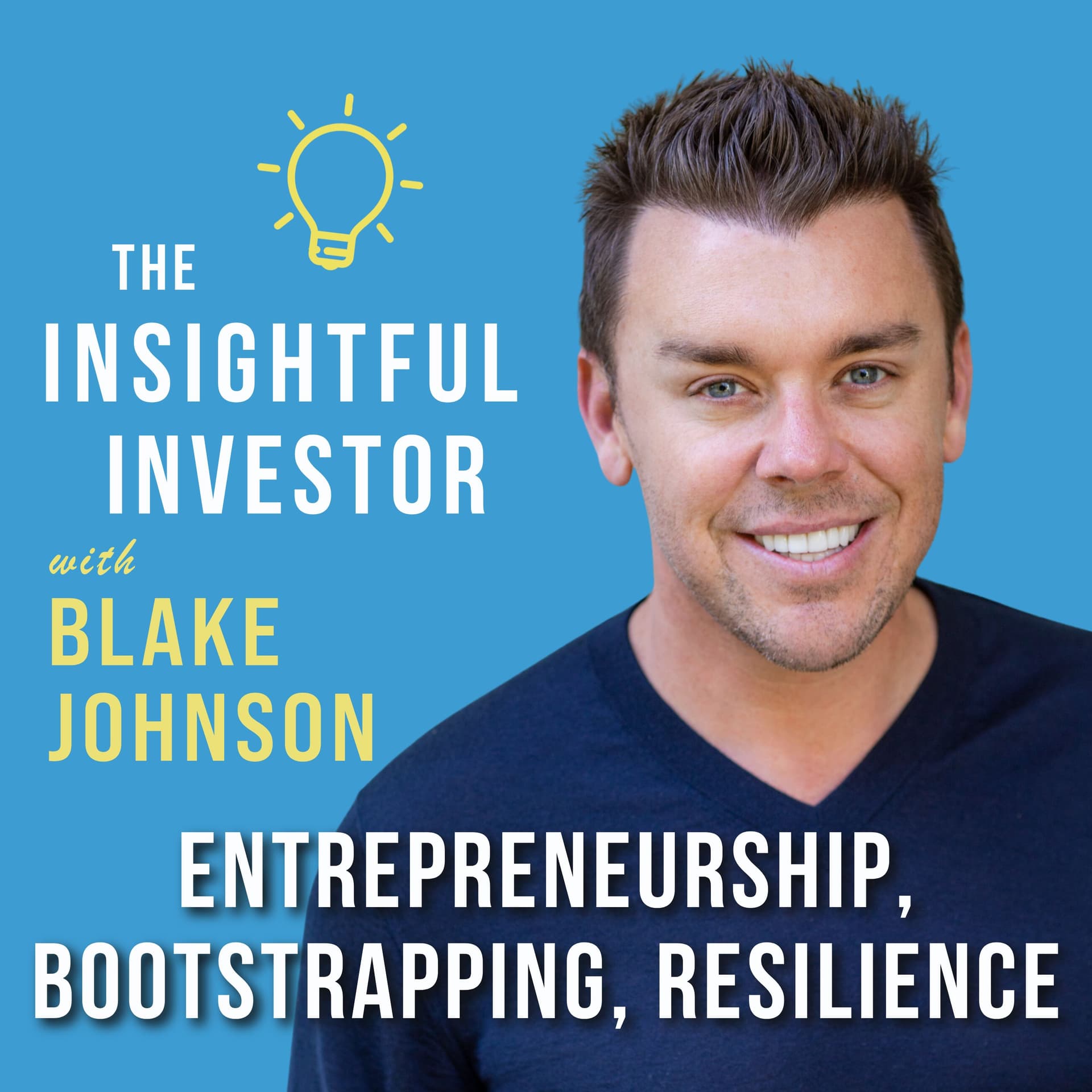
Insightful Investor Podcast Episode Summary: #81 - Blake Johnson: Entrepreneurship, Bootstrapping, Resilience
Episode Overview In this episode of the Insightful Investor, host Alex Shahidi interviews Blake Johnson, a serial entrepreneur, investor, and philanthropist. The discussion centers on Blake's journey of building and scaling businesses, particularly focusing on his experience with Byte, a billion-dollar company he founded without outside funding. Blake shares insights on entrepreneurship, resilience, leadership, and the importance of giving back to the community.
Key Themes and Discussions
- Origin Story and Early Influences
- Small Town Beginnings: Blake grew up in El Centro, California, a small border town with a high unemployment rate. This environment fostered an entrepreneurial spirit from a young age.
- Early Business Ventures: Encouraged by his mother, he started his first business selling potpourri in first grade, which laid the foundation for his future entrepreneurial journey.
- IQ vs. EQ in Leadership
- Emotional Intelligence (EQ) Over Intelligence Quotient (IQ): Blake asserts that in entrepreneurship, 80% EQ and 20% IQ are crucial for success, especially post-education where emotional skills become vital in navigating business challenges.
- Mindset for Overcoming Challenges
- Resilience and Adaptability: Blake emphasizes the necessity of being comfortable with failure and adapting to different paths to achieve business goals. He compares the entrepreneurial journey to climbing a mountain, highlighting that many paths lead to the top.
- The Journey of Building Byte
- Bootstrapping Success: Byte reached over a billion-dollar valuation in less than four years without external capital. Blake discusses the fundamental principles behind this success, including a focus on unit economics and entering a scalable market.
- Market Strategy: Blake explains how Byte differentiated itself from competitors like Invisalign by leveraging existing market awareness and focusing on branding rather than category creation.
- Navigating Business Challenges
- Financial Discipline: Blake stresses the importance of being financially astute and operationally disciplined to ensure that revenues exceed expenses.
- Common Pitfalls for Founders: Entrepreneurs often misdiagnose their challenges and overestimate their product's market viability, leading to financial miscalculations.
- Philanthropy and Giving Back
- Blake Johnson Alliance: Blake reflects on his commitment to philanthropy, particularly in supporting children and creating opportunities for those in need, stemming from his own childhood experiences.
- Building High-Performance Teams
- Identifying Strengths: The importance of assembling a team with members who excel in their specific roles is highlighted. Blake draws parallels with sports teams, where each player has unique strengths.
- Future of Direct-to-Consumer Industry
- Evolving Landscape: Blake discusses the rapid advancements in technology, including AI, that could reshape the direct-to-consumer model in health and wellness.
Key Takeaways
- Embrace Failure: Understanding that failure is an integral part of the entrepreneurial process allows for growth and resilience.
- Focus on Fundamentals: Being sober and realistic about business fundamentals, such as market viability and financial modeling, is crucial for long-term success.
- Build Strong Teams: Ensure team members are placed in roles that match their strengths and maintain a clear structure without overlapping responsibilities.
- Commitment to Philanthropy: Giving back and creating opportunities for others can be a powerful motivator for sustained personal and professional success.
Conclusion Blake Johnson's conversation with Alex Shahidi provides a wealth of insights for aspiring entrepreneurs and established business leaders alike. Focused on resilience, adaptability, and the importance of community, this episode encourages listeners to embrace challenges and remain committed to their goals.
For more information and to access past episodes of the Insightful Investor, visit [insightfulinvestor.org](https://insightfulinvestor.org).
Written by AI. May contain mistakes. Listen to the episode to check what was said.
Transcript
Automatic transcript. May contain errors.0:05Welcome to the Insightful Investor Podcast, a weekly series that seeks to share industry investment and market insights. We define insights as concepts that are counterintuitive, widely misunderstood, or underappreciated. In other words, unique ideas that you probably won't hear elsewhere. I'm Alex Shahidi, the host of the podcast and co-CIO of Evoke Advisors, a leading investment advisory firm. Learn more about our show at insightfulinvestor.org.
0:38Today's guest is Blake Johnson. Blake is a serial entrepreneur, an investor, and a philanthropist known for founding and scaling companies such as Byte, Currency Capital, and his latest venture, Alter. He has successfully built and sold multiple businesses with combined valuations exceeding $1.1 billion. Blake, thank you for joining us today. Thank you, Alex. Let's begin with your origin story. Are there any early experiences or influences that sparked your passion for entrepreneurship? Yes, absolutely. I grew up in a really small farming town in Southeast California, right on the border, about two hours east of San Diego called El Centro, California.
1:20I think by its nature, being so close to the border and growing up in that environment in the 80s, everything seemed to be entrepreneurial down there. It was common in everyday occurrence, you were dealing with some type of financial transaction or negotiation or somebody trying to hustle something or other, sell you something or buy something for cheap. I remember at a pretty early age, it just kind of became a second nature to grow up and kind of get reared in that environment. And is there anything specific that helped shape your drive and approach the business? Growing up down there, at the time, I was desperate to get out of there.
2:03But looking back now, it was a really critical cornerstone to my development. El Centro, statistically, in the U.S., has the highest unemployment rate. Very poor community. We had brief glimpses of the outside world. We'd go to San Diego or get exposed to something on TV. I remember Sundays in my house, it was tradition. My dad would always barbecue carne asada. we'd watch 60 Minutes. And after that, during that time period, Lifestyles of the Rich and Famous came on with Robin Leach, always enamored with this other life outside of the dirt roads and canal water that I was experiencing every day.
2:41There was definitely at an early age, and I don't remember when, but very young, I got this idea in my head that that really looked appealing. And I was very curious as to what that really entailed. So you're acquiring some of the insights into building a business just from your upbringing. Would you say there were any major turning points in your entrepreneurial journey as you grew up? My mom, when I was about in first grade, encouraged me to start a business and I did. And I've actually never publicly talked about this. This is a first and somewhat internally blushing as I'm about to tell you this, but she had it in her mind that a good business when I was, I don't know, seven or so was going to be selling these cinnamon spice things you could put in your house to make your home smell better.
3:34She helped me start my first business early on. The name of the corporation was Puppy Dog Tails. I went out to neighbors. I to solicit them purchasing these packages of these potpourri scents. She probably was now, in retrospect, fulfilling something that she wanted to do. But I got my first taste of that pretty early on. That later then compounded into a whole different assortment of things, from raising pigs and selling them at 4-H to buying suckers and lollipops in Mexicali for cheap and then selling them at school for a profit. But it was pretty common. It wasn't necessarily unique to me. That was very much a cultural thing down in that part of Mexico and California.
4:24You start acquiring some of these skills, even in first grade, which is pretty remarkable. I've had many guests on the podcast. I've talked about building a business. And the earliest that I heard was sometime in high school. First grade is you get a very early start. So when you kind of look back on that journey and you think about the skills that are required to be a great leader and build a business. How much of it do you think is IQ and how much of it do you think is EQ in that decision-making process? Today, I think it is 80 % EQ and 20 % IQ. I've always kind of often observed that the first 22 years of a person's life, the schooling system really rewards you for IQ.
5:07How well you can read a page, regurgitate a concept or an equation or a passage on a piece of paper, and then quickly forget about that. The rules of the game drastically change once you get out of school. The world ships. Business and leadership and really building things of value much more heavily depend on EQ at the later stages of the game. It's been an interesting thing for me to observe over the years, but having that EQ embedded culturally and also combined with work ethic. I filed my first tax return when I was 14 with working through cattle at a feedlot. You start to kind of get these building blocks along the way.
5:52I've been able to look back now and very clearly understand how certain components early on in my childhood were embedded. To no credit of my own, it was just a place and time I grew up with. I woke up this morning thinking how lucky I was to be born in the 70s and come up during the 80s and being born in the US, kind of winning that genetic lottery, even though I was a self-made guy and built all that myself, I was able to obtain these right elements through growing up in a time period in the United States, later really promoted some great accomplishments. That EQ, IQ distinction that you described is really fascinating.
6:35I think you're right. When you talk about people going to school and learning and you're taught the facts and the way things work, and then you have to regurgitate it. And the better you do, the better your grades and better schools you go to. One thing that I learned is as you go through that process, it curtails some of the independent thinking that I think is required to really launch and build a business. Being independent minded and forging your own path. How do you think about that side of it? I think a lot about that. And I look as I'm going through life for people with that skill set. It's absolutely critical to build up certain elements ingrained in leadership.
7:12That ability to fail and get back up. The confidence you can have, or not necessarily the confidence, but the faith that you're going to be able to figure out a solution as it goes along. There's certain things on the leadership side that are ingrained. I believe starting young within grade school and certain situations that kids are placed in that get them comfortable with dealing with other people and leading other people, whether it be on the athletic field or in Boy Scouts or in school, whatever that is, that comfort that's instilled early with communicating with other human beings, with having the thicker skin to not get too disheartened when you're knocked down the environment that encourages you to get back up and keep persisting.
8:08And really, and I speak with my kids a lot about this, getting highly, highly comfortable with failing. All these things are kind of the basis of what's needed to go on further achieve these things that society will deem as valuable. Is that related to this notion of focusing on what the destination is, knowing the path to get there is going to be challenging? And don't be discouraged when you face those challenges, because in some ways you should almost expect them. Absolutely. If you're not failing, you're doing something absolutely wrong. And if you're not comfortable in failing, you don't have it.
8:46I always preach that there's one destination, Let's say it's to get to the top of the mountain. But there's many paths up the mountain that one can take. And one's not better than the next. You have to be open to the various paths. And inherent in any path, there's going to be obstacles that come in your way. It is part of the game. They're not fun. They're frustrating as all hell sometimes. And you have to be persistent and nimble to get around those. and I'm always constantly preaching about, I don't care what path I have to take to get up the mountain. I'm open to all of them and let's find the best one.
9:26So that gives you the foresight and the ability to kind of scan the environment and not get so pigeonholed on one that this is the one, this has to work. Because if you're so focused and myopically focused on one path, you might be missing the right path that's right beside you. That may give you a shortcut up the mountain or maybe promote an easier journey to get up to the top. In some ways, you have to be humble about your ability to foresee the right path up front. Meaning what you just described sounds intuitive, but I could see a lot of people, the way they think about it is they see the top of the mountain and they strategize, here's the path to get there.
10:07And then once they hit an obstacle, they get discouraged. What you're describing is focus on the destination. I don't really care what path I have to take to get there. And I'm going to be adaptable to going up that mountain. And even if I have to take a step back, I just know that I'm heading in the right direction. It's a very different approach, but it's so relevant in building business. Absolutely. Then the one thing I constantly remind people, especially when we're starting new businesses or new endeavors, that whatever we think is the right path today, that's the only guaranteed thing that is wrong.
10:38And if you approach that with that attitude of here's our thesis today, and we're going to start out like that, but we're going to evolve along the way and the evolution needs to come. And we can only evolve by starting to walk down the road and seeing what opportunities are presented, seeing what obstacles are presented, and then being nimble and adapting along the way. That is the recipe that everyone needs to take. And you hear these great accomplishments in any kind of thing, whether it be athletics or building businesses or building institutions or leading people. Each story always has the part that things got really ugly and really difficult.
11:25Most of the people get wiped out by those and you never hear those stories. They just stop. the great ones persist past that they're okay with the failure they understand it's part of the equation in order to get to the top of the mountain and they adapt and they keep understanding and keep their perspectives broad and keep looking for the opportunities that most other people overlook along the way so it sounds like part of the mindset of facing resilience and setbacks as you're climbing up the mountain is a realization that those are going to come. And if you just think about it from a probability standpoint, when you're at the bottom of the mountain and there's a thousand paths to the top, what are the odds that you're going to pick the right one without really knowing what the journey is going to be like?
12:12The odds are almost zero, like you said. You know that's the wrong path. And if you assume it's the right path, you're probably going to face challenges that feel insurmountable. If you approach it from the other perspective, then you can just bounce along the way. and find the right path. Exactly. I have seen people and business owners and entrepreneurs get it right on the first time and it's a smooth sailing journey and they incur relatively little to no problems and they get these big outcomes. It is once in a blue moon and God forbid you are one of those people. You are cursed for the rest of your life.
12:50I've seen a few, a handful throughout my years where those people can never perform later. They never incurred anything. Everything was smooth. And so the next thing that they do in life, and there will be a next thing, there are the inevitable bumps. And they don't know how to deal with those bumps. And they don't know how to get through them. And they peak early at a very young age. I always, again, preach to my kids, let's never peak. NFP, never effing peaking. We talk about this regularly in our family. We always kind of will look out and get that person peak. When are they going to peak? Trying to predict it.
13:29But in order to go the distance, you need to be pretty durable with thick skin and a pretty strong fortitude to face problems. Without that, you will peak early. You've successfully built and sold multiple businesses. Let's talk through some of those. And just to set the stage, most billion-dollar startups raise multiple rounds of funding and undergo significant dilution on their way to unicorn status. Byte, one of your companies, took a very different path, reaching a billion-dollar valuation in just a few years without raising outside capital. Would you walk us through Byte's story and how you approach scaling the company so quickly?
14:12And all my companies, and Byte was the fifth one, started from scratch in my head. I was employee zero, self-funded all of them and sold. People marveled at how you sold it for over a billion dollars in cash without any external capital in less than four years. While that is all very true, Byte still, in my mind, was a 15-year-old startup, meaning I had four other businesses prior and currency number four, the one prior to Byte, We exited for$100 million, big number, in about the same time period. Currency still was a 10-year-old startup, and so forth and so on. My point of that is that I've made tens of thousands of right decisions, but I've made hundreds of thousands of wrong decisions.
15:05And with each iteration of a business, and in my mind, the DNA of any business out there, any business at all, the DNA is 98 % the same. The fundamentals are the same. So when you start to focus on the fundamentals and all the lanes of a business that you have to get right, you quickly see that they're not too dissimilar in any industry. The things you have to get right, and more importantly, the things you have to avoid getting wrong are almost identical. I can go really into any industry and quickly assess the business and people will think, my God, have you spent years in our industry? It's not the case.
15:48It's just that the fundamentals are the same. With each business, with each iteration, you're learning along the way of what to do and what not to do. When I decided to start Byte, I was on a plane from Los Angeles to Toronto. And I made that decision that day after thinking about it for the month prior about doing it that I was going to start it. But going into it, I had a pretty clear thesis of the fundamentals and knowing what we needed to do to avoid problems and to scale very quickly. At the root of everything is really focusing on unit economics and then getting into, which I deemed we were accurate with, and it turns out we were, is getting into a very scalable, very big addressable market.
16:40When you can offer a product into a big addressable market, and when you can focus on the unit economics, meaning each additional unit that you sell, you make more profit. And that's a lot easier said than done. When you align all that and you can line up all the green lights through the intersections, you can start to run really fast and accelerate and hit that hockey stick curve and unicorn status that everybody talks about. For those not familiar with Byte, would you just give a quick background on the company? I decided to do Byte December 7th, 2015 and ended up launching it about 13 months later.
17:21And it was a direct-to-consumer orthodontic company. We were, at the time, a competitor to Invisalign and SmileDirect, offering orthodontic treatments direct to consumers without the need for the patient to ever visit a dental office. We did that through clear aligners that would sequentially move your teeth into place, giving you a great, beautiful smile. What were some of the biggest challenges and advantages of bootstrapping by it compared to raising venture capital? I never raise capital, mostly because there's a very big disconnect in my mind from the boardroom to the street level. The operators, the entrepreneurs are operating on the street.
18:07And oftentimes I've seen they have a very clear understanding of the business that gets disjointed as you move away from the day-to-day activities and you're then managed by a group of investors or a board that are kind of looking from a boardroom down and don't really understand the inner workings of the business as well as the operators. I've seen many VCs and private equity groups dramatically steer a business off course to no fault of their own. They just weren't there living the day-to-day and therefore had the wrong data points to make the decisions. That's always scared me. I've never want to be beholden to having to answer to somebody that is less informed than I have.
18:53And so I haven't. With Byte, there were some advantages and disadvantages to that business model being self-funded. But at the end of the day, it obviously worked out and worked out tremendously well. The ability for us to make decisions in a real-time basis based on market conditions and what we not only were seeing today, but what we were anticipating that was going to happen in the next week, in the next month, in the next quarter, in the next year, I think really well positioned us to hit that dramatic growth cycle. But doesn't that also go back to the unit economics that you described earlier?
19:31You need something that is profitable early on in its life cycle. Otherwise, it's difficult to not take outside capital. Very true. And I often give an analogy, entrepreneurs are like trapeze artists and go out and perform every day. the ones that raise outside capital and have a big balance sheet, perform with a net. So if they miss the bar, they can fall safely into a net. And there's certainly a lack or a diminished day-to-day pressure that's applied as if you are performing without a net, otherwise known as self-funding. If you're self-funding the business, you don't have a net. You miss the bar, you're going to fall to the ground and it's going to hurt or kill you.
20:20It's very binary. You succeed or you fail. Your success or failure is dependent upon your revenues exceeding expenses. It's impossible to get to profitability immediately. But in modeling out businesses, and we still do this today, we have a very specific understanding and thesis around how quickly you're going to get to profitability. And when you're doing it yourself and operating the business every day and playing with your own money, it creates an acute awareness of each move. If you're missing that bar, sometimes you're only missing it by an inch, whether you grab it or you miss it are the smallest of margins.
21:05And so when you are from a desperation standpoint, having to grab that bar, because if you don't every day, you're going to fail and it's going to hurt and set you back tremendously, then your actions, I believe, are that much more in tune and focused on what you need to execute in order to get to profitability. And I suppose a profitable business can also be a more resilient business when you go through the trough and the economic cycle. Absolutely. And I certainly have had businesses that haven't been as resilient as I needed to. I almost went bankrupt very close to it. I got down to my last$7 ,000 to my name in 2009, post the recession.
21:52I had an equipment leasing company. Talk about sobering and talk about never wanting to be in that position again. I always equate that business. It was a company called Capnet. And two years prior, it was lauded in the papers as being one of the fastest growing companies in Los Angeles. And it looked all the part. I always give the analogy that that was looked like a beautiful Ferrari on the outside. And you open up the engine compartment and there was two sick hamsters in a wheel trying to make it go. Resilience is something that we are very focused on anticipating where businesses can go wrong and understanding how good business can go bad.
22:33You see it all the time and you can do a kind of a postmortem analysis on the businesses most of the time and see that there was these glaring inherent problems that were always there, customer concentration sometimes, regulatory concerns, concerns with the certain demographic of your customers, et cetera, et cetera, that you realize that you need the breeze blowing the right way at all times to be in business. When it fails to go that way, then the breeze changes and economic shifts happen or regulatory procedures mature or whatever it is, the business gets knocked out. COVID and other things, the business gets knocked out and knocked out quickly.
23:19One potential advantage of taking outside capital is it allows you to scale and market your company. How did you differentiate Byte and compete with established industry giants like Invisalign, just doing it on your own. You hit that on the head. When I think about a business, our businesses or others, I typically break it down into four categories. Out of a dollar of revenue that comes in the business, you typically, in my mind, want to have a 20 % net profit. So that gives you 80%, 80 cents on the dollar to operate the business on. Of that 80, cost of goods is typically 25 % or so. The SG &A, the overhead and paying rent and employees is typically 35 % at scale.
24:04And then your marketing expense is typically around 20 to 25%. That is that last segment, the marketing expense is the most difficult to get right. It is a very, very finicky and difficult equation to operate at scale. Meaning there's like less science with it? There is a lot of science. There is a lot of blocking and tackling, but it can greatly reward you when you get it right and greatly punish you when you get it wrong. It's extremely finicky. And the markets shift a lot. The markets are very fluid when it comes to the avenues that one can take. to advertise or solicit business to gain customer acquisition.
24:51And it very much is a science in my perspective. But when you're getting into these businesses, we always actually look, we want to fall behind some very well-funded, very well-established competitors. We've also had the ability to create brands that can draft right behind these bigger organizations that spend hundreds of millions of dollars in marketing, creating the category awareness. When we think about the marketing funnel, we don't want to spend our dollars creating awareness of the category. We want to spend our dollars creating awareness of the actual brand and compete against these bigger, oftentimes slower, bigger moving ships that may be less in tune with what the target audience is buying and come in and really compete on a brand level.
25:50You're like the speedboat following the cruise ship. We like the cruise ship to take out all the choppy water and just kind of sail in the wake. Love it. So you talked about Byte and the direct-to-consumer industry. How do you anticipate direct-to-consumer evolving for consumer health and technology? We're at a very interesting time in history. Extremely interesting. I probably spend 25 % of my day thinking about AI, looking at the shifts that are occurring on a daily basis. Oftentimes, I feel like the frog is a human species, the frog sitting in the pot of water that's slowly starting to boil and not realizing it.
26:31We're starting to see this drastically in some of the companies that we have right now, the marketing metrics changing. The advancements in technology that we see on a monthly basis are almost hard to comprehend. And where it's heading will inevitably, like with most things, create a lot of opportunity and also a lot of threat to us as a society. In certain respects, there's a narrative that we're going to have a much better consumer experience delivered amongst various industries. and in turn, the data will support and promote a better process, a better outcome. On the flip side of that, the data will be consolidated and ultimately used by very few companies to provide services and goods to people.
27:23The vast majority of people in the world and Americans will ultimately find their skill sets are a commodity that are not valued ultimately. And so when we look at the business side of marketing, I've been saying recently, we're in the Model T era of this, and I expect some very rapid advancements in the years to come. And how that will impact a lot of the subjects that we're talking about will remain to be seen, But directionally, there'll be both a lot of good and a lot of bad and a lot of challenges that are incurred for society as a whole on a number of different levels. It's certainly a very fascinating time.
28:10Byte is just one of the companies that you've built. Can you share more about your other ventures and what you learned from those experiences? The most impactful business I think I had where I learned the most was my very first one. I became an accidental entrepreneur in 2005. To no real credit of our own, we had wild success. It was a gale force wind at our back. We thought we were doing all the right things and thought we were cool and had the beautiful company and the beautiful people working at the company. And really, it was a poorly run company. It took 2008 and subsequently 2009 and 10 to really expose who was who.
28:48I think Warren Buffett had some quote and I'm going to butcher it, but the tide goes out, you see who's wearing pants. The tide went out and we were naked. It was a tough time for me. I lost my business partner. He didn't have the stomach to get through it. He decided he wanted to move to Santa Barbara and check out, do something else. And I stuck with it and grinded it out. I didn't take a day off of work for three and a half years. It was Memorial Day 2012 that I I finally took a vacation with my wife to New York over Memorial Day. That three and a half years really was my education. I was faced with doing a workout on my own businesses.
Read the full transcript
29:27Subsequently, I started another two businesses during that time because I was growing these beliefs and a thesis around what constituted healthy businesses. And also realizing that if you're very sober, businesses only end in one of two places. They either get bought and acquired and you could generally say, okay, going public is in that camp or they go out of business. One is good. One is not so good. And having been faced in barely getting through going bankrupt and having to shut down a business, I ended up turning that business around and had a wild success with it later by myself. I really said, I'm never going to be in that position again.
30:06I'm going to fight like hell not to. And I'm going to focus on building strong businesses that I can sell to somebody else who has a skillset and a balance sheet to take it from the garage off the runway and then really get it into the next hemispheres. That's not my skillset, not my interest. I like taking something from the beginning and getting it to a certain level of a few hundred million in revenue and then exiting it. I really felt at that time, I was intentional on not being in that bad position again and obsessed with creating something that was durable and that could ultimately be a value to somebody else.
30:48And so the learnings that I had along the way were vast. I'm still learning and I'm still making mistakes and still surprised that I didn't see X, Y, or Z coming when I should It was logical all along. There was a whole process that happened over the course of a decade that was really fundamental to understanding how to grow businesses successfully and responsibly. Wellness and finance seem to be recurring themes in your career. What draws you to these market segments? Finance has always been this constant drumbeat. Everything operates around finance. to have a good understanding of financial statements and examples of other businesses on how they function, I think is always extremely healthy.
31:36And I'd recommend nobody can overdose on that. That just was a staple in my life day one. And it resulted mundanely from a job I took after I graduated college. The other aspects and the other industries I've been enamored with have been this idea about getting into somebody's home and providing them a solution to better their lives. Bite was a big draw to that. I grew up in a small town. All I wanted was straight teeth all my life. I ended up buying them later in life, but I was always self-conscious that I didn't have a perfect set of teeth as other people did. So when this came about and when the financial modeling, when I looked at it and figured out we felt we couldn't really make a run in this.
32:23It was great to be part and solving the problem that I know so many people had and so many people are hampered by. And you would walk through our customer service department and our customer service agents, you would regularly see them crying because they were listening to stories about how our product changed somebody's life. Mothers would call in and say, my daughter was contemplating suicide. Now she has these perfect teeth. I've never seen her so happy or talking about weddings and this and that and the other thing. And so emotionally that really started a fire in us that we liked that feeling.
33:00We liked those customer reviews and we liked that thought of giving something, somebody that they could not have afforded it. Otherwise the divisal line was three, four X, the price often times out of somebody's ability to pay for it. That kind of seeded this mentality in later iterations and most recently with Alter, that ability to really get in and help people lose weight and live a much healthier life was really a big draw for us. We're doing it really well. Where do you see the biggest opportunities in wellness and some of the other areas looking ahead over the next, let's say, decade or so?
33:37The advancements in wellness and technology are going such at a rapid pace. With the advent, the breakthroughs in science that have recently occurred with the GLPs, with the ability of scientists to combine amino acids together and form peptides and the benefits of that, the knowledge that we're getting on how to really burn fat and build muscle. All these things combined are dramatically, dramatically changing the composition of the average American and the average person on earth. That will only continue. The data now and the systems that collect the data are robust. And all the data points that are coming in and all the learnings that we're getting from that data are and will be continuing to promote healthier people, people that live longer, in combination of our ability to now address and cure diseases that once would kill you.
34:35It's really fascinating for me to see this quick evolution that it's constantly changing day-to-day and providing solutions for people that want them. It's sort of the gale force winds you described earlier in terms of potential business opportunities. It's amazing. Internally, externally, the advancements in medicine, and you see it in plastic surgeries. And my 13-year-old son was commenting the other day on the Kardashian mother and how beautiful she looked. And I was like, what do you mean? And I looked at a picture, I'm like, he's right. And you're starting to see this evolution on all fronts and the problems that are being solved and what it's doing and promoting within human beings is really fascinating.
35:18And internally, people don't pay as much of attention to what's going on under your skin. It's equally, if not more important, the advancements in cardiology and cancer research and all these things are profoundly changing with each year. You touched on this a little bit earlier, but are there any habits that you feel are most critical to your ability to start and scale multiple ventures? There was this sign when I was growing up in my bathroom in El Centro. I don't know where it came from. I stared at it every day and it said, it's not doing the things you like to do, but liking the things you have to do that make life blessed.
35:55Starting and scaling businesses, it's not what you see on the movies. It's not sexy. It's not romantic. It sucks on a day-to-day basis. I mean, you're waking up solving problems. You're going to bed thinking about solving problems. Why do these things? Everybody's built differently. And there's motivations that are inherent in people that are unique to themselves on why they start to climb a mountain. But the things that ultimately I would argue that you need to have are, in which we touched on earlier, that persistence, that comfort in failing, the ability to get back up and look at the equation and ask yourself, what am I doing right?
36:39What am I doing wrong? being very sober around the fundamentals of business, specifically marketing metrics, and is your product and is your service, whatever you're selling, is it viable? Is it needed by the masses? And maybe it's not needed by the masses. Maybe it's a specific dog bowl that people want and you can make a little business out of it or something. But in order to scale these big businesses, you need a scalable product that solves an underlying condition for the masses. And it's hard not to be biased in that assessment. It's hard not to be biased. People get drunk on their own Kool-Aid all the time.
37:23And you'll hear me talking about sobriety. I'm not talking about drinking or anything else. I'm talking about sobriety at looking at your business. We have all seen the examples of, I love it on American Idol. I haven't watched it in a decade, but you'd see the people audition and the parents would be like, oh my God, my child is the best singer on God's green earth. And the child gets out on stage and it's clearly the worst singer on God's green earth. And I feel like business owners and entrepreneurs look at their business like that. Oftentimes being sober at assessing your business and not hoping my dad would always say, whatever you're planning on, it's going to take twice as long, cost twice as much and be twice is hard.
38:05Cast your plan and then multiply everything by two. And I found that to be accurate one, but nowadays I'd multiply it by three. So I build out these financial models and everything else based upon that, but you got to be sober. You can't hope. You have to assess things without emotion and do your best to understand all the elements around you that are either promoting your growth or will stand in your way of getting there. Obviously, these businesses start with an idea, but then you have to build it out. And part of that is assembling a team. What are your core principles for building high performance teams and cultivating a strong company culture?
38:46So at the core of it, I learned a hard lesson early on. I would have employees and they were good at their one specific thing. And then I would naturally promote them to a bigger role or something different. And they would utterly fail. It took me a while to realize that that was a consistent thing. And I was always scratching my head around that. And nowadays, when I think about a team, I think about, we'll give the analogy of baseball. What makes a really good pitcher makes typically a very bad shortstop. What makes a good outfielder doesn't necessarily make a good third baseman and so forth and so on, unless you're Shohei Otani, which kind of breaks the rules.
39:24But same with a football team. What makes a good quarterback makes a really bad running back. What makes a good wide receiver makes a really bad offensive lineman. My point is that everybody has their individual strengths and each business is comprised of many different positions and many different lanes. When I start to design a team and I have a new company in the women's apparel space, believe it or not, that will be launching here in a couple months, I look at some of these industries and some of these businesses as going to find the best person for that specific position. And in orthodontics, we didn't know anything about orthodontics, but we didn't know everything about building businesses.
40:07And so that's 80 % plus. I had my team and I knew my marketing guy was going to do this, my accounting head of sales, sales team, supply chain, dah, dah, dah, dah, dah, dah, dah. I knew all of that. I went to go recruit the expertise that we did not have that was esoteric and specific to that industry. Same with the healthcare company we have right now and the same with the apparel company. But I go look fundamentally to understand who the best player in that one specific lane and then that one specific position and I go find and recruit that person. And then complemented by problems happen internally within companies when the lanes cross.
40:52I remember at Byte, I had my head of human resources and recruiting really opine and weigh in to criticize my marketing guy. She had no basis in marketing. And I remember specifically heavily criticizing what the marketing guy was doing, that he was missing it, da, da, da, da, da. All typically is step in pretty hard at those points and say, stay in your lane. P.S., 90 days later, she's exclaiming how great the marketing guy is and they're buddies and we all worked well as a team. My job is to make sure everybody is working and running hard in their specific lane and lanes don't cross. How do you approach mentorship, both as a mentor and in seeking guidance for yourself?
41:38I'm better at the former. I'm better at giving a direction on the mentor side. I'm doing it right now with three companies in various industries, all the industries I haven't spent a lot of time with. But I understand the business like the back of my hand at this point. Preach on the fundamentals. And I'm a constant reminder of staying sober. And I'm a constant reminder of this is going to suck, but you got to do this in order to get to the goal you're looking to achieve. And there's various degrees of people's grit and will along the way. I have certain people I've done this for over the years and I look at them, I'm like, they're never going to stop.
42:17And I've done it time and time again with different companies, altruistically for free. I enjoy the process and enjoy seeing others experience success. It's fun for me. But you do see a lot of different personalities and different characters within that realm. And some are grittier, some are tougher, some are smarter, not necessarily any of these things correlated. it. And then on soliciting advice myself, I've been less apt to do that. May sound a little hypocritical, but I'm very suspect of people's opinions at certain points because I believe they could have experienced something in a certain time period that would not perfectly overlap with what I'm going through.
43:04And they're giving you maybe an assessment of X, Y, or Z that happened 10, 15, 20 years ago, different marketing conditions, different teams, different circumstances, and they're imposing their view and their words on your situation that might not be exactly the same. I've seen that go wrong plenty of times with others. And I take others' advice with a big spoon of caution a lot of the times. I will do it if it is a specific problem. We'll take orthodontics. We had to go solicit a lot of advice from orthodontists at the time, how best to move teeth and how best to construct a compliant company.
43:49Those are great things to do. And you need to do those in those circumstances. That is very different from going to a retired 70-year-old billionaire and saying, how should I build the business? These general questions, I'm not prone to asking those. I suppose some mountains have only one or two real paths and you could try to climb those and figure it out yourself, or you could ask somebody who's done it multiple times and other paths might be many to choose from. And those maybe are less relevant. Correct. So how do you evaluate new ventures and what factors do you prioritize when deciding whether to invest?
44:28The process is the same amongst any industry or any business. I want to underwrite the math. I'm a big math guy. Our good friend, Damien Masserier, who we know and love is arguably one of the smartest human beings on the face of the earth. He would argue I'm not a math guy, but I've known him since we were in boarding school and in high school together. But I've turned into a big math guy in later years. And I joke about that, But there's truth where I'm going in with 100 % sobriety and looking at the business and looking at certain elements that constitute a business. First of all, having a gut feel of how big the addressable market is.
45:08From there, understanding what a potential or likely cost per acquisition is per customer. Understanding the cost, fulfilling the service of product, the cost of goods. doing some back of the envelope analysis on what it takes from an overhead standpoint and that general catch-all bucket of SG &A fully loaded. How efficiently or at what expense can we operate the business at scale? What does that look like? You see all these people that come out freshly minted out of business school and go start their businesses. they raise a bunch of money and they spend a crazy amount of money on rent and food in the kitchen and this and that.
45:55Our businesses, you will never see that. I'm haggling for sublease space. There's no food in the kitchen for employees, but yet I've managed to have multiple, multiple companies in the best places to work in Los Angeles and have, I would argue, one of the best cultures, which we can manufacture in any business out there. Our mentality of this is we look to build the vehicle. What's it take to operate the vehicle? How fast can the vehicle go? And where is it going to break down? And our job is to get from point A to point B in an efficient matter. Point A is starting the company. Point B is selling the company and leave the company with a lot of meat on the bone for the buyer to go take that and hit new heights post us.
46:44And we're happy running the first two laps of the race and then passing the baton for the great finish for somebody else. And we will applaud them along the way. What are the most common pitfalls you've seen founders make? They hope too much. They get their financial modeling wrong. That's it in a nutshell. Everybody does to some extent, even me. They get too myopically focused on trying to procure a product that isn't necessarily commercially viable for the masses. They are undisciplined on growing the business. They convince themselves to spend more money along the way or pay more than they should for certain elements and ultimately get the financial modeling wrong.
47:31Businesses fail for one reason, one reason only. The revenue cannot exceed expenses. When you break it down from that standpoint, there's things that'll come and swipe you along the way that we previously talked about from supply chain to regulatory. There's a million things that can go wrong. But ultimately, those things all funnel into a mismatch of revenue and expenses. Or a company will plateau because they didn't get into a big enough addressable market or they get some things wrong along the way. I like to break things down in the most simple terms. Never the smartest guy in the room, but I've had this innate ability to look at the room and see where people are misdiagnosing elements.
48:17And that misdiagnosis is common. A couple of years ago, chairman of YPO in Los Angeles and have a front row seat to some of the best businesses run in Southern California. And it's shocking how the misdiagnosis is an epidemic in nearly every business. And you see it just happening because it's human nature. You don't want to stare at the bad things. You just want to bask in the things that make you emotionally feel better, even when they're wrong. I know you're extremely passionate about giving back. Would you tell us about the Blake Johnson Alliance? Growing up in El Centro, we didn't have a whole lot.
48:54There wasn't a whole multitude of access to much. I remember specifically in my childhood wishing that I had this or I had that. Sometimes it was a car or sometimes it was an opportunity for an internship. I felt that only if I had somebody give me an opportunity, I would take it. And that was a very prevalent emotional feeling I had growing up. And I certainly have had a lot of great people along the way give me their time and give me advice and direction that I was able to capitalize on and crack open a door that I bolted through. And a lot of it, I just hustled myself and got somebody to agree to something that they wouldn't have otherwise never agreed to.
49:40In my later life, as I kind of got out of college, the first thing I did out of college, I went down to the local Big Brothers and Big Sisters office and I signed up to be a Big Brother. I didn't have any money at the time. I was$4 ,000 in debt coming out of school. It was one of these things that I just kind of instinctively understood that I needed to try to do that. And there's other people out there that were probably asking and wanting the same thing as I did as a child. And if I could be that person for them and give back, that felt right to me. And that's something I just never even overthought.
50:19I just always was doing that. As time goes on, as wealth was accumulated, that just got amplified. 2023, it was Los Angeles Philanthropist of the Year vis-a-vis the Blake Johnson Alliance. And I have routinely and still to this day, give away vast sums of money to specifically focused charities and initiatives. And it's something that I still to this day try not to overthink. If I stare at the checks going out on that, it could get a little gut-wrenching sometimes, but I keep doing it. And intentionally, I'm not allowing myself to get off that treadmill. And I want to focus specifically on kids.
51:02I believe after early 20s, the concrete starts to harden and our ability to change behaviors and change perspectives gets more difficult. I like pointing our dollars and more importantly, our time to those areas where we can really have an impact and get into somebody's mind and provide them opportunities that they would have not otherwise had. And hopefully change not only their life, but you think about the multiplying beyond that, they have been the ability to impact others in a positive direction. Very different unit economics in that universe. Yeah. You want to stay drunk on those unit economics, not think about it so much because it's hard to quantify.
51:45I like quantifying everything. You do that more based in faith. Blake, this has been great. Appreciate you sharing your experiences and all your insights with me and our audience. Thank you for joining us. I appreciate it. Thank you so much for having me. Thanks for listening. We hope you enjoyed this episode. Please visit our website at insightfulinvestor.org to access past shows and learn more about our podcast. If you have questions, feel free to email us at info at insightfulinvestor.org. And if you enjoyed the discussion, please subscribe to this podcast to ensure you don't miss future episodes.
52:21And don't forget to forward today's conversation to others you think would enjoy listening. This podcast is provided for informational purposes only and should not be relied upon as legal, business, investment, or tax advice. All opinions expressed by podcast participants are solely their own opinions and do not necessarily reflect the opinions of Evoke Advisors, their affiliates, or companies featured. Due to industry regulations, participants on this podcast are instructed not to make specific trade recommendations, nor reference past or potential profits. And listeners are reminded that securities trading, commodity trading, and alternative investments are complex and carry a risk of substantial losses.
53:01As such, they are not suitable for all investors.
53:07Listeners should be aware that guests featured on the Insightful Investor may have current or past associations with Evoke Advisors or the host, including as an investment manager of a private fund opportunity by Evoke or access through an affiliated Evoke fund or as a client. Participation as a guest on the podcast should not be perceived as an endorsement or testimonial with respect to Evoke Advisors, the podcast host, or their services. Similarly, the inclusion of a guest on the podcast does not imply that Evoke Advisors or the host endorses the guest or any company with which they may be affiliated or employed.
53:47Evoke has neither paid nor received compensation from guests for their participation.
From the publisher
Blake is a serial entrepreneur, investor, and philanthropist who has founded and sold businesses exceeding $1.1 billion. He shares his journey from small-town beginnings to building Byte into a billion-dollar company without outside funding, and discusses lessons in entrepreneurship, resilience, leadership, and giving back.


