
In short
Podcast Episode Notes: Joe Lonsdale: American Optimist - Ep 115: Scott Wu, Devin, and a Trillion-Dollar Opportunity
Podcast Overview Title: American Optimist Host: Joe Lonsdale Description: Focus on innovators and leaders solving pressing challenges while promoting hope and optimism in contrast to mainstream negative narratives.
---
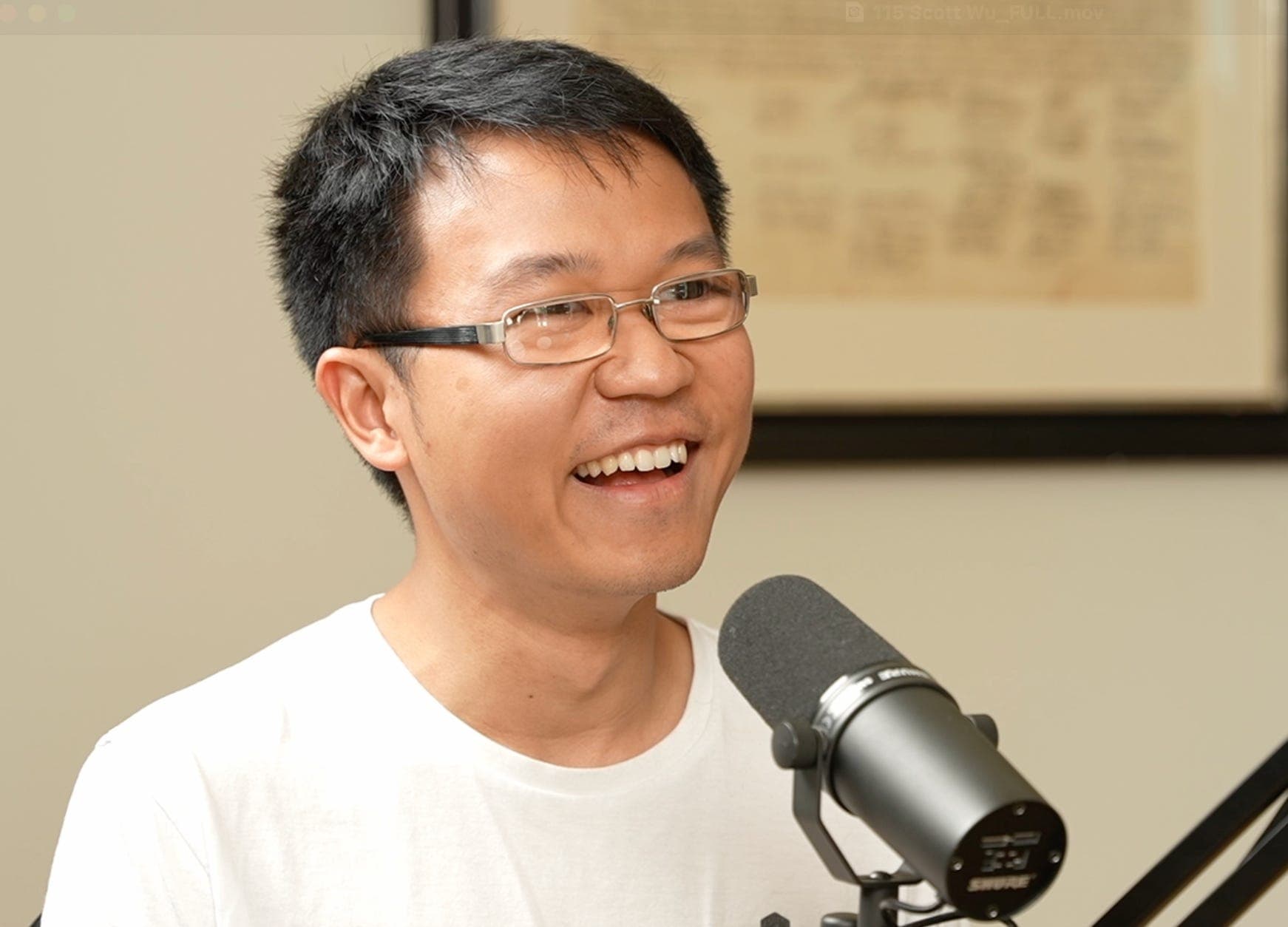
Episode Summary In episode 115, Joe Lonsdale interviews Scott Wu, the founder and CEO of Cognition AI, which has developed Devin, the first AI software engineer. The discussion explores Scott's journey from a math prodigy in Baton Rouge to leading a company valued at over $4 billion, his insights on the future of AI in software engineering, and the vast economic potential of AI-driven productivity.
---
Key Points
- Scott Wu's Background
- Early Life: Raised in Baton Rouge, Louisiana, as the son of Chinese immigrants.
- Achievements: Excelled in math competitions, including a national Mathcounts championship and multiple gold medals at the International Olympiad in Informatics.
- Career Path: Worked as a top engineer at Addepar before attending Harvard, where he eventually dropped out to start his first company, Lunch Club.
- Cognition AI and Devin
- Introduction of Devin: An autonomous AI software engineer capable of understanding codebases, debugging, and iterating on tasks.
- Economic Impact: Devin is seen as part of a potential trillion-dollar market, improving productivity by making previously time-consuming software engineering tasks significantly faster (e.g., from months to weekends).
- Team Culture: Scott emphasizes a collaborative environment of top math and programming talents, regularly engaging in math challenges and games.
- AI and Software Engineering
- Generative AI: Discussion about the evolution of generative AI from simple tools to more complex systems capable of extensive coding tasks.
- Human-Machine Collaboration: The importance of maintaining a symbiotic relationship where AI handles repetitive tasks, allowing human engineers to focus on higher-level decision-making and creativity.
- Future of Software Engineering: Scott envisions a future where software development becomes largely about directing AI, streamlining the creation of software products.
- Optimism and Economic Potential
- Positive Outlook: Scott discusses the exciting possibilities AI brings to productivity and creativity, emphasizing that humans will be empowered to accomplish more.
- Disinflationary Impact: The potential for AI to reduce costs and increase output across industries, possibly leading to significant economic growth.
- Cultural Context: Scott emphasizes the importance of American innovation and the culture of meritocracy in fostering technological advancements.
---
Key Quotes
- "If you're not using AI, you are just slower."
- "We've been spending our whole lives in Minecraft survival mode, and now we're going to get to play Minecraft creative mode."
- "The balance in AI does just inherently swing a lot more technical."
---
Discussion Topics
- Math and Programming Competitions: Importance of foundational skills in AI development.
- Jagged Intelligence: Concept introduced by Andre Karpathy, highlighting the varying strengths of AI across different domains.
- Future Work Environment: Scott believes that AI will not replace engineers but will enhance their capabilities, leading to new forms of work that prioritize creativity and strategic thinking.
---
Conclusion Scott Wu's optimistic perspective on AI as a transformative force in software engineering offers a compelling vision for the future, emphasizing the potential for increased productivity, creativity, and economic growth. The conversation reflects a broader narrative of optimism in American entrepreneurship and innovation.
---
For more discussions and insights, visit [Joe Lonsdale's Blog](https://blog.joelonsdale.com?utm_medium=podcast).
Written by AI. May contain mistakes. Listen to the episode to check what was said.
Transcript
Automatic transcript. May contain errors.0:00If you're not using AI, you are just slower. The future of software engineering is you telling your computer, here's exactly what you need to build, and it just happens. It's a trillion dollar market. How do you think of the possible value and opportunity of something like Devon? We can do not just like 10 % or 20 % gains, but more like 10x. Why is it all these math people are so good at AI? I go to Glasgow Middle School, and I'm in seventh grade. What is the value of$255 ,000? Scott. $5 ,000. $5 ,000 is the correct answer. This company you're building, you're hanging out with these top minds in math and physics and competitive programming.
0:32So we do a lot of math games for sure. First person to solve it in the comments, we're going to send you some swag. Code is honestly the fastest growing use case of AI out there. We've been spending our whole lives in Minecraft survival mode and now we're going to get to play Minecraft creative mode.
0:52Scott Wu was the world champion in competitive programming at the IOI after winning multiple gold medals. He used to work for me 10 years ago at Adapar. And today he's the CEO and founder of one of the fastest growing AI companies in the world. He's surrounded by a lot of the top minds in math, physics, competitive programming. They're building one of the fastest growing companies I've ever seen. What are the top minds in the world? Think about AI. Where's the world going to be in five or 10 years? And can you solve Scott Wu's math problem? Welcome to American Optimist. Really excited to have my friend Scott Wu here with us.
1:23Scott, you're the CEO and founder of Cognition AI. You were the world champion at the IOI competitions, top math competitor, and your company's doing awesome. Thank you for joining us. Yeah, no, thank you so much for having me. I mean, it's exciting to be here. I mean, it's for a few reasons. I mean, first of all, I am actually American and an optimist. And so it's exciting. But also, we've known each other for like 12 years now. And Joe actually gave me my very first job. I was an engineer at Adapar 12 years ago. You were a superstar at Adapar. It's cool to see you go on to build one of the giants in Silicon Valley, hopefully it looks like.
1:53But let's step back a bit. So about a year ago, you guys released a demo of Devon, which is what the product of Cognition is called. Did you have any idea it would go so viral? What surprised you? I mean, look, no, not at all. We hoped it would go well. You know, we put a lot of energy and effort into it. And it was, yeah, it was really awesome to see. I mean, I think it's, we have always had the view of just skating where the puck is going, basically. And around end of 2023, we were working on AI and specifically AI for coding. And we felt that things were going to shift a lot more agentic, basically.
2:31And everyone's talking about agents now, but back then it wasn't really a term. At a high level, we had the view that instead of pure text interfaces, there was going to be a lot more full interaction where AI systems could not just read text and answer questions, but actually just go and interact with the real world. And in code, obviously, that means debugging, pulling up the logs, reading documentation, testing code yourself, and so on. Well, it's amazing. It's a trillion-dollar market. I want to dive more into that. But before we do that, Scott, let's go to your background. You're from Louisiana originally, right?
3:00That's not exactly the epicenter of the math and programming world. What made you interested in these topics? Yeah, but your dad is from Louisiana as well, right? You spent some time there managing a plant, actually, when he was younger. That's true. So, yeah, I mean, similar story for me. I mean, both my parents were chemical engineers. They immigrated from Shanghai in the 80s. And, yeah, I mean, it's naturally there's a lot of oil and gas emissions and so on. And so my parents both worked in basically the emissions industry in Louisiana. I grew up in Baton Rouge and it was, yeah, not a lot of people who did math and programming in Baton Rouge.
3:33But I mean, I always loved math. I had an older brother also that did a bunch of math and programming competitions and first got me into it. But yeah, it's something that I knew I wanted to do from very, very early on. So in our family, my dad ran a plant there and he was a chemical engineer too is why he was there. And then my wife's grandfather ran an oil plant there. So you do get a lot of talent, I guess, coming through that way. But it's not seen as a center for these things. So you got into competitive programming. How old were you when you first started doing that? Yeah. So my first math competition, I actually still remember, my first math competition was in second grade.
4:06So I was like seven or eight years old. There was this, you know, the local college held a math competition for like middle schoolers and high schoolers. And so I was competing, I think, in the seventh grade division. So it was like me and a bunch of seventh graders basically doing math competition. What kind of problems were that? It was like, you know, a lot of the typical stuff for seventh grade math is probably things like, I don't know, exponents or something, you know, fractions or whatever, you know, like the standard problem where the frog is at the bottom of the well and goes up and falls down every night and stuff like that, basically.
4:36But yeah, it was, you know, I remember it because they were calling out the awards. And so, then they called out, you know, third place and second place and third place. And none of them was me. Like, I didn't win, you know. And I was really, I was like eight years old and I was like, really? You're disappointed you didn't win. Really disappointed. Yeah, I was really upset about it. And so then the next year, I trained a bunch. I competed in Algebra 1 the next year when I was in third grade. And then I won. And then I kept doing math competitions from there. And then programming competitions, I started around middle school.
5:07And so around sixth grade. I learned to code when I was in fourth grade or so. And then I started doing some of these programming competitions when I was sixth grade. And I always loved them. So as an aside, right now in the Bay Area, I think you have a lot of the top competitors happen to be Asian, have me based in the Bay Area. But it's interesting because they're actually dropping a lot of the honors courses in math and other things in the Bay Area. Have you followed this? What do you feel about that? Yeah, I mean, it's it's sad. I mean, I think the like I'm only here because of advanced math classes.
5:41It's kind of what I would say. And it's I think growing up in Louisiana, you know, folks were really nice and really supportive. Honestly, there were a lot of people basically at all levels that that kind of allowed me to, you know, I was taking I was at I grew up and I went to a school called Buchanan Elementary School in Baton Rouge. And it was right next to this high school called McKinley High School. And because of a lot of hard work from folks, basically, things were set up so that I could actually have someone walk me over every day to go to the high school to take math classes at high school.
6:11and it's obviously, I mean, I think the, yeah, I think it's, it all obviously starts with math and with technical education. And so, no, it's a very near and dear to my heart. My friends and I actually got walked also to like to go to the higher school. So, there was a group of us, six of us, and they helped me build Palantir later. So, it's interesting. I don't think we were quite as advanced as you as many grades, but it was really important. And I'm told nowadays they wouldn't allow that to happen anymore. So, I guess equity means that they have to pull us down now, which is too bad. But you were crushing these contests.
6:40Where'd you go to college? How'd that work out? Yeah. Yeah. Well, so before I went to college, actually, I worked at Aderpar. I was there for a year and a half. And why'd you do that? Why didn't you go right to college? Yeah. Yeah. So it's after high school, you know, I was coming out of it. I had done a bunch of these competitions. I think at that point already, I really felt like I wanted to start my own thing at some point, which is funny because I don't think I knew what that meant. You know, it was there was apparently people. And people, I don't remember this, but people tell me this, that when I was in fourth grade, I had a math teacher at high school.
7:11And I told him that I was going to start a really big company someday. And then I was going to give him a position as a software engineer. You still owe the positions, guy. Well, we got some work to do to get there first. We're going to build a big company first, and then he'll have the software engineer. The signature, huh? Okay. But it's, yeah, I obviously had no idea what that meant. So I'm not sure what I was talking about at the time. But yeah, it was really exciting to just see technology move and see real companies get built. And I wanted to learn what that was like and what that was in the real world.
7:44And so I took a year off, a year plus both of the summers around it. And I worked at Atapar. And it was a lot of fun. Basically, I was on the computational architecture team. I was figuring out how to compute a lot of big financial metrics for a lot of these. Well, we have$8 trillion on the platform now, so hopefully some of your insights are getting used at scale. I appreciate it. Yeah, yeah, yeah. And no, it was a lot of fun. And then after that, I decided that after all, I would go to school and try out school for a little bit. I wanted to, less so, I think, to learn software engineering and more so to basically meet interesting people, take classes, and just kind of develop personally.
8:25I was at Harvard for about two years, and then I dropped out and started my first company, and it was a great experience. And your first company was called Lunch Club, which I remember writing a small check into you saying, I think it's a bad idea. But actually, they figured out eventually something really good there. But tell us about that. Yeah, yeah, absolutely. So, Lunch Club, it was, you know, we started in 2017, which is way before kind of generative AI. But the whole idea was we used AI to make the right professional connections. And so, folks would come in and they would tell us, you know, their interests and their goals.
8:54And then they would also give us access to their contacts and their calendar. And based on that, we could figure out who were the right people for them to meet. It was all in-person meetings up until COVID happened. And then we had to support video meetings as well, which was a fun journey. But yeah, I was there for about five years. We made millions of meetings. It was a really fun journey. And I feel like it's taught me a lot of the lessons that I take. And Vlad, who you built it with, was obviously someone who's an amazing recruiter of talent. And I think he's pivoted to something that's working.
9:23So it's no surprise he's going to make it work. What was the inspiration for starting Cognition? Yeah. So it's, you know, it was a fun journey. Actually, a lot of it came back to these math and programming competitions that I did when I was a kid. And so I was still super, super tight with a lot of these folks. You know, it's like we would do these math competitions in middle school. We would do these programming competitions and math competitions in high school. You know, a lot of folks went to either MIT or Harvard. And so people were pretty close by as well. And then naturally, many of those people were working in AI.
9:53And so there was kind of a core group of us who we'd all spent our last 10 years basically building in AI and thinking about AI and building different companies. One of my co-founders, Stephen, was the first engineer at a company called Scale AI, which was doing incredibly well. My other co-founder, Walden, was the first engineer at a company called Cursor. And yeah, so we had all done a bunch of different things. And there was a point where we basically all got together and said, you know, let's try and just do some projects together. It wasn't a company at the time. It was just like more of like basically like a research project, you know, messing around with some ideas.
10:31We rented a house here in the Bay Area and then just got a bunch of people together for like two weeks and hacked on stuff together. That was November of 2023. And then in December, we got another house in New York and we got everyone together and hacked on a bunch of stuff. And then in January, we got another house. And in February, we basically just kept doing the hacker house model. And eventually, I guess, we incorporated a company. But that really came later. That's awesome. And you really obviously brought together an all-star cast. You mentioned founding engineers and all these top companies.
11:00These are your smartest friends from the math, from the competitive programming world. Why is it all these math people are so good at AI? Is this raw IQ? What's going on here? Yeah. I mean, I think it's, to an extent, it's always been the case in tech and Silicon Valley. You know, that a lot of the smartest people, you know, one of my favorite things is Mark Zuckerberg actually was a competitor on TopCoder. You can find his profile on TopCoder. He was a competitive programmer, you know. And a lot of the initial folks who built that with him, like Adam D 'Angelo, for example. Adam D 'Angelo was like an international medalist at competitive programming.
11:32And so, it has always been here to an extent. But I think it's especially true in AI. And it's actually, it's crazy to the extent to which it is. I mean, I think like OpenAI, Anthropic, Google DeepMind, I mean, a lot of these folks are like the folks running all these big labs. And then, of course, like the folks running a lot of these startups are actually people that I've known for more than a decade now just from these communities. I think there's a couple of reasons for it. But one thing I would just call out is I think AI is I think that the balance in AI does just inherently swing a lot more technical.
12:11You know, it's it's there are a lot of pure technical problems that if you can just solve these really, really hard problems, it is it is incredibly clear, you know, what happens and how you turn that into a business. I want to stop you there and get one of these. Not all of our audience is going to understand. But try to start at a level that's like advanced, but not crazy advanced. Like what's one of these hard problems you've solved? Can you tell us about this? Yeah, yeah, for sure. And so, you know, in these Olympiads, for example, like a lot of the problems that come up are things like, you know, you're in a network grid and you have to go find the shortest path between a bunch of places.
12:44But, you know, certain roads get blocked over the course of the day. And, you know, you're adjusting and you're still solving for these paths over the course of the day, for example. And you have to support all of this and make this run really, really fast, right? That's like an NP complete problem, right, as I'm told, right? So, this one actually, it turns out there's some really sick things that you can do. Yeah. Yeah, but these are the kinds of problems that folks think about. And the cool thing is that every problem is unique. It is not about being asked something that you've already seen.
13:11It is all about coming up with a new algorithm, which could be based on things that you've studied or understood. But it really is like doing the first principles thing. So just for intuition, again, for the listeners, why was that road problem tied to a real life thing that matters? You're obviously not doing literal shortest path problems in AI. But I think that a lot of the pure technical problems that exist in AI are a lot of these things of basically training AI models that can solve really tough problems or understanding exactly what the right architectures, the right systems are for AI to be able to go and do these things.
13:45And I think with software engineering in particular, I'm obviously a programmer myself. And so it's a fun thing to get to spend time on, teaching AI how to code as a programmer nerd myself. and it is like yeah I would say a lot of it is really like thinking about thinking you know it's how do we you know somebody hands you a bug and how do you fix the bug and maybe the answer is you know you go and you run the code locally you you reproduce it yourself once you figured that out you you go and find the error in the logs you look at those files and you understand it but but a lot of it is teaching AI systems to do those same things you know and there's a lot of kind of thinking about thinking that that goes into I love it I feel like your social IQ has gotten like a lot higher the last 12 years and you're being really careful not to tell us anything it's too complicated for us not to understand but i want i want you to like go past that for a second yeah and like what what's like what's like an example of something that not everyone's going to understand this sure that you solve there with this yeah yeah absolutely you know i i think the the broad in in generative ai you know everyone talks about kind of the whole generative ai wave i actually think it's two waves you know the first wave was kind of what i'll call like imitation learning and the second is is more like rl reinforcement learning um and the really cool thing about RL is you basically can, I think the natural conclusion of RL, which is what we're kind of getting to, is you basically can solve any benchmark, which is insane to think about.
15:01What does that mean? Which means like, if you have a clean set of environments, if you have a good feedback loop to decide what is correct or incorrect, you have all the necessary context that you need to make those decisions, you can train a model that just aces that. Which is, you know, we're seeing that in practice on a lot of these things. Actually, it's funny enough, like a lot of the benchmarks that people evaluate models on today are actually just the math and programming competitions themselves that we all did when we were kids, which is partially maybe because all of us are math and programming nerds, but partially also because it's a clean way to just kind of see how good the models are at reasoning about hard problems.
15:38But yeah, I mean, one of the cool things there is it just means that if you think about what happens next, a lot of what happens next is really just understanding and really defining the benchmark. And so, in practice, what that that means is figuring out exactly what are the use cases and tasks that we want to solve for? What are the right set of tools that an agent should have access to? How are you going to evaluate success or failure? One of the reasons that code is growing so quickly is because you have this really great feedback loop of success or failure. It's in health care or in law or something like that.
16:13It's a lot harder to say whether you did the right job or not. And code, you can run the code. And so that's often the feedback loop that gets things to work. But that's kind of the core. Scott, not all of our listeners are in the computer science world here in Silicon Valley. What does Devin do? Just basics. What is this? Yeah. So Devin is an AI software engineer. And basically what that means is it's an autonomous system that you can work with the same way that you'd work with a human engineer. And so you can assign a bug to Devin. You can give Devin a task. Devin will go, you know, it'll know your code base.
16:43It'll be able to test itself. It'll be able to iterate and work on things. It'll produce a code diff, a pull request for you to review and look at. And you basically work with it as your own junior engineer. So Devin's being used by a lot of large companies, I'm noticing. There's a lot of large enterprises doing like these big giant, you know, once a million dollar adoptions and whatnot. And like, do you iterate and figure out what's working or not in there? Like, what are the milestones to see what's working or not that you're learning from in these environments? Yeah, yeah, yeah, for sure. And so with these, it's a lot of the general setup is, you know, we want to look for the right use cases where we can do not just like 10 % or 20 % gains or 10%, 20 % ROI, but more like 10x.
17:24And so we pretty routinely see spots where we can make things like anywhere from 6x to 20x more efficient. What does that mean? 20x more efficient means you built something over the weekend that would have taken you months. Yeah, exactly. Exactly. So it means every hour of an engineer's time at that company on this particular use case using Devin is equivalent to six to 20 hours of an engineer's time not using Devin. And practically, obviously, what that looks like is basically just reviewing the code that Devin puts out and just making sure things look good and then just kind of signing off on that.
17:56But yeah, in practice, in enterprises, a lot of what that looks like is... The cool thing about it is it turns out it's a lot of the kind of more tedious, repetitive stuff that human engineers don't want to do, which is kind of a nice... I think there's this really beautiful synergy of AI and humans, which is that AI has always kind of been good at the more boilerplate side of things, right? At taking on these more repetitive tasks, which are also nicely... You know, the humans want to be able to work on the higher level strategic decisions or the creative side of tasks. This is interesting, though, because this is man machine symbiosis originally with like lick litter in the 60s is you do the automatable things, the computer and then the higher level of humans.
18:34And in chess, we always talked about this. But then eventually it got good at everything. It was better than humans, everything. And it's like it's like there's this funny joke where you if you're not married yet, but like like a husband and wife will agree, like the husband gets to make all the big, important decisions and the wife can handle the small things. But then after like 60 years of marriage, as you guys, as it turns out, there were no big decisions. But it's like if you give something a small thing, eventually it's going to get everything. Right. How do you think about that? Yeah. Yeah.
18:59No, it's so. So, you know, Andre Karpathy has this phrase jagged intelligence, which I really love. And it basically just means that, you know, you can think of humans with our intelligence. We're kind of uniform, or at least from our perspective, we are where, you know, as a kid, you grew up and you kind of just get smarter and smarter in a lot of different fields. whereas with AI it is there are certain things which is incredibly superhuman at and then there are certain things that it is incredibly bad at right and and one of the cool things about jagged intelligence I'll just say is it means that that humans plus AI it really is the way to go at least for for for the foreseeable future right because I think there are certainly there are more and more things that we're seeing that that the AI is just able to do incredibly incredibly well but as long as that kind of tail exists of all the things that humans can do you know that is that is what we'll own.
19:46And if anything, we'll be able to just do a lot more. How long do we have, Scott? How long until it gets along too? Yeah. And I think the long tail will take quite some time. And I think there's some things that are honestly inherently human. I think it'll always be up to us to decide what to build, for example. And I kind of think that the future of software engineering is basically that. We talk about programming languages and architectures and all these things. But at the end of the day, the whole point of software engineering is just to tell your computer what to do, right? And you should be the one deciding what to do.
20:18And you should be able to express that cleanly and just have it built. And I think that's kind of what we're going to get to over the next, I'll call it like five or so years, is a point where software engineering, we might even still call it software engineering or programming or whatever. But it really is just you telling your computer, here's exactly what you need to build. I'm going to, you know, let's add a new page on this website, or let's add a new table and store this and that information and just make sure this is ready to load. Or, you know, this button could be a little bit rounder, let's go and do that.
20:45And it just happens. Will there still be a role for people who are deeply technical to iterate with the computer better? Or can it just be like a random person listening to this who's never studied computer science is going to be basically just as good at doing all these things? Yeah. And that's the thing, which is, I think the, I think the answer actually is both. I think folks who are not completely non-technical are going to be able, you know, we kind of see this already, right? Where it's, it's so much easier already for people to build kind of websites or apps or something like that, even just, just from, plain text.
21:14At the same time, obviously, there will still be a lot of moments where you want to kind of peel back the layer of abstraction and be able to understand exactly, okay, what is really going on here? You know, I think a parallel that comes to mind for this is basically no one writes assembly today with the exception of folks who are really, really optimizing for very high performance work, right, where they want to get in deeply and understand every single command that gets run. And I think it's going to be kind of like a similar new level of abstraction on top of programming where it's, I think folks will not have to dig into the details of what exactly the machine is going.
21:49But I think having these deep abstractions and really understanding what's going on is, of course, just still going to allow you to get to another level of making the right design trade-offs and decisions and so on. Yeah, no, it's interesting because to be really good as like a, as a CEO in the Valley, you have to like understand the things a couple steps down and to be a really good product leader, I think you do have to understand some amount of engineering in order Because you have to know what's possible. You have to know the frameworks. It just seems very unintuitive to me that someone could build a whole product without having some sense of the architecture and the trade-offs.
Read the full transcript
22:18I was going to say, it's computer science classes, for example, arguably, they actually don't teach you how to go and build real-world software. Or their concepts. A lot of it is more just, yeah, how do you think about breaking down logical problems? How do you think about algorithms? How do you think about the model of a computer and what a computer can and cannot do? And I think a lot of the, people ask me all the time, my son or daughter is 16, should they even be studying computer science? And I always say, yeah, absolutely. And I think the reason is because these are the concept level things that actually allow you to be a really good thinker about deciding what to build.
22:54No, I think we're going to need more people who have good at logic and are able to build things, that's for sure. It's interesting because the demand seems like it's going up for software engineering. And the more you make it cheaper, the more the demand goes higher, right? So, right now, what is it? It's about a trillion dollars a year we pay engineers? Do you know what the numbers are? It's multiple trillion, yeah. It's multiple. There's about 30 million software engineers in the world. And my favorite stat that I always love to share is right around the turn, you know, the 1999-2000, you know, which was internet boom.
23:21Obviously, these things were, you know, these things were just, were becoming really, really big. There were actually less than a million software engineers back then. Really? Wow. The thing that's kind of interesting, I think, is to your point, it's we have never really run out of demand for software. And if anything, already over the last, from 2000 until now, if you just think about Python and React and Cloud, we've done a lot of things that have made it much easier to go and build software. And yet, of course, the number of software geniuses has gone way up because we've just done way more things with software.
23:54And I think we're going to see something similar here where it's, you know, imagine what we will do, you know, when we get to the point where everyone can just build products and websites and apps and whatever it is of that level of quality of some of the best apps out there. You know, we will just build a lot more of these. It's very interesting because a lot of people are worried, for example, the Indian economy has like these five giant software firms where it's like long-tail outsource software engineering. A lot of people are saying all these agents are going to compete with that, but there's a way in which the agents can just like make those people more productive.
24:25Is what you're saying? Yeah. And look, it's, I mean, the, the, the skills will change certainly, you know, and I think this kind of pure, pure implementation version, you know, is, is, yeah, I mean, it's, it's going to be different in a few years. But I think a lot of the fundamental skills of building software, you know, if you think about as a simple example, you know, it's even today, if we say, oh, this person, they're like a really great engineer, you know, what do we mean? Usually it's not that they like type really fast or that, you know, right. A lot of it is that they are just really good at thinking about these abstractions.
24:58They understand every case and every detail. You know, they know about all of the, you know, the kind of like higher level decisions that have to be made to build and architect something well. Right. And I think that is the general shift where over the next few years, things will move more and more to that in terms of what human engineers are spending their time on. Okay. So I want to ask you about the culture of cognition in this company you're building. You're hanging out with these obviously top minds in math and physics and competitive programming all together. And like all these cultures are probably there late at night together all the time and doing stuff.
25:30And this is Devin's growing all over the world. It's gone viral in Japan. It's gone viral all around the U.S. And as I was mentioning earlier, my little brother, at first he was critical of this when it came out. It just didn't work for what he wanted. And now his whole company is using it to be way more productive. And it's a really good sign because your little brother is always negative on things you're doing. So it must be good then. But so you guys have this amazing thing that's growing. What's the culture internally? And when you talk about the future, what are you guys thinking about it?
25:55And by the way, when you hang out, I hear you play math games with each other. Tell us about this. Yeah, yeah, yeah. So we do a lot of math games for sure. No, I think the, look, I was saying from the beginning that we started in a house and we did another hacker house and we did another hacker house. And in some sense, we never really stopped doing that. I feel like it's been a hackathon for like the last year and a half. And it's, you know, we have about 30 people on the team today. And one of the crazy things is actually, you know, yeah, we have a lot of people who came from this kind of like, you know, Olympiad background in math or programming.
26:26But we actually also, 19 of us, I think, were founded a company before, 19 or 20 of us. Wow, so you've got a bunch of former founders. A bunch of former founders. And I think it's an experience that's relevant, I think, in a lot of different ways. And I certainly had the same experience as well, building Lunch Club, which is, yeah, I mean, you do run into a lot of these challenges and learn a lot of these things. But also, it gives you a lot of fire, I'd say, for all of us to just be like, this is the one. We're going to make this the really, really big one. We're going to make this the massive success.
26:55And that's what we're all motivated and excited to go for. There's a lot of agency from founders. like everyone's just taking it and running with it, which is cool. Yeah. Yeah. And I think with this, it's, I mean, there's, there's a lot of big decisions that we need to make, you know, this is true on obviously on the capabilities work, but it's also true on the product side. It's true on go to market and so on. And so, um, yeah, no, we, we have a lot of fun. I mean, it really is a lot of very, very late nights, you know, folks are, are, um, pretty often, pretty regularly in past midnight. Um, what's an example of a math problem you give the team that was too hard for our listeners.
27:27just yeah okay so so so the one of the games that we play is um there's a game called 24 where you you put out four if we have a deck of cards we can play but it's uh you you you put out four cards and and let's say it's you know eight seven four and two okay um eight seven four and two and so now the question is you have to yeah i'm gonna you're gonna i'm gonna make you do this by the way yeah let's do it let's do it okay so so you have to you can use any operations add subtract multiply divide okay and you have to use all four of the numbers you You can put them in any order. You can use parentheses or whatever.
27:59And you have to make that equal 24. You have to do an expression with all four of these numbers. Got it. So you have to use these four numbers as fast as possible to get to 24. Yeah, as fast as possible. But you can't reuse a number. You can't reuse a number. So seven times four minus eight over two. Great. Yeah. So eight over two is four. Seven times four is 28. 28 minus four is 24. There we go. Very fast. It's good. It's good. Yeah. So, you know, at some point that got too easy. And then we did it with six cards. And then you were making 163. And then there was like eight cards and making the current year and stuff.
28:25And then this is a game that we used to play all the time when we were growing up and stuff. But there's been some fun ones. Yeah. So I'll give a hard one. Give us a hard one for our listeners. Yeah. Yeah. Yeah. So you have the numbers 3, 4, 5, 8, and 13. Uh-oh. Okay. And you're trying to make 198. You're trying to make 198. Yeah. All right. And so we're going to pause and fast forward this now. Yeah. Then one second later, Joe comes up. Okay. Pause. Okay. but you can't just combine them you have to do operations basically that's kind of cool so it's like what is like for the power of yeah this is a lot harder than the other one this is harder yeah i can probably get it actually it's it's it's tough yeah yeah if i think it i think it would take a while yeah got it okay well we'll we're yeah no no hey hey turn it off i i can just i I can just tell you that.
29:23I'll just tell you that. Okay, tell us. So you do 13 divided by 4. 13 divided by 4. That's a really sick thing. That's actually crazy. I would not have intuitively gotten that one. Yeah, and then you add 5. 3.25, so 8.25. Yeah, 8.25. And then that times 8 is 66, and that times 3 is 1 and 8. Wow, so it's 8.25 times 8 times 3. Yeah, yeah. That's probably harder. There's no way to do it without doing fractions. There are a lot of fun ones like this. that there must be some other way where it's like where it's like you know three to the power of five and then do something else you just can't do it how you try it it's uh yeah yeah so so there's there's there's none yeah yeah usually it's uh you're not allowed to use exponents if you were you could do a three to five minus four times eight minus 13 that's that's what i was working um but but without exponents i think the only way you can do it is with these fractions so the fun ones i think are the ones where yeah it's it's not just integers you know that you're working with amazing amazing okay let's do an even harder math problem first person to solve in the comments we're going to send you some swag scott what's a harder one all right all right let's do it so i'll give another one of these uh making a number so if you have four five six ten ten and ten so three tens and then a four five and a six can you make 163 and again you can only use add subtract multiply divide you have to use all the numbers once each you can put them in any order but you know your equation has to have exactly three tens for example you can't have more or less.
30:45All right, audience, go to it. All right. Well, thank you. Thank you for showing us that when you're not doing math problems together, which I think is really cool. I think I remember last time I was, I was, you guys were talking about the future and debating and you say you're an optimist. Cause a lot of people in my world, there's like this messianic branch where it's like, we're creating this God and everything's gonna be totally different in 10 years. And then like other people are like, Oh yeah, it's really negative. It's going to like be centralized power and control and destroy everything.
31:11Whoever gets in charge, the top but yeah, it's going to be negative. And then there's also the optimistic points of view. What's your optimistic point of view here? Yeah, yeah, absolutely. In one line, my co-founder Walden says this all the time, which I love, which is, we've been spending our whole lives in Minecraft survival mode, and now we're going to get to play Minecraft creative mode. And that's like the, yeah, I think that really is the really exciting future that we're heading towards. I think the main thing I would just call out It's like, I think human creativity, human passion, you know, desire to build things and meaning.
31:48I don't think that stops because we have some really smart AI or anything like that. Right. And I think we're, if anything, we're going to be able to spend a lot more time doing that. You know, we're going to do really cool things. You know, one of the things that I always think about is like, if you just imagine folks from thousands of years ago, you know, looking at us today, like sitting here talking about this, right. And it's, it's funny to think that in the sense that like, probably most of, of what, You know, most of these white collar jobs out there, it would be crazy for them to even think about it as work.
32:14You know, it's like you sit there, you have, you know, you're talking in the room with other people. Maybe you're pushing buttons on this thing or whatever. And you call that work. You know, you're not in the fields. You're not actually like pushing things around. And I think that we will go through like another level of that, honestly, with AI. Where it's, similarly, it's, you know, we might still call it work and think of it work. But it's going to look more and more like really pursuing your own passion and building great things and building really cool things. And I think that, yeah, and I think that that's going to, you know, it's like it's at the end of the day, I think we've made a ton of progress over the last, you know, thousands of years.
32:49But there is still like a lot of suffering. There's still like a lot of, you know, things that we don't need to have, basically. And I think getting to the point where people can really just do what they want to do and build really exciting things and put things into their life's work that they create is really exciting. I mean, with Devon especially, I mean, we're all programmers ourselves, obviously. And so, we love coding. You know, we love building software. And I think one of the big things that is really, really exciting about it is, yeah, you don't stop building software just because, you know, you can have AI that helps you write code, right?
33:24I think if anything, yeah, we're going to have way, way, way more great products. And we're going to have way more great ideas that we're going to be able to bring to reality because it's so easy. Everyone has so many ideas that they have of what they want to do and what they want to build. And being able to turn that into reality is just really exciting. So we're recording this before the Reagan Economic Forum I'm going to this week. So I'm thinking in economic terms right now. And I love what you said with this positive Minecraft trader mode. And so in economics terms, that means that productivity goes way, way, way, way up.
33:51And it's massively disinflationary. And you just create things cheaply, whether it's farming, whether it's building, whether it's health care, whether it's education. How do you think of the timeline? I know it's kind of an unfair question because you're thinking a very positive vision of this 10 years out. Do we start to see productivity just shoot way up in the next few years? When should we expect this? Or how do you think about that? Yeah. And I think we have, honestly, we have a special lens into this because I'd say code is honestly the fastest growing use case of AI out there. And I think it is representative in the sense that, look, in code, it is real.
34:25It is very clear that if you're not using AI, you are just slower. But I don't think that leads to kind of a negative for us in the sense, if anything, it means that we all get to build a lot more and we all get to do a lot more. And so, I think that is kind of the shift that we're going to see in a lot of these fields. I think on a per-person basis, each person is just going to have their own team of AI assistants that's going to help them do a lot more. And it's actually amazing if you think about it. The U.S. economy is, well, it's like a$20 trillion economy, depending on different ways of measuring it.
34:57So if you make productivity go up 10%, that's a$2 trillion a year, which equity-wise is a$20 trillion thing in one year. So even 5 % is in the order of$10 trillion of equity value. So it's actually fascinating. The positive sum nature of this stuff works, it's worth tens of trillions of dollars. And so how do you think of the possible value and opportunity of something like Devin? I think this actually is a multi-trillion dollar opportunity because it's fixing such a big space. Is that the right way to think about these things? Yeah, yeah, for sure. I mean, I think for us, it is the, you know, the central question that always roots us in basically all of our product decisions and all of our strategic direction and so on is, it's just like, what is the future of software engineering?
35:37You know, I think it's, I think in startups, people often get caught up in, you know, kind of figuring out fancy tactics and things like that. But it always, obviously, it always starts from what is, you know, what is the future and what is the value that we're going to provide? And a lot of it for us is just that the fun thing about this space is that the answer to that question basically changes every couple of months in the sense that, you know, you hit a new tier of capabilities, you build models that can do these crazy new things. And that changes the whole experience of like, what is the right way that humans should be working with AI to write code?
36:07What's a recent tier that you feel like you've hit? Can you give us some insight? Yeah. One of the big ones that we've just rolled out actually is basically the ability for humans and AI to just, you can use AI to interactively plan and scope out the task. And then once that's ready, you can just hand that off and go. um the similar thing is just even you know getting to the point where every time you file a ticket in slack or a linear or grr or whatever service you use you know it's you just you just have your coding agent go and work on that right and i think it's crazy to think about because you know a few years ago for example like the um you know github copilot and others were kind of some of the first to really kind of pioneer the ai coding space and you know this single line where it would give you a suggestion which you could tap complete like that was all you could do in code you know it was Because we had models that were pretty exciting, but obviously they weren't good enough that you would trust them with these bigger things, right?
36:58And I think one of the really cool things actually is a crazy stat, which is if you look over the past few years since that kind of tab completion era, you can kind of think of an AI model or an AI system in terms of how much work it can do in between interventions from a human, if that makes sense. and so it's like you know can it do five minutes of work of human work straight in between you know an intervention and because once the errors get to be too much it just has to stop basically but doesn't always know to stop right yeah yeah yeah it's like until like the human has to step in and give more feedback or something like that and the crazy thing is over the last like three four years that number has basically it's doubled approximately every three months wow um which is you know two x every three months is four doubles every year which is 16x right and it's i mean it It is kind of, you know, over three years, that's about 4 ,000x, which is correct.
37:48What is it over a decade? Two to the 40. Which is a lot. It's about a trillionx. That's a big number. It's a big number. And so, obviously, we'll see how long that continues. And so far, it shows no signs of slowing down. But, you know, it really has, over the last few years, gotten from systems where it can just complete the line for you and just do that two seconds of typing for you versus now we have systems that are going to do hours of work. You know, they're going to go build a feature or solve a bug. I think it's about a quadrillion, by the way, Scott. Not a trillion. It's a quadrillion, right?
38:16Am I wrong? Two to the 40? That's a million square. Damn it. Can we delete that part? I'm just kidding. I keep trying to get him. I lose. I'm terrible. Yeah, it's a million square. This is a million square. This is really bad. I shouldn't challenge him. You had me worried for a second. That's funny because that would be a big deal. Yeah, yeah. Okay. I was going to ask you to cut that in. No, yeah.
38:43you know don't worry you're right scott and what does this mean for large organizations because there are a bunch of them adopting it they're getting more productive yeah like are they gonna you know there is a question like people have stopped hiring quite as many engineers the last few years maybe they over hired in 2021 though like what should we think about that yeah i think there are certain economic factors economic factors that came into there but but i would say it's it is very clear if with with every engineering team you know i've never met an engineering team that's told me, all right, you know, we have this project and then we're going to do that project and then we're done.
39:12No more software, you know, that's it. Right. I mean, every team has a hundred things that they want to build and that they want to ship, but they have to pick, you know, four of them to do this week because that's, that's all they have bandwidth for. Right. And I think that the, um, yeah, I really do just think that the demand for these things is going to grow. One of the things that I think about all the time is, you know, if you think about these, the best products in the world out there today, right. And in my mind, that's probably, you know, YouTube, Instagram, TikTok, things like that. And obviously they have tons and tons of hours and tons of usage, but, but they're about as close to perfect as, as we get in software today, I'd say where it's, you know, the, the algorithm is amazing.
39:50It knows every little detail about me. You know, the it's, it's streaming a ton of data and it's able to do that super efficiently. It never goes down. The product UX is super, super intuitive. It always, you know, it's really easy to understand what, how to do what you want to do. Um, and, and, and that's kind of the top tier, right? And, And, you know, let's say that's, call it 100 million hours of engineering time that we've put into that, you know, across tens of thousands of engineers or something, right? And so, that's kind of the absolute top, right? And every tier, you know, every order of magnitude that you go down, you feel it.
40:21You know, there are products out there that have tens of millions of hours. And I'm thinking about a lot of, you know, banks and healthcare products and things like that, which, you know, I use these all the time as well. And you can feel like the difference of the bugs that you run into or little things that are unintuitive or don't quite work or really should be easier. And then you go to the products that have 1 million hours and then 100 ,000 hours and so on. Right. And, you know, eventually you get all the way down to your, you know, your local like school website or something, which is like.
40:46You can't use it. It's from like 2001 or something. You know, and so it's, I guess what I would just say is like, it is, there's so much more out there to build. And I think it is very clear that there are a lot of products and a lot of product experiences that could really use like a lot more care and a lot more effort. And if anything, we're only bottlenecked by how much we can build. I'm seeing later today my friend who's like using AI to like build roads with like construction machines and stuff and other things. I feel like, do you think like all these new possibilities are going to be made easier from what you're doing?
41:17Like are we going to be able to all of a sudden train things to do things they couldn't do before? Yeah, yeah. So I think it's, we're entirely focused with software engineering. And there's, I think, a lot of bespoke problems in code. And that's what we want to spend all of our time on. But yeah, I think it's happening everywhere. And to your point, I think there is kind of this cross acceleration, right? I mean, there are a lot of companies that hire software engineers, not just software companies, right? And I think in general, there's a lot of things that we can just continue to make more and more to just keep accelerating.
41:46Software engineering does seem to be the highest level of abstraction for doing things in the world, I guess, is the leverage point for everything else. So, you know, what are you most inspired by in terms of like recent breakthroughs otherwise? Like what else is most exciting to you? Yeah. Yeah. I mean, it's honestly, it was a pretty exciting moment for me to get to see. There's been a few things that came out over the last year. Google had a really amazing result where they got a silver medal at the International Math Olympiad. And then OpenAI had a really great result where they got to approximately the top 100 competitors in the world in competitive programming.
42:18And it is really, it's, it is. Yeah. Yeah. I feel like I've had my AlphaGo moment over the last year to kind of seeing that. And it is really, really cool. And I think what it kind of shows, I would say, is actually, I think we're at a point now where intelligence actually isn't the bottleneck, if that makes sense. I think these models are capable of solving some really, really hard problems. And a lot of the work that's being done right now is just figuring out how to make the models really good at your hard problems. And there's obviously a lot of specificity. This is true in software engineering.
42:47You know, there's things that you spend years and years on learning all the details of how does this thing work? How do you use this library? You know, what does this mean? How do I debug this error or whatever? Right. And that's a lot of the kind of more practical work, I think, that's happening everywhere in AI right now, where it's, yeah, we've shown that the models are capable of doing some really, really hard stuff. And so, Scott, to end this here, you know, I love that you're building probably one of the most advanced companies in the world in this space, creating the future. You're doing it in America.
43:14You said you're an optimist. You're an American. Why is America the right place for this? Like, are you proud to be an American? Like, what's it have to do with what you're doing? Yeah, well, I'm very proud to be an American, I'd say. And I mean, I think a lot of it is just, yeah, is believing in merit, I would say, in one line. I mean, I think that innovation is incredibly important. And I think that it's, if anything, over the next few years is only going to become more important. And I think making sure we have the right culture and the right circumstances and everything that allow folks to just build new things and come up with new ideas and iterate and try things.
43:51And, you know, many of those will not work, but some of those will. And I think that's a lot of what's really beautiful, I'd say, about the American spirit. I love it. And if it does work, it looks like it's going to create a really bright future. Were we going to, you said, would you say it was Minecraft what? Minecraft creative mode. I love it. That's a very positive vision to end on. Scott, thanks for joining us. Thank you so much for having me. Music Music
From the publisher
Scott Wu took the technology world by storm when he released a demo of Devin, the first AI software engineer. A year later, Devin has gone global, and his company — Cognition AI — is valued at over $4 billion. What are the next leaps for AI coding agents? Could the total economic impact be in the trillions of dollars? And is Scott worried that Devin may someday replace him?
Scott's journey to the epicenter of the AI race started in an unlikely place: growing up in Baton Rouge, Louisiana, the son of Chinese immigrants. At an early age, he excelled in math and was fast tracked into high school courses [not held back in the name of equity!], culminating in a national Mathcounts championship and three gold medals in competitive programming at the International Olympiad in Informatics. After highschool, he joined Addepar as a top young software engineer before attending Harvard.
Scott gathered his smartest friends and many other math, physics and programming champions under one roof to build Cognition, and when they're not architecting new AI breakthroughs, they're quizzing each other with math games. Learn why the top math minds are dominant in AI and what this tells us about the nature of AI progress and where we're headed next. Plus, the first person to solve one of Scott's tough math challenges in this episode gets free swag [leave your answer in the comments or email info@americanoptimist.com]. Finally, we discuss the future of software engineering and what AI coding agents mean for economic productivity as tasks that once took months to complete now take a weekend with Devin. Is it a trillion dollar opportunity?
It's inspiring to see the impact an optimistic, brilliant mind like Scott can have on the world — and he's still a few years shy of his 30th birthday.
0:00 Episode intro
1:38 Math prodigy to AI savant
9:43 Origins of Cognition and Devin
11:25 Why are top math minds dominant in AI?
14:40 The next wave of generative AI
18:45 Jagged intelligence & man-machine symbiosis
25:35 Solve Scott's math challenge
31:05 Scott's argument for AI optimism
35:10 Trillion-dollar opportunity?
39:10 The future of software engineering
42:10 Optimism for the future
This is a public episode. If you would like to discuss this with other subscribers or get access to bonus episodes, visit blog.joelonsdale.com