Ask ChatGPT

 Joe Lonsdale: American Optimist
18 Nov 2026 · 41m · 16 chapters
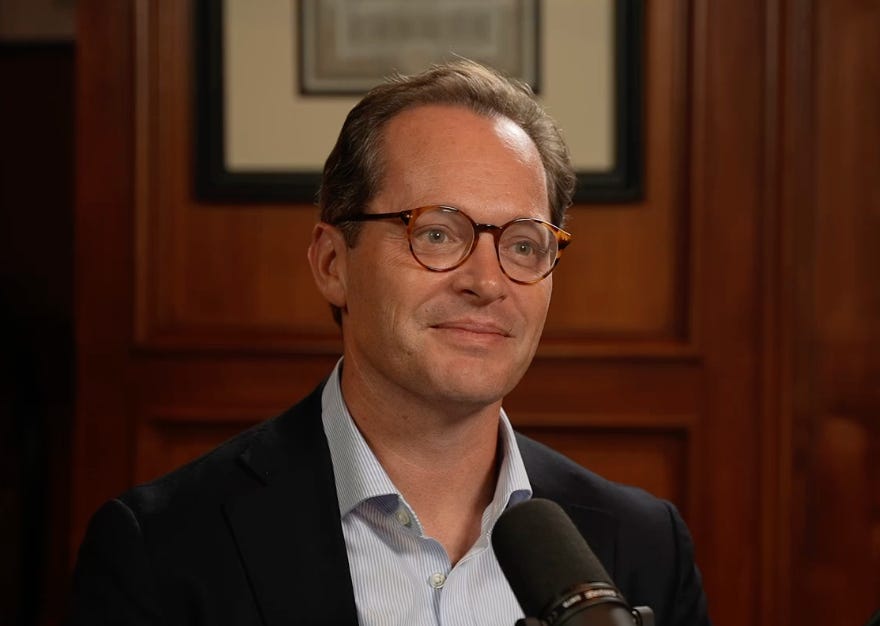
Roger Zakheim argues historians overfocus on summit diplomacy (e.g., Reykjavik) and miss how Reagan’s “peace through strength” military buildup positioned the U.S. to prevail in the Cold War. He claims Reagan rebuilt U.S. military capacity after Carter-era detente, sustained defense spending, and accelerated technologies from “lab to field,” helping force Soviet retrenchment.
Roger Zakheim is director of the Ronald Reagan Institute at the Reagan Presidential Library. He co-founded the Ronald Reagan National Defense Forum and is author of Peace Through Strength: How Ronald Reagan’s Build-Up Won the Cold War. His background includes work on the House Armed Services Committee and Pentagon defense issues; his father served in the Reagan Pentagon under Caspar Weinberger.
Reagan increased defense budgets (20%+ first year; about $2T over eight years), raised defense spending to roughly 5–6% of GDP, resisted cuts and SDI concessions, and used public messaging to secure support.
Patriot missiles, Apache helicopters, Abrams tanks, B-1/B-2 bombers, F-15/F-16/F-18, GPS, Tomahawk missiles, a 600-ship Navy; F-117 stealth’s role in Desert Storm; SDI’s impact on Gorbachev; Gorbachev’s Dec 7, 1988 UN speech withdrawing forces from Eastern Europe; Reagan’s Medal of Honor ceremony story (Sergeant Benavides).
Written by AI. May contain mistakes.
Discover how Reagan's military buildup played a crucial role in winning the Cold War.
“Historians actually miss a lot of what won the Cold War.”
Learn about Roger's journey to the Reagan Institute and the National Defense Forum.
“your background like how'd you become the director of the Reagan Institute so it's not the sort of thing that uh you grow up you're like okay that's what I want to do or be uh but when I was a kid Reagan was president.”
Explore the inception and significance of the Reagan National Defense Forum.
“Let's tell our audience about the defense forum.”
Understand the changing dynamics between defense contractors and the military.
“For two of us, we have it together because we thought back then, over 13 years ago, that it was essential to create the defense forum.”
Delve into Reagan's philosophy of 'Peace Through Strength' and its historical context.
“Let's go back to Reagan and peace through strength.”
Discover why historians often overlook crucial elements of Reagan's defense policies.
“as much as you could trust China today not to do certain AI research.”
Learn about Reagan's approach to military strength and its impact on the Cold War.
“And we are engaged in a foreign policy of detente, which basically said, you know, because of Vietnam, because of the strength of the Soviet Union, it's just a fixture in geopolitics.”
Explore the military advancements achieved during Reagan's presidency.
“We had the military readiness was so poor.”
Understand the significance of the F-117 stealth fighter in military operations.
“So you had a lot of industrial capacity that was unused and had been neglected.”
Uncover the history and implications of Reagan's Strategic Defense Initiative.
“The Secretary of Defense in 1991, great story here, if I could just take 30 seconds on this, at the time of Gulf War 1 was Dick Cheney, future Vice President of the United States, okay?”
Learn how Reagan's commitment to missile defense laid groundwork for modern technologies.
“I mean, if you've ever watched any of those videos in Israel, the ballistic missiles coming in and this little tiny like interceptor shoots and it like barely gets it before it hits the ground.”
Explore how Reagan's strategies and military buildup contributed to the Soviet Union's decline.
“handwritten, where he envisioned a world where if we, in an all-out race of systems, we would beat the Soviet Union, and they would all, and then we lend them our hand once they had lost.”
Understand how Reagan revitalized the U.S. military and the significance of the all-volunteer force.
“you know, they would do in the fall every year, and this guy gives a speech, and he announces that they're going to roll back the Red Army out of Eastern Europe.”
Discover Reagan's efforts to restore honor and respect for military personnel.
“Friedman was a big fan of Reagan and a big fan of the all volunteer force.”
Learn about the challenges and strategies the U.S. faces in competing with China.
“One difference is that their industrial base in some ways is even ahead of ours, even though I still think we're better at innovation.”
Explore the foundations of optimism regarding the future of America and its core values.
“No, and a lot of the stuff from the 1980s, like Raytheon makes like 60 to 80 Tomahawk missiles right now a year.”

Get the gist, explore an idea or ask about something said.
 Claude
On Joe Lonsdale: American Optimist, what are the key points of this episode?
Searching your listeningAutomatic transcript. May contain errors.
0:00Historians actually miss a lot of what won the Cold War. They didn't do a deep dive into what did Reagan do to position the United States to prevail. Roger is the director of the Ronald Reagan Institute, and you're also the author of Peace Through Strength. When President Carter came to office, right, in 1977, it was the view that there was no Cold War. Reagan comes in on a platform of peace through strength that we'd have to rebuild the military. He plussed it up 20 plus percent the first year,$2 trillion over eight years. GPS, the South, we had the Patriot missiles, the Apache helicopter, and a 600-ship Navy, right?
0:33And Tomahawk missiles. All of those platforms, they are the backbone of our military today. For Reagan, it was unleashing the American entrepreneurial spirit. And Gorbachev knew he could never compete with them.
0:52Roger Zakheim is the director of the Ronald Reagan Institute at his presidential library. And he also helped create the Ronald Reagan National Defense Forum, which is now the most important annual gathering of defense leaders from government industry in the United States. Roger's new book is Peace Through Strength, How Ronald Reagan's Build-Up Won the Cold War. How did Reagan pull off the greatest peacetime build-up in history? And what are the lessons that are relevant for our military situation today? And how this build-up with Reagan in the 1980s creates some of the most sophisticated military platforms we've ever seen, many of which are still very relevant today.
1:22Names you know, such as the Patriot missiles, the Apache helicopters, the Abrams tank, the B-1 and B-2 bombers, fighter jets such as the F-15, more advanced versions of the F-16 and the F-18. What was Reagan doing? What was the country doing that allowed us to do that? What can we learn for our buildup today in the 2020s? This is an important and timely book as we confront the challenges with China and our adversaries in the years ahead. Welcome to American Optimist. Really excited to have Roger Zakheim here with us. Roger is the director of the Ronald Reagan Institute. you're the co-founder of the Ronald Reagan Defense Forum which a lot of our friends go to the top defense event of the year and host of the Reaganism podcast and you're also the author of Peace Through Strength how Reagan's military build up won the Cold War thanks for joining us Roger it's an honor to be here thank you I'm excited for your new book but let's go first tell us about your background like how'd you become the director of the Reagan Institute so it's not the sort of thing that uh you grow up you're like okay that's what I want to do or be uh but when I was a kid Reagan was president.
2:20And so in many ways, he was like the paradigm of a president. And then I worked on the House Armed Services Committee, which is a congressional committee overseas, the Pentagon. And it's there when we're dealing with defense issues, it was the height of Iraq and Afghanistan. We're having fights over budgets that I was like looking at, oh, you know, who is a model? Who's the paradigm of how you build up a military, how you strengthen military? And that's where I got to Reagan build up and learned about Reagan's presidency. My dad also served in the Reagan administration in the Pentagon. He was a deputy undersecretary of defense for Reagan's secretary of defense, Cap Weinberger, who features a lot in this book.
2:57And then just by chance, the chairman I was working for, his district came to include the Reagan Library. And we came up with this idea to build the Reagan National Defense Forum. And then it sort of built from there that I left Capitol Hill, practiced law for a bit, and then the opportunity to start the Reagan Institute because of my relationship through the defense forum. Let's tell our audience about the defense forum. This is an amazing event. Like all of the CEOs of the top defense companies, like a lot of people who run all of national defense are there. Like, like how, how'd you start this?
3:27Yeah. Well, one, thank you, because you as a trustee of the Ronald Reagan Presidential Foundation Institute have been a great supporter of it. The work you do here at HVC, co-founding, founding Palantir, you're a big part of why we've had success at the Reagan National Defense Forum. The way we started it, we were dealing with this problem of sequestration, where during the Obama administration, he decided that to deal with our debt and deficit issues, we need to cut defense. Huge mistake, something we're deeply opposed to. Actually, Reagan encountered the same thing over and over and over again in his administration.
4:02But as president, he never gave into it. Of course, President Obama did. And we were looking for ways to collect the National Defense Committee to talk about what the impact would be on this sequestration, these deep cuts to the Pentagon. And there was no way to do it. There was no convening. There was no kind of forum to bring people together to talk about this, whether it's the CEOs, whether it's Secretary of Defense, whether it's the service chiefs, you know, the people with stars on their shoulders or the congressmen and the senators. And that's why we started the Reagan National Defense Forum at the Reagan Library.
4:32And until then, the Reagan Library hadn't really done much convening or events around defense issues, despite President Reagan's legacy. And now it's the top event of the year for defense. We go there. It's funny because we're no longer talking about sequestration at all there. I didn't even realize that we're talking about what should we be investing in as a country and what it's exciting in defense and how do we make it work to oppose our adversaries? Well, it's For two of us, we have it together because we thought back then, over 13 years ago, that it was essential to create the defense forum.
4:59But as you know well, and you're devoting your professional life to it, the challenges we face today are, in many respects, far more significant than we understood 13 years ago. It starts with the People's Republic of China, and that's the largest military modernization we've seen since the Soviet Union. And at the same time, we've seen this technological revolution, which obviously you've been involved in and accelerated. And what we've been working on at the Defense Forum is how do we bring the stakeholders together so we can integrate, leverage all the great innovations for our military. And that's been a big part of our conversation over the years.
5:30I remember one just quick anecdote. Perhaps you were there one time. We had brought in Andruvill, familiar with that company, you know, leading an autonomy to the Defense Forum on stage. And we had a secretary of the Air Force like, why am I going to sit with these guys? Like, who are these guys? Think about that. You know, the notion that autonomy should have anything to do with our Air Force. Here we are years later, and that's changed radically, as you know. Secretary of the Air Force, that's funny. It's like, why am I being told to sit next to these random guys? Yeah, it took some persuading.
5:56I love it. Well, nowadays, it's obvious. Things have shifted a lot. Fast forward years later, and they want to be sitting with these guys. They're partnering with them. They know that the future of the Air Force, just like the future of every military service, relies on autonomy, integration of AI, and all the things I know that you're working on at ADPC. Well, it turns out the very top people in the tech world have a lot of influence now in terms of how these things can possibly work. So I hear. So I hear. That's what it seems. You know, and it is really cool for me to see that forum, by the way, go from like only really the primes.
6:26And now the primes are still there. But the most interesting companies that everyone wants to talk to are the top five or six neoprimes, as we call them. I like that. You know, we can map this actually through the defense forum. Early years, it was just the primes and there weren't any other people to be there in terms of our partners. And then we had entities like Palantir, Andrel, others come aboard. But there was hostility, as you know well. Whether you're SpaceX or you're Palantir, the primes and the Department of Defense, right, at the time didn't want to deal with them. And now we're in a new era.
6:55And I'm sure you're seeing this with a lot of the companies you're investing in, is that now the primes in particular want to partner, right? And the new technology companies want to partner with the primes. I think that actually ultimately is the best outcome and the benefit of our warfighters, which is the goal. Definitely good to work together. I think eventually the best run companies that are the new companies will probably take over and the primes will be split up and put into them. But we'll see what happens. You heard that. That's my 10 year view. That's my 10 year view. Let's go back to Reagan and peace through strength.
7:24Peace through strength is one of my favorite framers. I guess it comes from Latin originally. It's a very old concept. If you want peace, prepare for war. How did Reagan come to peace through strength? Yeah, I mean, you're right. It goes back. I actually go back all the way to the Bible. It's in Psalms, you know, where my faith tradition is King David, who is writing about that God bestows strength on the people and the blessing will be peace. So it goes back that far. And then, of course, George Washington spoke about it in 1790, his first report to Congress. So it's always been part of the American consciousness and part of our leadership.
7:57But Reagan, I believe, came to it because he looked at the failure of the world to prevent the Second World War. Big admiration for Winston Churchill. Reagan certainly saw him. He wasn't confused about this. Churchill was a hero of the Second World War, but he also knew that there was a gathering storm that Churchill wrote about, and he failed. That is, Churchill failed to persuade the people about the rise of Nazism, and Reagan did not want that to happen again. And so he understood that if you want to prevent the United States and the West from losing, in this case, the Soviet Union, the Cold War, you needed to be strong and you needed to negotiate from a position of strength.
8:39That's how I end the book. I end the book focusing on that, the great contrast between Churchill and Reagan. It was a great achievement because Reagan figured out how to deliver strength and build strength to deliver peace without firing a shot, as Margaret Thatcher said. So you said of your book, Roger, that you went through looking for a history of the Reagan buildup and couldn't find one and that historians actually miss a lot of what won the Cold War. Like, why did they miss this? What did you find? I feel like this is a very Lonsdale sort of observation here. You're going to like this. It was a full-on bias, a prejudice that scholars, not that they had any sort of malicious intent, but they're sort of just oriented for looking at symmetry and the diplomacy and what was happening in the National Security Council, what happened in the conversations between Reagan and Gorbachev.
9:25And so they jumped to there, and they didn't do a deep dive into what did Reagan do to position the United States to prevail in that summit, in the negotiation. And for years, he built that military and no one had written a comprehensive story about it. He had to find articles here and there, chapters and books, but not beginning to end. And of course, it didn't just start when he came to office in January 1981. This is something he thought deeply about. He was just referencing the Second World War. He was writing about it in 1962. 1964, he gives this famous Time for Choosing speech when he's uh politicking for barry goldwater he talks about peace through strength and then he saw in the 1970s this era of doubt the vietnam syndrome and america's getting weakened and detente is working against us and he's like we need to correct this and it kind of came to head during the card administration it gave the political mandate for him to do it in january of 1981 amazing yeah it's always struck me it's just ridiculous the sophistry of like the nuance of the conversations at a summit in iceland and like how the plates were placed and what people said first and you know this implied this and that implied that.
10:29I'm like, guys, the State Department obsession with these nuances, it seems like a joke. Like, obviously, it's the backdrop of the overall dynamics that matter more, right? Well, I mean, Reykjavik in particular was highly consequential, but not because Reagan sort of played into the game plan of the diplomats. It's actually quite the opposite. And he was so sort of heterotics in everything he did. But in this respect, right, Gorbachev wanted him to give up the strategic defense initiative, right? The so-called Star Wars program. And he went so far to say, listen, we will go ahead and get rid of nuclear weapons, but you have to end the strategic defense initiative.
11:06And Reagan rejected it. I mean, it made his secretary of state, he's a great man, George Shultz, you know him well. Crazy that Reagan would do this. And there's a movie out about this. And Reagan went straight to the American people afterwards because he anticipated there'd be a crisis. Like, how could you give up this opportunity? And he looked the American people in the eye and he did this throughout his presidency, particularly on defense issues. I can get back to that if you want. And he said, there's two things I will never give away. This is what he said in his speech after the Reagan speech or summit.
11:32He said, I will never give away your freedom and I'll never give away your future. Freedom and your future. That's very much who President Reagan was. And he understood the freedom and the future of the American people relied on strength. And by the way, you can trust the authoritarian government to give up their nuclear weapons just as much as you could trust China today not to do certain AI research. If we make a bigger agreement, you obviously cannot. Yeah. Yeah. No, I think obviously the trust would verify language came from Reagan and he emphasized that. And that's why Reagan was never going to give up the strategic defense initiative for exactly that reason.
11:59Is this, this stuff always bothers me that if you have an authoritarian country making really good promises to us, and then therefore we should give something up. And it's like in our country, if you were to break the rules of an agreement, somebody could speak up because they would, because we're an open society and their country, no one will necessarily speak up because they'll be killed if they speak up. So of course they're going to be able to break the rules. And that was something that, you know, I learned a lot about president Reagan prior to his time in office, which really helped me understand what he was doing, went in office, and he had a deep understanding of what communism was.
12:27He traveled before his presidency to Germany in 1978 with a couple of his advisors, and he saw the Berlin Wall. He actually went through Checkpoint Charlie and went to East Berlin, saw Alexanderplatz. He saw sort of the banal daily oppression that those suffering under communist rule had to face, And he left that trip, Joe. This is his one of his advisors. Person does not get nearly enough credit. Dick Allen. He told Dick Allen as they were leaving Checkpoint Charlie exiting out of East Berlin to West Berlin. He said, we need to do something. We need to figure out how to bring down this wall in 1978.
13:03And who would have thought just over 20 years later or 20 years later, a decade plus later, the wall would come down. That's amazing. So Lincoln and Wilson and FDR, obviously those are presidents who built up the government and built up our armed forces during wartime. I actually don't even agree with all the ways we built up the government during those wars because you've got to be careful. But obviously you had to build up. And we still go back and study a lot of this. We study World War II a lot nowadays in our companies 80 years later. There's some really great books about how they got that machine going.
13:32Reagan's was the first really serious buildup during peacetime. How did he convince the American people to do this? It seems kind of like an insane thing to do in retrospect. Yeah. Well, thanks for that question, because it really goes to the heart of the book. And I think the heart of what we need to be doing here in America today. It's sort of remarkable, Joe, that when President Carter came to office, right, in 1977, he was the view that there was no Cold War. The Cold War was over. Yikes. People don't even realize that. And we are engaged in a foreign policy of detente, which basically said, you know, because of Vietnam, because of the strength of the Soviet Union, it's just a fixture in geopolitics.
14:13We're not going to be able to walk away from it. And as a result, there was no arms race. And as Reagan would say, because only one side was racing, it was the Soviets. And so we were weakened. We were riddled with self-doubt. Reagan comes in on a platform of peace or strength that we'd have to rebuild the military. It started actually in 1976, which here's a remarkable thing. Reagan went into the Republican primary against the sitting president, Gerald Ford, and challenged him and took him all the way to the convention. And it was in part over this peace through strength platform because he wanted to do it.
14:44It took him years to get there. He gets elected in 81, right? And at that point, it was such a major debate in the election that it was clear there'd be a mandate to rebuild the military. And he plussed it up from a dollars and cents standpoint significantly. 20 plus percent the first year, consistently year over year,$2 trillion over eight years. I mean, it was something he had to fight for every day in office. I'll wrap up the response with this. He comes into office after them attacking, you know, Carter and Democrats and the press as a warmonger. They basically said, your push to rebuild the military is a ticket to warfare.
15:20That's what they tried to convince him. And of course, in his mind, the strength was what would allow us to realize a true peace, not to go to war. And his presidency proved that. He overcomes that. His OMB director, David Stockman, a fantastic memoir, by the way, really interesting figure, freaks out over the deficits and tells Reagan, you're going to have to cut this defense budget you want to build out. This is like the Casper Weimer versus Stockman confrontation. Full on, in the Oval Office, like where you and I are seeing presidents in the middle and they're going at it. And Reagan tells him, he's like, what are you talking about?
15:50I ran on this. I I'm not going to bring back, lower our defense growth for this issue. He told them straight up. And everybody understood. Then Democrats tried to stop him. Then Republican senators tried to stop him. We had, I mean, it goes all the way to 1987 when you had Black Monday with the most significant loss in the stock market in a single day since you had the Great Depression. And again, they tried to cut in to the defense growth. Reagan was unwilling. That's the only way you get it done. Because as you know, it takes sustained investment and it ultimately won the day with Gorbachev.
16:26And what was our like percent of GDP for defense like before Reagan and then during Reagan? I mean, the big fight, it was like three to four percent during the Carter years. Then they were pushing Carter, even Democrats. Things were so bad. We had the military readiness was so poor. You had general officers, service chiefs calling it the hollow army. So he was pushed to make a commitment of 5%, didn't quite get there. He put forward very courageously a budget in his last year in office that would put the burden on Reagan to carry through to do the plus up. But Reagan took it up to over 6 % at the height of his buildup was consistently in that 5 % to 6 % range.
17:07But he had to fight for it every day. We can't do the scholars don't treat it well. The popular conception, it's a given. He, over the eight years, okay, he had about 3 ,000 or so public statements as president the United States. And as you know, every president, those public statements matter. And for Reagan, it especially mattered because he had the ability to communicate clearly and directly to American people. Just shy of a third of his public statements were about the buildup. Every three days, he was telling the American people, we need to invest in strength. We need to be strong. That's the recipe.
17:39That's the key to peace and prosperity. It's amazing. And the 1980s actually did give us a lot of really great military technology. My son is two years old. He's almost two and a half now. And he's just suddenly obsessed by the way with fighter jets which is fun because i'll come in the morning and or unmanned what do we do well no he's like he does this he just like seen the old video so i'll bring him on to him and he'll and he's just like he wants to see every type of fighter jet and ask he's like two and a half let's go about it's hilarious it's like his new upset used to be construction machines now it's fighter jets but but what we had i mean we had the bombers the b1 and b2 we had the f-15 the f-16 the f-18 ornament yep uh which is like and then you had of course like gps and stealth we had the patriot missiles the apache helicopters just how do we get all this innovation in the 80s without it just being a boondoggle because most of the time when government spends lots of money like a lot of other things it's just it's a boondoggle it's a waste it's a mess like like this is actually really good stuff and a 600 ship navy right and tomahawk missiles of course so yeah um all the things we're finally replacing 40 50 years later because they've gotten old and expensive fast enough but like which we will replace don't But it was an amazing decade.
18:44Yeah, it was an amazing decade. It's funny. Your little guy, you know, is looking at the planes and the aircraft. He's probably ready to watch Top Gun, too, maybe a little bit. Give him a couple years. My little guy started getting to Ferris Puehler's Day Off. Another great film in the 80s, but not exactly going to land him a job in aerospace. But, you know, it's pretty remarkable because all of those platforms that you just, you know, named here, they are the backbone of our military today. Yeah. Decades, decades later. 40 years later, we're finally about to replace some of these things. But it's extraordinary that they innovated and then lasted for that long.
19:18So what did they do to get that confidence? The recipe was this. See, there's something that Reagan had that we don't have today. And that is, you still have the industrial capacity that serviced the Vietnam Army of the, of the Army of the, and the military where we had the draft. So you had a lot of industrial capacity that was unused and had been neglected. And so when President Reagan comes in and gets the capital infusion, right, they're able to start cranking this stuff out. And he was, he was very disciplined and his Secretary of Defense, Casper Weinberger, and his service secretaries had a, an approach that I think was very wise.
19:54and you can only do when you have sufficient capital, which was we're going to keep the platforms we have and we're only going to get rid of legacy systems until the new modernized platform is ready to go. So we're not going to trade capability today for something that, you know, they didn't have PowerPoint back then, but the existing, you know, it was on some sort of Madison Avenue slide, right? And during the late 70s, during the Carter administration, here they deserve credit. There's a bunch of scholars that want to say that, you know, sort of this continuity thesis, which in my judgment is, there's just no evidence for it.
20:29I mean, I did the research that basically Reagan just picked up where Carter left off. Yeah, it wasn't the case. Carter, I have a chapter on this, was an anti-defense president, full stop. But Harold Brown, his secretary of defense, knew we were behind and started making technological investments in the lab, as it were. And some of those investments came to maturity in 1981, 82, 83, 84. So there was also a bipartisan investment thing that had been done in the 70s as well. No question. That's good. But they didn't, again, they were late to the game on this and absent Reagan jumping in and saying, we're going to give the capital infusion to get this stuff, to move it from the lab.
21:03Reagan used this language. We need to move this from the lab to the field. And he was totally invested in that. And then of course you have it coming along where you have the Abrams, you have the Bradley, you have the F-15s, F-16s, F-18s. And then you get so far down the road by 1986, 87, you get the F-117, the first stealth fighter aircraft, which ultimately I begin the book with a prologue about how we won Gulf War I. It was the F-117s that Reagan had cultivated throughout his presidency. So what you have there is you can have, as you know, great technology and it could look amazing in the lab, but there's a tremendous amount of effort that's required to get it out of the lab, to put it in the field, to produce it at scale.
21:47And President Reagan did that as a big part of what happened in the 1980s. Just for fun for our listeners, like what is an F-117 and why was it critical in the Gulf War? Okay. So the F-117 was a first stealth fighter, which basically radar couldn't pick it up. All right. I'm not physicist or aerospace engineer to tell you how it works. The shape is completely crazy. It came out of Skunk Works by Lockheed Martin. If you come to the Reagan library out in Simi Valley, California, we actually have an F-117 on display. It's super cool. We had Jeff Bezos out at the defense forum that year and he couldn't have less interested to talk to me on stage, but he's like, where's that F-117?
22:20I want to see it, which is amazing. But the F-117s, okay, at the time, you have to go back to Gulf War I, the air defense systems of Saddam Hussein's Iraq were considered one of the most sophisticated in the world. And it was thought that we couldn't penetrate that airspace. And it was the first time we deployed stealth technology and they went in and not one was shot down. And we took down all of the command and control, the communication of Saddam Hussein's Iraq and took out the air defenses which allowed the other uh aircraft to come in behind it and that's how we had air superiority and was able to uh repel saddam's forces and roll them back out of kuwait it's operation desert storm right yep well it's definitely a big storm once you take those things out maybe for fun we'll have to show off throughout the episode some of the pictures there's some good footage there yeah it's all a bunch of uh interesting like the the the chairman of the joint chiefs of gold for one was colin powell who was the military assistant to casper Weinberger in 1981 when President Reagan comes to office.
23:17The Secretary of Defense in 1991, great story here, if I could just take 30 seconds on this, at the time of Gulf War 1 was Dick Cheney, future Vice President of the United States, okay? At the end of Gulf War 1, and Dick Cheney, we gave him the Peace Through Strength Award at the Reagan National Defense Forum. You see, I'm sort of committed to this, this idea of peace through strength. He told a story, which I document here, is that after we won, Gulf War 1, okay? And this is where we basically, it was clear that we're going to win. So sometime after that air campaign we just discussed, the first call he makes, this is Dick Cheney, a secretary of defense out of the Pentagon, was to California to President Reagan, of course, out of office at this point, a couple of years.
23:54And he says, Mr. President, I'm calling to thank you. And President Reagan responds, thank me for what? You're the one who just, you know, won this war. He goes, because of your buildup, America won this war. And that's what the secretary of defense said to Ronald Reagan after we had really was our first military victory since Grenada. That's huge. It was a huge one. It's amazing. Well, there's one more piece of lore from that era we have to touch on. STI, Star Wars. Yes. All sorts of crazy rumors behind this. Where did this come from? Is it true that Reagan held the reveal from his defense secretary that he was going to tell people?
24:28What's the history of this thing? This is fascinating. There's some really great scholarship on it. it was the most consequential defense program in Reagan's presidency. And it had the most biggest outside impact on winning the Cold War. It's like Golden Dome today. Yeah. I think Golden Dome owes it in terms of what Reagan contemplated, but it goes back really far in the 1970s. Okay. President Reagan took a trip. Actually, it was, I think it was around 1978 with a couple of his advisors. Peter Henniford is the one that comes to mind to Cheyenne, to NORAD. This is the air defense headquarters and be the principal place where you see intercontinental ballistic missiles being fired from the Soviet Union on the United States.
25:15And they're showing him all this technology. I think it was General Hill was the name of the general all the time. And Reagan had one question. He goes, it's amazing. You can see all the missiles coming in. What can you do about it? And the general looks at President Reagan and goes, nothing. and we just, I guess, you know, we should fire back. And so the only thing you could do was sort of counter with your own nuclear attack. And for Reagan, that was unacceptable. He always felt that mutually assured destruction was psychotic and was a paradigm that we need to escape from. So already, you know, and then earlier, when he was in California, governor, he went to Lawrence Livermore Labs and had already been talking to Edward Teller about misled offense.
25:57So it had been in his head for a long time. Wow. But as the book lays out, is that it was the failure of the Reagan administration to get votes for its modernization program for the, what is it called, the land leg of our nuclear weapons called the MX missile. That basically got him with Casper Weinberger and the service chiefs to say, well, what if we go ahead and invest in missile defense? but not just missile defense at a tactile level, right? That could stop an intercontinental ballistic missile attack in space. And so he got his service chiefs to buy in on it. And it spooked, it spooked Gorbachev.
26:39And we were talking before about the summitry. And they felt they were at a supreme disadvantage because as one of Reagan's national security advisors, Bud McFarlane told me, who was also critical in developing the strategic defense initiative, He goes, the thing you have to understand about SDI, Star Wars, it wasn't just about being a military platform. For Reagan, it was unleashing the American entrepreneurial spirit. Yeah. That's what it was about. And Gorbachev knew he could never compete with that. Yeah, he knew we were doing so many things with computer chips and with advanced technologies then that were going so far ahead of the Soviet Union.
27:14This was a way to take that whole spirit and say, listen, we are going to beat you. We are going to have something you can't have. Yeah. And he, I mean, Gorbachev comes into office to write about this. I mean you know everybody lied in the Soviet Union I mean it was just they lied to everybody the people they work for the people to the left the right and below them and so he knew even as a member of the Politburo that he was being lied to about the amount of money the Russians were spending on their defense yeah thought maybe it was 20 percent they were told it was less than 10 he gets in there it was 40 percent a wartime economy right 40 percent and yet they were still behind the United States, which was, of course, exemplified by SDI.
27:50And that sort of, that in Chernobyl led to the cracking of the Soviet Union. It took us some time to figure that out and create other complexities. But it's pretty remarkable that SDI really was sort of the final straw for Gorbachev. No, I love it. And you're right. It does tie to things we've done today. I mean, if you've ever watched any of those videos in Israel, the ballistic missiles coming in and this little tiny like interceptor shoots and it like barely gets it before it hits the ground. This is all stuff that we were investing in and that they've taken further now. No doubt. I mean, we would never have the missile defenses that we've seen Israel use, that we've used in the context of Operation Epic Fury or Midnight Hammer without Reagan's vision and commitment to missile defense.
28:34I mean, it was something that people thought was fantastic, a waste of money. And the technology wasn't mature, but he acknowledged as much. but i mean you see this in the world adventure right you have an idea and you could sprinkle capital on it to let it flower and develop it's gonna pay off and it has uh for for free people around the world no it's an amazing thing everyone made fun of it at the time thank goodness we have it now a lot of people making fun of the time probably have cousins that were saved by it in the future so that's the way it works so in 1987 you described that as a year soviets really started pulling back the empire began to crumble was reagan aware of that at the time so you know President Reagan always believed that in an all-out race, our system would win over their system.
29:19I'm actually, as I say that, I'm quoting from a 1962 speech, and we have a copy of it, handwritten, where he envisioned a world where if we, in an all-out race of systems, we would beat the Soviet Union, and they would all, and then we lend them our hand once they had lost. That was his vision. And it later was expressed as we win, they lose. But by 1987, after Chernobyl, after Gorbachev coming in and applying the reforms of Perestroika and Glasnost, it was understood that they were reeling, that they could not keep up. And it was a result of this buildup. And it was already captured in their various summits, like we're talking about in Reykjavik, Geneva, and elsewhere, and they had signed the first arms production treaty, right, which was the INF treaty.
30:13But, you know, Bob Gates, who's now known as a great secretary of defense, was in the Central Intelligence Agency at the time, you know, there were people who were quite concerned that the Soviets, even with their diminished capacity, still had tremendous ability to continue churning out the war machine, you know, the tanks. And that always figured heavily on the thinking. So even Caspar Weinberger, who ultimately leaves as Secretary of Defense after seven years of service, his chiefs are saying, listen, even if you reduce the nuclear weapons, there's still this conventional fight. There's still a concern that the Soviet tanks can roll over Western Europe.
30:51And so they dealt with that in 1987. But by 1988, and the date that I turned to, Joe, that I think is the most consequential and overlooked is December 7th, 1988, when Gorbachev comes to the UN General Assembly, you know, they would do in the fall every year, and this guy gives a speech, and he announces that they're going to roll back the Red Army out of Eastern Europe. Half a million boots in the ground, tens of thousands of tanks. It's a remarkable thing, right? Without firing a shot in the same presidency, Reagan comes in and challenges them with all this stuff. By the end of the presidency, I mean, he leaves office in January 1989.
31:31In December 7th, 1988, Gorbachev comes to New York City and announces that. It's almost like a paying respects to him before he's out or something. It's crazy. You don't usually do that with an adversary. Well, and they were so beaten up. I mean, the rate, we had won that race and we had leveraged the strength so well that he had no other choice. This was an act of charity. He needed to do this to preserve whatever he could of the Soviet Union. I think one other underappreciated aspect of what President Reagan did then is he actually helped save of our all-volunteer military, you talk about this?
31:58What's that about? Well, the all-volunteer force emerged during the Nixon administration. And obviously with Vietnam and the draft was deeply unpopular. The institution as a whole was deeply unpopular. One of the ways our leaders and Nixon sought to change that was creating the all-volunteer force. but our military leaders really doubted whether or not the all-volunteer force could truly meet the national security challenges of the day and so there was always those who kind of harbored the assumption that eventually we're going to return to the draft yeah and what by the 1976 77 78 uh we have this recruiting crisis we can't get people to come at the military the economy's bad.
32:48They have a drug problem in the military. I mentioned before that with the readiness, you had military leaders saying there was a hollow force. It was just not working. And so by the time Reagan comes to office, he's talking about a buildup. He's talking about increasing the size of the military. He's talking about restoring the pay to our military. He gave them a 24 % raise roughly in the first year. And there was always doubt that if we do this buildup, we're going to need to go ahead and reinstitute the draft because people won't volunteer to do it. And Reagan refused and his secretary of defense immediately felt that if we gave the raises and we gave people the best kit, right?
33:27And we celebrated them with all the pomp and circumstance of the presidency, pride will return within the military and America will restore its pride in the military. And it happened and it happened pretty fast. This is much healthier for our country to actually have pride in our military, to treat thermo three spec to pay them better. We probably still need to pay them better today, but there's always, yeah, you want, you want volunteer force. It's crazy to think of that. So there's a great exchange between a general Westmoreland, who was a sort of infamous Vietnam general, Milton Friedman, who I know you deeply admire, as do I, this was during the 1970s.
33:58Friedman was a big fan of Reagan and a big fan of the all volunteer force. And there was a commission, it was called the Gates commission after Bob Gates, but an earlier secretary of defense that Milton Friedman sat on where they decided and recommended the all-volunteer force. And Westmoreland goes over to Milton Friedman and says, you're making me a military full of mercenaries, right? Because you're paying these people, right? And Friedman says to Westmoreland, he goes, well, there are no more mercenaries than the barber who cuts my hair is a mercenary, right? Or the dentist who fixes my teeth is a mercenary.
34:34He goes, and I'd rather have a mercenary than having an army of slaves. Yeah. Right. And, and then, and, and Westmoreland's like, how dare you call them slaves? He goes, well, you're a mercenary general. Why, why, why, why should we, why, why shouldn't they be mercenaries too? Great example. And so during this early on the administration, as Reagan's fighting to get the pay and benefits, the military Freeman sends him a note saying, Hey, keep it up and tells him about this exchange. I mean, obviously you want people who are there as a patriot volunteer and not being forced. That just seems, I guess, in retrospect is that the world just worked very differently 50 years ago.
35:07I can see why the country would be pissed off. But we got to be careful about this. You know, it's something that we can't take for granted that we have an all volunteer force. And I think our countries, even with the controversy over the war in Iraq and Afghanistan and way, you know, presidents since then have, have called it, you know, failed wars, endless wars and the like. At the same time, we continue to celebrate our men and women uniform. That's good. We have to celebrate them. But we probably owe them more. And Reagan certainly did. He worked really hard at this. I'll give you another example, a great story.
35:40Early on his presidency, Secretary of Defense Casper Weinberg got wind that the Carter administration had been sitting on awarding a Medal of Honor to a Vietnam soldier. Someone came out of Vietnam named Sergeant Benavides. They just didn't give to him. Why? he was deserving of it because they want to stay as far away from Vietnam as possible and touching Vietnam would be a problem and Car uh Weinberger knew that Reagan would absolutely want to give the Medal of Honor to uh Sergeant Benavidez and so much so that Reagan in a conversation with Weinberger said to him um who's going to go ahead and read uh the award right with laying out what Benavidez did and it was just unbelievable valor and heroism.
36:28And Weinberg got wind of what Reagan was asking. He was, Reagan was asking, can I read it at the ceremony? And Reagan became the first president of the United States to actually read the Medal of Honor at the ceremony and embrace each other. It was an example of what he did to restore the duty and the honor and the respect for the military. That's so important. We support a lot of things today to try to do more of that. I know you do. Yeah. China, Roger, is the obvious modern day parallel to the Soviet Union in the 80s. It's obviously not exactly the same. There's a lot of big differences. One difference is that their industrial base in some ways is even ahead of ours, even though I still think we're better at innovation.
37:08What should we be doing to compete with China better? Like you've written that, that we can't just do this by procurement right now because we actually have to fix some things. Like what do we need to be doing? Yeah. So I think it's a bigger challenge that is dealing with the People's Republic of China and the People's Liberation Army than the Soviet Union. Although at the time, we didn't know that we had these advantages over the Soviet Union. And we can't forget that throughout Reagan's presidency, during the buildup, they all knew that they were not going to match the Soviets ship for ship, tank for tank, fighter for fighter.
37:43We always were going to have the quantitative disadvantage. In that respect, there's a parallel to the People's Republic of China. We need to have better stuff. We need to have better concept operations. And of course, our advantage throughout then and now is we're free people. And that was our comparative advantage. And we are able, our military trains us people, trusts us people, and allows that young lieutenant and captain to lead. But the challenge is, one, on our side, we don't have the industrial capacity. We don't have that industrial capacity that Reagan had from the Vietnam War during the Clinton years.
38:15They effectively consolidated the industrial base to the point that we only had just-in-time manufacturing for a very limited amount of military platforms. We're redoing it now. And I think we're doing a lot now to do that. So what we can do is figure out how to reconceive how we do this. Certainly technology is going to be a contribution. How we manufacture, you know, the good news is that we're going to have to reconceive it. So we're not going to use the same manufacturing systems that we use in the 1980s. So here we are. I'm sitting with you in Austin, right? One of the great stories of defense technology has come out of Operation Epic Fury is what Cerronic, right?
38:56This new company, which I know you've been involved in bringing along, that is building autonomous boats and maybe one day ships for our U.S. Navy. We got a few of the 180 footers already rolling off the line. See, there we go. And they're making an impact in the straight of Hormuz. And that's the sort of thing we're going to have to do more of. The other piece, I think our advantage is, you know, our systems, like Reagan said, will beat out their system. And so it's a combination of using that entrepreneurial spirit, the same one that delivered SDI, we're going to need for our systems today, integrating AI and autonomy.
39:31And then double down on our system. Yeah. No, and a lot of the stuff from the 1980s, like Raytheon makes like 60 to 80 Tomahawk missiles right now a year. They're trying to ramp up a little bit. And, you know, we already have a company that's testing things that are equivalent, that are less than a fifth the cost, and they're going to make thousands next year. So we're, I think we do have new things coming, fortunately, that can solve a lot of the problem. Yeah. And I want to add one more thing to this because, you know, we have low risk tolerance in this country. Right. And, you know, we've been used to firing weapons from a distance or using drones to do it.
40:08And that may be the way we win in the future. But you don't win wars by crouching under a missile defense, right? The warfighters are trained to be the best and they're ready to go out and carry out operations if our commander's in chief, given that mission. I think that's another element Reagan understood. We won in Grenada. He was willing to use the military when necessary to win. So Reagan famously campaigned on the slogan that it's morning again in America. Roger, what makes you optimistic about the future of our country? Well, I'm sitting, you know, with the American optimist right here. And I think it's just that, is our system, I think, is what will deliver, has delivered for 250 years and will deliver for the next 250, the best results for, you know, human prosperity, peace, because it's all about freedom.
40:56I think our founders put in place a system that allows for that. You know, government is not the solution. It's the problem. So we got to make sure government is limited in the way that our founders intended and let freedom reign in every domain of life, economic freedom, political freedom, religious freedom. And that that gives me real optimism for our future. Awesome. Hand me the book I'll show people. It's Roger Zakheim, Peace Through Strength, out the week of November 17th. Congratulations, Roger. Thanks, Joe. Great stuff.
How did President Reagan win the Cold War without firing a shot? How did he create the world's most lethal military without turning defense spending into a crony boondoggle? And what are the lessons for our buildup today in order to deter China?
We dive into these themes with Roger Zakheim, author of the new book: “Peace Through Strength: How Reagan’s Military Buildup Won the Cold War.” Roger is the Director of the Ronald Reagan Institute and co-founder of the Reagan National Defense Forum -- the most important gathering of defense leaders in the West. He previously served as general counsel of the House Armed Services Committee and as a Deputy Assistant Secretary of Defense.
We begin with Roger’s leadership of the Reagan Institute and how he turned the Reagan National Defense Forum into the top defense gathering and helped bridge the divide between the Pentagon and the startup ecosystem. Next, we dive into his new book and why most historians miss the significance of Reagan’s military buildup as a key factor in ending the Cold War. Roger explains how Reagan sold a $2 trillion defense investment to a skeptical country, and why he resisted the conventional Washington wisdom, such as his refusal at Reykjavik to give up the Strategic Defense Initiative. Then, we explore how Reagan’s buildup produced the world’s most sophisticated defense technologies: stealth bombers, GPS, Patriot missiles, Apache helicopters, and more. In fact, many of these exquisite platforms are still the backbone of our military forty years later. Finally, Roger lays out what a buildup against China would require, and why he believes America’s system of freedom will prevail again.
(00:00) Episode intro
(01:40) How Roger started the Reagan National Defense Forum
(04:50) “Am I gonna sit with these guys?” — the Anduril moment
(07:20) Where “peace through strength” originated
(08:50) Why historians miss what actually won the Cold War
(11:20) What Reagan understood about communism
(14:00) How Reagan sold his buildup to a skeptical country
(18:05) GPS, Stealth, and creating the world’s most lethal military
(24:10) The legend behind Strategic Defense Initiative aka Star Wars
(29:00) The Soviet Union crumbles
(31:45) How Reagan saved the all-volunteer force
(36:50) China and the next buildup