
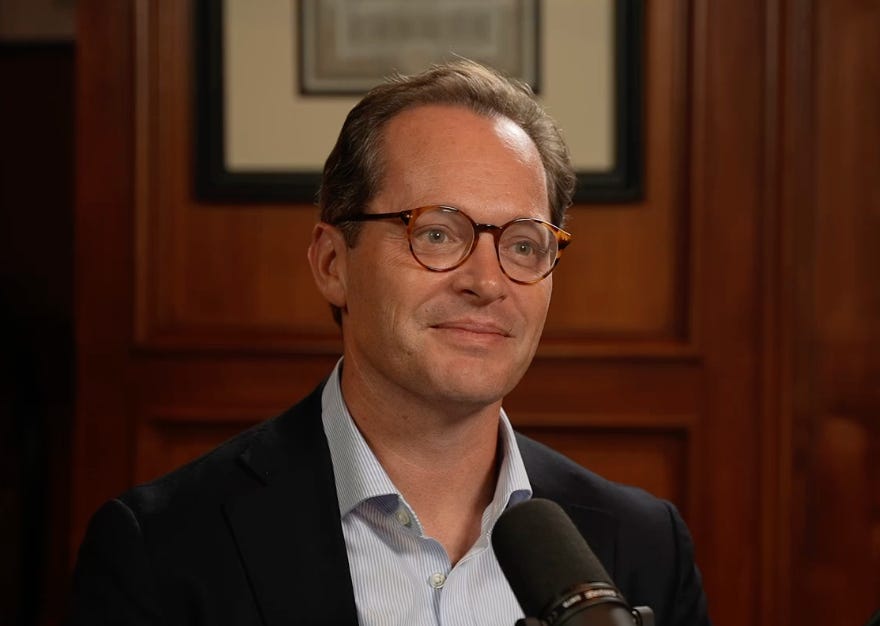
 Joe Lonsdale: American Optimist
15 Oct 2026 · 49m


 Add vo to ChatGPT or Claude to ask about everything you hear
vo listened to this episode to put together the overview and transcript, so there may be the odd mistake.
Eric Glyman (Ramp CEO) explains Ramp’s rapid growth and strategy: sell outcomes, invert incentives to help customers spend less and save time, and use AI to redesign back-office workflows (expenses, invoices, payments) rather than just digitize them. He also discusses AI spend economics, “agentic” inference costs, and Ramp’s Router product to cut inference costs; plus Ramp Economics Lab data on AI adoption and productivity, and Ramp’s use in government procurement/auditable spend.
Eric Glyman, CEO of Ramp (built/sold Paribus; previously Capital One acquisition experience). No other guest is named.
Ramp is a “productivity company that happens to move money.” Typical Ramp customers cut expenses ~7.5%/year (vs ~2% at launch). Ramp manages small teams (8–12) to avoid bureaucracy. AI spend is ~2% of white-collar wages and inference costs rose from ~$30B to ~$150–170B/year. Businesses can cut inference costs ~40% with Router.
Paribus price-drop refunds via Gmail receipt scanning; Capital One incentive misalignment lessons; expense/invoice workflows with many manual steps; Router routing to cheaper AI models; government use cases for auditability and reduced visibility-driven waste/fraud.
0:00There's probably a trillion dollars of work towards jobs that I think are beneath people's potential. About a year ago this time, the entire world was spending on the order of$30 billion a year on inference across the major labs. Today, estimates are something closer to$150 to$170 billion. In other words, the amount spent on AI is equal to about 2 % of all white-collar wages. You are now over$2 billion revenue run rate. It's growing over 100 % per year, growing faster this year than it did last year. You've described Ramp as a productivity company that happens to move money. A typical business running on Ramp is able to cut their expenses by about 7.5 % per year.
0:45I think a lot of companies get stuck in this idea of we're going to go sell you a product. They forget really at best, companies should be selling outcomes.
1:00Eric Blyman is the CEO of Ramp. He has over a$2 billion run rate growing over 100%. One of the top AI teams in the AI world today with over 2 ,000 people. How did he build this business? Let's hear from him about what it means to focus on outcomes, to focus on aligning with your customers and solving your customers' problems instead of trying to sell them stuff. How does Eric run a company with 2 ,000 people with tons of top AI talent? He has these really small teams he manages. Let's hear from him and see what it looks like inside of an AI champion. Eric, thanks for joining. Joe. Couldn't be happier to be here.
1:30It's a ton of fun. Eric, you are, I guess, now over 2 billion revenue run rate. I guess maybe that's secret. You're growing over 100%. You're crushing it. This is an amazing company. Let's go back to the beginning. I think you and Kareem had already built and sold Paribus when you decided to start RAM. What did you do before? What was that company? So Paribus, now the idea is much more popular, but it was a prehistoric AI agent is how I would describe it. The premise was, let's say you bought something online, let's say a TV, and it dropped in price a week after you bought it. Stores, Amazon, Best Buy, whatever, would guarantee that you get the difference in price if you ask them.
2:05So we built an app that would ask for you. You would link it to your Gmail. It would scan your inbox for receipts, structure the data. And if you were eligible, just wrote an email to them. Stores would respond and you'd wake up to the difference and we charge a percentage. What did you learn from that experience? What did you guys learn building that? Well, one, it helps to have a really simple, easy to understand value proposition, stores owe you money, we're going to go get it for you. And having very aligned incentives, that was super helpful. And a lot of the learning truly that picked up and led into ramp happened post acquisition.
2:38So it was a very fast process. We launched in May of 2015, a year later, we had sold. And Capital One, which bought the company and wanted to scale us from a million users to 10x more, put us in the credit card division. When we were there, we really got a deep lesson in how financial institutions work, what make them great and very profitable. But I also got a deep education in incentives and actually how does it affect what people really do? We found an organization that said good things, but somehow people were working to grow the amount that people spent on their cards. Then there was other teams trying to grow margin sometimes it meant to convince people the points were worth a lot and then there was another division that would go devalue the points to try to make more money try to make more money we were in the savings divisions and so we'd call customers and ask them you know and we had to sell cards to we'd ask them like what do you want do you want points cash back something different and if you really listen to people people would say you know i actually just want more of my bank account we're like huh do you really think through that and you help people not spend a hundred dollars and some subscription that they're paying for but forgot about, no longer using, cancel that.
3:51At the end of a month, that's$99 more in their account than if they got like a dollar back on that purchase. And we got obsessed with this idea of like, why isn't there a card or software design help you go and spend less? But I think that financial institutions, a lot of organizations are filled with these misaligned incentives. From the bank that could pay you more interest, maybe they have a higher yielding savings account, but they don't want to tell you about it. you know, loans that could be at lower rates. And I, not only did we learn a lot about incentives, but it led us to really question of what if you tried to create a financial institution, a company that inverted those incentives that actually was aligned with the idea of what if we tried to make our customer better off?
4:33What if we try to be on the team of your customers as much as you really can? Yep. That's exactly right. And so that's where a lot of the idea came from but um we got a lot of education that we also got a lot of education too and what happens in large uh organizations you know they go from these lean mean fighting machine startups that everybody loves to work at to what happens when there's 50 000 people and how do you fight uh really the slowdown and bureaucracy that can go and set in which has helped us become a fast moving company we can get into that too i would love to talk more about that too your ramp is famously one of the best run companies.
5:08You're the CEO. You guys are accelerating, growing faster at scale now at this giant size, which doesn't usually happen in these worlds. But so just step back a little bit. You've described Ramp as a productivity company that happens to move money. I love that because AI productivity, that's like one of our themes we're obsessed with. What does that mean? And how's that philosophy shaping what you're focusing on as well? Take something as simple as an expense report or paying an invoice that you get. right? If you kind of think about it, there's too many steps to all of it. Probably most people listening, if you've ever taken a business trip or taken a client out to dinner, maybe you had a credit card issued by some company, perhaps based in New York.
5:48Your expense policy doesn't drive how the thing actually works. Swipe it, goes through, you get a piece of paper, and then you're supposed to go onto another website, maybe made by a company out in Germany. And you are supposed to manually enter all the details of the transaction that was digital, by the way, in the first place. And you're going to enter all that. Maybe you do it the next day. You probably do it the next month. Then your manager is supposed to look at it a week later. They probably look at it a month later. Then maybe a center of excellence in India reviews all this stuff. Then eventually it gets reconciled.
6:20And a month or two has passed. There's so many unnecessary steps. Paying an invoice. It's not just sending the check. When someone in accounts payable goes and gets this, they have to go and see, do we have a contract with this vendor? Is this really them? Or is this someone trying to pretend that they're them? Did we pay this invoice already? To the descriptors breaking apart, how do we book this and allocate the expense? It can be 50 steps to do any of this stuff. The payments are the easy part. The hard part is actually going and asking, how do you get this done with less bureaucracy, with less time?
6:56And I think that our initial problem we tried to solve is if you could go and help make the company run on less, every dollar go further, every hour go further, you start asking about these different types of steps that banks never really thought to look at. They were in the business of selling money, and we wanted to be looking at how do you go and sell people time. And it turns out AI that can reason can go and not just digitize these process, but well, redesign the process to make it such that you could tap a card and your expense is done. You get an invoice and it's paid correctly on the last day that you owe the actual money.
7:31So you're maximizing your earn and you can just eliminate this bureaucracy in the first place. And so we're really focused on this. I like that. So you got the incentive of your clients at heart. So you want to wait and pay when they have to pay because why not? They aren't getting extra money and you're up. If optimizing that over hundreds of thousands of invoices, that could be a lot of money for a big company. It adds up. And look, when we launched the company with this opposite idea of we're going to help you spend less, we did our very best and we could help the average business cut their expenses by about 2 % per year, which is quite good.
8:03It's pretty significant. Today, a typical business running on ramp is able to cut their expenses by about 7.5 % per year. Wow. And to put it in perspective, the average American business has an 8 % profit margin. It's really significant. And a lot of this is not one weird trick. It's all these little things that steal people's time, the sources of bureaucracy that take out the energy of great businesses. Are you mapping out every single one of these? What does that look like? Do you have a team that's going in and just trying to learn where these things are getting screwed up? Yeah. Yeah. We look both at what are the dollars going in?
8:38What is the company paying for on day to what vendors do they actually keep? What costs can we go and negotiate down? What waste can we eliminate? And so there's a whole side focus just on tracking dollars going out. What spend do we block that was out of policy that would have gone through if not for our technology? There's a whole segment focused on time. We actually go and try to measure clients' calendars. How much time do they actually spend in the app? And unlike social media companies that are incentivized to get you to spend more time looking at the feed longer, we're obsessing over how do we get you out of ramp?
9:12How do we make sure you never have to go and spend time again? I love it. So if you're spending too much time in it, you're going to figure out how to get them back that time, whatever way you can. That's right. Now, could this company have been built before AI? It feels like this is like a company that's like really AI is its core. You guys started it just before a lot of this became possible. So how did that work? Because your mission must have expanded over the last few years. For sure. I mean, I think we're stepping into a future that is, look, it's very exciting. Like when I think about the background of part of what made America great was, you know, we took on manufacturing and we were able to kind of go outbuild and outproduce.
9:45And I think that this machine intelligence is going to allow us to have firms that are radically more competitive. And I think there's a whole host of questions that need to be solved related to this. But, you know, a lot of this spend is going through cards and bill payments today. So we're very attuned to it, but we, we fell into it in a funny way. Our, you know, back to the mission, how people spend less time and money uh we were interested in these very narrow problems of how do we go match an image of a receipt so you don't need to go and be like this receipt goes here or this receipt goes there or you get a you're an accountant and you get a list of 200 transactions you have to go click click this this um uh invoice or or this payment to amazon you know is in supplies which is accounting code you know 60 635 how can you go and have auto complete for that.
10:33And while we were building this, I mean, we just saw so many incredible moments. Like we were one of the first customers to use GPT-3 when it was a research product, you know, months before it. And, you know, I remember it couldn't do arithmetic to now, you know, within the last month, you know, AI is solving math problems that no mathematician alive has ever been able to solve. And so some of this is just feeling the expansion along the way. But, you know, our goal is, I think a lot of companies get stuck in this idea of we're going to go sell you a product, we're going to sell you a card, we're going to sell you a car or a computer, and they forget, you know, really, at best, companies should be selling outcomes.
11:18You know, I'm not interested. It's the Palantir framework as well as the outcomes thing. I think that's a great way to think about it. A hundred percent. Like I, it doesn't, it doesn't make the world better if I can put, you know, sell more credit cards and more wallets or sell more subscriptions. I think it makes the world better when you can actually look someone in the eye and say, like, if you use these products, your business will be better. And if there's other tools you can use that are better than mine, fantastic. But we need to compete by understanding who you are and how do we actually build products in service of that.
11:50And AI was this huge accelerant. So we talk about making the world better. I love that. Let's go back a little further in your background, actually. Where are you from originally? I grew up in Las Vegas. In Las Vegas. And what is there something about your background that gave you values to want to fight for like the right kind of way to do build things versus the wrong things? Like where does this come from? It's a good question. I think some of this, I mean, even before right and wrong, just building things. I think a lot of people grow up in towns that have been established where the people who created things were people you read about in the history books.
12:23Vegas, a hundred years ago, had 500 residents, maybe. It didn't really work until the air conditioner was invented. And I'm in my mid-30s. When I was born there, I think it must have had 400 ,000 or 500 ,000 people. And when I left to go to college, there was almost 2 million. And so my whole childhood was just parts of the city were getting built as you were there. You kind of, you didn't just hear about people whose names on the buildings. You might have, you might know them. You might be able to meet them. And so there was just something to growing up there that I feel really lucky with, which is it did not feel crazy to be a kid who wanted to build things, to wanted to create businesses, to wanted to build.
13:10Um, and I feel really fortunate for that. Um, you know, I think as to doing the right thing, some of this is just maybe how I was raised. Like, you know, um, I think my family always had, uh, tried to emphasize this idea of humility, um, uh, of trying to leave the world, uh, you know, uh, a better place and, and actually working hard, you know, I don't know how long we all have, but hopefully it can be, um, worth it and, and, uh, and meaningful. And so some of it was that too. I think as I eventually got into doing more work for more people, I don't know, it feels better to be able to work super hard, help people.
13:51And it's like actually here, like, you know, see, see people who you worked hard for, like do better and succeed. And so I find it pretty infectious. I love it. I think there is something really nice about the law of the innovation world that is positive somewhere. You're going to be a billionaire anyway at this point with your success, but it's basically more enjoyable. And I think you even do better if you're doing something in a way that's helping everyone else around you, because then they're going to be rooting for you more, right? You know, it's just the history of the world. Like it's never been zero sum, you know, people come up with an idea and everyone gets to be, you know, hopefully a little bit better off and, uh, you can have small conveniences that, uh, help people live a better life.
14:28And if you just keep on doing that, like, you know, you just think about how much the world has advanced from, you know thousands of years ago to hundreds of years ago um where most people were farmers you kind of got by by how much could you lift up or what limited skills you have to you have people flying around and you know tin cylinders through the sky heat up sand and uh you have intelligence amazing what the enlightenment and property rights and systems that work could do for civilization for sure and you know so i want to go back to early ramp again ramp was originally kind of fighting to become the default in the startup ecosystem and there's a company called brexit since sold that was like i think it was before you guys and you ended up taking over from them now of course you're gonna you're powering agriculture manufacturing construction you're getting everywhere else like when you started up in the startup world like what was your focus there and why'd you win i think it came back to incentives at the core of it i think there was good ideas that came out of that that company to be clear but in many ways i think it was a continuation of how financial institutions have been built sign up for a card and we'll give you points and multipliers that if you buy on this category we'll give you 4x points this one 3x points this one too they had figured out a way to reach a new audience but it was still at the core what was best for the business was not best for the customer yeah and i think that with ramp there There was two big things we focused on.
15:55One, we should want the same things that our customers want. We should be happy to make less money in a given month so our customers can be healthier, have stronger balance sheets, and we can grow with them. And so we inverted the incentives to go and help businesses spend less, to do better, and to line our excess with theirs. And so it led us to not just have happier customers who genuinely liked us, but it led us to ask the next right question. Not just what can we sell, but what do our customers want? What will make them better off? And you're expanding, obviously, very quickly today, accelerating at this size, like we said, it's very unusual.
16:36Were you seeing the best opportunities to expand further? What kind of businesses are partnering with you now? One, just the scale of it all is hard to comprehend. I mean, truly, we talked about this. This business is doing multiple billions of dollars a year in revenue. It's growing over 100 % per year. It's growing faster this year than it did last year. And the product maybe ramp classically was most known for of the corporate card world. We're on the order of 3 % of corporate card transactions in the US, which is a really nice way of saying we have 97 % to go. We haven't done much of anything yet.
17:11And by the way, there's more forms of payments. By the way, most businesses are earning almost nothing on their deposits. Most businesses aren't getting paid on time. Collections are a really hard problem and are having to deal with how do I go and adopt AI? And so we're just in the very earliest days of it all. But to give you a sense of the type of customers, we've got really every industry is represented. There's over 85 ,000 businesses that use this from farms to nonprofits, to companies launching rockets into space to manufacturers, to healthcare. I think about from the nonprofits, there's organizations working hard to make sure kids are somewhere safe to go after school, and they're obsessing over this problem.
17:57And yet what drags them down is just the cost of bureaucracy of operating that organization. And so we're focused on helping make sure dollars go to that mission. And we're focused on making dollars go to whatever mission people are working towards. And what are the products you've launched? You're helping people do their accounting versus invoicing and everything else too. And your new one is called Router, I think as well. Is that something you guys have already launched? Yes. Yeah. Well, we should talk about just AI spend in general because it is, in some sense, this unbelievable opportunity.
18:31I'll put it this way. Like, I mean, we've seen just the advancements in intelligence. They're like, these models can be incredibly useful and help people think faster, access skills that they don't have or don't know about to simply do tasks for them, make them more productive. And so there's a huge amount of promise. And yet I think about most of the businesses that I meet and that we serve, most don't have a single software engineer at the company, let alone one going and trying to make their finances better. And so when we're seeing AI usage explode and some companies getting all the benefit, a lot of what we think about is how do we bring this?
19:10How do you partner with these tens of thousands of companies who work with you who might not have the ability to? That's exactly right. And some of this is just simple tools embedded where I'm not trying to sell you AI. It's tap card and your expense does itself. It might be AI in the background that does it for you. It might be you get an invoice and it's paid, it's reconciled. We show you lower costs. We do a lot of the research in the background that you would want. And it's a part of how it works. And so a lot of this is putting in the background. And then next, there are more and more companies starting to buy these services and use them.
19:44And I think this is an unbelievable, but also very hard to manage category of spend. And classically, if you were a small business owner, or if you were a CFO of an organization, you could build infrastructure to manage basically two types of spend. One, the people you hire. Maybe you have frameworks to assess how much they cost, how much are you making, and you can kind of predict those types of costs out. Or the vendors that you're doing work with. You have a contract. People follow the contract. If they go above it, you can decline the spend. it's fairly linear, hard, but fairly linear. With AI, it's quite different in some sense.
20:26One, it's growing very, very quickly. About a year ago this time, the entire world was spending on the order of$30 billion a year on inference across the major labs. Today, estimates are something closer to 150 to 170 billion dollars per year depending on on on how you measure it to put that in perspective i think in the united states there's something like eight trillion dollars a year spent on white collar wages um sort of back office wages in other words we're at about the amount spent on ai is equal to about two percent of all white collar wages and it just went up 5x over the last year and could go up, who knows, but some other multiple again.
21:14And we're a knowledge economy and information ecology. It doesn't strike me as so crazy if you were to say, hey, we spend 10 % of what we bring in on thinking. You might even say, perhaps that's low. And these machines are getting smarter. And so one, it's growing at a rate that other categories have never grown up second most of the spend you know in the industry they call it agentic spend um uh but there's really two types one is maybe what many people are used to you have a chat bot you ask a question there's a cost of that question and it comes back and forth then there's another called agentic where you give it a complicated task and the the model will spin up many agents who perhaps hire other agents who perhaps either other agents to go break up the work and come back to you so that's already 70 to 80 percent of all the spend is that in what it means is that it's growing exponentially most companies don't really have visibility into how to go and manage this and then there's also back to incentives very misaligned incentives i don't i think many of the people at the labs have good incentives but right now they're racing towards building the smartest possible AI possible at almost any cost.
22:31I know they're, they're thinking about safety, but one thing that they're not obsessed with is, well, sometimes there are some models that could answer your question for a dollar. And other times there's models that could go and answer it for a penny. And if you ask the model that costs a dollar for it, it's, they're not going to route you to the penny model. They've no incentive to, They're very compute constrained. And back to what we started Ramp with, we want to help organizations, well, pay the penny instead of paying the dollar. And is this product something a lot of people are adopting already?
23:06It is growing extraordinarily fast. I mean, for businesses that turn it on, it takes under five minutes, really just change out a few lines of code. The average business that turns it on is able to cut their inference costs by 40%. Wow. That's a lot of money. Which is pretty good. It's a lot of money and the product is getting better and better. And so I think that it is a huge opportunity for anyone spending on AI in a real way. Router.com is very valuable and we're trying to do what we did for spend in general to spend on AI. So let's talk a little bit about your team and AI and your engineering team.
23:45A lot of people say that it ramps one of the very strongest AI teams in the country. Some people have told me it's the strongest AI team in New York for what that's worth. You obviously have attracted a lot of really great talent. First of all, how do you get all the really great talent? And then second of all, how do you keep a culture where they're all together? Because right now everyone's trying to hire everyone in AI. How are you maintaining that culture? What are you doing to keep these people coming there? Past a certain point, I think great people just want to work with really great people.
24:11And so what we started the company with was trying to ask the question of like, who are, how could we find and assemble a group of people where every next hire is better than the last one? And the people that are there are worth trying to work with. And so this was back in 2019, you know, we were, you know, to give you a feel for some of the first people, like one, um, he was in competitive math and computer science competitions, uh, graduated from MIT in two and a half years. Um, and, um, was absolutely brilliant. Joined before his 21st birthday to, you know, but Viral, Viral now is leading the router product.
24:49he started an app that if you have an iPhone, there's an app called shortcuts on your phone. And well, he created that when he was 14 years old. And so we were just trying to find extraordinary people who had shown signs of ability to work very hard to achieve something that was unusual early on and bring them in. And so the next person looking at our website would say, these people look really good. I actually want to work with them and learn. And, And I think great people often walk out of the building of companies or take the next offer when they feel that it's just too hard to do good work.
25:25There's too much bureaucracy. It's too hard to go from proposing an idea to you've actually built it. So how do you keep out the bureaucracy? Because everyone can say this, but then you have to have some kind of process at a big firm because you're now an owner of a firm that's worth tens of billions of dollars with your co-founders. And you don't just want someone to go in and do something out of a data and blow it up. So how do you have a process, but then keep it going fast? So some of this is like, how do you design the organization? Is it flat or not? Is there accessibility? Can people actually meet me?
25:56Do they actually meet me or Kareem? And how far is that to, you actually try to inspect how easy is it to go, you know, to buy something, to ship something. And so maybe on each one, one of the best ways to take a small, productive, awesome, fun team that's getting it done and make them unproductive is just like, just hire 20, 30 people and say, go agree on this. You know, happens all the time in companies. Too big of a group are not all going to align. So it's just going to take a long, longer to get things done. 100%. And so one of the practices we still maintain, and I think people are often shocked by it, is like, you know, once a team gets to, you know, 8, 12 people, we break it up.
26:43Small teams where you clearly have an area of ownership. You can live or die by the decisions you make, but we have lots of small teams working on different problems and takes work to go and manage that. But it allows people to go and to make decisions, understand what they're optimizing for and own it. I mean, if the teams fail, then the leader fails and doesn't get to run a team or something like that. Sure. Yeah, but there's an objective function. You can go and measure and say, this is what we aligned on that we can go measure. And then we can try to break apart why. Fix it. Exactly the wrong goal.
27:15Access, I think, is very important, too. Like I still, to this day, we're coming up on 2 ,000 people to firms before any offer goes out. Kareem reviews the profile. Colin reviews the profile. I review the profile. Uh, and so in, in some sense, one, I can look someone in the eye the first week when I meet them and say, you're here because I wanted you here. Um, two, other people can understand what we're looking for. And three, I do meet people in the first week. Um, you know, every single person. Um, and I think why does it feel different to people and that they can move fast is, uh, we met, we spent time, they get to ask me questions.
27:50We've worked on things a bit together. And so the next first time they encounter a real problem, it doesn't feel so strange to come to a leader or the company and say, like, we need to fix this. We need to make this better. So we have a lot of CEOs who listen to the show and ask a couple more questions along these lines. So for these small teams, so they like make a deck about what they're going to do. They have metrics ahead of time. Like, how do you manage them? Like a startup or like, and then do you have people who are managing multiple of these teams for you above those people or how does that work?
28:19Because if you have 2000 people or whatnot, that'd be a lot of small teams right now. It's a lot of small teams. So tell us more. So one, there's different phases. Well, there's different, maybe to simplify the framework, there's some organizations that are focused on building things. And there's some which are focused on like selling and sort of running the playbook. And there's slightly different strategies they take for each. I still adhere to the philosophy of like small teams. You can have larger organizations, but very small teams. um inside of the builder organizations you get these sub questions of all right we've got lots of people i think the majority of our um research and development teams engineers designers um product managers are working on products that have not yet been released they are gold on something closer to finding product market fit understanding what are problems that people have orienting and trying to understand a problem deeply to starting to go and develop something that people actually use, get value of, would want to use and starting to show these signs of people use it, they would actually be terribly sad if the product were to go away.
29:32And you could start to go and tell, find more customers like this who would go and try to adopt it. And so a lot of that is more oriented of like put a bunch of people in a room, give them some goals, leave them alone, you know, for a year. So it's like having dozens of startups, basically within the company. That's right. And as you get through certain gates, you can go and allocate more resources. You can share it with more people, but there's a certain practice around actually finding product market fit, which is more around utility co-building with customers and starting to see more usage metrics.
30:05Later, when you've gone from this zero to one, you know, and you have to go from, there's people who like it to how do we go from one to 10 and start to scale it, it becomes much more oriented around scaling. There's both metrics of growth of the product. Maybe there's a single metric. We're trying to grow 10 % per week or 20 % per month, whatever it is. And you could pick, is it purchase volume on it? Is it funds under management? Maybe it's time saved. It depends. Receipts automated. It depends where you are in this. And you also pick some counter metrics as well. You want to be looking at, you can keep building new products that do this but if user satisfaction drops below a certain level uh if the lag and suddenly everything gets slow the load uh you cannot build new things until you fix this and so it keeps people kind of oriented on it and then once you've set this output metrics what we engage in doing very heavily is looking at inputs um what are the activities that lead um to better outcomes for engineers it's like how many things did we chip how many customers did we talk to um you know for sales development people it's similar it's like actually like the way you you train to win a super bowl um you know is not by showing up for practice and you say like you know okay team we're gonna go practice to win the super bowl today like no one has any idea and yet people in business do this all the time they're like you have to grow revenue by 30 percent instead what you actually orient people on is like today we're gonna lift weights tomorrow we're gonna run sprints the next day we're gonna go run this play over and all the submetrics and goals for each part.
31:38That's right. And so a lot more of the one to 10, 10 to a hundred kind of goals are really oriented around understanding what inputs lead to the outputs and how do we get better at running these plays. And so, and also maybe just as a meta point, actually breaking things down, make the problems become more tractable. Sometimes when you get these really large organizations, not only is it not clear who's making decisions, but you can miss actually in the details, there's all these interesting sub questions of how should you organize? What should you build? Where is the bottleneck? And so kind of at every level, we prefer small teams.
32:15And I think that works well, as long as you have really good telemetry, so you can identify problems where you're not in the room and see things. And then two, I think that a lot that becomes very important there is just review, like reducing overhead costs, coordination costs become even more important. And I think AI is, I think one of the best opportunities ever, not just for small, but frankly, I think if large companies get their act together, this might be the best thing to ever happen to them. The coast coordination costs. It's interesting on these things. Totally. It's a formula, right?
32:50Totally. We study these things. So let's step back. A couple of other points I want to hit while we have you. Ramp is a real-time map of the American economy. I think it's super interesting. You guys actually have an economics function based on this. It's called Ramp Economics Lab. Tell us about this. Well, anyone can see this. It's ramp.com slash data. This came together because look, if you step back, consumers actually, there's like a lot of data to understand things, right? You can go to Amazon or Google and you can search prices for almost anything in the world. You can compare Uber versus Lyft.
33:23You can go on Zillow and even get a real-time estimate of what is your home cost? And for most businesses, they're flying blind. They don't know what the startup down the street paid for Salesforce or what discount they've negotiated with these labs. And we said, what if you could actually arm the rebels a little bit? What if you can actually go and share some of this aggregate information so a regular business can say, how is my price on this random piece of software compared to the rest? I love it. So you're learning from the economy, but you're also measuring things. For example, our friend Kevin Warsh is a chairman of the Federal Reserve.
33:55He has a lot of people who work from there. He's going to try to measure productivity. It's obviously critical for the economy, but you guys are able to see productivity in different ways too. What are you learning about productivity in AI? So we have one of the most interesting data sets, I think, out there in part because one of the backbones of the American economy is what's happening in small, midsize and scaled businesses. And often it takes a long time for whether it's the Federal Reserve or the Bureau of Labor statistics to actually get stats. And often what they're doing is trying to go and maybe you'll ask people a question.
34:28So for example, if you were to look a year and a half ago, there were stats coming out from, I believe it was the census asking about AI adoption. And they would ask people, you know, do you use AI, do you pay for AI in your business? And I think early last year, about 5 % of businesses, according to their data said that they did. And I think today those stats are closer to 20%, something like that. We have data to go and look and see who actually pays for it. Who's paying for OpenAI? Who's paying for Anthropic? Is it one license? Is it lots of licenses? Which model? How deep is that usage? How does that level of intensity and spend go?
35:12And so one, it turns out we were able to get a much higher fidelity view into about 1 % of all corporate payments today are flowing through RAMP. And so you can actually really understand in depth that statistical significance, who's spending on what and actually how is adoption, by the way, it turns out that adoption is a lot higher. I always wonder why like JP Morgan Chase with their Chase cards, or because this is like before you existed, didn't just run like a long, short hedge fund or something. Is that legal? Are they allowed to do that? Are you allowed to do that? It's like, we're not supposed to do that.
35:43How does that work? It's, it's an interesting, I can't say the thought about it too deeply. you know we'll try to get deeper what would i say i think there are interesting areas where it can break like i remember reading this case like it happened at capital one where there were some analysts trading on uh chipotle data credit card data the inside information probably you probably shouldn't do that i think they went to jail but i don't know if they went to jail for trading on it or if it was because they had like signed contracts saying they wouldn't Um, so it's always unclear, you know, back in the day, back when Reed Hoffman and Peter Taylor were friends, like 2004 or so, I was working with Peter, uh, we were kind of getting pounder started by solving with a hedge fund and Reed gave like us like a feed to LinkedIn.
36:30And, and, and, and I don't remember if we traded on it or not, but we definitely built a back test strategy using just even the data at that time was very clear. It was very profitable. Yeah. If you had a date, I know he turned it off at some point, so I don't know if anyone ever made any money on it, but it's interesting to me on these things, I guess, but, but I I guess you're educating people, you're helping people, you're not as focused on monetizing it. What I tell you is like, we do not sell any of this data. And that's been super important is because like part of our, like at the end of the day, we're selling like that you can, right?
36:59You can trust us to help you run a better business that we're going to do right by your information. And frankly, we're doing it to help you. So when we put data out, it is published at the same time for everybody to go look at, to see and understand. And frankly, we're trying to democratize just as, you know, I think the costs of consumer goods have gone down once people have better information. I think Amazon's been an amazing, Walmart been an amazing force for that. Home tradings have gotten more efficient with Zillow. I think we want to do this for business data and help people understand what's happening in AI.
37:31You know, and as for things you can do with it, like you're totally right. I think one of the subtle ways people don't think about is part of why accounting is so much easier for clients running on Ramp is it might be your first time reconciling a particular vendor. It might be your 100 millionth time reconciling that particular vendor. And so when the next person goes and joins Ramp, well, their books are even more complete in an automated way and more accurate. it's like well that's interesting because you use in the old days you'd have like double bookkeeping where you do both sides but now it's like a triple bookkeeping thing i guess too where you can probably automatically figure something out although would there be issues there with fraud or with like stopping fraud i guess too because if one side is keeping books differently i guess it's not your job to look for those things because right because because you'd be like what's one of one side saying they're making this much money the other side's saying they're not paying it and you're in both like are you is that something you flag well i I think a lot of, there's this question of like, where does accounting fraud arise from?
38:26And I think a lot of it arises from a lack of fidelity in data where you can actually have these journal entries. Yeah. So it's harder to do that if the data is clearly like, wait a second, that's not what the data says. Yeah. A hundred percent. And if you actually can go down to like, who approved this? What department? What location? It makes fraud a lot harder. So if someone's using you guys, it just really is a lot harder. That makes sense. That's a positive outcome as well. I think most people don't want fraud in their business. That's very good. Speaking of fraud in business, I want to ask you about government.
38:59Yes. I know this is a nonpartisan company that does things for everyone, as it should. And the government manages trillions of dollars. Some of us believe there may be a lot of fraud there. I don't know. It's a big debate. But could Ramp help modernize government procurement? Could it make government more efficient? Is it doing any of these things? Yes. There are thousands of cities, of states, tourism boards, power authorities, folks around the countries that are using RAMP to run better organizations, institutions, reduce their spend, make it easier to audit. So it's like government. Yes. I love it.
39:38And it wasn't something we had started and intended, but the scale of it is immense. I think it's something like one in six Americans who work, work for the government. You know, it could be teachers, could be policemen and women, firemen and women. Like there's a lot of facets to it, but it sort of found us as we were scaling. And when I think about whether it's waste or fraud or any of it, a lot of it starts from a lack of visibility. You know, people, you know, good intentions, I think, but only have a piece of the puzzle and, you know, are asked to do horribly bureaucratic things. You have one system for cards, another for expenses, another for audit, another for reconciliation, another for payment.
40:21It's just a super mess. And part of, I think, why we help is you just bring all these silly tools under one roof and you get the whole picture. And then you can start to go and ask the more interesting question of like, should there really be anybody whose full-time job is to go and take receipts and attach it to a transaction? or should that just be a machine? You know, you've got all these people, like, I think, like, like, what a shame you have people who are like trained in finance and accounting can do deep levels of math are interested in these deep questions of how do we allocate capital?
40:57How do we go and make the city better? Um, you know, how do we put funds in the right places instead? They've been reduced to, I don't know. Um, I, I don't want to say like, like a, some form of a weird receipt bean counter. And like, for me, I think about this problem is like the trillion dollar back office. Like there's probably like a trillion dollars of work towards jobs that I think are beneath people's potential. Yeah. I love you to describe that. What AI is doing in this case is it's elevating them from a bean counter to someone who's making more high level decisions, who's using concepts to do their job as opposed to just like filling out something that's wasted their time.
41:41Why do people associate waste or frauds with government? And I think some of this is like the organizations are really big. It's very, the coordination costs, the, you know, um, co-stherem of, of these large organizations is simply they're very large and the cost of business is high. And I think that the immense potential of, of AI and tools like ramp, um, that make it easy to get visibility and to take action and do the right things is the coordination cost goes down. And I think that for organizations willing to redesign and say, you know, actually, how do I go and repurpose people instead of from the slow value work to things that are more interesting?
42:20I think there's so much that can be built and unlocked from small, from, you know, actually get people out in the field, actually doing better work and more interesting types of service. So speaking of potential waste, fraud, and bean counters and lack of visibility, one day I hope you guys go into the Pentagon. And because we haven't been able to audit the Pentagon in decades successfully, which is ridiculous to me. So if they ever put me in charge of it, I'll first have to divest, unfortunately, from any shares I own in your company. And then I'm going to insist you come in and fix it. I mean, this is crazy.
42:49They haven't fixed this stuff yet. It is. And the scale of it isn't, I mean, this is all public record. I think the Department of Defense spends on the order of$10 to$12 billion a year just on cards a lot more in procurement i think i think you're right it's something like five or six of the past audits have been failed um which i don't think any private business could do that all right let's well let's add the pentagon there should be something that like every political side wants to do except for maybe the political side that's like making money off that maybe there's some part of some both sides that are bad and part of both sides that are good right so we got to got to go in and fix that i think so uh so speaking of elevating people's jobs i want to ask this we You started this show to push back against nihilism and cynicism and blackpilling.
43:32This is American optimists. I'm very optimistic about the future. It sounds like you're very optimistic about where I was taking people to. What gives you optimism from what you're seeing at RAMP, what you're seeing with AI? What makes you feel good about where America's going? I just think a little bit about... Recently, I was trying to go and spend some time learning about grandparents, great-grandparents, more history. And if you go far enough back and you can really trace it, probably for most people listening to the show, like a great, great, great, great grandparent, what did they do? They probably were a farmer.
44:03You know, half the people, I think, in the 1900 census or 40 percent something worked in agriculture, really low level work. And, you know, I was going through the thought experiment of like, could I explain what is it that we're doing with our life or our day? Like, I think even, you know, we were kind of touching on this a little bit, but like, imagine that conversation is like, well, I'm going to go and get in a metal tube, go underground, go uptown. And someone else who was in a metal tube from across the country flew here and we're going to go have a conversation. And then we're going to go back.
44:38And once we're done, we're going to go in front of this thing. There used to be sand. Then we made it really hot. And then we put some electricity. I'll explain what that is soon to you. And then we see some images and we think, and then we go home. It's crazy, like just the change. And this is not that far back of how different lives are and how much poverty has been eliminated, how much longer and healthier lives people actually lived, how much more entertained, fulfilled. Like it's amazing. I think the changes that have occurred and not that far, and that's a few hundred years. And a lot of this is, you know, industrial revolution, computer revolution, all that.
45:17I think about AI, it's really hard to contemplate and it's sometimes hard for people not deep in it to relate. But, you know, we use these systems four years ago. And as we touched on it, like GPT-3 could not do arithmetic. If you asked it how many R's are in strawberry, it would get it wrong consistently, you know, and, and, and what is it really mean that in a four-year time period, you have computers that can do math, which again, is much more of a reduced search space and maybe different than our type of task. But within four years, it can solve math problems that no human over the past 200 years was able to solve despite people working on this.
45:59This is amazing. This is unfathomable in many ways. And I think about, you know, there's still so much like human misery in this world. Like, I think that there's so many diseases that people die from, or there is no cure. There's still so many people who die from car accidents, from things that could be solved. And I think that if you can go and use these advancements to, you know, of course, not just make businesses more productive and have more resources, but actually try to go solve some of these diseases, to actually go and work on more hard problems. It's hard for me to imagine that the world doesn't get a lot, at minimum, more interesting, but hopefully a lot better.
46:51Like there's these questions of like, are we ready for it? What is it like when, I think part of, I think an under-discussed part of why it's a little bit strange and scary if you're working at an AI lab is in that four-year period of a time, you go from machines that maybe have the IQ of a small animal to something, I guess, in certain tasks beyond what researchers could do. Um, uh, and so I think it's hard to kind of think about, you know, um, this identity you had as a researcher or if you were kind of, uh, maybe our, our ancestors a long time ago, they got by because they could lift heavy things or, you know, um, exactly.
47:37That was the thing to, in the last hundred years, you know, you had your big brain and, uh, you were smart. I'm still mostly lifting heavy things over here. That's right. You look strong, Joe. Better than ever. But no, it's there is this identity thing where there's a lot of people working on this stuff where their whole identity was they were the smart one. And that was special. And that was how they got ahead. And if they're successful, being the smart one won't be special. Actually, intelligence will be free. So there's these interesting questions of how do people cope with that? But at the same time, when you kind of look at what most people in the world are solving for of like being able to have good nutrition, shelter, spend times with friends, to see more of the world, to live a better life, to enjoy abundance.
48:27I think AI can be an incredible tool to achieve all of these things. Awesome. Well, you're definitely teaching a lot of us, Eric, just watching you how to achieve outcomes, how to raise productivity. If we do achieve too many positive outcomes and we all have to have existential crises about who we are, that will be a new challenge for us. But I think this is a very positive direction we're going. So thank you very much. I think so too. Thanks, Joe.
Eric Glyman is the co-founder and CEO of Ramp, the finance platform doing over two billion in annual revenue and growing over 100 percent year per year. How did a company built on the promise of helping customers spend less become one of the fastest-growing AI businesses? What’s Eric’s unique approach to managing small teams of exceptional talent? And what does Ramp’s view into corporate spend reveal about AI adoption and where the economy is headed?
Before Ramp, Eric and co-founder Karim Atiyeh built Paribus, a “prehistoric AI agent” that scanned inboxes and secured price-drop refunds on customers’ behalf. Capital One acquired it a year after launch, and the two spent their time inside the bank studying how misaligned incentives shape what financial institutions actually do. In 2020, they launched Ramp and quickly became the fastest-growing corporate card and expense management platform.
We begin our conversation with the origins of Ramp, specifically how learnings from Paribus and operating inside a big bank revealed new possibilities. Eric explains why Ramp is a “productivity company that happens to move money” and how its obsession with outcomes, rather than selling products, drives its meteoric growth. Next, Eric explains the small-team philosophy behind Ramp’s speed, and why he takes the unusual step of breaking up teams after they reach a certain size. Then, we get a look inside the U.S. economy via Ramp’s unique insights into corporate expenses. For example, Eric explains that AI inference spend has grown five-fold in the past few years but still only amounts to two percent of all white-collar wages. After seeing the surge in inference costs, Ramp launched Router, which dramatically reduces customer inference costs — an example of prioritizing outcomes and operating at a speed that competitors can’t match. Finally, we talk about the impact of AI on white-collar work, and what it would look like to apply Ramp’s transparency and cost savings to the federal government.
(00:00) Episode intro
(01:45) $2B in annual revenue; origins of Ramp
(05:20) "A productivity company that happens to move money"
(09:30) Could Ramp have been built before AI?
(11:15) Selling outcomes vs selling products
(15:10) Why Ramp beat Brex
(17:00) 3% of corporate cards, 97% to go
(20:00) AI spend is 2% of all white-collar wages
(22:45) How Router saves businesses 40% on AI spend
(24:00) Eric's small team philosophy and how to kill bureaucracy
(33:00) How Ramp maps the US economy
(39:10) Can Ramp modernize government spend? Audit the Pentagon?
(44:30) Future of work / optimism for the future


Scan the code with your iPhone camera
Listen in the app.