Ask ChatGPT

 Joe Lonsdale: American Optimist
2 Oct 2026 · 58m · 28 chapters
Anthropic insiders discuss why they expect AGI-like models (as capable as all humans) within a couple of years, how RL and agentic coding are accelerating, and the tradeoffs between optimism (post-scarcity potential) and near-term risks (unemployment, bio/cyber dual-use, regulatory design, and open-source/open-weights dynamics).
Sholto Douglas and Nicholas Marwell, key technical leaders at Anthropic. Douglas grew up in Sydney, studied robotics, worked at DeepMind for two years, and joined Anthropic ~18 months before the episode. Marwell is from San Francisco, previously worked on AI safety while at Thrive Capital (resident), and joined Anthropic ~3 years ago; he leads reinforcement learning science.
marginal intelligence gains can compound exponentially; models are shifting from “tool” to “junior team member” that can work independently for days; math evals rose from ~0% to 40–60% over the past year; biology is the biggest near-term impact area, but lab infrastructure in the US lags China; cyber may become defense-dominant within two years if everyone can preemptively harden systems.
“frontier math” improvements; agentic coding reducing manual coding; “Fable”/“Mythos” rollout with government; distillation as a cat-and-mouse that commoditizes copies; open-weights pushed by major firms (Nvidia/Amazon/Microsoft) and well-funded public labs.
Written by AI. May contain mistakes.
Explore the potential and risks of AI and its impact on humanity.
“Models which are as or more capable than all humans are very likely to occur in the next couple of years.”
Discover the backgrounds and experiences of Sholto and Nick.
“Really excited to have today two amazing talents from Anthropics.”
Learn about the innovations and projects at the cutting edge of AI.
“You guys don't release numbers officially, but lots of stuff leaks.”
Understand how programming with AI has transformed in recent years.
“Is there any high level you could tell us?”
Explore Anthropic's mission towards achieving AGI and its societal implications.
“I think you're right in the core of like the fastest growing company.”
Discuss metrics for evaluating the rapid progress of AI models.
“Well, the mission from here is always we think that AGI is achievable in the next couple of years.”
Examine the varying advancements in AI capabilities across domains.
“the fact that you could just use the AI as opposed, you know, there's a junior employee.”
Identify key areas where AI can make a significant impact.
“and you asked them to like make intelligence.”
Exploring the transformative potential of AI in advancing biological sciences.
“Are there categories or areas of things we should be having this intelligence do that we're not yet?”
Advice on navigating career opportunities in the evolving landscape of AI.
“You're not in the middle of Silicon Valley.”
Addressing societal anxieties regarding AI advancements and their implications.
“But I think a lot of the rest of the country, uh, there feel like there's threats to their business, threats to their livelihood.”
Discussing the shifting dynamics between offensive and defensive strategies in AI security.
“Because you can preemptively try and hack yourselves, build up the defenses, patch all the vulnerabilities, and then eventually we'll end up in a much more cyber secure world.”
Examining the narrative of regulatory capture in AI and Anthropic's approach.
“A lot of my very smart friends have impression that there's some kind of regulatory capture strategy in ThoughtWorks trying to do this not a good thing and it's a bad thing.”
Learn about Anthropic's strategic decision to partner with the government for technology deployment.
“And this was just a decidedly bad economic decision for the company, but one that was aligned with our values about how we think models should be deployed and regulated.”
Explore the challenges of engaging with government regulators in the tech industry.
“I think that they are leaning into the classic American public-private partnership that has been such an important part.”
Discuss the balance between promoting open source and ensuring safety in AI models.
“So far, we've slowed ourselves down much more than anyone else.”
Understand the implications of AI regulation in the context of global competition, particularly with China.
“You know, if a model can do cyber attacks, what threshold of capability are you comfortable with?”
Examine the issues surrounding model distillation and its impacts on AI development.
“This is going to make a lot of people very uncomfortable and for many different reasons, for buyer, for cyber, for employment.”
Learn about the importance of protecting intellectual property to drive investment in AI.
“On the one hand, distillation, there's a couple of things to talk about here.”
Explore how innovations in AI lead to decreasing costs and democratization of technology.
“Like we get more drug development in the US as a result of protecting IP for people who invest in it.”
Understand the economic potential and transformative effects of AI advancements.
“There's one on artificial analysis that shows this exact trend line.”
Discuss the potential for a future where AI leads to unprecedented abundance and equality.
“There's a huge amount more value at the leading edge.”
Delve into the socio-political questions surrounding the distribution of wealth in an AI-driven future.
“And if Anthropik is driving that forward, that's obviously worth trillions of dollars.”
Exploring the importance of work and the potential of AI to enhance productivity and GDP.
“Because the dignity of work right now is really important.”
Discussing the balance between AI's benefits and its potential disruptions to society and employment.
“But at some point, our belief is that we're going to go from a world where you need a human paired with an AI model to sort of get all the value out of it to a world where you don't.”
Examining the implications of AI on education and the importance of intellectual pursuits.
“There's, there's virtues, there's families, there's, there's like traditional values, which a lot of people like base their lives on.”
Speculating on the future of AI and robotics by 2028 and the factors influencing rapid advancements.
“I think that one thing that many people in AI believe that I actually think they get wrong is that AI is just going to fix education.”
Explore how data scaling impacts AI capabilities and the potential future of AI in solving complex human problems.
“that makes everything go a few years faster.”

Get the gist, explore an idea or ask about something said.
 Claude
On Joe Lonsdale: American Optimist, what are the key points of this episode?
Searching your listeningAutomatic transcript. May contain errors.
0:00Models which are as or more capable than all humans are very likely to occur in the next couple of years. Each marginal unit of intelligence is worth exponentially more than the unit that came before. You can keep increasing and potentially doubling the productive intellectual and physical capacity of humanity in such a way that allows you to truly get to a post-scarsity world. You guys are the edge of the AI frontier. One of the most exciting things you're working on. AI is going to be the most important technology in the life sciences, certainly of our lifetime and maybe ever. but it also comes with massive risks.
0:31We shouldn't be releasing these technologies into the world before we can keep the bad actors from doing a lot of that. Tech leaders I know who are more skeptical, who are saying, oh, well, Dario is trying to scare everyone to create more rules, to slow things down. So far, we've slowed ourselves down much more than anyone else. Is there any scenario you'd slow America and let China go ahead?
1:00Nick Marwell and Sholto Douglas are key technical leaders at Anthropic, the fastest growing AI company in the world. They're both very optimistic about the future, despite some really serious threats we're facing as a civilization. What are these threats? How do we think about offensive versus defensive dynamics in bio, in cyber, in other key areas? Some people are pretty angry at Anthropic. For regulatory capture, what is their view on this? What is Anthropic trying to do? What do they think of the battles with distillation in China? If everyone's able to copy their models, how is Anthropics still going to be worth trillions of dollars and why?
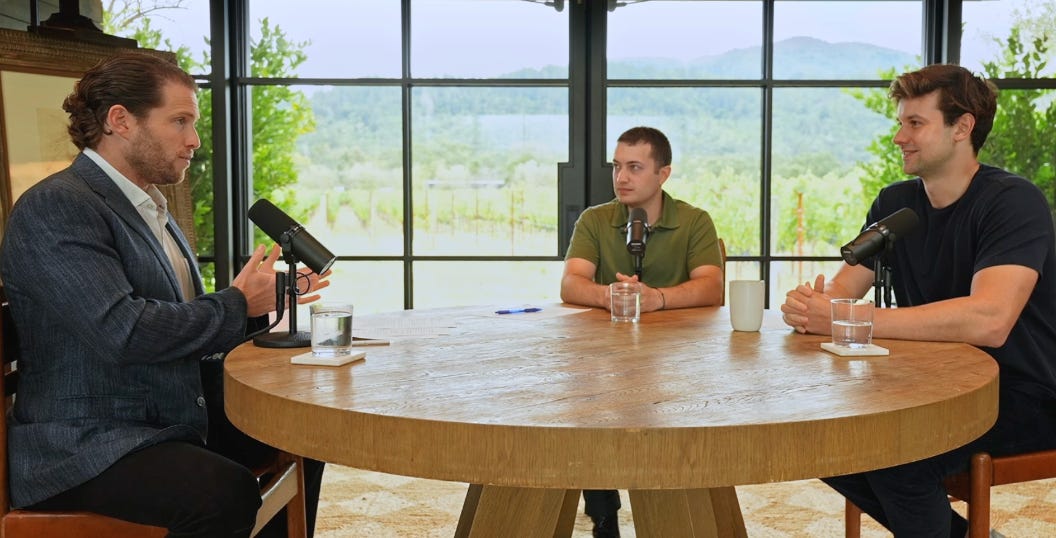
1:32If you're a young person in the workforce, if you're trying to build your career, but you're not in the center of AI, what should you be doing for the next 10 years? An optimistic insider's view on one of the fastest moving companies in the world at a fascinating time. Excited for you to hear from them. Welcome to American Optimist. Really excited to have today two amazing talents from Anthropics. Nick, you're the key member of the technical staff, helped lead RL Science, reinforcement learning science. and Schulte Douglas. Also, your tech lead in reinforcement learning. Is that right? Yep. And how long have you guys been in Anthropic?
2:02Just over three years for me. The company's only, how old though? It's... Five years or so. Yeah. So it's amazing. It's like one of the most important, biggest companies, fastest growing companies now in the world. And it's only been around for five years. So this is a heady time here in California. We're filming here in Napa today. Thanks for being here, guys. Thank you for inviting us. It's going to be fun. Thanks for having us. Let's start with your backgrounds. So where'd you grow up, Schulte? Where are you from? I grew up in Sydney. I got very convinced that scaling and in general, we were on track to get AGI in the 2020s, in about 2020, reading a mixture of blog posts and papers.
2:37And I worked very hard on nights and weekends to prove that I could do the work with a quality bar that was demanded by DeepMind and Anthropik and OpenAI and these kind of companies. Had you studied computer science? I studied robotics in undergrad. So I graduated in 2019. And then I was doing my own research, basically. Ended up working for DeepMind for two years and at Anthropics for the last 18 months. Awesome. And Nick, where are you from? Yeah, I'm actually from San Francisco originally, which is rare nowadays, I suppose, in folks in AI. I grew up in a household with a father in particular who had spent the first half of his career doing very traditional business things.
3:18And then had found this interesting path in the latter half of his life and my more formative years where he had gone and spent his time trying to figure out how to give back. And in particular, figuring out how to leverage technology to give back. and I think a lot of sort of as I was thinking about what I wanted to do I was looking for things that sort of let me get this experience of sort of both at the same time building the skills to sort of become an effective sort of like capitalist or whatever you want to call it and also to use this to be able to sort of make social good. I think Anthropic was sort of this very perfect coincidence where I was getting very concerned about AI safety.
4:01I was actually a resident working on a very different company at Thrive Capital at the time. And it was just one of these things where it sort of came out of nowhere. And I was like, I think this is the thing for me to go do. Amazing. Well, since you guys are joining Anthropic, I think it has become the biggest of the AI companies. You guys don't release numbers officially, but lots of stuff leaks. The stuff that leaks just for the audience, it says it's here in August of 2026. I keep my face very still. Very still. Very still. No reactions. You know, it's like you're supposed to be doing over$80 billion of run rate and growing really fast ahead of OpenAI, ahead of everyone.
4:36You guys are the edge of the AI frontier. What are the most exciting things you're working on internally right now that you can tell us about? What's it like to be at that cutting edge? Well, I think what I can talk about a lot is how the experience of programming has changed. Because I think this is the most visceral way that we felt progress. And 18 months ago, I was typing all of my lines of code by hand, basically. then you know a few months into anthropic i was guiding a model i was intervening every few minutes i'd say what i wanted to do write the next function on this kind of thing but i'd have to check in and every few minutes because it would do it would make mistakes it would go off course and this kind of thing and where we're at now is i can ask models to do a day or two days of work independently and drive progress basically like a junior team member and that's just over the last 18 months, we've gone from what is really very much a tool where you have to stay in the loop to something that feels very much like a junior team member.
5:29So as we're talking right now, the junior team members, the AI is working hard for you. Yeah, yeah, they are. There's a bunch of them working hard right now. What kind of stuff are they working on that you could say? Is there any high level you could tell us? Just a bunch of RL science stuff with some of Nick's team members. Awesome. I'll give a slightly different answer here. So I think a lot of sort of model development up to this point has really been about getting models to be able to do tasks that humans are actually already quite good and capable at. And really what we're trying to do is, you know, capabilities that bring lots of additional leverage to things humans were sort of already cognitively capable of achieving, right?
6:06Building a piece of software that like a team of human developers could also have built in the same period of time. I think what you're starting to see now, and I think some of the most recent sort of results in math, for example, are a good example of this, is people trying to figure out how to use models to push past sort of the frontier of human intelligence and human achievement. This is like some of the recent math things. Yeah, there have been like a lot of new math proofs that have come out that are sort of things humans have been interested in for a long time and sort of never been able to solve.
6:37Some of those, it just seemed like a really smart mathematician realized that the computer is good enough to brute force something that every person couldn't have brute forces you see i'm saying like there's some of them still seem like they're like good at specific things that humans are using or is it really like a whole new theory that they're getting at or how do you think about that i think it it is not sort of uh at least yet some some idea where like they're they're coming up with ideas that humans would have been incapable of coming up with but i actually think very little progress or intellectual achievement ever looks like this in many ways i think you know, there are of course exceptions, but I think most of the things that society has achieved are really just about sort of connecting the dots and building upon the prior intellectual achievements of things that came before.
7:19And I think that what you're seeing when you describe something like putting two ideas that different people had together to find something new, this is the foundation of like what humans do. And it's sort of the important thing that's different now is it's really putting together sort of new ideas, or sorry, forming new ideas from combining other human ideas that weren't happening before. Whereas I don't think writing another web app was actually some new intellectual achievement for humanity. And so we've never seen companies scale this fast in Silicon Valley. I think, again, not to... It's 10x, 10x, 10x.
7:54The topic's growing really fast, obviously. We had another company here in Napa last night that I'm on the board of staying over. And it's like it's a new company every 60 to 90 days. There's so much happening, right? And I think this is the experience of a lot of us. I think you're right in the core of like the fastest growing company. Like what's it, what's it like versus like your life before, like, where do we go from here? Is it going to keep accelerating? How do we think about this? I think one thing that's been really nice about Anthropik has been that our ambitions are, have been able to scale now with the, with the acceleration of the company.
8:25You know, it really felt like 18 months ago, we had to be so insanely focused on code and really like proving out that we could be the best in the world or something. And now the mission of the company is so much grander than make good models that are going to code. And as the company has scaled, as the revenue has scaled, it's let us really start putting together the pieces to start pushing on more of that. Let's talk more about that mission. I was with another friend who's senior in AI earlier this week. And I understand he was saying how at first you had to be the very best at code and math.
9:00But then there's going to be new things that's going to be the very best at. There's going to be all these other human skills you can get to be A++. Is that the idea, is bringing in a bunch of new skills? What's the mission from here? Well, the mission from here is always we think that AGI is achievable in the next couple of years. Explain to our audience what you mean by that. So we think that models which are as or more capable than all humans are very likely to occur in the next couple of years. So it's something that can do all of the things that a human could do on a computer. or once we get sufficiently advanced robotics, all of the things that a human could do in the physical world.
9:34So it's going to be like much better at the podcast. Like I just let the model. Let the robot jump in. Well, you know, the podcast might be one of the last things I have. I'll just go to the vineyard. It's made more fun. Exactly. And we think this both has huge upsides, right? It would allow you to multiply the intellectual labor and physical labor done in the world today. It would allow you to get centuries of progress, potentially much, much, much sooner. But it also comes with massive risks. And so really, the goal of the company is shepherding the world through those risks so that we can get the upsides on the other side.
10:08So let's step back on the AI wave in general, like where we are on this AI wave. Obviously, you were saying in 2020, I think you realized you said the AGI was going to become possible. I think that's right around GPT-3 came out from OpenAI. I was looking back at some emails because we're doing like a 10-year ADVC book right now. And I was making jokes even in 2020 about how we're going to replace all the associates. And so it was, it was kind of, it was kind of in the air that, okay, this is, this is starting to become likely. Uh, you know, I think we were talking to Dario earlier this year and like by some metrics, some capabilities were like doubling every, every few months.
10:38Like how do we think about quantifying progress? You talked about the fact that you could just use the AI as opposed, you know, there's a junior employee. Is there any other way to think about like how much better it gets the next couple of years, like metrics wise? Yeah. Uh, I think there's a lot of evals and these are like basically exams where people test the models. And on these, progress is extremely rapid. We go from being able to do, a great one is, I don't want to lean too much on math as an example, but math is maybe the best in some ways, where we went from 0 % on a set of problems assembled by professors across different fields to well over 40, 50, 60 % just over the course of last year.
11:16And that's an evocult frontier math. Do you need something that's falsifiable, right? You need something to iterate on. So could you like have it like talk to a girl on Instagram and like get a certain percent chance that it like gets her to the water, go on a date with you. Right. Right. I mean, is it enough to ask? Like, that'd be a false line on that. Right. I'm married by the way. It's not for me. I'm just like, we haven't trained on that. Um, but, but that's an example of other sorts of things like that. That'd be probably very useful for like, especially some of our friends in San Francisco, maybe there's two ways the models improve, right?
11:45One of them is via a training on vast corpuses of text from the internet and then the second form reinforcement learning what we both work on is doing these work problems and checking whether or not you got the right answer and so this is what you're talking about which is very easy for math and for computer science it's pretty hard for romance or or poems or other things right yeah and that's why you've seen math and computer science advance so much faster than everything else but we actually think it's not that hard to put other problems in this frame. Yeah, I actually think there's like in some ways a technical explanation for why math and computer science came first.
12:26I also think to some degree there's like a social explanation for why this happened, which is that you took a group of people who primarily came from backgrounds in math and computer science and you asked them to like make intelligence. And of course they decided that the first things they wanted to do were to like make intelligence in the domains they understood because they both were most interested in them. And because it's much easier, you know, it's amazing how much time when you're trying to train good models, you actually spend like reading what the model is doing and trying to understand as a result, like how, how capable it's becoming, what kinds of things you might need to focus on sort of areas that needs to get better.
13:05And it's much easier to do this for domains where you're an expert and you understand what's going on. Do you have to primorize it when you think about it? I don't think I personally do. I think there are some people who probably do, and I'm sure some of them work at Anthropic. I mean, our brains are kind of programmed. There's whole parts of our brains that are set up to think of the person we're looking at and mirror what we think their emotions are in order to talk to them. So we have all these things built in from evolution to treat an intelligence as another intelligence. But it seems like it'd be hard to avoid doing that when you're working on this day to day.
13:35This is maybe one of the bigger debates in terms of how of people try and frame these things as tools or as entities. And I really think that entity is a useful frame because with a tool, you are using it the entire time. And with these models, what you're really doing is you're taking this thing that is very intelligent and you're releasing it actually out into the world in some respects, where it's going to take actions on your behalf. And so it's often more useful to think about these as an entity for that reason. Are there categories or areas of things we should be having this intelligence do that we're not yet?
14:10Like, those things you guys are excited about or working on, we're like, we're going to use this a lot more in these other areas. Like, what are those areas? I think the big one's biology, right? Yeah, I think it depends if you're asking a question that's about what our models already grade at that we think are just underutilized skills versus where are we most excited about where models are going. I think on the latter question, and we can get more into why, biology is the thing that I am most excited about over the next, say, six to 24 months in terms of where I think models will really begin to make an impact in the way that they have in software engineering.
14:42But not just in the sense of that they'll be widely adopted, but that the sort of societal positives that come out of this will be really diffuse and really, really powerful. Curing diseases and making all of us healthier and longevity is like, it seems like there's all sorts of weird things about epigenetics that are tied to longevity that we're kind of just discovering through the Nobel prizes starting 20 years ago. And all of our friends have companies now in the Bay Area. There's billions of dollars trying to like figure out how to trigger these things and how to make your body younger and stuff.
15:11So you think AI is going to be critical in advancing this stuff? I think AI is going to be the most important technology in the life sciences, certainly of our lifetime and maybe ever. In fact, I am confident to the point that I am almost more concerned that if we have the physical and lab infrastructure required to take advantage of this than I am about whether AI will be able to be a useful intellectual partner. Three years ago, we should have been probably building a lot more compute, for example. We talked about this too much. Should someone be putting a lot more lab space for you to use or something right now?
15:45I think so. And I think that there are a couple of axes on which this is important. I think one axis on which this is important is literally how much lab space do have. But I think that there are also a number of sort of metrics around quality of the labs that we have in the US that are clearly lagging behind places like China. Really? And I think it is one of the great sort of societal infrastructure projects that people should be thinking about how to go solve is how to get the supply chain and lab complex in America back up to being sort of a gold standard. Best in the world. Yeah. Yeah. This will be the right limiter on biology progress.
16:25All right. Well, let's go. Let's go solve that after the podcast. That sounds like a good one. You get some OSC money from the Department of War for Supply Chains and build some labs. Stepping back a little bit on where we are in the wave, what would you do as like a new college grad or someone who's in the workforce? You're not an anthropic. You're not in the middle of Silicon Valley. You might be a smart person who's ambitious. How should you think about your career, given what's happening with you guys in these few years? So I think that there are a couple of different scenarios we could end up in.
16:56And Anthropic sort of has a responsibility to speak about the risks that it's bringing into the world. And one of them is we're actually quite concerned about unemployment. But I do think it's possible that this technology will take long enough to diffuse into the world, that there are a bunch of scenarios in which you have a 10 or 20 year period where there are actually a ton of opportunities to be part of the diffusion of this technology and sort of have that be what defines your career. And a thing I've said to some folks, I mean, I have a brother who's like in college right now and actually thinking about this exact question is, I think that the next decade, if we are in such a scenario, is really going to be one that sort of belongs to the generalists in a lot of ways.
17:41I think a lot of the way you sort of had a great career over the prior, I don't know, 20 or 50 years is you had a sort of set of skills that were very valuable and very marketable. And it was very easy to have a set of skills and depend on other people to figure out for you how your skills could be useful. I think where we're headed is a world where like everybody has all the skills. Because everyone has AI. They have the power of a thousand person company at their back. And what it's really going to mean is that the people who are capable of best understanding what are the problems to go out and be solved?
18:16What are the things that would make my community better? Whether it's from a sort of like commercial standpoint, from a social good standpoint, et cetera, they'll have all of the tools they need to go to go affect that change. And so sort of problem selection and things like that will be the defining skill. You said like, what are the problems to be solved? How do I make my community better? one of the kind of fundamental backdrops to my view of the world, and I was raised Jewish, is you're supposed to pretend you're repairing the world six days a year, and then you're done on the Sabbath and the day of rest, which I think a lot of our major religions have something similar.
18:47And my optimism is that there's always going to be things for each of us to kind of repair and help and fix with the people around us, with the communities around us. Like, unless you believe we're going to be in Utopia, there's going to be things to do for people, right? I think it's an optimistic framework. Yeah, there's a lot of work between us and Utopia. Yes, exactly. So there's like the whole fundamental, I think like the implication of the religion is, is not ever utopia here until like the Messiah comes or something. And so therefore you have to like, just keep fixing things. Right. And that's like a positive thing.
19:14I know you guys are optimists. There's lots of positive things. I want to go into some concerns though, first of all, because this is where a lot of people are very, very curious about. Obviously on the coast, I think we're seeing all these really positive things around us in our communities. We all have friends building companies faster than ever before. It's just like this really positive energy, at least for me, when I come out to San Francisco, when I go to New York, it's the things I'm doing in Austin, Texas. But I think a lot of the rest of the country, uh, there feel like there's threats to their business, threats to their livelihood.
19:40It's scary. They don't know that you guys aren't just going to like be like some kind of wacky people who are going to like conquer with this or whatever. What are people missing? Like, like, like what's, what is there? Is there a plausible bad path that you worry about? Is the bad path they worry about wrong? Like, like what's the, how do you think about this problem? I think the concerns are extremely reasonable. Um, there's a couple of big categories that we're worried about um but all of them are ones that if we we think if we take the right actions over the next couple of years we can end up with a radically better world in the 2030s and so those categories are a big one we've mentioned already is unemployment right and we should have a long discussion around that and like why we think that's uh you know a risk and what we think you know the right things to do about that uh there's also the more immediate near-term um uh concerns of bio and cyber risk that are literally happening like this year right now yeah um there's also sorts of annoying things there where people would make fun of Anthrop because you couldn't ask it about the mitochondria of a cell.
20:34That's a classic case. And it's like, well, actually, probably you should be able to do that. And just maybe just don't help make a bioweapon or something. You should definitely be allowed to do that. But we're sort of putting in place the infrastructure so that we can feel confident that no one can make a bioweapon out of them. What's incredibly hard with things like bio and cyber is that these are inherently what's known as dual use capabilities. So I think cyber is the easiest one to understand. If I prompt Claude and I say, here's a code base. Please find all of the vulnerabilities. It is just as likely that I am the owner of that code base trying to harden my defenses as it is that I am the attacker trying to find my way in.
21:10And this is what fundamentally makes things like cyber or bio, which has many of the same sort of dual use characteristics, so hard to police. No, you're trying to target something and you're in a cell and it's a really good chance, probably like 99.9 % chance you're trying to kill it to get rid of cancer or something but there's some tiny chance you're trying to target something terrible right and so i think we're working on a number of things that are sort of meant to uh to to enable us to make sure that good actors get to use these technologies and bad actors are kept but i think that our our general feeling is we shouldn't be releasing these technologies into the world before we can keep the bad actors from there's there's there's definitely people and it's not even anthropic i think they're using like open models from china with terrorist groups, for example, in Africa, to figure out how to more easily make certain bombs that they didn't know how to make before.
21:59And it's just smart enough to help them because they weren't very smart at that. It is, there's scary use, but at the same time, like, I guess my bias is overall with more intelligence, more people can understand the scary uses and use to stop them as well, right? There's a trade-off. And so a big dynamic here that we should talk about is whether a area is offense or defense dominant. Yes. Right? And right now, both cyber and bio are offense dominant. But I think that over the next two years, cyber becomes defense dominant. Especially if everyone has access to intelligence to hack themselves and build it.
22:32Exactly. Because you can preemptively try and hack yourselves, build up the defenses, patch all the vulnerabilities, and then eventually we'll end up in a much more cyber secure world. Everyone already has access to intelligence. They figure out how they're going to break in. So therefore, that's what we're doing. That's what we're doing is we're ahead of time. I mean, I think one of my friends helped break into something at the Pentagon and the banks when they asked them and showed them, but they're using new AI because AI is so good at it. And so now everyone has to do it quickly. Now let's step back for a second.
22:56I think the offense defense thing is super interesting, right? This has been a concept for thousands of years in human history. It changes a lot. I'm a big fan of like the very free city states that used to compete in Europe. And this was a really good thing. And if one city state was doing something badly, you can go to the other one. And then unfortunately, these kind of jerks came along with cannons that could just knock down the walls really easily. And then they built these big empires and you couldn't just leave your city stadium workers now you know now you're under them regardless and and so it's and so there's like different times when things have like moved between offense and defense and i agree i think cyber right now is super offense dominated to the point where like people should be scared by the way like anyone listening if you're not on the cutting edge using ai to challenge your systems they probably will be broken into you by and it might be a very bad person so it's like so right now it's scary i agree eventually cyber could become more defense dominated used correctly i guess i guess there's a question with ai like one of the fears for me is like are there certain hidden things in the world that are just super offense dominated so for example and i don't believe this is the case but for example if you can make like a self-replicating nanobot with like enough intelligence that eats the whole world and like one genius makes it and then eats the whole world and then we're all dead and again i don't think that's going to happen but but but i guess as a question like we i guess we have to make sure we're using the intelligence to find out whatever super offense dominated sooner right right and and actually bio is super offense dominant until we put a huge amount of work into making the world defense dominant there are ways you can make the world defense dominant and inspire but it's literally like it's going to require hundreds of billions of dollars of infrastructure it's sort of because it's unreasonable to do until you get dramatically advanced capabilities in robotics um in like the 2030s to uh help you build this out so this is like a very scary period of a sense where like it's currently offense dominant we want to make a defense dominant i guess the solution is to make sure these things are not too secretive and to maybe show them off and have a lot like my view is you want lots of people using intelligence to challenge everything not just having like any single group doing something secret we very much agree on that note um so anthropic is uh generally like very admired also like any company i compared to microsoft in 90s when you become like the champion people get jealous and attack you and like sometimes those attacks are because they're jealous and you have lots of aura and you're dominating and sometimes there's certain things are legitimate as well in those attacks.
25:10A lot of my very smart friends have impression that there's some kind of regulatory capture strategy in ThoughtWorks trying to do this not a good thing and it's a bad thing. I'm curious, we could talk more about the details there, but how do you react to that? I think there's probably two things that are worth talking about here. I think one is the sort of rise of the regulatory capture narrative tied to the open weights discussion that's been going on. And then there's also probably just the like, if you were trying to do regulatory capture in a very self-serving way, would you have done it the way Anthropic has?
25:43I think on the first one, it's not unreasonable sort of if you're not in the details of what's going on to interpret something to the effect of open weights is sort of an important public good technology that we want to keep around. It is in some ways a natural opponent to parts of Anthropic's business. And Anthropic wants to use any regulation it can to sort of push around the people who are developing open weights, because historically open weights or open source have been communities that are smaller, less well-funded, and have a hard time navigating the regulatory system. I think that's not what's going on with open weights here.
26:27If you look who the people who are pushing and developing open weights models and serving those models are, it is largely the most gigantic corporations in the world, right? In the US, it's people like Nvidia and Amazon and Microsoft who are like pushing the frontier of open weights forward. And then even with, for example, the Chinese labs, these are extremely well-funded, more and more often now public labs that are pushing this. And so these are companies who are, you know, Even though these are open weights models, these are companies who are very capable of navigating a regulatory environment.
27:03So I'm not particularly concerned about their having some regulation of models, both open and closed, being something that slows down the developers of open weights in a way that's disproportionate to the developers of closed weights. I think the other part of this is just like more directly, if you were sort of doing regulatory capture in a way that was meant purely to advantage you, it's very unclear to me that Anthropic would have done the set of things that it's chosen to do. I think that one very good example of this, and there are probably others, and maybe Sholto has some other things in mind, is what happened with Fable, right?
27:42If you think about Fable or Mythos before that, from a pure economic motivation standpoint. Anthropic had this model that was far and away the best model in the world. Nobody had a model even close to it at the period of time. And Anthropic basically made, first decided to go work with the government to roll it out in a way the government was comfortable with when it could have chosen to take a multi-month long model lead and probably put to bed any questions of could other labs be competitive with the company. And this was just a decidedly bad economic decision for the company, but one that was aligned with our values about how we think models should be deployed and regulated.
28:29And so it's not a strategy of regulatory capture for economic interests. It's a strategy of we think the government has a really important role to play in how critical and possibly dangerous technologies are developed and deployed and we think it's our responsibility as someone at the frontier to to make sure that they're informed of that and that they participate in that process because otherwise who's going to represent everyone but it's but it's interesting too because obviously there's like a lot of people in the government actually there's quite a few smart people in this government there's a lot of people who don't know what they're doing at all as well and so you'll you'll end up with a silly circumstance where for example maybe you can't say it but i can say it which which is that like like anthropic would from my understanding would have had more cyber capabilities that people could have used for defense, but then they were nerfed in order for the government to let it go out, which I thought was a mistake.
29:13I think that they are leaning into the classic American public-private partnership that has been such an important part. We are not built in a way that the government has to be the most knowledgeable, competent body about every subject in the world. And what we want to be able to do is build a great public-private partnership where the government knows how to engage with Anthropic, with OpenAI, with Meta, like whoever else it may be, to understand and then decide how to regulate. And to the people, some of like maybe tech leaders I know who are more skeptical, who are saying, who are saying just to put it out there, like, oh, well, Dario is trying to scare everyone to create more rules, to slow things down, because he's going to be one of the dominant people who owns that process.
29:56Like, what's the answer to them? So far, we've slowed ourselves down much more than anyone else. And in fact, if you take a look at the discussion around Demis' proposal for the closed model providers, OpenAI, DeepMind, Anthropic there, to coordinate in a way that they can actually have basically thresholds, like safety thresholds that we have to meet before we can release our models. This is us discussing slowing ourselves down because of our principles. now I think also by the way we should clarify what our overall stance is on open source yes what is that what actually is it at least personally we're very supportive of open source like we genuinely believe that it's a very good thing for this to exist in the world I've learned how to do ML on open source models right we also believe that there are a lot of risks and there will be increasing risks in future so what we believe is that basically there should be thresholds for what society at large feels they're comfortable releasing.
31:04You know, if a model can do cyber attacks, what threshold of capability are you comfortable with? And we believe that closed and open source models should have to meet the same bar. Other than that, people should be able to do what they want. Is it worth even trying to do that if China's just going to be releasing random stuff that everyone could use anyway? Like what's the, you know, and similarly, it was a probability we overregulate out of fear and then China doesn't. And then there's a problem anyway and or they're ahead. Like, how do you think about that? I mean, the ideal world is one where we can actually work with China such that they I mean, they also don't want cyber attacks on their country.
31:39I think they want cyber attacks on us. That's my impression. Maybe they don't want cyber attacks on themselves. That's fair. So the ideal world is one where we can work work together with them on that. Yeah. But that's tricky. Right. That is going to be one of the most difficult parts of the next couple of years is AI capabilities are going to keep racing ahead. This is going to make a lot of people very uncomfortable and for many different reasons, for buyer, for cyber, for employment. And as a result, you're seeing already, for example, like pushback of stopping the data sets. and this is one of those worlds where or one of those like debates where it becomes really tricky to pause unless you can arrange unless you can sort of coordinate with that with the other parties and trust the other parties to hold to that and china's not gonna pause though so right so is there any scenario you just slow america and let china go ahead uh i don't think any scenario that we're comfortable with would involve slowing america and letting and letting china go ahead yeah which it seems to be the only option in our control right now yeah for any any slowing scenario it would have to be fully coordinated in a way that we fully trust uh every kind of party basically there's no way we'd slow america you're surprisingly relative to other people think like more for open source it's a good thing it's affected your lives positively um some of this open source stuff seems to be coming from people stealing it from you which i would be annoyed by if i were you and it's called distillation and a lot of people say well why don't they just stop it by being really smart with their AI and watching everything.
33:07And so why aren't you able to stop distillation? How do you feel about it? What's happening with that? Yeah. On the one hand, distillation, there's a couple of things to talk about here. One of those is like, why are we against distillation? Like, is distillation good or bad? And one of those is why can't you stop it if you think it's bad? Let's just close off a second, which is there's a bit of a cat and mouse game, right? Where actually people want a lot of access to their models. They want to be able to inspect the outputs. They want to run on their local computer. They want to look at the thinking traces.
33:32But every additional bit of access you give makes it easier to distill. And so there is this tension between how open your tool and product can be and how easy it is to distill, in effect. And then I think on the first bit, which is like, why should we be unhappy about distillation, period? I think the way I often think about it is this, right?
33:56You want AI to make progress forwards because we think getting smarter and smarter models are going to do all of these great things for the world. And distillation is not a method that's capable of bringing you past the frontier of current models. Just copying you. It's a copy. And the problem with this is that getting to the next frontier requires enormous upfront capital investments. We're going to be in regimes, forget about today, eventually we're going to be in regimes where there are 10 billion, 100 billion, trillion dollar training runs. And you can only support that kind of R &D investment if you're able to then make money selling the thing that you invested in.
34:41And the problem is if everyone else is able for a fraction of the cost to take your thing, copy it, and put out a copy in a week or two, they will actually be an economically advantaged competitor against you because they don't have this big R &D load. And so if you want progress on the frontier, then you want to protect the sort of IP and rights of people trading these models. I think that people also, just to say one other thing, often have compared this to sort of like drug development, for example. And I actually think AI is very interesting because I think it gets you a lot of, like protecting against distillation gets you a lot of the good things about how we protect IP and drug development and avoid some of the bad things.
35:22So what are the good things? Like we get more drug development in the US as a result of protecting IP for people who invest in it. I can't invest in drug development if I can't make money on it. Exactly. Some of the bad things are that like costs are extremely high as a result. what's interesting about ai is unlike in drug development where like you get this protection for like a decade or more it's 20 or 30 years i think um in ai like intelligence is it's incredibly deflationary because the shelf life of the frontier is like measured in months yeah and so you imagine that like every six months yes the frontier is going to be expensive but everything behind the frontier, which felt frontier six months ago, is going to be made abundantly cheap by the fact that you push the frontier forward more.
36:12This is sort of an artifact of how trading goes. And so I think it gives you a lot of the good and actually avoids most of the bad in sort of regimes that we've been in. And this, I mean, you can very concretely see this in the cost of a given level of intelligence. You can look at heaps of eval dashboards. There's one on artificial analysis that shows this exact trend line. It gets roughly 10x cheaper every year. and it gets cheaper it gets cheaper after a year so this incredible deflationary extent and by the way this is happening without distillation without distillation it's just because of the natural progression of the technology of course and it's just intuitively unfair for someone to be able to copy you and would and would break the whole system if everyone did it yeah that maybe a follow-up question this way you'd be like well hey isn't that a crazy business model where like your thing gets obsoleted well you know in some respects after like definitely a year if not six months and the frontier seems like it has to keep moving forward for you to win the frontier feels like it has to keep moving forward if you win i think this is a very important part of like our general world view which is actually ai has gone a very tiny amount into the global economy it's gone you know like some total of ai revenue somewhere north of 100b right um into a tens and tens of trillions of dollars economy yeah so and that's an assuming that the economy won't grow dramatically as a consequence of this technology which we expect it will.
37:27And so there is this frontier. In many ways, you can think of the level just behind the frontier, like the lagging edge, gets commoditized in many ways. But then the leading edge has even more value. There's a huge amount more value at the leading edge. We often talk about this as sort of exponential economic returns to intelligence, where each marginal unit of intelligence that you're capable of is worth exponentially more than the unit that came before it. And this is actually like, we've already seen this occur. So if you look at something like coding, right? Like the first unit of intelligence in coding that was sort of like useful at all to people was tab auto-completion in coding.
38:10And you moved from this into the next marginal unit of intelligence where you made agentic coding a reality. In your terminal. And in your terminal with Cloud Code. And this was like a 10 ,000 ,000 X more valuable capability. And so even though tab auto-completion got like commoditized behind it or something, this is like you can't even really have a company based on tab auto-completion at this point. These like next incremental units of intelligence are just extremely, extremely. And this was very unintuitive to me when I was like thinking about Anthropic a couple of years ago. because I, because I would, my intuition from like everything else I experienced as a human being living in this world is that the exponentials don't go for that long.
38:51So I think, okay, well, this is really valuable for a couple of years, but at some point there's not like an exponential to get going. I think in some ways it requires you to be extremely optimistic, right? Because you have to believe that like, you're going to go from tab completion and coding to agentic coding and you're like, but what could be more valuable than agentic coding? Like, oh, like maybe we can like cure cancer, right? And like how could you, and even between those is more things. Between those, it's like you have a full-on drop-in software engineer that's better than any software engineer in the world.
39:20Yep. And that feels extraordinarily achieving. And you have an executive that helps you. Exactly. And you have all sorts of these things. And so by the time that people often talk about, oh, you know, like won't this just lead to commoditization? By the time that any of those worlds, you're even in like a hope of like complete commoditization, the entire economy is radically transformed. Literally the entire economy by that point is being done by AIs, both intellectual and physical. And probably is a much, much larger economy. And it's a much larger economy. And if Anthropik is driving that forward, that's obviously worth trillions of dollars.
39:51So, yeah. Exactly. All right. So we're all rich. Just kidding. So there's obviously a lot of concerns, but you're optimist. So you're concerned, like, why are we pushing us ahead so fast? Remind us again of what's going on here. What are we fighting for? Yeah. What are we fighting for? So to come back to like what we're concerned because we're going to get something that's a drop in for a human, right? It's going to be as good as a human at everything they can do on a computer. It's going to be, once we have robots, as good as a human at everything in the physical world. But at the same time, that unlocks massive, like radical improvements.
40:24It means you can literally take technology that would have required the next couple of centuries to develop with our population and compress that into the next decade, couple decades. I'm already seeing this with like aerospace where there's airplane design stuff that's going so much faster that there's probably really advanced planes we would have gotten in like the 2040s that we're probably going to start seeing, I think, in the next few years. It's really cool. And so you can keep increasing and potentially doubling the productive intellectual and physical capacity of humanity in such a way that allows you to truly get to a post-scarsity world.
40:53Like this is a world where literally everything is reduced to the cost of energy, where building homes is reduced to the cost of energy. Yeah, the middle class will all have giant homes if they want. Giant homes. You could literally have whatever you want in that world. Yeah, I mean, you can go to the mountain and do like a 500 ,000 square foot thing. And it's a middle class thing. Exactly, exactly. That would be a middle class thing. In the same way that things we have today are unimaginable to even the kings of like centuries ago, right? Where we've cured every disease. Where people actually probably we've cured longevity.
41:23And so you're in this world where literally the abundance, everyone on earth has a level of abundance available. will own like not even to the richest people in the world today and that's the world we're fighting for but it's a very tricky world because it means that you need to like one you have to sort of chart this course through to it and two you have to figure out well how do we even like share the proceeds of that world in such a way that you don't end up with massive inequality right that the returns don't just flow to people who happen to have capital in the pre-existing world and instead everyone if they so want to can have that kind of abundance this is a big social political question of like how do you share in the benefits.
42:03Yeah, there's a lot of mistakes you can make by assuming we're already there though too, right? Because the dignity of work right now is really important. And we're not there. We're not even close to there, right? But if we invest in the technology in the right ways, then we've got a shot of getting there. And so we think that like basically let's like draw the trend lines out a little bit from today, right? Over the course of the last four or five years, we've been 2xing or 3xing the amount of compute capacity devoted to AI every year. And an interesting question will be, and so I think that's roughly together the hyperscalers are spending about a trillion dollars this year on CapEx related to AI.
42:45A very interesting question will be, will that keep that trend line hold? And so will it go to$2 trillion next year and then$4 trillion in 2028? And if that trend line broadly holds, and you can sort of maybe expand that to encompass the broader robotics industry and this kind of stuff, then that means that in the early 2030s or something like this, you start to get to the point where you're actually effectively doubling the GDP of humanity in the early 2030s. Which again, a little bit of a ridiculous concept. Requires a lot of things to go right. But it seems like the productivity growth could just start going.
43:23I mean, yeah, and it feels like it should even be in the next couple of years. I think something we really noticed like in the statistics, Kevin Warsh is the new chairman of the Fed. He is, I don't know, he's AGI-pilled, but he's very bullish on AI productivity right now. Very smart friend of ours. Like it feels like we're going to start seeing that a lot more, but then that'd be like the kind of, it feels like insane to say, but it could just accelerate. It could accelerate even more. And I think like one of the interesting charts I saw recently was this chart of employment actually in the Philippines, which went up.
43:51I was surprised by this. So I thought the BPO was going to get really hit. The BPO is the end for business process outsourcing. They're doing like the low end call centers. And yet they're still growing. And yet they're still growing. And actually software engineering employment is up as well. And I think a lot of this is because all of a sudden people are dramatically more productive than they were before. And a very interesting trend line would just be like, how long does this bump continue? Where people are sort of repairing in the same way. There's so much more to do. There's so much more to do.
44:17You're using this stuff. There's positive stuff. Well, at least in the short term, it seems that way. But I do think it's important that we don't convince ourselves too much that it's just all going to be fine. It's going to be disruptive volatility. Right now, as Shulte put it, you're in this actually possibly good moment where all your employees are still very important parts of taking advantage of AI. Yes. And as a result, what happened is you got an enabling technology that made every one of them more valuable. And so you wanted to hire more of them. But at some point, our belief is that we're going to go from a world where you need a human paired with an AI model to sort of get all the value out of it to a world where you don't.
45:01And I think that's the world where we start to get very nervous about the consequences. This is like with chess for 30 years. It was like the best chess player was a human plus a machine. And now the machines are just crushing us. And we think that's just a much shorter time period. Yeah. We think it's a cut. I think one thing that was a big update for me over the last three years was when I first started, maybe over the last five years, when I first started thinking about sort of the rate of AI progress, I believed eventually we would sort of get to a place that looked like where we are today or where I think we'll be in a year, but that it would take longer.
45:34And in large part, I thought it would take longer because I thought that scaling the data required to do this was just going to be an extremely, extremely time and dollar expensive pursuit. And the thing that happened that even by my sort of like lofty expectations at the time of AI progress was unexpected, was sort of that the ramp of the revenue and the scale of these businesses of anthropic and open AI was so fast that all of a sudden it became completely plausible for the people developing this technology to throw money at the problem of blasting through much faster what we thought a lot of these bottlenecks might be.
46:22The compute ramp is another great example of this. It would have been inconceivable to most people five years ago that we would spend a trillion dollars in a year. It was inconceivable to people a year ago. Right.
46:35And so it is kind of cool how it worked out. All these giant tech companies always had like hundreds of billions of cash they were hoarding. And then we kind of criticized them for it. And now they actually were able to use it. Now they're productively invested. Right at the right time. It really worked out. It does seem like we are in a timeline where a lot of stuff that actually is sort of very large interaction term with each other is happening at once. Some good and some bad, right? We talk about the move into space for compute. It's kind of interesting that AI is coming around at roughly the same time that SpaceX is coming into its own.
47:11It worked out very well. So the timing of that was really interesting. You could imagine if SpaceX had taken 10 years longer to get here, that AI timelines might have extended. It's the only thing to Elon, too. He was crazy enough to start it way before anyone else would be doing it. On the other hand, by the way, you have some much more concerning things that are happening. I don't think it's great for the world for all sorts of reasons, including race dynamics, including that AI, I think, fundamentally is a technology that can benefit authoritarianism more than most other forms of government.
47:41That AI is arriving at a time when we're entering certainly the most bipolar world in my lifetime. Isn't that linked though? Like, isn't, isn't the, isn't there something about like social media in like how it uses machine learning and how it uses improving AI that does polarize us? Is it something about the attention economy? I think when I'm saying bipolar, I'm really referring to sort of like the China-US global picture. You don't mean the left-right polarization? No, no. I mean, that's probably another thing that's worth thinking of. But I really do think I would have updated us at least slightly more positively on like the prospects for AI going very well if it was coming into the world say in like the early 2000s when you had this very unipolar world it's more safer yeah yeah it's like a tragedy worthy of a sci-fi novel that the most valuable resource in the universe is produced in this little island between the two world superpowers it's very it is very it is very crazy poetic in some respect and so i mean i mean overall there's a lot of optimism in terms of where this goes for humanity if we get through this period it seems to be it seems to be the high level thing one other question i want to ask i think a lot of our listeners are wondering about is it's one thing to have like extraordinary wealth, but there's also things we care about in our civilization.
48:52There's, there's virtues, there's families, there's, there's like traditional values, which a lot of people like base their lives on. There's a dignity of work obviously, but there's always other things around that, which is like our traditions that make us who we are. And, and I think there's some concern that because this is happening in San Francisco where those traditions maybe are not as valued on average that is it is there some kind of agency the people in charge where now they're just going to like remake the world and like get rid of my like traditional sense of whether it's christianity or whether it's it's like you know monogamy or whatever else like and like and like are there institutions we can be willing to help preserve these things how do we think about that from the perspective of being the center of san francisco and changing everything i think one it's interesting in san francisco we actually expect a resurgence um in importance of these institutions because as work decreases in its primacy to people's lives and as like pure capitalism decreases in its primacy to people's lives because we are sort of progressively have more and more and more abundance we think that the the important parts of people's lives are going to be tradition and ritual and providing values to other people and uh and this is your local community and sort of those bonds um i'm actually yeah i i also think like counterintuitively, uh, sort of, sort of many, many sort of intellectual pursuits and the, the, the sort of pursuit of figuring out how to become someone who knows how to think about the world and, and, and, and is, is actually something that, that perhaps grows in importance, just not in a, in a sort of economic sense.
50:21Right. Um, I think that, uh, in a world where you want for nothing. It's sort of the last thing that's left to sort of entertain yourself, to feel part of community and all of these things. So you guys are both young and very successful. Let's just say Anthropik keeps working out. Obviously, everyone there is going to have resources. The whole world has got more resources. Have you thought about building institutions to help with these things? Is there something you're passionate about there to create? Yes. So, I mean, Nick, you've got a great example of the early childhood stuff that your dad's working on.
50:52But I think this is a very big topic of discussion at Anthropic right now. Philanthropy is a very important part of Anthropic's culture. Huge amounts. I think there's a great blog post on this called New Wave of American Philanthropy or something like this, where people talk about how the philanthropic outpourings of Opening Eyes Foundation and the employee base of Anthropic would be like hundreds of ARC institutes or like tens of the gates foundations or something like this nice um which and there's there's all kinds of things that people are thinking of one thing uh foundation that i've donated to is a program that intends to try and end all viral disease uh and so like a lot of people are focusing on things which are health related um one of my colleagues has donated to uh basically not for profit that's focusing on trying to figure out what the right way to do uh this like how to handle labor force impacts basically really study them figure out what's going on what should we be actually concerned about what's the real picture what's the data on the ground and what policy should we be advocating for so that everyone makes it through this like transition in a way that they feel are supported and they're better off basically on the other side um and so uh yeah i mean i i am certainly heavily influenced i think by by by my father in this regard who who spent probably the last 15 or 20 years of his life or at least the last 15 or 20 years focus on education.
52:17I just talked about how I think, you know, education, while the things we may want to learn, I think will change a lot. It's unclear to me that, you know, we want to be going out and getting PhDs in highly technical fields 20 years from now. I do think the sort of like pursuit of knowledge and the joy of learning and the ability to engage intellectually with one another and frankly, to understand the world that we're living in, which is going to be a very confusing world for most of us if things play out in sort of the way we've been discussing is only growing in importance. I think that one thing that many people in AI believe that I actually think they get wrong is that AI is just going to fix education.
53:04And I think that if you want to understand, like, if you care about the education of, like, everybody and not just say, like how do I give a really great education to a child with two parents who are in the one percent and who are highly educated themselves I think that there's two really important things to understand the first one is your education is a like deeply deeply compounding thing yes and so a good example of this is the number one predictor of how well a student will do in math is whether they can read at grade level at the end of third grade. Because the problem is that when you get to the end of third grade, this is where you transition from learning to read to reading to learn.
53:49And there are many things in education that are like this, especially because children and many humans have this psychological thing where when they perceive themselves to not be good at something, they lose motivation to keep doing it. And the problem, if you believe this, is that there's one thing that at least so far AI seems to be extremely bad at, and it is like computers cannot hold the attention of young kids. In fact, they seem to be an incredibly distracting force in the classroom. Well, that could be a whole new thing you train them on if you want. You've got to figure out the game. Maybe, although I'm not sure.
54:21And so while I think that there are parts of the process of educating children that AI will help in extreme ways, in particular sort of making sure we're teaching kids the right thing for them at the right time i i really don't think that sort of the uh there it's going to be this panacea that we just like get really smart ai and like all the problems of education well there's a lot of smart people working i agree this is really critical so guys flash forward to august 2028 you're looking back at this podcast what has to have happened for you to say like wow that went something much faster than i expected much faster than we expected we expect things to do pretty fast um much faster i I mean, I think timelines to get data centers in space is a big one.
55:03I think there's wide error bars on this, depending on who you ask. And that's a really big part of it, because there's so much more you could do up there. The compute ramp, once you have that, will be even faster. So we should tell Elon to go faster, and that's the main thing we need. That could be a second surprise to you. I broadly expect something like TerraFab to be online by then, but TBD on the actual ramp. And so some question of how much? uh no okay i would be interested to see how many humanoid robots we have in homes in 2028 so i think this is very likely to be like a whole bunch of early deployments you know maybe tens of thousands of robots in 28 um in homes doing laundry and like some basic cleaning and this kind of stuff uh but it could also be a fair bit faster than that yeah we just put out an episode with generalists it's like it's pretty amazing how good the world models are getting and it's faster than I expected.
55:58It seems like that could be a thing that makes everything go a few years faster. Yeah, exactly. And then once you get robots, it really compounds. Like progress goes fast. Yeah. I think there's some other things. I mean, I think a lot of the things here are data related in some ways. Like I think one of the slowest or sort of like the biggest regulators of progress in AI capabilities are how fast can we scale the data in the domains that we care about. And I think that this has already gone faster than I expected for sort of a reason I discussed earlier, which is there's been a lot more money to throw at the problem than I thought there would be because of what lab revenues have become.
56:39But I think my expectation is we will be slowed by sort of like some rate at which humanity can produce this data. And if you told me, for example, that we went on a crusade of building tons of labs to produce biological data for training models or something like that, and that started today and it was in full swing a year from now, I probably would update my timeline sooner. It's fun now that we're focused on obviously all these types of data for this very specific task like coding and math and everything else. I wonder, do you think one day we'll be working on data for shaping virtuous people or good character or mental health or something like that?
57:16I mean, obviously it's much more complicated, but could there be these other kind of interesting, really complex problems the AI solves in the future? Those problems I kind of want humans to solve. to be honest. Well, wouldn't we use a tool to solve the problem though? I mean, definitely I think AIs will help us in those discussions, right? But I think that falls into the broad category of data, which I expect to be like both quite tricky to scale and extremely dependent on the person and just like just very, that comes later than we solve, you know, robotics. You're still somewhat human-pilled, it sounds like.
57:48There's still room for us in these areas. I guess like one thing, you know, would I expect an AI to win a Pulitzer Prize in 28? It's like probably not. Well, what if we didn't know we were giving it to the AI? Yes, that's true. Would I expect it to win a Fields Medal in 28? Quite possibly, right? That makes more sense. Extremely likely. Nobel Prize, also not crazy. Awesome. It feels very likely before the end of the decade. Well, it's exciting to chat with you guys. We definitely have some challenges to work through, but I'm feeling very optimistic about the future of humanity if we get this stuff right.
58:18Me too. And thank you for joining us. Thanks for having us.
58:24Thank you.
Anthropic is one of the fastest-growing companies in history and sits at the forefront of the AI race. This week, we’re joined by two key leaders on Anthropic’s technical team — Sholto Douglas and Nicholas Marwell — for an inside look at the AI frontier. Are we on the cusp of AGI — and what does that mean? What are they most excited about and most concerned about? And where does Anthropic stand on open source, as well as criticisms of its regulatory approach?
Sholto Douglas grew up in Sydney, Australia, where he studied robotics and taught himself Machine Learning research; he went on to work at DeepMind before becoming a tech lead in Reinforcement Learning (RL) at Anthropic. Nicholas Marwell, a San Francisco native, studied at Yale and joined Anthropic early in its journey to lead RL Science and now the Horizons team. We begin with the state of AI progress, and why Sholto and Nicholas believe AGI is likely within the next couple of years. We unpack their case for AI optimism, why biology is the most exciting next frontier, and whether a post-scarcity world is truly achievable. Then, they explain why the next decade “belongs to the generalists” and offer advice for young people entering the workforce in the coming years. Then we dig into the hard questions: offense vs. defense in cyber and bio, regulatory capture, open source, distillation, and competition with China. We also discuss the importance of virtue, faith, and institutions, and whether the leading AI researchers in Silicon Valley share the values of the heartland. Finally, they offer a few predictions for the years ahead and whether AI will soon win a Fields Medal or even a Nobel Prize.
NOTE: This conversation was recorded about a month ago, and delayed beyond our control, but it’s still timely.
00:00 Episode intro
02:00 Self-taught ML; Unlikely paths to Anthropic
04:13 What are the most exciting things you’re working on?
07:48 Have we reached AGI — and what comes next?
10:10 How to measure AI progress
14:05 Is biology the next great frontier?
16:30 Career advice & the decade of the generalists
19:10 What could go wrong? What are the biggest AI risks?
22:50 Offense vs defense; how technology evolves
24:50 Answering the regulatory capture critique
30:15 Anthropic’s stance on open source
31:30 Would you slow down and let China go ahead?
32:50 Anthropic’s view on distillation
39:50 Is a post-scarcity world achievable?
48:30 How do we preserve values, tradition & community?
54:45 Predictions for 2028