In short
Podcast Notes: Joe Lonsdale: American Optimist - Ep 125: Sen. Eric Schmitt on Exposing Mass Censorship & Outsmarting the Far-Left
Episode Overview
- Host: Joe Lonsdale
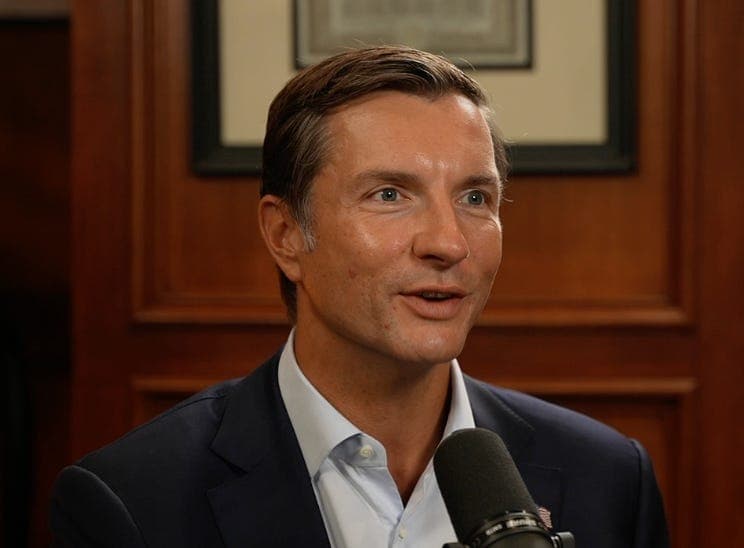
- Guest: Sen. Eric Schmitt, U.S. Senator from Missouri
- Date: November 2022
- Key Themes:
- Mass censorship and government collusion with Big Tech
- Strategies for combating government overreach and far-left agendas
- Importance of free speech and legal actions to protect it
Key Takeaways
Introduction to Eric Schmitt
- Background:
- Grew up in a working-class family; father worked night shifts.
- Became a lawyer and served as Missouri Attorney General before being elected to the Senate.
- Inspired to enter politics due to personal experiences, particularly related to his son's health challenges.
Mass Censorship and the Role of Big Tech
- Missouri v. Biden:
- Schmitt's lawsuit against the Biden administration exposing government collusion with Big Tech to censor dissenting voices.
- Discovery Phase: Uncovered communications between government officials and social media execs aimed at controlling narratives.
- Schmitt argues this was the most significant free speech case in U.S. history.
Government Overreach
- Censorship Tactics:
- Allegations that the FBI authenticated the Hunter Biden laptop before the 2020 election and worked with Big Tech to suppress its narrative.
- Discussed the establishment of secret channels for censorship coordination.
Legislative Priorities as Senator
- Aggressive Republican Stance:
- Advocating for a robust Republican response to threats such as Supreme Court packing and redistricting.
- Emphasizes the need for increased law enforcement, particularly in urban areas facing high crime rates.
The Future of AI and Manufacturing
- Concerns and Opportunities:
- Expressed caution over potential AI censorship but optimism about AI and robotics reinvigorating U.S. manufacturing.
- Advocated for a return to domestic manufacturing, supported by advanced technologies and a skilled workforce.
Legal Strategy and Future Challenges
- The Last Line of Defense:
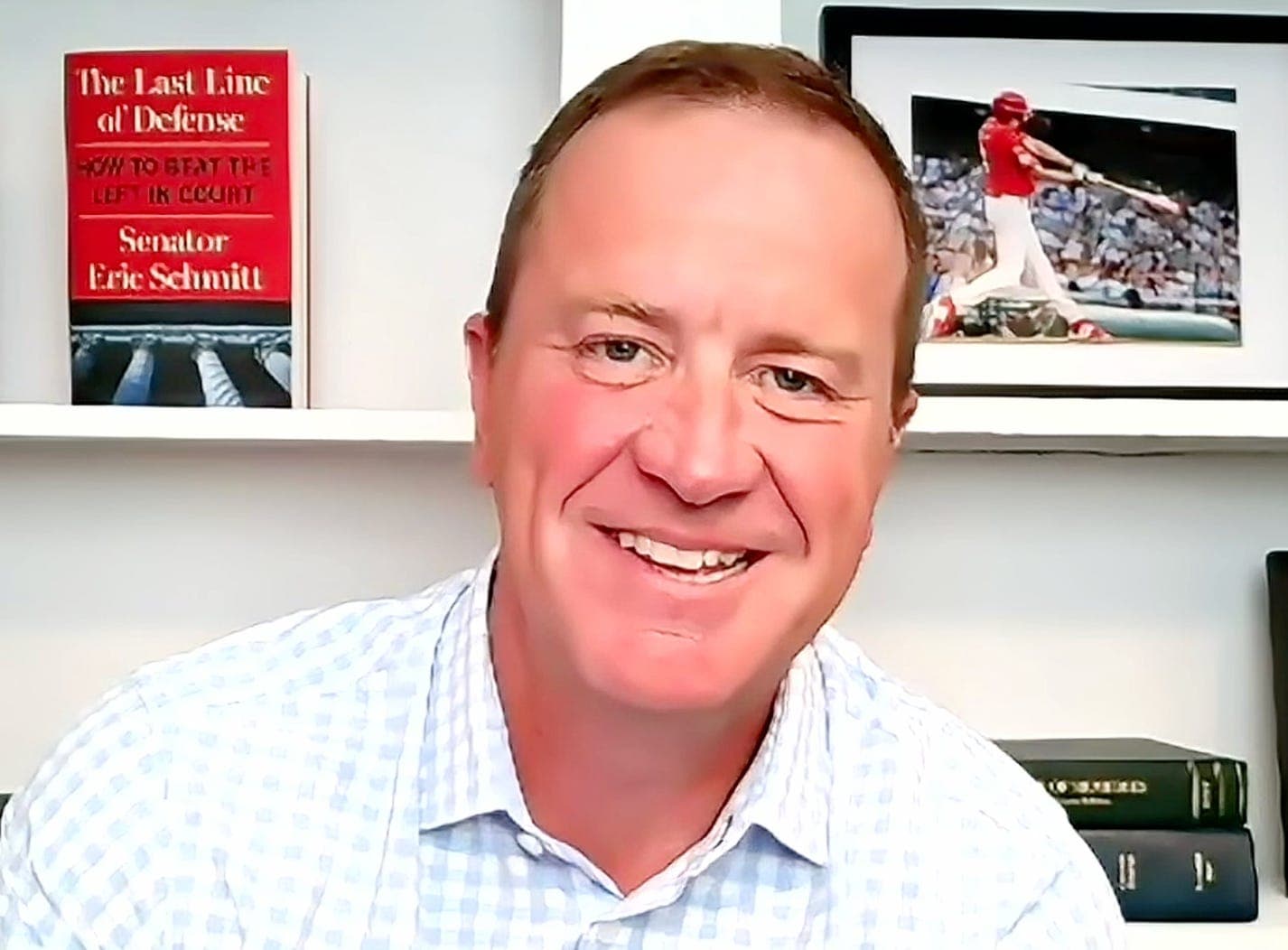
- Schmitt's book which serves as a guide for conservatives on fighting back against leftist policies in court.
- Emphasizes the importance of understanding and utilizing the legal system to protect conservative values.
Optimism for America
- Future Outlook:
- Schmitt believes in a forthcoming "golden age" for America driven by strong leadership and a focus on American interests.
- Encourages resilience and vigilance in preserving free speech and opposing government overreach.
Episode Structure and Key Moments
- Introduction (00:00): Overview of the podcast and guest introduction.
- Exposing Mass Censorship (05:00): Discussion on censorship tactics and Schmitt's legal battles.
- FBI's Role in Censorship (09:30): Details on FBI's actions regarding Hunter Biden's laptop.
- Redistricting and Battlegrounds (15:18): Strategies for maintaining Republican power in elections.
- Suing the CCP (21:40): Overview of Schmitt's lawsuit against China for COVID cover-up.
- Insights from the Senate (24:45): Schmitt shares lessons learned in the Senate thus far.
- AI and Manufacturing Renaissance (28:30): Schmitt's views on the impact of AI on U.S. manufacturing.
Conclusion
- The podcast culminates in a discussion on the importance of fighting for free speech and protecting American values against government overreach and censorship. Schmitt expresses a strong belief in the potential for a brighter future for America if proactive measures are taken.
Additional Resources
- Book: [The Last Line of Defense: How to Beat the Left in Court](https://www.amazon.com/Last-Line-Defense-Beat-Court/dp/006343718X)
- Blog: [Joe Lonsdale's Blog](https://blog.joelonsdale.com?utm_medium=podcast)
Written by AI. May contain mistakes. Listen to the episode to check what was said.
Transcript
Automatic transcript. May contain errors.0:00There are these secret portals between social media execs and high-ranking government officials. It's the most important free speech case in the history of our country. The FBI authenticated the laptop for Hunter Biden. They knew it was real in 2019. The FBI starts having monthly, then weekly meetings with big tech platforms. They really wanted to control the narrative. You really exposed a lot of censorship here between big tech and the Biden administration. What was going on? A lot of these people who had opinions they didn't like were being shadow banned or deplatformed altogether. I was honored to be throttled by the same people as well.
0:31It's the biggest affront to the first known we've ever seen. The one thing that worries me the most probably about AI is the censorship piece. So I think having a more robust marketplace for tech is really important. Civilizations come and go based on who kind of develops and utilizes technology. We're not guaranteed to be what we are now 100 years from now.
0:57Eric Schmidt is a U.S. senator from Missouri. He's a bold fighter for our country. He famously sued the Biden administration in the famous case Missouri versus Biden in 2022 when he was the AG in Missouri, fighting back against censorship, against big tech collusion with our government. The discovery uncovered some amazing things that led to the Twitter files and a lot else. He also sued China over the COVID conspiracy. He actually won in the courts, won$24 billion. He's a fighter on so many fronts. He's on the Judiciary Committee. He's on the Senate Armed Services Committee. He just feels strongly about fighting for the American worker.
1:29He just published a book called The Last Line of Defense about his battles in the court system and what we have to do next. Great guy to talk to to hear what's going on in America, and he's feeling optimistic about our future. Welcome to American Optimist. Really excited to have here today U.S. Senator from Missouri, Eric Schmidt. Mr. Senator, thank you for joining us. It's great to be with you, Joe. I've followed your work for a long time. Of course, we've been in touch. You're a former Attorney General of Missouri. Made me really happy with some of the aggressive things you did there. You're an author of a new book, The Last Line of Defense, How to Beat the Left in the Court.
1:59So we're going to talk about that today too. But I want to start with the personal side of your story. I understand your father actually, he worked the night shift at Anheuser-Busch seven days a week and you got one family vacation per year. So you started off working class in Missouri. So what about how you grew up, inspired you to want to run for office? Well, yeah, I mean, I think that absolutely shaped who I am. I saw how hard my dad worked and yeah, he worked the midnight shift seven days a week. I tell him the story how he had one week of vacation a year and we would go, we'd drive somewhere, but we'd go down to Silver Dollar City in Branson, Missouri, and you'd see these blacksmiths forging something out of heat and pressure and create something.
2:38And I feel like my time as AG, I felt like there was a forging process there. But no, I'm very blessed to have had two great parents, my mom and my dad. And I was the first person in my family to go to college out of high school, let alone law school, became a lawyer, was practicing law and became a partner. And all those things were great. And then I became a dad for the first time. And Steven, my son is, was born with a rare genetic condition as something called tuberous sclerosis. He's nonverbal as epilepsy on the autism spectrum. And then that, of course, seeing him go through all those challenges, including a four hour seizure one time kind of spurred me into doing something more with my life.
3:16So I ran for office and to try to make a difference. So, so here I am. It's the adversity that shapes us the most, especially when it's that close to us. Your new book is called The Last Line of Defense, How to Beat the Left in the Court. You know, we talk a lot about institutional decay in this podcast and institutions that once were great and that are broken. It started at a high level. How did the courts get to be captured? How did they get to be more broken? What's going on here? What's your playbook for fighting back? Well, I think for a long time, conservatives honestly have sort of ceded a lot of territory to the left.
3:43I mean, there's so many of the institutions that you've talked about that the left has sort of captured over time. And the point of the book is that we've got to have the courage to fight back and win in our court system. And so the book's not written for lawyers. I mean, I hope lawyers read it, but it's really about about, you know, sort of normal people understanding some of the decisions you make, strategic decisions, but sort of directional decisions to stand up and fight back. I think now that we're in this place, Joe, where I start the book by saying in November of 2024, the fever broke.
4:14So we're kind of like on the other side of this fever dream with a lot of the successes we're seeing from the Trump administration. But I think it's important to remember what happened the four years previous to that. What did the Democrats do when they were in power? And this was a time of lockdowns and compulsory COVID shots and open borders and DEI struggle sessions and ESG and a censorship enterprise that they created that was so vast. It's the biggest affront to the first event we've ever seen. And so when I was AG, we stood up. We pushed back against all that stuff. We won at the Supreme Court on student loan debt forgiveness, on COVID stuff.
4:47We brought the Missouri versus Biden lawsuit. So the point is, if you have the guts to stand up and fight back, we can win. And this is a playbook to go do that. And I want to jump in and talk a little bit about Missouri versus Biden, something a lot of us were a huge fan of your work there starting, I think, in May 2022. You filed that lawsuit. But before we jump into that with a book again, just understand what does it mean otherwise to beat the left in the court? Because there's a lot of judges. Fortunately, the Supreme Court's pretty sane right now. And it's a lot of Trump appointees. Overall, it's good.
5:14But there's a lot of judges we're not going to be able to remove. We're not going to be able to impeach. So given that there's all this corruption going on, all this broken stuff, like how do we actually beat them? How do we make this stuff work? Well, I think, you know, I got asked this a lot in the first, especially the first couple of months of the Trump administration. You'd have some random district court judge make some ruling here or there. But ultimately, on the programming side, think of what the Doe's stuff was all about on the personnel side, also on the illegal immigration front. As those cases have made their way through the courts, by and large, President Trump has been successful because what he's trying to do are clear Article 2 authorities, right?
5:50Of course, the chief executive can make these kinds of decisions. The left is trying to constrain his ability to do it. But you might have a district court judge there that was a radical appointed by Joe Biden. But as they make their way through, especially at the Supreme Court, he's been vindicated. I mean, one of the best examples so far is on this universal injunction, this nationwide injunction issue, where you saw like some random judge in some district somewhere trying to direct the foreign policy of the United States of America. It's crazy. And so the separation of powers works that way, too, right?
6:19It's a lot of times the courts are the arbiter between the branches of government here. Their power isn't limitless either. And so the Supreme Court, I think, has kind of checked a lot of the abuses that we saw at the lower courts. And so we're not going to win 100 percent of the time. But I think by and large, on the things we care about, the stage is set now. If we fight back with the right arguments, we can win. You had a lot of funny memes for a while on this one where it's where I think I think they'd say, like, you know, judge orders Trump to rebuild Iranian nuclear program. I mean, these guys were going against everything he was doing for a long time.
6:51I guess it looks like we have fought back. We made that illegal, which is great. Let's jump into the lawsuit you filed, because this was something that a lot of us were really terrified by the previous administration kind of using its power to intimidate people and block free speech and effectively kind of force companies to censor things and get permission to do things because otherwise they would come at them. And so I guess through discovery, you really exposed a lot of censorship here between big tech and the Biden administration. Take us through the case. What was going on? Yeah. So in the last line of defense, I think this is probably, I mean, it probably occupies the most pages in the book because I think it's the most important free speech case in the history of our country.
7:29So in 2021 and 2022, you know, we're sort of watching this kind of unfold. You see Jen Psaki at the podium saying, we're flagging this for Facebook. And Joe Biden's saying that these tech companies are killing people. They're threatening to take section 230 protections away. If they don't do more, you have a disinformation governance board. Remember, this was floated. Yeah. Where that, you know, terrible Mary Poppins figure was, you know, singing songs about censorship. It was tied to a nonprofit at Stanford, right? I mean, there's literally these nonprofits on the left and the universities like helping this go forward.
8:03Yes. And so that is what so basically. So November 2022, we filed a lawsuit, Missouri versus Biden. We allege some pretty significant abuses of power with the federal government, including and coercing big tech companies. We made a strategic decision. Normally, in those kind of cases, you seek an injunction, which is to stop the government or somebody from doing something you think is unlawful. We actually sought discovery first because we knew it was being lampooned as a conspiracy theory or I was just trying to get attention. So, we got the discovery. And that, to me, was the moment that was truly eye-opening because there were these secret portals that were established between social media execs and high-ranking government officials.
8:44The Surgeon General is texting back and forth. And all of this stuff, they really wanted to control the narrative on the Hunter Biden laptop, on COVID-related issues, on a whole host of things to really sideline half the country and censor them through a way that they, the government, can't do. But then outsourcing that to big tech companies. And to your point, it went beyond that. Stanford, University of Washington were part of this coalition that was doing the dirty work for him, too. Right. They said they were basically giving them grants to do the flagging of stuff they wanted censored. And we had the opportunity to take the deposition of Anthony Fauci.
9:18We took the deposition of Elvis Chan, who was the FBI agent in Northern California, who was pre bunking the Hunter Biden laptop story in 2020. This is a really important story. I think the left would love to memory hole what happened here. And I think it's really important. We don't forget as a country what you discovered there. So basically, basically what happened is the FBI knew Hunter Biden's laptop was real. They knew it would hurt Biden in the election. And so they purposely ahead of time brought everyone together, I guess, with Elvis doing this. They told everyone there could be stories like this, such as this laptop that Russia pretends to have found and pretends to be a big deal.
9:51This could come up before the election as Russian disinformation. We want you to be ready to censor that and don't let the Russian disinformation interfere with the election. So they did this knowing that this was real and knowing that it would come out in order to try to prepare them to help the Biden regime censor for the election. This is actually insane stuff that you have here, right? Yeah, it's like it's like you would imagine the Soviet Union, right, or something. And and you had again, this is kind of the legacy of the original sin of the Russiagate stuff, right, which was they concocted this nonsense.
10:22and then everything they didn't like later on, whether it's about President Trump or other things, became Russian disinformation or Russian misinformation or Russian malinformation, all this stuff. So yeah, you're right. So basically, the FBI authenticated and knew the laptop for Hunter Biden with all the crazy stuff in it. It could have, by the way, implicated Joe Biden in some bad stuff. They knew it was real in 2019, in November of 2019. the FBI starts having monthly then weekly meetings with big tech platforms about this topic in particular, which is look out for this Russian hack and leak operation.
10:58Yole Roth, who was the former like integrity guy at Twitter in an affidavit said, yes, he specifically mentioned Hunter Biden laptop. And by the way, it's also worth noting when you start connecting some of these dots, which is kind of crazy. There's a guy by the name of James Baker, who was the general counsel at the FBI and during the Russiagate stuff, who's now been implicated in leaking classified information in 2016. In 2020, he's the general counsel for Twitter. Yikes. So the, like, you know, like it's just kind of crazy, but that's what was happening. Let's jump into that for a second. Cause what you mean is that they do this very effectively.
11:33So they have different organizations that are all sort of political ideological allies and they capture. So Twitter was very clearly by anyone's metrics captured by the left. So And then they have someone who's like helping the left in sketchy ways in the government, then helping the left in sketchy ways in Twitter. And it's the same cabal, right? It's the same group of people. It's not a conspiracy. They clearly are doing this. And they're clearly coming between those places, between the nonprofits, especially funded by Soros and others, and the universities, right? It's all together. One of the reasons why axing a lot of what USAID was was so important, because what happens is you have these lefties in the, like a Democrat administration they're in.
12:08Then they go out to these nonprofits and they come back in. It's sort of like one hand washing the other. And I think a lot of this stuff needs to be exposed. But when we got those documents, when we started taking those depositions, Joe, you've got to remember, you go back in time. This was before Elon Musk had bought Twitter. This is before the Twitter files, which further amplified it, by the way, and showed additional ways by which they were trying to control speech and sort of suppress people's First Amendment rights in working with the government. So, and this is, of course, before the investigation.
12:41So, yes, this was sort of an all of government effort. And it wasn't just like one agency, Joe, like the CDC. We took the deposition of somebody at the CDC. Like there were words and phrases that they specifically wanted censored. It got censored. You had CISA. What's CISA for your audience? Your audience might know. It's basically a cybersecurity agency to protect us from cyber attacks and critical infrastructure. They weaponized that against the American people to do censorship work also. And it kind of came from this election integrity project, which was this kind of weird thing. But again, in 2020, was working to censor speech.
13:17So then Biden comes in on day three. We discover in the discovery that the censorship operation began on day three of their administration. They started taking down RFK Jr. They started taking down Tucker Carlson. And a lot of these people who had opinions they didn't like were being shadow banned or deplatformed altogether. And it was truly chilling. And so Missouri versus Biden exposes all that. And as a judge said in one of the lower courts, it was the most, you know, the biggest affront to the First Amendment in American history. I mean, it's just crazy. When my friends bought Twitter with Elon, they actually, my account was also throttled.
13:53I'm a more minor player in this whole thing, but I was honored to be throttled by the same people as well. So it's totally, totally crazy stuff. What ended up happening with the lawsuits? You uncovered all these amazing things. We all can kind of see that there's more conspiracies going on. But then what did the courts do? Like where did it go? We wanted the district court level. We wanted the appellate court level, the Fifth Circuit. And then the Supreme Court took the case up and then essentially punted based on standing. They said, well, we need to send it back down to the lower court to further establish whether or not Missouri and the other plaintiffs have standing.
14:23One interesting side. So as far as I'm concerned, exposing all of it was the big win. It's still kind of rattling around, but the government never wanted that stuff exposed. One interesting sort of side note from it, we can talk about Fauci's depot too, but one of the plaintiffs is a guy by the name of, I'm sure you know, is Dr. Jay Bhattacharya. It was a Stanford guy who came up with this radical theory along with others that said, you know what? Natural immunity is still a thing, even for COVID. And they tried to wreck his life. And now he's the director of the NIH, which I think there's some nice historical symmetry to all of that, I suppose.
14:57That's good. It's poetic justice. He gets to be in charge after showing that courage because it's tough for academics, especially to show courage. They really come at them in those areas. Well, that was a really big shift. And how do we think about this for the future? Unfortunately, these people may be in charge again in our lifetimes. I hope not, but there's a good chance the way politics works is things swing back and forth. And eventually, some of them are going to get into government again. What have we fixed to make us that can't do this again? Is this going to be something we're dealing with in the 2030s?
15:24Well, my worry is, and one of the reasons I wrote the book, The Last Line of Defense, How We Beat the Left in Court, is that, you know, as the Czech writer, Milan Kodaro once said, the struggle against power is a struggle against memory and forgetting. So we can't forget the lessons and what they did with the power they had, Joe, when they had it. You think of COVID, the consolidation of power that happened. You think of this censorship enterprise. It's really about power and control. You think about what they would do in the United States Senate if Democrats had what we had right now. Like at this point, they would pack the Supreme Court and add states to the union to maintain permanent control.
16:01So like and what do they do with it? Then it becomes, you know, an emergency. Then you other people. And then, of course, you're suppressing speech. So we've got to be pretty vigilant moving forward because you're right. I think we're winning right now. And I'm proud to have been played at least a small part in this kind of renaissance of free speech. You know, I've always been a conservative and I was in college in the late 90s. And I was always remember a little jealous of liberals that kind of had the high ground on free speech, you know, but I don't think that's the case anymore. Like, and that was also the beginning of this sort of like crazy political correctness movement that it just morphed into this woke mind virus that exists now.
16:37So I think we're winning. And I also think you look at younger voters right now, especially, you know, 18 to 24 year olds who live through these dark, crazy times. They're I mean, they're they're the most conservative or they vote Republican more than any generation previous to them, because I think they saw a lot of the abuses and excesses and reject it. They really have seen and have gotten it. Yeah, it's interesting you say that it seems like the left in the US, their values are based more on power. So it turned out free speech was useful for them, for their power and their messages in the 1960s and 70s.
17:10And that was their platform. And then by the time it was no longer useful for them, then they tried to ban it. And, you know, the political correctness point is interesting. Peter Thiel once told me this. I guess it was originally came out of the Marxists. And so if you were politically correct in the 1930s, 40s, 50s, it means you got the little booklets the Marxists would give out about the correct things to say. And so and that kind of morphed into our leftist culture and media in general, where you're politically correct by saying the correct things. And so for me, I love going against it and purposely not being politically correct because it's kind of signaling against the power of these people who want to run our society.
17:40I totally agree with you. I've had this conversation with Peter, too. I think in that at the time they disguised a lot of that in flowery language and it was just about, you know, being respectful and all that. Of course, we should be respectful, but you're right. It's a it's a it's an issue of control, because if you can control what people say, that's a powerful, powerful thing. And I'm the same way. I'm sort of almost a free speech absolutist and a bit of a contrarian anyway. That's kind of my nature. So that's why this stuff in particular for me really struck a chord and why it was so important to fight back.
18:11Even when people were saying, oh, this is loony, this is a conspiracy theory, it turns out it was all true. And I think, you know, the left, think about what they were doing in Hollywood. I mean, just the canceling of anybody that would say something they didn't agree with, they couldn't get jobs. It's just wild. This was Ronald Reagan's thing he was fighting against, right? He was against the commies there. That's how he started his career. I want to ask a little bit more about power in the Senate and different things we could do. You'll have to forgive me here. Maybe these are too crazy. But for example, I agree.
18:38I'm really worried that if we lose again, they will make two new states. I'm really worried they'll pack the court. And so the question becomes like, what do we do to counter it? Just for the sake of argument, you could say, well, there's arguments for why there's 13. We could put 13 in ourselves first. Or you could say, if you guys don't want us to do that, we can all agree on a constitutional amendment that there's only going to be nine. Those would be two ways to protect ourselves. It seems like the third option of doing nothing is bad. And similarly, we could say, well, we don't think there should be a new state in D.C.
19:03That's ridiculous. But if you want to give some more people to vote, you could take a part of D.C. that's not part of the government and put it in Maryland because that's like, you know, Senator Lee has been talking about this. So it seems like there's things we could be doing to protect ourselves in the Senate that we're not. How should we be thinking about this? No, I think that's right. I think I support a constitutional amendment that would enshrine it at nine. I think that makes the most sense because because here's the other thing is, let's say they do it. Let's say they add four. Well, when we come in power, then we're going to add then why not 50?
19:30Yeah. Like, why not 100? Yeah. You know, then you become like there's no limiting principle. You become kind of a banana republic and that's a dangerous road. It seems like an obvious miss in the constitution that someone would abuse that. Like, I think we kind of messed that up. And that's what the founders missed it. Well, I think that, but again, like I come from Missouri, this isn't Harry Truman's Democrat party, right? Like this is like, this is a different iteration. I hope for the sake of the country that they, that they move more a little bit to the center, but politically, I mean, they're about ready to elect a, like a legit commie in New York.
20:03Like, I don't think they're coming back. And this is what Hugo Chavez did in Venezuela. He stacked the courts and we just interviewed the opposition leader last week. They didn't let her run because they stacked the courts. But let's go back to that if you're in favor. So I think there's some things to do there. And I also think one of the things that we absolutely this is, by the way, within the rules. The difference is they want to shatter the rules. I think we have to be much more aggressive within the rules. It's one of the reasons I wrote the book, Last Line of Defense, How to Beat the Left in Court, because these are current and people can get it now.
20:27These are current systems that exist that we had. Quite frankly, I think we've been a little soft on that. We need to have the courage to fight. Take redistricting. Yep. Perfectly, perfectly constitutional to redistrict right now. And the Democrats have a lot more to lose than we do. If you look at the red states that could redistrict, Missouri is one of them. We would stand to gain more if you we wanted to be aggressive on the census. There's no reason in the world why we should accept the idea that illegal immigrants are counted in the census. California has way too many representatives than it should have because we count illegal immigrants.
21:05Like if we actually are tough here and are aggressive within the rules, that's how we win. Their only avenue is to sort of bust up the rules. Yeah, we'll totally agree. Well, I hope we can, it seems like the only way they'll agree to a constitutional amendment, for example, to hold it to nine is if we actually come very close to meaningfully threatening to do the extra ones while pushing for that. So I hope you can get your colleagues to be more aggressive. I know you're very aggressive and I feel like the party needs to be aggressive at these things. I want to, speaking of aggression, I want to ask, I think you were the first to sue China after the COVID thing.
Read the full transcript
21:40How much money, how much money, what was the judgment for their coverup? Missouri has currently a$24 billion judgment against communist China that is, you know, can, you can seize assets. So it'll, it's up to my successor now to go do that. Um, I hope they do. Um, cause yeah, but we like early on in what's Joe, I talk about that in the book too, Last Line of Defense. What was really interesting about that was we were able – I mean, we put together this compendium of all the things that communist China did. They stopped flights in and out of Wuhan domestically, but not in and out internationally.
22:15They became the net – they were the largest net exporter of PPE. They became the largest net importer of PPE. They knew. They knew. They knew. And they didn't do anything about it and kind of unleash this thing. And so that's the basis of the lawsuit that we filed. But it was interesting when we filed the lawsuit. And if you remember when President Trump at the time stopped flights coming in and out of China to this country, the left lost their minds. It's the right thing to do. They lost their minds. It's kind of like what's happening in Washington right now. He's saying, you know what? We want to take on violent crime.
22:44There's not been a murder in 10 days. And the Democrats have lost their minds. It's crazy. We're trying to get red states to step up too. Do you think Red State governors should be doing this in the cities where they can as well? Because they're not yet. Well, it's funny. The timing was not, it wasn't coordinated in this way. I've been working with Kash Patel since his inauguration to get help into St. Louis. So the FBI is going to have the largest per capita infusion of permanent FBI agents in St. Louis anywhere in the country. So we're going to get, like, there's federal help. Like he's talked about getting those agents out of Washington into the field.
23:19And that's what they, we should be doing. You were on Fox news. You said urban crime is a policy choice. You were talking about this. I love that you were doing this at the same time. Yeah. Look, we shouldn't accept this. Like as a former prosecutor myself, there's just no substitute for a law enforcement presence on the streets and actual prosecutions. All this other stuff that people have been toying around with for five years is nonsense. It just, I mean, the world needs social workers, but you need cops. you need prosecutors and that's how you solve the problem and we shouldn't apologize for that i i 100 agree i think this is an issue the right has been on the has has not been aggressive enough on the left broke our cities and a lot of people on the right the answer we've taught them has been oh that's too bad it's their fault they're on the left that's why they're going to be broken i think our answer instead should be you know what even though the left's breaking the city our civilization needs functional cities and we are going to do whatever we can using our power to come in and fix the city and protect it even though you guys are in charge and you suck We shouldn't just let it be broken is my view.
24:15I agree. I agree. We shouldn't accept this. Like we shouldn't accept like third world living conditions in America. And I think you're right for far too long. We probably have. I love it. Well, let's, let's step up on that. I want to ask you a bit about the Senate. You're new to the U S Senate or not that new, but you're still in your first term. What's your impression so far? Like, like, what's your job in the Senate? What do you, what are you in charge of? So I'm in a, on a, on a few committees that are, that keep me pretty busy. I'm on the armed services committee. And so I consider myself in the foreign policy space.
24:44I didn't expect this, but kind of I think the ascending foreign policy view, which is American realism, you know, President Trump has that. J.D. Vance is a believer in that. Bridge Colby, you know, a lot of people that, you know, that that believe that and I do that America, the permanent Washington sort of impression and and policy on all of this stuff. It works well in the cocktail parties in Washington, but it doesn't really work. You can't be everywhere all at once all the time. We need to be smarter. We need to have basically diplomacy first. What are the core national interests of the United States of America and focusing on China, which is our chief rival for the 21st century.
25:22And we got to get our European allies to step up in a much more meaningful way. That dynamic, I think, is shifting. And we also have to rebuild our industrial base that's atrophied for 30 years through consolidation, all sorts of problems. And And so reinvigorating that so that when we do it, when we do have to act, it's with overwhelming force and it's an unfair fight, but a much more restrained foreign policy, I think, than a lot of the neoconservatives and neoliberals have espoused over the last, you know, many decades. So that's been a lot. That's been interesting. And I'm on the Judiciary Committee.
25:52We deal with that's like Thunderdome, basically, like every controversial thing. It's like you just put on put on your armor and you get into the you get into the Coliseum on the Judiciary Committee. So Judiciary Committee is like federalism, free speech, separation of powers. Tell us about a couple of the things that Judiciary Committee. Yeah, so I chair the subcommittee on the Constitution, which we've already had hearings and we've launched investigations on things like the suppression of free speech. What is the Civil Rights Division going to do now with Ramit Dillon in there? What's her agenda?
26:22Well, it turns out, which I'm very happy, and we certainly are encouraging her to do it. You've got to start going after these companies that have had these racist policies, racist hiring policies. Same with universities. You got to get back to merit. We saw it go, you know, awry in so many different places, including our military. So get the Civil Rights Division back to like making sure people aren't being discriminated upon based on their race, unlike the previous administration where they were actually encouraging discrimination based on somebody's race. My friends tell me there might be a lot of liability that companies have created for themselves by doing illegal discrimination over the last several years, I think even 2014, 2015, this stuff started.
26:57So there must have been like eight or nine years in some cases of just clear discrimination. Are we going to see some more cases where we're going to discover this and kind of go after it and punish these HR people? I mean, it seems to be kind of satisfying for some of us. Yes. Yes. I think it's coming. It should come. And I think they need some scalps on this thing to make sure that this stops. Because, I mean, I noted in the book when we went after DEI policies, whether it's in school or ESG policies with the Net Zero Banking Alliance. But, you know, Coca-Cola, for example, was having sessions about how people had to explain how they wanted to be less white.
27:33Dude, Lockheed was doing this. Lockheed was doing this left and right. Great seat. Yeah. No, and it's like overtly discriminatory. But they were, you know, checking some box on some corporate, you know, index that was being pushed, by the way, by these NGOs and funded in part by George Soros. And what does that do? It makes you less competitive and it satisfies this sort of, again, weird kind of woke mind virus that took hold. I think a lot of that stuff's in retreat, but it still exists. And what you can't have is all that stuff go underground by a different name. Everybody's familiar with DEI now.
28:07It could be called something else later, but the policy, it's cultural Marxism, honestly. It's divide the room by oppressor and oppressed. That's what it is. And so we got to root it out. I love it. I love it. So you guys are going hard on that. You actually chair that. And then we call it the SASC, the Senate Armed Services Committee. We obviously do a lot there. I've built a few defense companies myself. You've done a bunch of stuff there. You recently introduced a bipartisan bill to create 10 new defense tech hubs. Tell us about that. Yeah, I think there's a lot of innovation that can happen everywhere around the country.
28:37I mean, you look at St. Louis, where I'm from. It's got a just great tradition. Think of McDonnell Douglas, and you've got all these suppliers, and you've got NGA West, and there's a lot of innovation. I mean, Scale AI is a company that's there. We want to get more. I mean, I think just having more of a diverse ecosystem for innovation so that it's just not in one or two places is part of this more resilient industrial base that we need to have. As you know, like the days of like, you know, turning the Ford plant assembly line into building airplanes, that is not how it works anymore, right? And we got to bring, we got to have the supply chains brought home.
29:09We got it. And having more entrance into the marketplace as disruptors is very important. I think we were complacent for too long. And by the way, take drones, for example. Drone technology is outdated like in six months. If you have a typical procurement process at the Pentagon that you would build like an aircraft carrier for, which is what they do, we are not getting anywhere against countries that are much more nimble and see the future and how they want to compete. So I think that's part of the reform mission. I will say that a lot of that can be done by the, through the NDAA, which I'm on the committee, but also you need leadership in the Pentagon.
29:46And I think this administration, part of the allure of having a band of reformers and disruptors brought into the cabinet is, you know, we can go do that. And I think they have some great people that, that that's their mission, but you got to get that, you know, that, that mid-level bureaucrat that's, you know, serving out a four-year stint who just doesn't want to make a mistake. We got a lot of my really smart friends I admire who've built great things. We're now in the DOD and the administration partnering with you guys. And all of us are so bullish on what this means for the U.S. because you're right.
30:15It's a completely different framework. And frankly, a lot of legacy companies don't know how to work in this new framework and are going to get left behind, but we have to allow the best ideas to win and not let the big guys smash them. Well, think about, think of the contrast from where Google was, say like a decade ago, where they didn't want to, they didn't want to participate in it. And you know, they had, they had stuff in China, which is kind of wild, but stuff in China, project maven came up and they gave it up and you know that was like the alarm bell that led to the founding of andrel and epros and sironic and these big companies we're building now as we realize wait a second if they're not doing it no one's doing it we better do it so a lot of a lot of us stepped up and after you know expounder people and then why not that's good that's a good thing so obviously there's a lot of advanced manufacturing getting going in the u.s that i'm really bullish on we learning from some of what elon showed us all learning from all this new ai you know on the topic of technology there's a big debate over ai manufacturing also immigration the future of the American heartland.
31:05And there's a lot of real anger about these types of topics, obviously, right now. How do you approach these issues? Can AI plus robotics bring back U.S. manufacturing? What does this have to do with immigration? How should we be thinking about it? Yeah. So I think, okay, give me a little bit of runway here. I think what's fascinating about the moment that we're in right now, I gave a speech on the Senate floor about this. What President Trump has been able to usher in right now is a very unique moment in time where for the last 30 years, so think of after the Cold War ends, we don't really adjust our foreign policy.
31:35We had NATO in its form and the imbalance that existed on funding, primarily to defeat Soviet communism. Once that happened, there wasn't really an adjustment. All these unfair trade deals that existed during the Cold War for similar reasons, after the Cold War, there was never really an adjustment. Now all that stuff is in play and I think ripe for a real adjustment. But like for the people that I grew up around, I mentioned my background, sort of a working class kid. A lot of my, all my friends, their parents worked in factories or operated a forklift or they were a cop. Their jobs in many ways were sent overseas to China for lower wages.
32:11And then they get hit with the double whammy, Joe. Then as they're looking for the next career, their wages were undercut through, you know, mass migration or illegal immigration, right? Like it just, for the heartland, it was just this devastating blow that's played out over 30 years. Globalization plus immigration just crushed a lot of these people. Absolutely. Absolutely. Yeah. The globalization. And by the way, these are the same people that don't believe in free speech. These globalists, they're the same people that use NGOs to fuel mass migration into our country because they don't actually believe in the things that we believe in.
32:41What does it mean to be an American and why should we be proud of that? They all think we're global citizens. But anyway, I do think this offers this moment in time offers a lot of hope for advanced manufacturing to bring that back to the United States. And I think AI can help augment that. and have a fulfilling career for somebody that, you don't need to have an advanced degree in engineering to benefit from all that. You're gonna need a lot of engineers with advanced degrees, but you're also gonna have somebody who can be in that advanced manufacturing facility and have a great life. And maybe, maybe, just maybe we can get back to an opportunity at least for a one income household if that's what people choose to do.
33:18That's been ripped away in many ways. My wife doesn't work for a living, And even though she's a Stanford lady and really smart and was raising six kids with me, I hope other people should be able to do that without having to start companies like me. So I think that's right. Yeah. So I think it's an opportunity and we got to get it right. The one thing that worries me the most probably about AI is getting back to the censorship piece. It could really be manipulated, I think, in that way. And so just making sure that we don't have the sort of the content bias that I think some of the folks would like to have.
33:50And that was my big concern with the Biden administration, that you're going to lock in sort of big tech monopolies in exchange for suppression of speech. And so I think having a more robust marketplace for tech is really important. This is why it's important to me. We have open source for AI. We have Elon competing. We have other winners. If you only have one winner and they can lock it down, they can really break everything, especially if it's Biden wanted one winner. They can then make us say certain things. I'm in the middle of like a pretty big battle right now on the AI front in our country.
34:19You probably know there's actually 1 ,200 laws right now being proposed in the 50 states to try to regulate AI in different ways. And by the way, some of them I think are perfectly, like it's not up to me, but I think obviously you should be able to stop child abuse material, right? You should be able to protect creators. There's all these things I think that the right in general is going to want to do properly, make sure like that tech's not doing things that are bad in our society. On the other hand, you have a lot of blue states that have these crazy regulatory bodies that want you to have to do DEI or talk about race more sensitively or whatever other censorship they want before you can deploy your AI.
34:51And I don't think we want to let the blue states censor everyone. We don't want to let China win by forcing our companies to have to go through 20 hoops in each of these blue states before they can deploy and do something useful in our country. And so there's this really big kind of fight that I think is just on their surface now. I think earlier in the news, you know, Marc Andresa and others like we're putting$100 million stores out the same way they were for crypto. And I'm against like big tax values, but I'm for building and I'm for productivity. I'm for wealth for the American worker. This is going to be a big fight in our party.
35:20How do you see this playing out? Yeah, I think that we probably have to make sure people are really aware of the real dangers of what blue states could do if they inhibit all this. And again, I go back. I think the best example here is on the censorship piece, the regimes that could be put in place. And look, I guess look at it like this too. Look at when California does a crazy emissions rule that effectively was to box out the normal cars, like the internal combustion engine by, what was it, 2035 or maybe it was 2030 even. like that has an impact across the country, especially when California does it.
36:01Right. And so I just think that we've got to probably do a much better job of talking about what the opportunities that exist and how AI can sort of enhance the American worker. And you're starting to see some people talk about this. I know you talk about it. Vice President Vance has been talking about some of this stuff and I probably need to be more active in that front too, because this I think is the future for the country. And we better understand the competition that we're in because China is coming for our lunch on so many different fronts that if we don't get this right, like, look, civilizations come and go based on who kind of develops and utilizes technology.
36:36We're not guaranteed to be what we are now 100 years from now. China's hellbent on that because they view the last 150 years as a great humiliation and they still view themselves as the middle kingdom. And so that's why they're building islands in the South China Sea. It's why they're playing meaningfully in space and why they want to beat us to the moon and Mars. So I love hearing that from you. I think, yeah, all of us building these things, we want to fight for the American worker with AI and we want to beat China and we want to make sure America's and our values are dominant. You know, we started the American optimist, Mr.
37:03Senator, to push back on this cynicism and pessimism in our country. What are you optimistic this administration is going to achieve? What makes you optimistic for the future of America? I mean, I really believe like think of the incentive structure. It's so different for President Trump right now in this non-consecutive term. I think he's totally committed to having, you know, empowering American workers. I mean, just look at the no tax on tips, no tax on overtime. That means a lot to people who are actually in those industries and working as money in their pocket. I also think we've got a chance, you know, after the Chevron decision, not to get too much in the weeds, but like kind of actually reevaluate what the role of the expert and the regulator really is.
37:38I think President Trump's leading on that. I'm trying to lead on that in the Congress to sort of pull back this heavy weight. I think, by the way, AI can help with that. Like, hey, I can identify all of this, like, duplicative regulation. Doge was was doing some of this stuff, too. I actually handled the rescissions package in the Senate. I believe in this stuff. Thank you for that. We're huge fans of that. That's it's really. Yeah, we got that done. And it's it's expression of will that we can do these things that that some people think, oh, Washington can't pull that off. Sure, we can if we've got the political will to do it.
38:06So I just think we're entering a president. Trump calls it a golden age. I just think America, a strong America on the world stage means so much for us. A robust economy for everyone people benefit from. I think that's where we're at right now. And I also think this rebalancing of trade that's happening is so unique that it gets lost that President Trump basically said, listen, we shouldn't get ripped off anymore. And now markets are opening up. I was at the State Fair in Missouri two weeks ago. We're talking about how they're able to sell beef in Australia now. That's a big deal. So I just, I'm so optimistic about what things, the opportunities that lie ahead.
38:44And I'm just really grateful to be in the fight. And, but I also, again, while I wrote the book, last line of defense was, man, there were some dark days just a few years ago where all of that stuff seemed like it was very much in jeopardy. So now we're on the other side of the fever dream and we got to fight to win. Well, that's thanks to fighters like you that were on the other side. Thank you for fighting for America, Mr. Sander. Really enjoyed your book and I look forward to more. Thank you so much. Thanks, Joe. you
From the publisher
Sen. Eric Schmitt is a fighter for our country — and knows how to win. In November 2022, as Missouri Attorney General, he sued the Biden administration for colluding with Big Tech to impose mass censorship on the American people. His actions exposed the most chilling government intrusion of our time, and launched a groundswell of opposition, culminating in Elon Musk buying Twitter. What was his strategy? How can it combat further government overreach? And how can we outsmart the far-left when it comes to redistricting, stacking the Supreme Court, and other battlegrounds?
We discuss this and more with Senator Schmitt, author of the new book: "The Last Line of Defense: How to Beat the Left in Court." After serving as Missouri Attorney General, he was elected U.S. Senator, and currently serves on the all-important Judiciary and Armed Services committees.
We begin with Sen. Schmitt's working class upbringing and his inspiration for running for office. Then, he reveals how he architected Missouri v Biden to expose the unholy alliance between the Biden White House and Big Tech to censor contrarian views (myself included, as it was later revealed in the Twitter Files). He also details his lawsuit against communist China for covering up COVID, winning $24 billion in damages for the people of Missouri. Next, we jump to his priorities in the Senate, and why he's pushing Republicans to get more aggressive, whether it's protecting the Supreme Court from court packing, defending redistricting, or securing an increase in FBI agents to crackdown on violent crime in St. Louis. Finally, we get his take on AI, and why he's wary of opportunities for censorship, but also bullish on robotics and automation bringing manufacturing back to the heartland.
00:00 Episode intro
05:00 Exposing Biden's mass censorship
09:30 How the FBI covered for Hunter Biden
15:18 Redistricting, packing SCOTUS, and next battlegrounds
21:40 Suing the CCP -- and winning
24:45 What have you learned in the Senate?
28:30 AI & Manufacturing renaissance
This is a public episode. If you would like to discuss this with other subscribers or get access to bonus episodes, visit blog.joelonsdale.com