In short
Podcast Notes: Joe Lonsdale - American Optimist
Episode Title
Ep 134: Inside the White House and the AI Race with OSTP Director Michael Kratsios
Overview In this episode of *American Optimist*, host Joe Lonsdale invites Michael Kratsios, the Director of the White House Office of Science and Technology Policy (OSTP), to discuss the current landscape of artificial intelligence (AI) in the U.S., its implications for workers, and how the U.S. can lead globally in AI innovation amid competition from China.
---
Key Themes
- AI Race and Importance of Leadership
- The U.S. is in a critical race for AI supremacy, necessitating swift and effective government action.
- Michael Kratsios emphasizes the need for the U.S. to lead in AI development for economic and national security reasons.
- Three Pillars of Winning the AI Race
- Regulatory Frameworks: Establishing supportive regulations to foster innovation.
- Infrastructure: Ensuring proper energy supply and data centers are in place to support AI technologies.
- International Engagement: Promoting U.S. technology abroad to counter Chinese influence and ensure allies adopt U.S. tech.
- Impact on American Workers
- AI is projected to create new jobs, many of which are currently unforeseen, while also enhancing existing roles.
- Historical context: The transition from agriculture to more diverse job sectors provides a precedent for workforce transformation due to technology.
- Concerns Over Regulation
- A patchwork of state regulations threatens innovation and complicates compliance for new startups.
- Kratsios advocates for a national standard to ensure smooth development and deployment of AI technologies.
- Threats from China
- The conversation highlights the potential dangers of Chinese AI models and their impact on global security and technology standards.
- The U.S. has a temporary lead in chip production essential for AI, which must be leveraged to maintain a competitive edge.
- Education and Workforce Development
- Emphasis on training programs for workers to transition into new AI-driven roles.
- Importance of K-12 education in teaching students about the implications and limitations of AI technology.
---
Michael Kratsios' Background
- Worked under Peter Thiel before joining the Trump administration.
- Held positions such as Chief Technology Officer and Under Secretary of War for Research and Engineering, giving him extensive experience in tech policy.
---
Key Quotes
- "We are in an AI race and we need to win it as a country."
- "This technology will be a boon for the workforce."
- "The U.S. has to lead in adoption. We need American students... using this technology."
---
Conclusion Michael Kratsios articulates a vision for a future where AI enhances American innovation and competitiveness. His insights underscore the importance of cohesive policies and proactive engagement to ensure that the U.S. not only leads in AI technology but also cultivates a workforce that can thrive in the evolving landscape. The episode concludes on a hopeful note, emphasizing the unique opportunity to uplift and empower citizens through innovation.
---
For further information and discussions, visit [Joe Lonsdale's Blog](https://blog.joelonsdale.com?utm_medium=podcast).
Written by AI. May contain mistakes. Listen to the episode to check what was said.
Transcript
Automatic transcript. May contain errors.0:00We are in an AI race and we need to win it as a country. The top open source models are all Chinese now. The AI that's going to be adopted in all these countries could be even far more dangerous. What does AI mean for the American worker? It's going to create so many new jobs that we don't even know what they are yet. In 2010, I joined Peter Thiel in San Francisco. More and more as investments were being made, there was a consideration going to regulation. We have to do a better job as a government to accelerate those technologies out into the world. What keeps me up at night is that we as a country do not adopt AI fast enough.
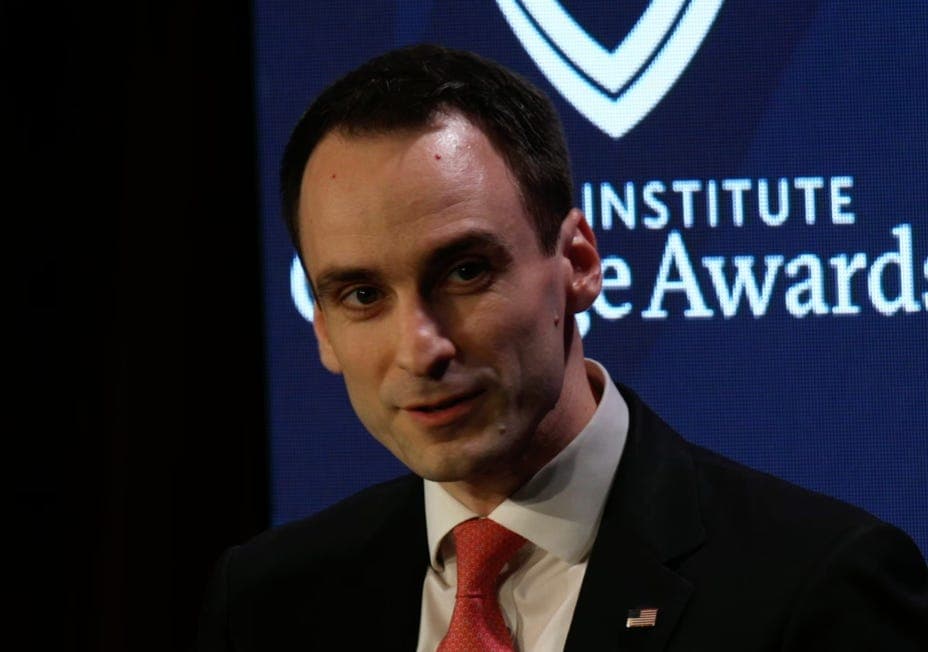
0:39I was honored to have our friend Michael Kratios at our 2025 annual Cicero Courage Awards. Michael is the man of the hour in the first Trump administration. He was the CTO of the USA. This time he has an even more senior job. He's a senior advisor to the president. He's running all this work around what we're going to do with AI for our civilization. Leaders like David Sachs and Sri Ram and others are on his team. Michael is a key architect of this administration's AI action plan, and he spells out what we need to do to stay ahead and make sure AI benefits American workers and leads to the next great American century.
1:12The Cicero Institute is getting a lot done all over the country. We got 87 wins in over 23 states this year. We are honored to feature Michael as our keynote speaker this year. If you want to support Cicero's work, please check it out. Michael Kratios, thank you so much for being here tonight. No, thank you for having me. It's great to be in Texas. So, Michael, you're the director of the White House Office of Science and Technology, senior advisor to the president. Last administration, you were there for four years. You were undersecretary for defense, and then you were our nation's CTO. It seems like you have an even bigger job this time than being the nation's CTO.
1:42You're running everything in this area. I think the transition of technology policy from being kind of a tier two issue, I think, in Trump 45 now to really becoming a national issue has been a hallmark of this administration. I don't think a day passes where you don't have some AI-related news story on the front page. You are the man of the moment. David Sachs, people are hearing about, is on your team. You guys are working on a lot there. I guess your job is to usher in the golden age of innovation in America. So tell us first about your background. You work closely with Peter Thiel. What did you do before you were in the administrations?
2:14Yeah. So actually, in 2010, I joined Peter Thiel in San Francisco and started working at his hedge fund, Clarion, and ultimately spent about seven years with him and also at Teal Capital. And I think what I observed during my time there, and I think you probably saw this as you were investing in a lot of companies, was that more and more as investments were being made and companies were being considered, there was a consideration going to regulation and how that was impacting the types of businesses and the risk profile of the businesses that one was going to be investing in. This actually red-pilled a lot of my friends.
2:49They finally had to worry about this kind of stuff. Yeah. And I think in those days, you can think of even sort of the most basic examples, companies like Lyft or Uber that were getting off the ground. Every city was a battle to try to get the regs in place to allow it to succeed. Big companies like even SpaceX had to deal with the different regulatory hurdles that everywhere from Department of Commerce to transportation to get to get licenses for for for the rockets. But I almost saw it, I think, you know, as there's sort of I always think there's these two types of technologies out there. There's technologies that are born in captivity and there are technologies that are born free.
3:22If you kind of think about that mindset, you can think a little bit about kind of where regulations should be in place. For technologies that are born free, the hallmark example is always the internet. You want to be careful as a government to get in the way of that, to kind of have to allow it to actually be born and flourish. And I think we're seeing some hallmarks of that in the way we're thinking about AI. And there's technologies that are born in captivity, things like drones, for example, or self-driving vehicles, those are actual things in the world that we can't legally do unless the government says, yes, you're allowed to do that commercial drone operation, for example.
3:56And I guess during that time period before I got into government, you kind of saw this and you realize there's so many of these technologies that are born in captivity. Like we have to do a better job as a government to accelerate those technologies out into the world and those kind of early things we tackled. So, Michael, take us into the Office of Science and Technology in the White House. What does OSTP actually do? What are you in charge of right now? Yeah, so I think in the U.S. government, technology policy is spread out across so many different agencies. And that's kind of unique to the U.S.
4:29system. In most countries around the world, you have a technology ministry, and they're the ones that do all regulations associated with tech or for science. In the U.S., we're very spread out. We have the Commerce Department that does standards at NIST. You have another part of commerce that does oceans and weather at NOAA. You have the National Science Foundation that does a bunch of basic research grants. You have a Department of Energy that has all of our national labs. We spend almost$9 billion a year in research at our labs. So our office serves essentially as a hub within the federal government to coordinate policy across all of those agencies.
5:02And just to give you sort of one example is drones that I've sort of been fixated on for many years now. If you want to actually allow for commercial drone operations in the United States, it's not a singular decision made by the FAA. And if only the FAA would just do one thing, suddenly it would all work. It's something that lots of agencies have to agree with. You have to get the national security folks and people at DHS, even at the Department of Energy, to agree with the rules such that drone operations over nuclear facilities or over military facilities are comfortable with, or specific authorities that law enforcement may need to take down drones that are doing commercial activities.
5:39So essentially, the White House is the only building or the only institution within the federal government that can bring all these agencies together in one place, sit them around the table, and sort out what and how is the best way to execute on the president's vision. And one of the key areas of vision, you're a key architect of the White House's AI action plan, right? And so broadly speaking, why does it matter for U.S. to lead in AI? Can we catch up later? Why do we have to lead now? What are the stakes and what are you doing about it? Yeah, so AI is by far our number one tech priority for this administration.
6:10And we believe that we are in an AI race and we need to win it as a country. This is critical for both our economic and national security. And we see it in the present has expressed explicitly himself what imperative it is for us to win. And the way that we think about winning that race is essentially in three categories of work. The first is around leading in innovation and in R &D. And that means that we have to create a regulatory structure in the U.S. that can allow AI applications to flourish and thrive. And we have to continue to fund the critical recent development, which are going to allow for the next great breakthroughs.
6:47The first was transformers that ultimately led to the large language models we have today. But there will be something next. And we need to make sure that that discovery happens here in the U.S. The second is around infrastructure. And I know you had a chart up in what you presented a little while ago. We have to make sure that we have the energy and the data centers necessary to power the AI revolution. We know that we have the best chips in the world. And we know that right now there's more than enough to go around here in the US. The challenge we have is hooking up those chips to a grid and being able to actually power the data centers that we need to drive this forward.
7:17So lots of work is done in the action plan and how you can expedite permitting and lots of other things to get these things built. And the third is around international engagement. And this is something that I take very personally because I spent many time, a lot of time, maybe far too much time in Trump 45 running around the world trying to convince my counterpart tech ministers to rip and replace all the Huawei that they had built all throughout their networks. Spyware. And the challenge that we face today is that the AI that's going to be adopted in all these countries could be even far more dangerous than have nefarious telecom technology.
7:53The AI that a government chooses to fine tune in order to do or run their health care services, in order to do and fund all of their treasury services or anything else that citizens may use, that's going to be a critical, critical decision that governments make. And they, we hope, will be able to choose an American stack. So a big third part of the plan is to export the American AI stack. Make sure that countries around the world are using our technology, our chips, our models, and our applications, which are best in the world. Yeah, and one of the slides I skipped over in my talk is, unfortunately, the top open source models are all Chinese now.
8:30We know we have lots of different evidence that they are stealing things from our companies and then iterating on them and opening them up back to us, which is kind of crazy. There's a joke is that, you know, I was working with Cognition as one example. You know, those guys there, and they worked with OpenAI a bunch, and they scored it, and they had some really great results. And then three months later, DeepSeat came out, and they scored the six scores after working on it a ton, and it's the exact same as OpenAI three months ago. And so the joke is somebody had a Chinese girlfriend, but it's not good for America.
9:01Well, there's lots of evidence that a lot of the Chinese labs use distillation techniques where they just kind of hit the APIs. They do it a million times, too. That's probably pretty useful. Over and over and over again and kind of build up their mind. That's not as fun of a story. It might be true. Both can be true. Both can be true. Yeah, exactly. But it's a major problem. Hopefully, we are trying to get our models out there. Because if they get models out there, then we don't know something they're doing. They can watch everything in a government and change the results. Absolutely. And we know that they want to do this.
9:28And I think we're at a very lucky moment in the story of AI now where there is a point in time where we as a U.S. are the dominant creator or fabricator of the chips necessary to power an AI stack. The Chinese are trying very hard. SMIC and other and their counterparties in China that are trying to become sort of fab leaders still aren't to the point where they're producing enough chips that China can export. So there is this small window for we don't know how long where the U.S. is essentially the sole exporter of the vast majority of AI chips in the world. And this is where we have to lean very hard.
10:03And the president signed an executive order creating the American AI Export Program. And that's a program where we're going to be doing just this, packaging our best AI technologies together than going out into the world and sharing them. So tell us, what does AI mean for the American worker, right? So I mean, a lot of people, we were talking earlier, people are worried there are going to be jobs that are destroyed. Like, what are the new jobs that are going to be created? Is this technology going to benefit those who are left behind? And how do we think about it? My view is that ultimately, there's no question this technology will be a boon for the workforce.
10:32This is a technology that can help enhance the American worker. But more importantly, it's going to create so many new jobs that we don't even know what they are yet. And we've seen that throughout time. I mean, the classic example that people always give is the turn of the last century. The vast majority of Americans are working in agriculture. Today, it's less than 5%. And we're at full employment today. The question is, how do we navigate through that transition? And that's where it's critically important for us to develop kind of very sophisticated and well-thought-out workforce training programs.
11:06programs and do as much of education AI as possible. And a lot of the ideas that you shared earlier about the way that you can reform some of our technical schools in order to motivate the type of workforce training that's beneficial is really important. The second thing we worry a lot and think a lot about is AI education, especially in K through 12. This is something that the First Lady has focused on personally herself and the President signed an executive order on. For us, it's critical that we teach America's youth to understand how this technology works. It's not about how a student can maybe use ChatGPT to help them do their homework.
11:37It's more about teaching students to understand the limitations of the technology. Where should this AI be used? Where shouldn't it be used? Where does it work well? Where doesn't it work well? And I think the better that we can educate America's youth, the more attractive they will be to the workforce as they grow. Let's talk a little bit about the threats to these opportunities. So I mentioned over 1 ,200 laws have been proposed at the state level alone. This is a little bit complicated, especially for someone like me, I'm generally a states rights person. I'm a fan of getting things done in the states.
12:05Now, seeing these laws, I actually think 5 % or 10 % are reasonable. A lot of them are crazy. A lot of them would mean everyone takes months before you roll out your new version of your app, or a lot of them would mean they're trying to arrest developers in Maryland. They're trying to force DEI into the systems in some of the blue states. It would be a disaster for America. And so, you know, how do you think about this? Like, what should the states be in charge of? What shouldn't they? And how do we fix this so that China doesn't get ahead based on all these laws. So this was when we released our AI action plan in July, this was something the president actually spoke himself about in the speech he gave at that event.
12:38And what we worry about as administration is a patchwork of regulation all across the country, which makes it very hard to build and deploy AI technologies. And it essentially does two things. For new upstarts, for people who want to create new technologies, it becomes very, very hard to actually comply with the law. How in the world can you deploy across the whole country if every state has a different set of AI rules? The second is it helps very large incumbents. That is not something that we necessarily want to do. We want to create an environment where competition is fierce and where our best and brightest have an opportunity to succeed.
13:14And creating this patchwork threatens that. So to us, we believe that there should be a national standard around this and not allow for individual states to sort of create this patchwork. And it's tough to pull off. But I do think one thing, there's a lot of examples in history where experimentation across states has actually been beneficial and has driven innovation. You can see it with autonomous vehicles, for example, where some states have been more permissive than others and companies have uprooted their entire business and moved to other places where they are more competitive. So I think what I want to take out of that is that there are certain places where states could be actually very innovative and could do very exciting work.
13:53If a state wants to be very forward-leaning and create AI test beds where you can actually test sort of novel AI applications. Those rules should definitely be that. In healthcare, especially. And that's exciting. Some people doing AI healthcare tests. This would be amazing. If one state would even do that, the whole country, the whole world would watch, right? So one can only dream if you had someone courageous enough to do that one. So listen, there's a lot to be optimistic about. A lot of us are very wary of big tech. You mentioned big tech is trying to, in many cases, it's in their interest to pass all these different laws.
14:21Big tech is also censoring conservatives online all the time, all sorts of regulatory capture. We want to hold powerful interests accountable, but we don't want to hold back American tech companies versus China. How are you thinking about big tech and how we handle them? Look, I think some of our greatest companies that we have in the United States are technology companies. Some of the greatest technological breakthroughs happen because of these technology companies. And we have to, and we as an administration, fiercely defend them abroad. The one place that we constantly see are places like Europe trying to beat down on our technology companies.
14:54They're trying to keep fining them, too. They're trying to steal money. It's unbelievable. That's ridiculous. I think they are so jealous of the success that we've had as a country. And they don't know what else to do. I think they have failed so miserably in being able to develop an innovative technology ecosystem that they have just turned to essentially trying to punish American tech companies. And that's something that we should be able to take care of our companies here at home, but we're going to protect them abroad. So hold them accountable at home, but protect them abroad. Because it does seem like there's more things we could, I wouldn't mind demanding more transparency from big tech in different ways.
15:30Is the administration going to look into anything like that or other ideas along those lines? Yeah, I think one area where we always see a lot of common ground, actually on both sides of the aisle, is around protecting America's children and America's youth. It's something that the First Lady has spoken about. She was very supportive of the Take It Down Act. And it's something that if we think about places where There are trades potentially to be done on some of this preemption work on AI. That's an area where I think it could be really important. And I think everyone can agree that we'd get a closer look at.
15:57Awesome. A couple more questions for you. As you look at the landscape, Michael, of all the emerging technologies, your job is to be looking at everything going on, AI, quantum, nuclear, the space race. Like what keeps you up at night? What concerns you the most? I guess the easy answer that keeps me up at night is what would have happened if Kamala would have won. That would have been a terrifying, terrifying nightmare that I try not to have. But honestly, I think what keeps me up at night is that we as a country do not adopt AI fast enough. To me, when we ask our question, when someone asks a question, you know, you always keep saying we need to win the iRace, we need to win the iRace.
16:31What does that mean, Michael? What does that mean? The answer to me to that always is the U.S. has to lead in adoption. We need American students. We need American workers. We need American industry. We need American government employees. People need to be using this technology. And we can have the best models in the world. We can lead all the leaderboards. We can be at the very top of them. But if no one is using them, we're not winning. So that's where I stress. I love it. And we have a lot of leaders in this audience here, a lot of American leaders who I've learned a lot from. A lot of people are leaders in their communities.
17:03What can they do to be most helpful to you in the White House's efforts along your lines? I think number one is keep innovating. This country is by far the greatest place to build and create businesses. It is absolutely astounding. And it is so special. And to be honest, I think some of us take it for granted. And as we go and I go to these silly G7 and G20 and all these other things, and you listen to all these ministers talking about all the great innovation they're going to have, and it doesn't compare. We are so much better. So to me, I think we as a country can uplift all of our citizens by continuing to do the tremendous building that all of you do.
17:42So keep building. That's an awesome missing note to end it on. Thank you, Mike. Thank you.
From the publisher
Michael Kratsios is the man of the hour, charged by President Trump to usher in the golden age of AI and American innovation. How is the White House approaching this revolution in technology? What does AI mean for the American worker? How do we stay ahead of China — and also persuade other nations to adopt U.S. tech over Chinese?
We hosted this conversation at the 2025 Cicero Institute Courage Awards, where we recognize bold policymakers on both sides of the aisle for standing up to special interests and fighting for liberty. Amid the regulatory battle over AI, we were honored to feature Michael, who currently serves as Director of the White House Office of Science and Technology Policy and a Senior Advisor to President Trump. In the first Trump term, he was the nation’s Chief Technology Officer and later acting Under Secretary of War for Research and Engineering. He started his career working for Peter Thiel, first at Clarium Capital and later Thiel Capital.
We began our conversation with Michael’s journey to the White House, and his role leading the White House’s science and technology policy agenda. He outlined three key areas to winning the AI race: the right regulatory frameworks, the necessary infrastructure, and international engagement. How do we not only stay ahead of China but also persuade other nations to adopt our AI stack? Michael lays out the strategy. He also makes the case for a federal AI standard and explains why a patchwork of laws stifles innovation, hamstringing the upstarts and entrenching the incumbents. Finally, he lays out what AI will mean for the American worker, and as the man in charge of overseeing AI, quantum, space, and more, he reveals what keeps him up at night. We have a generational opportunity with AI to bring down the cost of living and lift up millions of lives; we’re grateful to have leaders like Michael at the helm.
This is a public episode. If you would like to discuss this with other subscribers or get access to bonus episodes, visit blog.joelonsdale.com