In short
Undersecretary Jacob Helberg discusses “Pax Silica,” an AI-era economic security coalition aimed at securing critical supply chains (minerals, energy, logistics) and boosting allied growth to compete with China. He argues AI won’t cause mass unemployment, citing historically low unemployment and past tech transitions (PC/software jobs). He also criticizes Europe’s low-growth, overregulation approach and says deregulation, lower energy costs, and growth-focused policy are needed.
Guest backgrounds
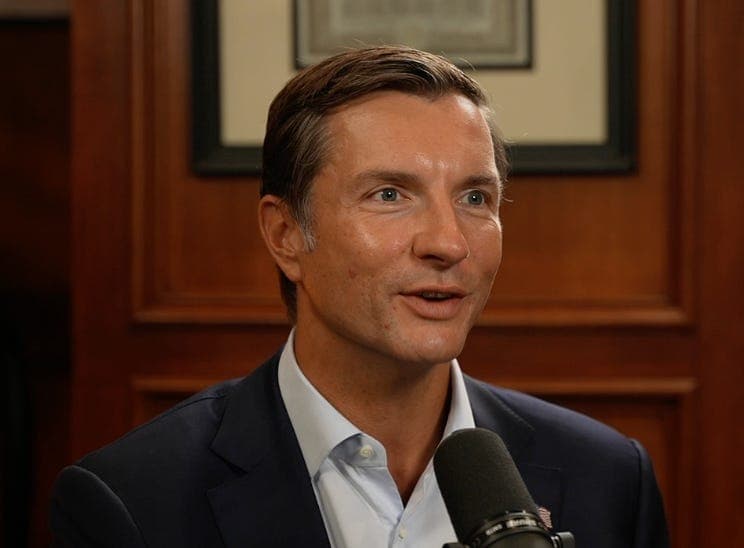
Jacob Helberg is Undersecretary (U.S. State Department, Economic Undersecretariat), founder of the Hill and Valley Forum, and author of “Wires of War: Technology and the Global Struggle for Power.” He previously worked at Google, Brookings (U.S.-China Economic Security Commission), and Palantir.
Key claims
“Pax Silica” will reorganize global supply chains; China is decoupling; AI-driven productivity supports job creation; Europe’s culture discourages “heretical” risk-taking.
Notable examples
a Philippines deal for a 4,000-acre “AI-native industrial park” near Subic Bay; unemployment below 5% and “7 million unfilled vocational jobs”; PC revolution job displacement/creation; “Pax Silica” growth vs G7 (about 4% vs 1% cited).
Written by AI. May contain mistakes. Listen to the episode to check what was said.
Chapters
Tap a time to open that second in VOThe Impact of AI on Employment
0:00 to 0:35
Exploring the dual nature of AI's impact on jobs and the economy.
“In the history of human civilization, we have never encountered a time when you had a technology that led to mass unemployment.”
Introduction to Pax Silica
0:35 to 1:29
Understanding the significance of Pax Silica in global supply chain reorganization.
“We need to win the race for global market share.”
Securing Supply Chains for the AI Era
1:41 to 2:19
Jacob outlines the core mission to secure supply chains in the AI race.
“You were confirmed as undersecretary last fall.”
Global Demand for American Technology
2:19 to 2:56
Discussing the international appetite for American technological advancements.
“And that's why we're doing deals around the world on energy, on minerals, and on infrastructure.”
Building AI-Native Industrial Parks
2:56 to 3:47
Details on the historic agreement for an AI-native industrial park in the Philippines.
“As you know, we are engaged in a massive re-industrialization effort in the US.”
U.S. Influence and European Relations
3:47 to 4:53
Examining U.S. efforts to strengthen influence in Europe and address economic concerns.
“They're excited what you guys are doing.”
Critique of European Economic Policies
4:53 to 7:42
Jacob discusses the need for economic reforms in Europe to stimulate growth.
“I went to Europe, As you know, I lived in Europe 18 years and when my mother worked at the European commission, believe it or not.”
Cultural Attitudes Towards Success
7:42 to 11:14
Exploring the cultural disincentives to success and innovation in Europe.
“And well, so the good news is the Draghi report, who was obviously authored by Mario Draghi, an institution in the European establishment, really basically says exactly that, that Europe's economy is anemic.”
The Role of Borders and Economic Flexibility
11:14 to 13:01
Discussing the significance of borders and workforce flexibility in economic growth.
“And they come up with these things like the sanitary cord, as though these right-wing parties are just beyond the pale and a fundamental threat to the republic.”
Personal Experience and Tech Policy Evolution
13:01 to 13:52
Jacob shares his experiences at tech companies and their influence on his views.
“Well, Jacob, you worked at Google in the past.”
Show all 20 chapters
Asymmetrical Power of Technology
13:52 to 14:06
Analyzing how technology can create asymmetrical advantages in global power dynamics.
“And it's really fascinating because it really shows how the asymmetric nature of technology and how you can have, you know, really small.”
The Flaws in Linear Thinking about China
14:06 to 16:52
Explore the misconceptions about China's economic growth and the impact of technology on it.
“I mean, for a long time, our foreign policy debates were dominated by very linear thinking.”
The Optimistic Case for AI and Employment
16:52 to 19:01
Understand the positive outlook for AI and its effects on job markets and productivity.
“and you're seeing productivity go up a lot right now.”
Pax Silica: A New Coalition for Economic Security
19:01 to 22:11
Learn about Pax Silica and its role in reshaping economic security through international collaboration.
“And they think that they're not doing that badly because they're in a low growth environment, but they're not in a recession.”
The Role of the Philippines in Global Supply Chains
22:11 to 24:35
Discover how the Philippines fits into global supply chains and the benefits it offers.
“holistic approach, an ecosystems-based approach to supply chain security.”
Principles and Policy of Pax Silica
24:35 to 27:51
Examine the fundamental principles that guide Pax Silica and its policy initiatives.
“We need the inputs in order to keep our factories running here.”
Insights on Administration Dynamics
27:51 to 28:03
Gain insights into the professionalism and dynamics within the current administration.
“And I know from speaking earlier, you were telling my wife how positive you are in this administration.”
Working Dynamics in the White House
28:03 to 29:26
Learn about the unique professional environment and dynamics within the current administration.
“I mean, we have a, this is an incredibly unique administration.”
China's Response to Pax Silica
29:26 to 30:54
Explore how China views Pax Silica and the competitive landscape between the U.S. and China.
“But I mean, just even speaking offline, obviously you're very positive on what's going on.”
American Economic Optimism
30:54 to 33:35
Understand the positive outlook for America's economy and the future of global trade.
“much, you know, our private companies are very positive some because they work through joint ventures.”
Transcript
Automatic transcript. May contain errors.0:00In the history of human civilization, we have never encountered a time when you had a technology that led to mass unemployment. Many people are skeptical of the AI in the U.S. People would have said that personal computers would have put a lot of secretaries out of work. In reality, the PC revolution gave birth to the software industry, and it displaced 3.5 million jobs, but it actually created 19 million jobs in America. For all of the noise in the press, unemployment is still below 5%. We are at the center of the biggest economic revolution in over 100 years. Let's talk about Paxilica. We are probably engaging in the biggest reorganization of the global supply chain in a very, very long time.
0:41We need to win the race for global market share. We need to win the race for innovation. And we need to win the race to secure our supply chains.
0:56Undersecretary Jacob Hellberg is working with the Trump administration and Secretary Rubio on PAC silica. He's securing supply chains, minerals, energy, all the things we need for the AI revolution. And he's partnering with new countries to make them key allies. Who's going to grow faster? What countries are going to be left behind? What does AI diplomacy look like in the next era of American dominance. How is China pushing back? And how is America working to make sure we're positive some allies that lift up all of our allies versus China expropriating from them? Jacob Helberg is optimistic on the US and the next great American century.
1:28Welcome to American Optimist. Really excited to have my friend, Undersecretary Jacob Helberg here with us. Jacob, you're the founder of the Hill and Valley Forum. You're also an author of the Wires of War Technology and the Global Struggle for Power. It's good to have you here in Austin. Joe, it's great to be here. You were confirmed as undersecretary last fall. What's your mission and why are you doing this? So our core mission at the State Department and the Economic Undersecretariat is to secure our supply chains. There are three conditions we need to meet to win the AI race. We need to win the race for global market share.
1:59We need to win the race for innovation. And we need to win the race to secure our supply chains. China is on a path to decoupling from us and de-risking all of its single points of failure. It's absolutely essential. And I think the last 20 years of lived experience has shown us the importance of actually de-risking the choke points that our economy depends on. And that's why we're doing deals around the world on energy, on minerals, and on infrastructure. And it's incredibly exciting about the progress we've made. So what's the most surprising or interesting thing you learned so far? Well, the amazing thing that I've learned is just the enormous insatiable appetite that the world has for American technology.
2:39And just last week, we signed a historic deal with the Philippines, 4 ,000 acres, right next to Subic Bay, where we're going to build a first-of-its-kind AI-native industrial park. And the goal is really to secure inputs that are vital for American and global supply chains. As you know, we are engaged in a massive re-industrialization effort in the US. A lot of those factories depend on so many different inputs that come from all corners of the world. And right now there is a massive over-concentration of those inputs from China. And so the goal is we are walking and chewing gum at the same time.
3:15We need to re-industrialize at home while making sure that all the factories that are in Ohio and in Oklahoma and in Virginia actually have all of the inputs and niche motors and components that they need to keep running and actually being cost competitive. And so we're looking and triaging interests from a number of companies in order to consider what the long-term build-out is going to look like in the Philippines. And it's very exciting to actually build this out from first principles and actually create a platform out of it. I love it. I was there for a day in the Philippines with everyone.
3:49They're excited what you guys are doing. Yeah, you were there right when we were in the last mile of negotiating that agreement, actually. I'm glad I didn't screw anything up for you. They were actually raving about you. Very, very good. The president's an interesting guy. My friends are close to the defense secretary. You got some competent pro-US people over there. I'm a little worried about the impact of AI on their BPO economy. So hopefully we can build some stuff with them. It's a good ally. So you get to work closely with some interesting characters. What's it like working with Marco Rubio?
4:19You know, he has really set an example of professionalism at the department. The department is incredibly well-run. We have no leaks. We are a very low drama department. Everyone is heads down focused on advancing the president's agenda. We have had an incredibly successful tenure. I mean, the operation Venezuela was incredibly historic in terms of regaining influence in our hemisphere. And we are actually raising all of the right and hard questions with Europe, which are really overdue. I went to Europe, As you know, I lived in Europe 18 years and when my mother worked at the European commission, believe it or not.
5:01And I, I, so I went back to Brussels a few weeks ago and I told them, you know, um, it, when you really love someone and someone who's sick, the empathetic thing to do is actually tell them that you're worried about them and that they're not doing well. Um, it is not, there's nothing empathetic about self-denial and pretending like everything is completely fine when it's clearly not. And the reality is we are Europe's only ally who cares about them enough to be willing to have those hard, uncomfortable conversations. And so I think that message was generally quite well received. Um, Europe has not grown meaningfully in over a generation and everyone can see it.
5:46And you travel around the world. I certainly talk to lots of people from around the world, and it's really gained an international reputation for overregulation and low growth. And it's incredibly sad because it's a place that has given birth to so much ambition and adventure and innovation for 2 ,000 years. It's really, really sad to see in just 50 years, 2 ,000 years of civilization being unraveled. It's really interesting because there's all these historical theories on why Europe was so dynamic. And I think there's like certain competition that's really good that was really helpful to it. Obviously, you don't want another world war.
6:23And so I think because of the world wars, they've kind of like brought everything together. But then but then somehow it's just totally stagnated. And your mother was what did she do for the government there earlier? Yeah. So she was a web programmer. So she was, you know, not really a politician at all. She was a web programmer for the, they call them DGs. It's basically like their equivalent of ministries basically for the DG education and culture. um she had a very you know sort of small you know humble job as a programmer there um she was the editor-in-chief of a magazine in paris back in the early 90s but then left the job market for a long time because when my sister and i were growing up to be a stay-at-home mom and so by the time she re-entered the workforce the industry had totally changed so she actually taught herself how to code um at 47 believe it or not and uh and then just became a programmer.
7:14And so she was doing that. And I think, you know, like a lot of Europeans, she really wanted to believe in the European projects of the European union. But I think it's, it's, you know, for people who really remember what Europe was like in the nineties, it's really hard to look back at the last 30 years and conclude that Western Europe today is better off than it was 30 years ago. So if we're talking to them, like, what are we telling them to do differently? Like, like, what does Europe need to do in your mind to get back to where it needs to be. Totally. And well, so the good news is the Draghi report, who was obviously authored by Mario Draghi, an institution in the European establishment, really basically says exactly that, that Europe's economy is anemic.
8:03It needs to deregulate. It needs to put an emphasis on productivity. And any regulation in Europe needs to factor in the impact on growth. And sometimes I hear European politicians, they run for office, they're in office, they do these interviews and they kind of lay out these super complicated plans for somehow reviving the economy when in reality, it's actually not that hard. All you have to do is have a secure border, deregulate lower taxes and bring down the cost of energy. That's it. If you do that, investment will come pouring in, you will have growth again, and you'll start to see unemployment start to decline.
8:46And Sarkozy kind of did this in the late 2000s, and France's unemployment was actually trending towards 5%, but obviously that was cut short. It seems like there's an element related to that where they're just really negative on successful people. I don't know if it's a jealousy or it was just like criticism from sticking out or there's something about how there's something wrong with you if you're too successful there, which seems to be very anti-growth as well. Is that tied to it at all in your experience? Yeah. And it's interesting because in a way, and our friend Alex Karp actually talks about this a lot, about how there's something really unique about American culture and that has given rise to Silicon Valley.
9:28And when a lot of countries have tried to replicate Silicon Valley, but there really is, you know, to have a community like Silicon Valley, you need a certain cultural approach to risk taking. People being willing to be heretical and contrarian. The heretical thing is really key. And in Europe, you know, culturally, I actually think that strand definitely used to be there when you look at, you know, all the incredible thinkers and, you know, researchers. But today, I think the inertia is just so strong, where if you stand out too much, you kind of get cut down, you know, because you're ridiculed or, you know, the press just totally goes after you.
10:13And so I think, you know, the culture has kind of changed in a way where it really strongly disincentivizes risk taking and heterodox thinking. I talked about this with Shom earlier and how in the Pentagon it was always the heretics who like went against the bureaucracy and did the right thing and forced it through that kind of made everything work. And it feels like in Europe right now, you're saying they're particularly against the heretics, particularly against people who think too differently right now. Yeah. And if you look at, I follow French politics a little bit more closely than other countries, simply because, you know, by virtue of my own background, but, you know, they come up with these concepts, you know, frankly, in France for a long time, I think one of the frustrations that the public has had is that the options that a lot of people have had in politics is a left is a left wing leftist government and a right wing leftist government.
11:04And there has lacked, you know, an actual right wing government. Was it like in UK, like the Tories and labor, like the Tories ruled like the Democrats. And then that didn't work. So now they're going with like the far left Democrats. Yeah. Yeah. And so and so now you basically have, you know, Marine, you kind of have an ecosystem of, you know, a handful of different parties, primarily led by Marine Le Pen's party, who actually have, you know, more right wing viewpoints on immigration, at least on social issues, on immigration and security. and they brand them as far right. And they come up with these things like the sanitary cord, as though these right-wing parties are just beyond the pale and a fundamental threat to the republic.
11:45And it's just, it's so crazy because what you're doing is you're basically telling people and voters that if you support those parties, you are basically emulating, you're right there supporting the Nazis, basically, is kind of what the implication is. Which is ironic because you obviously support a lot of that and you yourself are Jewish as well, so. Yeah, yeah. I mean, I think the fact that we have gotten to a place where some schools of thought have emerged and it's really a global phenomenon where having a border is seen as being radical and wanting to have workforce flexibility to be able to have a dynamic work environment is seen controversial.
12:28I think is really, really a shame. And, and I think, you know, the interesting thing is, and frankly, I think Americans are actually pretty good at being clinical about these things. But if you just look at the evidence, countries who actually have a more capitalist approach to their economy actually outgrow and do better than countries that are more socialist. And that's just a fact. And I really wish Europeans saw that and kind of took that feedback because it feels like they're trying everything, but that. Oh, it makes sense. Well, Jacob, you worked at Google in the past. Uh, I think it was the U S China economic security commission at Brookings.
13:07You were at Palantir for a little bit. How did these shape your interest right now? I guess is it, so you're working a lot on AI. Is it, do those, does that kind of lead into that? Yeah. So it's interesting because, um, so I worked at Google right when, you know, tech policy became a thing. Um, it really wasn't seen as, uh, a field, you know, uh, uh, uh, uh, an issue worth a big topic of discussion until about the mid to late 2010s, basically. And then there was just all sorts of tech policy debates that started emerging. And then joining Palantir really helped me, gave me a window into these two huge trends, the AI revolution and the global rearmament that is taking place around the world and how technology is changing hard power.
13:54And it's really fascinating because it really shows how the asymmetric nature of technology and how you can have, you know, really small. I mean, for a long time, our foreign policy debates were dominated by very linear thinking. So people said, you know, China has 1.4 billion people. Therefore, they will inevitably become the largest economy because if their GDP per capita rises remotely close to ours, obviously they're going to overtake us by a lot. But that school of thought had a fundamental flaw, which is it didn't factor in for the asymmetric power of technology. It's true that China will catch up to us.
14:39if you assume that we live in a world where the prevailing economic trend is convergence. As you know, you know, from the world in tech, you don't have convergence. Sometimes you have divergence and sometimes you actually have, you know, unlinear, nonlinear growth. And it's interesting because you can have, you know, at a micro level, you can see that with a country like Israel that has less than 20 million people that has a bigger GDP and a stronger military than Nigeria that has a quarter billion people. And it just goes to show how tiny Israel actually has a larger economy than a quarter billion people country.
15:22Technology can be very divergent. Very divergent. Very divergent. Especially right now. So this is a moment in time where it seems very divergent. We're all living through everything going on with mythos and with productivity. I'm very bullish on productivity. It's going to reshape our country. But if you look at the polling, many people are skeptical of AI in the US. How do you think about this? What's the optimistic case for AI? I think the optimistic case is for all of the noise in the press, unemployment is still below 5%. And so people keep talking about mass unemployment scenarios as though we are living in a mass unemployment environment when the reality is the labor market is actually pretty tight.
16:04We have unfilled jobs for technicians, for lots of different fields. In manufacturing, it's really hard to hire because we have - It's so hard to hire. There's like 7 million unfilled vocational jobs. That's right. I have this very obnoxious view, which is that if you are not mentally retarded and you want to learn and work, you can get a job right now. I know you're not supposed to say as a politician, but that is the case right now. There are a lot, a lot of unfilled jobs. And the data shows that. Unemployment is historically very, very low. we are at full unemployment. The IMF standard for full employment is about 5%.
16:37We're actually below that. I want someone to like email me and tell me how they like, can't, if they're willing to learn and they're willing to go to vocational school, which we're willing to, which we pay for, by the way, the government, like how they can not get a job. And I just, I feel, I feel like it's just like, yeah, I don't understand where people are coming from. I don't know. Yeah. And, and, and you're seeing productivity go up a lot right now. I mean, we're at 5 % productivity growth. And so I think the bull case is in the history of human civilization, we have never encountered a time when you had a technology that led to mass unemployment.
17:11And so, you know, there's, I think, you know, in the debate on the future of work, I think you can look back at history and say, if you look at the computer revolution, people would have said that personal computers would have put a lot of secretaries out of work. But in reality, the PC revolution gave birth to the software industry. And it displays three and a half million jobs, but it actually created 19 million jobs in America. I'm definitely paying for a lot of administrative assistance right now for various things. Exactly. Not just for myself, but for all my teams and everyone. It seems like we're still using them.
17:46So part of your job as Undersecretary, Jacob, is to examine how AI and other advanced technologies impact geopolitics. Like, how is this changing national security balance of power? What does it mean for these things? Well, it's going to mean that, you know, and the interesting thing is we launched Paxilica, which is a fundamentally different grouping than the G7 and the G20. And the G7, which is obviously an artifact of the Cold War. you're really seeing diverging growth. And because AI is productivity, productivity means growth. And so economies that are leaning into AI are actually growing a lot faster than economies who aren't.
18:22And what we're seeing is the Paxilica countries are growing roughly around 4 % year on year compared to G7 countries that are growing somewhere in the zone of 1%. And that kind of diverging growth Growth is likely to lead to, if you extrapolate that for a decade, it's likely to lead to a very different map 10 years from now. So you think 4 % versus 1 % right now is the average. Yeah, because that means you're doubling in 18 years versus doubling in 70 years. That's right. One generation of this, and you're a totally different country. Totally different country. Which is what happened to Europe, by the way, is they don't realize they're the poorest relative to all of our states because we've just been growing so much faster for the generation.
19:00Yes. And they think that they're not doing that badly because they're in a low growth environment, but they're not in a recession. And so they think it's not a crisis. But when the rest of the world is growing at 3%, it actually is a crisis because you are becoming relatively poorer than everyone else. How do you assess China's capabilities in the AI race? So, you know, it's interesting because China is without a doubt our most formidable competitor. Their superpower is their incredibly deep manufacturing ecosystem. With that being said, our software companies are better by a lot. I mean, we are objectively leading in AI and in model development.
19:41And, you know, China has a lot of problems. They're at a macroeconomic level. Their economy is really not doing well. They are decelerating at home. You know, their data is really falsified. And they actually tried to hide their books so much so that they've made it illegal for people within China to ask too many questions or do due diligence on their economic indicators. It's what people don't realize is in China, they just make a lot of this illegal to ask and figure out. Their economic indicators are untethered from reality, and they're not growing at 4 % or 5%, whatever the official number is.
20:22And so their economy is not doing well. And so the interesting thing is that they are actually entering a phase where they're becoming a little bit more akin to where the Soviet Union was back in the late 70s, which is low growth, but still very, very technologically formidable. I mean, there's amazing things they're doing with innovation and manufacturing, obviously. There's certain areas where I think they are even ahead of us. But then I think when you have a communist economy, and Xi Jinping really is much more of a commie than any of us, I expected anyway, 10 years ago. It just breaks things, I guess.
20:56Yeah. And I always find it interesting when people overseas want to invest in China, because every successful person in China, all they want to do is get their money out of China. And so to me, why would you want to put your money in a country that doesn't believe in the right of private property and where all of the elites want to basically, you know, find clever ways of getting their money out of the country. To me, that's obviously a red flag. But, you know, it's, they have really wrecked their economy, but we, you know, are obviously, they're never to be underestimated because their manufacturing ecosystem is incredibly powerful.
21:32Yeah. I guess they had these free economic zones that you just get way ahead and that we partnered with for generations. So they have some advantages there. You know, it's kind of sad. I kind of wish that they weren't communists and we could work with them because there's so many amazing Chinese people there who are so talented, but I think for now, it's a lot of them in Silicon Valley. Well, we get this as a power, a lot of Silicon Valley. Yeah, it's for sure. You know, so let's talk about PAC Silica. This is something you created with the secretary, with Secretary Rubio, like what does a diplomacy look like?
21:58What are you guys doing here? So PAC Silica is an economic security coalition with a group of now 14 countries that each bring unique industrial capabilities to bear to help secure our supply chains. We want to take a holistic approach, an ecosystems-based approach to supply chain security. And so one of our first big flagship efforts is the rollout of this economic security zone in the Philippines. Part of what we're looking to do is actually partner with countries to have a product-driven approach to foreign policy. China basically has done the Belt and Road Initiative for 25 years now, And it's basically, you know, the Chinese government has these state owned enterprises and in-house where they basically implement a lot of these big capital intensive industrial projects.
22:48For us, you know, it doesn't make sense for America to do that because that's not our strong suit. We're not the government's not good at doing things in-house. What we're really good at is we have companies that make really great products. And so we want to lean into our unique strengths by having a product-based approach to foreign policy. And so as the government, we want to create the right environment and the right incentives and create platforms on top of which companies can build. So the economic security zone is our big first platform. We're planning on rolling out three more by the end of June.
23:28and ultimately, we're going to make a big play in logistics. We're going to make a big play in minerals and they're all going to connect together. And so to everyone watching, if they're interested in building really, really fast, we know a place where they can do it. So, I mean, this kind of reminds me of the original industrial revolution where it started really in the UK and then it spread very quickly to Europe and to America. And then back then, I think there was a lot more freedom in general. So you kind of already had, you didn't really need a free economic zones because the countries were basically free economic zones.
24:03I mean, on the margin with after the enlightenment and it really lifted up those parts of the world so much faster than everything else. And so now we have a new industrial revolution. It's definitely centered in the U S and is this, this is a way, is this a way to help spread that industrial revolution to our partners? It supports us, but supports them too, I'd imagine. And, and it's, it's, I mean, the main, it's actually very mutually beneficial because Because obviously, for the Philippines, this is going to be jobs, investment, and making sure that the Philippines is a key anchor in the global technology supply chain.
24:35For us, it means that our companies and our factories and all of the operations that we are building out here in the U.S., hundreds of billions of dollars in investments, will never be held hostage by an adversarial foreign power. We need the inputs in order to keep our factories running here. And that's why we're doing this. Is there any chance that the EU would have some free economic zone to be part of PAC Silica? They need it. They need it. Do you do it if they wanted to? You know, we were actually talking with one EU country. I don't want to get them in trouble, so I won't say which one. Can you get around Brussels for a free economic zone?
25:16That seems tough. That seems tough. But, you know, they're really, really interested. They, they, a lot of national, so the fascinating thing about Europe is a lot of national governments actually really want to do the right thing and are very pragmatic about their economy. The challenge is, is that they have to deal with a supranational European commission that irrigates more and more power away from national governments by passing a new regulation. They're like, okay, guys, we're gonna have a free economic zone, but it's going to be 32 hour work weeks. We're going to have African migrants. and there's going to be free operations for trans people yeah by free economic zone they mean you know everything has to be free and oh man well i hope i hope i hope for europe's sake you can get to do that but this is obviously makes sense for philippines i hear it'd be something with israel i've been allowed to say that like what like what else who else is part of this yeah so we're we we want to have one in every hemisphere um we think it makes a lot of sense and and we obviously want them to be connected.
Read the full transcript
26:19And so we're having lots of really great conversations with a number of our partners. We hope to basically reach that goal before the end of the year. Amazing. Amazing. Well, maybe given what we're doing in Venezuela, who knows, you could do stuff there too. It could be exciting. The sky's the limit. And you said, I think there's three core pillars, I guess you say, there's principles, partnership, and policy. What does that mean? Yeah, so we started with the declaration in December, and that declaration was really an articulation of our first principles, principles that we share. You know, what are the core, the North Star that we want to work towards and the things that are really going to bind us together?
26:58And so obviously there's a lot of clauses in there about having a pro-innovation approach to regulation. There's a lot on supply chain security and the protection of critical infrastructure. then we want to basically you know take that those principles and say okay how do we translate this into action and so we decided to set up two work streams one on policy and one on on projects the one on projects are the products that i mentioned earlier the idea of having you know three or four different key flagship project projects that um we want to productize and roll out to the rest of the Paxilica ecosystem.
27:37And then policy workflows are conversations that we have to have around the protection of an intellectual property, the protection of sensitive technology, critical infrastructure, and the promotion of an AI-friendly regulation agenda. Awesome. And I know from speaking earlier, you were telling my wife how positive you are in this administration. You spoke, of course, very highly of Secretary Rubio. Who else is in the administration that you get to work with? What's the dynamic like working with the White House? Yeah. I mean, we have a, this is an incredibly unique administration. I mean, it is such high caliber.
28:12As we were catching up earlier, you know, Secretary Rubio has really brought a sense of professionalism to the department that has really been phenomenal. And the undersecretaries work very, very hard to really emulate that standard of professionalism throughout our undersecretariat. You're not supposed to be making jokes about any of this stuff. About any of which stuff. Professionalism means you can't just like start speaking appropriately about things. Exactly. Okay, I'll push you on it then. And, but Secretary Lutnick has, you know, taken such an entrepreneurial and industrialist approach to the Commerce Department.
28:52It really is like having a bunch of like industrialists and business people in the government right now. Yeah, we have a team of executives. And, um, and they're really doing, um, an unbelievable job. Is there anything that's like particularly annoying about working in DC? You know, um, it's hard for me to say because I feel like I live out of my office. So I don't really know what it's like to live in DC because I basically spend my days between the Harry Truman building and my house. Um, so, um, but you know, hopefully I'll get a little bit more absorbed in the tapestry of the city. I want you to give us anything negative.
29:28But I mean, just even speaking offline, obviously you're very positive on what's going on. You guys are having a hugely positive impact. And is China trying to push back on PacSilk at all? Are there like adversarial things you're experiencing at all? You know, I don't think they're thrilled about it, but that's okay. I mean, they also, they don't expect us to not compete. I mean, I think that's just kind of baked into the cake. Like they're, they, you know, the president has been clear that he wants to have a positive, constructive relationship with Xi Jinping. And he does. They actually have a very good rapport.
30:02That doesn't mean that we're not going to compete. And so and I think everyone kind of understands that we are about we're always going to put America first. And, you know, so we can do both at the same time. I feel like when we say we put America first, we're also partnering with our allies to lift them up. Like that's just, we're very positive somewhere. So if you look up China's Belt and Road and you go to these countries, they're very negative on the Belt and Road because it's almost like they went there and the Chinese people built it themselves with their own labor and their own restaurants and their own stuff.
30:31And they extracted for their economy, but they didn't go there to lift people up. And right now all the Belt and Road loans are coming due and no one can pay them. It's a big crisis right now. They're trying to get money at the IMF. So it does seem like our approach is a lot more positive some than theirs. Is that your experience? Well, this is a fundamentally difference, a fundamental difference between the American approach and the approach that the Chinese have had. And I think part of that might be because China has, has used state-owned enterprises so much, you know, our private companies are very positive some because they work through joint ventures.
31:03They have lots of partnerships with lots of companies around the world. You only win if everyone wins together. Exactly. And, and so, you know, our companies are very comfortable partnering with others. And I think, you know, especially in the tech industry, people really believe in a growing pie. So there isn't this view that, you know, people are trying to basically compete to get a bigger slice of a shrinking, you know, of a shrinking pile of wealth. They believe that the pie grows. And so that really is a fundamental difference between us and China. I love that about what you're doing. You really are like, we care about our partners.
31:39We care about the Philippines and others doing well and succeeding. And we're going to help them do that with our work here. And that's, I think that's a fundamental core. When I'm in the palace with the president there, we can honestly say that we care about them winning because otherwise it's like, what are we doing with this? We started this podcast to push back against like cynics and doomers. And what do you think you can achieve during your time in Washington that's positive? A lot of people say, oh, nothing's getting done. Like you're obviously very optimistic on it. Like, like, like, what do you think the future of America looks like because of the work you're doing there?
32:06I'm actually incredibly optimistic. I mean, this administration is laying the foundations for the next several decades of American success. We are at the center of the biggest economic revolution in over 100 years. And that is really directly thanks to the president's policies on energy, on accelerated permitting, on tax incentives with full CapEx intensity. expensing and on trade, creating the environment to make sure that America is the birthplace and the engine of the AI revolution. It has been incredible. And I think you really see that just by how resilient the economy is, the American economy is, despite global headwinds.
32:56We're taking steps that will actually, that helps secure our hemisphere. And then economically, I mean, we are probably engaging in the biggest reorganization of the global supply chain in a very, very long time. And so, you know, this economic security zone that we're doing in the Philippines, as well as the critical minerals deals that we're doing around the world and PAC Silica, the partnerships that we're doing through PAC Silica are going to completely rechange the map of the global supply chain. And what that means is the picture for global trade flows will be very different in the future.
33:34And so we're present at the creation in a lot of ways, and it's a very exciting thing. Awesome. Well, Jacob, we're grateful for the work you're doing with the president and Secretary Rubio and everyone else in the administration. So thank you very much. Thanks for having me.
From the publisher
Jacob Helberg is leading the State Department's efforts to secure critical supply chains and win the global AI race. How is the U.S. shifting from dependency on China to building new partnerships around energy, minerals, and infrastructure? Which economies will grow fastest in the AI era? Who will be left behind? And how will this impact geopolitics? We discuss these timely topics with Jacob, Under Secretary of State for Economic Growth, Energy, and the Environment. A tech policy veteran who worked at Google and Palantir before serving on the U.S.-China Economic and Security Review Commission, Jacob was confirmed last fall to help execute the administration’s economic statecraft agenda. He's the author of "The Wires of War: Technology and the Global Struggle for Power."We begin our conversation with Jacob’s mission at the State Department and the launch of Pax Silica: a new US-led economic security coalition to secure supply chains and help America dominate in AI innovation. We dive into Jacob's recent deal in the Philippines to build an AI-native industrial hub, and explore the contrast with China’s Belt and Road Initiative. Next, Jacob makes the bull case for AI drawing on lessons from history: the PC revolution displaced 3.5 million jobs, he explains, but created 19 million more with the advent of the software industry! Finally, he explains why principled, positive-sum diplomacy is delivering results where old models failed, and how the AI revolution is transforming the global balance of power.
00:00 Episode intro
02:30 Historic deal with Philippines
05:25 Jacob's background
07:30 Why is Europe falling behind?
13:00 The asymmetric power of tech
15:35 Jacob responds to AI doomers & skeptics
19:15 Global Competition: China, AI, and Diverging Growth
21:45 What is Pax Silica?
23:45 New Global Order in AI age
29:30 Is China pushing back?
31:45 Optimism for the future
This is a public episode. If you would like to discuss this with other subscribers or get access to bonus episodes, visit blog.joelonsdale.com