In short
Coleman Hughes argues that America should study the legacy of slavery without turning it into a partisan “weapon” that assigns moral worth by race. He contrasts “maximalist” views (everything traces to slavery/white supremacy) with “minimalist” views (little direct through-line), and says each issue should be judged case-by-case with evidence.
Guests
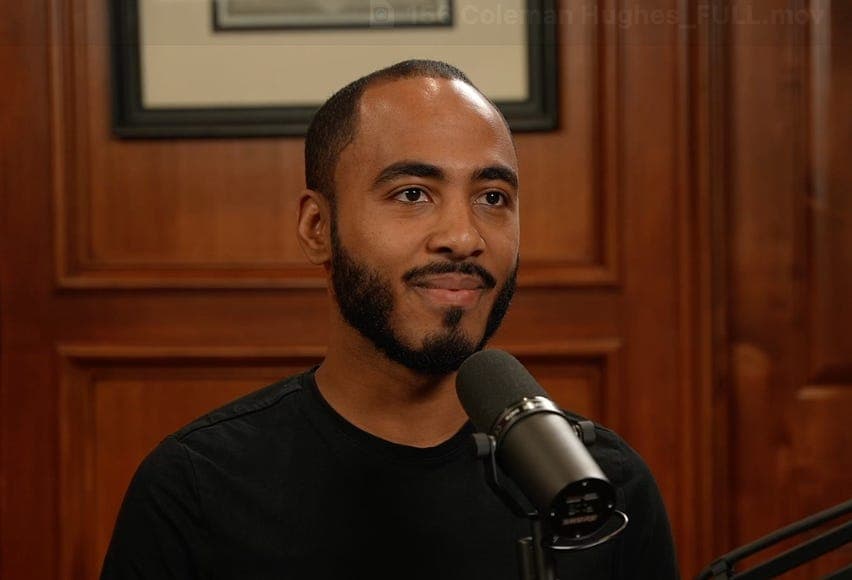
Coleman Hughes, author of The End of Race Politics; host of Conversations with Coleman; visiting professor at the University of Austin (UATX) teaching “The Legacy of Slavery.” Background: grew up in Montclair, NJ; describes being influenced by Martin Luther King–style “content of character” thinking; says Columbia exposed him to critical race/identity-focused ideas that he found inconsistent with lived experience.
Key claims
1619 Project’s central narrative is flawed (e.g., 13 colonies rebelling to preserve slavery); mass incarceration is not primarily a slavery legacy; Western abolitionism emerged earlier than “slavery was always wrong” claims suggest; hypocrisy about founding principles helped force resolution on slavery.
Notable examples
Thomas Sowell’s global history of slavery; Moynihan report on Black family structure; Akerlof’s “Shotgun Marriage” theory; comparisons of emancipation episodes (US 1865, Russia 1863–1900, Brazil 1880s).
Written by AI. May contain mistakes. Listen to the episode to check what was said.
Chapters
Tap a time to open that second in VOIntroduction to the Legacy of Slavery Debate
0:00 to 0:41
Explore the contrasting views on the legacy of slavery in America.
“If you want to weaponize the history of slavery to divide Americans, the subconscious lesson is white people, evil, black people, good.”
Introducing Coleman Hughes
0:41 to 1:44
Learn about Coleman Hughes and his course on the legacy of slavery.
“Coleman Hughes is one of my favorite young American intellectuals.”
A New Approach to Teaching Slavery
1:44 to 3:30
Discover how Hughes plans to teach the legacy of slavery differently.
“Really excited to have my friend Coleman Hughes with us today.”
Maximalist vs. Minimalist Views
3:30 to 5:12
Understand the two schools of thought regarding the legacy of slavery.
“maximalist and the minimalist school of thought.”
Critical Examination of Arguments
5:12 to 6:05
Hughes explains how he presents various arguments in class.
“But it doesn't seem like it explains everything.”
Coleman's Intellectual Journey
6:05 to 8:25
Hear about Hughes' background and his path to becoming an intellectual.
“And the goal is really not to impart to them like my personal view as a professor.”
The Critical Race Theory Perspective
8:25 to 10:41
Explore the foundations and implications of critical race theory.
“He got angry at me for using the word woke.”
Thomas Sowell's Take on Slavery
10:41 to 14:01
Discuss Thomas Sowell's views on the history of slavery and its implications.
“And that's where the black power movement comes from.”
Historical Context of Slavery
14:01 to 16:43
Explore the global history of slavery and its various aspects.
“modern day and benefits some people politically, right?”
The Evolution of Abolitionist Sentiment
16:44 to 19:06
Learn about the emergence of abolitionist sentiments in the West and their implications.
“And then you actually look at, so where did the sources against slavery come from?”
Show all 22 chapters
Hypocrisy and American Founding Principles
19:07 to 21:56
Discuss the hypocrisy surrounding America's founding principles regarding slavery.
“So, one reason America comes in for extra criticism is because of the hypocrisy, right?”
Dr. King's Legacy and Modern Activism
21:57 to 24:16
Contrast Dr. King's vision of civil rights with modern activism.
“Even if we get inside, we're never going to be full citizens of it.”
The 1619 Project Overview
24:17 to 26:30
Understand the key tenets of the 1619 Project and its historical implications.
“And the real reason they tore him down, as far as we could tell, is he was a leftist activist that they had his name everywhere.”
Critique of the 1619 Project
26:31 to 28:05
Examine the criticisms and controversies surrounding the 1619 Project.
“The New York Times launched this, I think it was in 2019.”
Fact-Checking the 1619 Project
28:05 to 29:48
Discussion about inaccuracies in the 1619 Project and ignored contributions to civil rights.
“Hey, like, look at this before we vet it.”
The Impact of Family Structure
29:48 to 33:36
Exploration of the changes in family structure within the black community over decades.
“in my view is one of the most dangerous paths we could go down as a country is to say some groups of people are just inherently good and some groups of people are inherently bad.”
Cultural Shifts and Marriage Norms
33:36 to 37:10
Examining the decline of shotgun marriage and its effects on family dynamics.
“Now we're at 66 % roughly of single parent homes in the black community.”
Wealth, Slavery, and Economic Growth
37:10 to 42:01
Analyzing the relationship between slavery and America's national wealth.
“really hard to know because once once that a cultural norm like that goes away it's super hard to reinvent in the absence of extremely strict religion.”
The Economic Impact of Slavery
42:01 to 43:34
Explore the economic consequences of slavery on land use and labor markets.
“but then like the land itself is not being used nearly as well as if you have a bunch of free people.”
AI and Critical Thinking for the Future
43:34 to 45:26
Discuss the role of AI in shaping beliefs and encouraging critical thinking among youth.
“It's clearly part of the whole 1619 kind of fake kind of framework to try to say it is, but yeah, but it's unfortunate because a lot of people at our schools seem to be brought up with this nowadays.”
Racial Progress and Colorblind Policies
45:26 to 48:32
Examine the steps needed for racial progress and the importance of colorblind governance.
“The fact that Grokipedia is a great intervention because Wikipedia is going wonky and their efforts to influence it and that therefore influences the LLMs because they're trained on Wikipedia.”
Optimism for America's Future
48:32 to 49:32
Discuss the potential for a positive future in America amidst current challenges.
“And then the third thing is, ultimately, I think when the economy is doing well and when people feel they have good prospects and good schools, that just that lowers tension inherently.”
Transcript
Automatic transcript. May contain errors.0:00Coleman Hughes:If you want to weaponize the history of slavery to divide Americans, the subconscious lesson is white people, evil, black people, good. I grew up with that old school Martin Luther King liberal idea of treat people by the content of the character, not the color of their skin. You're one of the most famous young intellectuals. You're also a visiting professor at UATX. The course is titled The Legacy of Slavery. Wouldn't it be amazing if you could actually study the history and the legacy of slavery, where you can actually read everything from the right and the left and make up your own mind? How worried are you about woke AI?
0:32Coleman Hughes:The extent more and more people get their info from LLMs, that would be probably a net good. How do we get back to racial progress in America? There's three steps to it. One.
0:50Coleman Hughes is one of my favorite young American intellectuals. He's the author of The End of Race Politics. He's frequently on the free press, and he's a visiting professor at UATX teaching a course on the legacy of slavery. A lot of people believe that a lot of our national wealth came from slavery. A lot of people believe that we can never get past race politics. There are really a couple of views coming out of civil rights. There was Dr. King who wanted to judge people on the content of their character. Dr. King wanted to get to a race blind society. And then there were people like Derrick Bell and the Black Power Movement of the 70s.
1:20And really, frankly, the people behind the 1619 Project today who want race to stay at the center of the American story, who believe we can never get past race politics, who believe that everything has to be colored by this guilt and by this obsession. How do we get to the optimistic view? Can we be American optimists about race and about where our society is? There are definitely huge challenges today. Coleman's one of the great thinkers on this topic. He's an American optimist. Let's hear from him. Welcome to American Optimist. Really excited to have my friend Coleman Hughes with us today. Coleman, thanks for joining.
1:48Coleman Hughes:Great to be with you, Joe. Coleman, you're the author of The End of Race Politics. You have the Conversations with Coleman podcast and you're doing stuff with the free press there every week now. You're also a visiting professor at UATX, our new University of Austin. How's that going? It's going great. This is my second time teaching. I've refined the course a little bit. The students are great. I'm having a blast and we're learning a lot. So you're having a blast. The course is titled The Legacy of Slavery. Pretty heavy subject. How are you approaching this class compared to how other universities would approach it, first of all?
2:17Coleman Hughes:So when I was at Columbia, I took many courses on the history of slavery, race relations broadly. And similar to the rest of elite higher education in America, the people you read range from basically centrists at the most to far left. Outside of that, I spent a lot of time in college reading people like Thomas Sowell and Shelby Steele and Jason Reilly and many other names I could name, great conservative thinkers and writers. And I always thought that perspective was missing from those courses. And wouldn't it be amazing if you could actually study the history and the legacy of slavery, racism more broadly, and actually include conservative voices in that picture for college students.
3:04Coleman Hughes:So when I came to UATX, I figured I would be part of the change that I want to see in the world. I would try to create the course I would have wanted to take, where you can actually read everything from the right and the left and make up your own mind and put those arguments in competition and in conversation with each other. So that's what the class is. I think there's two schools of thought, right, that you're trying to teach them. This is the legacy, not the actual history, but the legacy. So you're looking at today as well. There's a maximalist and the minimalist school of thought. What are those?
3:32Coleman Hughes:Yeah. So the course is legacy of slavery, not history of slavery, because I'm not trying to teach kind of a dry history course. No offense to those kinds of courses, obviously, but I'm not asking them to memorize a bunch of dates and put this in sequence. They're going to get some of that through the readings that we do. But what it's really about is this conversation we've been having in America for some 50 years at this point, since the civil rights movement. What is a part of the long-term consequences of slavery and white supremacy and what isn't? So for instance, I know you're familiar with all these arguments, probably your listeners have heard them, but is the prison system part of the legacy of slavery?
4:11Coleman Hughes:Or are the problems and therefore solutions in the prison system, do they have nothing to do with slavery and have to do with modern day ills, other systemic dysfunction, bad incentives, and all that? So I argue that there are two schools of thought, the maximalist school and the minimalist school. The maximalist school are the people that try to attribute virtually everything to the legacy of slavery. It's more of a mindset than a philosophy. It's being on the hunt for clues and fingerprints and ways in which modern American life, the long-term consequence of slavery can still be seen or felt.
4:49Coleman Hughes:And the minimalist school is the opposite instinct. It's the instinct that slavery was a long time ago. We've got many problems today, but there's no clear through line between slavery and white supremacy and, you know, something like mass incarceration. My instinct, just like in general in life, is a dialectic where there's like truth on both extremes. Like there must still be some things from slavery that are having impact today. But it doesn't seem like it explains everything. Like where do you come down on this? I try to take it on a case by case basis because my view is each topic should be treated independently and in an evidence based way.
5:27Coleman Hughes:So if we're talking about the prison system, like that's a case where I genuinely don't think the legacy of slavery has much to do with it. Because if you look at when mass incarceration starts, it starts in the 70s. It starts for reasons that have very little to do with slavery. But, you know, we can get into these topics one by one. But my view is like, as a professor, I try to present each reading in its strongest version for about 10 minutes at the beginning of class. They've already read it. And I make sure of that because I quiz them on it for two minutes at the beginning of each class. And then the rest of the class can be devoted to the strengths and weaknesses in the argument.
6:05Coleman Hughes:And the goal is really not to impart to them like my personal view as a professor. Although sometimes they'll ask for it. My goal is for them to develop the tools to successfully critique arguments that they see, no matter how those arguments are presented. Before you go into more details, I want to step back a bit. I think you're one of the most famous, I can still call you young, young intellectuals. You're 30 now. Barely, yeah. How'd you get into this originally? Like, where'd you come from before Columbia? Yeah. So before Columbia, I was, I grew up in a town in Montclair, New Jersey. It was like progressive town, very racially diverse town.
6:42Coleman Hughes:And I just grew up with the ethic of I had friends of every race and I didn't care what race they were. And I grew up with that old school Martin Luther King liberal idea of treat people by the content of the character, not the color of their skin. And I really lived out that dream. And then when I got to Columbia, I encountered this totally new philosophy, which said, your race is the most important thing about you. If you're a person of color, your POC-ness is almost a kind of magic that makes you in a way morally superior to white people. And not only that, white supremacy is ever present, even at campuses like Columbia, which are extremely progressive.
7:24Coleman Hughes:And this all was very confusing to me because I was seeing my fellow black students at Columbia say things like, I experience white supremacy every day on this campus. So I was a 19-year-old black kid looking around for this white supremacy, waiting for it to hit me, and it was never coming. And so I became curious about the distance between narrative and what was clearly my lived and all of our lived experiences on campus. I was like, what's going on here? Why are people saying these things that are just demonstrably clearly not true? Why are they sounding more pessimistic about American race relations than my grandparents that grew up in segregation.
8:06Coleman Hughes:And that was a curiosity that led me to just read a ton of books, seek out mentors like John McWhorter and Glenn Lowry, and try just to make sense of what people were saying and how it didn't match reality. And that was my whole entry into politics. Glenn's a smart guy. He got angry at me for using the word woke. He made me like define it really precisely. He's a sharp one. So it's an interesting dynamic you just gave there because that's another dialectic, of course, is from civil rights is you have Dr. King on one side and you have, I guess you'd say Derrick Bell and critical race theory on the other side, right?
8:42King had a dream of transcending race, whereas Derrick Bell taught us that racial equality is impossible and illusory. Talk a little bit more about that. It seems like a lot of the scholars in the universities come not from the Dr. King side, but from this Bell side, right?
8:54Coleman Hughes:Yeah, that's right. Yeah. So critical race theory emerges in the 1970s as an explicit rejection of the civil rights movement. In other words, if you go back and read the foundational texts, what they say in their own words was, yeah, Dr. King and Bayard Rustin and A. Philip Randolph and Roy Wilkins. Yeah, they were whatever. They're fine. They did some good things. But fundamentally, their whole view of America and the West was wrong. They have this fantasy that there is such a thing as a race-neutral institution, a race-neutral society. There is a place we can get to where people will be competing on equal footing that the principles our society is based on could even be neutral with respect to race.
9:42Coleman Hughes:and what they do is they make this intellectual move. The analogy I use for it is sort of like, you know how when you're a kid and you learn what an accent is and like you think accents are things that other people have like, oh, he's got an Irish accent. He's got a British accent. And then eventually you grow up and you realize, oh, actually everyone has an accent. The American accent is just one way of speaking English, not the default necessarily. I still have the kid's viewpoint, by the way, but that's... Yeah. Everyone else has an accent. Yeah. So basically, they're doing that, but with respect to all institutions and values and philosophies.
10:17Coleman Hughes:So there is no such thing as an institution or a philosophy or a value that is actually neutral with respect to race. Everything is just favoring one race or the other. So they go, we might as well just be honest about that and tear down this society that wasn't built for us black people, build one that is built for us black people. And that's where the black power movement comes from. That's the philosophy of BLM. And in the manifesto of the black power movement, they even have a line where they say, we can't promise that when we build these institutions, it won't be racist against you guys, right?
10:56Coleman Hughes:Because the philosophy is consistent there. which is what they did with DEI for 15 years is they found ways to be racist against others. And they pretend, I think a lot of them pretended or a lot of people were fooled into thinking it's supposed to be some neutral thing, but it comes from something that's explicitly supposed to be racist against others. It's interesting. Yeah. Yeah. Cause they, they, they think the neutral thing is tilted against them because every, there's no such thing as a neutral, a neutral set of standards in, in their worldview. I put out a post recently that was a little bit controversial on X or I was sharing it.
11:25It was interesting. It took, it said, if you take someone, whether they're white or black or Asian or Hispanic, and you create buckets by IQ, then they actually have very, very similar average salaries in the US. I saw that, yeah. Which seems to me to be a very powerful statistical data point. Because that shows, if someone does have the ability, you obviously have a lot of high IQ and ability, you have just as much potential, according to that data, as anyone of any race in America is seen. Does this show that they're wrong? Is this an important point? Is it missing something?
11:56Coleman Hughes:I mean, in principle, in a meritocratic society, you would want to see a tight link between individual psychometric scores and something like income, right? Maybe IQ may not be the only relevant variable there. There might be other... It's one possible variable. But it's one possible variable, right? And then there's a further question of how to close IQ gaps and all that. But yeah, ultimately, you would want to see a tight link between individual psychometric scores and outcomes. That would be in a way, the measure of, of, of meritocracy. It seems to me it shows they're just wrong and that there's other issues causing the problem, which is, which is there.
12:35So, so who, who was the pushback? So you have the whole CRT, black power, Derek Bell, all that stuff. And then you have like Thomas Sowell, someone that a lot of us and our friends really admire. He's still alive, but he don't see any of us. He's too, I guess he's very private. It was like, it'd be awesome to get to meet him. I tried every means, possible means of trying to meet him. I know he's an amazing man. So he, he, uh, my, my mentor of mine, Milton Friedman was a mentor of his as well. So I met him very briefly, but I was a kid, he don't remember me. But he wrote The Real History of Slavery.
13:02What was Thomas Sowell's conjecture here?
13:04Coleman Hughes:So Thomas Sowell's point in writing The Real History of Slavery was as follows. He said, if you want to use history as a cudgel and as a way of undermining and lowering the status of your modern day political opponents, what you would basically do is focus on American slavery and pretend slavery wasn't a worldwide phenomenon everywhere, and also pretend or omit the fact that Britain in particular, but also America to some extent, are a huge part of the reason why slavery ended all around the world, right? What you do is you put the microscope on on slavery in one country for a few centuries. And the subconscious lesson that that leads to is that white people are evil, black people are noble victims.
13:57Coleman Hughes:And that psychology hardens in the modern day and benefits some people politically, right? Now, if you were being objective, and you didn't have a political axe to grind, Sowell says, you would tell a more global history of slavery wherein you would be sure to include certain facts such as slavery was endemic to Africa before the first Europeans arrived there, had been thriving for thousands of years since time immemorial. The slave trade was not forced on Africans. It was absolutely part and parcel of the way of life, as it was not just in Africa, but pretty much everywhere for most of human history, most recorded history.
14:45Coleman Hughes:90 % of the slaves that came to America or came to the New World, let's say, were originally captured and enslaved by other African tribes, by stronger African tribes, by victorious African tribes, and were sold to Europeans, not at the point of a gun, but just as commerce. In other words, the roots Kunta Kinte version where Europeans are going inland and like capturing people, that happened a tiny bit with the Portuguese, but 90 % of the story of Western slavery, slavery in the new world was not that. Arabs enslaved between, 12 and 20 million Africans over the years, starting with the conquest of Islam in the seventh century.
15:32Coleman Hughes:So not only that, you could talk about Russian serfdom, right? If you think of who is the greatest emancipator of the 1860s, everyone would think Abraham Lincoln. Well, the Russians are emancipated 20 million, 25 million Russian serfs in the 1860s as well, far more than, than Lincoln did American slaves. I mean, there are, there's, you couldn't, and then, you know, you also talk about the enslavement of, of, of Christians, right. Of, of white Christians by, by Muslim North African pirates. I always thought this was fascinating. There were millions and millions of Europeans that were taken as slaves.
16:09They would raid for women for, for, for hundreds of years, they'd raid and steal millions of women into big sex slaves in their empires, as well as the even more African slaves. It's pretty crazy. Yeah.
16:19Coleman Hughes:Sexual slavery was massive and endemic in the Ottoman empire and the Muslim world more widely. Sarkeesian slaves, obviously the word Slav turned into slave because Slavs were the main source of slaves before the Ottoman empire arose. But so all of this, this is the world we come from. And Sowell points out that. In fact, so if you look at slavery just as a global fact of life everywhere on earth, right? And then you actually look at, so where did the sources against slavery come from? Because slavery is sanctioned in the Torah, it's sanctioned in the Bible, it's sanctioned in the Quran, it's regulated in all of these things.
17:00Coleman Hughes:So all of these holy books, actually, if you compare them to the status quo that they entered into, they were all somewhat progressive. And most of them say, like you should treat slaves better and you can't enslave everybody, which again is progressive relative to the time. But where do you get the first abolitionist sentiment? In other words, the first principle of slavery is wrong for all time, no matter who you are. You get that in the West, you get that in America and in Britain in the 18th century, you know, from Quakers and from other religious groups. It's a very enlightenment value in a way, right?
17:33It kind of tied to all the other things going on in the enlightenment. Yeah.
17:35Coleman Hughes:And if you want to try to find it somewhere else in the world before that, you're not really going to find it. You're not going to find it in the Buddhist Analects. You're not going to find it in India. You're not going to find it anywhere. And so this thing we take for granted today that slavery is wrong, it was just not obvious to people that slavery per se was wrong until very recently. And that is a Western... Not only is it a Western principle, it was enforced by the West in the sense that the British Navy went around the world stamping out the slave trade, forcing people, negotiating with Ottoman leaders, forcing them really at the point of a gun to stop slave trading.
18:13Coleman Hughes:And it was over the loud objections of African chiefs, Muslim leaders, all around the world that the slave trade was ended. I have a couple portraits of the British guys who passed the laws over in my game room. If you go look at the guys in robes, they're the ones who banned slavery for the British Empire. And so just to put a point on this, so I talked about how if you want to weaponize the history of slavery to divide Americans, right, the subconscious lesson is white people evil, black people good. But if you look at the broader history of slavery, the real lesson is Western values are basically good and moral and at the vanguard of advancing the issue on slavery.
18:52Coleman Hughes:and that no group of people should be entrusted with unbridled power over any other group of people because all groups of people have tended to lord over others unchecked power is very dangerous which is the kind of quarter hard government works but you said something interesting earlier about this when we were chatting off offline is that this in some ways this makes us like more hypocritical than others right yeah which makes it easier to attack because A lot of ways, our founders of America had these values, and then they were sort of aware that they're being hypocritical, right? Yes. Yeah.
19:24Coleman Hughes:So, one reason America comes in for extra criticism is because of the hypocrisy, right? And you might say, okay, you found a nation on this idea that all men are created equal, and yet black people are still enslaved in many of the states. Even the founders themselves, several of them own slaves. There are two ways of looking at this. One is to say, okay, the hypocrisy makes it even worse. But if you actually think about it, I would argue the hypocrisy makes it better. And I know that sounds crazy, but most of the world, there was no hypocrisy because there were no values that had any clash with slavery.
20:00Coleman Hughes:In other words, when Western leaders went to the Ottoman sultans and said, hey, you guys have got to stop slavery, the Ottoman sultans would literally just hold up a Quran and say, here's the verse, here's the verse, here's the verse, slavery is perfectly legal. what the heck are you even talking about, right? In America, once you had the Declaration of Independence and you had the founding principles, you had lots of people saying, hold on guys, what the heck are we doing? Why are we complaining about individual rights, the equality of man vis-a-vis the British, when we have people in chains in our own country?
20:36Coleman Hughes:They were able to hold that up and expose a hypocrisy that forced a resolution, right? Because you can't live in hypocrisy forever, right? So it forced a resolution ultimately that freed the slaves. It's much better to have that forcing mechanism of hypocrisy because you have good principles than to have no principles that actually force attention with slavery to begin with. This is something I always loved about Dr. King and his allies in the civil rights movement is they really believed in like US principles and US constitution and then the foundations of our civilization is something that I really believe in as well.
21:07And I love that I kind of, that energy brought us together. and then it's just like terrifying to me this like other 1970s energy right that just was more about just ripping us apart and it's no surprise right when you see communists and marxists you see our adversaries of course they're going to want to fund some of these other things like like the dei and crt stuff because it does rip us apart right it makes sense the adversaries would not want to lift up dr king they'd want to lift up this other version right i mean uh so two things
21:34Coleman Hughes:One is the difference between Dr. King and the civil rights movement and all the movements that came after is what Dr. King was asking is, look, if America is a house, the house is fundamentally good. We're just asking you to let us inside. Yeah. We're not asking you to change the house. We're not asking you to destroy it and build a new one. Yeah. The other folks are saying the house is fundamentally flawed. Even if we get inside, we're never going to be full citizens of it. So tear it all down and build it anew. That's the fundamental difference. Now, the problem that the modern day race activists have is that almost everything Dr.
Read the full transcript
22:17Coleman Hughes:King said was the opposite of their philosophy. If you actually go back and read it, right? in his in his book why we can't wait he says we should have class-based policy not race-based policy fundamentally over and over he said what matters about a person is not their racial identity but their individual values over and over again he said this yeah so they have a big problem because dr king still is basically a secular saint in our society as as he should be in a lot of ways. If we're going to have one, he's a very good one to have. But they have to manipulate what he says. So basically what happens, and I've written columns about this, every single Martin Luther King day, there's a trick that's played.
23:00Coleman Hughes:There's like 10 of the same exact article that get written at all the usual suspects. And they're basically copy paste of each other. And every one of them says this, Martin Luther King was really radical. You're like, oh, that's interesting. Hmm. That makes you think, oh, he'd probably support Black Lives Matter and all these things. And then you double click on like what they mean by radical. You ask for the receipts and all the evidence is he was against the Vietnam War before it was cool, which is true. And he was like pro-universal healthcare, Bernie Sanders type economics policies, which I don't agree with.
23:34Coleman Hughes:But there's nothing in there about like racial essentialism, anything to do with race at all. It's just economics and, and his anti-war philosophy. And he wasn't trying, he was trying to lift us all up together. He wasn't trying to tear, tear us apart or just like these guys. So, so it's, it's kind of a bait and switch there where it's like, actually, no, there's no evidence he, and in fact, in his final book, he, the whole second chapter is a critique of the black power movement, which was the BLM of its stay. Really? He actually did a critique of them. Yeah. It's the entire second chapter of his final book.
24:06Coleman Hughes:and he in that chapter he he says one of his critiques of black power is that they should change their name to power for poor people because it should not be focused on race it should be focused on class i love it yeah clarence jones is still alive i had him on the show he's in his 90s he was like he's really smart lawyer yeah we talked about some of these things i didn't realize that at all though one one worry i have actually i'm curious what you think they had uh so caesar chavez was another almost not the level of dr king but very admired in our society but and And they recently tore him down because of some things that came out that he'd done personally.
24:40And the real reason they tore him down, as far as we could tell, is he was a leftist activist that they had his name everywhere. But he was very against legal immigration and very against legal immigrants, which is obviously very problematic for the modern left. And so they so they were kind of I feel like they were looking for an excuse. And then when they found some horrible things he'd done in his personal life, they just took his name right away off everything. And I hope this doesn't help to Dr. King, because clearly his personal life wasn't perfect. Obviously, he did have some complicated things.
25:03like hopefully he's more protected from the things that they did to take down teaser chavez i don't
25:08Coleman Hughes:know i don't know he might be more protected because he's more uh he's he's more beloved by by more people i don't know but he is we know he cheated quite a bit on his wife some of the allegations that have been made through the rumor mill and the fbi spying on him and all that stuff are probably worse than cheating allegations of sexual assault perhaps probably impossible to litigate at this point in time. And I think the values you stood for were so powerfully uniting that hopefully we don't take them down, but I'm worried that the actress will. I mean, the, the, the irony of these things is almost, I mean, so many of the men that are admired from history have these kinds of foibles and the ones we choose to take down are, are a function of which values we want to promote today.
25:54Coleman Hughes:So on the left, you see, I mean, Marx had so many things in his personal life. Such a bad guy. Yeah. He was a terrible guy with his friends, with women, with money, with racism, with the N word, with antisemitism. Foucault, let's not even get into Foucault. It's a weird child stuff. Yeah. Right. So he's a terrible guy. These guys are eminently cancel, cancelable and never canceled. Because he's the far left's in charge of the canceling. So like, let's not, let's not play that game. No, that's totally fair. Well, Well, going back to the kind of modern movements, I think one really big one that you got involved commenting a lot on was the 1619 Project.
26:32The New York Times launched this, I think it was in 2019. Yeah. Right. And can you remind our audience, what were the tenets of the 1619 Project? How did it fit into all of this?
26:40Coleman Hughes:Yeah, the 1619 Project was an effort to tell a version of American history that put racism and white supremacy at the center of the American story as the protagonist of the American movie, if you will, as opposed to a chapter that everyone should study, right? How did they do this? One thing they said is symbolically 1619 was the founding of the nation, not 1776. And what they meant by that was simply that America was a slavocracy when it started, not a democracy. We should view white supremacy as the central uniting theme throughout American history down to the present. Within that, there were a lot of specific claims.
27:22Coleman Hughes:The most controversial, and because it was false and poorly researched, was the idea that the 13 colonies rebelled against Britain in order to preserve slavery. The idea they were afraid that Britain was about to take their slaves or about to emancipate their slaves in short order. And they got together and said, okay, we can't stand for this. We've got to form our own country to protect slavery.
27:49Coleman Hughes:It's I mean, the funny part is they got this historian, one of the historians that got to sort of check the project before it went out because they weren't historians that wrote it. They were journalists. They got this historian, Leslie Harris, who is a very respected historian and happens to be a black woman as well. Hey, like, look at this before we vet it. And she raised a huge red flag. She says, hold on, hold on, hold on. This is totally not true. Right? And they were like, okay, cool. Ignored her, released it as is anyway. And then she came out later and said, I was hired by the 1619 Project to fact check.
28:22Coleman Hughes:I told them this was wrong and they just ignored me. It's crazy. Right. So besides that, I mean, the idea was in Nicole Hannah-Jones's flagship essay was also that black Americans essentially fought alone in order to secure our civil rights. that was that's the exact wording yeah that we we fought back alone erasing the contribution of a every every union soldier that died in the civil war the the whites that flooded the south in the aftermath of of the civil war to secure uh rights for former slaves massive movement all all the the the predominantly jewish but also white lawyers that co-founded the naacp and all the other civil rights organizations where you had really a lot of over-indexing of Jewish involvement in that cause.
29:15Coleman Hughes:You had white civil rights activists that were literally killed in Alabama and other places during the civil rights movement. I had friends whose parents were allies of the civil rights movement who were white, who grew up with like crosses burning on their lawns, right? And stuff. It's crazy to leave them Yeah, it's crazy. And there's really no reason for it other than a pure and unapologetic disdain for white people and a desire to exclude them from the circle of moral righteousness, which in my view is one of the most dangerous paths we could go down as a country is to say some groups of people are just inherently good and some groups of people are inherently bad.
30:00Coleman Hughes:Whichever way that is done, we all know that the white supremacist version of that is dangerous and terrible. But the opposite version that puts people of color in a position of moral superiority, I think a lot of people on the left mistake that for some deep moral wisdom, when in fact, it's just pure identitarian bullying couched in the language and the veneer of moral wisdom. Yeah, no, that's dangerous stuff. Let's go to a few more hot button legacy issues for how you would think about this yourself and how you might teach this for our audience as well. One of the ones I always get in trouble on is family structure stuff, right?
30:39So there's a very famous Senator Moynihan report. This is the Democrat doing the report in the 1960s when they're working on the Great Society type legislation, trying to help everyone. And he warns that there's 25 % of black births are out of wedlock at that point. And at that point, it was about 5 % of white mothers were having kids out of wedlock. I believe today it's about 70 % in the black community. It's over 30 % for whites now. And this is, and like the data is very clear. This is very bad overall on average. It doesn't mean any one of them is not a great person doing the right thing, but on average, this is terrible for our society.
31:11How should we be thinking about this and why has it gone to over 70 %?
31:14Coleman Hughes:So you're asking a question that is very difficult to answer. There's a lot of research on it. I don't think there's a settled answer. So you're right. Senator Daniel Patrick Moynihan, 1965, he gets asked to do some research that was never meant to be released. It was supposed to be an internal memo for the Department of Labor so that LBJ could study it and, you know, sort of come up with some of his big federal interventions around poverty. And this is also occurring at the height of the civil rights movement. The height of the civil rights movement when like finally enough powerful people in society have gotten behind the idea that black people have got to be allowed to vote, sit wherever you want on a bus, go to go into any restaurant, go to a public park.
32:01Coleman Hughes:And there's this like intense, come on podcasts. Yeah. Podcasts were segregated back then. Um, but like there was this intense celebration around, like, finally we have hit upon the solution to America's centuries long race problem. And then Moynihan comes in right at the height of that. And he basically says, hold on guys, if you aren't seeing this other problem that's happening in the black community right now, um, none of this other stuff in a way is going to matter. Like he supported all that as a Democrat, but he was like, we're, we're, we're totally not even looking at this massive problem that is brewing, which is even though black people can vote and go anywhere you want, how is that, how much status and income is that going to buy you as a black person if increasingly children are born into single parent homes with no father around in whole communities where there are no fathers present.
33:04Coleman Hughes:We've never seen a version of society sort of work with that structure. And we have no idea what's going on. No one's talking about it. We don't know how to solve it. And that's why his report was called The Black Family, the case for national action, right? He was saying, I don't know how to solve this, but we all have to stop celebrating about civil rights. Cool that we did that, but we've all got to get on this new problem right now or else it's going to get way worse. And he was completely right. 61 years ago and we didn't get on it. Yeah. And he was at 25 % at that point. Now we're at 66 % roughly of single parent homes in the black community.
33:42Coleman Hughes:So yeah, the question is like, what happened? I mean, there's one theory is like deindustrialization. A lot of black men used to work in factories in that day and factories got shipped overseas, automated, and therefore there were fewer marriageable men. It probably doesn't have 0 % to do with it, but the idea that unemployment would lead to a bunch of single parent homes, you would expect to see that in other economic downturns throughout history, right? In the Great Depression, for instance, you don't see that. Yeah, it seems like a cultural issue to some degree, right? I mean, there's really successful black men who also don't get married and have tons of kids.
34:22So it's a culture thing, right?
34:23Coleman Hughes:So George Akerlof's, I think, thesis is the most interesting to me and worth exploring, which is in the 90s, Akerlof, the economist, writes a paper called Shotgun Marriage, The Decline of Shotgun Marriage. And he argues that prior to, say, like 1965, 1970, all of America lived in a culture of shotgun marriage, whites and blacks, which is true. The out of wedlock birth rate was like effectively zero. It was probably 5%. There was a lot more shame for it, right? Yeah. There was a lot of shame for it. So he argues like what changed around 1970? What changed is you had birth control pill widely available and abortion.
35:05Coleman Hughes:Now, how does that change like the game theory of mating, coupling, and marriage? It changes it in the following sense. prior to those innovations women had the capability of demanding commitment in exchange for sex meaning that if you know you're a young man you're 20 years old you're meeting a woman at the bar at the dance floor whatever there's an expectation that if you get her pregnant you will marry her yeah and your parents will enforce that and her parents will enforce that and you'll simply obey yeah right and every man understood that that's the culture and women were capable women were cape had enough negotiating power that they could demand that successfully because it's not like the man could just go to a different woman that different woman would have the same exact terms you're not going to get better terms than that in 1950 right yeah but after birth control and and an abortion some women can avail avail those cell themselves of that technology and they can start having sex uh casual sex they can start having casual sex and they won't get pregnant.
36:05Coleman Hughes:So they don't have to demand those same terms, which means that they can get access to that male attention and commitment and not commitment rather, but that male affection without having to demand marriage of this man. That changes the whole market. That changes the whole market because now other women can't compete unless they meet that same price as it were, right? And it's weird to think of the dating market in that way, But it's actually, it does work that way. So Akerlof argues once those things come on board, you get this slow diffusion of totally new market terms where, you know, people expected birth control and the pill to get rid of unwanted pregnancies, but it actually had the opposite effect because it destroyed the shotgun marriage norm.
36:48Yeah.
36:49Coleman Hughes:Amazing. And that hit Black communities harder earlier um not exactly sure why that's kind of maybe under theorized they were already more that way and then so yeah it was already the right thing that was happening right it's definitely it's definitely unfortunate i mean is there anything to do about this uh it's it's really hard to know because once once that a cultural norm like that goes away it's super hard to reinvent in the absence of extremely strict religion. Yeah, that's definitely a challenge. One other thing that comes up a lot, I get this in my replies sometimes randomly on X, is that our national wealth is the result of slavery, that America's wealth overall is tied to slavery, that because of slavery is why white people are richer or black people are poorer.
37:40I mean, obviously there must be something from 150 years ago where black people would be poor, and then therefore they wouldn't be quite as rich today. But how should we think about our national wealth tied to slavery overall? Like in Soviet ties to reparations? Like, how do you think about this issue?
37:51Coleman Hughes:There's a whole school called the new history of capitalism that was popularized like 10 years ago. And the way they argued was basically they would look at how terrible slavery was, um, hit you with a bunch of mostly true facts about how bad it was for slaves. And then pepper in statistics, like at one point, half of American exports in the early 19th century were of slave picked cotton. It's like, whoa, half of American exports. That sounds huge. Right. And then would jump from that kind of, after that mood had been set, would say things like America's national wealth is derived from slavery.
38:31Coleman Hughes:And that sort of, if you read it all in sequence, it all kind of makes emotional sense. Then when you go back and unpack it, you say, well, hold on. Were America's exports the reason we became rich? Half of what? American exports peaked at 6 % in the 19th century. So it was half of 6%, meaning 3%. 3 % of our economy was due to slave pit cotton. Now, that's not nothing. Is that the basis of our national wealth? And then furthermore, you asked the counterfactual question, well, where would the American economy have gone if we hadn't have slavery, if we didn't have slavery, right? You look at the fact that Egypt had slavery and slave-picked cotton at the same time we did.
39:17Coleman Hughes:India had cotton that was picked even more cheaply than slave-picked cotton in America. Neither one of those countries became wealthy the way America did in the 19th and early 20th centuries. What's going on there? And then you step back once again and you say, well, if we're going to talk about national wealth, we should probably first build a model of what makes nations wealthy to begin with. We should probably ask economists who have been studying the subject for hundreds of years, why are some countries rich and other countries poor? And what economists have found is that the countries which are rich, they have these very important wealth-friendly institutions like property rights, individual property rights, without which there's really no incentive to build wealth.
40:03Coleman Hughes:They have legal systems that are predictable and not corrupt. Because if your money can just get stolen randomly, again, not much of an incentive to build wealth. So once you have all of these institutions, you need entrepreneurs to innovate, basically, right? You need labor plus capital plus innovation. That's the solo growth model. So if you look at... Now you asked the question, knowing how growth works in the abstract, what did slavery do to all of those variables in America? Well, did it make our country more stable? Well, actually, no. It caused a civil war that was a massive loss of wealth in the South.
40:45Coleman Hughes:Even before that, the threat of slave insurrections was a major deterrent to people investing in things like railroads in the South. So they demanded higher interest rates. Was it the reason we had those growth-friendly institutions to begin with? Well, no, that had to do with the fact that we were an offshoot of Britain, which is where all of those growth-friendly institutions really cemented and the growth miracles began. And so, and then you get to the question, well, did slavery make us grow faster? Was it somehow more efficient than free labor. And there you've got some very interesting research, which says it wasn't.
41:23Coleman Hughes:So for instance, there's a great paper which compared the value of land on either side of the Ohio River. The reason that's a great natural experiment is because the land is the same, but slavery was legal in Kentucky and illegal in Ohio. So you can look at the output of that land in the 1850s. And what do you find? You find, A, on the Ohio side, on the free side, there are just more people, right? There are more laborers. There's the land is being utilized much more. More of the land is improved and ready to be fielded. So slavery is clearly like, in this case, probably like economically better for that slave owner who runs all those slaves.
42:06He himself is doing better. but then like the land itself is not being used nearly as well as if you have a bunch of free people.
42:12Coleman Hughes:That's exactly right. That's exactly right. And I mean, the analogy to think of is like a drug Lord or something like the drug Lord gets incredibly rich, but there's whole swaths of Mexico that are underproducing economically as a result. No one else can invest there. And so what it really, what really happened is slavery caused such a stigma and it was such a repellent of free labor that people did not want to work. People didn't want to move into lands where slavery was legal for many reasons, either because they didn't want to work next to slaves because it was a status thing. And Frederick Douglass talked about that because then you're doing slaves work.
42:45Coleman Hughes:He's one of my favorite guys. Yeah. Or it's because they had moral opposition to slavery, right? So all of the land was being literally half underutilized on the slave side as opposed to the free side. It was not good for the economy. And then the other thing you can look at is just like the natural experiments of mass emancipation events, right? United States had had a mass emancipation in 1865. Russia had a slower mass emancipation between 1863 and around 1900. Brazil had a, had a mass emancipation of slaves in the 1880s. In every single one of those cases, the economy grew faster after slaves were freed than it was growing during slavery.
43:27You're going to give free people the incentive to build for themselves. They're going create a lot more than if they're slaves.
43:31Coleman Hughes:Yeah. Yeah. So, so national wealth is clearly not tied to it. It's clearly part of the whole 1619 kind of fake kind of framework to try to say it is, but yeah, but it's unfortunate because a lot of people at our schools seem to be brought up with this nowadays. It's like, it makes our, makes your society a lot more divided than it should be. It taints our wealth with the moral sin of slavery. Yeah. Which has nothing to do with how I made my wealth as far as I know. I don't know. It's like, it seems pretty disconnected, but no, it's, it's interesting. uh so looking ahead uh we're entering the age of ai right now there's a lot you know the world's changing really quickly a lot of what young people believe is going to be influenced by what their models believe and what they're using like how worried are you about woke ai like should we be teaching students to be more critical thinkers of some of this stuff and some of the stuff that's just wrong and we've gone over going to be enshrined as truth in some of these frameworks like what should we be thinking about this so i i think about it in comparative terms meaning comparing AI to the alternatives that young people would be getting information from, it seems to me the AIs are consistently fairer, less political, and less biased than the alternative sources of information.
44:40Coleman Hughes:So to be clear, I'm not saying there are no biases. I think on balance, there are some liberal biases and chat GPT say, but they're not that bad compared to the teacher at your public or private school, the professor at your college, a random Reddit thread, YouTube videos produced by liberal think tanks, whatever it is, the common knowledge you grew up with in your family, folklore and folk myths. LLMs do a lot better than that whole set. And so my view is to the extent more and more people get their info from LLMs, that would be probably, probably a net good. No, that's fair. Well, we got to keep them accountable with competition, but that's a good point.
45:26Definitely. Definitely.
45:26Coleman Hughes:The competition is very important. The fact that Grokipedia is a great intervention because Wikipedia is going wonky and their efforts to influence it and that therefore influences the LLMs because they're trained on Wikipedia. Yeah. Wikipedia is really bad. It's just been conquered by who seems to be crazy people to me. So stepping back a little bit, how do we get back to racial progress in America? Should we be talking about race less? We still have to talk about it more because of what's going on. Like, how do we acknowledge the mistakes of the past, but then like unite and move forward in a positive way?
45:56Is there a chance we could do this? Yeah.
45:58Coleman Hughes:So I think there's three steps to it. One has been partly achieved, and that is to get race wherever possible out of the law, to get racial discrimination out of the law. And that's been one of the elements of the Trump administration I've supported, as well as the Supreme Court decision against affirmative action that is imperfectly enforced, but still nonetheless a really good signal. We should have roughly colorblind government to the extent that we can. Yeah, because if it's not colorblind, it creates more racism response, right? Yeah, 100%. It just creates an endless cycle of legitimate racial grievances from different groups, right?
46:35Coleman Hughes:And that's the most dangerous situation is several groups that think they are victims for different valid reasons. Right. We don't want to make Asians victims. We don't want to make black victims. No one should be a victim of the government. Yeah. So that's one step. you know step two and a reason i'm always optimistic is because children tend to be naturally colorblind unless they are actively programmed uh another way and i know parents uh parents observe this which is that like your your your child will genuinely almost not even notice the race of a different person yeah or will notice it just in the most innocent and meaningless way Like literally that has, that person has dark skin or that person looks different and it has no deeper meaning to me than that.
47:22Coleman Hughes:It's just like interesting. There's variation in humans and that's it. I have six little kids. That's true. Yeah. And so each new generation is an opportunity to get it right. And what I think we need to, how we need to be educating our kids is, is, is to understand that first their default setting is probably good. And all they need is a little bit of extra reinforcement on treating people, treating people kindly, no matter what they look like. A little bit of Martin Luther King. I have a dream content of character as the norm, right? On Martin Luther King Day at school. And that's it. They don't need anti-racist baby by Ibram Kendi.
48:02Coleman Hughes:They don't need white fragility for kids. Yeah. And unfortunately, there is a whole class of people that have been educated at like teaching colleges and pretty highly progressive institutions that believe kids need to be actively inculcated to think about race more often, which is not true. Sounds like a religion. It's like it's against their original sin. That's crazy. Yeah. And so that's like the cultural intervention that needs to happen. And then the third thing is, ultimately, I think when the economy is doing well and when people feel they have good prospects and good schools, that just that lowers tension inherently.
48:46Coleman Hughes:So we've got to figure out how experiments in charter and public schools can improve lives for poor people, regardless of race. And disproportionately, that would help black people and Hispanics, but not on that basis. And the fundamentals of the American economy have to be sound, low unemployment and yearly growth. And all of that stuff helps. Awesome. Well, I'm very optimistic on the economy, so hopefully you can culturally fix this. What makes you optimistic on the future, Coleman? I think the fundamentals of America are still sound. There's a massive negativity bias in the media. So you always have to correct for that.
49:24Coleman Hughes:When it seems like you're living in the worst of times, it's possible you're living in the best of times. So that's what makes me optimistic. Awesome. Thanks for joining. All right.
From the publisher
Is America’s national wealth built on slavery? Are disparities between races today attributable to past injustices? Will we ever overcome race politics? These difficult questions are at the heart of Coleman Hughes’ new course at the University of Austin titled “The Legacy of Slavery.”
Coleman is one of the clearest voices confronting race-essentialism in America today. He’s the author of The End of Race Politics: Arguments for a Colorblind America, host of the Conversations with Coleman podcast, and a visiting professor at the University of Austin.
In this episode, Coleman takes us behind the scenes of his new UATX course, where he examines the two opposing philosophies that emerged from the civil rights era: Dr. King’s colorblind vision and Derrick Bell’s Critical Race Theory. He breaks these down into two camps -- minimalist and maximalist -- and explains how he equips students to weigh the merits of each side. He contrasts the UATX approach, where Thomas Sowell versus Ta-Nehisi Coates takes center stage, to his time at Columbia University and its obsession with racial grievances. Then we dive into a few legacy debates: Is America’s wealth due to slavery? Is the collapse of the two-parent black family a result of past injustice? Finally, Coleman lays out three steps toward an optimistic vision for race in America: get race out of the law (end affirmative action), stop programming children to see race, and foster a growing economy with opportunity for all.
00:00 Episode intro
01:40 Teaching the Legacy of Slavery
06:20 Coleman’s journey from Columbia to UATX
08:30 Dr. King vs Derrick Bell
11:20 Racial disparities by IQ and salary
13:00 Thomas Sowell & the Real History of Slavery
19:00 America’s Founding hypocrisy
24:00 Will the Left cancel Dr. King?
26:20 Understanding the 1619 Project
30:25 Breakdown of the black family
37:20 Is America wealthy because of slavery?
43:50 Are you worried about woke AI?
45:40 Three solutions for racial progress
This is a public episode. If you would like to discuss this with other subscribers or get access to bonus episodes, visit blog.joelonsdale.com