In short
Scott Nolan argues the “AI energy crisis” is really a grid expansion and, especially, electricity-cost problem. He says China has tripled grid capacity since 2010 while the US has stayed flat, threatening re-industrialization and AI/data-center growth. He frames nuclear as a key baseload option, but only if the US fixes the missing enrichment step and scales fuel supply.
Guest backgrounds
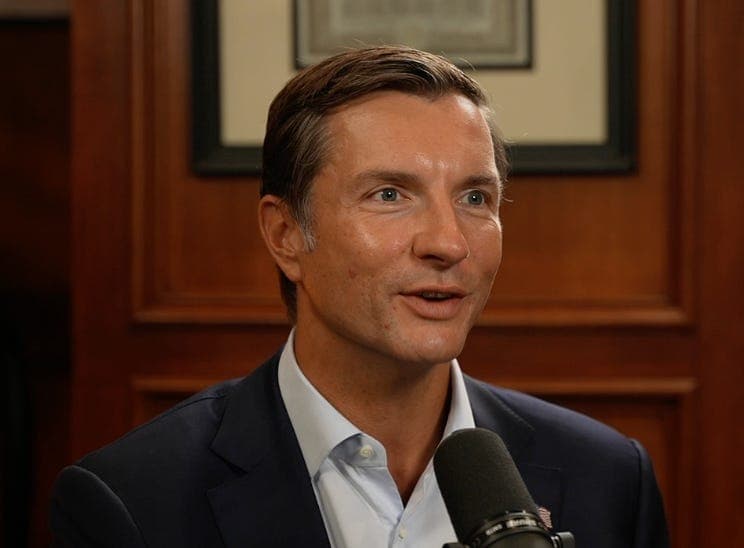
Scott Nolan is a partner at Peter Thiel’s Founders Fund. He joined SpaceX in 2003 (early team; later full-time) and is founder/CEO of General Matter, an American uranium enrichment company.
Key claims
The US stopped large-scale enrichment after Cold War “megatons and megawatts,” last site shut down in 2013. Advanced reactors may be factory-built and safer, but they still need high-assay low-enriched uranium (10–20%, often ~19.75%). Fuel supply (not licensing) is the bottleneck; General Matter aims to be online by end of decade (2028–2030 ramp).
Notable examples
General Matter enriches uranium in a “warehouse/data-center” style facility; one enrichment pellet can equal “over 100 barrels of oil” or “over a ton of coal.” He cites NRC fast-track fuel-cycle licensing and DOE milestone funding (up to $900M) plus Export-Import Bank financing for Japan/Korea utility contracts.
Written by AI. May contain mistakes. Listen to the episode to check what was said.
Chapters
Tap a time to open that second in VOScott Nolan's Background
1:21 to 3:08
Scott shares his journey from engineering to the nuclear industry.
“Really excited to have our friend Scott Nolan here with us.”
Contrasting Boeing and SpaceX
3:08 to 6:05
Discussion on the differences in culture and efficiency between Boeing and SpaceX.
“How is Boeing different than SpaceX having experienced both of those?”
Cost vs. Time in SpaceX
6:05 to 8:35
Exploring the trade-offs between cost and time during SpaceX's early days.
“I remember getting there on day one and reading the employee handbook.”
Introduction to General Matter
8:35 to 13:20
Scott explains what General Matter does in uranium enrichment for nuclear energy.
“It is a really fun kind of problem though, where you have all these optionality.”
Nuclear Fuel Production Process
13:20 to 14:00
Detailed explanation of the steps involved in producing nuclear fuel.
“Once it's a gas, you can more easily pull apart the different types of uranium.”
Understanding Nuclear Fuel Efficiency
14:00 to 16:30
Learn about the efficiency and safety of advanced nuclear fuel designs.
“One of those pellets is equivalent to over 100 barrels of oil or over a ton of coal.”
The U.S. Nuclear Enrichment Landscape
16:30 to 19:40
Discover the history and current state of nuclear enrichment in the U.S.
“I think that's That's one of the big thrusts over the past few years, I think the decade ahead.”
The Need for Increased Energy Production
19:40 to 23:00
Explore the need for increased energy production and the role of nuclear in re-industrialization.
“Think of like the big propane cylinder behind people's homes in rural areas.”
Investment Opportunities in Nuclear Power
23:00 to 27:20
Learn about investment opportunities in the nuclear sector and the challenges faced.
“This is a big theme for all of our stuff.”
Licensing and Future of Nuclear Projects
27:20 to 28:00
Understand the licensing process and future timelines for nuclear projects.
“One is all these new advanced reactors need to not only prove, you know, that they work, prove their safety, prove their performance, prove cost structure.”
Show all 14 chapters
Navigating Licensing and Regulatory Challenges in Nuclear Energy
28:00 to 29:16
Learn about the current state of licensing for nuclear facilities and the impact of recent executive orders on the industry.
“And then I think 2030 is where it really ramps.”
Funding Strategies for Nuclear Projects
29:16 to 33:14
Discover how funding sources, including government grants and foreign contracts, are crucial for advancing nuclear technologies.
“So if we go back to like 2020, people would have told you it's a very, uh, you know, clear process of what we have to do.”
The Strategic Importance of Enrichment and International Competition
33:14 to 36:00
Understand the strategic implications of nuclear enrichment capabilities and competition with global powers.
“It was Congress that appropriated$2.7 billion for HALU enrichment.”
Vision for Future Energy Abundance and Technological Advancements
36:00 to 38:34
Explore the potential of energy abundance and the role of technology in shaping the future of society.
“And I think, fortunately, in many other parts of the supply chain, there's dozens of reactor companies.”
Transcript
Automatic transcript. May contain errors.0:00Scott Nolan:I joined SpaceX in 2003. The company was maybe 30 people. I remember getting there on day one and reading the employee handbook. And on the top of page one was, You're a partner at Founders Fund. You're the founder and CEO at General Matter. We enrich uranium for nuclear energy. That's the one step the U.S. doesn't do at any scale. We have to import it from Russia. In 2010, we were completely tied neck and neck with China on grid total capacity. In the 15 years since 2010, they've tripled. The whole thing is how do you bring down cost? What are the new possibilities for nuclear? If you just think, how are we going to power things on the moon, especially the dark side of the moon, nuclear just makes the most sense by far.
0:38Scott Nolan:We're going to have a science fiction future that everybody was promised as long as we don't stop it.
0:49We're attempting to re-industrialize in America, but power is too expensive. China has gone in the last 15 years from the same amount of power as us to three times the amount of power. They're adding a Texas to their grid every year. What are we going to do? Scott Nolan is a partner at Peter Thiel's Founders Fund. He was a leader at SpaceX early on, and he's building general matter. He's identified the key bottlenecks in the nuclear industry. He's going to help us enrich uranium. He's putting billions of dollars to work to help ensure the nuclear supply chain is ready to scale nuclear massively and help America re-industrialize in the next 10 years.
1:21Let's learn about it from him. Welcome to American Optimist. Really excited to have our friend Scott Nolan here with us. Scott, thanks for joining.
1:26Scott Nolan:Yeah, thanks for having me on. Scott, you're a partner at Founders Fund. You're the founder and CEO at General Matter. Before we go into the company, tell us a little bit, what's your background? Where'd you come from? Yeah. I was always an engineer. So my background started with, you know, with science and technology, probably in middle school, high school, I was, you know, just building model rockets. That's what I did for fun. Where'd you grow up? Pennsylvania. Pennsylvania, building model rockets. I guess Peter Thiel at PayPal said a lot of them built bombs. You didn't build bombs. No bombs.
1:55Scott Nolan:It's like a controlled bomb. You know, you have like, you would have to go to the hobby store and go buy your, um, your solid little rocket motors made by Estes and, uh, you can buy the different sizes. So they're basically like, you know, explosives, but inside a rocket motor. And so how high would these things go? A few thousand feet. If you built them yourself and put enough motors on it. Sounds, it could, could be dangerous if you wanted it to. That's impressive. Yeah. Yeah. I mean, yeah, I guess it could be, they were small, um, but started off doing that. And then in college, led a rocket team at Cornell.
2:27Scott Nolan:And so did that for a few years there. And Cornell has this internship program. And so got to work at Boeing during college, got to see what a cost plus government program looked like. Thousands of people going extremely slow, decided I didn't want to do that. Didn't want to go back to Boeing. Instead, went to SpaceX, which I was fortunate had just gotten started and started off there as an intern. One of the early team members there had reached out to a bunch of Cornell professors and said, who here, you know, do you know anyone on campus that likes rockets or would be interested in what we're doing?
2:59Scott Nolan:And my name popped up and then ended up joining as an intern and then full time after that in 2004. So going back to that a little bit, you saw what cost plus looked like for our listeners. What does that mean? How is Boeing different than SpaceX having experienced both of those? Yeah. So the U.S. space industry had been going on since, you know, the 60s. and there was all this hope that there'd be all this progress. And then it never really materialized the way people thought it would. And then the question was, well, why not? And I think the program I was on was, like I said, a cost plus program.
3:33Scott Nolan:And what that meant was, as much as everyone at Boeing might have wanted stuff to move really fast and be exciting and innovative, the fundamental business model was you do work and you get paid for the cost of that work plus some additional amount. So you might make 110 % of the amount of money that you spent on the program. And if you do the simple logic, the way to make the most money then is make the program bigger and bigger and bigger. So the incentives, even if these aren't bad people, the incentives somehow cause them to want to spend a lot more money rather than actually get things done.
4:08Scott Nolan:Or at least it doesn't discourage it. So then the program optimization basically becomes, how do we keep this program on track? How do we make sure we deliver? Let's give extreme high quality. Cost is no obstacle to doing the best job possible. Let's hire subcontractors who are specialists in this. And it ends up being that dynamic of subcontractors all the way down. And then you get all this stacking of costs. So everyone's trying to spend more money to do something that's perfect. There's not really competition, I guess. So if you spend$5 billion on something, who's to say that you shouldn't, right?
4:39Because there's no competition doing it for a 10th as much.
4:41Scott Nolan:Yeah. I think the idea with cost plus is that it's for programs that are not well understood and, Hey, we really need this capability. Let's go build it. Let's do whatever we have to do to make it work. Very hard to get, give a good cost estimate. Just go, go do it. And you'll make some decent margin. I wouldn't say that individuals are saying, let's make the number bigger. I think there's just no strong incentive against that. And then in any organization, if there's no incentive against costs increasing, it'll just increase. So Boeing, obviously, with a cost plus culture, was a culture that would just spend whatever it took to get things done, not trying to be super efficient.
5:15How's that different than maybe insights in the culture of SpaceX? What are some takeaways from there?
5:19Scott Nolan:Yeah, polar opposite. So I joined SpaceX as an intern in 2003. The company was maybe 30 people, then went back 2004, 50 something people. That's when I joined full time. And even from that point, I felt like this team of this really small team of people could ultimately do a better job than the thousands of people that were working on this other program. It would take growing the team and everything, but the basic, the basic software that ran the company was all about performance. It was all about cost adjusted performance, not extreme over reliability, or let's take years and years and years to do this program.
5:58Scott Nolan:It was, let's go quickly. And then And let's optimize the system for delivering the most performance for the lowest cost. That was basically it. And it was whatever it took to do that is what you did. I remember getting there on day one and reading the employee handbook. And on the top of page one was just a single line that was in bold. And it said, this is not a science experiment. So it was all about, we're not trying to do any crazy new technology. We're trying to get rockets to be much cheaper. And so we will just have to clean sheet engineer them to take costs out of the system. And that's it.
6:31Scott Nolan:And it was almost that simple. Were they more concerned maybe about costs back then than they are now? I remember one of the famous Elon quotes I've heard more recently is the cost of time is greater than the cost of costs, which is obviously true for things like SpaceX. Back then, the cost of costs was pretty high, though, because you didn't have that much money, right? Yeah. Yeah. Well, I think the original formula was it was always a cost trade with time. Yeah. And so it's almost like you're filming a movie, every day costs some amount. If you can pack in the scenes into a shorter amount of time, your movie costs you less to produce.
7:01Scott Nolan:And the concept was the same at SpaceX. The formula was basically, hey, every single day we're spending X dollars. If you're on the critical path of schedule and you can make a one-time decision to pull in schedule by a day, like you can expedite something that's otherwise going to make us have to exist as a company for two more days, five more days, and it costs you less than that one day. So the day is very expensive to wait. Exactly, exactly. And that's the day-to-day that you're spending. If you pull and schedule a day and you're really online in a year or your first launch is in a year, you're going to be spending a lot more in one year.
7:35Scott Nolan:And so that was always the cost time trade back then. And it was all about how do we minimize the cost of getting the first rocket to orbit? It's very unintuitive to people because something that costs a million dollars might seem wasteful if you could do it for$100 ,000. dollars. But if it's going to save you, you know, five days and every day of the company costs a million dollars or something like that, then it becomes worth it just to spend the extra money. Yeah. And the thing you have to be careful of is it needs to be the thing that actually pulls in the schedule. Yep. There's 15 things people are working on at once.
8:02Scott Nolan:You can't spend it across all 15. Yeah. Spend the extra money. This is five days faster, but then this is still taking longer. It's not worth it. So you have to really be sure that. And maybe, and maybe on the other thing, you spend less and let it take longer. Like ideally everything's kind of just lined up on the same schedule. So that's the optimization that was run. Now that was back then. I think now the company has money and can be cashflow positive whenever they want to be. And so now it's much more about how do we just go as quickly as possible and make that right trade. It's not about minimizing total cost to the milestone.
8:32Scott Nolan:It's about how do we make the overall progress go faster. It is a really fun kind of problem though, where you have all these optionality. In some cases, it's worth spending less and taking longer because it's not the long pole. Yep. And it's like, someone has to be aware of that. I guess that must be the CEO who's aware of that most. Right. Yeah, that's right. I mean, there's probably a bunch of people in the organization that are aware of what that long pole is, but then it's actually delegated down to the individual teams to make the right decisions. It's like, okay, team A, you are on critical path.
9:02Scott Nolan:Now all these rules of thumb apply to you. Bring in schedule, do whatever you can to go faster. So let's talk about how this applies to general matter. I'm actually really curious. We haven't had a chance to have a strategy session in a while. I'm a small investor in General Matter. I'm really curious about the long polls here. Tell our audience, first of all, what is General Matter? So General Matter is an American enrichment company. We enrich uranium for nuclear energy. And you go to, I guess, to give some background in the space, every nuclear reactor in the world runs on nuclear fuel. And there's five steps to make nuclear fuel.
9:35Scott Nolan:You have to mine it out of the ground. You have to convert it into a gas. you enrich it, turn it back into a solid, and then you form your specific fuel pellet. So when you mine out of the ground, I think you need like a million pounds of uranium, for example, if it's uranium, to get like a pound of U-235, which is the radioactive one, right? Is that correct? That's about right. Yeah. And then now you have this U-235, which you're going to use. Why are you turning it into a gas? What's going on here? Yeah. So the, I mean, you can think of it as like 1%, maybe not a million pounds to one pound, actually 1%.
10:03I mean, it's for 1%. Okay. So 100 pounds gives you a pound of it.
10:06Scott Nolan:Yeah. So, so essentially, yeah, out of the ground, you have 0.711 % U-235. Call it 1%. Got it. I'm probably thinking of all the other rock you need that you're taking the uranium out of or something. Yeah. Yeah. So it also depends on your ore deposits. Like, is your, is your deposit that you're mining out of 1 % uranium, 2 %? And there's a wide range on that. So it's a 0.7 % of whatever percent the uranium is. Now you have the U-235. Now what do you do? Yep. Now you do, now you do milling. What's milling? Milling can be either if you're doing open pit, it's basically turning the raw ore into just raw uranium.
10:41Scott Nolan:You're trying to get to U308 yellow cake. The newer mining techniques really combine mining and milling by running an underground process that's somewhat similar to fracking. You put a fluid down, you draw it back out, and then you isolate the U308. So what's U308? That's commonly called yellow cake. Why is it called three? What's three ways? does it mean? The molecule has three uraniums, eight oxygen. That's what comes out of the ground. Yeah, this is good that we're breaking it down. So essentially, you're trying to get the uranium. And the way you end up getting it out of a mining process is as U308.
11:17Scott Nolan:It's an oxidized uranium. You then want to actually find a way to separate it, not based on uranium versus other elements. You want to separate it based on its isotope. So how many neutrons are in the uranium. And so the common ones are U-235, U-238. U-235 is fissile. U-238 is not. So the U-235 is the one that's kind of unstable, which you can use to make energy. That's the one that you want. And that's the one that in enough concentration can sustain a chain reaction. It could also make a bomb. At a high enough enrichment level with lots of other technology people make. Yeah. But that's a different thing.
11:54So do you get enough of this to sustain a fission, a fissile reaction to make nuclear energy?
11:59Scott Nolan:That's right. So most reactors, the big ones, people think about gigawatt scale reactors. They need the uranium enriched to about 3 % to 5%, U-235. And then the small ones, 19.75 % is where everyone's ending up. But it can be - So you got to really enrich it a lot for the small ones. Yeah. On a relative basis, a lot more. But the small reactors may be much easier to mass produce. That's the idea. So the whole thing we're hearing about in the advanced reactor world is really two things. One's been safety and passively safe designs, designs that may use types of fuel that are self-contained, but also making them factory built.
12:36Scott Nolan:So the real push here is nuclear energy for the past 50 years has been the cleanest form of energy, no carbon emissions, the safest form of baseload, which people find really surprising, but fewer human deaths per terawatt hour than any other baseload and even any other energy source except solar. It's basically tied with solar. So safest and cleanest, just not the cheapest. So all the reactor companies that are trying to do new designs, a lot of these designs are oriented around how do we actually build these things at scale in a factory? If we can factory build them instead of stick build them on site.
13:10Then you can make a lot of them, but they're all going to need even more enriched fuel for those to work. So going back to this, so you have this yellow cake and you're turning into, to explain, explain what's the next step? Yep.
13:19Scott Nolan:So step two is turn into a gas. So that's converted. So that's a chemical conversion. Once it's a gas, you can more easily pull apart the different types of uranium. You can separate them based on other attributes. That's right. Now you've got the U-35 as a gas. Then what do you do? Then if you've enriched it up to enough concentration that it's ready to become fuel, then it's turned back into a solid with a deconversion process and then put into pellet form. And these pellets are what you're giving to the nuclear plants. Yeah. And I think the size you can kind of keep in mind is like the end of your pinky, the final joint, or almost like, this is for traditional pellets, or like the earplugs, you know, those short little cylindrical earplugs.
13:57Scott Nolan:Yeah. And how much energy can you get out of one of these tiny little pellets? One of those pellets is equivalent to over 100 barrels of oil or over a ton of coal. That's really cool. It's a ton of coal, 100 barrels of oil, or this little thing the size of the end of your pinky. And that's enriched to 3 % to 5%. Yep. So now if we're talking the more enriched fuel, that often comes in a different format. A lot of people doing the fuel for advanced reactors, they want that fuel to even be safer than any reactor. They want the reactor to be safer than any other reactor design that's been done. And so they will take the fuel and they'll take a tiny bit of uranium and they will put it inside a coating, a silicon carbide type of coating with zirconium.
14:38Scott Nolan:So you'll coat the uranium. Exactly. So then it becomes like a poppy seed sized piece of uranium. tiny and it's got two attributes one the shell can handle up to a very high temperature so it basically can't melt down it will be able to handle any temperature that a reactor could get to we're talking over a thousand c and then part two is some of the coding self-moderates so if it starts getting too hot it'll automatically absorb and stop more neutrons it'll effectively make the feel less reactive and slow down the reactions. So you get this self, this feedback loop. Coding itself would change and it's really, really tiny.
15:16So you're making it like as perfectly safe as possible for these new reactors.
15:19Scott Nolan:That's what people are going for. So going back to your point though, the whole thing is how do you bring down cost? And so it's factory building, hitting scale economics on the actual reactor. Part two though, is once you make your reactor really cheap, if you're doing the more enriched fuel, you have to go through more of that uranium out of the ground to get that much enriched uranium at 19.75%, more of the upstream services. And you're basically just running that process more and more on a bigger funnel at the top of the funnel. Now, obviously, your fuel cost is going to cost more per kilo.
15:50Scott Nolan:And so you do this trade and you see the reactor costs come down, but the fuel cost proportionally goes up. And so you go from a situation where the reactor is over 90 % of total costs of energy produced to where, and fuel is obviously single digit percentages with low enriched uranium and gigawatt scale reactors and those simple metal fuel pellets to now where the fuel is often more than half the cost. And the smaller the reactor, the higher the cost proportion. Your view of what we should be doing with, maybe we should talk about energy as well, but we obviously need a lot more energy in this country.
16:23And you think this is a big part of the solution is making lots of these small nuclear plants, but then you're going to help them make sure they have enough fuel.
16:30Scott Nolan:Yeah. I think that's That's one of the big thrusts over the past few years, I think the decade ahead. However, I would say I think we should do both. So either way, it's just how do you come down that learning curve? And it requires scale. It requires not making one at a time, but 10, 100, 1 ,000 at a time. And which part of this is general matter doing? You're not taking uranium out of the ground. What are you doing in general matter? No, we're just doing the middle step of enrichment. So if you've got mining, conversion, enrichment, deconversion, and fuel fabrication, we just do enrichment. The reason we're doing enrichment is because that's the one step the U.S.
17:00Scott Nolan:doesn't do at any scale. Why not? It's a long history, but we used to. So the U.S. in the 80s was actually more than 80 % of global enrichment. We used a process called gaseous diffusion that was invented during World War II. We did it a few sites in the U.S. And then the Berlin Wall fell. The Cold War was over. And we said, we have this old technology that's pretty expensive and uses a lot of electricity. When people hear about the Manhattan Project using 10 % of US energy, it was because of this part of the process. And so we had an old technology that required a ton of energy. The Cold War was over.
17:41Scott Nolan:We could trade with Russia. We did not want them to have so many warheads. And we started this period of disarmament and said, let's take the warheads and let's blend them down and use them to run in our reactors as low enriched uranium. We started taking all their technology, all their warheads instead to use in our reactors. We turned off all of our stuff. It was called megatons and megawatts. We still ran our gaseous effusion for a while. We traded more and more with the Europeans for enrichment on uranium. And eventually we said, okay, we can't really operate these plants profitably. It's a free market.
Read the full transcript
18:13Scott Nolan:We don't need to do this anymore. This is like the ultimate though, de-industrialization. We talk a lot about things we turned off in the US. We turned off all of our nuclear capability here in terms of in terms of enriching all the time that we kept somewhere and then for like the army or something or no uh so what the military has is left over from that era it's a big stockpile um and we shut down the last enrichment site in 2013 and that site was actually in western kentucky on doe land that our company is now building on so you're now so you're not going to build where that last site was in western kentucky that's right and and once you so you're giving this given this material and and you and you make it a gas and enrich it or maybe you're giving the gas and you enrich it and then you give it to somebody else once it's enriched because there's already a process for making the fuel pellets that's right the way this industry works the utilities take care of their own fuel they'll go buy the uranium out of the ground from a miner and then they will own title on that and they will buy services all the way through so they'll just for every for every little piece or you do this part you do this part you do this part so there's already people who are really good at making i mean shouldn't you make more of the new little tiny poppy seeds or something because there's going to be more plants and no one's doing it or it's not it's not worth doing that part so what else is doing there's there's a bunch of companies doing that.
19:20Scott Nolan:So I think that'll be taken care of. The step that I was most concerned would not be taken care of in time was enrichment. And so we're doing that step. And so to your question, the business looks like a big building. Think of like a warehouse, data center, biopharmaceutical plant, big rectangular building, lots of equipment inside. On one end comes in a big cylinder. Think of like the big propane cylinder behind people's homes in rural areas. on the other end, out goes two cylinders, one enriched, one not enriched. Amazing. And let's step back for a second. I was with Elon recently, he was here and one of his big concerns for the US was not having enough power.
19:58He's very impressed by how much power China's making overall. I think they're bringing on maybe like a new Texas worth of electrons every year, something like that. I think overall, even though we might be higher per capita, they're like 3X, I think America right now is this massive amount. And obviously for the AI race and for AI in general, and for, I think for the wellbeing of our average citizen in general, we want more and cheaper energy. And so the question is like, what's the answer? And I know he's focused on solar is one of his things. I know natural gas is something I'm pretty excited about.
20:26My friends are building more natural gas plants. We have tons of cheap gas in America. Like, like where does nuclear fit into this? Like what, how much of the solution is it? Is it a key part of the solution? How do you see it?
20:35Scott Nolan:Yeah. So I was talking with someone about this recently and The US has done an amazing job on actual fossil fuel production, fracking, natural gas, exports. And that's actually been the mechanism that we've used to bring down carbon emissions in the country during the last decade. Yeah, fracking and natural gas is way better for the environment than coal and oil and other things. Yeah, half the carbon per unit of energy, basically. Yep. And so you just emit much less carbon doing it that way. You know why fracking was so unpopular? Because Russia spent a bunch of money convincing Europe not to do it.
21:03This is one of those things that drives me crazy. I don't know if you know this. They funded the Green Party. They funded the protests. and they turned off fracking in Europe because it's so good for the environment. They tricked everyone because obviously they don't want competition. So I think it's probably also a nuclear thing too where people don't. It's nuclear competition as well. But anyway, go on.
21:18Scott Nolan:Yeah. Well, yeah. US has done a great job there. But to your point on the grid, actual electrons, like that's fuel. We can sell that, export it, use it for other things. But when we're talking about literally making electricity, which up until now is, you know, it's always been on the grid powering data centers. If you look at the grid, in 2010, we were completely tied neck and neck with China on grid total capacity. Something like 4 ,000 or 5 ,000 terawatt hours per year. Since then, in the 15 years since 2010, they've tripled. I think this year they're actually at 3x the U.S. grid capacity. And we just haven't got it.
21:54Basically flat. Why not? What are we doing? Is it just like, why couldn't we go up? Is it not worth investing? It probably is worth it financially, right? Or do we just not have that demand?
22:02Scott Nolan:It's worth it now. I think a lot of people thought for a long time that it was just about efficiency. It was about US moving out of these energy intensive industries into services industries. Oh, because we were de-industrializing. So China was building manufacturing. We were de-industrializing. We didn't need more power. Now we're realizing, wait a second, we're going to re-industrialize. So we need the power. Yeah. The conventional wisdom was GDP is completely correlated with energy consumption up to a point. And once you get to that point and you go past industrial sort of operations and you're doing services, businesses, then maybe you don't need as much.
22:34Scott Nolan:I think now that's completely flipped with data centers consuming so much power and needing them to scale the next few years. And EVs, advanced manufacturing, I think turns out a lot of manufacturing is going to come back on shore, but we need the power. We can't do it. Yeah. I think we need to turn around from viewing it as being okay that we've had a flat grid to realizing we need to almost go vertical on it. I mean, it's a disaster for our whole re-industrialization. This is a big theme for all of our stuff. You're a founder's fund and doing a bunch of things in these different areas, right?
23:06Like we need to re-industrialize. We need the power.
23:07Scott Nolan:Yeah, it's not even the amount of power. It's the cost of power. That's the other part. So that's why I think, you know, with nuclear, it's not just can we build more nuclear, but can we make it so cheap that we bring a lot of these things back to the US, like aluminum production, steel production, these things where the major cost is just electricity cost. Nuclear power could be a very big part of the production, you think? Like, what does that look like? Like, what's the cost of power right now? What could you do with mass nuclear production? Yeah, I mean, cost of power is like wildly different based on state.
23:36Scott Nolan:I think, yeah, what could it be? I think back in the, what was it, 60s or 70s, I think in today's dollars, nuclear was costing about three cents per kilowatt hour. That was the actual production cost. Obviously, in places like California, you know, people are paying 30 cents. So I think there's a lot of room there. Yeah. No, I think nuclear should be a huge part of the mix. Today, it's 20 % of the US grid, which a lot of people don't realize. So it's already still 20 % now, and you think it could be a lot more? Yeah, it's I think 18.6, 18.7 % right now. We're going to see some up rates the next couple of years, people taking plants that are already online and just amping them up with different fuel.
24:18Scott Nolan:And then I think we're going to see some restarts as well. So we'll see that grow a little bit. But you talk to any of the hyperscalers who want to build big data centers in the 2030s. And I think for all of them, it's about nuclear. How did you get this idea? You're also an investor at Founders Fund. You guys have been crushing a lot of areas. Were you looking to potentially invest in nuclear in different areas? This was a gap? Yeah. So over a decade of just looking at engineering driven companies, really starting in things like satellites, ended up going all the way across pretty much every space ending up in energy in the late 2010s, invest in a company called Crusoe, invest in a company called Panthalassa.
24:59Scott Nolan:These were really about stranded energy sources. And then invest in a company called Radiant that was looking at stranded demand, not stranded supply. What does that mean? What's stranded demand? So imagine an Alaskan village that goes entirely off of diesel and they get a shipment in the summer only when, when it's not iced over. Yeah. And so places where people have to pay a lot of, uh, you know, a high cost of electricity and where a small nuclear reactor can actually compete with the cost that they're already paying. So what companies are you bullish on providing those reactors, by the way, are there certain ones that you're more than others?
25:33Scott Nolan:I mean, I would say there's three segments. You have the micros, which are for applications like that. You've got SMRs, which can be anything from, uh, data centers to industrial processes. And then you've got the really big reactors gigawatt scale for grid. And so I think we need all three. I think all three are going to scale. When you asked before, like, oh, should we just do the SMRs? I think it's all of the above. We should do way more gigawatt scale, get really good at building them, build them the same way every single time, bring that cost down. And so then you've got SMRs that could be great for data centers and then the small ones.
26:06Scott Nolan:I think there's going to be winners in every single category. But to your point, how did I find out about this? it was meeting companies in the space for years. And the thing they all said was actually getting the license is not as hard as you think, Founders Fund. The hard part is getting the fuel. And they said, we're really hopeful that we can import some of this fuel, this HALU fuel. HALU stands for high assay, low enriched uranium. So that's the 10 to 20 % enrichment level, which everyone converges on 19.75 because it keeps you out of weapons grade, but helps you get the most density of energy in your reactor.
26:45Scott Nolan:And they said, we can't get the fuel. We have to import it from Russia. So the obvious question was, why don't the U.S. companies that make all the other fuel just make your specialty fuel? And the answer was basically like a blank stare back. Like, what do you mean other providers in the U.S.? There are no other providers. And so spent almost a year looking into that, understanding what's broken on the supply chain, what part is missing. And the answer was, it was the enrichment piece. We didn't have domestic US company led enrichment. And so tell us about, you raised a bunch of money for this company.
27:21Like what's, where is it, Ryan? What's this timeline? Yeah.
27:23Scott Nolan:So timeline is driven by the market. So there's two market dynamics. One is all these new advanced reactors need to not only prove, you know, that they work, prove their safety, prove their performance, prove cost structure. They need to scale. And so their initial bits of fuel are coming from DOE, but to scale deployments, they need new sources. There's already fuel the Department of Energy has to give them for their tests. Yeah. But as they start to scale, they're going to need you. So you're ready, you're saying? I think that timing is coming, you know, 2028 through 2030. They're going to first really start doing the, you know, single digit deployments.
28:00Scott Nolan:And then I think 2030 is where it really ramps. In 2030, you could potentially see a lot of these plants coming online, in which case the demand goes way up for you. And so our commitment is to be online by end of decade. Got it. So you need to rush right now. So we were talking earlier about what's the thing that's going to hold you back? What's the thing that's going to take the longest? Tell us about that. What are the things you're sprinting to get done? Yeah. So if you look historically at timelines, you would look to licensing as probably the timeline driver. What's that? Licensing what?
28:26Scott Nolan:So getting a license to operate the facility. And that comes from the NRC, the Nuclear Regulatory Commission. That used to be impossible to deal with. I'd imagine it's a little bit easier to deal with now or maybe not necessarily. Oh, it's become much easier. So, uh, you have to say that cause they have to give you a license. No, absolutely not. Uh, if you go back to, if you go back to 2018, um, and you ask those companies like, you know, is this the hard part? And they would say, no, it's not the hard part. It takes a little while and you have to do the work, but it's predictable. And what we're all trying to figure out is, you know, make sure that this is going to be a safe reactor.
28:58Scott Nolan:That's what everyone would have told you. Um, you know, I think today is actually the one year anniversary of the, of the nuclear executive orders. Um, and so there were four executive orders covering DOE, NRC, DOD, and the supply chain that has really created a huge tailwind for the space. So if we go back to like 2020, people would have told you it's a very, uh, you know, clear process of what we have to do. The timeline is unclear. If you then go to a week or two ago, you might say, okay, the executive orders, you know, did say, did give some timeline limits on reactors. They did not give clear timeline limits on fuel cycle facilities like ours.
29:41Scott Nolan:Yep. But you could say a fuel cycle facility is maybe equally difficult or some, you know, less difficult than a reactor. And so if they're going to do 18 months, turn around on reactor license applications, you would maybe guess something like that. And if he gets 18 months, then it can end up being the long schedule driver. Yeah. And I think it was Thursday, the NRC announced that a new fuel cycle license application went in and they're committing to put it on fast track and get it out in 12 months. There's someone other than you who's doing that application. Yeah. And so if you assume 12 months, all of a sudden it's back on the companies.
30:21Scott Nolan:And now the companies are actually the timeline driver. And so it becomes one of these like types of very difficult company called that, you know, Peter at Founders Fund would call a complex coordination company where you're working on eight different work streams at the same time to go as fast as possible. If any single one fails, it will delay the project. And so the key capability is how do you just coordinate everything? And so teach us a little bit more. One of the work streams was that license which you haven't, you've not applied for yet because you know, because you have to do certain things first.
30:49Like what are your main work streams?
30:51Scott Nolan:Yeah. So one work stream is license. So, So submitting that this year, another work stream would be technology, just improving the technology's performance relative to cost. Another one is construction. This is one people really underweight, but here in Austin, you guys have seen it firsthand. We like building fast here. Our friend Omid, right? They did that fast with Elon, the plane. Yep. Austin Gigafactory. And so the key thing on construction we've found is you can't just hand it off to some other company. No, no, no. You have to own this. Ceronics doing all of its own stuff. We're doing thousands of autonomous boats here.
31:24You got to do it yourself. You got to do it yourself.
31:26Scott Nolan:Yep. So this is classically - It's part of the core IP. It's classically called EPC, Engineering Procurement Construction. And so just like those companies, we build an in-house EPC. It's about 20 people in Kentucky. They're leading our project. They'll work with the subcontractors, the welders, the grading firms, you know, cement, everything. But it's run in-house. You have your project managers in-house. It goes so much faster if you do this right. Yeah. So construction and licensing and the technology itself, those are the main things. Manufacturing. What are you manufacturing? The hardware that would go inside the facility.
32:00So you got to design it with the science, then you actually have to manufacture it all.
32:03Scott Nolan:Exactly. So it becomes a scale manufacturing problem. So it's like, you know, Starlink, we've got a user terminal factory here in Bastrop, what, 30 minutes away. And that's a problem where, yeah, you can build one, but can you build a million of these things? Can you build a million a year? How do you scale that? That's the hard part. And then how much money do you need? I think you also got like a massive amount of money in Exxon financing, right? Because this is key for the US. So not only did Trump speed up the licensing, he's also like putting money into this area for cheap loans or what? How does that work?
32:31Scott Nolan:Yeah. So the funding we've gotten spans venture capital equity, debt on things like manufacturing equipment. There's a grant we received from the DOE. It's really an IDIQ, so indefinite duration, indefinite quantity contract, in which it's a lot like NASA's COTS program, if you remember back to that with SpaceX, where it was completely milestone based. So you do certain things, you unlock capital. So you prove you're doing it right, they'll give you more money. And not cost plus, but fixed price. And so our whole contract with the DOE, which we received in January, we received that award under President Trump's DOE.
33:12Scott Nolan:actually were down selected and first applied under the Biden administration. It was Congress that appropriated$2.7 billion for HALU enrichment. And we received one of those awards for 900 million. So$900 million milestone based contract, which will be earned over the next few years as we build that capability in Kentucky. So that's part one. Part two is what you referred to on the EXIM side. So the Export-Import Bank of the U.S. wants the U.S. to be competitive internationally, be able to play on the same level playing field as other countries and create jobs in the U.S. And so we have an LOI with them to wrap our contracts that we sell into Japan and Korea to help pull some of that financing forward to help us build a greater scale.
34:01Scott Nolan:And so right now that's an LOI to go do those contracts. And then we're working with Japan and Korean utilities to move that ball down the field. That's cool. Japan also has like hundreds of billions to invest in U.S. energy. I guess you should probably talk to those guys too. Yeah, yeah, that's right. I think the XM deal is really just around utility contracts. And so that's the next big piece. We're not just interested in that as something to expand the commercial scope of the business to move internationally. there's a big U.S. national security benefit of that, or like even a global non-proliferation security benefit of that, which is if the U.S.
34:45Scott Nolan:does not provide enrichment to these countries, they will have to get it somewhere else as they build up their nuclear fleet, or they turn back on their nuclear fleet. And that'll be Russia, China. So yeah, you want to be part of the U.S. kind of power group, not the other guys. Right. That seems really critical for the U.S. to get this right. and have you thought about like what's the trade-off a lot of people would think oh if you could do this you might as well be the one making like tons of the power yourself and owning a big utility but a lot of people say no just stay really focused on the thing you're doing it feels like more like what elon and some of our other successful entrepreneurs we know would do to own the whole thing yourself versus just do the one piece but there's something about just the one piece you got to ace i guess for now yeah i mean this is always um thinking back to like the very beginnings of my time at founders fund it was working on peter's class cs183 yeah that became the book zero to one and one of the core lessons from that was you know don't think of this as don't think of the energy market as a trillion dollar market and oh if only i can get one percent of that trillion dollar market it's much more focus on something that you can do on the narrow piece first yeah focus on the really narrow thing where that no one's meeting the need and where you can actually deliver huge value to the industry and where you can you can just perfect that and then you expand out once you win that who knows you could start building other things being more aggressive.
36:01That's right.
36:01Scott Nolan:And I think, fortunately, in many other parts of the supply chain, there's dozens of reactor companies. There's a bunch of people making the fuel pellets. I think the thing that we want to solve is the enrichment piece. And if we do that, we think that alone can be a huge business. It definitely can be. So stepping back a little bit, let's look ahead. What are the new possibilities for nuclear otherwise? I think Jared Isaacman, who is on this show, runs NASA. He wants to maybe do nuclear power in space. Is that something you think this stuff's going to happen? Absolutely. Yeah. I was just reading some of the announcements.
36:29Scott Nolan:I think they're aiming for nuclear-driven space propulsion by 2028. And then they're talking about reactors on the moon's surface to create heat and power things. It's great. I think it's, you think about like, if you just think, how are we going to power things on the moon, especially the dark side of the moon? Nuclear just makes the most sense by far. You just got to make sure it doesn't blow up on the way up there, cause a lot of trouble. Yeah, true. We have some pretty reliable rockets these days, fortunately. And I guess moon aside, what does it mean to have like energy abundance on our planet?
37:06If we can make energy as cheap, go back to three cents everywhere or whatever, or there's much cheaper everywhere, you know, what does that mean for us?
37:13Scott Nolan:Yeah, I think three cents shouldn't even be the limit. Like that was three cents building huge gigawatt scale mega construction projects, not factory production. And so I think we should physically be able to get less than three cents if we were doing it before. and you start talking about energy that cheap, there was the classic phrase, too cheap to meter, which I don't think, maybe it doesn't have to be so cheap that you can't even afford to put a meter on the house. I think that might not really make that much sense. But so cheap that you can bring back all these industrial processes to the US, you can rebuild the manufacturing base and just have immense economic growth.
37:51Scott Nolan:I think that's exactly what happens. I think it's kind of fun if energy is really, really cheap and AI is really, really good and it starts working in the physical world, then basically anyone in the middle class is going to be able to build this, like, you know, a giant cave that they designed. It's like 40 moons underground, right? Or whatever. I just think about it. It's like crazy, like, or a beautiful castle. You're going to be able to have castles being designed and built by everyone if they want. I mean, probably HOA should have ruled. Yeah. As long as HOA is okay with this underground.
38:18I don't necessarily want giant castles everywhere I live, but you can go buy your own land. You do it. It's just going to be amazing. Everyone's going to be able to build things no one could have built before, right?
38:25Scott Nolan:That's the idea. Or just that we get so much more prosperity. Yeah, everything should be cheap, right? Everything should be a lot cheaper for everyone. Yep. I love it. Well, I'm very bullish on the future. We started this podcast actually to push back on cynics and doomers. Like what makes you optimistic for America? Somebody was reminding me that this year is America's 250th anniversary. And they said, okay, what do you think about the next 250 years? And I thought back and, you know, you look up, okay, 1776, a long time ago, what do we have? We didn't have electricity. We didn't have cars. We didn't have antibiotics.
38:56Scott Nolan:We didn't have any of the stuff we have today. And so you fast forward like another 250 years and you say things are actually accelerating. What's it going to look like? I think we're going to have the science fiction future that everybody was promised as long as we don't stop it. I think today we'll look even more backwards 250 years from now. Than the last 250 years. I think people don't realize that. Like they'll see us and they'll he has these like crazy barbaric ancestors that are like just everything's like completely weird and different and hard yeah that's my view i think it's gonna be exciting i think the next 10 years we're gonna see a lot of this stuff really take off just gonna make sure everyone stays tough yeah because you know if everything's too easy it's like it's fair fair the cycle but yeah in general i'm very optimistic though well thanks scott for joining us yeah thank you
From the publisher
In 2010, the U.S. and China were at parity in electricity generation. Today, China boasts triple our capacity. We’re at the vanguard of the AI revolution but falling dangerously behind in energy production. Scott Nolan has identified a key bottleneck in nuclear energy and is at the forefront of the effort to scale nuclear power and help America achieve energy abundance.
While studying at Cornell University, Scott landed an internship at Boeing. He quickly jumped to SpaceX as an early employee and worked on the Falcon propulsion systems and Dragon capsule. He later became Partner at Founders Fund, where he focuses on energy, infrastructure, biotech, and other key sectors. In 2024, he founded General Matter to rebuild America’s nuclear enrichment capacity.
We begin the episode with Scott’s entrepreneurial journey, the contrast between Boeing and SpaceX, and how to build a culture that prioritizes speed and performance in a highly regulated sector. Next, Scott explains the origins of General Matter and breaks down the science behind creating nuclear fuel. In the 1980s, the U.S. produced 80% of global enriched uranium; today that number is zero. Learn how post-Cold War disarmament destroyed our capacity to the point where we are now reliant on Russia, among others, for enrichment. Scott explains how China surged ahead in electricity generation, and what it will take to jumpstart America’s nuclear renaissance. Finally, we cover exciting new possibilities, including nuclear power in space and on the moon, and what a future of cheap, abundant energy could look like.
00:00 Episode intro
01:20 Boeing vs SpaceX / lessons on speed & performance
05:20 What made SpaceX unique?
09:05 General Matter / how to make nuclear fuel
16:45 Disarmament and relying on Russia
19:50 The AI energy crisis / falling behind China
24:30 Founders Fund and energy investing
27:15 How to scale nuclear energy
32:00 How to fund the nuclear buildout
36:15 Nuclear in space & new possibilities
This is a public episode. If you would like to discuss this with other subscribers or get access to bonus episodes, visit blog.joelonsdale.com