
In short
Podcast Summary: Joe Lonsdale: American Optimist - Ep 64: The Palantir Interview with Dr. Alex Karp
Episode Overview In this insightful episode, host Joe Lonsdale interviews Dr. Alex Karp, co-founder and CEO of Palantir Technologies. The discussion revolves around Palantir's significant contributions over the past two decades, its innovative work in AI, and its impact on global security, especially in the context of the Ukrainian conflict. Dr. Karp shares his unique background, the philosophies that guide his leadership, and the cultural factors that enable innovation in the American tech ecosystem.
Key Themes and Discussions
- Palantir's Impact and Growth
- Significant Contributions: Palantir has played a crucial role in preventing terrorist attacks and providing advanced data infrastructure to Western countries.
- Technological Advancements: The company's software has made a notable impact on the battlefield in Ukraine, helping to give Ukrainian forces a strategic edge over Russian troops.
- AI Leadership: Palantir is emerging as a leading AI platform for large organizations, showcasing innovation even after two decades of operation.
- Dr. Alex Karp's Background
- Outsider Perspective: Dr. Karp discusses how his dyslexia and outsider upbringing shaped his worldview and influenced Palantir’s design and mission.
- Philosophical Foundations: He holds degrees in law and philosophy, studying under prominent intellectuals, which informs his leadership style and approach to business.
- American Optimism vs. Pessimism
- Dr. Karp emphasizes the contrast between optimism and pessimism in American culture, noting that the U.S. rewards innovation and outside-the-norm thinking.
- The culture of experimentation and risk-taking in America is described as a key driver for technological advancement.
- The Importance of Military Strength
- The preservation of Western values hinges on a strong U.S. military, which Dr. Karp argues should leverage the best software and technology available.
- He advocates for reforms in military procurement policies to prioritize innovative, commercially successful solutions.
- Challenges in the Defense Sector
- Dr. Karp discusses the need for the U.S. Department of Defense (DoD) to invest a small percentage of its budget into products proven in commercial markets.
- He critiques current governmental structures that favor cost-plus contracts, which may stifle innovation.
- AI and Its Future
- The episode explores the current landscape of AI technology, distinguishing between real innovation and theatrical claims made by companies without proven products.
- Dr. Karp argues for a focus on practical applications of AI that enhance operational efficiency across sectors, especially in healthcare.
- Ukraine and Palantir’s Role
- Dr. Karp describes his visit to Ukraine and the courageous spirit of its people, highlighting how Palantir’s technology is being used in critical operations.
- He emphasizes the need for data protection and proper evidence chain management in documenting war crimes, an area where Palantir excels.
- Organizational vs. Technological Challenges
- Dr. Karp asserts that the West's challenges are more organizational than technological, criticizing a lack of alignment between innovation and institutional practices.
- He stresses the importance of a robust defense policy that harnesses the best technological talent and solutions available.
- Future Optimism
- Both Lonsdale and Karp express a hopeful outlook for America’s future in enterprise software and innovation, stating that the response to external threats can unify the country and propel it forward.
- They conclude by highlighting the foundational values of rule of law, free speech, and human rights as essential for a prosperous future.
Key Takeaways
- Innovation and Risk-Taking: America thrives on a culture that embraces failure as a stepping stone to success, particularly in technology and entrepreneurship.
- Defense Reforms: Strategic changes are needed in military procurement to ensure the U.S. can leverage cutting-edge technology effectively.
- AI as a Catalyst: The implementation of AI in various sectors could significantly enhance productivity and operational effectiveness, particularly in challenging environments like healthcare.
- Courage and Resilience: The resilience of the Ukrainian spirit in the face of adversity showcases the power of courage and innovation against authoritarian threats.
Conclusion This episode of *American Optimist* presents a compelling discussion on the intersection of technology, philosophy, and the future of America in the global landscape. Dr. Karp's insights into Palantir’s mission and the broader implications for society emphasize the importance of optimism and innovation in overcoming contemporary challenges.
Written by AI. May contain mistakes. Listen to the episode to check what was said.
Transcript
Automatic transcript. May contain errors.0:00The most important thing in my view that can happen for the preservation of the West and its values is for the US military to be by far the best in the best in the world.
0:16Alex is one of my favorite people. He's one of the most interesting minds I've met in the world. He's a leader in business. He's a philosopher. He's also going to share a lot of his backstory that people haven't heard before in public. You know, it's really exciting to talk to Alex about Palantir. Palantir is unique in that it's 20 years old, but it's doing some of the most important innovative work in the world right now. Some of the new stuff they're doing in AI, you have to check out. It's really extraordinary. Probably the most important AI company in the world. It's very rare to see this kind of innovation from a company that's 20 years in and it's already had such a big impact globally.
0:45Really excited for you to get to know our leader and CEO there, Alex Karp. Today I'm with my friend Alex Karp, the co-founder and CEO of Palantir. Alex, thanks for joining us for the show. Very happy to be here, Joe. We have a long and windy road together and it's been great to have you part of my life. Well, let's start with the big picture. You know, Palantir, we talked a lot about different philosophy that you teach us, and we'll talk about dialectics. And one of the animating dialectics is, you know, between pessimism and optimism. And what's the best case for an optimistic view for the United States right now?
1:14You know, America produces crazy outside the norm people that are driven. We're not constrained the way other cultures are by intergenerational risk-taking. So, I mean, it's proverbial. You're allowed to fail here. It's a banality, but it really is true. We push responsibility in all contexts, generally to people who are first-generation achievers. So that is very different than other cultures. Perhaps there's some good and bad facts around that, but we really do reward outside the traditional, this short version would be outside the box, thinking whatever the box means more than other cultures.
2:11We have a deep and very, very successful culture of sophisticated technical accomplishment, especially on the West Coast, born out of universities, but then financed in a way in which there is at least as much alignment as humanly possible between entrepreneur and investor. They're obviously not always complete alignment. And we on the entrepreneurial side, you've been on both sides, but there are obviously issues there. The tech community on the West Coast of America is more important than all other communities combined in the world. That kind of rolls off the lips easily, but we forget how important that is.
2:59We still are a beacon for the most talented people in the world to come here. our educational institutions and in our general culture of cooperation one of the most valuable and least read books partly because i'm not sure it's in english is um this book by pleasner who was a um a philosophical anthropologist which is a way of saying he was talking about uh structures that are pre-cultural that impact human behavior was about how america allows you to choose the community you're in, but then the rules of that community apply to you. So in Europe, for example, the state decides which church, which synagogue, what mosque is actually real.
3:46Like when you start a company here, you start your own culture. And then I think all of these things cascade together. So if you're sitting in any part of the world and you want to do something interesting, your number one choice right now, without a good choice, number two, is to come to the U.S. and build it. And I would say on top of everything else, for all the class issues we have in this country, we are very forgiving of successful people. You know, it's in most cultures, success could land you in a very, first generational success is very dangerous. And that's just a limited list. I think America, if you wanted to do a simple reductionist version of this, you could say, well, why are almost all software products in the enterprise context built in one part of the world?
4:41It's very hard to answer the question, but it is true. And if you went to any country besides the U.S. and said, could we have 10 % of that, they would do really anything to have it. But it's a mystery how we continue to do this. And so we're so successful at this that we don't even notice it. And then we're very focused on the things we're less successful at, like making our highways and schools and other things run our health care system. We can go back. You can go do a diagnostic on what on why. And there'd probably be disagreement between us on the why. But it is true that we're just the best in the world at a certain set of things and we're not the best in the world at others.
5:28And we're very focused in America on that. And that obfuscates that without, you know, I had a slight advantage that I spent so much time abroad that when you kind of re-immigrate back to America, you see these things in a more wondrous way than maybe if you're looking at some of the things that really are below the, say, European standard. Let's go with it. I want to hear a little bit more about your background for everyone, Alex. Where did you grow up and how did you become an entrepreneur? I think my road to being an entrepreneur broadly defined, so building things. Now, I would define my role as building things that transform key aspects of society.
6:16That's what we built at Palangir. It's software as a transforming engine. Really began with, like many things, something I didn't want and was not overly forward about in public, which was my dyslexia, which I hid. so I was very good at certain things and I would say still am that other people are not as good at I legitimately saw the world differently my brain is was structured differently than other people and I was able to perform at a professional level in certain areas even as a young kid but then really was hindered in other areas and we had this weird family structure where my mom was in grad school as an artist and everybody was an artist.
7:10So they were outside the norm. It was a heavily Jewish environment. My mom is black. We were pro-Israel and super erudite, heavily Jewish environment. Everything about my life was further outside the norm than I realized. It's like extreme outsider for, for, there's no, there's no insider bias with that. I would have loved to be an insider somewhere. And the minute I could be an insider, I'm like, shit, I'm dyslexic. So it was like, I used to wonder as a little kid, how could this get worse? You know, I was like, but you know, it was like, I mean, not, I, I, not in a sense that I was, you know, thought that it was bad, but I was like, this is just like, and I always thought from the beginning and this is why despite what people thought about palantir sometimes i view palantir as a civil liberties juggernaut that doesn't mean everyone in the civil liberties community will ever agree with us but i always thought if fascism comes i will be the first or second person on the wall because you're like the most outside most who they're going to target there's like and this is before i had tendies so now i was like no matter what happens if something goes wrong in society, I'm done for.
8:25And, and, you know, America's changed a lot, but it just in every environment I went into, but on the other hand, I was also a deep insider. So it's this insider outsider, you know, um, my family is just so highly educated. So it's not just the case that I was an outsider, but I was insider in terms of understanding, uh art science to some extent math through my father but but anything historical or uh cultural to my mom and i spent every weekend in museums at cultural events it it took it took a decade before after leaving home before i could even go to the museum because um because i i we just had to spend so much time.
9:15And so that insider, outsider, insider of what I would call the fundamental structures of Western thought and art, which then later refined in grad school, but while simultaneously not belonging, but at the same time believing, and I believe this still, the only way in which non-belonging people belong is in the context of a Western society that protects the rule of law, that protects the right of free expression, that protects your property rights, that de facto protects unpleasant people. Like it is, our societies are still the best, though flawed at protecting people who are unpopular because of their views, because of their habits, because of their, of who they are.
10:07And I, that resonates with me on all fronts. And in fact, um, and then, uh, who make people because I can see myself in all those people. And so how did this, this leads you into law school and you got a PhD in philosophy? Why law school and philosophy? I mean, law school was, I thought I could actually help people with a law degree. What I discovered quickly is it's hard to help people if you have no interest in what you're doing. So that was this weird thing where a lot in business, one of my theories is a lot of the best decisions happen for the wrong reasons. Like I had a reason for going to law school.
10:45It made no sense. um i but i spent a lot of time fighting with peter about political issues and that made a lot of sense peter tales in your class at law school at stanford yeah and we were in the same dorm and in the same section and uh we both had um heterogeneous non-conformant views his leaning to the right mind more classically but not completely classically on the left i spent no time doing anything there except for reading books and running into people and arguing with them peter being the primary one and so that made a lot later this the stanford thing really you know stanford is the premier university for tech in the world it is what connected all of us, I guess, ultimately in the end.
11:34Yeah. The Stanford, Stanford is a fascinating institution and in and of itself, but it is the tech university of the world. And I didn't think of it that way when I went there. I certainly was not, it was not at all part of my thinking. It also made me think I should go do something I wanted to do because I was unhappy there. And what I wanted to do was write about basically Germanic post-war thought in whatever field. I didn't really care that much, but I didn't want to do a Ph.D. in the U.S. because that would have meant doing a master's degree and doing three years of regurgitation. It's like I've already done.
12:17I've already had a three year bid. Like, I don't want to, you know, I've escaped my three year bid. I want to go do what I want to do. And you ended up studying under Habermas. Was he somebody you'd studied previously, you were excited to work with? The longer version is I went over to study with him. I was in his colloquium and I studied with him. Then we had a falling out and then I finished my Ph.D. with someone else. But not on bad terms. It's just I discovered while writing my Ph.D. that the stakes were very low and the personalities were very difficult. and I also discovered partly by in proximity to him but in proximity to other people who are kind of world-class one meeting with Luman uh watching debates between Habermas and Appa uh people came to the colloquium and Habermas that I had certain abilities they didn't have to like be a builder and while I was good enough to be in the room with them and argue interview with them on where I was a technical expert, dedicating myself to reading and writing all day was not what I wanted.
13:26And they did not seem to understand. I wouldn't have put it in these terms because I hadn't built anything, but they didn't have the right personality for building. Yeah. Um, well there's a certain, from the business world perspective, there's a certain dysfunction to a lot of the smartest academics that they're very good at some things, but they can never come out into what we see as the real world. I guess for them that they're in their own real world. Yeah, this is true. I would say in fairness to people at the level of, um, like Appel, Habermas, Luhmann and others that I ran into, Bella came to a speech, gave a speech at Harvard.
13:58I think they would have succeeded at anything. There is a, yeah, there is a level, maybe it would be, have to be low on human management, but there are entrepreneurs who are low on human management. They're just so smart. They'd figure, they'd iterate and figure it out with their wisdom the level of talent that um just take nicholas luman who's uh it wouldn't be for the audiences um probably the most important thinker of social thought post-world war ii wrote more than most of us read in a life um and was developed this kind of theory systems theory which was a way of explaining how humans and systems function that basically is if you were only reading one thing you would read.
14:46One of the really important things about working with people at that level is you're working with people at that level. There's just a way in which the gears are different. And while I don't think they would build or run Palantir particularly well, I do think that they could materially advance an institution. They might have to have someone below them who could actually interact with the people. But these are people who are just like when we were, you know, building Palantir together, our engineers. Yeah. The very best in the world. The very, very best in the world are the brain structures different.
15:25One of the things that our institutions underestimate, but we're, we have an advantage in America because we have this tech scene is that people think that there's like, you know, they're with a standard deviation of the best if you're the second best but it's not it's just a different universe it's not true and you see this in software and building software products the very best in the world the people who built pg their the brain structure the way of solving problems it is not at all similar to how you know if you i don't want to mention their last names because i think one of them is happily not famous i think my picture comes up for him when he starts my mind uh on PG with Bob, there are very few people who could have pulled that off.
16:15And I would say, if you took Ryan and Bob and put them in an academic context, I don't think Bob McGrew minds, I'll leave Ryan's last name out, but they would do very, very well. Yeah. Well, Bob obviously went on to OpenAI to do very important work there. It's an interesting point about talent that I think you framed in a way. It was very helpful to think about that you actually have to be within a couple of standard deviations to even appreciate this. And so, I I think a big problem with a lot of our institutions, for example, around the Pentagon, is if you have people who are only one standard deviation above, they can't even tell a difference between four and five.
16:44They have no idea what's even going on at those levels. So you need people who are good enough to even appreciate that. We have a huge advantage. Let's just take U.S. commercial. This is a really true thing and really not understood that to appreciate talent, you need to be within standard deviation of that talent. unless you have some specialized weird. This is where, for whatever reason, I think I have some kind of weird ability where I have picked some of the best and managed some of the best engineers in the world consistently. Larger institutions struggle in some cases because they think they can't tell the difference between.
17:24I think it's almost like those cultures reject these people who are extremely good. But again, to your American optimism thing, which I share, and we have a culture that nurtures them, allows them to be managed, provides capital, teaches them. One of the things I think people get wrong is you don't learn to win by failing. You learn to win by working with people who have ups and downs and then win. So there's like a deep understanding whether they work with you at HVC or they work with others, some of whom I like and some of whom I don't. But you do learn what it means to build business. And in the American commercial context, especially, you have this high turnover.
18:08So it's like people really do – the people running these institutions on the tech side. Like five years ago, CIOs didn't buy our product. Now they do, because it's like there's this like plasticity of of learning in the U.S., which is something that I think other countries struggle with, that it is true that identifying the difference between, you know, Bob and Ryan and any very strong normal engineers, something that takes specialized. Quite frankly, I think it's very similar to music. Very few people can hear the blue note. Almost no one can play it to be what we do in tech as we hear the blue note.
18:47blue note on the tech talent side which very few people they it's like you roll three crazy people into a room and a very talented normal person will pick the one person who's moderately talented whereas if you roll those three people into palantir or to your vc we'll be like no we want that one and that's great then you have to be able to manage that person that's that's also basically that's like my my karma to have to manage these people now after you had to deal with us when we were kids. So that's how we're doing it. Well, I have a lot of stories about our times together. Our times together are some of the best of my life.
19:25Oh. So, Alex, you said you left academia in part because it was a bit self-gratifying, you said earlier. And so, obviously, you had this skill. You could be a builder. The academia wasn't where you wanted to be. How do you transition into the business world? By the way, this is your podcast about me and not about you. But one of the things I always admired about Joe, Joe is the most loyal person on the planet. And sometimes, you know, you have to fight and you're wrong. You could be loyal and wrong. Yeah. No, no, Joe. It's like so those a lot of our fighting for justice and winning. Joe is spearheaded.
20:01And it's been a mistake where I've been too loyal and I've kept people I shouldn't have around certain positions. It's very hard to get this right. So I appreciate it. Well, it's a mistake that we all at Palinger enjoyed you having. And our times getting Pounder off the ground were just crazy magical, dangerous, scary. We almost went out of business a lot of times. And in fact, except for the fact that we were so maniacally focused on getting this thing to work, it would never have worked because no one wanted to invest in us. all the top VCs were like, it's a crazy idea to be interested in data, working with large institutions.
20:42We did have a little bit of an attitude that I think you and I shared, which was like the famous kid teamist Caesar Vias, which is, why are you afraid? You're carrying the people who are going to be successful to the famous boatman with Julius Caesar. There's something like that, which I don't think it was necessarily arrogance. It was just a sense that we have to win. I think we were arrogant, but in some places we were too arrogant. in some places we weren't arrogant enough that's like you know if we had gone into the vcs and been like fuck you we're gonna win they probably would have given us money do you have any any favorite stories from some of those vc meetings well i mean we had so many but obviously unfortunately too many the most famous is we're at we're at like the most famous vc and like we're you know in the last round and they're pretty and the the most important partner just like spent his time doodling my fantasy of it is he was doodling some erotic little picture that he was you know fixated on but you know uh but in in non-fairness to that person i think if we had stood up and walked out we're like fuck this you guys are wasting our time chances of us of them investing would have been much higher one of the things that entrepreneurs or builders need to understand about the valley is if you're not overtly aggressive about representing yourself they'll just assume that you know you're it's not real and we were ironically too modest with those people how and then sometimes too arrogant with like government people yeah and others where we're like me as a 22 year old was probably not the right person to sell to the government that was that was complicated but yeah but in fairness to us the government's changed a lot i mean not there's a lot of problems and i have some ideas of how to fix them but we we were we were the first to break in and there it's like the a lot a lot of other companies have now come in and some are doing very well i'm able to do a lot in defense now thanks to palantir that then spacex and others right well we we showed up we we succeeded which again none of this matters if you're like some academic project you don't succeed we sued the government not to buy our product but to ensure that people bought products that worked uh because the most important thing in my view that can happen for the preservation of the West and its values is for the U.S.
22:59military to be by far the best in the world. What are a couple of things they could do to fix it and be better? Obviously, they've changed. They've improved. What do you want to see them do? They've changed. They've improved. There's just, you know, in business, it's really important to go back to like things that are kind of obvious. But one of the obvious things that's not part of every structure of the U.S. government is almost all enterprise software that works in America or in the world has two characteristics. it's built in America and it's built as a product. And it has a third characteristic, quite frankly, that it's sold commercially.
23:32So if you just say the rebuttable presumption is if a product is world-class, it is a built in America. Again, rebuttable doesn't always mean, but very likely it is. You could get drilled down on that. It's built by this, but just, It is a product and somebody commercially has bought that product. It is very non plausible that you would have the best software product in the world and no one you've never sold it commercially because you don't have time to make your company be worth 50 billion dollars. It is not a product. OK, so that means you will never scale it. And by the way, that also there's a lot there because you want the world's best engineers to work on something, the ones that can do things no one else can.
24:18tell them you want to not build products and see how far that goes yeah and again for reasons that are complicated and hard to understand it almost as invariably is built in america most likely on the west coast but not exclusively on the west coast anymore okay we know this to be true a percent the u.s government should have a policy where a small percent of all especially the dod a small percent of its spend has to go to products built in the software built in the united states that is a product that has been proven both on the battlefield and has been in some derivative sold commercially but the insiders are all doing like cost plus contracts right so then they're still doing that if you want to reform institution you've got to start by reforming parts of it so i would just say starting now one percent has to go for this one percent of 900 billion dollars is roughly the budget it's like and then every six months it goes up by a percent or you could even say every year because in the end and by the way that would change the number of people selling to the dod because even now i'm sure there are like a lot more people when we were building palantir every i'm glad the vcs have changed i'm glad the culture in silicon valley now can either be interested in in helping the dod or as likely pretend they're interested but in fairness one of the things that stops even more investment is there's these long time cycles and it's not clear that your product isn't going to be out bought by someone providing a service.
25:51By the way, services things tend not to work. Early on when we were trying to sell the government, the services things would capture the vast majority of the revenue and they'd toss us a really tiny piece. And that was the only way you'd get in. And I was talking to people today and obviously people in the government have realized that we work. Some of those services companies just seem extremely jealous of Palantir. It's like we thought they were dumb and apparently they think we're bad or something like that and i'm wondering is it's because they're jealous like like there's i think there's some huge jealousy with i mean i shouldn't mention the names of these companies but these big companies would do all the ontologies you know and get paid tens of millions of dollars something useless i think there's i know this seems like extreme jealousy or something from the outside outsiders we we you know you're you're a warrior for justice and i i i am in a different way uh a fighter for western values if you want to reform these institutions, the best thing is to not engage in why they may like us, we may not like them, but to say it is clearly in the best interest for the country that produces this unique thing.
26:54By the way, the thing that is the most valuable thing in the world that no other country is producing. We should be using that in the DoD. There should just be a minimal part of the budget. And it's minimal. It's 1%. By the way, the other thing we need to do is every single thing that is not being present is being presented to people at any level that is not actually running on real data there should be a flag this is a video yeah because like what you'll see across large institutions not just the dod but commercial institutions that people get presented things that are literally videos they're so yeah it's like well maybe someday they'll work but it it it's It's very purely intuitively.
27:38It's very hard. It does not correspond to anything that people believe, because you would think 5000 people being paid a billion dollars would produce something more valuable than five people working for equity. Just purely intuitively. But it's not true. Yeah. So it used to be true with like maybe tanks or something, but it's not true. Well, one of the things, one of our advantages in software is that we, like the hardware cultures are really struggle with software because these things are true for tanks and they're true for other things and big metal things. They're not true for software. But again, it's also true that software is the most important asset and our adversaries are going to be much better at building these big metal things than they are software.
28:23But to this point, the way to reform the system is say a certain percentage that's small must go to these things. I love it. That's a great point. And then the second thing is, just as an addendum, when you show off if the products are working, the financing should be triggered at some point. It was like, oh, it worked. Pay for it for working, not pay for it for just working. And last not least, there should just be a minor thing in every bill. oh, by the way, we are going to flag every time something is a video and not working. So that every senior leader, and by the way, every institution, not just every institution in the world should have a mandate.
29:03It's okay to do things that are notionalized or things you're going to build in the future. That's part of innovation. Be honest about what's life. But you have to force honesty on your institution because otherwise, again, to the beginning of this, people will buy from the people that they like, that are like them. And sometimes that's valuable. But in software, a lot of times you're buying something from the freak show and it works. And the future of the West depends on buying things from people that are sometimes, not always, outside the norm, unlikable to you, are not going to conform to your thing, are not going to do the right dinners.
29:40Are you calling us unlikable, Alex? I'm not calling. I like myself. I'm just saying. Otherwise, the insiders always win every time. But look, the thing about reform is that you're going to blow up the institution doesn't work either. You've got to say we're going to pick here. And then the institution, especially in America, will adapt. Because if you once you see a tiny sliver is going to this thing. It's working. People are like, but it not only works, it's the best in the world. This thing is scaring our enemies. Yeah. You know, Americans right now are very motivated inside the DoD to scare our enemies.
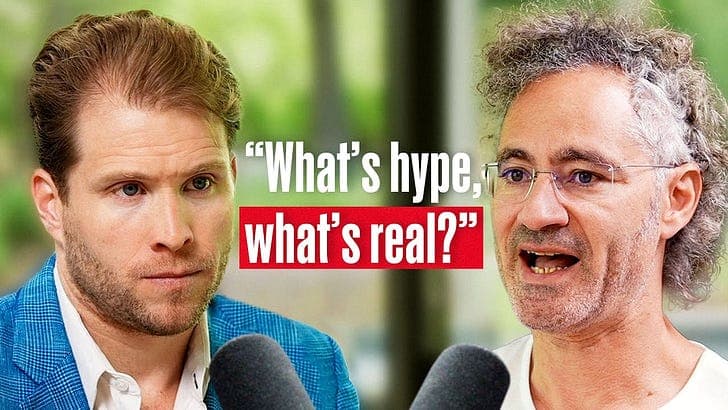
30:12Yeah. And I'll tell you what scares our enemies. using software that is actually a product that's almost invariably built here and that someone on this planet has actually paid for commercially. So speaking of that, let's move on to AI, because this is obviously tied into this. You said recently, Alex, that some tech leaders are calling for an AI pause because they don't have a product ready. How much of AI right now is innovation in theater? What's real and what's hype? What should we be paying attention to? Well, the big thing that we have to avoid in our country, but there's less of a problem for us than in other countries, is there's just an attempt to dampen AI and its utilization by people who don't have a product.
30:57And that is like this is actually a big deal inside and outside of government. Now, luckily for us in this country, it's a much smaller deal than, say, in Europe, where it's like, you know, there's all these discussions, some of which I very much support and some of which we can power. Where does the data go? How does it used? Where does it flow? What is in the algorithm? Is the algorithm discriminatory? But some of it is, you'd say, in German, vorgeschoben, which means kind of just put out there as a theatrical thing, because there aren't really that many. There are some companies providing AI in the form of advanced machine learning or large language models.
Read the full transcript
31:36We have a slight bias here at Palantir. We build a software that will allow you to process large language models, rebuild the output of large language models, turn it into what we call an agent, which is a safe algorithm you can run across your enterprise, and we can interact back and forth with large language models or other forms of AI so that the algorithm of large and large material understands your enterprise, but you don't outsource the knowledge of your enterprise to the large language model. So I believe that that will be the future and that these things implemented correctly. Large language models and AI are a crazy advantage over people who don't.
32:18And you could just take very simple examples on margins and business, efficiency and allocation, being a resource allocation um uh rebuilding your enterprise so that you get the most efficient parts at the right time um allocation of assets resources um figuring out by the way one of the most important uses of ai for america that we're just beginning to see which we're seeing at a company i won't mention just because i haven't but like manufacturing often manufacturing has a cultural element. So if you want to manufacture something in America, like is it manufactured in Japan or Taiwan, that's actually a really hard thing to do.
32:59But one of the things algorithms and AI will allow you to do is control the instruments, control production so that you get an American workforce, the advantages of being in the US and production like you exactly like you would have in Japan or in Taiwan or other places. And so that is not theater. That is, And by the way, the part that's definitely not theory is you're going to watch the GDP of America compared to the world. This is what I also wanted to ask you about, because it does seem to me like it could affect productivity, right, which is the input to GDP. And in America, productivity in things like health care, education, even areas, if we disagree on politics, we can both agree those are very important to work better for our country.
33:37Productivity has stagnated in those areas for decades. Is AI finally going to break in and maybe help productivity there? Are we going to be able to fix some things? We had no clients in education. We leave education. We're not heavily involved in that. But on health care, pharmaceuticals, hospital care, we had basically very few clients last year. And now I think we power allocation between 13 % and 14 % of all hospital bed allocation in the country. Wow. We have. And it's simply because the people in these industries know that they need instruments to increase efficiency and productivity. Part of the reason why it was hard to do this is the use case they have is very difficult because you have to increase productivity with low margins under harsh conditions, meaning you will you can get sued.
34:32You do get sued. There are privacy protections that are the most sacrosate in the world. There are issues around resource allocation that involve class and race, which mean that... I don't want to touch those. So those are issues that where you need to be able to track what goes into the algorithm, how the algorithm is used, and how that algorithm then leads back to efficiency without getting into hot water either morally, institutionally, or legally. Palantir is ideal for that. And so, but again, it's precisely because one of the amazing things in business is no one believes that we're, you know, that Palantir's deep understanding of the technical issues that involve data protection, civil liberties, are things that generated our product.
35:27Yes, but if you're dealing with this use case, there's only one engine you can use because we've spent 20 years thinking and building products for this. And interestingly, it's the kind of things you use to identify adversaries with software also presuppose a data protection, civil liberties bias. It's not just find enemy. It's find enemy. Is this the stupid general we want to keep alive or is this the general that's smart? OK, speaking of that, we got to talk about Ukraine then. Speaking of stupid generals to keep alive. That's great. Let's change gears to that. You were the first Western CEO to visit Zelensky in Ukraine.
36:05I thought that was a very bold thing to do. It was very cool. You went over there very quickly. Can you paint a picture of Ukraine's capabilities pre and post-Palantir? In the Ukraine stuff, I have to be super general.
36:21But first of all, and again, this is what I should say, but it also is true. The Ukrainians are courageous in a way that it's almost unfathomable when you're sitting here, like you meet people who are going into battle. Ukrainian people, and I realize there's a lot of debate in our country, and I welcome debate as like a kind of very much on the side of the First Amendment and kind of all the way up to, you know, it being as expansive as it can be. We used to have this debate inside of Palantir, by the way, early on, on a lot of issues, right? So that's something you always – it's always part of the culture.
37:00The right to express yourself, including things that will upset other people, is core to a functioning democracy. And, you know, the fact that you're being offended shows you're living in a democracy. Yeah. And, you know, that's – I try to empathize with the other side of that issue. I really – because I think you have to steel man all these arguments. But in the end, once you, you know, the rights you give up will be used against you. And that's something that, you know, it does place a high burden on people who have to listen to speech that they find offensive. And I engage all the way to the margin and engage with people who speech I find offensive.
37:50And I talk to all sorts of people in all sorts of small rooms where, by the way, there's a bobcat behind you. Oh, wow. A really nice. That's a cool bobcat. You guys should get that on film. It came out from the National Park. That is nuts. Alex always lives in the most interesting area. I've seen how people feel wild about it. Look at that. Wow. That is like a mini tiger. Wow. That is. Have you seen that here, Lance? It's like. It's here to honor you, Joe. i've never seen it before it's a good omen for us alex um mary uh in ukraine you went to these people so they usually when you go you know i've spent 20 years going to important institutions of all kinds and there is often but not always a moment where you're in a small room with someone and they're like yeah but the truth is i don't agree with so and so i don't believe i you know I think my leader is beyond or something.
38:46Yeah. There was none of that. Like the amount of kind of deep patriotism. And again, I'm talking about all sorts of people. Hi. I like talking to people, quite frankly, who are unimportant. So I have a kind of honor to meet lots of important people. This is not because they're afraid of expressing a different viewpoint. i speak the ukrainians are it is not a place where people are particularly afraid of expressing any viewpoint you know you you are going to hear a lot of free speech they are fighting because they believe and you can debate a lot of things uh and uh and there's a healthy debate about the ukraine war in this country uh but i can tell you from my experience on the ground uh these people are fighting and they are willing to fight and you know at a general level without going to details some of the places that have used our product have been bombed people have died and the same day those people are back at work wow same day i mean it's like and they're also very very technical at a high level what's palantir able to do that other systems are not able to do is a matter How much is useful for the Ukraine?
40:09Some of it's the part that's public is obviously documenting war crimes, but war crimes are hard to document because of data protection issues, to take it to court, where the evidence has come from, who's touched it, chain of custody issues. So that's kind of what we're doing. Understanding who's doing what on the other side is a classic use case for PG. So how is the adversary – as a matter of theory, you can just go through the products. So there's a kind of the civilian prosecution. There's in the PG foundry constellation, there's an ability to understand what the adversary is doing kind of with their operatives, who's doing what and how it's doing it.
40:53With segmented data access, which is crazy important in a warm-up. But it's funny is that people don't understand you need segmented or high data protection because the knowledge that these people have is so valuable, meaning people will die if it gets out, that you have to control who sees what. Gaia, meaning who is it will allow you on the battlefield to be able to see where in real time, what plan out your battle, attack, retreat, understand the adversary. And then the most powerful use of our product currently, and again, of one of our products is being able to identify an adversary over a large lying mass using AI.
41:39And that obviously it's been reported has led to a different level of ability to acquire the adversary's position. And there are so many lessons that we need to learn in this country and we'll learn. But one of the obvious lessons is we are in a software world.
42:05It was the case that this was the ramblings of a couple people 20 years ago that people didn't think should have been in this business, including you and me and our other co-founders and early employees. It's just a banality. And the other thing is our adversaries now are awake. China and Russia realize this. They didn't realize it before. And that is going to change where they invest their money. And we'll give them ability to catch up if we're not on top of this. I mean, this was a thesis 20 years ago. This would clearly become by far the most important part of the defense world, which it seems to have become now.
42:42It's a little scary that they're aware of it too, but it's nice to have a lead for now. You know, zooming out a little bit, I want to ask about Silicon Valley before we end. You said our problem in the West is not technological, it's organizational. And can you expand on that? Is that true of government and technology? How do you think about that? Again, we build these crazy valuable things. We build them in a way no one else builds them with like tiny groups of exactly the right people managed aggressively against a goal that could take years where we split the proceeds pretty equitably across the people who build it and where people can be involved and from the outside.
43:23We have a general culture that embraces that, extends it, tries to insert that into institutions with all its flaws that, and there are many, and we've, I pay, we've lived under those flaws that is unlike any other in the world. But we obviously could become much more efficient. And then we are also very misaligned on some of these issues. We have a significant number of people in the West who believe if we disarmed, the world would be a better place. This is a belief structure that, in my view, is theological in the sense the assumptions can never be problematized. Because there's no evidence this is true ever in the history of humanity.
44:09But it does conform to the way we would like the world to be. I would like the world to be. It also conforms to a certain derivative of our philosophical and religious systems. It also happens to be completely untrue. And so those of us who want to have believed that you will get a better world, not a perfect world, but a better world by making Western institutions, especially the United States of America, stronger, especially on the battlefield. We confront an ideological system that will never agree with us. They confront a reality that will never conform to their views. And we as a culture have to navigate that.
44:59Now, I do think Russia and China's actions in the last five years have made it much harder. And even in Silicon Valley— It's woken up everyone, right? They actually all want to do defense with us now. This is very funny because even when I was starting a new defense thing seven, eight years ago, people were like, you're kind of quirky. I thought you weren't doing that anymore after Palantir. Like, why would you do defense? And they still didn't get it. But I think now people actually get it a little more. One of the ways that our lives have changed is 20 years ago, this was like from Mars freak show, all these views.
45:31The West must defend itself. The best, the people producing this thing called software must be aligned with our government. We should not allow institutions, software institutions, to sell to our adversaries but not sell to the U.S. government. The world will become disjointed and more violent. simultaneously startups would rise and become a very large in terms of market captain and footprint and that these software companies palantir and i hope others someday will change the course of history as you've are if you've seen and and are in ways that no one believes or or some ways are classified um and that um but simultaneously and that you can convert get people to believe by seeing the success and the impact and last not least and our adversaries will completely act up because without them acting up i still think people would not believe us we've come closer to the norm yeah and so like now all these things are like you walk around and people are i don't think everyone's saying he believes it but they are beginning and and you know and that that's that's kind of very gratifying um and it's probably good that they've forgotten that they all called us assholes 20 years ago it was really interesting to live knowing obviously palantir helped stop some really major attacks that were not public and people just thought we were weird and didn't appreciate it and so you're finally getting some public appreciation i guess after maybe not for everything we've done but for some of the new well a lot of things we've done we've done can never be publicized and i do i do i do in some ways which they were more well known both for Palantirians.
47:09And because these institutions that, you know, I revere, like our military institutions and others would get even more support if people understood the impact they were having in clandestine services, positive impact. Now, there are reasons they can't talk about these things and probably shouldn't. It has changed from we are like essentially the X-Men in a very deep cave and then being shuffled back into the cave and told, you know. But there's still a lot of that. I always get in trouble for saying the obvious fact that without PG, Europe would be completely different politically. And this is just a fact.
47:49I think U.S. might be as well. We probably shouldn't talk too much about this because you don't see it as big of a problem. But I mean, I think a lot of the battles we're having, There are cultural wars right now over things. It might not be the battles we'd be having if there had been multiple successful attacks. I think the culture could have transformed in a very different direction. Yes.
48:09There's a lot that has gone into some of the luxuries we have, including certain dialogues that are clearly luxury products. Alex, we started American Optimist to push back against cynicism and pessimism. You've seen a lot of parts of our country. What innovations and breakthroughs make you most excited about the next 20 years? What gives you hope for the next few decades? America is by far the best at enterprise software. You saw this before AI and large language models. I think at this point, it's kind of hard to ignore. We continue to attract and retain the best talent in the world. We have cultural and cultural systems for managing that talent and turning that into productive companies, like some of the ones you support in finance, and I would say most notably Palantir.
48:58And I think a lot of the kind of, and then we have, there's a way in which our adversaries who are really focused on hurting us galvanize and bring the best out of America and allow us in many cases to look past divisions that are quite obviously less important than us unifying to outmaneuver and be stronger than our adversaries and leave them so scared that they act up less and quiver at the idea that rule of law, free speech, protecting a property, and in general respect of humans is a basic human right. Awesome. I think that's a great note to end it on. Thanks, Alex. Thank you.
From the publisher
Over the past two decades, Palantir has prevented a large number of terrorist attacks, deployed the most advanced civil liberties data infrastructure throughout Western countries, and changed the course of history. Today, its technology is most evident on the battlefield in Ukraine, where its software has provided the Ukrainians a devastating advantage over Russian forces. And now, Palantir is quickly becoming the leading AI platform in the world for large organizations.
How did a small startup overcome overwhelming institutional resistance to become one of the most important software companies in the world? And what can we learn from its CEO, Dr. Alex Karp — How does he attract the very best engineering talent? How did his dyslexia and outsider upbringing impact his views on the world and how Palantir is designed? We cover these questions and more in a special conversation between two of Palantir's co-founders.
Dr. Karp holds a B.A. from Haverford College, a J.D. from Stanford Law School, and a Ph.D. in philosophy from Goethe University in Frankfurt, Germany, where he studied under Jürgen Habermas and other leading intellectuals. In this episode, we explore the impact of philosophy on his life and why he ultimately left academia to build. We share some of our favorite stories from Palantir's early days, discuss how to reform the Pentagon to improve its results, and look ahead to how AI is changing the nature of warfare. Dr. Karp is one of the wisest leaders I know, and you'll learn how his iconoclastic views on software, patriotism, talent, and innovation have been proven right over the past years, and what they mean for the future.
This is a public episode. If you would like to discuss this with other subscribers or get access to bonus episodes, visit blog.joelonsdale.com