In short
Podcast Episode Summary: Joe Lonsdale: American Optimist - Ep 76: Accelerate or Die! Guillaume Verdon and the e/acc Movement
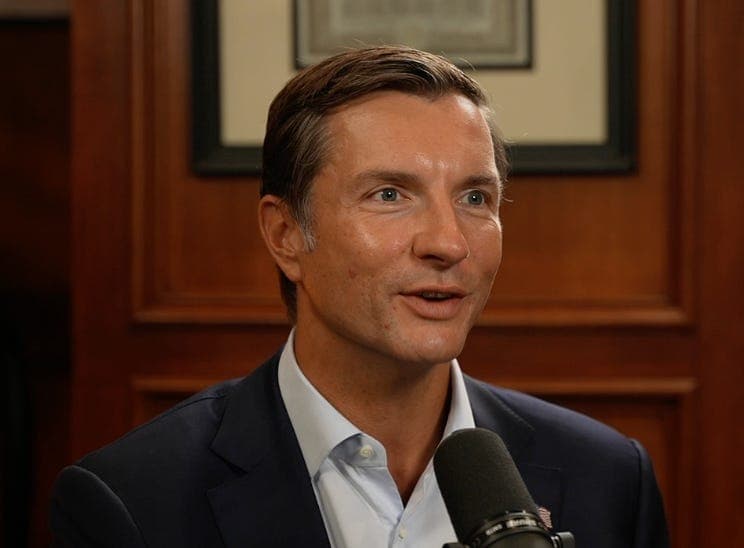
Episode Overview In this episode, Joe Lonsdale welcomes Guillaume Verdon, a theoretical physicist and a pioneer of the e/acc (effective accelerationism) movement. The discussion centers around the concept of e/acc, its rise within tech's elite circles, and the implications of this movement in counteracting the prevailing pessimism in contemporary discourse regarding technology and progress.
Key Themes and Concepts
What is e/acc?
- Definition: e/acc, or effective accelerationism, is a cultural and technological movement aimed at embracing and promoting technological advancement instead of succumbing to doomsday narratives.
- Goals: To inspire a cultural renaissance that encourages optimism about the future through technology.
- Historical Context: The movement arises as a response to a growing culture of skepticism around technology, particularly the doomer and degrowth movements.
Importance of Narratives
- Cultural Shifts: The episode discusses how the portrayal of science fiction has shifted from optimistic to dystopian, affecting societal attitudes toward technology.
- Vision for the Future: Lonsdale argues that an optimistic vision can foster societal actions that align with positive futures, while a pessimistic outlook can lead to self-fulfilling prophecies of decline.
Background of Guillaume Verdon
- Education and Career Path: Verdon shares his journey from studying physics at McGill University to working on quantum computing at Google X, illustrating his deep engagement with cutting-edge technology.
- Motivation: He expresses a desire to not only understand but also to contribute to the advancement of humanity through technology, motivated by values he associates with the American dream.
Discussions and Insights
The Role of Technology in Society
- Potential vs. Limitations: The conversation highlights how technological advancements can solve many societal challenges if embraced rather than feared.
- Energy as a Metric: Lonsdale and Verdon discuss using energy production and consumption as a benchmark for societal growth and health. This approach contrasts with more subjective measures that can lead to skewed perceptions of progress.
Ethical Considerations
- Diversity of Perspectives: The importance of maintaining a variety of cultural perspectives to ensure balanced growth and societal health is emphasized. Verdon suggests that rather than suppressing underperformers or non-contributors, society should invest in their potential.
Moving Forward with e/acc
- Encouraging Optimism: The episode closes with a call to action for listeners to engage with and promote e/acc principles, encouraging individuals and groups to envision and work towards better futures through technology.
- Role of Policy: Verdon emphasizes the need for a voice in policy discussions to protect the values of innovation and open-source development from regulatory encroachment.
Conclusion The episode serves as a rallying cry for optimism in technology and innovation, advocating for a cultural shift towards effective accelerationism. By highlighting the importance of narratives, ethical frameworks, and the potential of technology, Lonsdale and Verdon encourage listeners to actively participate in shaping a positive future for society through collaborative innovation and responsible technological advancement.
Key Takeaways
- e/acc promotes a positive and proactive approach to technology and societal progress.
- The narratives we embrace can significantly influence collective actions and outcomes.
- An ethical framework that values every individual's potential is essential for sustainable growth.
- Active engagement in policy discussions is crucial for maintaining an environment conducive to innovation.
For more insights and to engage with the movement, listeners are encouraged to visit [American Optimist's blog](https://blog.joelonsdale.com?utm_medium=podcast).
Written by AI. May contain mistakes. Listen to the episode to check what was said.
Transcript
Automatic transcript. May contain errors.0:00We were always obsessed when I was working with Peter Thiel 20 years ago with how science fiction had gotten horrible and turned so negative, right? It's like science fiction used to be the most inspiring thing in America 50 years ago. How do we bring that back? Do we see it coming back? Are there ways to turn this around? I mean, that's what we're trying to do with EAC. Like, let's imagine all sorts of potential awesome futures. Let's back propagate from those ideal futures towards today. What actions can we take that maximize the likelihood of the advent of those futures? And let's do those actions.
0:24And that's a really great algorithm to sort of amplify the likelihood that we make it. Elon is very much the same, you know, has grand visions of the future and he works relentlessly towards them. In a sense, like once you identify a positive reward in the future and you really model it, your brain just like rewires itself to figure out how to get there.
0:49Today, we got to talk to the based Beth Jezos. His real name is Guillaume Verdon. He's a theoretical physicist on the cutting edge of quantum and AI. And he created the EAC, effective accelerationism movement. This is a cause that's near and dear to my heart as an American optimist. It's all about the prosperity of humanity, about accelerating into a future where we're all doing better, where technology is solving problems and making human life more successful. You know, there's a strange thing in our culture where science fiction used to be really optimistic. We used to see really positive visions of where humanity was going to be in hundreds of years in the future.
1:24And whatever you believe, whatever you work towards, it tends to bring about that reality. If society sees a positive future where we're in space, we're living on Mars, where people are living hundreds of years long, where we have a peaceful future of exploration, that becomes more likely. If society sees a dystopian future, if they see environmental destruction, if they see negative totalitarian governments, that becomes more likely. It's really important for our culture to embrace these positive visions and for us to have our best and brightest people working towards bringing about those positive visions of the future.
1:54And for that, I'm grateful for the EAC cause and I'm excited for you to meet Guillaume. I'm Joe Lonzo. Welcome to American Optimist. Guillaume, wonderful to have you here with us. Well, thanks for having me, Joe. Pleasure to be here. Really excited to chat today. Before we dive in, Guillaume, let's start with your background. You grew up in Montreal. You did your undergrad at McGill University and grad studies at Waterloo. Tell us a bit about yourself. Yeah, I mean, I've been living my life according to somewhat of a master plan, right? Living life like a game. You have a limited time. You know, you spawn, you start, you got to understand the rules of the game, identify the highest impact opportunities, and then go and pursue them.
2:28And so, you know, the first phase of my life, uh, I pursued sort of theoretical physics, trying to understand the laws of the universe. The only real laws are the laws of physics at the end of the day. Um, and, uh, that, that got me to study physics and math at McGill university. And then later on, I went to do a master's in theoretical physics at the university of Waterloo and the perimeter Institute for theoretical physics. There I was working on really what are the edges of our knowledge, right? You know, there's the cosmos, the grand scale of things, the very small scales, so the quantum mechanical scales.
3:04So I was working on quantum cosmology, a bit of black hole physics. And there I got really interested in information theory, notions of compression, because black holes are really the densest objects in the universe and they have the highest density of information. Tell us a little more about that. I'm curious to hear, how does that work in terms of actually information being compacted in a black hole? I know it squeezes all the stuff together, you know, and there's all sorts of interesting formulas at the kind of boundary of the singularity. How does this tie to information theory? Yeah, yeah.
3:35I mean, you know, information theory is originally a theory by Claude Shannon, which was, you know, laid the foundation for computing, but it's also used in physics to describe thermodynamics of various systems. And, you know, Stephen Hawking very famously worked on the entropy of black holes in their temperature. And there, the information or the entropy of a black hole actually scales with the area of the black hole. So somehow it's compressing information of what's inside the black hole into a hologram that scales as the area. And that was very interesting to me. And so I basically studied that mechanism and other mechanisms that are similar for how does nature actually encode and compress information?
4:15And can we create algorithms that decompress that information? And that's actually what got me into considering what would be a way to learn this compression code. inspire ourselves from nature. And that got me into studying quantum mechanical form of computing and trying to define a quantum mechanical form of AI. So quantum mechanics, for those not familiar, is the physics usually of the very small things are in superposition. They're very much not like day-to-day life. And at the time, you know, it was around 2015, I was seeing that, you know, quantum computing was an area of, you know, global competition.
4:53I was a theoretical physicist physicist at the time. I was like, how can I help, you know, the West? How can I help, you know, at the time I was in Canada, but how can I help Team America? And there I saw quantum computing as an opportunity and bringing my knowledge from theoretical physics to try to create value with quantum mechanical computers. So I was basically a pioneer of a field called quantum deep learning. So many people are familiar with deep learning neural networks, but extending those types of notions to quantum mechanical computers and really defining what does it even mean to have a sort of quantum mechanical deep learning program.
5:29And that journey got me to do a first startup during grad school. And during that first startup, I ended up being approached by Google to prototype really what would a TensorFlow for quantum computing look like. So TensorFlow at the time was the core software framework for Google to do deep learning. And we wanted to extend that for quantum mechanical learning. And so we hacked that prototype with a couple friends that I put together at the University of Waterloo nights and weekends. And, you know, they ended up liking it and bringing us on. And that started my journey, you know, within big tech, within Alphabet.
6:08And eventually I got out, luckily. A few things you want to pull apart there. So first of all, I love the implication that a base person in Canada is implicitly on Team America, which is how the world should hopefully work with these battles going on. But what made you want to fight for the West? A lot of people in your position didn't come up with those values. A lot of people at Google don't seem to have those values where you worked for a while. Where did this come from? I don't know. Growing up, people would say I'm the most American Canadian they know. But to me, America represents the land of opportunity, the land of freedom.
6:38It's obviously a pioneer in all things science, tech, and R &D pushes the boundaries of humanity. And that's the team I'm on, right? And it doesn't matter where you're born. If you identify with those values, you can move to America. You can become an American and you're welcome and you can contribute. And that's the American dream. It is. And you moved to Texas too, you know, for those values too. So it sounds like you spent some time here. That's right. So at Google, did you find some like minds around this? Was it something that didn't come up? Did it something you talked about with others?
7:06Yeah. Yeah, I mean, yeah, I did find a cluster of people that, you know, were more patriotic. And obviously, I can't talk too much about what I worked on. Because after that, after working at Google Quantum, I essentially moved to Google X to work for, you know, Sergey Brin and other leadership there. But there, you know, definitely we wanted to work on technologies that are important for this global competition. And so I worked on broader set of quantum technologies, including the U.S. quantum internet. So it contributed to the blueprint, quantum sensing technologies. So how to have very exotic sensors to sense gravity, biomedical signals, all sorts of signals you can resolve.
7:52Is this stuff working, by the way, yet in ways that are useful for quantum sensors for gravity and other sensors? Or is this stuff that we're actually using? I would say quantum sensors and quantum communication are much shorter term technology than quantum computing. And that's why I moved towards those fields after subfields after a couple of years in quantum computing. I do think there are very solid prototypes that can resolve regions of parameter space in terms of acceleration, positioning and timing that are not possible with classical sensors. And now it's a question of miniaturizing and robustifying those systems.
8:29But you can imagine a world where, you know, obviously, if you the first thing that happens in a conflict is GPS goes down. Right. You know, how can you precisely position yourself? If you have a very fine tuned accelerometer, you can just keep track of how much you've moved. That's fascinating. You know, my cousin at West Point tells me they train with a compass just in case because they kind of do assume that these things go down. And it would be pretty impressive to get all of Elon's satellites out of the sky. But I guess not all of them can be used for GPS. Right. Well, thank goodness for Elon.
8:58Yeah. Yeah, no, that's a good thing. But I'm intrigued, though, just going again to the point about the West. You just told me you worked at Google X and you're working on a lot of these things that are critical for the global competition. I mean, this is the same time, of course, when Google Maven was turning down working with the DoD, which was inspirational in a negative way to a lot of us. We had to get more involved and we had to be helping America. But so was Google X doing this for the reasons of helping the West or is it more just or is it more just something you're interested in? Because the way you said it, it was almost like you guys are doing this.
9:24It is really helpful to the West. Yeah, I mean, I can't comment too much on what we were working on and some of the decisions of the leadership there. But, you know, what I saw with my own eyes was that a sort of cultural subversion within big tech more broadly was stopping big tech from working with the government. Right. Like basically ideologies that sort of are very pervasive within the middle layers of the organization basically made it so that whenever, let's say, Alphabet or other organizations want to work with the government, there's a sort of, you know, protest and so on. And how convenient is that, you know, for our adversaries that the ideologies that are pervasive in our most advanced technological firms serve our adversaries in that, you know, we don't deploy the best technologies to the government because of these protests.
10:19And so that got me really thinking about, okay, you can work on technologies all day, but those that get deployed and funded, you know, if you don't have a sort of ideological or cultural support for what you're working on, you're not going to get to build and deploy certain technologies. And that kind of seeded the ideas for sort of cultural engineering, which has, you know, led to eventually to EAC. That's awesome. Let's go to EAC. I wanted people to hear about your background. You're obviously in the middle of a lot of the cutting edge stuff going on in the world. You're not just a keyboard warrior here.
10:51I think that's important context. So EAC, effective accelerationism, like what are the origins of this and how do you build this movement? Yeah, I think I started it roughly when I was towards the tail end of my stint at Google X there. Obviously, the baseline is secrecy. I couldn't talk much and, you know, about what I do and couldn't say anything too controversial. And so, you know, I started an alt account, as we say on Twitter, just to have a sort Really, you'd be surprised how much one restricts their own speech when they know they're being observed by peers, by their potential boss. I've noticed most of my friends do this.
11:25I've gotten in trouble because I don't do that enough. But yes, it seems to be what other people do. Right, right. Because once you have freedom of speech, it induces freedom of thought. And all sorts of thoughts you weren't giving yourself the right to have, you can now try to experiment in a sort of lower risk way when you have very few followers. Obviously, now I have a lot of followers and I'm docs, so it's a bit more difficult. But back then, I just wanted to putting out some ideas that, you know, that I thought in private, but that I couldn't discuss with anyone at the time. And it sort of grew, right?
11:57Because I would just say, you know, hidden truths or what I thought were truths at the time that maybe a lot of people thought in private, but couldn't vocalize. And that's sort of how the account grew initially. And eventually we put some of those thoughts into a framework that sort of went viral to some extent. Originally started just discussions. You know, Twitter space is a great product. You get to have, you know, 10, 20 people just have a discussion, just like a campfire discussion. Like, this is how things really are. Let's have a discussion. Where are things going? Where are we? Where are things going?
12:32And what can we do about it? And we wrote down some notes. It became a blog post and then it went viral. And that's how EAC started, really. It was very humble beginnings. So tell us a little bit about that framework you built. What are some of the first principles? I think it's something we're very aligned with, obviously, on my side. We're optimistic about the future. You can basically have all these problems you can actually solve by building and then things get better that way. What's the framework you started with? The basic framework comes from the study of life, biology, adaptive complex systems.
13:02Basically, most systems in nature that are alive, quote unquote, seek to acquire resources and utilize them towards their own growth. And that's kind of the basic principle. And systems that do this get selected for, like they're likelier to exist in the further future, and systems that don't tend to die out. It's that simple, right? And this happens at all scales. It happens at the individual scale, at the company scale, at the nation scale, and at the civilizational scale. So given this, it's like, okay, well, we could be an empire civilization that dies out if we have the wrong culture that induces the wrong mindset that leads to decline.
13:42So what if we created a sort of viral optimistic movement where we're self-aware that this is the thing we're optimizing for and we're seeking to optimize for the growth of the whole system? And really, we're not being prescriptive of how exactly to do this, but rather that we should maintain dynamism, adaptability, and an open mind as to how to engineer this growth. And so one of the sort of core tenets is to maintain variance, maintain adaptability, because, you know, it's just like an early stage startup versus a late stage company. an early stage startup, things aren't fully pinned down. You're still flexible.
14:18You're still malleable. You can pivot and then identify the opportunity for maximal growth. In a later stage company, maybe you have a large product. You've pinned down all sorts of processes. You're not as malleable, not as flexible. And so maintaining at a societal scale, this sort of adaptability is important for us to always be of highest fitness towards this growth. I want to play a little devil's advocate here just to get just to get some of the common pushbacks to here. And I'm 100 percent on the side of growth and dynamism. And there's all these ways we're breaking that today. But the way you define this, where you kind of want the system to grow and things to get more resources and let it keep growing and be alive.
14:56Maybe a stupid pushback. But how is that different from a virus that's growing or how is it different than like something that's, you know, they could have something that grows. That's actually like really, really nasty. That's like some kind of like empire that's nasty to everything around and just like an evil empire that conquers everything. Would that be something that counts as growing really well because it's better being an evil empire? How do you think of the ethical implications of what this is? Yeah, I think there can be fluctuations away from this perfect trajectory of growth, but on average, they tend to correct on a sufficient timescale.
15:28So if you had a sort of global authoritarian power, eventually that power would crumble because it's not a stable solution. Suppressing speech, suppressing people's thoughts eventually gets disrupted by a society that has way more freedoms, innovates much faster and outcompetes that empire. For a virus, if the virus is far too virulent, right? If it's like a parasitic growth, then it could kill the host and then it has no more substrate to grow upon, right? I think it's important to explore like the steelmen of our enemies. So, you know, when I was younger, I've been very lucky myself to grow up as like the like chess champion, math champion, like all these things where I'm, you know, pretty confident of things.
16:07And so I really valued, okay, the smartest people in the world are the ones who are going to make the biggest difference. And they're the ones who drive everything forward. And there's this whole framework around that. You can almost call it a niche-in framework where you want the Ubermensch to basically be in charge and run things in a way because that's going to make it all more effective. And it's like, basically, there's this theory that the top, whatever, 1 % or 2 % are the ones who are actually driving forward history. And I think there's a danger if you get like too into that philosophy, which is focused on like competence and growth and the very best people winning, which is that you kind of leave out like the Judeo-Christian background, which is that there are, I mean, I think society should be also be measured how it takes care of the people who are on the bottom 10%, right?
16:46There are people who are the meek of the earth, who, depending on your view of humanity, I'm kind of like, people are radically unequal on their impact. But I think equal dignity of human worth, for me, is very important. And for a lot of people, it's very important. Where you do want to take care of the bottom, even if maybe you shouldn't be putting them in charge. So maybe a society, just as an example, a quote-unquote evil society that just cut its bottom might actually grow a lot faster in some ways. Because those people are very problematic. Whereas maybe a more moral society would still grow, but take care of their bottom.
17:15How does that fit into EAC and how do you think about that? Yeah. So I would say like religions and subcultures, you know, really they're just highly evolved memes, right? You have mimetic competition for subcultures, ways to live your life. And different subcultures will confer an advantage or disadvantage to its adherence in terms of the growth of their subculture. And so these religions that have evolved are very well fine-tuned heuristics that on a long time scale ensure sort of robust growth, right? Like who knows if someone may not be productive now in society, who knows, maybe things change and their family becomes like super highly productive, right?
17:58Like down the line. So it's not worth, you know, cutting out the bottom 10%. And so really all we're saying is like, we're not saying a particular culture is the way to go. And it's not just about maximal strength at this moment. It's about search, maintaining broad search over cultures, not enforcing a single monoculture that's top down prescribed, letting people search over ways that they'd like to live their lives and maintaining that freedom to explore. that's the important thing because that's always going to yield a sort of high fitness cultural heuristic at any given point in time no it makes a lot of sense that a lot of evolution works this way you wouldn't all want to be exactly the same in the species you might get wiped out you want enough variation to adapt to new things and so why do you use energy as a measure of progress how does energy tie into that as a way to assess this yeah i mean you know fundamentally uh energy and information are some of the big two observables that we have in physics.
19:00And really, I want to measure progress that was anchored to reality, that was objective, right? There's other utilitarian philosophies like Edenism that they want to maximize some sort of subjective measure like pleasure, for example, right? And that's totally subjective. And that leads to sort of weird Optima, like wireheading, like you're just going to plug into the matrix and press the pleasure button forever. Whereas if we seek as an optimum to grow the system as measured by a measuring stick that doesn't change, which is like how much energy are we producing and consuming, then that's a good sort of anchor relative to, let's say, GDP that we can play with.
19:38We could fudge with the numbers. We can inflate the dollar away. And then once we unpinned from gold or a measuring stick, a lot of things, the world shifted towards financial engineering instead of like hard engineering. And so what I'm saying is I think every other metric of growth could be a projection of, let's say, energetic growth. That's kind of the key metric. And at least from the equations of physics, if you consider the whole system of civilization, the equations predict that the system will optimize towards its growth, towards consuming more free energy. And that's where we should go, where the universe wants us to go.
20:13It's fascinating though, because it does seem that in the last 20, 30, 40 years in the West, Like we've been able to grow in like more energy efficient ways, right? Or is that fake? Is there's nothing like growing without energy or how do you think of that? Yeah. So I'm not saying like, uh, let's grow, uh, and just burn energy for the sake of burning energy. The point is that it's growth on a long timescale. So it's not just the current instantaneous amount of energy we're burning. It's how much we're burning on a long timescale and hopefully that exponentially grows. And so if we're not utilizing our current energy in a clever way that leads to further growth, then we're doing something wrong, right?
20:51And, you know, a lot of things we do, like, let's say, developing better technologies, using that energy to develop better technologies gives us optionality for sort of later growth and helps us unlock the new scale. At the end of the day, how many humans can we sustain? How big of a civilization can we sustain is determined by our level of technology. And the more intelligences that we have, the more humans we have, the more the rate of technology progresses. And we want to keep that going, that sort of feedback loop going. I'm curious what you think. How many people could we have on the Earth at our current level of technology in a kind of comfortable, healthy way that we keep growing right now?
21:25That's a great question. All I know is that it's definitely bottlenecked by the Kardashev scale, which is the measure of how much energy production we have, because we can turn energy into food. We have all sorts of chemical processes for that. But definitely seeking forms of energy that are more potent, such as nuclear energy, which right now it's not necessarily the physics that's a problem over regulation. Yep. Right. That's going to be necessary. And so this sort of social movement where we push for less regulation, trying to make people aware that there's a huge opportunity cost to slowing things down is really important for us to unlock that next scale of civilization and unlocking the ability to support more humans, which I think most people would want.
22:06No, 100%. I feel like with nuclear energy and things like tunnels around our major cities and stuff to get rid of traffic entirely, because you're going to have arbitrarily large amounts of going in and out, it seems like there's no reason we couldn't have 100 billion people. You can still be comfortable. I think people have a bad intuition for this, but people hate it when I tell them this, so maybe I shouldn't keep telling them this. Permissionless innovation is one of your core tenets as well, which obviously that's really key for a lot of areas. That scares a lot of people about things like nuclear.
22:33They might not want you just to be able to do anything with nuclear and cause a problem. For the boundary cases for that, how do you think about it? Because regulatory states obviously slowed growth massively. I think overall it's hurt people a lot. How do you think of those boundary cases on the edge of regulation for extreme things? Yeah, I mean, I think like our point is not that like nothing should ever be regulated. It's more like the pendulum has swung toward, you know, there's been a sort of second law of bureaucratic complexity. It's only been increasing over time and it's massively slowed down many industries.
23:03For example, you know, nuclear energy has the potential of slowing down AI. Clearly, the drug discovery process as well just costs a lot right now. And that's slowed down drug discoveries. We don't know really the futures we left behind by regulating everything this hard, right? Maybe we would have discovered all sorts of drugs much faster if there were less regulations. But there is already feedback loops that are natural. If you do something terrible to another business, it could sue you. So that's a negative reward. Other businesses or consumers vote with their dollars. That's like positive reward.
Read the full transcript
23:38So there's a way to have this peer-to-peer alignment of incentives. And that's kind of our point as well about AI. if you have the trajectory of AI companies and products being steered by the market, eventually people wouldn't pay for an AI that's unaligned, doesn't do what you say, and is nefarious. They would pay for an AI that is a good worker, let's say, is aligned and is reliable. And if the person or the company that offers such AI systems could get sued if their AI is unreliable, then they're going to engineer it to be reliable. So the market is going to sort of drive this sort of demand for reliable and aligned AI.
24:18And I don't think like a heavy handed top down regulation that's secretly written by the current incumbents is the way to go. Because AI is moving on a timescale of month to month, week to week. And, you know, regulations are on a few year timescale at best put together. And that's just too slow of a feedback loop. And it's too heavy handed. And it's probably not the way forward. So that's kind of our thesis is that we have to swing the pendulum back towards freedom to innovate. 100%. I mean, it's the same thing in healthcare in America. All the incumbents write all the regulations. And so you can't adapt.
24:50And healthcare is like three times as expensive or something as it would be. It's the same thing with AI. They want to capture it. Probably a good idea for them not to capture it. Guillaume, I want to ask you about your recent posts about hyperstition and how culture correlates to progress or decline. Can you unpack that post? Why did culture and narrative matter? Yeah. If your editor shows the graph, like essentially over time, we've seen like discussions about progress, the future kind of decline and more about like risks, words of caution and people worrying, which is sometimes natural. But it's hyperstition means that you bias the reality towards the futures you're thinking about.
25:26It's kind of like in a startup as well, right? Like if you're optimistic, you know, you have a shot at growth and having a successful company. But if you're pessimistic, you're definitely probably not going to be successful. Yep. This is like, there's people very close to me in my life growing up who are probably at least as smart as me, but they're more negative and cynical. And so it makes it, I've started all these billion dollar companies because you have to believe it's possible. Otherwise you can't do it. That's right. Yeah. That's right. You gotta, you gotta believe it's possible. So we have to paint and think about better futures and then we can work towards bringing forth their existence.
25:57Whereas just worrying about doom and gloom futures, like makes us focus on that. And ironically, sometimes we engineer the advent, you know, just like I'm going to say it like, you know, we've there was centralized research on bioweapon defense. Right. And we were worried about a potential virus that could do a lot of damage. And then it was actually accidentally created through that research. And exactly. And we're going through similar stuff with AI. Now people are trying to do like sleeper agent LMS and so on. And so it's like, well, the market wouldn't want to create these things, right? Like nobody would buy a COVID virus for fun, from what I can tell.
26:40And so like the market, the market gives us a sort of probabilistic safety because it biases, it selects for things that are positive towards growth of the system that are a net value add, not a massive negative value. It's actually fascinating. The government by being worried and negative is actually creating things that would never have existed otherwise. or in the narrative is, you know, this is interesting because it actually is like a very personal framework as well as a societal framework. What I found in my life is that when you actually believe something is possible and you focus on it, you kind of merge your reality into a reality where it is possible and that you bring these things about.
27:13We were always obsessed when I was working with Peter Attila 20 years ago with how science fiction had like gotten horrible and turned so negative, right? It's like science fiction used to be the most inspiring thing in America 50 years ago. How do we bring that back? Do we see it coming back? Are there ways to turn this around? I mean, that's what we're trying to do with EAC. It's like, let's imagine all sorts of potential awesome futures. Let's picture them in our mind's eye. Let's backpropagate from those ideal futures towards today. What actions can we take that maximize the likelihood of the advent of those futures?
27:43And let's do those actions. And that's a really great algorithm to sort of amplify the likelihood that we make it. Elon is very much the same, has grand visions of the future, and he works relentlessly towards them. In a sense, like once you, once you identify a positive reward in the future and you really model it, your brain just like rewires itself to figure out how to get there. How do we get more people thinking about these with EAC? Do you need to do more better memes? Is there like cool, you know, stories and pictures of crazy fun things we want to create in outer space and Mars? How do we do this?
28:14Yeah. I mean, I think, you know, there's been EAC, there's, you know, techno, there's Mark Andreessen's techno optimism. There's all sorts of variants of this subculture. But really, if more subcultures that are positive about the future, positive about technology enabling such better futures exist, if they become more popular, then just by construction, more people will want to work towards those futures that are going to want to work on with innovative companies. And we're going to increase the likelihood of that better future happening. We definitely need better sci-fi. We definitely need to make sure that we We don't shoot ourselves in the foot preemptively by panicking about potential futures, right?
28:55Predicting the future is a very high variance prediction. It can be scary and we can preemptively do much more damage to ourselves with, let's say, overregulation than the damage that would have happened by just letting things happen. And so I think at this stage, there's a danger because we're going through a very rapid shift. There's a danger that this disruption and fear mongering becomes instrumental towards certain people and incumbents that are trying to gather power and crystallize their position before, you know, people realize that actually the future wasn't going to be doom and gloom.
29:34and actually was going to be great. But now you've crowned a couple organizations as all powerful and you can't go back. I was reading something the other day about how a Roman emperor met a guy who had a form of glass that you can hit and it would like, and then you'd just store it and you hit it and it fixed itself. It sounded like they were scrubbing plastic and he apparently just killed the guy because he was afraid that if it got out, it would ruin the future because it would make gold and silver worthless because it was a valuable material. But it does seem like people are very naive about.
30:03I wonder how much inhumanity in the past has stopped our advancement just by being scared and naive about these things. There's probably a lot of stories we don't know like that. Absolutely. I mean, we've always been scared of new technology, new knowledge, and how it could disrupt the powers that be. And so here we are at the advent of a new age. We're working on very sophisticated, self-adaptive hardware that could scare some people. But we think it's going to really impact the world positively. Tell me what you're working on now. You left Google and you've been working on a new startup for how long now?
30:34A year and a half, roughly. We're about 20 people. It's called Extropic. Essentially, I had a journey through quantum technologies and I realized, obviously, those technologies are going to take some time to really scale and mature and get to market. But I was seeing generative AI really become the sort of core workload of a lot of big tech players. And, you know, I came from a background in physics and really wanted to figure out how can we push the limits of computing to the very limits of physics and really have the most energy efficient, densest potential compute for AI and the densest, fastest, most energy efficient.
31:12Because, again, according to my principles of EAC, the more intelligence you have, you know, the faster the progress towards scaling civilization will have. And so making intelligence much cheaper is a priority. And so we're engineering a whole new stack. It's called thermodynamic computing because we're operating at the thermodynamic limits. But it's really aiming at speeding up generative AI massively. And of course, if people are scared of GPUs right now and what current-day silicon can do, they're going to be very scared of what we're doing. And so I knew like if we didn't prepare the culture for the advent of the technologies that we're building, we might become, you know, outcast or, well, hopefully not executed.
31:53But, you know, you get the gist. They'll try to do that. I really appreciate that Elon and others are even more visible or standing up strong. They're trying to get them. Unfortunately, we're still in a free country. They haven't taken them down yet, although they're trying. Let's go one step deeper on the tech just so we understand it. You know, for some of our listeners who are more technical, like what are you actually doing? What are you building? So essentially, we're building computers for neural information processing, and they really harness fluctuations of nature and nature's noise. Essentially, electrons tend to jitter around, and we can harness that jitter in order to make systems that are far more energy efficient, far more data efficient, and essentially do the machine learning as a physical process.
32:36So we're translating between the algorithms that usually run on a digital computer and we're just instantiating them physically. And that leads to a sort of system that's not alive, but, you know, it's adapting by itself. And it's quite interesting. And, you know, obviously for all the players today that are spending billions and billions of dollars on compute, this could be a big game changer. What's your timeline, you think, to get this being able to be used? Do you have a good sense? I mean, I haven't announced any prototypes yet, but we have our first test chips and we're iterating. But I think a couple of years from now, we'll be able to have this in production.
33:14That's very cool stuff. I got to make sure we learn more about it. Before we lose you, Guillaume, just looking ahead, what's next for the EAC movement? And how are you thinking about affecting policy? How are you thinking about what do you want to do with this movement? And what else do you want to push with it? Yeah, I mean, that's a great question. So far, it's just been very organic scaling. We haven't had a sort of top-down control. There's no centralized organization. You know, even the merch, I didn't even produce these. People gifted them to me, right? It's been very permissionless. Like, everybody can contribute to it.
33:42So we do want to keep that aspect but figure out how to scale it. But we are, you know, we do have to have a voice, let's say, you know, in Washington as these legislations are being pushed through or there's attempts to push legislations through to sort of stop open source from growing and competing with big tech, for example, by saying it's a dual-use technology, which we think is egregious, or give a sort of regulatory mode to the incumbents. That we need to stop in order, again, to maintain sort of this equal opportunity to build, this freedom to compute that is so important for innovators to just come forth and be able to participate in accelerating, you know, AI progress and tech progress at large.
34:29A hundred percent. Well, you probably know I have teams in 18 states and I just hired some people who are great in D.C. just for purposes like these. I know Marc Andreessen and his team spending$75 million for the first time hiring people in D.C. to fight for these values. So you have a bunch of allies out there. If you see stuff, you should make sure you flag it. You got a bunch of people eager to help with that. A final question, Guillaume, other than what you're working on, what innovation or technologies excite you the most right now? And how do we give people the sense that humanity is really just scratching the surface of its potential and there's so much more out there?
34:58Yeah, I would say, you know, obviously the technologies for software in terms of intelligence and artificial brains like we're building are super important. But then in order to really see progress in the world of atoms, we're going to have to transduce that potential of intelligence into the physical world. And so I think robotics is going to see a boom in the coming years as we cross that threshold of having sort of being able to have synthetic white color intelligence. I think there's a few year gap between we'll be until we can solve motor intelligence or blue color intelligence, if you will, and give people operational leverage.
35:32Right. You have intellectual leverage now with Chan GPT, but eventually you'll have operational leverage. And that's where we're going to see serious progress in the world of atoms. We're going to see deflation and the cost of building things in the real world. And I think that's something everyone wants to see because things have slowed down far too much. And so I'm really excited about that. And apart from that, obviously, nuclear energy technologies, fusion is great. Still pretty long timelines, but there's progress being made that's very tangible. And hopefully, fission that can work around all this overregulation.
36:05So those are the most exciting technologies. I love it. Well, we're working hard on that. Guillaume, really appreciate you joining us today. Thank you so much, Joe. Thanks for having me. New Taste of Democracy
From the publisher
What is e/acc (effective accelerationism) and why is it going viral among tech's elite? Who are the leaders behind this movement and what are their ambitions?
This week, we explore e/acc with one of its pioneers, Guillaume Verdon (aka @BasedBeffJezos), a theoretical physicist at the cutting edge of quantum computing and AI. Guillaume worked under Sergey Brin as the quantum deep learning lead at Google X before launching a thermal computing startup called Extropic. He started e/acc as a cultural counterforce to the degrowth and doomer movements that sow distrust of technology and seek to undermine the advancement of artificial intelligence and other emerging innovations.
Fifty years ago, sci-fi was some of the most inspiring art in America. It's no coincidence that it preceded the birth of the space and digital ages — the stories and narratives we tell ourselves as a society are the ones we tend to work toward. Not surprisingly, as sci-fi took a dystopian turn in recent decades, society's view of technology and progress soured as well. E/acc is the antidote; it aims to inspire a cultural, then technological, renaissance in the West. While e/acc has gained popularity through viral memes on social media, it's also a cohesive framework designed to apply to the modern world. In this episode, we discuss the first principles behind e/acc, steelman the arguments against it, and explore how it's compatible with religion and other ethical frameworks. This is an important movement that resonates with us at American Optimist.
This is a public episode. If you would like to discuss this with other subscribers or get access to bonus episodes, visit blog.joelonsdale.com