In short
Podcast Summary: Joe Lonsdale - American Optimist
Episode 83
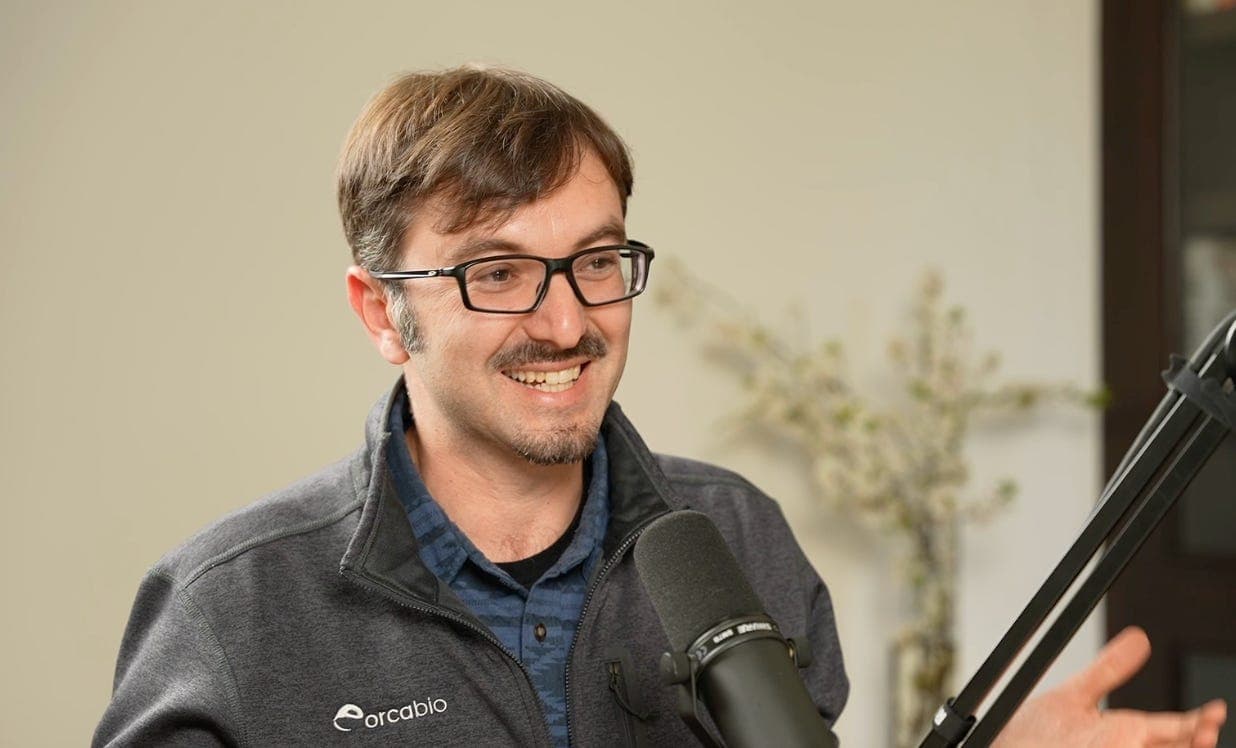
A New Cancer Breakthrough with Ivan Dimov of Orca Bio
---
Podcast Overview Host: Joe Lonsdale Guest: Ivan Dimov, Co-founder & CEO of Orca Bio Theme: The episode focuses on breakthroughs in cancer treatment through innovative cell therapies, specifically Orca Bio's approach to bone marrow transplants and their implications for treating various diseases.
---
Key Takeaways
Introduction to Orca Bio
- Orca Bio aims to revolutionize bone marrow transplants, an established but high-risk treatment for leukemia.
- Traditional transplants have a 20% mortality rate from procedures; Orca’s therapies aim to reduce this significantly.
Ivan Dimov’s Background
- Dimov has a rich academic and entrepreneurial background, with a PhD in applied biophysics.
- His journey reflects the necessity of translating technological breakthroughs into practical societal impacts through entrepreneurship.
Breakthrough in Cell Therapy
- Orca Bio's therapy modifies the immune system to attack cancer while minimizing rejection.
- The company has treated around 400 patients with promising results, showing virtually zero rejection rates.
Cell Therapy Explained
- Cell therapies are seen as a new frontier in medicine, allowing for the manipulation of living cells to treat diseases.
- Compared to traditional therapies, cell therapies can provide self-manufacturing solutions within the body, potentially treating chronic and complex conditions.
FDA Approval Process
- Orca Bio is navigating the challenges of obtaining FDA approval as a pioneer in this innovative area.
- Dimov emphasizes the importance of rigorous scientific data and collaboration with regulators to ensure patient safety and efficacy.
Ethical Considerations
- The episode discusses the ethical implications of delaying treatment options that could save lives.
- Dimov shares personal anecdotes about the responsibility Orca Bio feels towards patients and their families.
Future Potential
- Orca Bio believes their cell therapy could extend beyond leukemia to treat autoimmune diseases such as multiple sclerosis and potentially more.
- The vision includes helping tens of millions of patients by developing high-precision, life-saving therapies.
Unique Business Model
- Orca Bio is innovating not just in medicine but also in the commercialization of their therapies, often a step handled by larger pharmaceutical companies.
- The company is developing a vertically integrated model to ensure quick delivery and accessibility of their therapies.
Challenges Ahead
- Dimov discusses the logistical and biomanufacturing challenges of scaling up their therapies for broader patient access.
- The need to rethink payment structures for one-time curative medicines is highlighted as a major hurdle.
Optimism for the Future
- Dimov expresses confidence in the evolving landscape of biomedicine, indicating that advances are leading to solutions for previously untreatable conditions.
- The discussion concludes on a hopeful note regarding the future of medicine and the potential for longevity through scientific advancements.
---
Conclusion The episode highlights significant advancements in cancer treatment through Orca Bio’s innovative approach to cell therapy. Ivan Dimov’s journey exemplifies the intersection of science and entrepreneurship, and his insights provide a hopeful outlook for the future of medicine. The dialogue encourages optimism in overcoming current challenges and underscores the potential for transformative impacts on patient care and healthcare systems.
For more information, visit [American Optimist](https://blog.joelonsdale.com?utm_medium=podcast).
Written by AI. May contain mistakes. Listen to the episode to check what was said.
Transcript
Automatic transcript. May contain errors.0:00Give us something crazy that even though it's not proven, it could be the case. I think that, for example, we could regenerate pieces of the body that were, you know, once they were gone, they were gone. And you suffered all the consequences of that. And you had a shorter life, you had a worse quality of life. I think that a lot of these sort of really chronic degenerative diseases are the slow destruction of your tissues in your body, right? On the brain side, on the heart side, right? Just there's my hairline. I mean, there's definitely stem cells for hair. And I know if your company's working on it.
0:32So we could probably regenerate that too. And I think you're going to see a lot of these totally intractable problems now start to be within the realm of being solvable, and that will expand life.
0:47I'm going to introduce you to one of the companies I'm most excited about. Ivan Dimov is a CEO and co-founder of Orca Bio. He's already saving hundreds of lives. Pretty soon, he's going to be saving hundreds of thousands of lives per year with novel cell therapies. What's a cell therapy? how these bio companies work, why should we be optimistic about what's going on in this part of the world? Let's meet Ivan. Ivan is the founder of Orca Bio as the CEO and one of my favorite companies in the biotech world. So I'm really excited to have you on. Thank you so much. Appreciate it. Tell the audience about your background and startup.
1:17Where do you come from? You got a distinguished academic career. How'd you end up becoming an entrepreneur? Great question. I guess very early on, I just realized that solving really hard problems, especially with new technology or new technological solutions was really exciting for me. And so I've sort of gravitated towards that. And so at the beginning, I decided to study electrical engineering in order to kind of get a lot of training on how do you come up with really cool, innovative technological solutions, and then went on to do more on the science side and got a PhD in applied biophysics.
1:51Again, really trying to understand how you do research and how you do innovation. But I also around the same time figured out that the technical solution, if you want to have impact on folks, it's really important. But just as important, maybe even more important is how do you translate that solution to society? And that's where entrepreneurship was really key. It's really hard to take really interesting, cool ideas. And even if they work technically really well, translating that in a way that it can really impact society is hard. And it takes a lot of effort, a lot of time. and sometimes it can be even more challenging than an actual technical solution.
2:27So when I realized that, I was really hooked on this idea that you have to have the fundamental technology and solid scientific technical idea, but you also have to couple that with a lot of thought and a lot of effort and a lot of investment on the entrepreneurial side and really translate that into full impact on society. Otherwise, things just get stuck along the way. I like that. So you could be a PhD in biophysics and you have something in the academic world, which just funded by government and you make some big breakthroughs there. So for example, Irv Weissman's lab made some very big breakthroughs over a decade.
2:58But then, you know, she started working in 2016. We're now in 2024. You've been working really hard with a lot of people. You spent hundreds of millions of dollars and you're just about to get something approved. You've impacted already over 400 lives you've treated, but you're going to be able to impact tens of thousands of lives thanks to that. Break that down a little bit more for me. Like what do you do in academia and what do you do as an entrepreneur? Because I think there's guys like, you know, I'm friends with Ro Khanna, who's like much to the left of me. And he says, well, we're already paying for all these things in academia.
3:24Shouldn't the government just tax most of them because we created them in academia? Like, what have you done to create something in the last eight years at Orca? Like, how is that different than academia? I mean, I'm not sure about sort of how you do ultimately, you know, build a country and how to make it most successful. But what I do know is that there's a huge step when you go from research and development and fundamental breakthrough to translation into impact on folks. And especially if you're doing something life-saving, where you have to really demonstrate that it's scalable, that it works, that it can impact a lot of lives, that can fit into the existing system, both from the perspective of delivery and from a perspective of reimbursement and from a perspective of really getting to the right patients and giving access.
4:09I mean, those are pretty big challenges that you need to spend quite a bit of thought and effort onto it. So let's go specifically into Orca. What did you guys do at Stanford? What was the breakthrough? We got inspired by Irv Wiseman. You know, he told us a bit about a story of a company he'd built maybe 20 years earlier, where it was probably one of the pioneers in cell therapy. And it was really important for that therapy to actually work, to have high precision manufacturing. And it was sort of an interesting story because they had really incredible results in terminal breast cancer patients.
4:43And it was ultimately acquired by Sandoz slash Novartis. And everyone thought that was going to be delivered to patients. But, you know, they shut down the whole program two years later. And we went back and looked at it almost 10 years later, or 12 years later, and saw that the cure rates were really incredible, like several fold higher than what you'd expect. You basically, if you have terminal breast cancer, it's a death sentence, Right. So having this incredible results was was a really compelling idea where, look, we actually can have a way to how to cure these patients. Over a decade, we haven't been doing it.
5:16And one of the big barriers to be able to achieve that was developing high precision manufacturing of cell therapies. So we started working on that initially at Stanford, developed some of the prototypes, some of the initial ideas, developed a lot of the very fundamental breakthroughs. And at some point you realize that, you know, academia just doesn't have enough of the elements to take it to the next level. And that's when we had to spin it out as a company. So let's step back a little bit. Let's explain what cell therapies are to people because not everyone knows that. There's a new frontier in medicine, but it comes with complications.
5:47You know, it used to be that we treated things only with molecules or maybe with a biologic in the 1980s where it'd be like something really small, like a peptide or an antibody. Obviously, with cell therapies, you're treating people with cells, which are much larger than these things. What are the complications and how does this work? Yeah, it's a really exciting new area. I mean, I think it's a brand new realm of medicine. The impressive thing about it is that you're harnessing the unit of life, right? The cell. And you can do things with these cells that you can only dream of or would sound like science fiction with, you know, chemicals or other proteins.
6:17They're like little machines that can go in and do things. Exactly. So one very, very basic idea, like imagine this, I'm giving you the cell, I'm putting it into the patient's body and it starts dividing, right? And if you think of the cell as the actual active ingredient of the medicine, the actual medicine is a cell, what you're seeing there is that the medicine is self-manufacturing within your body and expanding, right? You could never do that with any other approach. And so what that allows you to do is to really try and tackle diseases and problems that were totally untenable before with the existing approaches.
6:47And so it's a very exciting space. It's not a super new idea. It's been around for many decades, but I think lately what's happened is we've gotten the tools, we've gotten some of the basic science around to be able to start harnessing the power of this approach. And we've started to see some of the initial approvals, really incredible data coming out of patients that were not supposed to be alive and are all of a sudden cured. So it's been a wonderful revolution that started in the therapeutic space. And I think there's still, we're just at the tip of the iceberg, there's still a ton more to do there.
7:16And so Orca's novel therapy, it's designed to replace conventional bone marrow transplant. Bone marrow transplant is, I guess, one of the oldest cell therapies in a sense, but you're doing it in a totally different way. Every year right now, I think it's what, 20 ,000 Americans or so receive a bone marrow transplant. Why did you start there? I mean, you almost mentioned it in your answer. It's one of the most well-established, oldest, most impactful cell therapies. It's an impressive cell therapy because it ends up treating patients who have failed all other treatments, patients with really terminal blood cancer, and have no other option, and it actually does so trying to cure them.
7:50So the fact that you can cure patients at this late stage is really a miracle. There are very few cancer treatments out there that are done with curative intent. And so it's incredible. And the folks who developed it got the Nobel Prize for it. But it also carries a lot of risk, just like other cell therapies. Maybe 20, 30 % of people will die from the medicine itself. 20 % of people will die from the bone marrow transplant. Why would someone ever do that then? That's the question, right? And so what you do is you wait till you're at the end and you have 100 % certainty of dying from your cancer.
8:18So you're going to die for sure from cancer, you might as well take a risk and try to do it. And with Orca doing it, is it still 20 % of people who die? Well, we'll see. But the data so far suggests that we can bring it down to practically zero, right? Zero transplant related mortalities. How many people have you treated so far with the bone marrow transplant with Orca's method? We've treated about 400 or so folks with a couple of different products that we have in the clinic right now. And the rejection rate was 20, 30 % normally. What was the rejection rate so far for you guys? We've optimized the different protocols around it.
8:48And when you deliver it the right way, I guess so far we're seeing nothing, really. It's pretty crazy. Are you taking out the cells that would cause rejection? Like, what are you doing differently? Right. So we're building what we think of as sort of a designer immune system or an optimized immune system might be a better word for it. Basically, you can think of the immune system as a combination of maybe 50 or 60 different cell types, and they all have different functions, and you can think of them as an immune army. And if you understand which function each of these units does, you can basically select the right ones for the right job and leave behind the ones that might cause rejection or toxicity.
9:25And so you build a custom sort of army that is really designed and structurally put together to be able to fight the cancer, fight infections, and not have the structural ability to reject you. And so again, you're harnessing the power of biology. If you understand how things work, you know now what to sort of push on and what to sort of leave behind. And I think that's sort of the key. It's using these naturally occurring cells, which means you harness a lot of the power of whatever is already built by nature without creating any more risk, without having to manipulate them and totally restructure them and ultimately get these incredible results out of patients.
10:03Interesting situation here because a bone marrow transplant originally was not FDA approved. It's a method or process existed, I think, before the FDA started regulating these things. So that puts you in a unique position. How do you approach the first ever FDA approval in this space? What does that mean? What does that require? It's a good question. It's a tough question. Basically, being a pioneer is not easy. It's definitely hard, but it's also exciting because you get to set the standards. Specifically, how we deal with the FDA and that whole process, it's been a huge learning curve for me.
10:34But ultimately, you have to go back down to basics, to fundamental principles, science and data, and really have a very open and direct and frequent conversation with the FDA. And I think when you're doing something pretty novel and exciting, everyone gets excited by it. And ultimately, whether you're a regulator or whether you are a biotech, the goal is still the same thing. It's really help patients. And when that realization comes together, you basically begin to collaborate. And you actually develop a really good, interesting connection. And you learn a lot from them. And they learn from the science that you're building.
11:10and it's been basically going down to the fundamental principles of how do we regulate the space given the fact that it hasn't been regulated in the past and how do we learn from whatever we can learn from other pseudo proxies. But ultimately, a lot of these decisions, you don't know if they're going to work out or not. And it is pretty scary. So you, Ivan, you're obviously, you're very respectful of the regulators. A lot of them are excited to be working with you to save lives. You're much more politically correct about it than me. And listen, I think there's smart people in the FDA for sure.
11:37I also get very frustrated with bureaucracy. And I look at this and I say, wow, you've cured 400 people so far. Normally 80 of them or more would have had rejections. And so it's just very clearly like if my relative is going to get this bone marrow transplant, if they have late stage cancer and they're a candidate, I would like fight however I can to make sure it's orca. I think Stanford Hospital even said, I heard it's unethical not to use orca at this point. So I mean, if I probably wouldn't be allowed in the FDA, but if I was still on the FDA, I'd be like, Like, this is crazy. We have to just approve this right away.
12:06It's obviously correct. What's the delay? What's the process? Like, shouldn't this be something we're going really fast on? I love the energy and I really appreciate it. And I think it's a great piece of energy and everyone should be affected by this. And look, I think the truth is we are going as fast as we can. And I think even the regulators have been really amazing in trying to be as flexible and as open as possible. Ultimately, the key is that you need to make sure that you can unequivocally say that your stuff is better than anything else out there. And you have to do a randomized study.
12:39That is the gold standard. And you're doing those studies. And we're doing those studies. We're almost at the end of those studies. So I think this, it is, you know, we're almost there, right? I think we, we had a huge leap forward in identifying what the goals were. We set our minds to it. We executed as quickly as possible. We got a lot of acceleration. We were able to finish this way faster than pretty much any of the other counterparts that have attempted something like this in the past. So I think we're getting there pretty quickly. So if 20 ,000 people a year get this, let's just say on average, that means there's probably like, you know, at least 1 ,600 people or more per month getting this.
13:13If 20 % of them are dying unnecessarily, that's at least 320 unnecessary deaths per month. It feels like a very serious responsibility. Like, this would almost drive me mad. Is that something the company is in a mission everyone is kind of aligned with? Like, wow, we're going to save these lives? What's that feel like inside the company? Oh, it's a ton of, it's a huge ethical kind of weight on us. And we, even during the clinical trial phase, we've had scenarios where a lot of people want to get enrolled and we made it a mission never to have a waiting list. And even during the pandemic, everyone was locking down and we were expanding the manufacturing facility so that we can deliver, deliver, deliver.
13:51Thankfully, everyone so far that has wanted to enroll in the trial has had a chance to enroll and has had the option. I agree. Getting this out there to even more people is a huge mission for us. We're trying to go as fast as possible and get everything in line to make sure that we've got the right data, that we have the unequivocal demonstration, and then getting everyone aligned. I think once you get everyone aligned, you're probably going to have even more rapid adoption, an even more rapid impact than trying to sort of figure out a brand new process. So yes, it's not an easy, it's definitely really, really tough balance, especially once you're dealing with human lies.
14:29And you know, one of our favorite stories from Orca is that your co-founder's father-in-law actually got cancer. And I guess he was too old for the study, but you guys changed the rules of the study to save his life, which I think that's very noble. Tell us about that. Yeah, it's one of the most incredible stories. We've had a ton of patients that have had really exciting stories and just sort of unbelievable stories. But this probably is right there on the top. Basically, around 2021, he was diagnosed with mild dysplastic syndrome, which is almost a version of AML or really bad leukemia. How old was he?
15:06He was about 72, 71, 72 at the time. And usually the general sort of mentality in the space is if you're over 65, you're not going to get a bone marrow transplant, especially not the myeloblative, sort of the most curative version of bone marrow transplant. You're going to get some reduced version of it, which doesn't have the curative power of the myeloblative approach. And so that's what they were sort of thinking about him. And there weren't really many other options. We knew that the data on the sort of reduced intensity approach was way worse. and it almost like made us think, why go through all the trouble if you're not going to have the best possible outcome?
15:42And we really wanted to get a really good solution for him. You know, our trial at that time was only indicated up to 65 years old. So we were a bit unsure if we're going to make that leap and jump and give it a shot. At first, we want to just make sure, are there any other clinical trials? Is there any other technology anybody else is developing for people like him? And we knew a lot of the opinion leaders in this space. We knew the space really well. We dug really deep and Nate, my co-founder, did an incredible job there, really left no unturned stone. And unfortunately, the result was really barren territory.
16:16There was like nothing out there for folks like him. It was really sad and it felt like a really underserved population. And at that point, we looked at our own stuff and said, well, look, the data is really strong here. It's really safe. Why couldn't we try it on somebody else? Can we break through that barrier? And then we engaged with all the opinion leaders, all the most experienced doctors in this space, and went through several committees, and even ultimately got the okay from the FDA to change the rules, like you said, and give it a try. And in April of 21, we treated him, and it was incredible because a lot of the doctors felt, well, he's pretty old, even though he's on the more healthier side, you should expect really slow recovery.
16:58It's going to take him months to get out of the hospital. Don't be surprised. We've seen, you know, things like this in the past. So just be aware of that. And incredibly, like in a matter of weeks, he was out of the hospital. He was out there way faster than all of his younger counterparts that were getting more like regular treatments at that time. And then within a month or so, he was playing tennis. He was back on his bike. And that first year he did like 3000 miles on his bike. I don't even do that right now. And I'm not even saying. There's a lot of miles on a bike. There's a lot of miles.
17:28So it's an incredible story. Total full recovery. He's almost three years now past treatment. No sign of cancer. Amazing. You know, no rejection, no infections. None of that talks. It's really incredible. That must feel really good for Nate to do that. What a gift. Oh, it's one of the most humbling feelings and opportunities you can find. That's so special. I wish I could have done that for, you know, for my mother. It's something. Hope you get this to market faster for everyone else. Ivan, the other thing that's really interesting about Orca's innovation is basically a safer reboot of the immune system is what you're doing.
17:58And then when you reboot the immune system, it turns out it can kill cancers. What other diseases could it possibly treat, right? There's, there's all sorts of Americans who have autoimmune diseases. Like what's next here? Let's say that you get this approved and you're saving, you're helping with all these cancers. Like what else can you help with? Right, right. So I think like you mentioned earlier, the big challenge has always been when you reboot the immune system, how can you do that safely? Because otherwise if you don't do it safely, you're sort of renegated to really the terminal end stage, most sick and ill patients out there.
18:28But there's way more people who aren't at that stage who could really benefit. And there are sort of serendipitous situations where people have had, for example, really severe autoimmune diseases like multiple sclerosis, happen to also have leukemia on the side. For the leukemia, they get an immune system reset and then they, you know, magically see the disease vanish, right? That also happened with HIV, which is pretty incredible. So we've actually seen that in other cases with these very risky versions of the bone marrow transplant, it actually gets rid of multiple sclerosis sometimes or HIV, which suggests that you could potentially be used to treat those diseases.
19:00Exactly. As long as you have the right profile, the right safety profile, you can open it up to a larger swath of patients. So our vision ultimately is we think that if we can give you a strong, powerful, healthy blood and immune system when yours isn't working right or has a defect or has a disease in it, that's a powerful tool for medicine at large. That should be a general tool for all of medicine. It's amazing. And the The more that we can enable, the better. And I think ultimately, if this keeps progressing the way that we've seen it so far, there's no reason why you couldn't be helping tens of millions of patients.
19:32How do we get from here to there? And let's ask also, the other major innovation for Orca is you're actually commercializing your drugs. So most people who are not in biotech don't realize this, but that's very unusual. Normally, you prove this out, you get approval, and some big drug company swoops in and buys you for some number of billions of dollars. And if Lina Khan at the FTC allows them to do deals anymore, which hopefully there are some still going through, then they worry about the marketing. Because, I mean, you're a scientist, now you're an engineer, but now you're going into this really hard part of the business to distribute it.
20:03Like, why are you doing that? Great question. I think it's the same story over and over again. When you pioneer something, you do it from scratch. Unfortunately, everything around it has to change. So for example, if you look at a regular medicine, from the moment you get the raw material until you ship it to the factory, you build the pills, and then you ship, you have the whole distribution network and all the warehousing until it gets to the hospital and ultimately gets given to the patient, it could be a couple of years in that cycle. We got to shrink that whole thing into 72 hours. So when you shrink everything to 72 hours, a lot of the fundamental systems no longer work.
20:39They sort of break down and you have to reinvent them from the scratch, which means you have to sort of become a vertically integrated company. Now, my sense is if there were partners out there that already had that infrastructure built out and there could be synergy, of course, we want to collaborate with them because we want to have this impact go out there as quickly and as broadly as possible. But when you look around and you see that all the infrastructure built out there doesn't really fit this new class of medicine, you're sort of forced to kind of do it yourself. There's no obvious buyer that could just plug this in.
21:07There needs to be an entrepreneur for the next part of this as well to get it to tens of thousands and then more people. Exactly. And right now we're sort of the group of folks that got the most experience with the nuances behind all of this. And so we're sort of in this predicament that we got to do it. At least we got to do the first versions of it, demonstrate how it can be done, how it works. And then hopefully other people take it on and we can expand faster and further. I mean, this is like a biomanufacturing challenge. It's a logistics challenge because you need to get these medicines there very quickly.
Read the full transcript
21:33So it doesn't last a long time. And then there's a delivery and sort of sales challenge too, right? Because you have to condense all of the regular payments that you do when you take a pill. you might take a pill for many years, you have to condense them all into one payment because at the end of the day, this is a single dose curative medicine. So you're having huge impact on the medical system because you're curing potentially and you are preventing a lot of other diseases from popping up and other toxicities. So you're saving a lot of sort of dollars from the system, but you're delivering that all in one's fell swoop at the beginning.
22:03And then that also kind of disrupts the payment structures that are out there. And you have to sort of figure out innovative ways to handle that too. Right. So it's sort of like from, from right from the raw material all the way through to payments, everything gets disrupted and you have to rethink the system. And when something's really novel, you got to bring some of those more daring minds to try to do that versus the established, you know, companies that are a lot more focused on sort of the things they really know. The big companies know how to run these big machines that are already well-defined.
22:32They don't know how to necessarily do some of these new things. I think they do, but it's just much harder for them. And so we want to be able to accelerate this as quickly as possible. That makes sense. Let's talk a little bit more about the biomanufacturing side and the challenges there. Like what infrastructure and technologies are needed to deliver these at scale? So we originally had to develop a bunch of machinery technologies, had to develop novel ways of sorting cells. Because originally you had like a subconductor plate and there'd be like lots of little wells in the subconductor plate and you could scan each one.
23:00And certain things would drop through the plate, right? If it was the correct cell or not. But then are you going to use that longer term or what's the framework now? Right, right. So we would like to, so we have a whole stack of technologies that the technology you mentioned is sort of the accelerator to be able to broaden it out to really huge numbers of patients. We're basically using lasers and light to move cells around and sort them. And that can really speed things up by orders of magnitude. So we're really excited about that scalability opportunity. But then around that, you also have to build all the other preparatory technologies and all the logistics technologies.
23:34Like we actually have to develop our own logistical system and our own set of medical couriers who will actually take the product and deliver it to the patient, our own tracking systems, and then ultimately also get the hospitals to be able to interact with these products and quickly get them into the patient veins rather than have them sitting around. Is this something that goes through an IV or how does it get delivered? It's an IV bag, yeah, that's right. So they have to sort of be ready with the patient. The patient has to be prepared to receive this so they get this conditioning regimen to be able to receive the medicine and all has to be synchronized.
24:01So it's sort of a process, but it's also a product because the composition of matter of the cells is unique and proprietary. And there's some key things there that have made it work and made this happen where people have failed in the past. But then you have to have the whole other garnish around it to really be able to extract all that value and get the impact onto the patients. And then ultimately access is a big one too, reimbursement and the payment systems and the payment... There's a lot going on here. There's all sorts of things. There's a lot of stuff going on. Yeah. You know, actually one thing I've noticed is you seem to run pretty lean.
24:35A lot of biotech companies, especially the last 10 years with a lot of funding have hired a lot and spent a lot of money. I think you bias on not being as wasteful, but how do you think about that? And how many people do you have? Yeah, we've been growing. Definitely. I think the difference is that we grow at a steady pace instead of exponential growth and then having to cut people. We go long-term steady. We've tripled our size over the last, I think, two years or so. So it's been pretty painful in some ways. So you are getting ready to go big because you have to. Yeah, we got to. But the thing for us is always trying to be as realistic as possible and knowing that sometimes things take a bit longer.
25:12So sometimes when you preempt too much and you get too ready too soon, you get caught sort of off guard. So we try to be a little bit more cautious, but ultimately we need to grow. We need to be able to hit these milestones. I mean, how many people is it? Can you say a secret if you didn't get into it? What's the scale in general? Is this like thousands of people? No, no, no. So this is definitely a high value, low volume operation, at least initially. So I think right now we're sort of in that one to 200 range of employees. So nothing too crazy in terms of numbers, but not too small either. Ultimately, I think we probably will still need to add, a couple hundred people more.
25:52And I think definitely within a thousand people will be able to do a lot and extract a lot of value and deliver a lot of products to patients and hopefully save a lot of lives. And so you have this first treatment coming and you're going to scale that up and hopefully replace within a few years, most of these bone marrow transplants, because who wouldn't want to do the old way? Are you going to launch phase ones with the FDA in terms of other types of things you could be going after for like autoimmune diseases or whatnot? If it's secret you don't have to tell us. What can you tell us about that?
26:18Great question. I mean, this is just a really timely question. We recently actually just got clearance from the FDA to begin clinical trials with multiple sclerosis patients with our second gen product, OrcaQ. That's extraordinary. So this is our first foray into autoimmune. It'll be really, really exciting. We lost my aunt five years ago to multiple sclerosis. She'd had for a very long time, And that would have been really amazing. So this is probably for people who are further along with real serious problems. You're going to be trying to help? Right. So we're starting off with primary progressives, which is one of the variants of multiple sclerosis that's really challenging.
26:56And there's really no medication that stops the progress there. And within sort of a very defined amount of time, they get into pretty bad shape. So we'll start there. We'll see what the safety profile looks like with those patients. and then we'll hopefully expand it to the rest of the variants as well. And you have one big plant in Sacramento right now. And I mean, if this stuff works, you're going to have to build more of these plants on the East Coast as well to treat people and then around the world. Are you thinking about, is that a few years from now you need to build more plants or how's that going to work?
27:26Right. So we built already one big plant that will sort of be the template and hopefully we can use this template across multiple other areas. We are also right now exploring opportunities with partners to see if we can adapt some of the existing plants that are out there to our version of manufacturing so that we don't have to always start from scratch and go faster. So I think it'll be a mix of multiple solutions from partners and manufacturing support and our own plants that will, again, sort of case by case, but we're, again, our principle here is go as quickly as possible, impact as many patients as possible, as long as it's effective and good.
28:05If you were to inappropriately make very bold predictions for the future. Let's say we're in 2030 now, we're looking back and you've been successful and you've taken this to a bunch of areas. Like, what does this company look like? And how many people is it helping each year, you know, in a decade from now? I'm hoping we're in the millions, many millions, tens of millions, hopefully. And look, I think the idea is to bring really high precision cell therapy medicine to a large swath of people. I think even combining it with some of the modern gene editing approaches in certain scenarios would be extremely exciting and helpful.
28:38And we've already initiated some work on that kind of stuff too. I just think that this better understanding of biology combined with these really high precision tools that we have is just opening up a huge, huge opportunity. And we're just seeing the tip of the iceberg right now. And what's the biggest obstacle to getting there? If you're going to be helping millions of people per year in a decade, if that doesn't happen, like why not? What's the obstacle? What's hard right now? Right now, I think we have to figure out the entire path from raw material to reimbursement. And of course, along the way, the regulatory piece and the approvals, all of that needs to be figured out.
29:15But once you figure that out, I think we can sort of use that as a template over and over and over again. And I think if it doesn't work, I hopefully will blame it on the tough science, but everything else should be worked out, I'm hoping. It seems like science is working right now, but it'd just be something you don't understand that happens. It's something that you, I think there's something, it's unknown unknowns. I think that would be the unknown unknowns on sort of the fundamental biology. But I think it'll work on, in many cases, there'll be some cases where it won't, and we'll need to probably go deeper into biology.
29:44Amazing. Well, this is such an inspiring company. Ivan, we started American Optimist to push back against a lot of cynicism and pessimism in our country. Given the progress that's been made in the biosciences over the last decade, can you tell us a little bit about what's possible now that wasn't five years ago? It's a tough question. I think lots of new things are possible. Again, going back on sort of deeper understanding of biology and ultimately precise medicine, both on the genetic side, on the cell therapy side, on the gene therapy side, we can control biology with unprecedented ways. There's still, don't get me wrong, biology is really complicated.
30:22There's still a lot more complicated stuff we don't know about biology. But just the big jump that we've had in the last couple of decades is so mind boggling. And I think you can see what happened during the pandemic, right? Within months, we had one of the most effective vaccines ever developed. That is science fiction, basically. But that's just sort of a snippet of where the biology and science and technology is at these days. So I think we'll see a lot of disruptive things of that nature. Doesn't mean we'll solve all the problems because the problems are just really, really big and hard, but there'll definitely be some key problems that we will solve and will be hugely impactful.
30:59And I think we'll live better, more prosperous, more longer lives. Other than what you're doing, I'm curious, what other areas are you most optimistic about in biomedicine for the next couple of decades? What kind of science fiction things are coming? I mean, again, I'm going to be biased here. And I think cell therapy is really exciting because I live in it every day and I just see everything that's happening. And yeah. And is this the sort of thing, I mean, is this going to affect longevity in our 80s and 90s? Like, how does this apply? Give us something crazy that even though it's not proven, that could be the case.
31:26I mean, I think so. I think that, for example, we could regenerate pieces of the body that were, you know, once they were gone, they were gone. And you suffered all the consequences of that. And you had a shorter life, you had a worse quality of life. I think that a lot of these sort of really chronic degenerative diseases are the slow destruction of your tissues in your body, right? From the sort of neuronal side and on the brain side, on the heart side, right? Just there's my hairline. I mean, there's definitely stem cells for hair and I know if your company's working on it. So we could probably regenerate that too.
32:00And I think you're going to see a lot of these totally intractable problems now start to be within the realm of being solvable and that will expand life. Amazing. Ivan thank you so much for joining us today thank you for having me
From the publisher
Every year, more than 20,000 Americans receive a bone marrow transplant — a Nobel prize-winning procedure that saves many lives but also carries great risk. For leukemia patients, it's a choice of last resort, as nearly 20% die from the transplant. Ivan Dimov, co-founder & CEO of Orca Bio, and his team have created a novel cell therapy alternative that has already saved over 400 lives in clinical trials with virtually zero rejection!This week, we dive into Ivan's journey, the science behind Orca's cancer breakthrough, and the potential of cell therapies to cure a host of other diseases. By discovering new, high-precision methods to manipulate cells, Orca is able to provide leukemia patients with a designer immune system that attacks the cancer while nearly eliminating rejection. By safely rebooting the immune system, Ivan and his team believe Orca also has the potential to cure autoimmune diseases like Crohn’s disease and multiple sclerosis, and impact the lives of millions of Americans.Orca is currently seeking the first-ever FDA approval in this space, and since it's a unique one-time curative therapy, they are also commercializing the drug in-house — a rare move in biopharma. Ivan walks us through the path to bringing Orca's products to market, from collaborating with regulators to negotiating with insurance companies and scaling up its manufacturing. Though many challenges remain, you'll see why we're incredibly bullish on Ivan's leadership and Orca's potential to transform the future of medicine.
This is a public episode. If you would like to discuss this with other subscribers or get access to bonus episodes, visit blog.joelonsdale.com