
In short
Podcast Summary: Joe Lonsdale: American Optimist - Episode 84
Episode Title
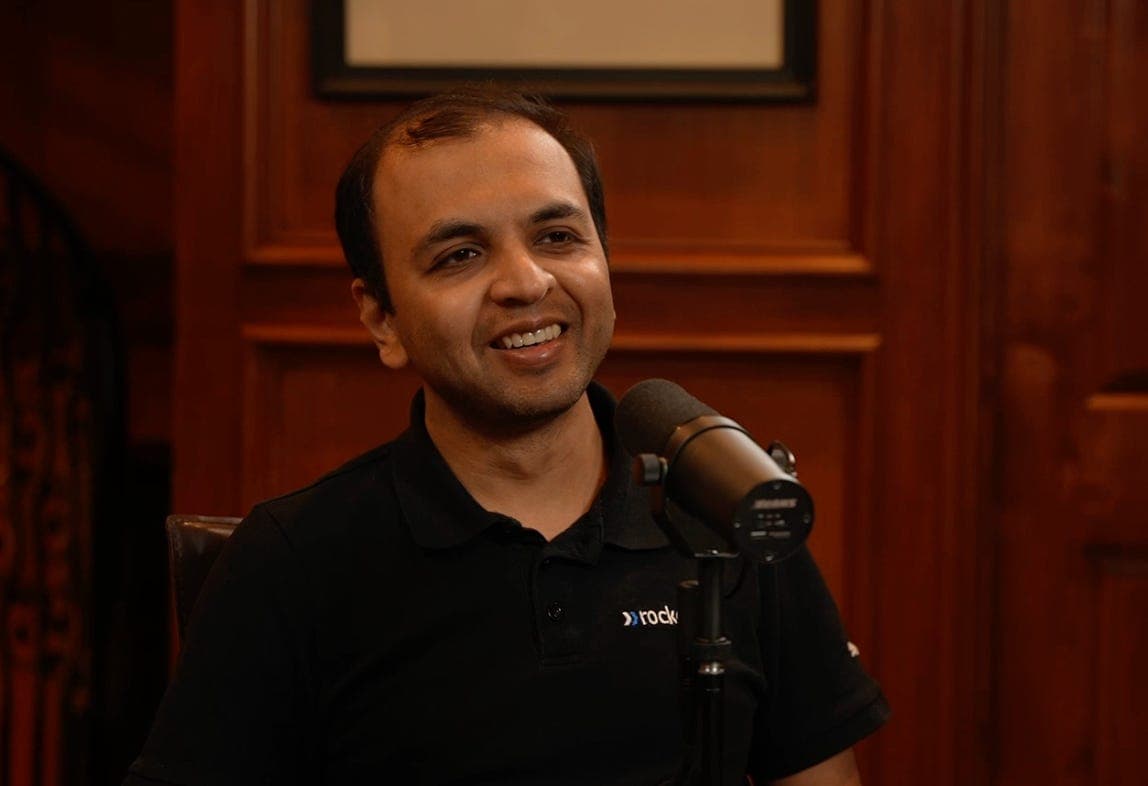
Sri Ganesan on Freshworks' Big Win, Building Rocketlane & India's Tech Boom
Overview In this episode, Joe Lonsdale speaks with Sri Ganesan, the Founder and CEO of Rocketlane, about the significant evolution of India's tech ecosystem. The conversation covers topics ranging from Sri's entrepreneurial journey, the success of Freshworks, and the implications of India's tech boom for global markets.
Key Themes
- Evolution of India's Tech Ecosystem
- Inflection Point: India has reached a critical juncture in its technology development, transitioning from an outsourcing model to building homegrown software companies.
- Homegrown Giants: Companies like Freshworks symbolize this shift, showcasing India's capability to create significant tech firms that compete globally.
- Sri Ganesan's Journey
- From Konotor to Freshworks: Sri's first venture, Konotor (later Freshchat), was acquired by Freshworks. This acquisition marked a pivotal moment in his career, allowing him to gain insights into scaling a successful SaaS business.
- Lessons Learned: Working inside Freshworks provided Sri with valuable education on running a SaaS company, particularly regarding product-market fit and customer engagement strategies.
- Freshworks and Its Impact
- Public Debut: Freshworks went public with a valuation of $10 billion, altering perceptions of equity and ownership among Indian tech employees.
- Cultural Shift: The success of Freshworks has led to a growing belief in equity and ownership in the Indian workforce, influencing hiring practices and expectations.
- Rocketlane's Mission
- Focus on Implementation: Rocketlane aims to facilitate better software deployment and project management, addressing common pain points in customer-facing projects.
- AI Integration: The company is leveraging AI to optimize team staffing and project management, anticipating trends in enterprise AI deployment.
- Cultural Insights
- Differences in Work Culture: Sri discusses the contrasting work cultures between India and the U.S., emphasizing the more in-person dynamics in India and the rapid pace of hiring in the U.S.
- Mentorship Importance: In India, younger employees often seek mentorship, which necessitates a more in-person work environment.
Key Takeaways
- India's Tech Future: The emergence of successful tech companies in India signifies the country’s growing importance in the global tech landscape, with a shift towards product development rather than solely IT services.
- Entrepreneurial Mindset: The risks and rewards associated with entrepreneurship are evolving, with increasing confidence among Indian founders to pursue ambitious ventures.
- Intercontinental Collaboration: The synergy between U.S. and Indian tech ecosystems is becoming critical, fostering innovation and growth.
Notable Quotes
- "The Google of India is Google. The Facebook of India is Facebook... but the DoorDash of India is Swiggy."
- "You need to be a little delusional to startup... the probability that you succeeded is actually so low."
Conclusion This episode provides insightful commentary on India's tech evolution through the eyes of an entrepreneur at the forefront of this change. Sri Ganesan’s experiences highlight the potential of India as a tech powerhouse and encourage international collaboration to harness this growth.
For more insights, visit [Joe Lonsdale's blog](https://blog.joelonsdale.com?utm_medium=podcast).
Written by AI. May contain mistakes. Listen to the episode to check what was said.
Transcript
Automatic transcript. May contain errors.0:00The Google of India is Google. The Facebook of India is Facebook, etc. But then the DoorDash of India is Swiggy. The Uber of India is Ola. So we have a different set of companies now which have scaled up to do you know what's a lot of India. biggest advantages America has is that we attract the best and brightest from around the world. And some of the most amazing people who've come to America and helped make America a really great country are from India. They're running a lot of our top tech companies. You've got extraordinary talent working with here. And anyone looking at what's going on in the Indian subcontinent realizes this is going to be one of the most important economies in the world over the next couple of decades.
0:47It's not only one of the places with the most people in the world, but just a lot of amazing talent. And it used to be we'd send our easy problems to India for technology for them to work on for us. Now you see us setting out our hardest problems. You see Indians themselves starting to build extraordinary companies. Sri from Rocket Lane is right in the middle of this ecosystem. He was part of Freshworks, one of the first really big wins that was built in India. And he's now created another company that's growing quickly. He's building his teams between India and the US. I'm really bullish on what's going on between the US and Indian tech ecosystems.
1:16Let's learn from one of the sharpest minds building in the US and India. Sri is a friend and founder and CEO of Rocket Lane. and you're one of the original players in the rapidly growing entrepreneurial ecosystem in India. Thanks, Joe, for having me on today. Excited to join. So let's start with your journey into entrepreneurship. Tell us about the first company you built, how you acquired into Freshworks. And the first one was called FreshChat. Yeah. So we were called FreshChat after the acquisition, but originally the product was called Conator. And yeah, we started off as a messaging SDK that went into other people's apps, enabling communication between the business and the customer.
1:51Had great success in India, Southeast Asia, sort of the mobile first markets. Didn't take off as much in the US or other Western regions. We had Target and 1-800-Flowers using us. And eventually, when we were about to raise a round for like an angel round, we had inbound interest in the company. And Freshworks, though at that time it was still a startup, we felt it would be a better home for us to build and continue building our product, which later became FreshChat. So Freshworks is now, I don't know, it's about $10 billion market cap company. It's one of the big SaaS wins in India. What does Freshworks do?
2:29And was that what they were doing when they bought you? So Freshworks was called Freshdesk when they bought us. It was, they had two products, but the flagship product was Freshdesk. it was a help desk solution not like business software today it's broadly business software because there's a crm help desk itsm different kinds of tools that's part of it but yeah when they bought us it was main focus was the help desk product and we were looked at as like the third product within freshworks there was itsm help desk and then the chat product right so we launched that in relaunched inside fresh works in 2017 when we got in end of 2015 the company was i think 18 million arr so much smaller than today's i don't know it's 600 million plus i guess yeah we were there for a four and a half years seeing it all the way through to mid 200 millions So it was a very, I would say, educative journey for us.
3:32It felt like going to a SaaS school, a lot of learning every day. And I think when we did the startup on our own, we were learning, but we didn't really know how to run a SaaS business. We were doing our best, but inside Freshworks, we got a ringside view to how a world-class company would do it. Let's set the stage for the Indian startup ecosystem. So basically, South and Central India have historically, they've been technology hub. There's a lot of talent there. There's great access to top engineering talent. And there's a longstanding culture of building software. I mean, I think it was for a long time, we would kind of send outsourced problems to India from parts of the US and other parts of the world.
4:13And I feel like that was probably where a lot of the money was originally spent there. And we've gone through a few different waves of software development in India now. Can you give us a bit of historical context on how the ecosystem got started and how it started shifting to building companies? Yeah, I think the first piece of context, I think India has always been very big on education and a lot of people taking that engineering track from academic perspective and then going on to become software developers in IT services companies, right? those who move from India to US typically to do their post-grad like MS or you know PhD would end up joining the product companies in the US but in India it was largely still IT services which was happening of course I think that was the first wave where the likes of Infosys and Wipro and TCS, all of these large, you know, technology consulting and tech services companies essentially brought together so much of software development talent.
5:14I think the wave around products started maybe in the early 2000s, you had some B2C product companies emerge in India. A lot of them would be, I would say, if there's a successful dot-com in the US, maybe there was going to be a parallel in India as well. So try to copy it for India. Yeah. But I think it's in the 2010 to 2020 that you could see a lot of different kinds of product startups emerge in India. Zoho, which, you know, the Freshworks founder used to work there for 10 years, was one of the very early B2B product companies from India though. So I think they, even as early as early 2000s, had their cloud-based SaaS products coming to market.
6:03And that is where Girish, the founder of Freshworks, built his career. And after 10 years over there and building very successful products at Zoho, he decided to start Freshworks. And very few B2B companies in that era, I would say. Why were there so few given there's so much talent in India? Just wasn't in the culture to start one yourself. They didn't have access to the markets. What was it? I think the VC ecosystem was very small at that time. Hard to raise the money. Yeah, hard to raise money from India. What was unique about Garish? What was, did he have different vision than other people?
6:36Why was he able to do this, do you think? I think he, again, the way he looked at his career was almost like at Zoho, he was given money to spend and learn to build a business, which is what he did. And once he had that confidence that, hey, I can build a very large business on my own. I did it within Zoho. I can do it outside as well. I think he went out and with an ambition of not necessarily building as big a company as it turned out to be, but let's build something, right? Let's build something of our own and make it big. Small team. I think one of the things I like about what he says is that he was dreaming in installments.
7:18The first dream was, hey, can we get this company to$10 ,000 MRR, which for a small six-member team may actually be self-sustaining. So that was his first goal. First, you get to be default alive. That's hard. Yeah. How do you survive? And then just keep building bigger and bigger. And it seems like one of the things I love about the technology world is a lot of times, whenever you have a really big success, you can only get there by attracting lots of other really good people. And so every one of those leads some more things. And so I think one of the ways we met Ia was through Garish and through the success of Freshworks.
7:50And we said, you know, there's a lot of talented people here. Let's get to meet some of the best ones. Was he particularly good of attracting people? Was it the only place in town you could go? What was the dynamic there? Yeah, he actually built the business off of initially really, you know, young, fresh grads from different engineering colleges. And in specific, I think he went to, you know, one engineering school, kept going there every year to hire talent. And for every function, whether it's support or marketing or sales or product development, it would be fresh engineers from this school.
8:24I like it. So the engineers are just smarter than everybody else for every role. Pretty much like let's, engineering has become like the default thing for a lot of Indians to do. So if you're smart, you do the engineering. So you want the smart kids. Yeah. You go there, they buy them by, you know, by the time they finish college, they've figured out they don't necessarily want to do coding. Some of them, if they're good at storytelling, put them in marketing. If they're good at holding conversations, put them in sales. So sort of. Pound here is this way too. We basically put a bunch of engineer technical people who, who are more social into our sales side because that's better.
8:58Yeah. No, no, I agree with you. This is a very elitist thing. No one wants to hear from us, but that's the way the world works is he wants the smart people. And so, so tell me about how the culture changed around Freshworks around, around the Indian ecosystem. When Freshworks went public, it was valued at about$10 billion. It went down and back up now. It's still there. Do people believe in equity more because of this? I mean, there's one challenge, right? If you haven't had friends who made a lot of money, they don't believe in the shares of a company. Did that change how that worked? I think there's very few companies where people believe in equity.
9:25So if you're hiring someone who used to work at Freshworks, they're going to ask you for more equity, less cash. If you're hiring talent from elsewhere, they don't understand the value of the equity yet. Right. Likewise, in the overall product ecosystem in India, I think there's been only a few big exits that have happened. And I think there's been IPOs from some B2C companies like Zomato and so on. And there's been some really good acquisitions, the likes of Flipkart, Mintra, etc., where people have seen the value of it. They've seen the cash. And do their friends start to get it? Like some young people say, oh, I know someone who was there.
9:59I want to get equity too. Is that starting to happen more? Yes, it's starting to happen more. I don't think it's real until you've seen people around you. Yeah, I think it's very important for these things. I don't think these companies work if you don't have people who are, who are proud to be owners, right. And are working for themselves as well. Right. And I think for us, sometimes we have to educate the people we are hiring saying, Hey, I know you want more, but I'm doing this for you. I'm giving you equity because I want you not to regret this later. It's, it's interesting. You know, in China, 20 years ago, people would tell me, Oh Joe, China is just different than America.
10:30We don't need equity here. It's not how we think about things, but even there, I think the most successful companies, they did have equity. So I think, I think people think their culture is different, but actually this is like a rule of humanity. Like you want people to be owners, you know? Right. It's interesting. So that's starting to spread there. Let's, let's dive into the weeds for a moment. You know, just on the company growth of Freshworks first, before we go to Rocket Lane, tell us about the strategy. There's, was there some kind of, I think there was some kind of arbitrage that Grish saw relative to CRM.
10:54What was the strategy that worked out? What'd they get right? Yeah. I think the first thing they focused on was, there is a clear gap that the market has where the SMB isn't being served well, right so the strategy was to enter with an smb play and then gradually go up market company in the u.s typically cannot afford to serve the smb well in terms of like the hours of support you can offer it's too expensive to offer small business or something but india you can it's interesting you can do the same high touch engagement that you would to a mid-market or enterprise customer fascinating remotely with an inside sales team and a remote support team so So because you have higher margins being based in India with cheaper labor, that's interesting.
11:36And so that was kind of a space they found. That's right. When did you know you had product market fit? Was there a time when it was clear it was just really starting to work when you were there? I think for us, for the chat product, we relaunched Inside Freshworks twice. And the first time we didn't really see that PMF happen. We had assumed that the Freshworks machinery would sort of help us grow faster. and the first time we relaunched, our product was still focused on mobile apps and that didn't really take off. Mostly because I think the Western markets didn't see mobile as important as India or Southeast Asia where these were mobile first economies in a way.
12:18So once we realized that and once we saw that, hey, there's companies like Drift and Intercom which are growing so fast with just web chat, we sort of decided, hey, maybe we need to relaunch with Webband Mobile. And that took off in a big way, became the fastest product in Freshworks to hit various revenue milestones. Wow. So once you got it right and you could let them do it both ways, it worked. Right. And tell me a little bit about the philosophy around the multi-product expansion. I think, you know, there's something called a compound SaaS company, which, you know, Rippling is a very famous example here.
12:49And Freshworks was sort of an early compound SaaS company. Like how many different products were there? How do you think about how they related to each other? Right. I think the way to think of it is, is there value in bringing different kinds of experiences together? Think of what the smartphone did, right? You have a camera, GPS, before that, maybe you had the iPod and so on, and the phone as different devices. but by putting them together, it's not just about carrying one device, but it's also about the new use cases it enables, like sharing a picture with a friend because your contact is on the phone and the camera is on the phone.
13:25So that's the equivalent we see here where from a Freshworks perspective, if the customer record can be common across the CRM, across help desk across the marketing automation platform, et cetera, that enables automatically a lot more use cases for the business. And that's sort of the idea behind building this as a composite or compound product, create the iPhone moment for business software, right? Creates new possibilities that way. Right. And so let's go back to what you're doing now. So in 2020, you launched Rocket Lane. Sounds like you're trying to help people further accelerate the adoption of software because you're working on deployments, right?
14:05Right. I think the beachhead market for us has been, as you said, the whole, you know, software deployment or implementation projects. How can we accelerate those? How can we make those, make parties hold each other accountable in an easier way during those projects? Because very often things go south and then there's finger pointing and no one's happy, right? So that's a problem we saw commonly among software companies and thought, hey, this is worth fixing. There's a variety of tools that people are cobbling together to get the job done. None of this was built, ground up for these kind of projects which are customer facing in nature.
14:43Fun fact is I think 50 % of the projects that run on Smartsheets or Asana or Monday.com are actually customer facing projects. But none of these were built, ground up for that use case. And so we identified that there could be a better customer experience. There could be better tooling for the internal teams to work with those customers. So use that as the wedge and build the first version of our product. And then we've sort of expanded into full-fledged professional services automation capabilities, like a services team needs to do their time tracking, manage their resources better, staff the right people on the right projects, understand are they running these projects profitably?
15:25so any services team that's running projects can now make use of rocket lane to elevate the experience that the customer has their team has to deliver on those projects interesting so basically the initial pain point was just getting into a company and deploying stuff which is always very very frustrating because the other company has like 20 things they're supposed to be doing but if one of those things drop they think it's your fault so you have to have some way to have transparency to work together but then you're saying like the from the compound startup perspective to the next thing. It's just if you're doing these deployments, you have a services team, and there's lots of software they need to know what they're doing and keep track of it and do a better job.
16:00That's right. The idea is to become that all-in-one product for everything that the services team needs to do, whether it's taking notes on a meeting they're on or sending out weekly status updates, surveying the customer on how they think the project is going. Everything comes together in one tool. Another big theme going on right now in the US, of course is AI, artificial intelligence. What role does Rocket Lane play in the AI world? Like with the AI boom going on, what does Rocket Lane do with that? I think there's two sides to what AI does for Rocket Lane, not how we think about it, right?
16:34One is for our own product, we're going to have different areas where we can leverage AI. We already launched like a resource AI module, which helps you staff the right team for the right project based on, do you want to optimize for margins? Do you want to optimize for balancing the workload? So one piece is what we incorporate in our roadmap. But I think there's this larger theme of if deploying AI in the enterprise is going to be like a big theme, and there's going to be probably even companies that are built just like new services companies that all they do is deploy AI in the enterprise, then I think we have a role over there as well as the solution they would use to accelerate those deployments.
17:16Makes sense. You started this in India. Where'd you live in India? Chennai. So you started this in Chennai. Most of your team's there. But you moved to Utah recently to help bring Rockland to market. You're building a team here as well. What spurred that? I think we very quickly started going upmarket. So, you know, once we started seeing more and more mid-market customers, we knew that we needed a presence in the US. This is the biggest market which we're going to serve. And we already had, I think, 70 % of our customers in the US. And obviously there's a team working through the US shift from India, which has been doing a great job.
17:51But we also felt there is potential to sort of establish our presence here in the local market, be here, right? Be where the customer is. It is always helpful to be around your customers, to make those bigger deals happen. You, you know, travel. You got to go see them in person. You got to go break bread with them. So you're hiring senior executives in the US as well? That's right. Are you doing the same thing where you hire engineers or what? Who are you hiring here? Well, here we're looking at sort of been there, done that execs who have seen this journey before. I don't know. I think the engineers are smarter.
18:29Yeah, watch out for people with too much experience. So you want people who are on the kind of sales side here who know what they're doing? That's right. We've also hired a VP of customer success recently over here. So are these people in Utah, there are people all over the country you're hiring? Right now, most of the team is in Utah, but we have started making offers outside in others. I think we have someone joining us in Texas too. Are there cultural differences in employing people and hiring people? Like one, one thing I heard is in India, you tell me if this is true. One thing I heard is that you have to give a lot of notice from your job.
19:03And so someone will try to hire you and they'll say yes, but then a lot of them will just like talk to others and find another better offer instead and then not show up. And that's like a, I think that's a pretty common thing in certain parts of India. Whereas in America, especially a senior person would almost never do that because that would just really destroy the reputation for if they, if they did something like that. Plus they just do it faster. But then also what that means is in India, you can kind of go a little bit slower when you're hiring someone. Whereas a senior person here, if they're available and they're going to leave, you think you have to go like, I think it's go really fast to lock them down if they're really good.
19:31I think it's like, it's a little, a little more intense speed competition. I'm curious, are these true? Like what are some of the differences? In general, that's true that, you know, people may not join after accepting an offer from you in India. I think it's been called out a fair number of times on LinkedIn and so on. So I think the behavior is changing a bit, but I would also say it depends, right? Like if, for example, at Rocketlane, a lot of the people we hire are people who know people who are already working at Rocketlane. So they're already in your network. And so it's less likely they're going to kind of screw you.
20:02That's right. They know us, they are joining us not because we gave them a better salary, but because they see this as an opportunity to join. And they care about the equity too, if they're in your network. That's got the high-end version of the entrepreneurship ecosystem. Right. But what about making offers here? Have you found different cultural needs to go different speeds or different ways of doing it? Yeah, I think we do need to be faster over here, clearly. We've learned that if we hesitate, that creates an impression in the interviewees, in the candidates' mind, that probably this is not moving.
20:35I mean, especially with startups, I guess they expect things to move at a certain pace. Multiple times a day. Yeah. Yeah. So yeah, if you wait a week, people assume you're just not interested, I think. And then for the culture, is the culture in person in Chennai? You guys are all in the office together? Yes. In Chennai and in Utah, we are all in person. So when you hire people who are not in Utah, I guess that'll be more complicated to do that. That's right. India in general is more in-person culture even in the US, you think? yeah i think in india a lot of teams are in person i think younger people when they're joining the workforce it helps to have people around who they can look to as mentors they generally hesitate to ask questions uh if you're not around right like they're not going to ping you on slack and ask you a question too interesting so it's like so it's like more rude to do that in india yeah you kind of have to give someone space to live their life outside of work i think people I think they should solve the problem on their own.
21:31They tend to believe that, you know, it makes them look bad to ask for help. And that's something we're trying to change in the team. Because I think even with working with customers, it's better to bring leaders in faster if you have... If you're not sure, double check and improve it. Yeah, bring someone else in to make sure it's good. That's interesting. Is this your first time living in the US? It is. What's different living in Utah? Are you in the city, in Salt Lake City, in a suburb? Where are you? I'm in Lehigh, which is, I think, 25 minutes south of Salt Lake. Have some friends in the entrepreneur world in Lehigh, because I think there's this Silicon Slopes, which, you know, there's a SaaS chapter that started.
22:12I'm one of those, you can say, early members who's trying to create that community. That's good. Well, it was good to see you when I was in Salt Lake City for Adapar. We have a lot of talent there as well. Utah is one of my favorite places to hire some good people for a lot of different things. you know i want to talk about a little bit about for the future basically let's talk about the future of india i'm very i'm very bullish on what's possible in india i mean it's pretty amazing right i think just like the i think a lot of the people running u.s tech companies are all indians who've come over here so it's like you guys have a pretty good track record in terms of like helping run silicon valley it's extraordinary and uh you know it makes sense india itself should be able to do this too if people can come from india and do this here how do you see india's role evolving in the global software and the global tech ecosystem?
22:52Yeah, I think we're probably in generation three or four of like this, this set of product companies emerging out of India now. I'm sure a lot of people don't know that companies like Postman or Chargebee or Atlan, et cetera, were started in India and then came to the US. So now I think there's learnings that are getting passed on from companies that saw our journey before. We have a whole network of founders like this paid forward community called SaaS Boomi, which essentially is built by founders to help other founders who are up and coming today in the ecosystem. So I think that's really helping move India from being an IT services nation to being a product nation, right?
23:40So I think that movement is real. And it's not just SaaS. even on the product side, I would say, while in the past, the Google of India is Google, the Facebook of India is Facebook, etc. But then the DoorDash of India is Swiggy. The Uber of India is Ola. So we have a different set of companies now which have scaled massively. And so I think there is this B2C and B2B tech ecosystem now in India that's fairly mature. Early on, it used to be only engineering talent that would be available in India. But now I think we have great product design, great product, slowly product marketing. Every function is...
24:23And do you feel like the risk tolerance is going up as well for the founders? Are there new areas they're going to start taking bigger bets on? Because I still feel like most of the stuff that's really good in India, like you said, kind of has an analog here. Are there new, bold, entirely creative areas you think they're going to start going after? There are. I think probably there's some of this already. There's like a grocery app called Zepto, which said they will deliver within 10 minutes, right? Like order food and groceries. That'd be hard to do in the US. Yeah. That's cool. But there's all kinds of startups that have emerged.
24:57And I think there's different cities with different characters. Bangalore or Delhi in India, I think as a founder, you would, I'm sure, agree. You need to be a little delusional to startup, right? You need to believe that. Yeah, be confident. Yeah, I said delusional because I think when in hindsight, the probability that you succeeded at what you're doing is actually so low. You know, we are looking at those who succeed. So it doesn't look that way. But there's so many who started and failed. I think the more delusional you are, the more you move towards B2C, because it takes even more to succeed.
Read the full transcript
25:32B2C does feel riskier to me. You know, I've built multiple, multiple big B2B companies. I've not really had success in B2C. It's a hard area. Yeah. So I feel Bangalore and Delhi have that confidence, extra confidence to do B2C. Interesting. Chennai does B2B. You're more humble. I'd rather be slightly risk averse and win for my first company or two. Maybe they'd be more delusional on the next one. You can still build a multi-dollar company with what you're doing, of course. That's right. It's not too bad. What are the different areas? So there's Bangalore and Delhi. There's obviously Chennai. I think Pune, we have a strong office for Adapar.
26:07Are there other entrepreneurs in all these areas? Are there more entrepreneurs than just a couple of them? I think Hyderabad, Mumbai, Pune, these are all like the big ecosystems other than the ones you mentioned. I feel Mumbai has definitely emerged as a really good place as well, where I was recently looking at LinkedIn. And some of my friends, entrepreneur friends in Mumbai were doing this Mumbai Tech Fest, which was celebrating startups in Mumbai. So I think they have some good successes as well. Awesome. I want to ask you a little bit more about India. Let's do a rapid fire series of questions.
26:44I'm going to be visiting again relatively soon in a couple of months. First of all, what's your favorite place to visit in India? I actually like Mumbai. I feel there's a certain energy. It's more New York-like in the sense that super ambitious people and fast-paced. And what's your favorite restaurant and favorite order there? My favorite restaurant is this place called Avatna in Chennai. It's essentially a sampling menu of South Indian food, which is really done tastefully. So I think, you know, it's like 11 course, 13 course sampling menu, but it's really nice. Do you go work out before you go there?
27:28It's small portions, so it's okay. And what Indian entrepreneur do you have not worked with, do you admire the most or who's your favorite? I would pick a couple of folks. Krish Subramanyam at Chargebee and Kadim from Watfix. I think they're both extremely thoughtful founders and I love getting their perspective on how they would approach a problem or a situation that I'm in. I get new perspective from them. So I think it's two founders who I really look up to. And do you have an Indian early stage company other than yours that you're really excited about the most? There's a few I'm really excited about.
28:06There is a company called Sprinto, which is in the security compliance space. There is a company called Everstage, which is in the sales compensation space, which is growing fast, doing well. Revenue Hero, which again is a interesting young startup taking on Chili Piper. Taking on Chili Piper, the other company there. What do they do again? So it's like, how do you get someone on your website to book a meeting with you really quickly is like the wedge, but there is a lot under it that they're planning. I love it. A lot of good B2B companies here. As people listening in the US, you have a lot of investors in the US.
28:48I think we see India and you say, yeah, of course it makes sense. It's gonna be a really important place for technology the next couple of decades. Like what should people in the US be doing who wanna look at opportunities in India? How should our leaders be engaging with it more? I think visit, meet the entrepreneurs over there. I think that would probably give you a sense of how they're thinking, what their plans are. not every founder is making the move to us like i am so i think it helps to visit and get a pulse for what's happening get a pulse for what's different what can you do to help first right because i think the best way to participate in an ecosystem is to offer help and and when you help then you earn the right to work with those companies in different capacities and what's your what's your favorite experience coming to the u.s so far is there anything in particular that was really fun or interesting or surprising?
29:41Well, I tried skiing three weeks ago. So that was fun. Amazing. Completely new experience for me. Did you, did you make it down the mountain? I just did some bunny slopes. All right. We'll have to take you out to Montana and show you some good slopes. Sri, thanks so much for joining us today. Thanks.
From the publisher
India’s tech ecosystem has hit an indisputable inflection point in recent years. For decades, American corporations outsourced basic services to India, while India outsourced its top talent to Silicon Valley. But today, India’s tech economy boasts homegrown software giants and a flourishing startup scene.
This week, we get a front-row look into India’s startup evolution with one of its top talents: Sri Ganesan, Founder and CEO of Rocketlane. His first company, Konotor, was acquired into Freshworks, which went public in 2021 for $10 billion and became one of India's biggest wins. Now, Sri is building Rocketlane into a leading solution for SaaS deployment and professional services automation, with teams in the U.S. and India. By combining American know-how with Indian talent, Rocketlane represents an important dynamic for the future of tech and expanding key partnerships around the world.
In this episode, we dive into the lessons learned from Freshworks's success and how it paved the way for greater entrepreneurial risk within India. We also explore Sri's journey in scaling Rocketlane, from finding product-market fit to positioning the company to take advantage of the AI wave. We discuss what India’s rise to become one of the world's most important economies means for the future of tech and global talent distribution, along with the cultural differences between India and the US, and what it's like building on two continents simultaneously. Finally, Sri guides us through the various tech hubs in India, from Mumbai to Bangalore and Chennai, even down to his favorite restaurant and must-visit destinations for anyone heading to India soon.
This is a public episode. If you would like to discuss this with other subscribers or get access to bonus episodes, visit blog.joelonsdale.com