In short
Podcast Notes: Joe Lonsdale - American Optimist
Episode
Ep 98 - How Wokeness Foments Antisemitism; a Conversation with ADL's Jonathan Greenblatt
Podcast Description
American Optimist, hosted by Joe Lonsdale, aims to provide an alternative to mainstream media's fear and cynicism. The podcast features innovators and leaders tackling pressing challenges in a hopeful and inclusive manner.
---
Episode Summary In this episode, Joe Lonsdale speaks with Jonathan Greenblatt, CEO of the Anti-Defamation League (ADL), about the organization's history, its current challenges, and the rising antisemitism, particularly in light of recent events. They discuss the impact of "woke" ideologies and criticisms directed at the ADL for perceived leftist leanings.
---
Key Points and Discussions
- Jonathan Greenblatt's Background
- Started in the Clinton administration before becoming an entrepreneur and returning to the Obama White House.
- Has been with the ADL for nine years, focusing on combating antisemitism and promoting civil rights.
- History of the ADL
- Founded in 1913 in response to the lynching of Leo Frank, a Jewish man wrongfully accused of murder.
- Mission: "Stop the defamation of the Jewish people and secure justice and fair treatment for all."
- Historically significant in fighting antisemitism and participating in civil rights movements.
- October 7 Incident and Its Aftermath
- October 7 marked a significant escalation in antisemitic incidents, tripling reports received by the ADL.
- Greenblatt describes the environment post-October 7 as one in which antisemitism has "turbocharged."
- Criticism of the ADL
- Concerns that the ADL has shifted too far left, promoting ideologies that may harm Jews.
- Criticism regarding the promotion of Critical Race Theory (CRT) and associated narratives that pit "oppressed" against "oppressor."
- Wokeness and Antisemitism
- Greenblatt acknowledges that the current "woke" ideology can marginalize Jews.
- Discussion of how radicalized anti-Israel sentiments are intertwined with antisemitic rhetoric.
- Iran's Role
- Greenblatt discusses Iran as a significant state sponsor of terrorism and its influence in funding antisemitic activities in the United States.
- Calls for Action
- Lonsdale emphasizes the need for the ADL to refrain from partisan politics and focus on its mission to combat antisemitism.
- There are calls for the ADL to reconsider affiliations with controversial figures and ideologies.
- Future Outlook and Optimism
- Greenblatt expresses optimism about the future, citing advancements in technology and the resilience of the Jewish community.
- Encourages a focus on positive actions and a unified stand against hate.
---
Key Takeaways
- The rise of antisemitism is a pressing concern, exacerbated by recent conflicts and societal narratives.
- The ADL has a storied history of fighting for Jewish rights and civil rights broadly, but it faces scrutiny over its current stance and actions.
- An ongoing dialogue is necessary to navigate the complexities of modern antisemitism and ensure that the fight against prejudice remains effective.
- Emphasis on community action, education, and a balanced approach to social issues is crucial for fostering understanding and combating hate.
---
Final Thoughts The episode underscores the critical intersection between cultural narratives, social justice movements, and the experiences of Jewish communities today. As both Lonsdale and Greenblatt highlight, fostering open dialogue and addressing complex issues with nuance is essential for creating a more inclusive society.
Written by AI. May contain mistakes. Listen to the episode to check what was said.
Transcript
Automatic transcript. May contain errors.0:00Our leaders aren't leading on college campuses, elected officials, so many are failing to demonstrate moral clarity. When you're either on team oppressed or team oppressor, everybody loses that game. This crazy woke ideology has a lot to do with why Jews are being marginalized and attacked. I totally agree with you on that, but you guys pushed a lot of those ideas originally, right? You were pushing CRT. We've never pushed CRT. We don't teach CRT. You also have material from Todd Nhesi Coates. Did you see what Todd Nhesi Coates has said in the last week? We saw his interview with Tony DeCocco on CBS, tough questions, fair questions.
0:34And then Tony got raked over the coals. We're pushing back on that pretty hard. So I think you're taking the right tone defending the guy at CBS, but do you realize that his name's still on your site promoting his work? I have to take a look at that. You've called out places like Harvard. Are they getting any better? Last year was a disaster on many of these campuses. We have taken on more cases, done more litigation in the last year than we did in the first 110 years.
1:07Jonathan Greenblatt is the CEO of ADL, the Anti-Defamation League. The ADL has been a very important organization for the Jewish people for 100 years. It's done a lot of amazing work. It's also gotten into a lot of controversy lately, where a lot of us thought it went too far to the left. I'm excited to talk to Jonathan about what's happened over the last year since October 7th. Jonathan was a great entrepreneur with a lot of success. He worked in the Obama administration, where I've known him for over a decade. And he and I don't agree on everything. In fact, there's a lot we don't agree on. I asked Jonathan some tough questions to make sure some of the ideas the ADL is promoting is not actually backfiring to hurt Jews and to take political stances that are inappropriate.
1:41I was very encouraged to hear some of his perspectives about the threat from Iran, the problems with the woke narrative, and his optimism for the future of America. I'm Joe Lonsdale. Welcome to The American Optimist. Excited to have my friend Jonathan Greenblatt from the ADL here today. Jonathan, thanks for joining. Thank you so much for having me, Joe. I'm really delighted to be here. So, Jonathan, let's start with your background. You're the CEO of the Anti-Defamation League. For our audience who aren't familiar with your story, Tell us about yourself a bit, like in your work in the private sector and in government.
2:06Sure. So I've been here at ADL for nine years, which seems hard to believe. But before that, I had a career in public and service in the private sector. So I got my start in government doing international economic policy during the Clinton years. I did that for five and a half years at the Commerce Department and then at the White House. In between, after that, I got an MBA at Northwestern. And then I went out to California to be part of the Internet Revolution. I was a product manager at a little internet company at the time called realtor.com that ended up getting very big and going public. And I wrote that out at NFV, the vice president of consumer products.
2:46The product guys are always the smart guys, huh? That's my experience. I don't know about that. But I learned how to do market research, how to work with consumers, how to work with an eng team and drive a QA process. and I learned how to ship product. And I learned I was pretty good at running a team, but I missed public service. And so I left that. And with my roommate from business school, we started a company called Ethos Water. And the goal was to use part of its profits to help children of the world get clean water because there are a billion kids or a billion people without clean drinking water.
3:18Ended up raising a couple rounds and scaling that company and selling it to Starbucks. And Howard Schultz also asked me to join the board of the foundation and figure out. Now we had, you know, scores of millions of dollars in free cash flow. How are we going to invest in clean water programs around the world? And then I got recruited back in to come to the White House, the Obama White House, where I ran the Office of Innovation in the West Wing that was focused on accelerating economic recovery. I remember we had a few meetings when you were there at the time. I agree to know each other pretty well, the Obama White House.
3:48That's one thing I'd give the Obama White House credit for that's different than this White House is that people like you who are interested in hearing from people of all points of view. Yeah, totally. Like I wanted to try to figure out how to use innovation to kickstart and turbocharge the economy, create more jobs, better jobs. So that's what I did. And then I thought I was going to go back to California and go run another business. And I ended up getting called out this job at ADL and I got recruited into it. I never thought I would be here. I had no nonprofit experience. I'm not a lawyer. I mean, I'm a Jewish person, I never worked in the Jewish world before.
4:21But what interests me, Joe, is running not a Jewish nonprofit, but a best in class, high performing, impact driving, you know, margin earning organization. And that's what I'm trying to do here. So it's amazing background. So really, you were in many ways an entrepreneur and also like an impact entrepreneur. Sounds like you helped huge numbers of people get clean water, help people in lots of other ways, made a bunch of money doing it. So that's a very successful career into the White House and now ADL. And I do love the framework of impact. Obviously, the ADL has been something that's important to our people.
4:55We're both Jewish. It's something that's been important to our people for a very long time. We'll talk more about it because it has a very complex history. But maybe tell us a little bit about what the ADL did in the past and why it was important. It's like, what are some of the successes it had? Sure. Look, ADL was founded in 1913 around the Leo Frank trial. This was a Jewish guy who was wrongfully accused of a crime, ultimately sentenced to death. There was exculpatory evidence, and his death sentence was reduced to life imprisonment, and the mob was so enraged, they tore him from his jail, and they hung him from a tree.
5:30And the wake of his trial and death led to really the creation and the acceleration of ADL. So when it was founded in 1913, the mission statement that they wrote was that its purpose would be to, quote, stop the defamation of the Jewish people and secure justice and fair treatment to all. So ADL has always thought we have to defend the Jews, and we do that by defending others. When everyone is safe, the Jews will be safe. ADL is involved in the civil rights movement as well. Yeah. So, like, look, ADL was the Jewish organization that made America safer for its Jews in the 10s and 20s and 30s and 40s.
6:05ADL fought the Nazis. ADL broke open the quotas. ADL stopped the discrimination. But in the 1940s, ADL started fighting for civil rights for African-Americans. And ADL, it filed its first amicus brief of the Supreme Court in 1947 on a case called Shelley v. Kramer that was about housing discrimination against Blacks. And in 52, in Brown v. Board of Education. And ADL was the group in the 1950s that got anti-masking laws passed in America to kneecap the Ku Klux Klan. And ADL fought also in the late 50s and 60s for immigration reform. And ADL fought in the 80s and 90s for anti-LGBTQ hate. So ADL has always had that duality.
6:55And one thing you said earlier to me that you're not for red or blue, you're for protect the Jews and obviously to help everyone. We'll go into this more, But one question is because it came up. So we fought as ADL and the Jewish people against the Jewish quotas. Obviously, these were things that were keeping us out of Harvard and Yale. I think there was a certain percent you could be Jewish otherwise. So it kept huge numbers out. But then but then today you wouldn't fight for against the Asian quotas. And because that's not something as popular. So I'm curious, how would you think about that?
7:23No, I think it's a really good question. I think we would fight against quotas. So, you know, I think we took a position on this Supreme Court case that was up maybe about a year. It was before the Supreme Court about a year ago on perceived discrimination against Asian American applicants at Harvard. I think, you know, without going into all the details of the case, I think it was kind of really on the borderline. But this organization, ADL, is against quotas. This organization will not support the idea of quotas that repress Asian Americans or Jewish Americans or black Americans. You can forget it.
8:01I think the thing about that case was, as you think about issues of diversity, is race something to consider in a holistic view of diversity. and we think there's merit to that but I do want to be crystal clear Joe like we don't support quotas not not then not now not ever no that's fair we'll go into a few more of these things I want to stop though and ask you a bit about October 7th which I think changed things for a lot of Jews in America this is it's not that there wasn't things going on behind the scenes that I think it just kind of forced awareness for everyone it kind of brought a lot of anti-Semites out.
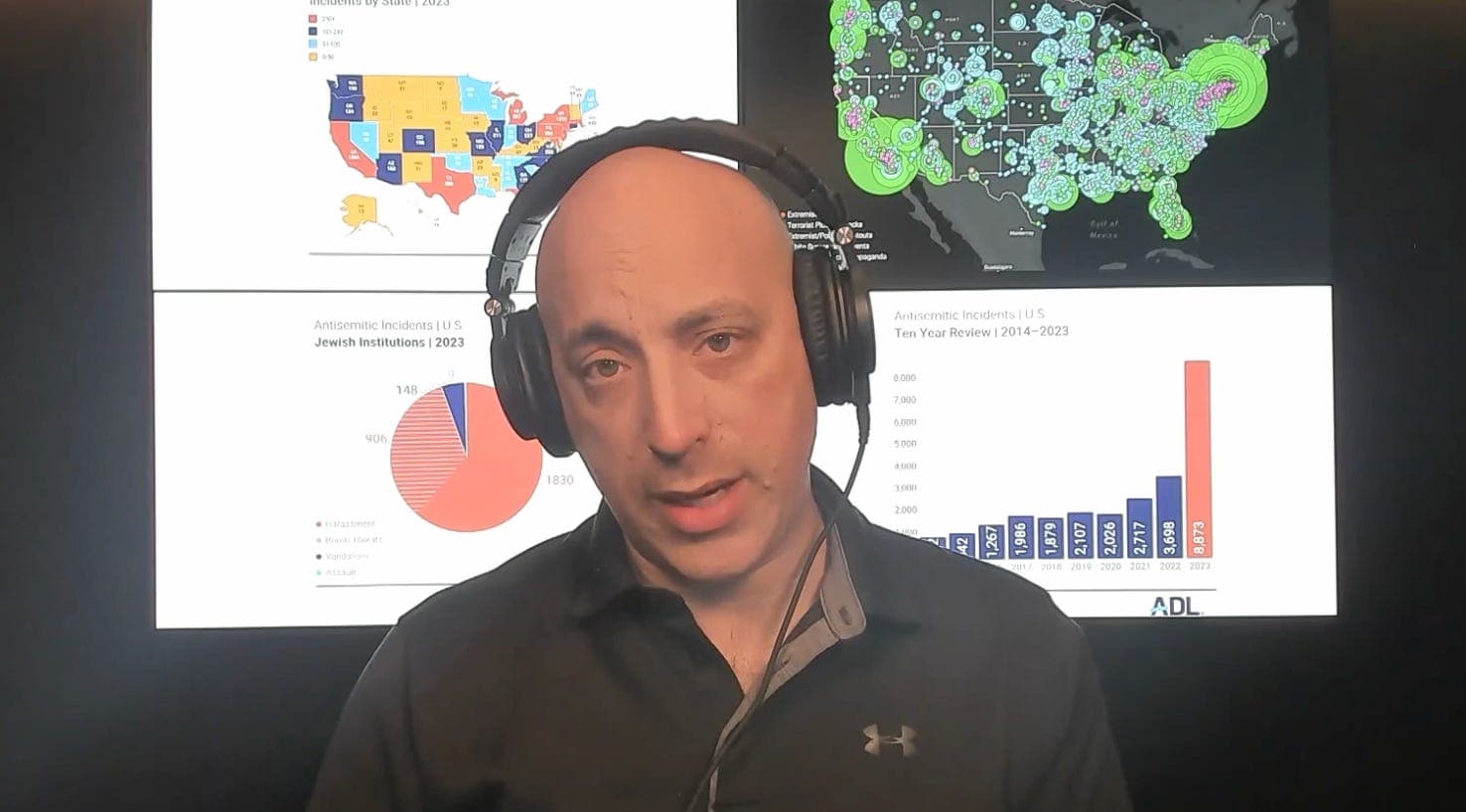
8:36Can you talk a bit about what you saw and what you learned over the past year? Look, anti-Semitism had been building before October the 7th, but it was turbocharged that day. Literally, I mean, our offices, and we have 25 offices, and one of the biggest things that we do is we deal with anti-Semitic incidents. People report them to us and we respond. We have almost 500 full-time employees, and we investigate every report that comes in and respond. Like, Joe, in the last year alone, in the last 12 months since October the 7th, we fielded more than 10 ,000 incidents. That is triple the number of the prior 12-year period.
9:18Is that what's on the screen behind you right now? Yeah, actually. Yeah, so you can see these, I mean, the data here. Look, you see year over year, 2023 was a terrible year, but the numbers are continuing to go up. since 2023. Up there, you can see our heat map. I mean, we literally track anti-Jewish incidents, extremist incidents every single day. And we've hit high marks in 19 and 21 and 22. But after 2023, it just exploded. And I want to ask, what are you guys doing about this? Because on one hand, obviously, this is very important to call out and confront and show people. On the other hand, there's a perception that Jews are really powerful and are going to force people not to attack them using other organs of government or something, which might make of them hate us even more, right?
10:02So like what's, what's effective in, in, in, in attacking these things? It's a good question. I mean, so I will just say antisemitism is like a conspiracy theory that posits that the Jews are responsible for all the evil in the world. The Jews have too much power. The Jews have too much money. So what happens, Joe, is when you push back on that, you're successful. The haters say, aha, you see, we told you they have too much power. They have too much money. If I was a billionaire, powerful Jew running companies pushes back on this, is like that's exactly the conspiracy so what so what are we doing is useful here so it's kind of lose lose i mean our approach is number one we have to disrupt the extremists so we have a whole center that tracks you know left-wing radicals right-wing extremists religious fanatics and literally we try to intercept and stop them joe before they can perpetrate hate that's number one um and so we're working with law enforcement to put these people away when i say put these people away, we are not censoring free speech, as some of the conspiracists would say.
11:02We're not. We are trying to take people who represent an imminent threat because they have intent, they have weapons, and we can figure out where they are. I mean, that's the kind of people we're talking about. The anti-Zionist who wants to assault a Jewish kid because he's Jewish. The white supremacist who wants to shoot up a synagogue. That's the kind of threats that we try to intercept. So are there other instances in the last year where you found these people when you've got Got them stopped? Does that happen a lot? Oh, yeah. Yeah. Like in 2023 alone, Joe, we gave over 2 ,000 tips to law enforcement where we could identify.
11:36Again, a threat means you have intent, like I want to kill Jews or I want to kill Joe Lonsdale. You have a weapon and we see that like in pick, you indicate it or we can see represented in like a photo or an image, a knife or a gun or something or an explosive device. And we can identify that person is located in the Chicago area. So that's the kind of tips we provide to law enforcement. And it's crucial. I mean, they lead to search warrants and arrests and prosecutions. Well, that's amazing work. And I thank you for it, Jonathan. That's really important for our people and for America in general.
12:12You know, I want to get your theory on what's going on in our country and in the world right now. You think there'd be maybe an outpouring of support for Jews after October 7th, which there was from some of my friends seeing the horrible images and seeing what happened. But, you know, instead, obviously, we've had a lot of people kind of joining in the attacks on Jews. You've seen blatant anti-Semitism from so many areas, including a lot of our most important educational institutions and the leaders there. Like, what's your theory of what's happening? I have some theories myself. I want to hear from you.
12:37You live in this every day. Like, why is this happening? Well, I think there are a few things that are happening. I think, number one, I think this moment, look, it's fraught, right? Like, you see the images of, like, you know, civilians getting killed in Gaza or Lebanon. And you can be upset about that. And we all should be. No civilian should be killed. On the other hand, we can argue about why they're being killed, right? Why are they in harm's way in the first place? So your heart should break for civilians and your blood should boil that Hamas put them in this position or Hezbollah put them in this position.
13:11But that being said, I think what's happening, Joe, is number one, the anti-Israel protesters have been radicalized by anti-Semitism, okay? So they are using anti-Semitic images like from the river to the sea come straight out of the Hamas playbook. Yeah. From the river to the sea is like saying Germany for Germans. Germany for Germans, like in some abstract context might be OK. But when someone where, you know, when a white supremacist says. When you're referring to the Holocaust and saying Germany for Germans, that's obviously not OK. Yeah, I'm totally fine if they don't want to have immigration.
13:50I'm not fine if they're saying they should kill. They should kill people. Right. That's that's the difference. Yeah. It's nuts. So I think on the one hand, the activists are using inflammatory, intentionally using inflammatory language to alienate and marginalize Jews. I think that's one thing. I think, secondly, they feel very emboldened because there's no pushback. Like, our leaders aren't leading on college campuses, elected officials. So many are failing to demonstrate moral clarity, you know? Like, there's been this debate in higher ed, Joe, that you're probably familiar with about institutional neutrality.
14:23Yep. I like the idea of institution neutrality because like universities and companies, organizations, they should focus on what they do every day. Like Brian Armstrong from Coinbase says, you know, like do your job. Like our job is crypto. Our job isn't to show up on every social issue. But on the other hand, I also believe in moral clarity. And if your employees or their families are getting butchered and tortured and murdered, like it's OK to say something that is like the right thing to do. So to be really honest, I think radicals have kind of infiltrated and inculcated themselves into institutions.
15:01They're intimidating the leaders who are weak to begin with. They're using inflammatory, hostile, hateful language that's being there's a permissive attitude towards it. And Jews are getting caught in the middle. And it's deeply terrifying. You've called out places like like Harvard and others and I think probably Penn and whatnot. And like, are they getting any better? Like, are things improved a little bit? Not really. I mean, last year was a disaster on many of these campuses. So far in the early days of this academic year, there have been less people involved in these rallies. I hate to even call them rallies, Joe.
15:38They're like riots. Like, let's not credit them as rallies. Let's not call these activists or antagonists. That being said, there have been less people involved, Joe, but the intensity is even higher. So the kind of rhetoric is even more charged. The tactics are even more sort of combustible. I think we're like a mat stroke away from real violence. Now, by the way, Joe, in the past month, since classes started, we tracked, I think we've got about half a dozen assaults, anti-Jewish assaults. We're representing students at Pitt, at Michigan, I think at Ohio State, who've been victimized and assaulted in just the past four to five weeks.
16:23It's a legal arm actually helping them take action. Yeah. That's great. I mean, look, and this is one thing I would say, Joe, that matters. Any organization you're talking to in the Jewish space, like if you are not doing things differently now, if you're not experimenting and innovating and trying new stuff, you should go home. Yep. Literally, you should go home. Like I said, ADL, Joe, we have taken on more cases, done more litigation in the last year than we did in the first 110 years. We're suing universities, school districts, representing Jewish people. We're suing companies for employee discrimination.
17:02We're suing the Islamic Republic of Iran. I mean, we're being much more aggressive. And this is a good example of where... It does seem like Iran is actually funding some of these activists. We saw it and we reported to law enforcement in October of last year that we saw things that indicated that many of these student groups were providing material support for a foreign terror organization. I wrote a letter to 200 university presidents on this. And this past summer, you know, the Directorate of National Intelligence, the arm of the government that coordinates the FBI and the CIA, the NSA, they reported Iran is providing money and organizing capabilities to these protesters.
17:45Does it bother you on Iran? Just to just go on that for a second. So for me, Iran is is is a very clearly set of evil people running that country. I love the Persian people. They're natural allies of the Jews. But the people running that country are sponsoring terrorism all over the Middle East. They seem like the main problem to me in the Middle East. And it feels like for some reason, Obama had this theory to get you. You worked with him. He gave them a bunch. Well, not what you were doing, but he gave them a bunch of money. He tried to do a balance of power. Biden as well tried to empower them.
18:12I think it led to more attacks on Israel to our people. Was that wrong of Obama and Biden to empower this regime and to naively try to do a balance of power? Or what do you think on this? I get in a post-Arab Spring world, there was this idea that maybe there would be an opportunity to kind of reset the region and democracy or normal would follow. But abnormal and terror are the tools of the Islamic regime. Yeah. The Islamic Republic is the largest state sponsor of terror and their number one export isn't oil, Joe, it's anti-Semitism. You agree with people like me who think we need a regime change in Iran?
18:49Yeah, we do. And I mean, we can argue about what's the best way to get there. But there are there's I will say this, Joe, for you to hear and your audience to hear. There is no such thing as reformists in the regime. There are only hardliners and ultra hardliners. And so we need a new regime, one that respects its people, that respects its minorities and respects its neighbors. This regime specializes in terror and militarism. And I just want to be clear, they are a revolutionary creed that targets Israel, the Jewish people, and the United States of America. That's a problem for me. They call Israel the little Satan and America the great Satan.
19:35They're coming for us. That's right. So, Jonathan, I really appreciate that. We're aligned on a lot of things. You're doing really important work for the Jews and for America. I wanted to have that context because I'm going to ask you a few tougher questions as well. Because I have to say the thing is sad is if my boobie, my grandma who passed away, would have been really proud that I was chatting with you. Because the IDL is so important to her and to our people for decades. some of my friends today who are jews especially those who are on the right uh are questioning questioning me for talking first of all i want to educate them with some of what we talked about about the important work you're doing but i want to i want to give you some perspective of some of the things they're they're frustrated about sure um and so you know a lot of us i'd say on the center and center right i believe the adl shifted hard to the left um and become partisan i think it's okay for you to be partisan obviously you obviously fired off tweets opposing pompeo and kavanaugh and that sort of thing i don't think that's a scandal or anything in 2020 actually was interesting.
20:28You went on Al Sharpton's show and called for a corporate boycott of Facebook for not censoring pro-Trump ads, and then briefly tried to pause advertising on Twitter a couple years later as well. It seems like you've moved back from those petitions now, or what do you think about calling for boycotts for people who are not censoring Trump and that sort of thing? Well, let's step back. So a couple of things. So number one, I don't think I'm partisan. It's certainly true that I work for President Clinton, President Obama, and I'm proud of my public service. But on the other hand, my job here, as I was telling you before, isn't to play for the red team, the blue team, it's to play for the Jewish team and for the human team.
21:04I think my job is called balls and strikes. So I regularly call out people from the Republican Party, the Democratic Party. And I often get criticized for that, right? The left thinks I'm too conservative. The right thinks I'm too liberal. I really think if you look at the expanse of our track record, at the end of the day, we're doing what we think is right, not weighing in this way or that way. Now, that being said, and by the way, I'll say one other thing, if I might, I think part of the reason why we're in this fix is because so much of our society and its cultural sources, universities, media have been sort of seized by this kind of, you know, this oppressor oppressed kind of model.
21:47And I think when we get forced to play in the oppression Olympics. Yep. When you're either on team oppressed or team oppressor, everybody loses that game. Yeah. And I do think this crazy woke ideology that sees so many, again, segments of society has a lot to do with why Jews are being marginalized and attacked. But I totally agree with you on that. But you guys pushed a lot of those ideas originally, right? You were pushing CRT, you were pushing all that stuff. You're saying people call you never push CRT. We don't teach CRT. We don't have a, we don't do CRT. Now we do believe in like anti-bias education.
22:24We've been doing that for decades. We do think we do try to, we do anti-hate content, but I don't think we, and I just, we look, let me be clear to you. We don't always get it right. And we've made our fair share of mistakes. And I can talk about my mistakes, but I would, I really do not agree with this perception that we're teaching CRT. By the way, like we don't have a relationship with Black Lives Matter. We don't teach CRT. We still do these things, even though I know there's a perception that we do. So on the Facebook Twitter thing, like we originally went after Facebook when there were white supremacists organizing through Facebook groups.
23:02And we track extremists. We saw them doing it. I brought it to the company's attention. They didn't act. And that was why we said advertisers should pause on the platform, not a permanent boycott, pause on the platform. So it wasn't about Trump, you're saying it was more about the white supremacist groups. It was about white supremacists and extremists. And by the way, to Facebook's credit, they did things after we did that. For example, they created a VP of civil rights. They started blocking Holocaust denialism. They started taking down extremist accounts. That's a good thing. And more recently, they called out the fact that Zionist is being used as a slur to attack Jewish people yep so like when companies get it right we will give them credit and when we get it wrong we'll call them out and i appreciate that i want to push a little harder on a couple of these things because i think sometimes there's what you believe and i think and this is not unique to the adl but in my experience a lot of staff in the non-profit world tends to skew very much to the left and then tends to do more left things maybe even than the organization intends to do so for example a lot of the educational material on your site um has a lot of stuff that would be considered by most people to be woke, to be tied to this oppressor or oppressed frame.
24:10We're going to give you an example here. You have a bunch of material referencing Ibram Kendi, who to many of us on the right is a hate figure, even though you guys, people, even though not you guys, but even though people on the left support his work, we think he's one of the most hateful and people who supports a lot of these things that hurt Jews. You also have material, I want to cite it to you, from Ta-Nehisi Coates that actually suggests people go read Ta-Nehisi Coates' works on reparations for black people. This is on your site today. Did you see what Ta-Nehisi Coates has said in the last week?
24:39Yeah, I don't know if you saw, I mean, I spoke to the New York Post about this at the beginning of the week. So we saw his interview with Tony DeCopal on CBS News. I thought it was a great interview, tough questions, fair questions in a measured way. And then Tony got raked over the coals. We all heard the recording. And then, you know, I had conversations with the leadership of CBS News about this. And so we're pushing back on that pretty hard. You can read, you can read what I talk, you know, talk to Charlie Gaspar. So I think you're taking the right tone defending the guy at CBS. But obviously you've seen for our listeners, Taunesse Coates came out, did a lot of things with classic anti-Semitic tropes on Jews as oppressors, Zionism as colonialism.
Read the full transcript
25:16And he, during a conversation with Trevor Noah talked about how if he had been a Palestinian, he might've participated in October 7th himself. This is what both of them talked about, which is obviously it was just like killing, raping, horrible thing against Jews. And so you realize that his name's still on your site, promoting his work while he is saying this. You see how people on the right might be a little bit frustrated with ADL for associating with these people. So I get that entirely. I have to take a look at that. So I'm just being honest. I have to take a look at that. I mean, I think what Ta-Nehisi has said about Israel and about the Jewish people is so objectionable.
25:50I think his book is full of bias and it's more notable, not for what it includes, Joe, but for what it excludes, which seems intended to distort and warp the reader's perspective. Look, he's a Pulitzer Prize winner. He's a MacArthur Genius Award winner. So we take him seriously. But I think he's got it seriously wrong. And to push this book out on the anniversary of October 7th, I think, is really, really awful. I hope this will cause leaders like you, who I think are more moderate, to question things like the MacArthur Genius Awards, which are clearly conquered by the far left in our view, to question things like some of these other things that your interns are putting on your site.
26:30Because you're clearly accidentally supporting far left people who hate us, even though that's not your intention, it sounds like. It's certainly not my intention at all. So in the latest Gallup polling, I don't know if you saw, 35 % of Democrats sympathize with Israel, 43 % sympathize with the Palestinians. Meanwhile, 80 % of Republicans sympathize with Israel. In the past, you've said right-wing extremism was the biggest threat to Jews. Isn't the left more of a threat to us now, given that those are the numbers and given what you're seeing from these people? I think there are a couple of things.
26:58So number one, I think the truth is that American Jews have allies across in both parties on both sides of the spectrum. And I think anti-Semitism is a bipartisan issue. It's not just unique to one side or the other, but it's certainly also true that threats change. They evolve. And we need to be mindful of that. I mean, it's just like, look, there are aspects of the Biden administration's policies that I don't agree with. and yet President Biden has been super strong going to Israel in October in the beginning of the war, passing National Strategy to counter anti-Semitism. They took many of our recommendations, by the way.
27:34That was good. At the same time, look, what President Trump did was good in terms of the Abraham Accords, his executive order on anti-Semitism. So I think there is good on both sides. And guess what? There are members of the squad like Rashida Tlaib and Ilhan Omar who are incredibly problematic. And there are people on the right, like Marjorie Taylor Greene, or some voices like Tucker Carlson, who I find extremely problematic as well. She keeps calling me out for my space lasers. It's not cool. Exactly. So I think there's reason to... Here's what I would say. We can't afford for one side to be the only pro-Jewish side.
28:13We can't afford for other people to objectify us and turn us into a partisan issue. we've got to push back against that with every fiber in our and I appreciate that and I think it's really interesting how you led with how you also see how this woke oppressed or oppressed narrative obviously hits Jews I think a lot of Jews don't realize this because I think frankly a lot of Jews probably were involved I mean I feel like the Jewish culture is about helping the oppressed is like one of the things that's like a positive thing it's part of what the ADL's mission is about but I think because of that I think a lot of Jews went whole hog into this woke narrative and then it turns out if you teach all the young people that success is tied to oppression, then you see Jews on average are successful.
28:51It's no surprise, I think, that like more than half of young people have problems with Jews. And I wonder if ADL could play a part in teaching people how this woke thing is actually leading to anti-Semitism, because I believe it is. But I feel like that's the sort of thing that you would never educate people on your site about because your interns are on the left. And so I'm wondering if there's ways you can educate people about the dangers of woke stuff on your site too, you know? I hear that. And so I think you're calling something really important. I think the anti-Semitism issue is not so much a left-right issue.
29:16I think it's an old young issue. And I think we've got issues with the younger generation that doesn't get their news from the New York Times, which would be a problem, by the way. Yes. But they get their news from TikTok, right? That's even worse. And so TikTok, there's no context. I don't need to tell you. So TikTok seems like it's purposely made more divisive by China making things go viral that happen to be divisive. And so I think China seems like it's purposely making more of this stuff, is my impression, go viral against of Jews as well. I don't know if that's correct, but I just think we need, we have a generation problem.
29:49And so, yeah, I think this kind of rigid oppressor, oppressed ideology, I don't know how anyone who looks at it can't see how it's problematic. We need a society that's not about, you know, crazy notions of equity. We need realistic notions of opportunity. We need to Focus on merit, opportunity, and belonging, not on, like, again, a rigid ideology which excludes people because you happen to be born Jewish or you happen to be born white or whatever. I mean, I have a big problem with, again, quotas and dividing people rather than bringing them together. If we can help you do more on that, we can help you get the guys like Kendi off your site who are pushing this, this, the forms of oppression are, you know, dominating everything that we have to discriminate because of that.
30:36I think that'd be awesome to get rid of that there. But let's, let's go back to some solutions as well, Jonathan. Like, like, what should we be doing to support the positive things the ADL is doing? What could we each do in our own lives right now to find anti-Semitism? A lot of my friends have a lot of resources. I guess that's an anti-Semitic trope, but it's just, it's true sometimes. They have a lot of resources in our people. They want to use it for good. They want to use the help. Like what else could we be doing to kind of help our society during this tough time? Well, I think all of us have the capacity to push back against hate, to fight anti-Semitism, to create a more, you know, a world where everyone feels valued.
31:09So what are things you can do? Look, if you're an individual, you can volunteer. You can do stuff online. You have to speak out when you see hate, whether it's flagging a post that's problematic or interrupting someone when they're making an anti-Semitic comment. Yep. I think you have to share facts, you know, like don't like forward some crazy email from your mother's neighbors, you know, father-in-law. Yeah. You know, that talks about the space lasers are controlling the weather. I mean, I think know your facts because I think the truth will set you free and stay measured and controlled. But I also think like different parties can do a role.
31:44So I mentioned a few minutes ago, you know, we're suing all these institutions. We're working with a whole bevy of law firms. Like, I mean, the biggest firms in the country, like Jones Day and Davis Polk and Latham and Watkins and Arnold and Porter, the biggest firms are working with us. That's what they're doing. We're working with corporations. We created something called the Workplace Pledge Against Antisemitism. Google, WPP, Apollo, J.Crew, a bunch of gigantic companies and firms have joined that. We are, you know, I don't know if you saw or not, but earlier this year, we issued a report card evaluating universities and how to deal with anti-Semitism.
32:27Use our report card. Share it with your friends. I mean, there's so many different ways people can be involved. But speaking up, sharing facts, and showing strength, this also matters. Joe, I think we can't always be in the negative. We've got to be positive. like showing Jewish pride, like leaning in, not leaning back, getting on offense rather than playing defense. This also really matters too. And you did a scorecard in universities. You know, I found that a lot of very Christian universities have kind of been able to push back on the woke stuff. And I think they're probably better for Jews.
32:58Is that something you guys found at all? Is it something you saw in there? Well, we've evaluated 85 institutions. I don't know if there are any Jesuit or quote unquote Christian universities in there. I don't think so, But I can tell you, we're doing the next version in March. It'll expand to 135, 140 schools. So we're almost going to double it. I'm sure there will be some in there and we'll be able to talk about that. My impression living in the South is actually really positive. Before we go, I want to ask you, because I think it's the opposite of this. I don't know if it's comfortable to talk about for us.
33:30But so I think a lot of people say, you know, Jews are oppressors and that's why they're successful. I tend to believe that our society is somewhat meritocratic. and I tend to believe a lot of success comes from positive traits in Jewish culture. Are we allowed to talk about that? Are we allowed to say there's positive traits in Jewish culture that lead to success? Of course there are. I think Jews, look, for many different reasons, Jews have been stereotyped and scapegoated for thousands of years, marginalized in nearly every society, and they've succeeded because we're illiterate people, we're a civilization, and we're focused on helping each other out.
34:05And those attributes of being civilizational, being highly literate, being very kind of career focused and education oriented have been very positive for us. So there's nothing, not only should we not, not only can we talk about that show, we should talk about that. We should talk about that with pride because these are sources of strength and we shouldn't hesitate from lifting them up. So there's no conspiracy. Here's the thing. There's a sense that, oh, the Jews succeed because there's some conspiracy. Like, give me a break. If we control the media, we're doing a terrible job of it. You know?
34:38I mean, the reality is, is that our success has been dint of hard work. And I don't think there's anything wrong with celebrating that commitment to industriousness that's been so good. I'm very proud of our people's history in America. Obviously, we, you know, there's guys who are Jewish, who all provide some of the money for the American Revolution, who fought in the American revolution is i think from the very beginning george washington kind of what came to the synagogues and said this is this is a country for you as well and you're critical people and i i really love that so this podcast is called the american optimist jonathan can you leave us with a note of hope for the future this is obviously a dark chapter but is there a silver lining that you see oh my gosh i see such a silver lining look in many ways we're living in the moment where we should have more hope like human livelihood has been so improved in the last 150, 25, 10 years, generative AI and the revolution in like synthetic biology and other kind of genetic engineering holds tremendous promise for our society.
35:35And I think these things can be employed in service of creating, again, a more equitable, more future with opportunity for everyone. So I feel great about that. And look at the Jewish people ourselves. The fact that we've survived over 2 ,000 years, the fact that Israel has done what it's done in just 75 years is nothing short of miraculous. So I have nothing but optimism when I look to the future. And if we have the ability, again, to dig deep and we put aside the politics and just focus on what's right, I think we can change the world. Well, Jonathan, I appreciate it. Thank you for fighting for the Jewish people and for the work you do.
36:11And thanks for joining us. Thank you, my friend, Joe. Good to be here.
36:17you
From the publisher
Founded in 1913, the Anti-Defamation League has played an important role in protecting the Jewish community and fighting for civil rights. But in recent years, many believe it has lurched too Left and promoted content that ends up harming Jews. I sat down with its CEO, Jonathan Greenblatt, to discuss what the ADL has gotten right and debate where it's gone wrong.
Jonathan started his career in President Clinton's administration before finding success as an entrepreneur and later returning to the Obama White House. We don't align on politics, but we have mutual respect and I visited him at the White House during Obama's tenure to discuss policy issues. Many of the ADL's core activities are noble: report illegal threats against Jews, push back aggressively on anti-Semitism, and provide legal assistance for Jewish students harmed or threatened on college campuses. But recently, many on the Center and Right have taken serious issue with some of the ADL's actions, including its pressure campaigns against social media platforms and embrace of progressive politics that may be making Jews more vulnerable.
In our candid discussion, I challenged Greenblatt on ADL's Left-wing stances and its promotion of critical race theory and Ta-Nehisi Coates' earlier work. I was encouraged to hear about the ADL's aggressive actions against Harvard, Penn, and other institutions after October 7; his agreement that oppressor vs oppressed frameworks foment hate against Jews; and his call for regime change in Iran, not appeasement.
I’d like to see the ADL stop demonizing many on the Right and promoting woke nonsense on their site, distracting from its core purpose of fighting the actual enemies of Jews. But Jonathan and I agree that the ADL is an organization with a storied history and a valuable role to continue to play, especially given the pressing need to combat antisemitism today.
00:00 Episode Intro
02:15 Jonathan's background
05:14 ADL's History
08:39 Lessons from October 7
15:33 Have things improved on college campuses?
17:20 Iran funding antisemitism in the US
20:20 Has ADL gone hard Left? Does ADL teach CRT?
24:00 Will ADL stop promoting Ta-Nehisi Coates?
28:36 How wokeness causes antisemitism
This is a public episode. If you would like to discuss this with other subscribers or get access to bonus episodes, visit blog.joelonsdale.com