
In short
Noetic’s approach to training transformer-based “world models” on human tumor data to reduce cancer trial failure (claimed 90–95% fail) by improving patient selection rather than target/drug chemistry.
Guests
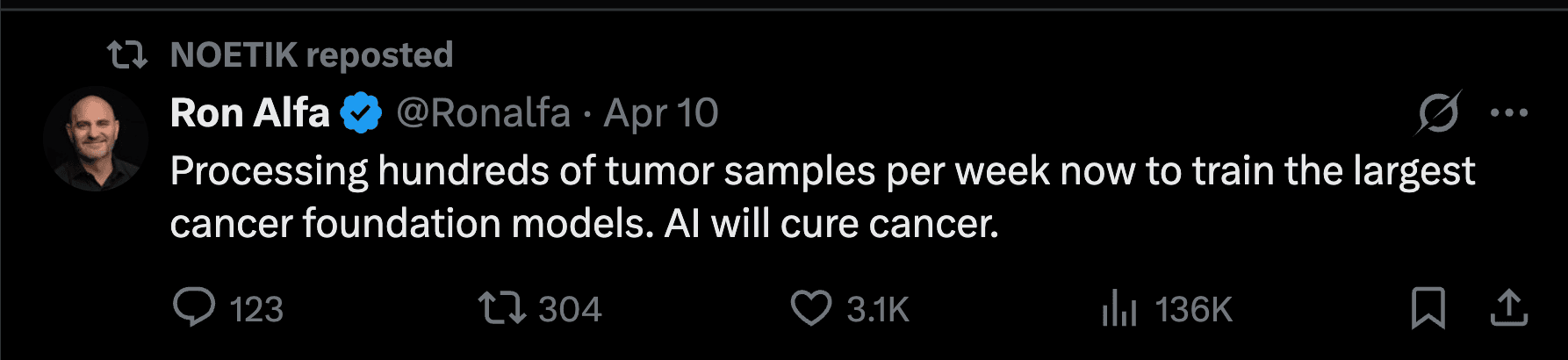
Ron Alfa (Noetic co-founder/CEO; physician-scientist background; focuses on AI “curing cancer” hot takes) and Daniel Baer (Noetic VP of AI; biology PhD; moved into computational neuroscience, computer vision, self-supervised learning).
Key claims
- Trials fail because of poor patient cohort selection; simple biomarkers (single mutations/protein stains) are biased and weakly correlated with success.
- Human pathology subtypes are richer than classical histology; one “lung cancer subtype” may split into multiple therapeutically relevant subtypes.
- Public datasets are too small/limited; Noetic generates intentional, controlled multimodal data at scale to train foundation models.
- At inference, models can predict response from H&E alone and can infer spatial gene/protein patterns and “virtual cell” counterfactuals (e.g., knockdown simulations).
Notable examples
- H&E-only inference: responders/non-responders cluster in latent space; model can highlight predicted target/protein expression in responders.
- Validation via in vivo PerturbMap: CRISPR barcoded gene knockouts in mouse lungs (immune “hot/cold” phenotypes) to test model predictions and pathway-consistent phenotypes.
Written by AI. May contain mistakes. Listen to the episode to check what was said.
Chapters
Tap a time to open that second in VOUnderstanding Noetic's Mission
0:45 to 2:39
Discussion on the rationale behind founding Noetic and the challenges in cancer drug trials.
“There just, like, weren't really data sets out there that people had been able to develop on.”
The Challenge of Patient Selection
2:39 to 4:28
Exploration of the importance of selecting the right patient populations for clinical trials.
“So you're actually using the models partly at least to select the patient cohort, not just so you can imagine working either way.”
Limitations of Current Cancer Research Models
4:28 to 7:17
Critique of existing cancer research models and their inefficiencies in predicting patient responses.
“And I would maybe even go further and say, like, nobody actually knows what the subtypes are.”
The Role of AI in Drug Development
7:17 to 9:32
Discussing how AI models can improve patient and drug matching in trials.
“And so and pharma has done this for, you know, 20, 30 years where you develop a drug, you test it against, you know, hundreds of bees.”
Data Generation in Cancer Research
9:32 to 12:40
Importance of generating intentional and high-quality data for effective AI training in cancer research.
“We are saying, okay, well, we want the model to learn, let's say, from lung cancers.”
Comparing Data Scales and their Impact
12:40 to 14:00
Discussion on the scale of data needed for effective AI applications in cancer compared to other fields.
“So that's why we've taken this approach.”
Understanding Data Scalability in AI
14:00 to 15:10
Explore the relationship between data scale and AI model effectiveness, especially in biology.
“That can't be the only thing because there's a lot of video data as well.”
The Complexity of Biological Data
15:10 to 16:40
Discuss the challenges of using biological data to predict drug effectiveness for cancer treatment.
“I kind of have some follow-ups with PDB, but I'm just curious at this point.”
Data Generation Techniques in Oncology
16:40 to 18:20
Learn about the techniques and principles behind data collection for cancer research.
“and some of the less major indications that that will result in a model that can generalize pretty well to kind of any type of cancer we would throw at it.”
Innovations in Image-Based Data Collection
18:20 to 20:30
Discover how image-based data collection improves the understanding of cancer biology.
“The other was, how do we design these data sets so we can control for things that we know are going to be important, such as batch effects?”
Show all 37 chapters
Understanding Spatial Transcriptomics
20:30 to 22:20
Get an introduction to spatial transcriptomics and its significance in cancer research.
“If you just sat back and you said, okay, I want to train a foundation model that understands human biology.”
Linking Molecular Data to Cancer Treatments
22:20 to 24:10
Examine how molecular data connects to the development of cancer treatments.
“So you could say, well, I want to know whether there are immune cells and different subtypes of immune cells.”
The Concept of the Virtual Cell
24:10 to 28:00
Explore the virtual cell concept and its potential applications in drug discovery.
“So DNA transcribed into RNA, which is translated into proteins.”
Simulating Cell Biology with Virtual Models
28:00 to 29:10
Learn how virtual cell models simulate biology to predict drug responses.
“And so the way we've designed these first virtual cell models is maybe just to simulate the biology of a cell in some context.”
Challenges in Single Cell Gene Expression Models
29:10 to 30:20
Discover the limitations of current models predicting patient drug responses.
“like either cell culture or primary cells, something like that.”
Integrating Patient Data for Better Predictions
30:20 to 31:30
Understand the importance of incorporating comprehensive patient data in models.
“So it's much more about trying to discover what's really there in patient biology than go based on the text that people have written about it.”
Translating Patient Clusters into Clinical Decisions
31:30 to 34:20
Learn how patient clusters influence decisions in drug trials and therapies.
“How do you translate those clusters of patients to making decisions?”
Leveraging H&E Stains for Predictive Models
34:20 to 36:40
Explore how H&E stains are used to create predictive models for drug efficacy.
“I just want to call out maybe like the simplest use case is the one where there's like a company that has a drug and they've given it to some patients and we know some of those patients responded.”
The Power of Multimodal Data in Cancer Research
36:40 to 39:00
Discover how multimodal data improves the accuracy of cancer treatment predictions.
“And so that adds a major level of interpretability there because we can see things like, okay, good, the responders are actually expressing the protein target of this drug.”
Innovations in Gene Knockout Experiments
39:00 to 41:30
Learn about in vivo perturbation experiments using gene knockouts in mice.
“There are lots of models that take H &Es and go to gene expression out there, open source, whatever.”
In Vivo Perturbation Experiments in Cancer Research
42:00 to 45:50
Learn about the use of in vivo perturbation experiments to validate models in cancer research.
“Well, there's, yeah, there's a big piece that we haven't talked about yet, which is actually, we are running perturbation experiments, except they're in vivo perturbations using a platform based in mouse.”
Mapping Human and Mouse Tumor Biology
45:50 to 48:20
Discover how diverse tumor biology is mapped between humans and mice to improve drug responses.
“And then we just said we have a mouse ball.”
Humanizing Mouse Models for Better Drug Development
48:20 to 53:10
Understand the methodology behind translating mouse model results to human biology for drug development.
“And so we're in silico humanizing the mouse.”
Introduction of the Tario Model in AI
53:10 to 56:00
Explore the new Tario model architecture in AI and its advantages over previous models.
“And lo and behold, there are, you know, five genes that are in the same pathway.”
Understanding Masking in Transformer Models
56:00 to 58:00
Learn how masking in multimodal transformers affects model performance.
“And forcing the models to learn them is really what gives it this predictive power.”
The Evolution of TARIO and Model Scaling
58:00 to 1:00:00
Explore the development of the TARIO model and its scaling capabilities.
“I think there's actually a pretty subtle but very interesting result in that blog post with Taria, which is that you only really see the benefits of using larger models when you're looking at longer context lengths.”
Partnership with GSK and Business Model Insights
1:00:00 to 1:02:30
Discover the details of the GSK deal and its implications for the industry.
“And there definitely seems to be an advantage to looking at larger regions of tissue as well.”
The Shift in Pharma's Approach to AI
1:02:30 to 1:04:10
Understand the changing landscape of AI adoption in the pharmaceutical industry.
“let's say, a small amount of money with number of seats where you're licensed.”
Challenges in Training Foundation Models
1:04:10 to 1:06:30
Learn about the challenges and data requirements for training effective models.
“And I think also, you know, with the structure prediction models, protein structure prediction, binding prediction models, there is like this massive public data set.”
The Importance of Data Quality in Machine Learning
1:06:30 to 1:10:00
Explore why data quality and generation processes are critical in ML.
“There was no prior here that any of this would work.”
Designing Effective Experiments in Biotech
1:10:00 to 1:11:30
Learn about key considerations for designing successful experiments in biotech.
“how to design the experiments, iterative cycles over the years, seeing things that did work, things that didn't work.”
The Importance of Data Quality and Technology
1:11:30 to 1:12:44
Discover why high-quality data and understanding technology trends are critical in biotech.
“And like, what is the right data for solving this problem?”
Collecting and Utilizing Data in Trials
1:12:44 to 1:14:34
Explore strategies for collecting valuable data in biotech trials and the challenges involved.
“And that took me a full week of manual work.”
Insights on Protein Data Bank (PDB) and Its Relevance
1:14:34 to 1:17:08
Understand the significance of the Protein Data Bank in modeling and research.
“I mean, imagine trying to train a foundation model on hot enough data.”
Challenges in Modeling Cancer Biology
1:17:08 to 1:20:03
Learn about the complexities of modeling cancer and the importance of data diversity.
“Without necessarily being convicted that this was going to lead to solving protein folding.”
The Future of AI in Biological Sciences
1:20:03 to 1:23:37
Discuss the potential of AI to revolutionize biological sciences and drug development.
“And those are now by far the most predictive models of how a given neuron is going to respond to real world stimuli in a real brain.”
Challenges in AI for Therapeutic Development
1:24:00 to 1:25:14
Explore the complexities of using AI to improve drug trial success rates and the need for comprehensive data.
“there are a lot of problems in AI for biology, AI for biochemistry, etc.”
Transcript
Automatic transcript. May contain errors.0:00Daniel Bear:So we basically opened the lab, we hired a team, we got all the instruments, we started sourcing tumor samples. There was no prior here that any of this would work, like zero. We just started generating data and like sourcing human tumors, processing. We built this whole processing pipeline to get the tumors into like these arrays and the formats. So you've got like these two-week runs where you're processing two slides. And we're just churning data for months. And we couldn't even train a model. So we sort of just built all this. And then, like, let's say 18 months later, hey, I wonder, can we train them all off?
0:34Daniel Bear:And then it was not, you know, like, it wasn't obvious.
0:37Ron Alfa:Yeah, there wasn't really, like, anything major to go off of. I mean, there were, like, transformers developed for single cell data. There just, like, weren't really data sets out there that people had been able to develop on. We do a lot of, like, custom model building.
0:55Daniel Bear:Hi there, I'm RJ Haneke and this is Brandon Anderson. We're the co-hosts of the Latent Space Science Podcast. And today we're really happy to be in the studio with some of the people from Noetic. I'm Ron Alpa, co-founder and CEO of Noetic, physician scientist by training. My hobbies are making hot takes about AI curing cancer.
1:16Ron Alfa:Hi, I'm Dan Baer. I'm VP of AI at Noetic. I'm a biologist by training, did PhD work in neuroscience, and then moved into comp neuro, computer vision, self-supervised learning, and have been doing AI research at Noetic for the past few years. Maybe we should start with what is Noetic?
1:35Daniel Bear:Why did you found it? What is the difference between Noetic and the other virtual cell companies? Maybe just start with a little bit of a centrarian thesis, which is really the reason for founding Noetic. Like, it's, we all know the numbers that 90%, 95 % of cancer drugs fail in the clinic. Why do they fail? So our thesis is they fail not because we're bad at pharmacology, not because we're bad at target selection, you know, making the drug. We're actually better at that process than we have ever been in the history of drug development. Most of those drugs fail, we'd argue, because we're bad at selecting which patients those drugs are in or worked in.
2:14Daniel Bear:And oftentimes you see trials where there is no placebo effect in cancer. Some patients respond to these drugs. And if you have a patient that responds, that tells you something that there's some biology that's active there, but you have a problem in patient selection. And so really that's the thesis behind it. I think is can we build models that can fundamentally understand patient biology from the very beginning and help you position molecules in the right patient population? So you're actually using the models partly at least to select the patient cohort, not just so you can imagine working either way.
2:47Daniel Bear:You could design, oh, I think that this molecule will do well because I know something about the patient population. But you could also say, I think that this patient population is the match for this molecule. And that's sort of the power of the models is like once you've trained these models on patient data, you can use them on both sides of the equation. So you can use them for discovering new targets directly from the patient data, which people often refer to as reverse translation. So starting from humans and then trying to understand which targets to go after, and then you can use that to develop molecules.
3:23Daniel Bear:But you can also use them directly on patient data. If you have, let's say, a phase two or phase three trial, you can use these models to understand which patients or what underlying biology of the patients in the trial is a predictor of response. And we've been doing a ton of that recently. Are you doing a lot of like rescuing trials that had a bad effect? We are doing a lot of looking at data from phase two, phase three trials, and then using the models essentially to run inference on patient biopsies and understand whether there's underlying biology that would help us design the next trial.
4:03Daniel Bear:We haven't shared any of that yet, but you'll see this too. So cancer is kind of like infamous in that there are many, many different types of cancers. Whenever it says like cure cancer, it is almost a meaningless vacuous statement. So your point is, even amongst cancer, or you pick a specific type of cancer, and then a subtype and a subtype, there's a bunch of different patient populations that each one of them will respond differently to drugs. And your point is, you can figure this out right now, that some subpopulation will do well and respond to this drug when you think, generally speaking, the rest of the population would not, even though we have historically classified this as what type of cancer, what indication, or so on.
4:43Ron Alfa:Yeah, that's exactly right. And I would maybe even go further and say, like, nobody actually knows what the subtypes are. There are cancers that originate in a certain tissue, like the lung, that, you know, have been classified into subtypes based on pathologists looking at them for, you know, more than a century. and, you know, those subtypes certainly have some connection to the real, like, carving nature at its joints, like what are the actual functional subtypes of disease there. But our thesis is kind of that if you look at the data, a much richer kind of data, so the multimodal data that we're generating in our lab, we're going to see that actually, you know, what people thought was one subtype of lung cancer is really three distinct subtypes of cancer.
5:33Ron Alfa:And that is going to be critical for figuring out which patients should get which drugs.
5:38Daniel Bear:Yeah, maybe I'll just go back to one of your first questions. And I was saying, many drugs fail in patients because we don't understand which patients they will work in in oncology. Why do we end up in that situation? So whenever you make a new drug, you do a set of experiments in cell culture, cells in a dish. Those cells are often cell lines. These cell lines have existed for 40, 50 years, and they're immortalized. So they have genomes that allow them to persist that have abnormal numbers of chromosomes. They have gene expression patterns that don't represent any known cell in the human body, really.
6:22Daniel Bear:These are sort of Frankensteinian cells. that cancer drive, that are ruinously cancer. That's right. They're mostly cancer. And so you can do your experiments in these cell lines in a dish, or then you can move these into animal models. And in oncology, you often have sort of a panel of different animal models with different cancer types that you'll test these in. And in doing these experiments, we sort of convince ourselves that some of these cell lines are, let's say, lung cancer cell lines or colon cancer cell lines. And then even that some of them in the mouse context are colon cancer cell lines and lung cancer.
7:01Daniel Bear:And then we, in the mouse, we implant them under the skin and like weird places and we treat the mice with drugs and we see how they respond. But ultimately, there is a big gap because they don't translate to patient biology most of the time. So these cancer cell lines, most of them don't even, you know, even if they are derived from a colon cancer, they don't even have the mutations that human colon cancers have in many cases. And so and pharma has done this for, you know, 20, 30 years where you develop a drug, you test it against, you know, hundreds of bees. It's not an art experiment. You can send this out to any CRO.
7:40Daniel Bear:They'll test your drug against hundreds of different cancer cell lines. And you can sit back and say, OK, well, which of the 50 colon lines responded to my drug and which of the 50 covarian cancer lines? And you could try and map that to human biology. But the problem is these cell lines as an abstraction do not relate in any way to human patients. And so what happens is ultimately, no matter what you do preclinical, the molecule gets in the clinic and the clinical team says, look, we don't really know how to design this trial because none of the data that you've produced gives us any insight on which patients to run.
8:15Daniel Bear:So we're going to basically enroll an Oakland label study. So we're going to enroll all tumors, all patients that are enrollable in this trial, and we're going to see where we get signal. imagine doing that in an early phase trial where let's say you have 50 patients and you're trying to do you test different doses and you don't really know the dose of the drug and you don't know what the safety margins are and you're also trying to figure out where is my signal and then what if I told you that let's say in just lung cancer hypothetically let's say there's only 10 different subtypes of lung cancer and you don't even know if it's lung it could be any so So, you know, this is what happens.
8:55Daniel Bear:And oftentimes you get to the end of these early stage trials and you don't see very many responders as you would expect statistically. And then these molecules get canceled. So you're imagining that your noetic system, you help the pharmaceutical company to characterize, we expect that people with a certain genetic profile or even transcriptomic profile will respond to this drug. And then you go and you actually sequence from the patient and you say, yes, this is a match. Is that the sort of grand vision? Yeah, I mean, I would say we are even less biased than that. We are saying, okay, well, we want the model to learn, let's say, from lung cancers.
9:40Daniel Bear:We want the model to learn, like, how many different therapeutically relevant subtypes of lung cancers are just from self-supervised learning from the data. And those subtypes could be driven by large genetic changes. They could be driven by, you know, immune changes. It could be really driven by any biology that the model is learning in the process of training. And we do see different types.
10:05Ron Alfa:I mean, feel free to contradict this as the actual doctor here. But the biomarkers that people have been using are biased towards simplicity. Does the patient have this particular mutation? Sometimes like stain for this single protein. or, you know, do transfertomics, like, to look for a particular gene signature. But, like, there's no reason to think that biology or, like, biology of cancer is that simple that you're going to capture, you know, most of the meaningful variation with such simple biomarkers. And, you know, most of them, they have, like, weak correlations with, you know, clinical success.
10:51Ron Alfa:But the hypothesis really is here. Like, again, if you were to carve nature at its joints and figure out what's really going on, is there, you know, these five subtypes that the correlation there between which patients you give a particular drug and whether you have success is much, much stronger than if you're forcing yourself to go with these like very simple biomarkers.
11:15Daniel Bear:You mentioned the lab. You do a lot of data generation in the lab. So why do you think that that versus using existing public repositories or whatever is appropriate? Yeah, we generate all our data in the lab. Everything from sourcing tumor samples themselves to processing them and generating the data. Maybe another hot take I have just in AI and bio is you're sort of not at the order of magnitude of data that you are in other spaces of building training models. And so it becomes really hard to brute force these problems just by collecting data. We have a couple pretty good examples of where someone has designed a data set.
11:59Daniel Bear:So PDB was designed and has been built over the past 50 years or so. And so it's not an accident that that data set exists. Someone decided that we are going to design this data set. We're going to collect this data over decades and decades. and then with the intuition that potentially this would help solve protein folding down the road. And it did. So it's not just that PDB is a bunch of random data that people have organized from the web. I think that in bio, you really need to be intentional about the data that you generate and how you generate it and have some foresight around, well, what are the models we're going to want to train and what are the models I need to learn from from the very beginning?
12:42Daniel Bear:So that's why we've taken this approach. Yeah.
12:45Ron Alfa:And I mean, like a good comparison is to the ImageNet data set, which kicked off the deep learning revolution in computer vision with convolutional neural networks, like actually demonstrating that neural networks can do better than other methods on object categorization. And ImageNet is, at least the part of it that people were developing models on, is 1.2 million images, very carefully curated. These are high-quality images, not like random images from the internet or like multiple data sets cobbled together. And labeled. Yeah, and labeled. And I think with the data that we're generating, we're around that scale right now.
13:30Ron Alfa:But, you know, of course, people have gone much, much larger in image data sets and language data sets, text data sets, obviously for LLM. So we think that we need to get the data up to that scale before we can really see the meaningful progress on the algorithm side. The scale of language data. Yeah. Language is really the only modality where people are seeing these very impressive scaling results. and part of that has to be just the scale of data that's there and that the models are trained on. That can't be the only thing because there's a lot of video data as well. People are training on thousands of hours of video data and haven't seen the scaling results that you have in language modeling.
14:20Ron Alfa:But having the right scale of data is necessary, if not sufficient, to really make progress here.
14:26Daniel Bear:Can I refer a contrarian take to that? Sure. So, I mean, there's this whole concept about the jagged frontier of LLMs and Dirt of AI and how like certain regions that can be really good at solving some problems and then remarkably stupid at solving nearby problems. And maybe the arguments with happening is that a lot of these frontier models are just becoming massively, like everything is becoming in distribution. Like if everything starts out O2D, if you just get more data, it now becomes in distribution. Is it possible that for biological systems, because these are, they're underlying physical processes here, that you can basically make things more in distribution earlier and that you can't actually cover the space?
15:10Daniel Bear:I kind of have some follow-ups with PDB, but I'm just curious at this point.
15:14Ron Alfa:Yeah, I mean, I think it's a good question is, like, sort of how much data and what kind of diversity do you need, like, in biology to solve? You know, say, like, the drug translation problem, like, figuring out which drugs are going to work in which patients. my intuition from working in biology, like for a while is that we're still pretty far from that, like, because, you know, we're building data sets that are focused on right now, cancer, and, you know, I've generated data from thousands of patients in a few major cancer subtypes, but there's like every other disease, there's healthy tissue, there's even other species, you know, there's a lot of biology to learn, especially if you think about it as we have to learn kind of the spatial and functional patterns of tens of thousands of genes, tens of thousands of proteins, how their spatial arrangement contributes to the function of organs and so forth.
16:16Ron Alfa:You know, my hunch is that biology is like pretty complex and that we still need to generate a lot more data. But yeah, I don't know. Yeah. But as a cancer company, do you think you could
16:26Daniel Bear:actually do this hypothetically for cancer? I mean, for at least some subclasses.
16:30Ron Alfa:Definitely. Yeah. I think that we've done experiments that suggest that, you know, if we can generate data from several hundred patients in all of the major cancer indications and some of the less major indications that that will result in a model that can generalize pretty well to kind of any type of cancer we would throw at it.
16:52Daniel Bear:So backing up, what is the data you're collecting? Because my understanding is you use some pretty specialized instruments and gathering very specific data sets. So how did you come to that decision about how much data, how much to spend on it, and what types of data? Yeah. I'll give a hat tip to my previous employer, Recursion. So we spent six years at Recursion from the very beginning. And a lot of what we were doing in the early days was figuring out like the things we didn't understand about the datasets and figuring out what the problems would be in the dataset. So batch effects, controls, how to orient samples on plates, things like that.
17:32Daniel Bear:Flash forward to founding of Noetic, started the company, you know, already with some principles around how we should think about building the data set. What are some things that we know matter? So, for example, over many years, we learned that images are actually a really powerful data set for machine learning for many reasons. One, they're scale. So we can put patient samples on slides and on a single slide, we can capture many patients worth of biology. The images themselves are very rich sources of biological information beyond that. Now we have a very information-dense modality and we can decrease the cost of data generation.
18:13Daniel Bear:So then we can increase the amount of data generation over the whole data set. And that's always been a really big benefit to image-based modalities over, let's say, sequencing, where every time you run a sequencing run, you're basically, your end is, you know, a patient's first. That was one way to think about it. The other was, how do we design these data sets so we can control for things that we know are going to be important, such as batch effects? So, for example, if I have a slide, we do a, let's say, a spatial transcript on this run on that slide. You stay in the slide, do a bunch of wet lab processing, you put it into a machine, you get data out.
18:52Daniel Bear:If you do that on two different days, there are going to be different variables that impact the data. That's going to be a large source of variation in data sets. So you want to be able to control for things like batch effects. So really you want more patients represented on multiple different slides so you can process them different in different batches. So you want to be able to control for things like this. So you can go downstream and look at the data and say, okay, well, once we have, let's say, patient level embeddings, we can ask, well, do the patient level embeddings represent, let's say, patient response to immune therapy or do they represent staining batches?
19:30Daniel Bear:So you're actually taking one patient and you're spreading across multiple slides so that you can get sort of a calibration across the slides. Yes, our data looks very different than anyone in the space of generating data on histology or digital pathology types of specimens. So we receive a sample. We sample those samples dozens of times to build these arrays. And each array has hundreds of different patient samples, randomized. And every patient is represented on multiple different arrays. And so we're getting a lot of different representations of each patient that we're sending through the data process and pipeline.
20:09Daniel Bear:And then that lets you downstream be able to answer some of these questions and control for some of these barriers. You mentioned some terms I just want to define for people, spatial transcriptomic. Yeah. What is that? Yeah, so what be? I mean, this was your first question. So what are the data types? So you just sit back, and this is not my background in terms of spatial. Again, everything we did on your previously was cell biology in a dish. If you just sat back and you said, okay, I want to train a foundation model that understands human biology. What does that mean? How would you go after that problem?
20:40Daniel Bear:And that was really the starting point for the company. Okay, but from first principles, how would we do this? So you probably want tissue level biology. You want to understand tissue. Cells are organized into tissues. You probably want some modality that is relevant in clinical use. So you can relate clinical data to what your models are learning. That's why we generate pathology, H &E. So that's what every patient gets a tumor removed and then they get this stain on H &E, and that's what the pathologists... I can't explain where H &E is. Basically, two different dyes, hematogyslin and eosin, and it really just creates a contrast over the tissue.
Read the full transcript
21:20Daniel Bear:So you've probably seen these purplish pathology specimens. So pathologists can look at those, and they can identify different cellular structures, and they've used those to classify tumors based on the classical classifications of, you know, had no carcinomas, small cell carcinomas, things like that, but basically cellular structures. Okay, so there's like a specific patterns would show up when you add these two sayings and it is well established that like you classify tumors based on? Based on, yeah, pathology on your classifications. And this is what every, basically every tumor, you know, that gets processed.
21:59Daniel Bear:and the hospital will get this H-E-E state. And it's how the pathologist typically classifies a tumor from the first level. So, okay, so you want that. You probably also want to understand cell types. It's really hard to understand cell types from just that state because it doesn't reveal that much that a human can use to classify cell types at least. So you could say, well, I want to know whether there are immune cells and different subtypes of immune cells. We want to have some layer of cell biology. Okay, so you want to know about immune cells because, like, you have these cancer cells, and oftentimes the immune response dictates whether or not, like, it will be, you have an effective treatment or...
22:37Daniel Bear:It's like the immune environment of the tumor will be a core, we know is a core constituent of whether a patient's going to respond or not. So you want to know, okay, you want to give the model, so the model's going to get this tissue-level information. There's not enough cell-level information in there for the model to learn enough cell biology about different subtypes. So we also want to present it with some cell-level information. So we use protein stains, so standard neofluorescence. So you basically use antibodies against a small set of cell markers to label different T cells, B cells, standard subtypes of cells in the tumor-y and microbiome.
23:15Daniel Bear:So in this stain, just for those who are familiar, the stain on the antibody has a fluorescing protein. When you hit it with a certain frequency of light, then it fluoresces. So you can tell the antibody bound to a certain protein. And now it has a fluorescing gallatin attached to it. Yep. And in terms of the data, so from the tissue layer, you have an RGB image. from the next layer you have a multi-channel image with each channel representing you know let's say one color and so for example certain immune cells are each in a different channel so you have this multi-channel image now okay so that's great so we've got tissue we've got cells but if we actually want to make drugs we need some some type of molecular information we need to tie all of this down to what's happening in the genome what is the cell doing what are the mechanistic principles of the biology.
24:11Daniel Bear:So then we get spatial transcriptome. So that's spatially resolvable RNA. So DNA transcribed into RNA, which is translated into proteins. So we get basically the RNA in a spatially resolved pattern for the same cells that we're seeing all of these other layers. So now you have between 1 ,000 or 19 ,000 different genes. And again, these are all image layers that are spots of where those RNA are and in which cells. And this works a little bit similar to how we talk about protein, where you have a segment of RNA and then you have a fluorescing protein. And usually there's some sort of combinatorial thing.
24:51Daniel Bear:So you have, if you see these four colors in this amplitude, then that means this gene because they're right to each other or something like that. So for the detection method, you're basically binding a probe at each one of those RNAs and then you're cycling it. And it takes weeks to run one of those assays. So you're cycling the machine, it'll cycle across each species and it'll amplify and you'll get a signal for each RNA species. Now, at this point, you now have basically this very rich data layer where you have the tissue, you have the cells, and you have the molecular information. And you can use all of that to train the model.
25:24Daniel Bear:And so you think of it as, it's essentially the central dogma, if you will. And we also have DNA. We genotype just so we understand the genomic alterations in these tumors. All right. So you get the stack of images, basically, that you can train models on with understanding the expression of genes and the proteins that are being expressed at the time that the sample is taken, all in the image information, and then you can train your models with that.
25:51Ron Alfa:Yeah. I mean, the spatial transportomics is particularly dense because if you think, Let's say there are 20 ,000 genes in the genome. Now, you know, we're running assays that are detecting nearly all of them in a single sample. So you can think of one of those data points as an image, except instead of being an RGB image that has three color channels, now all of a sudden it has like 20 ,000 color channels. So it's like a very meaty computer vision problem to try to look at those data and figure out what makes patient A different from patient B, and then go from that to which drug is going to work in which one.
26:33Daniel Bear:And so you have a hot take about virtual cell. Like, I want to understand how, okay, so you, you know, you have this big pile of data that every single sample has a massive data set with it, and then you have many, many samples. So how do you turn that into useful knowledge? Maybe just what is a virtual cell? Everyone's always asking that question. I think there are really two ways to think about it. One is we want to be able to simulate all the biochemical processes in a cell. So we want to have this sort of comprehensive foundation model where we understand, you know, if some signal from outside the cell interacts with the cell, then here are the millions of intracellular chemical reactions that are going to happen.
27:19Daniel Bear:and you could sort of predict them from the model. So that's one view. I think it's sort of an interesting intellectual pursuit. I don't think we have all the modalities of data that you would need to solve that problem. I tend to see the virtual cell problem as something more practical. We're trying to make drugs that work in patients. So from a virtual cell perspective, really what we want to do is understand cell biology in some heuristic that's useful for making drugs. And the heuristic could be a way to understand your targets or a way to map your cell-level biology up to patient-level biology.
28:01Daniel Bear:And so the way we've designed these first virtual cell models is maybe just to simulate the biology of a cell in some context. And the biology of that cell being, let's say, the cell being in some context and the output being the transcriptome in that context or, you know, the protein in that context. And these types of, you know, input-output relationships allow us to essentially design experience. And so really the very simplistic thing that we're doing is really just the model can simulate the biology of cell or, you know, many cells in different contexts and give you, and allow you to run some simulations in that regime.
28:38Ron Alfa:Yeah, I mean, I think what, most of the things that people are calling like virtual cell models right now are focused on single cell gene expression, so transcriptomics data, RNA data, and they're largely geared toward the problem of predicting what's going to happen to the transcriptome. So the set of genes expressed when you hit cells with either a small molecule, a drug, or a genetic perturbation. And typically this is cells grown in vitro, like either cell culture or primary cells, something like that. I think that's genetic perturbation being where I like knock out a gene
29:19Daniel Bear:or add a genially and see how that impacts the expression of the debarious RNA.
29:26Ron Alfa:Exactly. So, and I think my view, and I think Ron shares it too, is that like may be of interest in some cases, but the problem we're really trying to solve is predicting what's going to happen in a patient and you're just modeling data that comes from a patient is, in my mind, much more likely to translate to what happens when you give a patient a drug than something that's happening in cell culture.
29:54Daniel Bear:Is there other clinical data that you're pulling into the model besides the actual, so you're calling the context of the cell just the surrounding cells, but is there other this drug caused a bad reaction kind of stuff?
30:07Ron Alfa:Yeah, I mean, we're pulling in data from the entire patient. So not just, you know, the very local neighborhood of the patient. So far, we haven't done much integration of, you know, like electronic health records or, you know, other information that one could get about the patient. And that's pretty intentional. like we really want these models to learn basic biology again like the central dogma not just the central dogma but you know the basic biology of genes protein cells tissue in a self-supervised way so purely from the data that we're generating and not be biased by you know what the doctor wrote about that patient because you know our thesis is kind of like most of the therapeutically predictive and important information is not contained in those very small number of, you know, patients who have been treated with a given drug and whatever the doctors thought was important to write down given the state of knowledge at that time.
31:15Ron Alfa:So it's much more about trying to discover what's really there in patient biology than go based on the text that people have written about it.
31:24Daniel Bear:So you have this self-supervised model, you eat a lot of data, you have essentially some clusters of patients now. How do you translate those clusters of patients to making decisions? Like you go to a pharma company and you say, we can repurpose or we can suggest this subtype should be the focus of your phase two trials. Like what is the process for that? What data do they need to provide you and how do you translate your models? So it depends on what the problem is. I think it's important. So one of the more interesting aspects of these models is they are useful for a broad array of use cases, as we were talking about from the very beginning.
32:07Daniel Bear:So you as the pharma company could say, okay, well, I have this molecule and the target of the molecule is X and I want to design my clinical trial. The molecule has seen zero patients apart. All I know is the target and some biology around the target. So we can run simulations using the models and our cohorts of patients. And let's say if we were to look at lung cancer, we can run simulations around the target and ask, okay, which sets of patients here would this target be important in across a cohort of lung cancers and colon cancers and across all of oncology? And you might see, and we see this sometimes, you might see that your target probably don't want to put it in lung cancer.
32:49Daniel Bear:Maybe you want to put it in ovarian cancer because it's not really important in lung cancer. What are you simulating here? So, like, you say that this drug is expected to knock down this gene, and therefore it will result that you want to look for clusters where knocking down this gene inhibits tumor growth rather than enhancing tumor growth?
33:11Ron Alfa:I mean, that's certainly one way we could do it. There are other types of simulation where you might just want to ask, like, if there were immune cell here, like a T cell, which is responsible for actually killing tumor cells, what would happen to it or what genes would it express or what proteins would express in this particular patient's tumor microenvironment? And that's what we've called like these virtual cell simulations, like we have a model called octovirtual cell that does this. And that can give quite powerful answers to the question of, are these drugs going to work in these patients?
33:49Ron Alfa:because you might find like, actually as Ron was saying, the thing that this drug targets is just not important in this particular patient's tumor in that there's not, like it's not going to have any effect on the T cells or the macrophages or some other cell type there. Then, you know, there's the type of simulation you alluded to where you can ask the model what would happen to this patient's tumor if you were to knock down this particular target gene or its protein product. And you might be looking for cases where the model predicts that removing that gene or that protein is going to have a large effect, like either increase the immune system function, its ability to fight that tumor, or decrease the tumor's ability to grow, or some other readout that you think is correlated with clinical success.
34:43Ron Alfa:I just want to call out maybe like the simplest use case is the one where there's like a company that has a drug and they've given it to some patients and we know some of those patients responded. And then it just becomes like a question of like, has the space of patients that the model has learned via self-supervision tell us that all of the responsive patients are in one of these clusters and not the other nine clusters or something? So if we know that, then there's a pretty straightforward hypothesis that this is the right cluster.
35:19Daniel Bear:So that's the scenario where you would sequence something. What would you collect about those? So you have a cohort that responded and one that didn't.
35:27Ron Alfa:Yeah, so this is getting back to something Ron mentioned earlier, which is this type of data called HNE. It's a stain, the standard pathology stain that makes these pinkish and purplish looking images. Right now, what we do is we've built models that are trained on kind of all of the multimodal data we generate. But then once they're trained at inference time, all they need is an image of H &E. And that could be something that we generate in our lab, or it could just be, you know, a digital image that they have from a trial that was run years ago. And the reason that that is so powerful and flexible is, again, because H &E is kind of like the lingua franca of pathology and especially oncology.
36:17Ron Alfa:So almost every patient who's been given a clinical stage drug is going to have that.
36:22Daniel Bear:You can look at the two cohorts, the responders and the not responders, and say these H &Es live in this part of the latent space and these H &Es do not.
36:33Ron Alfa:Yeah, exactly. And I think, you know, one way we've gone further than that even is given the H &E, they can say, I predict that these genes are expressed at this location in this patient. So not only do we have these clusters, these embeddings that say, you know, all of the responders to this drug are over here, all of the non-responders are over there, but we can actually see, okay, for the responders, these are the genes that are expressed much more highly or predicted to be expressed much more highly in the responder cluster versus the non-responder cluster. And so that adds a major level of interpretability there because we can see things like, okay, good, the responders are actually expressing the protein target of this drug.
37:26Ron Alfa:So we would be worried if that weren't the case, but we can see it is. On the other hand, we also see that the biology is very, very complicated. So kind of explaining why these simple biomarkers, like looking at a single gene or a single protein, just really don't capture what is predictive of therapeutic response.
37:47Daniel Bear:Yeah, so I have like a million directions I want to go here. H &E, that actually gives you a pathway to a diagnostic then as well. Exactly. Right. Yeah. And so that you can imagine after the drug hopefully makes it to the market, then a doctor says, oh, you have cancer. I'm very sorry. We're going to do a H &E stain of your tumor. And then we're going to put in the model and it says, oh, you know, this one won't, or free, but this one won't. That's right. And so we're using the same approach for actually today. We're looking at many different mechanisms from different collaborations that we have in place.
38:28Daniel Bear:One of them we've announced with a company called Agenus. These are all different mechanisms. The input is still H &E. And some of the same indications are using H &E. We're asking whether DRHA works in some sets of patients, whether DRHA works in other sets of patients. And so you can take that to its natural progression and say, well, OK, if you can use that same input, just H &E for experimental drugs, why not use it also for drugs that are on the market already? In a sense, the same assay can be very predictive across many different cancers and many different potential therapeutics. There are lots of models that take H &Es and go to gene expression out there, open source, whatever.
39:11Daniel Bear:They do, you know, so-so. I've read in Twitter, your Twitter feed and whatever, that you feel that you have a data mode, right? And so why is NoetX model better? Sure.
39:21Ron Alfa:I mean, I think, you know, the scale of data that we've trained these models on is, like, you're pretty different from a lot of what's out there. Like, the reality is there's just not that much of this kind of paired H &E plus other data modalities. Typically, there are some data sets generated by academic labs, others where they might have maybe like 100 or a few hundred patients worth of data with paired spatial transcriptomics. That might even be an overestimate. In comparison, we're generating these data that are multiple patients per slide, individual patients distributed across multiple slides.
40:02Ron Alfa:we've generated now you know more than 100 million cells spatially resolved and spatial transcriptomics that's all paired with h e and protein as well at least an order of magnitude larger than any of the other data sets that we've seen out there and i think that makes like a pretty enormous difference i mean we've seen with our own models that if you drop down to 40 percent or 10 percent of that data used in training in the models get a lot worse and they especially get worse at kind of generalizing to other types of cancer from the ones that they've been trained on so i think that's a big piece of it i also think that you know the algorithmic side of it is important you know we've developed custom architectures specifically for training on this multimodal data and again my background is in computer vision and specifically in self-supervised learning there.
41:01Ron Alfa:And so we've tried to develop, you know, self-supervised learning approaches for these data that are really adapted for solving this problem of, you know, figuring out what is different in one patient versus another, and then simulating what would happen if you were to like knock down a particular gene or protein or something. So this is why we call these world models, where we're trying to build models that can simulate what's going to happen if you take a particular action. I think that's another big differentiator for these models. And then, again, the interpretability as well is probably a third one.
41:39Daniel Bear:It's funny because you were just talking about how one of the other strategies people take for this is to do perturbations on cells and then watch the response. And now your experience plus your strategy is you can simulate this sort of counterfactual perturbation idea without even having to collect the data to do that. And you can see this.
42:03Ron Alfa:Well, there's, yeah, there's a big piece that we haven't talked about yet, which is actually, we are running perturbation experiments, except they're in vivo perturbations using a platform based in mouse. We have another platform where we are, it's called PerturbMap. Ron, if you want to describe any of it, but basically, this is a platform for generating highly multiplexed knockouts of individual genes. So the same kind of like CRISPR knockouts that people are doing for individual cells in vitro, except when we knock out a gene in a cancer cell, that cancer cell gets injected into a mouse. It's barcoded so we know which gene was knocked out, and it's being injected alongside roughly 100 other cell types with different genes knocked out.
42:55Ron Alfa:So you end up with mice that have tumors that are barcoded that have 100 different genetic perturbations in them. We can actually use that to validate our models and ask what the models are predicting in humans via simulation actually borne out when you do these perturbations in a mouse system. Sorry, there's a lot to validate there. Barcode. Yeah, so sorry, barcoding. This is a technology in which an individual gene is knocked out with CRISPR, but also this introduces a set of protein tags in that cell that get expressed. It's a combinatorial code, so gene X might have proteins A, B, and C. Gene Y, when it's knocked out, has proteins D, E, and F.
43:47Ron Alfa:And we can tag those proteins or label them with antibodies so that when we go and look in the mouse, we know exactly which gene was knocked out based on which of those protein tags were expressed.
44:01Daniel Bear:So you knock out a gene, but you also added a gene that has the barcode proteins encoded on them. Yeah, exactly. And I mean, the system's designed, so everything that we're doing here is tissue, well, you could be in vivo, you know, tumors that came for human that are in the form of the tumor that are the whole tissue. And then here in this mouse system, you have hundreds of tumors in the lungs of a mouse. And if you look at these images, it's a mouse lung with like literally hundreds of tumors in it. And each tumor has a distinct biology that's driven by the biology of the knockout, of the gene that's being perturbed.
44:41Daniel Bear:And we can capture basically the biology of each tumor in a spatially resolved way. So what you can see is, okay, well, we have a bunch of tumors in humans that we have certain tumors in humans, let's say, don't have immune cells in them. And so those tumors are very aggressive and they don't respond to immune therapies. You can generate those same tumors in this mouse system. and again they don't have immune cells and you can do it genetically so you can start to map kind of the gene the causative gene relationships between these different immune or just broadly tumor genotypes or biological profiles if you will to to what you see in the human and then you can treat those mice with drugs and you see how hundreds of tumors in a single mouse responds to treatment with one drug, or you can treat many different, let's say 50 different knockouts across a panel of mice with 50 different drugs.
45:36Daniel Bear:And you can start to build this intersectional pharmacology and genetic experiment. On Twitter and in various places, I've heard you say noetic is no cell lines, no war bottles. Maybe you even said that a few months ago. And then we just said we have a mouse ball. Yes. And injecting cell... In the lungs. In the lungs, not under the skin. So, yes. So, you know, fundamentally, we think it's really important to build models that are trained on human data. And we are sourcing all these tumors to build human-centric models. So that is also true. From the very beginning, we have asked this question of, you know, let's say we want to develop a drug from the very beginning.
46:21Daniel Bear:And let's say the FDA, and I know things have changed a little bit with the FDA. But let's say the FDA wants you to have some data in an animal that says your new mechanism works in some animal system. What do you do? You're kind of stuck because you've now generated arguably the best data that you can in the human system. And then the FDA says, well, cool. But does it work in the mouth? How does it work in the mouth? And then so you have to back into this system that it doesn't translate. And so from the very beginning of the company, this has been sort of a question. And so we've started, probably at the same time we started generating the mouth to the human day, we started building this mouse platform with the aim of drawing connectivity between these two systems.
47:07Daniel Bear:And so we focused on a platform. We wanted a platform that, one, allows you to map up diversity of human tumors because we know that if we just run a mouse model with one tumor, that tumor has no connectivity. So in the mouse system, we want to have diversity of tumors and we want to see a mapping of diverse tumor biology to the tumor biology that we're seeing in the human across many different locations. So we licensed this system and we've been building it so you can see many different perturbations that produce a lot of the tumor biologies, plural, that you see in the human. And then we also want to be able to get from this mouse system to biologically relevant, let's say, targets or genes in the human as well.
47:51Daniel Bear:So one of the fundamental problems in mouse systems is we share many genes with mice, but there are a lot of genes in biological process we don't share with mice, as is obvious. And so oftentimes you run into these when you're developing drugs. It's okay, you have a target, you have some biology that works really well in mice. Maybe that doesn't even exist in humans, or maybe that pathway is useless in humans. So one of the things we've started to develop that we'll share more about soon is a way to use one of these models to essentially infer human biology from the mouse directly. And so we're in silico humanizing the mouse.
48:28Daniel Bear:So all the outputs in terms of the transcriptome from the mouse are in the form of the human genes. And so when we read out this mouse system, we're reading out in the form of a human or alcanal. How do you validate that? I mean, that's a pretty impressive claim if you can do it. But man, it seems like a tricky validation task. In my experience, both here at Noetic and my previous employer, I could say recursion. A lot of the approaches you're looking for when you're building these types of models is you're trying to ask whether the models are recognizing biology that you know to be true. So, for example, in the human context, we know that 12 % of patients with lung cancer respond to immune checkpoint inhibitors.
49:19Daniel Bear:Do the models recognize those patients? Can they recover those patients without training? Yeah, and we see that. And then when you go look at those patients, we see the underlying features of those patients maps to what we know about those patients in the client. in the mouse system we have control genes so we ask if you if you look at the mouse tumor embedding space do the tumors that should be really cold look really cold from the human inference um cold in the sense of like they don't have immune cells no mys that want to yeah yeah um and then hot in the sense of like lots of immune cells so we try to build systems where you have these hand ults and then you know the more of these examples that you know to be true that work that you see, the more confidence you have.
50:06Daniel Bear:Obviously, when you're into the regime of something very new, it's still uncertain to some extent. So the bridge is sort of, the bridge between the mouse and the human is you build a world model on a human, build a world model on the mouse, and then you say, what are the parallel structures in the two latent spaces? Is that kind of the intuition here?
50:24Ron Alfa:That's one thing that we're doing, but actually this is like even simpler, which is that we've trained models on human H &E, spatial trend tryptomics, etc., and then are just inferencing them on mouse H &E, which is easy to generate. And apparently mouse H &E looks enough like human H &E that the models think is perfectly valid H &E, makes predictions about is this like immune hot, like immune infiltrated versus cold versus fibrotic, versus some other tumor phenotype. And those predictions are accurate. So, you know, these are like some of the controls that Ron mentioned. So, you know, we know that in mice and humans and everything, if you knock down tumor cells' ability to present antigens to immune cells, you know, those are very cold.
51:18Ron Alfa:Like immune cells are nowhere near those tumors. And, you know, that's exactly what we see in the mouse. And that's exactly what the models, the in silico humanized models predict. And, you know, then there are other examples where, again, we're recovering the biology that we expect to see there. And then there are findings that are novel, but also make total biological sense. For instance, we have done knockouts in the mouse of, let's say, half a dozen genes that are all in the same pathway. So you might predict that knocking down those genes are going to produce the same phenotype because they're on the same pathway.
51:59Ron Alfa:And that was a pathway. Yeah, so a pathway is like protein A signals to protein B signals to protein C. And, you know, there's like a chain of events that leads to the cell having some behavior, you know, changes in its metabolism, its growth, etc. So these are, I don't know if you've ever seen these crazy looking protein signaling diagrams that, you know, make you want to stay away from biology. But, you know, like, you know, people have, you know, worked down a lot and they know that these two proteins interact physically and signal to each other and so forth.
52:36Daniel Bear:And so, you know, one of some chain of those interactions that this protein binds this protein and that causes it to upregulate a gene that causes other protein to be formed, blah, blah, blah, until you get to some phenotype, meaning the cell changed the way it looks.
52:52Ron Alfa:Exactly. And so, you know, based on decades of biological literature doing experiments on these, there's a very strong biological prior that if you hit gene A, gene B, gene C, and they're all in the same pathway, you should get similar phenotypes. I mean, this is kind of how like old school genetics was done. And we see that with these in silico humanized mouse models, which is amazing to me as a biologist, that you have a model that's trained on human data, then you show it some mouse histology, and it's able to say these five different tumor genotypes all look like they have the same phenotype.
53:33Ron Alfa:And lo and behold, there are, you know, five genes that are in the same pathway.
53:37Daniel Bear:So you guys, switching gears a little bit, because we want to talk about models on Latents-based podcast. You guys recently, there was an interesting blog post, Tario model. It's some transformer-based model. Do you want to talk about that?
53:52Ron Alfa:Sure, yeah. So this is a new model architecture that we developed post the first virtual cell model, OctoVC, that we developed. So Tario, this model is just a different transformer architecture. One major difference between it and our prior models, I guess if this is a model podcast, this is getting into the self-supervised learning objective. So for a while, including with OctoVC, we were training models on what's called the masked auto-encoding loss function or objective where you have a piece of data, you chunk it up into small chunks you mask out some of those chunks and the the training task is the model has to predict the masked out chunks from the revealed chunks like burt yeah exactly
54:44Daniel Bear:like burt what are the chunks because this is multimodal and like i would imagine the different channels contain wildly different levels of information and i remember seeing something like 99 masking in octo vc if i'm yeah yeah so and i was like that was kind of surprising because when you have you know 19 000 channels and maybe some of the channels are fairly uh like most of the signal is fairly sparse yeah then it seems like to be either there's a huge redundancy here in your data or you really risk like just throwing maybe out what the path yeah what are the chunks
55:22Ron Alfa:that totally depends on which modalities we're talking about so spatial transcriptomics one chunk or one token might be the level of expression for a particular gene at a particular spatial location. For protein images, multiplex protein images, again, it might be, you know, the image patch for that particular protein at a particular location and so on. And, you know, for like histology images, again, those are usually just patches of the image. So pretty standard like vision transformer style the masking and the maybe surprising result that like you can and actually need to mask out large amounts of the data to get the model to learn anything interesting if you ran the hypothetical where you only mask out like 10 of the the image you know maybe more like burt for instance in language modeling what do the models learned and you know they learn these kind of like boring behaviors like how to like continue an edge a little bit you know between two like regions of an object or something so they can learn that task very well but they don't end up learning anything about sort of the holistic structure of the image data and we found pretty early on at noetic that the same thing was true with these multimodal like transformers where if you mask out a lot of it, there are actually pretty strong correlations between where protein A is expressed and where protein B is expressed.
57:00Ron Alfa:And forcing the models to learn them is really what gives it this predictive power.
57:05Daniel Bear:And so TARIO, though, is an auto-aggressive model.
57:10Ron Alfa:Yeah, exactly. So yeah, that was going to be the buy-in. So prior models, including auto-VC, were of this masked auto-encoding style training objective. Tario is an autoregressive model, which if you think about it is kind of a particular choice of masked autoencoding, except, you know, instead of randomly masking on front of the data, you're always asking the model to predict the next token in a sequence. We know that this is something that scales very well with LLMs, like training on the next token prediction task. And it's still an open question, How do you get models of other data modalities to scale the way that LLMs have scaled?
57:53Ron Alfa:Tario was not actually our first attempt, but one of our subsequent attempts to bring that autoregressive, like, next token prediction task into modeling spatial transcriptomics data. we found that when we used this architecture and this task, we started to see much better scaling behavior where bigger models and especially at longer context lengths were really outperforming the smaller models at shorter context lengths.
58:24Daniel Bear:Because they can see further an image?
58:26Ron Alfa:Yeah, that's probably a big part of it. I think there's actually a pretty subtle but very interesting result in that blog post with Taria, which is that you only really see the benefits of using larger models when you're looking at longer context lengths. And here, longer context really means, again, like you're seeing more tissue at once, more area at once. And I'm not like super deep into the language modeling literature, but I don't know if there's an analogous thing with like language models where like you only see these scaling behaviors at longer contexts. So it could be that we're finding here is that like with patient data, you really do need to incorporate sort of more of the patient spatial context to really get the models to learn these more complicated nonlinear patterns in the spatial transcriptomics and take advantage of it.
59:23Daniel Bear:Is it possible part of this is because you have some number of low expression genes and that the behavior is driven entirely by some better intermodeling of low-expression genes?
59:36Ron Alfa:Yeah, definitely possible that the more context you have, the more likely you are to touch these low-expression but highly predictive genes, etc. I would guess it's a combination of that and larger area. We've done some experiments just comparing model of the same amount of context, but in smaller or larger areas. And there definitely seems to be an advantage to looking at larger regions of tissue as well.
1:00:05Daniel Bear:I want to hear about, you did a big deal recently, you got a lot of press, and I think have the distinction of being one of the only AI for bio-tooling companies that is making money. Accidental. So can you tell whatever you can disclose about that? We'd love to hear. Yeah, so we were really excited to announce a deal with GSK. We're relicensed then OctoVC, which is for Virtual Self-Valination Model. So we announced that back in January. It's a$50 million deal. It includes an upfront payment, milestones. And then separate than that, it also includes an annual license fee, model licensing fee. You know, I think this was an attractive deal for both parties, for us and for GSK.
1:00:54Daniel Bear:because, you know, really the deal focuses on models that we've trained already on lung cancer, colon cancer, allows us to, you know, provide them with access to the models. You know, GSK is one of, you know, the top AI teams in biopharma. So, you know, they know how to use these types of capabilities. They can use them for their internal use. They can also use them to fine tune on their data. So that was a really big sell for GSK as well, because GSK and every pharma is sitting on mountains and mountains of so-called translational data. So the types of data that we're training the models on come from clinical trials, pathology specimens across many different therapeutics.
1:01:39Daniel Bear:Everyone's sitting on a lot of this data, and it's been very hard to unlock. And so all of a sudden, GSK can use our models both to do simulations and to do therapeutic discovery, but they can also fine-tune the models on their data. And in a way, the model then becomes sort of GSK's version of the model. This was super exciting. It was the first, at least the first announced foundation model licensing deal in the space. And frankly, it was one we've been trying to do for a long time, even before Noetic. I think a lot of companies have been trying to do these types of deals. And it's been, I think it should have been historically slow for adoption on the pharma side.
1:02:17Daniel Bear:And it's been slow to demonstrate like a very clear value proposition for different types of capabilities. And so what's unique about this deal is it looks, you know, it doesn't look exactly like a software, you know, licensing framework for, let's say, a small amount of money with number of seats where you're licensed. Well, it looks like a real business development deal in the industry where there's a very significant multimillion dollar cash up front and year term payment. But then the substrate of the deal is not a molecule. It's not doing therapeutic discovery work together. The substrate is actually a model, which is what really made this pretty.
1:02:58Daniel Bear:Why do you think there's appetite for this suddenly? And it seems like almost whiplash that, you know, it seems like only maybe a year or two ago that Bio was dying and whatever. And now suddenly there's this deal, Bolts is getting a ton of attention. There's so much attention on isomorphic. People are AI-pilled. In some extent, we increase it more. I mean, maybe not totally, but increasingly more. People are, you know, in pharma, you know, across the industry are seeing the value of different capabilities. They're able to use some of the open source capabilities and they're able to demonstrate the value to themselves internally.
1:03:36And if you look at a pharma company, you know, these companies are working on dozens and dozens of programs.
1:03:42Daniel Bear:And so, you know, my opinions, just frankly, my opinion is I think pharma increasingly want to be able to access models, not just for one collaboration where you and I are working together on this one program. They want to be able to access the technology across the whole pipeline. And so I think that's going to create sort of a driving force for not just, you know, bespoke project-driven licensing, but actual broad licensing where a pharma can access the technology in many different therapeutic programs. Yeah.
1:04:13Ron Alfa:And I think also, you know, with the structure prediction models, protein structure prediction, binding prediction models, there is like this massive public data set. There are increasing amounts of data. People can generate data to augment that. So, you know, there's enough data to the point where people can train very good models, but maybe not just on the data that any one biopharma company has. And I think that the same is true, but even more so for the types of models that we are building, which are, you know, foundation models at the patient biology level where like, you know, no one company, I mean, these companies may have a lot of data, but it's, you know, scattered, it's siloed and pulling everything together to like train an actual foundation model may not be as easy as it sounds like within a single company.
1:05:03Ron Alfa:Whereas we have just said, you know what, we're going to generate enough data ourselves to actually train a real foundation model. And that's the nice thing about being a startup here is like we can make that bet that like you actually do benefit from generating all of this data in a, you know, uniformized way, like very high quality, etc. and then use that to develop and train the models. And my opinion is that you need to have data at that scale before you can even think about developing models that actually work. It's like you can't do the AI R &D or build the algorithms until you have a good enough data set to tell you whether your favorite algorithmic idea is actually working or not.
1:05:51Ron Alfa:That's a major advantage for us is like we have enough data to see, like, is my idea or someone else's idea about how to build a model, like, actually leading to improvements there. Yeah, I mean, this is a good point. I mean, so, like, sometimes people ask me,
1:06:08Daniel Bear:well, why doesn't GSD just generate your data? So we just started generating data for years. There was no model. It was like, how many years? Like, how, like, two years, maybe? A year and a half, at least, before we had the first trained models working? Like, maybe a year and a half we had the first.
1:06:23Ron Alfa:So I mean, certainly, yeah, like the OctoVC model, like we trained in 2024. So that's like two years after. Yeah.
1:06:32Daniel Bear:So we, how? Zero four years of SIL. So this is year four. And so we basically opened the lab. We hired a team. We got all the instruments. We started sourcing tumor samples. There was no prior here that any of this would work. Like zero. Big, crazy. Like I was just going for it. like we just started generating data and like sourcing human tumors, processing. We built this whole processing pipeline to get the tumors into like these arrays and the formats. And it takes weeks to, you know, it takes literally two weeks for a machine to run a couple slides on the spatial transcriptomics. So you've got like these two-week runs where you're processing two slides and we're just churning data for months.
1:07:13Daniel Bear:And we couldn't even train, we didn't even have enough data to train a model for like at least a year and a half. And then you're building like like processing pipelines, you have to align all the data, you've got to like post-process it off the machine. So we sort of just built all this and then like let's say 18 months later, hey, I wonder if this stuff, and then it was not like it wasn't obvious. There wasn't like, oh, we're going to like off the shelf, you know, train this on some like open source architecture. You know, we've had, you know, Dan and the team have done a ton of work.
1:07:43Ron Alfa:Yeah, there wasn't really like anything major to go off of. I mean, there were, like, transformers developed for single-cell data, but, like, incorporating spatial data into that was, you know, again, there just, like, weren't really data sets out there that people had been able to develop on. So we do a lot of, like, custom model building, and I enjoy that. I think people enjoy that, because I love for joining. A lot of build custom models.
1:08:11Daniel Bear:Yeah, really unique, innovative, and involved. Sorry, who are you looking for? Like, what kind of people?
1:08:16Ron Alfa:Anybody excited about doing ML research on, again, this kind of alien landscape of data where you really have to figure out what's working from first principles and obviously the work we do should have very, very large impact. So definitely not restricted to people who have a biology background, you know, people who just like tackling very challenging machine learning problems and are, you know, open to learning the minimum amount of biology necessary to like make progress, I think, you know, would be great candidates.
1:08:52Daniel Bear:Talking to you guys reminds me a lot of the Leash Bio labs, which I know that both of you are part of the recursion mafia. I'm not. Yeah, we're going to be on the show in the future, too. So, yeah, we're looking forward to that. But it's interesting because both of you seem to have really similar philosophies and that you have deep convictions that you're just going to start collecting data before you know this is going to work. And you are going to just brute force it, go, go, go, and eventually it will work. And you have signs. I don't know. I think that's really impressive. I wonder, is there something about recursion, which is in the water, which has led to this sort of thinking of just like, we're going to commit to doing things at scale and it may not work at first.
1:09:38Daniel Bear:You have to hit a certain point before it will. I mean, we failed a lot at the beginning. You mean at recursion? At recursion, yeah. And so you, and we had, I said we had to build it from first principles and we really did. And so we spent many years trying to figure out like, what should the data look like? Ian, myself, we're all involved in kind of platform development. how to design these data sets, how to design the experiments, iterative cycles over the years, seeing things that did work, things that didn't work. And so at the end of, you know, coming out of recursion, I think what a lot of folks there had was like an understanding of what are the things we need to think about so that even if I wanted to design a different data set today, that's like totally different.
1:10:21Daniel Bear:What are the things that we learned and we had to learn like over mistakes, over like, not mistakes, but like trial and error basically over that many months that we would try to insert in our new approach. And so I don't know that everything that I've predicted at Noetic in terms of like how to generate the data set has been important necessarily. I know that we could start at the very beginning and say, okay, well, let's make sure we do these 10 things. I know every one of these 10 things was important before. Let's at least make sure we do these 10 things. I don't know that all 10 things are important for us today.
1:10:54Daniel Bear:but I would presume that many of them are and it lets you sort of leapfrog that process of trial and error a little bit. Certainly we do have trial and error still but hopefully we're not having to solve like 15 problems maybe we're only solving three problems, four problems over tell. So for small biotech startups which are probably in the A space who are collecting their own data their own data mode do you have any advice or any suggestions about how to be more successful there? I think you sort of need to, I mean, you think ahead to, okay, what am I trying to do on the machine learning side?
1:11:32Daniel Bear:And like, what is the right data for solving this problem? I think oftentimes I see like a lot of companies are like, okay, well, I want to generate X data set. I'm just going to generate X data set and I'm going to do machine learning on that. Like that might not be the right data set. you might not have designed it the right way. It doesn't follow that any data set is a machine learning data set. It doesn't follow that that data set is going to solve the problem you're trying to solve. For me, it's really, and even following your mic, it was, okay, what problem are we trying to solve? And then what are the data that are going to help solve that problem?
1:12:09Daniel Bear:Rather than going from the data directly to try
1:12:13Ron Alfa:to solve. I also, sorry, I also had a quick piece of advice, which is like you know pay attention to where the technology is and you know where it's changing rapidly so you know I finished my PhD in 2016 I did a lot of looking at spatial RNA like via this technique called in situ hybridization same technique that is like at the base of what we're doing I could look at maybe two genes at a time on a single sample. And that took me a full week of manual work. And, you know, I came to Noetic like five years later, six years later, and all of a sudden, you know, there are platforms where you can look at a thousand genes or 20 ,000 genes at once.
1:13:02Ron Alfa:You You know, it's a single machine that can run this assay. It's expensive, but it's just like data beyond the wildest dreams of Dan Baer in 2016. And that is only improving like rapidly. So I think it's important to see what the technology of today, you know, allows and also where it's going in terms of what data to generate.
1:13:25Daniel Bear:And what does that pitch look like? So I'm going to generate data for a year and a half, and then I spend$50 million, and then... It wasn't$50. It was maybe closer to$10. So yeah, I mean, it isn't. So yeah, you have to do that. I mean, if you're going into a regime where there's no data, and you want to do something different, then, I mean, there's no shortcut to it, right? You're going to have to generate the dataset. And so you're not going to know the answer until it's there. And I mean, and that's why a lot of companies are not going into that space where there are no data sets, because, you know, I think it can be challenging to do that.
1:14:07Daniel Bear:I mean, I think a lot of smaller biotech AI startups will try this pattern where they first will either start with a public open source data set or they will try a pilot will internally collect a small amount of data and see if something works or something it doesn't. And oftentimes there's almost like a critical point where below this, you're just not going to get a new signal. And you have to have conviction that you need to collect up to certain point before you start like really driving something like fundamentally valuable. Yeah. Yeah. I mean, imagine trying to train a foundation model on hot enough data.
1:14:45Daniel Bear:Yeah. And then that's, it's sort of your clinical trial. called gpt2 gpt3 gp3 you know gpt1 2 and 3 like there was a clear progression there as each one of them you could see there was something which worked with scale and there was this insight to we're going to scale this off um you know some kinds of biological data like the process of collecting lots of data is just very expensive to begin with you can't just take something off the shelf and expect that you're going to hit the threshold of you know gp3 like usefulness yeah Yeah, yeah. So yeah, it takes some conviction.
1:15:18Ron Alfa:It definitely takes conviction. I think, you know, it also takes sort of like a scientific belief. And there's a lot out there like that we just don't know yet and that you're not going to capture the biology you need to by having right now like an agent that reads all of the biological literature. Because again, that's just like a tiny slice of what's out there. Like, this is, I don't know if it's a great analogy or if I'm going to botch the history here, but like in astronomy, it was required like Tycho Prahe, like collecting this enormous amount of astronomical data at his observatory that then was the substrate for Kepler, you know, figuring out the first laws of motion of the planets.
1:16:01Ron Alfa:And then, you know, that was superseded by like Newton's laws and so forth. But like, I don't, I sometimes don't know how you even get started without like this large repository of really high quality data being with. And, you know, maybe there's like a tragedy of the commons problem here of like, who's going to generate that data and who's going to capture the value of it. But I'm very glad that we're, we're taking that bet and, you know, we're seeing it pay off.
1:16:29Daniel Bear:I mean, this is not my expertise, but hypothetically speaking, how much of PDB do you need to train? I mean, there was some people I argued that, yeah, you can get some pretty good models with, I think, 1%. 1 %? Yeah. And there are people going back in the 1990s who argued that the PDB was already complete in the sense of, like, if you had a sufficiently smart algorithm, you could have done a pretty reasonable job of protein folding even back then. Interesting. So you don't need a lot to get a pretty big boost, but the community was sort of independently collecting PDB data for quite some time.
1:17:07Daniel Bear:Yeah. Without necessarily being convicted that this was going to lead to solving protein folding. Yeah. But then it was also usually quite, most of those structures were quite useful in and of themselves. So maybe that's the harder point is oftentimes just knowing a protein was very helpful for some useful data set. And we did see a transition from like early data. How many samples did we do? I'm guessing probably on the order of a few hundred before there was like...
1:17:35Ron Alfa:Yeah, there was definitely a moment like very soon after I joined where like the data set just kind of doubled in size overnight because there was like a huge bolus and like the models immediately got a lot better at that point. And, you know, now we'd run these more controlled experiments of seeing, you know, what happens if you train on 10 % of the data versus 40 % versus 100%. What happens if you hold out all of the pancreatic cancer or all of the breast cancer? so you know we have a much better idea of what kind of diversity and scale we need now I guess I would say if we were sticking to cancer maybe we're not like that far off I think you know again if we end up generating a few hundred patients in a bunch of major and you know some minor indications which we're you know going to do this year like maybe that's enough to generalize to kind of all cancer, because there is a lot of shared biology in, you know, cancer and immune cells across different tissues and different, you know, mutations and so forth.
1:18:41Ron Alfa:But if you think about all of the disease biology that there is for a model to learn, you know, maybe that's like another order of magnitude. But even being able to solve all cancer biology,
1:18:53Daniel Bear:I thought you would be a pretty impressive... Yeah, to cure cancer would be great. Well, if it's all cancer biology, and not say cure-cares or ulcerative disease. But at least if you go to Madeline, just sort of, like, just take one drug. If you could look at one drug mechanism across the whole of oncology, that's incredibly powerful. I mean, imagine what Merck has done with K-Truda. Like, Merck has run hundreds of trials with K-Truda. Like, it might even be over 1 ,000 trials of K-Truda in different populations to find, you know, all these different indications. Okay, the subset of ovarian cancers, the subset of lung cancers, the subset of colon cancers, that's all been done by enrolling trials.
1:19:37Daniel Bear:If you can look at that biology from model embeddings and at least have a very well-defined starting point for, okay, if I'm going to run a trial, it doesn't have to be as broad as it would need to be if I didn't have any answer. Then that can be a really powerful tool for a diversity of mechanisms.
1:19:55Ron Alfa:Yeah. Maybe it's just like last point, like going back to the virtual cell hot takes. Like, you know, if your goal is to build like an actual mechanistic model of an individual cell and then build up from one cell to an entire tissue and then, you know, tissue to patient and so forth, like you might need a lot more data and a lot more data modalities than, you know, just like gene expression or something like that. But, you know, we're taking much more of like a top-down approach of we're trying to first solve the problem of what is determining heterogeneity among actual patients and which of that variability is predictive of drug response.
1:20:38Ron Alfa:And my intuition is that you don't need to model the mechanism at the subcellular level necessarily to solve that problem of which patient should get which drug or, you know, which targets are important in which patients. And I saw a similar debate play out in neuroscience and computational neuroscience, where for a long time, people were really trying to build these biophysical models of individual neurons, and then they were going to stitch them together into models of, you know, the brain and so forth. And what actually ended up working in, you know, in terms of building computational models of the brain and behavior is this abstraction, you know, we're just going to treat individual neurons as, you know, linear, nonlinear units and, you know, put them together in neural networks that are connected by, you know, linear weight matrices and, you know, stack a bunch of layers together and then build neural network models of the brain that abstract away kind of all of the details of biophysically what a neuron is doing.
1:21:46Ron Alfa:And those are now by far the most predictive models of how a given neuron is going to respond to real world stimuli in a real brain. And I think that my bet is that the same is going to be true for these models too, is that like by modeling sort of at the level of functional tissue where you have a bunch of cells interacting in like a disease context that that's going to get you to the problem of predicting kind of the patient level behavior much faster than trying to first model a cell and then stitch a bunch of those cells together.
1:22:23Daniel Bear:Yeah, that makes sense to me.
1:22:24Ron Alfa:It's a good analogy.
1:22:25Daniel Bear:I like to help these. Do you have any call to action for the listeners? Yeah, I mean, I would say one, everyone should be excited about biology. You know, sometimes a lot of my hot takes on X recently are just that I feel like there's a huge amount of enthusiasm in sort of like the mainstream tech ecosystem and like people aren't really following a lot of like what's happening in the biology space but at the same time like you're hearing you know French Tree Lab saying we're going to cure cancer and yeah people should actually look at the the folks working on curing cancer or working on aging or working on areas of biology these are really exciting you know problems.
1:23:04Daniel Bear:There are real, like, significant NL problems in the space. One call to action is with love for people to just, like, be more stoked about learning about applications of machine learning in, like, biological sciences and, like, solving some of these hard problems. Because I think these are the problems that are going to, like, massively impact humanity in, like, the next 10 years. And we're just, like, really at the very beginning. Like, you know, maybe we're in the, like, first inkling of the chat GPT moment for bio, but it's, like, very much just the very beginning. So we'd like to catch it while you can.
1:23:36Daniel Bear:Yeah.
1:23:37Ron Alfa:Yeah. In line with that to like really dig in and learn more about the details. I think, you know, a lot of the times it's presented as we have these protein folding models, we have these binding models, you know, we have AI for science agents that are, you know, like reading all of the literature and automating these computational biology workflows. And I think it's important to realize that there are a lot of problems in AI for biology, AI for biochemistry, etc. And some of them, and they're very important, but like solving any one of those is not going to like solve the problem of how do we develop better therapeutics.
1:24:19Ron Alfa:And, you know, we're focused on, you know, a pretty particular slice of that process, which is again, translating things that we know work well in some patients into actual, like, successful drug trials where we know exactly which patients to give them to. And that requires building foundation models at a particular level, you know, the patient level. But people should not be under the impression that, like, this is all going to be solved immediately because, you know, AI agents like LLMs are going to just read the literature and figure out what the right drug is. Like, there are a lot more data to generate.
1:24:58Ron Alfa:There's a lot more ML problems to solve and there's the need to translate those methods into actual successful drugs. And there's a lot of different places to contribute.
1:25:11Daniel Bear:It's a lot to do. Yeah, great. Thank you very much. Here we are.
From the publisher
Today, we explain this piece of “clickbait” from our guest!
TL;DR: 95% of cancer treatments fail to pass clinical trials, but it may be a matching problem — if we better understood what patients have which tumors which will respond to which treatments, success rates improve dramatically and millions of lives can be saved — with the treatments we ALREADY have.
See our full episode dropping today:
Why Big Pharma is licensing AI Models
Tolstoy famously wrote, ‘All healthy cells are alike; each cancer cell is unhappy in its own way.’ Or something like that. Cancer might be the most misunderstood disease out there. It’s not one disease, it’s a family of diseases. Hundreds, maybe thousands, of unique diseases each with its own underlying biology. With this lens, saying you’ll “cure cancer” is like saying you’ll solve legos.
We keep hearing AI will cure cancer, but sadly it may not be so easy. Today’s guests — Ron Alfa and Daniel Bear from Noetik — thinks they can use AI to break through a core bottleneck in the treatment development process.
GSK recently signed a $50M deal for their technology that also includes an (undisclosed) long-term licensing deals for Noetik’s models like the recently announced TARIO-2, an autoregressive transformer trained on one of the largest sets of tumor spatial transcriptomics datasets in the world. Whole-plex spatial transcriptomics is the richest way to read a tumor, and approximately ~0% of cancer patients going through standard care ever get one — and TARIO-2 can now predict an ~19,000-gene spatial map from the H&E assay every patient already has.
Most big AI plays in BioTech have focused on discovery, and usually result in an in-house development effort (meaning tools companies usually become drug companies). This deal stands out in that it is a software licensing deal, and represents a commitment to a platform rather than a drug.
With attention on other software tools for drug development (see the Boltz episode and Isomorphic for example), it is starting to look like the appetite of Pharma for biotech tools has finally started to grow. Why the sudden interest?
Cancer is hard
Biology is hard, cancer is harder. But despite this, we’ve made incredible progress. So many cancers that would have been death sentences twenty years ago are routinely survivable. It used to be our main strategy was just chemotherapy — poison you and hope the tumor dies before you do. Now, there are many treatments that actually kill a tumor and leave the rest of you intact! Immune checkpoint inhibitors like Keytruda and Opdivo target the defenses of dozens of tumor types. CAR-T therapy adds modified T-cells to your blood that can target B-cell malignancies very accurately. Antibody Drug Conjugates such as Trastuzumab combine a drug with an antibody, allowing it to target very specific (cancer) cells. We truly live in marvelous times.
With that said, we still have a long way to go. For every type of cancer with a miracle treatment, we have many more that are still death sentences. The world spends $20-30 billion a year trying to cure cancers, with hundreds of clinical trials yearly.Yet, progress is slow with a 95% failure rate in clinical trials.
The lab doesn’t translate to the clinic
Are we leaving something on the table? Enter Noetik and Ron Alfa. Ron’s core thesis is that many of these “failed” treatments actually work! But we’re not looking at the right patients with the right tumors. If only we had a way to really understand the unique types of cancer biologies and which patients will respond to which treatments, we might be able to show a much higher success rate. Millions of lives (and billions of dollars) may ride on this.
The Hard part: Blind Faith in Data Collection
Ron and Noetik had the conviction to spend almost two years just collecting data. Lots, and lots, and lots, of data. Noetik has acquired thousands of actual human tumors, and collects a large multimodal dataset of hundreds of millions of images that allows them to create a detailed map of the cell makeup in the local environment. These are real human tumors, not frankenstein mouse models or immortal cell lines.
This data is then fed into a massive self-supervised model, creating a “virtual cell”. This model has a deep understanding of cancer biology — Noetik has worked carefully to show it can distinguish different types of tumors. Maybe even tumors we didn’t identify as distinct previously! More recently they figured out how to scale up their model and data, and see no limit in their scaling laws!
Noetik’s models can simulate how a patient will respond to experimental treatments. They are working with partners to test promising drugs that were demonstrated to be safe, but not effective. If these models work as hoped, Noetik will bring new cancer treatments to patients without developing a new drug! Their models will also guide the discovery process towards drugs that are more likely to make it through clinical trials. You can imagine why this is so attractive to GSK.
We’ll see…
Ron and Dan make pretty persuasive arguments that their models will truly assist in cohort selection in useful ways and this seems valuable. And we think it’s pretty clear that
* Translation from lab to clinic is the biggest bottleneck for drug development.
* Better cohort selection using biomarkers is likely to improve translation from lab to clinic.
Noetik has already had some success here. We’ll see if they’re able to translate that into a reliable advantage.
Stepping back a bit from the technology, curing cancer is a pretty unambiguously positive application of AI. It is also a very hard problem to solve. Our guess is that most people have been impacted by cancer or will be at some point soon. And we hope that learning about the amazing work that companies like Noetik are doing will inspire a generation of AI engineers to work on the hardest and most exciting problems that society faces.
Full Video Pod:
This is a public episode. If you'd like to discuss this with other subscribers or get access to bonus episodes, visit www.latent.space/subscribe