Ask ChatGPT

 Legally Speaking Podcast
2 Nov 2026 · 51m · 22 chapters
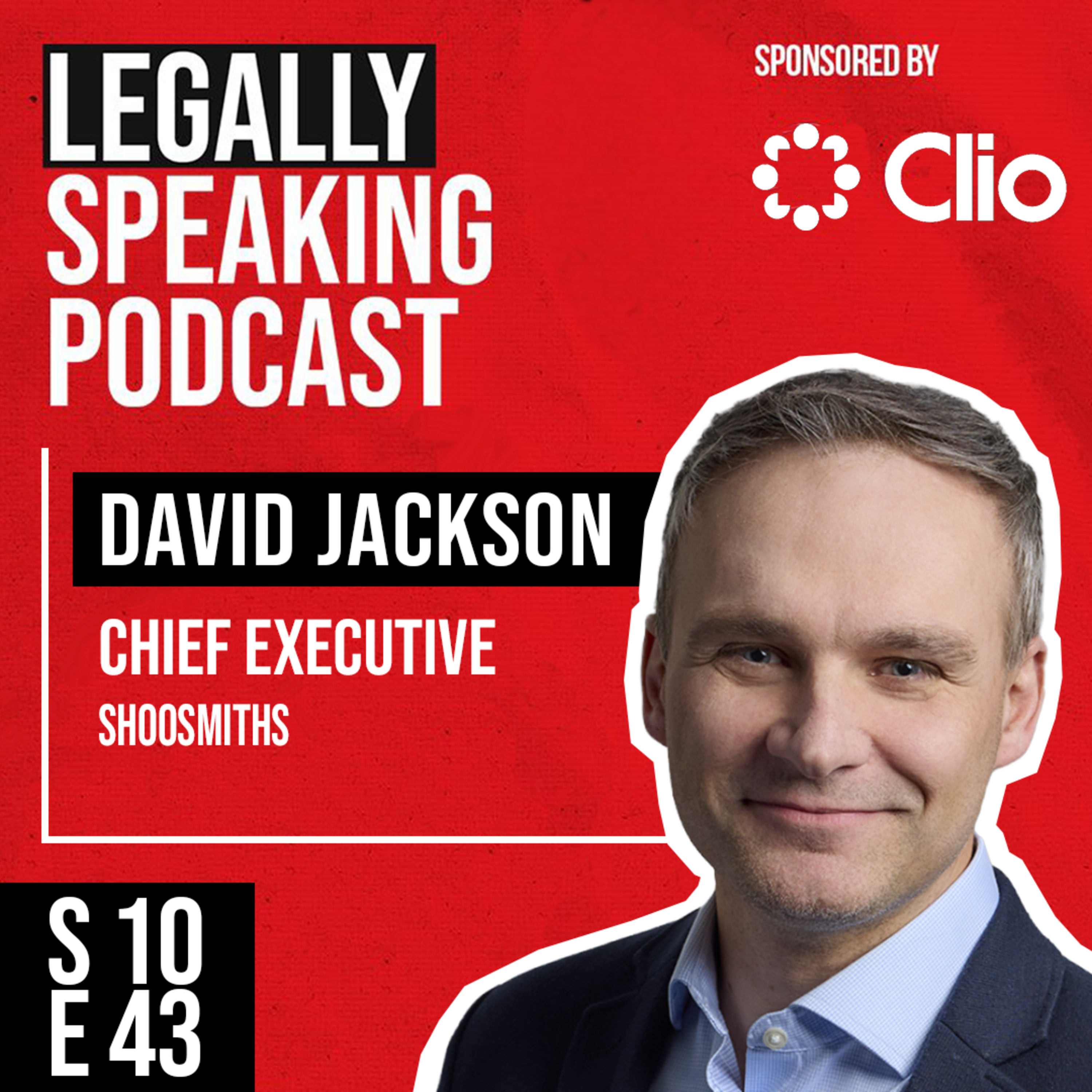
David Jackson (Shoosmiths CEO) discusses leading a modern UK law firm: client-based innovation, growth strategy (2030), culture and followership, international expansion, and how AI/tech is embedded responsibly. He contrasts CEO vs managing partner roles and explains Shoosmiths’ connected-services model (Shoosmith 8) and AI rollout, including internal incentives and a Copilot Studio agent that reduced lease-portfolio friction for real estate clients.
David Jackson is a commercial outsourcing and technology lawyer; joined Shoosmiths in 2006, led the national commercial group for over a decade, helped develop technology and launched Shoosmith 8, and became CEO in 2022. He previously trained at what is now Squire Patton Boggs and worked at DLA (including two years in-house in industry).
Leaders need followership; CEOs execute strategy and run day-to-day; structure should mirror client organization to reduce friction; Shoosmiths aims to be AI-enabled (not AI-native) while keeping human relationship-led legal advice.
London office growth to 300+ people (Bow Churchyard); 1 million prompts AI campaign; AI agent for lease break/rent review questions built with Microsoft Copilot Studio; Northampton Saints/Loughborough Lightning partnership tied to firm identity.
Written by AI. May contain mistakes.
Overview of David's career trajectory and leadership role at Shoesmiths.
“David is a commercial outsourcing and technology lawyer who joined Shoesmiths in 2006.”
David shares personal preferences and insights on legal technology.
“and how the role of a CEO differs from that of a managing partner and the strategy behind Shoesmith's transformation success.”
David recounts his upbringing and the steps that led him to a law career.
“I'm the youngest of four boys and my poor mother had four of us to contend with as we were growing up.”
David explains how he transitioned to Shoesmiths and the risks he took.
“So definitely get the empathy for your mum there as well.”
David discusses his transition from commercial lawyer to CEO and leadership lessons.
“So I will always be grateful to that partner, Fran, for giving me, I guess, the encouragement, but also the backing that if it didn't work out, there was a safety net there for me.”
David outlines the differences in responsibilities between a CEO and a managing partner.
“just so our listeners know where we sit.”
David describes the varied tasks and responsibilities he handles weekly as CEO.
“So my typical week involves talking to potential partners or teams that might want to come and join the firm.”
David discusses his role at Shoesmiths and the operational dynamics of the firm.
“spending time in those jurisdictions, meeting with people, exploring whether there are opportunities to join Shoesmiths.”
David explains the strategic changes made to align with client needs and market dynamics.
“And in terms of where am I based, predominantly in London, but because we're a national firm, I spend a lot of my time in many of our core locations across the country as well.”
David reflects on the journey of Shoesmiths and the importance of engaging partners in change.
“which is focused on our contentious capability and how we take that out to market.”
David outlines the significance of focusing on core locations while ensuring inclusivity across the firm.
“been really important as we've navigated these changes over the last few years and one of those changes is I guess redefining how we take our message to market from a geographic perspective.”
David discusses Shoesmiths' strategies for competing in the competitive London legal market.
“I know you've sort of touched on, but I want to focus on this because it's a bloody competitive dominated market.”
David explains Shoesmiths' growth strategy and how they aim to position themselves in the market.
“being able to recruit for the london office over the years as well i think that's so true you know the culture definitely is really consistent across the board.”
Learn how Shoesmith attracts top talent through a unique culture and growth opportunities.
“And you shared Shoesmith is focused on high quality work in creating an environment where talent and people can do the best work of their careers.”
Explore the defining elements of Shoesmith's culture and how it supports ambitious growth.
“I played a key part in helping the firm get from there to there.”
Discover how Shoesmith 8 provides innovative solutions alongside traditional legal services.
“So would you mind explaining how 8 works in practice?”
Understand the transformative effects of AI on legal professionals and their workflows.
“I mean, you can see the level of investments in legal technology, acquisitions, the super mergers that we're seeing, et cetera, et cetera, et cetera.”
Learn about Shoesmith's long-term vision incorporating technology while maintaining client relationships.
“And it was really, I was really proud that that then got the recognition that did from, you know, the highest parts of Microsoft.”
Learn about Shoesmiths' long-term vision and the role of technology in law.
“You know, you actually go out there, be proactive.”
Discover the importance of Shoesmiths' Northampton roots and community ties.
“with your clients, your colleagues, your mentors, stakeholders is going to be your superpower.”
Gain insights into essential skills for future law firm leaders.
“elite sports people at the top of their game.”
Explore thoughts on the evolving landscape of the legal profession.
“In 2026, I think it's a great development that kindness is a really important part of being successful now.”

Get the gist, explore an idea or ask about something said.
 Claude
On Legally Speaking Podcast, what are the key points of this episode?
Searching your listeningAutomatic transcript. May contain errors.
0:00Excellence can come from unusual places. Leaders are only leaders so long as they have followership. And I think that's really important in a law firm context, particularly a partnership, where other key stakeholders are in the business with you. So I only get to do my job if I can convince my partners and the broader Shoesmith community to head in the same direction. That's been really important as we've navigated these changes over the last few years. One of the key responsibilities, I believe, of any leader in a current leadership role is to equip your workforce with the tools that they will need to thrive in this new world.
0:35On today's Legally Speaking podcast sponsored by Clio, I'm delighted to be joined by David Jackson. David is a commercial outsourcing and technology lawyer who joined Shoesmiths in 2006. Leading Shoesmith's national commercial group for more than a decade, he helped the firm develop its technology and launched its connected services business Shoesmith 8. David took on the role of chief executive in 2022. Under David's leadership, Shoesmith has continued investing in people, technology and infrastructure. The firm has experimented with new approaches to legal technology and AI, connected services and initiatives.
1:11Today, we'll explore David's journey from commercial lawyer to CEO and what it means to run a modern law firm and how the role of a CEO differs from that of a managing partner and the strategy behind Shoesmith's transformation success. So a very big warm welcome to the show, David. Thank you so much, Rob. It's great to be here. Thank you. Oh, it's an absolute pleasure to have you on the Legally Speaking podcast. A big fan of your work and all the great stuff that you're doing with the firm. But before we get into that, we've got a couple of serious icebreaker questions. Well, not so serious. Firstly, what's your favorite beverage and what's your preferred choice of footwear on a typical work day?
1:48I would say a nice Sauvignon Blanc is probably my favorite beverage. I assume you meant alcoholic beverage. Otherwise, either or. Okay, well, Diet Coke then in that case, if I'm being sensible. And preferred footwear, a pair of brown shoes maybe. Although mostly at the weekends, I'll be in a pair of Crocs in the garden probably. it's amazing how many people are saying crocs in the most recent episodes we've had they're definitely getting yeah i know absolutely um okay one piece of legal technology or everyday technology you now rely on that you would have thought unthinkable at the start of your career oh i am a big claude fanboy so uh claude is my favorite ai tool of choice at the moment but it does fluctuate um obviously when he came out that blew my mind um and uh i've used other products as well but claude is my favorite at the moment i find to be particularly creative for creative content yeah absolutely okay well thanks for those let's get into your uh your story david could you walk us through your journey from studying law to becoming a commercial lawyer and then joining scuse miss in 2006 and then ultimately becoming chief executive i guess it was a bit of an unusual route for me because I guess growing up in the 80s in Bristol in a working class family, really humble beginnings.
3:14I'm the youngest of four boys and my poor mother had four of us to contend with as we were growing up. But becoming a lawyer, whilst it was a dream, it wasn't really a realistic aspiration or at least so I thought. I was always the geek in the family so I loved school I was always kind of into into doing my school work and so I kind of stumbled through the academic process and found myself at university studying law so I'm not sure it's necessarily on the cards for me but because I always enjoyed school my parents were really encouraging of me to use that as a route to achieving something in life I trained at what is now squire pattern box but back in the day it was edging ellison a great firm in the in the midlands and then i moved on qualification to join what was then dib lupton also in 2000 and became dla really enjoyed my time there as a junior commercial lawyer had the privilege of working with some exceptional partners and then in 2004 i went in house for a couple of years which was really quite unusual for commercial lawyers taking that route with the intention of coming back to private practice i always felt that as a commercial lawyer in order to have credibility with clients you need to spend some time working in industry and so i spent two years working in house i love my time in house a huge amount particularly for how private practice lawyers should work with in-house counsel and I used that experience when I joined Shoesmiths in 2006 to develop I guess a practice around serving the in-house lawyer community and working with general counsel over the years to deliver services in a way that really made sense for them and that was kind of I guess the the foundations for the career that I've built and where I find myself today.
5:14Yeah and It's wonderful to hear. I'm one of three boys. So one light. So definitely get the empathy for your mum there as well. And, you know, you mentioned geeking out a little bit. You've spoken about coming from a background where you may not typically choose a route to become a lawyer. What inspired you to truly pursue a career in law? Was there a moment? Was there a thing, something you saw? so this will date myself but um listeners that remember la law back in the 80s i had uh i guess uh this image of what being a lawyer might be like which is completely not how it is in real life not least because those lawyers were based in los angeles and but it became the aspiration for a kid in the 80s growing up in bristol that you know I'd love to have that job and that lifestyle I think I was always quite argumentative as a child as well so I think teachers always assumed that putting those uh those skills to good use in a profession would would make sense for me absolutely they say play to your strengths right um so you mentioned obviously joining Shoesmiths in 2006 what did you see in the firm there then which made you want to build a career there great question so one of my colleagues and friends from DLA actually joined SheSmiths early in 2006, Alex Bishop, who's now the head of litigation at SheSmiths actually, and she'd recommended that I have a conversation with a few of the partners back at the end of 2005.
6:45And at that stage, I wasn't looking to move back into private practice from my in-house role. The opportunity came up more quickly than I was anticipating. And at that time, the firm had recently opened up in Birmingham, and they were looking to establish the full suite of practice areas and they needed a commercial person to come on board to kind of spearhead the commercial practice in Birmingham and I was only 30 at the time I was five and a half years qualified and and it was just too good an opportunity to to pass up I'll be ever grateful for them taking a chance on me at that stage in my career I had intended to go back to DLA actually.
7:25And I remember having a conversation with one of the partners at DLA kind of summing up this opportunity, a big opportunity, but also potentially a big risk for someone at my stage in my career. And I'll never forget that that partner was incredibly gracious. And they said, look, at your age, you know, how many people get the opportunity to go and set up a team? What's the worst that can happen? If it doesn't work out, there will always be a home for you here at DLA. And that gave me a safety net. But it also gave, you know, it gave me the opportunity to be a bit bolder in seizing that opportunity and really making the most of it.
8:06So I will always be grateful to that partner, Fran, for giving me, I guess, the encouragement, but also the backing that if it didn't work out, there was a safety net there for me. I love that. And we talk a lot around the show about having mentors and people around you that can inspire you, help you grow because, you know, the comfort zone is great, but nothing ever grows there. And taking that opportunity, like you say, sometimes you're only one opportunity away from changing your career. And clearly that was a great move for you. Want to talk now from the move from lawyer to CEO, because you spent many years as a commercial lawyer and led Shoesmith's commercial group before becoming CEO.
8:40What did the role of a commercial lawyer teach you about leadership? Being a commercial lawyer exposes you to lots of different types of scenarios and lots of different types of businesses. So it gives you a really good broad grounding for not just legal practice, but also operating a business because you get to work with clients across, you know, lots of different sectors, doing lots of different transactions, commercial deals. So it gives you a really good broad perspective. And I was always interested in the kind of operational, the practical side of how businesses operate. And in many respects, that's why I chose to be a commercial lawyer in the first place because it kept options open to maybe go and work in business as I did as an in-house counsel but maybe more broadly as a commercial director doing doing deals for example so I think that that broad contractual and commercial experience was was really useful in understanding how businesses operate and then I guess as a as a outsourcing and technology specialist, I could see where the world was moving in terms of emerging technology and the impact it was having on legal practice.
9:55And I felt that I had something quite unique to offer in terms of a bigger leadership role, taking that commercial experience that I've gained over many years of working with clients and building up my, I guess, my commercial expertise but also marrying that with my passion for technology emerging technology and looking at how you could deploy that technology in the delivery of legal services and so it kind of made a natural choice for me personally I was very lucky that I was kind of in the right place at the right time with that skill set because it feels like being a law firm leader in this moment in time it matches my experience gained over many years so as with many things in in our careers you know timing is really critical and you need lots of lots of luck as well along the way so it's kind of all come together for me at the right time yeah absolutely and I also think you make your luck as well you've worked exceptionally hard and I love there's a lesson in there that you were sharing as well which I hope our listeners picked up the self-belief you know to back yourself actually and the confidence to take these opportunities and to sort of rise to the challenges I think is a really good career lesson for people tuning in.
11:08We have people tuning in from all aspects of law and people entering the profession so more of just a practical sense now just so our listeners know where we sit. How would you describe the difference between a CEO and managing partner of a law firm and how do the responsibilities differ? Shoesmith changed its corporate structure back in the early 2000s and moved away from the traditional managing partner, senior partner roles to a CEO and a chair to mirror the structures of our clients. And I think my role as chief executive is probably broader than a managing partner role, but it's similar in many respects.
11:51my job is to look after the day-to-day running of the firm and to execute the firm's strategy. So working with the chair who has an oversight and governance role and making sure that the executive is kind of held to account. But my job is to deliver the firm's strategy. And it's quite a broad role as a chief executive because you get involved with everything. So my direct line reports are the chief finance officer and the chief operating officer and then we've got a whole business services function around that with lots of directors and functional leads but then also i'm very active on the legal services side so three of three divisional heads also report into me and and i'm responsible for the financial performance of the the divisions as well so a broad role um but it's a you know it's a it's a privilege to to have this role and it's um it's challenging but it's it's massively rewarding you know it gives me um access to colleagues across the entire breadth of our firm um as well as client side as well so i still you know i'm active with working with clients and and listening to our clients about how we can evolve our service to make sure that we remain relevant as the kind of the legal world changes and changes rapidly of course as well the way we sit today you mentioned obviously in charge of the day today i probably can't ask you what does a typical day look like because it'll be too varied but maybe just a week in your life what does that look like again so people can picture the image of what these ceos are getting up to within a law firm walk us through that yeah so um it is really varied and that's partly why i love the role actually it's it's impossible to get bored in in these roles So we have a really ambitious growth agenda at Shoesmith at the moment.
13:43So my typical week involves talking to potential partners or teams that might want to come and join the firm. We've been very open about the next phase in our firm's growth is about internationalizing our platform. So I'm spending a fair bit of time talking with partners in overseas territories across Europe, spending time in those jurisdictions, meeting with people, exploring whether there are opportunities to join Shoesmiths. I also spend time with my divisional heads, understanding what the pressures are that they are facing and that our partners and lawyers are facing in terms of the market dynamics.
14:27and then also on the kind of operational side making sure that the operations are running smoothly and that varies from week to week so at the moment my this week my CFO is retiring after 20 years amazing loyal service so I've been quite busy working with the interim CFO that we've got on board to make sure that she understands the kind of priorities of the business and I'm kind of supporting her to get up to speed with everything. But it's a really varied role. And in terms of where am I based, predominantly in London, but because we're a national firm, I spend a lot of my time in many of our core locations across the country as well.
15:13So, yeah, no two days are the same, no two weeks are the same. My wife's often asked me, you know, what are you up to this week? and unless I've got my nose in my diary, I really couldn't tell you. I kind of look the night before where I'm supposed to be the next day, turn up with a smile on my face and just get on with it. Oh, you're preaching to me there. That's exactly how I feel in certain weeks as well. But it's incredible what you're doing. And I love the passion in your voice and the energy and the excitement you have for internationalizing and clearly the ambition. I mean, I've followed Shoesmith's journey for many years and it's incredible, the growth and some of the people you've been able to acquire and some of the innovations that you've brought.
15:52You touched on before, but again, just to give our listeners a little bit more clarity around the strategic commercial thinking, you mentioned you changed the model to reflect more of your clients. Would you just take us through were there any challenges, objections from people wanting to keep more of a traditional model? And if you were to do it again, how would you think about doing it if you were a law firm who was potentially considering doing it? It predates my time as CEO. So the visionaries back in the early 2000s thought that it made sense for our law firm to mirror the structures and the way in which our clients are organized so that there's less friction when clients are using us.
16:31And that's a structure that served us well over many years now. And so it's just ingrained in how we operate. um interestingly as of the first we've made some um some further structural changes um just this week so on the 1st of october we we realigned our divisional structure so so historically we had a corporate real estate and an advisory services division and within the advisory services division that included um several of our specialist areas including my old team the commercial group our litigation capability, employment and pensions. And that was established over a decade ago now. And that structure served us well.
17:14One of the things I'm keen to do is to put people together who can collaborate more effectively around client need. And so we've just moved our commercial colleagues into an enlarged transactions division to work alongside our corporate colleagues because we think there's greater potential for collaboration amongst those people when it comes to serving our clients. And it's also enabled us to have a much sharper focused litigation and risk division, which is focused on our contentious capability and how we take that out to market. So we're always looking at refining the platform and making sure it's fit for purpose, that it's reflective of how clients need to access the firm.
18:01It also takes account of how the market is evolving. Obviously, we've been on quite the journey over the last four years in terms of, I guess, redefining what Shoesmith wants to be famous for in the market. And that's involved divesting ourselves of several areas that aren't necessarily core to our 2030 strategy. So it's, you know, it's an ongoing thing that we need to keep just just just sense checking. Are we structured to, I guess, capitalise on the opportunity that exists in the marketplace and crucially how our clients need to access our expertise and services across the broad range of services that we offer?
18:46And that was the key point I was picking up there, how exceptionally client centred you are. And, you know, clearly that's a testament to the success that you've been having. And look, nothing changes if nothing changes in business. And, you know, we have to evolve with the markets and the rate of change that's happening. And I love that you talk about two things that we talk about all the time. My listeners will be sick and tired of me saying it. But one is the friction piece. You know, you want fusion rather than confusion. The more you can remove that friction and meet your clients where they're at, the better the experience, the better the trust levels, all of the good stuff.
19:14And then collaboration is domination. I love that you talked about the importance of that. I think it's so, so important. And you touched on some huge milestones. Obviously, you mentioned the 1st of October. but I want to kind of give you a reflective chance now on milestones, because moving from perhaps regional to national, and like you say, what you want Shoesmiths to be famous for, you know, you develop very strong regional roots and now into sort of a national firm. Would you mind sharing some of the key milestones that you're most proud of and the firm's perhaps most proud of as part of that journey?
19:40Whenever you embark on a change programme, it's not without its challenges, because the most important thing, of course, is to take your people with you on that journey. leaders are only leaders so long as they have followership and and I think that's really important in a law firm context particularly a partnership where other key stakeholders are in the business with you so I only get to do my job if I can convince my partners and the broader shoestomist community that you know they want to head in the same direction and so that's that's been really important as we've navigated these changes over the last few years and one of those changes is I guess redefining how we take our message to market from a geographic perspective.
20:22We have lots of offices around the UK but what we've done in recent years is really concentrate our investment around the core economic centres across the UK. So we talk about core offices in Edinburgh, Leeds, Manchester, Birmingham and London but we also have amazing people in other locations throughout the UK. And it's really important that when they hear me talk about the core locations and those large economic centres, that they don't feel as though we're somehow leaving them behind. They are absolutely a crucial part of the Shoesmith story and the amazing service that we deliver for our clients.
21:00But I'm also conscious that we need to try to simplify the message going out into the market about what Shoesmith is about. And so, yeah, We have lots of brilliant people across the UK and in Scotland, in Northern Ireland and in Brussels. But sometimes when you present a version of the firm to the external market, you have to simplify the message somewhat. But as I say, it's really important that people that aren't in those core locations don't feel as though somehow they're not equally as important as those that are. Absolutely. You've got to take them on the journey. as you say, we is greater than me.
21:38And I absolutely agree with just simplifying things. I think sometimes it's so much better to be clear than it is to be overly clever. I think if you can get real clarity, because ultimately, if you confuse these people, you're going to lose them. So really key points. Okay, I want to talk about London now. I know you've sort of touched on, but I want to focus on this because it's a bloody competitive dominated market. You know, it's not easy to cut through. And you know, you've come from regional offices, you've made a real investment into the London market doing well. How do you compete? How are you winning market share?
22:07What are some of the strategies and tactics that have worked well for you? Yeah, great question. So we've always competed in London, even though we haven't necessarily always had an office in London. So one of the things I think the firm's been successful at is attracting London work, but then servicing it from our regional locations. And that's enabled us to provide clients with a really great service, but very cost effectively. we opened up in London in a really small way probably about 10 years ago and have grown it I guess in a material way over the last five years in fact we opened our London office during Covid we had the fit out happening all throughout Covid but now that we we have amazing offices in Bow Churchyard in just off Cheatside and we've got a really thriving community there over 300 people so it's our largest single location now it used to be Birmingham which was just under 300 but London has has quickly grown because I think we're able to offer something slightly different in that market from a cultural perspective in terms of the kind of firm that we are but I'm really proud of our London office because when you walk around it and the vibe of the London office is exactly the same as the vibe of any of our Shoesmiths offices and I think one of the reasons that we were probably a bit slower to open up in London was because there was a nervousness about what that might do to our culture and what we've seen happen in some competitive firms.
23:34But I'm really pleased to say that, you know, the, as I say, the culture and the atmosphere in London is exactly the same as you'll find in any of our shoes and his locations. And I think it's really important that we continue to ensure that that's the case. Today's episode is brought to you by Clio. If you're spending more time managing your practice than practicing law, it's time for a change. Clio is the intelligent legal work platform built for modern solicitors, combining context aware AI with trusted legal research to help you work smarter, not harder. Switching is easier than you might think.
24:10Clio's dedicated migration teams handle your client and case data every step of way so you can focus on what matters most your clients plus award-winning support 24 5 via live chat phone and email means help is always on hand when you need it visit clio.com forward slash uk to find out why thousands of uk solicitors trust clio now back to the show having had the honor of being able to recruit for the london office over the years as well i think that's so true you know the culture definitely is really consistent across the board. And I think, like you say, it's really hard to sometimes get that right and certain firms maybe get that wrong.
24:50And it's great to see that Shoesmiths is invested in that. I want to stick with growth now because your strategy is on becoming, obviously, a leading upper mid-market firm in various selected markets. So how do you make the decision about where Shoesmiths should grow next and what are some of the factors you should be taking into consideration? Yeah, so one of the things that I looked at in the run-up to becoming CEO in 2022, Someone had recommended a book by Jim Collins called Good to Great. So I would definitely recommend that book to any of your listeners that haven't read it. I mean, it is, you know, it's a classic and it's interesting.
25:23So I took a holiday just before starting the CEO role in 2022. And I was sat around the pool reading this book, again, geeking out. But I had several people just come up to me around the pool and say, that's an amazing book. So it is a great book. But it's a blueprint for how companies can follow a really clear strategy. And so that was massively influential for me in developing the Shoesmith strategy around clarity of focus and really understanding where the firm can be successful and where we should play to win. And one of the things about that book is, you know, you have to be honest with yourself about your capabilities and where you can play to win.
26:08And so when we established our strategy in 2022, I deliberately chose 2030 as the reference point for where we should set our goals, because that enabled us to be more ambitious than we might have been if we were just looking at a three or four year strategy. So there has to be credibility to the vision that you set for your people. and so part of the the journey that we've been on around divesting of the non-core areas and saying that we're really doubling down on corporate real estate litigation those are the major engines of shoesmiths and then having clarity around our five core sector focus areas that's where we are concentrating our investment and in terms of that upper mid-market space it's quite difficult to define but but effectively it's the premium mid-market that we're chasing and we want to be a leader in that space you know excellent quality firms known for delivering legal excellence but at a price point that maybe is is just below the elite global firms and and that's where we're pitching ourselves we also think that by marrying the latest technologies around AI with our service provision actually that is a sweet spot for for where shoesterness can um really excel and where our people can really excel for our clients we'll obviously talk about tech and ai in a bit we can't get away from it um on every episode now it's the world that we live in i also love the book um good to great and i also heard um you know jack newton who's ceo of cleo who who you know they sponsor our show talked about that and you know the importance of the flywheel and the momentum and the energy inputs and the more that you can put into the flywheel you know that more momentum and compounds and actually you get better and better and better and better.
27:51So I'd absolutely recommend anyone listening to go and check out that book. If you're thinking about building a business, you're stuck or you want to take to a new level, I think it's a great resource. I couldn't agree more. I want to double down now on a talent attraction specifically because earlier this year, Shoesmith announced the promotion of nine new partners reinforcing the firm's continued investment in exceptional talent and its focus on delivering high quality complex work for clients. And you shared Shoesmith is focused on high quality work in creating an environment where talent and people can do the best work of their careers.
28:22So what does Shoesmith specifically offer lawyers and staff to attract and retain the best talent in a very competitive market? Yeah, it's a really competitive market actually. And the default answer would be around culture, but I am really conscious that every law firm nowadays holds itself out as having a strong culture and a great culture. And I'm sure that's the case. So culture, of course, is critical, but I'm not sure it's the differentiator that maybe it was 10 years ago, because I think law firm leaders understand that in order to attract the best talent, you've got to provide a culture where people can thrive and they can be their authentic selves.
29:06So that is obviously an important part of who we are and what we celebrate at Shoesmiths. But I think specifically what we can offer people is an active seat in growing and building something. I think there aren't too many law firms at our stage of development where people can genuinely come on board and making a meaningful contribution to the growth and development of our practice and where we're trying to get to. We've set ourselves a really ambitious 2030 strategy and we'll only deliver it by having really great, motivated, exceptional people to help get us there. And so that's the thing that we can offer that maybe some other firms can't.
29:50It's if you come to Shoesmiths, you'll get access to brilliant quality work, amazing clients, fantastic colleagues, but you're building and shaping something that you can look back on in 10, 15, 20 years and think, Do you know what? I played a key part in helping the firm get from there to there. And that's been the thing that attracted me to this firm 20 years ago. And it continues to be the thing that attracts people to the firm today. Every Friday is normally the first Friday of the month, but it's been a bit busy over the last few weeks. I have a virtual coffee with new partners that have started.
30:28and I had two of them today, one with a tech and AI specialist in our London office and another with a real estate partner in Leeds and both of them talk about being attracted to Shoesmith because they want to come and build something and be a part of building something and feeling as though that they are not a small cog in a massive wheel but actually their contribution makes a meaningful difference. So that's the differentiator, I think. If you want to come and join a firm where you can actually move the dial, this is the firm to join. Yeah, we talk a lot about amplifying your impact. And I think that's a great example of that, where, you know, not just a lawyer, you know, you have, and I think also the firms and companies of the world that have a clear mission, and people can understand what that impact and how that directly affects the mission that you will buy in through the values and goals that you set.
31:16I think that ultimately creates high performance. You touched on culture. I want to give you a chance to maybe brag a little bit about the culture, because, you How do you preserve culture and the identity that Shoesmith has been very successful at over the years, whilst obviously having very ambitious growth plans and continue to grow? Yeah, look, I'm smiling because I'm so proud of our people. You know, we do have just the most amazing people within the firm, really down to earth people. They're excellent at what they do, but they don't brag about it. You know, there is a quiet confidence to my colleagues at Shoesmith.
31:52and they're all super ambitious and really hardworking. But, you know, they've got great personalities, you know, and as I say, they don't take themselves too seriously. And it's, you know, it is a privilege to lead such an amazing bunch of people. And, you know, I quite often talk about the difference that we make or that our people can make and help deliver towards our strategy. The kind of the things that would otherwise go unnoticed, that because people do the unexpected things, it takes our service from expected to exceptional. There are so many examples of this across the business in every role.
32:33And so the challenge I often give our people is, you know, just think about how you could do something. And if you didn't do it, nobody would notice because nobody was expecting it. But the fact that you do it makes all the difference. and there are a million little examples of where people do that and they really take that to heart and you know it's it's you know quite often I move to tears genuinely because I hear some of these stories and it's not the corporate stuff it's the personal stuff where they've gone out of their way to do something special either for each other or for for our clients in a particularly challenging situation so yeah I couldn't be proud of of the people that we have in our firm and I love that I think it comes down to also just being a good human right little touches big impact my late grandfather ran a successful law firm built off his own right in the 1950s in Leicestershire and every morning I mean at the time he only had about 40 or 50 people in the office but he made it made an effort every morning to go and say good morning to everyone in the office from the cashier to the receptionist to his partners and lawyers and just having that sort of connection and that just making people seen heard and you know it's that little thing taking the time and I think that's irreplaceable and you talk about that culture instilled across the firm that's super powerful because it's a given you're a technically gifted lawyer there's a reason you're in the position but actually putting all these things together that creates a wonderful culture okay want to talk about tech and innovation now we'll talk about AI in a second as well but technology has been a significant part of your career my career pretty much everyone's career including obviously your work around Shoesmith 8 and connected legal services so So Shoesmith 8 is about being a trusted advisor who can triage any issue and assemble teams and solutions to order.
34:15So would you mind explaining how 8 works in practice? Yeah, so it's a connected service business. And I know that these were all their age about 10 years ago. And actually, during lockdown, the then CEO gave me and a few of my colleagues the challenge of setting up a similar service offering for Shoesmith. And that's what we did. So we established Shoes Miss 8. It's now run by an amazing guy called Tom Speller, who is a pocket rocket. He's got so much energy and enthusiasm for what we're building. But essentially, it's a bunch of ancillary services that sits alongside legal services. So it's not the delivery of legal practice, but it's stuff that's adjacent to it.
35:01So some good examples, we've got a product called Smart SAR for subject access requests. So we can take that headache off of our client's desk where they're dealing with multiple data subject access requests and put a system and a process around it to help our clients comply with their regulatory obligations. But do it in a way that's really cost effective and just takes that headache away from them. There's another one around AI comply. So as we're starting to see emerging AI regulatory requirements, we've joint ventured with a third party tech provider to go into our clients and audit their systems and protocols to see whether or not they are compliant with either existing or likely emerging regulatory requirements.
35:52so as you can see it's not necessarily law that's being delivered and in most cases it's not lawyers doing the work but it's adjacent to what we do at Shoesmith in terms of legal practice but at its core it's about identifying a problem or a headache of a client and then taking off their their hands and dealing with it in an effective way yeah and clients are lovely for it as well um okay I promise Let's talk about AI. We'll talk about AI in the future lawyer now because, you know, AI is rapidly changing the legal profession. I mean, you can see the level of investments in legal technology, acquisitions, the super mergers that we're seeing, et cetera, et cetera, et cetera.
36:32But how is AI affecting the way your lawyers are thinking and developing their skills? Yeah, I mean, it is absolutely the core of what we're what we're doing and what we will do. We have been playing with AI for a good 10 years now. So you'll remember that probably 10 years ago, AI started to emerge as the next big thing. But at that time, we refer to it as kind of analog AI. So it was rules-based decision tree AI, which was very effective. But actually, the kind of target market, so the client base was very skeptical about this technology. It wasn't really pervasive across society in a way that it is today.
37:09And so it took a long time to take off. We joint ventured with a company called Thought River to create a product called SEER, which is a contract review product. It's an excellent product. We learned a lot through that endeavor because trying to take it to market at a time when the market wasn't really ready for that product offering. But all of that changed, obviously, when ChatGPT first emerged and everybody had access to these tools on the telephones or whatever. And of course, generative AI is very different from the AI of 10 years ago. and we're just starting to understand the power and capability of that technology.
37:46But it will fundamentally change how everybody operates. And one of the key responsibilities, I believe, of any leader in a current leadership role is to equip your workforce with the tools that they will need to thrive in this new world. And because of my experience of having developed that product with colleagues at Shusen Miss 10 years ago, we were very quick off the mark to start implementing AI tools. So we were one of the first law firms in the world to try on Microsoft Copilot. We obviously were one of the first businesses to financially incentivize colleagues to engage with AI. Our£1 million for 1 million prompts campaign that we ran a year or two ago gained a lot of traction in the market.
38:36But that was all about getting colleagues excited about being curious. So we obviously had very clear frameworks around the early use of AI to make sure that we were using it responsibly. We always talked about using it in the business of law, but not in the practice of law. So not using generic AI tools to deliver legal advice. And obviously as products have become more sophisticated and legally tuned AI is available, then they can start using it in the delivery of legal advice. Be very, very careful in how we've rolled it out. But we've absolutely encouraged curiosity. I love hearing about the novel use cases that people at the coalface are finding for this technology.
39:23I mean, that's where true innovation comes from. It's not from me or anyone on the board. It's from colleagues at the coalface thinking, my goodness, there must be a better way of doing this or there must be an easier way of doing that. And then using technology in a creative way to deliver on that. And actually, last year, we ran a client excellence campaign and we challenged all of our people across the business to find new ways of really leveling up our services to clients. And we put some amazing prizes behind that on a quarterly basis. And the Star Prize was a choice between a brand new car to celebrate amazing automotive clients or£25 ,000 towards a new house to kind of honour our house builder clients.
40:10And the winning entry was from a colleague that had identified a particular challenge that our real estate colleagues had when working with corporate clients with multiple lease premises across the UK. And for this particular client, it's a high street retailer. And they probably got around 600 units across the country. and quite often the client would ask our colleagues questions around that lease portfolio. You know, when's the break date? What's the kind of rent review? And historically, that's been quite a manual process. And so this colleague, Joanne Bevan, created an AI agent using Microsoft Copilot Studio.
40:57Nobody had asked her to do it. She had identified that there was this friction in how we deliver for our clients. She created this agent for our lawyers. And then it meant that when the client was asking questions, the lawyers were able to interrogate the information and service it in a much more effective way. But we also then opened it up to the clients that they could have direct access to this agent and the information repository. And the client was just blown away. And so she won a brand new Volkswagen EV. And because we developed it in partnership with Microsoft, the UK and European CEO used it as a case study as part of his keynote at London Tech Week earlier this year.
41:40And so, you know, another brilliant example of one of our amazing colleagues taking it upon themselves to try to find a novel solution to a problem that was going to help not just her, not just our clients, but also our colleagues. And it was really, I was really proud that that then got the recognition that did from, you know, the highest parts of Microsoft. Proactivity pays. I think that's a great example of that. You know, you actually go out there, be proactive. Yeah, all the accolades truly well deserved. Okay, vision. What is your long-term vision as CEO for Shoesmiths? And how do you actually go about planning, achieving the goals that you've set out for the firm?
42:16Yeah, so our 2030 vision and I guess using technology in a novel way to deliver better and faster outcomes for our clients. We're not trying to create an AI native firm, but we do want to be AI enabled. but it's still grounded in human qualities. You know, I think AI will become a superpower that we use to deliver amazing results for our clients. But fundamentally, law is about relationships, that trusted advisor status. You know, I think as legal professionals, it's a real privilege that we have that relationship with our clients where they call upon us when they really need help. You know, when their back's in the corner, we want to be the people that they pick up the phone to so that we can help them through that process.
43:09And I think that is a really privileged position to be. So human skills are critical. I think at Shoes to Miss, we've always prided ourselves on the fact that we are good people, you know, down to earth people to do business with. And if you can marry that with the very latest technologies, you know, you are delivering something truly exceptional for your clients. So that in broad terms is the direction of travel. I guess from a granular perspective, you know, we're really excited about the next phase of growth for the firm in terms of internationalizing our practice, taking the amazing work that we do to our clients in other jurisdictions.
43:48And yeah, it's an exciting time to be at the firm. Yeah, you're doing incredible work. It has to be said. And I say it all the time. We're no longer in this B2B, B2C. it's that H to H, that human to human connection and those people skills and building that connection with your clients, your colleagues, your mentors, stakeholders is going to be your superpower. OK, a couple of reflective points now. Well, actually, there's one as a recent LinkedIn post that I saw, which obviously sparked our connections as well. Your partnership with Northampton States and Loughborough Lightning, being a Midlands person myself, although Leicester Tigers fan, admittedly, you highlighted the connection between Saints' Northampton route and Shoesmith's own history.
44:28So how important is the connection to the firm's identity as it continues to expand nationally? Yeah, this is a really interesting one because for a long time, I think we probably didn't have the confidence to shout about our Northampton roots. The legal market is super competitive. And when we're trying to establish ourselves in London, it probably isn't the most obvious thing to be talking about being founded in Northampton in 1845. One of our core values as firm as being ourselves and we really want our people to show up and be their authentic selves and not have to put on a mask or pretend to be someone that they're not um and actually that extends to uh corporate brand um we were founded in northampton in 1845 um we have an office in northampton staff of amazing people um i quite often call them the the kind of unsung heroes of the firm because it's many of our back office functions and so when this opportunity to work with Lightning and Saints came up I thought it was both a brilliant way of honoring my colleagues in Northampton because Saints is their team in particular but it was also a way of demonstrating that excellence can come from unusual places you know Saint and Lightning are elite rugby clubs elite sports people at the top of their game.
45:54And they're from Northampton and they're proud of it. So, yeah, for us, it was a great opportunity to honour that. And when we started out on this journey, I didn't know that William Shoesmith, who established the firm in 1845, two of his sons played for Northampton Saints in the 1880s. And the idea for the partnership came from an article in The Lawyer earlier this summer where it talked about the fact that London's most prolific dealmakers were born in Northampton. And there was that juxtaposition between the fact that our firm does more M &A transactions in London than any other law firm, and we're from Northampton, which probably isn't the most obvious place you'd think of the law firm coming from.
46:38So I love a headline. I love a story. And that story just wrote itself. And so it's a really new endeavor we we haven't kind of done a a sports partnership really before um but it's it's exciting and colleagues around the business are really excited for it so we are not now all of us passionate states and lightnings fans even though some of my colleagues may well support leicester tigers they're not allowed to say it in public well they're welcome in our community anytime but no i think it's a wonderful story like you say and i love like legacies and you know things like that that just shine through.
47:17Okay, some final advice now for listeners, watchers who want to become partners, managing partners, indeed CEOs of top law firms. What do you say are the top three skills you'd encourage them to think about developing early on in their careers? I'm a good example that anybody can do this if they put their mind to it. There was nothing special about me. As I said, I came from really humble roots. I was very fortunate to have people around me that supported me and backed me and gave me that encouragement. And so I try to pay that forward now with other people in terms of giving them that same safety net when they decide maybe they're going to leave Shoesmith and go and take an adventure somewhere else.
47:57You know, we always want to kind of part on really positive terms. So put yourself out there. Don't be afraid of failing. We all fail. You know, things don't always go according to plan. But it's important, building up that resilience and learning to cope with the failures and the knockbacks in life. Some of the best lessons that I've learned in life are from the losses and not from the win. And then just, I guess, kindness. In 2026, I think it's a great development that kindness is a really important part of being successful now. It sounds trite, but it is true. You know, just treating people with respect, kindness and ambition and not taking yourself too seriously and being prepared to fail and learn from it, then that will serve you pretty well in life, I think.
48:50I think it's really sage advice and I couldn't agree more. It's something I'm passionate about with a lot of the work that I'm trying to do with the show along with the team is to build a more kinder, connected, collaborative legal community and sort of perhaps remove some of the old perceptions that existed. because it's just going to help so many people. And I think when you're talking about the sort of getting on with it there, it brings to mind the Winston Churchill famous quote, isn't it, that I'll probably butcher, but it's something along the lines, success is not final, failure is not fatal, it's the courage to continue that counts.
49:21And I think that's so true, isn't it, in a lot of the world that we live today. I think if you can just keep going, good things will happen. Okay, if you can finish this sentence before we close, I've really enjoyed today's discussion. So complete this sentence for us. the future of the legal profession will belong to the firms that embrace the change could not agree more i'm really well said um david this has been a wonderful conversation really enjoyed uh listening to your own journey your ambition i can just hear the passion and the excitement for shoesmiths and the plans that you have moving forwards in your voice if our listeners want to follow you or indeed learn more about shoesmiths and the firm where can they find out more feel free to share any websites or any social media handles.
50:03We'll also share them with this episode for you too. Yeah, absolutely. So I'm on LinkedIn, so I always accept LinkedIn connections. So please do link in and check us out at shoesmith.com. It's a really exciting time at the firm. So if you want to learn more, please do get in touch. Absolutely. Just leads me to say thanks so much again, David. It's been an absolute pleasure having you on the show. And I think this conversation has given us real insight to what it means to lead a modern law firm as a CEO, the journey from a commercial lawyer to an established leader, and to transform Shoesmiths from its regional roots into a very growing, serious national and potentially international firm.
50:39It's about building a clear vision for the future. It's about understanding your clients. I think we've heard very closely about being client-centered, attracting, developing great talents, in addition to obviously creating the environment where your employees can thrive. And of course, we talked about embracing the importance of AI technology, recognizing the importance of those human skills. So from all of us here on the league's been podcast sponsored by cleo wishing you and everyone at shoes miss lots of continued success but for now david over and out thank you for listening to this week's episode if you like the content here why not check out our world leading content and collaboration of the legally speaking club over on discord go to our website www.legallyspeakingpodcast.com there's a link to join our community there over and out
On today’s Legally Speaking Podcast, sponsored by Clio, I’m delighted to be joined by David Jackson. David is a commercial, outsourcing and technology lawyer who joined Shoosmiths in 2006. Leading Shoosmiths’ national Commercial Group for more than a decade, he helped the firm develop its technology and launched its connected services business, Shoosmiths EIGHT. David took on the role of Chief Executive in 2022. Under David’s leadership, Shoosmiths has continued investing in people, technology and infrastructure. The firm has experimented with new approaches to legal technology and AI, connected services and initiatives.Today, we will explore David’s journey from commercial lawyer to CEO, what it means to run a modern law firm, how the role of a CEO differs from that of a Managing Partner, and the strategy behind Shoosmiths' transformation
So why should you be listening in?
You can hear Rob and David discussing:
- Leadership Being About Influence and Followership
- Building a Clear Strategy and Being Able to Make Difficult Decisions
- Embracing AI and Tech to Transform Legal Service Delivery
- Putting People, Culture and Clients at the Heart of Growth
- The Importance of Being Ambitious, Resilient and Kind.
Connect with David Jackson here - https://uk.linkedin.com/in/david-jackson-16ab9b8