
In short
Episode topic: How technology and AI can reshape legal practice and access to justice, with practical guidance from Clio’s Solutions Champion Damien Riehl (Damian Reel).
Guest background
Lawyer since 2002; represented Bernie Madoff victims; Best Buy commercial litigation; sued JP Morgan over mortgage-backed securities crisis (2008). Built legal AI tools since 2015 across Thompson Reuters (NDAs), Fastcase/Vlex/Clio. Did cybersecurity work investigating Cambridge Analytica for Facebook. Chair of Minnesota State Bar Association’s AI Committee; oversees an AI sandbox for underserved communities.
Key claims
92% of legal needs are unmet; 80% of certain court litigants are unrepresented. AI can reduce “drudgery” by handling research/thunking, but lawyers must validate cases/text to avoid ethical risk. Hallucination risk drops when tools retrieve actual case text from databases (not generated text). Access improves if legal information/advice is available beyond paywalls.
Notable examples
Neighbor fence dispute in Minnesota—AI surfaced additional causes of action (adverse possession, easement, and “boundary by mistaken line”) and produced a complaint in ~15 minutes. Minnesota AI sandbox aims to reduce unauthorized-practice prosecution for legal-aid use. AI alignment with human values via “law as if-then statements.”
Written by AI. May contain mistakes. Listen to the episode to check what was said.
Chapters
Tap a time to open that second in VOThe Impact of AI on Legal Systems
0:00 to 0:43
Exploration of the potential of AI in transforming access to legal information.
“The reality is this is happening whether we like it or not.”
Damien's Career Journey
1:17 to 2:20
Damien shares his diverse experiences in law and technology.
“It's an absolute pleasure to have you on the show.”
Inspiration to Pursue Law
2:20 to 3:38
Damien discusses the unusual events that inspired him to enter law.
“I worked for a big law firm where I represented Bernie Madoff victims.”
Memorable Cases and Experiences
3:38 to 5:55
Reflections on significant cases and their impact on Damien's career.
“what inspired you to pursue a career in the law initially?”
AI's Role in Reducing Legal Drudgery
5:55 to 8:15
Discussion on how AI can streamline legal processes and reduce repetitive tasks.
“and being able to say, you have options one, two, and three, and kind of guiding them through those options.”
The Importance of Quality Data
8:15 to 9:47
Damien emphasizes the significance of clean and reliable data in legal AI tools.
“down on data because, you know, it's well-bounded.”
The Role of Clio in Legal Technology
9:47 to 10:46
Insights into Damien's work at Clio and its impact on legal tech.
“And that hard work paid off when AI came in.”
Daily Life as a Solutions Champion
10:46 to 11:49
Damien shares what a typical day looks like in his role at Clio.
“And to your point around, you know, Clio generally, ClioCon this year was just incredible in terms of Jack Newton's keynote and just the level of sort of innovation that was pouring out from Clio.”
AI as a Tool for Enhanced Legal Practice
11:49 to 14:00
Discussion on how AI aids in legal practice and improves outcomes.
“But I think for those lawyers that get it, that I'm able to talk to, they're really excited about this because of that drudgery aspect we talked about earlier.”
AI's Role in Legal Efficiency
14:00 to 17:48
Learn how AI enhances legal processes and reduces costs for lawyers.
“You can have faster and better, but not cheaper.”
Show all 18 chapters
Ethics of AI in Law
17:48 to 23:08
Explore the ethical considerations of using AI in legal practice.
“But what are some of the ethical considerations lawyers should really be thinking about and aware of?”
AI and Access to Justice
24:02 to 28:00
Discover how AI can improve access to legal services for underserved communities.
“Incredible work that you're doing for good.”
Impact of TED Talk on Music Copyright Cases
28:00 to 29:05
Learn how a single TED Talk influenced copyright arguments in high-profile music cases.
“And before that TED Talk, every defendant in You Stole My Melody lawsuit cases lost.”
The Evolution of Copyright: Scarcity to Abundance
29:05 to 31:07
Discover how the nature of copyright is changing from a scarcity mindset to one of abundance.
“And then he was sued by the chiffons who sang, he's so fine.”
Aligning AI with Human Values
31:07 to 34:19
Explore the role of law and values in aligning AI development with societal needs.
“And so I think that's where copyright has to reckon with what are we going to give somebody a monopoly for?”
The Future of Justice and Accessibility
34:19 to 37:41
Understand how technological advancements can make legal systems more accessible to everyone.
“And I remember reading a little segue here from Jeff Bezos, obviously, of Amazon talking about in a constant world of change, let's think about things that might not change.”
Advice for Aspiring Lawyers in a Changing Landscape
37:41 to 40:06
Get insights on how to navigate the legal profession amidst evolving technologies.
“So I would say that, you know, what we're doing by providing access to justice at Clio is to be able to say, maybe we should give our democracy to everyone.”
Harnessing Neurodiversity as a Strength
40:06 to 40:57
Learn how neurodiversity, specifically ADHD, can be an advantage in the legal field.
“requirements, to be able to write the prompts, to be able to solve the problems.”
Transcript
Automatic transcript. May contain errors.0:00The reality is this is happening whether we like it or not. What if you were to take 100 countries worldwide and turn those cases, statutes, and regulations into symbolic AI if-then statements? I think that we societally can run quite better because then we could be able to have the answer as to if you build a fence up to somebody's house, then what are the results of those things? And then all of us can be clear as to what the societal OS really says. Ignorance of the law is no excuse. What's the excuse of hiding that law behind a paywall and not giving access? But that's the problem. 92 % of legal needs are unmet.
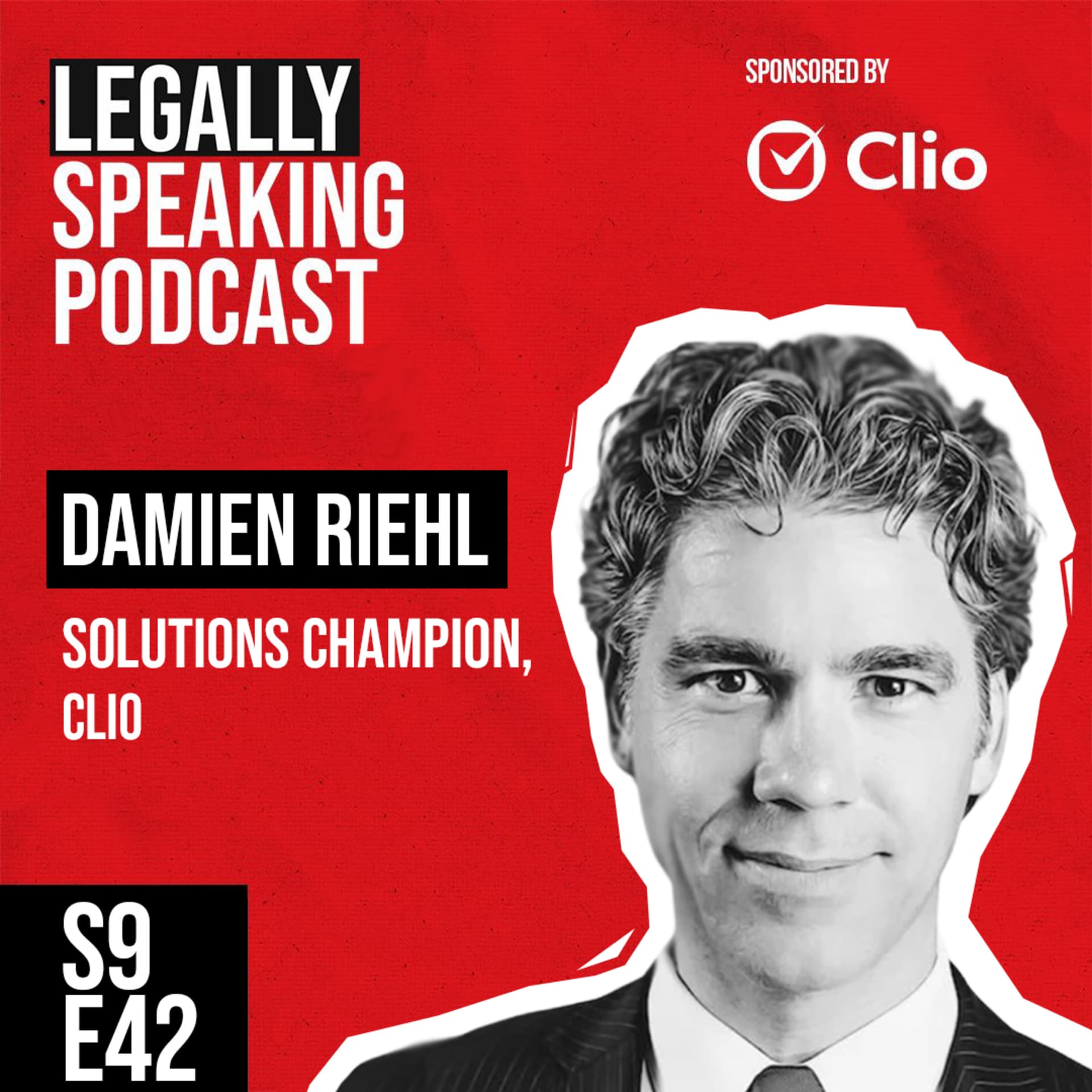
0:33The solution is to use this AI sandbox that we're doing in Minnesota, saying that if you're using AI to help that 92%, then maybe you will not be prosecuted for the unauthorized practice of law. On today's Legally Speaking podcast, I'm delighted to be joined by Damian Reel. Damian is a lawyer with experience in litigation, counseling businesses, handling cybersecurity crisis, and managing intellectual property matters. He has represented Fortune 500 companies, startups, and nonprofits. He is also the solutions champion at Clio. As a technologist, Damien has spent more than a decade designing and developing AI tools in the legal practice.
1:09His goal is to build technology connecting law to the people it serves. So, a very big warm welcome to the show, Damien. Thank you so much, Rob. Really good to see you. It's an absolute pleasure to have you on the show. Really looking forward to today's discussion. But before we get into it, I do have an icebreaker question or two for you. Firstly, what is your favorite beverage and what is your preferred choice of footwear on a typical work day? Those are great icebreaker questions. I would say that on preferred beverage. So I like to drink sparkling water and bubbly is my preferred brand of sparkling water.
1:42If you're pressing me on a flavor, I'd say cherry bubbly is my favorite beverage. So that's number one. And my footwear, I tend to wear something that is easily slip on and offable. I travel enough that I go through security, airblind security enough that I say, okay, if I need to take off my shoes, I want it to be easy. So on a typical workday, I'm having loafers. There we go. Bubbly, sparkling water and loafers. With that, we can move swiftly on. And I mean, it's a hell of a journey. When we were doing the research into this episode, this could be a five-hour long podcast, given the accomplishments and the amazing work that you've done over the years.
2:15But to begin with, could you give our listeners just a bit about your background and career journey? Sure. So I've been a lawyer since 2002. I worked for a big law firm where I represented Bernie Madoff victims. I also represented Best Buy and much of their commercial litigation and also helped sue JP Morgan over the mortgage-backed security crisis of 2008. So I did high stakes bet the company litigation, but I've also been a coder, I would say a terrible coder since 1985. So anyone who works with me says I can't code with my salt. But these days with vibe coding, it's quite easy to code. So I've always had technology and law as part of my practice.
2:46And so in 2015, I pitched Thompson Reuters. I said, here's legal tech that can change the world. I think you should build it and hire me. And they were dumb enough to help build and hire me. So anyway, I worked with a bunch of people on a cool thing there. And then I went on to do cybersecurity, where the biggest thing I did there was that Facebook hired me and my company to investigate Cambridge Analytica. So I spent a year of my life on Facebook's campus with Facebook's data scientists and my former FBI, CIA, NSA people. And we figured out how bad guys use Facebook data. Did that for a while until I figured out that maybe traveling to the Valley isn't quite as much fun as it should be.
3:16And then I talked to Ed Walters, who was leading a fast case. and I said, Ed, you've got a massive data set. You've got cases, statutes, and regulations. I said, let's do some really cool things with it. So since July of 2019, I've been with Fastcase, which turned into Vlex, which recently turned to Clio. Absolutely. And I told you, listeners, there was a lot there to unpack. Highly, highly impressive. Just going back towards the early stage, what inspired you to pursue a career in the law initially? Because you studied music, I think, at North Dakota State University. So yeah, where did that inspiration for law come from?
3:48You've done your research. Yeah. So I was doing a choir conductor, at least I was going to be a choir conductor. And so I was conducting a Brahms piece as a student teaching, and two of my tenors started punching each other in the face. And I thought, oh, maybe I should go to law school. So the joke is that I broke up a fistfight in a classroom so I could create fistfights in the courtroom. And so, yeah. But I thought, so between that fistfight, I worked for the federal courts, where I worked for the clerk's office for the U.S. Bankruptcy Court. And I got to know a lot of the clerks who had just graduated from Harvard and Yale and those kinds of places.
4:19And I thought, gosh, they're not that smart. And so maybe I could go to law school too. So that's ultimately what I did. Yeah. And rightly so. Everything you've done seems to touch the gold ever since. You touched on before some of the cases that you've worked on. I mean, it's incredible. You've litigated council businesses, handled some of those cybersecurity crises, represented Fortune 500 companies, and on and on and on. What have been some of the most memorable cases, perhaps maybe less in the publicly available that you've worked on that have really helped shape you commercially, not just as a lawyer, but as a general business person as well?
4:52I would say that the most important aspects of my litigation experience were that it had a lot of drudgery. That is, you know, you think of, you know, you watch legal dramas and you think, gosh, I want to be able to catch that person in a lie while they're on the stand, or I want to be able to make that pivotal argument that makes the other side say, oh no, I lose, right? So that's really what the zeitgeist is with law, but really the reality is mostly just saying, you know, I'm just going to look at a screen and look at an email from somebody saying, I'm not going to give you my documents. And then I'm going to say, no, you're going to give me your documents, right?
5:23And fighting over that for a while. So really the drama of legal dramas really is really betrayed by the drudgery of a lot of litigation, which I was a litigator and advisory. So I would say that really with AI right now, we have an opportunity to get rid of that drudgery. So my friend Casey Flaherty says, we as lawyers do a lot of thinking, but we do a lot of thunking. That is a lot of drudgery. And AI can maybe do a lot of that thunking for us. So I would say that there were really amazing aspects of my career, where is advising clients and being able to say, you have options one, two, and three, and kind of guiding them through those options.
6:03Those were my favorite parts of litigating. And maybe with AI doing a lot of the drudgery, we could be able to maybe enhance and be able to do more of the thinking and a lot of the high level advising. Yeah. So let's get into that because I'm a big advocate for AI. You and I both sort of, you know, tech for good and, you know, removing friction and providing more fusion rather than confusion with technology. So as a technologist, you've spent more than a decade designing, developing AI tools, particularly within legal practice. Can you tell our audience about some of the AI tools you've been involved with building and which you're most proud of?
6:34Sure. So yeah, since 2015, I've been building. And so I can't talk much about the stuff I was doing at Thompson Reuters because of NDAs and that kind of thing. But I can say that while we were at Fastcase, while I was at Fastcase, Fastcase turned VLex turned Clio, we've built some quite remarkable things. And the reason we've been able to build those things is because we have the data. We have the cases, we have the statutes, and we have the regulations. And if you have those things, if you think about almost all of legal advice is applying your client's facts to the law. to those cases, statutes and regulations.
7:06So if you don't have the law, really just have facts, right? And any AI model can be able to analyze facts, but not every AI model has yesterday's case and yesterday's statute. So the things that we've been able to build have really taken advantage of those cases, statutes and regulations. That is to be able to, in Fastcase, we have several patents, had several patents on being able to visualize what the law looks like and who's been citing whom and which cases are the most authoritative. And then moving on to Vilex, they for 25 years had been creating even cooler visualizations and doing it not just in the United States, but in 100 countries worldwide.
7:41So being able to ask now, when comparative law comes into the fray with AI, now we could be able to say, tell me about the privacy regulations for online advertising in all 50 states in the US and in the UK and in the European Union and in Spain or France or Italy or Latin America, Mexico or Brazil and Hong Kong and Singapore, right? So to be able to do these multi-country jurisdictions, you need that data. So being able to use AI to be able to parse data that, to be frank, nobody else has, it's been a great joy. Yeah, absolutely. And I want to double down on data because, you know, it's well-bounded.
8:18People say it's the new gold, et cetera, et cetera. how do you know good data is good data what what should you go by for people that maybe are looking to acquire businesses or think about that to to get data what are some of the things you would highly recommend doing your due diligence so you're right that data is oil and you have private oil and you have public oil uh the private oil is what's you know the settlement agreements and contracts but then there's public oil cases statutes and regulations and i say public in quotation marks because they're really often not that public uh that is it's really hard to get all the cases.
8:49It's really hard to get all the statutes. It's really hard to get all the regulations because a lot of courts actually, even though it's quote unquote public, they make it very hard to get because they see people that are pulling that data as quote unquote data brokers. So they fight every tooth and nail to be able to keep people from acquiring it. So not only is it hard to acquire the cases, the statutes and the regulations, but often that data is quite dirty. That is, there are line breaks where there shouldn't be line breaks. And there are headers and footers at the bottom that you have to strip out to be able to get rid of those things, to make clean data.
9:22So I would say anyone to your question, anyone who's thinking about the quality of the data they're receiving, whether it's public data or private data, cleaning that data, you know, when I was at Facebook, the data scientists would say cleaning is about 80 to 90 % of my work. And then the fun part is the 10 % of the work. So, so, you know, VLEX and before that FAST case had been cleaning that cases, statutes, and regulatory corpus for 25 years. And that hard work paid off when AI came in. Yeah, absolutely. And now it's, you know, it's a superpower, isn't it? When you bring the two together. Very, very exciting.
9:56And that probably leads quite nicely on to Clio, because, you know, you are a solutions champion at Clio. What is your role in Hattel? Tell us a bit about it. As a solutions champion, like we get to, at Clio, do something I think has never been done before in the history of legal tech, which is connect the business of law with the substantive law. And that is to be able to say, if you bring in a new matter, we could be able to say, here are the cases, the statutes, the regulations that relate to this matter. And maybe here are some new complaints that relate to your matter. And here are some motions that have won before your judge.
10:26And to be able to connect that business of law that is making money with the law and bringing in new business with the substantive law, with the practice of law, those two things, bringing them together. It's quite extraordinary in that I don't think it's ever been done in the history of legal tech. And I think we have a chance to do it. You absolutely have a chance to do it. And that's why we're big supporters of Clio, obviously support the show. And, you know, I think it's just pioneering. And to your point around, you know, Clio generally, ClioCon this year was just incredible in terms of Jack Newton's keynote and just the level of sort of innovation that was pouring out from Clio.
10:59So for you, no two days the same? Typical day? Could you talk us through what that looks like? Well, my typical day is on the road. So last year, I think I was on the road 200 days out of the 365. So I was on the road a lot. And I think that there's an aspect of the, we are right now in a moment with AI and that everyone knows that everything we as lawyers do is built on words. That is, we ingest words, analyze words, and output words. And it turns out that AI does all three of those things at superhuman speed and a postgraduate level. So the typical day for me is going to the four corners of the earth, spreading the gospel of things are changing.
11:37And, you know, this is my friend Casey says that this is happening and it's either happening to you or it's happening by you. So my typical day is going to the four corners of the earth, saying to lawyers, this is happening. You need to be able to adapt or not adapt and your competitors will be in your lunch. But I think for those lawyers that get it, that I'm able to talk to, they're really excited about this because of that drudgery aspect we talked about earlier. We can get rid of that drudgery. Yeah. And, you know, we talk a lot about, you know, career enhancement on the show as well. There's a big play here by removing that drudgery for, you know, things that you may historically have missed.
12:13You know, being a lawyer in high pressure environments or going through paperwork that you may have to forego. And actually, tech for good could get that back. There's some moments you might be able to buy back time, which is the one thing none of us, you know, we all want to try and get more time, right, to do things that we want to do. So, yeah, we're big advocates for that. Okay. And really, and I want to, you just said something that you, AI catches things that you would have missed. And I really want to focus on that, that, you know, in data science, you talk about precision. Did it get it right?
12:39And then recall. Did you get all the things that you wanted to get? And I think the recall aspect is something people often forget. They often focus on the precision saying, was there hallucinations? but did it get all those cases that you needed to get and did it get all the statutes that are necessary a short anecdote that might be interesting to your users is my next door neighbor right over here uh they what they did uh is that they um they were going to build a fence uh literally right up against my house uh within within an initiative my house uh and so i used vincent to be able to say what are the potential causes of action uh and uh and it turns out that i've been walking that place for 15 years so i have an adverse possession claim i also have an easement claim.
13:15But what it caught that I wouldn't, after 15 years of litigation known, there's an aspect, a cause of action in Minnesota called boundary by mistaken line or something like that. So this is a cause of action that I wouldn't have pleaded had I been just using my brain. But AI actually gave me this extra cause of action. And then within 15 minutes, I had a complaint that had all the causes of action. And I said to my neighbor, like, listen, let's talk about a reasonable place to put this fence. Otherwise, this complaint is going to be on your front door. So anyway, so this is a way that we can be able to enhance and not just do things faster.
13:52People talk a lot about faster, but do it better. Get more causes of action. So doing the faster, better. There's an old joke that faster, better, cheaper, pick two, because you can't have all three, right? You can have faster and better, but not cheaper. You can have cheaper and faster, but not better. But really, AI maybe gives us all three. It gives us cheaper, faster, and better because it gave me that cause of action I wouldn't have known of before. I love that insight. And thank you for sharing that and giving a real practical example. And I think, you know, I heard from someone, I forget who it was speaking the other week about there's still the debate, isn't it?
14:23Human versus AI. And he said, let's stop having that discussion about AI replacing humans, whether it won't it, whatever. And actually talk about AI being more useful, you know, in certain parts, you know, AI can be a lot more useful. And you've given a great example there where things were missed, but the usefulness of that piece of technology has outperformed that particular, you know, where the human mind is. And so, you know, actually see this as a tool that can really help you sharpen your axe 10x. Yeah, that's right. Steve Jobs said that, you know, at its best, technology is a bicycle for the mind.
14:52And I would say that AI is not just a bicycle, but it's a motorcycle that is giving you even faster, better, stronger insights. Yeah, absolutely. And look, we're tech for good on the show. And I think it's great, all the things that are out there, you know, with due diligence, but the opportunities here are huge. But with opportunities, obviously, are threats. And so many see AI-generated content as a threat. So you see it as an opportunity. What's the biggest misconception about AI in the legal profession today? I would say that the headline-grabbing aspects are lawyers cited hallucinated cases.
15:27So that is, of course, the biggest thing. So generated AI, a lot of lawyers say, I'm not going to use generative AI because I don't want to hallucinate cases. But let's think about that a bit more. What if you have yesterday's case and yesterday's statute and yesterday's regulation? And what if the tool like Vincent actually shows you the text, the actual non-hallucinated text from those actual non-hallucinated cases? And what if it does that 100 % of the time, not 99 % of the time, but 100 % of the time? And your listeners might be saying, wait, wait, wait, wait, how can you say 100 %? I know about generative AI.
15:56And I can say 100 % because the text that Vincent shows wasn't generated by generative AI. The text was a database search, like we've been doing a database search for the last 40 years. So what if you add the actual non-hallucinated text from the actual non-hallucinated case 100 % of the time? Then that risk of hallucinations goes to zero because you can actually go to that case and the text of that case, copy and paste the text of that case, and then that mitigates the risk. So that's thing number one. Thing number two, my friend and colleague, Ed Walter, says, you know, a way to mitigate that risk is to read the effing cases.
16:33You know, if you actually read the case or, you know, the people that use ChatGPT with that hallucinated case, had they tried to find that case in a regular database, they would have known that it was hallucinated. But I think that what those hallucinated cases show is not that generative AI is bad, but that bad lawyers, bad lawyer. That is, they, you know, bad lawyers have been citing cases for non-existent attributes for decades. I, as a judicial clerk, know that I would read the citation and the proposition in the brief, and then I would look to the case, and that case would not have that proposition at all.
17:08So bad lawyers have been doing this for decades, but the hallucinated cases, what it does is really brings it to the obvious for, to say that people that have been citing cases for their non-proposition support have now are hallucinating cases. So bad lawyers aren't going to bad lawyer yeah there's a quote in that i'm sure we're going to use absolutely because it's so true isn't it you know ultimately yes this can speed up you know ai can speed things up it can make us more efficient we can pass on the games but we still need to make sure we're engaged you know as the human and like you say doing that due diligence and doing the job which ultimately we're putting our names on the tin for okay let's stick with ai and ethics because you know ai is becoming more and more embedded into legal workflows and it's only going to get faster and better over time.
17:50But what are some of the ethical considerations lawyers should really be thinking about and aware of? Yeah, I think that there's two aspects of this. One aspect is, you know, right now in the year of our lawyer 2025, we have to validate the cases and we have to validate the text from the dead back cases, right? So if you don't do that, you are arguably ethically perilous, I will say. But really, as we go forward to 2026, 2027, as the models get smarter and they're doing an exponential intelligence leap and they become exponentially cheaper, which they are. What used to be a$500 for a million tokens is now 50 cents per million tokens.
18:26So I would say that as intelligence goes up and as cost goes down, I think that our need for human diligence is going to decrease. Because right now we at Vincent have, you can think of it like agent number one, finding the case, agent number two, finding the text that is most relevant to those cases. Agent number three is being able to validate how well that text answers the user's question. Then bot number four is able to put it into the memorandum. And then we have bot number five that validates that this is a case in our database. So that's already five bots, agents, doing this work. So you can imagine as the large language models get cheaper going forward, we'll add bots seven and eight and nine to do that extra double and triple and quadruple checking to make sure that this is an actual non-hallucinated case and an actual non-hallucinated text.
19:11So I think that in 2025, we ethically need to be able to validate this. But I would say that as bots become cheaper, a lot of the work is going to be done by large language models. And so then as we go to that future, and maybe even on our present, everyone talks about, is it ethical to use AI? But we should be saying, is it ethical to not use AI? That is, if you're billing your clients 12 hours for a task that Vincent can do in a minute and a half, and you can validate it in 15 minutes? Are you overcharging your clients? And how soon before we actually flip to say it's unethical to not use AI?
19:49And it's so true, isn't it? And it's being about as client-centered as possible, particularly if you're trying to be a law firm. And that's a great example where actually where the industry does shift to actually, this is table stakes now, actually, that there's an expectation that we know this could be done faster, better, accurately within this timeframe. And actually, this is our budget for it. And it's on the law firm to make sure they're meeting the needs of the clients because the market will show no loyalty. As many people who have joined Richard Susskind's keynotes, he talks very openly and very closely about that.
20:17The market will show no loyalty. And I think it's a really exciting opportunity and time for law firms who really want to get on the tech bus and really see where they can go with this. And bus is the wrong term. It's a rocket ship, that's for sure. Okay, you do so much. But one of the worlds that I wanted to ask you about is your chair of the Minnesota State Bar Association's AI Committee. And as part of your role, you oversee an AI sandbox expanding legal services to underserved communities. So how do you see AI reshaping access to justice, especially for communities who cannot afford legal help?
20:49I would say that, you know, start with the problem, then we can think through the solution. So the problem is that 92 % of legal needs are unmet because we lawyers are too expensive. So that is a reality. And another statistic is that 80 % of litigants in our courts in, say, family matters and, you know, debt collection matters and those types of things, 80 % of them are unrepresented. So they are pro se, self-represented litigants. So with this 92 % of legal needs unmet and 80 % unrepresented, these people are getting clobbered with the law. Uh, that is, they are, they are saying, uh, you know, gosh, I can't afford a lawyer, so I'm just going to risk it and bad things happen to them.
21:25And so, um, if we say that, you know, ignorance of the law is no excuse, um, then what's the excuse of hiding that law behind a, you know, behind a paywall and not giving access to those, to those, uh, people. So that's the problem that we're, we're having. Uh, the solution is to maybe, uh, use this AI sandbox, uh, that we're doing in Minnesota saying that if you're using AI to help that 92%, then maybe you will not be able to do prosecuted for the unauthorized practice of law. And this is something that we've been working on since spring of 2023, is that we've been working on this. And really the reality is that people are using AI every single day in self-represented litigants.
22:03One of my court of appeals judge friends said, you know, after ChatGPT came out, my self-represented litigants briefs became much, much better. And it's true. And so we're building a sandbox so that legal aid organizations could be able to be in that sandbox and do this. But we're well aware that ChatGPT is not going to apply the sandbox. Neither is Gemini, neither is Claude, neither is any of the Microsoft tools that are doing this work. And so the reality is this is happening whether we like it or not. And so do we allow ChatGPT and Claude and Gemini to provide what is maybe legal information or legal advice?
Read the full transcript
22:37We can really debate as to which they are providing. I think it's legal information that they're providing. So if we're allowing ChatGPT to provide that legal information, then maybe we should also allow legal aid organizations that have yesterday's case and yesterday's statute. And they have the expertise to be able to say, you know, Judge Smith hates it when you do this. So don't do this. Right. So if we, if we allow ChatGPT to do it, then maybe we should also allow legal aid organizations to do it. So right now, Minnesota, the Bar Association has handed the baton to the Minnesota Supreme Court, which we hope will be able to constitute its own committee to start this AI sandbox.
23:09Today's episode is brought to you by Are you frustrated with your current legal management software? You're not alone, and thousands of solicitors across the UK feel your pain. However, the hassle of moving all their existing client and case data holds most back from switching prolonging the frustration. Clio is here to help. Their dedicated migration team will be with you every step of the way while you transfer your information and if you have any questions you'll get award-winning support available 24-5 by live chat, phone and email. So help is always there when you need it most. It's no wonder Clio is consistently receiving five-star ratings with ease of use and top-notch service.
23:49If you're ready to leave frustration behind, visit clio.com forward slash UK to learn more and see why Clio continues to be the go-to choice for solicitors across the UK. Now back to the show. Incredible work that you're doing for good. And, you know, we really sort of advocate for that. And, you know, it's just really, really inspiring what you're doing. A more broader question than sticking around sort of access to justice. Do you think AI will lower cost of legal services for everyday people? Will it widen the gap between resources and those without? I think it will lower the cost because if you think about the anecdote I had about my neighbor in the fence, right?
24:26In the old world, that would have been – even I, as a lawyer, would have spent maybe eight hours researching that. And so it would have been out of reach even for a middle-class person. And so there was a joke when I was an associate at the law firm is that we associates couldn't afford to hire ourselves at our own billable rate. And I would say that most lawyers are probably that way, that they can't afford to hire themselves. And so really that 12-hour task to research the fence and the causes of action turned into literally 15 minutes. And then I had a complaint. If it did that for me, what if it does that for the populace at large?
24:58And I know that your listeners who are billable hour lawyers are saying, my gosh, where's our revenue going to go? But this goes to something called Jevons Paradox. Jevons Paradox is that we thought that LED light bulbs were going to save us a lot of energy. But it turns out they're so cheap, we just leave them on all the time. Uh, so the light right now is too cheap to measure. So what if a law is too cheap to measure? What if I'd say, gosh, you know, I want to call my lawyer Rob, but every time I call him, it's a thousand bucks. Forget it. I'm going to risk it. Right. But what if that thousand bucks shrinks to a hundred bucks?
25:31I'm going to call you every day. In fact, I'm not, maybe I'll call you in the aggregate 15 times and maybe I'll spend 1500 bucks or 2000 bucks. Whereas in the old world, I would have just spent a thousand bucks. So Jevin's paradox is if you shrink the cost of a service, society will demand more of it. That is, you'll be able to increase the demand. So I think that maybe we are that 92 % that we were talking about earlier, economists would call that a latent market. That's just waiting to be served. And so, you know, each, maybe each litigation matter or each transactional matter, each individual matter will be less, but the volume will be so much more.
26:05We'll be able to make it up in volume. I mean, a simple example, would you agree an Uber or a Lyft is that prime example? you know, they have been able to provide the cost a lot lower and the demand has surged. Hence, there are so many Uber drivers and the business has been able to expand and it's been exponential and been able to raise and grow and grow and grow. Would you say that's a fair analogy? That's a great analogy. And there's all sorts of other analogies, you know, to be able to say that, you know, if you open up more lanes in highways, then the highways get more crowded, right? Because you build more houses in those highways.
26:35And so that's Jevons paradoxes everywhere. And so I think that if we as lawyers get away from a scarcity mindset and say, gosh, AI is taking my money and go to an abundance mindset saying, what opportunities does this open up? I think we're going to be a lot better and we're collectively going to be able to make more money. Absolutely. And a more jovial thing comes to my mind with my wife and saying, looking at houses. And I said, we don't need a bigger house because there's going to be more toys for my daughter that's going to go into the various rooms. You know how these things go. But anyway, I want to switch lanes a little bit from legal now because you're multi-talented, so many different directions we can go.
27:08And I want to focus on music because you're a musician and you've helped create the world's largest open source data set of musical patterns, which is fascinating. So how did you create the Melody database? Sure. So we'd finished a 14-hour day at Facebook and we were at the hotel lounge with my buddy Noah. And I said to Noah, do you want to break music? He said, F yeah, let's break music. So what we've done is we've copyrighted 471 billion melodies. And the way that we've done that is through brute force. You can brute force a password by going A-A-A-A-A-B-A-A-C. We did that with music where we went, until we mathematically exhausted every melody that's ever been and every melody that ever can be to the tune of 471 billion melodies written to disk.
27:48Once written to disk, they're copyrighted. So we've copyrighted 471 billion melodies. And then we put everything in the public domain to protect you stole my melody lawsuit dependence. So I gave a TED Talk back in 2019 that has been seen 2 million times. And before that TED Talk, every defendant in You Stole My Melody lawsuit cases lost. After that TED Talk, every defendant has used my arguments and has won. So Katy Perry, Led Zeppelin for Stairway to Heaven, Ed Sheeran twice, once in the UK, once in the US. All of them argued what I argued, saying that maybe those melodies are unoriginal, therefore uncopyrightable.
28:19So this is a small dent in the universe. And I think that this friend of mine works, he's an entertainment lawyer in New York City. And he said, Damien, you realize that you've essentially taken the wind out of all of these you stole my ability lawsuits. And I said, what do you mean? He said, well, almost all those cases were contingency fee. That is, the lawyers would take this saying, you know, you as, you know, Marvin Gaye's estate don't have to pay. If I win as a lawyer, I get, you know, whatever, a third of the outcome. But he said, before your talk, every defendant lost. So of course, this was a sure bet.
28:52I, as a contingency fee lawyer, are going to take it. But afterward, everybody's lost. so you'll notice that since 2019 there have been dramatically fewer of those you stole my medley lawsuit uh cases and of course correlation is not causation but there's pretty good correlation there i'd say pretty good correlation there as well and yes some great examples you you listed up there and a lot i followed in the news actually quite quite interestingly to see how they would pan out and sticking with copyright then just leaning on what you were saying there because you previously stated copyright is broken so can you tell us about when you realized law wasn't keeping up with technology and what you see going forward well it's back to law school when uh there's the George Harrison case where they, he sang, my sweet Lord.
29:29And then he was sued by the chiffons who sang, he's so fine. And the court, you know, George Harrison said, I've never heard that chiffon song. And the court said, I believe you that you don't think you've ever heard it, but I think you subconsciously infringed. And so I think this idea of the radio back in the 1970s, the radio being a way that how can you prove a negative to be able to say that you've never heard of something on the supermarket loudspeaker or in your friend's car, right? Proving a negative is impossible. So since in the 1970s, that aspect of copyright has been broken. And I would say now in 2025, a different aspect of copyright is broken.
30:02And when we think about what copyright is and what patents are and what any intellectual property are, they are a government provided monopoly. And people don't often think of it, but they're saying, you know, governments hate monopolies. But what they do is they say, even though we as a government despise monopolies, we're going to give you a monopoly. And the reason we're going to do that is because of scarcity, because we want to have more music. We want to have more art. We want to have more writings. And so to incentivize you to provide more of those things, we are going to do something we hate.
30:31We're going to give you a monopoly to be able to incentivize you to do this. That's the exchange that was in the US Constitution. But that's a scarcity mindset. Right now, my machine didn't need incentives to crank out 300 ,000 melodies per second. That is an abundance. There was no incentive needed to crank out those 471 billion melodies. There's no incentive needed for Suno to be able to crank out beautiful music with customized lyrics. There's no incentive for ChachiBT to create a novella, right? So we are now, rather than scarcity from the founding of the Constitution, to an abundance. And so do we need to have that exchange of a monopoly for something that my machine could crank out at 300 ,000 melodies per second?
31:14And so I think that's where copyright has to reckon with what are we going to give somebody a monopoly for? because if I use AI in, say, ChatGPT to create a novella, right now the U.S. Copyright Office has said, well, you only get a copyright on the human-contributed aspects of that novella. But if I add a period or a semicolon here or there, is that enough human creation to make that copyrightable? And how do you even say, like, oh, okay, here are the bits that I changed if you didn't do track changes? And how do you do track changes with, you know, Suno? There is no track changes with Suno. So I think that we as a copyright have to be able to think about what is it we're really doing with copyright?
31:53What are we incentivizing? And do we want to give a monopoly for something where maybe we don't need to incentivize that monopoly? Yeah, fascinating. Yeah, and it's really interesting seeing where you think things may go and sort of the current landscape and where things are at. And you mentioned before that you've been on the road a lot, you know, 200 days, I think, out of the 365. So on traveling, I think recently you traveled to the Vatican and you were joining other AI builders to discuss building systems, aligning with human flourishing. So what did you most enjoy about your time there? And tell us about it.
32:23Yeah, so really something that everyone's been talking about, including Sam Altman of OpenAI and Dario Amadalian, really all the leaders say that AI, what it needs to be able to do is align with human values. And my response to them is we've kind of had alignment with human values for about 800 years. It's called the law. That is because really the question is, who's human values? Is it Rob's human values or Damien's human values or any of our 8 billion people on this earth's human values, right? But the way that we've kind of collectively said, okay, these are our German values or our UK values or our Texas values, we express those through laws.
33:01So one way to be able to say let's align with human values is to align with the law. And so that's one aspect. And then, of course, we've also had human values back to the beginning of humanity in the form of religions. The Ten Commandments were a reflection of human values. And so, you know, Islam has human values. You know, Judaism, Christianity, all of them have human values. So the discussion at the Vatican was to be able to say, you know, we have a lot of human values in the Vatican archive, but right now they're locked away. And, you know, if a philosophical tree falls in the forest, but no one's there to hear it, does it make a societal sound?
33:37So perhaps we could open up the archives to be able to allow AI to ingest those human values in the Vatican archives, and then maybe be able to then incorporate that as agents do their work. So as OpenAI and as Google and as Microsoft create these agents going into the world, you could be able to say, before the agent takes each step, would this violate the laws of Germany or the laws of Texas? And if so, above a certain threshold, maybe alert a human to say thumbs up or thumbs down. Or if someone is a Christian, they could be able to say, does this violate the, you know canon law or does this violate islamic law or does this violate jewish law so the whole idea is to be able to provide those human values which has served humanity for millennia and maybe provide those to ai so ai can be able to do that too yeah it's going to be interesting to see how things continue i love that you reference the the 800 years they're called the law because it's so true isn't it and i think you know sometimes we need to understand you know what what's already been around and you know we're so focused on where the puck is going and you know looking at what's next, what's next, what's next.
34:37And I remember reading a little segue here from Jeff Bezos, obviously, of Amazon talking about in a constant world of change, let's think about things that might not change. So in Amazon's case, for example, he can't wake up one day and imagine the world where his customers wouldn't want cheaper prices. He couldn't wake up one day imagining a world that they wouldn't want their products faster. He couldn't imagine a world. And you see where we're going with this. And I think so many people are focusing on, you know, the change, where things are going. But actually, there's a lot of things that perhaps, you know, are going to be constants or going to be around them.
35:02The law is going to be around. So the law is there. And I think it's a really, a really key point. And so anything you would say to that? Yeah, I 100 % agree. And, you know, really the law is the way that we decide, uh, way, the way society works, uh, is that, you know, my friend Bridget McCormick says that law is the, uh, DNA is the operating system of society. Uh, and so really to be able to say, you know, what can we do and what can't we do? Uh, and really when we think about what the law is, the law is if then statements, if this thing happens, then this is the result. Uh, if you murder someone, then you go to jail.
35:33If you embezzle, then you will either go to jail or pay a huge penalty, right? So if then statements are really the heart of the law going all the way back to Hammurabi, right? And so really, what if you were to take 100 countries worldwide and turn those cases, statutes, and regulations into symbolic AI if then statements? I think that we societally can run quite better because then we could be able to have the answer as to if you build a fence up to somebody's house, then what are the results of those things? And then all of us can be clear as to what the societal OS really says. Yeah. No, fascinating.
36:10And looking forwards then to sort of build on that, what are some of your predictions, maybe some of your wildest predictions that maybe may sound crazy today on a podcast that might come true in terms of developments you're going to see regarding AI in the legal sector? I think that our combination of the business of law and the substantive law is going to be quite revolutionary because really if you align those two things, I think that we're going to be able to then be able to say that, take away the scarcity that we've been talking about during this podcast to saying that AI will eat all of my revenue.
36:42And combining the business of law and substantive law really adds to abundance. To be able to say that we can actually bring in more cases. And then with those more matters, we could be able to then work on them more quickly and more efficiently, faster, better, stronger, all three aspects of those triangles, and then bring in even more business. And this will be a flywheel for Jevons Paradox, to be able to then either eat our competitors' work, that is to be able to go laterally and steal our competitors' customers and clients, and go down market to that 92 % of legal needs that are unmet and serve that access to justice.
37:17And so I think that a wild prediction is that we are going to have a more just society because the law will not be something that is just for the rich and we'll actually be able to go down to the middle class and down to the lower class to be able to say that, no, the law is for everyone. Because if people feel like they're locked out of a system, the legal system, which right now 92 % are, then they're like, well, the system's not for me. And that's bad for society. So I would say that, you know, what we're doing by providing access to justice at Clio is to be able to say, maybe we should give our democracy to everyone.
37:49And part of our democracy is the justice system. So let's do justice. Let's do some good. yeah and we strongly advocate for that and let's hope that is indeed the the direction of travel and where things go and i'm you know i know cleo is doing huge amounts of work to uh to really deliver on that and before i let you go and there's been a fascinating discussion just a couple of questions firstly for people thinking about moving into the law or getting into the law what should they be thinking about given the times that we're in and you know so many other things out there now and jobs changing the traditional first year associate job being very different you to the partner job.
38:22What would you say to people thinking about getting into the law and from your own experiences, sort of going through different phases and different experiences? Yeah, speaking to a lot of law students and also young associates, they're worried about robots taking their job. I would say that no, this is perhaps the most exciting time to be a lawyer because getting up to speed on a matter is easier than ever these days. And so if you're thinking about going into the law, embrace AI because this is going to be your superpower to give your clients better, faster, cheaper matters and be able to expand your work.
38:51So if you're a practicing lawyer, it's very exciting. If you are thinking about getting legal tech, again, there's not a better time to do it. And for those law students and lawyers to say, what do I need to do to prepare for legal tech? Should I take AI courses, that kind of thing? I say, no, no, no, don't. Because really, that's what the Googles and the OpenAIs are going to be able to build the tools so that you won't have to be a prompt engineer. And so really the most important aspect of legal tech is subject matter expertise. That is, were you a lawyer sitting in the seat of a lawyer knowing that these are the pain points I felt as a lawyer?
39:23And this is how I'm going to solve those pain points using AI. And that is what will sell. Because with Legal Tech, of course, we ultimately need to be able to solve problems that people are willing to reach into their pockets and pay value for. And so really, you know, in the old world, when I first left the practice of law, I would build a bunch of requirements for the software to say, here are the 25 or 30 or 50 or 100 things I want the software to do. Throw those requirements to my coders, and then the coders would actually build it. But right now, the requirements that I built are the code.
39:54That is, those are the prompts that will ultimately build the thing. So for those people that say, I want to get into legal tech, I say, sit in the seat of the lawyer to get the subject matter expertise to be able to write those requirements, to be able to write the prompts, to be able to solve the problems. Yeah, brilliant. Love it. Yeah. And very exciting times like you, I think, for people entering the profession now. There's so much opportunity out there. Very, very exciting times ahead. Quickfire question. What's one skill in your toolbox that you would never want to lose? I would say that one thing that I have, I was diagnosed at age 47 with ADHD.
40:30And so I would say that it's a neurodivergence that, you know, there's a joke that one person's neurodivergence is another person's superstar lawyer. that ADHD has an aspect of, of course, we get distracted, but we also have a thing called hyper-focus. And so being able to, I can work for 14 hours without a break. And that worked really well when I was drafting a brief, worked really well when I was preparing for court. And so I would say that my superpower maybe is hyper-focus, that I can work really hard for a long time and not be distracted. Brilliant. And look, this has been a hyper-focus conversation.
41:04It's been brilliant. Loved every minute of it. It's been super fast-paced, learned a ton. and it's been absolutely brilliant having you on the show and I'm sure our listeners have enjoyed it too. So if they want to know more about yourself or indeed Clio, where can they go to find out more? Feel free to share any websites, any social media handles of yourself and we'll share them this episode for you too. Yeah, so I would say that, you know, Clio, Clio.com, we have all sorts of things like Clio work and Clio operate and other aspects to be able to combine that business of law and practice of law, substantive law.
41:31So it's Clio.com and then my handles, I spend a lot of time on LinkedIn these days. So Damien Real is on LinkedIn. There we go. Well, thank you so, so much for joining me today, Damien, on the Legal Screen podcast sponsored by Clio. It's been an absolute pleasure hosting you, wishing you lots of continued success with your own journey and indeed what you're building with Clio to transform the legal experience for all, which is something we highly support here on the show. But now from all of us, over and out. Thank you for listening to this week's episode. If you like the content here, why not check out our world leading content and collaboration of the Legally Speaking Club over on Discord.
42:05go to our website www.legallyspeakingpodcast.com there's a link to join our community there over and out
From the publisher
On today’s Legally Speaking Podcast, I'm delighted to be joined by Damien Riehl. Damien is a lawyer with experience in litigation, counselling businesses, handling cybersecurity crises and managing intellectual property matters. He has represented Fortune 500 companies, startups and nonprofits. He is also the Solutions Champion at Clio. As a technologist, Damien has spent more than a decade designing and developing AI tools in the legal practice. His goal is to build technology connecting law to the people it serves.
So why should you be listening in?
You can hear Rob and Damien discussing:
- AI Transforming Legal Services
- Data Quality and Access
- Ethical and Practical Impacts of Legal Tech
- Intellectual Property in the Age of AI
- Alignment of Tech with Human and Legal Values
Connect with Damien Riehl here - https://www.linkedin.com/in/damienriehl