In short
Whether social media (and attention-grabbing phone use) can trigger body inflammation, worsening mental health and possibly immune/allergy conditions.
Guest
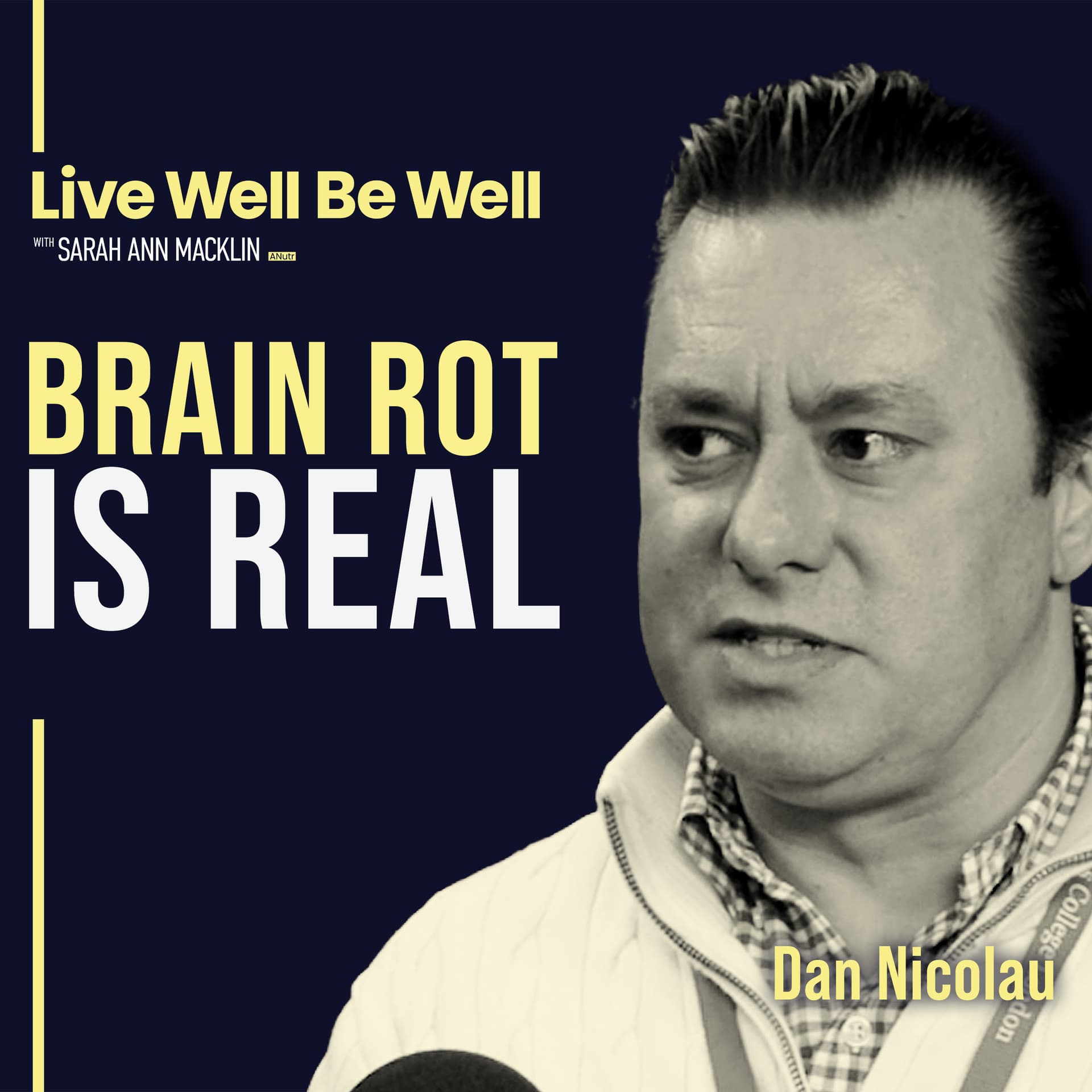
Professor Dan Nicolau, researcher affiliated with the Digital Futures Institute and the Center for Attention Studies; focuses on attention, stress, and inflammation markers like CRP.
Key claims
(1) More social media use self-reportedly increases CRP six weeks later, and reducing use should lower inflammation. (2) Socially stressful content (violence, shouting, hate speech) drives inflammatory changes more than neutral content. (3) Content moderators have higher inflammatory markers and worse mental health outcomes due to exposure to disturbing material.
Notable examples
train observation of widespread phone use; WhatsApp “read” pressure; Simon Sinek flying to write offline; South Korea/Australia studies on gaming/pornography; “brain rot”/doom-scrolling and algorithm rabbit holes.
Written by AI. May contain mistakes. Listen to the episode to check what was said.
Chapters
Tap a time to open that second in VOSocial Media and Inflammation
0:45 to 3:16
Discussion on how social media usage relates to stress and inflammation.
“made a really conscious effort now to put my phone away.”
Attention as a Human Right
3:16 to 7:22
Exploring the concept of attention as a human right and its implications for mental health.
“And that's what we're working on, which is what you asked about.”
Hypotheses on Social Media's Impact
7:22 to 11:24
Outlining hypotheses regarding social media's role in causing inflammation and related health issues.
“Nonetheless, we do need to do the work as always in science.”
Practical Solutions and Insights
11:24 to 12:39
Discussing practical steps to mitigate the negative effects of social media on health and well-being.
“But loads of things that people, like sleep better, more sex, you know?”
Transcript
Automatic transcript. May contain errors.0:00Welcome to Live Well Be Well, a show to help high performers improve their health and well-being.
0:10When we're kind of looking at social media use, we're talking about inflammation here, like many stresses that we have day-to-day. Phones is one of the biggest parts of stress. and you're currently working on a study and your three hypotheses that allow you to share like three thoughts you know that you're interested in but this first came when you were sat on a train and you were coming back and you just looked up and you looked around and every single person was on their phone and I've been really aware actually over the last kind of few days before talking to you one of how much I am on my phone when I'm walking which is about 95 % at the time and I've made a really conscious effort now to put my phone away.
0:51But also then I wanted to look around on the streets. And it is about 95 % of people that are looking down on their phones as they're walking. So it is a big thing. And I have a niece and nephew who both have phones, but don't have social media yet. Can you just talk about the study that like that or the thoughts and hypothesis that you're looking at now with inflammation and social media? The original thought was because I I was at the time a fellow of the Digital Futures Institute and there's a Center for Attention Studies. The original thought was actually out of frustration on this train, right?
1:27As you said, but so obviously attention is really all we have in life. I think that's a statement. So it's almost a trite, right? That's why we talk about it like we talk about money, like you're not paying attention. So it's an implastic resource. You can't replace it. Once you've given your attention to something, you can't give it to something else, right? And it made me think, I'm not an expert in that field, but watching people be so kind of like bombarded by requests for their attention on their phones all the time made me think that we should think of it as a human right. So in law, for instance, there's something like trespass to property.
2:02You can't just walk on someone's land. There's also trespass to person, which is short of assault, but you can't just grab people. And so we all accept those things, right? It would be crazy to live in a society that didn't protect privacy, property, and your personal space. But we don't have that for attention. Why? Why does, I don't want to say a particular platform, but I'm sure you can impute one. Why does platform X get to snatch my attention? I open my phone to do something and I'm bombarded by a bunch of requests for my attention that I did not allow, that I didn't give permission to. I wasn't even asked.
2:38So it made me start thinking that attention should be protected like a human right, like privacy. privacy didn't used to be protected as a human right that's something that happened in the 1800s late 1800s before that people just didn't think that privacy was a thing that needed to be protected none of us now would live in a society that didn't protect privacy and if you think about societies that don't protect privacy like north korea none of us would want to live there and yet we're doing that with attention um of course then i wanted to connect it to inflammation because the obvious hypothesis is that the the snatching of attention the the commandeering of attention would drive inflammatory processes and therefore mental health problems.
3:16And I do believe that. And that's what we're working on, which is what you asked about. But it started off with thinking like, should attention be protected as a human right, like privacy or property or your person? Well, I think it's such a big thing. I think many people will connect to WhatsApp, right? Even not thinking about social media. So WhatsApp, I, a couple of years ago, took off the last scene or when I've read someone's message because the pressure of someone knowing that I've read their message and not responded in that instant was causing a lot of frustration between work conversations, friends, and I would feel this pressure to always be on and respond.
3:54I think we moved it too. Yeah, which then basically took me away from any of my work. And then if you add social media on top, so you basically now, I mean, any average person who is working will be able to be contacted via email via whatsapp via instagram dms by linkedin and so it's like this constant stream of ways that people can now access you and that becomes so overwhelming that it can kind of become quite disability like disabling in the same way where then actually sometimes i just don't respond to anything because i have a sense of overwhelm you don't even want to open the phone i don't even want to open the phone you used to be able to escape on airplanes you can't anymore they put Simon Sinek and he said to write his book, he's got ADHD, he would literally book a plane ticket to write a book.
4:42And he was getting to the point where he would call up an airline and say, give me your cheapest ticket so I can get on a plane and write my book. Because he was like, it was the only place I could focus. I'm genuinely now considering doing something similar because my focus and my attention span is so poor and I'm trying to write at the moment. Now I have got a couple of flights coming up i think it's quite a good idea i should just get on and be able to i'm not going to connect to the internet to write my book so when we're thinking about what you're looking at for instance what is it that you're looking to find through your three hypothesis that you that you're exploring thank you for the question so pretty simple actually almost something you could explain to well i think i could probably explain to my four-year-old so So if you, hypothesis one, social media use in some context at some levels causes inflammation.
5:34Causes in the sense that, of course, you have other things that are causing inflammation and other things that are reducing inflammation like antioxidants. But causes in the sense that if you get rid of it, your inflammation will get better. And if you bring it back, your inflammation will get worse again. And you're going to look at that through CRP levels? There is some evidence. Yeah, CRP is a course marker of inflammation, as you know, because you're a biochemist. There is some evidence now, yes, that I can talk about, that the more social media you self-report that you use, the more course inflammatory markers are up six weeks down the line.
6:11hypothesis one hypothesis two specific content causes it socially stressful content like violence like shouting like hate speech bad things i use the word bad very loosely but i think you know what i mean and i think everybody does know what i mean by bad yeah they're not looking at puppies they're not looking at butterfly like mating cycles yeah that's hypothesis two that specific socially stressful content causes these changes and not just all content like not if you're looking at videos of sunsets or whatever. Hypothesis three, independent of social media, people who do content moderation, people whose job it is to filter out bad things so that we don't see them will have higher inflammatory markers than matched controls.
6:57People who are very similar to them but just don't do content moderation for a job. We know that those people who do content moderation for a job have terrible health outcomes. Many of them commit suicide. Many more attempt suicide. They have depression. They have anxiety. They have all sorts of problems. And indeed, why would you expect anything different if your job is to like watch horrible, you know, violent or sexual assault videos that no one else does? Of course, you're going to be affected. So I think it's very difficult to imagine that last hypothesis not turning out to be correct. Nonetheless, we do need to do the work as always in science.
7:24I wrote this down the science I didn't forget. I'm thinking about my nephew who loves gaming. It can be quite aggressive. I mean, they go. I mean, obviously, it's not like people, but you're literally going around with guns, right? Killing people. Would that cause inflammation? Is that the type of negative usage that we would also put that under? Because I'm thinking gaming is huge now. Gaming is huge. Two things that have been well studied previously are gaming and pornography. And they have been studied very well, respectively, in South Korea and Australia. And the research there is good. The evidence base is very thorough.
8:05and in both cases there is basically at inappropriate levels. They both cause all sorts of problems, including mental health, but also inflammatory states. Social media has not been studied, which is sort of surprising. And when it has been studied, people have looked at screen time. There is no obvious reason, and they've concluded that there's very little evidence, but there's no reason to think, there's no sensible reason to think that simply screen time itself would give you problems. It depends what you're watching. I would think virtually everybody would agree with that statement. It's likely that the content is doing things to you, if anything, right?
8:44So people have studied screen time and they conclude, well, there isn't that much of a link between screen time and bad outcomes. But a little, you know, screen doom scrolling at night or like, you know, a 16 year old watching like pornography at two in the morning, that's not the same as you're watching, as you said, David Attenborough or something about, you know, I don't know, volcanoes or something. I mean, it's interesting because the brain, the word in the Oxford dictionary this year was brain rot. And so that was the new word, which is basically that it's like social media is rotting your brain by doom scrolling too much.
9:17And I think we're all at mercy, not yourself because you don't have it, but, you know, ending up going down a black rabbit hole of content and not quite sure how we got to this part of this content because the algorithm had kind of fed us this kind of this weird route to get there. Just thinking about kind of practicality, people that are listening to this, that obviously it's like a little bit worrying. Is there anything that you're kind of seeing immediately that or some thoughts that you might be having that maybe if children or young people maybe have some chronic conditions, whether it's something that's like asthma to, I don't know, hay fever or an allergy, that these are also increased by poor social media use because it's got the inflammation markers are higher?
10:04Yeah, well, there is some good evidence that if you're feeling unwell for any reason, like if you have a cold or an asthma attack or something, you will seek out social media, which is the opposite direction, I think, to what you're asking. But nonetheless, it's a very interesting hint. It presumably is also the case that the more of the doom scrolling that you seek, the worse that you will feel. To the extent to which inappropriate use of digital technologies generally is very likely to cause higher inflammation and higher inflammation itself is more likely to cause triggering of allergies, whether neuroimmune wise or peripherally, more likely to cause asthma attacks or worsen them, more likely to cause other crises like rheumatism, other things.
10:52To the extent to which that we've never found anything other than a bidirectional communication. I think it's extremely likely to be the case that inappropriate use of digital technologies, generally of which social media are obviously an important case, but not the only case, is likely to bidirectionally drive those things. It also gives you a hint at the solutions, right? Because we have pro-inflammatory processes and we have anti-inflammatory processes. So if we do more, it's almost like, try to say it, right? It's almost like a tautology. But if you do less pro-inflammatory stuff and more anti-inflammatory stuff, like sleep better, drink some tea and, you know, have some friends.
11:27But loads of things that people, like sleep better, more sex, you know? Things that just make you better, yeah. And less things that make you not better, then everything will be better. But it's hard because it's also quite addictive. And so it's, I think, what I find kind of the irony of this situation is that we actually know that social media is bad for us. And we know that screen time is bad for us. But we are so, the dopamine hit is so large that we feel so attracted to it. again we know that ultra processed food is bad for us and we know that whole foods and grains and fruits and vegetables are good for us but it's so addictive from the dopamine hits that we get that we we kind of seek these things out and so you know we're all intelligent human beings we all kind of know the right from the wrong but we seek out these more negative kind of self-sabotaging behaviors but then if the irony if you flip on all of its head about you know what we're talking about today about living well being well the longevity sector is going up more than ever before the wellness industry is predicted to be nine trillion dollars by 2027 yet the kind of the things that are going to increase our longevity from what i'm hearing from you is literally like turning off our phones going back to basics which isn't kind of what's being i guess spoken about in the kind of longevity longevity sphere as much thanks so much for listening to hear the full episode there's a link in the description
From the publisher
What if inflammation didn’t just come from your diet but from your digital habits? In this clip, Professor Dan Nicolau shares the overlooked connection between attention, immune response, and the subtle biological cost of modern screen use.
Dan Nicolau
Listen to the full episode here.
Watch the full episode on YouTube here.
***
If you enjoyed this episode you might also like:
The Brain Immune Expert: ALERT! Social Media Is Reprogramming Your Immune System | Prof Nicolau
https://youtu.be/2zNw6pzv8qk
***
Sign up to Sarah’s Compassionate Cure newsletter:
Science Simplified, Health Humanised. Join thousands in exploring actionable insights that prioritise compassion, clarity, and real-life impact. https://sarahmacklin.substack.com/
***
Let’s be friends!
📷 Instagram: / sarahannmacklin
📹 Subscribe: / @livewellbewellsarah
🐦 Twitter: / sarahannmacklin
📱 TikTok: / sarahannnutrition
💌 Newsletter: https://bit.ly/3rUbHyS
#DigitalWellbeing #ChronicInflammation #MentalHealth

