
In short
Muscle building and fat loss “shortcuts” for people over 40, centered on lifestyle stress reduction, whole-food nutrition advantages, and training variables (consistency, frequency, effort, volume) that drive strength and hypertrophy.
Guest backgrounds
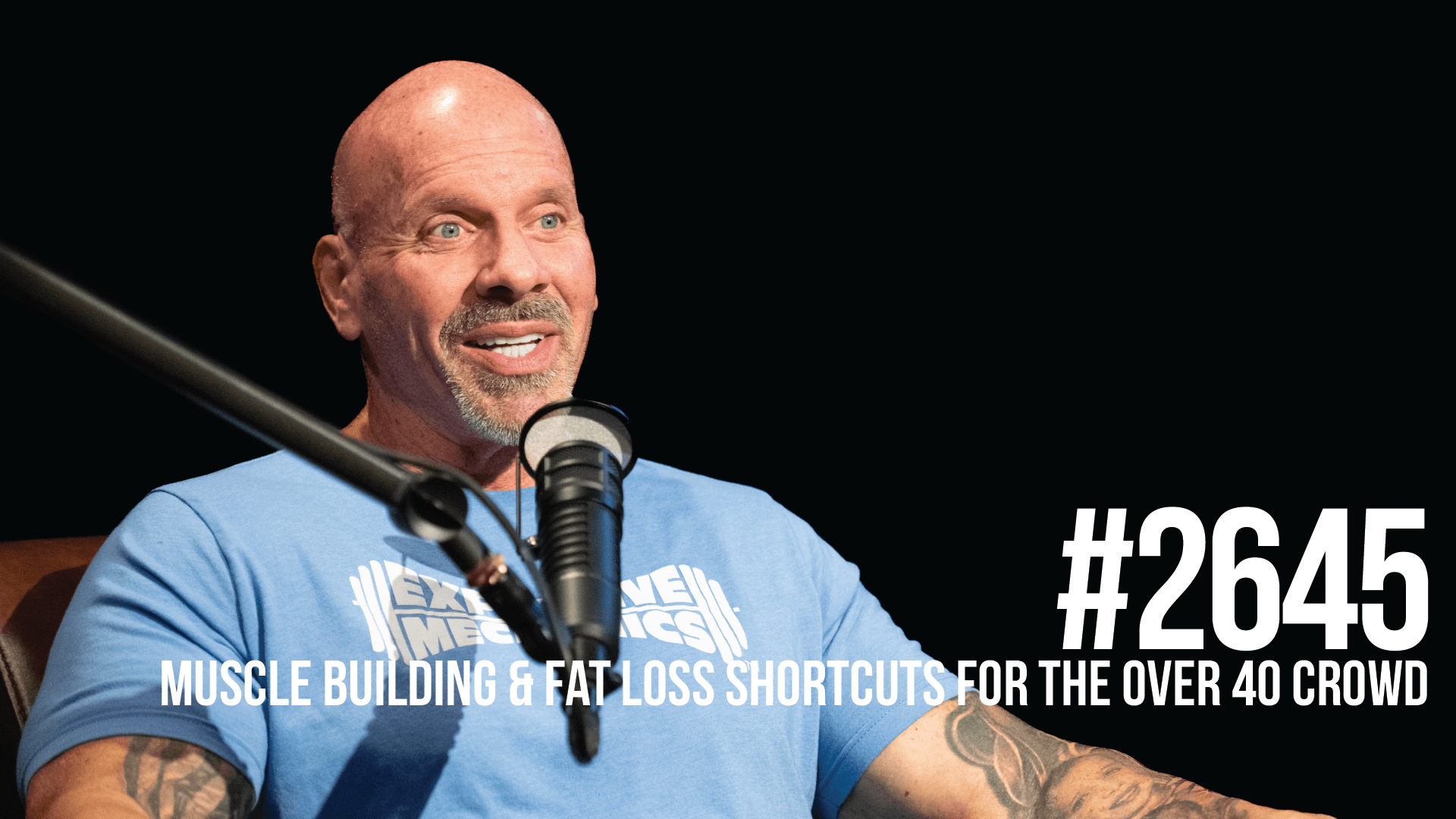
Stan Efferding is a fat-loss and muscle-gain expert with experience across powerlifting and bodybuilding, and he developed/advocates the Vertical Diet. He also trains regularly while aging, using periodized approaches. Hosts are Sal DiStefano, Adam Schafer, and Justin Andrews (Mind Pump).
Key claims
- Less stress and more relaxed routines improve health and performance; he attributes island “island time” to reduced stress.
- Whole foods beat shakes for satiety and micronutrient density; over-restriction causes digestive issues and deficiencies.
- Weight loss plateaus often come from inaccurate calorie tracking and hidden calories; adding muscle can improve body composition even if scale weight changes slowly.
- For hypertrophy/strength: compliance is “the science,” frequency matters (twice/week beats once/week), train close to failure, and avoid excessive volume that creates fatigue without adaptation.
- Lifting heavy responsibly doesn’t inherently cause injuries; pain is biopsychosocial and lifting can reduce injury risk.
Notable examples
- He moved to American Samoa; he plays pickleball daily/regularly and credits it for recovery from aches and for staying active.
- He cites a Stanford-style fermented-food study (yogurt/kimchi/kefir/sauerkraut) improving gut microbiome diversity.
- He discusses egg whole vs whites research, attributing differences to confounders like saturated fat and cholesterol absorption limits.
- He recommends isometrics (e.g., 90-second wall sits) for lowering systolic blood pressure and mentions post-isometric contraction benefits.
Written by AI. May contain mistakes. Listen to the episode to check what was said.
Chapters
Tap a time to open that second in VOStan Efferding's Journey to American Samoa
1:14 to 1:54
Stan shares his experience moving to American Samoa and the changes in his life.
“Get 25 % off your first month's order of Seed's daily Symbiotic.”
Impact of Island Life on Health
1:54 to 4:11
Stan discusses how island life has affected his health and fitness routines.
“This is the first time I've been back to the States since I left.”
The Joy of Pickleball
4:11 to 7:59
Stan talks about his newfound passion for pickleball and its social benefits.
“You said there's no streetlights on the island, 25 miles an hour is the speed limit.”
Nutrition: Whole Foods vs. Supplements
7:59 to 11:28
Discussion on the benefits of whole foods over shakes and supplements.
“When I got up to Toronto, I did the seminar.”
The Vertical Diet Insights
11:28 to 14:00
Stan shares insights on the vertical diet and its impact on health and performance.
“The psychological component of just being less stressed and relaxed is probably the biggest change.”
The Importance of Whole Foods Over Shakes
14:00 to 16:49
Learn why whole foods are essential for better digestion and gut health compared to protein shakes.
“A lot of digestive distress comes from being in an over-restricted state.”
Bioavailability of Nutrients from Whole Foods
16:50 to 19:56
Discover the complexities of nutrient absorption and why whole foods might be more beneficial than supplements.
“Is there any data that supports that nutrients from whole foods tend to be more bioavailable or your body tends to use them better?”
Muscle Gain and Metabolism
19:57 to 23:05
Understand how building muscle can significantly impact metabolism and calorie intake.
“and most of it that's in your small intestine is free cholesterol that was put there by the liver.”
The Reality of Lifting Heavy and Injury
23:06 to 27:00
Examine the myths surrounding heavy lifting and injury risks, emphasizing safe practices for longevity in training.
“And then they hear this, oh, well, it only burns an extra six calories a day.”
Training Strategies for Sustained Health
27:01 to 28:00
Learn about effective training periodization and how to balance heavy lifting with overall health.
“worry about lifting heavy and how it might injure them.”
Show all 40 chapters
Injury Prevention Through Weight Lifting
28:00 to 29:19
Learn how weight lifting can prevent injuries in adolescents and the importance of proper training techniques.
“So, uh, and it's not, you know, the, the, the highest percentage of injuries in the gym, 65 % of all injuries in the gym is dropping a weight on yourself.”
Balancing Powerlifting and Bodybuilding
29:20 to 30:58
Discover the benefits of incorporating both powerlifting and bodybuilding techniques for longevity in training.
“more frequency and volume from a variety of different angles and maintained really good health that way and had a pretty long career himself.”
The Importance of Consistency and Frequency
30:59 to 32:06
Understand how consistency and training frequency impact muscle building and strength gains.
“I just need you to take yourself to a place where it's a little more than last time.”
Training Volume and Intensity Insights
32:07 to 34:21
Explore the debate around training volume and the impact of load intensity on muscle growth.
“Every one of them trained every body part twice a week.”
Diminished Returns in Weight Training
34:22 to 37:19
Learn about the concept of diminished returns in strength training and its implications for workout frequency.
“So generally speaking, if you're doing 85 % of your one rep max, that might be a five rep grinder.”
Wisdom from Experience: Avoiding Common Pitfalls
37:20 to 39:28
Gain insights into common mistakes in training and how to avoid them for better results.
“Over six weeks, 33 % increase in strength.”
Adjusting Training for Older Adults
39:29 to 42:00
Understand how to modify training programs for older adults to enhance performance and avoid injury.
“And a lot of the progress that we made was in spite of the mistakes that we made, not because of those mistakes.”
Training Adjustments for Older Adults
42:00 to 43:35
Learn how to adjust training programs for older adults to optimize performance and recovery.
“But then I looked at his training program and it was the bro split and it was way too much volume and less frequency.”
Central Nervous System and Muscle Performance
43:35 to 45:30
Discover the relationship between the CNS and muscle contraction and perceived exertion during workouts.
“He was an instructor in the exercise phys department at UNLV and head of the dietetics department.”
The Effectiveness of Isometrics
45:30 to 47:25
Explore the benefits of isometric exercises for strength building and blood pressure reduction.
“More than running three times more than walking.”
Warm-Up Techniques for Maximum Performance
47:25 to 49:20
Understand the best warm-up strategies to enhance workout performance based on research findings.
“And then when you do your final set, you'll do better.”
Priming Techniques for Novice Lifters
49:20 to 51:35
Learn how to effectively prime novice lifters for optimal performance during their workouts.
“You're turning on your CNS so it works more effectively.”
Managing Fatigue in Powerlifting
51:35 to 54:05
Discover strategies for managing fatigue and optimizing training volume in powerlifting.
“Then you grab your top set, your heaviest set that you can handle when you do like six, you know, maybe your partner taps you on number seven.”
Avoiding Junk Volume in Workouts
54:05 to 56:00
Learn the importance of avoiding junk volume to improve efficiency and results in training.
“So if you're with an 85 % of your one rep max, you might be able to grind out five reps.”
Understanding Muscle Training Dynamics
56:00 to 57:30
Learn about the role of muscle fatigue and rest periods in strength training.
“That's why creatine helps as a supplement for getting that extra rep.”
The Importance of Mechanical Tension
57:30 to 58:50
Discover how mechanical tension influences muscle growth and performance.
The Changing Perception of Sodium
58:50 to 1:01:10
Examine how attitudes towards sodium in diets have evolved over time.
“had male carriers in my family, didn't lift weights, had protein diets, had really muscular calves, had mechanics in my family.”
Navigating Sodium's Role in Health
1:01:10 to 1:04:40
Learn about the nuanced role of sodium in diet and its impact on health.
“Years ago, our friend Rob Wolf sent us Element, which is a company we work with.”
Electrolytes and Athletic Performance
1:04:40 to 1:10:02
Understand the significance of electrolytes and hydration for athletes.
“Now, as we, with respect to the general population, those who are not salt sensitive, You do not see a significant, maybe 0.3%, maybe one millimeter of systolic blood pressure reduction for sodium reduction.”
Cramping and Rehydration Strategies
1:10:02 to 1:10:44
Learn about the author's experience with cramping during a meet and effective rehydration techniques.
“And Mark came out with Jesse Burdick, and they were like, what's wrong?”
Optimal Electrolyte Ratios for Performance
1:10:44 to 1:12:20
Discover the ideal sodium and sugar ratios for hydration solutions to enhance performance.
“A couple of years later, Larry wheels had the same problem, uh, at a meet in Sacramento or in Oakland.”
The Role of Coconut Water and Potassium
1:12:20 to 1:13:46
Explore the benefits of coconut water and the importance of potassium in sports nutrition.
“is coconut water you ever look at the yes amount of potassium to sugar in natural coconut water and then just add some salt to that.”
Revolution of Medical Interventions for Weight Loss
1:13:46 to 1:15:05
Examine the cultural shift in weight loss strategies, particularly with GLP-1 medications.
“I think GLP ones are doing the same thing.”
Understanding Peptides and Their Benefits
1:15:05 to 1:17:16
Gain insight into various peptides, including their applications and effects on weight loss and appetite.
“It had some interesting side effects to it.”
The Efficacy and Side Effects of GLP-1 Agonists
1:17:16 to 1:21:03
Delve into the effectiveness of GLP-1 agonists for weight loss and address common side effects.
“we saw 17 18 and now tersepotide 23 sustained weight loss over two years crazy so they're hugely effective.”
Behavioral Changes and GLP-1 Usage
1:21:03 to 1:22:41
Understand how GLP-1 agonists can modify behaviors linked to eating and appetite signaling.
“Obviously, the nausea can be greatly reduced with titrating the dose, but people were concerned primarily about muscle loss, and people were making extraordinary claims about muscle loss.”
Personal Experiences with GLP-1 Agonists
1:22:41 to 1:24:06
Listen to firsthand accounts of using GLP-1 and the significant changes in appetite and cravings.
“That's the biggest, I think the biggest qualm that we have with it is the name brand stuff like Wagovi and some of that.”
Understanding Food Noise and Hunger Signaling
1:24:06 to 1:26:48
Explore the intense focus on food experienced by bodybuilders and its implications for appetite signaling.
“But I talked about the fact that one of the reasons I have some empathy with respect to people's appetite signaling is because I used to bodybuild.”
The Role of Coaching in Overcoming Dietary Challenges
1:26:48 to 1:27:40
Discuss the importance of good coaching in addressing dietary issues and managing hunger.
“which is why you see some people suddenly like, I don't want to smoke.”
Challenges of Appetite Dysregulation
1:27:40 to 1:28:32
Delve into the complexities of appetite dysregulation and its impact on individuals struggling with obesity.
“about discontinuing glp ones would you say somebody with that was hypogonadal or somebody it was hypothyroidism, which you tell them to discontinue their medication as hormonal problems.”
Transcript
Automatic transcript. May contain errors.0:00Cozy season is ahead and you'll be spending way more time inside. Is your home ready? Don't worry. With Wayfair, you can upgrade your space without breaking the bank. Score up to 70 % off during their Labor Day clearance on furniture, area rugs, mattresses, and more. Plus, surprise flash deals you can't miss. Whether it's one room or the whole house, Wayfair has pieces for every style and budget. Shop Wayfair's Labor Day clearance now through September 7th at Wayfair.com. Wayfair, every style, every home. If you want to pump your body and expand your mind, there's only one place to go. Mind Pump.
0:37Mind Pump. With your hosts, Sal DiStefano, Adam Schafer, and Justin Andrews. If you're over 40, you won't want to miss this episode. Stan Efferding is on the podcast. He's an expert on fat loss, muscle gain, and he breaks it down. Now, this episode is brought to you by our sponsor, Seed, the world's best probiotic. Look, there's a lot of documented benefits from probiotics, including, of course, better digestion, but mental clarity, better skin, and better athletic performance. And if you want a probiotic that actually works, go with Seed. Go to Seed.com forward slash Mind Pump. Use the code 25MindPump.
1:15Get 25 % off your first month's order of Seed's daily Symbiotic. We also have a sale on workout programs this month. MAPS, Split, and the Anabolic Metabolism Bundle is all 50 % off. just head over to maps fitness products.com and then use the code july 50 for that discount here
1:33Stan Efferding:comes the show dan welcome back to the show thanks for having me it's been a while man it has been yeah you look extra relaxed this time i escaped is it the island life or what it is yeah yes last summer i sold my home packed up and my family and we all moved to american samoa it's where my wife was born and raised and we've been visiting frequently over the last 20 years and finally decided to head on down there for good. So I've been enjoying island life. This is the first time I've been back to the States since I left. And it's kind of a whirlwind trip. I flew from American Samoa to Honolulu to Vegas, and then stayed in Vegas for a day.
2:12Stan Efferding:And then I went to Toronto, Canada. I was up there doing a seminar at Fortis Fitness for the weekend. And then I flew down to see my pops in Iowa via Chicago and spent a few days with him. He's 94 years old now and uh then i zipped over to uh cincinnati matt whittimer from beat training he was the guy who helped me with john jones and henry cejudo and did a seminar out there and then uh i dipped down to uh dallas texas to do a a podcast with jordan syatt yeah yeah i love him good guy i had a great time and then uh up to back to vegas and then yesterday i was in sacramento with the bell brothers with mark bell and uh and here i am today in san jose and i'll be vegas back in vegas tonight and tomorrow morning back to the island oh good did you uh did you keep the gym and property there do you still or did you get rid of it uh still partners with uh um eric has to try and own sin city iron yeah beautiful spot we finally moved into a spot with air conditioning which is kind of nice yeah i'm spoiled as i get old you know the good old days are gone those Those, you know, those dungeon gyms with no air conditioning and just sweating.
3:23Stan Efferding:And so, but we sold the home. We have no place in Vegas to say. And just moved down to the land that my wife grew up on. She had 11 brothers and sisters. So there's nephews and nieces and cousins. Oh, that's cool. And the whole works. And I have a little 10 and 12-year-old that just turned 11 and 13, actually. And they've settled in nicely. And it's just the whole island is built around raising children. So you're the perfect person to ask this question because you're really smart. And you also have a lot of experience. It's unique to find a combination of both. Somebody's got the education, intelligence, but also has worked with lots of different people, has trained themselves.
4:03Decades of wisdom. Yeah. So there's some really great wisdom. And we were talking off air. You're talking about the slow pace of the island. In fact, you said something funny. You said there's no streetlights on the island, 25 miles an hour is the speed limit. Yeah.
4:16Stan Efferding:Everywhere. And it took you, you said, three months or so. It took me months just to calm down. I felt like there was something I needed to do. You're so hurried in the US. So someone like you, perfect person asked this question. What's the impact been on your health and performance? Because you still train. I'm assuming you still eat healthy. It's always been important to you. The only difference is the environment. Vegas versus the island. how has it impacted your health performance like all the you know the metrics that you know to pay attention to yeah i think most of it would just be the less stress possibly um the island most people don't have a you don't look at a clock or a calendar most of the time they have what's called island time you get there when you get there and if uh i'm standing by the car with my keys and tapping my foot because we're supposed to be at dinner at five and my wife's like nobody's gonna to get there at five.
5:09Stan Efferding:We show up at five 30. There's still nobody there. And I'm like, it's going to be dead. Nobody's coming at six o 'clock. It's packed. Uh, and that's the way it is. And it's, it's been very peaceful not to be so hurried, not to have such a tight schedule, you know, here in the fit fluencer industry and other people surrounded with social media, they often come on and put on a you know a day in the life of and it's you've seen the funny ones with some guys up at 3 30 in the morning and they've got this whole thing before 8 a.m they've accomplished more than most people do all day and they brag about it and I just it's just the opposite opinion now and I get up when I get up and obviously I got to get the kids to school I drive them back to and from school in a golf cart.
5:58Stan Efferding:It's pretty easygoing. And it's just less, I've been able to be more calm and less stressed. And that's a pretty good impact. Like you say, the training routine is pretty consistent. They have gyms down there and I swim. And oh my God, I picked up this nasty little addiction about a year ago in Vegas. I lived right on Sunset Park where they have a 26-quart lighted from 5 a.m. to 11 p.m. pickleball oh you're doing pickleball my brother just got the bug dude is it the gayest thing in the world you know how far from grace can one man oh dude he has definitely he's all into he's got himself a little thing that's shooting you anybody can pick it up though that's you can pick it up quick and it's fun to play and it's one of the reasons we moved to the island to be honest with you we were there christmas before last and we had a great two weeks of christmas break and we We were, you know, we went snorkeling and we went out fishing in the ocean and we went golfing and hiking at New Island and all sorts of different things we did.
7:02We just had a fantastic vacation. One of the things they have there is a Pickleball Association of American Samoa and they have an indoor pickleball facility. And so I made sure to set aside a couple hours every day to go join them for pickleball. And there's a big group, a wide range of people from teenagers to elderly folks that are in their 60s and up in their 70s.
7:23Stan Efferding:You get these little ladies with the 65 year old with their little tennis skirts on whooping your ass and pickleball when you're running around, you know. And the Samoans love to talk shit, you know, it's it was so much fun. And I met such a big group of people. and when my wife asked me if I'd ever be interested in moving to Samoa, I was like, oh yeah, I'd move here. I didn't mention the fact that the number one thing was probably because of the pickleball. I talked about my trip. I said I left America. Samoa went to Honolulu in Vegas. When I landed in Vegas, I played pickleball. When I got up to Toronto, I did the seminar.
8:00Stan Efferding:Then I went out and played pickleball. When I got to Iowa, visited my pops. In the evening at home, I'd go play pickleball. I got to Cincinnati, did a seminar, went over and played pickleball. I got to Dallas, did the podcast. I went over and played pickleball. It's the neat thing about pickleball is that you can go anywhere, anytime, just by yourself with a paddle. And you can just join in whoever's playing. They have open play or whatever. Put your paddle up and you're joining. Last night, I was at Sunset Park in Las Vegas playing pickleball. And it's, you know, it's kind of a social thing. And it's fun.
8:29Stan Efferding:And, you know, I've always said to everybody, what's the best exercise is the one you'll do. You'd never catch me in the gym walking on a treadmill. It's just nauseatingly boring. And it's not anything anybody looks forward to. But I wish people could find something that would help them move more. And I'm fortunate that, you know, I was able to kind of happen onto this little activity. But yesterday, end of my story, I'm talking to Nseema, who's a black belt in jiu-jitsu. That's Mark Bell's podcast host and partner up there, who wins tournaments. He's just a phenomenal athlete for those people who are familiar with Nseema.
9:05Stan Efferding:And I started comparing pickleball to jiu-jitsu. and you have to know what a nice guy and sema is but the look on his face and i was just i was just fucking with him right i was i was like oh it's just like jujitsu maybe a little harder and he's really physically demanding the kindest guy on the planet and his face just went blank and then he starts kind of playing along yeah you can just show up and then you can like have a match with someone and he starts actually trying to support your argument yeah support my argument and I just I let it go on and on and on and just laugh at my house and then sometimes when I go for like an overhead smash my shoulder do you ever get like shoulder problems in jiu-jitsu you know and SEMA's winning competitions is a black belt in jiu-jitsu and I'm playing pickleball with a 65 year old lady in a with a plastic wiffle ball and I was making more repairs poor in SEMA but he yeah he played along you mentioned the social aspect uh and I think that's one of the most important parts of all of this.
10:08So you have this social life, this connection to your community, a reduction in stress. How has it impacted things like inflammation, movement, exercise, like objective things that people who listen to our podcast tend to get motivated by. They hear the conversations around stress all the time, but it's hard for them to put that together with what they're focused on, which is like, how does it affect my fat loss, muscle ganglia. Are you noticing anything different in your body from this different lifestyle? Yeah. Well, you know, I've always had that, that foundation of the 10 minute walks moving often after meals, et cetera.
10:46And I've of course lost a significant amount of weight from when I was powerlifting. I lost even a little more weight intentionally because I was trying to get better
10:54Stan Efferding:at pickleball and I haven't moved laterally since college and pickleball, especially when you're playing doubles, you're not supposed to be much movement, but when you're as bad as I am and they keep moving you around, I'm just running from side to side. It must've taken me six months or better to get over a lot of the aches and pains from the side to side change of direction movement in my hips and my knees and my ankles and my feet. I had to wear these Joe Biden hookah shoes because my feet were sore from playing you know i would on the concrete for two sometimes three hours a day every day i would i would limp home at night and then wake up in the morning and uh and do it all over again but uh there's you know the movement is key yeah and the frequency of movement as we know now we've talked about the 10 minute walks in the past but even five minutes an hour just sitting is like the the new smoking and so i do try and get plenty of movement in I have lost additional weight and more than what I had additionally dropped from powerlifting.
11:59Stan Efferding:So my health has been great, obviously. The psychological component of just being less stressed and relaxed is probably the biggest change. I feel like you look the best right now. You look very healthy. You do. You look really, really healthy. Yeah. That's a little bit good. And what's cool about the enjoyment factor is you mentioned two hours, three hours. You're not going to exercise for that long unless you're really enjoying what you're doing. It sounds like you're having a lot of fun. Something else you said off air, which I would love to veer off into, is we were talking about the difference between getting your calories and macros from things like shakes and bars versus whole foods.
12:38And there's kind of this debate, right? Well, it's all the same. Same macros, same calories, whether it's bars and shakes versus food. There's no difference. But you have experience in this. You've trained lots of people. yourself. Adams talked about this when he competed. I knew this with my clients. There's something else about whole natural foods. Even when we, even we, when we count everything and measure everything, it seems to be the same. What do you think it is? Or do you think we just don't know what it is with whole foods that makes it different? Well, I think there's two things we can certainly say there's plenty of evidence to support that are pretty obvious.
13:10One is the satiety value of whole foods over drinking. Even if it's a protein shake, we know it doesn't have the same satiety benefit as if you have, say, a steak. And I've used that to my advantage in the vertical diet, as we've talked before, whether I'm trying to, I've got a client or whether I'm either competing in powerlifting or bodybuilding, whether I'm trying to gain weight or lose weight. So on both ends of the spectrum, you can use whole foods differently to impact satiety. When I'm working to people trying to lose weight or having them cut and chew steak, when I'm working with people who need to gain weight, I'm using ground beef and white rice and bone broth to make the moisture content and the consistency, the softness of the food so they can consume more.
13:51So those are strategies that we use that I think are important when you're talking about shakes. The other thing is going to be the micronutrient density of a food as opposed to a shake. The protein might be the same, but are you getting the iron and the B12 and the zinc and the choline and the biden are you getting what you get from steak or eggs or yogurt um i don't i don't think shakes contribute anything to your digestion uh improvement for your digestion and we know that fermented foods at least in the sonnenberg trials at stanford they they fed uh you know either yogurt or kimchi or kefir or sauerkraut to some participants in their studies and found that a hundred percent of them improved their gut microbiome diversity and density so So the vertical diet always intended to be more diverse because as far back as the late 80s when I started training people for competition and I was competing already, I found that the over-restriction was causing a lot of problems.
14:48And we still see that today. A lot of digestive distress comes from being in an over-restricted state. Same thing happens, of course, with the bulkers doing the dirty bulking. They get a lot of digestion problems. And so particularly with respect to, say, the bikini competitors, they tend to demonize and exclude too many foods. You know, they end up with that egg white, tilapia, asparagus diet, maybe a tablespoon of almond butter or something like that. And so I'd always intended the diet to be more diverse to help avoid things like anemia with iron deficiency and things like, you know, calcium deficiency.
15:29So we keep the dairy and fruits and, you know, egg yolks for biotin for skin, hair and nails and getting them to salt their meals. And, you know, so we have the diversity matters, some salmon for omega threes. And I think that people just get too restrictive. So I think that's what's pretty important about whole foods as opposed to shakes. And then there's the bro science, like we mentioned earlier.
15:51Stan Efferding:You know, sometimes even the academics will say the bros were right. and i said on mark bell's podcast some 10 years ago you know shakes are for fakes eat steaks and i and i think that that jay cutler also said in an interview once he was never able to gain or maintain a significant amount of lean mass on shakes he always had to incorporate plenty of whole foods i hate seeing people drink shakes after shake after shake yeah if you're going to throw shakes in then you know mix them up whole food shake whole food shake something like that That would be. And how much science is behind that, I'm not sure.
16:23But we have plenty of good reasons to eat whole food, as mentioned. And the rest is just kind of my experience. Yeah, I think that there's a lot we know about food, but there's so much we don't know about food, especially in relationship to mammalian metabolism, which is incredibly complex, one of the most complex things we've ever identified. So I think a lot of it's mystery. So at this point, it's like, this is just what we've seen. And I have experiences as a trainer. Like, you could count everything, make it as equal as you want. It just doesn't work the same. Is there any data that supports that nutrients from whole foods tend to be more bioavailable or your body tends to use them better?
17:01In other words, low iron, if you eat a certain amount of iron from liver versus taking an iron supplement or you need more B vitamin, eating it from meat versus taking a B supplement, is there any data to support that it's just more efficacious when it comes from whole food versus a supplement form?
17:19Stan Efferding:I don't think we can say that. I think that the supplements are, a lot of them are made to be identical too. But the diversity is different in food, like you said. I mean, even when Winston A. Price was doing his research, the dentist that traveled all over the world and did his research back, I think it was in the 1930s, to be honest. It was a long time ago. It was a fantastic book. I think we've all read that some time back, maybe a decade or more ago. He found there were certain nutrients that he couldn't even identify or wasn't aware of at the time. I think they were referred to one as an activator X and they weren't aware, you know, and eventually as time progresses, we see, you know, we weren't even aware with scurvy that it was vitamin C.
17:58Stan Efferding:So we are discovering new things. I think we've got a pretty good grip on it now with the level, you know, the advancement of science now. But, you know, now it's a different kind of problem is that we're eating foods that are, like you mentioned, they're devoid of a lot of nutrients just because those are the cheap, you know, the highly palatable ultra processed. calorie dense foods and those tend to be deficient of it. And then they end up having to, you know, put vitamins and minerals in those just to meet some minimum requirements. You just made me think of one bioflavonoids. We know that we know that you actually, if you get a vitamin C supplement, sometimes they offer or they include them, but that makes vitamin C and like an orange more effective.
18:39Whereas before we didn't understand that whether it was just a vitamin C orange has other things called bioflavonoids, which help with the vitamin C. Penols were important to many of those things. Yeah, yeah, yeah. I read a study. There was a study a little while ago and people quote it often that compared whole eggs to egg whites controlling for macros. The whole eggs produced better muscle protein synthesis levels. Do you think it's the cholesterol? I know old school bodybuilders swore by it. What is it? I do recall the study. I quoted it myself many years ago. I think there was a calorie difference.
19:12I don't think they controlled the calories.
19:14Stan Efferding:The macros were controlled, but I don't think the calories were controlled. And we're discovering now, like we used to think that cholesterol from eggs would raise LDL and increase cardiovascular disease risk. And now we discover that the cholesterol and dietary cholesterol is really a cholesterol ester that the vast majority of people can't break down. Only a small percentage, 15, 20 % of the population who are hyper absorbers actually absorb cholesterol from the diet. We've also been able to find out that one of the confounders was that a lot of the foods that are high in cholesterol are also high in saturated fat.
19:48Right, and that makes a difference. And it was the saturated fat that was raising the LDL and not the cholesterol. Most of the cholesterol that is in your bloodstream is made by the liver or recirculated. and most of it that's in your small intestine is free cholesterol that was put there by the liver. And in the absence of a sufficient amount of insoluble or soluble fiber, that it doesn't actually get taken out of the system. And so a lot of it's just recirculated from your own endogenous production. Okay. You know, staying on the metabolism talk, I don't know if I've heard you communicate this or not.
20:24Really curious to your thoughts on, and this is a debate that I feel like we find ourselves Allison, I can't count how many times I've taken a client that was eating 1 ,600, 1 ,500 calories and can't move the scale, stuck there. And we reverse diet them, build, say, five, six pounds of muscle. And this is over a period of time, say, six months to a year. And I've now got that female client that was eating 1 ,500 calories, eating 2 ,700 calories and staying lean, sometimes even losing. yet you get the science nerds that want to argue that it's not the muscle that's burning all this extra calories it's you know maybe a pound of muscle burns another four to ten calories a day yet i've seen this example over and over of where i've just added five pounds to someone and their metabolism is through the roof how do you communicate that to to somebody there's a few
21:22Stan Efferding:variables there oftentimes the individual that says they're eating 1600 calories isn't really eating 1600 calories. That's a challenge. Uh, that's the most common problem when somebody's weight loss stops and they claim of a certain calorie consumption, if they were actually to very accurately weigh it, they're probably going over sips, bites, licks, snacks. Um, you know, those kinds of things can add up sauces, uh, just oils that you cook food in. It's not a good food, bad food conversation. It's just hidden calories. Uh, secondarily, a lot of times when they raise their calories up, we're putting in more protein.
21:53We know the thermic effect of food, they net out 70 of the 100 calories, right? So they're actually getting kind of a benefit from that. They also tend to use more fibrous foods and fiber doesn't really count in the calories necessarily. So they're able to eat more food volume. Maybe the calories on the package or, you know, on the label might say one thing, but what you net out could be different. And then on the muscle discussion, yeah, you burn around six calories an hour per pound of muscle. um is it per pound or is it per 10 pounds it's per it's per pound i think it's about 60 calories a day for for about uh i want to say it's 10 pounds of muscle for 10 pounds of muscle at rest yeah that's the key component in the energy expenditure side of the equation is that at rest the bmr uh only burns that extra 60 calories a day but when you move the muscle now you burn significantly more it's oh yeah so it's not accounting for that probably because It doesn't account for that.
22:56The reason why I wanted to talk about it is because I think it's a really terrible message. And it comes from our space. Sometimes we're, again, trying to argue and debate with each other. And I think we lose a lot of people that were maybe considering strength training and building muscle. And then they hear this, oh, well, it only burns an extra six calories a day. Like, what is that to me? Yeah, what's the point of that? I'd rather just get on the treadmill or do something else. And I just think it's a terrible message. and it loses a lot of people when I know I've helped many, many clients that were eating 500, 700 less calories just by simply building some muscle on their body.
23:35Yeah. And I've got to say in this whole conversation about the energy intake side and the energy expenditure side, as it relates to weight loss, the energy expenditure side isn't very promising. But 99 % of the weight loss occurs from the calorie deficit on the energy intake side. more exercise doesn't equal more weight loss. And so the idea of having someone try and do more exercise, and that's because of Herman Ponser's constrained energy model of obesity and the fact that people compensate in a number of different ways. When they exercise more, they also tend to sit more and it increases their appetite.
24:09They get hungry and eat more. And additionally, the body becomes pretty efficient, more efficient. Say day one, you go in and do 30 minutes of treadmill and you burn 300 calories, just an estimate. By day 30, you're burning 120 calories for the same 30 minutes at the same pace. Now, ideally you'd increase the pace and duration over time, I guess, but it's just not the most effective. You get diminishing returns. It's not necessarily the most, people don't adhere to it as long, particularly the hard workouts, the battle ropes and burpees where they're just sweating and their heart rate's going crazy and they think they got a great workout, but that's not a client that's going to do that consistently over an extended period of time.
24:48So I'm cautious with the energy, talking about the energy expenditure side as it relates to fat loss, but exercise is great for health. And then the weightlifting is fantastic for everything else. Yeah. And I would even say, I think we could speculate quite a bit. I think a lot of it we don't necessarily understand because I've experienced this same thing that Adam says. I mean, just changing how your body responds to insulin and testosterone, all things being equal will change body composition, right? Like I know when you build muscle, you increase androgen receptor density and insulin sensitivity, both of which might change how much body fat you store, uh, even with the same calories.
Read the full transcript
25:26Yeah. And that's different than scale weight, right? And so the calories might determine the scale weight, but how your, your hormonal milieu or your training, you know, your muscle, your strength training is going to change body composition. Yes. So that's very, and can increase your, your caloric expenditure over time, your basal metabolic rate. So that makes a big difference. Yeah. You know, I want to ask you this because you're, uh, you're interesting in the sense that you've, you've done powerlifting, bodybuilding, you train heavy, hard. You've got a history of that. To my knowledge, you don't have like these lots of major crazy injuries.
25:57Uh, and now you're an older guy working out. Like how have you been able to do that? And what does lifting look like for you as you're getting older? Because you often hear the argument and people will use examples like Ronnie Coleman, like, Oh, well, he's, you know, look, look what he did himself. and he's really injured because of his heavy training. And I can get that rationale. Like, how do you communicate? Oh, you know, you can lift heavy, not injure yourself. Or what does that look like?
26:19Stan Efferding:Yeah, Ronnie Coleman's in a wheelchair because of some bad back surgeries, not because of heavy lifting. If he had never had a surgery, he recovered from the heavy lifting. You get little bumps and bruises along the way. And back pain. And people have more back pain who don't lift than people who lift have back pain. so there's a whole pain science the people are really good at that i think is is uh jordan fagenbaum and austin baracki at barbell medicine and they pursue a uh a biopsychosocial method of pain dr larimar mosley's work out of australia and it's fascinating stuff and they do a very good job of that so i won't try and get too deep into that but uh so people do with ronnie's example worry about lifting heavy and how it might injure them.
27:05But in fact, lifting, you know, responsibly, but you should lift with enough weight to maintain strength. And, you know, as you age and you should live with enough effort to within a couple of reps of failure, right? That'd be your effort such that you get a sufficient stimulus that you're actually getting some result from the training probably the biggest thing with me and i had a few bumps and bruises along the way you know popped a hamstring and a um you know shoulder torn rotator cuff and things that happen when you're power and competing at a very high level i've always said that health and
27:42Stan Efferding:fitness are not the same thing and that if you want to be healthy don't compete yeah as we know the fitness level required to compete is often at the sacrifice of health people don't know you were lifting insane weights so i mean you could expect to have maybe an injury yeah and the same would be true of a football player at that point it's a sport it's a sport at that point and or a 14 year old gymnast in the olympics with carpal tunnel syndrome or achilles tendons popping or 10 year old badminton players in china blowing out lateral collateral ligaments so it's not specific to the lifting as a matter of fact lifting actually prevents injuries and we see that american academy of pediatrics has said that it is essential for adolescents to lift weights and it has a huge impact on decreasing exposure to injury.
28:23So, uh, and it's not, you know, the, the, the highest percentage of injuries in the gym, 65 % of all injuries in the gym is dropping a weight on yourself. It's not from the lift itself. And most injuries are incurred. Uh, I guess this gets us to the original question. Uh, what I, what I did then, um, mostly was, uh, I would periodize my training. I would power lift for a while and then I would bodybuild for a while. And so I would go up in weight and lift heavy weights. And then I would actually be dieting down and with more frequency and volume, which was, you know, bodybuilding can be a, you know, it could be a, how do you term this?
29:03Because you're not using maximal weight and you're doing more frequency and volume and you're incorporating more cardiovascular fitness, it can be more health, healthy than powerlifting. And with that, I was able to have more longevity the sport. Eddie Cohn trained the same way. He competed in powerlifting meet twice a year. And in between the meets, he would do bodybuilding stuff, higher repetitions, lighter weight, more frequency and volume from a variety of different angles and maintained really good health that way and had a pretty long career himself. So that was big, but what I didn't do then that I do now after learning more about this.
29:36And I did a video, the best way to recover from training on YouTube. I'm one of my rhinos rants. And I was talking about everything that I did after the training stimulus. I talked about passive versus active therapy. I always said that the things that are done to you or for you are not as effective as things you do for yourself. So if someone's giving you a chiropractic or a massage or dry needling or gua sha or any of the passive therapies that you go in and have somebody do to you to try and recover from workouts, foam rolling, were pale in comparison to any kind of movement that you just do.
30:13The 10-minute walks, that's how that kind of originated for me. As I found out, my DOMS would go away much quicker if I was moving frequently following big workouts. So that's how I was managing fatigue back then. I was doing everything after the training session. But now, as we've evolved with her knowledge, we announce of prevention is worth a pound to cure. We look at everything on the front end in terms of load management and try not to do too much damage to begin with. We try and do just enough training so we get a sufficient stimulus so that we can then get super compensation from that. Not so much training that we're, I always said to John Jones, hey, we're not digging ditches here.
30:58We're building mountains. I just need enough. I just need you to take yourself to a place where it's a little more than last time. And then let's cut off and let yourself recover. And I look at the days off as growth days. The training days are breakdown days, right? You don't grow in the gym. You break down muscle tissue, even though muscular damage is not a driver. It's just a phrase, but muscular damage is not a driver of hypertrophy or strength. And neither is metabolic stress, as we know now, the pump. It's all mechanical tension. And you have to get a sufficient stimulus to get mechanical tension and recruit maximum muscle fiber.
31:32And that just requires that you lift to within a rep or two of failure. And there's some variance here between powerlifting and bodybuilding, of course. So that just, it's the effort has to be significant enough. Probably even more important than effort. If we wanted to start from the top, we would say that consistency. I've said compliance is the science. Just you have to get in and train regularly. You can't be on and off, on and off. you're just going to whatever results you get are going to go away that's joe rogan said it was like building a sandcastle bodybuilding it's just eventually it all you know washes away you have to keep at it obviously uh so that would be compliance is science and the next one i think would be frequency is probably the second most important thing on that list a hierarchy of most important things for the results for strength or hypertrophy and the frequency now we're finding you get far better results from uh from doing three sets twice a week than you do from doing six sets once a week yeah far better results now whether or not you go to three days a week you might may see a tiny bit more results but the big the big difference is that twice a week is better than once a week yeah and what's interesting is the academics have always coined the once a week training as as the bro split and i thought that was funny because back in the early 90s when i I used to drive down to Gold's Venice from Oregon and take my road trip so I could watch these guys train and ask them questions.
32:51Every one of them trained every body part twice a week. And most of them trained twice a day. They would split the quads and hamstrings and do the double split. Most of them would do six days straight. It was a push-pull legs, push-pull legs day off. Now we've kind of involved in our thinking and mentioning that the days off are the growth days. And we've tried to do a little more with less and have more days off. So maybe push-pull day off, upper-lower day off, upper-lower weekend off would be an example. When I design programs now for my clients, I give them one of a couple of choices, and that's an upper-lower day off, upper-lower two days off.
33:32If they wanted to do everything in a six-day window as opposed to a seven-day window, then they just go upper-lower day off, upper-lower day off, and just keep repeating it like that. If they wanted to go to an eight-day window, they could go upper day off, lower day off, upper day off, lower day off. That's twice every eight days. So those are progressions. Twice every eight days, twice every seven days, twice every six days. Those are potential progressions that you could design into a program for someone. Start them at twice every eight, then twice every seven, twice, and see if they're still progressing.
34:00So that's your frequency. The next thing on that list after frequency is probably going to be your effort. and that's going to be getting within a rep or two of failure. For bodybuilding, you can get closer to failure. It's okay to grind some reps here and there. For powerlifting, you kind of want to leave a couple reps in the tank and not do slow reps because speed is a component for powerlifting. It's a lot of central nervous system adaptation for powerlifting. So generally speaking, if you're doing 85 % of your one rep max, that might be a five rep grinder. Do the three, leave the other two in the tank for powerlifting.
34:35and another thing to consider uh with respect to power lifting is that strength is specific and so it does have to be a heavier load 80 85 percent of your one rep max hypertrophy as you know can be on any range you can do a heavy five rep or you can do a light 20 rep here's what's interesting that i didn't realize 10 years ago i thought the lighter 20 rep set would be less fatiguing than the heavier weight just looking at load right but now we're discovering that it's
35:00Stan Efferding:not it's more fatiguing more fatiguing yeah absolutely and we know now that that it's because there's a lot of metabolite accumulation possibly calcium channel ions or maybe it's not lactate but hydrogen ion clearance and we're noticing that that's what is causing the doms it's not necessarily muscle damage although some of that can be accumulated in a good workout but that's the muscle damage doesn't drive the workout the the the tearing of the muscle fibers and repair we used to think that that was a driver of strength or hypertrophy. And now it's a passenger and it isn't necessary. So back to, we said effort was the next most important.
35:37And I guess that takes us to volume. And volume is where we have this huge argument going on right now, right? In the social media industry amongst the academics and the lifters. And some people believe in high volume, some people believe in low volume. At my age and with athletes, I'm much more inclined to believe in low volume. Of course. I think a lot of the high volume studies are confounded by a number of different variables. I think that they measure the muscles too close to completion of the study, in which case they're, uh, it's influenced by swelling and water accumulation, DEMA, whatever.
36:11Um, I think that, um, there are newbies in a lot of case they're new lifters. Uh, and so a lot of the initial volume is probably a neural adaptation from lack of experience or coordination with the movements whereas seasoned lifters would you know very quickly adapt oh i agree i think a seasoned lifter can get more out of one set than a newbie can get a 10 percent and the third variable which i think is the largest variable that that confounds a lot of this literature is that uh all of the participants who made gains also increased strength there was a progression in load or reps. Right. And that I believe is, is the ultimate driver.
36:54You cannot build muscle without getting stronger. You can get stronger without building muscle, but you cannot build muscle without getting stronger. And if that's happening inside of a volume study, then who gets credit for, for the results? I'm, I'm much more interested. I'm far less interested in the most you could do to get the best results. I'm far more interested in the least you could do to get results. I just read a study. I just quoted it. Now this was with people over the age of 60. Still fascinating. One set. And they took one exercise once a week. The leg press. Over six weeks, 33 % increase in strength.
37:30Stan Efferding:100%. Like that to me is far more interesting than the, oh, you can do up to 38 sets per body part and see whatever and get 15 % more growth than if somebody did. I don't care. Well, here's what we know or we think we know. the first set that you do of an exercise in the gym you're going to get x result from that set right the second set is going to be 50 of x the third set 50 of the second set so you get diminished returns yes it's not nothing but it's going to keep diminishing right and each subsequent set is going to accumulate more and more fatigue to the such the point where eventually if you're going to do a really high volume workout you'll get less and less result from each subsequent set and you'll get more and more fatigue, which will create DOMS.
38:12Now, DOMS and hypertrophy are two different things. Usually the hypertrophy stimulus only lasts for about 48 to 72 hours after the workout to which you're growing. Then you see the single drop. And then you see the decline. So that's when you want to pop in a new workout. But if you've done so much damage that by the time you do your next workout, you're still sore and you're unable to perform at the level of the previous workout. You're just healing. You're not adapting. You're healing, but you're not adapting. And so you have to separate those two things. and I think a lot of people can they confuse how hard the workout is or how much pain that they're how much soreness they have and I did that we wore it as a badge on everybody yeah look a lot of this conversation a lot of these questions that I answer with respect you know now that I have the opportunity with my years of experience to reflect upon some of the things that I did wrong I don't want to sound like a curmudgeonly old you know has been that that's just shitting on everybody's program.
39:07I listened to guys like that as I came up and through the years, it would just sit there and complain about everything. Uh, that's not my intent. It's just, I really want to be able for people to look at this and, and figure out what's meaningful, what works and what is probably unnecessary. So they don't have to go through a lot of the things. It's wisdom is what it is. And a lot of the progress that we made was in spite of the mistakes that we made, not because of those mistakes. One question I want to ask you, I would love your input on this because this is something that we noticed. We released the program recently and the intent initially was for people who don't have a lot of time with their workouts.
39:50And what we ended up finding was some of our seasoned lifter listeners, many of them, followed this program and were breaking PRs. I broke a PR. I love it. Adam got great results. So here's what it was. Okay. You're doing two lifts a day, six days a week. You're doing 20, 25 minute workouts versus let's say two, one hour, one and a half hour workouts, same total volume. But because it's spread out every single day, the fatigue that you just mentioned is removed. Do you think that separating out sets and doing a little every day is more than doing a lot sometimes? Or what do you think is happening there?
40:26I think you should get 48 hours. Ideally, when I said you go from twice every eight to twice every seven to twice every six, that to me is a progression. I'd like to pinch that down to where I said that hypertrophy only occurs for 48 to 72 hours after a workout. So I want to hit that muscle every 48 to 72 hours. If you're doing it daily and you do the Chinese with their Olympic lifting, I mean, they do 16 workouts a week. Yes. It's pretty high. Now, they're not maximal efforts. No, and the fatigue is not even a factor. And fatigue is not a factor. intensity is way down they're not doing max loads they're not trying to to do a lot of muscle damage but just doing you know a couple of sets and and grabbing all of the stimulus with very little fatigue they're coming back and doing that as soon as you can especially if you're going to do an everyday workout you're going to want to do maybe two sets yeah for a like a chest workout you're getting all the all the good stuff without any of the potential bad stuff yeah and we noticed that that people writing in are like, I've been working out for seven years.
41:23I followed this program because my time was limited
41:26Stan Efferding:and I'm breaking PRs. You know, what's hard is I just took on a client last week. I still train clients to this day. I still do online coaching and I've done, I was a personal trainer in college and worked at box gyms. I've owned numerous gyms over the years and I still do it. And I took on this and I learned something from all of them, particularly the athletes, the collaborations. It's more of a, you know, a shared experience. took on a 71 year old client last week. And he was telling me all about all the trainers that he had. He trained with the former Mr. Olympia and the Mr. AAU, whatever.
41:57And he's been training for 40 years and blah, blah, blah. And he wants to put on 10 pounds of muscle tall order for a 71 year old. But then I looked at his training program and it was the bro split and it was way
42:06Stan Efferding:too much volume and less frequency. And, uh, he was lifting lighter loads and, uh, not that load matters. Of course, effort matters more, but, um, I saw opportunities there, a lot of opportunities there. And so I, the same type of deal. And when I told him he was only going to do two sets for chest, he was like, I had to explain it to him. I said, look, you're going to, you know, I just want you to give it a try. Because I said, all I'm interested in is PRs. That's all I'm interested in. Every time you go to the gym, I want one more rep or five more pounds, not every time, but you know, over time.
42:37And like you said, with all your people who followed your new program, they're setting PRs. And that's all that matters. Did you get a one rep or a five pound PR? is all that matters. You can't get bigger. How's his results? So far, he's doing great. He loves the program because he's not sore all the time. And I remember for years after I stopped competing in powerlifting, I kept trying to go back in and do a lot of the same workouts. And even while I was competing, you'd walk around for two or three days after a big leg workout just in this fog state. You survived. Yeah. You just walk around and you just did the brain fog was outrageous.
43:13Your whole central nervous system was drained. Really, what we've learned a lot now is that firing muscle contraction is a signal that's sent from the brain. It's not the muscle that fails. It's your brain's perceived level of exertion, which is why my co-author of The Vertical Diet is Dr. Damon McCune, PhD RDN. He was an instructor in the exercise phys department at UNLV and head of the dietetics department. and he did a his phd thesis study was on um taking in carbs pre-workout versus swishing a carb drink around your mouth spitting it out that's been repeated there's a number of different studies such a weird result same result yeah it's psychological cns related it's cns related it's psychological and it's about perceived level exertion that's that's why when somebody goes to the gym if you're stressed from work or you're tired from a missed night of sleep or let's say you missed a meal and you're hungry if you get to the gym and you're hungry that's a distraction you know it's like things like caffeine theanine work so well they keep you focused you know and we just saw another study just came out this week on um uh i think it was pre-workout stims that multiple ingredient stims versus just caffeine versus no stimulant but a a it was a placebo that was to taste good they had equivalent results isn't that great in terms of performance largely psychological even even some of the caffeine benefit yes largely psychological just to back you up you know we just talked about the chinese uh olympic by the soviets by the way uh you know they did a lot of that stuff i mean what they're what they're practicing the lift they're training the central nervous system and just to add more credence to what you're saying we've heard stories of the mom the car flipped over it's on the baby oh no all of a sudden she can lift the car right there's some truth to that and really what's happening is you're not able to be as strong as you can because your brain limits it's afraid that you're going to hurt yourself and in some cases an extreme duress you can override that but through training you can maximize that and one you know when we first started working together justin brought up isometrics now isometrics strength athletes used forever and they kind of fell out of favor but justin perked my interest i started looking at the data on it i'm like oh my god like now it doesn't work as long but in a short period of time if you want to build strength and activate muscle fibers isometrics there's a crazy uh slope of strength gain and stuff from them you're starting to see them start to pop back in into training how do you feel about isometrics
45:54Stan Efferding:what do you think about them and do you use them great for a lot of reasons one is it's probably one of the most, probably one of the most effective forms of exercise for reducing blood pressure. More than running three times more than walking. Yeah. It's huge. And I wasn't aware of that. That research. Interesting. We've never shared. We've never talked. No, that's. He had another benefit. We talk so much about isometrics. I don't think we've ever talked about it. It's post isometric contraction, right? It's a big one for me. 16, 90 second wall sits. Do a few of those every other day. Maybe even a leg extension to a hold or just a gripper.
46:25all three of those have better output than than running or jogging or walking for reducing systolic blood pressure is that because of the i'm assuming it has to do with the cns and how it dilates blood vessels and so you're training the ability to contract relax yeah i wouldn't be
46:40Stan Efferding:the best guy to explain it but i see that the outcomes are consistent wow how funny when you think about the the journey of that like you probably as a early trainer scoffed at the the wall sits and like oh these must be you know i'm saying and then here we are full circle recommending that before you recommend doing cardiovascular exercise or something else that's so wild to me yeah yeah and in the bronze area uh strength athletes uh that's a lot of their training was holding things and pushing against things that couldn't move and yeah they're it just they're very safe and yet super activating when it comes to muscle fiber and and and the strength gains on are great if you look at the the studies on it's wild the strength gains you see in isometrics are you don't get that with any other form of muscle contraction yeah which is really really cool you know perilla performance he's been around for decades loved him as early as the 70s i think certainly by the 80s he was doing the golgi tendon organ desensitization programs i don't know how effective those are but that was always perilla was trying to turn off or desensitize the golgi tendon organ is is what kind of interprets the load for the tendon to make sure that you don't hurt yourself and it'll shut down your muscle contraction or turn off the nervous system because it's worried that you're going to break yourself yeah and so he would perform different exercises to try and desensitize that that's right it was his theory yeah i'm i'm not certain what works for that other than just you know loading over time yeah which is why they say strength is specific because you have to lift a heavy weight in order to get your body and you know what recent and a recent study that came out in terms of warm-ups you know we've all argue about what the best warm-up is and how people and a lot of folks will foam roll or they'll ride the bike for 10 minutes or they'll stretch either dynamically or statically and they went through and looked at all these different warm-ups and they found that as far as and whatever warm-up gets you to be able to work out is great okay but if you're trying if you're asking what the research says about which warm-up helps you perform the best none of that stuff dynamic static foam rolling biking none of that stuff actually out improved performance the one thing that improved performance was actually lifting uh the working up to about 80 percent of your one rep max on the exercise that you intended to perform yeah and we know that because of post activation potentiation you know if you go up and lift do a single at a particular weight and then maybe drop down you can do more reps yes so saying get to about 80 percent of your one rep max and And it's just potentiation of the central nervous system.
49:10And then when you do your final set, you'll do better. You'll get one more rep. So I'm going to add to that because there's a little bit of context there or nuance, right? So essentially what you're doing is you're turning on your CNS. Yeah. You're turning on your CNS so it works more effectively. Yeah. Powerlifters know this, by the way. A powerlifter is going to warm up a bench press by bench pressing or warm up a deadlift by deadlifting or a squat. but power lifters and experienced lifters know how to turn those muscles on get in that position get tight grab the bar squeeze the bat whatever to get into that right position to set them up when you're training a novice person this is from a trainer perspective if i have a novice i'm teaching them how to squat i can't warm up with a squat because the warm-up's gonna look like crap so we do we will do what's called priming and priming is is a a a it's second best but it's best for a lot of people because they can't perform the squat properly to begin with.
50:02So with them, I would look at them and say, okay, you got a little thoracic issue there. Let's, let's get you in a position where we could squeeze the rhomboids, bring the scapula down and back. Let's hold that contraction. And I would piece it out, then get them to do the squat as their first warmup. And then they jump in the exercise. So we call that priming is what we do.
50:18Stan Efferding:I've told this story before, but when I was preparing, when I was backstage warming up for a powerlifting meet, there were a couple of things that I would do because a lot of but I understood was psychological and that post activation potentiation, I would get on the bench and I had said that I didn't like to do a lot of junk volume or get a pump. When you're powerlifting, you don't want to get a pump. And now I believe that when you're bodybuilding, that you don't chase a pump first. It's it, it usually comes along with a hard workout, but can actually decrease the number of repetitions or load that you can use on your top set.
50:50Stan Efferding:If you have a pump already interferes with the way that the muscle fibers can, can slide. and contract. So two different conversations very briefly. Whenever I was powerlifting, I would get under and I would maybe just warm up with a band and get my body temperature up and walk around the room, right? Get your heart rate elevated slightly. I would bench 135 for a couple of reps and racket. And then I would sit there for a minute or two or whatever. And I would bench 135 again for a single. The second time I benched it, it would explode off the chest. Put two and a quarter on. I'd come down, I hit a single, racket.
51:22I'd wait three minutes. I'd do two and a quarter again the second time just fly off the chest i do that with 315 do it with 405 and then i was ready to to hit you know probably get out on the platform and hit your opener but each each time i hit the weight the second time it just fell faster again perceived level exertion is gonna is gonna you know dictate or determine your muscle contraction and my perceived level exertion on the second set was uh of the single rep on the second set of the same weight was like this is nothing this is light everything's just flying off the floor but the first set was like the second one's pow pops right off of you so i make this analogy when somebody goes in to do a hypertrophy workout traditionally we've all done this in the past you go grab the to do an incline dumbbell press you go grab the 60s and you do a set of 10 and you set them down and you rest a little bit grab the 70s and you do a set of 10 rest a little bit and then you grab the 80s you do a set of 10 you rest a little bit.
52:18Then you grab your top set, your heaviest set that you can handle when you do like six, you know, maybe your partner taps you on number seven. You didn't do four sets. You did one set. And the other three to me are junk volume. And they probably interfered with the number of repetitions or the load that you could have used on your top set. And so I would rather do back down if at all. I'd rather do two top sets than a bunch of junk volume leading up. That is what you learned from powerlifting that I think made your bodybuilding better because the pump, I think the reason why we value the pump for, well, there's two reasons.
52:52I think we like it. It looked bigger. So it's really cool, right? I also think getting a good pump really is just a sign that you're well hydrated, well rested, good diet. So when you get a good pump, you build more muscle, probably as a result of the other things, not necessarily the pump. But what's funny what you said about the pump that you don't want to chase the pump early because it messes with the rest. Every athlete knows this. You talk to a jujitsu fighter. Hey, do you want a forearm pump while you're in a match? No, absolutely not. I can't grip the gi anymore. I suck. You talk to a cyclist.
53:22Do you want a quad pump while you're out there trying to compete? No. It was never beneficial for me. No. In fact, I remember my first time encountering this early trainer. I was a young trainer. I had this kid who hired me. His parents hired me to train their kid who was a motocross racer. You know what his question was? I need you to help me not get a forearm pump while I'm riding and racing. And at that point, I thought the pump was the best thing ever. How do I train this guy to not get a pump? You know, type of deal. But yeah, the pump reduces performance. So what you're saying makes absolute, you know, So what does that look like if you went back and you were to kind of reprogram, you know, leading up into a powerlifting meet in terms of like managing fatigue
53:58Stan Efferding:and then also like, you know, eliminating the junk volume? Yeah. Well, I think the big thing about powerlifting is, is I mentioned that you don't want to do grinder sets. So if you're with an 85 % of your one rep max, you might be able to grind out five reps. You only do three and that'll allow you to accumulate less fatigue. You maybe even do an extra set there if you want, or you can train again sooner and potentially benefit from that super compensation and start to progress your loads. That's the goal, really. It's not how much you can do in any one workout, but how you can grow by stringing together a series of workouts.
54:29Stan Efferding:What was that on social media? The lady that said, you go to the gym and you train real hard and you come home, you look in the mirror and you'll see nothing. Over and over again, you're like, yeah, go into the gym the next day. We're trained real hard. You see nothing. so uh you know you could train long or you train hard but you can't do both and so i just i believe in those shorter training you said you created those workouts you probably also did some synergistic or antagonistic uh antagonistic body part you do chest rest a minute back rest a minute so now you shorten the training session down to 20 minutes but you got the same volume the same total number of sets for the body and it's just as efficient as if you'd sat there and done just your chest rest chest rest just there's a lot of things that you train in those workouts, like that dumbbell example that I was giving, you know, eventually I would have the client just do two sets with the 60s or two reps with the 60s, one rep with the 70s, one rep with the 80s, time to take your top set.
55:27Dorian Yates put all this in his blood and guts. He was right. He was 100 % right. Because you're not training hypertrophy at that point. Now that we know it's all mechanical tension and everything else is a passenger, there's other things that happen whenever you do a set to work out, you know you're having a central nervous system impact that takes time to recover, which is why people who rest for two and three minutes do better on the subsequent set than people who rest for one minute and they get better hypertrophy and strength outcomes because the one minute people, their central nervous system didn't recuperate.
55:56And so they weren't able to lift as significant amount of reps or load on the second set. And we talked earlier about whether it's calcium ion buildup, whether it's cardiovascular fitness, whether it's creatine phosphate is something that you utilize in the first 10 or 12 or 15 seconds, and it takes you time to replenish those creatine phosphate stores. That's why creatine helps as a supplement for getting that extra rep. But when you deplete those in a 10 or 12 or 15 second or 20 second set, that needs to replenish itself. And so you're training something else other than you know uh uh muscular contractions right mechanical tension you're training something else and that's fine if that's your goal we say this when we train sprinters too if i'm training a sprinter and let's just say for example that you're we don't do hundreds we usually do 40s but if your 100 meter dash is is 10 seconds and you're training for speed as soon as you're 10 percent slower you're no longer training for speed no no it's a little stamina repeated You train bad patterns.
57:01There's all those other things. So as soon as you're, you know, either you rest longer or you go home because you've. You're not training what you want. This is our biggest pet peeve with plyometric training that you see. Yeah, they turn it into fatigue. They bastardize the hell out of that. I mean, you rarely ever. It's at least rare for me to walk in a gym and see plyometrics being applied correctly. It's just like. Well, a lot of people try and combine. Cardio. Cardiovascular exercise with their strength training. even Henry Cejudo when we were down there working with him fighters want to keep moving they want they want to always be moving get their heart rate up and they want to go from they want to have short rest periods they want to go from exercise to exercise it's not the most efficient way to train strength right no no no and so it's really hard so sometimes we would just throw in fake stuff like uh uh wrist curl grippers or something just to let him rest his legs a little
57:47Stan Efferding:longer all we were really worried about was the belt squat that's that's old trainer wisdom right so the superset would be a bunch of shit you know like pinky curls keeping busy so yeah these are great coach i like these you know okay we've got our three minutes let's go do another talk of that with such great wisdom there right like an area where you know it's best but you also know like i can't this this is such a habit for this guy yeah how do i meet him somewhere in the middle where i make him feel like he's still staying busy but what i'm really doing is i'm making him rest we'll lay on the side of a bench and do the rotator cup exercise and it's so smart it's not for anything but to give us some rest time so we can smash him on the next i became i became an expert conversationalist with my client with some of these clients because let me just make this a great conversation that lasts for three minutes so they forget exactly that we're resting you brought up mechanical tension i i i observed something as a kid uh over the years that then resulted in me uh you know including a a type of training in some of the programs that i wrote now we hear people talk about it like they'll call them like exercise snacks i call them trigger sessions or whatever but I had family members that didn't lift weights, had male carriers in my family, didn't lift weights, had protein diets, had really muscular calves, had mechanics in my family.
59:01Nobody worked out. I'm sure that at that point, after six months of doing what they did, and they did for 30 years of cranking on wrenches, they weren't getting a workout. These guys had crazy looking forearms. I thought, how are they building these body parts when they're not like working out? They're not getting damaged. They're not creating lots of waste. They're just moving these muscle groups. It was the tension. It was the mechanical tension. And so how do you feel about including, you know, sessions throughout the day? You'll see this with arm wrestlers. Well, they'll practice a gripper or practice it.
59:33Do you think that there's some value in that for the traditional lifter who can add a few, you know, minor things in the middle, maybe maintain a muscle protein synthesis signal? Like, what do you think about that? I said that frequency after consistency was probably the second most important thing on this hierarchy of things. Frequency that you can recover from. So I think as often as you can train, and we talked about the Chinese weightlifters, as often as you can train, so long as you've recovered from the previous session, I'm all for it. Yeah.
1:00:04Stan Efferding:And that's using all the methods that we just discussed in terms of less fatigue. That's the biggest key is the over-application of intensity on something like that. I mean, we see this with our own programs where we've included what Sal was talking about, where we have these trigger sessions that are designed to be, you know, take you five, eight minutes to do. You're just supposed to get a really light pump, you know, and then you get feedback from how the people are doing it. And they're going to failure. The industry refers to intensity as load. That's why I always say effort and load. I never use the word intensity because it confuses my client and it confuses me, to be honest with you.
1:00:38Because intensity to me seems like how hard you train, but intensity is, is to define the load that you're using. Yeah. It's my understanding in the scientific literature.
1:00:47Stan Efferding:And so I always use effort that's to within a report to a failure. And load is the amount of weight. Yeah. So I just don't want our client or our viewers to get confused when we're using all three words. Intensity gets confused, but yeah, load and effort. You know, one of the biggest changes I've seen in perception around nutrients is around sodium. Now, I know we all were in fitness in the 90s and in the 80s and 90s, and sodium was like a bad thing. Avoid it at all costs. Terrible for blood pressure, whatever. Years ago, our friend Rob Wolf sent us Element, which is a company we work with. And it's electrolyte.
1:01:24He sends me Element, too. Thank you, Rob. Yeah, and I remember he sent it. And my assistant's like, hey, are you interested? Sat in the back for months. And electrolyte. I'm like, no, I'm not interested in electrolyte powder. Who cares? Nobody cares about electrolytes. And it sat there forever. And then one day I was walking around in the back and I looked at it and I'm like, a thousand milligrams of sodium? Like they finally, somebody figured it out. So, and now the attitudes around sodium are starting to change. Let's talk about that a little. Is it scary? Should you avoid sodium at all costs?
1:01:50Stan Efferding:Is it valuable? You know, there's a lot of nuance here. And so bear with me, okay? I put out a video some years back. This sucks, or creatine sucks, but this works. This is the video. And it wasn't really a knock on creatine. I've always said that it gives you a little result. And after a year, it seems like it's somewhat equivocal, but now we've got some of the cognitive benefits, et cetera. Take Korean. Korean's great. It's cheap. Give you a little boost to performance, but people kind of overlooked the necessity of salt for performance. And in that video, I talked about the importance of salt for performance.
1:02:21But a lot of the academic or the medical community conflated my recommendations with sedentary, hypertensive people. And I got attacked from all sides. But in the video, I very much spelled out that if you're eating a lot of ultra processed foods or packaged foods, you probably don't need salt. And the vast majority of the country, 70 % being overweight or obese, probably don't need to add salt to their diet because 70 % of the calories. They've already got plenty of it in their food. It's already in your food. Okay. So I wasn't talking about those folks. We know that about 25 to 30 % of the population is hypertensive, salt sensitive, and they should minimize their salt.
1:02:56They should exercise and lose weight, but they should also minimize their salt. But even in the salt studies, the DASH diet, the ones that reduce sodium to reduce hypertension, they had less of a decline in blood pressure from the sodium restriction than they had from adding in more potassium, magnesium, and calcium. Right. That was the bigger variable. So don't cut the sodium, increase the other electrolytes. For hypertensives who are eating a lot of processed foods, cut the sodium. but add in potassium, magnesium, and calcium, you'll get a much bigger effect. But we also now have 5 to 15 % of the population we know suffers from reverse salt sensitivity, where if they lower their sodium, they have an increase in blood pressure.
1:03:43One of the things that has changed since I did that video, I had talked about the research on the J-shaped curve, where when you had lower sodium intakes, you would see an increase in in poor health outcomes, cardiovascular disease risk. And that was from the PURE study, which was the largest international multi-country study. One of the authors on that was Dr. Salam Youssef, head of the World Heart Federation, a cardiologist. Unfortunately, what we found out now, they would do one 24-hour urine test for salt. But when you do multiple tests, because the body's salt is constantly, you know, the sodium level in the kidneys are constantly adjusting.
1:04:27When you do multiple tests, you'd flatten out the J curve. You don't see, you don't see poor health outcomes from low sodium, but for the five to 15 % that are salt sensitive. And so that JK shaped curve kind of washed away with the new research. Now, as we, with respect to the general population, those who are not salt sensitive, You do not see a significant, maybe 0.3%, maybe one millimeter of systolic blood pressure reduction for sodium reduction. But you have other problems that occur. You start to get some insulin resistance, potentially with a lack of sodium, or maybe some water retention even.
1:05:06So for the general population, I think the current average consumption is somewhere between three and five grams a day. and that seems to be okay for the general population, not for the salt sensitive people, of course. And then for active individuals, now we're in a different realm in terms of performance. If you're a salty sweater and that's genetically predetermined, we use Dr. Sandra Godick, president of the Heat Institute. She's a PhD in thermoregulation and hydration. She sends sweat tests. She has a website called levelin.com. Oh, interesting. L-E-V-E-L-Y-N. You can order a sweat test. They send it to you in the mail.
1:05:43you put a patch on your athlete and let them wear it for an hour during their training and you send it back and they'll tell you how much salt does your athlete sweat out every hour we did that with hoff or we did that with john jones we did that with you see a big variance yes it's genetically predetermined lane johnson from philadelphia eagles sweats out five grams of sodium an hour five grams isn't there a new i think gatorade is doing this right now where there's like a patch that you can wear and it actually you can watch it in real time i'm not sure if it's similar or not yeah google it i'm pretty sure his gatorade does it i don't know how accurate it is yeah i just saw it recently though well that's crazy you guys five grams per hour so you would have to drink five packets of element per hour to make up you'd have to design a rehydration program that accounted for his daily needs we don't do it the only acute uh oh right intervention that we do is probably post-workout right but it helps also to be you hydrated or to have some hydration prior to training so that you kind of stave off a little bit of that and so you know with lane we had to design a program for him that that included you know over the 24 hours but if you've got two training sessions a day now there's a shorter window so salt sweat rate is genetically predetermined and then if you're in a hot climate or a humid climate or you know hockey players if you're wearing clothing while you're training then you have to take a good look Look at how much sodium you're sweating out.
1:07:03One of the things we do in sports is we weigh athletes before and after. I think the ISSN suggests that for every kilogram of weight that you lose during training, you want to get about 1.5 liters of water with about 500 milligrams of sodium. now for consuming uh salt with water for say pre-workout which seems to be one of the better times to consume it you don't want to guzzle it because your body only absorbs it at a limited rate so you kind of want to sip the whole hour prior to training and then maybe throughout training there's a lot of peri-workout drinks that have a little bit of salt in them and then post-training it's not a more as better scenario if you take in too much sodium you could end up with diarrhea.
1:07:51But one of the things with athletes, we want to make sure that the titration matters. I mentioned blood pressure is important, right? In terms of how much sodium you take in, there's a second concern that the concentration of salt can potentially be bad for the endothelial lining of the blood vessels. If you're eating a whole thing of potato chips, let's say. So like all at once? All at once. Yeah. The concentration of sodium in your bloodstream, you should have sufficient water to dilute it so it's not damaging the endothelial lining. So that becomes important, consuming enough water with the salt.
1:08:29The other factor is what's the concentration? What's the optimal concentration so that you're absorbing, getting the water into the bloodstream from the small intestine through what's a sodium glucose transporter? that kind of determines the gradient as to how well the water is absorbed. And it kind of gets us back to Gatorade. So a little bit of sugar, good idea. A little bit of sugar, good idea. Too much sugar, bad idea. Bad idea. Can do just the opposite problem. One of the things I talked about in this video was when I was doing a powerlifting meet with Mark Bell in Sacramento. It was over 100 degrees and we were in a warehouse and I was wearing a beanie.
1:09:07And I was just sweating like crazy. And after weigh-ins, I started downing just tons and tons and tons of Gatorade. And I'd never historically done that. Well, that actually increased my urination and I ended up dehydrating myself. And I got done squatting and I started cramping up. Too much, too fast. Too much, too fast. The sugar did just the opposite. All the sugar started to get me to expel and to urinate. And so I would grab the bar and my fingers actually were cramping onto the bar. I had to actually pry my fingers off the bar. And so it was really, because that's the sodium potassium pump.
1:09:40has a great deal to do with muscular contraction and relaxation. Everything that's affected by the nervous system is affected by salt. The heart for arrhythmias, your digestion, you get constipation. Everything that's affected by the nervous system is affected by salt. So I started cramping up really bad, and I actually told my wife to get the keys and we had to go to the hospital.
1:10:02Stan Efferding:And Mark came out with Jesse Burdick, and they were like, what's wrong? And I said, I'm cramping, I have to go to the hospital. like no no no here drink some oh no you're not done with the meat yeah you can't leave so they fed me a whole bunch of nun tablets at the time which is just salt tablets and i sat there for 20 or 30 minutes and i just drank salt salt salt salt salt uh because the gatorade was high in sugar but low in salt yeah it's not enough salt and the the the the ratio is like six to one and at most maybe a three to one works uh better it should be closer to one to one two to one okay right in there.
1:10:39So long story short, I was able to get rehydrated. I was able to finish my bench. And that was the, uh, 2303 world record total that I set that day. And so it was almost didn't happen. A couple of years later, Larry wheels had the same problem, uh, at a meet in Sacramento or in Oakland. And I was there with him and we did the same thing. We had to, to rehydrate him because he had, so let's be specific. Cause people, we talked a lot of numbers here about percentages, is usually about 2 % sodium, 2 % glucose for the drink. So let's make it easy for people. Let's just use a gallon of water. I'm not suggesting you can drink the whole gallon, but take a gallon of water, put in 500 to 1 ,000 milligrams of sodium and about 80 grams of sugar.
1:11:25A fructose-glucose blend is a little easier to digest on the stomach. so that could be your your water bottle that's mixed correctly it could be an lmnt right with a gallon of water and uh i usually use dextrose 80 but you could use table sugar what do you think about waxing maize or that's fine too okay yep and put that all in your water and shake it up and now you sip that that's your whole gallon yeah and you don't drink the whole gallon i'm just
1:11:53Stan Efferding:that's an easy way to mix it so everybody can you know can mix it the same that would be the the concentration the titration that i think would be most effective for performance you know what i found that by the way it's another bodybuilder bro thing to sip on the electrolytes all day long too i just want to point yeah i don't think it's an all-day thing and i do think it's around and again dependent upon your sweat rate and the amount of sweat that you uh are you know the temperature the humidity and are you sweating during your work you know what i found to be a great natural and i'll just add sodium to this and it's just a great natural example of what you said is coconut water you ever look at the yes amount of potassium to sugar in natural coconut water and then just add some salt to that.
1:12:33And it seems to be like a great ratio. It does. I will say this with respect to potassium because people look past the sodium into magnesium potassium. I think there's some extra benefit to that. It seems like the sodium is the primary driver. One thing that Dr. Godick did tell me when I was asking her about potassium, she says the muscles release potassium into the bloodstream while you're working out. She said, so we don't put it in our drink for that reason. eat it with your food and we know how important potassium is and we're talking about salt we
1:13:04Stan Efferding:should you can't not talk about potassium uh that definitely should be in your diet as well yeah yeah coconut water is interesting coconut water and a little salt to it it's like this nice ratio it is yep and you'd want a little uh sugar in there too i don't know how many calories are not not enough but it's got some sugar in it yeah just natural sugar get your two percent yeah 80 grams per gallon yeah so i want to ask you uh we're going to take a left turn here and ask you about a topic that, you know, we've talked about on the podcast many times. I've said that I believe we are in a culture shifting moment in regards to medical intervention for weight loss.
1:13:42And I, akin to like birth control, birth control changed the world. I think GLP ones are doing the same thing. How do you feel about them? Are you, do you, do you work with people who are using them? like what's your opinion on on this this revolution of of just peptide intervention yeah peptides in
1:14:00Stan Efferding:general i mean back in 2006 i was using melanotan to get ready for bodybuilding shows there's a peptide uh to get tans yeah to get tanned for the show i'm i'm irish so i just turn red and back to white and you got to be tan on stage and those tanning beds just burn me up so uh yeah peptides have been around for a long time and they're supposed to you know they're short-chain amino amino acids uh there's probably over 60 legal fda approved peptides people aren't aware of many of those but the most popular ones are insulin of course yeah and they're supposed to have more targeted action with fewer side effects um and uh the glp1 glucagon like peptide is the family that you're talking about for semaglutide and wagovi and ozempic and and now the new terzepatide uh is hugely successful for weight loss.
1:14:55And they've been used in, I think, diabetes control for nearly 20 years, best to my knowledge. So we have a lot of research on them going back a long way.
1:15:04Stan Efferding:I used Melanotan back as long as 2006. It had some interesting side effects to it. So other than the tanning, Melanotan was combined with what was PT-141. Did you get a libido boost from that? You get a little libido boost from that. You get those, and they're not predictable. You're walking through the grocery store and next thing you know, you're like, yeah, that's the worst thing ever. What do they say about CL is something about if your erection lasts longer than four hours, call the doctor. I'd be calling the wife. Yeah, I'd be calling the wife. So I used those back then. And then early on, there was some appetite benefits from things like the ghrelin agonist, GHRP6, ipamorelin.
1:15:49We would use those to improve our appetite so we could eat more at the time. GH does that too.
1:15:55Stan Efferding:GH can give you an appetite. The problem with too much of that stuff is it can cause insulin resistance. It was one of the problems with too much GH or those. and the ghrh the growth hormone releasing hormones is the tessimerelin cermerelin those uh yeah those all they help your own endogenous production max out and release at a greater rate and those can have some benefits as well and some drawbacks there's a you know there's a side effects to everything and that kind of brings us to where we're at today with these glp1 agonists which have been revolutionary yeah you know for the longest time personal trainer for 35 years as mentioned since college we've been getting our asses handed to us in this industry with the obesity epidemic it's just a losing battle with 50 percent weight regain after the first year 90 plus percent after year three most people regain the weight i think in most of the research comparing people who diet to people who diet on glp1 agonists dietary adherence after two years with just dieting was two percent weight loss it's not even necessarily clinically significant you need five or seven percent to resolve some fatty liver maybe even 15 to reverse type 2 diabetes so it's two percent weight loss uh so on the glp1 agonist we saw 17 18 and now tersepotide 23 sustained weight loss over two years crazy so they're hugely effective.
1:17:24They do have some side effects and a lot of it seemed kind of interesting to me. You know, people who use these products and have used these peptides for years, back when I was using melanotan in 2006, I found out really quickly that you don't take the whole milligram on day one, you know, the daily dose. You take a small fraction of that and your body will adapt to it because it causes nausea. It's the same thing with GLP-1 agonists. It causes nausea at full dose. But if you take a smaller dose and slowly titrate it up over time, which is what they're finally doing now after a couple of years of making people puke, the same thing happened.
1:18:00There was the side effect of the melanotan that caused the libido was from PT-141. Yeah. Which you can buy by itself now. You can buy by itself now. For that. It's for libido. Yeah. And it was, it was, it was FDA approved for a women's libido because it works on the brain rather than the organs. And, but they were charging like$900 a month for it. And you hear all these stories about women would take their milligram of, of whatever the name of the drug was, I forget.
1:18:32Stan Efferding:And they would get violently sick and start puking. yeah because they were horny yeah they were taking it an hour before they anticipated uh kind of like now we you know instead of taking 30 milligrams of cialis now the the generic form is to dalafil you take five milligrams a day and it can provide you an increase in libido without the side effects some people would get headaches or they would get blurred vision just because of the the microvasculature uh the vasodilation uh but to dalafil now is utilized for uh for libido but also for blood pressure. There's a lot of health benefits. A lot of health benefits.
1:19:07Endothelial lining of the blood vessels improvement because of the, you know, kind of like beets, the nitric oxide, BPH, that's the increased, the benign prosthetic hyperplasia, you know, increased sense of urgency, incomplete evacuation, waking up numerous times throughout the night to pee. Tadalafil helps with that. And what's interesting, and you probably, I don't know if you've interviewed him yet, but a great person in this longevity field is uh dr matt kaberlein uh he's uh he's an mit grad who's head of longevity institute a professor at the university of washington and he's done the bulk of the not the bulk but he's done he's well regarded uh and well funded by the nih for studying um different things that affect longevity he's done all the nmn and research and all that other stuff and uh with uh what's his name from harvard the um there's a lot of nmn research that's done stuff anyhow matt caberline did a recently talked about like the top 10 things that actually probably will help with longevity and one of them was to dalafil and he said that it seems to have uh pretty good benefits and he was actually going to incorporate he's not even a weightlifter he doesn't have high blood pressure but he's going to incorporate it into his regular supplement program along with like omega-3s and because that that class of medications um you know like it's it's beets you know people take beet juice for the same reason the nitric oxide uh but to dalafil obviously some much has a longer half-life and it's a much it's it's easier to meter yeah um and whatever the dose is at least it's you know it's consistent because it's pharmaceutically produced um but like that um we you know you discover how to use these products and uh you know back to the glp1 agonist they're incredibly effective.
1:20:54There's been a lot of people making some really big claims about the side effects that are now unsupported by the long-term studies. Obviously, the nausea can be greatly reduced with titrating the dose, but people were concerned primarily about muscle loss, and people were making extraordinary claims about muscle loss. And as it turns out now, our long-term research suggests that when you compare a similar weight loss, it's actually can be muscle preserving and of course if you eat enough protein and work out then it's it's a non issue uh one of the concerns i think people had was that you had to stay on it or the results would go away right well the same would be true if you had diabetes and your insulin intake same thing would be true if you had um high blood pressure and you're taking medication for that or if you had i i argue against that i think uh i think that these peptides are getting abused for some people i want to lose 10 pounds that's true yeah like you know you're not the right person but the right people but i will argue just had a 600 pound guy yesterday yeah i will argue that for the right person using a glp1 uh that that they will have better results coming off of it um than they would hadn't they not used it lost the same weight because of how it allows you to train uh and develop different behaviors i do think that the a lot of overeating there's a lot It's very complex, but part of it is behavior-based.
1:22:17And I think if you stop engaging those behaviors, those neural networks start to weaken. You develop other behaviors. If you do it right over time, you can come off and yeah, the appetite signal will go up, but you're not gonna have the same pull towards that behavior that you engaged in when you were stressed or bored or whatever. And that's how we're coaching our trainers and coaches that listen to the podcast to use them. It's like use them as a training wheels to get that person - Or tighten them down to a much smaller dose so you can wean them off. That's a key component. That's the biggest, I think the biggest qualm that we have with it is the name brand stuff like Wagovi and some of that.
1:22:50Preset pens. Yeah, the preset pens. It's like, but so many people. So we did a thing last year where we took a group of 50 people that were all already taking GLP once and we took them through. We kind of wanted to do it just to see and learn, right? And we met with them every week and wanted to see it. And almost all of them that had any of the nausea problems, it was all because they had the preloaded doses. almost everybody also at one point hits a plateau where they have to reverse diet where they need to come back on the dose a little bit so they can increase some of the calories build some muscle and so that was the most common things that we found have you personally uh experimented with it at all i haven't used it myself so i took it last year did you really i did just and i wanted to take it so i could speak firsthand not we understand the science we've read on it so with that but i also wanted to feel i didn't need to take it to lose weight but i wanted to see what would happen how i would react it was mind-blowing the the like the disassociation that i had with like behaviors around snacking and stuff that i would crave and habits and obviously i've been a bodybuilder before so i could discipline myself for periods of time of eating only this but how much i had none of that noise not i mean it was so strong two things you said there one addictive behavior in general we see a reduction in in alcohol that's weird cigarette
1:24:11Stan Efferding:smoking uh just gambling yes gambling we see reduction stan it was wild nothing i've experimented like the food noise is incredible and that's that's the i was just watching a video uh bd carpenter i've never met him he does a great job on instagram it's a fantastic job um he and uh so he fit his wife he did a fantastic video and i had told this story myself many years ago not as well as he told it. But I talked about the fact that one of the reasons I have some empathy with respect to people's appetite signaling is because I used to bodybuild. And when you diet for bodybuilding show, food was just preoccupy your brain.
1:24:47I think I told you dream about it. You dream about it. And in 3d dream of the pizza going across the conveyor belt, the pepperoni curling around the edges, cheese bubbling, you would just dream about food. You would have no interest in sex. You would just 24 seven food. And he was telling the story about how he was prepping for a bodybuilding show. And he was telling his sister about this. And she looked at him and she's suffered from obesity for her whole life. She said, you just described every day of my life. And people understand that bodybuilders diet down sugar to single digit body fat and have enormous hunger signaling, like we'd mentioned.
1:25:24But if you diet down from 40 % body fat to 37 % body fat, you have the same, the same feedback just because you don't have a six pack doesn't mean you don't have the same hunger. So food noise was huge. Two things with that. One thing I heard Mike Israel tell say one time, but I hadn't even considered, he said, imagine the productivity loss. And I thought that was incredible because he's constantly thinking about food. That's a huge one. And then also as a trainer, you have to find a way to get your client to eat enough. Yeah. Because they end up getting too low of protein and they just aren't eating.
1:26:05They don't think about food. You know, when I have clients that take it, sometimes they're like, have you eaten today? They're like, I don't think so. They haven't thought about it. They might eat one meal a day. And that's a problem. I think that a good trainer and a good supervision, that's what it needs. It needs a good coach and trainer with it. I think you're going to see some people fix one problem and trade it for another. Overweight problems, then under-muscled problems, which, you know, look at the data. Under-muscled and being weak is as bad or maybe worse for you than even obesity in some cases.
1:26:35Agreed. So I think good coaching is really important with that. But we interviewed Dr. Seeds, who's one of the world-leading researchers and doctors on this. And he speculates that it acts on the hedonistic reward systems of the brain, which is why you see some people suddenly like, I don't want to smoke. I don't want to smoke cigarettes all of a sudden, or I don't even want alcohol, or I'm not gambling. And I think what we've done in our have everything you want, society, food, engineered to be like drugs, literally have drug-like effects, I think what we've done is we've messed up our hedonistic signaling.
1:27:07I really do. And so I think in some cases, because we've trained lots of people, what happens when you train lots of people is you might be a fitness fanatic, you might think you have it figured out, you train enough people and you're like, wait a minute, this is very different for this person. You have empathy. whereas i think some fitness fanatics look at people struggle with obesity and just think you're lazy and you don't have enough discipline and it's like no i've trained enough high-powered executives who have incredible accomplishments who struggle with obesity to know it's not just discipline they're very disciplined other areas it is appetite dysregulation yeah there's something else going on there's there's plenty of hormonal challenges there i'm going to say the same thing about discontinuing glp ones would you say somebody with that was hypogonadal or somebody it was hypothyroidism, which you tell them to discontinue their medication as hormonal problems.
1:27:54So it's all, that's another theory is that there may be a GLP one deficiency in some people that might've be a result of lifestyle or who knows. Yeah. So I do think it's an interesting topic. Yeah. I'm, I'm fully for it with, for the right people and managed correctly like yourself. And you guys have done as much as anybody to see how that works. Very cool. Stan, always a pleasure having you on, man. Sorry it took so long to get you back on.
1:28:16Stan Efferding:No, that's fine. Another six months. so I'll probably leave the island. Yeah, yeah. Anytime you come over here, you just have to hit us up. That's what you need to do. I couldn't believe how cold I was when I got here. Yeah. It's cold here. I've been in shorts and a tank top for nine months straight. Always good seeing you. Thanks, Dan. Appreciate it. Thank you for listening to Mind Pump. If your goal is to build and shape your body, dramatically improve your health and energy, and maximize your overall performance, check out our discounted RGB Super Bundle at mindpumpmedia.com. The RGB Super Bundle includes MAPS Anabolic, MAPS Performance, and MAPS Aesthetic.
1:28:51Nine months of phased expert exercise programming designed by Sal, Adam, and Justin to systematically transform the way your body looks, feels, and performs. With detailed workout blueprints and over 200 videos, the RGB Super Bundle is like having Sal, Adam, and Justin as your own personal trainers, but at a fraction of the price. The RGB Super Bundle has a full 30-day money-back guarantee, and you can get it now plus other valuable free resources at mindpumpmedia.com. If you enjoy this show, please share the love by leaving us a five-star rating and review on iTunes and by introducing Mind Pump to your friends and family.
1:29:33We thank you for your support, and until next time, this is Mind Pump.
From the publisher
Over 40 Muscle Building & Fat Loss Shortcuts with Stan Efferding
-
The impact of 'island time' on his overall health. (3:16)
-
Shakes are for fakes, eat steaks! (11:55)
-
Supplementation vs whole foods. (16:22)
-
Busting cholesterol myths. (18:18)
-
Energy intake versus energy expenditure with weight loss. (19:48)
-
The components of lifting responsibly as you age. (25:14)
-
Doing the least amount as possible to elicit the most amount of change. (39:08)
-
The benefits of isometrics. (44:21)
-
Eliminating junk volume. (53:19)
-
The value trigger sessions. (58:03)
-
His attitude toward sodium. (1:00:30)
-
Peptide intervention: The good, the bad, and the ugly. (1:12:54)
Related Links/Products Mentioned
-
Visit Seed for an exclusive offer for Mind Pump listeners! **Promo code 25MINDPUMP at checkout for 25% off your first month's supply of Seed's DS-01® Daily Synbiotic**
-
July Special: MAPS Split or Anabolic Metabolism Bundle 50% off! ** Code JULY50 at checkout **
-
Comparison of once‐weekly and twice‐weekly strength training in older adults
-
Get your free Sample Pack with any "drink mix" purchase! Find your favorite LMNT flavor, or share it with a friend. Try LMNT totally risk-free. If you don't like it, give it away to a salty friend and we'll give you your money back, no questions asked! Visit DrinkLMNT.com/MindPump
-
Mind Pump #2597: Before You Take Ozempic, Wegovy, or Mounjaro Listen to This!
Featured Guest/People Mentioned
-
Stan "Rhino" Efferding (@stanefferding) Instagram
-
Mark Bell (@marksmellybell) Instagram
-
Jay Cutler (@jaycutler) Instagram
-
Ronnie Coleman (@ronniecoleman8) Instagram
-
Parrillo Performance (@parrilloperformance) Instagram
-
Robb Wolf (@dasrobbwolf) Instagram
-
Ben Carpenter (@bdccarpenter) Instagram
-
Michael Israetel (@drmikeisraetel) Instagram
-
Dr. William Seeds (@williamseedsmd) Instagram


