
In short
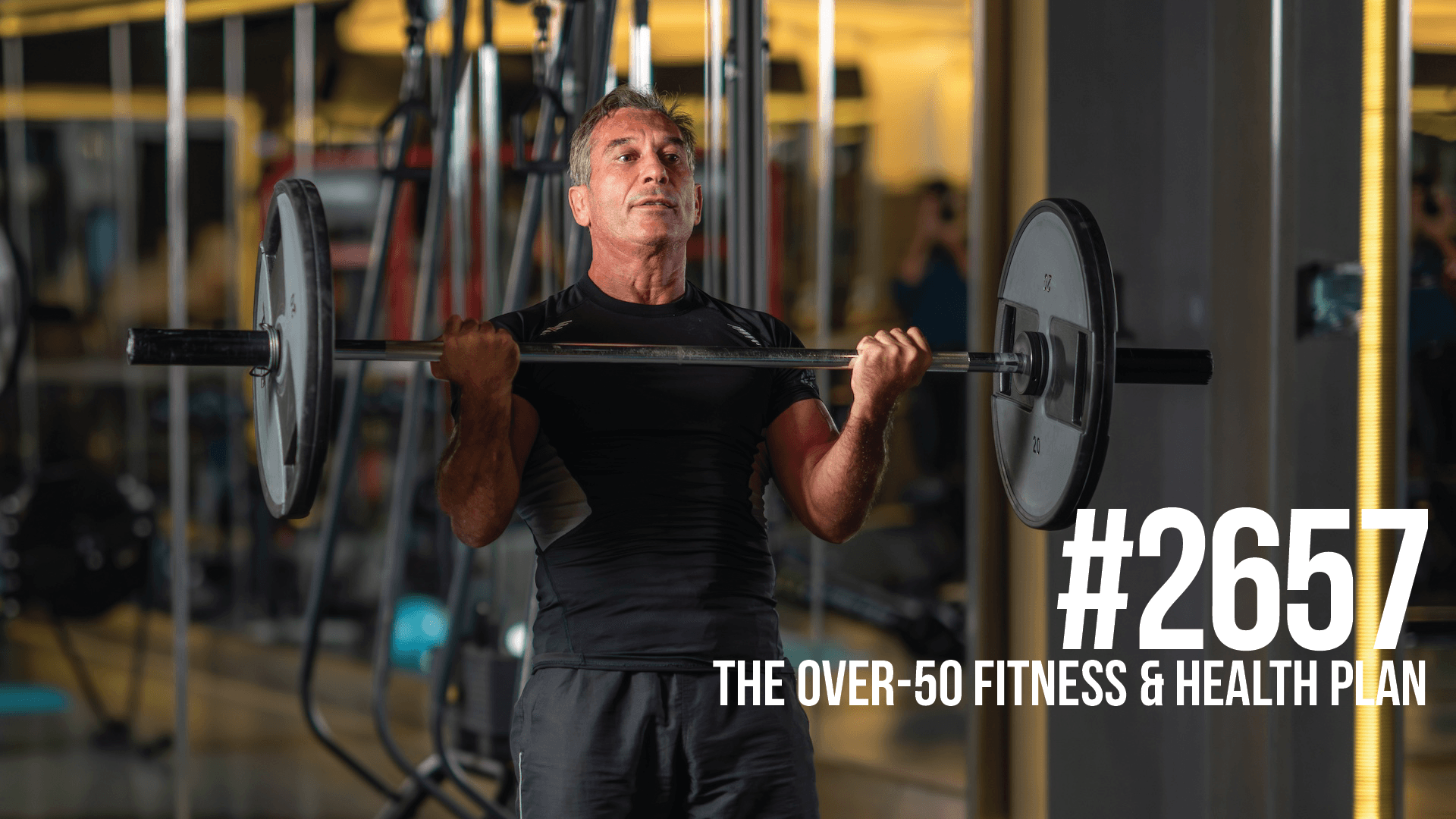
Mind Pump episode 2657 lays out an “over-50 fitness & health plan” covering strength training, daily activity, diet, sleep, and key supplements. Guests/hosts: Sal DiStefano, Adam Schafer, and Justin Andrews (fitness/health educators).
Key claims
age doesn’t remove the ability to build muscle; most failures come from wrong methods and overdoing intensity. A fit older person can be dramatically healthier than peers (even healthier than an average 30-year-old).
Notable examples
clients in their 50s who previously weren’t active reported “best shape of my life” after applying the right approach; deconditioned beginners benefit from novelty stimulus. Workout: 2 full-body strength days/week (example Day 1 includes sled pushes, incline dumbbell press, cable rows, standing DB shoulder press, DB curls, triceps pressdown, plank, plus trap bar deadlift, elevated push-ups, lat pulldown, rear fly, hammer curls, close-grip push-ups, cable chops, calf raises). Activity: target ~8,000 steps/day, progressing to 10k/12k. Diet: protein first (women ~30g/meal; men ~45g/meal), then vegetables, then starch/fruit; eat until satisfied. Sleep: 9-hour time-in-bed window; glycine ~3g + magnesium before bed. Supplements: vitamin D+K and creatine (5–10g/day).
Written by AI. May contain mistakes. Listen to the episode to check what was said.
Chapters
Tap a time to open that second in VOIntroduction to Mind Pump
1:24 to 2:00
The hosts introduce Mind Pump and outline the episode's topic on fitness for those over 50.
“If you want to pump your body and expand your mind, there's only one place to go.”
Understanding Fitness Over 50
3:05 to 4:36
Discussion on how age affects fitness and the importance of proper methods in workouts.
“Look, if you do it right, your body will respond.”
Building Muscle at Any Age
4:36 to 8:12
Exploration of muscle-building potential for individuals over 50 and the right practices.
“I can't tell you how many clients I had in this age group, uh, in their fifties that, uh, they didn't really have a fitness lifestyle in the past.”
Effective Workout Strategies
8:12 to 11:01
Outlining a two-day strength training workout plan and its effectiveness.
“I did say that your ultimate potential definitely reduces as you get older.”
Choosing Weights and Practicing Movements
11:01 to 12:21
Advice on selecting appropriate weights and focusing on movement practice for beginners.
“on a consistent basis following this program.”
Strength Training Fundamentals
12:21 to 14:00
Explanation of how to structure strength training sessions for optimal results.
“Number one, you should feel better at the end of the workout than you did in the beginning.”
Strength Training for Over-50s
14:00 to 23:18
Learn effective strength training exercises tailored for people over 50.
“Lowering a weight causes more damage and soreness.”
Daily Activity Recommendations
23:19 to 25:04
Discover the importance of daily activity and step tracking for health.
“and you're going to see when it feels like...”
Basic Diet Guidelines
25:05 to 27:39
Understand dietary recommendations for protein intake and meal structure.
“I'm going to give some very basic suggestions for diet.”
Sleep and Supplement Tips
27:40 to 28:01
Get insights on improving sleep quality and essential supplements.
“Turn off your electronics an hour before bed.”
Show all 12 chapters
Essential Supplements for Better Sleep
28:01 to 29:39
Learn about two key supplements that can improve sleep quality.
“And then have some magnesium before bed.”
Starting a Fitness Journey in Your 50s
29:40 to 30:41
Discover the importance of consistency and the right approach for fitness in your 50s.
“that were old athletes, were really jacked before.”
Transcript
Automatic transcript. May contain errors.0:00Hi, I'm Jake Rez, also known as Nurse Jake. As a travel nurse, I've worked in all kinds of places, different settings, cities, and climates. Every assignment brings on a new challenge, which is why I always bring my figs. These scrubs are built for whatever the job throws at you. They're breathable, flexible, and comfortable in any environment. No matter where I land, I know they're going to keep me looking and feeling my best. And don't sleep on the details. The pockets, the features, the finishing touches, everything has a purpose and it makes a real difference when you're moving nonstop. The fit is clean, tailored, and super polished, and they come in a huge range of colors.
0:34In other words, they feel great throughout a 12-hour shift, and they always look good. See every healthcare professional on Instagram. If you work in healthcare or know someone who does, check out Figs and get 15 % off your first order at wearfigs.com with code FIGSRX. That's wearfigs.com, code FIGSRX. Hey, Chicagoland. The Wayfair store is in your neighborhood at Edens Plaza in Wilmette. Finally, you can feel the fabric, sit on the sectionals, and even open the refrigerators. Plus, our in-store designers will help you bring it all together with free one-on-one design support for any project on any budget.
1:10Yep, we said free. Oh, and did we mention the cafe? So what are you waiting for? Come see all that's in store. Visit the Wayfair store today at Edens Plaza and Wilmette.
1:22Adam Schafer:Wayfair, every style, every home. If you want to pump your body and expand your mind, there's only one place to go. Mind Pump. Mind Pump. With your hosts, Sal DiStefano, Adam Schafer, and Justin Andrews. You just found the most downloaded fitness, health, and entertainment podcast. This is Mind Pump. Today's episode is for those of you over the age of 50 who want to be fit, healthy, lean, and strong. In this episode, we give you the workout, the diet, how to sleep. We even talk about supplements. You have everything you need in this episode. We know you're going to love it. By the way, this episode is brought to you by a sponsor, Masszymes.
2:04Adam Schafer:These are digestive enzymes that help break down those proteins, carbohydrates, and fats for better digestion and better nutrient absorption. Go check them out. Go to Masszymes.com. That's M-A-S-S-Z-Y-M-E-S.com forward slash MindPump. Use the code MINDPUMP10, get 10 % off. We also have a sale on a workout program this month. MAPS 15 is 50 % off. Now, this isn't some random quick workout routine. It's a fully structured program that solves the number one fitness problem, staying consistent. With MAPS 15, you'll get short 15-minute daily workouts that you can stick to. They build muscle. They burn body fat.
2:45Adam Schafer:It's just 15 minutes a day. and you can do them at home with minimal equipment or if you want to use barbells and dumbbells, there's a version in that for those as well. Head over to mindpumpmedia.com forward slash maps dash 15 dash minutes and use the code muscle50 at checkout for the 50 % off. Back to the show. Fitness and health over 50. Workouts, diet. Look, if you do it right, your body will respond. You'll get incredible results. The problem is most people do it wrong. They mess up. And then they blame it on age. It's not age. It's how you're doing it. Today, we're going to talk about the right way to work out and eat to get great results if you're over 50 years old.
3:29Adam Schafer:I looked ahead here. We're going to put together a legit plan for people. Let's give them a plan. I want people to leave with something they can actually practice. Concrete. That they can do themselves. I like it. I want to start off by saying, and there's many studies on this. In fact, there's studies on 70 and 80-year-olds around this. Your body never loses the ability to build muscle and improve its fitness. Now, the difference is the potential, right? The max strength and fitness for a 70-year-old is going to be different than when they were 20. That's true. That being said, your body still adapts.
4:05Adam Schafer:And it's remarkable at how it adapts. There was a recent study with people in their 70s, and they built exceptional muscle and strength in a very short period of time. The reason why I'm saying that is there are challenges as we age that if we apply exercise wrong, we don't respond. We get more aches and pains. It feels like we're just working out for no reason. This is not making me feel great. Why isn't this body fat coming off my body? And it has more to do with the methods and how you're applying them than it does your age. It really does. and a majority of our clients uh back in the day when we used to train people this is it do you they were in the stage room yeah do you think the misconception out there is really because of a lot of the marketing for like let's say like asper cream or like advil or you know like they're always like highlighting these pain points of your aging they scream give up yeah exactly it's like give up take this instead for all these eggs and instead of like realizing there's still a lot of potential left for you to still build muscle and improve.
5:07Adam Schafer:Yeah. I can't tell you how many clients I had in this age group, uh, in their fifties that, uh, they didn't really have a fitness lifestyle in the past. Um, and then, you know, after training with me and applying it the right way, this is so important, everybody. Like if you do it the right way with considerations, which we're going to talk about, cause there are general considerations for people in this age group. If you do it right, you respond great. And many of these people would tell me I'm in the best shape of my life. And I never thought this would happen.
5:34Sal Di Stefano:There's another way to reframe this too, for that person who feels discouraged or, oh my God, I'm so out of shape or I've never lifted weights. And this seems like it's so far away. The positive side of that is, man, anything we do is going to be a novel stimulus. And in the game of adaptation, that's a huge win for us. The fact that you haven't done anything. So I have to do very little to get your body moving in the right direction, which I think that's a very positive way to look at that. You look at it like, oh my God, I had this long mountain to climb, but it's like, hey, but you know what's cool is that you haven't done any of these movements I'm gonna teach you and the body is gonna right away start going, oh my God, this is new, this is different.
6:19Sal Di Stefano:And that is such a, the game of novelty when you have been doing this for a really long time, it gets difficult. You've been lifting for 20 years. One of the challenges of being consistent, yes, you may be healthier, stronger, a higher ceiling than that person, but also getting this novel stimulus and always having to kind of progressively overload the body to see more results versus the person who's deconditioned, out of shape, this is all new, scary. That's actually a really good thing because we're going to start seeing change relatively quick.
6:47Adam Schafer:If you follow what we're about to say, so long as it's appropriate, because of course we're doing a general episode, this should be appropriate for about 80 % of the people watching this. If you follow this, you're going to see really good results and you're going to feel good. And it's not going to feel like you're beating the crap out of yourself. One of the big mistakes people make in all age groups when they start a workout is they over-apply everything, thinking that that's going to get them faster results. That's not true at all. Some of the considerations that we need to take when constructing a routine around somebody over the age of 50, well, one, joint issues and pain is a bigger consideration.
7:25Adam Schafer:Okay. That's a fact. So we pick exercises or we pick movements where that becomes less of an issue. There's going to be exercises in here that are effective, that give you great results, that build strength and muscle and speed up the metabolism and help balance out your hormones, that tend to be easier on the joints. And we picked exercises where we're not trading results for safety. Sometimes that's what happens, right? The best exercise is over here. but I have to really take away the, in order to make it safe, I'm also taking away its effectiveness. That's not necessarily true with a lot of movements.
8:00Adam Schafer:So we picked exercises that are safer, less likely to cause pain. Many people watch this. Most people watching this, so long as you don't have major injuries are going to be able to perform these movements and get phenomenal results. Here's another truth, by the way, as you get older. I did say that your ultimate potential definitely reduces as you get older. I don't think I need to make that case. However, this is also a fact. A fit 25-year-old is only this much different than an average 25-year-old. There's definitely a difference, but it's not a huge difference. When you're 50, 60, 70 and you're fit, the difference between you and your peers is massive.
8:41Adam Schafer:It's massive. A 55-year-old that does things right, that exercises, that takes care of themselves in the right ways, like we're going to talk about, is so different from their 55-year-old peers who don't do these things. They almost appear to be in a different universe. And that's the thing that you need to consider here is when you start to do this and you start to become more fit, watch what happens over the course of six months and a year. Look at yourself versus your peers who aren't doing this, and they're going to be blown away.
9:09Sal Di Stefano:A fit 55 to 60-year-old is in better health and condition than an average 30-year-old. That's right. I mean, that's - The evidence shows that. Think about that. You could be 55 years old or above and be healthier, fitter, stronger, better shape, all the markers than the average 30-year-old. That's right. And you can control that. That's right. And doing the - I love the exercises you picked. I looked at the stuff that you did. And it does really open it for everybody, right? But you hear on this podcast a lot, we talk about the benefits of barbell back squats and barbell deadlifts and just how that's such a great movement, the biggest bang for your buck.
9:50Sal Di Stefano:But in reality, when you go back to our list of clients that we've all trained, there was a big percentage of them that I couldn't start there. We had to work to that. And sometimes it took years to even get to a place where we could do that. And so the plan that you put together right now looks more realistic to the average beginning program that I started a lot of people on before I could ever get them to ultimately those things.
10:16Adam Schafer:Right. So the workout is going to be, uh, consist of two days of strength training, full body. Now you might be thinking, is that enough? Yes. In fact, it's more than enough. Two days a week of full body, effective strength training. By the way, effective doesn't mean you beat the crap out of yourself either. Effective just means effective. two days a week of, in combination with daily activity, which we'll get to as well, but two days a week of structured strength training, full body, done properly, will build phenomenal muscle, will build phenomenal strength, will help your metabolism move in a faster position or place so you can burn more body fat.
10:52Adam Schafer:It's full body, two days a week. And if you're listening to this and you don't think it's enough, trust me, try it yourself. Try it for 60 days and see what happens. You'll get stronger on a regular basis, on a consistent basis following this program.
11:04Sal Di Stefano:I want to comment on something I'm sure you'd get around to saying, if so, I'm going to beat you to it. Because I know one of the questions that people get after we lay out the exercises and kind of the program is, well, what weight do I choose? What do I do? Approach it with just practice. Do not overthink the amount of weight you need to do. And like, is that important? It's like, if we haven't been doing any of these movements, pick a very light and easy weight and just go practice the movement. Go get good at the movement. that especially in those first couple months is going to take you so far if you're not doing any of these things and i start you off really light and easy and it's really just go there and practice these movement you're going to see so many you're still going to build muscle just from that that's just from that without because i know that that's the next hurdle that people get is like okay got it here's the exercises well how much weight do i do and how hard do i have to push it's like don't think like that this is one of those situations too where yeah you pick the lighter weight, but also you can control your effort with that movement.
12:03And what I mean by that is really increasing your tension, your contraction of your muscle, you can intrinsically create a bit more effort and output that way, which is a safer way to do it, which then also increases your strength and then naturally will allow you to then pick a heavier load.
12:20Adam Schafer:Right. So what it's going to look like, so here's some metrics for you. Number one, you should feel better at the end of the workout than you did in the beginning. Okay, so when you're doing this workout, if at the end of the workout, you feel like you survived it, you feel like you beat yourself up, you went too hard. You should feel good. At the end of it, you should feel like, man, you know what? I feel energized. That means you had a good workout. Now, the workout will be challenging. You should challenge yourself, but don't go beyond challenging yourself. Pick weights that are kind of hard, but ones that allow you to, like Adam said, practice the movement and have good, perfect technique.
12:54Adam Schafer:Okay? Both workouts are full body. We're going to go through day one first and both workouts start with a lower body exercise. And typically what you do when you train full body is you start with the larger muscle groups and you move to the smaller muscle groups. Now, why is that? Well, one of the reasons is small muscle groups are involved often in the larger muscle group exercises. You don't want to fatigue them before you need to, number one. Number two, you want to do the harder exercise at the beginning when you have the most energy and end with the ones that require the least amount of energy.
13:27Adam Schafer:So let's start with day one. So day one, we're going to do a leg exercise, and you're going to start by pushing a sled. Pushing a sled is an exceptional way to build strength and muscle in the lower body. It's also simultaneously incredibly functional. It's one of the few lower body exercises that doesn't just involve the upper leg, but it involves the lower leg and the foot. You're extending all the way through. You're on the balls of your feet and you're pushing. There is no negative portion of the rep. So when you're lifting a weight, the positive portion would be me curling a weight. The negative is me lowering it with resistance.
14:01Adam Schafer:Lowering a weight causes more damage and soreness. Pushing a sled - More stress around the joint. There is no negative. It's just pushing. So what you want to do is you want to get yourself a sled. Most gyms have them. Load it with some weight. You want to challenge yourself a little bit. And you want to push it for about 20 to 30 steps. That's how you do this exercise. And it's a great lower body exercise. and you want to do it for three sets, three rounds. By the way, in between each set, you should rest around two minutes, okay? You're not trying to go through every exercise one after another.
14:31Adam Schafer:This is strength training, not cardio training. We're trying to build muscle. The rest in between sets is what makes it strength training. It's what builds the muscle. If you don't rest, what you're going to get is stamina, which is okay if that's what you want, but you're going to miss out on the muscle building, metabolism boosting, hormone balancing effects that strength training provides.
14:49Sal Di Stefano:And to emphasize what Justin said, as you go through choosing the weight. Again, don't overthink that. Choose a weight that's somewhat challenging, but what you can do is do long, slow strides to emphasize the intensity. Then you also get the extra benefits of really kind of challenging your mobility, priming yourself nice and slow and controlled. You can intensify it without adding more load to it, so don't overthink. How much weight do I put on this sled? You can always slow it down and take longer, deeper strides. That's how I would approach this slow push.
15:21Adam Schafer:So three sets of that. Next, we're going to move to a chest exercise. I chose incline dumbbell chest press. I like the incline because it puts the shoulders in a better position than a flat bench. A flat bench is fine as well. It's just a little bit more technical. Some people have issues with that, especially when they first start exercising. And laying flat on your back can be an issue for beginners sometimes. For sometimes laying on your back can cause issues where you need to get back up. Getting down with dumbbells can be difficult. Incline is a little bit more, a little easier. And so with an incline dumbbell chest press, you are working the shoulders, the triceps, and the chest.
15:56Adam Schafer:And again, you want to do three sets. Rep-wise, I think if the reps are anywhere between 8 to 15, we're perfectly fine. I don't care if it's 8, I don't care if it's 15, but keep it within that range. Lower than 8, higher than 15. Now we're moving out of what I would be considering effective at this point with the repetition.
16:14Sal Di Stefano:And just so the audience knows, every single exercise that we talk about or describe today, you can go to the Mind Pump YouTube channel, put in on YouTube, put in Mind Pump and then the exercise, and you will see us teaching and performing this exercise. So if you need a video demonstration of what the form and technique looks like with coaching cues, it's on our YouTube channel. It's absolutely free. You literally would just put in Mind Pump and then the exercise that we are mentioning right now, and then you'll see the breakdown. Yeah, I love that you picked the incline especially because one of the biggest problems we see is this protraction of the shoulder, which causes some pain there to occur.
16:53So to be able to naturally allow those gravity to kind of pull and set you in that better position with your shoulders, the incline bench is preferable for that.
17:02Adam Schafer:Yes. Next up are cable rows. I love this exercise for everybody. Now with a cable row, you want to sit nice and tall. And what you want to imagine is you want to bring your shoulder blades together and down, right? You want to fight the urge to shrug your shoulders, and definitely don't let your shoulders roll forward. You're pulling the handle to your belly, squeezing the shoulders back and down. This is a posture exercise. It strengthens the muscles of the back, in particular the mid-back muscles, and people benefit greatly from this, especially people in this age group. This will make you feel taller if you do this properly.
17:37Adam Schafer:You'll stand up and feel so good from doing this one. Next up, standing shoulder dumbbell press. This is just standing straight up, taking a pair of dumbbells, pressing them up nice and tall and bringing them down all the way. This is a shoulder and tricep exercise. And then we're going to finish off with some easier movements. Dumbbell curls, a tricep press down. I chose a press down because that tends to be easiest on the elbows. Sometimes overhead movements with triceps can cause people elbow pain. So pressing straight down, perfectly fine. And then you're going to do a plank. So a plank is where you hold yourself in this elevated position on your forearms, tuck your tailbone a little bit and hold this for 20, 30, or 60 seconds.
18:17Adam Schafer:What we're trying to do here is build strength and stability in the core, which is going to help support your low back. And I chose a plank because it's a safer exercise for the low back for a lot of people. I like that you're challenging the standing. I mean, to regress that though, just to be safe, if like there's any stress in the lower back and you don't know how to brace properly, You can always sit and do the shoulder press that way. You can even kneel, which I would even prefer, do a kneeling shoulder press.
18:45Sal Di Stefano:And then the plank, although probably sounds like the most basic of all these movements, I would highly recommend watching the YouTube video that Sal teaches the plank on that YouTube channel because I do think this is a commonly misdone exercise in the gym. You see people tend to arch their low back and so we tend to coach with like this tucking of the tailbone exaggerating that a little bit because i think it's not only is it it's safer it's more proper and it engages the core so you're not resting the weight on the low back which tends to be how most people do this exercise so even though that seems basic most people go oh i know what a plank is and they just get down and
19:26Adam Schafer:do it watch that video yeah next up we have a deadlift but i picked a trap bar deadlift way less potential strain on the low back. It's far less technical. It's easier to do, but it's still a deadlift. It's still a great deadlift exercise. And it's one that is exceptional at building the strength of the low back, the glutes, the hips, the hamstrings. A trap bar is just the bar that you stand inside of. Handles are at your size. Nice neutral grip, which I always love. Brace your core, stand up with it, put it down. Here's a mistake a lot of people make. They go up and down real fast. Bring it down to the floor.
20:02Adam Schafer:Let it sit on the floor for a good second or two. Pause. Brace your core. Come back up. That's how you do a rep. Three sets.
20:09Sal Di Stefano:Such a great entry-level hinge movement, right? There's no way we build a program that doesn't have some sort of a hinge in there. This is probably the safest entry-level place to take everybody from. And you can get really strong, tremendous benefit from it. And it is the natural regression to a traditional type of a deadlift.
20:27Adam Schafer:Next up is a push-up. Now, of course, you can go on the floor and do push-ups. And if you can do push-ups that way, that's great. But a lot of you might not be able to. Elevate yourself. Elevate. Elevate. On top of a bench. So what this would look like is my hands are on a bench, or I can use a bar on a squat rack or a Smith machine. I can lift it up as much as I need to where I'm not bending over quite that much. And the reason why I like push-ups is it involves core stability. I got to brace my core while I do this. Very functional chest, shoulder, and tricep exercise.
20:55Sal Di Stefano:This is actually my favorite way to use the Smith machine. I prefer it actually to a bench because it's nice to get that firm grip. And you have all the levels. So I could take a client. I mean, I could take a client who cannot. I mean, I've had clients so deconditioned that just pushing their body weight off a wall is challenging enough. So taking somebody on a Smith machine where they're this angle and then here, then here, and then you could progress them very nicely. And what a great way to show that client who couldn't do that, that progression to where they eventually can do a traditional push-up.
Read the full transcript
21:28Adam Schafer:Next up is a pull-down. So this is a pull-down machine. And you're going to just take a regular overhand grip. You don't want to go too wide. You want to go about shoulder width, so nothing crazy. And you're going to pull the bar down to your upper chest, stick your chest up, pull their shoulders down and back. This is a great back exercise. Too wide, you're probably going to feel it in your shoulders. I know you see a lot of bodybuilders do that. Not a bad exercise, but it requires more shoulder mobility. So you're literally going to take about a shoulder width grip on that. Next up, we're going to do what's called a rear fly.
21:57Adam Schafer:With the rear fly, you want to lay on an incline bench so it supports your chest. And you just take these dumbbells and you separate them out. This is going to work the back of the shoulders. And it's also going to work on some of your posture. Then we get to the easier exercises. Hammer curls, just like regular curls, except your hands stay neutral. And then you have a closer grip push-up. So again, you can go back to whatever bar you used. And rather than having your hands outside your shoulders, Now put your hands about shoulder width. This is more of a tricep exercise. You try and keep those elbows in close.
22:27Adam Schafer:That's it. And then next up, we have a cable chop. This is great for rotation, strengthening the core. And it's literally, you just take a cable, stand with your feet together, and you want to use your body to rotate across the body. All of these, by the way, are three sets. All of these are eight to 15 repetitions. And then finally, a standing calf raise for the calves. Most gyms have a calf raise machine. And if they don't, you can stand on a block and do them with just your body weight. This basic exercise, this basic workout that we just gave, if you're starting a workout, this right here will have you progressing for six months to a year.
23:02Adam Schafer:I mean, honestly, you don't have to change much. What's going to change is the amount of weight that you continue to use on each exercise. You can add more and more and more. It covers the entire body. And again, you want to feel better at the end of the workout than you did at first. The intensity will naturally progress as you become more fit. and you're going to see when it feels like...
23:21Sal Di Stefano:Since we're talking about the workout portion, and I think this goes hand in hand with the activity, even though I know you have diet coming up next, I think it's important to talk about activity because the very common question I get from the client who's super motivated right now is, what if I want to do more? What if I want to come to... This is where I'm going to encourage my client to walk. And typically what I want to know is like the baseline where they're currently at. So I love using any Apple Watch, Fitbit, Oura Ring, whatever tracker, it doesn't matter. Anything that you can get a cheap$4 on Amazon pedometer, but just get an idea of where our baseline steps are and we're going to start.
23:51Sal Di Stefano:Now I know you put as a target right out the gate to start for about 8 ,000. I think that's a great goal. Typically I just figure out where their baseline is and I add 2 ,000 every week. And that the goal is, Hey, if you got, if you, you have more time, you have days, you want to go to the gym more often or whatever, walk. This is where you're just going to, we're going to encourage more movement and activity right here. We don't need to necessarily do anything more strength training yet.
24:13Adam Schafer:Walking is one of the best forms of daily activity. It results in very, very low risk of injury. It has tremendous health benefits. Generally speaking, 8 ,000 steps is what you want to aim for. 8 ,000 is where you'll get about 80 % of the benefits that we see from daily activity. And I like measuring steps because it's just what you do throughout the day. So if you want, you can get on a treadmill and try to hit this. Or what I like to do with my clients is track your steps throughout the day. And if they're low, just go out for another little walk. And basically, by the end of the day, you want to hit 8 ,000 steps.
24:46Adam Schafer:Once that feels easy, then you can move it up to 10 ,000 steps. And once that feels easy, then 12 ,000 steps. And if you did 12 ,000 steps on a regular basis daily, plus two strength training workouts, like we said, that is a great pro-health, pro-muscle, going to get leaner, feel good type of routine. Now let's get to diet. I'm going to give some very basic suggestions for diet. And that's, and these are, by the way, these are basic suggestions that have a high ROI, return on investment. There's lots of different things you can do with your diet, but we like to give advice on the ones that tend to move the needle the most that are also the most simple.
25:24Adam Schafer:And I'm going to generalize here. Women, I want you to aim for about 30 grams of protein per meal. Breakfast, lunch, and dinner, 30 grams of protein. For men, 45 grams of protein. Now here's the kicker, eat it first. Whatever your plate looks like, here's your 30 grams or 45 grams of protein, eat that first. That has the highest satiety effect, so it tends to naturally make you wanna eat less. It also causes, it is really good for insulin sensitivity. It helps stabilize blood sugar, which makes you feel better. Also helps with fat burning. So do that first. Second on the plate are vegetables. Eat that second.
26:01Adam Schafer:And then finally, you can have your starches or your fruit. All right, here's the best part of all this. Eat until you're satisfied. I'm not going to tell you to eat less. If you just do this and you stick to whole natural foods, you will see yourself get leaner in a nice consistent basis. So 30 grams or 45 grams of protein first. You have your vegetables next. And then eat your starch or your fruit. Eat until you're satisfied. If that's what your meals look like with no processed foods, you're going to crush. You're going to get great, great results.
26:28Sal Di Stefano:And I'd like to add to this because what's really common, and you get somebody doing good strength exercise like this, moving more like this, the appetite will kick up. And I actually want to feed you. I want you to eat. So let's say you're eating three meals, you're adhering exactly what it sounds like. You're like, man, I'm still hungry. Have another meal. Just like the same format too. Have another meal. Eat it with 45, if you're men, grams of protein. Eat it first. Women, 30. Because you're still landing at three meals. For women, 90 grams of protein. For men, only about 130 grams or 135 grams of protein.
26:59Sal Di Stefano:That's still on the lower end of protein. We can still afford another high protein. You can have another meal. Another meal. And that's how we start here. This is where I want them to start. And then if they come back to me like, Adam, I am just, I am hungry. My appetite is, have another meal. Have another meal. You're going to burn muscle. Good. That's a good sign. That's our metabolism kicking up. And I do not want to restrict from it. I want to feed it. And I want to give it another meal. And I want to just, again, stick to those same exact rules all the way through. That's going to serve you really well.
27:26Adam Schafer:Now, what you don't do is aim for processed foods in this case. Notice I'm talking about whole natural foods. But again, if you just do this, you're going to see yourself get leaner and build muscle at the same time. All right, now we're going to talk about sleep. Sleep is very important. Turn off your electronics an hour before bed. And again, I'm going to preface this. We're going to talk about the things that make the biggest difference, okay? Give yourself a nine-hour window every night. So go to bed and then wake up, and that should be nine hours. And the reason why it's nine hours is that helps guarantee about seven and a half to eight hours, right?
27:56Adam Schafer:We don't go to sleep right when you hit the pillow. So nine hours every single night. And here are the two supplements, the two things you could take before going to bed that studies have shown to have the biggest impact on improving sleep quality that are also not narcotics or not hormones, okay? You take about three grams of glycine. This is an amino acid. And then have some magnesium before bed. That combination for many people improves the quality of their sleep. Now, since we're talking about supplements, here are the supplements that make the biggest difference for many people, but especially people in this age group.
28:28Adam Schafer:A multivitamin, about 2 ,000 IUs of vitamin D plus K. So if you buy a vitamin D supplement, you'll get the one that includes vitamin K. They're both needed to be used appropriately or to be effectively. And then creatine. Creatine is the longevity supplement. It has profound effects on muscle, longevity, health, and cognitive function. Aim for 5 to 10 grams a day. 10 grams is better for the brain. 5 grams is just for muscle. If you do 10 grams a day, divide the doses up throughout the day. 10 grams all at once tends to cause stomach distress. So what it would look like would be I'd have 3 grams with breakfast, 3 grams with lunch, 3 grams with dinner, and that's not going to bother your stomach.
29:12Adam Schafer:And creatine, again, a great longevity. It's actually the longevity supplement for health and for muscle building, and it'll help indirectly with fat loss.
29:21Sal Di Stefano:And I want to add to this advice goes for anybody, whether you were a ex-athlete, used to be in great shape. If you are just getting back on your routine and you are in your 50s, start here no matter what, no matter how advanced of a level you think you were before. because I can't tell you how many 50-year-old clients that hired me that were old athletes, were really jacked before. And so when I would train them like this, it's not enough. No, it's enough. I can do more. We could do this. Why aren't we doing it? Like, this is all you need to do. This is all you need to do and watch how far this takes, especially for like the first six months.
29:58Sal Di Stefano:The first six months, this will take you so far. And really, the thing you want to focus on is consistency. Can I check all the boxes that we just said? day in and day out, and how many of those days can I string in a row? That in itself is difficult. That in itself is difficult. And so if you find yourself with extra time and you're wanting to do more workouts, spend more time planning the other things to make sure you're successful. If you are really, really good about doing workouts, you want to do more of them, but then you're a little inconsistent with the diet, well, then maybe take that extra time and plan your meals out so you hit your meals on time.
30:32Sal Di Stefano:Or maybe you take that time to get to bed earlier and get better sleep. So try to check all those boxes, be consistent with that and watch what happens in the next six months.
30:41Adam Schafer:The last thing I'll add is the right dose is the best dose. Again, just to add to what Adam said, doing more will not get you faster results. Doing more will get you slower results. We'll actually compromise your body's ability to adapt. Adapt meaning build muscle, improve stamina and endurance and burn body fat. Look, if you like this show, come find us on Instagram. You can find us at MindPump Media. We'll see you there. Thank you for listening to MindPump. If your goal is to build and shape your body, dramatically improve your health and energy, and maximize your overall performance, check out our discounted RGB Super Bundle at MindPumpMedia.com.
31:19The RGB Super Bundle includes MAPS Anabolic, MAPS Performance, and MAPS Aesthetic, nine months of phased expert exercise programming designed by Sal, Adam, and Justin to systematically transform the way your body looks, feels, and performs. With detailed workout blueprints and over 200 videos, the RGB Super Bundle is like having Sal, Adam, and Justin as your own personal trainers, but at a fraction of the price. The RGB Super Bundle has a full 30-day money-back guarantee, and you can get it now plus other valuable free resources at mindpumpmedia.com. if you enjoy this show please share the love by leaving us a five-star rating and review on itunes and by introducing mind pump to your friends and family we thank you for your support and until next time this is mind pump
From the publisher
The Over-50 Fitness & Health Plan
-
The body is always adapting; if you do it right, you will respond great! (1:42)
-
Considerations to take into account when constructing a routine for this avatar. (5:49)
-
The RIGHT Way to Workout & Eat to Get GREAT Results if You're Over 50 Years Old.
-
An effective full-body workout 2 days a week. (8:52)
-
Day 1: Push a sled, incline dumbbell chest press, cable rows, standing dumbbell shoulder press, dumbbell curls, press down, and a plank. (12:02)
-
Day 2: Trap bar deadlift, push-ups, pull-downs, rear flys, hammer curls, closer grip push-ups, cable chop, and standing calf raises. (18:03)
-
Activity: Aim for 8k steps a day, then 10k, and then 12k steps a day. (21:57)
-
Diet: Women eat 30, men eat 45 grams of protein per meal FIRST, eat veggies SECOND, and eat a starch or fruit LAST. (23:40)
-
Sleep: No electronics, take glycine and magnesium before bed, and aim for a 9-hour window. (26:13)
-
Supplements: Multivitamin, 2000IU Vitamin D plus K, and creatine 10 grams a day. (26:57)
Related Links/Products Mentioned
-
Visit MASSZYMES by biOptimizers for an exclusive offer for Mind Pump listeners! **Code MINDPUMP10 at checkout for 10% off any order. **
-
August Special: MAPS 15 50% off! ** Code MUSCLE50 at checkout **
-
How Do I Choose The Right Weight? (LIFT RESPONSIBLY) – Mind Pump TV
-
Mind Pump TV - YouTube – Search ALL exercises with videos and coaching cues mentioned above.
-
Walking 8,000 steps just 1-2 days a week linked to significant health benefits
-
Mind Pump # 2497: The Amazing & Weird Side Effects of Creatine


