
 Monetary Matters with Jack Farley
8 Nov 2026 · 1h 5m

 Add vo to ChatGPT or Claude to ask about everything you hear
vo listened to this episode to put together the overview and transcript, so there may be the odd mistake.
Private credit’s hidden risks, especially credit fundamentals, liquidity/asset-liability mismatch from retail inflows, and interconnected exposure through insurers/reinsurers; includes claims about “extend-and-pretend,” mis-marking, and potential systemic issues.
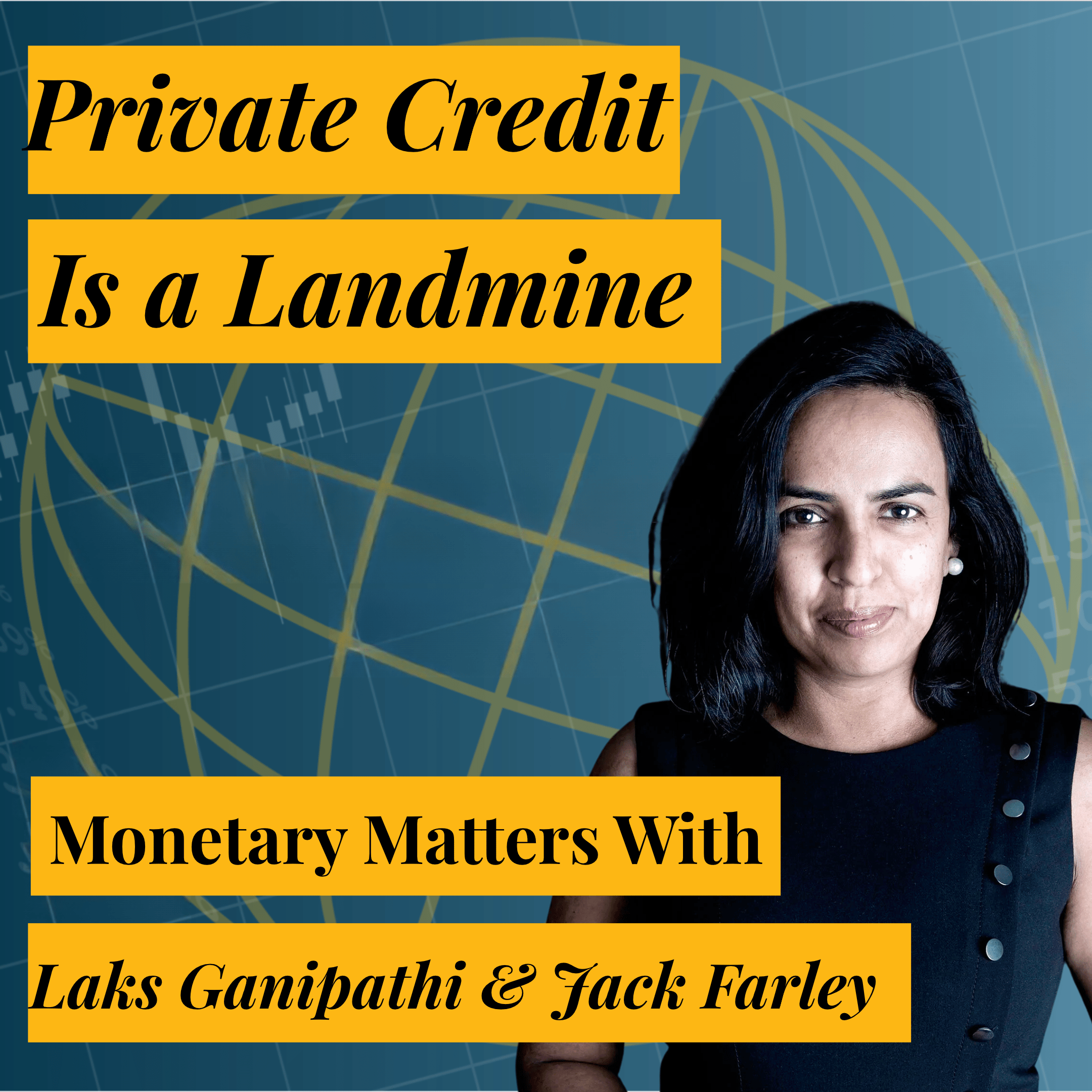
Laks Ganapathi, founder of Unicus Research and Minerva Investment Management (short-biased). He says he has done private credit loan-book analysis since 2021–2022 and also “boots on the ground”/source work. Michael Burry is mentioned as a senior advisor (views are his own).
Private credit grew after 2008 and moved into consumer lending and commercial real estate; underwriting/due diligence is allegedly not happening for some funds. Retail wealth channels allegedly pushed illiquid, long-duration risk without proper disclosure, creating redemption risk. He argues reported default rates may be understated due to “extend and pretend” and Payment-in-Kind (PIK) accounting. He expects more redemptions/caps and a “bloodbath,” though he says the asset class may survive.
BlackRock HPS Corporate Lending Fund (gated after $1.2B redemptions; $2,500 minimum). Atlantic Coastal Life receivership tied to alleged reinsurance/loan collateral problems connected to 777 Partners/Lead and Haul Capital Partners (double-pledged collateral; Bermuda reinsurance license canceled for nonpayment). He also cites BDC/loan-book sector findings: healthcare providers/services, consumer goods, HR services, education, and household products—not just software/AI.
0:00This episode is brought to you by Sarmaya Partners, who manages the Return to Tangibles ETF, LENS, ticker L-E-N-S, the Sarmaya Thematics ETF, built for a return to tangibles. Learn more at SarmayaETF.com and see the show notes for disclosures. Let's get into it. My guest today is Laks Ganapathi, founder of Unicus Research and Minerva Investment Management, a short biased fund. Michael Burry has joined as a senior advisor and her views are her own. Laks, welcome to Monetary Matters. Thank you, Jack. Good to be back. You've been doing a lot of work on private credit. Yes. What drew you to the field of private credit and what's the source of your concern here?
0:36How worried are you and why? It's important to understand the private credit and non-bank financial institutions. They started to thrive after 2008 when there were so much regulations and enforcement. And they've been growing quietly under the radar, in the shadows, as I would like to say it. But over the past, since 2020, it has kind of gotten into mainstream and private credit started to penetrate into consumer lending and commercial real estate lending. And that field is like a little bit beyond their usual lending to small businesses and such. So we have been observing private credit since 2008, but we started to focus keenly into the nitty-gritty of the loan book analysis of the private credit since 2021, 2022.
1:34One of the reasons is because EquitySide was not telling us the story that we wanted to know. EquitySide always says that it's all nice, it's all rosy picture, and we wanted to know what's the real picture. So there are two ways to get the real story if you wanted to understand what's the underlying problem in a particular company or a particular loan book. And that would be either through loan book analysis, which is what we've been doing on private credit. And the other one is speaking with sources, speaking with previous employees and doing surveys and boots on the ground kind of work, which is what we've been doing on the data center as well.
2:18So the concern for me with respect to the private credit is mostly to do with how, from the point of view of democratic investing for all facade, they are retirees, annuity holders, and all their money is being used to invest in illiquid assets like private credit. credit. And that is my concern. And that's what made us look more into private credit on the loan book analysis, nitty gritty side. I think you were saying a lot of the analysts of the private credit stocks, the management firms, they are focused on fee growth, and they're not really focused on credit underwriting and the credit work.
3:11And you have done that. So I want to get and the credit work you've done. I also note that within the fixed income world, duration and credit risks, like how much interest rate risk you take versus credit risk. Over the past five years, taking credit risk has been rewarded because defaults have been low and taking duration risk has been brutally punished because we've been in a fixed income treasury bear market. Private credit has among the lowest duration and among the highest credit risk. And as a result, it optically has been the best performing sector and a ton of money had flooded into it.
3:41A lot of the LPs or investors in the space had been colleges and endowments, foundations, and they are quite aligned with the, you know, it's like, oh, we're going to lend to build a bridge for 14 years. But the question is, in addition to that, a ton of retail money through wealth channels has come into that sector. And the question is, is there a mismatch there? Can they handle just how long duration these assets are. So yeah, tell us about your concern about the asset liability mismatch, but with the retail clients, the new flood of hot money that's gone in, what's gone over there, as well as then we'll get into the assets.
4:19That was an interesting question because we did write on that in March of 2026 called the$2 ,500 trap, right? So BlackRock, Blackstone, and the likes, They have not done, we have heard from some sources that like obviously not like to be named that the underwriting due diligence is not happening. The underwriting due diligence for some of the private credit funds that are well known are not happening. And that should scare everybody. So the institutional model works, right? We did see, unfortunately, some of the pods and some of the funds blew up over the past week because everybody was piling on this AI trade.
5:14So this is something which you can see. You can see there's a huge amount of flush that happened over the past week. Tremendous selling going on. But what you're not seeing is how these are all connect on the underlying on the private credit side. And these are the risks that's been moving around, not only to the banks, but also on the insurance side. And that moved around to the reinsurance side, and there are no enforcement, no auditing happening. And that should concern everyone. So the institutional model on the private credit side works because it was designed to work for institutions. So long duration capitals are locked up, deployed into illiquid loans.
6:03The institutions were aware of the risks and they were handsomely paid in terms of the risk that they were taking. It has logic and it worked until it didn't. the problem is and i have been consistent in saying that private credit as an asset class is going to survive it's going to survive this mess it's going to be a tremendous bloodbath we expect more private credit coming out with the redemption capping redemptions but private credit as an asset class is going to survive it's built to survive so the problem is it's a structural problem and it was directed towards a retail crowd. We were told that the mediators and the wealth management channel, like you said, they were not doing due diligence.
7:01I was extremely naive to believe that the wealth managers have the responsibility to advise their clients in a way that justifies their investment. I was under the assumption the wealth managers were reviewing the prospectus of the fund they want their clients to invest in thoroughly. Guess what? They were not. We were told that the wealth managers were getting kickbacks. We were told that no one reached the prospectus and that all they told their clients was, you will make a lot of money in it. You have to put$2 ,500 in, right? That's the entry price investment for the BlackRock's HPS Corporate Lending Fund.
8:00On March 7th, they gated for the first time in their four-year history. Investors submitted$1.2 billion in redemption requests. BlackRock returned roughly$600 million. They had a minimum series of trance with a minimum investment of$2 ,500. dollars and that when i read that how could a wealth management manager who has a responsibility to advise his or her clients that the risk that is involved whether it is a liquid or illiquid whether your money is locked or not locked can you get the money out or not out none of that was told, right? So the difference comes in for the private credit, the difference between the institution investors and the retail crowd is that when something goes wrong, the institutions have the cushion to take it.
9:06Whereas when there is a fear, the first one out of the gate would be the retail investors. For institutions,$2 ,500 probably doesn't mean much. But for retail investors, you have a retail crowd. Jack, you have to understand people are using BNPL. Personal loan taken out of the banks have skyrocketed. People have credit card debt. The chances are the same crowd is putting their$2 ,500 in these private credit funds. So I think that's where they went wrong. And the private credit, we've been saying they are using the retail money as an exit liquidity. And when the redemptions were happening, at some point, there was a private credit default rate hit 9.2 % in 2025 by Fitch.
10:02but we don't trust that number is real. We think the number is higher than that, but that's where the private credit funds are making a mistake. And every single private credit fund, they have their own arm of insurance company. So all of these are going and sitting in there. So the risk is not diversified at this point. The risk is no one knows where the risks are. It's like everything is invested, everything is diversified, but it's a landmine and you have no idea where the risks are. It's a matter of if you make a wrong move, you're screwed. That's where we are in. I didn't mean to scare anybody, but that's where we are in.
10:50No, it's okay. I want you to share what you think and what you feel. Where is the greatest amount of concern that you have located? Is it about the underlying credit fundamentals, regardless of liquidity, inflows, outflows? Or is it about those liquidity issues you just said that all of this retail money has flooded in and now it wants out, even though that money is limited how much they can get out? It's a mixture of both. I have serious concern about the underlying credit on the private credit funds, the investment. We think most of the private equity firms are zombie companies, as in they are in deep red or they should not be in business and nobody knows which is which.
11:34And the other aspect is that it's like a Ponsai financing. It's like Hyman Minsky's Ponsai Finance. It's what it is, is that, yes, more money flowing in. Is more money flowing in is to boost the existing organic investments? Or is there more money flowing in to the private credit funds so they can use that more money to check off the redemption and pay out the investors who are waiting in line? And that line is out there. So that's my concern. I refuse to believe unless one of those big funds invites me and gives my team a line by line how organically they have invested and what's their nav or return on investment or whatnot.
12:26Unless that happens, I refuse to believe the inflows coming into the private credit funds are invested organically. Right now, we think the money coming into the fund is used to, in one way or other, pay off the exit liquidity. Hey, everyone. Hope you're finding value in my questions. I've got a quick question for you. How much of your portfolio actually depends on the physical world? If you own the S &P 500, more than a third is tech. Energy materials and precious metals, about 5%. Sarmaya Partners believes the next cycle belongs to tangibles. The energy and metals sectors have been underinvested and underloved for a decade.
13:07They call it a return to tangibles. And LENS, ticker L-E-N-S, the Sarmaya ETF, is an actively managed ETF that they manage to express this view. And active is the point. The team follows the theme across sectors, market caps, and borders as the cycle evolves, adding where they see opportunity and trimming themes that look overextended. Miners, energy, precious metals, critical metals, all in one actively managed ticker, Lens. When inflation runs, stocks and bonds can fall together. Lens adds real asset exposure with the potential to diversify both the stock side and the bond side against inflation and geopolitical risk.
13:45Learn more about the Lens ETF and their full data and comparison, including performance at SermayaETF.com. Investing involves risk, including possible loss of principal. The fund's investment objectives, risk, charges, and expenses must be considered carefully before investing. This and other important information is contained in the prospectus, which may be obtained at surmayetf.com. Please read the prospectus carefully before investing. Thanks for listening. Let's get back to today's interview. Lux, now let's talk about the fundamental credit quality. You cited the default rate reported by Fitch, and you think it might be higher.
14:15Tell us what does your work find about the broad space? And then we can get into individual funds and perhaps even loans that you've done a lot of work on. But what does the industry say the default rate is? What does Fitch and the ratings agency say the default is? And what do you think it really is? So right now, Fitch's private credit default rate reached a record high of 6.3 % for trailing 12 months we've been doing work on the equities for for a while especially car dealerships so what the extend and pretend concept does for car dealerships consumer credit commercial real estate anything the extend and pretend is pretty much what it does is to readjust the portfolio to make your your loan is current so it's it's not on the default range so the default rate i believe what fit is doing is when a payment moves from cash to pick so i have a feeling that that conversion that they are considering as default.
15:33And also there is like a loosely held term of, oh, there is a cash to pick and there is all pick. For me - Payment in kind. Explain what payment in kind is. Yes, pick is like a payment in kind. It's like writing I owe you and I might or might not owe you. So that's the fancy term. You got a credit card bill for$1 ,200. instead of paying it in cash, you pay it in debt. So it's taxed onto the principal. So that conversion is where my questioning is. The numbers you have to understand. When we analyze the loan book, all we can see is at what value they got the loan, right? And what is the current value now?
16:18And it says if the loan is at par or if it's written down a little bit, that's why we are creating the private credit loan book because what we are doing is we are overlapping all the loan books and see if there are similarities of the same tranches across the loan book so we have 150 private credit funds give or take and we are still working through the 20 or 30 funds in and we are overlaying it to see if there are similar tranches and if the similar tranches are there but we have our programmer write a code to see if there are similar tranches priced or marked differently or not then we can after we finish the 150 then we can deduce okay okay, so this is full of junk and this is probably at par.
17:16But right now it looks like everything is at par unless it's not, right? And one of the things I want everybody to understand is private credit is by design. It's private. It's getting complicated for them because they wanted to get into the commercial real estate. They are into the data center. they are into the auto loans and all of it and they are coming out of the shadows which means people like us are going to poke around here and there and then you started to find that it listen when jp morgan's ceo jamie diamond said when you see one cockroach there are probably more we've been saying that since the tricolor first brands primal end and the same people whether it's jamie diamond or other talking heads were like well you know it's it's an isolated incident and we've been saying that and we are saying it now that it is not isolated we started pulling one thread out and we are looking into the loan books we are saying things we are not happy about And it's leading us all the way to insurance where you have pension funds, you have amortes, and you have people relying on that.
18:38So it's all going and hiding there. So private credit funds are bundling all the tranches together, dumping it at the insurance. And then that goes into the reinsurance. Private credit funds also own their own reinsurance companies. this is as incestuous as you can get and that is what we are poking into for instance we recently published on Atlantic Coastal Life I don't know if you had a chance to read that this happened in 2024 but nobody knew about it and recently sometime this year or last year you have the state file for a receivership. That is a fancy way to say an insurance company is going bust.
19:30And technically insurance companies don't file bankruptcy. They just, the state takes over and pays and retirees. So that's what happened. So many of us haven't heard about, even we didn't hear about 777 Partners and they are, 777 was a Miami investment firm run by Josh Warner and Steven Pascoe. Their business was tremendously boring. What they did was they bought future payment streams from people who preferred cash today. You know how you, in TV, you see the advertisements of injury lawsuit settlement and if you want cash now you can get it so these guys were legal finance litigation finance yes so in september 2022 one of the 777 lenders london-based lead and haul capital partners got an anonymous tip it said the asset backing the london hall's loan do not exist so i'll take you back i don't know if you followed first brands i did so every loan needs to be backed by a collateral so if you don't pay the loan at least that they can salvage the collateral so what happened in first brands they double pledged it you have 10 loans but only five of them are collateralized and they were collateralized over and over again it should not happen in theory this is where people we have checks and balances which we live in a land that nothing exists nothing can be enforced so we have a problem like first brands double double pledged or double collateralized so coming back to lead and haul some anonymous steps said to leave and hold that hey your loan does do not exist right the asset backing the loan do not like exist so if if your loans were not paid there is nothing for you to go and scrape it off so vendor had either never bought them or had already pledged them to another lender nobody knew in march 2023 this guy reached out to a second lender credgy and shared its own collateral list.
22:04Liedenhall said more than 1 ,600 of the same asset worth about 185 million. They appeared both on Liedenhall's list as well as Crudgy's list. They were double-cledged. So in 2024 of May, Liedenhall filed a federal lawsuit in New York. I looked it up. I could not find it. It was in some random newspaper or maybe in Bloomberg, but it was not on the front page. It should have been on the front page. So the lawsuit said that 777 pledged more than $350 million of collateral. It did not own or had already pledged elsewhere. So what happened next was funny. In August 2024, Leeden Hall amended its lawsuit and decided to drag ACAP at the center.
23:04ACAP has a little list of, I believe, insurance companies, and one of them is Atlantic Coastal Life. So then 2024, Bermuda, this is where we recently hired Jack. We recently hired a forensic investigator to go to Bermuda's and Cayman to poke around because all the reinsurers are over there okay so the 2024 back to 777 Bermuda cancelled 777's reinsurance license in October now one I was again naive in asking oh they cancelled the certificate license because they were aware of this in May and then they did due diligence they did auditing and out of obligation and responsibility they cancelled no we found out the only reason Bermuda cancelled the certificate of license reinsurance license because they weren't getting paid on time that's why they canceled now because it was like double pledging not in may but they canceled because they were not getting paid so then utah state of utah moved against a cap insurance and south carolina tried to stop a caps one of the atlantic coastal life from writing new businesses they were like you you can't write any more business this month so all of these happening and recently the state started to file a lawsuit for receivership.
24:52What's interesting in Atlantic Coastal life was majority, all of the retirees were more than 70 years old. There is a surrender ship coming in three years and it's expected to be at the sum of$2.5 billion dollars and atlantic coastal life only has 75 million dollars so the lawsuit goes on all these retirees will eventually get paid but they have to wait for three years two years and this is one insurance company jack we have tons of them we found another one because we were like okay we had no idea what's going on no one was talking about it it was not in the mainstream media what else happened and there was an other i think we were we published there was another insurance company that was having the same problem and this and this is like i think golden gate capital was indirectly involved.
26:06I don't know if you read that. Yes, I did. We did a deep dive due diligence that whether this had happened before, because I work under the premise that if these guys are committing this kind of reckless behavior, this would have happened before. whether it's Bernie Madoff, whether it's in the 18th century, 19th century, 20th century. It had happened before and there has been precedence for the similar scenarios over the years. You're welcome to share the link to your audience and I think there was a scenario where a piano company that bought annuity insurers and spent all the money on the company itself.
26:56there was an insurer that bought almost everything from a junk bond desk and there was a tremendous insurance fraud they invented policies out of thin air and sold them all to the reinsurers we are working on a insurance company as a potential short for our client and i can't name that but i'm on the edge of my seat i'm sorry i have like i get it yeah my attorney starring on me but so if you were to remove the reinsurance concept in that right 50 percent they this particular company has more than 40 reinsurers and out of which 50 of them are 100 owned by the insurance company itself. And if the reinsurers were to just go away, 50 % of their surplus is gone overnight.
27:57There was another insurance company called PS &P or HL Variable. I haven't even heard of them. They are in receivership and the lawsuit is ongoing. And there was, You know how I found that news? I found that news in a local newspaper somewhere buried in. Why this is not in the mainstream? That's because no one wants to be the first one to spook anybody. Yeah, Lox, this is, you know, excellent work that you've done, we will link to it. My question is, to what degree is this systemic? Because, you know, you could argue that always, you know, one to 20 basis points of fraud is kind of always happening, but it doesn't set them a crisis.
28:44So like if you and I had an insurance company and we did some things that we shouldn't have done and it was like 900 million policies, obviously it's a disaster for us and for our policyholders. And, you know, perhaps we should be punished severely, not just financially, but perhaps criminally as well. But I feel like for it to be systemic, you've got to get the real big boys involved, Apollo, Aries, Blackstone, Blue Owl, and the associated insurance companies, whether it's Apollo's Athene, whether it's a literal captive insurer, or they have a fund flow agreement where basically they don't own the insurance company, but they have an agreement where they manage a lot of the assets.
29:23Have you done work on sort of these much bigger and better known companies? Do you think that there is a similar level, even to a small amount of issues there? Yes, we are doing work on them. Working on one insurance company, it connects to tons of them. There is a cancer, right? The cancer cells are spreading faster across. You can do the chemo and everything, but it's spreading everywhere at a faster rate. And yes, Apollo, Athene, Blackrock, Blackstone, they all have problems. I can say systemic as we have been doing this work and continue to do this work. The reason is when we look at Athene, that connects us to something else we are looking at.
30:19That connects us to MetLife. Commercial mortgage, commercial real estate is all infested in MetLife. And then there is nearly 20 to 30 percent of insurance is exposed to investments, is exposed to private credit. And then there is no single number. These guys are very, for the lack of better words, mob-like, where nobody wants to say anything to anyone. No numbers are getting leaked. nearly 14 percent give or take of general account assets were in private placements in 2024 roughly close to a trillion trillion dollars up from 10 percent in 2014 that is the number that we know. But here's the thing.
31:1234 % of$1.29 trillion in cash, give or take, and invested assets are invested across 122 Bermuda insurers. This is according to the S &P, right? And then you have to go poke into the Bermuda's insurance and publicly available data. Then you have to go to Bermuda's or Cayman to get the data. And that boils down to that's why we hired a private forensic investigator who is going to fly to Bermuda and Cayman's. So how can I say this is systemic. That's because whatever we have seen so far is connected to the big guys in a very, very intricate manner. And Lox, as you alluded at the beginning, there is tons of different types of private credit.
32:13There is direct lending. So lending to companies, most of whom are owned by private equity. So they have a quote unquote sponsor. Then there's asset backed finance, lending against planes, making mortgages, basically anything can be considered private credit. Is there an area that you are the most concerned about? Direct lending. Direct lending. That's okay. Well, that's the majority of it, really. Okay. Yes. Because I think direct lending is you have the buy now, pay later. It's not only just for consumer credit. It's also for commercial real estate. So that's where our concern is. Okay. So direct lending, lending to companies.
32:54That is actually something that I have visibility into, into the public business development companies that are trading at quite a severe discount. And if there isn't a credit crisis, probably are quite cheap in my view. Just what is the issue there? What is the degree of credit stress that you've seen both in the public BDCs, which I'm sure you've done tons of work on, as well as the private BDCs, which is a lot harder to get access to. But I know you've been doing a lot of work on there. And by the way, I have a view and it was expressed by Nick Nemeth, who like you is a private credit bear.
33:30He said it on my show and I kind of agree with him that there's tons of negative press about Blue Owl. But really, it's not like Ares is not doing what Blue Owl is doing. And like there are tons of allocators who respect Ares and Blue Owl. Oh, Blue Owl is red light and Ares green light. But I'm not really seeing a big difference in terms of the stuff. So I'm curious what your view, but go ahead. I mean, it's just, obviously, you would not expect Aries or anyone to come out and say, oh, yeah, you're worse than Blue All. But Blue All is the weaker link. They can just let Blue All down just to see how it impacts others.
34:11And whatever is Blue All doing, I'm sure they are doing tons of times worse than that, if that makes sense. Tell us about the Blue Owl BDCs, whether it's OTIC or OTF. You've done some work on the private ones. Yeah, we did publish on OBDC. So with respect to ODBC, I think as of March 31, there was health care providers. So here's the thing. When it comes to private credit, everybody assumed that majority of the exposures are in software. And what we found surprising is software is not that bad or it's not that exposed on private credit as we continue to look into them. But there are others. There are like Internet software and services.
35:08But the top five has been healthcare providers and services, consumer goods, human resource support services, joint ventures, education, household debt, household products. In a top five is not even scratching the software. So it's just in a weird way, the narrative that the software deterioration is leading the private credit is kind of misleading. Most of them are, yes, software is there, but most of them are healthcare, consumer products. It just depends on which BDCs you look into. Right. So in terms of OBDC as of March, in terms of industry deterioration, internet software and services ranked 10th.
35:56Right. Net unrealized depreciation ran about like 10 to 12 million. Right. It's not that big. The markdowns for the OBDC portfolio, education was marked down as a loss as a percent of cost is close to 52, consumer product 20 percent. And it's healthcare is not software is not even on the top nine. So that is something that we found really interesting. And Blue All has been in the news all this year, and Blue All attributed the redemption's concerns to AI disrupting the software. But majority of the book and the laws that they have taken in OBDC are not even software, or not even AI. Blue All blamed AI software for its redemption.
36:57I'm not saying AI software is fine. I'm saying AI disrupting the software narrative is real and it has issues. But I think most private credit funds are using AI as an excuse. When you look into your portfolio, you have from consumer credit to healthcare to education to anything but the kitchen sink is on the top 10 of their losses. So you're saying it's not just software? It's not definitely not just software. It's across the board. In some of the loan books, say, for instance, if you take BlackRock's Beacred, for instance, right, that has software, right? So that has the exposure is made into the software first and then the healthcare, then the consumers.
37:59But not all of them were software. So when Blue All came out and said, oh, you know, our AI disrupting the software is the reason for a redemption. I'm like looking at the loan book for OBDC and I'm like, since top nine is not software. So that made us to question, are they identifying the healthcare sector in some way as software? Education? Are they tagging it differently? I don't know. Yes, you're saying that the majority of the markdowns for Blue Owls OBDC are not in the software sector. I have heard a slightly different interpretation, which is not a more positive one. It's just a different explanation for the phenomenon that you're accurately describing, which is that there are actually, as you say, there's healthcare sectors, but they don't.
38:53So really the book is 40 % software, but that would look bad because lending books are supposed to be diversified. So instead they say, oh, we're only 10 % software. And then the other 30%, it's like healthcare software. It's educational software. So it really is software. They just don't call it software. And that's funny you mentioned that because we are like hiring engineers now, not only analyzing the loan books. And it's so interesting because you analyze the loan book and they are attached to healthcare, education, consumer products. So in the worst case, they also have whole-co, mid-co.
39:29So now we have two separate headaches. So not only the loan book analysis, now we have to drill into, okay, who owns the whole-co? And then it's probably two or three private equity firms. Then we have to look into, okay, then what their investments has been for the past decade. Is it all software? Is it all retail? Is it all consumer products? So then that drives into further who else is funding it. Then you will somewhere in the fourth or fifth nesting, you would say, oh, you have XAI. Oh, there it is. You have NVIDIA. So for us to go from the loan book to drill down, it's like some cases five or 10 steps to see who is actually exposed.
40:22And then there is another project that we are doing in the loan book analysis is to, like you said, okay, so get into the healthcare. line by line manually look into the companies to say are they really healthcare or are they healthcare software are they education software are they just pure education they may all these big companies they get away with convincing investors to invest in their well-articulated PowerPoint presentations in a loaded pile of crap because no one has time to drill into this mid-co, whole-co, and then go into each and every hundreds of companies that are hiding into the healthcare to see if they are really healthcare or healthcare software.
41:23So it's easier to say, oh, Fitch is saying this is the default rate, but that's not really the default rate because does Fitch has the manpower to drill down? Do they care? So we are doing the dirty work and it's taking time. So I will definitely keep you posted as we get deeper into the weeds. Yes. And as you accurately write about how OBDC has this thing called a joint venture or consolidated entity where it owns equity in this thing. But what does the thing do? It makes loans. And so it's a way to basically be more levered. That's what I was referring to. ARCC, which is the most respected business, does the exact same thing.
42:07So it's not as if Blue Owl is unique in doing so. They're all the same crap. It's branded differently. I don't know if that answers correctly. like Blackstone and BlackRock are the biggest humongous funds in the world period and they can do whatever they want and they own the private credit funds and the private credit funds also own stake in the insurance company that they are diversifying into I would be inclined based on the work that we have done to say that they might be a lot worse than Blue All. Blue All is the weaker link and they can just make an example of to say that, hey, look, private credit fund is bad.
43:00Hey, look what they did. And we are not like that while in the hindsight, try to clean up their act. And I bet you that's exactly what they're doing now. So Lux, almost by definition, the private funds and the private business development companies are almost always marked at par or marked at NAV. The public business development companies that you can buy and sell in the market historically have traded at net asset value NAV or often slightly above net asset value. So certainly if you were saying this and public BDCs were at or above net asset value, there would be a difference there. But it's no surprise that the public BDCs, OBDC, are trading, they've had a bad year as money has pulled out of the private BDCs and they have cheapened and weakened the price action.
43:49So their implied yield from the loans is a lot higher. Do you think that accurately reflects the distress and the credit stress that you perceive, or do you think that the sell-off hasn't gone far enough? First, the ARCC, we are working on to publish on our sub-stack, so it should be any moment this week or next week no they are not i don't think anybody is marking to the actual value in terms of public bdcs i have to take a look what the current state is but in private bdcs for definitely they are not marking it down because it's private and they don't want to so you have to look at your own books objectively and not in denial to say this is crap this is crap and mark it down and what happens is if you are doing that it's going to trigger that oh arcc is doing it so there must be something bad and the investors are going to pick up their phone and say hey you're marking down your nav so you don't believe those values that much what is the reason why you don't believe it.
45:04So either they don't have the answer and they think that this entire raft is going to make a turn and come back. So they are keeping it par to see how far it goes. I don't know. I am waiting to see how the AI sell-off is going to echo into the private credit. And I don't know how this hire for longer because a lot of private equity firms are are coming for refinancing end of this year and into the next year. So we are yet to see some news from private equity and private credit into the tail end of this year. It's been very quiet. So that scares me. Lox, I have a view and correct me if you think this is wrong, but my observation is that the greatest perceived weakness in the so-called private credit market has actually been in the jumbo size deals that approach or even can be included within the so-called leveraged loan market and the bank loan market.
46:08Like the bank loan market trades every single day, even if it is somewhat illiquid, and those loan values have gone down. And so the BDCs that own those have gone down, in my view, I think the most or among the most. And actually, it is the private credit purists BDCs that haven't gone down because they have higher yields. So the market likes that. And they are not marking their books down at all. I might say a company like Sixth Street, their BDC is still trading at or above NAB, or at least it was a month or two ago. And their loan values have not gone down because it is so illiquid. They are the only lender to it.
46:47And they do have a, on paper, very good track record of low loss rates. But just like CSLX is a ticker, I've looked into them and they basically, they own first lien loans, but they aren't actually first lien loans. Basically, they and the banks co-own first lien loans, but they take the loss first. And I wonder your view on that, not 6.3 specifically, unless you have views, but just the view that really the pain has been in the publicly traded, broadly syndicated loan market. I don't know if you have seen OCSL. Yes, I know that well. Oaktree, yeah. Yeah. So when you talk about first lien, it reminds me of the question that I keep asking my team, and is that how many first liens are actually first?
47:34Something about the entire private credit loan book, something about the tranches, the first lanes, it's kind of, for me, it threw me off into a loop since Tomo Bravo's handed medallia to its lenders and wrote off like$5.1 billion of equity. And they just went to Blackstone, Apollo and KKR and they injected like further$150 million. I wanted to hear your thought on like how you see this whole wave of problem and then absolute quietness. And then everybody is marked at horrible par. It does not make sense to me, does it? Yeah, it's one of those things like the loan could be worth 100. It could be worth 70.
48:25It could be worth literally zero. I think a lot of it depends upon the recovery value. And an argument that private credit has made is that historically their recovery has been higher. But if you're lending to a software company that is heavily indebted and has basically been one-shotted by AI, I don't know if there is a lot of assets to recover. If there is any value, even if they recover something, is there a value to it? For my question, is there any collateral? How do you know the collateral is not double-plugged? So there are a lot of things that are not aligning correctly. and it's insane how everything is fine and when i see firstly loan and now market are above par and he was saying that and it's like oh you know if i come out and say like oh i'm doing great i do splendid reports and my clients are losing money which they are not so they're losing money but I'm coming here and saying, oh, it's splendid.
49:28It's like what I do is the best. That's how I feel. Like you have nav at or above par, but based on what? So can someone just explain to me with the facts, make me sit in front of an Excel sheet, show me how you are doing that, then I will believe it. Lux, I've got a question for you, which is what stops us from two to three years from now, us sitting here and you basically the situation is, yes, credit quality was worse than perceived and wasn't 100, but they kicked the can down the road and eventually things stabilized and were fine. Because I remember three to five years ago, I interviewed folks who were very worried about commercial real estate, particularly offices, how people were not going to the office because of COVID and the like, and it was quite indebted.
50:19I took those arguments very seriously. And obviously there has been some idiosyncratic pain, but to the question of has there been massive losses in commercial real estate? I would say the answer is quite clearly no. And it just goes to reflect like the institutional private market world moves very slowly and they can kind of just kick the can down the road. What do you think the odds are of that happening? Basically, you're somewhat right on the fundamentals, but they just work it through. Okay. So this is extend and pretend. So we had extend and pretend. Then we have double extend and double pretend.
50:50So you can keep doing that, but you have a higher for longer interest rate. And there is a huge wave of commercial real estate coming for refinancing, private equity coming for refinancing. Somebody clearly didn't have the guts to increase the rate right into the midterms. So they are going to increase the rate in December. They have to. so to answer your question it we can see that in commercial real estate you're absolutely right there were people who are saying fundamentally everything is crappy it's kingdom come and nothing happened and everything is fine the same with car loan extend and pretend you have 90 plus months car loan like are you taking a freaking mortgage are you taking a car loan You have a 90 plus months car loan, extend and pretend.
51:46We know a wholesaler who went to auction and he is one of the biggest wholesalers. And he told us that Ally guys come in, they do not want to buy the cars. We spoke with a couple of repo sources that we have. Ally banks should not be trading at what it is trading right now. and they are doing extend and pretend we were told by the repo guys that the bank does not want to repo why because the manufacturers increase the prices the value of the car is worse than what it is every single automobile that's out there are upside down negative equity so we were told by one of the repo guys who hangs out with another repo guy who takes repo for ally that they were instructed not to throw good money after the bad.
52:47Does it mean the market says, oh look, there are no repos, so we must be doing fine? No, there are a bunch of cars that are piling up somewhere and nobody wants to touch it because if the banks take the repo, they have to show it in their books. Now, what happens if you show it in your book? If you show it in your book, then you have to increase your permission for credit losses or you have to take the charge off. Okay, so what do you do? We were told it's a denominator game. So when things go bad, whether it's commercial real estate or automobile you have to increase the originations so the more originations you increase the lesser the default looks and it doesn't look that bad so you end up pushing vantage score instead of fico and you give it to loans to everybody and anyone who have a heartbeat and extend it to as much as you can.
53:53So you don't need to show the provisions. You can reduce the provision for credit losses. Your earnings go up. You don't need to take the charge offs. You look great. There are no repos on the book. It's fine. So if you ask me the question, okay, two years ago, this was this, what's the guarantee? I don't know how long they could do. They could do for another one year. They could do for another two years. People are living in a car that they cannot afford in a 90-month loan, that the loans that they cannot pay, people are putting everything in BNPL. Personal loans are skyrocketing over the past year.
54:37And we have been recommending AutoZone as a short from the north of 4 ,000. Do it your own business is completely down. My car mirror broke and I'm not fixing it because I got an estimate from an OEM, which is a VW, that it's$1 ,000 without labor. I got an estimate from another guy. It's just$500 with labor. so you have subprime consumers you have consumers who are making six figures and they choose to go to dollar tree and dollar general because that's what the management said two quarters ago we live in farfield county there are two dollar tree and dollar general coming up so consumers are rotating and they cannot afford it so to answer your question on commercial real estate how long they can extend and pretend.
55:34It depends how long the banks allow it. That's the scenario we are in because they are kicking kank down the road. We thought that they would somehow have to face the music. And then there is a new fancy term. You have double extend and double pretend. So now we might be triple pretend and triple extend. I've got a question. So you talked about direct lending, a disproportion of which is in the software sector. And I understand you so actually in one BDC, that majority of these losses were not in the software sector. And that's really interesting. And okay, AI is going to kill software. But what about the actual AI debt?
56:14CoreWeave, Nebius, Lambda, Terawolf, HUD8, QTS, APLD, RD Michigan, Stargate, Hyperion, El Paso, Soapipia. Yes, a lot. So the AI buildout used to be funded with free cash flow, increasingly it's being funded by debt. And a lot of that debt is just investment grade bond issuance, Amazon, Alphabet, Meta, Oracle, NVIDIA, SpaceX, AMD. Okay. Yes. But a lot of it is private credit and private credit like instruments. I've been trying to find, you know, I know where the loans are, but I'm trying to find who owns this stuff. It's not in any of the ETFs I see. It's not in the mutual funds, not in the public business development companies.
56:54And I'm just trying to like, with my binoculars, find out where is this data center debt. Yes, there's convertible. The convertible bond market is chock full of these instruments. But other than that, I can't really find them. Where is all this data center debt and what's your view on it? Oh, my goodness. I'm honestly, it's nothing to you, but like, honestly, tired of hearing that word data center. It's just so exhausting. They should rename it as like a natural resource guzzling monster like now we have democrats whether you're left right center democrats are like bad for data centers so we expect a huge rate of coming in but it's the data center loans are hiding in it's probably in blackrock blackstone and other big companies big funds, but we haven't seen a data center.
57:56We haven't come across a data center specific loan book analysis. If I do, I will definitely tell. But I can tell you is that it's all in the private credit funds. The private ones? The private credit funds, yes. Yes, yes. You flagged, there's a tiny public BDC that owns some of this debt, but yeah, Yeah, the vast majority of public BDCs have a relatively small amount of this. Yeah, most of them are in private. Yes, yes. That's interesting. It's funny, I was, you know, to prepare for this, I read an Aries newsletter, and they seem quite bearish about lending to data centers. And they're making the argument that when you're investing in AI, you want to focus on the right tail.
58:39And actually, like being a venture capitalist and investing in an anthropic is actually very aligned with the right tail. But for credit, you want to harvest the extra hundreds of basis points and protect your downside. And for something that's so uncertain, it's not very well-oriented to it. It's funny. Aries, I believe, is a huge lender to software and not the biggest lender to AI. Apollo is a very big lender against GPUs and chips, but they've been public about how they think software is a big risk. So it's funny that both sides of the private credit playbook are kind of dooming on what they're underweights.
59:14You know? KKR private credit funds are investing in data centers, right? There is Digital Bridge and Silver Lake. They have committed billions to scale Vantage data centers. We, our team, visited Vantage data centers when they went to Texas road trip. We are publishing the report shortly in another week or two. And Brookfield, I believe they have a huge exposure in data centers. Blackstone, I think they own some data center platforms and they have invested through that. And there are some AMD ventures that they have linked to data centers. So most of them are either directly invested or created a private fund and invested through them.
1:00:07We are still looking into it, but most of them are private. Yes, that is your most recent article called Fire Sales Season. We will link to that. And there is a unnamed seller has put half a billion dollars of data center loans for bid at once. I believe that seller is ING. ING, ING. Yeah, it's been reported, yeah. What are you more bearish on, data center debt or direct lending software private credit debt? Oh, man, that's tough. the priority wise data center first and then the direct lending because private credit takes a little longer to deteriorate because it relies heavily on the investor asking for redemptions and then that will unravel a few issues but data center debt it would be the first one triggered by the macro and the macro issues are the huge sell-off democratic sweeping the senate and the house and by having that macro flush out is going to make investors focus now more into the underlying fundamentals.
1:01:22So investors were fine as long as it's making money. And now they're going to ask questions because now they feel like they have to grab a cup of coffee or scotch and start looking through the line items. And that's why the data center debt would be the first priority and then the private credit. So when you're looking at tactical opportunities on the short side, what types of bets do you prefer over others? So obviously, there are the publicly traded alternative asset managers that do private credit. There are the publicly traded BDCs that, as I mentioned, are down quite severely. And then there are the companies that people might not think of associated with private credit, but they have exposure in a way that people who haven't done the work you have might not be aware of.
1:02:11Where are you seeing the best kind of opportunity on the short side here, right now? I cannot give names, but I can give an overview of sectors. Consumer retail could be a little stronger and it will deteriorate well into 2027 beginning. That's because the BNPO is pretty much holding the economy together. Airbnb fundamentals are they have a huge regulation problem in Europe and across the world and the reason they are doing well is because BNPL. BNPL is a reason why it's doing well. BNPL is a reason why some restaurants are doing well. So the consumer credit is being held by the BNPL. And who buys the BNPL loans from Affirm and Klarna and everything?
1:03:08Private credit. And what are they doing with those loans? They are bundling it up and through SRTs and dumping it on asset-backed securities market or in the banks. So if you think AI trade as like a circle of financing, there's this entire loan buying and moving it around. It's a whole new issue. Well, Laks, it's been a pleasure. Could you sum up your views on private credit? What's your parting message for our audience here? Private credit is a very, very opaque instrument for a reason, and it's distinct for institutional investors. And retail investors need to be very cautious and ask questions before they invest.
1:03:50and also know where your investments are when it comes to insurance, as well as when you are reaching out to the wealth managers, know where they are investing your money. Thank you, Lox. Thank you, everyone, for watching. Please leave a rating and review for Monetary Matters on Apple Podcasts and Spotify and subscribe to the Monetary Matters YouTube channel. Thank you for having me, Chad. Thank you. Just close this door. Hope you enjoyed that. want to say a big thank you to today's sponsor Lens, ticker LENS, the Sarmaya thematic ETF, which gives real asset exposure and the potential to diversify a 60-40 portfolio.
1:04:30Read the prospectus at SarmayaETF.com. Disclosures in the show notes. Thanks for watching.
This episode is brought to you by Sarmaya Partners. Learn more about Sarmaya’s LENS ETF, their full data and comparison, including performance here:
https://sarmayaetf.com/
Laks Ganapathi, founder of Unicus Research and Minerva Investment Management, where Michael Burry recently joined as a senior advisor, argues that private credit has become a landmine hidden inside retirees’ portfolios. She lays out what she calls the “$2,500 Trap”: wealth managers putting retail investors into illiquid private credit funds that are now gating redemptions. Laks walks through her team’s loan-book forensics across roughly 150 private credit funds and follows the trail into insurers and their affiliated reinsurers in Bermuda and the Caymans, where she has sent a forensic investigator. She tells the story of 777 Partners’ double-pledged collateral and the fallout at Atlantic Coast Life, and describes an insurer she is short whose surplus could be cut in half if its affiliated reinsurers went away. She argues that “AI is disrupting software” is a convenient excuse, since the biggest markdowns in Blue Owl’s OBDC are in healthcare, education, and consumer, and she asks how many first liens are actually first. Laks also covers extend-and-pretend in auto loans, BNPL propping up the consumer, and why she thinks data center debt cracks before direct lending. Recorded November 6, 2026.
Follow Unicus Research on X https://x.com/UnicusResearch
Jack Farley on X https://x.com/JackFarley96Pieces by Unicus Research:
“PIK Your Poison: Blue Owl's (OBDC) Version - I
OBDC’s borrower map, the nesting problem, and what happens to the companies at the end of the chain when the funds get redeemed”:
https://contrarianunicus.substack.com/p/pik-your-poison-blue-owls-obdc-version
“777 Partners Double-Pledged Collateral. Atlantic Coast Life’s Retirees Are Exposed. How Many Insurers Are on the Edge of Receivership? - I”: https://contrarianunicus.substack.com/p/777-partners-double-pledged-collateral
“The $2 Billion Insurance Failure and the Private Equity Firm Golden Gate Capital: The Rise of Insurance Companies’ Quiet Failures. - II”:
https://contrarianunicus.substack.com/p/the-2-billion-insurance-failure-and“Fire Sale Season? Stargate, Vantage and CyrusOne Hit the Auction Block
Hospitality Blues: Hotel debt from the last boom comes due as data center debt from this one goes up for bid”:https://contrarianunicus.substack.com/p/fire-sale-season-stargate-vantage
Follow Monetary Matters on:
Apple Podcasts https://rb.gy/s5qfyh
Spotify https://rb.gy/x56dx5
YouTube https://rb.gy/dpwxez
Important Information
The Fund’s investment objectives, risks, charges and expenses must be considered carefully before investing. This and other important information are contained in the prospectus, which may be obtained by following the links Prospectus and Summary Prospectus or by calling +1.215.330.4476. Please read the prospectus carefully before
investing.
There is no assurance that the fund will achieve its investment objective. The Fund may not be suitable for all investors. Investors should continue to review their investment objectives and risk tolerance periodically.
An investment in the Fund involves risk, including possible loss of principal. Exchange traded funds (ETFs) trade like stocks, are subject to investment risk, fluctuate in market value and may trade at prices above or below the ETF’s net asset value (NAV), and are not individually redeemable directly with the ETF. Brokerage commissions and ETF expenses will reduce returns. ETFs are subject to specific risks, depending on the nature of the underlying strategy of the Fund, which should be considered carefully when making investment decisions. For a complete description of the Fund’s principal investment risks, please refer to the prospectus at https://sarmayaetf.com/
Metals and Mining Companies Risk. Metals and mining companies can be significantly affected by events relating to international political and economic developments, energy conservation, the success of exploration projects, commodity prices, tax and other government regulations. Investments in metals and mining companies may be speculative and may be subject to greater price volatility than investments in other types of companies.
Management Risk. The Fund is actively managed and may not meet its investment objective based on the Adviser’s, Sub-Adviser’s, or portfolio manager’s success or failure to implement investment strategies for the Fund.
Shares of the Fund Are Not FDIC Insured, May Lose Value, and Have No Bank Guarantee.
The Fund is distributed by PINE Distributors LLC. The Fund’s investment adviser is Empowered Funds, LLC, which is doing business as ETF Architect. Sarmaya Partners LLC serves as the Sub-Advisor to the Fund. PINE Distributors LLC is not affiliated with ETF Architect or Sarmaya Partners LLC.

Scan the code with your iPhone camera
Listen in the app.