Ask ChatGPT


 Monetary Matters with Jack Farley
19 Nov 2026 · 58m · 25 chapters
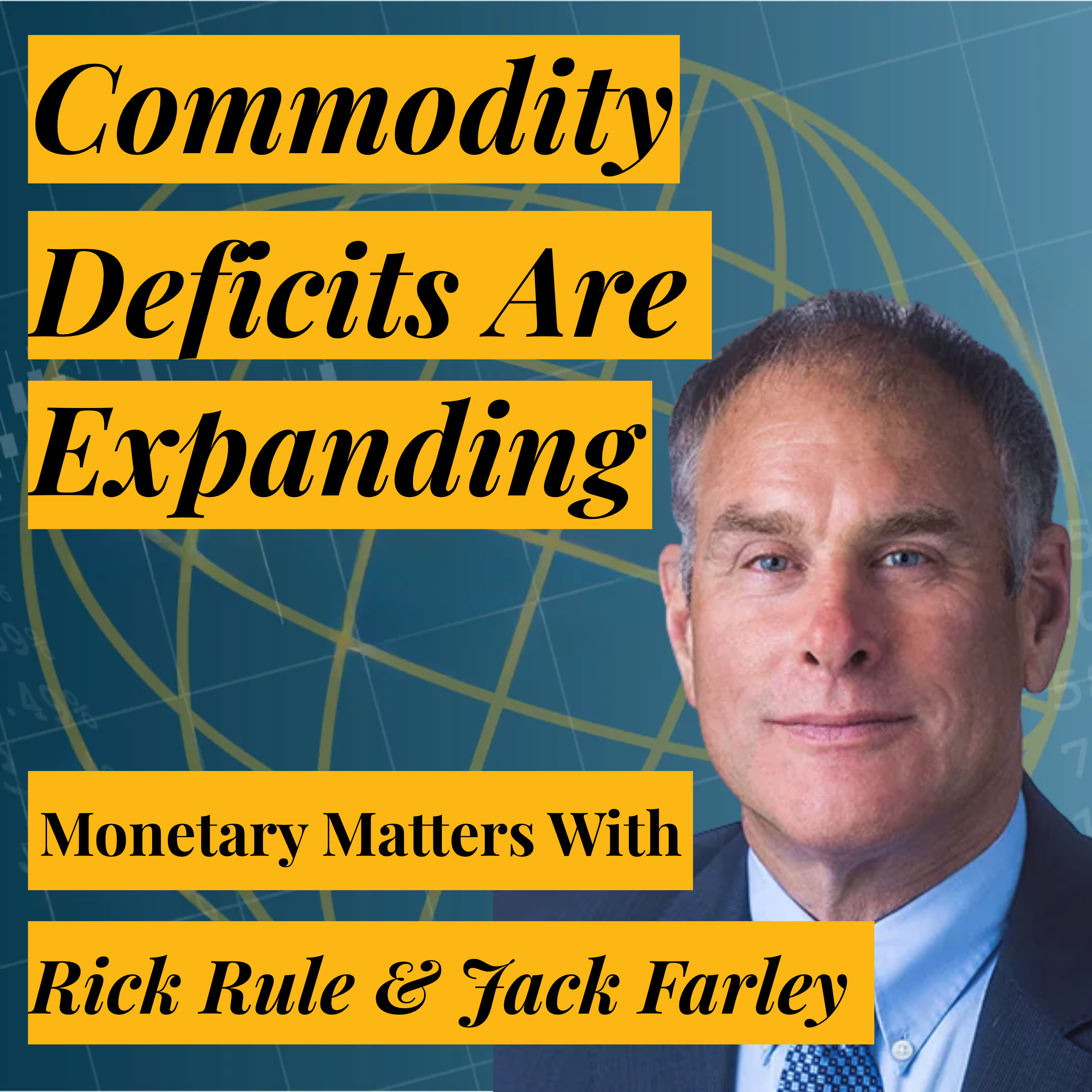
Rick Rule discusses where gold, silver, and mining stocks sit versus each other; why deficits and underinvestment will drive a commodity supercycle (especially copper); and why royalty/streaming deals—particularly copper byproduct streams—will accelerate. He also covers risks in mega-projects and the outlook for gold demand, uranium, and energy-driven costs.
Rick Rule, resource and mining investor; founder/leader of Rick Rule Investment Media and Battle Bank.
Gold is a “savings/insurance” bucket; silver is better expressed via discounted silver stocks (he sold physical silver in January after a parabolic move and rotated into silver miners). Silver stocks were discounting about $35–$40/oz vs ~$42/oz earlier. Copper supply is hard to replace quickly; underinvestment plus capital intensity means deficits likely persist and rationing may be via price. Royalty/streaming is structurally advantaged, but “me-too” exploration royalties are overbid.
Wheaton Precious $4.3B silver deal (Feb); copper maintenance capex estimates (~$250B in 2025 rising to ~$375B by 2030); BHP vs Wheaton cost-of-capital example; Pebble (court approach, $80M spent); Donlin (Alaska remoteness, Indigenous engagement); Resolution (BHP/Rio Tinto) permitting delays; NextGen uranium financing shift via term contracts; Orion/Sprott-style royalty monetizations.
Written by AI. May contain mistakes.
Rick Rule shares insights on the current state of gold, silver, and mining stocks.
“Well, what is your reflection of where we are in gold and silver and the mining stocks?”
Discussion on the value and risks associated with investing in silver stocks versus physical silver.
“are discounting somewhere between$35 and$40 an ounce.”
Rick discusses the trends and challenges in the royalty and streaming market for mining.
“So background is that in a lot of copper mines, there is gold and silver as a byproduct.”
The conversation covers the capital requirements for copper companies and the impact on streaming deals.
“so the copper, trying to do copper royalty and copper streaming deals?”
Rick shares his cautious perspective on newer royalty companies and the risks involved.
“even though actually I think they do have some gold and silver streams?”
Discussion on the complexities of investing in the royalty and streaming business model.
“million market cap company, can employ all three of those skill sets simultaneously is probably problematic.”
Rick Rule discusses his outlook on copper supply, demand, and market dynamics.
“And what's your reaction when you look at those charts showing a projected deficit based on forecasted demand, as well as the lack of supply that's going to come online.”
Discussion on the challenges faced in mining permits and capital allocation for projects.
“And it would appear, who knows after this election, but it would appear that the permitting difficulties now are less extraordinary.”
Analysis of the political risks associated with mega mining projects and their implications.
“It probably would be easier to permit in Iraq.”
Examination of the mining industry's past underinvestment and future acquisition strategies.
“And so ultimately, I think that the people behind Donlan, in particular Tom Kaplan, will do a very good job with Indigenous people.”
Differentiating between strategic and tactical mergers in the mining industry.
“Subsequent to that, capital became unavailable.”
Explore the difference between strategic and tactical acquisitions in the mining sector.
“And when two smaller companies merge, let's say Equinox takes over Orla, there's no strategic reason to do that.”
Discuss the cultural factors influencing gold investment in India and China.
“passive buyers to be there, whether it's the Canadian pension plans or someone else, your former employer.”
Learn about the saving habits of young South Asian women in tech and their preference for gold.
“It would appear, by the way, that the only citizenry on the planet that are net sellers of gold are in North America and Western Europe.”
Understanding the deep-rooted distrust of government in South Asian cultures.
“But to be told it eloquently was useful.”
Examine savings habits and gold demand related to the Nigerian economy.
“I subscribe, if you will, to the Doug Casey saying that the U.S.”
Analyze the substitution threat between silver, copper, and aluminum in industrial uses.
“Building out the Nigerian economy might have, for a connected person, much higher internal rates of return than precious metals ownership.”
Explore how rising energy costs affect gold and aluminum production.
“from its place in, as an example, the long distance transmission of electricity.”
Explore how rising energy costs affect various industries, particularly gold and aluminum.
“getting the ore out of the ground, it's about processing the ore.”
Discuss the potential of nuclear energy to reshape future energy costs and availability.
“If you define it five or six or seven years from now, the outlook is not good at all.”
Analyze the shifts in uranium demand and how market dynamics are changing the landscape for producers.
“So we have a fourfold increase in the commodity price, and we've seen production decreases.”
Examine how financing structures and long-term contracts are impacting uranium mining companies.
“important topic of the market going forward.”
Delve into the evolving landscape of royalty deals in the mining sector and their implications.
“to issuers like NextGen and Paladin that wouldn't otherwise have been able to attract the capital.”
Discuss the potential growth of royalty and streaming investments in the mining industry.
“Now understand, this will take time to play out.”
Learn about the emerging trends in oil and gas royalties, specifically the role of family offices.
“And these are oil and gas royalties or non-oil gas?”

Get the gist, explore an idea or ask about something said.
 Claude
On Monetary Matters with Jack Farley, what are the key points of this episode?
Searching your listeningAutomatic transcript. May contain errors.
0:00This episode is brought to you by Sarmaya Partners, who manages the Return to Tangibles ETF, LENS, ticker L-E-N-S, the Sarmaya Thematics ETF, built for a return to tangibles. Learn more at SarmayaETF.com and see the show notes for disclosures. Let's get into it. Joined today by very accomplished resource and mining investor Rick Rule of Rick Rule Investment Media and Battle Bank. Rick, great to see you once again. Pleasure to be with you, sir. Rick, when we did our interview in the winter of 2026, you made a call saying, I am actually selling a little bit of my silver and I'm rotating into the mining stocks instead.
0:41Boy, did that call age well. I just want to give credit on that call. Well, what is your reflection of where we are in gold and silver and the mining stocks? So not just the absolute level, but the relative attractiveness of the metals to the stocks or the stocks relative to the metals. You know, where are we, where have we been this year? Where are we right now? And what do you see going forward? That's a nuanced question. I regard gold as a savings and insurance asset. And I think it belongs in a different bucket than the stocks. I save in gold. I invest in high quality mining stocks and I speculate in juniors and I consider them three different buckets.
1:19In January this year, my physical silver, which had been in my speculative bucket, didn't deserve to be there anymore. I was speculating in it because when I bought it, it was hated. And in January, as you might recall, it was a parabolic up move, which defines it as no longer hated. So I sold it. For half the proceeds, I bought the silver stocks, which I thought were priced at a discount to the silver market. The silver stocks as a group haven't done great, but they've done better than silver has. And I'm delighted to say that the subset of silver stocks that I picked has done better than the silver stocks generally on offer.
1:59But I need to say that the silver stocks had and still have, I suggest, a better juxtaposition of price to value than physical silver. They present a different set of risks. an investor who buys physical silver has to follow one variable or two at most. The investors need to pay attention to fundamentals and the speculators in the small silver stocks need to do all kinds of work. So really the question involves answers that revolve around the participants' tolerance for risk, their tolerance for volatility, and their appetite for work. So now that the mining stocks are down less than the metals, where are you seeing the relative value between both of them?
2:46I still see better value in the stocks. In January, I anticipated that the silver stocks were discounting about$42 an ounce in terms of figuring out the net present value for future cash flows. I think that the silver stocks now are discounting somewhere between$35 and$40 an ounce. So I suggest that there's still better value, more shelter to the downside and more leverage to the upside in the silver stocks than in silver. Following though, that logic, it's incumbent on the person implementing that strategy to do the work required to determine which silver stocks. That's a different question for those people who aren't willing to do that.
3:29They're better off being in the silver itself. It's really a function of how much work you're willing to do. Rick, since our conversation, I've been doing my own personal research into the royalty space. The royalty and streaming model this year really has done a lot of deals. And I think that the pace of deals and the size of the deals is probably among the biggest ever. What have you made of these deals? and also are you worried that there are so many people in the market now that actually the deals will be slightly less good in the same way that in the 1990s basically most private equity deals was just an absolute phenomenal deal whereas now obviously they have so much more competition i think the small side of the royalty space is getting overbid i think a lot of people are competing for exploration stage royalties most of which will never make any payments And I think that part's overbid.
4:22But I think with regards to the streaming deals, you ain't seen nothing yet. I think, and this is a very specific call, I think the capital required for the copper business and the fact that byproduct gold and silver cash flows from copper projects are worth more isolated in a precious metal stream than they are combined with the other free cash flow from the copper business means that the The copper companies are going to access capital for their development expenditures by selling gold and silver byproduct streams. To put that quantum into perspective, at Metals Week in London, I think it was October of 2025, a paper was presented which suggests that the 10 largest publicly quoted copper companies in the world, not the copper industry per se, just the 10 biggest, needed to invest$250 billion, constant 2025, unescalated dollars, to maintain their copper production.
5:23But copper is in a deficit, which is to say that doesn't erase the deficit, nor does it take into account the growth. A different problem is that the input costs are increasing between 8 % and 10 % a year compounded. So 2025's$250 billion becomes 2030's$375 billion. And the industry doesn't have the$250 billion. The knock against the streaming business has been that the very large transactions that enabled, say, Wheaton Precious to grow was a thing of the past. And that's exactly wrong. It's a thing of the future. I suspect that the need for capital in the copper business will generate so much gold and silver stream volume that even Franco and Wheaton will need to syndicate deals out, which means that the second tier will participate in that.
6:14As for the tertiary royalty companies, the guys that are buying royalty packages on exploration projects, I think that sector is overbid. That's very interesting. So background is that in a lot of copper mines, there is gold and silver as a byproduct. So all these copper companies, they have gold and silver as part of revenue, but they can sell those streams to exclusive gold and silver streams that have extremely high margin cash flows, and those cash flows are valued higher. And the three big companies, Wheaton Precious, Franco Nevada, and Royal Gold, although there's lots of others as well.
6:53I'll say out in the outset, I know you're a big admirer of Wheaton Precious Metals, and I'm a big admirer of Wheaton Precious Metals. So this is coming from two admirers. But did you think that they overpaid for their$4.3 billion deal in February of this year, given where silver was? I do not. I do not. It's worthy to know that that project will have incredible silver flows. I think they paid a fair price. I think the instructive part is that the largest mining company in the world, BHP, had a higher cost of capital than Wheaton Precious, that they could do a transaction that was at once accretive to Wheaton and simultaneously accretive to BHP.
7:38That tells you how many more transactions are going to occur in this space. Normally, a company 10 times the size of a different company has a concomitantly lower cost of capital. And that wasn't the case. Gold and silver, particularly silver cash flow, domiciled in a stream, characteristically trades at 15 or 16 times EBIT, while that same cash flow characterizes copper revenue, trades between five and seven times EBIT. That discrepancy, and there are reasons for it, of course. Silver, as an example, is more volatile. But in particular, with the streamer, you don't have to worry about the capital cost, so it's pure cash flow.
8:21That discrepancy between, say, 15 times and six times is such that you can do very large transactions that are beneficial both to the buyer and seller. What do you make of the newer royalty companies that are trying to do royalty deals, and successfully have done several, in non-precious metals, so not gold, not silver, so the copper, trying to do copper royalty and copper streaming deals? What do you make of those prospects in theory and then in practice? In theory, I think it's great. In practice, there are too many me-too companies in the small space. If you're buying a third-tier royalty in the streaming company, say a new one or one with less than$250 million market cap, you need to look for a durable competitive advantage.
9:05They grow right now by paying more than their competitors in auction, and that's not a viable strategy. If you find a company like Origin or the old EMX, where they grow by creating royalties, that's different. Or Nations Royalty, where their durable competitive advantage might be the fact that they're First Nations controlled and have better access to royalty or streaming or impact benefit agreement benefits from other First Nations. That's a definable business advantage. A different definable business advantage might be Empress Royalty, where they have an express tie-in to Endeavor Financial, which is one of the largest arrangers in the space.
9:47But the Me Too royalty companies, the people who came into the royalty business because it's easier to raise capital there, where their definable business advantage is perhaps they're quick, but basically because they're prepared to outspend their competition. Outspending your competition is a poor strategy. I was under the belief, Rick, that actually, if we were to use the term me too royalty companies, that actually there were a lot more of them in the precious metal space than in the copper. I thought in the copper, there was technically only four, Acora, Altius, and Evolve, and then the Australian one.
10:27But you actually named several companies that I've never heard of. So tell me. Well, those are much more agnostic as a commodity. And I would suspect that they're more properly regarded as precious metals royalty companies. I was extending that simply to the whole tertiary crop of royalty companies. I think you're correct. I think that you look to the names that you mentioned as being names that are more specifically, let's just say that they're more generic in terms of their commodity interest. That makes sense. What do you make of these companies that focus almost exclusively on non-precious metals, even though actually I think they do have some gold and silver streams?
11:04Those, you know, let's Acora, Altius, and Evolve. Well, certainly Acora and Altius had the ability to be early movers. is Acora basically used a coal royalty to expand into the copper space and the lead and zinc space before it was popular. Altius, similarly, bought the Canadian Pacific royalty package and, of course, the Voise's Bay package, and then later the Chapada package when everybody else was focused on precious metals. The truth is that the market has correctly come to understand that the royalty business and to a lesser extent, the streaming business is a better business with generally higher returns on capital employed and lower general and administrative charges relative to the revenue stream than the mining business.
11:56And the consequence of that is that it's easier to raise money in the royalty and streaming space than it is in any other sector of mining. And the consequence of that is that management teams are more attracted to easier to raise money. And I suspect that real mistakes will be made in the royalty space in the future, irrespective of commodity. When you see royalty companies in particular, or streaming companies, acquire financial interests in non-producing projects, you better be very careful about the ability of the management team to understand the exploration and development cycle. And I'm starting to see some management teams who, while they may have that skill, haven't demonstrated it in the past.
12:43That'll be challenging for them. Yes. What is your outlook of the percentage of non-producing projects that can make it to actually getting copper, gold, silver out of the ground? I imagine a lot of it is heavily correlated to commodity prices, but I'm sure there are other inputs that you track as well to formulate your answer. Well, that's a nuanced question. I'm attracted to the copper price, frankly, but I also believe that capital will accrue to more experienced teams. And so there isn't a one-size-fits-all answer. Certainly projects that appear to be in the lowest cost quartile worldwide with scale and projects that exhibit returns on capital employed in the best quartile, but at least 25%, are likely to get funded.
13:36If you're talking about pre-development stage properties, you know, advanced exploration stage properties, it gets a lot trickier. A lot trickier for a lot of reasons. The skill sets involved in discovering and delineating a deposit are different than the skill sets involved in developing and constructing the project, which are themselves different than the skill sets in producing it. And the idea that a junior company, as an example, a three or 400 million market cap company, can employ all three of those skill sets simultaneously is probably problematic. An incompetent or inexperienced management team can foul up a good project in and of itself at risk, but that risk manifests itself by their occasional inability to attract the capital necessary to build it.
14:26So the question that you pose has a very nuanced answer. And so certainly you are a bull on the royalty and streaming business model, and certainly your admiration for and interest in the top performing royalties in that space, certainly that's been evident. But is it fair to say that given how many people are in the space, the so-called Me Too royalties, you're striking a note of caution. Is that fair to say? Sure. Yeah. Yeah. I mean, listen, I'm attracted to the exploration space, which is highly risky, but I'm on record as saying that 90 % of the publicly quoted exploration companies worldwide are valueless.
15:06So although I'm hugely attracted to the exploration space, I'm hugely discriminatory. That attraction isn't ubiquitous across the length and breadth of the space. It's rather very concentrated around management teams who I think have the demonstrated expertise to succeed. Hey, everyone. Hope you're finding value in my questions. I've got a quick question for you. How much of your portfolio actually depends on the physical world? If you own the S &P 500, more than a third is tech. Energy, materials, and precious metals, about 5%. Sarmaya Partners believes the next cycle belongs to tangibles. The energy and metals sectors have been underinvested and underloved for a decade.
15:50They call it a return to tangibles, and LENS, ticker L-E-N-S, the Sarmaya ETF, is an actively managed ETF that they manage to express this view. An active is the point. The team follows the theme across sectors, market caps, and borders as the cycle evolves, adding where they see opportunity and trimming themes that look overextended. Miners, energy, precious metals, critical metals, all in one actively managed ticker, Lens. When inflation runs, stocks and bonds can fall together. Lens adds real asset exposure with the potential to diversify both the stock side and the bond side against inflation and geopolitical risk.
16:28Learn more about the Lens ETF and their full data and comparison, including performance at SermayaETF.com. Investing involves risk, including possible loss of principal. The fund's investment objectives, risk, charges, and expenses must be considered carefully before investing. This and other important information is contained in the prospectus, which may be obtained at SermayaETF.com. Please read the prospectus carefully before investing. Thanks for listening. Let's get back to today's interview. Rick, what's your view of copper? And what's your reaction when you look at those charts showing a projected deficit based on forecasted demand, as well as the lack of supply that's going to come online.
17:03As a veteran in the business, you've seen very rosy outlooks of demand is going to go up 10 % year over year and supply is only going to go up 1 % year over year. And some of the time it's true, but you've seen some of the time it's not true as well. What's your outlook when analyzing this? I don't look at that much. I pay a lot of attention to the study, I think it was a Wood Mackenzie study that suggested that the top corporate companies in the world need to spend$250 billion maintaining production. And when I look at project by project through a company like, say, Freeport's supposed pipeline, the fact that Freeport needs to raise so much money, and I'm not picking on Freeport.
17:47I'm just using them as an example. Because the business is so capital intensive, so cyclical, and involves so much time, it's very difficult for me to see where the copper will come from five years from now, absent a global depression. I'm not calling for global depression, by the way. I'm just saying that the only way that supply and demand could meet themselves is if demand fell because the existing supply deficit, taking no growth at all into account, suggests that 20 or 25 years of underinvestment is going to come home to roost in the next five years. But separate and apart from that, I believe that copper demand grows, perhaps not to the extent that the real copper boosters suggest.
18:34I'm a skeptic, as an example, with some estimates of data center demand. But it needs to be acknowledged that humankind, the material advancement of humankind, requires energy, in particular electrical energy. And generating that energy and transmitting that energy and using that energy requires copper. At the bottom of the demographic pyramid. A billion people on earth have no access to primary electricity, and they want it, and they're going to get it. And that, without data centers, suggests that the industry is going to be bit by 20 years of underinvestment in copper, and we're going to have to accommodate that.
19:18And I suspect, absent a synchronized global recession or depression, that the way we ration copper in the future will be by price. I totally understand how when there was a depression in the price of copper in 2015 or in 2020, that there was almost very little was being spent on greenfield exploration or even brownfield expansion. But with the copper price so high now, you're saying even now, Freeport-McMoran is not spending enough to to bill out supply. They, I mean, last week made a very important decision, I think, around Baghdad. it makes perfect sense that they wouldn't have expanded Baghdad 10 years ago, not because of supply and demand, but rather because of the permitting difficulties in the United States and in the state of Arizona loomed large.
20:08And it would appear, who knows after this election, but it would appear that the permitting difficulties now are less extraordinary. And Jack, if you dial yourself back five or 10 years, capital markets were less attracted to extractive industries. Some of the largest financial services companies in the world were populated by people who thought that mining was evil. They just didn't want to fund it. I think that same generation of people has come to understand there's a correlation between resource utilization and poverty, a positive correlation. One of the ways that you reduce poverty on a global basis is resource utilization.
20:48And so we're coming into, I think, the world, a more favorable climate for regulation and permitting, and separately, a more favorable regime for capital markets. That may change. It's important to note, by way of example, the best undeveloped copper deposit in the United States by a country mile is a deposit called Resolution, jointly controlled by BHP and Rio Tinto. Deep, to be sure, capital intensive, to be sure, over a billion tons, over one and a half percent copper in a world where the average mine grade is less than one half of one percent. So three times the average grade worldwide. worldwide, this thing has been permitting for 28 years.
21:35And you can understand a board of directors being unwilling to commit pre-construction expenditures in the half a billion dollar range when they suspected that their return on capital employed might never occur, or if it did occur, would occur 15 years hence. If you think about the net present value of cash flow deferred by 15 years, if you use an 8 % discount, that cash flow disappears from current models. Yeah. So Baghdad is actually not in Iraq. It's an Arizona project, right? Yeah. It probably would be easier to permit in Iraq. Let's get risk put on the page. I have found that one of the riskiest jurisdictions in the world politically is the United States.
22:22In fact, the worst experience I've personally had with political risk was in the People's Republic of California. I've had much, much, much better experience with political risk, even in South Sudan and Congo. It's just that it's a different kind of political risk. People who look like me more than you, old, bald, fat, white males, suspect that political risk that comes from people like themselves in English, via the legislature, according to the rule of law, is somehow riskier. But that's not in fact the case. Money that goes to money heaven, irrespective of how it goes to money heaven, is equally risky.
23:03And while I have been treated very, very, very poorly by the California legislature, by contrast, I was treated extremely well by the Congolese. What's your view of the kind of mega projects that were to be super expensive to build, You know, whether it's the Don Lind gold mine or the Pebble copper mine, I guess those two projects in Alaska or these super big projects that if they ever came on would be massive. But the market is pricing it as if it's a very low probability. I think Pebble in particular suffers from sociological and political challenges. The management team there chose, I think, to deal with the Indigenous people in the courts as opposed to dealing with them directly.
23:51They felt, I think, that their discussion needed to be had with the U.S. government and the Alaska government as opposed to with the traditional representatives of only 6 ,500 people. You will note that at Pebble, they spent in excess of$80 million in the courts. I suspect that a fraction of that spent on community development would have achieved a different result. And I suspect going forward that that lesson's learned, but that's going forward. Donlan has a different challenge. I've been to Donlan. It's a long way from anywhere. And so ultimately, I think that the people behind Donlan, in particular Tom Kaplan, will do a very good job with Indigenous people.
24:34I think that Tom, who's a good friend of Bob Quartermain, will, if he hasn't already, go there and listen. And they will tailor a package to the benefit of the local people. That won't overcome legitimate environmental challenges. And it won't overcome the infrastructure charges, nor will it overcome the capital intensity of building a project of that scale in an area that's that remote. So there will be, I think, with this new legislative regime, I think that there will be renewed wilderness area permitting challenges. A deposit in Alaska that doesn't have, I would say, insurmountable capital constraints would be the Arctic Copper Deposit.
25:26And it should be noted that when the prior administration couldn't stop that project any other way, the Biden administration decided, despite the request of indigenous people, to not allow the road to obviate access to the deposit. And it could be that type of obstructive bureaucratic interference will now return. And that's not a projection on my part, but it's an observation on my part. I think that the Democrats likely feel more beholden to the organized environmental groups than the Republicans felt. That makes sense. Going back to gold and silver, where are the sort of the junior mining plays?
26:21I guess kind of the whole strategy there is most of the time to be acquired by a major senior mining stock, someone like Barrick or Newmont. How acquisitive do you think the largest gold and silver mining companies in the world are going to be going forward, as I imagine that has a large impact on those junior mining stocks' fortunes? Extremely acquisitive. The mining industry has, for a very long time, underinvested and then improperly invested. if you go back to the decade 2000 to 2010. It's important to understand that history too. In that decade, the gold price went up six or sevenfold and the free cashflow per share of the mining industry declined.
27:04Now it takes real skill to generate reduced cashflows when the selling price of your product goes up six or sevenfold. So there was the misallocation of capital. Subsequent to that, capital became unavailable. So one could say that not just the copper industry, but the gold industry too, has underinvested or malinvested for 25 years. The consequence of that is that with some exceptions, the development pipelines of the companies relative to their depletion schedules means that never mind to grow, to keep their ground, they're going to have to acquire. A separate discussion, I think, involves lateral as opposed to horizontal mergers, tactical mergers.
27:53It is a truism today that a lot of the aftermarket volume in these equities is passive or index driven. And when two smaller companies merge, let's say Equinox takes over Orla, there's no strategic reason to do that. There's no operational synergies. But if you put those two companies together, their resultant size means that they have larger index inclusions, which means that they get passive buying, that every two weeks as a consequence of payroll deduction, they grow. So I think in terms of M &A, that you need to look at strategic acquisition, which is where a company buys an asset that leverages their existing inventory, and tactical acquisition, where people buy for the sake of buying and growth.
28:43I think both of those are going to occur. So what's the difference between lateral versus horizontal acquisition? Well, I would suggest that horizontal acquisition is, I guess, by definition, where a bigger company buys a smaller company. So I would prefer to make the differentiation between strategic acquisition. strategic acquisition might be Agnico Eagle buying a deposit in the Abitibi where because that deposit could feed an existing mill they don't have to spend the money to build a mill they save the three or four hundred million dollars involved in infrastructure and mill construction by simply building the mine and then trucking the material to their existing deposit where there are actual operational synergies from already owned assets.
29:33That's a strategic acquisition, irrespective of its horizontal. A tactical acquisition is, as an example, Equinox acquisition of Orla, or perhaps Oceanic's proposed acquisition of Osgold, where there aren't any operational synergies, but where there may be excess management capacity or simply the fact that four plus two in this case equals seven or eight as opposed to six. Because you want the passive buyers to be there, whether it's the Canadian pension plans or someone else, your former employer. Yes. Correct. Yep. Or even just the GDXJ. The GDXJ is partially liquidity and market cap based. And there's all kinds of passive or index buying that's a consequence simply of index inclusion.
30:29I wonder for gold, certainly the gold bulls talk very frequently about the central bank buying of gold, which is a very steady hand, diamond handed buyer of precious battles in gold for sure. But I wonder, certainly it seems to me just looking at the volumes that the Chinese and Indian investments, the private investment community is a very, very big player there too. And I'm curious if you have any thoughts on their behavior in terms of the bull market in gold over the past five to 10 years, as well as trying to estimate, is this demand going to be as strong or may even accelerate or weaken? Your general thoughts here.
31:09I would be tempted to answer that question, but you have me way out over the edge of my skis. I know a bit about the Indian investor because I've observed him or her for a long period of time. One just needs to walk into the gold souk in Dubai and see the expatriate Indian workers buying physical gold and silver every two weeks with some portion of their paycheck to understand the cultural predisposition that people on the South Asian subcontinent feel. I'm told that that same sentiment exists in China, but I'm less familiar with it. I notice that the Chinese state is still overtly encouraging gold ownership.
31:52While they have prohibited the export of gold and they've also prohibited trading in some certificated or derivative instruments, probably for consumer protection, they continue to encourage private savings in gold. And it would appear, looking at the volumes, as an example, in the Shanghai Exchange or the flow of gold, that the Chinese citizenry continue to be retail investors in gold. It would appear, by the way, that the only citizenry on the planet that are net sellers of gold are in North America and Western Europe. Yes. Yes. And certainly, I mean, if you're a bull on India, it's not a crazy speculation to say that, you know, if the Indian economy has a lot more money, that would be bullish for gold.
32:44I think that's a very good observation, frankly, particularly rural India. In rural India, there's a millennium-long distrust of the Indian government and the cultural habit of saving rather than in fiat currency instruments in gold and silver. And I think those cultural habits are hard to break. I noticed by way of anecdote that my own database, which I monitor as well as a 73-year-old can, was exhibiting real growth among young female people of South Asian ancestry. given that I didn't know what the reason for that was. I was interested. I had an informal contact where I got hold of six of these young women and asked them to have a conference call with me so I could understand more about this market, not knowing very many young female South Asians.
33:48And some interesting comments came out of this. It's anecdotal, not statistical. But these young women all lived in Silicon Valley, California. they turned out all six to be involved in technology they were all engineers they were all making by the standards of somebody sub 30 a lot of money 150 160 170 000 a year they all said jokingly that if they showed up at the wrong building in the morning they got a pay raise but making 160 000 a year wasn't enough money for them to buy a house in silicon valley So they were living four or five or six to a house, spending$1 ,500 of rent and being South Asians, saving religiously.
34:30And they all said that in their culture, one saved primarily in gold or silver. One of them went so far as to say, Rick, in your culture, your distrust of the government is 100 years old. In our culture, our distrust of the government is 1 ,000 years old. This is anecdotal, right? It's not statistical, but it was a really eye-opening discussion of me. I guess I should have, had I thought about it, anticipated it, given my observance of the behavior of expatriate Indian workers in Dubai buying physical gold and silver. But to be told it eloquently was useful. That's really interesting. Yeah. And that's one case, I think a lot of gold bulls talk about the growth of fiscal deficits and central bank buying, but that's a really important point that just the growth and emergence of the global middle class first in China and now in India is a real driver.
35:32I think another thing that you have to consider, my narrative about gold is an American narrative. That's because I'm American. I subscribe, if you will, to the Doug Casey saying that the U.S. dollar is the worst currency in the world, with the sole exception of all of the others. It is not inconsistent, as Brent Johnson will tell you, to believe that the U.S. dollar continues to be the world's reserve currency, albeit with that hegemony reduced, and for gold to do well, too. I believe that the U.S. dollar will lose and is in the process of losing 75 % of its purchasing power. But despite that, I think it'll outperform most other currencies in the world.
36:12The Indian peasantry isn't necessarily making a call against the U.S. dollar, which is something an American citizen might do. They're making a call against the maintenance of their purchasing power in rupiah-denominated savings products. That's very interesting. You know, Rick, what is a demand for gold among countries that are in Africa? You know, one looks at the growth of the Nigerian economy as well as projections, which, you know, they're projections, but of like how many people are going to be in Nigeria in 2050. And it certainly is a very large number. So I wonder, could a similar narrative be true about Africa?
36:52I don't know very much about the length and breadth of the citizenry of Nigeria. I know some Nigerians. By the nature of what I do, I would suspect that the people who are interested in dialogue with me have similar viewpoints. The savings habits of the few Nigerians I know are very gold-centric. If you want to find a group of people who have no trust for government unless they happen to be in it, that's the Nigerians for good reason. The idea that the wealthiest country in Africa has the second highest poverty rate in Africa is all about government. It's not about the inherent capabilities of Nigerian people or the carrying capacity of the Nigerian economy.
37:37It's all about incredible corruption and mismanagement. And one response to that is probably gold. I suspect that participation among middle class and upper middle class Africans will lag the participation that you see in Western countries because I think the opportunity sets that are in front of them in their own economies are much higher. When I talk to private Nigerian businessmen about the hurdle rates that they expect before they invest in Nigeria, the opportunities that are available to them, perhaps at higher risk, are better or at least more rewarding than the opportunity sets that are available to me.
38:23Building out the Nigerian economy might have, for a connected person, much higher internal rates of return than precious metals ownership. Mm-hmm. Rick, I wonder your view of aluminum in the following way, that silver is a very large input into solar panels, but it is being replaced by copper in that. So that is a dent in silver demand is that silver demand, silver's gotten so expensive, people are replacing it with copper. I've read that that might be a similar threat to copper, that if copper goes to$10 or$15, the engineers and the construction folks are going to do everything they can to get as much aluminum into the projects and replace copper with aluminum in the same way that they're doing it with silver.
39:13So the same way copper is a threat to silver, aluminum is a threat to copper. So I wonder your views on this and to what degree it dents your bullishness on copper, as well as boosts your bullishness for aluminum. I think you need to understand those are very long-term phenomenon. The cure for high prices is always high prices. If the copper price does That's what I think it will do over the next five years. You will have an incentive to find ways to substitute other materials for copper, and you will have an incentive to find ways to use copper more efficiently. That will happen, but it won't happen in the near term.
39:46What will happen, I suspect, is that five years from now, copper will be as pervasive in financial discussions as AI or the internet, and that whole discussion will be sowing the seeds of its own destruction, which is to say that the high price will validate the narrative at the same time that the high price will encourage substitution and efficiency. I've observed this a lot in my career, by the way. The cure for high prices is always high prices, and the cure for low prices is always low prices. Investors miss this because their time horizon is limited to a quarter rather than a decade. And so what's your view on aluminum and the aluminum mining sector?
40:31Is that something you don't traffic that much? No, I follow aluminum fairly well. There's variability there in the sense that one of the most important contributors to the price of finished aluminum is energy. And I would suspect that countries that are relatively low cost aluminum producers, an example, the United Arab Emirates, if they are slow to adapt nuclear power, as an example, will become inefficient producers going forward. So it's a fairly nuanced discussion. We haven't spent a lot of time in the last 15 years looking for new bauxite supplies because the existing ones were too large, but that's going to come to be a constraint.
41:12So I think that the ability of aluminum to substitute for copper will depend on the energy intensity in the aluminum business and what happens to the price of aluminum. You know, it has its own utility separate apart from replacing copper. As the world uses more energy and as there's increasing incentive to have in particular transportation, but other forms of capital equipment that are lighter, aluminum has attraction separate and apart from its place in, as an example, the long distance transmission of electricity. There are a lot of interplays. I understand you're looking for a simple declarative statement, but I'm not smart enough to give you one.
41:53Or maybe you're smart enough to not give you one. Well, that's a charitable response. So that is a really key point that it's not just about getting the ore out of the ground, it's about processing the ore. And that processing is often very energy intensive, in particular in aluminum. The surge in energy prices this year, oil, natural gas, everything. What other knock-on effects does that have beyond just aluminum? Oh, I think a lot. You're starting to see it show up in the gold business. Agnico Eagle said that next year, the diesel prices could add$80 an ounce to their production costs. The world runs on energy.
42:39And whether the big thinkers want to admit it or not, It runs on conventional carbon-based supply. Everything we do is energy intensive. And to the extent that we either underinvest or malinvest in energy sources in the future, we will pay the cost. I believe that the world is beginning to be on the right path with regards to energy. I believe that increased utilization of nuclear power and increased investment in and deployment of nuclear power plants will bring down the upfront capital cost of building nuclear power plants a bunch. And I think that the improved regulatory climate has the ability to do that.
43:23The United States, when they turn out a new nuclear power plant, if you include the time cost of money, brings them in at$30 billion a copy. and the Chinese can bring in the same output for$5.5 billion. That needs to equalize. But if we do that, if we understand the economic necessity, particularly the poor, of higher access to electricity, and we utilize the technological resources that are available to us and marshal the correct financial resources, I think the future in energy is great as long as you define the future 10 or 15 years from now. If you define it five or six or seven years from now, the outlook is not good at all.
44:04Where do you see the demand from uranium being used in energy coming from other than China? Because in the US, people talk and wax poetically about how we should be using a lot more nuclear energy. But in terms of the follow through, at least as a human being waking up, going day by day, certainly is moving very, very, very slowly. Well, all this stuff takes time. But I would say within the next two years, the surprise user will be Japan. Japan's uranium consumption went from being the second largest in the world to being non-existent post-Fukushima. And post-Fukushima, popular polls about nuclear power in Japan were 80 % negative.
44:50Those same polls are 72 or 73 % positive today. Japan's nuclear fleet is 42 plants, 43 if you include Fukushima, but I don't suspect Fukushima will be rebuilt. And their current operating nuclear fleet is 17 plants. A political will exists among the Japanese and a political eagerness exists among the Japanese government and Japanese industry to restart those downed plants. They don't need to be built. They don't need to be reopened. And the public will exist to do that. The lowest hanging fruit in the uranium demand space is Japan. And what's your outlook on not just the uranium price, but the uranium mining sector as well?
45:42Boy, the uranium, well, I guess these are related questions. If you had asked me a question six years ago about what restarts or new mine supply would look like. That$100 uranium, because that's, by the way, that's where the contract price is today. I would have said, we're not short of uranium, we're just short of$20 uranium. So we have a fourfold increase in the commodity price, and we've seen production decreases. I don't know what the incentive price is now. I do know what the permitting challenges are like, and I suspect that any response to the incentive price will occur over time as opposed to quickly.
46:22I don't have an opinion on that. It ceases to be a variable. What I do have an opinion about is the fact that the market dynamic has changed substantially. The references are all to spot, but the spot market is so illiquid that it's irrelevant. Most days, the Sprott Physical Uranium Trust does four or five times the dollar volume that the spot market does. One could say that the sprout market has become the spot market. This illiquidity means that increasingly transactions are taking place on the term market. And that's an important dynamic. That means that unlike any other commodity on the planet, in the Iranian business, a supplier can understand the quantity that he or she can sell at the price they can sell it for.
47:10In terms that go up to 30 years, at the same time, developers who are building nuclear power plants, and more importantly, their lenders, understand that they have the ability to lock in supplies 30 years hence. Increasingly, the lenders, let's say that you're an efficient builder, a Chinese builder or a Saudi builder, and you're building a$7 billion plant that actually costs$7 billion as opposed to$30 billion in the US. And the lenders will lend you $5 billion of the$7 billion. The lenders are increasingly requiring the developers of the plants to lock in enough supplies to amortize the loan.
47:55This is hugely, hugely important. It isn't manifested yet in the price of uranium companies, but it is beginning to be manifest in their cost of capital, both by way of debt and equity. This is going to be an increasingly important topic of the market going forward. So the power plant operators who are building the power plants are buying the uranium at 30 years hence, or the mining companies are selling at 30 years hence than the former? Yes and yes. For every buyer, there's a seller. This is profound. If you look as an example at NextGen, this is not, by the way, a recommendation of next gen.
48:33But if you look at next gen, six years ago, they would have had to sell that deposit because they couldn't finance building it. Now, next gen, because they bought some physical uranium and they have a lot of cash on the balance sheet, can enter into a supply contract with Duke Power or the Southern Company or Ontario Hydro or Tokyo Electric Power. They have a credit, an investment-grade counterparty. And they can absolutely take that purchase order to the bank to secure the financing necessary to build the mine. Five or six years ago, NextGen would have had to sell that mine to Rio or to Cameco or to Tech.
49:14Now they can at least pretend to build it. There's no other commodity in the world, Jack, where I can tell you with any certainty how much product I can sell or at what price. That's really important. A lazy credit analyst or security analyst, say Rick Rule, doesn't have to make up price and volume. And if that price and volume is from an investment grade counterparty, that goes an awful long way to ensuring the security of capital and will absolutely lower the cost of capital to the issuer and make capital available to issuers like NextGen and Paladin that wouldn't otherwise have been able to attract the capital.
49:57So this allows more mines to actually be financed and more supply to actually come online? Correct. And it allows NextGen, as an example, to do something else. Threaten to build a mine. Six years ago, everybody looked at NextGen and said, listen, they're not going to be able to finance it. They're going to have to sell it. And the Canadian government won't let the project be sold to a non-convenient buyer. So the only people they'll be able to sell it to will be Cameco. How do you have an auction with one bidder? NextGen gets to say now, no, we don't have to sell it. We can build it. And besides Cameco, there's Anglotech, which now has the financial capabilities to build it themselves.
50:37And Rio has just, well, they're in the process of building an eight or $9 billion project at Janssen Lake. And all of a sudden, NextGen is able to say, no, there's not one there. There's at least two. Us ourselves, we could build it. If Cameco comes to us for the right price, we'll sell. It isn't limited to Cameco any longer, because although Rio Tinto might not have as an example, critical mass in the uranium business, and Anglo Tech has no mass in the uranium business, if they can prove that they can build the mine, they can sell the offtake. And they can sell the offtake in volumes and at prices that they can predetermine.
51:19And if they're selective, they can do it with investment-grade counterparties. The listeners that you have that are interested in this need to understand that concept, investment-grade counterparties. If the counterparty is a private trading company that isn't investment-grade or doesn't publish their financials, that doesn't count. it's important to note that. So I imagine that the fact that because of the term market existing in uranium and lenders being more willing to finance mines and more supply coming online, that might benefit a company like Uranium Royalty, whose a lot of their value is on whether these products are going to come online, as well as the uranium price.
52:01Yeah, absolutely. Now understand, this will take time to play out. To the extent that your listeners have a three-month timeframe, this is valueless information. Talk about royalty deals. What did you make of Uranium's deal with Sweetwater buying a gigantic and long-lasting soda ash royalty? I think that they had a share price that was, let's say, very full, perhaps not very full on a five-year forward basis, but in a 2026 basis. And they looked at the ability to monetize their market capitalization and lock in a royalty stream where they had no competition for a very long period of time. They paid a very full price, but it's important to note that they got not just mineral, but fee ownership of a huge bit of land.
52:50Now, a bunch of that land is at best lizard pasture. Yeah. But if I were uranium royalty, I would have done exactly what they did. I don't think that they had the ability to monetize their market cap in capital markets because it would have disappeared. But I think that they had the ability to use that premium market capitalization to acquire an asset at a very full price that will pay them over time. If they can perform the magic of using soda and Trona cash flow at uranium multiples, they will have hit a long ball home. Yes. And the entity from which they bought it is one of the biggest players in the private mining of private financing space for mines, mine debt and royalties.
53:38and the other company that is of a similar scale is one you used to work at. So obviously, you know the space very well. And it occurs to me that a lot of these funds that have invested in private royalties, they've done very well on paper, but to whom are they going to sell? Are they going to sell to each other? Or do you expect more of these financings to basically public companies buy them for private packages? I think I wouldn't say that demand for royalty in streams is limitless. But I get a call every month now from a family office, as an example, or an institutional investor looking for these things.
54:19People have paid attention to what I talked about, the demand for streams from the copper business. They've listened to the interview and they've called me up and said, Rick, if you come across one of these, we will pay you to involve us. It's important to note too that the vendor of that royalty, Orion, is an extremely good competitor in the space. And they have historically generated royalty in streams and then sold them. A bunch of the royalty package within a Cisco was purchased for a billion dollars from Orion. They are probably the preeminent integrated capital source for junior miners on a global basis.
54:58And do you expect more packages to be sold by them and other private funds that have to return capital to public stocks? I think you'll see them sell to public stocks, family offices, sovereign wealth funds to everybody. It's important to note that the Orions and the Sprots of the world raise money in 10-year terms from partnerships. But But when those partnerships expire, they either have to distribute the assets in kind to the investors who may or may not know how to operate them, or they have to sell them. And that's what Orion has done. Orion's dispositions haven't always just been opportunistic.
55:36They've been reflective of the fact that the vehicles who held them, which is to say the other people's money, needs to be paid back. And that necessitates a distribution. The difference between them and the private family offices who, as an example, have dominated the oil and gas mineral interests in the United States is that they're limitless. They don't have timeframes. I know of some very large royalty packages that have been in private Texas family offices for 50 years and will not be sold as long as that family office is controlled by the family whose surname is on the office door. Mm-hmm.
56:14And these are oil and gas royalties or non-oil gas? Yeah, oil and gas royalties. But I think you're going to see the family offices, among other things, come into the royalty and streaming space, particularly the streaming space in size. And when that happens, we'll see less structural need to sell or syndicate packages. That makes sense. Rick, it's been a pleasure. Thank you so much. Tell us about, Rick, Rule Investment Media as well as Battle Bank. two things. Rule Investment Media, if you like what I have to say about natural resources and you want to personalize it to your portfolio, you can do that for free.
56:48Go to ruleinvestmentmedia.com, that's my website, and list the natural resource stocks that you own. Sidebar, no crypto, no tech stocks, natural resource stocks, and I will for free rank them, one to ten, one being best, ten being worst. I'll comment on individual issues if I think my comments might have value. Separate and Apart from that, if for any reason whatsoever you're dissatisfied with the service or the products that you receive from your current bank, I suspect that means all of you, check out Battle Bank. One of the things we pay you interest on your checking account. We allow you to bank in 20 currencies.
57:21We allow you to invest your IRA or your solo 401k as long as you see fit. We will buy, sell, or store precious metals for you. More importantly, unlike anybody else, we will lend you money secured by your precious metals. So if gold is of interest to you, if foreign currency is of interest to you, if interest is of interest to you and you aren't being well satisfied by your current bank, check out BattleBank, BattleBank.com. Thank you, Rick. Thank you, everyone, for watching. Please leave a rating or review for Monetary Matters on Apple Podcasts and Spotify. Until next time. Thank you. Just close the door.
58:00Hope you enjoyed that. want to say a big thank you to today's sponsor lens ticker l-e-n-s the sarmaya thematic etf which gives real asset exposure and the potential to diversify a 60 40 portfolio read the prospectus at sarmayaetf.com disclosures in the show notes thanks for watching
This episode is brought to you by Sarmaya Partners. Learn more about Sarmaya’s LENS ETF, their full data and comparison, including performance here: https://sarmayaetf.com/
Jack Farley is joined by legendary resource investor Rick Rule to break down the impending $250 billion capital crisis in the copper industry and explains why precious metal streaming giants are perfectly positioned to capitalize on the shortfall. They also explore a massive structural shift occurring in the uranium term market, revealing how 30-year contracts are single-handedly transforming the way new mines are financed. Tune in for masterclass-level insights into navigating political risk, avoiding "me too" royalty traps, and tracking the future of global energy markets.
Follow Jack on X: https://x.com/JackFarley96
Follow Monetary Matters on:
Apple Podcasts https://rb.gy/s5qfyh
Spotify https://rb.gy/x56dx5
YouTube https://rb.gy/dpwxez
Important Information
The Fund’s investment objectives, risks, charges and expenses must be considered carefully before investing. This and other important information are contained in the prospectus, which may be obtained by following the links Prospectus and Summary Prospectus or by calling +1.215.330.4476. Please read the prospectus carefully before investing.
There is no assurance that the fund will achieve its investment objective. The Fund may not be suitable for all investors. Investors should continue to review their investment objectives and risk tolerance periodically.
An investment in the Fund involves risk, including possible loss of principal. Exchange traded funds (ETFs) trade like stocks, are subject to investment risk, fluctuate in market value and may trade at prices above or below the ETF’s net asset value (NAV), and are not individually redeemable directly with the ETF. Brokerage commissions and ETF expenses will reduce returns.
ETFs are subject to specific risks, depending on the nature of the underlying strategy of the Fund, which should be considered carefully when making investment decisions. For a complete description of the Fund’s principal investment risks, please refer to the prospectus at https://sarmayaetf.com
Metals and Mining Companies Risk. Metals and mining companies can be significantly affected by events relating to international political and economic developments, energy conservation, the success of exploration projects, commodity prices, tax and other government regulations. Investments in metals and mining companies may be speculative and may be subject to greater price volatility than investments in other types of companies.
Management Risk. The Fund is actively managed and may not meet its investment objective based on the Adviser’s, Sub-Adviser’s, or portfolio manager’s success or failure to implement investment strategies for the Fund.
Shares of the Fund Are Not FDIC Insured, May Lose Value, and Have No Bank Guarantee.
The Fund is distributed by PINE Distributors LLC. The Fund’s investment adviser is Empowered Funds, LLC, which is doing business as ETF Architect. Sarmaya Partners LLC serves as the Sub-Advisor to the Fund. PINE Distributors LLC is not affiliated with ETF Architect or Sarmaya Partners LLC.
Timestamps:
00:00 Intro
00:28 Silver vs Mining Stocks
03:34 Royalty Deal Boom
08:31 Me Too Royalties
12:46 Funding New Projects
15:27 LENS by Sarmaya Partners
16:49 Copper Deficit Reality
21:05 Permitting Political Risk
26:13 Gold M&A Wave
30:29 Asia Gold Demand
36:29 Africa Gold Savings
42:11 Energy Costs Nuclear
44:04 Uranium Term Market
51:40 Uranium Royalty Deal
53:25 Private Royalties Exit
56:32 Conclusion