Ask ChatGPT
 Monetary Matters with Jack Farley
14 Nov 2026 · 53m · 14 chapters
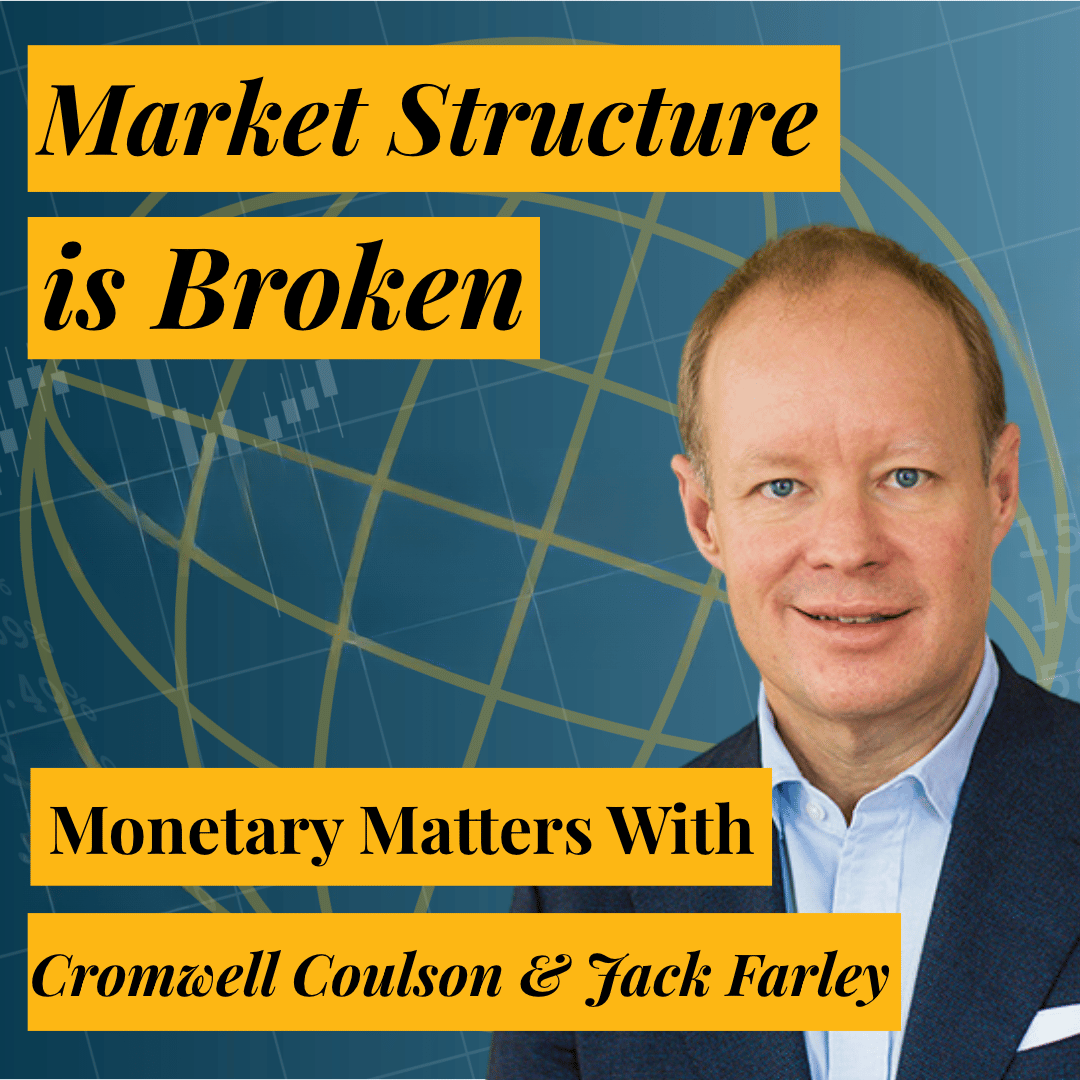
Cromwell Coulson (CEO of OTC Markets Group) argues that “public markets” should be a broader pyramid than just NYSE/Nasdaq, emphasizing disclosure, market data, and SEC reforms to improve small-cap and OTC capital formation. He discusses how OTC Markets operates regulated ATS tiers (OTCQX, OTCQB, OTC ID, Pink) and uses “flags” to warn about promotion/pirate-like activity without stopping trading.
Cromwell Coulson is CEO of OTC Markets Group, a market operator providing trading services, market data licensing, and issuer disclosure distribution. He previously frames OTC markets as historically less automated and less transparent than exchanges.
SEC offering modernization and expanding ATM programs will reduce dilution and make capital raising more efficient for smaller issuers. Markets need both trading transparency and issuer disclosure; lack of disclosure should not automatically ban trading. OTC Markets’ tiering and risk-factor approach aims to ensure every security has a price reflecting known flaws.
Stratton Oakmont/NASDAQ vs OTC; 2021 meme-stock “fever” cooling via ATMs (CBS/Viacom example); Fannie Mae and Freddie Mac on OTCQB; flags for promotion and upcoming flags for repeated reverse splits.
Written by AI. May contain mistakes.
Cromwell explains the role of OTC Markets Group in capital formation.
“Before we go into the weeds, Cromwell, tell us, what does your company do?”
Cromwell discusses the need for transparency and issuer engagement in public markets.
“They need to play in a well-lit stadium, but they also need to broadcast to the world.”
Discussion on market cycles, speculation, and the current state of investing.
“is so important to both democracy and capitalism.”
Cromwell outlines the issues smaller public companies face in accessing capital.
“And then we also have the SEC is probably the best team I've seen at the SEC in almost 30 years.”
Learn about the functions and regulations of alternative trading systems (ATS).
“for companies that have already raised capital.”
Explore the different market tiers and their disclosure requirements for investors.
“of some securities are not made of precious metals.”
Discover how technology is used to enhance market compliance and investor protection.
“We also have lots of community banks and many community banks leave NASDAQ because of the cost and complexity and they just want to use their community bank filings.”
Understand the importance of risk flags in ensuring market quality and investor awareness.
“Because we're a big believer that markets need two streams of information, supply, demand, and trading of the market, and then the issuer disclosure.”
Discover how market feedback influences stock issuers and promotional activities.
“And finally, if insiders are selling or the issuer is issuing stock to bring some clarity.”
Explore market structures and the challenges for international companies in public markets.
“So Cromwell, in your previous answer, I agree that, of course, very difficult to forecast the market.”
Understand the competitive dynamics of market operators and data demand.
“They'll have governments who are not as supportive of business.”
Explore the advantages of public companies and the sustainability they offer.
“Complexity well understood is what happens when you have a thriving market.”
Discuss the regulatory challenges and declining number of public companies.
“And, you know, the great thing about a public company is you not only have the IPO or the capital, but you get the governance and the durability.”
Examine the potential impact and challenges of tokenization in the market.
“Companies are accessible to the citizen who can buy shares.”

Get the gist, explore an idea or ask about something said.
 Claude
On Monetary Matters with Jack Farley, what are the key points of this episode?
Searching your listeningAutomatic transcript. May contain errors.
0:00This episode is brought to you by Sarmaya Partners, who manages the Return to Tangibles ETF, LENS, ticker L-E-N-S, the Sarmaya Thematics ETF, built for a return to tangibles. Learn more at SarmayaETF.com and see the show notes for disclosures. Let's get into it. I am joined today by Cromwell Coulson, CEO of OTC Markets Group. Cromwell, welcome to Monetary Matters. Jack, thank you for having me. Before we go into the weeds, Cromwell, tell us, what does your company do? Who are the various players in the ecosystem? What do we do? We're a market operator. We've got a history, which was the OTC markets were not very automated, not transparent to investors or issuers of the stock and inefficient.
0:49So as a market operator, I look at it, you provide three real services. One service is to the broker-dealer community. And for broker-dealers, you're providing tools for them to find, connect with liquidity, execute trades, attract order flow if you have the best price, and compete. And America has this incredible legacy of the over-the-counter market, which was partially NASDAQ before it became an exchange, and brokerage firms around the country choosing which stocks to trade and make markets in. That has moved forward as the internet protocol showed up and technology showed up, and America's markets have the greatest technology stack on earth.
1:39And that world we've built on, and we've done a really good job connecting trading. The second part is if you think about public markets are like where professional sports teams are. They need to play in a well-lit stadium, but they also need to broadcast to the world. And that's our market data business. That's letting everyone else inside the room to see the same type of data. And that really changes markets as markets have gone on to investor screens and data into broker's machines. The final relationship is where historically this market didn't have a relationship with issuers. And if issuers are not involved in providing disclosure and data into the market, it is never going to be an efficient market.
2:31There will be imperfections. So we've built services for issuers to distribute their disclosure and their data digitally and build investor mindshare, stream updates, and also make it so brokers and investors can understand both compliance with securities regulations and governance. And finally, the biggest tell of a company joining in one of our premium markets is investor engagement. Yeah. And the way I would think of it is people familiar with the very popular movie Wolf of Wall Street, like Jordan Belfort calling the guy about that company. Number one, we can't prevent that company from attempting to sell stocks.
3:18But what can be done is making sure that there's transparency. And it sounds like from that company, that company would not get the stamp of approval by being on your more premier your tiers and it would be amply disclosed that it is a very promotional company. Do you know where all of the Stratton Oakmont, Jordan Belfort's firms, do you know where they all listed? I don't. NASDAQ. That was their call. They would call up and say, oh, no, this isn't an OTC company. This isn't a pink sheets company. This is a NASDAQ company. And nobody remembers that. And in fact, we lived in this world. There's an incredible writer at the New York Times who was writing about these.
4:05But in the days of paper, New York Times, it was just started to come online, is if you didn't get the New York Times that day, you didn't know. and they used an aggressive boiler room to go around and call people. And they would have a list. And it was, you know, they used the brand. And that's a responsibility piece is we're not an exchange, but there's a whole bunch more securities. And if we think about capital formation, we need more than just exchanges. We need a whole pyramid and giving companies a place, a place to climb the stairs of success and also a place because, you know, 64 percent of the S &P 500 is going to go down.
4:56Some number like that, 60 percent. Maybe I'm off of it is companies are not going to be as successful. And that's the market constantly doing these things. but you need a place in the capital formation world for these things to go to. And you need to be able to price these. And it's a super important tool because public markets, the ability of corporations to be transparent and citizens to be able to buy a share in companies is so important to both democracy and capitalism. And it's one of the luckiest things we live in America is we have this investor culture. from Peter Lynch to Warren Buffett, people like to own shares in companies that they are consumers of or respect.
5:45Yes. And I think the last slew of sort of pump and dump in 2021, I think a lot of it did occur on the NASDAQ SPACs, which obviously ended up not very well for most investors, was on the New York Stock Exchange and NASDAQ. And also, I will say in my personal portfolio, as well as in a model portfolio I run for clients. I do own stocks that are OTCM actually, I think roughly a quarter. So yeah, I certainly wouldn't compare myself to Buffett, but definitely I think there are some opportunities there. Cromwell, all that being said, you do have an insight into market cycles based on how much capital is being raised, how many companies are being listed, as well as the percentage of people paying for data who are retail versus institutional.
6:33Just how would you compare right now in terms of what you're seeing through 2021, which was certainly a period of high speculation. And what we now know at the time was a market peak, which we of course have surpassed. But I'm curious, are you seeing similar signs of exuberance or not? 2021 was very different. Was COVID, people trading from home, really a different environment, the economy not being as bad but still having challenges so we had a boom then and i'm not going to say this time it's different however the world is financializing trading investing growing we will have down cycles and very few people i know know how to pick when the down cycle is going to happen and very many people pick too early and they miss for a while.
7:27The goal as an investor is to stay a business and the good times will get more good than the bad times as long as you watch your leverage. Is it a world where stocks are amazingly cheap right now? Now, is it a very dynamic time with what AI does from both pros and cons? Yes. Will technology create more trading over the long term? Yes. So we have trends that are concerning. And then we also have the SEC is probably the best team I've seen at the SEC in almost 30 years. of pragmatically going through, looking at the rules and trying to set up a system where capital and capitalism can succeed. And they're very early days.
8:29It takes a while. Those proposals, we will start seeing in the second half of next year, the effect of a start. And for that, we're going to make our markets more efficient, more accessible, more open, and it will be good for everyone. It's interesting. What are some of those changes? So capital formation for smaller public companies, whether listed on NASDAQ, NYSE, NYSE Amex, or the OTC markets, is broken. What happens is if you are not a large public company, and by large public company, I mean a Wixie, which has a shareholder float of over$750 million, you're not able to access capital efficiently.
9:19Large companies can do something called shelf offerings with ATM programs, where they basically can sell shares into the market as easily as they buy them back through passive broker's transactions. Historically, regulators only wanted this type of financing to take place for the most liquid because they didn't trust the market price, which is kind of ludicrous. I mean, if you're a market regulator, your goal should be we should always be working. How do we make the market price more trusted? And the idea that the issuer wants to sell shares into the market is probably a pretty good signal. I mean, it's like if the issuer is a seller and the example I use is during the 21 meme stock craze.
10:12Do you know what broke the fever? ATMs. CBS Viacom was getting manipulated through swaps and they announced at around in the 70s, you know, it got way out of value and CBS Viacom comes from the media industry and they're very good at looking at whether the stock is a buyer or a sell for capital allocation. And they did an ATM, announced it in the 70s, closed it in the 60s. That took the fever off. And then the meme stocks though, they wanted to do that too, but they had to put better disclosure in the market of risks. And they took a moment, they spoke to their lawyers because they were a bit more nervous.
10:54unlike CBS Viacom, where some third party had just been taking the market, Mr. Market had done it. They'd been making some statements that were optimistic. So the information came into the market and the share supply increased for the demand, and that money went into the company's treasury. That's a good thing. If an investor thinks a stock has opportunities and the capital is there. So for companies that can't access ATMs, either newly public, smaller public floats, or OTC companies, they were stuck raising capital privately, often at a discount. It was dilutive and would reset. And the providers of capital weren't regulated entities.
11:41You know, they are private funds, which is fine. However, it wasn't good for the market because the companies would try to be opaque about what type of financing and dilution was taking place. And you look at companies where dilution and duration of investment are two things which investors really have to think about. They get very wound up that a market maker who's providing liquidity every day is making a little bit of money, but their duration and the market are totally different. Dilution is if I own one share at the beginning of the year, what percentage of the company do I own? And how does that change through the year?
12:27And if the company is like CBS Viacom, when their stock was really overvalued and they were to raise cash, great, fantastic. But if a company is selling shares at half the public price, that's terrible for capital formation. So the SEC has a rule, which is going to do two really important things. It's the modernization of registered offerings. And number one, there's a whole bunch of state blue sky rules, which are complex. And you get out of them if you list on an exchange. This is for when you do a registration statement. Now they're going to preempt all the state rules when you do an SEC registration document, which is fantastic.
13:10and that's going to be a huge efficiency. You know, if you're providing your disclosure to the federal regulator, you shouldn't have to then go re-register in every state. The states still have anti-fraud if you're blind to their investors. Then the second piece is ATMs. And they're expanding ATMs to all exchange listed issuers and they're expanding it to issuers that are on the OTCQX best market and our OTCQB venture market. So this is going to transform access to capital. The proposal is out there. I would expect that we will find out in the first quarter of next year what will happen. And that will really change things because our market has not been a capital raising market.
13:57It's been a secondary market for companies that have already raised capital. And when you make things more efficient and lower the cost, you get more of it. And tell us what type of companies are listed on your service, which is not an exchange, you know, listed both internationally as well as nationally. We are not a national securities exchange. And remember, NASDAQ for a long time was not a national securities exchange. It was a quotation system. We are registered under regulation ATS, alternative trading system. So we operate multiple ATSs that fit different business models for broker-dealers, and we are highly regulated.
14:40We're regulated for fair access. We're regulated for systems compliance and integrity. And so the services we provide are what I would say is exchange lightweight. And what's important about that is ATSs are not self-regulatory organizations. So we rely on FINRA to be the regulator. And it's actually how you would have set it up if you were thinking of how markets should operate. There should be the commercial market operator who is trying to organize what could be chaos and create more efficient and higher quality markets. And then there's FINRA, who is the SRO regulator. And we work together for market integrity and transparency.
15:31Tell us about how you provide that transparency. In preparing for this interview, I found out you have, what, five tiers, four, five, maybe six different tiers. And they're kind of telling investors what stage a company is at, as well as the level of disclosure that there is. And is it true that you on some stocks that don't have good disclosure that you give a skull and crossbones logo? Is that true? We have a different philosophy. And our goal is every security should have a price. And how do we put the information out there so investors can make intelligent decisions? Investors who read. we can't help investors who don't want to do basic research.
16:18So from our perspective, and it's a different perspective, exchanges have more and more leaned into what I call the Tiffany blue box branding, where everything in the blue box is fantastic or has to be. Now, the challenge is that model only works if you're a company that they have high listing standards. Within the trading industry, there's a real debate of some securities are not made of precious metals. And so what we did was we took an approach, which is much like how auction houses do. If you have an auction house, you have to be able to handle a Rothko and you have to be able to handle the entire contents of someone's house after they passed away.
17:11And some of those objects are imperfect. Some of those objects don't have perfect information, but they take a very thoughtful approach. Number one, you want great visibility and connectivity. However, you also want to make sure that every object is described fairly or if there's limited information, it's one. Two, you want known flaws disclosed. Super important about known flaws. We call them risk factors. You know, Fannie Mae and Freddie Mac trade on our OTCQB market. They are companies which lots of great investors are buying and selling, but they are not a blue chip security. There are risks in the market and they are known to the market.
18:01So we think we're doing a great job when the flaws are there and the price reflects it. Then there is provenance in the auction world. We call that ownership history, management, shares. It's a bit harder because companies are dynamic versus auction objects are static. And so the understanding about what the insiders are doing in markets and what the issuance is taking place on. That takes some work. And, you know, finally, is it legal lawful to trade? You know, can you buy something with with a band ivory in it or or something is who can buy it? And securities regulation, it's incredibly complex because we have SEC rules, we have FINRA rules and we have them.
18:52We have 50 states, the District of Columbia and three U.S. territories. And our job is to use technology to make securities as compliant as possible. But we need issuers as partners. And a lot of the problems of the older market back in the days of the pink sheets was you traded with a phone book, which was ludicrous. Fixing that with technology was hard because you had to bring together a whole bunch of diverse broker dealers, but it was not as hard as engaging issuers to want to be connected into their markets for market quality and compliance purposes. So now to go through our markets. We have OTCQX market, that's our best market.
19:45And if you think about who is OTCQX for, number one, we have ADRs such as Roche, Adidas, BASF, fantastic global companies who are national champions. These companies create great disclosure in their home market using their national accounting standards, their local exchange regulations, and they have a culture of compliance. They want to be able to do the same things to serve and support U.S. investors as a company listed on the New York Stock Exchange. And so we've created this market. You can't be a penny stock. You need certain governance standards. And it's for companies which have achieved a certain level.
20:39You can't be bankrupt. You can't be a shell company. You can't be a penny stock. So those standards are there. We also have lots of community banks and many community banks leave NASDAQ because of the cost and complexity and they just want to use their community bank filings. Again, this is an operational efficiency. It's not a disclosure arbitrage. And they want to provide a baseline of information to investors so there's an efficient market. Are they going to be active or as proactive as either a large cap with a global large cap with a professional IR program? No, but they are going to provide the amount of information so the market can get the price right.
21:24Then below that, we have OTCQB, our venture market. And venture markets provide a role for entrepreneurial companies or companies where the business is emerging, that there are issues. It's a disclosure-based market. It is, if you think about what a venture market is, it's not venture capital. A venture market is a market that gives companies a chance to succeed. And by making that statement, it's for companies that have not yet fully succeeded. They haven't become blue chips. And that part is, it's a different goal. Now, both of those markets, OTCQX more so, have been recognized more and more by state regulators and recently the SEC, when we talk a little later about capital formation.
22:17However, we had those markets and we realized we needed another market, which was a basic market, where we didn't really have any standards except for putting current disclosure in. And that would provide a very lightweight process for certain companies and also a door into the markets before liquidity starts. And that's called our OTC ID basic market. Finally, we have our markets where the companies are not connected. So those markets are more imperfect. There's our pink limited market, which is a market for broker dealers to provide best execution in any security with current information available, but we haven't gotten a confirmation from the issuer that they are in compliance with securities laws or that they plan to keep putting information out.
23:09And so those companies should trade at more discounted valuations. And there's various reasons. There's smaller companies that are economically distressed in the PIC Limited. There's also big companies that are less concerned about their shareholders, especially in the U.S. Some are listed on foreign exchanges, but they have concerns that their disclosure under their local standards might not meet U.S. standards for accuracy and truthfulness under 10B5. There's a lot of international companies that spend their time thinking the U.S. is this dangerous place. And yes, the U.S. is a dangerous place if you mislead your investors.
23:55But if you have a culture of compliance versus a culture of avoidance, you know, that gets paid back in your valuations and your reputation. So and then finally, we have the expert market, which the regular retail investor can't see. It's for companies without any current information available. And we're really trying to build that into a place in between private markets and public markets where professionals can see price transparency. Because we're a big believer that markets need two streams of information, supply, demand, and trading of the market, and then the issuer disclosure. However, if an issuer doesn't disclose, we don't think we should make it that that security can't trade anymore because it just tramples on minority investor rights.
24:44And it's important, and this is a whole history where the OTC market has a glorious history of every famous value investor from Ben Graham, Warren Buffett would spend their time when they had smaller portfolios looking around for inefficiencies. and they would find value driven and they were a source of liquidity, which is great because if I own shares in something and management and I want to be able to sell them, it's a property right. So those are our markets. And then you alluded to our flags. If you have a Tiffany branding, you. You can't say, hey, here's a risk there, investors. Let's punch you in the face with it.
25:33You can't because everything is fantastic. Now, I take a look at another company, which is a great American company, Patagonia. And they're not a prestige brand company. They're a functionality driven company. And their job is to support you on your mission with quality goods. However, they also, they care about mountains, we care about markets. But they're able to advocate for problems that need to be solved, where the industry is complicit, whether it's growing cotton and why organic farming is better, whether it's protecting water, protecting wilderness, you know, they're incredibly passionate about those things.
26:21And they're able to point out things that are icky and even where the industry has some complicity. And there's not a true solution and work towards those solutions. And I've always thought markets, we are working with broker dealers. We are working with regulators. We are working with issuers to improve market quality going forward. So we have a group of flags. We have one flag. We started out, the famous flag was the skull and crossbones. And the idea is because we're not a regulator, but we would find out certain things. And we wanted a flag that said, hey, something seems off. There could be pirates around.
27:02Look out. And we were trying to address there are a few things going on in the market. Promotion, third party anonymous promotion, which could affect the stock price and other areas that we used as a tool. We didn't stop trading, but we flagged it. Then we added other flags. We have a flag for promotion. Our promotion process has been incredibly successful because not only we flag it for investors, we flag it in a feed to broker dealers and their compliance and risk control processes. And when we have an issuer who's OTC, we have them make a statement into the market to address any misleading information, say where the information they believe is accurate and where they disclaim the information, and also to say if they have paid directly or indirectly.
28:03And finally, if insiders are selling or the issuer is issuing stock to bring some clarity. Now, what's fantastic is when we started, you know, it was less than 2 % of all symbols, closer to 1 % of all symbols during the whole year. So only a few securities. And we were able to only use market feedback to create a responsibility for the companies where the market was being affected. And 98, 99 % of the other issuers didn't have another burden, which is fantastic. And we're bringing out new flags in the near future for reverse splits. If you've done two reverse splits in the last two years, you can't be on our OTCQX market, which is a problematic activity we've seen on exchanges.
28:57And we publish our promotion data. the vast majority of dollar volume in promotion has moved to the exchanges. And that's a really important part for we have done a good job of making it manageable and identifiable so the market can get the right price. Wow. So you're saying back in the day, a lot of promotion did happen over the counter, but now some of it has migrated from the over of market into the exchanged markets that's the vast majority wow a huge amount and we track that promotion we feed broker dealers we don't have a relationship with the issuers so we haven't published it on our website when the promotions are taking place however the vast amount of dollar volume is taking place on exchanges hey everyone hope you're finding value in my questions i've got a quick question for you.
29:55How much of your portfolio actually depends on the physical world? If you own the S &P 500, more than a third is tech. Energy, materials, and precious metals, about 5%. Sarmaya Partners believes the next cycle belongs to tangibles. The energy and metals sectors have been underinvested and underloved for a decade. They call it a return to tangibles, and LENS, ticker L-E-N-S, the Sarmaya ETF, is an actively managed ETF that they manage to express this view. And active is the point. The team follows the theme across sectors, market caps, and borders as the cycle evolves, adding where they see opportunity and trimming themes that look overextended.
30:35Miners, energy, precious metals, critical metals, all in one actively managed ticker, LENS. When inflation runs, stocks and bonds can fall together. LENS adds real asset exposure with the potential to diversify both the stock side and the bond side against inflation and geopolitical risk. Learn more about the Lens ETF and their full data and comparison, including performance at SermayaETF.com. Investing involves risk, including possible loss of principal. The fund's investment objectives, risk, charges, and expenses must be considered carefully before investing. This and other important information is contained in the prospectus, which may be obtained at SermayaETF.com.
31:09Please read the prospectus carefully before investing. Thanks for listening. Let's get back to today's interview. That's very interesting. So Cromwell, in your previous answer, I agree that, of course, very difficult to forecast the market. And I'm not saying that the data that I'm about to ask you about is like some sort of magical leading indicator, but it is true. Wasn't it that on the OTCQX, the volume traded in 2021 was extremely high and we're not there yet. So perhaps you see it going higher, but I just think in terms of market structure that that's interesting. Could you tell us about kind of the different volumes going on in your different tiers and what we might glean from that?
31:45I think the long-term goal is us moving the volumes because if you have OTC companies acting like a NYSE listed ADR issuer, if you're an international company, or a NASDAQ listed community bank doing the same things to service and support their investors with the same quality of disclosure, just with less complexity, you're going to see our markets grow. The real holdback for our markets is not the technology. It's not the connectivity. It is the same. We've got the same electronic market makers and online brokers and open access, But it's really the engagement of issuers. And the second part is a company that could not list on a major exchange.
32:42But if they're doing the same things to the best of their abilities, you're going to have a more efficient market. The market will get better. And that's the part where it is. I mean, I think 21 was a very big year in various ways, but we also had an administration change. We had a regulatory clamp down. The regulators looked at the industry as a problem. I'd be much more nervous about the 2001 cycle we had. 2008 was brutal for the industry. We go through these cycles. And if you've read, Matt Ridley wrote a book, How Innovation Happens. And progress has always included bubbles. Bubbles are where we attract a bunch of capital and human brainpower to a new opportunity.
33:40AI is a big opportunity. Who knows who's going to win? The internet was a big opportunity at 2000. Where's Global Crossing? Ask Jeeves. But they all moved the game forward. And we'll have those things. And it's a great thing about the world is, you know, you have to look at the stock market through a framework of there's index funds where the S &P 500 is able to take up 500 speculative securities and turn it into a savings product. It buys more of the winners and sells the losers. It's a great product. The individual stocks are riskier, and those you have to be a thoughtful investor about. And that extends down to our world where there's opportunities and then there's risks.
34:28And we're hopeful through the cycles that people will believe more in being public, because not only will this SEC be increasing the benefits of being public, they're also going through decreasing the burdens. So public markets can compete with private equity for companies that are profitable and venture capital for companies that are consuming capital. A disproportionate percentage of companies that are listed would be mining companies, as well as the giant foreign ADRs like Roche or LVMH. What about AI companies? Because I think there are a lot of folks in Silicon Valley and in New York who they see the pipeline as you have a venture capital backs the company, the revenue grows a lot, the market cap valuation goes up, and then you list on the NASDAQ.
35:22That is kind of the goal. Where do you see your role in that ecosystem? If you're a company that can be in the S &P 500, the top part of the Russell or the QQQ, you should list on an exchange. you have the lowest cost access to capital. There are many U.S. companies where index investing is not going to be a significant amount of the funds. There are also many international companies where their nexus is not in the U.S. If you're an international company and your nexus has moved to the US, there's competitive valuations. However, that's not the rest of the world. The rest of the world is doing business.
36:08There are a lot of interesting companies. Many of these international companies spend too much time thinking about themselves, that their peers are within their own country by market cap rather than by industry. And these companies should be coming to the U.S., benchmarking themselves against their U.S. competitors, benchmarking themselves against comparable business models, and putting their data out there in U.S. dollars to be compared to U.S. competitors, and competing. The world is a big place, and diversity of different companies, different economies will do well. They'll have governments that are supportive of business.
36:56They'll have governments who are not as supportive of business. Business still moves forward. And so our viewpoint is we can all win. The U.S. is half the world's financial markets. You have to be in it. And I always find it interesting that often pink limited international companies who are not engaged in the U.S., They're not doing the same things that their NYSE listed ADR peers are doing to support and service U.S. investors. They are nervous that they might get sued for the quality of their current disclosure. They're the ones who attract the U.S. activist investors. You can't play the game that way.
37:40You have to be competing as a public company, same way professional sports teams compete. You know, if you don't have, if you're not in a well-lit stadium with a scoreboard, quarters, seasonal results, you're playing pond hockey. That makes sense. So Cromwell, your company has historically been quite a profitable one. Just looking at the past 10 years, every single year had an operating margin in excess of 30%. So that is not a ton of companies can say that. And then you have three business lines. The most steady one and one that has been increasing the most appears to me to be market data licensing.
38:23Why is the demand for data and the data product doing so well out of those three business lines? So, Jack, first, I disagree with you. Yes, a 30 % margin is fantastic. And most companies would say this is so great. And it gives us a great margin of safety. I mean, I remember Bear Stearns went out of business, Lehman Brothers went out of business, and then Madoff showed up. And it was brutal. And we were making our business plans of what happens if 30 % of our subscribers go away. And as a market operator, we have to stay in business. This really important part is we have to be seen as a reliable partner.
39:07Now, if you look at the exchanges, their margins are much higher. And we like having a Costco model, which is subscriptions with some transactional prices on top where we can deliver everyday value. And that is where we look at our margin is a competitive advantage because we don't have the monopoly of an exchange. However, we are a cost competitive, collaborative partner for broker dealers and companies. And that's super important is there's a role for that type of player. To the broker dealers, we want to be a really competitive provider of trading services. We will always compete. And we want them to feel that we are aligned with their success and we do well.
39:57It's very different. Exchanges want every trade to take place on an exchange. We're happy when broker dealers can cross trades on their own systems because we know there's enough business where they need to find the other side. And they're going to use one of our ATSs, whether it's where they want to trade on a bilateral basis with one of their competitors, fully disclosed, or they want it anonymous, or they want to be using agency order routing services. And we knit all those things together. So we have the most powerful market that supports all different types of broker-dealer business models and openness.
40:31And agency brokerage means they're connecting a buyer and seller. They're not buying and selling it themselves, I believe. Agency brokers are direct access. There's two parts. There's being a dealer, which is where I'm a principal, and I'm selling you liquidity. Dealers are great because what they can do is they can create more liquidity when there's not an order book. Really important for smaller public companies without deep order books. Really important for international companies where you need cross-border arbitrageurs and markets are closed. So we really support the dealers. Now, that doesn't mean we're not like this is the best way of trading because the best way of trading is what the investor chooses.
41:09And every investor has a different goal. Then there's a ton of electronic direct access brokers. and the client, the broker just wants to access the best price electronically in an efficient, cost-effective manner. And then there's finally, there's a lot of electronic traders who want to provide liquidity in the systems on a proprietary basis, but be anonymous. So nobody can see what their model is and they want to choose point by point by point versus having a continuous quote out there all the time. All of those players, the big tent in markets wins. There is no best. And what is best changes on a security by security day by day basis.
41:48You'll see more internalization when markets are slow. When markets are moving, you see more crossing the spread and trading. So that's a really important thing to understand about markets. Many people outside the market game want markets to be simpler and simpler markets are smaller. Complexity well understood is what happens when you have a thriving market. And that's always been our goal. Our goal is to be able to support the most electronic market makers at the highest level, but a small firm in the Midwest who makes markets in a hundred community banks, every one of those players adds value.
42:29And you said you disagreed with me. What did you think I said was wrong? I disagreed on that we had the lower, that ours was super profitable compared to our competitors. If you have a 30 % margin versus a 60 % margin, like some of our competitors, you can price a product 40 % cheaper with the same cost. And I would say our competitors are really pushed for high margin. But at some point, if I'm buying a service, and only 40 % is going into making that product, there's a lot of air. I see. Yes. I think I was saying that of all stocks, a 30 % operating margin is high. And that is a correct statement.
43:22But you're saying in the universe of exchanges and services for trading that it's actually, you have competitors or other folks in the ecosystem who have higher margin. Yes. That makes sense. And then the business lines of market data licensing versus corporate services revenue, looking at yours as well as other companies who sell data, it just seems like a very rapidly growing and consistently growing business of folks buying data. Could you speak to that market and why it has been so robust and consistent? Because the data has become more useful. Our markets have become bigger. The interest is becoming wider, it's becoming more global.
44:03Market data is an incredibly useful product. And it supports a lot of other activities. And, you know, if you think about it, AI, if AI is the automobile industry of its generation, you know, data is the fuel. So creating useful data, whether it's a core data, which only we have, it's a data where there's multiple sellers, but you can be competitive to fit a quality price licensing, or it's a commodity data set, but it all works together. You know, selling financial data has given all of us many extra points of IQ. I mean, If you look at other businesses that have been successful, there's a guy, Mike Bloomberg, and he's a super smart guy.
44:54Besides my one disagreement is he should be a public company. Perhaps that will change, Scrumwell. Yeah. He's made his money off public markets. And, you know, the great thing about a public company is you not only have the IPO or the capital, but you get the governance and the durability. and done right, a public company leaves a more sustainable legacy. And I always think about for CEOs, CEOs have great runs, but what's it look like five years after they're gone? Did they build a business that is sustainable or was it a good run at the craps tables? That's a very compelling argument about why companies being public is good.
45:39And I happen to agree with that argument. Why do you think that the trend has been the opposite and that the number of companies that are public over the past two decades has actually shrunk? Our regulatory system is biased against public companies. It puts bigger burdens on them. If you looked at the former SEC, they had ESG burdens that would only apply to public companies. It sounds great. Let's have ESG. Let's get more information. There's these ESG investors. But for IRR investors, did they want the company spending half a percent or 1 % of their market cap on ESG? Or would they rather have that ESG information collected by outside data providers and you can choose if you want to buy it?
46:26And it's a regulatory challenge where people with good intentions create disadvantages for public companies because politicians can see them. And this SEC understands that and they want to make things more competitive. Venture capital has real advantages in funding companies. Now, on the other side is it's something like mid 80s as the percentage of venture capital backed founders who lose all of their investment in the company. So, yes, it's a really high and private equity CEO turnover is higher. Private equity has some real advantages, which S &P 500 companies have, but smaller public companies don't.
47:13And if you look at the data, the shrinking in public companies has actually been that a lot of smaller public companies have been rolled up into larger public companies cap tables. Because the tax system, when, you know, OTC markets, you can look at our balance sheet and we don't have a lot of assets because we've been an organic growth company. If we'd acquired these markets, we'd have all these intangibles, which we'd be writing off. And so when a private equity firm or a public company buys another company, they get about a 15 % premium to the price just in tax benefits of having intangibles that they can write off over time.
47:53So they've got a tax drive and they also have other advantages and, you know, both for VC and private equity. And what we want to do is we want to make public markets have more benefits and fewer burdens than being private. Because it's so good for democracy and capitalism that companies are transparent. Companies are accessible to the citizen who can buy shares. And the companies are more durable. You know, private equity companies, they have a lot more debt. And the down cycles are tough. They also, because they're paying that debt, they can't invest in organic growth. So how do we do that? And that's part of the conversation that's going on.
48:41It's not completely figured out. But over time, I'm a big believer that over time, we can make public markets less painful and more plentiful. Carmel, my final question for you is, what do you think about tokenization? People have been talking about it for many years, as you know. Is it real? Is it going to happen? And what is, in addition to your views on it, the SEC doing around it? Well, you'll have to call the SEC because they're doing a lot of things around it, which is fantastic because we've had previous administrations where do nothing except be scared. And I think tokenization is a really exciting technology.
49:22It's a lot like when broadband showed up. It's a technology. It has use cases. It can expand functionality and reduce costs. It is not the answer to everything. When broadband showed up, you had traditional telco had a switch network. Cable had a one-way network. You know, wireless and satellite were IP-based in different parts, made proprietary protocols. IP protocol, both TCIP and UDP showed up. You know, they transformed the securities industry. but also all of the broadband providers all now run on IP networks. They stole the technology and they put it in where it's most useful. And so where I think about for tokenization is it's where is it going to be useful inside the stack, outside the stack?
50:14You know, tokenization is better for fractional shares. But does that technology, how that technology comes into it? There have been statements that you need tokenization for 24-7 trading. We operate the Moon ATS overnight, five days a week. I think TradFi Rails, one of our competitors has announced they're going to do weekend trading with Robinhood in a small group of securities. There's risks until we get DTC and NSCC going forward in that for the industry. However, traditional rails are coming forward. And it will be with a rational regulator who's in conversation, the regulations will move forward at a thoughtful rate.
50:57atomic settlement, really useful for certain things and for collateral management. Really interesting is for ownership transfers, super interesting in some areas, but dematerialization, what DTC does has a lot of value. Do you really want to have your whole investment portfolio in your own wallet that when you go to perish, your phone gets stolen and your investment portfolio goes away? Probably not. And so using financial intermediaries where they provide value is really important. So I'm very optimistic on where the technology will be. Their smart contracts will be very interesting. What can we put on top of securities?
51:42But now we're at a moment where a lot of the stuff promoted may not turn out to matter. And a lot of the technology is just going to show up through the same way every traditional telco runs on IP. Is every cable company runs on IP. It's all moving along. And that will happen. So I'm optimistic. I think it's great. But it's going to be a slow part. And the two industries will merge. Crypto will become more regulated. And blockchain and tokenization will become part where it adds value. Cromwell, thank you so much for coming on Monetary Matters. Thank you everyone watching. Please leave a rating and review and subscribe to the Monetary Matters YouTube channel.
52:27Thank you, Jack. Hope you enjoyed that. Want to say a big thank you to today's sponsor, LENS, ticker LENS, the Sarmaya thematic ETF, which gives real asset exposure and the potential to diversify a 60-40 portfolio. Read the prospectus at SarmayaETF.com. Disclosures in the show notes. Thanks for watching.
This episode is brought to you by Sarmaya Partners. Learn more about Sarmaya’s LENS ETF, their full data and comparison, including performance here:
https://sarmayaetf.com/
Cromwell Coulson, CEO of OTC Markets Group (OTCM), joins Jack to explain how the over-the-counter market actually works, from OTCQX-traded giants like Roche and Adidas down to the Expert Market. He says the Wolf of Wall Street’s Stratton Oakmont stocks traded on Nasdaq, not the pink sheets, and that the vast majority of stock-promotion dollar volume has since moved to the exchanges. Cromwell walks through the SEC’s proposal to modernize registered offerings, which would preempt state blue-sky rules and open at-the-market (ATM) offerings to OTCQX and OTCQB companies for the first time. He also explains his tiering and warning-flag system, including the famous skull and crossbones, and why he runs OTC Markets on a “Costco model” with lower margins than the exchanges. Jack and Cromwell discuss why the number of public companies has shrunk, how regulation and the tax treatment of intangibles favor private equity, and what it would take to make going public attractive again. They close on tokenization: what’s real, what’s hype, and why Cromwell thinks it will end up as plumbing, much as IP protocol did for telecom. Recorded November 2, 2026.
Cromwell Coulson on X https://x.com/cromwellc
Jack Farley on X https://x.com/JackFarley96OTC Markets Group website: https://www.otcmarkets.com/
Follow Monetary Matters on:
Apple Podcasts https://rb.gy/s5qfyh
Spotify https://rb.gy/x56dx5
YouTube https://rb.gy/dpwxez
Important Information
The Fund’s investment objectives, risks, charges and expenses must be considered carefully before investing. This and other important information are contained in the prospectus, which may be obtained by following the links Prospectus and Summary Prospectus or by calling +1.215.330.4476. Please read the prospectus carefully before
investing.
There is no assurance that the fund will achieve its investment objective. The Fund may not be suitable for all investors. Investors should continue to review their investment objectives and risk tolerance periodically.
An investment in the Fund involves risk, including possible loss of principal. Exchange traded funds (ETFs) trade like stocks, are subject to investment risk, fluctuate in market value and may trade at prices above or below the ETF’s net asset value (NAV), and are not individually redeemable directly with the ETF. Brokerage commissions and ETF expenses will reduce returns. ETFs are subject to specific risks, depending on the nature of the underlying strategy of the Fund, which should be considered carefully when making investment decisions. For a complete description of the Fund’s principal investment risks, please refer to the prospectus at https://sarmayaetf.com/
Metals and Mining Companies Risk. Metals and mining companies can be significantly affected by events relating to international political and economic developments, energy conservation, the success of exploration projects, commodity prices, tax and other government regulations. Investments in metals and mining companies may be speculative and may be subject to greater price volatility than investments in other types of companies.
Management Risk. The Fund is actively managed and may not meet its investment objective based on the Adviser’s, Sub-Adviser’s, or portfolio manager’s success or failure to implement investment strategies for the Fund.
Shares of the Fund Are Not FDIC Insured, May Lose Value, and Have No Bank Guarantee.
The Fund is distributed by PINE Distributors LLC. The Fund’s investment adviser is Empowered Funds, LLC, which is doing business as ETF Architect. Sarmaya Partners LLC serves as the Sub-Advisor to the Fund. PINE Distributors LLC is not affiliated with ETF Architect or Sarmaya Partners LLC.