Ask ChatGPT
 Monetary Matters with Jack Farley
9 Nov 2026 · 1h 5m · 21 chapters
The guests argue U.S. equity volatility is structurally compressed at the index level due to structured-product and options hedging flows, creating a “fat left tail” crash risk. They expect volatility to stay suppressed unless a catalyst triggers follow-through, with highest probability of long-convexity opportunities end of year/early 2027. They also claim the Fed/Treasury will likely need QE-style backstops amid a looming Treasury crisis in 2027.
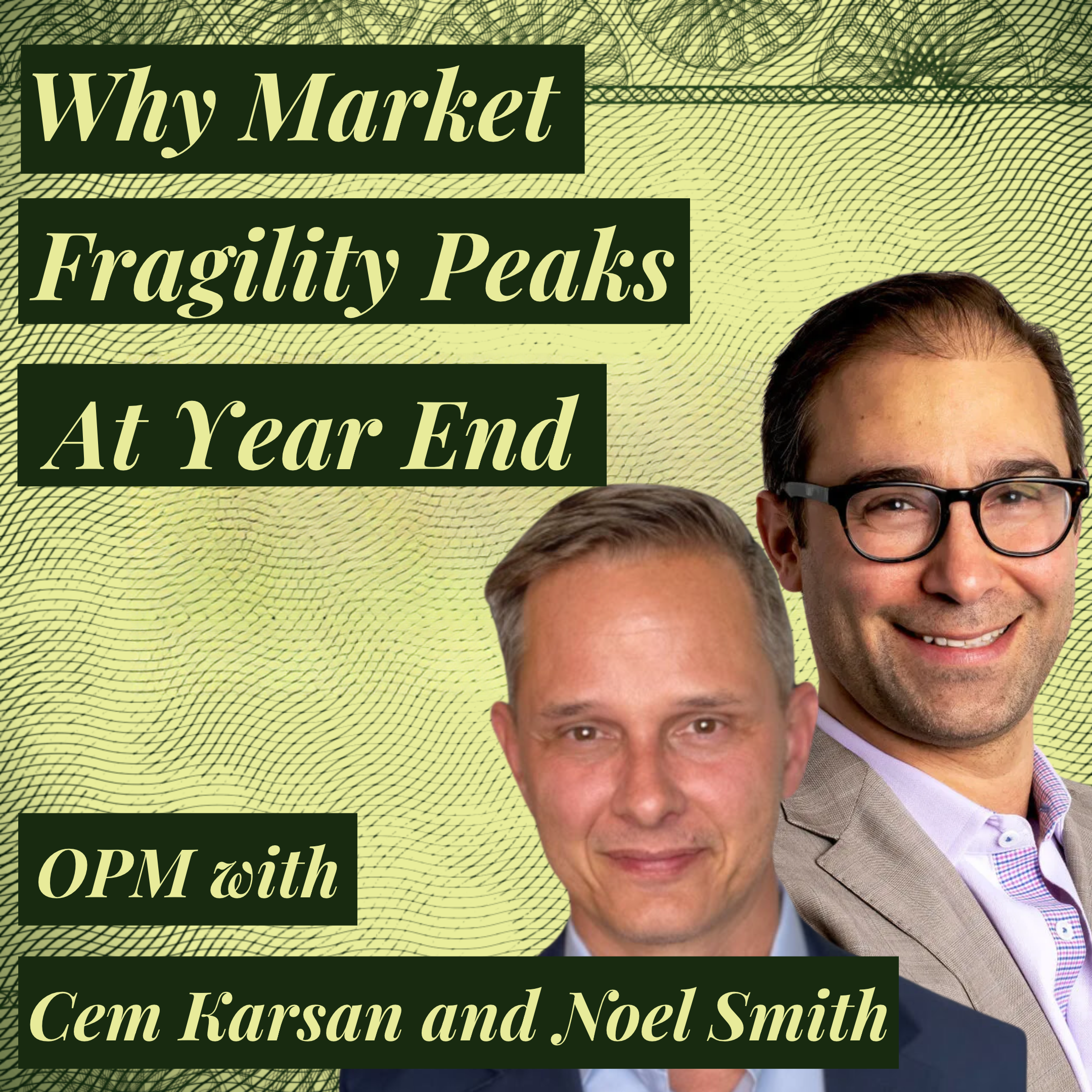
Cem Karsan and Noel Smith are co-CIOs of Kai Asset Management. They focus on cross-asset volatility/option-market structure and flow-driven reflexivity.
(1) Dispersion is rising under the hood while index-level VIX stays low. (2) Buying outright puts/calls is expensive; they monetize hedges instead of adding long vol. (3) Downside skew (10-delta puts vs calls) reflects an insurance “carry trade” that supports markets until the tail activates. (4) Structural higher rates are likely due to refinancing waves, structural inflation, and credit stress; QE/backstops are the “only way out.”
VIX rising after midterms; structured products selling index vol and buying constituent vol; AI/semis “crashes” while the S&P 500 goes nowhere; 2000–2006 value regime comparison; “Hank Paulson” warning about a 2027 Treasury crisis.
Written by AI. May contain mistakes.
Discussion about the upcoming treasury crisis and the Fed's actions.
“45 minutes with Bloomberg to declare nonstop for 45 minutes.”
Analysis of market volatility following the midterms and index-level actions.
“With that out of the way, I want to just get right into the markets.”
Understanding the dispersion of stocks and the impact of volatility compression.
“That dispersion that you talk about, which is, as you know, we've talked about, Noel's talked about as well, when you're compressing volatility index level, that forces things away from each other, right?”
Exploration of crash risk in the current market structure and its implications.
“they did yesterday, that is a high correlation, which is to say low dispersion event.”
Discussion about underlying market pressures and potential risks ahead.
“you get dispersion, you get things kind of idiosyncratic risk still exists.”
Insights into trading strategies regarding volatility and market positioning.
“And then there's a massive tail on this market.”
Identifying potential catalysts that could trigger significant market shifts.
“If the VIX goes to 80 on Monday, I will have wished that I didn't do that.”
Explore the dynamics of market flows and the associated risks.
“The currency has to kind of compensate for that.”
Examine the patterns in call buying and their market impacts.
“But in the meantime, until that tale happens every day, there's reflexive flows that come back and support that trade and allow it to keep being a very profitable trade that then continues.”
Discuss strategies for managing volatility and optimizing trades.
“People that are selling structural volatility at a 30-day tenor or whatever else, who would they sell it to?”
Analyze predictions for the market and the dynamics affecting risk.
“So those negative signals in order for them to not be able to regross, that stuff's in sample no matter what now.”
Discusses the impact of market catalysts on AI and tech stocks, emphasizing the volatility and pressures in the current market structure.
“Obviously, in event, a kinetic action in the Middle East is likely to have a negative impact on markets, is it required?”
Explores the long-term structural changes in market dynamics, focusing on the potential for value to outperform growth due to macroeconomic factors.
“We've seen that many times this year already.”
Analyzes how rising interest rates affect business funding and investment strategies, particularly in relation to current market conditions.
“And we're amidst a massive populist wave.”
Explore the impact of cash flow and interest rates on market behavior.
“And if you don't have cash flow, if you don't have a widget that you're selling in the here and now, good luck.”
Discuss the causes of structural inflation and its implications on the economy.
“Where on the curve is the most volatility?”
Analyze the relationship between rising debt and interest rate trends.
“he said, did I tell him the right number, boss?”
Learn about the collaboration between traders to optimize market strategies.
“How are you aligned with him and how does that make this partnership sort of work?”
Discover how options can be used to manage risks and capitalize on market movements.
“The decline that's going to come that is necessitated to roll out this plan and naturally would happen without this response is, in our opinion, coming sometime before June of next year.”
Learn about the structural support in the market and the interplay of financial incentives.
“So, you know, put calendar flies have been part of what we're looking at.”
Discover strategies to optimize risk-adjusted returns in a volatile market.
“And that's the point of what we're trying to do with Kya Asset Management.”

Get the gist, explore an idea or ask about something said.
 Claude
On Monetary Matters with Jack Farley, what are the key points of this episode?
Searching your listeningAutomatic transcript. May contain errors.
0:00I love Bloomberg. Hank Paulson shows up. 45 minutes with Bloomberg to declare nonstop for 45 minutes. There's a coming treasury crisis and we need to prepare a facility to backstop it. That's weird. We're used to them being reactive only and just letting things be until a crisis happens. That's not the current Fed. The only way out of this mess, point blank, period, the only way to continue the growth that we want, that's supporting this market at this point, given the interest rates, given the wave, there's only one way out, QE. I'm completely aligned with them. Just even now listening to them, I completely agree.
0:41The idea that there are concepts and forces that will drive trades is the point of our partnership. This episode is brought to you by Sarmaya Partners, who manages a return to Tangibles ETF, LENS, ticker L-E-N-S, the Sarmaya thematic ETF built for a return to tangibles. Learn more at SarmayaETF.com and see the show notes for disclosures. Let's get into it. Welcome to Other People's Money. I am joined today by Jem Carson and Noel Smith. They're the co-CIOs of Kai Asset Management. It's a partnership that is very new. With that out of the way, I want to just get right into the markets. We're recording this the Friday after midterms.
1:25We really had the first big post midterms volatility event on Thursday. 2026 has been all about dispersion, single stock vol. This was the first cracks that we really saw at the index level with the VIX rising. What was it that got us some action at the index level? I think this is just kind of the beginning. This is kind of the first shot across the bow. the amount of flows of all compression that exists at the index level is tremendous the growth of structured products which is the primary driver of that vol compression has been 100 % year over year now for four years it is it is something that's very hard to break and I will say it takes a lot of negative macro like really big headwinds and that's what we're starting to see and we've been seeing now under the hood for some time.
2:23That dispersion that you talk about, which is, as you know, we've talked about, Noel's talked about as well, when you're compressing volatility index level, that forces things away from each other, right? And add to that, that underneath the hood from a macro perspective, earnings have also been having a similar breakdown. It has created historic, really historic dispersion. We've reached the higher dispersion level in general, but even from there, we've gone to a really extreme level. And my opinion is at some point that itself can break the bigger picture and unpinball. And I think that's what we're starting to see.
2:59Noel, do you have a take on that? Just for the audience, I'll define dispersion real quick. Consider taking a handful of marbles, dropping them onto a marble floor, and the marbles just kind of go everywhere. That's dispersion. Everything moves on its own and does its own thing. Conversely, take a handful of marbles, drop them into warm, wet mud, and they don't go anywhere. That's correlation. So as the market starts to move as a unit, like a school of fish, you'll see high correlation. And as markets start to move en masse, like they did yesterday, that is a high correlation, which is to say low dispersion event.
3:34So what's been happening is you've had each sector kind of doing its own thing and names within that sector kind of doing its own thing and kind of balancing out at the index level. And as Jim was saying, there are structured products that take advantage of that. They sell index volatility, and then they buy volatility within that same index with the constituents. And that's been a great trade, honestly, for years. And days like yesterday make that trade very painful for those people. Now, in fairness, those levels that have been historically low in terms of dispersion, that trade anyway. And I think that Jim is right.
4:10I think that that trade from these levels has got a lot of blue sky above it, which is to say it can go way, way higher. That is the big question, I think, on everybody's mind. Whenever you get an elevated VIX, people love to step in and try and sell vol because it looks like you can get a good premium. But at the same time, there's a reflexivity aspect here. And so I want to ask you both, and we'll go back to you gem to start like about crash risk and whether you think that this is an opportunity to step in and buy that expensive volatility um or this is something where you think you need to be a little bit more cautious the way the um the market structure is at this point is it's it's become increasingly narrow it's all compressed at the index level right right distributed, but with a very fat left tail.
5:03Okay. And so when that index is very compressed, you get dispersion, you get things kind of idiosyncratic risk still exists. So things will go up or down and that'll push the other things the other way. It'll force kind of higher volatility under the hood, net net because of that dispersion. And because the market itself is so pinned, it's hard to go down. Like we're seeing, we saw after the election, we go up, even though the macro news is bad. That's the flows and supportive, you know, supportive vol compression. But then the macro overwhelms, it goes down. But then what do we see again this morning?
5:38The bounce back. Those are the flows. So it's very hard to break out of that, even if you do it for a day, to break out of it structurally. I will argue that if, this is the if, and I would argue when, because I think it's coming. It's just going to take a while. If you get a big enough move, that was not big enough yesterday, right? We need a continuation. If we had woken up this morning and the market was down two, it would have been down probably five because that gives gamma effects of that tail out there, would have kicked in. And then you can start to kick in much bigger tails. So I will, I would be incredibly, I cannot emphasize this enough.
6:18the tail on this market is tremendous. Think of it as, I'll use my own metaphor here, it's two tectonic plates. Even though things aren't moving, if there's immense potential pressure building under the hood, you won't see anything moving. It doesn't mean the potential energy doesn't exist. And this is what we're in. We're in this sumo market, in this tectonic plate market, where all it's going to take is the right moment, that kind of Minsky kind of moment, that last sand pile. And then there's a massive tail on this market. Because the macro and the fundamentals and the realities underneath this market are incredibly fragile, but it's being held together by massive structural flows.
6:57Now, Noel, on your side, obviously volatility rose a lot yesterday. You and I were talking and you said just buying puts outright is starting to look pretty expensive and we get something like we had today. I think you said the VIX will come back down to 22. I think we got like 23 or something like that at the open on what was pretty green. So you're basically spot on in what you had predicted would happen today. With volatility coming in, are you loading back up on long volatility bets? Hard no. So yesterday what I did is I sold some VIX options that we had in inventory already. These prices are definitely not a price that I want to be buying volatility.
7:39Now, whenever you have inventory, there is a presupposition that you have something to do with it, right? You have units on the shelf in which you can move. Now, if you walk into the pantry and there's no units, it's a different trade. If you are at risk of blowing up your business or losing your job and you have to buy puts, that is a situation that is unique to your situation. But it's also a situation where people that have those units can capitalize on that. So I think this is a terrible time to buy volatility unless you really, really need it. And, you know, we're in the lucky enough position to have some of that coming into yesterday.
8:10And we had different call and put structures on the book already so that a day like yesterday, a lot of the pain was mitigated. And that's kind of the point of that trade. Then what do you do? How do you take advantage of this? Is it, do you want to step in and be selling vol or are you more just stepping back from the market right now? So I'll just tell you what I did as opposed to guessing or speaking in theoretical. I sold almost all of my hedges. Now, is that the perfect time? I have no idea. I really wish I could tell you. But I don't know. If the VIX goes to 80 on Monday, I will have wished that I didn't do that.
8:41But I will also say that there's a little bit of money on the table still. And there's convexity there to be had. So that's all good and well. But we've been carrying hedges and they've more than paid for themselves. So it's been a satisfactory outcome. But when it comes to when to monetize that, we have to try to disentangle the market structure and what's going on. And that's a bit of judgment. You're looking at cross-asset volatility. You're looking at the way volatility is being bid. You're looking at the VIX futures. Where's the cash VIX relative to the futures? Where are the options on those futures?
9:12And you're trying to divine signal from the flows and from the information that you're getting out of the marketplace, especially if you think it's a handful of hedge funds that are blowing out. If there are people being carried out on stretchers out the back door, that's going to go away, and then the market should bounce as a function of that. It might give you a better opportunity to redeploy those hedges. I don't have any better information than anybody else has that is a market practitioner, but it was my judgment to monetize some of those hedges, the majority of those hedges, and I would not put them back on unless I was either forced to or the setup was a much more favorable opportunity set.
9:51Now, Jim, I want to go to you and talk about what are the potential catalysts that you see ahead for that Minsky moment, right? We got through earnings season, we got through the midterms, we still have anthropic IPO pricing, you know, on the near term horizon. When you look out at what could really force that type of event, and, you know, push null back into the market. What do you see on the horizon? there are times and moments because we can look at flows and we can look at kind of the distribution forward outcomes where it does, to Noel's point, make more sense to be more just long volatility broadly, right?
10:31Not just long a tail convexity, right? And funding that with some other part of the distribution. And I agree with Noel, that is increasingly not the case right now. Our view from a macro, and we'll get into kind of some macro and incentives, administration, kind of forward-looking things that are not just flows, right? And those things, I'm telling you, our highest probability comes at the end of the year and into early next year, okay? So we really want to be long convexity here, but also looking for opportunities to go more long vol broadly right or implied vol as we head out of these opex and that's from that's when the the last kind of that third leg of the stool that's very supportive those flows really are more likely to dissipate into late early next year okay um but uh but that is more of an outlook again you need a catalyst we see very high skew in the last call it 10 years we've had three periods of skew that have been this high three one was late 2019 think of it as september october 2019 the one after that was 2021 july august september 2021 right and and here we are right and so what do those all have in common they all preceded then let's say six months a decline the beginning of a major decline, but they all preceded as the point, not the day before, week before, month before.
12:04And that's because there's a reflexivity when people are positioning to hedge for coming risk. Institutions are worried. They're worried for a reason, but there's a reflexivity to that, which means all of this vol compression, the skew, the hedge, the wall of worry, right? That creates these Vaughn and Charm flows that creates all this structural support. And you have to shake weak cans before eventually that macro kind of reality tends to play out could you just define skew for the audience yes downside uh options or downside insurance in the market i think uh you know 10 out of the money put 30 to 60 days out um and versus the the the pricing of the call which is maybe five to ten percent out of the money right that that relationship is incredibly high volatility for the put, implied volatility, low volatility.
12:57Think 12 % volatility on the call, whereas the put is maybe priced on a 35, right? So this is the biggest carry trade in the world at the end of the day. Downside protection on a realized basis versus implied is incredibly overpriced, right? Why? Because people need insurance and everybody's long. They don't buy insurance for the upside. They buy insurance for the downside. If anything, they sell insurance for the upside, which compresses the option implied volatility there. And that skew, that hedging creates a very, very, the market goes nowhere. You collect, you can sell something for the same premium, 15 % of the money that you can buy maybe 5, 6 % of the money, right?
13:39On the call side. And so there's an incredible imbalance. That is a very profitable trade and the world, the insurance of the world, right? That is warehoused by market makers, by banks, by funds. And that carry trade itself has, much like all carry trades, massive flows on a currency carry trade, which is what most people are thinking about. Those flows go to the currency, right? The currency has to kind of compensate for that. In the S &P or in the equity world, that's what those VANA and Charmflowers. Every day that goes by, that is a profitable trade that makes people money and they need to take down their hedges and their offsets of that trade.
14:18and we put it on. Okay. But there's also much like all carry trades an incredible tail because the reason that structural trade exists is because it's one-sided and everybody has one side of the trade, which means that fat tail is bigger than ever. That's part of what's driving this massive distribution. This fat tail partially is because the whole world is short as the structured products, as the hedging, as everything grows that tail in terms of how people, somebody has to warehouse that. Somebody. has to warehouse that risk. And so if the market gets ugly, that somebody does not have an out.
14:58That is a very small door and smaller than ever, right? But in the meantime, until that tale happens every day, there's reflexive flows that come back and support that trade and allow it to keep being a very profitable trade that then continues. Well, at least at the individual stock level, that wasn't necessarily the story. There were, you know, certainly unlike the memory names, there was a lot of call buying and it was the opposite at points in time this year. I'm not sure exactly who was responsible for buying and bidding up all of those calls, but it seems like that has been a huge, huge change.
15:38Do you think that there's any way that we get people coming back in to buy calls if we do stabilize here at some point? Of course. And I want to be clear, that actual breakdown between that call positioning in the single list and that particular area versus all of this massive skew in the index has been a tremendous driver of the dispersion that's going on. Because what we've not seen is gamma squeezes early in the year, right? On that side of the trade, on the AI complex, which while the index is pinned, which forced a lot of things that were very much value like dramatically down dramatic underperformance because mathematically the only way that worked was through that process but then what happened after and we called this in may this year as the market jumped and those calls just exploded higher and implied vol got bigger and bigger and bigger people piled into him because like oh this is great canvas squeeze buy more eventually almost impossible to keep up with the rate of change there and then the summer comes in and other volumes drop.
16:44And guess what? All the dealers were short those calls, long stock. And we called it in May. We said, watch for a massive countertrend dispersion in the summer. And we just saw the exact opposite, right? All the Vonacharm flows came into the index. All Vonacharm flows came into that other side and just completely pushed this massive rotation over the summer. That was all flows in a very vol compressed time. And when the flows become very dominant in the summer, they also become quite dominant here, November, December, right? Because people on holiday, people step away. So my point is that point you're making has been critical.
17:22And watching that and understanding that dynamic has been really, really the biggest driver of being able to predict where this rotation is going. But at the core, the rotation has to happen if the index is going to continue to be compressed, which is mostly driven by all that structure product kind of all compression flow that keeps coming into the market um so to answer your question though more directly uh is that can that come back yeah it'll come back you know it'll come back when it starts squeezing higher again when will that happen probably and from now you got to start thinking about macro and other things that are happening under the hood and uh you know for that to initiate for for them to stimulate like that, you would need to have it, in my opinion, a big risk off and then a reflation again.
18:07And I think that's what is probably coming. Hey, everyone. Hope you're finding value in my questions. I've got a quick question for you. How much of your portfolio actually depends on the physical world? If you own the S &P 500, more than a third is tech, energy, materials, and precious metals, about 5%. Sermaya Partners believes the next cycle belongs to tangibles, the energy and metal sectors that have been underinvested and underloved for a decade. They call it a return to tangibles and LENS, ticker L-E-N-S, the Sarmaya ETF, is an actively managed ETF to express this view. An active is the point.
18:43The team follows the themes across sectors, market caps, and borders as the cycle evolves, adding where they see opportunity and trimming themes that look overextended. Miners, energy, precious metals, critical metals, all in one actively managed ticker L-E-N-S. When inflation runs, stocks and bonds can fall together. Lens adds real asset exposure with the potential to diversify both the stock side and the bond side against inflation and geopolitical risk. Learn more about the Lens ETF, their full data and comparison, including performance at SermayaETF.com. Investing involves risk, including the possible loss of principal.
19:22The fund's investment objectives, risks, charges, and expenses must be considered carefully before investing. This and other important information is contained in the prospectus, which can be obtained at sarmayaetf.com. Please read the prospectus carefully before investing. To rip off of what you're asking before about calls, you know, there's a lot of products out there that are buy rights, things like that. People that are selling structural volatility at a 30-day tenor or whatever else, who would they sell it to? Well, they sell it to the market makers. The market makers buy that stuff. And that also, you know, as the prices start to go up, that kind of causes them to kind of keep their deltas relatively flat around those tenors.
19:58But if things start to continue to rip, there can be chase. And especially going into year end, people can find themselves in a situation where they're chasing performance. So I think call spreads, call flies, which is to say buy one, sell two, buy one further up. That's a fly. Is a superior trade than just closing your eyes and buying deltas, going out there and buying queues, buying spies or whatever. Because that has got obviously the one-to-one downside risk is an addition to the one-to-one upside risk. So there are ways that you can structure the vol into your favor so that you have asymmetry.
20:32It's kind of what we're looking at doing, right? We always want asymmetry. We want to make more than we lose in any given scenario. So those types of opportunities to me feel they're a lot, much more perspicacious view on the marketplace than just going out and buying some calls. Because if you buy 32 vol on some call and the market goes up 60 bps, your 32 vol call is going to be a 22 vol call and you will lose money. So that's a rough trade. And it's maddening to have long calls to have the market go up and also lose money. Ask me how I know. It sounds like something you've been through. Now, you talked about people chasing, trying to chase P &L until the end of the year.
21:12It doesn't feel like that's what we're doing. It feels like people are on defense. You're seeing 10 headlines yesterday about a different fund, whether they're liquidating entirely, closing some aspect of their business. A lot of people in the hedge fund industry are on defense right now. You've probably been through a couple periods like this. Does it usually end after one day of headlines? Can we expect more bodies by the time this is all over with? So the idea that we bounce back, you know, right back to where everything was on Monday, man, I'm very circumspect of something like that. That just does not seem likely to me.
21:49But in the same vein, so I'll give you both sides of it. If you're looking at hedge funds being carried out or pods being fired or people, you know, redeeming their cash, that'll be transitionary. The other side of it is if you look at something like a vol control fund, yesterday was a huge move. So we're not going to get, you know, they're looking at vol control, which is to say yesterday was T, T plus one is today, T plus two is Monday, et cetera. They're not going to have, they're going to have this data in sample for like another 20 days. So those negative signals in order for them to not be able to regross, that stuff's in sample no matter what now.
22:23So those signals are not going to come back in a robust way until, you know, a month from now. So there's definitely reason to think that this isn't going to just bounce right back on Monday. Again, from a mechanical standpoint, It has nothing to do with my opinion on, you know, Anthropics IPO or whatever else. This is not an opinion. This is something that's structural, something that Gemini talk about all the time. This is just, you know, two plus two equals four. It's a mechanical thing. It has nothing to do with somebody's opinion. I'd like to add this wrinkle of like forward distribution based on flows.
22:55Again, let's take the macro out of it. The biggest open interest by far in the market is December puts. The world is hedged long December put, short call in December. And that skew and vol dynamic is an incredibly important dynamic that will only become more important as we move forward here for the next seven weeks. okay every quarterly opex is the biggest opex ever and the december one will be the biggest ever because it was leaps it's been on the boards and it's a quarterly you know etc so the amount of flows coming out of the options uh market are tremendous from that but remember what did i say that type of positioning causes a very fat left tail right distributed market in order to activate that tail in the market, we need to get going.
23:55We need soon. We need to make it such that dealers who are able generally to manage these positions, a move like yesterday is not a big deal to a dealer, right? At the end of the day, they can manage that. And as long as things slow down, like they did it's not a crash they can then manipulate move prepare etc what you need in order for this to continue and to activate that tail which is what we're talking about right you would need a continuation soon really in the next several days that's how soon you have to keep the pressure on those that are long or that have that de-skew position that they can't get out But it does not currently, to Noel's point, look like that's going to happen.
24:47If that reactivates over the weekend because we bomb Iran or something happens, right? That's on the market surprise. Then you can continue to activate that. That can become an area of stress and we can get a real continuation all the way into D-SOPX. That is not a high probability. That is a low probability, even lower this morning than it would have been yesterday. going home, right? Because we've already gotten some bulk compression. People have been able to get back on sides, right? Dealers are able to manage and move things to help prepare. And so from now till really end of day Tuesday, which is not a lot of time, in my opinion, you either continue this rollover into Friday and a Monday, which does not look likely as we're sitting here right now, right?
25:35And really try to activate and push kind of stress into that part of the curve, which then could steamroll. And if that doesn't happen soon, and dealers know that, that's why we're still up here at the end of the day, right? If there's no bad news here, then the net result is those flows start kicking in, not just the novopex, because we're getting into kind of that window of those vol and the charm flows for that novopex, but then we get that fast forwards us to Thanksgiving. And then Thanksgiving is there where vol gets compressed and that vol compression can sneak in. And then you're to December 1st and then you're two weeks from DeSaupex and there's very little time to initiate that.
26:15So the structure here as we go into the end of the year from a flows perspective, unless we get going now until that stress, unless that stress activates right now, right? Is dissipating by the minute, by the hour and the net right distributed market here at the end of the year will likely kick in. And markets make the front run this. Like, I'm not the only one who knows this. So you better believe my opinion is by Tuesday, Wednesday, right? If, if we don't continue this decline, then, then, you know, we could get it, we could be right back at all time highs pretty quickly. because markets like to move in nowadays, right?
26:53Because the signal is very clear, quick moves and then digest because that vault compression will come back in. So, you know, our views were at this real important, critical moment here where not probable, but high impact if it were to happen. Fat tail, but again, very short window. And if it doesn't happen again, this is, and again, this is all without all the macro all the other things that we're talking about this is a baseline the market structure the natural flows which are very important and and very dominant particularly in these periods like the summer and the end of the year but it's not to say you know trump drops a nuclear bomb on iran you're going to get an action and that and that tail which is i've already said is fat will be very fat okay i guess my my question would be do you need a nuclear bomb And it's not an actual nuclear problem.
27:46By the way, that's not that improbable based on what we're hearing, just so you know. I mean, that's maybe a 1 % or 2 % probability where normally that would be a 0.001. Noel, I want to ask you about this idea of this window of opportunity to get follow through to the downside. Obviously, in event, a kinetic action in the Middle East is likely to have a negative impact on markets, is it required? If people have just fundamentally given up on the AI trade and they're selling every bounce that we get to get out of positions, do you need a news event, something to push us? Or can people souring fundamentally on some of these dominant trades cause that follow through early next week regardless?
28:36I think that's a distinction without a difference because there's one ubiquitous part of this marketplace is the money is always going to seek the path of least resistance. The idea that people just abandon the AI trade because they decide they don't like AI, I just don't agree with that. I think that the idea that there is a blue wave and maybe some of those people are going to be less favorable to data centers and the funding for that is going to be a little bit more difficult. And that's going to compress IPO valuations, maybe push back a day or two. Then you have Nvidia earnings right before VIX options expiration.
29:07Those are all real catalysts. But the idea that people are just kind of bored of making money in Nvidia, I know Nvidia is not where it was last week. I'm bored of losing money in Nvidia. Yeah, exactly. So I guess the only thing you could say is that everybody kind of tries to lock in those factors that have been working for them. I don't really think that's also a thing, right? I think that's also a very small percentage chance. I think that the most likely situation is there is going to be a catalyst. Whether you perceive it to be the same as somebody else is a matter of debate. But there's always a reason that people do what they do.
29:40Market structure puts pressure on the distribution and at baseline without anything else. It is one-to-one predictive. But there are other factors that also put pressure on that distribution. And they're interacting with one another, right? Structurally, distributionally, this is a right distributed fat left tail market that overwhelmingly without a catalyst is going to, especially as time goes forward here for the next several days, really be a positive structural vol compressing setup. That's just the reality. But that's at the index level. And Max, you keep asking us about the tail and AI versus kind of the market.
30:19And those two things, I want to be abundantly clear here, are not the same thing. We have seen multiple times this year crashes, literally crashes. You can't really describe it as any other way in parts of the market. Look at the semis right now, right? With the market going absolutely nowhere. Okay. So I want to be clear that that can continue. The supportive move in markets, the vol compression I'm referring to is at the index level. And if anything, that is going to force more dispersion. I will tell you again, I said this in May of this year, expect massive dispersion if this market continues to get compressed and go higher in November, December.
31:02And if anything, I would argue that's probably going to continue with what's weak, continue to get worse while you start to see other leadership. I want to ask about that leadership, right? So you don't think the rotation flows are exhausted in any way that we could continue to see the different areas of the market? You can see a flip reversal. But it's not a beta one. There's a difference. We've seen that many times this year already. Right. We saw a massive tech move with the market going not much of anywhere. Right. And then we saw tech collapse in the summer. And then we saw the tech rally again.
31:36And then we've seen it collapse again. It's just flipping around. Right. And that could happen again. I wouldn't I don't think that's as probable, but it's possible. Right. Yeah. Jim's totally right. I mean, look at like look at health care. You know, it's been doing fine. Look at home builders doing fine. Look at SKU and option dynamics in gold. Utilities, they're not that expensive. Relative to tech, they're techs on the moon. So the idea that things can't move under the hood without the apparatus writ large changing, I completely agree with them. Of course, it can just rejigger everything and then we're kind of, you know, at the index level, might not be all that busy, but there can be all kinds of activity below the surface.
32:15And the dispersion is accentuating that, but I will highlight there's also macro reasons for it, right? which are helping kind of push it along. 2000, when we didn't have even a fraction of these flows that we're talking about, they existed, but not nearly at the scale we're talking about here. The initial decline in the NASDAQ, when the NASDAQ was down 50%, 5-0, the S &P 500 was down 15. And 50 % of the market was up 20, 30%. S &P down 15, that's how big a rotation happened in the tech bubble. So again, don't think just because we're talking about the market and the end of the year and these flows, what I'm talking about in terms of market is market S &P 500 direction and the flows that are affecting that.
33:09And the fact that that, if anything, is going to accentuate that dispersion, accelerate it. Now the question is, which way is that going to go? That's a harder question. But given the macro stress and the other things that now gets into the other parts that are affecting this distribution, my best bet is that that continues, that stress continues during the end of the year, despite the market probably hanging in just fine, unless that tail gets activated in the next two, three days. So you talk about that difference in 2000. I mean, it really kicked off what was a six-year period of outperformance of the value factor and many of the sort of like hedge fund legends of that early 2000s period were the value guys i'm sure you've seen the funny memes with uh with lord of the rings like the time of the orcs has come like the time of the value factor has come do you think that we've reached a more structural regime change in terms of value outperforming growth or any of these sector rotations actually sustaining for a a multi-year factor rotation.
34:15I have a strong view on that. I have a very strong view on that. And the answer is what you saw in 2000 to 2006 value was a very narrow window in the grand scheme of things. You look at 125 years, these are like 40 years growth or 30 years growth outperforms, 25 years value outperforms, right? And there was a moment there, right? Where growth, the bubble popped, right? But the truth is for now 44 years, we have done supply side economics. That is why the growth factor has dramatically outperformed. We have lowered interest rates from 20 to zero. Every crisis has been that response. And what we have, what has begun really starting in about 2020, right, is a more populist kind of move.
35:05Now, Trump version 2.0 has come back in a point and attempt to bring that to a more right-wing populist answer, which is really supply-side economics again, but trying to kind of give crumbs to people right through, whether it's Trump accounts or other things, right? But it is still an incredibly supply-side response. And the big question, the answer to your question is, it depends on one thing. Is this now repudiation of Trump? Is it going to lead to an unlocking again of what had started in 2020, which is an unlock of this populist wave and policy that is going to be more populist? And if it does, the value factor will outperform for the next 20 years.
35:51And why is that? Why do populist politics make value? All right, buckle up. Because populist policies mean you're taxing the rich and giving to the poor. When you give money to the poor, people spend money. When you give people money to the rich or capital, whether it's through lowering interest rates or QE, people invest money. Incredibly different approaches. People are like, oh, we're getting stimulus, right? Could not be more money. You send money to what I call Planet Palo Alto, which is what we've done for 40 years. send money to companies. Companies send back Ubers and Amazons and Teslas.
36:29They don't send us back demand, which is deflationary. To which our next response is more monetary policy, which gives us a short-term sugar push, but then leads to more and more deflation. And this is free market economics. This is supply-side economics. This is what we've done for 40 years. The Federal Reserve has two mandates, It's essentially maximized GDP, call it unemployment, but it's really maximizing GDP and price stability. And monetary policy achieves that with very low inflation. It's a deflationary setup and continues to drive growth. There's a problem. What's not in their mandate?
37:05Inequality. That process has driven 40 years of dramatic inequality and always does, which leads to what? A generation who says that's not fair. A generation who can't afford a home, who can't pay off their college debt. 18 to 36, 35 % of America from 18 to 36 is living at home with mom and dad. And that has led to millennials being pissed off and say, we need a system that prioritizes median outcomes, median outcomes, right? Not mean outcomes. And that alone, that little thing means higher interest rates. Because if you send money to people, people spend money, that drives inflation, that also drives popular protectionism, which drives global conflict, which drives higher commodity prices because we're sequestering commodities.
37:52We've seen this again and again and again throughout history. This is why big cycles happen. I can hear about, read about that. Neil Howes, fourth turning and all these other things. These are all a function of this generational experience. If you were born in 82, all you've experienced is increasing globalization, increasing inequality, increasing technological development, and you're sick of it. And guess what? they're coming to political. Those people are coming to political dominance. So at the end of the day, why will value outperform if that's the case? Because if interest rates go higher, if the price of money goes up, that's really bad for duration.
38:32That means you can't borrow money anymore. Think about the Amazons, the Ubers, all these companies never would have existed in a world where interest rates were higher because they couldn't have raised money. A lot of these companies didn't make money for 20 years. There's no other period in history, period, where you couldn't make money for 20 years and focus on dreams to build market share and ideas. They wouldn't have benefited from all the cheap labor. They wouldn't have benefited from all the things that came with a supply side model. When you go to a demand side model, you ultimately give money to people.
39:11It's more fair. It's more equal, right? But what that does is that That's naturally a higher interest rate environment. And that is awful for growth, awful for venture, awful for... You have to fund. You actually have to fund what you're doing with cash flow. And so if you're a value business and you have cash flow, guess what? You acquire the growth. You fund the growth. You have more growth because you're not competing. The value of the money that you generate is worth a lot more. So people like scratching their head. Why is growth dramatically... The value factor is dead. It's not dead. until demand, you know, it's, it's dead until the demand side economics comes back.
39:50And we're amidst a massive populist wave. It's clear. Look at what's happening in France. They're, they're burning down the Louvre. That's not, that's not a coincidence. And this pendulum always swings. It shouldn't matter how long they can keep it plugged to one side before they, you know, and how angry people have to get before it gets burned down. Question is, so if you ask me time, tell me what happens to that one factor and look at what happened with Lula, right? That wave unexpected look at what's happening in france look at what happened just now in the midterms it's all related we've been talking about it for some time and the politicians will try because they're very short you know they need to get elected in two years and four years they will try and keep the plate spinning and the only way to keep this planning is to keep going on the supply side approach but the politics will force and will continue millennials to get to political dumb it's in 36 there's still 10 years this is only getting worse so i i want to ask noel then how does that manifest itself in convex opportunities right short q's long spy done so basically if you're talking uh i mean i'm being cheeky but not really so what jem said is completely accurate if you want to buy a house say you say the house is a million bucks whatever um at uh 20 interest it's a pretty different mortgage payment than it is at zero percent interest so if you transmute that into, I want to launch my venture capital fund, or I want to launch my hyperscaler, whatever it is, if you're borrowing money for your harebrained scheme or for your great idea that still needs money, but the interest rates are something you can't afford, then you need to figure out a different plan.
41:28So if you look at Qs, which is growth, and you look at SPY, which has got a lot of growth in it, but less so than SPY relative to speaking. That's why I gave my smart aleck answer, which is short Q's long spy. As a relative value trade, that is basically what he's saying. He's saying that value as a pro rata percentage unit of risk will probably outperform growth as a function of higher interest rates because higher interest rates punish duration. Duration being, I'm going to launch a startup and I am not going to cash flow for five years. Well, what happens in that five years? I need to pay my bills.
42:05I need to pay my staff. I need to pay insurance. And all of that stuff requires money. And if you don't have cash flow, if you don't have a widget that you're selling in the here and now, good luck. How much of what has happened with the unwind of the AI trade is just a version of that. It's not necessarily that the outlook for the companies have changed, but we've seen rates rise. The value of future cash flows has gone down tremendously since the start of the year, since a lot of this money had been planned to be invested. Obviously, yes, CapEx estimates were raised throughout the year, but I think, you know, directionally people have had been predicting that, you know, for at least most of 2026.
42:45Do you think that that's at the scene of the crime here? Yeah. If you look at the ZQ futures, which is to say the Fed fund futures, they went from three, 2.86 rate hikes between a couple of weeks ago and September of 2027. Then it went down to less than two, and then it was one yesterday. And now the December contract has firmed up a little bit. So because of the jobs number this morning. So the market doesn't really know exactly what it wants to do, but a lot of that is being repriced in the here and now. And that will also manifest itself into anything that's interest rate sensitive. If you look at home builder stocks, they did fine on Tuesday because rates are coming down, and that interest rate sensitive names are gonna benefit from that.
43:31So what Gemma is saying is that there is this, the price of money undergrids everything, right? It is the foundation of our economics, of our system. And if that has volatility to it and it's unknown, that artifact of that ends up coming out in equities and in volatility of equities. And then, so that's why we look at cross asset volatility. We look at things like oil volatility, Gold volatility as a currency analog or actual currency volatility. Bond volatility. Where on the curve is the most volatility? Where on the curve is the most skew? And those are the types of things that people like us look at to get signal so as to come up with something that's actually useful.
44:12What do you think about the path of rates, Jem? I mean, we are still expecting to get a hike in December. Is this wobble enough to take the Fed off of course? So you have to understand there's two things that are massive inputs to where interest rates are going. And people have been used to about 40 years to only one of them up until about two, three years ago matter. That one that people, everybody watches that a lot of bond traders, most bond traders I've talked to have missed the boat actually on things because they've been playing the same trade for the last 40 years, which is cyclical, right?
44:50Cyclicality, The business cycle, right? That's one. And that's the whole game that every bond trader has played for the last 40 years. But there's a whole other side that I started talking about four or five years ago that everybody was missing the boat on, which is this supply side versus demand side equation. Structural inflation. We have not been below 2 % inflation in 68 months. What is happening there? Well, first off, I just talked about the structural inflation from fiscal spending, the increase in inflation from global conflict and the spending that goes in a global conflict, right? All this, again, the protectionism and the cost of supply chain breakdowns itself.
45:34Commodity costs increasing because commodities are now sequestered and we're not trading. Globalization is not expanding. So one, structural inflation. But two, as this happens, what happens well people don't want to buy us debt anymore because we're doing a protection we're not we're no longer the 40-year us that like spreading corporate kind of profits around and expanding globalization we care about our people our populism right and so less international buyers structural inflation and then here come the two biggest ones everybody refinanced in 2020 money 2021 and the average duration of the debt taken in 2021 five to seven years sovereign corporate municipal you name it all of that has to get refinanced that's a one-sided kind of tidal wave of money that now has to make a decision I was financed at one percent now I got to decide whether I want to do it at six and seven percent right or do I go sell the asset that I was investing on that was financed at one because now 7 % doesn't make sense.
46:49That whole wave is a huge part of this. And by the way, administration knows about it. That's why they passed the Strategic Loan Ratio Act. That's why they passed the Stablecoin Act. They've been trying to manage what is a very difficult one-way train of supply and demand. But add to that, the only way to keep the plate spinning amidst this rising interest rate when we have a funding problem is to push CapEx from those that had all this cash, which they did. Last September, they got everyone around the table. You guys remember? And they were like, everybody one by one said, how much are you going to spend for the next two years in CapEx?
47:28Remember the hot mic moment where Zuckerberg was sitting next to Trump and he said, did I tell him the right number, boss? So 600 billion too much, right? So there is a massive amount of corporate kind of driven by government, you need to push money into CapEx, essentially industrial policy, right? But driven through these hyperscalers. What happened? They burned through all their cash and now have gone to massive debt. And at somebody, at some point, you can't just encourage these companies to do this. You have to backstop them. Otherwise, that growth, all of that earnings growth, all that CapEx, everything that we're seeing, which is built on debt, that can't continue.
48:14And we're starting to see that. We've reached the natural point of that credit. Default swaps are blowing out, right? And it's crowding out sovereign, which is another wave of debt. There's not enough. So you're asking me, where's interest rates going? Long-winded answer. The answer is higher. And the base case is structurally higher. That doesn't mean over the next month or two higher. Although I do think it's probably going higher. the next month or two because if the market's going higher that will start to reflate and the cyclical part and people will have to see you're chasing you have a cash crunch at the end of the year that's a whole nother but i think the structural path is higher hank paulson came out in april took all the people paid all of like 12 hours attention to it he hadn't spoken to financial media for probably four years i'll believe hank paulson shows up 45 minutes with bloomberg to declare non-stop for 45 minutes there's a coming treasury crisis and we need to prepare a facility to backstop it that's weird strike anybody else is weird you think hank paulson just showed up to declare the world there's a coming treasury crisis and we need to prepare a facility to you know to prepare for it and what have we said said seen since he said that in april higher and higher rates structural you know push in interest rates and intervention at the long end of the curve from buybacks from treasury intervention in the yen from besant these are soft facilities the only way out of this mess point blank period the only way to continue the growth that we want that we're supporting this market at this point given the interest rates given the wave it's only one way out qe the federal reserve has to get on board and start printing money at the long end of the curve or backstopping this debt build out this build out.
50:06That's it. That flies directly in the face of the stated goals on the balance sheet of Chairman Warsh. Doesn't it? That's interesting, right? And that's all kabuki theory, because you need somebody, if you're going to deploy money printing at scale, it looks like you're a banana republic, unless you got somebody in the room being like, but we're responsible stewards, right? So, so yeah, I mean, it's weird because a backstop is is necessary to provide confidence but at the same time providing a backstop here is also an admission of the problem not necessarily does china have a problem they've been doing state state run 20 years of investing in uh solar and uh electric cars and rare earths and nuclear power uh was that for a profit incentive or was that for strategic build-out?
51:04They've been, you know, structurally, that's what it looks like to compete. We are moving, 20 years ago, China declared that they were moving to free market economics with Chinese characteristics. The U.S. is moving to communism with American characteristics. We are going to meet them in the middle. We are going to push massive state-run buying of equities and printing of money. Japan did it for 20 plus years. Japan owns 8 % of the Nikkei. There's no way out of the debt mess that the US has. They know it with higher interest rates. There's no way out of the populism mess unless you start buying stocks on behalf of people, sovereign wealth fund and Trump accounts.
51:47There's no way to support this market that's become way too big to fail. $300 trillion of equities goes up 20%. That's 50 trillion from the 250 to 300 this you know from april and may of of this year it's 50 trillion dollars of new collateral you know how much qe we did in response to covet 10 trillion mark is way too big to fail and they know it so we got a hedge fund manager for treasury secretary so we have a hedge fund manager for the head of the federal reserve markets are the thing there is no way out of this mess to compete with china to support this too big to fail market to monetize the debt and to run right-wing populism other than this.
52:33And give me the incentives and I'll give you the result. That's coming, and it's coming in the next six months. So, Noel, when you hear this, obviously you guys just partnered up recently. You've known each other for a while and you've exchanged ideas, I'm sure. But you hear Jem's sort of like overarching view of where we're headed, where markets are headed. How are you aligned with him and how does that make this partnership sort of work? Well, I'm completely aligned with him. Just even now, listening to him, I completely agree. And I think his ability to distill a complex spectrum of ideas and geopolitical forces that come from the economy and the governments and trying to look at human behavior and to take ideas and behavior and put it into something like a trade, which is kind of where I step in.
53:21The idea that there are concepts and forces that will drive trades is the point of our partnership. It is to take ideas and put them into execution so that we can have a risk-adjusted, more favorable outcome than we would have individually. I couldn't agree more. I think, you know, look, it takes a team and specialization to get best outcomes. I can speak to the pressures that are pushing on the distribution, and together we can model what that forward distribution of outcomes is. But to structure a trade that is optimally fit to that distribution takes another expertise altogether. I have some of that, but Noel has it in spades.
54:12And so that partnership's incredibly powerful. Noel, I mean, what are the structures that you're looking at to deal with these macro forces right now? That's where options are great. Options are perfect for this exact type of a scenario, which is you want to add specificity and time to some judgment and you want to limit your exposure so that you don't find yourself in a massive drawdown if you're wrong. There are a few different catalysts coming up that I think are important. I think NVIDIA earnings are very important. I think that NVIDIA earnings being tied to the same time as VIX expiration, then you have NOV, OPEX, you have the interest rate decision on December 9th, then you have DSOPX.
54:54All of those things are going to take a lot of options and just kind of wipe them off the board. And what that means is that all the activity that can commence more freely afterwards does open up a window of opportunity for volatility. So it would be our judgment to try to take advantage of that in an asymmetric way. Everyone says asymmetry, but it's not that tough to do. And the harder part is when to monetize. Going back to what I was saying earlier, taking off some of those hedges. I don't know if it's the perfect time. I don't know any more than anybody else if it's the perfect time. I hope that it's the perfect time.
55:25But I do know that we will not go broke making money. And taking those trade structures off and monetizing them and banking those returns is something that I feel is confident is going to be good for the business overall. The key here, as Knowles mentioned, is like options are purpose built for this. Right. And the view is very much that a decline is necessitated. And I didn't really state this clearly here to you, Max, but I've done it elsewhere. The decline that's going to come that is necessitated to roll out this plan and naturally would happen without this response is, in our opinion, coming sometime before June of next year.
56:05right and will be resolved by december of next year that's where the incentives are right and so if we think there's structural support in the market right now right and we think something's coming in by disop x or jan op x that's when it would get more begin naturally you want to sell disop x you want to buy right something in that june area right and then sell something out a year and D's. So, you know, put calendar flies have been part of what we're looking at. That said, we do believe there's a little risk that it starts sooner, in which case this thing wouldn't pay off. So we also have risk reversal.
56:46We think there's limited upside in the short term and little tail. That's not a long ball trade. The whole net thing, by the way, pretty flat premium, very little, right? So the asymmetry is in the timing. The asymmetry is in understanding where the, what parts of the distribution are valuable and which parts are overpriced. So structurally, these are the types of things that we're putting. And the question is, that's at the index level. Do we want it more in the NASDAQ? Yes, because we think that's where the pump is going to happen. Right. And there's other kind of nuanced parts of this. But generally speaking, those are the kind of structures we're looking at.
57:19Now, those are big long-term structures. That's over the next year and a half. Right. In the meantime, what Noel's talking about, which is kind of the having the tail of monicide. This is why he is sitting in that seat day to day, hour to hour, minute to minute, managing, monetizing and optimizing as those things change. So when you say that the incentive structures, are you talking about basically engineering an event that would allow for another refinancing event for the round? The engineering is way too... It misses all the pressures on the distribution. This is essentially a three-legged stool.
58:01You have options, flows, structural, not just options, flows in general, structural flows. That's one. We talked about that too. There's macro, which is interacting because markets are bigger than ever. What happens if the market goes down 20 %? Credit flows out, speeds up the macro decline. These things are all interacting. So two is the macro, all the things we've talked about. We've hit a point where the bond market has gotten, you know, the driver of the economic growth that has been driving this part of the market has reached its capacity to fund and continue that without support from the government.
58:37So there's a cap on that growth. There's a cap on a macro. Meanwhile, the Strait of Hormuz issue is structurally causing less demand from consumers because of the price of gas. And the rest of the economy is already rolling. So from a macro perspective, that's the other pressure. But then again, we can reflate the market goes up another 5 % from now to the end of the year or 10%. That's more liquidity cloud. We can keep the plate spinning for a little bit. But there is a third leg of that stool, which is the administration and their treasury and Fed and their activity in the market. They passed the strategic loan ratios.
59:17They passed the Stable Coin Act. They've done buybacks along the curve. They've intervened in the yen. They've told us there's a deal in two weeks and that all these things are getting resolved to squeeze the market when it goes, right? It's hard to argue with the fact that this market, the people in power are proactively trying to manage markets. If you don't believe that, I can't help you. You're not watching, right? Doesn't mean it's a grand conspiracy, right? This whole thing, you can't not take account of the Fed. Literally people for 30 years, maybe the biggest mantra of traders is don't fight the Fed.
59:58Do we ignore the Fed or do we pay attention to the Fed? So my point to you is the incentives of the Fed, the incentives of the Treasury are critical to understand. They are a huge part of that tale. We're used to them being reactive only and just letting things be until a crisis happens. That's not the current Fed. That's not the current administration. They've been very proactive. And my question to you is that proactivity, which has kept things spinning as push capex, who has driven this growth into midterms, into here. What are their incentives for the next seven to eight months? That's one of the three legs of the stool.
1:00:36And if you're not paying attention to that, you're doing yourself a disservice. Besant's gotten really quiet. You heard from Besant in a while? No. When's the last time you heard from Besant? Take yourself back three weeks. You could not stop hearing from Besson or Trump five times a day. That's not a coincidence. The one thing we heard from Trump was what yesterday? What did we hear from Trump yesterday? I told you if the Democrats win the midterms, this, we're going into a Great Depression. The tone has changed dramatically. Very little of what I've said is political. People love to make this political.
1:01:14These are the incentives on America and the outcomes. If you want the market to keep going, if you want the economy to keep growing, they need more proactive monetary policy to backstop the growth and the AI part of the market, which is the only part that is growing. That's it. And the only way we can do that is through massive intervention. And the only way we can do that is through a crisis. And people say, oh, that's a conspiracy theory. You don't need a conspiracy when interests converge. If a community thinks there's going to be a data center in the middle of their playground, there doesn't have to be a cabal of people to get together and go against it.
1:01:58If everyone doesn't want it, then everyone will kind of figure that out. So the idea that it is politically expedient for the market to go up isn't a conspiracy theory. It is what is suitable for the people that pull those strings. So I kind of wanted to take the idea that there would be some kind of evil thing and just point out that's different than just people trying to talk up their books, so to speak. I think that's a lot more simple way of putting it. So anyway, yeah, I guess the main thing I wanted to convey regarding our partnership is that we're trying to take ideas and execution and optimize them both.
1:02:38And that's the point of what we're trying to do with Kya Asset Management. We're trying to put trade structures around complicated and ever moving narratives and taking those things and putting them into asymmetric and risk adjusted bets that we think are better than we could do without each other. In a world that is lower and lower interest rates and supply side economics, passive investing, 60-40, growth investing, these things excel and you don't have to worry too much about the risk because even when it comes in 08 or a tech bubble, which are the brief accounts of it in the last 40 plus years, it is resolved by more monetary policy without the populist wave and the pressures to worry about inequality.
1:03:25That's the trade. But the second you start to worry about these other pressures, it is a completely different, not just two, four, five, we're talking decades ahead. And what is necessitated in that world is understanding risk, positioning and optimizing to risk adjusted returns, having the tools and the ability to do that. That is, the tools are there. But for most of investors, they have not yet been adopted. And so we're here to help provide that service, help people navigate what is otherwise going to incredibly choppy waters all right well look where can people follow you both jen we'll start with you kaiwealth.com kai asset management.com uh you can ask for a meeting we have a multi-family office ria structure for those that need this uh this service more broadly for asset allocation we have products as well on the asset management side that are purpose-built so people want to do it more do it yourself or you're an REA or need that help that that's kai asset management we can schedule calls with no or i if people are interested otherwise just want to hear our thoughts kind of follow us continue to help allow us to help you and educate you at jam underscore croissant croissant on x slash twitter and no what about you my twitter is just my name at noel smith and KaiAM or KaiAssetManagement.com.
1:04:59Both will find us. All right. Wonderful. Thank you both so much. Thank you. Thank you. I hope you enjoyed that. I want to say a big thank you to today's sponsor, LENS, ticker L-E-N-S, the Sarmaya thematic ETF, which gives real asset exposure and the potential to diversify a 60-40 portfolio. Read the prospectus at SarmayaETF.com. Disclosures in the show notes. Thanks for watching.
This episode is brought to you by Sarmaya Partners. Learn more about Sarmaya’s LENS ETF, their full data and comparison, including performance here: https://sarmayaetf.com/
Cem Karsan and Noel Smith, co-CIOs of Kai Asset Management, join OPM with Max Wiethe to dissect the volatility compression that is currently masking extreme dispersion across equity markets. Karsan explains why the current is one major catalyst away from a fat-tail Minsky moment, while Smith outlines the exact options strategies they are deploying to navigate the market's structural fragility. The duo also breaks down the macro shift toward populist, demand-side economics, predicting that structural inflation is here to stay and the value factor will crush growth investing in that environment. Finally, they reveal why an impending U.S. Treasury crisis will force the Federal Reserve to deploy massive quantitative easing, effectively bringing state-run intervention to U.S. equities to prevent a market collapse.
Follow Cem on X: https://x.com/jam_croissant
Follow Noel on X: https://x.com/NoelSmith
Follow Max on X: https://x.com/maxwiethe
Follow Other People’s Money on:
Apple Podcast https://bit.ly/4e7QJ1M
Spotify https://bit.ly/3Yhaazi
YouTube https://bit.ly/3C63VXR
X https://x.com/opmpod
Important Information
The Fund’s investment objectives, risks, charges and expenses must be considered carefully before investing. This and other important information are contained in the prospectus, which may be obtained by following the links Prospectus and Summary Prospectus or by calling +1.215.330.4476. Please read the prospectus carefully before investing.
There is no assurance that the fund will achieve its investment objective. The Fund may not be suitable for all investors. Investors should continue to review their investment objectives and risk tolerance periodically.
An investment in the Fund involves risk, including possible loss of principal. Exchange traded funds (ETFs) trade like stocks, are subject to investment risk, fluctuate in market value and may trade at prices above or below the ETF’s net asset value (NAV), and are not individually redeemable directly with the ETF. Brokerage commissions and ETF expenses will reduce returns.
ETFs are subject to specific risks, depending on the nature of the underlying strategy of the Fund, which should be considered carefully when making investment decisions. For a complete description of the Fund’s principal investment risks, please refer to the prospectus at https://sarmayaetf.com
Metals and Mining Companies Risk. Metals and mining companies can be significantly affected by events relating to international political and economic developments, energy conservation, the success of exploration projects, commodity prices, tax and other government regulations. Investments in metals and mining companies may be speculative and may be subject to greater price volatility than investments in other types of companies.
Management Risk. The Fund is actively managed and may not meet its investment objective based on the Adviser’s, Sub-Adviser’s, or portfolio manager’s success or failure to implement investment strategies for the Fund.
Shares of the Fund Are Not FDIC Insured, May Lose Value, and Have No Bank Guarantee.
The Fund is distributed by PINE Distributors LLC. The Fund’s investment adviser is Empowered Funds, LLC, which is doing business as ETF Architect. Sarmaya Partners LLC serves as the Sub-Advisor to the Fund. PINE Distributors LLC is not affiliated with ETF Architect or Sarmaya Partners LLC.
Timestamps:
00:00 Intro
01:21 Post Midterms Volatility Break
04:20 Crash Risk and Fat Tails
09:52 Catalysts and Timing Window
12:30 Skew Explained and Carry Trade
15:14 AI Calls and Rotation Flows
18:09 Sarmaya LENS ETF
19:36 December OPEX Flow Pressure
27:40 Do You Need a Catalyst?
30:12 Index Calm but Violent Sector Rotation
35:58 Populism Will Drive the Value Factor
44:22 Why Rates Stay Higher
48:50 Treasury Crisis and QE
52:38 Partnership and Process
54:15 Options Structures and Catalysts
57:36 Three-Legged Market Stool
01:04:04 Conclusion