Ask ChatGPT
 Monetary Matters with Jack Farley
15 Nov 2026 · 1h · 22 chapters
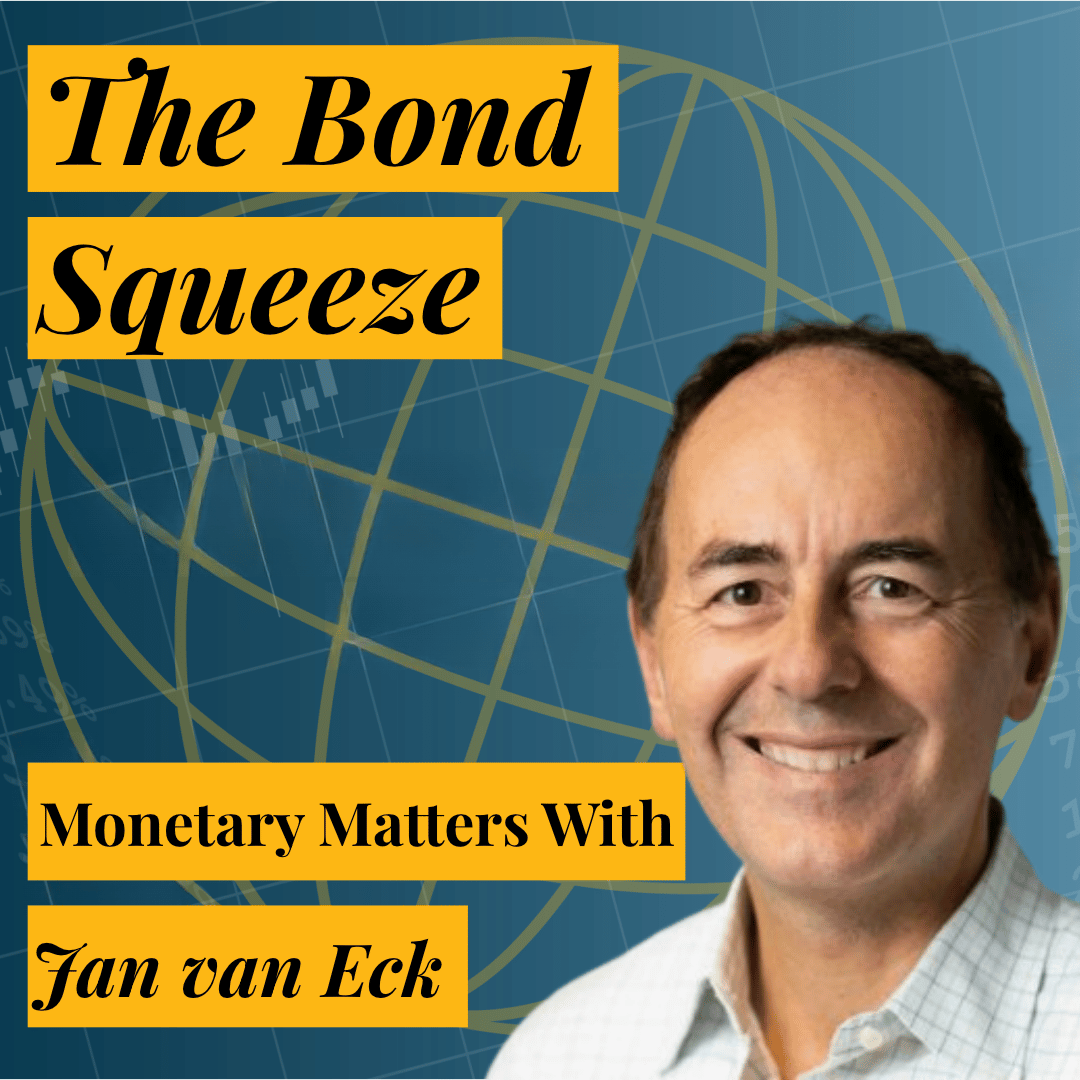
Jan van Eck (CEO of VanEck) lays out a 10-year macro framework and argues that rising Treasury yields (“the bond squeeze”) are driven mainly by strong economic growth, not deficits or oil/inflation alone. He then connects that to AI/semiconductors, token demand, and portfolio positioning (including gold), plus views on private credit/BDCs and an upcoming Anthropic IPO.
Jan van Eck, CEO of Van Eck (also discusses VanEck research with Angus Shillington and VanEck CTO). No other guest is interviewed.
Written by AI. May contain mistakes.
Discussion about the investment macro framework and portfolio strategies.
“What frames are inquiry about what people should have in their portfolios?”
Exploration of U.S. government spending trends and their implications.
“And that created China's growth and emerging markets as an asset class.”
Analysis of interest rates and their relation to economic growth.
“I mean, we're spending more as much or if not more than Brazil is right now.”
Explanation of the bond squeeze and its impact on markets.
“I think that, I'll give you the punchline.”
Discussion on AI technology trends and their effects on the stock market.
“So the title of that third quarter review is called the bond squeeze.”
Insights on investment strategies and the importance of diversification.
“2025 last year was the sort of AI 2.0 trade.”
Explore the growth dynamics of the semiconductor sector and the divergence in market performance.
“You know, but the point I make is we had this scare literally a year ago.”
Discuss the market's perception of AI firms and their competitive advantages.
“So I just wonder your view on what's going to happen if these semiconductor companies come out in Q1 and Q2 of next year, And they reaffirm their guidance.”
Analyze the return on investments and capital efficiency in AI companies.
“Angus Shillington from VanEck has done as well?”
Explore global token demand forecasts and the implications for AI compute capacity.
“Maybe I should just talk about the demand side.”
Exploring the potential for token pricing to decline as companies seek better ROI.
“And that actually the token pricing is going to collapse because companies, not necessarily VanEck, but overall average companies are kind of sick and tired for paying so much for tokens.”
Discussion on the expected slowdown in AI spending and its implications.
“the business proposition of an anthropic.”
Examining the competitive risks posed by China's advancements in AI and semiconductors.
“What is the one that you think you take the most seriously?”
Analyzing the implications of the upcoming Anthropic IPO and investor sentiment.
“Just what are your thoughts here about this important market event?”
Overview of VanEck's investment strategies in private markets and tech.
“But I don't know that much about the broader work that you do, not just in private funds, but whether it's private credit, private equity, and VC.”
Exploring the current state and risks associated with private credit.
“I will say, however, you know, that that will never rival the size of our ETF business.”
Discussion on the market's reaction and valuation of public BDCs amidst economic conditions.
“Default rates on bonds are generally low.”
Learn about the market's reaction to redemption requests and gold's current status.
“And so what happened is what happens in public markets focused 99 % of its attention on whether people were going to put in redemption requests every quarter for those funds, right?”
Explore the financial health of gold mining companies and investment strategies.
“I mean, I'd be happy if it were$3 ,000 an ounce.”
Understand how ETFs impact the gold mining sector and investment behaviors.
“What do you make of sort of your Venex role in the gold mining ecosystem?”
Discover the investment potential in India's market amidst growing consumer culture.
“Like I said before, one of the biggest changes in the markets over the last 30 years has been the rise of China.”
Learn about the current state of the Indian market and predictions for fiscal and monetary policy.
“So that's really important to investors too.”

Get the gist, explore an idea or ask about something said.
 Claude
On Monetary Matters with Jack Farley, what are the key points of this episode?
Searching your listeningAutomatic transcript. May contain errors.
0:00This episode is brought to you by Sarmaya Partners, who manages the Return to Tangibles ETF, LENS, ticker L-E-N-S, the Sarmaya Thematics ETF, built for a return to tangibles. Learn more at SarmayaETF.com and see the show notes for disclosures. Let's get into it. Got a very special conversation today. I'm joined by Jan Van Eck, CEO of Van Eck. Jan, welcome to Monetary Matters. Jack, great to be here. How are you thinking about investing right now? How about we start by you sharing your overall macro framework? Sure. Well, Venex has been around for 70 years through many, many market cycles, Jack.
0:35And we have a framework of thinking about how to filter out all the noise in the system, right? There's data every day, news headlines, shocks. What frames are inquiry about what people should have in their portfolios? Because that's the most foundational question. You know, am I 90 % bonds, 90 % stocks? Should I own gold? Should I own emerging markets? Those kind of questions. And the answers to those questions, I think, should change over time. You know, there's this word in our industry, 60-40, but that's just a sort of mathematical construct, right? What we really have to do, in our view, is look at what's happening in the world, preferably really focus on 10-year big picture trends to inform how we think about our asset allocation.
1:25I mean, certainly with the benefit of hindsight, having a 60-40 portfolio, 60 % stocks, 40 % bonds in 2021, when nominal GDP was growing at double digits and the bond yields were like two or 3%, that doesn't really seem like a very good idea. Tell us what your macro views are now over the next 10 years? Well, let's go through what the four questions are around the 10-year macro, and then I'll answer. So number one is government spending. Is it government spending a lot or is it cutting back? That's called fiscal, right? The second is money supply, the amount of money printing, if you will, that the government is doing.
2:10It's called that monetary policy, Right. Then there's I call it regulatory. There's no magic words for these things. But basically, our government structuring rules in a country to make it stimulate the stock market investments and businesses, or are they somehow contracting that? So the quintessential regulatory change was when China pivoted from a hardcore Marxist economy to a price-based system, right? And that created China's growth and emerging markets as an asset class. And then the last, the fourth out of four is technology. So let's go to monetary policy because you asked about 2022. After the financial crisis, yes, 10-year interest rates got to 1%, you know?
2:58And when you think about asset allocation, Jack, I went beyond your portfolio. What I said is if it's 1%, you should borrow as much money as you can, right? Because that always looks smart. 10-year interest rates are not going to zero. And indeed, that's what the Fed did, is decided to substantially contract monetary policy by raising interest rates. 10-year interest rates went from 1 % to 4.5%. That was obviously really bad. for bonds. And that also can be bad for stocks at the same time. And that's what's happened. And that's when people started talking about the death of 6040, because the theory of 6040s is bonds, you know, go one way, stocks go another.
3:44And that can kind of be true, but not if that second macro level of monetary policy is pulling one way or the other in the hard way. So that's the 2022. I think the question is, where are we today along those four basic questions? And my punchline, generally speaking, is you always want to be invested in the financial markets because over the long term, A, it's very hard to time them, but B, they're giving you real returns that are substantially above that that you get by leaving your money in the bank. even though that makes you feel a lot better, it's really costing you on a daily basis. So I have to say that my default is just to be fully invested.
4:32Having said that, we think that given one of these big long-term trends, namely US government spending, which is kind of, I'll call it out of control, that the next thing is to have some real assets or gold or Bitcoin in your portfolio. So maybe we'll start there. It's actually one of three 10-year trends that I want to talk about, but it's actually a trend that's a risk. And the bottom line is that the US government, and everyone kind of knows this, but I'm just saying, make sure it's reflected in your portfolio, that the government is spending crazy amounts of money. The United States is spending like an emerging markets country out of control.
5:18I mean, we're spending more as much or if not more than Brazil is right now. And Brazil is looked at as an economic basket case because of their super high interest rates. So our government deficit last year, Jack, went from something like high 5 % to 6.2%. So some of us were hoping that our budget deficit would be shrinking because of revenues from tariffs, and I'll call it doge, for lack of a better word. So less spending and more tax revenue. Unfortunately, it went the other way. And the budget deficit went to 6.2%. The budget ends at the end of September. So now we're in the new fiscal year in the United States.
6:06And with the Democrats sweeping the House and the Senate, it's likely we get even more spending this fiscal year because they have a debt ceiling limit, right, that they need to, unless they shut down the government, the president and Congress needs to agree to. So government spending is going up. So that risk, even though I say we have no idea when it's going to manifest itself, I would say you want to be owning or if you don't own it now, buy some gold and some Bitcoin to protect your portfolio if and when that risk manifests itself in the markets. That very high level of fiscal deficit relative to GDP, not just in absolute numbers.
6:49But again, relative to expectations, when Treasury Secretary Scott Besson came in, the goal was to get to a 3 % deficit. And as you said, it went up. Do you think that's why bond yields have been soaring in August, September, and October, which is having consequences on the broader equity market that we can get into? But do you think that's the main driver or are there other factors? That's a great question. And the short answer is no. I think that, I'll give you the punchline. I think that 10-year interest rates went to 5.25 % because of economic growth primarily, maybe a little bit because of inflation.
7:26So there's basically three reasons. That was the big move on the third quarter. And what I like to do in my quarterly reviews is actually take a step back and say, what just happened and why? So the biggest thing that happened in Q3 was the rise in interest rates. And then the question is, well, why? And there's three different theories out there. Number one, government spending is out of control. I just talked about that potential theory. The second is that the Iran war and oil prices were driving inflation concerns. So inflation was the reason interest rates went up. And the third is actually, no, the economy is just growing at a super high rate.
8:04And when the economy grows, individuals and businesses are spending like crazy, but they're also investing and their demand for money and borrowing money goes up. And I like to oversimplify life a little bit sometimes, Jack, just to be provocative. I think it was economic growth that drove interest rates up. And the reason is more that the inflation argument wasn't persuasive to me. So yes, at the end of the summer, interest rates would go up because oil prices were going up kind of in lockstep. But if you take a step back, since oil prices went up at the beginning of the Iran conflict, actually bonds rallied.
8:43Interest rates went down. So if that were a clear cause and effect, that really wouldn't have been the case. And then the other argument is, well, because of government spending, you know, French interest rates are going up. UK interest rates are going up. We're concerned about Scott Besson's bigger budget deficits. And the answer there is if it's credit concerns, usually the currency weakens, right? Because people are just running away because they have lost confidence in the U.S. government. And so the dollar was strong, was flat during that time period. So anyway, so that's why I think, no, I mean, I'm the biggest bond bear, right?
9:26I just talked about it over the last 10 minutes, but I don't think that's what's happened in Q3. I think what's happening in the economy today is we have high nominal GDP growth in third quarter, 4%, 5%, 6%. And that's causing demand for credit. And that's really why interest rates rose in the third quarter. So the title of that third quarter review is called the bond squeeze. And the reason I title it that way is because when interest rates go up, then people just think bonds are more attractive, right? And so that squeezes the rest of your portfolio. It in the short term puts downward pressure on your average stock price, gold, almost everything else in your portfolio.
10:12And that's pretty much what we saw. It was masked because these AI stocks, you know, were still levitating in the third quarter. The stocks that declined the most in October and so far November in the wake of the bond squeeze have been the AI stocks, not just semiconductors, but also in particular the data center construction stocks, the nuclear stocks. Do you think that's a sign that that part of the stock market and the economy, which is where a huge percentage of the earnings growth is actually is, is more sensitive to financial conditions than other parts, perhaps? Yeah. Yeah. So so my view is so of the three 10 year trends, the AI technology boom is clearly a multi year trend affecting the stock market.
11:05There's just no doubt. And it's driving tremendous profit growth and valuation growth, obviously, in the AI players. That's the big story. And what I encourage investors to not do is get distracted by the fact that within that large narrative that's very supportive for U.S. equities in particular, that we oversimplify the world and think there's not a lot of declines in stocks, if you want to put it that way, that comes from within that cycle. And so, yeah, there are a couple of trends, I think, within the AI trade. So one is we know that the best thing that AI is good for is writing software.
11:51So software stocks got hurt in the first half of this year. A second thing is that within the build out of data centers, there's different components. There's the semiconductors or chips. And then there's everything else you need to build out the data centers. I call the chips the AI 1.0 trade because that was so obvious, right? NVIDIA exploding in market cap. But then the AI 2.0 trade is kind of what you were talking about, right, which is data centers, nuclear power, which is needed to power the data centers, independent power producers, all those kind of things. 2025 last year was the sort of AI 2.0 trade.
12:35You can see nuclear here as one example right on the screen where nuclear stocks, because of bipartisan approval, had a tremendous run. And I think what's happening this year is a rotation. Semiconductors still, despite the last several days and weeks of correction, are up 40 % year to date, whereas the AI 2.0 trades are all down on the year between 10 % and 25%. So my theory, Jack, is that, you know what, it'll probably rotate again. And at some point here, AI 2.0 will kind of maybe match or maybe even overtake the AI 1.0 trade. Whether you buy into that yawn bifurcation of the market or not, the big picture is have a diversified exposure to this mega trend.
13:28At the very least, be comfortable in owning U.S. equities, right? Because the major indices capture all of that. And some of our model portfolios were overweight technology. And I argue that that's a reasonable position as well, despite the rotation. So then the last kind of dynamic that I want to talk about within this AI trade is the fact that, like you were talking about, some of the providers with weaker credit ratings have been punished more in the stock market. So Oracle and CoreWeave. You know, but the point I make is we had this scare literally a year ago. Oracle and CoreWeave were down 50 % in the fourth quarter of 2025.
14:12It's almost like we're deja vu all over again. So anyway, my big picture point is we live in a tech era. We should be comfortable in overweighting the U.S. equities to capture that trade. Could you give us rough numbers, even qualitatively, about just how much faster the semiconductor sector's earnings are growing than the rest of the sector? So, yes, perhaps because of that fact, a lot of hedge funds got into a lot of semiconductor stocks and maybe they got too levered and then there's been an unwind, which is what happened over the past month. But I don't want people to forget that the fundamental story of just how big the dispersion there is now.
14:57And, you know, health care has become quite a hot sector over the past month. But I'm not sure if that's anything fundamental that people like about health care. I think it's just that they're exiting tech and they have to bid up something. Basically, it's like 10 and 20 percent earnings growth, right, for the beneficiaries of AI. I'll call those the mag seven. And then Nvidia, of course, is in a different planet because its earnings growth trailing with something like 80 % and it's projected at 60 % going forward. You know, I'm well aware of that, you know, Jensen Huang headlines as we tape this.
15:32But that is really the point that tech is driving the market because it's growing profitability is hard to match. Now, I think a lot of people see that converging in 2027. So what's been really stark about 25 and 26 is the divergence between tech and the rest of the market. And I think that earnings growth is going to start converging, which means you probably be unreasonable to expect sort of the levels of tech outperformance than we've seen over the last 24 months. Hey, everyone, hope you're finding value in my questions. I've got a quick question for you. How much of your portfolio actually depends on the physical world?
16:15If you own the S &P 500, more than a third is tech. Energy, materials, and precious metals, about 5%. Sarmaya Partners believes the next cycle belongs to tangibles. The energy and metals sectors have been underinvested and underloved for a decade. They call it a return to tangibles, and LENS, ticker L-E-N-S, the Sarmaya ETF, is an actively managed ETF that they manage to express this view. An active is the point. The team follows the theme across sectors, market caps, and borders as the cycle evolves, adding where they see opportunity and trimming themes that look overextended. Miners, energy, precious metals, critical metals, all in one actively managed ticker, Lens.
16:57When inflation runs, stocks and bonds can fall together. Lens adds real asset exposure with the potential to diversify both the stock side and the bond side against inflation and geopolitical risk. Learn more about the Lens ETF and their full data and comparison, including performance at SermayaETF.com. Investing involves risk, including possible loss of principle. The fund's investment objectives, risk, charges, and expenses must be considered carefully before investing. This and other important information is contained in the prospectus, which may be obtained at SermayaETF.com. Please read the prospectus carefully before investing.
17:26Thanks for listening. Let's get back to today's interview. I think, Jan, there's a perception in the market now, the bearish view, the bear view of AI, that a lot of folks in the market and otherwise believe, but I think it's gotten incredibly popular just looking at the price action now, or we could say it's kind of implied by the price action that not only are the 2028 sort of estimates for semiconductors like far too high, but I think they're even having some doubts about 2027 numbers. So I just wonder your view on what's going to happen if these semiconductor companies come out in Q1 and Q2 of next year, And they reaffirm their guidance.
18:09I just wonder what your sense is of that scenario relative to kind of the implied expectation of the market now, especially the panic in November. So we don't know how it's going to end, but there will be losers. The question that we ask is, who has that ongoing competitive moat? Like, what are the companies that we're going to be talking about in 10 years and saying they were survivors? And I think, you know, the first answer is, I would say, is the Mag-7. And a lot of them are because they have a lower cost of capital. They're providing their own compute, but they have the customers. Like, at the end of the day, it's pretty simple.
18:50A, do you own the U.S. consumer or do you own the U.S. corporation? Right. And so let me speak to that. We have two frontier labs that have kicked down the doors and made a seat for themselves at the table, whether the incumbents like it or not. So let's talk about Anthropic first. And for those who don't work in corporations, I find that it's important to explain something. So when I logged into my computer at work, that is what I call like, you know, the real estate of corporate America. and in the real estate business, location is everything. They say location, location, location. So Microsoft used to own my desktop, right?
19:35I'd go to Outlook email and my calendar and all that kind of stuff. And sure, Google had a little market share, but let me oversimplify. Now, even this morning, I went to Claude because I was looking for an email two months ago and it's just so annoying to find it within my Microsoft location. So I went to Claude and it found it faster and easier and much more user friendly. And so Anthropic now owns part of corporate America and it's unlikely that they will go away. So it's not that they have the fastest model of this or that or whatever. It's the corporate users are using their front end to tap into the databases that they work with every day and making their lives more productive.
20:22And then open AI is the same threat to the consumer, right? So Google, we all, I always joke, you know, we live in Google's world, right? All search, they own the internet, all search activity, everything. And now for the consumer, open AI is a major entry point to researching customer activity, shopping activity, right? So those two firms, I'll argue right now, look like they'd be survivors and NVIDIA would be a survivor. Can you talk about your broader view about the return on investment that these companies are seeing based on the token work, token analysis that you and Angus Shillington from VanEck has done as well?
21:05Angus and I agreed that in Q2, we did a warning email to our clients about memory companies. We've seen it too often that memory companies still, all, despite some technology changes, are commodity providers. That's why there are different parts of the ecosystem that have less of a competitive mode. But those ones that I mentioned before, I think will be here in 10 years. And so that's kind of how I look at it. So the last thing that comes to mind is the efficiency of capital. Are we getting a return on the equity that's being invested in this trade. And the Amazon CEO, Andy Jassy, said several months ago now that they are seeing the same ROIC, which is just returns, profits, on AI compute investments that they have seen in their cloud-based businesses.
22:00Well, that basically, to me, underwrites the whole data center build out over the next couple of years. And so if the foundation is there, these companies have the money. I think it's a solid support for people to kind of be comfortable, as I said, with their equity positions. So that's a key point that regardless of over the next weeks, months, up, down, sideways, whatever, that over the long-term horizon, which is what I think people should be as long-term investors, you want to own companies with moats and that within the semiconductor and memory stack within that supply chain, there are companies that have much bigger moats than others.
22:41NVIDIA has a very large moat. ASML and certain other semi-cap equipment companies have very large moats. The memory producers like Keoxia, Sandisk, whether it's NAND or DRAM, they are making a lot of money now, but they are fighting it in something of a much more commoditized market. And commoditized markets, the cure for high prices is high prices. And that's something that people should be aware of. And I think there's a big overhang of competition from China because China will have structurally cheaper electricity, which is a big component of tokens. Maybe I should just talk about the demand side.
23:19So we know from their public announcements that these AI companies are building a lot of data centers to process what's technically called tokens. What we were able to do in our research a couple of months ago through Angus is kind of build up our own estimate of global token demand based on the usage by this small little company called VanEck. And what Angus got from our CTO was individual by individual clawed usage data. And he was able to model how people use AI. And so in the first year, and we don't all start at the same time. You think we would, but we don't. In the first year, usage goes up eight times.
24:07And then another 25 % a year after that was his assumption. And then there's a tail end. And what you see from this chart, I really, really like this chart. All that this chart shows is using VanEck data, but extrapolating it to the world. You end up with 62 gigawatts of compute in 2030, which is exactly the same as the green dotted line, which is an industry expectation. So all we're saying is AI used to be a theory, and now we can model demand for AI compute just the same way you'd model demand for hamburgers or flights to Europe or whatever that might be for normal companies. Really important point I want to add on this chart, which is the gray line at the bottom is what the AI companies are spending just to build their own models.
25:02So it's like an R &D spend. And so that black line this year is really this very small amount that they're selling to normal users like VanEck. That's what they call inference. And so the point is that number used to be so small as to be hard to estimate. But now, at least statistically, it's strong enough. And obviously, Anthropics revenue is growing towards, I don't know, 100, 200 billion a year, right? We have the S1 data. So anyway, we're kind of developing this into a normal market, if you will. The real question is what they can charge for that compute in the years further out. And the market has gotten extremely concerned that there's an overbuilding of capacity.
25:50And they're effectively saying that any compute today is really valuable. Any compute in 2030, I'm giving you no value for, which is, I think that's extreme, but that's what makes a market. Yes. And this model, of course, it could be too optimistic, but I say there is a little bit of conservatism in that gray bar of training gigawatt spending or spending from gigawatts not going up. I think it's been going up a lot so far. So it wouldn't be wild to think that it actually could be a little bit higher than that. Jan, so this is at the company level in terms of the return on investments that folks and companies are getting from the spend.
26:33What do you make of the tokenomics? Because so far, I would say that what we saw in Q1, Q2, and Q3 on a fundamental basis from Anthropic and the cloud companies, the hyperscalers, was quite robust. So I think that the fears that make sense to me are fears that that was temporary and the pricing and the business model is going to get a lot worse. But what is not a reasonable bear case is to deny the extremely positive progress. And that was happening this year. And I think from Anthropics, a gap operating profit of just shy of$900 million in Q2, a operating profit if you exclude a donation charge in Q3 as well.
27:13So Q3 wasn't quite as good, but still profitable. I mean, to me, that was kind of a wake up call when the S1 Anthropic came out because it showed that the business of serving tokens is actually a profitable one. I think that a lot of folks on the East Coast were skeptical that it actually was a profitable business model and that basically tokens were being heavily subsidized as Silicon Valley backed companies are often very subsidized to pursue growth. And I think that this was one instance where actually when it was reported to the Wall Street Journal in Q2 that Anthropoc was profitable, I thought, oh, maybe it's not on like a gap basis.
27:46But no, like the profit is real. But so what do you make of the bear case that yes, okay, Q1, Q2, and to some degree Q3 were extraordinarily good. However, there is immense competition coming from Chinese models and open weight models. And that actually the token pricing is going to collapse because companies, not necessarily VanEck, but overall average companies are kind of sick and tired for paying so much for tokens. And they're asking, where's the ROI? Where's the ROI? And that they want of a way so that they don't get a bill for$30 million of an anthropic or some extremely high bill. In other words, that Q2 was a token maxing era that we cannot extrapolate in the future because competition is here and pricing is going to collapse.
28:37What are your thoughts here? Look, there's no question that companies try to spend as less money as possible. And depending on how tech oriented you are, you're going to be faster to optimize those expenses and use open weight models and whatnot. Having said that, although the number of tokens and the percent of tokens, at least according to one kind of unique perspective, I'll call it, is now a majority the open weight models on the right in a faint line, but at the top, you can see that's the share of revenue and that's still staying very high, right? So there's no doubt, you know, you don't need to use an advanced AI model to find out when the movie is starting at your neighborhood movie theater, right?
29:34And people are doing that. But companies, you know, themselves, that the model companies are going to be optimizing their token usage for those kinds of answers. So there will be optimization short answer. Right now, we have no, despite, I would say, significant data around that trend, we have no evidence that it will impact fundamentally the business proposition of an anthropic. Because of that, and that's why I go back to my real estate analogy, they have earned their way onto the real estate of corporate America on the desktop. And it's continuing to grow in terms of number of users and companies.
30:14So I just, I don't see that going away. Listen, there is no doubt, and we talk about this almost every hour, there will be a deceleration of AI spend. No doubt. I mean, this is not going to, that NVIDIA's earnings are not going to grow 60 % a year for the next decade. I don't think anyone thinks that. I think to know when the market price is in that fear, Jack, is beyond, I think, most investors' capability. And so that's what I'm saying is have a diversified approach. And then as you see certain ecosystems that you like being trashed in the market, then maybe you want to buy a little. That makes sense.
30:57I also think that even if open-weight models continue to grow and grow, even as a percentage of revenue, not just tokens, that still has to run on a data center, that still has to run on chips. So even though that might compress the business models of the actual business of creating LLMs, the actual business model of serving tokens inference and the business model of supplying the supply chain might still be a decent business to be in. I mean, our economy is demanding it. Users and corporations are demanding it, right? It's not just the company supplying it. Jan, there's like at least 10 or 20 different bear cases on AI that, you know, if you walk in the street, you'll run into a bear case on AI and a bear case on semiconductors.
31:42What is the one that you think you take the most seriously? I think competition from China is probably my number one concern. You know, they've been building out their utilities infrastructure, so they will have a cost advantage when it comes to electricity. And, you know, they're in the game when it comes to, you know, chips and models. So I think if there's a bear case on the profitability of these companies, it's not Yan and Jack starting a model, you know, model AI frontier lab, or spitting up our own compute center. I think there's too many barriers to entry. But I think China can overcome those barriers to entry better than Jan and Jack can as startups.
32:27So that would be probably number one. Obviously, we have to look at the political risk to the data center build out. And we do have one data point I'd like to address, which is Virginia. Virginia is a big data center state. And there was a Democratic governor elected a year ago, and she issued an executive order and has proposed legislation. But from what I understand, development of data centers has not materially changed, and compute companies doing business there plan on expanding their compute facilities. So that is kind of my core assumption. I mean, I think a lot of weird things have been priced into the market.
33:14But as with the nuclear trade, we became bipartisan in supporting nuclear power under a Democratic president with Democratic governors supporting it. So I think, you know, obviously there are election talking points and things like that, and certainly very legitimate and illegitimate concerns around the political aspect of permitting. But, you know, that I would put that as a secondary risk after China. I think the pricing power around tokens has got to be the third, and we just talked about that. That makes sense. What are your views about this upcoming Anthropic IPO? I know you at VanEck do a lot of work in private markets.
34:00Just what are your thoughts here about this important market event? Yeah, to talk about sort of late stage private, So everyone knows that SpaceX was around for 20 years, right? And there are a thousand companies worth, you know, a billion dollars, right? That are private, that are tech backed. And they have been able to access new investor capital to grow without going public. And so I think this is totally potentially imaginary in my own mind, Jack. So welcome to Yon World. But I think there's a little bit of a fight between the returns given to late stage private investors. So let's say the people that bought Anthropic 12 or 24 months before it went public and the public shareholders.
34:51And I think the public shareholders are kind of saying, like, like, wait a minute. You know, you were able to buy Anthrop, you private investors were able to buy Anthropic at, you know, a trillion dollars three or four months ago. And now it's going public for up 30, 40, 50 percent. Like and then, you know, SpaceX goes public and it's flat. Like I don't get it. Like up 50 percent annualized and up 0 percent annualized. That doesn't seem like the right, like a good deal. Right. So if you want me to buy your stock when you go public, give me a little bit more of that return. I think some of the big buyers of these IPOs are starting to push back on the valuations and who gets that value creation.
35:38But I think whether the deal happens is no longer a risk. I think they've been able to message their revenue growth, to your point, and do all the regulatory filings. The world coming to an end is also a risk we didn't talk about, but I'll leave that aside. Oh, the 10 % chance that the Claude destroys the world? Yeah. Yeah. How do you put that into a DCF?
36:08Exactly. Well, it's definitely going to be a prediction market, right? But who collects? Jan, tell us about the work that VanEck does in private markets. I know you have an ETF about publicly traded BDCs that I actually personally am quite interested in that space. But I don't know that much about the broader work that you do, not just in private funds, but whether it's private credit, private equity, and VC. People know us for gold and people know us for resources. But over the last decade, we've really built out our capability in tech investing, believe it or not, and fintech. It was triggered by our interest or my interest in Bitcoin in 2017, probably, because I saw Bitcoin as a potential competitor to gold.
36:50And so we became the first ETF company to file for a Bitcoin ETF. But that quickly evolved into understanding the development teams of the Bitcoin or crypto ecosystem, but then also other fintechs where we've been investing. We've been investing in early stage venture and just adding portfolio managers in that area. So we have the biggest semiconductor ETF in the world. So we just have been devoting more and more resources into understanding different technology trends. And, you know, for our investors, we just said, listen, you know, we're not going to be as great as some of the tremendous VC firms that are out there.
37:30That's not VanEck's aspiration. But we think that for some of our clients, you know, from what we see and people we know, we can put together investments in some of these later stage growth companies, for example, that, you know, that can perform really well. So, you know, that's something, you know, that's something that we've added as their core capability. I will say, however, you know, that that will never rival the size of our ETF business. I very much believe, and we used to run hedge funds before our ETF business, that you can't let private funds become too big or the returns go down. That's something philosophically that we believe at what we call Vana Capital is that you have to be very careful and thoughtful about how big those funds become.
38:18The other thing I do want to say about how do we align with those investments is we always co-invest. So we never have a private fund where VanEck is not itself putting its money to work. You know, on the ETF side, how we try to align is more these kinds of market-based discussion. And, you know, I am bearish bonds long term, but we've been bearish semiconductors. We've been bearish Bitcoin. So, you know, we're both bullish and bearish, even on things where we offer funds. And what do you make of private credit and in particular the panic, the doom narrative about private credit? You know, on this program, I've interviewed folks who are very bearish in private credit.
39:00And then I interviewed the private credit folks and they say everything is fine. What are your thoughts here, both about the actual private funds, many of which are still marked at par, and then about the public BDC world, which are trading at quite a significant discount to now? Boy, you know, you think about all the all the negative stories on private credit. I think I was well into over 30 different kinds of concerns raised in social media and elsewhere in Q1. Listen, it's since the financial crisis, regulators basically said we want risky lending to not happen with the institutions that give you ATM access to cash.
39:39We don't want to be bailing out banks anymore. And so all that lending should be in the private credit world. And that is a secular growth business, right? And it's structured correctly, which is you can't take your money out every given day. Given that I think the economy was in good shape coming into the year, right? Default rates on bonds are generally low. And for the consumer and for the corporate, the concerns in private credit, I thought, became way overdone in the first quarter. And I think that business development companies became very attractive, as did the stocks of some of these private credit firms.
40:20Having said that, I was really bullish coming into Q2. I started feeling like a genius because some of those stocks really rallied into August. And then when the 10-year interest rates rose, I think that was another kind of punch in the gut for those companies. Because if you can get 5 % on treasuries, then because private credit basically said, I'll give you 8%, 9%, 10 % and interest rates are two. And who wouldn't take that? Now, if it's like 8%, 9%, 10%, but they're leveraged, so they have to borrow at higher rates and their competition for treasuries is 5%, their value added is less on a relative basis.
41:04And so I think that was a little bit of a breaks on the story. But no, I agree. I think there's a lot of it's basically a second type of high yield asset class because so many issuers, Jack, have been doing it in the private markets and not not doing bonds. Yeah. I mean, if you look at kind of the price of some of these public BDCs versus the price of high yield bonds, I think there's an implication that the market kind of expects just a drastically higher default rates for the private credit than for high yield. And if we have a 2008 style moment, not my base case, of course, I don't think high yield will be spared.
41:45So that differential is something that is interesting. I mean, I like to look at Blue Owl stock just as an indicator, and it got to the point where it was trading below its IPO price. It's trading below where it was when it had a third of the assets under management. And so what happened is what happens in public markets focused 99 % of its attention on whether people were going to put in redemption requests every quarter for those funds, right? Like as if the 300 plus billion were going to go to zero if they got 7 % redemption requests as opposed to 4 % redemption requests, right? But that's the only information the market had.
42:27And so it really amplified the signal coming out of that particular data point. But look, I take a step back where I'm like, these are big companies, they're solid, they have great customer relationships, origination capabilities, they're not going away. And the market is giving us an opportunity to buy them cheap. Yeah, let's talk about gold. So VanEck does a lot of things that are not gold, But I know it is a key focus of you. And certainly, like semiconductors, it had been a very, very good two years for gold and gold miners, of course, the GDX and GDXJ. What are your views on gold and the miners right here, right now?
43:08So, again, three 10-year trends, AI, India, which we haven't talked about, and U.S. government spending. And I think that last one is causing gold to revert to its historical role of being the number one global currency. And so I feel very strongly about that. I started pounding the table in 23 publicly on this trend. Having said that, right, it had a tremendous run up. Both gold and Bitcoin hit all time highs last year. And if you look at gold charts, even in the 70s, there are correction periods. Like prices don't go up like that, like forever, right? And they don't go up like that on a continuous basis.
43:53And so I've been saying very clearly, it'll take a year or two or more for the gold price just to absorb the appreciation that it's had over the last five years. So, you know, that's just a hunch, Jack, but it's having seen the cycle a lot. And it wouldn't make me uncomfortable that it has a correction period in that long-term thesis. You can't predict every month or every quarter return. What do I look at today to kind of make me feel comfortable with what I just said? First of all, the money coming from U.S. investors into the gold trade overall is very, very modest. There's no net flow going into gold ETFs this year.
44:41Even last year, if you look at our gold share ETFs, we had net redemptions. Like in the middle of a bull market, we had net redemptions. Now, my hunch is those redemptions came from people that were covering their shorts. But it doesn't matter. There was not a lot of net buying. So even though you see a lot of growth in gold demand from Asia and a lot of countries around the world, which is part of my thesis, you know, you don't you didn't see froth in the United States. That's for sure. I mean, the price looked kind of frothy, but you didn't see that kind of behavior. So we talked to a lot of investors here in the United States and financial advisors.
45:21And I can still say that, you know, while there has been some interest in real assets allocation because high oil prices and the war and whatnot, it's still crickets on a relative basis to, you know, kind of the very hot flows. You know, right? DRAM, the memory chip ETF, raised way more than gold has collectively over the last two years. right? One single hot tech sector. So that's where I look at where we're at now. And as I said, my theory about last quarter was a quarter of the bond squeeze and that you see downward pressure on gold, but gold is holding at$4 ,000 an ounce. I mean, I'd be happy if it were$3 ,000 an ounce.
46:09Maybe you can accuse me of low expectations, right? And still be very comfortable with the whole trade. So I mean, to me, it's held up really well. How do you think about the gold mining business now? How is it different from 10 years ago, 20, 30 years ago? And just how profitable do you think these gold miners are with$4 ,000 gold versus $3 ,000? People ask, should I own gold or should I own gold mining companies? And there's some fundamentals about gold mining companies that people need to know. One is that they've almost been through a near-death experience in the last decade. Gold miners from 2011 to 2016 went down 90%.
46:52And the reason for that is a lot of companies had borrowed too much money. So they were very frail financially. Fast forward to today, they've paid back pretty much all that debt. They are in very healthy shape. Their free cash flow is tremendous. I would say, however, a lot of their leverage comes from the movement in the gold price because there really haven't been any major discoveries of gold in the last 10 or 20 years. So that's just the framing that if people invest in the mining companies that they should understand that they're safer in a way, the fiscal need a much stronger position. But most of the leverage is kind of operating leverage, not growth-oriented discovery leverage.
47:39And so they're borrowing less money, either because they're spending less on projects, they're doing less brownfield expansion or less greenfield exploration. And the money that they are raising, they're either issuing equity, or they're doing it in the royalty space. Just what do you make of the royalty deals that a lot of the gold companies are doing? Do you think they're kind of selling away the family jewels, or do you think it's actually a really good deal? And then on the other side, what do you think of the economics for the companies that are doing the royalty deals, many of which are in your products as well.
48:14So if I came to Jack with a PowerPoint deck and a lot of drilling samples or drilling samples, would you give me money? And I said, Jack, come with me. Let's hike for five hours in the woods somewhere in Canada and look at a hill. Would you give me a lot of money? and I don't know about how Jack would answer that question, but I can tell you that generally name a big bank, they would say, Jan, go take a hike. We're not interested in that kind of financing, right? So there is a smart pocket of investors that say, all right, I understand those gold ore samples. I will give you financing, but I want some of that revenue if you strike in perpetuity and that's what royalties are, right?
49:00It's just money off the top of a gold project and there are standalone companies that offer that. And it's a fantastic financing mechanism for an extremely risky activity. And it's a unique part of the market, right? They outperform in bear markets and they lag a little bit in bull markets. So we allocate to them in our active gold funds. What do you make of sort of your Venex role in the gold mining ecosystem? them. And you tell me if the claim I'm about to make is actually overstated and you disagree with it, that you'll definitely push back. But I actually recently interviewed Rick Rule. So folks interested in gold and mining should, of course, check that out.
49:44And he said that a lot of the companies that are doing deals and royalties or are merging are merging because it's like a$90 million market cap. And it's not big enough for either the Canadian pension plan or a significant player in the gold mining market like VanEck to buy. And so they're basically doing deals so that they're big enough for you and Canadian investors and the like. And I'm curious if you agree to that, as well as just the role that VanEck plays in the gold mining ecosystem, which is certainly not an insignificant one. Yeah, I think there's a two-part answer to that. First of all, that's the world we live in, which is companies know if they can be included in a very popular index, they're going to get automatic shareholder buying, right?
50:30So there's no, there's no, and that does, you know, VanEck is no specialist, you know, specialist there. We have a big ETF business, but the, the, the victory of large caps is really, has really, it's a profound trend in the markets over the last 10 or 20 years that I think is not appreciated enough. So I appreciate you like asking about it. So it's, it's true across industries and, and sectors, Jack. And yeah, in the gold world, you know, that that difficulty of, you know, financing the hole in the ground is is tough for the smaller companies. Right. And, you know, I would say a gold mining ETF.
51:11ETF, one of the beauties of ETFs is it is more liquid than any individual gold mining company, even the biggest, which is a really cool kind of value add phenomenon that ETFs provide that level of liquidity. So, you know, getting back to the concern of, you know, making a company big enough to be included in an index, yes, but, you know, you need to have trading volume around that company too. So it's not just a market cap, right? So you can merge, you know, companies merge, gold mining companies and say, hey, hey, look at me, like I should be in your index. I don't make those decisions, but the people do say, yeah, but you don't trade enough, right?
51:51You need some built in underlying liquidity. So it's a two-step process. And VanEck a lot, not certainly not all, but a lot of the products track and index that that VanEck also manages. And I'm curious if you just tell us the role you see that strategy playing versus a lot of other ETF companies that do basically pay an index provider like MSCI or of course, you know, S &P Global for the S &P 500. Of course, you do that as well, but you also do this custom indexing. Tell us the strategy there and the value you think it provides to investors. I mean, we like to, maybe we're fooling ourselves, but we like to think that each ETF we think of like almost like a handcrafted beer.
52:37And so we put a lot of thought into the market structure, market cycles. Like, do we think this makes sense? You know, for example, we launched an ETF last year on alternative asset managers, private equity, private credit managers. You couldn't have done that 10 years earlier because there weren't enough companies. Right. But now is it a big part of the market? Yes. You know, So that's kind of how we think about it. Now, some of our first ETFs, we kind of came up with the formula for the handcrafted beer and gave it off to another company. And they could give it to other people. And we're like, well, why are we doing that?
53:14Why don't we make the beer? But I would say we're very open-minded. Some of the best ETFs use other indices. We have an emerging markets debt ETF that uses a JP Morgan index, which is a benchmark. Our biggest U.S. equity fund follows a Morningstar index. So, you know, we're very proud of our index company. We have 200 clients of that index company. And it actually is a pioneer because it was the first index company to offer indices 24 hours a day for five days a week. So, you know, so we're happy with it. But that doesn't, you know, they're very independent decision making processes. is. Jan, as you promised, tell us about India.
54:02Why are you excited about the investment opportunity there? And do you think it's not being given enough love and credit by market participants right here, right now? Like I said before, one of the biggest changes in the markets over the last 30 years has been the rise of China. And I mean, that's true for financial markets, but also real markets, which is the VanEck philosophy is like the real world will affect financial markets. India over the last 10 years has done the same level of, you know, maybe from a different starting point, but a massive amount of deregulation and digitization. So it's kind of a twofold thing.
54:41It's, they've basically everyone in the country was able to afford very cheap cell phones. And so now you have a consumer market of 900 plus million. And then so that's the digitization. And then there's just been a lot of deregulation that's allowed in China. And that's continuous. Now, you don't read about it a lot, but it's still like India's, first of all, going back, it's had almost the same returns as the S &P over the last 10 years. Now, since I started talking about Jack, India has really underperformed the emerging markets because it doesn't really have a direct AI play like memory companies or those kinds of things.
55:23Having said that today, I will stick with, I'll double down on my enthusiasm for the Indian market. Valuations are cheaper. The economic growth has continued. Profitability growth has continued. It's an equity market too. The IPO market in India, okay, smaller market cap levels, but there are somewhere between 50 and 100 larger big board IPOs a year. So it's a very equity culture, meaning it's okay to get rich. It's okay to go public. I think that kind of ethos has been there for a while. So that's really important to investors too. If the government is looking at the private sector and trying to punish it all the time, that's not good for investors, regardless of demographic growth.
56:13So yeah, it's not in the papers a lot. It comes in and out of favor. It's also been out of favor. International investors have been pulling money. There's some disadvantageous taxes that India imposed a couple of years ago, some of which I think might be reversed in the beginning of next year. So I think that would be kind of a boost to the market and valuations today because earnings have continued to grow or are much more attractive. So they're near the bottom end of the range. The Indian market always has a higher P.E. ratio than than other markets because of its growth. Yes. So I think it can be described as a growth story that is similar to China's in the 2000s.
57:00However, unlike in China, there is not kind of a mass attack on profits. The companies are not just allowed to grow their revenues. They're allowed to grow their profits as well as return capital to shareholders, which, of course, happens in China. But it's just there's an issue there. And I think if you look at some companies like Asian Paints, no personal position, but just the company's ability to compound has been demonstrated. Jan, so my final question for you is, what are you bearish on? I came into the year basically saying, don't worry, be happy. Don't even worry about the financial markets.
57:39So why I say that fiscal policy wasn't going to change in 2026. monetary policy wasn't going to change. People were worried about the feds, like, no way. They're going to put in the reasonable head of the fed. This isn't a banana republic, no matter what people think about Trump. Regulations were positive for the economy and the technology trend. So it's a big picture. I don't see anything, if you think of the four tests of the VanEck macro view to be super concerned about. I think we will see more monetary tightening because we had a bad inflation print this year. And I think the data center build out is going to happen for another two years, Jack.
58:25So there's going to be a little bit of Fed tightening, whereas government policy, government spending is still super loose and probably going to get looser. So I guess if, yeah, my worry is still with treasuries, but otherwise I just don't see a part of the market that I think is wildly overvalued. Jan, really appreciate your time. A lot of what we talked about has slides and in your Q4 outlook for VanEck, it's called the bond squeeze. So we will link to that. People should follow you on on X, LinkedIn, as well as your profile on vanek.com. Jan, thanks so much for joining. Thank you, everyone, for watching.
59:05Please leave a rating and review for Monetary Matters on Apple Podcasts and Spotify. And don't forget to subscribe to the Monetary Matters YouTube channel. Hope you enjoyed that. Want to say a big thank you to today's sponsor, Lens, ticker LENS, the Sarmaya thematic ETF, which gives real asset exposure and the potential to diversify a 60-40 portfolio. Read the prospectus at surmayetf.com. Disclosure is in the show notes. Thanks for watching.
This episode is brought to you by Sarmaya Partners. Learn more about Sarmaya’s LENS ETF, their full data and comparison, including performance here:
https://sarmayaetf.com/
VanEck CEO Jan van Eck joins Monetary Matters to walk through his firm’s Q4 outlook, “The Bond Squeeze.” He argues that the 10-year Treasury’s climb above 5.25% is a growth story rather than a deficit or oil scare, even with the federal deficit running at 6.2% of GDP. On AI, Jan explains why chips (“AI 1.0”) keep beating the power and data-center trades (“AI 2.0”), shares VanEck’s internal token-usage model pointing to roughly 62 gigawatts of AI compute by 2030, and names competition from China as the biggest risk to the trade. He and Jack dig into Anthropic’s IPO and the growing tension between late-stage private and public investors, and Jan explains why he thinks private-credit fears were overdone and what Blue Owl’s stock is signaling. He makes the case for gold reclaiming its role as the world’s number-one currency, explains why gold miners have repaired their balance sheets, and lays out the long-term bull case for India. To close, Jan says he doesn’t see any part of the market that looks wildly overvalued, though Treasuries remain his biggest worry. Recorded November 11, 2026.
Jan’s Q4 2026 Outlook: “The Bond Squeeze”:
https://www.vaneck.com/us/en/blogs/investment-outlook/jan-van-eck-q4-2026-outlook-the-bond-squeeze/
Follow Jan van Eck on X https://x.com/JanvanEck3
Follow van Eck on X https://x.com/VanEck_US
Follow Jan van Eck on LinkedIn https://www.linkedin.com/in/janfvaneck/
Jack Farley on X https://x.com/JackFarley96
Follow Monetary Matters on:
Apple Podcasts https://rb.gy/s5qfyh
Spotify https://rb.gy/x56dx5
YouTube https://rb.gy/dpwxez
Important Information
The Fund’s investment objectives, risks, charges and expenses must be considered carefully before investing. This and other important information are contained in the prospectus, which may be obtained by following the links Prospectus and Summary Prospectus or by calling +1.215.330.4476. Please read the prospectus carefully before
investing.
There is no assurance that the fund will achieve its investment objective. The Fund may not be suitable for all investors. Investors should continue to review their investment objectives and risk tolerance periodically.
An investment in the Fund involves risk, including possible loss of principal. Exchange traded funds (ETFs) trade like stocks, are subject to investment risk, fluctuate in market value and may trade at prices above or below the ETF’s net asset value (NAV), and are not individually redeemable directly with the ETF. Brokerage commissions and ETF expenses will reduce returns. ETFs are subject to specific risks, depending on the nature of the underlying strategy of the Fund, which should be considered carefully when making investment decisions. For a complete description of the Fund’s principal investment risks, please refer to the prospectus at https://sarmayaetf.com/
Metals and Mining Companies Risk. Metals and mining companies can be significantly affected by events relating to international political and economic developments, energy conservation, the success of exploration projects, commodity prices, tax and other government regulations. Investments in metals and mining companies may be speculative and may be subject to greater price volatility than investments in other types of companies.
Management Risk. The Fund is actively managed and may not meet its investment objective based on the Adviser’s, Sub-Adviser’s, or portfolio manager’s success or failure to implement investment strategies for the Fund.
Shares of the Fund Are Not FDIC Insured, May Lose Value, and Have No Bank Guarantee.
The Fund is distributed by PINE Distributors LLC. The Fund’s investment adviser is Empowered Funds, LLC, which is doing business as ETF Architect. Sarmaya Partners LLC serves as the Sub-Advisor to the Fund. PINE Distributors LLC is not affiliated with ETF Architect or Sarmaya Partners LLC.