Ask ChatGPT

 Monetary Matters with Jack Farley
1 Nov 2026 · 1h 17m · 27 chapters
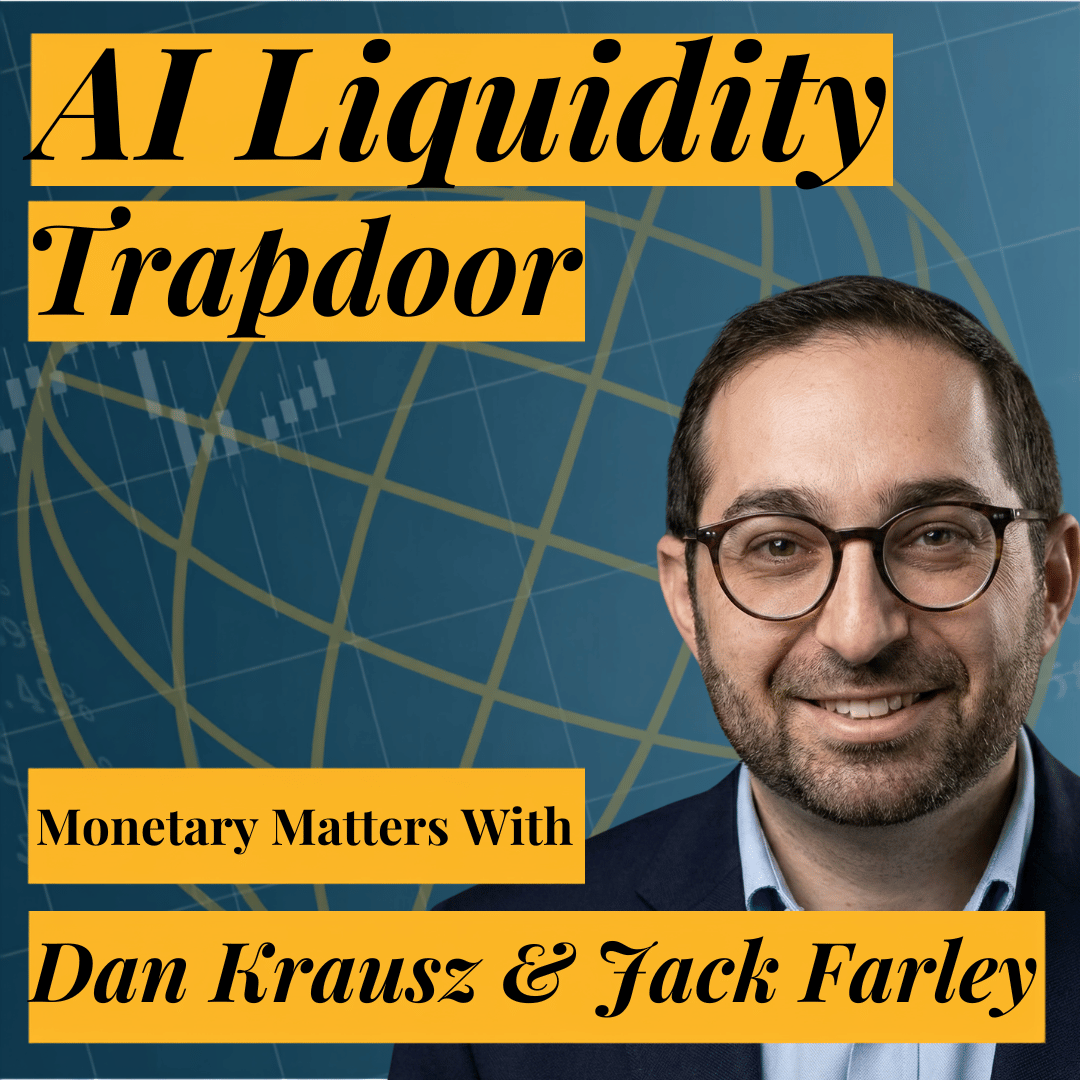
Dan Krausz argues the AI hardware/infrastructure selloff is driven less by AI demand and more by tightening global liquidity and capital allocation “waterfall” dynamics as the Fed tightens and Treasury issuance surges. He frames it as “liquidity trap door” risk: when top-tier credits (Treasuries and hyperscaler/IG) consume more capital, weaker credits (AI-linked unsecured debt, high-yield) get hit fast, widening spreads and constraining financing for AI capex.
Dan Krausz, portfolio manager at Blue Door Asset Management. He discusses liquidity as global availability of capital, linking Fed/balance-sheet policy, Treasury front-end issuance, bank lending standards, private credit tightening, and the dollar to financial conditions.
(1) Demand for AI use cases remains strong; financing is the bottleneck. (2) Policymakers are incentivized to avoid prolonged liquidity stress because AI is viewed as crucial and potentially disinflationary. (3) Capex growth may slow in rate-of-change, but not peak, as long as liquidity supports it. (4) AI “disruption”/software margin narratives may be overstated; AI can commoditize and pressure moats.
CoreWeave unsecured bond spreads reportedly up to ~15%; “Fannie Mae/Freddie Mac”-style government compute financing discussed by market figures; Goldman “AI at risk” index up 50% from lows; Claude used heavily by Krausz; oil-price/earnings example (Mastercard).
Written by AI. May contain mistakes.
Dan Krausz discusses the impact of liquidity on the AI hardware trade.
“So what I think is going on, and I don't want to sound cavalier about it.”
Exploration of how rising interest rates affect liquidity and capital needs.
“But the difference is last year it was being funded by cash on the balance sheet.”
Discussion on the precarious state of liquidity and market reactions.
“So what I'm talking about is, first off, markets, right?”
Speculations about potential government support for AI financing akin to Fannie Mae.
“And the idea was that with the tenuous nature of everything going on, we have enormous deficits, right?”
Understanding the relationship between liquidity and specific market conditions.
“They're not saying that this is absolutely necessary, right?”
Explore how liquidity affects markets and the economy, and the implications for companies.
“Because to some people, they might seem somewhat unrelated, but you see the connection here.”
Discussion on financial conditions, potential AI bubble, and Fed's approach to tightening.
“And because it was a signal to policymakers and they ease policy.”
Examine forecasts for consumer spending, economic growth, and their relationship with CapEx.
“Now, it's important to realize with a 6 % deficit, it's hard to really cause that That's substantial weakness everywhere.”
Explore how rising oil prices and Fed signals indicate market worries.
“oil goes up, people get worried about the market.”
Discuss how AI is influencing inflation and economic growth patterns.
“It's coincident with higher inflation and all that.”
Examine the Fed's current approach to growth and inflation concerns.
“The wealth effects were coming from one area, right?”
Analyze the implications of liquidity on AI infrastructure expansion.
“going, if you are the area of the economy that when you start getting going, the Fed starts getting worried, it's really hard to get the capital to flow to that place.”
Review current trends in capital expenditures and their market impact.
“And there's a lot of different ways this can play out.”
Investigate the demand for AI and the challenges posed by capital availability.
“And so my expectation is that CapEx will continue to grow.”
Explore how AI sell-off affects sector dynamics and market positioning.
“But my first concern is at the beginning, two years ago, there was always concern, well, it's not really going to have the impact, right?”
Discuss the ongoing risks of disruption in the market and strategic investments.
“infrastructure plays with weaker liquidity makes a lot of sense, right?”
The discussion covers the impact of AI on market margins and competition.
“You could have a situation where AI instructor keeps getting hurt at AI disruption once those shorts are covered becomes, oh, like the, there's still terminal value question here.”
Exploring the future potential risks of AI and its implications for pricing power.
“And so when you have big productivity gains, it can help margins, but it doesn't necessarily.”
Analyzing the role of liquidity in the technological revolution and its economic implications.
“But there are just so many variables before that, that I hesitate to take a strong view on it because, you know, I'd have to get 70 plus things right first before that became clear.”
Discussing productivity, ROI of AI, and how economic cycles affect these metrics.
“So that interview will air very shortly after this interview.”
Explore the nuances of productivity in AI and its effects on the economy.
“an overbuilt there, that like the capital investment is well in excess of the ROI and the growth initially.”
Discusses the importance of labor productivity and its implications for economic growth.
“But, you know, I think that there are always short term proxies for it to be like margins and things like that.”
Analyzes current employment trends and their implications for the economy.
“growth that's needed, A, to help with the debt and the deficit, and B, to justify the CapEx we're getting an AI.”
Explores the relationship between corporate earnings growth and employment figures.
“Historical relationships to what, sorry?”
Discusses how liquidity conditions affect equity markets and overall economic stability.
“I would say that energy are the bulk of the tremendous surge in S &P 500 profits.”
Examines current interest rates, fiscal policy, and potential future impacts on the economy.
“And that point should come after a decline in the dollar, right?”
Explore how AI spending and treasury policies might impact interest rates and the equity market.
“We know that Jeffries David Zervos went to the Treasury, right?”

Get the gist, explore an idea or ask about something said.
 Claude
On Monetary Matters with Jack Farley, what are the key points of this episode?
Searching your listeningAutomatic transcript. May contain errors.
0:00This episode is brought to you by Sarmaya Partners, who manages the Return to Tangibles ETF, LENS, ticker L-E-N-S, the Sarmaya Thematics ETF, built for a return to tangibles. Learn more at SarmayaETF.com and see the show notes for disclosures. Let's get into it. I'm here with Dan Krausz of Blue Door Asset Management. Dan, great to see you again. I just had asked you, what's your view of the AI hardware trade? And you said it's not about the fundamentals of AI, it's about liquidity. Tell us more about what you meant about that. And specifically, why is it now that we have your core we bond selling off AI credit spreads, widening and a corresponding sell off in the equities, although it hasn't hit the S &P, you know, it's been like kind of an orderly decline in semis.
0:43But yeah, why now? So what I think is going on, and I don't want to sound cavalier about it. The AI fundamental concerns are real concerns. They were just not different four or five months ago. And there's three reasons that I can think of, of why the AI trade really goes bad. Reason number one, demand just never comes through. That doesn't seem to be what's happening right now. Demand still seems to be pretty strong. Reason number two is something, you know, policy related, you know, the moratorium, a data center, something like that really kind of put sand in the gears there. Right. And then reason number three is a financing issue, which is a liquidity issue at the end of the day.
1:27And we create issues within the AI complex, not because AI is failing, but because there just isn't the capital to fund it. And I think what's happened over the last several months as the Fed has gotten tighter, right, as a lot of the positives of liquidity from last year, kind of that lagged effect came into mid year and then started to weaken. And most importantly, the amount of issuance going on. So what happens is you have massive amount of treasury issuance, right? You have massive amounts of AI issuance. And the issue with those being the two biggest parts of issuance is they're also the two most important credits in the market.
2:09And so they get funded first. Right. And so the way I always like to explain liquidity like a waterfall. Right. The buckets on top are going to get funded first. That's treasuries. The next buckets will get funded next. That's, you know, IG, like the hyperscalers. And then everything kind of flows down from there. And so the simple rule is whatever needs liquidity most, right, gets hit fastest when liquidity goes in. And what's happened now is that those buckets at the top of, you know, of the waterfall got much bigger in a short amount of time. Right. It's not the CapEx load. It didn't slow. We know that it accelerated.
2:49But the difference is last year it was being funded by cash on the balance sheet. And I often like to say that hyperscaler spending over the last two years has, you know, rhymes with fiscal spending in the sense that they didn't really need markets for it. Right. There was no issue of would they get funded because they were just using cash on their balance sheet. It was cash that was built up over the last 10 years, this war chest of cash. And now they're just spending it down. So it was kind of sitting outside of the economy. And a lot of the issues in the last 10 years, a lot of people talked about how they're just retiring cash, essentially.
3:23Right. They're just keeping it on the balance sheet. Now they're spending it down. It didn't require anybody else's permission to do so. Now that that's being funded by markets, it requires other permission to do so. Right. Now, that's not an issue. Google is going to get funded. Meta is going to get funded. But if they're taking up more and more of the capital, what it means is any incremental weakness in liquidity hits everything else that much more. and historically when you look at liquidity cycle when liquidity starts to weaken usually the thing that needs liquidity most is em and so em currencies get hit first the truth is what's interesting is it kind of happened this time around also right em currencies topped back in february right this cycle has been different every cycle has their different areas that are needed for the capex build out of that cycle and this one is ai and so what happens is when you have such enormous needs for issuance, and then liquidity isn't growing with it, but it actually weakens.
4:20So the impact of that incrementally weaker liquidity is so much bigger than you would normally be used to, right? Because what wags kind of the tails of the distribution is the fact that now the highest credits are taking up so much more of the capital that any weaker credit really gets hit hard. And that's, I think, what we're seeing. So, Dan, when we did an interview about a year ago, obviously, so many people were talking about AI, but I think you were one of the few people who were realizing just how serious the macroeconomic consequences of AI would be. And here we are a year later, and arguably the most important price in the world, interest rates, the 10-year treasury yield, have moved materially higher.
5:05And it is attributed to this huge demand in capital, not just from the fiscal side, the US government, but also the massive borrowing to fund the AI CapEx. So what are the consequences of this? You said that now basically tighten in liquidity. So the Fed raising rates matters more than it did in 2022 and 2023, because everyone then was panicking without a recession, but it turned out that the economy wasn't that sensitive to interest rates maybe, but now you're saying that it actually is sensitive to interest rates because there's so much borrowing? So what I'm talking about is, first off, markets, right?
5:40Before we get to the economy. Markets are more sensitive to liquidity, which is not just interest rates, which is important, than during typical times. 2022 was a period where we were also sensitive to liquidity, but it was different parts of the market that was getting hit hardest then, right? Then consumer really got hurt. Small caps really got hurt. Tech also got hurt, but now it's leading the way. I think the dynamic that's at play is that we are more sensitive liquidity than we used to be because there's more of a need for liquidity than we used to have. We didn't have to finance this much capital.
6:16You look at non-resi investment in today's GDP report, non-resi investment as a percentage of GDP is close to the highest that we've seen. Right. So that tells you the most cyclical part of the economy needs capital. And when you start to tighten that, it has real implications. Now, my view is, I think when we were discussing last year, we were talking about kind of there were three neutral rates. And that was a real challenge for the Fed. If you tried to raise rates enough to hurt AI in order to stop inflation that way, you were going to crush the rest of the economy. Right. And if you tried to help the rest of the economy, then you were likely going to create a bubble in AI.
6:58Right. That was just the dynamic that and it was kind of a tug of war there. Hard to say what's the right decision, what's the wrong decision. But that's that's the decision that that policymakers were faced with. We're kind of still there. Right. You've seen an L-shaped recovery in housing. Right. These rising rates just keep on putting pressure on housing. You've seen small businesses continue to struggle. They've been OK. It's not like they're in recession, but they're not really seeing the strength that you're seeing elsewhere in the economy. Non-AI cyclicals, same idea. They're OK. They're growing, but not particularly strong.
7:34Right. And there's a lot of parts of the market where actually margins have been weaker. And so you see a very kind of diverse dynamic within the markets. Now what's happening is as rates are rising, it's starting to hit liquidity faster. And more importantly, excess liquidity, meaning liquidity above and beyond what's needed to fund issuance. And now we're getting that very fast impact on markets. Last year, I wrote one of my investor letters and I called it trapdoors and trampolines. I remember. And the idea was that with the tenuous nature of everything going on, we have enormous deficits, right?
8:12We have a massive capex build out that requires a lot of issuance. We have higher inflation. We have geopolitical unrest. We have what's been mostly stagnant employment, right? And the consumer affordability crisis. So you put all that together, small missteps from policymakers. And when I say misstep, I don't mean they're making the wrong decision by hiking rates, right? That takes a lot of different calculations in terms of what am I trying to maximize for? What I'm just saying, misstep from a market perspective, right? Small missteps have bigger impacts on the market, okay? Because of all these various things.
8:47And so what it feels like, which anybody who has invested in AI stocks in the last several weeks knows exactly what this feels like. It feels like there's a trap door that just opened under your feet out of nowhere. Yes. But the thing is, with greater needs for capital being at the Treasury, it means that policymakers can't really afford for liquidity issues to last very long. Right. So in previous cycles, it was never a question of how's Treasury going to get funded? Are we going to have a failed auction? That was really never even in the realm of possibility. And so when liquidity weakened, the Fed, the Treasury could sit around and be like, let's wait and see how it plays out.
9:22Right. OK, so it'll hit some high yield companies that probably shouldn't have gotten funded anyway. When it's the Treasury that requires the liquidity, you have to be a lot more careful with liquidity weakness. And so what ends up happening is you feel that trap door. And as that trapdoor is opening, policymakers were putting trampolines under it because you needed to make sure that we didn't just kind of hit the cement hard. And so that is where we should be approaching. Inflation is making that harder. Right. I think we see from Treasury, they're talking about many different ways to impact liquidity.
10:01Right. They're talking about issuing more at the front end versus the long end and all the buybacks and all that kind of stuff. These are all ways to increase liquidity. What you do when you issue more at the front end, other than just helping liquidity in the market, you're also accommodating long end issuance from AI, essentially. And so these thoughts are going through your head. Now, will they go through with it? Will they provide that liquidity is a question. But the truth is, it would be pretty inconsistent for them not to at this point, because we've been told for the last several years that AI is existential for us to win the Aries.
10:41Right. And Chairman Walsh has told us that he believes that AI will be a major disinflationary force. So when you combine that Secretary Besant is saying that it is absolutely crucial that we win the AI race and Chairman Walsh is saying that it will be a major disinflationary force, raising rates in order to stop AI is not really consistent with that plan. Right. And so I think they're trying to be very careful with that. I am always very hesitant to say, you know, we're seeing something that they don't know. Right. They know it. They see it. And they're trying to manage the challenge of higher inflation, which they need to address with making sure that what they view as crucial to the future of the country doesn't get upended by their own policy.
11:31Right. And by the way, we've seen it recently. we've seen comments from some major figures, not government figures, but major investment figures talking about, well, we may need, you know, a Fannie Mae type of thing for AI. Really? I had, I had missed that. Tell us about that. Wow. They're not saying that this is absolutely necessary, right? But what, what it's being mentioned because it's different options of how to make sure that we are financing what is a revolutionary technology. Right. So it was late. I was mentioned kind of almost in passing as well, you know, maybe we'll need that. Not because there's a major problem happening, just because we know there's a lot of capital needed and it's so important in the same way that housing was so important is why the government stepped in to support that.
12:14Do I think that's happening tomorrow? No. Right. But the point is that it's such a crucial thing to be funding in an appropriate way, right, that, you know, I think that a lot of options can be explored. Inflation may not allow it. If inflation keeps going up, they may just have to continue to take out liquidity and it'll be tough for markets. But given the stance that we've seen from the government on AI, it would be surprising if their own liquidity policies ended up tripping up a trade. Wow. That is just blowing my mind that some people are speculating or talking about a potential government-centered enterprise to buy compute or fund compute in the same way that Fannie Mae or Freddie Mac does that for housing.
12:58Just to hammer home the point, Dan, that there really is a very reflexive quality that in the same way that fundamentals affect financial conditions, financial conditions affect fundamentals. And that 10 years ago, if Microsoft stock was collapsing or whatever, it didn't really matter. Like that's just more, it's a cheaper stock that Microsoft can do a buyback with. But now if spreads widen a lot, that really is going to impact the ability to finance this build out. Like literally, is there enough money or is there enough money at a price that people are going to want to do it? And nowhere is this more apparent than in CoreWave where the unsecured bonds yielded as much as 15%.
13:36I believe that issue, they yielded somewhere between 9 % and So that is a big widening. So Dan, tell us about what type of liquidity you are talking about and the connection between either the Fed raising rates or the Fed's balance sheet policy, the treasury issuing at the front end, those policies with the very acute financial conditions, such as core weave spreads blowing out or Oracle CDS blowing out as well. Because to some people, they might seem somewhat unrelated, but you see the connection here. What is it? Yeah, I think the connection is clear. We're going to use liquidity. I use liquidity kind of as a catch all.
14:12Right. It's really simply global availability of capital. OK, there's a lot of things that impact that. Right. A larger fiscal deficit is positive for liquidity. Right. Because it's essentially the government almost arbitraging lower financing costs for the government, putting into the private market rather than private market needing to borrow to create more money. Right. So fiscal deficit is positive for liquidity, but it also depends how it's financed. Financing it more at the front end is way more positive for liquidity than at the long end. Central banks, through rates and through their balance sheets, can tighten or ease liquidity.
14:50Bank lending has a big impact on liquidity. So credit standards, as they tighten, obviously less capital available. So far, lending standards have been mostly well-behaved, not too loose, not too tight from a large bank perspective. We did get in the earnings call this past quarter, JP Morgan saying they were incrementally tightening a little bit, but it doesn't seem to be anything major. Private credit, another source of lending. They have certainly commented that they've been tightening their standards. So that has an impact. The dollar has an impact, right? Because when you're talking about global liquidity, a weaker dollar means that global allocators actually have more capital to allocate to dollar-related assets and vice versa.
15:38So there's a lot of different factors. I mean, that was just a smattering of them. But what happens is the question that you brought up there, which is financial conditions and fundamentals, how does liquidity go from being this kind of wonky macro idea to becoming fundamental? OK, when liquidity weakens, everything gets hit to different extents, but everything gets hit somewhat. But only for certain companies do you have to worry about the long term impact of it becoming fundamental. Right. If you're a company that's highly levered, you're going to take it pretty quickly. And if it lasts long enough, it becomes fundamental for the company.
16:17If your company whose customers are highly levered, that liquidity weakness lasting long enough will become fundamental for them. If you're not necessarily highly levered, but your growth is very dependent on CapEx that needs to be financed by markets. So that can become fundamental, right? So understanding liquidity will hit everything, but certain things, it becomes fundamental. And we see this all the time in markets, right? My view on how liquidity impacts markets and impacts the economy is if liquidity stays tight long enough, it has a fundamental impact. And so what happens is the sensitivity of asset prices is much greater to changes in liquidity than the sensitivity of the economy.
16:57And so if liquidity weakens a bit, S &P may be down 10 percent. And everybody starts getting worried about the economy. And then policymakers respond and they stop tightening liquidity and the S &P is right back up. And everyone says, see, there was nothing to worry about. And the truth is what may have been happening in part was this was kind of sending a warning signal. Right. It was seeing that tip of the spear sensitivity to liquidity. And it reacted, allowing policymakers to adjust before it hit the economy. if policymakers say whatever 10 no big deal it goes to 15 it goes to 20 the liquidity starts to stay weaker for long enough to where now six months later nine months later it actually impacts the economy and so that's the mechanism that i would think about it with and so i often think about this as like why do markets discount you know everyone's favorite line you know 20 of the last three recessions right i think in part it's because it's so much more sensitive to liquidity And so the market was telling you liquidity is weakening.
18:00The risk of economic weakness is rising. And then if liquidity comes back, so the market comes right back and the economy never gets hurt in a meaningful way because it didn't last long enough to really impact the economy. And because it was a signal to policymakers and they ease policy. How would you assess financial conditions right now? Are they sufficiently tight where there's not going to be an AI bubble? Or are we at the type where financial conditions are so tight that they're too tight now and it's going to slow not just growth of AI, but just the entire economy? We got in the October Fed meeting, Fed Chair Warsh saying that, yes, I've noted financial conditions have tightened.
18:37That's kind of the intent of what I'm doing here. But that, no, I don't think that they're too tight so far, which by itself, I'd say, is a mildly hawkish statement. But I'm curious your views on this issue. I'll tell you, post the press conference, I probably read 10 to 12 reviews of it and came to the conclusion that the press conference was the ultimate Rorschach test. The bulls were all saying it was dovish and the bears were all saying it was hawkish and everything in between. My view is if we go through the different things he said, number one, right? He said we're not in a rush. Okay, so obviously that comes to the dovish side, commenting that the inflation target isn't a point in time on the calendar.
19:14right that's important i guess on dubbish side he said they don't think the economy is overheating right this is a really important concept i'll come back to it because i'll go through but it's a really important thing to understand with respect to ai specifically on them saying they don't think the economy is overheating they said and warsh said that the market pricing of inflation has been positive from his perspective not an issue he talked about the tightening of financial conditions. He kind of acknowledged it, which showed that he's paying attention to it, but also said, like you said, like, that's kind of what we're looking for.
19:47So, you know, maybe that, that leans a little bit more to the hawkish side. You know, clearly they have a tightening bias. They did upgrade the language from solid to strong on the economy. That's hawkish. Yeah. It talked about CapEx broadening. He referred to the hike as removing a dose of accommodation. We are heading towards those task forces, which will tell us now something on the balance sheet coming next year and how they may tighten with that. So it was a mixed bag. I think what we learned, what we know from it is the Fed wants to continue to hike. They will continue to hike most likely, but they want to do it in a measured pace.
20:29And I think part of how he may be thinking about it is he wants to be able to keep tightening financial conditions, but knows that if he does it too fast, it will be self-defeating. Self-defeating in the sense that he'll have to reverse that tightening because it ended up, you know, the final answer position is tightened more than he wanted it to. And so being at a measured pace kind of gives him that optionality to how did this play out? Okay, we hiked again. So I think that's what we know. I wouldn't call it necessarily hawkish or dovish. It's just he's got a framework of continuing to tighten because he can't allow inflation to be where it is.
21:02And at the same time, doing it at a pace that doesn't become self-defeating. I think that's what he wants. Now, in terms of what the impact is on the economy from the tightening and on AI, I expect we're going to get material slowing in growth next year as we go through the year. And it's not like I think it's immediate first quarter necessarily, but as we go through the year, I would expect a few things to happen. I would expect that the ISM is weakening through the year next year and the non-AI cyclicals start to see weaker growth. I think given that, I think like the quality factor next year will be, you know, a good place to be.
21:40I think consumption is likely to weaken next year for a host of reasons. But, you know, I've been kind of a structurally bearish on consumer discretionary relative to the overall market. And the reason for that is actually fairly simple. I look at the wallet share available for discretionary spending. That has been falling pretty materially over the last four years. It went on a 30-year rise of wallet share available for discretionary spending rising. Why? Because interest rates kept coming down and commodity prices kept coming down. All of the necessities were getting cheaper. And so I had more money to spend on whatever I wanted to do.
22:21That is now reversed. And so the state of affairs prior to 2022 was when interest rates fell, consumer discretionary outperformed. When interest rates were stable, consumer discretionary outperformed. And when interest rates rose, they underperformed. And I think we've flipped to a situation where when they fall, you'll still get outperformance from consumer for like a tactical period. But when they're flat or higher, you actually get weaker consumer discretionary performance. And that's because the higher interest rates are going to take a long time to feed into that wallet share available for discretionary spending.
22:57And therefore, it will be a continuous drag on the relative multiple for consumer stocks. That's what we've been seeing. I expect that's what we'll continue to see. Now, it's gotten extreme to this point, so you could get a bounce back here. But in general, I think long term, I think you'll continue to see that. Now, if you look at that measure, the year over year change in the wallet share available for discretionary spending is a pretty good lead on actual spending. And that has been weakening this year pretty substantially. So I would expect that we get weaker consumption next year as well.
23:30That is the lag effects of the rate hikes that we've already, or I should say the rate rise, not necessarily rate hikes, because it's long end just as much as anything that we've already seen. I think AI will continue to grow. I don't think it's going to be done growing, but I do think liquidity is tight enough that if it stays this tight for long enough, then by the time we get to the back half of next year, we'll start thinking about AI spent slow in a more material way. But I don't think we're there yet. But again, liquidity has tightened. And so I do think that continuing to tighten here, we're getting closer and closer to having to worry about that.
24:09And obviously, the market is starting to get worried about that. So that's kind of how I'm thinking about it. Now, it's important to realize with a 6 % deficit, it's hard to really cause that That's substantial weakness everywhere. It can be done, but it's very stimulative, 6 % deficit. And so you have to take that into account as you're looking at what rates have gone. So the weakness in the consumer that you are forecasting for next year, how much of that is coming from higher rates versus higher commodity prices versus some other factors? So in terms of the decline in that discretionary wallet share, it's been roughly even.
24:47I don't try to predict commodity prices for these purposes. Right. But what I do know is if let's say all the geopolitical problems went away tomorrow, oil prices came down to$60. So you would get a nice bounce in that. But it would still continue to be in this kind of structural period of declining because after you got that bounce and after the commodity prices settled out, the long tail of the higher rates feeding into the consumer will continue for years to come. Yes. I think that it's so strange. Normally when the price of oil goes up, people expect the stock market to decline. That has not happened.
25:24I think there's several reasons why. One is that we have a huge CapEx boom that is more than offsetting the concomitant decline in consumption. And the other is that earnings are priced in nominal dollars, not CPI weighted dollars. So like MasterCard just reported, they did phenomenal growth. And for some reason, I imagine that the price of gasoline going up was a modest tailwind to them, not a headwind, at least in earnings. Do you expect that this can continue consumer spending moderating and weakening as you expected into 2027 with the overall economy remaining strong in overall terms because the CapEx investment is so high and the stock market holding up too?
26:03Yeah, to be clear, consumer hasn't weakened yet, right? It's still been pretty strong. I think that's coming next year. I think nominal growth will likely weaken next year. Now, I don't think it's going to be recessionary. So I'm not talking about it dragging everything down to that extent. But I think directionally, we have had a period of accelerating growth for a while now. I think that's ending and will be materially the other way, even though I don't, you know, I don't think it's gonna be like recessionary. I think strong CapEx and strong, you know, high fiscal deficit does a lot to cushion that.
26:38Hey, everyone, hope you're finding value in my questions. I've got a quick question for you. How much of your portfolio actually depends on the physical world? If you own the S &P 500, more than a third is tech. Energy, materials, and precious metals, about 5%. Sarmaya Partners believes the next cycle belongs to tangibles. The energy and metals sectors have been underinvested and underloved for a decade. They call it a return to tangibles, and LENS, ticker L-E-N-S, the Sarmaya ETF, is an actively managed ETF that they manage to express this view. And active is the point. The team follows the theme across sectors, market caps, and borders as the cycle evolves, adding where they see opportunity and trimming themes that look overextended.
27:21Miners, energy, precious metals, critical metals, all in one actively managed ticker, Lens. When inflation runs, stocks and bonds can fall together. Lens adds real asset exposure with the potential to diversify both the stock side and the bond side against inflation and geopolitical risk. Learn more about the Lens ETF and their full data and comparison, including performance at SermayaETF.com. Investing involves risk, including possible loss of principle. The fund's investment objectives, risk charges, and expenses must be considered carefully before investing. This and other important information is contained in the prospectus, which may be obtained at SermayaETF.com.
27:56Please read the prospectus carefully before investing. Thanks for listening. Let's get back to today's interview. One of the things you said there is usually when oil goes up, people get worried about the market. I think that's a really important thing to think about right now. I mentioned earlier that Chairman Walsh said in his press conference that they don't think the economy is overheating. And that's a really important statement because you have industries, you look historically, right? People talk about industries that are early cycle, mid cycle, late cycle, right? Late cycle industries are light cycle for the reason, because they are the overheating growth.
28:28You don't want to be the overheating growth, right? Energy, usually when oil prices go up, you get worried about the market in part because the Fed sees that as a signal that it's time to take the punch bowl away. It's coincident with higher inflation and all that. And so if you are the overheating growth, it's hard to get a multiple because every time you start to get your feet under you, the Fed takes it away. The question was, with AI driving elements of inflation, would that now become the overheating growth? And we did see that in the tech bubble. In 99, when Greenspan started to hike, he said very explicitly, demand seems to be outpacing the ability to produce.
29:18right? And so that's saying in Fed speak, we're overheating, right? And that was clearly because of the tech spending. He also said that we're getting very strong consumption because of the wealth effects, right? The wealth effects were coming from one area, right? Sounds like right now, right? Sounds like right now. High wealth effects supporting consumption and high GDP growth because of an overheating CapEx boom. That's what we have now. I'd say I think CapEx from AI is bigger than the capex as a percentage of yeah it is but because the chips are so expensive that's why i think it's so important to acknowledge what chairman wars said which is that greenspan acknowledged that the overheating was coming from tech and suddenly tech became the overheating sector any incremental more growth from tech was going to be met with incrementally more tightening and that's a problem for markets right we haven't seen that yet from the wars fed right He said yesterday he doesn't think it's overheating.
30:19And that gives you a little bit of kind of a deep breath of, OK, so not every incremental positive growth point means I have to automatically mark up the Fed taking away more liquidity. He really did make a distinction between the inflation side and the growth side. And that's very important because that's different than what we saw in 99. Now, it doesn't mean that can't change, but I do think that was notable in what he said. But, you know, we see that chemicals, another good example, when these things start getting going, if you are the area of the economy that when you start getting going, the Fed starts getting worried, it's really hard to get the capital to flow to that place.
30:58And so it's actually important that the market not view it that way from the Fed's perspective, because then you really will start in a much bigger way than we've even seen so far, taking more and more capital away from the AI CapEx. I don't think that's an issue right now, but certainly we're at a pretty consequential point right now. And so what happens going forward with liquidity will be really crucial to the AI build-out. What do you think is going to happen going forward with regards to liquidity? How do you think this evolves over the past three months? Yeah. So look, here's the thing. I'm open-minded in the sense that this isn't something I can analyze and say, well, you know, when this happens, then that happens.
31:43This is the choice of policymakers. Right. Like I said earlier, the important policymakers have said that AI is crucial, both from the inflation side and from the competitiveness side. And so if I'm seeing the issues with liquidity impacting that, I'm sure they are, too. Now, we may weight it differently, but it's something they're focused on. And so I'm still going with the assumption that they will try to not create too much tightening for AI to be able to continue with the buildup. If we see inflation rise from here and continue to be too hot, it may force their hand. And so I think we have to be open-minded at this moment because it's quite consequential what happens next.
32:28And there's a lot of different ways this can play out. But for now, my bias is to say policymakers understand what we understand. And so they're not going to intentionally try to kill the AI build out. So policymakers on the margin are going to try and support the AI build out, and they will hike interest rates if they have to. But on the margin, they don't want to prick the bubble, so to speak. They don't want to unnecessarily derail this boom. I think that's right. I think based on what we've heard from them, that feels to me to be right. And I'm going back to that same line. If they were concerned about that, then I think we would have seen more talk of the overheating and AI related inflation from the Fed.
33:14We didn't. They're aware of it and they're watching it for sure. But it's not like they've put it in the crosshairs at this point. So I'm going with that for now because I think that I have to go with where the incentives are, but we have to be watching carefully because it's a very consequential moment. So in the Fed meeting, Warsh said that certain business purchases of capital investments were increasing at double digits, which is just a very, very hot reading. Obviously, that's a huge support to GDP. What is your outlook on CapEx, I should say, relative to mainstream consensus of the AI data center buildout?
33:52Meta has reported, Google reported, and Microsoft reported, and none of them raise their CapEx guidance, which has been rare over the past two years. It's been nothing but raising CapEx guidance, raising CapEx guidance, raising CapEx guidance. So I'm curious, your outlook, both of the level as well as the trajectory and amplitude of this CapEx boom? I mean, do you think that we're peak? Well, we might be peak rate of change or approaching peak rate of change. I don't think we're peak. I think it's going to continue to grow as long as the liquidity is there to service it. And that's the key because the demand is there.
34:27We haven't had a demand problem yet. And so my expectation is that CapEx will continue to grow. I don't think it's a bad thing. Now, of course, for the infrastructure stocks, it's not a great thing initially for them to not be marking up CapEx more. But frankly, I don't think it's a bad thing based on my framework, because the more you mark up CapEx now in a weaker liquidity environment, right the harder it is to actually finance and so keeping capex kind of where i was expected allow some time for liquidity to improve without causing a bigger problem and so i actually think it was not the worst thing for markets for them to keep capex flat even though i shouldn't say flat not flat but you know consistent with expectations not raising capex guidance further Yeah, exactly.
35:17Even though it's a disappointment given quarters and quarters and quarters of constantly blowing it out of the water, that wasn't sustainable. Right. And if you continue to do something that's not sustainable, the fall will be that much harder later. So I think this is an appropriate and necessary pause in the constantly marking it up. So you said the demand is there for AI. And I think that you are right. And certainly tons of people and companies want to use AI and they want to use the most frontier models. But I won't criticize your point, but I'll just talk when Jensen Wong says like, the demand is there, there's just not the capital.
35:54Tons of respect for Jensen Wong, but I might say that the demand for Lamborghinis is also very high. There's just not the capital. The world, we live in a capital constrained world. And when you say that demand is there, They just don't have the capital. You're basically saying that the demand isn't there because there isn't capital. So we have to subsidize it by various means. I'm curious what you think about this. I wouldn't quite say it that way. When I'm saying the demand is there, what I'm really saying is companies are finding uses for it. It's not as if we've spent all this CapEx into a technology that then is falling flat in usage, right?
36:30Companies are finding usage for it. If the capital was there, there's plenty of things people would do with it. That's what I mean by the demand is there, right? Whether or not the capital is there to do it is a function of liquidity, as we've been talking about. I think it's very different than the notion of if the capital is there, there'd be more demand for Lamborghinis. There's a million things people might spend on if they had more capital, Lamborghinis just being one of them. For most companies right now, the primary thing they would spend on is how to use AI to be more efficient. And so that's what I mean by everyone's focused on it.
37:09everyone's looking for how they can use it. If the capital isn't there, then it can't ever come to reality. But my first concern is at the beginning, two years ago, there was always concern, well, it's not really going to have the impact, right? People aren't going to use it like is expected, right? That was the bear case at that time. I don't think that bear case is playing out. The financing is where the bear case would be playing out. Based on everything we've been talking about, how is that influencing your macro views, not just about bonds and currencies, but about the stock market, various countries, but also sector dispersion as well.
37:43So one of the things that's really interesting is, as we've had this AI sell off, right, if you look at the GS, like the Goldman AI at risk index, is up over 50 % from the lows. Okay, there's been this mechanical trade where as AI sold off, there's been just like forced buying into everything else. If you looked at the positioning data, you saw that throughout this period, gross has been very high and net has actually been relatively low. What that tells you is people are really pressing their relative trades. And so if they're very kind of over their skis on those trades, when they have to unwind it, they mechanically have to buy the other side and it creates this massive rally and everything that's not AI.
38:33So Dan, what you're saying is gross exposure is high, but net exposure is not that high. So they have a lot of longs on, but also a lot of shorts on. So a lot of hedge funds have been like long core weaver or long certain AI hardware plays and then short the perceived AI losers. So I'll mention the individual stocks, I perceived AI loser like Intuit. Oh, TurboTax is going to be gone away. Everyone's going to use Claude. Adobe is going to be replaced by and stuff. So a lot of hedge funds have been short these stocks. And you're saying that if the trade reverses and instead of AI hardware rallying and these stocks selling off, if instead, as has been happening, AI hardware stocks sell off, then they have to reduce their exposure and not just sell some of their AI further, but also buy back their perceived AI losers.
39:20Yeah. Not if. Not if. It's been happening. Right? You've seen it. And that's why I'm referencing the Goldman AI at risk index that's been up over 50 % over the last several months, right? Now that's an index that has underperformed like two and a half years straight, basically. I think that's where it's really interesting from the, you're talking about like the sector dispersion point going into next year, because there's that important distinction to be made, which is what we were discussing earlier between the AI CapEx buildout and the AI demand and usage. there hasn't been a question on the demand and usage part for the most part, right?
39:59So companies are integrating it more, which means that, yes, we're selling off the AI infrastructure plays with weaker liquidity makes a lot of sense, right? But that doesn't mean that the companies that are going to disrupt it are less likely to get disrupted. And so there's been this mechanical rally in those names. And I think next year that likely fades again, and we likely get into concerns over disruption again. And that's regardless of what happens with liquidity, because that part of it is not driven by liquidity. That part of it is driven by just kind of people starting up businesses with it that doesn't use a lot of capital, right?
40:37Companies utilizing it more internally, all those kinds of things are what drive it that has nothing to do with liquidity. And so I think that's an important thing to focus on also, that it's not that the fundamentals have gotten better for a lot of those companies, right? It's just that they were overshorted. They got a short squeeze, but the disruption risk is still very much there. So you kind of think it's almost as if if you think we're in a bond bull market, but then there's a period where rates just surge up higher. Obviously, hedge funds have to kind of cover that, but you think the trade is intact.
41:08Long AI hardware short, short the disrupted that just because that we're having a position unwind right now doesn't mean that that isn't going to continue to be an excellent trade. Here's the way I'll say it. If liquidity, by the way, if liquidity bounces, that's going to be an excellent trade, right? If liquidity comes back three or four months from now, we're going to be talking about that brutal AI sell-off that is now 70 % of the way back. I think I mentioned earlier when we were talking, what happens when liquidity weakens is that timeframe shortened. And that's what's happening. So things that were concerned for 18 months from now, suddenly we're blowing out CDS on it now.
41:44And so it's not so much that I'm saying that AI infrastructure short AI disrupted trade is intact as much as what I'm saying is this AI infrastructure trade over here is liquidity dependent. This AI disruption trade over here is not liquidity dependent. And so those are not going to continue to necessarily be negatively correlated the way they have been. You could have a situation where AI instructor keeps getting hurt at AI disruption once those shorts are covered becomes, oh, like the, there's still terminal value question here. Yes. So you, you wouldn't necessarily want to be long stocks that basically have a workforce in India or stuff or people doing stuff consulting that, that, that AI can, can quite easily do now.
42:28You don't think that there's like value there. Not specific to that example, but that would be one of the examples that have been looked at as AI disruption. And yeah, it falls into that bucket. Yes. Well, I think that while software was rallying, maybe starting in May or June, there became this narrative that like, actually everything can be okay. That token demand can continue to 10 X every year and that no one's going to be disrupted. No one's going to lose their job. Every software company that has had historically amazing growth and margins, they're not going to be disrupted. Like everyone can win.
42:59And I just wonder if that's actually true. So I don't think that's true. And I actually think the story that AI is this big, you know, long-term margin boost is questionable. So initially it's great for margins, a hundred percent. But what happens is, look, I'll take my example of myself, right? I'm using Claude every day. I have rebuilt, I would say 95 % of my process in Claude and I'm utilizing it like every minute. OK, here's the thing. Everybody in the industry is. And so it becomes the table stakes. You have to be doing it. And so it's like not having a website. It's right. Right. Exactly.
43:43So margin structures are built on moats for the most part. AI is built on lowering moats and democratizing competition in almost anything and destroying moats. Yeah, exactly. And so to me, that's not consistent with a long-term margin story that is widespread. There will be like oligopolistic industries and things like that. You could get nice margin stories there. But use consumer as an example we were discussing earlier, like retail, as they become more efficient and you get the initial margin gain, it's a super competitive industry, right? People will price to gain share as that happens. It requires so much discipline across the market to maintain the margin benefits of that, it just feels very unlikely to me and is not really true historically of things that become commodities, right?
44:36The example I may have given last time we spoke, but I give all the time is, you know, the shale revolution was the greatest productivity gains for energy that we've seen in a very long time and was the worst thing that happened to a lot of energy companies because basically all of the benefits accrued to the consumer because oil just got crushed, right? And so when you have big productivity gains, it can help margins, but it doesn't necessarily. And if the product becomes a commodity product, it becomes less and less likely to really create that long-term margin benefit. And so I think that story is a really hard one.
45:13Now, it may not be for today, right? Because the initial days of it are still margin positive. Although I would also caution that a lot of the strength and margins we've seen has also come from fiscal deficit, right? When you have the government spending this much money, it's very margin positive also. So I don't want to, you know, you can easily conflate the two. But I do think that's really important that the long term impact of AI can be a lot of great things and a lot of scary things. But even amongst the great things, it's not necessarily that it's this great margin enhancer across the board.
45:48That makes a lot of sense. And yeah, just take insurance as an example, I probably, without thinking too much, I have tweeted about how like, oh, insurance is going to become so much more efficient. And someone pointed out that's not a bull case for insurance because it just is going to lower the price and the beneficiary will be the consumer, but that insurance companies that could actually be bad for them. Look, there's a longer term story here, which I don't even know if I should get into because it's so potentially far away and so remote in possibility. But if you got the real bare story for employment, right?
46:21It does create another level of risk, which is if you're a company that replaces your employees with, you know, ChatGPT or Claude, you know, Claude's kind of got you cornered now, right? When they decide to take pricing, there's not much you can do, unlike with employees where there's hundreds of millions of other ones that you can go get, right? And so the pricing power of any one individual, you know, I mean, obviously they can be very value-added individuals, but in general, you can go out and find somebody else. If it's only a handful of model companies that offer it and you've replaced your workforce with it, you become completely dependent on it.
47:00So that could be so far down the road and there's a lot of things that could come in between there to make that not true. But it's definitely something I think about as far as where this could go. And Dan, that world in which Claude has immense pricing power because a giant company has extremely dependent upon their workflows because they've outsourced a large amount of the thinking and intellectual capital to those models. I could see that being extremely strong for pricing power. And I think in Q2, when Anthropic made almost a billion dollars in operating profit, operating margin of 8%, gap operating margin, just to be clear, that was true.
47:34But tell me what the odds do you think of that continuing versus intelligence being commoditized itself. In other words, what Anthropic and Claude is doing to knowledge workers, Chinese models is doing to an Anthropic. And the degree to which you're on Claude all day long, let's say you start spending so much money on it that you decide you want to outsource to Chinese models who sell tokens at a fraction of the cost. I mean, it would be pretty surprising if we didn't to some extent end up there because that's the nature of how these things usually evolve. Now, policy can interrupt that, right?
48:12You could ban certain open source and that kind of stuff. But, you know, that's the nature of competition. What I was describing on the pricing power was kind of like a specific set of circumstances and more for small companies than large companies. Large companies are less likely to get caught in that. But a specific set of circumstances where you do have oligopolies, right? And people become very dependent on it. But I do think, and again, that's like a risk out in the future. I do think that what you described is a relatively likely scenario at some point. But there are just so many variables before that, that I hesitate to take a strong view on it because, you know, I'd have to get 70 plus things right first before that became clear.
49:00So I think what you're describing is very logical based on the history of economics. But there's a lot of different ways this can go. And that's why I'm so focused on the near term, right? Which is that this build out is an enormous change in how our economy works. Enormous technological revolution. But every technological revolution requires liquidity to continue. It requires capital. And so if we don't constrain capital, it likely continues. and likely becomes the bubble that everybody's worried about. If we do constrain capital, then it's going to be a much slower ramp, for better or for worse.
49:37I can't say if that's the right thing or the wrong thing, but just the reality is it would make it a slower ramp. That slow ramp doesn't seem to be what policymakers want because they're worried about losing the race. But that's kind of the reality to think about. I mean, the word race, it's all in the word. You're going to run as fast as possible to get there. If we actually are racing towards it, then I think that is quite bullish for CapEx. And also, Dan, one thing you taught me is there's no such thing in macro really as an end game and that the word race implies an end, but there is kind of no end unless you get to peak intelligence that if a model is at 180 IQ and there's no economic gain whatsoever to go into 190 IQ, then I guess that may be the end.
50:23I think I heard you talking about that with Citrini, right? Yeah, yeah. bit, which we hit a certain point where is there incremental gain? Yes, we can get even better. But like, what is the gain from that? It's another great question and big question mark on this whole process. I'll come back to we're not there yet. So it's not something I worry about today. But yeah, that's a very real and here's the problem is we don't know the answer until we get there. Right. It's not like we can say 180 IQ is the limit, you know, with any kind of certainty, with any kind of substance behind that, really. So we're feeling around in the dark a little bit.
51:01And you have to have a framework when you're feeling around in the dark because that's what the market is doing. Whether you acknowledge it or not, that's what's happening. The future is always equally uncertain, right? So there's always an element of it, but there's a greater element of it when there's such a massive technological change going on. And so all I can do is stick to my normal framework and apply it to this situation, which is that, you know, I see behind you the book Capital Wars, right? They're the liquidity gurus over there, right? Yep. You know, I definitely ascribe to the idea that liquidity drives markets.
51:38And that's how I'm thinking about this for now. And understanding that that will drive fundamentals ultimately. That's a nice snipe, seeing that thin little Capital Wars by Michael Howe. I actually just interviewed him. So that interview will air very shortly after this interview. Dan, I'm really, really interested in the question of return on investment for AI, the question of productivity. Basically, productivity is just the ROI question, but it's for the public sector generally and the economy generally instead of the companies who are doing the return on investment. So I think we're in a world now where the hyperscalers who've done the CapEx, they have a pretty good answer to ROI.
52:18They're like, well, my revenue just doubled. like Google Cloud's revenue doubled year over year. They can say that. And then the model companies like Anthropoc can say, we've 13X our revenue and in Q2 we were profitable. So they have answers to that. I'm not saying the question settle, but they have answers. But what I feel like with the weakest ROI and definitely the pain point, at least optically, is the spenders, the companies who have spent so much money on the capex. Like you're not really seeing the headlines of, oh, because of AI, we just tripled our revenue actually using AI. Yeah. Providing AI and investing in AI.
52:52Yes. The return and investment optically is there, but in terms of actually using it, I don't know if we have it optically yet. And then of course that ties to the productivity question. So I'm curious your views on those two topics. Yes. There's two elements on the corporate use side, right? Can it generate more revenue or can it generate lower costs for the same amount of revenue, right? Those are the two potential uses in the corporate side. The first one, can generate more revenue, I think is somewhat industry specific. There are some industries that AI is not going to generate more revenue, but it can make you more efficient somewhere, potentially it could.
53:29But on the cost side, I think it's still early to determine that. And the reason is because it takes time to build out what you're going to do with AI enough to be able to lower your costs by letting go of employees or something like that. You have to kind of run them in tandem for a little bit before you know if it's working properly. And so there isn't a time element to this where I'm just not sure we know yet, but I'm not sure we should know yet because we're still in the build-out stage. At the individual company levels, I'm sure there are companies that we can get anecdotes from saying, you know, it's been great or no, it hasn't had an impact.
54:12But at the economy-wide level, I'm not sure that the timing is there yet for where we should have that answer. On the productivity side, look, you have to be very careful. Productivity is unobservable, right? And heavily revised over time. Generally, the biggest productivity gain, if this really has the impact on productivity that people hope, you might see it in a recession, right? Or maybe in an employment recession, let's call it, right? It might not come out initially. The way that, usually you see your biggest productivity gains just post-recession when growth falls, but employment falls more, and suddenly you get this productivity job.
54:52And so I'm not sure if we should expect productivity to like, you know, just spike on a quarterly basis. Now, there may be different circumstances where we see it in, you know, when employment's a week or, or, you know, something along those lines. But I don't, frankly, I don't, productivity as a concept, extremely important. Productivity as a data point, almost useless. I could not agree more, Dan. And I'm so glad you said that. I just observed, if you look at the history of productivity, it surges when there's a recession, as you said. So actually productivity exploded higher in March and April of 2020 because we had massive layoffs because capital and labor are just key inputs.
55:37So labor productivity on paper explodes when there's 20 million people laid off, which is obviously extremely negative scenario. And likewise, I learned this from a paper by Pictet, which I did an interview about maybe 10 months ago. People should check it out. about how during technological revolutions, productivity actually goes down initially, even if it's a great buildup that should happen like railroads, although of course there was an overbuilt there, that like the capital investment is well in excess of the ROI and the growth initially. So that actually, even during things that aren't like giant bubbles, and that actually makes sense, that actually productivity should go down.
56:19So I think that if there's a chance that among the rosiest expectations for AI productivity actually are true, I don't think you'll see it in the statistics in one year or two years. And so I think that's really important. Yeah. And that's what I was saying on the first part. I'm not even sure we're at that point yet where we should see it at the company level in a mass type of way. And certainly if that's the case, we're not going to see the data yet. But, you know, I think that there are always short term proxies for it to be like margins and things like that. Right. But in general, like I said, as a concept, it is the most important thing, actually.
56:53And, you know, as a measurement is not so useful. But I do think that there's also something important to understand in the difference between capital productivity and labor productivity. Right. And what we've seen over the last, call it 30, 40 years, is this one way trip on returns on invested capital and margins up into the right. You know, in part because we had a secular decline in tax rates with a secular decline in interest rates. Right. We had a secular decline in the capital intensity of the economy. right until very recently, obviously. And we had a secular decline in labor share of GDP, right?
57:35Whereas profit share of GDP was taking share for many, many years now. Those four things have driven this return on capital rise for a long time. Of those four things, the secular decline in tax rates is probably over. I would say pretty confidently over. Do we go up a lot? Do we hang out here for a little bit? I don't know. But certainly that secular decline is that secular decline in interest rates clearly over the secular decline in the capex intensity of the economy over. So labor becomes really important. We better get that labor productivity revenues per employee, all that kind of stuff better come.
58:16Otherwise, you know, the capital productivity part, I think a lot of those arrows have been fired, right? Have been shot. And so we've kind of seen it. It doesn't mean it has to get much worse, to be clear. So it's not like, you know, something terrible, but we've seen those gains. And so we need the labor side to be more productive in order to generate the type of growth that's needed, A, to help with the debt and the deficit, and B, to justify the CapEx we're getting an AI. And that labor productivity, aka output per worker going up, how much of that do you think is going to go relative to fewer workers versus people, unemployment rate is still low, it's just that output is so high and that we have this mass abundance future?
59:03Look, we're going through stage one, which is employment's been pretty stagnant for the last several years. Not problematic, but not exactly growing particularly strong, especially if you look at full-time employment. So we're seeing the early stages of that. We could end up in that scenario where kind of this low firing, low hiring scenario for a while longer. It's not out of the realm of possibility at all. Look, there is definitely concern that the productivity comes at the expense of employees. And that's a very real concern. I try to be super humble about it because I also know that at every single technological turning point in history, everybody was worried that the productivity was going to come at the expense of employees.
59:54Right. That's been a commonality every time it's going to replace jobs and it's going to replace jobs and it turns out to create more jobs. So I do think that intelligence is something different, creating intelligence as opposed to industrial revolution and all that and railroads, like you mentioned earlier. So I do think that that is different, but I also have to be humble enough to say everybody thought it was different at the beginning of the technological version they were in front of. So it's something to watch carefully. Now, I actually think we're going to get a lot more information on that over the next year than we've had so far.
1:00:27I don't think there's any conclusive data so far on it. I think we're going to get some information on this over the next year for a couple of reasons, one of which we're in a little bit of a political lull. So you sound like you have an election coming. And so less likely where there'll be political impacts on hiring and things like that. The second is that based on the lag effects of what we've had over the past year, employment should be pretty solid. over the next six, nine months. It should be growing pretty decently based on historical relationships. Historical relationships to what, sorry?
1:01:05So, I mean, my favorite long-term indicator on employment, employment growth, I should say, is looking at consumption growth, less unit labor costs. You can also do an adjustment in there for residential investment because that has historically mattered a lot for employment. But just conceptually, it's very simple, right? If my unit labor costs are growing faster then consumption is growing. I'm going to start letting people off because it's detrimental. Every hour you work is detrimental to my bottom line, right? And vice versa. So over the last year, you've actually seen your labor costs very tame while consumption growth has been strong, which historically would imply that hiring should be solid.
1:01:46If we don't get that and we get a weaker employment environment, despite that, it's more information that we're breaking from historical relationships and that employment is seeing some different dynamic happening. So that's something I'll be watching closely. It's definitely been different, right, to have a nominal GDP environment that we've had with employment not being particularly strong. Now, again, it's not weak, right? Like you said, unemployment rate is low. Jobs claims are exceptionally low, all-time low. So it's fine, but it hasn't been, you would expect in a high nominal GDP environment like we've been in that, you know, employment growth would be stronger than it's been.
1:02:25It hasn't been. I think, I think we'll have a lot more information on whether or not the concerns are real in the next year or so. Oh yeah. So that's one chart. Another chart we talked about earlier is the relationship between revenue and profit growth for companies and headcount and wages. And you showed that actually like from 2023 until now, and I think the trend has continued, companies have grown their earnings without increasing headcount, which is anomalous. Most of the time, workers get to share in the benefits of a growing company broadly with the corporate sector. And this is one of those times where, in aggregate, that unfortunately is not true.
1:03:05And I think that's a really important statistic you flagged earlier. Yeah, I think that was in our last conversation, we had discussed that. And it was in the context of Back in 24, 25, I think there was a lot of people who got bearish for the wrong reason because of employment. People got nervous that employment is weak and that's going to ultimately hit the economy. And the point I was making in the chart that we discussed was when margins are rising, that's the differentiator between whether weak employment actually hits the economy or not. Right. And this was totally anomalous where margins are rising, but employment is kind of flattish.
1:03:43That almost never happens. And so all that meant was just continued strength and profits because like that flywheel of margins rise, but we're not adding jobs and it keeps going. So that's what we've seen the last couple of years. Right. What do you think about the huge earnings growth in the S &P 500, which obviously is quite concentrated in the AI supply chain companies, semiconductor data centers, and then also the hyperscalers who are spending that money, who are seeing a huge increase in their cloud revenue. I would say that energy are the bulk of the tremendous surge in S &P 500 profits.
1:04:21Do you think, oh, actually, I don't think that this is sustainable? Or do you think that no, actually, most earnings booms are concentrated in sector XYZ, and this just happens to be it? So it's not as if earnings everywhere has been weak. I think that's an important distinction. Earnings have been really exceptionally strong in the AI ecosystem, but earnings outside of that have been fine. And so is it sustainable to have the exceptional strength that we've had in the AI ecosystem? No, it's not sustainable to have that kind of earnings growth more than a year or two. It's not unsustainable because everybody else has been lagging.
1:05:03That is what should happen been in a boom, everybody else lagged, but everyone is still benefiting to some extent from a stronger economy. And so the rest of the economy, like the outside of the AI space has been, I wouldn't say it's been great earnings growth, but it's been fine. It hasn't been overly problematic. So that's kind of, that's how I look at it. The distinction between the two. I do think earnings revisions next year will be weaker for all the reasons that we've discussed earlier. And so that will be a change because they've been just off the charts strong. Yeah. I mean, what's your equity outlook right now based on everything we talked about and more?
1:05:37I'm going to go very unsatisfyingly back to liquidity. Yeah. I think that as long as we don't get incrementally tighter liquidity, equities will be okay. Because earnings are going to be okay. And we don't have that big boogeyman right here and now. So that's my base case, to be clear. but if we get incremental tightness from liquidity, I think that we could have a much, much bigger event. Now, again, when I say much bigger event, I'm talking about a 10 % plus correction. I think that we are more vulnerable to that right now than we have been in quite a while because of the tightening liquidity, but I don't think it's over.
1:06:19And I think that's the important point. And the reason I'm saying, I don't think it's over is because I've had this view that the policymakers will, to the extent that they're able to, continue to provide liquidity as long as they can, and that it will continue to be good for equity markets as long as they do. At what point can they no longer do it credibly and be good for markets? And that point should come after a decline in the dollar, right? To where now it's too dangerous to increase liquidity too much because the dollar has been weakened substantially. The dollar is strong. So there is plenty of space for them to increase liquidity if they really wanted to.
1:07:01That would still be bullish for equities. Same thing with historically, when you get into problematic situations with the deficit and all that, you end up with regulation that has the banks buying more treasuries. And they can make rules to force them to. They can incentivize them to. There's a lot that they can do. They haven't really done that very much yet. And so there is still space for them to stimulate liquidity more should they feel the need. And that's why I think that even if liquidity tightens here, we will have downside from that. I think you'll be in that trapdoor scenario. But until they're really, their hands are tied in their ability to provide more liquidity, they're going to try because it doesn't make sense not to.
1:07:43And so my assessment of that, I always look at four things to try to understand at what point does the size of the deficits and everything we're seeing become negative for equities. Number one is a spike in term premium. We haven't really had, which has not happened. The negative, the opposite, actually. Yeah. Number two is capital flows into the U S weakening. The opposite has been happening. Right. Number three is substantial dollar weakness. Haven't really seen that. Right. And number four is rates above the level of nominal GDP. So none of those are present right now, which means to me, this is a classic liquidity issue.
1:08:23It could have a bigger knock-on effect to AI, which would be concerning, but it's not one where policymakers are trapped yet. We're on the road to policymakers being trapped, given the size of the deficit, if nothing is done about it. So I'm not cavalier about it by any means. It's a real concern. But when I look at those four things, it doesn't tell me they're trapped right now. what do you think about the yield curve right now? And are you bullish or bearish anywhere on parts of the curve and why? You mean the steepness of the curve or just the level of rate? Just level, level, and also steepness if you want.
1:08:56Okay. Yeah, no, look, I think that rates are reflecting this combination of AI and fiscal being 8 % plus of GDP, right? This fiscal deficit plus AI capex in that range. So you have a huge amount of GDP being driven by areas that are hard to really knock down substantially without really tightening like we discussed. And so rates have kind of adjusted to that. Now, I think one key important point here is over the short and medium term, rates can be a policy choice. Right. You can choose. And over the long term, of course, markets will win. But over the short to medium term, you can choose to cap rates if you're willing to accept the weaker currency and accept other consequences of it.
1:09:48And so rates right now have been kind of moving with this increase in issuance, the need for capital, all of those things. But where rates go from here, in many ways, is a policy choice. We know that Jeffries David Zervos went to the Treasury, right? Right. The past, I don't know, three or four of the most recent pieces he wrote had to do with the power of Treasury to do a twist. Right. You know, to do buybacks and all that issue more at the front end. So they brought him in, presumably with that in mind. Right. Now, I don't know if they'll do it or not, but the point is they're looking at those options.
1:10:28And he has said, you know, rates in many ways are a policy choice. I believe, I don't want to, maybe I shouldn't say it just in case I'm remembering wrong, but he has mentioned that it kind of a don't fight the treasury type of approach. So will it play out? I don't know what policymakers will do next, but all I can do is work with what they've told me, right? And what their options are. And so when I think about rates, I really think about it in that realm, where if they allow rates to continue to go up because of the strength of the deficit and AI spending, there'll be consequences for it in the equity market.
1:11:03That may ultimately be an okay thing for the economy. It may not be. That's not really how I'm thinking about it. I'm just thinking about the consequences for the equity market. But I do think there'll be consequences if rates go and eclipse the previous highs. If they decide we're going to force rates to stay where they are or go lower, there may be consequences in the currency market. So it's a choice in many ways, again, in the short to medium term. And that's the realm in which I'm thinking about rates. The baseline is you have 8 % of GDP in the deficit and AI CapEx. As long as that's strong, it's hard to get a huge decline in rates.
1:11:42But look, I do think growth is going to be weaker next year. So it wouldn't be crazy for rates to kind of hang out a little bit lower if that happens. John, did that make sense? It sounds like you're moderately bullish on rates. What about commodities, Dan? This has been a really interesting year because obviously last year, gold and silver were on an absolute surge. This year, gold and particularly silver are down, at least from the February peak. But you've had strong rallies, obviously, in oil and oil products like gasoline and stuff, but also agricultural commodities, which I know you've been focusing on.
1:12:17Yeah, I was focused there earlier this year, less so now. To speak to gold for a moment, gold is the highest correlated asset that I have found with changes in how treasury issuance is happening. So when treasury issues more at the front end relative to the long end, it tends to be very bullish for gold and vice versa. And so, and gold, by the way, also recently, and you can see how it trades, it's been probably one of the earlier tells on liquidity as well. It's very liquidity sensitive. And so, because I do think that they're unlikely to increase long-end issuance and much more likely to increase short end issuance relative to long end, that should be bullish for gold.
1:13:11But if they don't, that's what I would watch. If you gave me one thing to watch for gold, it would be what is treasury doing with where their issuance is. And that's it. It's a chart that I, you know, I follow often. When we see a break there, I don't have a position goal right now, to be clear. If we saw a break there though, I would look to do that because I think it's very reliable historically. Dan, to close, I think a key message is that you think US policymakers are on the margin inclined to support the AI buildout, support growth, and attempt to halt the advance of long-term interest rates.
1:13:49I think that would be a fair characterization, right? Yeah, I think that's right. I think that is where their leaning is. I think that if inflation keeps accelerating, I don't think they're going to do it at any cost, right? So if you continue to get inflation accelerating, they'll tighten and they'll say, figure out everything else later because we can't lose our credibility on inflation. But absent that, if inflation is stable, I think the inclination is towards supporting the AI build out and understanding how they think about the importance of it for both growth and inflation. I wonder if you have any views on two factors within the AI build out in terms of supporting liquidity that are not the US government or policymakers.
1:14:34But one, it would be, I guess, the institutional Wall Street community who have obviously vast sums to invest in AI. And the second would be NVIDIA itself or Broadcom itself, the other semiconductor supply chains that can use their own balance sheets to support the build out. And they are in various ways. I'm curious, to me, that latter group, their willingness to support the AI trade seems so far very high, but I wonder to what degree it's limited? I'm curious your thoughts here. Yeah. So look, I think that, you know, in that second one, I think it should be high. I think it is there. I think they have a lot of power, but the problem with it is it's not unlimited.
1:15:13And so every time incrementally they are forced to be that, you know, people like for a time it's a lender of last resort, right? In the AI world, the market starts to look forward and say, okay, but how many times can they do this? And so, yeah, do I think they'll be there? It would make sense for them to be there. I'm not sure how much of an impact that will ultimately have like over the medium term, let's say, for the market pricing in the same way that in 2025, you know, you didn't think twice about CapEx from the hyperscalers because it was all coming out of cash. And then as soon as free cash flow goes negative and they have to borrow, suddenly people start talking about, well, how long can this go on for?
1:15:55Right. I think it's the same thing with NVIDIA, anybody else doing it, which is, yeah, there's still more they can do for sure. But I'm not sure that that positive gets capitalized by markets. You mean so earnings could go up a ton because of support that these companies think, but the investors will basically think it's fake or not sustainable and not put a higher multiple or actually the multiple will go down. Potentially, yeah. If let's say liquidity is tightening and NVIDIA says, don't worry, we're here. I don't think that would be enough. Yeah. In terms of the vast sums at institutional Wall Street, that's very sensitive to policy changes also.
1:16:35So I think that's wrapped up in everything else we discussed. We'll leave it there. Dan, thanks so much for joining. People can find Monetary Matters on Apple Podcasts and Spotify. Don't forget to subscribe to the Monetary Matters YouTube channel. Thank you. Thanks, Jack. Hope you enjoyed that. want to say a big thank you to today's sponsor Lens, ticker LENS, the Sarmaya thematic ETF, which gives real asset exposure and the potential to diversify a 60-40 portfolio. Read the prospectus at SarmayaETF.com. Disclosures in the show notes.
This episode is brought to you by Sarmaya Partners. Learn more about Sarmaya’s LENS ETF, their full data and comparison, including performance here:
https://sarmayaetf.com/
Dan Kraus of Blue Door Asset Management argues that the AI sell-off isn’t about AI fundamentals but about liquidity. As the buildout shifted from hyperscaler cash to market financing, it began competing with Treasuries for capital, so weaker credits like CoreWeave get hit first when liquidity tightens. In his words, “when liquidity weakens, time frames shorten”: concerns that were 18 months out suddenly get priced today. He explains why he expects policymakers to put “trampolines” under the trapdoor. With Bessent calling the AI race crucial and Warsh calling AI disinflationary, hiking rates to kill the buildout would be inconsistent, and some major investors have even floated a “Fannie Mae for AI.” We break down Warsh’s October press conference, why it matters that he didn’t call the economy overheating the way Greenspan did in 1999, and why Dan expects growth and the consumer to slow in 2027. Dan also explains why the rally in AI-disrupted stocks looks like a short squeeze rather than a comeback, why AI may become table stakes rather than a lasting margin boost, and the four warning signs that deficits have turned negative for equities (none are flashing yet).
Follow Monetary Matters on:
Apple Podcasts https://rb.gy/s5qfyh
Spotify https://rb.gy/x56dx5
YouTube https://rb.gy/dpwxez
Important Information
The Fund’s investment objectives, risks, charges and expenses must be considered carefully before investing. This and other important information are contained in the prospectus, which may be obtained by following the links Prospectus and Summary Prospectus or by calling +1.215.330.4476. Please read the prospectus carefully before
investing.
There is no assurance that the fund will achieve its investment objective. The Fund may not be suitable for all investors. Investors should continue to review their investment objectives and risk tolerance periodically.
An investment in the Fund involves risk, including possible loss of principal. Exchange traded funds (ETFs) trade like stocks, are subject to investment risk, fluctuate in market value and may trade at prices above or below the ETF’s net asset value (NAV), and are not individually redeemable directly with the ETF. Brokerage commissions and ETF expenses will reduce returns. ETFs are subject to specific risks, depending on the nature of the underlying strategy of the Fund, which should be considered carefully when making investment decisions. For a complete description of the Fund’s principal investment risks, please refer to the prospectus at https://sarmayaetf.com/
Metals and Mining Companies Risk. Metals and mining companies can be significantly affected by events relating to international political and economic developments, energy conservation, the success of exploration projects, commodity prices, tax and other government regulations. Investments in metals and mining companies may be speculative and may be subject to greater price volatility than investments in other types of companies.
Management Risk. The Fund is actively managed and may not meet its investment objective based on the Adviser’s, Sub-Adviser’s, or portfolio manager’s success or failure to implement investment strategies for the Fund.
Shares of the Fund Are Not FDIC Insured, May Lose Value, and Have No Bank Guarantee.
The Fund is distributed by PINE Distributors LLC. The Fund’s investment adviser is Empowered Funds, LLC, which is doing business as ETF Architect. Sarmaya Partners LLC serves as the Sub-Advisor to the Fund. PINE Distributors LLC is not affiliated with ETF Architect or Sarmaya Partners LLC.