
In short
Page 94 episode 185 (“Manc To The Future”) discusses Andy Burnham’s vision for “Greater Manchester” and what it would mean if he became Prime Minister, then pivots to a UK climate/politics argument about air conditioning, and ends with a review of a new book on Donald Trump’s “imperial presidency.”
Guests
Helen Lewis (journalist/author; co-host), Ian Hislop (editor), Richard Brooks (writer; “local council” and scrutiny themes). Andrew Hunter-Murray hosts.
Key claims
Devolution without local auditing/media scrutiny enables waste and fraud; Teesside is cited via Ben Houchen’s deals—taxpayer remediation, land sold for £1/acre, then a data-centre plan (Anthropic) involving £222m land purchase plus hundreds of millions for power-grid connections. Burnham’s housing/council-building aims need funding and will face NIMBY opposition; Manchester’s skyline growth is linked to affordable-housing “games.” Air-con debate is framed as culture-war: Conservatives/Reform allegedly push adaptation-only by scrapping net-zero; Labour supports heat-pump “air-to-air” with £2,500 help. Trump segment: “Regime Change” (Maggie Haberman, Jonathan Swan) argues second-term Trump is more unchecked, with broad immunity and preemptive pardons; Iran-strike decisions show few restraints.
Notable examples
Garden Bridge failure (Boris), Preston model/insourcing, PFI/“PFII,” Germany/Finland regional equalisation, Manchesterism contradictions, World Liberty Financial, and Trump’s “small triumphal arch” mock-up.
Written by AI. May contain mistakes. Listen to the episode to check what was said.
Chapters
Tap a time to open that second in VOAndy Burnham's Vision for Greater Manchester
1:06 to 2:06
Discussion about Andy Burnham's speech on rebranding and regional development.
“My name's Andrew Hunter-Murray and I'm here in the iStudio with Helen Lewis, Ian Hislop and Richard Brooks.”
Challenges of Local Democracy
2:06 to 3:36
Exploration of the shortcomings in local government accountability and media.
“About outsourcing, over-centralisation, no money in the region.”
Examples of Mismanagement in Teesside
3:36 to 5:45
Analysis of poor financial decisions made by regional mayors and implications.
“Do you perhaps have any examples of mayors who perhaps have spent rather like a drunken sailor and given contracts to their friends, Richard?”
Burnham's Housing Proposals
5:45 to 7:03
Discussion on the feasibility of Burnham's ambitious housing plans and challenges.
“And a couple of issues ago, we wrote about the latest manifestation of that, where a data center company plans to, Anthropik plans to build a big data center on that land.”
Funding and Planning Challenges
7:03 to 8:30
Examination of potential funding issues for housing projects and local objections.
“which is the debate over Sasha Lord, who Andy Burnham's nightlife czar, who had to pay back an Arts Council grant for COVID, essentially, and was seen to be having preferential access as a mate of Andy Burnham's.”
Long-term Vision and Political Challenges
8:30 to 14:01
Debate on Burnham's long-term goals and the political hurdles he may face.
“And some local councils and some we've written about have decided to do house building themselves and it hasn't gone very well.”
Understanding Fiscal Rules and Borrowing
14:01 to 14:55
Discover the nuances of fiscal rules and the potential for borrowing for investment.
“You know, you either raise taxes or you borrow it.”
Evaluating Ed Miliband's Financial Strategies
14:56 to 17:28
Examine Ed Miliband's past policies and their implications for future financial planning.
“You know, there is some some possibility.”
The Debate on Air Conditioning
17:29 to 19:10
Engage in the discussion about air conditioning's role in adapting to climate changes.
“And I thought, I mean, not entirely because of your efforts, but there is a bit of a consensus on PFI now after a couple of decades that it wasn't a great idea.”
Cultural War and Air Conditioning Policies
19:39 to 22:58
Analyze the cultural and political debates surrounding air conditioning policies.
“I look forward to the mailbag, but I think it probably has been quite hot.”
Show all 21 chapters
Navigating Climate Change Solutions
22:59 to 28:00
Explore the dual approaches of adaptation and mitigation in climate change solutions.
“it's an anti-reality position that they have found themselves in reform have always been like this the conservatives signed net zero into law what, seven years ago?”
Electrification and Infrastructure Challenges
28:00 to 29:25
Learn about the importance of electrification and the infrastructure hurdles in achieving clean energy goals.
“And the opportunity to electrify that is big.”
Political Strategy on Green Issues
29:25 to 30:46
Explore how political parties are responding to green issues and the risks they face with voter shifts.
“You know, if you haven't invested in the skills for generations.”
Andy Burnham and Education Policy
30:46 to 32:04
Discuss Andy Burnham's approach to education and infrastructure amidst a changing political landscape.
“But also it would be a big splashy thing to say.”
Trump's Second Term Dynamics
32:04 to 34:10
Analyze the implications of Trump potentially having a more unchecked second term as president.
“Now we should come to someone else who I'm not sure whether Donald Trump's got an English degree.”
Presidential Power and Accountability
34:10 to 37:39
Examine the controversial use of presidential pardon powers and accountability under Trump.
“and he feels he didn't get enough credit for that.”
Trump's Unique Leadership Style
37:39 to 41:19
Delve into Trump's leadership style and the cultural impacts of his administration's dynamics.
“and how much have we just got to get through and get rid of him and things will improve?”
Impact of Media and Reporting on Trump
41:19 to 42:01
Discuss the significance of detailed reporting in books about Trump and their reception.
“And so what he actually enjoys is once again, running it like the apprentice.”
Inside the Trump Administration
42:01 to 44:22
Explore the dynamics and reporting behind the latest Trump book.
“Why has it worked when lots of people have written Trump books?”
Construction and Political Metaphors
44:22 to 45:24
Discuss how Trump's obsession with construction reflects his presidency.
“on the subject of affordability and the cost of living.”
Ending on a Humorous Note
45:24 to 46:32
Wrap up with a humorous take on Trump's ambitions and the podcast closing.
“But they've got, you'll enjoy this, they've got a mock-up of the Ark to Trump, you know, this planned triumphal arch that he wants.”
Transcript
Automatic transcript. May contain errors.0:02That sound could mean a lot of things. And when something's going wrong at home, the hardest part can be figuring out what the problem actually is. At Thumbtack, you can upload a voice message or a photo, and our AI-powered search will help diagnose your project. Plus, the pros we know have over 14 million five-star reviews, so you can hire with confidence. Thumbtack. We know homes. Hire the right pro today. Thumbtack presents Tile Trouble. Every single time I use my sink, I make eye contact with the uneven grout on my kitchen backsplash. The crooked corners eye me and I'm haunted by more tiling questions than I thought possible.
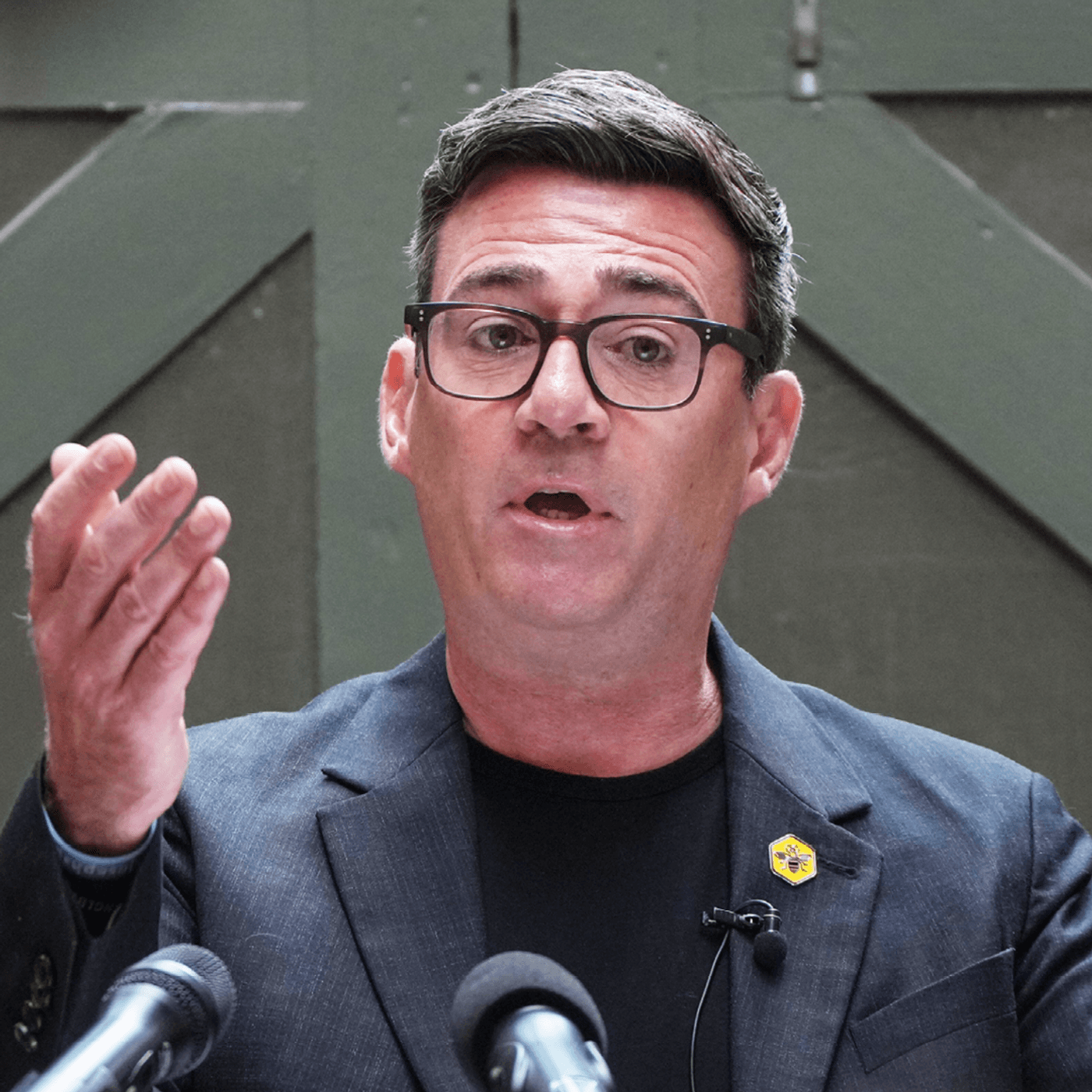
0:43What kind of pro can fix a backsplash? Can I replace one cracked tile or should I replace them all? What? What if I just use Thumbtack? I can hire top-rated pros, read reviews, and compare prices with a tap. All on the app. Thumbtack knows homes. Download the app today. Page 94, the Private Eye podcast. Hello and welcome to another episode of Page 94. My name's Andrew Hunter-Murray and I'm here in the iStudio with Helen Lewis, Ian Hislop and Richard Brooks. We're here on a momentous news day. It turns out that Britain is going to be renamed Even Greater Manchester. Andy Burnham's done a big speech outlining his big vision for the future of the country.
1:20Can we also mention that he's called Andy Murray Burnham? I know, I know. Nightmare. There has been an uptick in the number of Andy Murrays in public life. Yeah, yeah, yeah. I was just getting over the last one. I will say it was, in terms of the vibes, the vibes were good. It was happy, it was summery. He was in a little T-shirt with a suit over and he had to gag at the beginning about how Kemi Baden-Ock wasn't going to like this and he was halfway out of his Manchester clothes and he made a joke about how he was going to buy longer shorts or repeal the public decency. There was just a level of breeziness to it that I thought was quite good and somewhat refreshing.
1:55And for a public that's had a lot of speeches by Keir Starmer, I mean, this one just looked good, even if the bar is quite low. And I kept thinking, Richard, a lot of his diagnosis of what is wrong, you would have to agree with because you've written it and I've published it. Right. About outsourcing, over-centralisation, no money in the region. I mean, you do agree with some of these things. You know, the principle of more devolution, regional devolution, power to places that should know what to do with the money, you know, is a great one. The trouble is that while over the last few decades, while so much has been centralised, so much power and money has been brought into Whitehall, taken away from local government, so have the things that can hold those areas to account when they do spend the money.
2:48So local democracy is in a shocking state because people aren't really that interested in the bin collections or things like that. There's no auditing of spending regionally. The Cameron government abolished the Audit Commission, which used to look at local government spending. So now if you spend money wastefully, fraudulently, you basically get away with it. And thirdly, the local media as well barely exists. Hundreds of local newspapers have shut in the last 20 years or so. What's left is often sort of cheerleading for the region. It means there's no scrutiny in local journalism, really. So you're suggesting that with no one looking at how the money is spent, it might not go well.
3:35That's right. Do you perhaps have any examples of mayors who perhaps have spent rather like a drunken sailor and given contracts to their friends, Richard? Yeah, there's a chap called Ben Houchen, who's a mayor of the Tees Valley, who's not Ben Houchen, the former judge at the Political Podcast Awards in 2026. The one who overlooked us, you mean? The one who didn't win, Andy, for some reason. Enough of this petty griping. Sorry, sorry. So, yeah, I mean, Richard, what's really useful I suppose is how things have gone wrong and what you would do instead as in, you know, sorry, Teesside as an example of where it's gone wrong and what could have been done to avert it.
4:14Actually Houchen is in the Telegraph this morning writing about Burnham saying why he'll fail and I wrote out what he said he said, he points out that actually regional mayors have it quite easy because they don't have the really difficult things to do that the Prime Minister for example has to do. So he says we rarely make the calls that lose you friends crater your poll ratings and keep you awake wondering whether history will forgive you. The thing is, he's made a couple of decisions that should be keeping him awake that we've written about. Notably, with the spending of vast amounts of public money, which is what Andy Burnham is now proposing for regions around the UK.
4:53And it is re-industrialising, which is exactly what Burnham is proposing to rule out. These can create problems, these decisions. especially as as burnham says you know we need to bring everybody in we need to bring local businesses in as well as um you know local government the trouble is when you do that you've got to keep an eye on what they're up to with the money um and in teeside the deals that have been struck to regenerate the the former steelworks which closed down in 2015 as we've written about quite a lot um those deals have cost the local taxpayer hundreds of millions of pounds Essentially, Lord Houchen, as he is now, thanks to Boris Johnson, gave a deal to a couple of local businessmen who can now buy that land once the taxpayers remediated it for one pound per acre.
5:45And a couple of issues ago, we wrote about the latest manifestation of that, where a data center company plans to, Anthropik plans to build a big data center on that land. And it's agreed a deal in principle to buy the land from those businessmen for£222 million and pay them another couple of hundred million just to connect to the local wire network, which is like a sort of local grid for power because they control that as well. Because they were able to buy that under the land option. They bought a wire network with 20 substations for about£10. quid. So they can cash in on all this. And it is relevant because Burnham specifically mentioned steel.
6:33I mean, I think it is reasonable to look at examples that are in the north that are about steel, involve local mayors and haven't gone so well. Exactly. Teesside is the archetypal example because it is this old industrial region that was very successful in some ways, industrially, and could have been again, because there had It has lots of geographical advantages that tease Estuary. But it's, yeah, it's been absolutely thrown away. There's already been a kind of example of something similar to this with Andy Burnham, which is the debate over Sasha Lord, who Andy Burnham's nightlife czar, who had to pay back an Arts Council grant for COVID, essentially, and was seen to be having preferential access as a mate of Andy Burnham's.
7:17That's been the mill, which is one of the local newsletter type operations, has reported on that quite extensively. You're right, I think, to say that the scrutiny level just goes up a notch when you move from regional to national. And that'll be the thing I think that'll be the hard adjustment for Andy Burnham to make. I mean, he's already served as a minister, he's Minister for Culture, all this kind of stuff before. But, you know, as he said this week, he's been out of Westminster for a long time now. And I think that might be a bit of a shock to the system. The other one that reminded me was the fact that he said he wants the largest council house building programme since the Second World War.
7:50I mean in London you can't get developers to build private houses that will be selling off plan for£700 ,000 a pop right because of what they call the kind of the green tape the new staircase requirements post Grenfell the demand for a certain amount of them to be affordable housing. You know, we have laden down developers with lots of very good stuff, but it means that more and more of them are saying, well, we can't make this process work. So if you're talking about council house building, you're saying somebody, the state is going to have to take on that risk that you won't get planning permission, that risk of the upfront costs of it.
8:26I'm not entirely clear where the money for that is going to come from. And some local councils and some we've written about have decided to do house building themselves and it hasn't gone very well. Well, there have been some people trying stuff. Quite near where I live in Liversham, they built essentially modular housing, that very cheap kind of version of that. So people are trying to think creatively about it. But it is still an incredibly difficult thing to get through the gauntlet of all of the regulations and then all the objections from local people. And, you know, I worry about that. But you're not simply saying we can't have affordable council housing anymore or it's just too difficult to do.
9:05No, no, but what I'm saying is if you want to do it seriously, and I hope that he does, because housing is a huge issue, huge issue, particularly for younger people in this country, he will have to make some enemies of some NIMBYs. And that is also known as existing homeowners of whom there are a lot. And also he will have to find some funding for it from somewhere. And there is a quote from, I think, Howard Lees, who was one of the people involved in Manchesterism, saying the way we got so much built in Manchester was by ignoring those requirements for a certain amount of affordable housing. We basically just brought in developers and said, let it rip.
9:39And that's very different. Just build anything. And if you build enough houses, then eventually they will become affordable. There are parts of Greater Manchester that haven't seen this spectacular rejuvenation that he's claiming that will fan out across the country. Central Manchester has done extremely well, largely because of a big housing fund that was funded by George Osborne in about 2012. and a lot of the money has gone into the big skyscrapers that you can now see if you go to Manchester. The skyline's transformed. Most of them built by a single company that has made some people very rich.
10:23We've written about the chap who runs that company. The company's called Renacre. A chap called Darren Whittaker appeared on the Sunday Times rich list at somewhere over 700 million. But Andy Burnham made him rich and he can do that to the rest of us. That's why I'm hearing rich. I don't want to hear this talking down written anymore from you. Yeah, yeah, you've just got to level up a bit. Those skyscrapers were supposed to have affordable housing. To get the funding, they claimed that they were going to be profitable and they could get loans from this fund. But they escaped the requirement to put affordable housing in by claiming they weren't going to make enough money if they put affordable housing in.
11:00So there were these games played in development, which is why you have to keep an eye on it. I think one interesting thing is that Burnham will be the second recent Prime Minister to have been a mayor. So Boris Johnson was the mayor of London. And his deficiencies as mayor of London translated onto a larger scale when he became Prime Minister. So example number one, do you remember the Garden Bridge? Which was going to be a beautiful, literally a garden bridge. It looked absolutely fantastic in all the CGI renderings of it. Cost a lot of money, was never built. When Boris became Prime Minister, that became, let's have a tunnel to Ireland.
11:35so the smaller errors will be magnified of course Burnham was clear that this is a sort of 10 year plan 10 years is a long time so it's great to hear a bit of long term thinking but when you think of all the problems that are going to crop up along those 10 years and whether he'll survive them, whether he'll be able to resist them in a way or not bow down because he's kind of known for just wanting to keep people happy and giving in to what people lobby him on. Whether he can stick to it, show the resolve over that kind of period is pretty questionable. Well, one of the things he did say is he doesn't want such heavy-handed whipping, which I feel like is the kind of person who has not yet had to corral 400 members of the PLP to vote for something really unpopular that he thinks is good.
12:22But you're right. The interesting thing about that is that some of the things he was talking about was essentially following up this 2010s Labour project in opposition of what they called insourcing or the Preston model. Do you remember the Preston model? I don't. But it was the idea essentially that local councils should try and commission more services in-house, you know, bring investment back into the region. And that's the kind of thing that he was talking about, saying he wanted to be able to prioritise British businesses and contracts. That kind of, you know, that stuff, there is a fully developed, and we might laugh a bit at Manchesterism and expose its contradictions, but there are people who have been thinking about this stuff quite hard.
12:56And one of the things they talk about is the active state or the participatory state. You know, the idea that actually you do want to get more involved, you don't want to just leave things to the market. I think they're more comfortable with that than Starmer was. I mean, I think Starmer really had a particularly strong view on the market in either direction. We don't know what his views were. But that was part of the problem, yeah. There's time yet. He'll set out his missions. In his memoir, probably. Perfect timing. But there were more ideas, I thought, in the Burnham speech and more evidence of someone having given some of this some thought than we'd seen for quite a long time.
13:37And that presumably, I mean, overall, I kept thinking, I agree with a lot of the diagnosis here. As I've said, you know, our local council column will be saying a lot of these things, you know, this is right. But what are you going to do? And can you do it? You run the money column, Richard. Where do we get the money? Andy Burnham also hinted that he doesn't really want to raise taxes. He said he wants to give everyone a bit of a break on that front, didn't he? You know, you either raise taxes or you borrow it. There is a bit of room for that, borrowing for investment and infrastructure. Inside the fiscal rules.
14:12Yeah, that's right. Rachel Reeves has changed the fiscal rules slightly, although Andy Burnham didn't remember, didn't know what they were a few days ago. He perhaps does now. But she relaxed him a bit. So there's a slightly sort of friendlier measure of overall government debt, something called public sector net financial liabilities, which is a bit lower than the debt figure. And there's a bit of room there to borrow for investment, not for day-to-day spending, but for investment. So he can take advantage of that. And also, if he can change the way that the forecasters and the watchdogs look at this to give him the benefit of growth that will come from that investment.
14:54So it's a bit, you know, he was a bit daft, a bit naive to say we don't want to be in hock to the bond markets a few weeks ago. Don't say that. Don't mention the bond markets. But there's a bit of room there. You know, there is some some possibility. And I noticed that he managed to reference both Germany and Finland, the suggestion that other countries might have some ideas. Yeah. Outrageous. Outrageous. So Germany is this idea of the kind of essentially you have to equalise all your regions, which I presume in Germany came from the fact that the East was always so much poorer than the West. And post-urinification, there was a real transfer.
15:33At the moment, London is just this man's massive drag weight on the rest of the country, generating huge amounts of the income that then gets redistributed around the place. That, again, I'd be interested to see how that intersects with Sadiq Khan's feeling, that actually he would like a bit more investment in London. I think he made the point in the speech, didn't he, that he was quite careful to be nice about London as well. And said investment would get into London. Yeah, yeah, yeah. Yes, he wants a sort of London of the north, but in London. That was a bit, I've really slightly lost me a bit, I have to say.
16:04But yeah, there were some big ideas. You have to give him credit for some big ideas. I think we should say that none of this is going to happen if he makes the dangerous mistake of making an actual communist Ed Miliband chancellor. So can we all, you know, hold on to this for a second. I think that's unfair to communists, actually, Andy. Maoist? How much further can we go? You had an interesting thought about this, Richard, based on Miliband's previous time. I mean, Miliband was at the Treasury for eight years, ceding his radical communism, I know. But you had a thought about his sort of prior record.
16:33Well, he was Gordon Brown's special advisor from 1997 until 2002 when Gordon Brown and Tony Blair were very keen on the private finance initiative, which was essentially it was financial engineering to borrow money without the appearance of borrowing money. And it ended up costing a lot of money. We ended up paying well over the odds for hospitals, prisons. So it's a sort of cautionary tale, really, in the dangers of too much financial engineering with the public books. And that's what he's going to have to resist. There will be the temptation. Back then, the government had debt of about 40 % or a bit less of GDP.
17:20It's more than double that now. So the temptation is probably even greater. So he's not Redhead. he's blue ed he's dangerously right wing he's much too right wing to be chancellor flexible ed which is you know in keeping with the Burnhamism isn't it but the noises that have been coming out the Burnham camp people close to him and so on are that they may be looking for more conventional ways borrowing we talked about earlier which is the way to do it it's a lot more honest for one thing and it's more cost efficient because you're not paying the private bankers and investors' profits that you have to do on private debt.
18:00And I thought, I mean, not entirely because of your efforts, but there is a bit of a consensus on PFI now after a couple of decades that it wasn't a great idea. That's right, yeah. When the coalition government came in, they commissioned a review of it and said, no, not value for money, we're not doing that again. There was something called PF2. Why are they called it PFII? It didn't really work. Why not PFII, like Roman numerals? What's wrong with these people? You should have been a special advisor. Dropping the requirement for civil servants to have really, really good Latin was where the rot set in, in my opinion.
18:37I think the fact that people really hate Ed Miliband, or at least there's a big briefing war going on against him, has to be related to two things. One, that he has been seen as energy secretary to have been dabbling in other people's departments in a way that they have found annoying. And also, from the right, the criticism that he's trying to basically take, you know make you all eat a carrot and never drive a car again hair shirts and lentils yeah yeah but where does he stand on air conditioning andy that's probably where i'm going to take my view on ed milliband from thumbtack presents home overwhelm everywhere i go in my house it feels like an unfinished project is heckling me the uneven grout on the kitchen backsplash stares me down do i have to find a specialist to fix that tiling mess the ripped carpet by the basement indoor snags my shoe?
19:24Do I rip out all the carpet or just replace that section? What do I... Wait, what if I just use Thumbtack? I can find top rated pros for over 500 home categories and projects, easily compare prices and read reviews on Thumbtack. Download the app today. Can we agree that it's been quite hot? You never know. I look forward to the mailbag, but I think it probably has been quite hot. It's been quite hot. If you're watching this, it might have already got past 30 degrees again by now. Yeah, it's been too hot. Yeah. And a furious debate has now broken out about air conditioning. I can't install it in my house for physical reasons, but I am pro it because it is too hot to work in my house, and apparently that will be the future until I die, is that for a couple of weeks every summer I'm going to broil slowly.
20:08No, it'll be a couple of months by the time we're 20 years older, so don't worry about that. Yes, get air conditioning. You know, if you can afford it, terrific. As in, we've seen in the last couple of weeks, this big debate about a relatively, I don't want to say relatively unimportant, because, you know, it is important. Air conditioning protects you if you're very old, very young, pregnant, you're otherwise, you know, vulnerable. It can save lives. It's great. And there's this mad sort of attempt to have a culture war over it, but it doesn't reflect at all what the situation actually is. Which is?
20:37The Conservatives are trying to say there's a Labour war on against air conditioning. De facto ban. De facto ban. There are a couple of councils which have been a bit restrictive on it, and I think they absolutely shouldn't be, and I think they're going to have to change the rules. But the idea that there is a de facto ban is, in the old phrase, it's not even wrong. It's so wrong that Labour will pay you two and a half grand towards the cost of air conditioning in your home, in your home watching this. But this is via heat pump, right? There's a thing called a, it's called an air-to-air heat pump, and it basically does you cold air in the summer and hot air in the winter.
21:13The reason the government wants you to get one of those, to the extent that they will give you two and a half grand of the cost is that it means you need to use a gas boiler much, much less. It basically decarbonises your home heating very effectively. That's where they'd like you to get it. Free air conditioning on the government. Let's all get it now. That's the position. Is it a bit like the Guardian's air conditioning, which notoriously packs up when it gets to 27 degrees? That's my worry about eco. I just think I feel like... It all goes back to the Guardian. It all goes back to the Guardian.
21:43That was all I hear about every summer, though. I mean, yeah. The reason that I think this debate, which is not a debate, I just want to say it's not a debate, get it. If you can afford it, terrific, get it. Partly because we'll have so much solar on the grid by 2030 that the demand for air conditioning will perfectly soak up solar. And then you get, you know, it's very advantageous to do it. part of the debate is I think that you have now a block in British politics this didn't this wasn't the case five years ago the block of reform the conservatives who have decided that they're going to focus only on one element of the climate thing right the climate thing is two halves it's adaptation because we need to adapt to the fact that the world is much hotter than it was 30 years ago and it's mitigation which is stopping the problem from getting worse and worse and worse the way you deal with that second bit is to get to, if you like a net of zero to coin a phrase crud going from the bowels of hell into the atmosphere that's how you do it and the Conservatives and Reform have decided they're not going to bother with that they're going to scrap the 2050 target they're going to scrap all incentives they're just going to scrap the whole thing they're basically saying we don't want to deal with this so the reason they're talking about air conditioning is basically their attitude is well we'll just adapt, we'll just everyone get air conditioning it'll be as hot as Saudi Arabia just don't go outside it's an anti-reality position that they have found themselves in reform have always been like this the conservatives signed net zero into law what, seven years ago?
23:08Theresa May's part Boris Johnson the one thing he was right about apart from Ukraine is clean energy and the conservatives have absolutely abandoned a position of dealing with reality on this so it's a crazy thing and that is why I think we're talking now about air conditioning so much is because it's part of adaptation and it's a useful and important part. But mitigation is the other bit. If I've understood the arguments on the other side correctly, we can only have air conditioning if we drill in the North Sea tomorrow. Yes, that's very... Have I got that right? Yeah, if you want to get air conditioning and it comes from renewable, the extra emissions are pretty minimal.
23:46If you do want to drill a whole new oil or gas field, they'll be a bit higher. And presumably will not allow us to have widespread air conditioning. no i mean the even donald trump has been weighing i mean he always talks about the north sea i don't you know unlock the north sea we had 14 years of conservative government who granted licenses you know it's our bit is mostly knackered anyone whose main priority is the north sea isn't really folk can't do sums about what works and what works is going electric and the reason for that is the very boring thing that it makes your devices if it's heat pumps electric cars like three or four times as efficient.
24:24That's the gain you get. If someone invented a petrol car that went 2 ,000 miles on one tank they would be fated for all time. They'd win Nobel Prizes up the wazoo. But this comes back to my conspiracy theory about recycling which actually turns out to have been validated a couple of years ago. Lots of recycling just gets shipped off to China and put in landfill, right? But why does everybody like big businesses were very happy to wang on about recycling because it was saying it's up to you. Actually climate change can really be materially affected by you separating out your paper from your milk bottle.
24:55And I feel like the same thing about air con. It's saying, well, we can't do all these mitigations that would be expensive or trying to get to net zero by putting money, a levy on your bills or whatever it is. Instead, it's up to you to buy an air conditioning unit. And if you don't, that's your fault. That to me is it's about, you know, just shifting it back on to being an individual problem and the collective action problem. Yeah. And lots of people can't afford air conditioning, either to buy the thing or to run it because it will add to your electricity bills. And that is another big part of the problem is that policy matters, basically.
25:25But there's also a left critique of air conditioning, right? Which is the sort of degrowth one, which is essentially like the left-wing attack on GLP-1s, the anti-BST drugs, which is, it's a sticking plaster. So the idea is you have to morally suffer in your very sweaty house. Otherwise, you will never feel the pain that will make you want to attack climate change. In the same way, you shouldn't take a drug that suppresses your appetite because we should fix big food. That's, I think, the reason that the left can be quite puritanical about judging people for air conditioning. And coming from the centre, I'm always thinking, can we not do both of those things?
25:55Can we not have collective and individual action? What is limiting the progress on these air-to-air heat pump, air conditioner things, which sound like... They sound a bit sci-fi, don't they? I think until recently the government was focused on air-to-water, which is where it heats your water, so it does your radiators and that's because most people have radiators in their homes so it's sort of a natural first step i think it probably will catch up you know there's lots of money available for it which is a good thing and thank you to the readers who've been saying get with it air to air not air to water yeah as of last week when i read these letters andy i'm big on air to air it's it's great and having gotten air to water a system a year ago that's absolutely fine the degrowth thing I think is a bit of a mad perspective because people don't want to give up the things they have you see it a lot in the argument over uh cars for example people will say we shouldn't go to electric cars because uh actually active travel is much better much better you know we should be getting people walking and taking the bus uh or you know what I mean cycling this kind of thing but good luck doing that in America where one town is 100 miles away from the next time.
Read the full transcript
27:07Right. This is the thing. Even in the Netherlands, even in, like crazy, the Netherlands, I think about 9 % of distance travelled is active. Now, that's in the Netherlands, which has had decades of strong support for active travel, cycling, very flat. So the idea that that is going to be the answer is just not quite real enough. The Climate Change Committee have done the numbers on this. And basically, the savings that you get from going electric are so much greater. That's good. That's part of what I think of as your kind of climate sensibilism that I think I hope that I hope whoever becomes Chancellor of this, which is energy expenditure matters less than how that energy is generated.
27:46Globally, about 20 % of our energy usage is the electricity. So you do need to clean up electricity generation. But the other almost 80 % is the stuff that has not yet gone electric. So that's cars and home heating and all that stuff, low temperature, industrial uses, all of that. And the opportunity to electrify that is big. And that is why, especially in the wake of the Iran war, you're going to hear lots more about electrification. It's going to be a big focus of the COP meeting in November because it just gives you these massive efficiency savings. And that is one valid criticism of the current government's position, which is that they've been really focused on getting to clean power 2030.
28:25And Old Sparky has written a lot about this. clean power 2030 is great, but it is expensive to do the last few percent. And actually, there are lots bigger gains to be had. As in, if you run an electric car, even if you're basically only using a gas-powered electricity grid to make the electricity, that's still better for the environment than a petrol car. Because, you know, that is so much more efficient. But first, you need a huge investment in the national grid as well, don't you? You do, and I think we've needed one for a long time, and there just hasn't been much action on it. But yeah, the idea...
28:55Oh, that's another good thing about aircon. It gets more electricity used, which spreads the cost of the grid. It's going to be really expensive. The economy is basically a hybrid car at the moment, which is running two systems at once. And Burnham did say infrastructure. Yeah, yeah. At least once. At least once. So I imagine he's all over this. I think he's been quite good on green stuff. I think I see a bit of a difficulty with the number of commitments he's making there. Right. You know, the grid itself is going to cost a million fortune to upgrade and so on. And also the capability to deliver this.
29:26You know, if you haven't invested in the skills for generations. Yeah, there is a gap. We don't really have the engineers at the moment. So it's a rebuilding is a difficult process. You can't just chuck money at it. Yes. So, I mean, it's good to hear him talk about education and apprenticeships and technical education and leveling it with academic education. You know, these are, again, great ideas, but not easy to deliver. It was the least Blairite bit of his delivery, which, you know, was pretty solid, Tony, for quite a lot of it. And then he's going, you know, and I promise you that a lot of you won't go to university.
30:09That's marvellous. Well, if you could become an engineer or technician without an 80 grand debt, wouldn't you? Yeah, the numbers make sense, don't they? Sorry, just the last thing. There is quite a sort of... The electoral point is always a bit duller to me because I'm just a geek on all the tech. But Labour's voters tend to like this stuff and they've been losing a lot of votes to the Greens and to the Lib Dems, of course, because they seem to have been going a bit further right on all sorts of things. And I think if they do row back too far, then there's a real risk that they'll just lose more to their left.
30:46But also it would be a big splashy thing to say. I mean, one of the things he was talking about was more greater public ownership or public accountability for energy companies and utilities. But again, very expensive. But Keir Starmer's Labour were renationalising the railways. Like a great big left wing ask for a really long time. Just no one knows about it. No one knows about it. It's extraordinary. It's the same on the energy stuff. Like the record is terrific, but they seem to have been quite unwilling to make the case on it. It is weird. And the thing that plays well with people is actually not arguments about jobs or the economy.
31:18People quite like, well, this is protecting the planet for future generations. We all have to do our bit. This is a global problem. Electrally, that does better than there are this many jobs and this much investment, which is a spreadsheet thing to say. And Burnham is a storyteller. He can tell these stories. You were telling me he's got an English degree. I'm thrilled. I've got an English degree. Am I Andy Burnham? Yeah, if you look at this panel, you'll find quite a lot of English degrees. Yeah, I've got an English degree as well. Oh, dear. There's a very sad bit, apparently, in his memoir where he talks about the fact he didn't get into his first choice of Cambridge College.
31:50Yeah. He's been through suffering. Adversity. Adversity, yeah. Well, as stories of working class defeat go, I think that's pretty shocking. Now we should come to someone else who I'm not sure whether Donald Trump's got an English degree. He's got such a fluid command of the language that I think he probably has a few honorary ones anyway. But Helen, you have been keeping up with, you know, we're fresh from America 250. Ooh, yeah. The cage fighting on the White House lawn. And now there's been another book out about Trump, which is exciting. Yeah, by two New York Times journalists, Maggie Haberman, who is known as Trump's psychiatrist.
32:29That's her. He sort of invites her in. Gold couch. Why didn't my father love me? I mean, essentially, I think. And Jonathan Swan, who's an Aussie originally, did a very good, very fact-based interview with Donald Trump a couple of years ago that kind of made his name. Anyway, the book's called Regime Change because their essential conceit is that Trump is now running what they call an imperial presidency. We've talked about this before, about Caesar-maxing. But their thesis is essentially it would have been better had Trump won again in 2020, had Biden not defeated him. Because in his first term, he was disoriented, he wasn't ready, he was restrained by various chiefs of staff, by the Republican Party in Congress, not doing what he wanted, by judges, by the concept of conflict of interest rules.
33:14And then he had four years brooding in the wilderness, meditating on his grievances. And he also attracted a cadre of loyalists who would just say and do anything. And so in the second Trump presidency has been an imperial one where he's just smashed through absolutely everything. I mean, the stuff that the boys, the boys, Eric and Don Jr. and now baron, have done in terms of mingling their business interests with the family, extraordinary, through the crypto firm World Liberty Financial, through deals. There's been a deal recently with, I think, either a Kazakh or an Uzbek tungsten mine. You know, the fusing of the foreign policy and the Trump's family's own financial interests is extraordinary.
33:55Is it called World Liberty Financial? Yeah, it sounds like a made-up name. It sounds like a made-up name of an evil company in an 80s movie. Yeah, I don't know why that would be appropriate. But essentially the idea would have been that he decided in the first home he tried to obey conflict of interest rules and he feels he didn't get enough credit for that. He was like, they were still mean about me anyway. I only did a little tiny bit of corruption and I never got any credit. So now I might as well go wild. Is the idea that a second term following immediately on from the first one would have what?
34:24It would have meant more chaos and more incompetence and more of him not getting his way and now it would be over? Yes, exactly. But what actually happened was that he returned for the second time round, A, intent on revenge against everybody, and B, having won not just the Electoral College but the popular vote, absolutely in command of the party. So he's got a speaker in Mike Johnson who does whatever he wants. He has primaried so many people in the Republican Party. There is no one left, really. There is no Mitt Romney, the senator from Utah, who was very critical of him, voted for his impeachment.
34:59None of those people are around anymore. None of the chiefs of staff that he had previously tried to restrain him. He's now got Susie Wiles, the Florida operative, who sees herself as enacting his views. You know, he doesn't have... Pete Hegseth has been sacking people left, right and centre in the military, so he doesn't have the generals holding him back. He now has Dan Raisin Cain as his top general, who seems, although comes across in this book as being very sceptical of the Iran war, certainly hasn't, you know... Stopped it happening. Yeah, stopped it happening. You might put it. So it is a really fascinating portrait of what it means to hold the power of the American presidency without really anyone to rein you in at all.
35:40The Democrats obviously sort of bloodied and defeated, basically. The only people really holding anything back are the courts and usually like individual justices who say, well, you know, there's a bit where Stephen Miller, his immigration wants to repeal habeas corpus. He wants to just deport people without giving them any kind of hearing. And that gets held up by a judge. And so they go to kind of war against the judge. You know, that kind of stuff happens over and over again. And, you know, it just shows you how fragile it is. And then the other thing that comes out very strongly from it is the way that Biden on his way out used the presidential pardon power to preemptively pardon his son, who'd been involved in a load of felony convictions, actually, but accusations, too, and various members of his family.
36:27So Trump having seen that, it seems to be now the feeling, well, look lads, let's all get absolutely involved. And then there's a quote in it about, you know, I'm going to pardon everybody within 25 feet of the Oval Office on my last day, which is totally within the president's power to do. Just to... Preemptively pardon. Just say that you cannot prosecute anybody for anything that they did during this term period. So a time period rather than doing it as part of their job. Yeah, you can say anything that you can't prosecute anyone for anyone they did in this time frame. And he's already, thanks to a Supreme Court decision, got very wide presidential immunity powers for himself.
37:03You can't retrospectively go back and say, we think that this deal was dodgy and actually amounted to fraud. Because he did it as president. Presumably being told that you're going to be pardoned, whatever you do, is not automatically conducive to good behaviour. Yes, I'll spot it on that one. Right. It doesn't have a chilling effect, I think is what you're saying. Yeah. Imagine if you said that to a sort of seven-year-old, right? Anything you do this week on holiday, at the end of it, I'm going to completely forgive you. You should bury paint all over the walls. It would be a bad plan. You should be describing modern parenting, Helen.
37:37Yeah, so true. Helen, how much of this is changing the system permanently, irreversibly, and how much have we just got to get through and get rid of him and things will improve? Their thesis, which I tend to sign on to, was that most people, including people in Europe and the wider world, treated the first term as an aberration. This was a fluke. Well, America's just having a bit of a rumspringer and dallying with having an authoritarian. But no, the second term and the bigger win, they mean it, right? And they talk about that meeting with Zelensky in the Oval Office as being the moment that European leaders went, oh, it's like NATO as we know it is over.
38:15The idea of America interfering outside of its sphere of influence in the Western Hemisphere. interfering, contributing his expertise and wisdom. Thank you very much. But it doesn't work the other way around, does it? So Trump announces that really he does not want Edmund as Chancellor. So their foreign policy comes our way. It's just we no longer have any say at all. The only thing about it that gives me hope, and this is the bleakest kind of hope imaginable, is the book ends with all the decisions about the Iran strike. And it makes, I think probably due down to their sourcing, abundantly clear that No one really, maybe a bit Marco Rubio, Secretary of State, no one really thinks that's a cracker bang up idea.
38:58J.D. Vance is very worried about it. Tucker Carlson comes in to intercede with him about it. Susie Wiles doesn't seem thrilled. General Dan Raisin Cain doesn't seem. But no one can say anything anymore. And no Republican in Congress, which doesn't get asked to vote on it. No, they don't get a say. The judiciary doesn't get a say. There's no one left to rein him in. And this kind of comes back all the way full circle. You were saying it was a hopeful point coming up at some point. Well, actually, the imperialness of the presidency creates the seeds of its own unpopularity and destruction, which comes back, not to come back to Teesside, are very similar.
39:30I wasn't seeing any echoes at all. But the idea that if you don't have this level of scrutiny, what you don't get is any pushback on your bad ideas, and therefore they get through, and at some point, maybe you do meet the consequences of them. You mentioned power, and the quote I liked was this quote that Trump believes about himself, that he has more power than Mao, Stalin, Roosevelt, Augustus. He said in his original quote, this came from a historian, but it wasn't historian, was it? It was Gary Player, the golfer's caddy, who printed out a list of the fact that Donald Trump was one of the top ten historical figures, along with Hitler and Mao, and handed it over to him.
40:12And he went, yeah, those are the big dogs. And that's me, I'm up there. It's only the second best quote in the book. The best one is, I wrote this down because it moved me so much. When Elon Musk flounced out of the administration after being a special government employee and did a since-deleted tweet saying the reason they haven't released the Epstein files is because Donald Trump is in them, Donald apparently sat in the... Get your hanky ready. Sat in the Oval Office with a dejected, pensive look and said, they always leave, they always do this, this is why I can't have friends. if you have tears to shed cry them now that's an example as well they use as a direct quote which they say they only do if they've heard it from somebody who was there right and this is one of the extraordinary things about this book is it has direct quotes from discussions in the situation room supposedly the most secure room you just don't have that level of insight from any previous administration and a lot of the book is the subplot is the race for who gets the nomination next time.
41:14And that has been fascinating to me to see at what point does Donald Trump graciously move on for the next generation feels a touch out of character. And so what he actually enjoys is once again, running it like the apprentice. And, you know, there's a line when he says about all the gold decorations that they've had in the White House, you know, someone says, will the next president keep them? And he says, well, Cubans love gold, a reference to Marco Rubio, rather than his alleged successor, J.D. Vance, the vice president. So he's really enjoying. We can take a small moment of consolation to the fact that he's torturing JT Vance and Marco Rubio by kind of alternately favouring each one of them.
41:51I like your idea that who could the source be in this situation room given he moved the situation room to Mar-a-Lago and there's a wonderful photo of a man peering round the black thing looking in and watching them presumably discussing the invasion of Iran or the non-invasion or the bombing of Iran and he looks like he was one of the waiters yes in the next door room I presumably there are a lot of people who've leaked stuff well they made it you're right they made a makeshift I think they call it a skiff in which is the secure communications thing but it doesn't it doesn't look all that it is in the corner of a ballroom it doesn't look all that secure but you know they also had people dialing in on speakerphone and this is a government where many of the people involved either were podcasters want to be podcasters have podcast but didn't inhale so So there are a lot of people who are trying very much with one eye on the, not even the memoirs, but the future podcasts in this administration.
42:49Why is this book so big? Why has it worked when lots of people have written Trump books? I think because the level of detail and insight and reporting they've got is so much greater than anyone else's. You just are being taken inside and no one in the administration is seriously disputing anything that's been reported. This isn't like a, let's be rude, a sort of Michael Wolff where he's written down some like third-hand things that Steve Bannon told him about stuff. Ooh. No, but those books sold incredibly well, but they were a little, shall we say, looser in their sourcing. And these are two New York Times reporters who at the end of the process had an on-the-record interview with Trump to put all the allegations to him.
43:29But some of the... Here's the other bit that got me. He's got this woman, a 34-year-old woman called Natalie Harp, whose job is to print him things and bring them to him. And she once sent him a note that said, you are all that matters to me. And Susie Wells, the chief of staff, finds it and is just like, what are we in high school? What's happening? What's happening? She's sitting there signing her name from Natalie Trump or all that kind of stuff he was doing at 13. Very, very fascinating business. Did Trump dispute any of this when it was put to him? Or did he think, yeah, sounds good to me?
44:00I think because it's all about how amazing he thinks it is. The bit that he took from that is, I do, I am amazing. Yeah. Rather than this makes me sound like a... I am bigger than Hitler. Yeah, right. rather than this makes me seem like a megalomaniac. His generals abandoned him too. Oh. I mean, it's generating a lot of heat, isn't it? It is. It will affect the midterms. I mean, the thing that will affect the midterms is the fact that he can't be reliably kept on the subject of affordability and the cost of living. The Iran war obviously just sucked up a lot of time and attention and put up gas prices.
44:30But more than that, he just seems to... The only thing he really cares about now is building work. He's become sort of late-era Kevin MacLeod. He's probably got very strong thoughts about when you don't use a project manager, how that can actually really rack up costs. Yeah, he's obsessed with the reflecting pool, which obviously they repainted and it's all peeling off. He's got guardsmen around it now guarding the reflecting pool. It's such a fantastic metaphor, though. I always feel you get to a point in your career where the metaphors take over. And a stinky swamp in the middle of democracy's home seems to be difficult to escape from.
45:07And we should say there is an extremely good video of Private Eye's own Donald Trump, Lewis MacLeod, doing a video live from the Reflecting Pool. So if you want to see that, go to Instagram. He demolished the bipartisan commission that was supposed to be celebrating the 250th anniversary, replaced it with this very partisan one. And one of the things they've been having is this sort of World Fair, which the crowds do not look impressive so far. But they've got, you'll enjoy this, they've got a mock-up of the Ark to Trump, you know, this planned triumphal arch that he wants. And it's like the Stonehenge in Spinal Tap.
45:41It's like they put the order in for the wrong size. And there's something that's just incredibly funny about a very small triumphal arch. You can't get through. Just gets stuck in the triumphal arch. OK, well, that's ending on a funny note, at least. Yeah, well, I'm not sure whether Trump's presidency will, but yes, there we go. Right, that's it for this episode of Page 94. We will be back again in a fortnight, but until then, thanks to Ian, to Helen and to Richard, thanks to you for watching or listening to this. If you would like to get a copy of Private Eye, the latest one is still on newsstands.
46:16There is a very funny Andy Burnham joke on the front cover, and there are many more very good jokes inside, along with brilliant reporting of all varieties. You can subscribe at private-eye.co.uk. We'll be back in two weeks. We'll see you then and thanks to Matt Hill of Rethink Audio for producing. Bye for now.