
In short
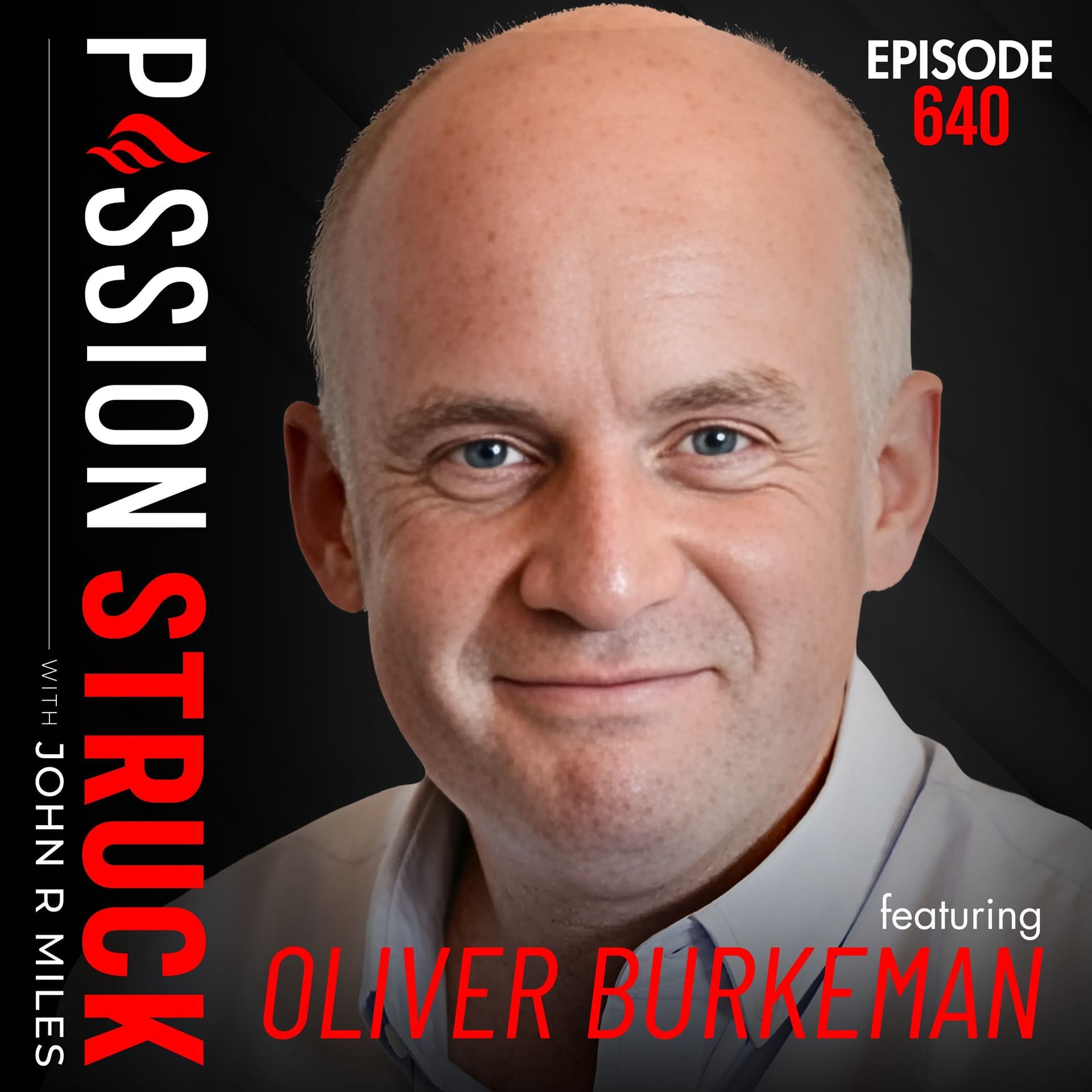
Podcast Episode Notes: Passion Struck with John R. Miles - EP 640
Episode Overview
- Title: Oliver Burkeman on Stop Optimizing, Start Living What Matters
- Guest: Oliver Burkeman, author of *Four Thousand Weeks* and *Meditations for Mortals*
- Host: John R. Miles
- Main Theme: The episode explores the notion that true emotional wellness comes not from an obsessive drive for productivity and control but from embracing our limitations and focusing on what truly matters.
Key Concepts and Discussions
Introduction
- John R. Miles reflects on the difference between being busy and finding meaningful engagement in life.
- The concept of productivity is challenged, suggesting that it may lead us away from a life that matters.
Oliver Burkeman's Perspective
- Burkeman emphasizes that embracing our limitations can lead to deeper freedom rather than an endless cycle of optimization.
- He critiques the modern obsession with productivity, suggesting that it often leads to feelings of inadequacy and anxiety.
The Philosophy of Imperfectionism
- Definition: Burkeman introduces "imperfectionism," which encourages individuals to take action and engage in the present rather than waiting for the perfect moment to do so.
- It emphasizes that small, imperfect actions are more meaningful than grand plans that are never executed.
The Myth of Time Management
- Burkeman posits that our attempts to master time often distract us from living fully in the moment.
- He encourages listeners to redefine their relationship with time and prioritize meaningful engagement.
The Importance of Choosing What Matters
- The conversation shifts to how individuals can define their priorities and values.
- Burkeman suggests focusing on what enriches our lives and gives us a sense of vibrancy rather than chasing after an overwhelming list of tasks.
Making Peace with Finitude
- Burkeman discusses the value of recognizing our limitations regarding time and how this acceptance can facilitate deeper living.
- He mentions the importance of not hoarding experiences and emphasizes the fleeting nature of life, akin to a Japanese tea ceremony that values each moment.
Overcoming Anxiety
- Burkeman reflects on how many high achievers are driven by anxiety rather than a desire for fulfillment.
- He remarks that true fulfillment comes from engaging with life as it is rather than constantly striving for perfection.
Key Takeaways
- Your Value Isn't Measured by Productivity: Understanding that you don't have to achieve more to be worthy is crucial.
- Life Will Always Be Unfinished: Recognizing that this is natural can relieve the pressure to complete everything.
- Embrace Your Limits: Accepting your limitations can help you focus on what truly matters in life.
- Live in the Present Moment: The only moment you can shape is now; cherish it.
Additional Resources
- Books by Oliver Burkeman:
- *Four Thousand Weeks*
- *Meditations for Mortals*
- John R. Miles' Substack: The Ignited Life for further insights on intentional living.
Conclusion The episode reinforces the idea that emotional wellness is found not in relentless productivity but in embracing imperfection and living intentionally. Burkeman advocates for recognizing our limitations and focusing on meaningful experiences, encouraging listeners to engage fully with their present lives.
---
For those interested in the full discussion, please refer to the episode link provided in the podcast.
Written by AI. May contain mistakes. Listen to the episode to check what was said.
Transcript
Automatic transcript. May contain errors.0:00Coming up next on PassionStruck. Imperfectionism is the stance that says the only thing that really counts is doing a bit of it today, this week, maybe badly, maybe too little by some standard, maybe with no confidence that you'll ever come back and do it again. Maybe it's just a one-off. Maybe you're not about to develop a wonderfully virtuous habit of writing your novel every single day, but you'll be doing it. You'll be bringing it into concrete reality. It will no longer just be an idea in your head. It will be real. And I think the big problem with a lot of ways that people think about productivity, personal development, spirituality, all sorts of things, is that it actually reinforces this notion like, not yet.
0:40Welcome to PassionStruck. Hi, I'm your host, John R. Miles. And on the show, we decipher the secrets, tips, and guidance of the world's most inspiring people and turn their wisdom into practical advice for you and those around you. Our mission is to help you unlock the power of intentionality so that you can become the best version of yourself. If you're new to the show, I offer advice and answer listener questions on Fridays. We have long form interviews the rest of the week with guests ranging from astronauts to authors, CEOs, creators, innovators, scientists, military leaders, visionaries, and athletes.
1:20Now let's go out there and become passion struck. Welcome to episode 640 of passion struck. I'm your host, John Miles. And I just got back from a week in Maine, hiking the trails of Acadia, breathing in salt air and sitting on top of Cadillac mountain. And as I watched the morning unfold over that wide open coastline, one question kept echoing in my mind. What are we doing with our time? Not just our schedules, but our attention, our energy, our one wild and precious life. That pause gave me perspective because too often we confuse business for meaning. We mistake productivity for purpose and we fall for the lie that if we could just do more, manage more, be more, we'd finally get to a life that matters.
2:11But what if that's backwards? That's exactly what we've been exploring this month on PassionStruck in our series on the power to change. Last week, I sat down on Tuesday with Dr. Stephen Haina to examine how our culture quietly scripts our sense of identity and motivation. On Thursday, Michelle Chalfant joined me to share how our emotional reactivity often comes from unhealed patterns and how to shift into grounded adult presence. And then lastly, on Friday, I was joined by Brad Deflin, who gave us a masterclass on digital self-defense in an age where cybersecurity is no longer optional, it's personal.
2:53If you missed any of those, go back and catch up. Each one builds on the idea that transformation isn't just about doing more, it's about becoming someone new. And that brings us to today. Because what if the deepest shift we can make is this, to stop trying to master time and instead learn how to live within it. I'm joined today by Oliver Berkman, the bestselling author of 4 ,000 Weeks and Meditations for Mortals. His work has helped millions rethink their relationship with time, meaning, and mortality, not as problems to solve, but as invitations to choose what really matters. In this conversation, we explore the cost of chasing productivity at the expense of presence.
3:34Why accepting our limitations actually leads to deeper freedom. The myth of the perfect time and why it keeps us stuck and how mattering isn't found in finishing everything, but in showing up for what counts right now. If you've ever felt like you're running out of time, behind on your life, or stuck in the grind of always trying to catch up, this episode will meet you right where you are. And if you're ready to live more intentionally, check out our sub stack, The Ignited Life at TheIgnitedLife.net, where I share weekly tools, reflections, and curated episode playlists. You can also catch this episode and more on YouTube at John R.
4:13Miles and our Clips channel at PassionStruck Clips. All right, let's get into it. Here's my meaningful and mind-expanding conversation with Oliver Berkman. Thank you for choosing PassionStruck and choosing me to be your host and guide on your journey to creating an intentional life. Now, let that journey begin.
4:33Hey friends, it's the beginning of 2026, and if you're like me, you didn't come into this year to coast. You came to live with purpose, to show up with energy, clarity, and intention. That's why how you start your day matters. And for me, that starts with Huel. Every morning, I reach for two things. First, Huel Daily Greens ready to drink. The peach and hibiscus flavor is crisp and refreshing. With 42 superfoods, vitamins, and minerals, all in just 25 calories and one gram of sugar. Then I turned to Huel Black Edition ready to drink. With 35 grams of protein, 27 essential nutrients, and no junk, it's a full meal that fuels focus, not fatigue.
5:11I start with Huel because I want to be present, intentional, and ready. Not just today, but every day. Start 2026 likey minute. Grab Huel today with my exclusive offer of 15 % off online with my code PASSION15 at Huel.com slash PASSION15. New customers only. Thank you to Huel for partnering and supporting our show.
5:37I am absolutely thrilled today to have Oliver Berkman on PassionStruck. Welcome, Oliver. Thank you very much for inviting me. As you and I were discussing beforehand, And I first discovered you through the popular column that you wrote for The Guardian called This Column Will Change Your Life. Love the title. Looking back as you were writing it, what did you learn about people's biggest struggles with meaning and significance? Wow, that's a good but a big question. If I'm really honest, that column ran for a long time, more than a decade, shockingly. and when I began it I had pretty skeptical maybe even borderline cynical motives right the idea was there was this whole field of self-help and personal development and it would be fun to test it out sure but but poke a lot of fun at the sort of dubious aspects of it and trust me many years later I still think there are plenty of dubious aspects to it but one of the big experiences that I had writing that column was a sort of journey towards sincerity in some ways.
6:46Not that there isn't a lot of rubbish masquerading as self-help, but that underlying urge to figure things out, to build a more meaningful life, to spend more of your time doing the things that make you feel the most alive and that matter the most. That urge is a good urge. and there are plenty of people profiting illegitimately off that urge but there are also plenty of people and plenty of parts of the culture disdaining the urge itself as if we shouldn't we should just get on with things or just obviously want the things that everyone else wants and so really one aspect of writing that column was just to understand how deep this yearning goes and how important it is and that doesn't mean you can't be amusing about some aspects of it but it's a serious thing and then I suppose where that led certainly in terms of book before last 4 000 weeks was to focus on the degree to which our limitations are and our limited time are a site of this struggle if we had all the time in the world it wouldn't matter that these things are difficult because we could just do them later but we can't do them later or not indefinitely anyway.
7:58So I think figuring out what matters and how to make it actually happen in our lives in the present, instead of endlessly postponing it into the future is a big part of that too. Okay. And I had a follow on question that takes this to you more personally. You just mentioned your book 4 ,000 Weeks. And in that it really reframed how we Think About Time became a New York Times bestseller, a global bestseller. Now, Meditations for Mortals, your latest book, which came out in October 2024, takes it even further, almost as a daily practice, which we'll get into as the conversation evolves, for embracing what truly matters.
8:41How has your own understanding of time and significance evolved through writing both books? the first thing to say is that like all of this is on some level is just me doing therapy in public on my own issues right i think this is probably a near universal truth for anyone who writes books that are books of advice or books about how to build a more meaningful life this is of interest to me because it has been a thing i needed to grapple with so one of the things that I've done is I've found that for me the process of bringing these ideas into focus is a very important part of learning to live them there's a strange phenomenon occurs whereby or that I've found anyway whereby you come with an idea for a book you come with some useful pointers about something that might be true about the world our time is very limited so we need to make wise decisions about what to do with it.
9:46And we need to be willing to let go of options that are not bad in themselves, but there are just too many of them. And I can have this intellectual notion. But when I try to really explore the issue in writing or in my thinking, my reading, I find that's when I have to actually live it. It would just be too hypocritical to, and not possible, but creatively somehow, to write a book about this and not at least do what you could to model it. So I'm constantly tacking back and forth between writing the advice that I need to hear and writing the advice that I have recently followed and found to be useful.
10:22I almost can't separate these questions about how have I changed versus what are the books about because it's the same topic. To get a little bit more specific, I suppose, I do think I'm significantly less anxious and constantly focused on the future in a worried sort of way than I used to be. I think I'm a lot better at making at least some time in the present for the things that I know I care about most, whether that's my writing or family or spending time in the natural landscapes that we live in here in the north of England. But it's all by comparison to who I was earlier, right? So I may still not be the world's greatest exemplar of it.
11:04I think I'm a lot better than I was. There's so much truth to what you're saying, wrote my first book, Passion Struck, because I was trying to figure out how do I reinvent myself? How do I get from where I found myself using a Henry David Thoreau quote, I was in quiet desperation, to rebuilding the basic foundation and scaffolding of your life to create one that matters. And it really, as I was writing it, I ended up doing, as you were describing, me search by trying out all the principles on myself to find out if they actually worked or not. And as I approach a book, it's always so interesting, the structure that you choose for it.
11:53And I'm writing a book now, and I was having a conversation last week with Dan Heath, who him and Chip are kind of like the masters of how to structure a framework for a book. And he gave me some unconventional advice. He goes, don't lead with the framework. The framework will find the book. And it's an interesting way of thinking about things. I'm not sure I can do, let go of that completely. But the way that you structured Meditations for Morals, I thought, was really interesting. Why did you decide to frame it as a month-long, quote-unquote, retreat of the mind? It was quite a long process.
12:34I'm very interested in that Dan Heath advice. I feel like I want you to say more about it, but let me just answer your question first anyway. In the earliest stages, Meditations for Mortals might have been a sort of quote every day for a year or something. And then I was working with two really great editors in the US and the UK, and we had various Zoom calls and chewed it over. And then it turned into a short chapter for each week of a 52-week year. And it still wasn't right. And I was writing bits of it at this time, and I had various sort of pieces to slot in, but it just, there was something it wanted to be is how I experienced it.
13:12Sounds a little bit pretentious or something, but I was trying to discover what this was supposed to be rather than deciding what it would be. And I think what it wanted to be was 28 short chapters, each easily readable in 10 minutes with a coffee or on a commute to work or something. Again, with the invitation that this could be a four week engagement by the reader. Obviously, I can't control how people read a book of mine that they obtain. That's none of my business on some level. but that by approaching it like that or at least just having the idea of approaching it like that in your mind it becomes something that you can weave into fold into your daily life right i have this that i didn't want it to be the kind of book where i was implicitly saying here's a great complicated new system for changing your life completely in a few months time when you finally get the bandwidth and you're really prepared to give it your all you can put it into practice now i wanted to say here are tiny little thoughts that might detonate in an interesting way and a helpful way and make a real change like in your life right now in the middle of having too much to do in the middle of having 50 000 unanswered emails or whatever because i think in my experience has been that is how meaningful change happens right it happens right here where i am in a way that doesn't require me first to get everything under control because everything is never under control so i guess the idea of a retreat of the mind as well is just that it's not a retreat where you have to clear your schedule and go and find a month to sit in a cabin in the woods or something although you're welcome to engage with the book that way but it's more just like there could be some little bit of your brain, some little sanctuary in there that was taking shape through the course of an ordinary, overwhelmed, scattered month in anyone's life.
15:14And maybe some of these ideas would be quietly taking root in real time, as it were. So that was the thinking. And I also wanted to share and collect a whole bunch of interesting quotations and insights from other people. So that, and there is one at the beginning of each week and of one at the beginning of each day of each week. So some of that sense of a book of quotes remains in the finished product. I'm glad you did, because one of the things I am told by reviewers of my book the most is they talk about the quotes that I included from other people and tell me how much it's strengthened it.
15:52So I think that's a really good use of the wisdom of other people to frame the days, frame the weeks, et cetera. The book in some ways reminded me of Mark Nepo's book on awakening, where he went through 52 days or 52 weeks with every single day, kind of a different thought for you to read and practice. So it had that type of feel to me. But getting back to Dan, when I try to think of a new book and I read a lot of books, I think about what gets the message across the best. And so I can't, not sure why this isn't showing up, but I'm holding up the Let Me Theory by Mel Robbins. And I've recently been finishing that book up, but before that I was reading Revenge of the Tipping Point by Gladwell and Start With Why.
16:45And I read Dan Heese's most recent book, Reset. So I've been looking at a lot of the ways that these books frame topics. And so to me, before I write, I always like to look at what's worked for other books based on what you're trying to convey in the sense of urgency you're trying to give people. Do you write a longer book, a shorter book, a punchier book? What type of voice do you use in it? And I guess what Dan was trying to tell me is I'm getting too hung up in that, although he was impressed that I was even thinking about it so deeply. And I should get more into trying to frame my message.
17:22And his best piece of advice is, as you're writing your book, focus on the fundamental question you're trying to solve. And that's where he was saying the framework will come out of that as you get further into trying to solve that problem. And that's really apt in my case too, actually, the way you put it there, the way he put it, because, yeah, I didn't really talk about this when my last answer, but I was trying to solve this problem of how do you make change actual? How do you do the things that you already know you want to be doing in your life? It's not about discovering your purpose. It's about implementing your purpose.
18:01How do you actually get this to unfold in reality? And this sort of 28 day structure was an answer to that question, although I didn't really realize it at the time. I think in my case, to do a 365 day book, they can have wonderful, there are some wonderful ones, but that would have not been what I'm talking about, because that's sort of that's a big mountain to climb, or it's a coffee table book that you refer to when you feel inspired. But one month is a good amount, like it's a solid amount of time, but you can see the end from the beginning. It's also not too big. And so it does meet the structure ended up helping to answer this question about how you actually really do things.
18:48But it wasn't necessarily conscious at the time. Well, I can appreciate that. And I want to dive into the book. And I want to start with this question, Oliver. Many of us are waking up, especially in today's digital world, where we just feel the weight of endless tasks. And we want to try to control them as much as we can and keep up with the pressure to keep pace with everyone and everything around us. But you challenged this notion, calling it a bit of a mirage. and I just did a solo episode last week on the mirage of more. I used a biblical theme because I was talking about the story of Moab in the book of Ruth.
19:34We're constantly chasing Moab instead of chasing Bethlehem analogy. But why do you think we struggle so much with this idea of letting go? I think at the very bottom of it all, there's something about the human situation, the fact that we die the fact that our time is finite the fact that we don't choose where or when or to whom we're born all the rest of it that just feels very uncomfortable it creates in us a desire to feel in more control than we are and one of the ways that we attempt to achieve that sense of security of being properly in charge of our lives is by getting on top of everything, is by getting every single conceivable task handled.
20:24It's pretty obvious that's not going to happen, especially in the modern world, but in some sense at any point in history, right? We've always been these creatures that are able to conceive of infinity, effectively, infinite number of things to do, infinite possibilities, but we're in material, physical bodies and in the particular point in time and a particular point in space and there are various different traditions have different answers to this right and obviously various different religious traditions suggest that the reason we have this ability to taste or touch infinity is because on some level we do belong in some realm or dimension that is greater than our finite lives but still right now at your desk on a monday morning there's no reason why just because you can think of something and feel like it needs doing there's no reason that you'll have enough time to do it there's this sort of radical mismatch between the hours we have in the day and the sort of endless number of things we can feel like we ought to get done that day and it's not only about quantity right this applies to how well we do our work it applies to how well we understand what's going on in the world we're limited in all these ways that make us, I think, very uneasy.
21:43And broadly speaking, my answer to all of this is the thing that maybe makes my books diverge from the productivity mainstream anyway, is that I don't say here at last is the system that will enable you to do every single task that you can think of. But rather, I try to say, yes, you're right. There's far too much and there'll always be far too much. and because there will always be far too much in a sense the concept of there being too much doesn't really make any sense you're you're just an you're a finite human swimming in an infinite ocean of possibilities so clearly your job here on this earth is to make a few wise choices and to pour your time and energy and attention into a handful of things that that really matter we can talk about what really mattering means and if you think that your job is to get your arms around the whole thing to sort of drain the ocean, to continue that metaphor, then you've just made a mistake about what it is to be a finite human.
22:43It's not that you haven't yet found the productivity system or the previously untapped reserves of self-discipline that are going to cause you to get to this summit. That's not what it is to be wholeheartedly human. So I think this is a very first glance. It's a depressing message, right? Because if you're deeply invested in the idea of doing everything or exerting total control in some other way. It's a bit of a buzzkill coming along and saying that it can't be done. But I think it's actually a really liberating and empowering message because to whatever extent you can give up fighting the fight to be in control of everything or to be a God, you might almost say, to that extent, you can really engage in the project of being a full human being and do a lot of good and meaningful and interesting things with your life.
23:38I want to piggyback on what you just said, because the reality is we live in this time of infinite distractions. I refer to this as the disease of disconnection. And it's really hard to make trade-offs about where to put your time and attention. This is what you really write about. and it's something I think about a lot. One of my favorite pastors when I was younger was this guy, Pastor Terry. And one of the best sermons I ever heard him give was on the Stephen Covey topic of the main thing, about the main things, keeping the main thing. And we talked about your watch or your calendar and your wallet are where you invest your time.
24:22But it really has led me down this profound thought pattern of how do we choose what really matters when everything competes for significance? And so I'm going to go back to what you brought up earlier, like what for you is the definition of what truly matters? I've found as I spend more time thinking and talking and writing about these things that this answer gets more and more intuition based and harder to put into a list as I go. So I think I resist in my writing delivering the list, right? Everyone knows that rich social and rich relationships, work that feels like it's making a difference to the values that you care about, time spent in nature, making time to be playful as well as goal focused.
25:18Everyone knows that these are the ways we want to spend our lives. And then many people would also definitely add a sort of a spiritual or a faith dimension as another sort of absolutely central part of things. But so what when I've given you that list, right? The challenge is not knowing what is on the list. The challenge is doing those things instead of, as you say, being relentlessly distracted by technologies and other things that are designed to steal away our attention. so I've moved gradually away from this question of do I have the right things on the list and more towards this kind of felt sense of is what I'm doing now have that feeling of vibrancy that feeling of aliveness that seems to accompany anything that matters I something that made a big difference to me in my life was a quotation that I've reproduced many times from the therapist It's James Hollis, who suggests asking of a life choice or of a way of life or something, whether the choice you're following or proposing to follow, does it enlarge me or diminish me?
26:26And it's a really powerful question, I think, because it sidesteps the question of does something make me happy or not, which is a very odd and hazardous area. We're very bad as humans at predicting what's going to make us happy. we all have that sense of meaningful moments in our lives where we were not happy like they weren't pleasant but we know that we were doing the right thing there's that deep sense that most people have of maybe helping a friend through some crisis or something and it's not because you're even being called upon for your great wisdom right you might be doing their dry cleaning while they navigate a terrible time in their lives or this might be a terrible time that you've endured yourself and when you're helping that person like that this is a thing that you're on the planet to do even though it's not fun and the flip side of that would be there's plenty of things we do all the time that are fun in some way but it's cheap calories right when when it's done that it wasn't really a wasn't really a meaningful way to spend your life and we probably all need a bit of that in in our lives i'm not really condemning it but so i think there's something, there's that very specific kind of feeling, which is, oh yeah, this is something that counts for my use of time on the planet.
27:48I think the other, just quickly, the other thing that's been really important for me is to see that in choosing something, in choosing to focus on a relationship or a activity or an organization, you're not saying that the other ones are, that you're putting aside are bad, right? You're not saying that I've figured out what matters and everything that I'm neglecting doesn't matter. There's too many things that matter for that. So in the end, you just have to follow your gut, follow your heart and pick a few things and try to be at peace with the fact that there are things, the friendships that you're not investing in while you invest in a few other friendships.
28:24It's not because those people are terrible. It's just because choices have to be made, right? Oliver, thank you very much for that. And it reminds me of one of the quotes from your book. It's by William James. And he wrote, the art of being wise is the art of knowing what to overlook. And I have to say, when I look at this own question, which I have pondered more times than I would like to admit, my viewpoint really changed after a conversation I had with Dacher Keltner, who you may be aware of. And we were talking about his book, Awe. And what really struck me were two words that he brought up, moral beauty.
29:05Like when he found through all his research that the time we experience awe the most is when we either perform or witness acts of moral beauty. And what I loved about that is then awe doesn't have to be something that you only find in these rare moments when you see a masterpiece or a birth of a child or something like that. It can be found in the everyday actions that we observe and that we make to make the world a better place is the way I interpret moral beauty. I love the phrase. So I want to go back to the book in which you introduced the concept of imperfectionism, which feels like a radical shift from the culture of optimization that we live in.
29:55How does embracing imperfection actually help people feel like they matter more?
30:03ultimately i think it's because what i call imperfectionism and this is you talk about frameworks this is just a label for the general philosophy that i'm putting out in this book i could have been a different label i think that what it means to me is it's a way of engaging with the world that causes you to that helps you take action in the world right because you're not holding out for the future moment when you're in control of everything or you've got your arms around everything. You're not holding out for the future moment when you really finally feel like you know what you're doing as a spouse, as a parent, in your work life.
30:44And because you're not chasing that kind of perfect security, perfect control, perfect level of merit, you're actually able as a result to plunge into life now. So the problem with the sort of standard approach to these things is that we endlessly postpone the point, the part of life where meaning is finally going to come along to this hypothetical moment when we know what we're doing in control, all the rest of it. And so it's essentially impossible for meaning to exist and to blossom in the present that way. So, you know, if it's the difference, if creative writing is part of what is deeply meaningful for you, just to give a sort of obvious example, then imperfectionism is the stance that says, the only thing that really counts is doing a bit of it today, this week.
31:44Maybe badly, maybe too little by some standard, maybe with no confidence that you'll ever come back and do it again. Maybe it's just a one-off. Maybe you're not about to develop a wonderfully virtuous habit of writing your novel every single day. But you'll be doing it. You'll be bringing it into concrete reality. It will no longer just be an idea in your head. It will be real. And I think the big problem with a lot of ways that people think about productivity, personal development, spirituality, all sorts of things, is that it actually reinforces this notion, like, not yet. First of all, you've got to fix yourself.
Read the full transcript
32:23And I think ultimately that just postpones meaning endlessly into the future. Thank you very much for addressing that. And one of the things you talked about at the beginning of a book was that you writing this in the previous book were really ways for you to address anxiety that you felt. And this is something that you touch on throughout the book in various sections. And one of them happens to be on this topic of crossing bridges when you come to them. And in the book, you write that I can remember exactly where I was when I was struck by the full force of a phrase. I must have heard by that point a thousand times since childhood.
33:12We cross that bridge when we come to it. And this is something that I think is important for people to understand, because in reality, most successful people are just walking anxiety disorders harnessed for productivity, as you say. Not my quote. It's Alec Wilkinson. But anyway, yes, great quote. Well, great quote. Why do you think this quote reveals so much about the way society defines our worth and significance? We have this emphasis on productivity as a way to get somewhere, on productivity as a way to finally convince yourself that you are adequate as a human being. And it's quite possible for that to be a very productive person, for someone who meets all those standards and is celebrated by society to be doing it entirely or at least largely from feelings of insufficiency and inadequacy but from trying to plug some sort of inner void we celebrate people who are driven in our society and they may be driven by sort of wonderful desires to share their gift and to make the world a better place but it's not a given at all.
34:32That will be why they are so driven. I think huge proportions of people in the working world who are successful outwardly are successful for sort of reasons of anxiety. And I'm pretty sure that at least until fairly recently, that has been part of my life story. Definitely a sort of straight A student, all these things that sound very boastful if you just say them with nothing, with no context, right? Did really well at university and went straight into a high status job and all these things. But if I'm really honest about what was going on there, what was going on was that I thought if I didn't hit this row of targets exactly, then something absolutely terrible would happen, or it would say something absolutely terrible about me.
35:22I think this is pretty common, right? There's this concept in psychology of the insecure overachiever. Whenever I mention this phrase, so many people nod in recognition, this idea that the rest of the world think is impressed by what you're doing, but the reason that you're doing it is not one that is conducive to happiness or meaning. And it turns every victory into a sort of a defeat, right? Because every time you get in, you reach a new standard in something that just becomes the minimum that you've got to meet next time if you're going to feel okay about yourself. On some level it's a good problem to have.
35:59Maybe it's better than being the kind of person who struggles desperately to try to meet any standard in academic work and things like that. But that's been my story and I think it's lots of people's story and it's not a peaceful way to be. And part of what I'm trying to explore in my work I think is whether it is possible, I think it is, to let go of a lot of that anxiety and feelings of felt inadequacy, but not let go of ambition and wanting to create meaningful, interesting, significant things in the world. Your book isn't about gaining more control. It's about finding meaning in imperfection and uncertainty.
36:38And so it's really about embracing the idea that we're already enough, even when everything around us pushes us to do more, which is such an important message for people because I did this interview last year with Jennifer Wallace, who wrote this great book, Never Enough, where she was talking about the challenges of kids today. And the issue with a lot of the kids is it's learned behavior because they're watching their parents do this. And the person who most needs to tell the child that they're enough is the parent, but the parent themselves doesn't feel like they're enough because they're disengaged, everything else.
37:16And so you're creating this never-ending cycle that's just getting worse and worse as generations go. So it's like, how do you break the cycle? Which is something, again, that I think about all the time. It's a really interesting topic. Take a lot of solace in the sort of insights from various strands of psychotherapy, Jungian psychotherapy, perhaps above all, that a big part of what we need to do as parents, for example, is to, but also it's just colleagues and all the rest of it, but is to be conscious of this, right? If you're conscious of the ways in which you are driven by feelings of inadequacy, it's in that being conscious that you can refrain from putting it on to your, to other people, to your kids, and that sort of cycle passing down the generations.
38:03It's not that you need to solve this problem for yourself and completely find a way to live in perfect peace and harmony with yourself and with your self-worth and everything. It's just that you need to see what you're up to, right? Because it's the person who doesn't see what they're up to psychologically, who then, you know, finds themselves making their kids' life hell by demanding that they become a conservatory standard violinist when actually they hate music or whatever it might be, right? People living their dreams and their unlived lives through their kids, that's a problem. But knowing that you're flawed and that you're not perfect, that's a big part of the battle, I think.
38:43Oh, it is. And that book, Passion Struck, I wrote a whole chapter on this, the difference between unconscious and conscious living and why living consciously is really about being intentional about your choices. And to frame this, I use the analogy of a pinball machine. And I said, a lot of people say that we're living on autopilot. I think we're living more like a pinball. We're unconscious and we are the pinball, just letting ourselves get bounced off of everything we encounter instead of learning how to play the game and being intentional about learning the micro games of the game of pinball.
39:20And that's really what we end up doing. So many people are bouncing off of things. And it's not just the less successful people that this happens to. It's everyone. I profiled Abraham Lincoln in this chapter, who for most of his life went through life, as he described it, as a piece of driftwood going from one side of the bank to the other until he actually found something that really mattered to him. And then everything changed. So I think that there are so many lessons that come from that. And one of those is that when you think about everything that's facing us, you say, we're never going to get on top of everything.
40:02And that's actually great news. Can you explain why? Because there's an important transition that I think comes when you shift from understanding something you're trying to do is really difficult. And you see instead that it's absolutely impossible. So because you're finite, and because the supply of incoming things that you could feel obliged to do or asked to do or want to do is infinite or effectively infinite, that's impossible. If you think that something's really hard, then you spend your whole life struggling to try to reach that place, right? So you're not there yet, but I could get on top of everything and I just need to find the right system in the right book, or I need to find the right amount of self-discipline or something needs to happen so that I can do this.
40:50And until I do, I'm a loser and it's my fault that I haven't done it. if you see that it's just off the table to do everything to control everything to know everything about what you're trying to do etc etc that's a really significant difference because then a burden is lifted in a way right then you no longer have to focus on trying to reach this impossible goal and instead you can free up resources and focus and energy for doing things that matter. The one example of this I give in the book is about imposter syndrome, right? If you feel imposter syndrome, and you may think that you face the very hard struggle of acquiring enough expertise and enough experience and putting in enough time to finally get to the point where you really know what you're doing, like you think everyone else does, that's an awful way to live.
41:52If you see that, in fact, in some fundamental way, everyone is just winging it all the time, that all the people around you who you think know exactly what they're doing are just a little bit better at spontaneously handling the things that come their way. They're not these kind of great masters of experience and of expertise. Well, then you can drop that fight and do now in your life all the things you were unconsciously postponing until the point at which you really knew what you were doing. So it's a real recipe for taking action to be able to see that you're never going to get on top of everything because, yeah, you get to focus on doing what you can do instead of fighting that pointless battle.
42:40So one of the things you and I have been talking a lot about throughout this episode is books. And it appears you and I both love to read books. And I used to go into reading books that I used to feel like I had to read them from beginning to end. And oftentimes this was after I was finding myself not really immersed in the book and it was becoming painful to get through it. And one of your reflections is about the never ending to read pile. And you say, we shouldn't feel guilty about unfinished books. We should see reading as a stream that flows past us rather than a bucket. Can this mindset apply to other areas where we feel pressure to complete everything?
43:27Absolutely. I think so. It's an easy way to start the to read pile because although we feel pressured by all the books on our nightstand or all the articles we've bookmarked, it's a sort of moderate kind of pressure, right? So I'm then coming along and saying, look, this supply is infinite. If you make it your business to get through it all, that way madness lies. What you need to do is understand it as a river flowing by, that you pluck certain things from and focus on for as long as it seems useful to do. You don't try to dominate. You don't try to consume all the world's knowledge. It's funny that people feel oppressed by their to-read piles because they just don't usually feel oppressed by all the books in the Library of Congress, for example, right?
44:06They just don't think about them. And so as soon as something is like on our pile or on our list or someone's recommended it to us, we feel like, oh, I really should do that. That's fairly easy to do because I don't think that many people really feel that they'd be a terrible failure if they didn't read all the things they feel that they would like to read. But the same logic applies to much more serious context, right? If there is some sense in which we look at a to-do list as something that we have to get through by whenever it might be, end of the day, end of the week. and we've just got to find a way to get through it.
44:42But if you realize that the number of things that could feel important to do is basically endless, then you've got no choice but to see that list as a menu from which you pluck things, right? From which you pick things. Cal Newport wrote Deep Work and a bunch of other great books has this great line somewhere where he says, you could take any arbitrary amount of time like if you had 50 hours in a day, right? You could take any arbitrary amount of time and fill it with things that feel like genuinely important work. Well, clearly that's a problem because you're never going to get to the end of that.
45:20What you have to do instead is pick whatever time you're willing to give to your work or to a kind of work or to some activity and say, okay, this is the time there is or that I'm allowing for this. what are the two or three or four things that I can reasonably fit into this time and yeah very many other things are going to be neglected it's a given what's so liberating about that I think is that it means you're always just choosing between negative consequences right there isn't some secret master key here that enables you to never disappoint anybody to never have to neglect anything that feels important to never have to risk anyone being impatient with you it's just a question of trade-offs.
46:04Okay. I could stay and answer another hour of emails, or I could go and hang out with my family. Which matters the most? It might be either. Sometimes it might be the emails, but that will be the result of a conscious trade-off and the best decision you can make in the moment. It won't be because there's some secret way of doing everything or some way of not having to make a trade-off, if that makes sense. That makes sense. So another area of the book that I really liked was something that you call the three to four hour rule. And something I explored in my own book was this whole concept of finding the zone of optimal anxiety.
46:41And it's interesting because McKenzie ended up doing this large survey of executives who ended up using this power of deep focus since you brought up Cal. And they showed that executives who were able to get into this zone of optimal anxiety or flow state, whatever you want to call it, were able to do in two hours what their peers were doing in eight hours. And I found it interesting that you point out that some of history's most productive writers, like Charles Dickens, only work three to four hours a day. So why do we resist this idea? And how can we start to embrace the power of stopping after we've reached the productivity limit for our day?
47:32It's a great question. And it's just really amazing how frequently this rough period of time, three to four hours, occurs through the history of artists and scholars and scientists' routines. I'm always pains to point out. I don't think the point here is that most of us these days professionally can afford to just do nothing after three or four hours of the day has gone. But if you have enough autonomy over your work, as many of us do these days, to decide when things get done, there are real benefits, as you say, to trying to ring fence three or four hours of your best time for your deep work.
48:10And not try too hard to ring fence or worry about the rest of it. Just accept that might be quite scattered. It might have a lot of interruptions. It might have a lot of distractions. But just really double down on that three to four hours. one of the really powerful parts of this is that there's a real benefit in stopping there's we people talk a lot especially in the world of sort of creativity of about how to get yourself to start and of course that's important but we all tend to assume that once you're on a roll you should harness that and keep going if you can there's been some really interesting research into academic writers specifically but i think it applies beyond that which suggests that it's not like this at all, that actually the most productive people over the long term are the ones who set a period of time for their work and then stop when that time period is up.
48:59Because if you don't stop, as this researcher Robert Boyce pointed out, you're reinforcing the notion that you need to really hurry. You're reinforcing a kind of impatience, a kind of frustration with not being complete. And what this does in the long term is it makes you less willing to return to the work the day after day, right? You turn it into this big, scary thing that you're trying to defeat. So today you'll give it eight hours, and then it adopts this scale in your mind that you either, that you want to avoid in future, because it's just not, it triggers all your fears. If you keep it really modest, and that could be three or four hours, but in some roles, it could be much less.
49:42It could be half an hour of certain kind of work in the day. you'll find that you're actually more excited to come back to it the next day and the next day and the next. And that over a given period, a month, two months, three months, you make more progress on it that way than if you had given in, because it is giving in to the feeling of being on a roll. Okay, maybe I can plow through it. Maybe I can finish this once and for all. It's that sort of completionist, controlly mindset that doesn't ultimately help us. I would completely agree with that. And I have found myself that I'm able to get myself in this deep state on a very frequent basis.
50:21What I self-admittedly am not as good at is knowing when to stop because there always just seems like there's something else that needs to be done. But I find that when I let myself go there, what ends up happening is by the time I get done the day, I've burned myself so much out that doesn't allow me to be present to the people who matter most to me at the end of the day. So there is a consequence to it. Completely. It's not sensible. What it is, it feels emotionally plausible in the moment that you do it, right? It feels actually, this is what I need to do in order to feel okay with things. So knowing when to stop goes a lot.
51:08there's a discomfort in stopping. And I think you just need to expect that. And then it's a lot easier to handle the fact that it's there. Well, as we're recording this right now, we're in standard time over here in the States. And yesterday was a great example of it for me. My wife and I always do a date night on Tuesdays. And I put a time limit that I was giving myself to work yesterday because I wanted to go with her to see a sunset. And just getting out in nature, seeing the sunset, getting away from it all made me feel so restored from the pressure and angst of the day. So there really is some magic to this.
51:52And by doing that, I let you reset as well. So glad you wrote about this. Yeah. So as we're having this discussion today, if Meditations for Mortals were to be read by someone at a turning point in their life, someone who's stuck, maybe they don't know what truly matters or can't focus on it, what idea from the book do you think would impact them the most? That's an interesting question. And it would, of course, depend on circumstances. But I think that But I think one that means a lot to me is this idea of the importance of just actually doing the thing. I'll explain what I mean by this. I think it's very tempting in the kind of situation you describe, if you're not just completely despairing, it's very tempting instead to decide to plan some enormous life transformation.
52:50Okay, from now on, I'm going to develop the habit of doing this or this every single day. or maybe you're in a sort of depressed phase and then when you come out of it you get into this okay now is a different time big fresh start whatever and what I want to emphasize in that it's the chapter of the book specifically called kayaks and super yachts which is an analogy that I don't need to explain here necessarily but it's one I find helpful the thing you need to do is not worry if you can about big life transformations or about becoming the kind of person who exercises plentifully or is very good at listening or something like or focuses on the people who the thing you need to do is just do it once like for 10 minutes badly just that any level of performance should be acceptable in the early phases of getting out of a rut like this provided that it exists it's a level that exists in concrete reality to pick sort of physical exercise example going on one walk for 20 minutes
54:03is immeasurably more valuable than the greatest plans for what you propose to do in the future the kind of person you propose to become later and one way i've expressed this in some of my writing is to do with being willing to move forward if you're 70 % sure of something or 70 % happy with what you've produced. That's another way of getting at the same idea, right? It's the sort of, it's the willingness to reach out to somebody if you're in a very low place or make an inquiry about some area that you're interested in working in or write a paragraph of something that you're interested in writing.
54:44The willingness to let yourself do that while feeling, oh, this is no good, or I don't know if I'm going to be able to do this, or I don't know if I'm going to be able to come back and do it every day. But to do it anyway, that is so much more valuable. That's the battle to win, the willingness to just do a little bit of the thing. Far more than going to motivational seminars and getting pumped up about how you're going to make a massive change in your life. The massive changes can come, but they come from this willingness to just do something. I'm going to end by talking about this because I think it fits into what you were just talking about in The 25th Day.
55:26You write about that you can't hoard life and you go into the Japanese tea ceremony in which fleetingness is understood not as a threat to what's unfolding, but as a source of its value. And you write, you can have a hundred tea ceremonies. You could even have all of them with the same people, but you can only have that ceremony, that cup of tea once. Then that stretch of time evaporates forever. And I think this is an important thing for us to realize is about our lives. We only get these experiences like I did with that sunset one time. We can see million sunsets, but you're not going to get that experience with the person you're with again.
56:12And so it's so important to show up and to not try to hoard all of them by being not present, by being on your phone, by doing so many other things. And also by not relating to them in the sense of feeling that like you're trying to get them under your belt. You know, this is difficult to explain, but like not trying to guarantee that there are more of them coming, not beating yourself up, even for trying to, not even trying too hard to be present in them, but just allowing them to be what they are, which is one moment and then another moment and then another moment instead of, yeah, firstly, instead of being on your phone, absolutely.
56:51But also instead of trying to really aggressively relish them almost, right? It's just to be in these transient passing moments of our lives. Yeah, absolutely. Oliver, it was such a pleasure to have you today. If people, listeners would like to learn more about you, where's the best place that they should go? Well, my books, 4 ,000 Weeks and Meditations for Mortals are available wherever you get your books and audio books read by me. And then my website, oliverberkman.com has more information, how to sign up for my newsletter, things like that. Oliver, it was such an honor to have you today. Thank you for putting such inspirational works into the world.
57:33Oh, thank you, John. I really enjoyed the conversation. I appreciate it. Thank you. And that's a wrap on this powerful conversation with Oliver Berkman. If there's one thing I hope you take from today, it's this. You don't have to do more to matter more. In a culture that treats time like a race and productivity like proof of worth. Oliver reminds us that real freedom comes not from mastering time, but from making peace with its limits. Here are a few takeaways I hope you carry forward. First, your value isn't measured by how much you get done. Second, life will always be unfinished, and that's okay.
58:11Third, embracing your finitude helps you focus on what truly matters. And fourth, the only moment you can shape is this one. If this episode resonated, I encourage you to subscribe to the United Life for weekly insights, curated playlists, and tools for living a more intentional life. Explore past episodes like the ones from last week with Stephen Haina and Michelle Chafant, each offering a different lens on transformation and self-leadership. And check out our full episodes on YouTube where we go even deeper with behind the scenes content bonus clips. And coming up next on Passion Struck, a conversation that will quite literally take us out of this world.
58:50I sit down with Susan Kilrain, one of only three women to ever pilot the space shuttle. We talk about courage under pressure, leading in high stakes environments, and what spaceflight taught her about purpose, mortality, and meaning back on Earth. I did approach my father and nervously thinking he wasn't going to support my dream and said, hey, I want to be an astronaut. And thankfully, he said, you can be anything you want to be. I think that's the key. Almost every child's success and ability to dream is that they have somebody in their corner that says, yeah, I don't know what my dad was actually thinking.
59:26He was probably thinking there is no such thing as a woman astronaut, but, or you're not smart enough or any of the above. but he just said, yeah, you can be anything you want to be. Until then, embrace your limits, choose what counts, and live life passion-struck.
From the publisher
What if the real key to emotional wellness isn’t in doing more, achieving more, or finally “getting it all together”—but in letting go of the need to?
In this deeply grounding episode of Passion Struck, John R. Miles sits down with Oliver Burkeman, acclaimed author of Four Thousand Weeks and Meditations for Mortals, to explore why our obsession with control, productivity, and optimization may be the very things keeping us from peace.
Burkeman challenges the conventional approach to time management and self-improvement. Instead of mastering life by getting on top of everything, he proposes that freedom lies in embracing our limitations, finding meaning in the present moment, and choosing what really matters.
Visit this link for the full show notes.
Go Deeper: The Ignited Life Substack
If this episode stirred something in you, The Ignited Life is where the transformation continues. Each week, I share behind-the-scenes insights, science-backed tools, and personal reflections to help you turn intention into action.
Subscribe🔗 and get the companion resources delivered straight to your inbox.
Catch more of Oliver Burkeman: https://www.oliverburkeman.com/
If you liked the show, please leave us a review—it only takes a moment and helps us reach more people! Don’t forget to include your Twitter or Instagram handle so we can thank you personally.
How to Connect with John:
- Connect with John on Twitter at @John_RMiles
- Follow him on Instagram at @John_R_Miles
- Subscribe to our main YouTube Channel and to our YouTube Clips Channel
- For more insights and resources, visit John’s website
See Privacy Policy at https://art19.com/privacy and California Privacy Notice at https://art19.com/privacy#do-not-sell-my-info.


